
閱讀後的互動式任務對台灣國中生字彙學習之成效 - 政大學術集成
168
0
0
全文
(2) The Effects of Post-Reading Interactive Tasks on Taiwanese EFL Junior High School Students’ Vocabulary Learning. 立. 政 治 大. National Chengchi University. Nat. n. al. er. io. sit. y. ‧. ‧ 國. 學. A Master Thesis Presented to Department of English,. Ch. engchi. i n U. v. In Partial Fulfillment of the Requirements for the Degree of Master of Arts. by Chiao-yun Hsu June, 2012.
(3) Acknowledgments I would like to express my sincere appreciation and gratitude to my advisor, Prof. Ping-huang Sheu, for his invaluable guidance and patient instruction during the research process. He carefully read my thesis and provided many enlightening suggestions for the revisions. I am deeply grateful to him, and feel amazed that the thesis is finally complete. My special thanks also go to the committee members, Prof. Chieh-yue Yeh and Prof. Yi-ti Lin, for their attending to my oral defense and reviewing my study.. 政 治 大 Without them, the thesis 立could not be better.. Their insightful advice and remarkable comments helped me enrich this thesis.. ‧ 國. 學. My earnest gratitude is also extended to my knowledgeable colleagues in Hsing-fu junior high school, who provided willing support and warmest. ‧. encouragement. They helped me solve statistics problems and cared about my. sit. y. Nat. research progress during these years. Meanwhile, I would like to thank my students. n. al. er. io. for their participation in the study. Their cooperation in the tasks and responses to. i n U. v. the instruction gave me reflections on my teaching practices. Without my dear. Ch. engchi. colleagues and lovely students, the thesis would not have been finished. Last but not least, I am truly thankful to my beloved parents, my brother, and my boyfriend for their absolute confidence in me. Their everlasting support and assurance helped me overcome the pressure from both the school teaching and thesis writing. This thesis is dedicated to them and to all the people I love. Besides, I am also blessed to have my two pet turtles around. Although they cannot speak, their cute bodies and glassy eyes helped eliminate all the tiredness and unhappiness. After all the efforts, I am really happy to announce that I finally made it!. iii.
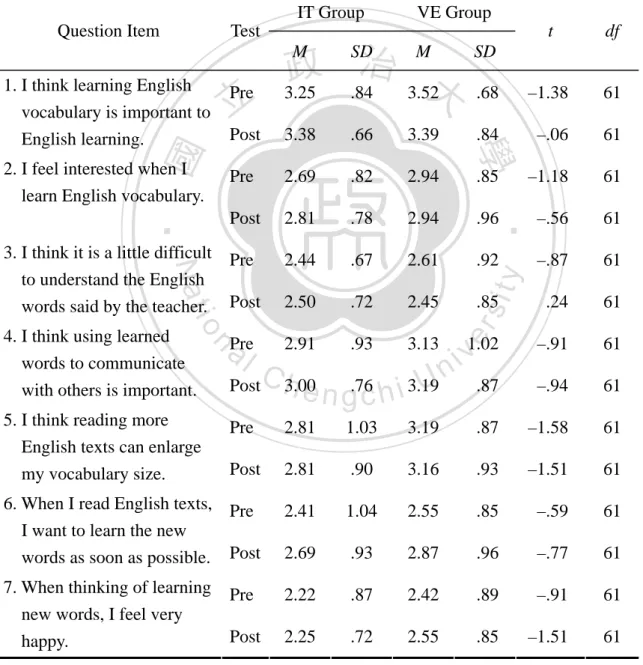
(4) Table of Contents Acknowledgments........................................................................................................ iii Table of Contents ..........................................................................................................iv List of Tables................................................................................................................vii List of Figures ............................................................................................................ viii Chinese Abstract ...........................................................................................................ix English Abstract .............................................................................................................x. Chapter One: Introduction .........................................................................................1 Background and Motivation ..................................................................................1. 政 治 大 Purpose of the Study and Research Questions.......................................................5 立 Definition of Terms................................................................................................6. ‧ 國. 學. Significance of the Study .......................................................................................7. ‧. Chapter Two: Literature Review................................................................................9 Vocabulary Acquisition ..........................................................................................9 Lexical Growth through Reading Plus Word-focused Activities.........................12 Post-reading Interactive Tasks .............................................................................17. sit. y. Nat. n. al. er. io. Concepts of the Interactive Tasks...............................................................18 Types of the Interactive Tasks ....................................................................20 Benefits of the Interactive Tasks................................................................ 24 Previous Studies on Post-reading Interactive Vocabulary Tasks .........................26 Zimmerman’s (1997) Interactive Vocabulary Instruction ............................26 Atay and Kurt’s (2006) Interactive Vocabulary Tasks................................. 28 Other Post-reading Word-focused Activities in Tawain...................................... 30. Ch. engchi. i n U. v. Chapter Three: Method.............................................................................................35 Research Design .................................................................................................35 Participants...........................................................................................................36 Instruments...........................................................................................................37 Vocabulary Tests...........................................................................................37 Vocabulary Learning Attitude Questionnaire (VLAQ).................................42 Research Procedure..............................................................................................46 Teaching Procedures ............................................................................................48 iv.
(5) Teaching Stage 1:Text Reading and Vocabulary Instruction .......................49 Teaching Stage 2: Word-focused Activities ..................................................49 (1) Interactive Tasks for the IT Group..................................................50 (2) Vocabulary Exercises for the VE Group.........................................51 Teaching Materials...............................................................................................51 Reading Texts ...............................................................................................51 Target Word Selection ..................................................................................54 Data Analysis.. .....................................................................................................56 Chapter Four: Results ...............................................................................................59 The Effects of Post-reading Interactive Tasks on Vocabulary Acquisition..........59 Participants’ Performance on the Vocabulary Pre- and Post-tests. ............60 Test Performance on Receptive and Productive Word Knowledge ..............63 Changes in Participants’ Word Knowledge .................................................66 Participants’ Attitude Changes to the Vocabulary Learning Questionnaire .........70 Comparison of Learners’ Attitude Changes between Groups......................70 (1) Cognitive and Affective Attitude Changes between Groups ...........72 (2) Behavioral Attitude Changes between Groups...............................76 (3) Perceptual Changes of Word-focused Activities between Groups..78 Comparison of Learners’ Attitude Changes within the Groups ...................81 (1) Cognitive and Affective Attitude Changes within the Groups ........82 (2) Behavioral Attitude Changes within the Groups............................85 (3) Perceptual Changes of Word-focused Activities within the Groups............................................................................................88. 立. 政 治 大. ‧. ‧ 國. 學. n. er. io. sit. y. Nat. al. Ch. engchi. i n U. v. Chapter Five: Discussion...........................................................................................91 Effects of Interactive Tasks on Vocabulary Gains ...............................................91 Higher Learner Involvement in the Vocabulary Interactive Tasks...............92 Interactive Tasks with Three Steps for Word Learning.................................94 Effects of the Interactive Tasks on Vocabulary Recognition and Production ......95 Effects of Interactive Tasks on Vocabulary Knowledge Changes........................97 Learners’ Responses to the Vocabulary Learning Attitude Questionnaire...........99 Learners’ Attitudes toward Vocabulary Learning ........................................99 Learners’ Attitudes toward English Speaking Ability ................................101 Learners’ Attitude Changes to Their Learning Behaviors .........................101 Learners’ Attitudes toward Vocabulary Instruciton ...................................102 Learners’ Responses to the IT and VE Enhancements...............................104. v.
(6) Chapter Six: Conclusion..........................................................................................107 Summary of the Study .......................................................................................107 Pedagogical Implications ...................................................................................109 Limitation of the Study ...................................................................................... 111 Suggestions for Future Research ....................................................................... 112 References..................................................................................................................115 Appendixes ................................................................................................................121 Appendix A. Vocabulary Pretest ................................................................................121 Appendix B. Vocabulary Posttest...............................................................................125. 政 治 大 Appendix D. Suggestions for Vocabulary Learning Attitude Questionnaire 立. Appendix C. A Questionnaire on Students’ Attitudes toward Vocabulary Learning .129. Modification.........................................................................................131. ‧ 國. 學. Appendix E. Unknown Words Checklist ...................................................................133. ‧. Appendix F. Reading Texts ........................................................................................135. sit. y. Nat. Appendix G. Interactive Tasks for Each Reading Topic ............................................141. io. n. al. er. Appendix H. Vocabulary Exercises for Each Reading Topic.....................................153. Ch. engchi. vi. i n U. v.
(7) List of Tables. Table 20 Table 21 Table 22. al. n. Table 19. sit. io. Table 18. y. Nat. Table 17. ‧. Table 16. 學. Table 14 Table 15. 立. 政 治 大. er. Table 13. Previous Studies on Post-reading Word-focused Activities in Taiwan .........32 Suggestions for Vocabulary Test Modifications ...........................................40 List of the Three Sections in the VLAQ ........................................................42 Modifications Made in the VLAQ ................................................................44 Internal-consistency Reliability of the VLAQ ..............................................45 Teaching Procedures in Each Class Session................................................48 Six Selected Reading Materials....................................................................52 The Twenty-five Selected Target Words ........................................................55 Descriptive Statistics for the IT and VE Groups ..........................................60 Comparison of Vocabulary Test Scores between Groups ...........................61 One-way ANCOVA for Effects of IT and VE on Vocabulary Tests .............63 Comparison of Participants’ Vocabulary Recognition and Production Ability in the Vocabulary Tests ...................................................................64 Comparison of Participants’ Performance on Four Kinds of Vocabulary Assessment .................................................................................................65 Participants’ Responses to Three Levels of Vocabulary Knowledge..........67 Comparison of Learners’ Vocabulary Learning Attitude Changes in Each Section between Groups.............................................................................71 Comparison of Participants’ Cognitive and Affective Vocabulary Learning Attitude Changes between Groups .............................................72 Comparison of Participants’ Behavioral Vocabulary Attitude Changes between Groups..........................................................................................77 Comparison of Participants’ Perceptuall Changes of Word-focused Activities between Groups..........................................................................78 Comparison of Learners’ Vocabulary Learning Attitude Changes in Each Section within the Groups ..........................................................................81 Comparison of Participants’ Cognitive and Affective Vocabulary Learning Attitude Changes within the Groups...........................................82 Comparison of Participants’ Behavioral Vocabulary Attitude Changes within the Groups.......................................................................................86 Comparison of Participants’ Perceptual Changes of Word-focused Activities within the Groups.......................................................................90. ‧ 國. Table 1 Table 2 Table 3 Table 4 Table 5 Table 6 Table 7 Table 8 Table 9 Table 10 Table 11 Table 12. Ch. engchi. vii. i n U. v.
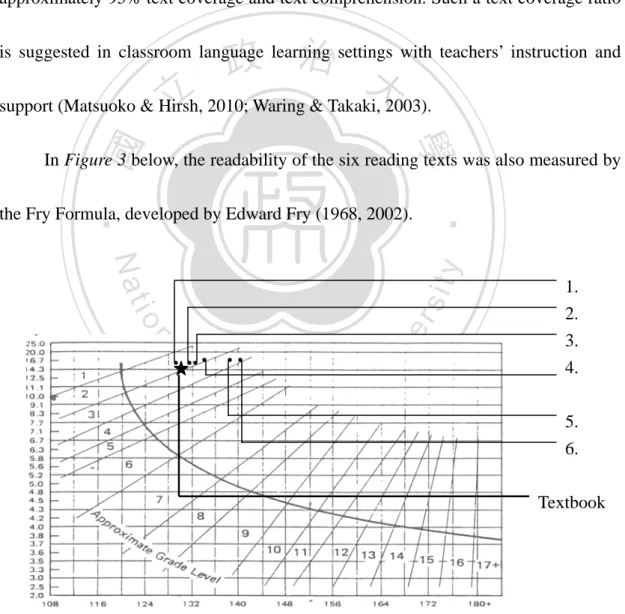
(8) List of Figures. Figure 1. The Framework of the Research Design ...................................................36 Figure 2. Flow Chart of the Research Procedure......................................................46 Figure 3. Readability of the Reading Texts ..............................................................53. 立. 政 治 大. ‧. ‧ 國. 學. n. er. io. sit. y. Nat. al. Ch. engchi. viii. i n U. v.
(9) 國立政治大學英國語文學系碩士在職專班 碩士論文提要. 論文名稱: 閱讀後的互動式任務對台灣國中生字彙學習之成效 指導教授: 許炳煌博士 研究生: 許巧筠 論文提要內容: 第二語言學習的研究者指出,有效的單字加強練習活動可以增強學生的單 字學習,然而過去相關研究的練習題形式偏重於個人學習,較缺乏同儕之間的 互動學習。因此,本研究採用準實驗量化研究法,藉此探討比較閱讀後的單字 互動式任務(interactive tasks)及傳統的單字練習題(vocabulary exercises)對國中 生 英 語 字 彙 習 得 (vocabulary learning) 與 單 字 學 習 態 度 (vocabulary learning attitudes)的影響。. 立. 政 治 大. ‧. ‧ 國. 學. n. al. er. io. sit. y. Nat. 本實驗的研究對象為桃園縣某公立國中的兩班八年級六十三位學生,所有 受試者依其原本的班級被隨機指定為互動式任務組和傳統單字練習題組,兩組 同學於每堂課都接受相同的閱讀文章和閱讀理解問題,並在閱讀之後進行不同 的單字加強練習活動,每堂課合計為 45 分鐘,歷時六堂,一共練習 25 個單字。 實驗前後,兩組受試者分別進行單字測驗及單字學習態度前後測,以瞭解學生 的主要單字(target words)學習情形和學習態度轉變。資料分析採用 SPSS 18.0 版 本,包含描述性統計、獨立樣本和成對樣本 t 檢定、及共變數分析。. Ch. engchi. i n U. v. 研究結果顯示: (1)在單字學習成效方面,接受互動式任務的學生明顯優於 接 受 傳 統 單 字 練 習 題 的 學 生 ; (2) 在 辨 識 字 彙 的 能 力 (receptive vocabulary knowledge)和應用字彙的能力(productive vocabulary knowledge)方面,互動式任 務明顯地有助於提升受試者在以上下文為主的試題(選擇題和文意字彙)表現, 但在無上下文的試題(中翻英和拼字)方面,兩組並無顯著差異;(3) 就受試者 單字學習知識(vocabulary knowledge)質的改變而言,互動式任務組亦優於傳統 單字練習題組;(4) 對於受試者的單字學習態度,兩組在認知、情意、行為及 單字練習加強活動皆有某些方面的改變。 最後,本研究認為英語教師可以多設計以單字為主的互動式任務來增進學 生的學習,並提出建議供未來研究為參考。 ix.
(10) Abstract. Research into second language learning has pointed out that effective wordfocused activities can facilitate students’ vocabulary learning. Yet, previous studies have been mainly focused on individual learning and on lack of interaction between peers. Therefore, the study adopted a quasi-experimental research design to compare the effects of specialized post-reading interactive vocabulary tasks and traditional vocabulary exercises on junior high school students’ vocabulary acquisition. Changes in learners’ attitudes to vocabulary learning were also investigated. Participants were 63 students from two eighth-grade classes in a junior high school in Taoyuan, Taiwan. The two classes were randomly assigned to the IT (interactive tasks) group and the VE (vocabulary exercises) group. Both groups received the same reading texts and reading comprehension questions, but they completed different vocabulary enhancing activities. Each class session was 45 minutes, and there were six class sessions, with a total of 25 target words for practice. To assess learners’ vocabulary knowledge of the target words, the two groups took pre- and post-vocabulary tests and a vocabulary learning attitude questionnaire before and after the experiment, to see if there were any attitude changes among learners throughout the study. The collected data was analyzed using SPSS 18.0, including descriptive statistics, Independent Samples t-test and Paired Samples t-test, and analysis of covariance (ANCOVA). The results are summarized as follows. First, in terms of vocabulary growth, students completing interactive tasks significantly outperformed those who received vocabulary exercises. Second, concerning receptive and productive word knowledge, interactive tasks were helpful in elevating learners’ performance on contextualized assessments like multiple-choice questions and filling-in blanks. However, in decontextualized assessments like L1 translation and spelling, there was no significant difference between the groups. Third, interactive tasks led to better performance on learners’ qualitative changes in vocabulary knowledge than did vocabulary exercises. Finally, for participants’ vocabulary learning attitudes, both groups had some changes in their cognitive, affective, and behavioral learning, and in perceptions of word-focused activities. In conclusion, the researcher suggests that English teachers design and apply more word-focused interactive tasks to enhance students’ vocabulary acquisition, and provides suggestions for future research.. 立. 政 治 大. ‧. ‧ 國. 學. n. er. io. sit. y. Nat. al. Ch. engchi. x. i n U. v.
(11) CHAPTER 1 INTRODUCTION. Background and Motivation Vocabulary is a fundamental part of mastering a foreign language. With sufficient vocabulary, learners can comprehend English texts, express ideas and interact with people; otherwise, limited vocabulary may cause communication. 政 治 大 breakdowns. Since correct lexical choice is the essence of communication, helping 立. ‧ 國. 學. learners develop vocabulary plays a crucial role in language teaching (Decarrico,. ‧. 2001). It has been suggested that with teachers’ help, effective vocabulary. sit. y. Nat. instruction takes place in a word-rich environment through “scaffolded wide reading,. n. al. er. io. writing, and discussion” (Blachowicz & Fisher, 2010, p. 7). For this to take place,. Ch. i n U. v. learners should have access to multiple encounters of the target words, and. engchi. opportunities to practice the words in a meaningful, interactive, and communicative way; their word consciousness thus will be developed. In view of this, it is better to instruct in vocabulary explicitly and directly, so that learners can be exposed to various types of information about each word (Hinkel, 2006). Although these important concepts of vocabulary instruction are widely known to junior high school (JHS) teachers in Taiwan, most of their teaching is still. 1.
(12) 2. teacher-centered (Chen, 2004), and vocabulary memorization and recitation dominate most lexical instruction. In the English class of today, students just receive word knowledge from the teacher without being involved in sufficient practice of the word’s usage in a more contextualized situation. The learned words consequently are easily forgotten and are hardly retained by learners. To solve this problem, more student-centered activities should be adopted in English teaching (Chen, 2004), to. 政 治 大. provide students with meaningful practice with the target words. Knowledge about. 立. words, such as meaning, usage, grammar concepts, and learning strategies, should. ‧ 國. 學. also be embedded in a variety of activities in classroom instruction, because this. ‧. other various information is equally important to memorization exercises.. Nat. io. sit. y. In recent years, researchers (Hulstijn, 1992; Joe, 1995; Laufer, 2003; Newton,. al. er. 1995) have been discovering effective ways to facilitate learners’ vocabulary. n. v i n C h word learningUin two conditions. One is acquisition. They have compared students’ engchi. learning words only through reading, while the other is reading plus post-reading word-enhancing activities. Results have shown that the latter demonstrates superior effectiveness for learners’ word gains over the former, and that post-reading word-focused activities thus play a dominant role in building up learners’ lexical knowledge and provide students with more opportunities to practice the target words. Studies in this domain include sentence writing (Keating, 2008; Kim, 2008; Lan,.
(13) 3. 2005; Laufer, 2003), text-based vocabulary exercises (Cheng, 2008; Lai, 2009; Min, 2008; Paribakht & Wesche, 1997), and composition writing (Chou, 2005; Lee & Muncie, 2006). Though many word-focused activities have been examined, some limitations were found in previous studies, including frustrations with equalizing the frequency of exposures to target words (Min, 2008; Paribakht & Wesche, 1997), and the lack. 政 治 大. of interaction between learners while learning (Lai, 2009; Min, 2008). Since. 立. repeated exposure is a decisive component of vocabulary acquisition (Folse, 2006;. ‧ 國. 學. Rott, 2007; Schmitt, 2008; Stuart, 2007), and receiving clarification of word. ‧. meanings during an interactive task is beneficial in remembering new words. Nat. io. sit. y. (Newton, 1995; Zimmerman, 1997), a further study inspecting the effectiveness of. al. v i n another C limitation in previous h e n gidentified chi U n. Besides, in. er. post-reading interactive vocabulary activities is needed.. research, only basic. receptive and productive word gain knowledge was assessed (Keating, 2008; Kim, 2008; Laufer, 2003; Paribakht & Wesche, 1997). Learners in these studies were required to report their perception of word knowledge, and make a sentence for each target word. Though this offered a quick measure of whether learners understood the words or not, this assessment seemed insufficient for testing learners’ contextualized vocabulary knowledge (Folse, 2006), leaving more varied levels of vocabulary.
(14) 4. assessment to be further administered. In addition, most of the participants were from intermediate to high level learners of English, with the experiments set in an incidental learning condition. Without teachers’ help, learners acquired words from reading and completed word-focused activities on their own. In the present research in Taiwan, however, incidental learning may have undermined JHS students’ vocabulary acquisition,. 政 治 大. since their English proficiency was at the elementary level and they were learning. 立. the basic most frequent 2,000 words. If they had received no instruction from the. ‧ 國. 學. teacher, they might have made wrong guesses or inferences of the target words from. ‧. reading, which would imply that teachers’ vocabulary instruction was inevitably. io. sit. y. Nat. needed.. al. er. In response to interaction between learners while learning vocabulary, Atay. n. v i n C h interactive tasks and Kurt (2006) proposed that post-reading e n g c h i U are more effective than. traditional vocabulary exercises in facilitating EFL learners of the beginning level. The tasks in their study involved learners perceiving and manipulating words in the learning process, where they negotiated word meanings while working in groups and practiced the target words in more meaningful contexts. The researchers found that most learners held positive attitudes toward vocabulary learning and were motivated to participate in the task-completing process. However, as in most of the previous.
(15) 5. studies, no attitude change was found in students’ learning after they finished these word-focused activities, and how students viewed these activities still remained unanswered. Adding these factors together, the effects of reading plus facilitative word-focused activities deserve to be researched. In an EFL context like Taiwan junior high schools, where teaching and learning conditions are less interactive,. 政 治 大. post-reading interactive tasks appear to be helpful in developing JHS learners’. 立. vocabulary knowledge. The present study aimed to compare two vocabulary. ‧ 國. 學. activities—interactive tasks and vocabulary exercises—with a view to seeing how. ‧. these two enhanced JHS learners’ lexical growth in post-reading conditions.. io. sit. y. Nat. al. er. Purpose of the Study and Research Questions. n. v i n C h tasks are effective Given the fact that interactive e n g c h i U in enhancing post-reading vocabulary learning and that no vocabulary-learning research has been done on Taiwanese JHS students, the present study was designed (a) to examine the effects of post-reading interactive tasks on Taiwanese JHS students’ vocabulary learning, and (b) to investigate students’ attitude changes after the experiment. It is hoped that this empirical study could provide more evidence to the existing literature on the effects of post-reading interactive tasks over vocabulary exercises. Based on the.
(16) 6. results, English teachers might incorporate these interactive tasks in their classroom contexts and come up with more creative tasks to facilitate students’ lexical development. The present study aimed at answering the following questions: 1. Do post-reading interactive tasks claim superior effectiveness in EFL learners’ vocabulary learning than traditional vocabulary exercises?. 政 治 大. 2. How do post-reading interactive tasks influence EFL learners’ receptive and. 立. productive word knowledge?. ‧ 國. 學. 3. What were the changes in vocabulary knowledge between the groups?. ‧. 4. Are there any changes in students’ attitudes toward vocabulary learning after. n. al. er. io. sit. y. Nat. the experiment?. Ch. engchi. Definition of Terms. i n U. v. Vocabulary acquisition Vocabulary acquisition refers to “the amount and kinds of cognitive processing that go into it” (Huckin & Coady, 1999), and is used interchangeably with the term “vocabulary learning.” Learners’ vocabulary acquisition is assessed by the vocabulary test scores in this study..
(17) 7. Word-focused activities Word-focused activities or word-enhancing activities are teaching activities which are designed on the basis of the target words learners are required to learn, and that are believed to provide learners with more repeated exposures to the words (Laufer & Hulstijn, 2001). In this study, these enhancing activities are post-reading activities, with a view to increasing learners’ exposures to the target words selected from the reading texts.. 立. 政 治 大. Vocabulary learning attitudes. ‧ 國. 學. Vocabulary learning attitudes mean learners’ cognitive, affective, and. ‧. behavioral responses to their vocabulary learning. These three learning domains are. Nat. io. sit. y. based on Wendon’s (1991) taxonomy of language learning attitudes. The results of. al. er. participants’ changes in vocabulary learning attitude were measured by the attitude. n. v i n C hdesigned for the present questionnaire, constructed and e n g c h i U study. Significance of the Study. With the intention of enhancing junior high school students’ lexical development, the current study answered the research questions raised above. It was hoped that the study could help language instructors to understand the effects of interactive vocabulary tasks in word acquisition, and could also offer knowledge of.
(18) 8. learners’ attitudes toward vocabulary learning and their perceptions of the tasks. The results of the proposed study may lead to three significant contributions. First, the study serves as a learning paradigm in the EFL setting in junior high schools to enhance students’ vocabulary knowledge and learning attitudes. It will help students obtain enough practice of the target words and build up communication skills between learners, since the tasks can offer near real-life use of English vocabulary.. 立. 政 治 大. Second, the findings may benefit in-class instructors when they feel a need to. ‧ 國. 學. increase learners’ exposures to the target vocabulary or provide students with. ‧. varying word enhancements. Through this study, teachers may also introduce. Nat. io. sit. y. students to more suitable word-focused activities and may bridge the gap of learners’. al. er. word knowledge and practical language use. For JHS course designers and textbook. n. v i n C inspiration editors, the study may provide some h e n g cto hincorporate i U peer interaction and vocabulary tasks in the classrooms. It is hoped that more preferable word activities can be designed for and provided in regular instruction. Finally, for JHS learners, the study may help them recognize the importance of vocabulary learning, encourage them to practice using the learned words to strengthen word memory, and help them gain confidence in the process of word acquisition..
(19) CHAPTER 2 LITERATURE REVIEW. This chapter reviews research on vocabulary acquisition through reading, on lexical growth through reading plus word-focused activities, on post-reading interactive tasks and related studies on word-enhancing activities in Taiwan. Section 1 discusses lexical growth and reading as a way to pick up new words and includes L1. 治 政 and L2 researchers’ viewpoints on the role of reading 大 in vocabulary acquisition. 立 ‧ 國. 學. Section 2 reviews the literature concerning vocabulary learning through reading plus word-focused activities. In Section 3, interactive tasks, including their concepts and. ‧. types are introduced and their benefits for accelerating students’ vocabulary learning. sit. y. Nat. io. n. al. er. after text reading. Related research is also presented. Finally, in Section 4, the chapter. i n U. v. ends with a brief review of some empirical studies on vocabulary learning through. Ch. engchi. reading, supplemented with word-focused activities in Taiwan.. Vocabulary Acquisition Many people consider that a word is learned when its form and meaning are acquired. Although it is true that the form-meaning link is the most essential aspect of learning a word, learners also need to know more about the lexical items, and especially about using a word in a new context (Nation, 2005). According to Nation 9.
(20) 10. (2001), three aspects are involved in knowing a word. Form means the spoken/written form of a word and its parts of speech; meaning consists of the form-meaning connection, concept and referents, and word associations; use means that learners should know the grammatical functions, collocations, and constraints in using a word. Form and meaning are relatively more amenable to intentional learning, whereas the more contextualized aspects of vocabulary use are much more difficult to teach.. 政 治 大. Therefore, it is suggested that vocabulary learning should consist of both “an. 立. explicit teaching component” which focuses directly on establishing the. ‧ 國. 學. form-meaning link, and “a component which maximizes repeated exposures to lexical. ‧. items,” such as reading (Schmitt, 2008, p. 334). Reading provides rich contexts and. Nat. io. sit. y. exposures to the target words, for learners to acquire vocabulary. In L1 conditions,. al. er. reading can facilitate word knowledge development; the majority of words are. n. v i n acquired gradually through multipleCexposures contexts (Stoller & U h e n gincvaried h i discourse Grabe, 1993). In most cases, vocabulary gains appear to be cumulative and. incremental, and learners can rely on contextual cues to successfully infer word meaning and other lexical features of the unknown words (Dubin & Olshtain, 1993). Research has also suggested that when learners know how to benefit from word families and take advantage of productive affixes for word analysis, word exposures from reading may be a primary source of vocabulary increase in L1 (Fraser, 1999)..
(21) 11. However, for L2 developing learners, reading-only may not be an adequate strategy for lexical growth (Coady, 1997). The reading-only approach for L2 vocabulary acquisition has been challenged in many previous studies (Paribakht & Wesche, 1996; Laufer, 2005), and some L2 vocabulary research, while still appreciating the importance of learning words from reading, has pointed out some of its shortcomings. First, though learners gained some orthographic, lexical and. 政 治 大. grammatical knowledge of the target words from reading, the rate of word acquisition. 立. is slow (about 1–5 words from short texts of 1,000 to 7,000 words) (Hulstijn, 1992;. ‧ 國. 學. Knight, 1994; Laufer, 2003). Paribakht and Wesche (1997) further described the. ‧. progress of L2 vocabulary gains through reading-only as “slow and laborious” (p.. io. sit. y. Nat. 175).. al. er. Second, many unknown words, if not bold-faced to draw students’ attention, are. n. v i n C most easily ignored by readers, and learners might have focused on general-gist h e ofn the gchi U. comprehension and neglected to apperceive the target words (Fraser, 1999; Paribakht & Wesche, 2000). Even if learners notice the new words, some words may lead to wrong guesses, especially for learners of lower L2 proficiency, and especially where there is a deficiency of contextual clues (Li, 1988). Furthermore, researchers have observed that even where a learner correctly infers the meaning of the unknown words, word acquisition has not necessarily occurred. This is because once “the.
(22) 12. immediate communicative need has been met, the learner does not undertake further mental processing of the word” (Paribakht & Wesche, 2000, p. 197). Third, although, with sufficient exposures to the target vocabulary, learners can acquire words naturally and incidentally (Krashen, 1993), in an EFL environment, repeated exposure to the target words is often limited (Min, 2008). That is, the acquisition of new words may not be reinforced if learners do not keep encountering. 政 治 大. the words in different contexts. In such conditions, learning new words may lose out. 立. finally, and the cumulative effect on word retention, prior to re-encountering the target. ‧ 國. 學. words, is thus questionable (Laufer, 2003). This leaves the concept of L2 vocabulary. ‧. acquisition through reading with only fragile status.. Nat. io. sit. y. Therefore, despite the fact that reading-only may account for large degree of L1. al. er. word learning, it seems that the effectiveness of reading-only for L2/EFL vocabulary. n. v i n Ch development is doubtful. More enhancements be created, to lead to better e n gshould chi U vocabulary acquisition.. Lexical Growth through Reading Plus Word-focused Activities Since reading-only may result in few word gains, vocabulary development should be built up through other enhancements. As Nation (2001) has indicated, while learning a new word requires a gradual elaboration of word knowledge through.
(23) 13. reading, and the capability to use it in appropriate contexts, the need for repeated and various word processing activities cannot be fulfilled only by multiple exposures from reading. Vocabulary development should be built up through other reinforcing activities. Reading complemented with other word-focused activities might be an appropriate way to facilitate word learning (Stoller & Grabe, 1993). Previous research has emphasized the effects of vocabulary activities. For. 政 治 大. example, Joe (1995) found that tasks such as story retrieval or using target words in. 立. retelling, encouraged deeper word processing and led to better retention. In his study,. ‧ 國. 學. adult learners attended to the various components of a target word and retrieved it in a. ‧. Nat. io. sit. acquisition of the unknown words.. y. text-based task. This higher level of word generation could facilitate learners’. al. er. Likewise, in an attempt to compare vocabulary learning through reading-only. n. v i n C h activity, Laufer and reading with a supplementary e n g c h i U (2003), Paribakht and Wesche. (1997) reported that the latter achieved superior effectiveness. Learners who completed post-reading vocabulary exercises outperformed those who just learned words from text-reading. The results corroborated Nation’s (2001) perspective, that EFL students should be supplied with more word-focused enhancements to draw their attention to the target vocabulary..
(24) 14. Since many researchers have highlighted the value of word-focused activities and recognized their positive effects, how vocabulary is learned and how learners process the new words while completing these activities, is worth discussing. As mentioned earlier, knowing a word involves knowing its form, meaning, and use (Nation, 2001). Based on this, Nation (2001) pointed out three steps for a word to be learned: noticing, retrieval, and generative use. The earlier steps are encompassed in. 政 治 大. the later steps. That is, retrieval happens after noticing, and both are followed by. 立. generative use of the word.. ‧ 國. 學. The first step, noticing, means that learners pay attention to a certain word and. ‧. view it as a language item to be learned. The target lexical input usually appears in. Nat. io. sit. y. “decontextualization,” (Nation, 2001, p. 64), i.e., separating the target word from the. al. er. flow of language context where it is situated. The purpose of decontextualization is to. n. v i n fastly convey the meaning of the C word up the initial form-meaning link. h eandnbuild gchi U Aside from that, noticing can also involve activities like negotiating and defining word meanings. Words that were negotiated between teachers and learners are better learned than those without any negotiation (Ellis, Tanaka, & Yamazaki, 1994), and words that are explicitly explained and defined are likely to be learned (Elley, 1989; Toya, 1993; Watanabe, 1997)..
(25) 15. As for the second step, retrieval, after a word is noticed, learners subsequently retrieve the word either receptively or productively in a word activity. Receptive retrieval takes place when a learner recognizes the word in a listening or reading activity and then remembers its meaning, but productive retrieval occurs when a learner has to express a word meaning in activities requiring him or her to produce the spoken or written form of a word.. 政 治 大. In the third step, generative use occurs either receptively or productively when. 立. a learner meets or uses the word in a way that is presented differently from his or her. ‧ 國. 學. previous reading. For example, if a student is familiar with the use of miss as in “We are. ‧. all missing you already,” and later encounters the phrase, “I missed the bus this morning,”. Nat. io. sit. y. they are experiencing receptive generative use. In this case, learners encounter additional. al. er. meanings of a learned word, but receptive generative use can also refer to collocations,. n. v i n C h As for productiveUgenerative use, learners realize the grammatical uses, and metaphors. engchi other properties of a learned word by changing its meaning when making new sentences and producing the word in a new context. Both receptive and productive generative use are believed to be important word learning processes in L1 and L2 language vocabulary learning (Nation, 2001). Based on the word learning steps mentioned above, post-reading word-focused activities can promote learners’ vocabulary learning in four ways. First, these.
(26) 16. activities are based on the target words and assist learners to notice them as new words to be learned. Such an encounter is viewed as an apperceived input (Gass, 1988), and this initial noticing attention to the forms/spelling of new vocabulary is essential and prerequisite for word learning (Hulstijn, 2001). Second, when completing these word-focused activities, learners can build up form-meaning connections by means of repetition and multiple exposures to the target. 政 治 大. words. Findings from memory research (Baddeley, 1997) have suggested that. 立. immediate exposures to a word right after an initial encounter can reinforce the. ‧ 國. 學. form-meaning link, and that repeated word retrievals in post-reading word-focused. ‧. activities can help learners deliberately commit lexical knowledge to memory (Laufer. io. sit. y. Nat. & Hulstijn, 2001).. al. er. Third, these activities provide productive target word tasks, where learners can. n. v i n C h This repeated U use the new words in different contexts. e n g c h i practice with the words can further elaborate learners’ lexical information processing, optimizing word learning and retention (Hulstijn, 2001). Finally, when learners are doing these activities, their active engagement in learning new vocabulary is motivated, and this learner involvement can trigger higher levels of word processing than reading-only. In attempting to augment learners’ vocabulary acquisition through post-reading word-focused activities, the present study.
(27) 17. adopted interactive tasks to enhance word learning among junior high school students. A detailed introduction to the tasks is furnished in the following section.. Post-reading Interactive Tasks The concept of the task has been recognized as an important element in classroom teaching, syllabus design, and assessment of learners’ performance (Nunan,. 政 治 大. 2004). It has influenced pedagogical policy in ESL/EFL settings. There are many. 立. definitions of a task, due to the different interpretations. Breen (1987) defined a task. ‧ 國. 學. as a goal-oriented activity where learners are required to achieve a goal set by the task. ‧. and the target language is pragmatically used between learners for meaning. Nat. io. sit. y. negotiation. Ellis (2003) offered another definition: that a task focuses on “language. al. er. use that bears a resemblance, direct or indirect, to the way language is used in the real. n. v i n C hp. 3). A task canUprovide a simulated situation for world” (cited in Nunan, 2004, engchi. learners to use the target language pragmatically, where they can make use of their linguistic resources and process the language to achieve a language outcome. For Nunan (2004), a pedagogical task is “a piece of classroom work that involves learners in comprehending, manipulating, producing or interacting in the target language” (p. 4). A task is deemed to be an enhancement for learners to recall their personal experiences as “important contributing elements to classroom learning”.
(28) 18. (p. 1). Learners are provided with opportunities to focus both on the language and their learning process. In summary, from the above definitions, it could be suggested that a pedagogical task entails three elements: a purpose/goal, a process of thinking and using the target language, and opportunities for information change. To accomplish the goals set by a task, the role of interaction has been highlighted. In the present. 政 治 大. study, the impact of post-reading interactive tasks on vocabulary learning was. 立. of interactive task, and their benefits.. 學. ‧ 國. investigated. The following section introduces the concepts of interactive tasks, types. ‧. Concepts of the Interactive Tasks. Nat. io. sit. y. Considering the interaction between learners, interactive tasks are efficient and. n. al. Learners work collaboratively. er. intentionally planned instructions that make learning a mutual social experience.. v i n to C observe, and communicate h e n share gchi U. in the target. language. Through peer/group interaction, they can learn how to productively practice the new words and thus speed up their word acquisition. The criteria for designing interactive tasks are as follows. First, interactive tasks should be designed as simulated real conversations for students to practice interactive ability. In these tasks, learners can imagine themselves to be in a real situation. They are able to exchange information, opinions and ideas, as.
(29) 19. they try to find something out, to fulfill the purpose ordained by the task. They work cooperatively to perform different tasks and promote their peer/group support and instruction (Craddall, 1993; Fathman & Kessler, 1993; Kim & McDonough, 2011). Second, interactive tasks should provide learners an equal opportunity to start their conversation, so that learners have access to equal turn-taking in initiating, negotiating and following-up peers’ contributions. While completing the tasks, both. 政 治 大. weak and strong learners should be allowed to extend themselves, to explore their full. 立. ability. Strong learners need to make themselves understood to peers with less. ‧ 國. 學. linguistic ability; weak learners should have the ability to accomplish easier tasks at. ‧. their own level.. Nat. io. sit. y. Moreover, interactive tasks should be integrated with various language skills,. al. er. and learners should be involved in meaningful work to acquire the target language.. n. v i n According to Willis (1996),C in h a task, the target language e n g c h i U produced by learners is seen as “bringing about an outcome through the exchange of meanings” (cited in Nunan, 2004, p. 3). In one study, students did not develop native-like syntactical construction of the target language and word choice until they had appropriate practice with elaborative output (speaking and writing) and collaborative dialogue (Swain, 1995). Working with others allows learners to notice gaps between peers, to modify their.
(30) 20. output, and internalize the target language. Such collaboration therefore can help learners to get involved in meaningful content through the tasks. A well-organized interactive task consists of a rich context and learners with mixed-levels of language proficiency. Learners can think and manipulate the language in a more meaningful way, which helps to consolidate their own learning, and most importantly, learners are required to undertake activities that provide not only. 政 治 大. controlled production but also communicative interaction. The different types of. 立. interactive tasks are introduced as follows.. ‧ 國. 學. Types of the Interactive Tasks. ‧. Based on diversity of interaction while learning, interactive tasks can be divided. Nat. n. al. er. io. sit. y. into eight categories. A detailed description is given below.. i n U. v. 1. Matching activities: These tasks are suitable for all levels of learners. Many of. Ch. engchi. the tasks can be teacher-led, or are “for real beginners who need lots of exposures before having to speak themselves” (Willis & Willis, 2007, p. 85). There are two kinds of matching: listening and matching, and reading and matching. Both kinds are for learners to “recognize matching items, or to complete pairs or sets” (Pattison, 1987, as cited in Nunan, 2004, p. 58). Learners are asked to match given sentences, phrases or pictures to their.
(31) 21. counterpart items. They can work together through pair/group work to discuss their answers. 2. Dialogues and role plays: These tasks can be scripted or improvised, and learners pretend to be someone else and practice the target language in a situation they are in. “If learners are given more choices of what to say or provided with a clear aim to be achieved by what they say in the role plays,. 政 治 大. they may be more willing to participate in the tasks than just repeat the given. 立. dialogues in pairs” (Pattison, 1987, as cited in Nunan, 2004, p. 58).. ‧ 國. 學. 3. Opinion-gap tasks: Learners in these tasks are engaged in identifying and. ‧. articulating a personal preference, feeling, or attitude in response to a given. Nat. io. sit. y. situation. Examples are story completion, discussion of a social issue, and. al. er. using factual information to justify one’s opinion (Prabhu, 1987, as cited in. n. v i n Nunan, 2004, p. 57).CThis U to casual social conversation. h einteraction n g c h isi closer Learners do not need to reach an agreement since there are no objective criteria to judge what is right or wrong (Richards, 2001). 4. Information-gap tasks: These tasks are those in which “one student or group of students has one set of information and the other or group has a complementary set of information. They must negotiate and find out what the.
(32) 22. other party’s information is to complete an activity” (Richards, 2001, as cited in Nunan, 2004, p. 59). 5. Jigsaw tasks: A jigsaw task is sometimes referred to a split-information task. In a group, one student has some information while another student receives quite different information. In order to achieve an outcome, they have to combine different pieces of information to form a whole. For example,. 政 治 大. students in groups may have three different parts of a story and they have to. 立. pool their information to piece the story together, and then try to retell or. ‧ 國. 學. predict the story. “This task is familiar to many teachers as a way of providing. ‧. learners with a purpose for communication” (Willis & Willis, 2007, p. 41).. Nat. io. sit. y. 6. Problem-solving tasks: These are tasks which rely on learners’ intellectual and. al. er. reasoning powers. They are given a problem and some information. They must. n. v i n come up with a solution toCthat U and complexity of the h eproblem. n g c hThei types problem will result in different processes and times taken on the task (Pattison, 1987; Richards, 2001). 7. Decision-making tasks: Learners are given a problem with a number of possible outcomes. They must collect and share information to arrive at one decision through negotiation (Pattison, 1987; Richards, 2001). After the decision is made, learners can read out their ideas and compare them with.
(33) 23. other groups. “This would promote discussion and involve the groups in a short writing activity” (Willis & Willis, 2007, p. 34). 8. Projects and creative tasks: These tasks are normally completed with pair/group work, which involves learners in some kind of free creative work. This kind of task also tends to comprise a combination of other task types (Willis, 1996). For example, learners can learn how to make a radio program or a web-page.. 立. 政 治 大. ‧ 國. 學. In the present study, three tasks were adopted: matching activities, dialogues. ‧. and role-plays, and opinion-gap tasks. These tasks particular were used for two. Nat. io. sit. y. reasons. First, considering the time spent on the tasks, since they are post-reading. al. er. tasks, only about twenty minutes was left during each class instructional time. The. n. v i n researcher thus chose theseCthree h etasks h i Ustudents could complete the tasks n g cbecause within the given time. Second, since the study was mainly focused on vocabulary tasks, these three tasks were designed on the target vocabulary, while the remaining five were intended to promote comprehensive skills in learners’ English proficiency. Based on these considerations, the researcher adopted these three tasks to enhance learners’ vocabulary learning and maximize their exposures to the target vocabulary, with the tasks integrated into pairs work to increase interaction between learners..
(34) 24. Benefits of the Interactive Tasks In the language learning domain, interactive tasks can be used to involve learners in real language use in the classroom context. While completing the tasks, learners can get the idea of a word through meaning negotiation, use the target language for interaction, and obtain sufficient information from the contextual support provided in the tasks. Therefore, the benefits of interactive tasks are in three aspects.. 政 治 大. First, according to Newton (2001), negotiation of meaning can facilitate the. 立. development of learning, which plays a vital role in acquiring a second language.. ‧ 國. 學. During the tasks, learners work collaboratively to “negotiate the meaning of new. ‧. items among themselves” (p. 33). They use each other as information resources rather. Nat. io. sit. y. than counting on external support. That is, when learners receive combined lexicons. al. er. in a group/pair, they will “spend more time negotiating their understanding of one. n. v i n another’s speech” (p. 35) because C thishcoverage of L2 vocabulary is usually greater engchi U. than any other lexicon provided in the task directions or teacher’s guidance. After initially paying a lot of attention to the basic knowledge about the new words, they can practice using the words in a more communicative and meaningful task. In this case, teachers can combine different tasks for learners to fulfill the task goals with a view to helping them attend carefully to the meaning of the new words..
(35) 25. The second benefit is that the tasks are effective for influencing learners’ processing of the target language. With peer or group language output exchange, this engaging in interaction is beneficial for target language development. Concerning the role of interaction, one function has been distinguished as a noticing/triggering effect, whereby Swain (1995; 2005) suggests that learners may notice the gap between their thoughts and their actual production of words, and then realize what knowledge they. 政 治 大. really lack in the target language. By obtaining feedback from peers, learners are. 立. forced to produce more accurate and precise language. This output production induces. ‧ 國. 學. learners to modify or reproduce their language form, which in turn may lead to. ‧. acquisition (Swain, 1995). Moreover, as Slavin (1995) has pointed out, the interaction. Nat. io. sit. y. between learners can help them develop positive attitudes toward learning and greatly. al. er. promote their self-esteem. With interaction, they feel less anxious when working with. n. v i n C will their peers, and no hindrance in their affective learning of the target h eben created gchi U language. Finally, the contextual support elicited from the tasks is beneficial in promoting learners’ performance (Skehan, Foster, & Mehnert, 1998). For example, the provision of visual cues situates learners in a real-life setting and activates their context-related knowledge to promote their task performance (Shortreed, 1993). Contextualized tasks with enough information and context discourse can be influential in word acquisition.
(36) 26. (Stahl & Fairbanks, 1986), and this enhances learners’ contextual knowledge of the words. Therefore, by the provision of contextual support, either through visual aids or discourse context, learners can acquire more language use and better understanding of the new words. With the benefits of the interactive tasks mentioned above, it can be clearly understood that learners can experience a series of target word enhancements. They. 政 治 大. can learn to negotiate word meaning, interact with each other, and learn words in a. 立. for learners to practice meaningful use of the target words.. 學. ‧ 國. more contextualized way. The aim of the interactive tasks is to provide an opportunity. ‧. Nat. io. sit. y. Previous Studies on Post-reading Interactive Vocabulary Tasks. al. er. Few studies have been done investigating how post-reading interactive. n. v i n C hacquisition. In thisUsection, a brief review of vocabulary tasks affect learners’ word engchi. two related studies on the effects of interactive vocabulary activities is shown as outlined and limitations and suggestions are also presented, to highlight the need for conducting the present study. Zimmerman’s (1997) Interactive Vocabulary Instruction Zimmerman (1997) conducted a 10-week classroom-based study to investigate the effects of interactive vocabulary activities on L2 university students. In the.
(37) 27. experimental group (n = 18), students read their textbook first and then were asked to do interactive vocabulary activities to “clarify word meaning and illustrate appropriate usage, practice using the appropriate word form in context, and demonstrate word knowledge in either oral or written original expression by using the target words” (p. 125). On the other hand, the control group (n = 17) did not receive any special instructions, but were simply encouraged to finish their self-selected materials reading.. 政 治 大. The results indicated that students receiving interactive vocabulary instruction. 立. outperformed those who completed self-reading, in their lexical growth. It was then. ‧ 國. 學. suggested that teachers should give more consideration to the effectiveness of. ‧. interactive vocabulary instruction on students’ reading ability.. Nat. io. sit. y. However, as Zimmerman (1997) explains, this vocabulary instruction is still not. al. er. the “optimal instructional program” (p. 137) because, first, the interactive and. n. v i n C various communicative instruction of activities was not investigated, and h e n vocabulary gchi U. the use of more contextualized exposures to language and communicative techniques is still unknown. Second, students in the control group received neither vocabulary instruction from the teacher nor any other reference books or tools to facilitate word learning. That students would wrongly guess meaning from the context and gain inferior scores on the tests was easily and undoubtedly predictable. Third, since a vocabulary checklist was used for students’ self-reporting of whether they knew a.
(38) 28. target word or not, this could only detect learners’ basic receptive and productive knowledge of the target words. As a result, this method failed to test students’ lexical growth when the word was put in a more contextualized discourse. Atay and Kurt’s (2006) Interactive Vocabulary Tasks Atay and Kurt (2006) stated that post-reading interactive tasks could facilitate learners’ vocabulary learning. The experimental group (n = 30) completed a series of interactive. tasks. including. 立. matching, 政 治 大. picture-word. picture. sequencing,. sentence-making by using the target words, and group-created picture stories. In. ‧ 國. 學. contrast, the control group (n = 32) did discrete written vocabulary exercises as. ‧. post-reading activities. After this six-week experiment, both groups took the. Nat. io. sit. y. Vocabulary Knowledge Scale (VKS) (Paribakht & Wesche, 1996) as the vocabulary. n. al. er. test, and the Cambridge Young Learners English Test (CYLET) as the reading comprehension test.. Ch. engchi. i n U. v. The results showed that students receiving interactive tasks demonstrated superior posttest performance to students taking the discrete written tasks. This implies, for EFL teachers, that this type of interactive task could be implemented in young learners’ classroom contexts as an alternative form of vocabulary enhancement. Though young learners might revert to their native language while doing the tasks, their word learning was facilitated, no matter what language they used to understand.
(39) 29. and communicate. Since learners had no difficulty in negotiating meaning while completing the tasks, as Atay and Kurt (2006) observed, the interactive tasks were “much more appealing to the needs and interests of young learners” (p. 267) in their vocabulary development. Although Atay and Kurt (2006) claimed that the interactive tasks were appealing to learners, no empirical evidence was provided. Learners’ responses to the. 政 治 大. interactive tasks were only from the researchers’ observation. Little is known on. 立. students’ self-report of their vocabulary learning attitudes and perceptions of the tasks.. ‧ 國. 學. In view of this, further research should be conducted. Besides, the Vocabulary. ‧. Knowledge Scale (VKS) (Paribakht & Wesche, 1996) was inefficient for assessing. Nat. io. sit. y. different aspects of vocabulary knowledge, such as parts of speech, word-forms, and. al. er. other contextualized word use (Folse, 2006; Kim, 2008). If another kind of. n. v i n C hadopted in furtherUresearch, the effectiveness of the vocabulary measurement were engchi interactive tasks on vocabulary learning could thus be revealed.. While the post-reading interactive tasks were beneficial in facilitating learners’ vocabulary development, the limitations of the above related studies can be summarized under three aspects: insufficient contextualized exposures to the words during the tasks; lack of a more contextualized vocabulary assessment to probe learners’ deeper receptive and productive word knowledge; and deficient.
(40) 30. understanding of how learners perceive and respond to the interactive vocabulary tasks. Therefore, the present study took these limitations into consideration, by adding more contextual support in the vocabulary tasks, constructing more contextualized vocabulary tests as instruments, and conducting an attitude questionnaire to investigate the effects of interactive tasks on junior high school students’ vocabulary acquisition and attitude changes toward vocabulary learning.. 立. 政 治 大. Other Post-reading Word-focused Activities in Taiwan. ‧ 國. 學. In the field of ESL/EFL pedagogy, researchers have given attention to the role. ‧. of post-reading word-focused activities in vocabulary gains. Several studies have been. Nat. io. sit. y. focused on the effect of a series of exercises that lead to learners’ lexical growth. For. al. er. example, in Cheng’s (2008) study, a hierarchy of text-based vocabulary exercises. n. v i n Ch (Paribakht & Wesche, 1997) was administered i U it had better effects than e n gto cseehwhether traditional worksheets (matching, word puzzle, and drawing) on elementary school students’ vocabulary learning. The results showed that both groups had vocabulary gains after the experiment, with the vocabulary exercise group (n = 30) outperforming the worksheet group (n = 29). Meanwhile, the text-based vocabulary exercises had impact on learners of different English proficiency levels. For high achievers, the.
(41) 31. vocabulary exercises were beneficial to their word learning, whereas for low achievers, no significant difference was found. Min (2008) conducted an extension of research by Paribakht and Weshe (1997) to reexamine the effectiveness of reading plus vocabulary enhancement activities (RV) and narrow reading (NR) on high school learners’ incidental vocabulary acquisition and retention. Fifty male students with intermediate English proficiency levels. 政 治 大. participated in the experiment for two hours per week over a span of five weeks. The. 立. RV group (n = 25) read selected articles and completed a variety of text-based. ‧ 國. 學. vocabulary exercises. The NR group (n = 25) read thematically related reading texts. ‧. beside the main selected article. A modified Chinese version of the Vocabulary. Nat. io. sit. y. Knowledge Scale (VKS) was used to assess learners’ vocabulary gains on the. al. v i n C h is more effective instruction e n g c h i U than. n vocabulary exercise. er. immediate acquisition and retention tests. Results showed that reading plus reading-only for word. acquisition and retention among EFL high school learners. Lai’s (2009) research is related to Min’s (2008), where the effect of post-reading text-based vocabulary exercises on vocabulary acquisition and retention was investigated, compared to the effect of reading supplemented with other related texts. Participants were high school learners from two classes, with one English gifted class for the high proficiency group and one regular class for the low proficiency.
(42) 32. group. Both classes were further subdivided into the reading-plus (n = 35) and reading-only group (n = 33). There were four rounds of treatment for two weeks; the two classes took an immediate posttest as the acquisition test after each round, and one delayed posttest as the retention test two weeks later. Results showed that students under the reading-plus approach had significantly more vocabulary growth, both in immediate and delayed posttests, for both the high proficiency and low proficiency. 政 治 大. groups. The studies mentioned above are summarized in Table 1 below.. 立. ‧ 國. 學. Table 1 Previous Studies on Post-reading Word-focused Activities in Taiwan. S. Instrument. C. io. Lai (2009). ˇ. Text-based vocabulary exercises Vocabulary exercises Vocabulary exercises. Traditional study sheet. y. Less effective. al. n. Min (2008). ˇ. More effective. sit. Cheng (2008) ˇ. J. Nat. E. VKS. er. Study. Word-focused activities. ‧. Participants. v i n Reading-only Ch engchi U Reading-only. VKS Multiple-choice test and filling-in blanks. Note. E = elementary students; J = junior high school students; S = senior high school students; C = college and university students; VKS = Vocabulary Knowledge Scale (Paribakht & Wesche, 1997).. However, some limitations of the previous studies are worth discussing. To begin with, in Min’s (2008) and Lai’s (2009) research, participants in the reading-plus.
(43) 33. group were more involved in different levels of vocabulary manipulation, including writing out the target words, retrieving meaning when doing exercises, and filling-in blanks, whereas participants in the reading-only group just read related texts with the same target words embedded and experienced a lower level of word processing. Since the exercises in the reading-plus group required more learner involvement, the better results claimed by the text-based vocabulary exercises might be undermined. Besides,. 政 治 大. in Cheng’s (2008) study, the traditional worksheet administered in the control group. 立. was not all word-focused. This would inevitably lead to less word growth than for the. ‧ 國. 學. experimental group, who completed a series of text-based vocabulary exercises.. ‧. Therefore, the effectiveness of text-based vocabulary exercises requires further. Nat. activities, such as interactive tasks.. al. er. io. sit. y. reexamination, to be compared with a series of word-enhancing and contextualized. n. v i n Cvocabulary Second, the text-based h e n g cexercises h i Ufocus mainly on the written form. of a word; the spoken form of a word was often neglected. If interaction can be embedded in vocabulary tasks, the more learners are involved in oral experiences, the more word meanings and knowledge they will learn (Armbruster, Lehr, & Osborn, 2001). Since interacting with others while learning a word may inspire students’ motivation and sense of participation in acquiring words, tasks involving interaction between learners may cause different vocabulary learning results..
(44) 34. Third, participants in the above studies were mostly high school learners and elementary school learners, which left the effects of word-focused activities on JHS learners unaddressed. How JHS learners would benefit from a series of post-reading word-focused activities is still unknown. Besides, in Min’s (2008) and Lai’s (2009) research, high school learners may be able to pick up a new word incidentally if their vocabulary size is between 3,000 to 5,000 words. It is presumed that learners at this. 政 治 大. level may infer new word meaning from given reading texts. However, for JHS. 立. students in Taiwan, whose vocabulary size is less than the basic frequent 2000 words,. ‧ 國. 學. it might be difficult for EFL JHS learners to complete the reading and exercises. ‧. without a teacher’s help. Therefore, in the classroom context, a more realistic way is. Nat. (Paribakht & Wesche, 2000, p. 28).. al. er. io. sit. y. to combine “an explicit instruction with the post-reading vocabulary enhancement”. n. v i n C h above, the present In view of the limitations mentioned e n g c h i U study aimed to compare. two series of post-reading vocabulary activities, interactive tasks and vocabulary exercises, on junior high school learners’ lexical acquisition and vocabulary learning attitude changes. These two series of activities were both accompanied by explicit instructions from the teacher, which could help learners to guess the correct meaning of the target words and provide them with sufficient basic word knowledge for them to carry on the word-enhancing activities..
(45) CHAPTER 3 METHOD. The present study was intended to explore the effects of post-reading interactive tasks on junior high school (JHS) students’ vocabulary gains and their attitudes toward the tasks and vocabulary learning. In this chapter, descriptions of the research design, participants, instruments, research procedures, materials, and data analysis are presented.. 立. 政 治 大. ‧ 國. 學 Research Design. ‧. Given the research purpose and research questions, the study adopted a. sit. y. Nat. io. n. al. er. quasi-experimental, between-groups design for the research method. The study. i n U. v. manipulated different post-reading word-focused activities as the independent. Ch. engchi. variables to investigate their effects on the dependent variables: learners’ vocabulary acquisition and attitude changes toward vocabulary learning, as illustrated in Figure 1. Two classes were selected as the IT (interactive tasks) and VE (vocabulary exercises) groups respectively. After they took the pretest, a six-session program of vocabulary instruction with post-reading enhancements was administered. During each session, the two groups read the same reading material and completed different vocabulary activities as enhancements. The IT group was asked to complete interactive tasks 35.
(46) 36. while the VE group did vocabulary exercises. The same teaching procedures was followed for the remaining five sessions and in the end, both groups took the posttest, after which learners’ scores were collected and analyzed. Independent Variables. Dependent Variables. IT Group: Post-reading interactive tasks VE Group: Post-reading vocabulary exercises. Vocabulary acquisition. Figure 1. The Framework of the Research Design. 學. ‧ 國. 立. Vocabulary learning attitude 政 治 大. io. sit. y. ‧. Nat. Participants. al. er. The participants in the study were 95 eighth graders in a junior high school in. n. v i n C hselected from threeUcomplete classes and were Taoyuan County, Taiwan. They were engchi. all taught by the same teacher. One of the classes was assigned to the pilot study (n = 32) and the other two were randomly divided into the IT group (n = 32) and the VE group (n = 31) respectively. All the students were native Chinese speakers between 14 to 15 years old and were from similar social and educational backgrounds. Their English proficiency was considered to be at the beginning level. Prior to the experiment, they had learned English for at least three years in primary schools and.
(47) 37. for one year in the junior high school. None of the students had lived in any English-speaking country before, and nor did any of them had passed the elementary level of the General English Proficiency Test (GEPT).. Instruments Two instruments, vocabulary tests (pretest and posttest) and a vocabulary learning attitude questionnaire (VLAQ), were administered to both the IT and VE. 政 治 大 groups before and after the experiment. The vocabulary pretest (see Appendix A) 立. ‧ 國. 學. aimed at ensuring that there was no significant difference between the two groups,. ‧. whereas the vocabulary posttest (see Appendix B) measured the word gains between. sit. y. Nat. the two groups. The VLAQ (see Appendix C) was used to investigate learners’. n. al. er. io. attitude changes toward vocabulary learning throughout the experiment. The. Ch. instruments are as described below.. engchi. i n U. v. Vocabulary Tests The vocabulary tests were designed according to Hughes’ (2008) suggestion that vocabulary assessment should consist of testing vocabulary recognition and production ability. The former is mainly about testing learners’ perception or understanding of the target words, including L1 translation of the target words and choosing the appropriate word for a given context. The latter requires learners to.
(48) 38. provide correct spelling of the target words. This ability is usually tested in the form of single word spelling and gap filling. According to Rott (2007), vocabulary is best assessed in a wider spectrum of different word aspects, such as syntactic and pragmatic characteristics. Providing context in a test item can make the assessment more authentic and valid because that is how language learners meet a word, and the context can help them activate the memory of the learned word (Hughes, 2008).. 政 治 大. Taking the above factors into account, the vocabulary tests in the present study. 立. contained four sections—L1 translation, spelling, multiple-choice questions, and. ‧ 國. 學. filling-in blanks, as follows.. ‧. L1 translation.. Nat. io. sit. y. In the L1 translation section, a list of 10 target words was included. Students. al. er. were asked to give an L1 equivalent of each given target word. The study adopted L1. n. v i n Cavoid translation writing because it could guessing. For the scoring, two h e nstudents’ gchi U points were given to each correct Chinese translation or synonym, one point when the meaning was correct but the Chinese character was partly miswritten, and no point for a wrong answer. The maximum score in this section was 20 points. Spelling. This section was to assess learners’ spelling ability. Participants were given a list of 15 Chinese equivalents of the target words and then provided with the.
數據


+7
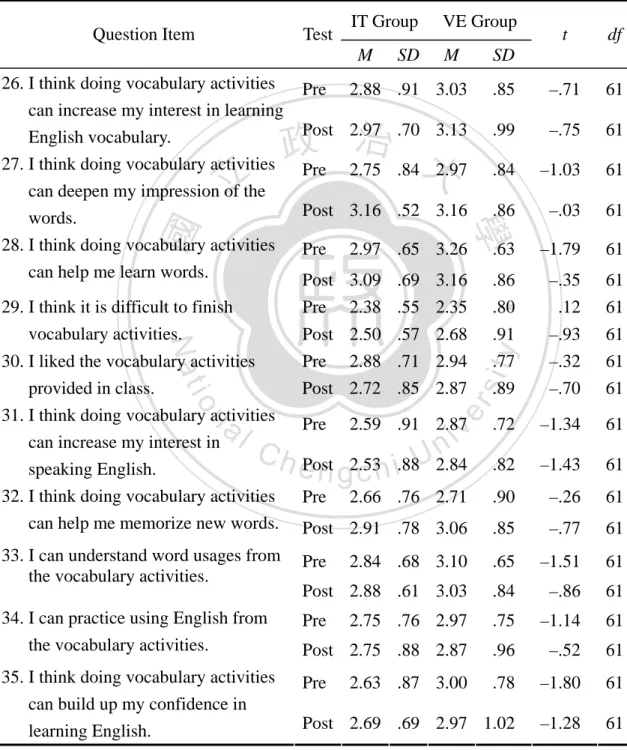
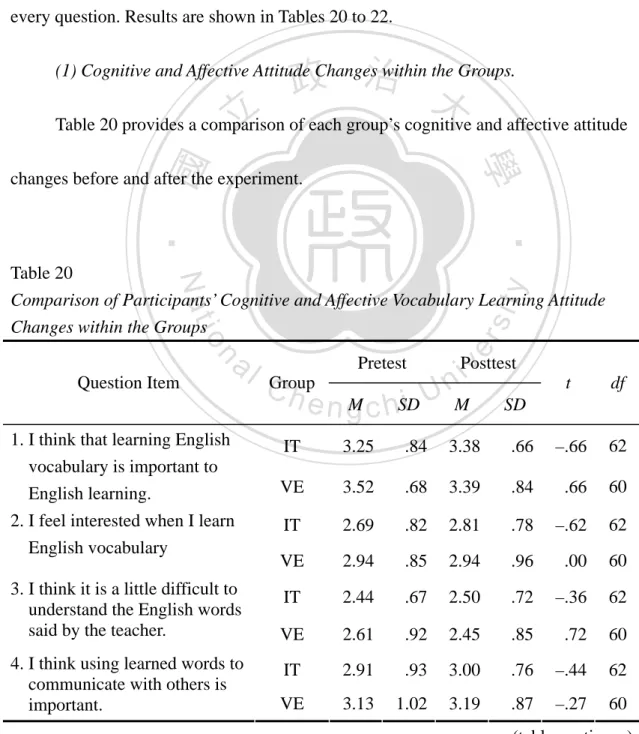


相關文件
Engaging Students in Task-based Learning Activities to Practise the Target Vocabulary Items and Language Forms. KS1 learners may not have enough experience in buying/ordering
• ‘ content teachers need to support support the learning of those parts of language knowledge that students are missing and that may be preventing them mastering the
Promote project learning, mathematical modeling, and problem-based learning to strengthen the ability to integrate and apply knowledge and skills, and make. calculated
• Information on learners’ performance in the learning task is collected throughout the learning and teaching process so as to help teachers design post-task activities
(1) principle of legality - everything must be done according to law (2) separation of powers - disputes as to legality of law (made by legislature) and government acts (by
Diversified parent education programmes for parents of NCS students starting from the 2020/21 school year to help them support their children’s learning and encourage their
(“Learning Framework”) in primary and secondary schools, which is developed from the perspective of second language learners, to help NCS students overcome the
stating clearly the important learning concepts to strengthen the coverage of knowledge, so as to build a solid knowledge base for students; reorganising and
