Various high-order modes in vertical-cavity
surface-emitting lasers with equilateral triangular
lateral confinement
C. C. Chen, K. W. Su, Y. F. Chen,*and K. F. HuangDepartment of Electrophysics, National Chiao Tung University, Hsinchu, Taiwan *Corresponding author: [email protected]
Received December 6, 2007; accepted January 18, 2008; posted January 30, 2008 (Doc. ID 90598); published February 28, 2008
Large-aperture vertical-cavity surface-emitting lasers with an equilateral triangular lateral confinement are fabricated to investigate the formation of high-order resonant modes. The experimental lasing patterns are composed of the superscar mode, honeycomb eigenstate, and chaotic mode. Experimental results confirm the theoretical predictions that tiny symmetry breaking can cause the high-order modes to reveal miscellaneous states of integrable and chaotic systems. © 2008 Optical Society of America
OCIS codes: 140.3410, 140.5960, 300.6260. Microdisk lasers with chaotic shapes permit high-power directional emission and have potential appli-cations in optical computations and communiappli-cations [1–3]. The lasing mechanism of directional emission in chaotic microdisk lasers has been analogously in-terpreted with the scar effect in chaotic billiards [4]. Specifically, scar modes have the wave patterns to be localized on the isolated and unstable periodic orbits (POs) in the chaotic quantum billiards [4]. In addi-tion to scar modes, the other significant high-order states are the so-called superscar modes [5] that are localized on stable and nonisolated POs. Superscar modes have been theoretically studied in square [6], equilateral-triangular [7], and circular quantum bil-liards [8]. Recently, two-dimensional (2D) microdisk lasers have been experimentally employed to explore the characteristics of resonant modes in square [9] and equilateral-triangular [10,11] cavities. The lat-eral radiation patterns of 2D microdisk lasers have been found to be intimately related to the superscar modes. Nevertheless, the whole morphology of super-scar modes cannot be straightforwardly observed from the lateral radiation of 2D microdisk lasers.
More recently, it has been shown that the trans-verse modes of the oxide confined vertical-cavity surface-emitting lasers (VCSELs) are equivalent to the wave functions in the 2D quantum billiards with the shapes the same as the lateral confinements [12–14]. The superiority of oxide-confined VCSELs consists in their longitudinal wave vector kz, which
can bring out the near-field patterns to be directly re-imaged with simple optics. Although square-shaped VCSELs have been manufactured to confirm the su-perscar modes [13], equilateral-triangular-shaped VCSELs have not been implemented as yet. Since the equilateral-triangular billiard is a classically non-separable but integrable system, experimental real-ization of the resonance modes in equilateral-triangular VCSELs can provide important insight into laser physics [15] as well as electron transport phenomena in quantum dots [16].
In this work, we fabricate large-aperture equilateral-triangular VCSELs to explore the near-field transverse patterns of the VCSELs at lasing
threshold. Various high-order coherent stationary modes, including superscar modes, high-order eigen-states, and chaotic modes are experimentally ob-served via precise temperature control to detune the transverse order. Experimental results revealed that spontaneous imperfections cause the lasing modes of large-aperture equilateral-triangular VCSELs to ex-hibit miscellaneous states of integrable and chaotic systems. The fundamental operation of the large-aperture VCSELs is discussed in [13].
The device structure of the present oxide-confined VCSELs and the methods used to measure the far-and near-field patterns are similar to those described by [12], except that the lateral confinement is equi-lateral triangular. Figure1 shows the optical micro-scope image of the device operated with an electric current under threshold current at room tempera-ture. The bright region indicates the equilateral-triangular pattern of spontaneous emission. The edge length of the oxide aperture was measured to be ap-proximately 66.8m. The VCSEL device was placed in a cryogenic system with a temperature stability of
Fig. 1. Optical microscope image of the device with pat-tern of spontaneous emission to display the equilateral-triangular aperture.
March 1, 2008 / Vol. 33, No. 5 / OPTICS LETTERS 509
0.01 K in the range of 80– 300 K. A current source with a precision of 0.01 mA was utilized to drive the VCSEL device. The near-field patterns were reim-aged into a CCD camera (Coherent, Beam-Code) with an objective lens (Mitsutoyo, numerical aperture 0.9). The spectral information in the laser output was measured by a Fourier optical spectrum analyzer (Advantest Q8347) with a Michelson interferometer.
Figures2(a)–2(f)depict the experimental near-field patterns that are characteristically observed at dif-ferent device temperatures. It is found that the las-ing patterns are generally robust and reproducibly observed under the same experimental circum-stances. The lasing pattern shown in Fig. 2(a)is ob-tained at the operating temperature of 295 K, and the optical spectrum indicates it to be a multimode emission. The lasing state at the operating tempera-ture of 275 K is found to dramatically change to a su-perscar mode that is similar to Fabry–Pérot modes impinging on lateral sides vertically [17], as seen in Fig.2(b). When the operating temperature decreases to 195 K, the lasing pattern shown in Fig.2(c) exhib-its a honeycomb structure. As discussed later, the honeycomb morphology corresponds to the pattern of a kind of eigenstate. When the operating tempera-ture further decreases to 175 K, the near-field pat-tern shown in Fig. 2(d) behaves like a chaotic wave state that can be described as a random superposi-tion of plane waves [18]. For the operating tempera-ture below 135 K, the experimental pattern shown in Fig.2(f)corresponds to another superscar mode that is related to a geometrical PO [10]. This superscar mode is found to be unchanged when the tempera-ture decreases from 135 to 80 K. Intriguingly, the las-ing pattern displays the transition and coexistence of the chaotic and superscar modes for the operating temperature within the range of 135– 155 K, as seen in Fig.2(e).
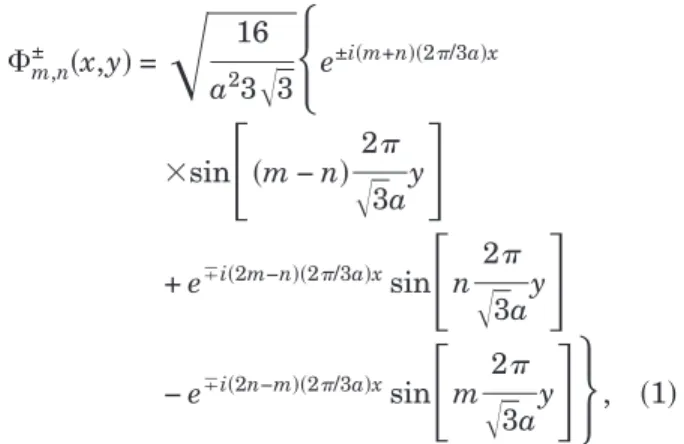
The analogy between the electromagnetic wave equation in paraxial approximation and the Schrödinger equation enables us to make a detailed connection between the quantum wave functions and the experimental patterns. Setting the three vertices to be at (0,0),共a/2,
冑
3a / 2兲, and 共−a/2,冑
3a / 2兲, wherea is the side length, the quantum eigenstates of the
equilateral-triangular billiard are given by [7]
⌽m,n± 共x,y兲 =
冑
16 a23冑
3再
e ±i共m+n兲共2/3a兲x ⫻sin冋
共m − n兲2冑
3ay册
+ e⫿i共2m−n兲共2/3a兲xsin冋
n 2冑
3ay册
− e⫿i共2n−m兲共2/3a兲xsin冋
m 2冑
3ay册
冎
, 共1兲 with 2nⱖm. The eigenstates ⌽m,n± 共x,y兲 are the repre-sentation of traveling waves. The wave functions for standing waves can be expressed as Sm,n± 共x,y兲 =⌽m,n+ 共x,y兲±⌽m,n− 共x,y兲. The experimental honeycomb pattern shown in Fig. 2(c) can be numerically con-firmed to correspond to the wave intensity of 兩S5,58− 共x,y兲兩2, as depicted in Fig.3(a).Superscar modes that are associated with classical POs can be analytically expressed with the represen-tation of quantum coherent states. The formation of classical POs in the equilateral-triangular billiard can be denoted by three parameters 共p,q,兲, where the parameters p and q are nonnegative integers with the restriction that pⱖq; the parameteris in the range of − to [7]. With the representation of quantum coherent states, the wave functions related to the classical POs with parameters共p,q,兲 can be given by [7] ⌿N,M± 共x,y;p,q,兲 = 1
冑
MK=0兺
M−1 e±iK⌽m o+pK,no+q共M−1−K兲 ± 共x,y兲, 共2兲 with mo=共p+2q兲N and no=共2p+q兲N, where mo and no indicate the order of the coherent state and Mstands for the number of eigenstates that are in-volved in the superposition. The relative phase factor between various parts of the coherent state has a causal relationship with the localization on geometri-cal trajectories [6,7]. Similarly,⌿N,M± 共x,y;p,q,兲 rep-resents the traveling wave, and the expression for the standing wave can be given by CN,M± 共x,y,p,q,兲 =⌿N,M+ 共x,y,p,q,兲±⌿N,M− 共x,y,p,q,兲. Based on thor-ough numerical analysis, the experimental superscar modes can be found to be well reconstructed with the coherent states of C36,9+ 共x,y;1,01,0.23兲 and
C22,6+ 共x,y;1,1,0.35兲. Figures3(b)and3(c)depict the numerical wave patterns of 兩C36,9+ 共x,y;1,0,0.23兲兩2
and 兩C22,6+ 共x,y;1,1,0.35兲兩2 corresponding to the
ex-perimental patterns shown in Figs.2(b)and2(f). The excellent agreement between the experimental and numerical patterns confirms that the quantum for-mulism is of great importance in describing distinct branches of physics because of the underlying struc-tural similarity. Conversely, the present analysis also provides a further indication that laser resonators can be designed to demonstrate the quantum phe-nomenon in mesoscopic physics.
Fig. 2. Intensity patterns of transerse near-field patterns at temperatures of (a) 295 (room temperature), (b) 275, (c) 195, (d) 175, (e) 155, and (f) 125 K.
Although an ideal equilateral-triangular billiard is integrable, some experimental patterns reveal the property of quantum chaotic modes, as seen in Fig.
2(d). It is well known that the intensity statistics of chaotic wave functions obey the Porter–Thomas dis-tribution P共I兲=共1/
冑
2I兲e−I/2 [19]. The intensitysta-tistics for Fig. 2(d) can be derived by digitizing the image file with the background removal of spontane-ous emission. We evaluate the intensity statistics for the experimental pattern to make a comparison with the Porter–Thomas distribution, as shown in Fig. 4. The good agreement validates that the wave pattern corresponds to a chaotic wave function. The origin of stationary chaotic modes is expected to arise from spontaneous imperfections, such as boundary rough-ness or inequality of the three internal angles. In other words, spontaneous symmetry breaking may cause the real devices with idealized integrable con-finements to exhibit the characteristics of noninte-grable systems. As discussed in [20], although a tri-angular billiard with internal angles slightly different from / 3 is intrinsically chaotic, the wave functions can still be scarred by families of POs. Briefly, tiny symmetry breaking can lead to the
emer-gence of superscar as well as chaotic modes in the al-most integrable systems. Our experimental results are consistent with the theoretical findings.
In conclusion, we have manufactured large-aperture VCSEL devices with an equilateral-triangular lateral confinement to explore the charac-teristics of mesoscopic resonant modes via precise temperature control. Experimental results generally confirm the theoretical predictions that spontaneous symmetry breaking can induce the appearance of su-perscar modes and chaotic waves. We also observed the honeycomb pattern that corresponds to the struc-ture of a high-order eigenstate. More importantly, the experimental lasing mode within a rather wide tem-perature range is found to be the coexistence of su-perscar and chaotic states. The present result can provide useful insight into laser physics and wave chaos.
References
1. C. Gmachl, F. Capasso, E. E. Narimanov, J. U. Nöckel, A. D. Stone, J. Faist, D. L. Sivco, and A. Y. Cho, Science 280, 1556 (1998).
2. N. B. Rex, H. E. Tureci, H. G. L. Schwefel, R. K. Chang, and A. D. Stone, Phys. Rev. Lett. 88, 094102 (2002). 3. M. Lebental, J. S. Lauret, J. Zyss, C. Schmit, and E.
Bogomolny, Phys. Rev. A 75, 033806 (2007). 4. E. J. Heller, Phys. Rev. Lett. 53, 1515 (1984).
5. E. Bogomolny, B. Dietz, T. Friedrich, M. Miski-Oglu, A. Richter, F. Schäfer, and C. Schmit, Phys. Rev. Lett. 97, 254102 (2006).
6. Y. F. Chen, K. F. Huang, and Y. P. Lan, Phys. Rev. E 66, 066210 (2002).
7. Y. F. Chen and K. F. Huang, Phys. Rev. E 68, 066207 (2003).
8. C. C. Liu, T. H. Lu, Y. F. Chen, and K. F. Huang, Phys. Rev. E 74, 046214 (2006).
9. A. W. Poon, F. Courvoisier, and R. K. Chang, Opt. Lett. 26, 632 (2001).
10. H. C. Chang, G. Kioseoglou, E. H. Lee, J. Haetty, M. H. Na, Y. Xuan, H. Luo, and A. Petrou, Phys. Rev. A 62, 013816 (2000).
11. J. Yoon, S.-J. An, K. Kim, J. K. Ku, and O. Kwon, Appl. Opt. 46, 2969 (2007).
12. S. P. Hegarty, G. Huyet, J. G. McInerney, and K. D. Choquette, Phys. Rev. Lett. 82, 1434 (1999).
13. K. F. Huang, Y. F. Chen, H. C. Lai, and Y. P. Lan, Phys. Rev. Lett. 89, 224102 (2002).
14. T. Gensty, K. Becker, I. Fischer, W. Elsäßer, C. Degen, P. Debernardi, and G. P. Bava, Phys. Rev. Lett. 94, 233901 (2005).
15. Y. Z. Huang, Y. H. Hu, Q. Chen, S. J. Wang, Y. Du, and Z. C. Fan, IEEE Photon. Technol. Lett. 19, 963 (2007). 16. L. Christensson, H. Linke, P. Omling, P. E. Lindelof, I. V. Zozoulenko, and K. F. Berggren, Phys. Rev. B 57, 12306 (1997).
17. J. C. Marinace, A. E. Michel, and M. I. Nathan, Proc. IEEE 52, 722 (1964)
18. P. O’Connor, J. Gehlen, and E. J. Heller, Phys. Rev. Lett. 58, 1296 (1987).
19. H. J. Stöckmann, Quantum Chaos: an Introduction (Cambridge U. Press, 1999), and references cited therein.
20. P. Bellomo and T. Uzer, Phys. Rev. E 50, 1886 (1994). Fig. 3. (a) Numerical wave pattern 兩S5,58− 共x,y兲兩2
corre-sponding to the experimental honeycomb pattern shown in Fig. 2(c). (b), (c) Numerical wave patterns of 兩C36,9+ 共x,y;1,0,0.23兲兩2 and 兩C22,6+ 共x,y;1,1,0.35兲兩2
corre-sponding to the experimental patterns shown in Figs.2(b) and 2(f), respectively. The geometrical POs are shown in the insets.
Fig. 4. Histogram: intensity statistics of the experimental pattern shown in Fig.2(d); straight curve, Porter–Thomas distribution.