
「跨台聯播」對新加坡付費電視產業競爭與策略之影響研究 - 政大學術集成
183
0
0
全文
(2) Acknowledgements Finally, amidst the passing of two loved ones and coping with the grief, the end of this journey has arrived. Words are insufficient to express my emotions but I am forever grateful for the guidance, support, love and constructive opinions during this journey. I especially would like to express my gratitude to the following people: -. to my advisor Prof Liu, thank you for taking the time amongst your busy schedule in guiding me through the thesis and advising me throughout the course of my studies;. -. to Prof Tseng and Prof Shih on my thesis committee, thank you for your valuable feedback and critiques;. 政 治 大 experiences, knowledge and expertise; 立. -. to all my other professors, thank you for sharing your lessons of life, valuable work. -. to Alladin, Conny and Vivi, thank you for showering me with so much administrative. ‧ 國. 學. support, laughter, love and care; -. to Mandy and Irina, I really owe you two much for helping me in tying up the loose ends. ‧. of this journey;. to my friends, who have been hearing me rant but yet still tolerating with me and giving. Nat. y. -. al. n. unforgettable journey.. er. and to my dear classmates, thank you for simply being comrades-in-arms in this. io. -. sit. me so much love and support especially through my lowest periods;. Ch. engchi. i n U. v. Last but not least, I would like to thank my family and relatives. I would not have survived these three years without all of you. Thank you for being my pillars of support and love. Finally, to my dearest dad and grandma, I love you and I miss you.. 8 August 2012, 11:53 p.m. Singapore.
(3) 中文摘要 在新加坡,付費電視產業的競爭與策略很少被討論。有鑑於此,本研究藉由檢視新 加坡媒體媒體發展管理局(Media Development Authority)於 2010 年所修訂的媒體市場 行 為 準 則 ( Media Market Conduct Code ) 之 「 跨 台 聯 播 」 政 策 ( Cross-Carriage Measure),利用五力分析、PEST 分析及 SWOT 分析,來探討新加坡付費電視產業的發 展、競爭、策略及「跨台聯播」政策所造成的影響。 在新加坡的付費電視產業競爭趨勢中,以新電信公司(SingTel)於 2007 年所推出 的 Mio TV IPTV 付費電視服務成長最多,2011 年時市占率已成長了 30%;同年,其競爭者 星和有限公司(StarHub)的星和視界(StarHub TV)付費電視服務卻成長不到 1%。本研 究發現,Mio TV 市占率成長之迅速是因新電信公司積極與內容提供者及電視頻道業者簽 訂獨家播映權,甚至以高價購買運動電視品牌 ESPN 的眾多頻道及其旗下英格蘭超級聯賽 2010 年至 2013 年的獨家播映權。此舉讓兩家電視業者競爭越趨激烈,採取多面策略以增 加訂戶率並吸引不同族群與多元喜好者,包括產品差異化策略、成本領先策略及集中化策 略等。. 立. 政 治 大. ‧ 國. 學. ‧. 研究結果顯示,兩家業者為爭取更多訂戶,主要採取的策略是與內容提供者及電視 頻道業者簽訂獨播合約(Exclusive Carriage Agreements),但此策略也引起媒體發展 管理局的關切。兩家業者所採取的獨播合約策略不僅增加了訂戶們訂閱內容的開銷,也讓 訂閱星和視界服務的訂戶們面臨必須同時安裝新電信 Mio TV 服務或不得不更換服務之不 便。為解決以上的問題,媒體發展局決定施行「跨台聯播」政策,規定付費電視業者必須 與其他業者分享所購得的內容或頻道獨播權,並支付對方播映費,受方不准修改轉播內 容,包括內容中穿插的廣告及原先業者的商標等。本研究發現,此政策將會促使付費電視 業者購買更多多元化的節目內容及推出更低價格的節目組合等,有利於消費者成為付費電 視服務的訂戶,同時也有利於降低既有訂戶的內容訂閱開銷。另一方面,星和公司及新電 信公司兩家業者也不再需要以高價購買內容的獨家播映權,於是更專注於為各自的訂戶提 供更創新及完善的服務。不過此策略亦有利於新進業者進入市場,預料將導致市場競爭更 加激烈,業者們也必須更投入差異化策略。同時,此政策也意謂獨播合約的現象將會減 少,間接使內容提供者的議價能力受到影響。. n. er. io. sit. y. Nat. al. Ch. engchi. i n U. v. 關鍵字:獨播合約、付費電視產業競爭、付費電視策略、 跨台聯播、星和視界、新電信Mio TV. ii.
(4) Abstract Competition and strategies in Singapore’s subscription television industries were rarely examined despite the growing phenomena of such research in other countries. The implementation of the Cross-Carriage Measure presents a timely opportunity to examine developments, competition, strategies and the impacts of the Measure on the subscription television industry. Using the Five Force model, PEST and SWOT models as the basis for the research framework, this thesis adopted the case study approach and used documents from various sources to examine the subscription television industry and discuss the changes brought upon by the Measure.. 政 治 大. Competition in the subscription television industry showed that SingTel Mio TV achieved more than 30 percent market share in 2011 since its entry in 2007 while StarHub TV. 立. grew less than one percent from 46.9 percent in 2007 to 47.5 percent in 2011. Such increase was. ‧ 國. 學. due to the aggressive acquisition of premium programming. Competition between FTA television and the subscription television industry saw a 78 percent market penetration for the industry in 2011 and 80-odd percent for FTA television. Both providers used a combination of. ‧. differentiation and cost leadership strategies to attract audience groups of different ethnicities. y. Nat. and specific interests.. sit. The outcome of the Measure required dominant player StarHub TV to offer its exclusive. al. er. io. content to SingTel Mio TV’s subscribers at similar prices and quality. With the Measure,. n. consumers could enjoy a greater variety of content at more affordable prices without incurring. Ch. i n U. v. the inconvenience of having multiple set-top boxes. However, StarHub TV might not wish to. engchi. bid aggressively for exclusive content, considering the high acquisition costs for both its cable and SingTel Mio TV’s IPTV platforms. Content suppliers might have lesser bargaining power for their content and more signing of non-exclusive agreements with providers. However, more competition might be expected as other operators can now acquire the previously exclusive content. The Measure might also lead to further increases in market share and ARPU for both providers as current subscribers could subscribe to other genres of content at lower subscription prices while others may see more advantages in subscribing to subscription television services. Both providers will have to devote more efforts into differentiating themselves and adopt different strategies if differentiation through exclusive content offerings were no longer used. Keywords: Exclusive Content, Pay-Television Competition, Pay-Television Strategies, Cross-Carriage measure, StarHub TV, SingTel Mio TV iii.
(5) Table of Contents 中文摘要………………………………………………………………….....................................ii Abstract …………………………………………………………………..........................….…iii Table of contents………………..………………………………………………………………iv List of tables and figures………………………………………………………………………….vi Chapter One: Introduction…………...……………………………………………………….1 1.1.. Research background……………...………….……………...................................1. 1.2.. Research objectives and research questions….………...…....................................3. 1.5.. 政 治 大 Scope and structure of thesis…………..………………………………..…………6 立 Significance and contributions of this thesis……………..…….………………....7. 1.6.. Term definition…………….………………………….........................................8. 1.4.. Research methodology ……………………………………………………………4. 學. ‧ 國. 1.3.. Chapter Two: Literature review……….....…………….……….............................................11. ‧. 2.1.. Literature on television industries………...………...….……...…………...…….11. y. sit. Examining competition and strategies in television industries..............................17. io. er. 2.2.. Nat. 2.1.1. Literature on Singapore’s television industries…………………………..15. 2.2.1. PEST and SWOT analysis……………………………………………….20. n. al. Ch. i n U. v. 2.2.2. Five Force model………………………………………………………...23. engchi. 2.2.3. Strategies………………………………………........................................31 2.3.. Issue of exclusive content……………………………………..………………...34. 2.4.. Summary……………………………………………………………………...….43. 2.5.. Research framework………………..…………………………………..………45. Chapter Three: Singapore and its television broadcasting environments ……………......48 3.1.. Political environment..…………………………………………………………...48. 3.2.. Economic environment……………….………………………………………….57. 3.3.. Social environment………………………………………………………………61. 3.4.. Technological environment……………………………………………………...64 iv.
(6) 3.5.. Implications for Singapore’s television industries..……………………………...66. Chapter Four: Competition and strategies in the subscription television industry………..70 4.1.. Development of Singapore’s television industries……………………………....70. 4.2.. Development and competition in the subscription television industry..................75. 4.3.. Strategies by StarHub TV and SingTel Mio TV..……………..…………………84. 4.4.. Summary…………………………………………………………………………98. Chapter Five: Impacts of the Measure on the subscription television industry……..…......99 5.1.. Exclusive content in Singapore and the Cross-Carriage Measure……………….99. 5.2.. 治 政 Impacts of the Measure on industry stakeholders………………………………115 大 立 Summary………………………………………………………………………..127. 5.3.. 學. ‧ 國. 5.4.. Industry development after the Cross-Carriage Measure…...………………...105. Chapter Six: Conclusions………………………..…………….……………………………...130 References……………………………………………………………………………………...138. ‧. Appendices…..…………………………………………………………………………………153 Checklist for examining stakeholders in an industry……………………………...153. II.. Definitions and conditions of the Cross-Carriage measure……………………….154. III.. Relevant definitions in the Media Market Conduct Code.......................................156. IV.. Offerings of StarHub TV………………………………………………………….158. V.. Offerings of SingTel Mio TV…...………………………………………………...162. VI.. Comparison of offerings between SingTel Mio TV and StarHub TV…..………..164. VII.. StarHub’s UEFA EURO 2012 offering for Cross Carriage………………………169. n. al. er. io. sit. y. Nat. I.. Ch. engchi. v. i n U. v.
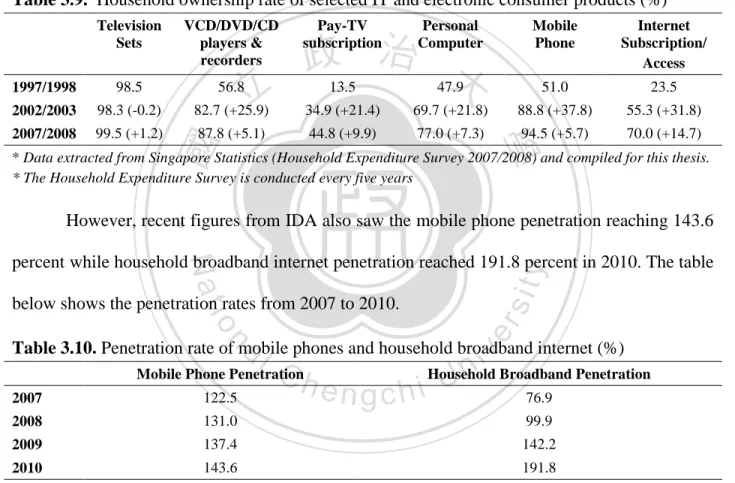
(7) List of tables and figures Tables Opportunities and threats in television industries Product and audience differentiation in television industries Applicable strategies in industries Types of subscription television broadcasting licenses in Singapore in 2012 Broadcasting spectrum being used in Singapore bv 2012 Gross domestic product (GDP) per capita and average household income (S$) Economic performance of motion pictures, radio and television in Singapore Population breakdown from 2007 to 2010 (thousand) Breakdown of Singapore’s residents across racial groups (thousand) FTA channels in Singapore and their respective target audiences Indicators of technology development in Singapore (thousand) Household ownership rate of selected IT and electronic consumer products (%) Penetration rate of mobile phones and household broadband internet (%) SWOT for Singapore’s subscription television industry Summary of offerings by MediaCorp TV Number of resident households with FTA television licenses (Receive-Only) FTA channels in Singapore Number of subscription television service subscribers till 2002 Examples of channel offerings by Singapore Cable Vision by 2001 Number of subscription television subscribers from 2005 Revenue earned by StarHub TV and SingTel Mio TV (S$million) Number of resident households with subscription television subscriptions Resident households with FTA TV licenses and subscription TV subscriptions Identified TV service operators with regards to the Media Market Conduct Code Number of analogue vs. digital cable subscribers for StarHub TV Summary of offerings by StarHub TV and SingTel Mio TV Summary of strategies by StarHub TV and SingTel Mio TV Identified operators with regards to Cross-Carriage Measure Channels offered by Fox International Channels (FIC) available on StarHub TV UEFA Euro 2012 Pay-per-view pack Comparison of offerings for the Chinese community (Kylin TV vs. incumbents) Channels on both StarHub TV and SingTel Mio TV Influences by stakeholders in the subscription television industry in general Influences by stakeholders for both providers before and after the Measure. 立. 政 治 大. 學. ‧. n. al. er. io. sit. y. Nat. Table 2.1. Table 2.2. Table 2.3. Table 3.1. Table 3.2. Table 3.3. Table 3.4. Table 3.5. Table 3.6. Table 3.7. Table 3.8. Table 3.9. Table 3.10. Table 3.11. Table 4.1. Table 4.2. Table 4.3. Table 4.4. Table 4.5. Table 4.6. Table 4.7. Table 4.8. Table 4.9. Table 4.10. Table 4.11. Table 4.12. Table 4.13. Table 5.1. Table 5.2. Table 5.3. Table 5.4. Table 5.5. Table 5.6. Table 5.7.. ‧ 國. •. Ch. engchi. vi. i n U. v.
(8) Figures Diagram of Five-Force model Research framework Regulatory structure of Singapore’s television industries Subscriber relationship before implementation of Cross-Carriage Stakeholders in Singapore’s subscription television industry Change in subscriber relationship after implementation of Cross-Carriage. 立. 政 治 大. 學 ‧. io. sit. y. Nat. n. al. er. Figure 2.1. Figure 2.2. Figure 3.1. Figure 5.1. Figure 5.2. Figure 5.3.. ‧ 國. •. Ch. engchi. vii. i n U. v.
(9) Chapter One: Introduction 1.1. Research background As media conglomerates slowly take shape in the various media industries in the 20th century, the influential power, ubiquitous and pervasive nature of such media industries in today’s societies are allowing increasing number of studies to be done in the disciplines of media management and economics. Today, research and inquiry in the academic study of media management and economics stretches across disciplines, theoretical domains and political. 政 治 大 concentration, as well as performances of media firms and industries. Especially in other 立. systems, examining critical issues in organizational behavior, strategies, competition, market. ‧ 國. 學. countries, media management and economics have become increasingly prominent academic disciplines in the field of media studies (Albarran, Chan-Olmsted & Wirth, 2006).. ‧. However, Singapore’s media industries are rarely examined in such academic disciplines.. sit. y. Nat. Scholars attributed the lack of such studies on Asian media markets (such as Singapore) on the. io. er. deficiencies in reliable economic or market data that can be employed for analyzes; lack of trade. al. records or published materials due to business practice and culture among Asian businesses in. n. iv n C Wildman, 2008). the dominant h e nAmong gchi U. the private sector (Fu &. forms of mass media in. Singapore, the press media have been cited in studies examining ownership, press freedom and censorship while the television industry was rarely examined in such disciplines despite undergoing tremendous changes and interesting twists since its beginning in 1963. Singapore’s television industry currently consists of three major operators: a free-to-air (FTA) television service MediaCorp TV and subscription television services StarHub TV and SingTel Mio TV. Although Singapore’s television industry has a shorter history as compared to its counterparts in other countries, it has also witnessed its share of competition and strategies in its short 49 years.. 1.
(10) Competition in FTA television occurred once between 2002 and 2004 when the industry regulator Media Development Authority (MDA) released the second FTA television license to MediaWorks (a subsidiary of newspaper Singapore Press Holdings). The competition was shortlived and the industry quickly returned to a monopoly in 2004 with MediaCorp’s acquisition of MediaWorks and forming the new MediaCorp TV. The company also diversified into the internet TV business in recent years. Although MediaCorp TV is the only FTA television service operator, it still experiences competition from subscription television services. The subscription. 治 政 大 Singapore Cable Vision was acquired by StarHub Telecommunications in 2002 and renamed 立 television industry also faced its share of competition and strategies where the first operator. StarHub Cable TV (which was further renamed StarHub TV recently). StarHub Cable TV. ‧ 國. 學. continued to enjoy five years of monopoly and experienced direct competition for the first time. ‧. in 2007, when SingTel Telecommunications entered the industry offering SingTel Mio TV on the Internet Protocol Television (IPTV) platform.. y. Nat. io. sit. Competition was slow and almost non-existent between the two providers till SingTel. n. al. er. Mio TV introduced the ‘Season Pass’ VOD service in 2009, offering latest television series from. Ch. i n U. v. USA at earlier timings as compared to other television services. However, a greater influx of. engchi. subscribers was observed when SingTel Mio TV managed to outbid StarHub TV and secured exclusive broadcasting rights for ESPN’s range of programming and major sporting events such as the English Premier League football matches in 2009 for the next three years at a rumored sum of S$280million (approximately at US$224million). As a result of the successful offerings of the VOD packages and exclusive sports content, SingTel observed a 156 percent increase of subscribers from 78,000 in 2009 to 200,000 in 2010. As of December 2011, StarHub had 545,000 subscribers while SingTel had 343,000 subscribers.. 2.
(11) However, such aggressive bidding for exclusive content brought MDA to conclude that the nature of competition is too predominately focused on the securing of exclusive broadcasting rights for content. MDA determined that the costs of acquiring such exclusive content were much higher than international benchmarks and often resulted in higher subscription costs for consumers. As an attempt to address the issue and shift the competition, MDA decided to implement the Cross-Carriage Measure, requiring the appointed subscription television service to offer its exclusive content (acquired after 12th March 2010) to other consumers on other. 治 政 大 actual formulation, feasibility the industry as stakeholders became concerned with the Measure’s 立 subscription television services’ platforms. However, the Measure sparked off heated debates in. and impact on competition and future development of the industry.. ‧ 國. 學. Several possible scenarios were emphasized in the debates. In view of the Measure,. ‧. many content aggregators and channel providers in Singapore’s subscription television industry felt that their negotiating rights for exclusive contracts have been compromised. Subscription. y. Nat. er. io. sit. television service providers seeking to sign exclusive contracts may have to bear any incurred costs in providing the exclusive content on its competitors’ platforms. Correspondingly, upon. n. al. Ch. i n U. v. expiration of existing contracts with content aggregators and channel providers, subscription. engchi. television service providers may have to re-negotiate their contracts and re-strategize their subscription television services in order to compete in the industry.. 1.2. Research objectives and research questions The implementation of the Cross-Carriage Measure presents a timely opportunity to examine the development, competition and strategies in the subscription television industry, which has not been examined in such areas previously. Also, considering the implications of the. 3.
(12) Cross-Carriage Measure on future developments, competition and strategies of the subscription television industry, there is a further significance to examine the industry at this juncture, as well as the impacts of the Measure in greater detail. This thesis therefore aims to: 1) provide an indepth understanding of competition and identify strategies used in the subscription television industry; 2) analyze the impact of the Cross-Carriage Measure on competition and strategies in the subscription television industry and 3) examine ways that the subscription television industry adapts to the Measure. Thus, the following questions are raised:. 政 治 大. 1. What is the current state of competition in the subscription television industry and what are the strategies used?. 立. 2. What are the impacts of the Cross-Carriage Measure on competition and strategies in the. ‧ 國. 學. subscription television industry?. ‧. 3. In what ways will the subscription television industry adapt to the Measure?. y. Nat. er. io. sit. 1.3. Research methodology. This thesis reviews relevant literature to construct the actual state of the subscription. n. al. Ch. i n U. v. television industry in Singapore and examine the issue of the implementation of the Cross-. engchi. Carriage Measure. Due to the infeasibility and difficulties in gaining access to interviewees, who are predominately based in Singapore whereas the author is based in Taiwan, reviewing literature from various sources will form the dominant research approach for this thesis to examine Singapore’s subscription television industry. Reviewing literature from various sources. In examining media industries and markets, Albarran, Chan-Olmsted and Wirth (2006) explained that researchers gather historical and statistical data about the industry and relevant firms while analyzing relevant articles in trade. 4.
(13) publications to provide a ‘multi-faceted view of the phenomenon under study’. Such approach is also predominant in media management and economics research examining media firms, industries and markets (Liu, 1997; Compaine & Gomery, 2000; Chan-Olmsted, 2006; Hocking, Stacks & McDermott, 2006). Cameron & Price (2009) stated that by focusing on analyzing and examining the literature obtained in various domains, there is more control and flexibility over the process of data-gathering, as well as range and depth of information obtainable. Also, to ensure the richness. 治 政 illuminate the study from different perspectives and depths大 (Cameron & Price, 2009). Sources 立 of the study, data triangulation from multiple sources is often encouraged in order to view and. include academic literature, benchmarking data, government statistics, industry reports and. ‧ 國. 學. organizational information such as prospectus, annual reports and audit reports (Cameron &. ‧. Price, 2009). These information can be retrievable from online databases and websites of the respective companies, newspapers and magazines, academic journals and trade reports (AGS,. y. Nat. er. io. sit. 1997; Albarran, Chan-Olmsted & Wirth, 2006; Hocking, Stacks & McDermott, 2006; Cameron & Price, 2009). Porter (1980a) also recommended obtaining information from relevant books,. n. al. Ch. trade associations and governmental departments.. engchi. i n U. v. Apart from referring to information available publicly on the companies’ websites, literature for this thesis will be gathered from established and reputable databases such as Ebscohost databases, LexisNexis Academic and ProQuest databases. These online databases contain extensive full-text collections of articles and documents from relevant publications and reports, such as the nation’s newspapers The Straits Times and Business Times, which is assumed to contain extensive coverage of developments and events in the country’s subscription television industry. To further ease searching of these articles, Boolean logic and keywords such. 5.
(14) as ‘StarHub’, ‘SingTel’, ‘Cross-Carriage Measure’, ‘Cable TV’ and ‘IPTV’ are used to filter and retrieve relevant articles. Annual reports from both providers (accessible and retrievable through their websites) will be used to extract relevant figures, derive insights into the competition from the insiders’ perspectives and examine strategies applied by both providers in the industry. Relevant excerpts from books, news articles, trade and industry reports will also be used to complement and generate an overall understanding of the competition in the industry from the objective view.. 1.4. Scope and structure of thesis. 立. 政 治 大. The thesis will begin with a literature review of studies conducted on developments,. ‧ 國. 學. competition and strategies in subscription television industries, then supplemented by a review of. ‧. frameworks commonly used to examine industries, competition and strategies in subscription television industries. It will then venture into an examination of developments, competition and. y. Nat. er. io. sit. strategies of Singapore’s subscription television industry. The implementation and impacts of the Cross-Carriage Measure on the subscription television industry will then be examined. The thesis. n. al. Ch. is therefore divided into the following chapters. . engchi. i n U. v. Chapter One introduces the background for this thesis, where the industry regulator has introduced the Cross-Carriage Measure in the subscription television industry. In light of the lack of literature examining developments, competition and strategies in Singapore’s subscription television industry, the significance of this thesis is also emphasized. Research methodology for this thesis is further clarified in this chapter.. . Chapter Two reviews literature on industry competition and strategy in subscription television industries, issue of exclusive content in subscription television industries. 6.
(15) and identifies relevant frameworks in examining competition and identifying strategies. A research framework will then be developed. . Chapters Three will focus on examining general environments and identifies factors that are capable of influencing the subscription television industry. . Chapter Four examines the current state of competition and strategies in the subscription television industry.. . Chapter Five will examine the issue of exclusive content in Singapore leading to the. 政 治 大 The impacts of the Measure on the subscription television industry will be examined 立. implementation of the Cross-Carriage Measure in the subscription television industry.. using the research framework.. ‧ 國. 學. . The final chapter then summarizes the earlier chapters and suggest recommendations. ‧. for the subscription television industry. Limitations and suggestions for further. 1.5. Significance and contributions of this thesis. al. er. io. sit. y. Nat. research will then be detailed.. n. iv n C This thesis is the first of its kind which attempts toU h e n g c h i examine developments, competition. and strategies in Singapore’s subscription television industry.. Fu and Wildman (2008) have stated that studies of media markets in Asia are rarely found in current literature on media economics and business in the English language despite the ‘growing richness, vibrancy and scale of Asian media markets’. In Singapore, previous studies done on management and economics of Singapore’s communication industries focused mainly on telecommunications services provided by the players in the industry (SingTel, StarHub and MobileOne), examining customer satisfaction and service quality (Chan, Lau & Tan, 2000; Teo,. 7.
(16) Foo & Ong, 2001; Chew, Ler & Toh, 2002). However, there are few studies examining Singapore’s television industries. Some of the few include Ng, Pang and Toh (2000) who attempted to analyze marketing and advertising strategies of the players; Aw & Lek (1997) who examined the impact of cable television on the local production industry and Chua (2002) who examined brand management practice in the local television industry. The implementation of the Cross-Carriage Measure provides a timely opportunity to examine development, competition and strategies in Singapore’s subscription television industry,. 治 政 Singapore’s subscription television 大 industry 立. as well as areas of change due to the Measure. This thesis therefore seeks to provide insights and understanding into. and eventually hopes to. contribute to the small but growing literature examining Singapore’s media and communication. ‧ 國. 學. industries. It is also desired that this thesis will be a helpful reference in allowing one to. er. io. sit. y. Nat. 1.6. Term definition. ‧. understand Singapore’s subscription television industry.. For the easy referencing of this thesis, the following key terms are as defined:. n. al. . Ch. i n U. v. ‘Subscription television’ – Subscription television services cater to niche audiences. engchi. on a subscription basis through monthly or pay-per-view payment, where subscribers can choose and package their preferred content. The content on such subscription television services usually have more variety and choices as compared to content on free-to-air television. Current players in Singapore’s subscription television industry include StarHub Television and SingTel Mio Television on the cable and IPTV platforms respectively.. 8.
(17) . ‘Singapore Cable Vision’ (‘SCV’) – Acquired by StarHub Telecommunications in 2001, it was an entity comprising of state companies Singapore International Media (31%), Singapore Technologies Ventures (24%), Singapore Press Holdings (20%) and Continental Cablevision (25%), which was then the third largest cable television operator in the United States. SCV spent more than S$600 million (US$300 million) in establishing a nationwide state-of-the art hybrid fibre-coaxial (HFC) cable network where it leased fibre-optic cables from SingTel and built coaxial extensions to each. 政 治 大 ‘StarHub Telecommunications’ (‘Starhub Cable’ or ‘StarHub TV’) – The company is 立 household. It also provided internet services through broadband cable.. . a fully-integrated info-communication company in Singapore, offering a full range of. ‧ 國. 學. information, communications and entertainment services. After acquiring SCV in. ‧. 2002, the company continued to offer cable TV services. It is Singapore’s largest. io. y. sit. ‘Singapore Telecommunications’ (‘SingTel Mio TV’) – The company is the nation’s. er. . Nat. Pay-TV operator.. first telecommunications company, providing a diverse range of communication. n. al. Ch. i n U. v. services and solutions. It is the nation’s leading mobile, broadband and fixed line. engchi. operator. The company started offering IPTV services through its ‘Mio TV’ service in 2007. . ‘Ministry of Information, Communications and the Arts’ (‘MICA’) – The ministry oversees the macro-development of information, communications and arts industries in Singapore, with particular focus on the country’s cultural and artistic developments.. . ‘Media Development Authority’ (‘MDA’) – It is an autonomous agency established by the Government to regulate and promote the media sector. The authority aims to. 9.
(18) develop a vibrant media sector in Singapore that nurtures homegrown media enterprises and attracts direct foreign investment which promotes economic growth and provides local employment opportunities. MDA also implements the Media Market Conduct Code, consisting of policies and regulations towards market conduct, competition and public interest in the local media industry. . ‘Infocomm Development Authority’ (‘IDA’) – Similar to the MDA, IDA is an autonomous agency established by the Government to regulate and promote the. 政 治 大 ‘Cross-Carriage Measure’ – Implemented by MDA in March 2010 in view of the 立. telecommunications sector.. intense competition in exclusive content by StarHub TV and SingTel Mio TV, it. 學. ‧ 國. requires subscription television service operators to offer relevant exclusive content to. ‧. their competitors’ subscribers on the competitors’ platforms with specific guidelines. io. sit. y. Nat. and requirements.. n. al. er. . Ch. engchi. 10. i n U. v.
(19) Chapter Two: Literature Review This chapter reviews past literature on industry competition and strategy, with particular focus on competition and strategy in television industries. Approaches and frameworks in examining industries, competition and strategies in television industries will be identified. The advantages and disadvantages of the approaches and frameworks will also be summarized.. 2.1. Literature on television industries. 治 政 大 due to the ubiquitous and century, the study of media industries became more prominent 立 As media conglomerates started to take shape in the various media industries in the 20th. pervasive nature of media industries. Today, research and inquiry in the field stretches across. ‧ 國. 學. disciplines, theoretical domains and political systems, allowing understanding of critical issues in. ‧. economics, competition, management, media markets, organizational behavior and strategies in media firms and industries (Albarran, Chan-Olmsted & Wirth, 2006; Chan-Olmsted, 2006).. y. Nat. er. io. sit. Following the rising trend of media convergence (where there is an integration of data, media and telecommunications systems) and changes in economic, regulatory and technological. n. al. Ch. i n U. v. structures, there is an increasingly growing global phenomenon of studies examining media. engchi. industries. Albarran, Chan-Olmsted & Wirth (2006) also stated that literature devoted to television management in various countries is increasing from both local and global perspectives. Television industries in United States have also been largely examined in recent years, evident from the published works of scholars such as Picard (1989) who examined concepts and issues in media economics; Compaine & Gomery (2000) who examined competition and concentration in mass media industries; Albarran (2002) who discussed media markets, industries and concepts; Hoskins, McFadyen & Finn (2004) who explored the application of. 11.
(20) economics in new and traditional media; Chan-Olmsted (2006) who examined competitive strategies in media industries; Albarran, Chan-Olmsted & Wirth (2006) compiling scholarly works by media scholars into a media handbook examining media management and economics in the Americas and Europe and Picard (2010) examining economics and financing issues of media companies. Chan-Olmsted (1998) examined the increasing trend of mergers and acquisitions between broadcasting companies and telephone services brought upon by convergence and deregulation.. 治 政 大 established that there was an and competitive provision of TV programming as it was clearly 立. Doyle (1998) commented that there was a redundancy in examining the issue of monopolistic. extensive and growing competition in such industries due to increasing demand for TV. ‧ 國. 學. programmes from technological progress which lowered costs in TV production, programming. ‧. and even the quality of television sets. Compaine & Gomery (2000) examined US television industries in great detail, exemplifying complex media ownership patterns among media. y. Nat. er. io. sit. companies and dwindling ownership regulations by the Federal Communication Commission. Compaine & Gomery (2000) stated that no research in mass communication should ignore. n. al. Ch. i n U. v. questions of mass media ownership and economic implications of such control, as mass media in. engchi. US and other parts of the world seek to maximize profits and therefore should be studied as economic institutions. To support its conclusions, Compaine & Gomery (2000) documented developments in US’s broadcast, cable and satellite television industries, where many companies are managing diverse businesses spanning across various media segments and markets. Such companies include Time Warner, News Corporation, Disney, Viacom and CBS. Specific examples cited were the Disney’s acquisition of ABC, the diversification into cable television. 12.
(21) system ownership by telco AT&T through the acquisitions of TCI and MediaOne, as well as the cooperative venture of MSNBC between NBC and computer software giant Microsoft. Hoskins, McFadyen & Finn (2004) also raised and addressed several important questions that are widely examined by scholars in media management and economics paradigm. Studies were done to examine reasons for the influential market power of particular television franchises, the process of analyzing media industries, the effects of market structure on media firms, industry conduct and performance, the type of strategies used by companies to compete, as well. 治 政 Olmsted (2006) also examined strategies and competition in大 US’s various television industries, 立 as measuring the competitiveness of an industry and dimensions of industry performance. Chan-. analyzing areas of changes in the industries over the years, through the extensive use of Porter’s. ‧ 國. 學. Five Force model, environment analysis approaches and strategic frameworks. Albarran, Chan-. ‧. Olmsted and Wirth (2006) also concluded that competition in US’s television markets would continue to increase as new technologies and the phenomenon of media convergence allow. y. Nat. er. io. sit. industries to cross legal and technical boundaries to compete in several areas of communication. In Asia-Pacific regions such as Taiwan, China, Hong Kong and Singapore, the number of. n. al. Ch. i n U. v. television management and related studies are also increasing. In Taiwan, studies are being. engchi. conducted on multichannel television management, competition and related subjects as evident through the works of Liu (1997), who examined the intense competition between multichannel operators of the various platforms and the challenges faced in audience ratings, advertising revenue, human resources, industry regulation and policy. In particular, the respective industry environments were analyzed using PEST analysis framework, followed by Porter’s Five Force model and SWOT analysis frameworks. Other studies included Li & Chiang (2001) who examined market competition and programming diversity in Taiwan’s television markets;. 13.
(22) Hartanto, Kow, Santoso & Wong (2002) who conducted a strategic analysis of Taiwan’s cable television industry; Chen (2002) examining the cable television industry’s ownership and concentration; Tsai (2003) on the digital broadband communication industry in Taiwan; Li (2004) on market competition and media performance of Taiwan’s cable television industry; Tsai & Chang (2005) who discussed mass media under convergence and Chen (2005) who discussed the broadcasting media ecology and industry in Taiwan. In particular, Chen (2002) examined ownership and concentration in Taiwan’s cable television industry and concluded that the. 政 治 大. industry had become oligopolistic and was increasingly being controlled by a small number of local media conglomerates.. 立. In other regions such as Hong Kong, Japan and South Korea, subscription television. ‧ 國. 學. industries and their related issues have also been largely examined. In regards to the legislation. ‧. and regulation, Leung and Wei (1998) examined the factors influencing the adoption of interactive TV in Hong Kong and their implications for advertising. Kang (2002) discussed. y. Nat. er. io. sit. factors that influenced adoption of digital cable television in South Korea. Kwak (2007) also examined the regulation of subscription television in East Asia, conducting a comparison across. n. al. Ch. i n U. v. Hong Kong, Japan and South Korea and concluding that Hong Kong’s de-regulatory framework. engchi. was more effective as compared to South Korea and Japan. Shin (2007) on the other hand, conducted a socio-technical analysis of the IPTV industry in South Korea, concluding that the industry development was first driven by technology and regulation but was now driven by market forces and users’ demands. Competition and its related issues in the subscription television industries have also been examined widely. For example, Cheng (2009) examined competition and the enforcement of competition law in Hong Kong’s television industries, while Rhee and Lee (2010) examined the. 14.
(23) effects of mergers and competition on consumer benefits in South Korea’s television industries. Hwang, Hong and Lee (2010) also conducted an analysis on the merger efficiency of vertical and horizontal integration in Korea’s cable television industry. An empirical study examining reciprocal carriage on vertical integration and market foreclosure in South Korea’s cable television industry was also conducted by Lee and Kim (2011), concluding that vertically integrated cable operators in the country tended to carry their affiliated channels and were unlikely to carry their rivals’ channels. The rise of the quadruple play strategy and media. 治 政 大 Japan, focusing on legislation comparison of IPTV legislation between South Korea and 立 convergence had also been examined. For example, Kim and Sugaya (2006) conducted a. concerning the convergence of broadcasting and telecommunications and the institutional. ‧ 國. 學. differences of the respective IPTV services.. ‧. 2.1.1. Literature on Singapore’s television industries. y. Nat. er. io. sit. Television industries in Singapore were much less examined due to various reasons. Fu & Wildman (2008) have already stated that the studies of media markets in Asia are rare. A search. n. al. Ch. i n U. v. into past scholarly articles conducted on Singapore’s media industries revealed that few studies. engchi. have been done on Singapore’s television industries as compared to other industries. Choi and Yeo (2001) examined the role of the government in the regulating and censoring of television content and the public’s opinion on existing regulations, concluding that there was a need for revision in the regulatory policies; Tham (2004) was one of the very few studies done on examining the relationship between market competition and programme diversity in Singapore’s terrestrial television broadcasting industry while Edge (2004) offered a detailed account of the. 15.
(24) development and competition in Singapore’s media industries, arguing that there was a need to ‘rationalize’ competition and not to eliminate it totally. Ang (2007) on the other hand, provided a comprehensive understanding of Singapore’s television industries, summarizing its developments and regulatory policies while giving a generic overview of Singapore’s environments. There were also several studies done on the examination of competition in the FTA television industry, where MDA released the second FTA broadcasting license to MediaWorks (a subsidiary of Singapore Press Holdings), who. 治 政 MediaWorks’ eventual withdrawal from the industry (Edge, 大 2004; Lee, 2005; Ang, 2007). 立. competed against MediaCorp and resulted in losses for both television companies and. There were also few studies done on the subscription television industry. Previous studies. ‧ 國. 學. conducted on the subscription television industry included Aw & Lek (1997) examining the. ‧. impact of cable television on Singapore’s broadcasting scene and Heng (2007) exploring audience fragmentation and polarization in Singapore’s cable television market. Similar to the. y. Nat. er. io. sit. public television industry, the subscription television industry was dominated by a single player (StarHub Cable TV) till SingTel Mio officially started its IPTV service in 2007. The latter was. n. al. Ch. i n U. v. not yet seen as a strong competitor against StarHub Cable TV (Reynolds, 2006; Chong, 2007).. engchi. SingTel Mio TV was only predicted to become a strong competitor when it acquired exclusive broadcasting rights to the Barclays Premier League’s football matches and ESPN Star Sports in 2009 (Lim, 2009; Media, 2009a). Competition between the two subscription television service providers were mainly discussed in newspapers and trade publications but not in scholarly articles (Media, 2006; Yin, 2006; Frater, 2007; Hicks, 2007; Low, 2007; TelecomWeb, 2007; Jenna, Arena & Lim, 2010; Lane, 2010; Ramesh, 2010; Tanner, 2010; Wang, 2010b). For example, Wang (2010b) discussed. 16.
(25) possibilities of intense competition following SingTel Mio TV’s acquisitions of sports-related content and indirect competition with public broadcaster MediaCorp. Lane (2010) and Tanner (2010) briefly discussed the issue of the Cross-Carriage Measure and its impact on industry stakeholders including consumers while Jenna, Arena & Lim (2010) provided a detailed analysis of the issue. Recent studies done were more focused on the developments of mobile TV in Singapore. For example, Lin (2010) concluded that current media laws are inadequate in managing the fast. 治 政 大a socio-technical comparison on should be created. Lin and Liu (2011) examined and conducted 立. developing mobile TV industries and recommended a light-touch customized mobile TV policy. the development of mobile broadcasting TV in Singapore and Taiwan, concluding that Singapore. ‧ 國. 學. was most likely to adopt the DVB-H standard and utilize a subscription model for mobile TV.. ‧. Lin (2011a) and Lin (2011b) examined the emergence of three-screen TV in Singapore and argued that the current TV-centric model would not be adequate to regulate TV across multiple. y. Nat. io. sit. screens and platforms, further recommending a ‘pro-innovative’ three-screen TV policy with. n. al. er. ‘light-touch’ licensing scheme and ‘loose’ content regulation so as to facilitate the development of the next generation TV.. Ch. engchi. i n U. v. 2.2. Examining competition and strategies in television industries The classic management and economic research in business-related disciplines states that all organizations or businesses face some sort of competition, either for resources, people, cash or customers. The environments that these organizations or businesses exist in are always uncertain, therefore emphasizing the importance for businesses and companies to position themselves strategically in order to compete successfully in their industries (Bourgeois, 1996).. 17.
(26) Porter (1980) theorized that industry structure strongly influences industry competition as well as the strategies available to companies seeking to compete against one another and therefore, the development of competitive strategy is built on the analysis of industry structure and competitors. Managers and business leaders have to understand the dynamics (or structure) of the industries they operate in, as well as trends in the external environments that may have effects on their businesses in order to position themselves strategically (Bourgeois, 1996). Almost all strategic planning approaches and frameworks involved the analysis of the direct and indirect. 政 治 大 theoretical frameworks have been developed and applied in real-life management, business and 立 environments where companies operate their businesses. Over the years, several approaches and. ‧ 國. 學. economic studies to examine competition.. These approaches and frameworks have also been commonly used in media management. ‧. and economics research to study media firms, competition, markets and industries (Liu, 1997;. sit. y. Nat. Hoskins, McFadyen & Finn, 2004; McGrail & Roberts, 2005; Chan-Olmsted, 2006; Albarran,. io. er. Chan-Olmsted & Wirth, 2006; Fu & Wildman, 2006). In particular relevance to analyzing competition of media industry segments, Compaine & Gomery (2000) stated that it is critical to. al. n. iv n C define the relevant markets, where theoretical frameworks then h e n g c h i U can be applied.. Liu (1997) employed several theoretical models commonly used and well-established in. management to examine competition in Taiwan’s television industries. In particular, Liu (1997) examined the industries’ general environments and communication environments, while using Steiner’s SWOT analysis and Porter’s Five Force Model to analyze competition in the industries. Hoskins, McFadyen and Finn (2004) stated that competition in media industries can be categorized into four categories: Perfect Competition, Monopolistic Competition, Oligopoly and Monopoly. In media industries, monopolistic competition is seen in books, magazines and radio;. 18.
(27) oligopoly in television networks, motion pictures and music recordings; and cable television and newspapers under monopoly. However, it is also important to note that industry and market structures can change over time (Albarran, as cited in Hoskins, McFadyen & Finn, 2004). Albarran, Chan-Olmsted and Wirth (2006) identified several categories of theories that have been applied in media industries examining competition and strategies. Such theories spanned across the disciplines of strategic management, economics, market structure, organizational structure, culture and leadership studies. However, strategic management theories. 治 政 大theories, the Structure-Conductstudies to date. Among the various strategic management 立 have been identified as the most widely used concepts and frameworks in media management. Performance (SCP) model developed from the Industrial Organization (IO) has been identified as. ‧ 國. 學. one of the dominant conceptual frameworks in studying media industries. It was also predicted. ‧. that as research in media industries progressed, strategic management theories taking social, economic and regulatory environments of media industries into consideration would develop,. y. Nat. er. io. sit. such as incorporating the PEST frameworks into the theories. Albarran, Chan-Olmsted and Wirth (2006) also stated that as the study of strategy progressed to examining the relationship between. n. al. Ch. i n U. v. strategy and performance, Porter (1980)’s Five Force model in integrating industrial economics. engchi. and firm strategy became a major paradigm in strategy research. In particular, to examine strategy formulation and implementation in media industries where the understanding of industry competition is compulsory, Chan-Olmsted (2006) proposed a framework integrating the environments of the media industries and resources (or capabilities) of the respective media companies. The framework stated that a media firm’s ability to implement its strategy is influenced by a combination of external factors relating to the general. 19.
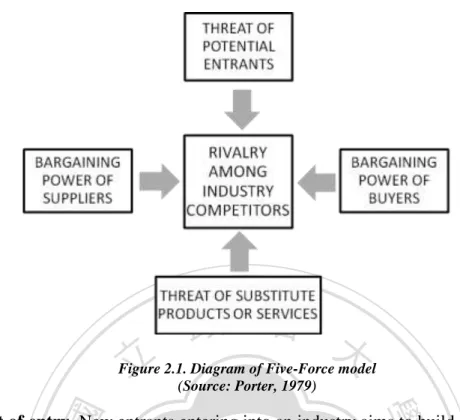
(28) environment and the particular media market in which the media firm operates and competes in (Chan-Olmsted, 2006).. 2.2.1. PEST and SWOT analysis In examining general environments of businesses and industries, the SWOT and PEST analysis frameworks have always been essential. The SWOT analysis (Strengths, Weaknesses, Opportunities, Threats) is often used to find the optimal match between resources and. 治 政 大the industry (Bouregois, 1996). company then can strategize and better position itself in 立. capabilities of a firm and external market conditions environmental trends, after which the. Strengths and Weaknesses refer to the company’s internal capabilities and limitations while. ‧ 國. 學. Opportunities and Threats refer to any external factor(s) that may influence the company’s. ‧. business decisions, often which includes the company’s competitors (Barney & Hesterly, 2006). The SWOT analysis is complemented by the PEST analysis (Political, Economic, Social,. y. Nat. er. io. sit. Technological) which examines specific areas and trends of the general market environment which the company is attempting to compete in (Botten and McManus, 1999).. n. al. Ch. i n U. v. In media management and economics research, Liu (1997) used SWOT analysis to. engchi. examine Taiwan’s multichannel television industry while McGrail and Roberts (2005) also demonstrated the use of SWOT analysis in influencing strategies applied in United States’ broadband cable television industry. Albarran, Chan-Olmsted & Wirth (2006) also cited many studies where PEST and SWOT analysis is used by various segments of the media industries to examine management and other issues. The PEST and SWOT analysis is also extensively used by market research firms in assessing telecommunication industries and its environments (Business Monitor International, 2010; Business Monitor International, 2011).. 20.
(29) Strengths in media industries can refer to the companies’ branding, availability of human resources, ample professional experiences, infrastructure and coordination between various business units. Weaknesses can refer to media companies’ high production costs in content, costly salaries for top-level management, political influences, lack of resources and conservative approaches in management and execution. Opportunities can refer to media companies’ listing on public stock exchanges, investments and diversifications into other media segments, promotional and cost-saving efforts, consumers’ continued interest in the companies’ content,. 治 政 大 in regulation and policy, to reduction of advertisers, decrease of audience ratings, uncertainty 立. audience segmentation, as well as innovation in content diversity and quality. Threats can refer. censorship of content, as well as incompetency and lack of human resources (Liu, 1997). Liu. ‧ 國. 學. (1997) and Chan-Olmsted (2006) also identified the following PEST factors that have affected. . ‧. television industries in Taiwan and the United States respectively:. Political: political history of the country, regulatory environments of broadcasting,. y. Nat. er. io. sit. deregulations to encourage cross-media competition, introduce new media technologies, apply cross-promotion strategies, sharing of resources; political changes towards. n. al. Ch. i n U. v. privatization and commercialization of media systems; opening of media borders for. engchi. global diversification, increasing programming demands and revenue potential and etc. . Economic: growth of global economy contributing to the market potential or decline of broadcasters; growth of GDP per capita allowing for more disposable income in entertainment spending; developments of global programming markets leading to more overseas media markets becoming potential revenue sources, mergers and acquisitions leading to growth of media conglomerates and creation of consolidated broadcast markets.. 21.
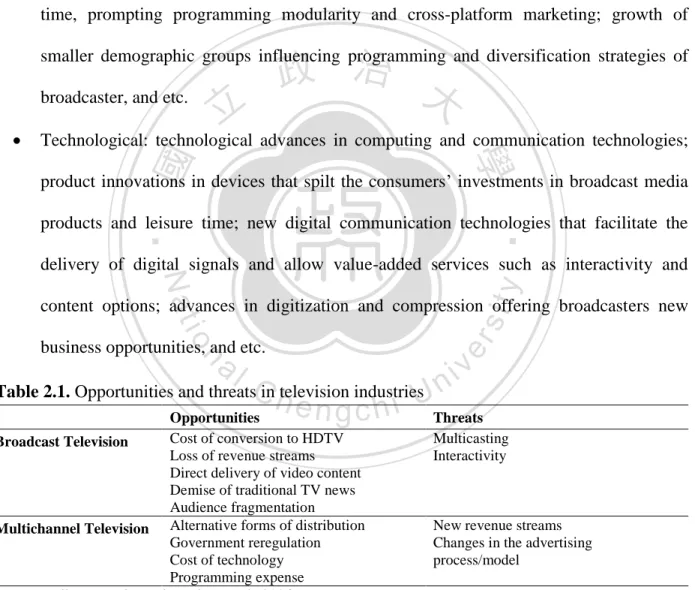
(30) . Social/Cultural: external forces that shape the types of audience, size, preferences and behaviors; aging of baby boomer audience segment widening reach-out for broadcast advertisers, altering programming approaches, scheduling strategies and competitive positions of different broadcasters; changing attitudes towards audiences’ quality of life and environment that can influence broadcasters’ promotional approaches and news focuses; busy lifestyles of audiences resulting in diminishing audience loyalty and leisure time, prompting programming modularity and cross-platform marketing; growth of. 政 治 大. smaller demographic groups influencing programming and diversification strategies of broadcaster, and etc.. Technological: technological advances in computing and communication technologies;. 學. ‧ 國. . 立. product innovations in devices that spilt the consumers’ investments in broadcast media. ‧. products and leisure time; new digital communication technologies that facilitate the. sit. y. Nat. delivery of digital signals and allow value-added services such as interactivity and. io. er. content options; advances in digitization and compression offering broadcasters new business opportunities, and etc.. al. n. iv n C Table 2.1. Opportunities and threats in television industriesU hengchi Opportunities Threats Cost of conversion to HDTV Loss of revenue streams Direct delivery of video content Demise of traditional TV news Audience fragmentation Multichannel Television Alternative forms of distribution Government reregulation Cost of technology Programming expense (Source: Albarran, Chan-Olmsted & Wirth, 2006) Broadcast Television. 22. Multicasting Interactivity. New revenue streams Changes in the advertising process/model.
(31) The above table summarized opportunities and threats in television industries. Ferguson in Albarran, Chan-Olmsted and Wirth (2006) also observed that opportunities and threats are ‘future-oriented’ and closely associated with the planning function of management.. 2.2.2. Five Force model The Five Force model by Michael Porter is an extension of the Structure-ConductPerformance (SCP) paradigm (Albarran, Chan-Olmsted & Wirth, 2006). Similar to the SCP. 治 政 大 where the state or strength of therefore also known as a structural analysis of an industry, 立 paradigm, the Five Force model examines industry competition through the industry structure,. competition in an industry is determined by five fundamental competitive forces from the key. ‧ 國. 學. structures of the industry (Porter, 1980; Bourgeois, 1996; Barney & Hesterly, 2006). The key. ‧. structures are the existing competing companies, customers, suppliers, substitutes and potential entrants in the industry. The circumstances surrounding them are the ‘competitive forces’, the. y. Nat. er. io. sit. intensity and areas of competition determining the level of competition and the collective strength of these five forces determines the profitability in the industry (Porter, 1980). In media. n. al. Ch. i n U. v. management and economics research, Liu (1997) specifically applied the model in analyzing. engchi. Taiwan’s television industries. Chan-Olmsted (2006) also used the model extensively to examine competition dynamics and their implications in the respective television industries in the US. The five competitive forces are shown below and will be discussed shortly. Appendix I contains a checklist for examining stakeholders in an industry.. 23.
(32) 立. 政 治 大. Figure 2.1. Diagram of Five-Force model (Source: Porter, 1979). ‧ 國. 學. Threat of entry. New entrants entering into an industry aims to build its market position, gain market share and share significant industry resources (Porter, 1979). Therefore, the threat of. ‧. entry into an industry is dependent on the respective entry barriers and costs of entry, such as the. y. Nat. sit. ease or difficulty of gaining and using resources, investing and start-up costs, retaliations and. n. al. er. io. reactions from existing competitors. If the entry barriers or costs are high, or existing competitors. i n U. v. are expected to retaliate severely against the new entrants, the threat of entry is considered low as. Ch. engchi. new entrants will not be keen to enter into the industry. Vice versa, low entry barriers or costs will heighten the threat of entry into an industry, especially in circumstances when the new entrants are diversifying from other markets and are able to leverage on existing capabilities, cash flows and other resources. Barriers of entry can be briefly summarized into the following categories: Economics of Scale, Product Differentiation, Capital Requirements, Switching Costs, Access to Distribution Channels, Cost Disadvantages Independent of Scale and Government Policy (Porter, 1979; Porter, 1980; Bourgeois, 1996; Botten & MaManus, 1999; Porter, 2008).. 24.
(33) Barney and Hesterly (2006) cited the example of the online book-ordering business in United States where Amazon.com faced the threat of entry by Barnes & Noble.com and Borders.com, who were already operating in the traditional publishing industry but ventured online to compete with Amazon.com. Barney and Hesterly (2006) also cited the case of ESPN facing threat of entry by Fox Sports Regional Network and College Sports Television; Budweiser, Miller and Coors investing substantial amount of capital in advertising and brand recognition to make new entry into the brewing industry difficult and the challenge of. 治 政 大media industries are: ownership of The factors and persons influencing Threat of Entry in 立. differentiation in wine-welling in France’s wine market.. the television stations and media systems, consumers’ demand for new television services, access. ‧ 國. 學. to distribution channels or programming, costs involved in ensuring adequate broadcasting. ‧. infrastructure and manpower, capital costs involved in ‘insuring’ financial performances and audience numbers for the media companies, switching costs for audiences and advertisers to. y. Nat. er. io. sit. switch from one television station to the new entrant, number of existing television channels in the industries, differentiation in channel genre and content, reputation of existing television. n. al. Ch. i n U. v. companies, needs and demands of television audiences, competition in pricing among existing. engchi. television companies, legislative requirements and conditions for new television companies (Liu, 1997; Landers & Chan-Olmsted, 2004; Chan-Olmsted, 2006). Intensity of rivalry among existing competitors. Rivalry in the industry occurs when companies feel the pressure or see an opportunity to improve their market position in their respective industries. The intensity of rivalry among existing competitors is dependent on several structural factors that interact and influences one another. Such factors include: the number and diversity of competitors in the particular industry, frequency of introduction of new products,. 25.
(34) rate of industry growth, level of switching costs, type of product differentiation, level of fixed or storage costs and etc (Porter, 1979; Porter, 1980a; Porter, 1980b; Barney & Hesterly, 2006). The usual tactics identified in companies competing against one another include price competition, product differentiation, advertising and marketing campaigns, introduction of new products, and customer service improvements (Porter, 1980a; Porter, 2008). In general, the more intense the competition in the industry, the more difficult it is for new companies to enter and the more challenging it is for existing companies to survive (Botten & McManus,1999).. 治 政 大entry into the online bookselling Nobles.com becoming competitors of Amazon.com after their 立 Barney and Hesterly (2006) cited the examples of Borders.com and Barnes &. industry; CBS, NBC, Fox, USA Networks and TNN becoming ESPN’s rivals; the case of the. ‧ 國. 學. global laptop and personal computer industry where there is no one company dominant; the trend. ‧. of intense price rivalry emerging in US’s fastfood industry between Burger King, Wendy’s and McDonalds, as well as the competition in US’s airline industry between airlines providing. y. Nat. er. io. sit. longer-route flights forced airlines to keep their prices low in order to attract customers. The factors and persons influencing Intensity of Rivalry in media industries are: similar. n. al. Ch. i n U. v. levels and areas of competency of the existing television companies, slow development of the. engchi. television industries due to economic downturns in the general environments, new entrants in the industries, product differentiation in channel genres and type of content, switching power of advertisers and audiences (Liu, 1997; Landers & Chan-Olmsted, 2004; Chan-Olmsted, 2006). Bargaining power of suppliers. Suppliers provide necessary resources to industries which require them and such resources include raw materials, human labor and other critical assets. Depending on the value and importance of the resources in the various industries, suppliers are at advantageous positions to negotiate for its own maximum profits. Similar to. 26.
(35) buyers, suppliers can influence industry competition through several ways, such as charging high prices or limiting the quality of its products and services. The extent of bargaining power for suppliers in an industry depends on the concentration of suppliers, the importance of the industry as the supplier’s customers, the suppliers’ dependence on the industry for its revenue, switching costs faced by buyers, level of differentiation of supplier’s products, replacement of supplier’s products with other substitutes and forward vertical integration by the suppliers (Porter, 1979; Porter, 1980a; Porter, 1980b; Botten & McManus, 1999; Barney & Hesterly, 2006; Porter, 2008).. 治 政 大 capabilities to Amazon.com and authors and employees who provide programming and logistics 立. Barney and Hesterly (2006) identified Amazon.com’s suppliers as book publishers, book. ESPN’s suppliers as the various sports leagues and TV personalities that host the various shows. ‧ 國. 學. on ESPN. Barney and Hesterly (2006) also commented on the suppliers posing a greater threat. ‧. when they are unique or highly differentiated. For example, the use of celebrities such as Michael Jordan and Oprah Winfrey meant higher costs incurred for companies who wish to. y. Nat. er. io. sit. leverage on them to promote their services or products.. The factors and persons influencing Bargaining Power of Suppliers in media industries. n. al. Ch. i n U. v. are: number of channel and content providers/suppliers, viewers’ demand for specific genres of. engchi. content, types of content available by the providers, pricing and quality of the respective content, programming costs and syndication rules, proliferation of media outlets and content buyers, trend of vertical and horizontal integration that is elevating the position of the broadcast buyers (Liu, 1997; Landers & Chan-Olmsted, 2004; Chan-Olmsted, 2006). Bargaining power of buyers. Regardless whether they are end consumers, commercial customers or intermediary vendors, buyers can influence industry competition by the extent of their bargaining power in the particular industry. Buyers often demand for better quality or value. 27.
(36) of goods or services, which forces competitors in the industry to compete against one another. Several factors affect the extent of bargaining power of buyers such as: the type of industry, price sensitivity, quality of the product, buyers’ profiles and purchasing habits, importance of products to the buyers, product variety and differentiation in the respective markets, volume and fixed costs of goods being purchased, buyer’s switching costs to other substitute or alternative products, backwards integration by the buyers in attempts to remove intermediary vendors and etc (Porter, 1980a; Porter, 1980b; Barney & Hesterly, 2006). In general, Botten and McManus. 治 政 in circumstances where intermediary vendors may influence 大 purchasing decisions of downstream 立. (1999) stated that the greater the bargaining power of buyers, the less advantage sellers has. Also,. customers and affect buyers’ profitability in the industry, the buyers who are now in the position. ‧ 國. 學. as suppliers (or producers) may choose to enter into exclusive arrangements with particular. ‧. distributors or retailers in order to retain their greatest industry profitability (Porter, 2008). Barney and Hesterly (2006) observed that buyers for Amazon.com included customers. y. Nat. er. io. sit. who purchase books and advertisers who purchase advertising space on Amazon’s website. Similarly, buyers for ESPN include audiences who watch sports on television and advertisers. n. al. Ch. i n U. v. who purchase advertising space on the network. Barney and Hesterly (2006) also commented on. engchi. the trends that powerful retail firms (e.g. Walmart and Home Depot) can make significant and complex logistical and other demands on their suppliers; as well as the concerns that firms such as Campbell Soup company have on keeping their costs for the tin cans (to contain the soup) low. Chan-Olmsted (2006) identified two categories of buyers in broadcast markets: advertisers and audiences. The factors and persons influencing Bargaining Power of Buyers in media industries are: levels of dependence in channel and content providers, possibilities of audiences switching to alternative media systems, number of subscribers and prices for content. 28.
(37) on pay-per-view or channel subscriptions, dependence on advertisers buying advertising time and advertising volume (Liu, 1997; Landers & Chan-Olmsted, 2004; Chan-Olmsted, 2006). Threat of substitutes. Substitute products perform the same or similar functions as the products in the particular industry that is being examined. In such circumstances, existing companies in a particular industry not only have to compete against one another, but also with companies in industries that produce possible substitute products. If those substitute products are sold at lower or equally competitive prices as compared to the products of that industry,. 治 政 industry (Porter, 1979; Porter, 1980a; Barney & Hesterly,大 2006). The threat of substitutes is 立 competition in that particular industry may be affected greatly, therefore posing a threat to the. higher when there are low switching costs between the original products and the substitute. ‧ 國. 學. products, or when the value or performance of the substitute product is higher and better than. ‧. that of the original product (Porter, 2008). Barney and Hesterly (2006) further added that substitute products can limit the pricing of original products or even replace them in extreme. y. Nat. er. io. sit. situations, further affecting competition in the original industries. Factors that may affect the replacement of original products with substitute products include tax policies on the original. n. al. Ch. i n U. v. products, any government funding or assistance to the development of the substitute products,. engchi. marketing efforts and distribution of the substitute products, as well as any collective industry action taken against the substitute products by the industries producing the original products (Porter, 1980b). Barney and Hesterly (2006) offered the example of Barnes & Nobles and Borders being substitutes for Amazon.com. Television was also observed to be a close substitute for books, with its popular offerings of comedies, dramas and documentaries providing another form of. 29.
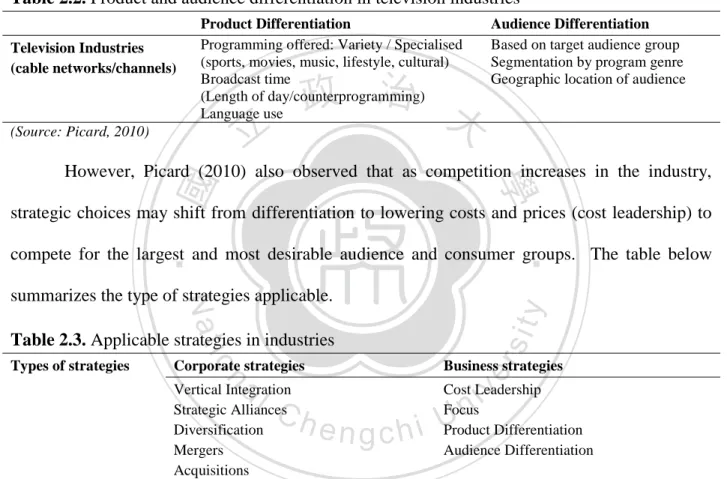
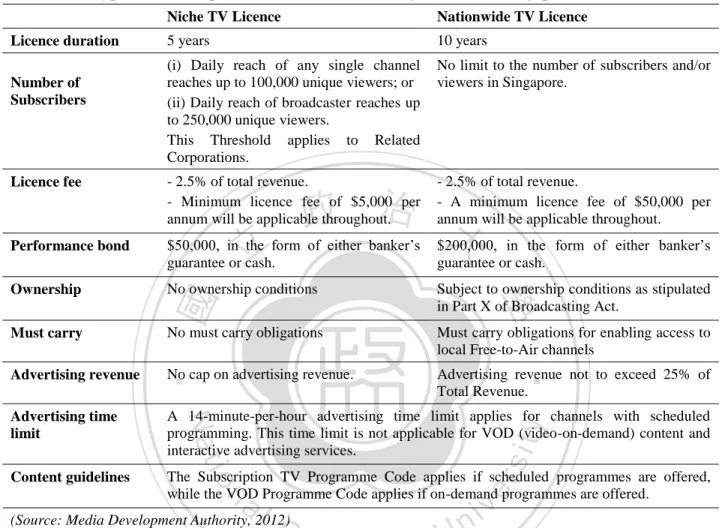
數據

+7




Outline
Literature on television industries
Issue of exclusive content
Political environment
Economic environment
Implications for Singapore’s television industries
Development and competition in the subscription television industry
Exclusive content in Singapore and the Cross-Carriage Measure
Industry development after the Cross-Carriage Measure…
Impacts of the Measure on industry stakeholders
Checklist for examining stakeholders in an industry
相關文件
In 2017, gross value added of the MICE sector, financial activities, Chinese medicine sector and cultural industries amounted to MOP 32.08 billion, representing 8.07% of the
In 2018, gross value added of financial activities, the MICE sector, cultural industries and the Chinese medicine sector amounted to MOP 35.33 billion, representing 8.1% of the
In 2018, gross value added of financial activities, the MICE sector, cultural industries and the Chinese medicine sector amounted to MOP 35.33 billion, representing 8.1% of the
In 2017, gross value added of the MICE sector, financial activities, Chinese medicine sector and cultural industries amounted to MOP 32.08 billion, representing 8.07% of the
In 2019, gross value added of financial activities, the Meetings, Incentives, Conferences and Exhibitions (MICE) sector, cultural industries and the Chinese medicine sector amounted
In 2017, gross value added of the MICE sector, financial activities, Chinese medicine sector and cultural industries amounted to MOP 32.08 billion, representing 8.07% of the
As regards the two main industries in manufacturing, namely manufacture of textiles and manufacture of wearing apparel, their gross output, gross value added and the structure of
As regards the two main industries in manufacturing, namely manufacture of textiles and manufacture of wearing apparel, their gross output, gross value added and the structure of
