行政院國家科學委員會專題研究計畫 成果報告
以培養正直性格為宗旨的管理教育課程設計之研究
研究成果報告(精簡版)
計 畫 類 別 : 個別型 計 畫 編 號 : NSC 94-2416-H-110-019- 執 行 期 間 : 94 年 08 月 01 日至 95 年 10 月 31 日 執 行 單 位 : 國立中山大學企業管理學系(所) 計 畫 主 持 人 : 黃賀 計畫參與人員: 博士班研究生-兼任助理:施俊名、蘇英芳 報 告 附 件 : 出席國際會議研究心得報告及發表論文 處 理 方 式 : 本計畫可公開查詢中 華 民 國 96 年 01 月 31 日
行政院國家科學委員會補助專題研究計畫成果報告
※※※※※※※※※※※※※※※※※※※※※※※
以培養正直性格為宗旨的管理教育課程設計之研究
※※※※※※※※※※※※※※※※※※※※※※※
計畫類別:個別型計畫
計畫編號:NSC-94-2416-H-110-019-SSS
執行期間:94 年 8 月 1 日至 95 年 10 月 31 日
計畫主持人:黃 賀
執行單位:國立中山大學企業管理學系
中華民國九十六年一月二十八日
行政院國家科學委員會專題研究計畫成果報告
以培養正直性格為宗旨的管理教育課程設計之研究
計畫編號:NSC 94-2416-H-110-019-SSS
執行期限:94 年 8 月 1 日至 95 年 7 月 31 日
主 持 人:黃 賀
國立中山大學企業管理學系
研究助理:施俊名 國立高雄師範大學教育研究所
研究助理:蘇英芳 國立中山大學企業管理研究所
中文摘要 雖然大多數人都認同正直性格的 重要,但環境競爭的壓力誘使人們追 求短期成功,難於展現正直的行為。 尤其是近年來台灣社會缺乏典範人 物,使得問題更惡化。 解決之道在於教育,本研究尤其 重視一個能培養正直性格的管理教 育。學生需要自尊、韌性與支持,才 會發展成為負責任的正直公民,這是 對教育工作者的重大挑戰,教育工作 者要為品格教育設計出創新與具創意 的課程。由於正直性格的概念不易明 確掌握與學習,這方面的教育課程尤 須重視變革的願景、課程發展、教師 訓練以及社區合作。 英文摘要Although the vast majority of people share a respect for the character of integrity, people today face great uncertainty and keen competition in a complex and troubled society so that they have difficulties in demonstrating integrity behavior. The stress of competition provides the major impetus for acting unethically if people are
tempted into a short-term success. What worsens the situation is the fact that there are very few exemplary public figures in this chaotic society of Taiwan in recent years.
The solution may again lie in education, especially a management education that builds character. The challenge for management educators is to provide students with the self-esteem, stamina, and support they need to develop into responsible citizens with integrity. Educators may want to meet this challenge through a variety of innovative programs for character education. As traits of integrity are not always readily apparent and easy to grasp or learn, new educational programs may include a vision for change, curriculum development, teacher training, and community collaborations.
壹、緣由與目的
著名的管理學者如彼得杜拉克、 布蘭佳等,與各有關領導力的研究著 作都再三強調品格道德是邁向成功領
導的最基本也是最重要的一項,領導 人必須能在道德上自律才能帶領出一 個健全的組織。換言之,所有組織正 向績效都是奠基在諸如正直、誠實與 信用等品格上。領導者如果擁有高度 能力與領導技巧,卻 不遵守誠信原 則,缺乏良好的品格,就絕難贏得社 會的信任。 台積電張忠謀認為,不論東西方 社會,正直與誠信長久以來皆是極受 推崇的社會價值,但已快速流失中。 Schwarzkopf也認為領導是策略與品格 的結合,但如果只能擇一,則應捨策 略 而 選 品 格 。 換 言 之 , 正 直 誠 信 (Integrity)、愛與關懷等品格才是超 越一切時空的關鍵因素,而且是領導 的根本基礎。 在社會普遍要求企業領導人具備 正直人格之之際 ,從 長遠的觀點來 看,著力點還是在教育,因為教育會 對學生的心智與生活各層面產生深遠 的影響。因此,管理教育須考慮開創 品格教育的學程,發展配合的課程, 並進行老師的訓練以及社區的合作。 本研究即希望透過妥善的課程設 計以培養學生的正直性格,讓學生知 道倫理規範準則,同時瞭解行為可能 產生的後果,並體會其對決策的重要 性,瞭解與預期學生經此課程實驗後 所造成的認知、情意以及行為態度等 各方面之改變情形。 貳、文獻探討 一、國內外有關企業倫理相關課程實 施現況探討 近年來,對管理教育尤其是MBA 教育的課程批評最力的,莫過於加拿 大著名的企管學者Mintzberg,他認為 目前的MBA教育是對一群不適當的人 施以不適當的訓練,導致不適當的後 果(Mintzberg, 2004),呼籲大學進行 課程設計的改革,他建議上課方式全 部改為小組討論,把課程區分為五大 領域,分別強調自我反省、創新、世 界觀、團隊合作以及變革行動。 課程(curriculum)就是促進學生的 學術發展的一個學術計畫。一個完整 的課程計畫,Stark & Lattuca (1997) 認為在設計課程時,必須考慮八個組 成單元:目的、內容、教學順序、學 習者、教學過程、教學資源、評量、 輔導措施等。在課程設計過程中應遵 守一定的原則(Gardiner, 2000),系 主任、教師、課程委員會都須扮演正 確的角色(Diamond, 1998)。 關於管理教育的課程設計方面, 國內外的討論甚多,但多未注意到與 品格教育的整合。例如蕭仲良(1998) 探討台大與政大商學院的課程規劃, 提出以下建議:一、涵蓋的課程領域 要廣泛;二、設立讓教師可以相互交 換教學經驗的機制;三、教師須訂立 明確的教學目標;四、發展本土化的 教材;五、教師可針對不同的教學目 標,採取多元化的教學方式;六、採 取一問一答互動式的討論方式;七、 教師應多了解學生的背景。這些針對 商管教育特質所提出的多屬於技術面 的建議,並未特別針對品格教育方面 提出看法。 至於國外大學對企業倫理課程的 研究,似乎以哈佛商學院最先採取實 際的行動,在1987年獲得兩千三百萬 美元的捐贈,用於企業倫理課程的創 設,推出「決策及倫理價值(Decision Making & Ethical Values)」新課程(徐 木蘭,1994)。近期的商管教育的課
程設計已普遍增加了企業倫理面的考 慮,例如密西根大學商學院近來推出 領導特質發展計畫,邀請業界高階經 理人來談談自身面對倫理兩難的心路 歷程,同時透過工作營和團隊遊戲, 希望藉此形塑學生成為有良心的企業 領導人。美國馬里蘭大學的EMBA 班 赴監獄訪問因經濟犯罪入獄的企業執 行 長 , 作 為 警 惕 教 材 ( 聯 合 報 , 2004.12.24,版B2)。也有學者認為利 用企業名人或企管學者的傳記作為正 面教材,可以讓學生能有效學習到管 理技巧(Witzel, 2001),傳記教學法 應亦可供品格教育之用。 二、課程規劃與檢驗標準 任何課程實施的時候,都因為明 確的目標規劃而使得教學產生遵循的 方向與實踐的力量。目標的來源雖然 有許多,但目標的建立卻是課程設計 的第一步。倫理教育課程由於強調實 踐性,因此,在課程設計上將以最能 符 合 學 生 需 求 的 「 經 驗 課 程 」 (experienced curriculum)與「活動課 程」(activity curriculum)作為規劃原 則,亦即冀望藉由多元的學習內容與 教學方式,使學生的認知、情意以及 技能等方面都能獲得 潛移默化的成 長,並建構出屬於個人的教育意義。 在進行課程設計時,須注意以下 幾個的問題:課程的範圍(scope)、課 程的統整(integration)、課程的順序性 (sequence) 、 課 程 的 繼 續 性 (continuity)、課程的明確性(articulation) 和均衡性(balance)(Ornstein & Hunkins, 1998)。此外,於課程設計時,須先確 立教學目標 ,再進行 課程內容的選 擇,組織課程相關之元素,利用循序 漸進的教學策略與評鑑,以達到預定 的教學目標。 依據課程設計理念,研究者參考 李琪明(2004)品德教育課程自評標 準加以修正,臚列出規劃正直倫理課 程時之十點自我檢驗規準: 1.課程設計定位清楚嗎?是屬於正式 課程、非正式課程還是潛在課程?還 是兼有之? 2.課程設計是否兼顧認知、情感、意志 與行動? 3.課程設計考慮周延嗎?是否納入背 景、輸入、過程與輸出等因素考量? 4.課程設計是以學生為主體嗎?還是 只為了應付政策或教學之績效? 5.課程設計對於教師有明確定位嗎? 有 讓 教 師 從 中 反 省 與 修 正 之 機 會 嗎? 6.課程設計有將校園納入考量嗎?學 校整體氣氛對於學生正直信念的培 養是正向還是負向?能善用資源並 改善阻力嗎? 7.課 程 設 計 能 免 於 意 識 型 態 之 宰 制 嗎?是否時時思考自己背後所隱藏 之或視為理所當然之價值? 8.課程設計是開放與容納多元價值的 嗎?其是否可以藉由溝通以達致暫 時性之共識,而非既定與單一之價值 觀? 9.課程設計展現了正義與關懷嗎?是 否凸顯了正直之意涵與價值? 10.課程設計之特點為何,與其他之課 程有何不同與關聯? 參、研究設計與規劃結果
一
、研究設計 為設計本課程內容,本研究從三方面分別 進行 。 首先 是蒐集次級資 料,參考歐美先進國家商管學院的做 法;其次,對國內大專院校目前的倫 理教育現況進行充分瞭解,對其成效 給予評估。研究者已發展出一系列正 直問卷,可就本計畫需要修訂後加以 應用;最後,舉行專家訪談,根據已 蒐集的國內外資料以及專家們本身教 學經驗,歸納適合我國國情的商管倫 理課程,以有效培養學生的正直性格。 二、課程規劃理念與架構 (一)課程概述 具體來說,本課程希望藉著多元 的教學方法培養學生 具有正直的性 格,並潛移默化於生活情境當中,瞭 解行為背後的後果,並體會其對決策 的重要性。本課程實施理念主要有三 點(至於實施策略請參考附錄一及附錄 二)。 1. 透過認知的教學活動使學生得到 正確的觀念與啟發,包括講述與討 論、探究、價值澄清及合作學習。 2. 實施同理心與引起共鳴的教學活 動,引發學生情意的學習與成長。 3. 透過體驗的方式以收到實踐的效 果,包括欣賞教學、參觀訪問及角 色扮演。 (二)課程主要實施方式 在企業倫理課程中,常用的教學 方法有講述法、討論法、文獻閱讀討 論、個案分析法、商業劇情報告、專 題討論、角色扮演體驗法、價值澄清 法、情境教學法、補充教學法(機構 參訪、專家演講以及義工服務)等等。 各種教學法均有其特色及適用之時間 空間,為了教學能生動活潑、具啟發 性,各種教學法宜交互使用,而其中 價值澄清法、角色扮演體驗法、情境 教學法、個案分析法以及補充教學法 如能相互搭配使用,再加上師生更多 之互動,可有效提高教學效率。茲將 上述教學方法簡介如下: 1. 價值澄清法(value clarification): 價值澄清法是 Raths 於 1957 年在 美國紐約大學任教時所創導。主要在 協助學生察覺自己和他人的價值,並 由此建立自己的價值體系。Raths 等人 認為「價值不明確的個人缺少生活的 方向,缺少選擇時間和精力的效標。」 (Raths, Marmin & Simon ,1978)。學生 澄清其價值以後,就更有目的、有生 產性,是一個批判的思考者,才能做 健全的意思決定。 基本上它包含了下列四項重要的 元素:(1)以生活為焦點;(2)接納事實 與既存的意見與立場;(3)促使個人進 一步的反省;(4)滋潤個人內在的力量。 價值澄清法所依據的前提是:「任 何人都沒有正確的價值可以傳達給其 他的人」。但是價值源於個人的經驗, 而非順應預先決定好的架構。所以, 價值澄清法依據人類自身的智慧,決 定價值是積極的或消極的,個人在社 會中自動地採取行動 , 並能改變環 境。換言之,人們重視決定人類行為 的內在因素而非外在因素。Raths 和 Simon 等人強調,價值形成的過程必須 經過下列五個階段: (1) 面對倫理兩難的問題找出各種可 行選擇; (2) 評估各種可行的選擇; (3) 做出理性和自由的抉擇; (4) 勇敢的表達自己的立場; (5) 根據自己的信念去實踐生活。 價值澄清法依據這五個過程來實
施價值教學,與傳統的灌輸式、注入 式的道德教學迥然不同,給予學生更 多的自由選擇的機會,協助他確定自 己的價值。因此,價值澄清法合乎三 種精神:第一、合乎民主精神,承認 人人都有選擇的權利;第二、合乎人 文精神,承認人人都有選擇的能力。 個人能運用智慧在瞬 息萬變的世界 上,在錯綜複雜的社會中,發展一套 做人處世的價值標準;第三、尊重個 人的精神,價值之存在純屬個人,倘 無自由選擇的機會,它便無法深植心 中。換言之,在教學中,學生是主角, 教師只是輔導者,可用暗示、鼓勵、 詢問、設難、提供意見、供給客觀資 料、啟發式的問題答覆、激起學生的 鬥志、恢復學生信心等。 研究者在課程進行時會提出一些 問題,除了引導學生更具體的去了解 授課內容及教學目的之外,更進一步 透過思考這些問題的過程反思自己的 行為,以達教學之功效。同樣的也希 望能透過提出問題的方式來引導學生 們做價值澄清,藉此對自己的行為做 適度的修正。 2. 角色扮演體驗法〈Role playing〉: 角色扮演是一種特別形態的戲劇 法,透過短劇,部份學生扮演指定角 色,其他學生觀察,最後一起討論結 果。角色扮演的主要目的在於促使學 習團體能更真實地感受到問題、事件 及某些情況,藉此幫助學生了解及面 對問題。在六○年代就有學者嘗試以角 色扮演法作為教學策略,並從事實驗 以探討其教學成效。到了八○年代, Joyce & Weil(1986)綜合幾位學者的
研究,發展一套角色扮演教學模式。 角色扮演在教育上的功能包括: (1) 學生能探索其所扮演角色的內心 世界。 (2) 學生可經由角色扮演而確認其內 在態度及價值觀,進而影響其行 為。 (3) 學生得以發展解決問題的技巧與 態度,有助於現實生活的解決。 (4) 學生可以透過多元途徑探討學科 知識,養成自動求知的態度。 正直倫理的課程即希望透過模擬 道德情境,體會不同當事人的不同立 場與心情,激發想像力以尋求最佳解 決方案。 3. 情境教學法: 情境根據刺激物對學生感官或思 維活動所引起的不同作用,大致可分 為實體情境、類比情境、語表情境、 想像情境及推理情境五大類。 (1) 實體情境:即以物體原型為主的情 境。 (2) 模擬情境:則在相似原理的基礎上 產生的情境。 (3) 語表情境:即運用語言表述的情 境。 (4) 想像情境:則是通過學生的想像活 動,在已經獲得經驗的基礎上,將 表像重新加以組合的情境。 (5) 推理情境:必須由形象思維逐步向 抽象思維過渡。 研究者將於課程中運用了情境教 學的教學策略,一方面引起學生們的 學習動機,另一方面讓學生們藉機認 識當時的時空背景及環境,使學生們 有一些先備知識。
4. 個案分析法〈Cass Analysis〉 傳統企管教育在課堂上主要講授 經營管理理論,由於許多學生未具有 企業實務經驗,因此學習成效不彰, 學生也抱怨不知將如何應用。而個案 教學不但提供學生大量的企業實務資 料,並要求學生針對具體實際的問題 進行分析討論, 提出 觀點與解決方 案。 由於個案問題大 都複雜且無條 理,因此學生必須要理出頭緒,收集 關鍵資訊,並在資訊不充足的狀況下 提出主張,並說明原因與執行方案。 因此,對於學生分析能力與決策能力 的提昇,會有很大的幫助。而學生也 會思考如何將在其他管理課程中所學 習到的理論知識,運用在個案實務的 分析中,來增加決策的信心與能力。 雖然個案決策不同於企業實際的 經營決策,因為前者只是模擬,不須 為後果負責,而後者是需要承擔決策 失誤的風險。不過我們仍以為,個案 討論將有助於決策分析能力培養,並 且可以增加同學以後在實務工作上進 行決策的信心。 5. 補充教學 在課程規劃上,除了一些講授倫 理準則外,在課程設計上將邀請一些 企業成功人士分享正直信念對企業經 營的重要性,藉由楷模偶像的現身說 法,激發學生仿效之動機,潛移默化 成人格的一部份。 此外,亦可透過機構參訪及義工 服務增進學生同理心,感同身受,表 現出正直之信念。 肆、結論與建議 一、對教師規劃課程的建議 將倫理經驗帶入自己的專業領域 來考量,是倫理教育者第一件可行之 事。專業品格教育往往不僅限於一個 課程而已,更重要的是它是所有的專 業 教 學 裡 的 潛 在 課 程 ( hidden curriculum),事實上平日教師們的言 行舉止與判斷,就已經在影響學生。 因此,在適切的課程內容中增添一些 富有正直信念的議題,將有助於學生 在潛移默化中內化成人格的一部份。 另外,品格教育要超越認知的領 域,不只是告訴學生什麼是善,什麼 是惡,而是要培養學生批判思考和決 策的能力 ,讓學生做 出 對或錯 的評 斷,並參與道德的實踐,他們主張必 須在形塑品格過程中,讓學生的心、 腦、手一起加入,協助學生「知善、 愛善、行善」(周慧菁,2003) 二、對學校舉辦活動的建議 學校可藉由舉辦相關的倫理課程 規劃研討會,或邀請專家座談、諮詢 等機會,要求校內老師儘量參加,以 瞭解課程發展與設計理論,並鼓勵全 校老師共同參與學校倫理課程的發展 與設計工作,希望能共同規劃出適合 學生、學校與社會需要的課程,使老 師不僅只是教學者 , 亦是課程設計 者,同時更期望老師能因參與所帶來 的成就感與滿意度,可以提昇教學品 質。 三、對研究的後續建議 本研究的主題為正直,最主要的 困難來自受測者對此類問題的高度敏 感,而不願透露真正的想法,本研究 為減輕社會讚許(social desirability)現 象所導致的測量偏差,在教學成效衡 量問卷的設計上須十分慎重,解決的 途徑可以採用vignettes(故事情境)設計
問卷,要求受測者融會其中,做出抉 擇;對正直行為的量表則須應用混充 題( filler)的問卷設計,讓受測者摸不透 測量的目的,前測與後測採用不同的 混充題,也可減低受測者對前測的記 憶。 此外,實驗組可能會發生霍桑效 應 , 或 者 對 照 組 產 生 士 氣 低 落 (Demoralization)的問題,有頼研究者 細心避免。 伍、研究結果自評 本研究曾申請延長三個月,執行 情形與研究計畫符合。整體而言,除 研究計畫預定之工作皆已完成外,參 與之研究助理並已獲得必要之訓練。 同時,於計劃進行過程中,曾訪問相 關領域教師,均有良好回饋,認為本 研究所提出的教學課程架構將有助於 未來教學與實踐。此外,研究者將撰 寫期刊論文,正式發表研究的成果。
參考文獻
李琪明(2004)。品德教育之課程設 計理念及其教學模式。學生輔導, 92期,8-23頁。 周慧菁(2003)。品格新世紀的第一堂 課。天下雜誌,287,36-40。 徐木蘭(1994),共創企業淨土,台北 市:天下文化。 蕭仲良(1998),國立政治大學企業管 理學系碩士論文,管理教育教學方 法與課程設計之實證研究-以國內 商管學院為例。Diamond, R. M. (1998). Designing and
Assessing Courses and Curricula: A Practical Guide. San Francisco: Jossey-Bass.
Goodlad, J. ( 1994 ) . Educational
Renewal: Better Teachers, Better Schools. San Francisco,CA: Jossey-Bass.
Joyce, B. & Weil, M. (1986). Models of Teaching (3rded.). Prentice-Hall Inc
Ornstein, A. C. and Hunkins, F. P. (1998). Curriculum: Foundations, principles and issues, 3rd. Boston: Allyn and Bacon.
Mintzberg, Henry.(2004). Managers Not
MBAs. San Francisco: Berrett-Koehler
Publishers.
Petrick, J.A. & Quinn, J.F. 2000. The integrity capacity construct and moral progress in business. Journal of Business
Ethics, 23, 1, 3-18.
Raths, L., Marmin, M. & Simon, S.(1978), Values and Teaching:
Working with Values in the
Classroom, Merrill.
Stark, J. S. and L. R. Lattuca.(1997).
Shaping the College Curriculum: Academic Plans in Action. Needham
Heights, Mass: Allyn and Bacon. Witzel, M.(2001). Biographical
Dictionary of Management, vols.
附錄一、培養學生正直性格課程規劃與實施概念圖
培養學生正直性格
認知概念
情意態度
行為表現
重點方案 推動主軸 核 心 概 念 道德 判斷 價值 澄清 批判 反思 勇氣 同理心 信任 真誠 行為 正直 關懷 助人 言行 一致 個案 分析 個案 分析 個案 分析 電影 欣賞 電影 欣賞 電影 欣賞 電影 欣賞 榮譽 制度 義工 服務 榮譽 制度 情境 教學 情境 教學 情境 教學 名著 選讀 名著 選讀 名著 選讀 名著 選讀 楷模 票選 愛心 活動 楷模 票選 實 施 策 略 生命 教育 角色 扮演 溫馨 活動 專題 演講 大地 遊戲附錄二、培養正直性格為宗旨之課程規劃(以「人力資源管理」為例)
一、課程內容具有「正直」意涵的教學單元主要讀本:Byars and Rue (2003) Human Resource Management, New York: McGraw-Hill.
週次 章節名次 具正直內涵的課程活動單元 教學性質 教學評量 一 Human Resource Management:A Strategic Function 由教師開宗明義說明「正直」 的意義、內涵及現階段研究 成果,並以大量舉例的方式 協助學生認識正直的價值, 從而體會其重要性。 課 程 講 授 式教學 提問 課 堂 參 與 程度 一 Implementing Equal Employment Opportunity 「以國內(包括中山)大學未 依法聘用一定比例之身心障 礙者、原住民人員,遭巨額 罰款案」為例,說明企業在 徵聘、面試、聘用,升遷、 訓練、薪津、福利等各項雇 用過程中,應重視員工公平 就業機會及保障。 個案研討 個 案 分 析 能力 課 堂 參 與 程度 二 Equal Employment Opportunity:The Legal Environment 參訪「勞委會」,實際觀摩 勞委會的作業活動以瞭解勞 工政策、勞工安全以及公平 就業方案等相關辦法。或參 觀監獄,訪問因詐欺入獄的 受刑人。 機構參訪 參 訪 心 得 報告
三 Job Analysis and
Design 探討工作設計時「人性化vs 績效化」的平衡。討論如何 建立、維持具有積極氛圍的 工作環境,以維繫組織生存 發展之道。 課程講授 式教學 提問 課 堂 參 與 程度 四 Human Resource Planning 以「流浪教師」及「教育部 師資培育政策」為例,說明 人力資源規劃與企業經營策 略之關係,進而釐清策略要 求與人力現狀的差距,據此 制定企業所需要的人員總量 個案研討 個 案 分 析 能力 課 堂 參 與 程度
和結構,並進一步推導到各 部 門 和 分 支 機 構 的 人 員 配 置。 五 Recruiting Employees 以「中鋼公司董事長任命方 案」為例,說明企業內升遷 或空降外部高階經理人對組 織人力資源管理的績效與衝 擊,以及對政策延續及員工 承諾之影響。 個案研討 個 案 分 析 能力 課 堂 參 與 程度 六 Selecting Employees 藉由選讀《企業全面品德管 理—-看見亞洲新利基》一 書,從不同層面的企業倫理 實踐進行省思,書中並提及 「具備優秀的人品才是真正 的優秀人才,然後才有優秀 的公司、高品質的產品及服 務」。希望藉此將古老價值 準則的品德倫理,內化至學 生的企業經營理念、價值觀 及人際互動之中。 名著選讀 心得分享 七 Orientation and Employee Training 參訪飛利浦(Phillips)或IBM 高雄分公司,以瞭解其員工 教育訓練與職涯規劃的策略 及實際做法 機構參訪 心得報告 八 Management and Organizational Development 採分組角色扮演方式進行, 角色扮演的內容主要從教師 所指定的十四個模擬情境中 擇一,藉由生動活潑的戲劇 詮釋,將正直信念融入到模 擬的情境當中。 角色扮演 教 師 依 劇 情 內 容 之 豐 富 性 加 以評選 九 Career Development 由教師針對「領導者與部屬 交 易 理 論 ( leader-member exchange theory,LMX)進 行講授,並以此為理論架構 說明主管與部屬間經由互動 之信任關係及歷程,所產生 的「圈內人」與「圈外人」 的對立模式,進而說明此一 課程講授 式教學 提問 課 堂 參 與 程度
模式如何影響員工的生涯發 展與規劃。 十 Performance Management Systems 以「美國西點軍校學生集體 作弊」為例,說明績效管理 與正直的關係,說明正直在 健全的績效管理系統(目標 管理、職能管理、職涯發展) 中所扮演的關鍵性地位,員 工必須清楚各項專業或管理 技能的訓練與發展,必須在 正直的前提下進行。 個案研討 個 案 分 析 能力 課 堂 參 與 程度 十一 The Organizational Reward Systems 以「美國證管會理事長自肥 乙案」為例,探討企業高級 主管的優渥薪資與福利是否 違反正直誠信的原則,以及 應該如何矯正。 個案研討 個 案 分 析 能力 課 堂 參 與 程度
十二 Base Wage and
Salary Systems 以「信義房屋」為例,說明 有別於其他房仲業的單打獨 鬥的模式,特別重視員工安 全的就業環境,例如率先提 出新人六個月每月四萬元薪 資保障及業務同仁的高底薪 設計,強調「合作分工」的 群 體 精 神 , 並 設 計 業 務 同 仁、主管及幕僚的團體獎金 等。由於秉持「信義立業, 止於至善」的經營理念,使 信義房屋穩居國內房仲業龍 頭地位。 個案研討 個 案 分 析 能力 課 堂 參 與 程度 十三 Incentive Pay Systems 以「台機電張忠謀與聯電曹 興誠針對員工領取股票分紅 的正當性爭議乙案」為例, 探討薪資酬勞分配原則是否 與其他利害相關人的利益有 抵觸的關係。 個案研討 個 案 分 析 能力 課 堂 參 與 程度
十四 Employee Benefit 藉由選讀《組織的盛衰:從 歷史看企業再生》一書,使 學生體會組織興衰的法則, 並以此檢視過度強化員工的 福祉往往會使組織僵化,逐 漸漠視自己的功能性任務, 進而促使組織滅亡。一如界 屋太一所說的「共同凋謝的 櫻花」。 名著選讀 心得分享 十五 Employee Safety and Health 藉由參訪行程了解「中油公 司」內部組織定位與任務, 及其相關員工職業安全作法 與設施,習取寶貴經驗並交 換意見。 機構參訪 參訪心得 報告 十六 Employee Relations 藉由觀賞《間諜遊戲》影片, 使學生體會長官與部屬彼此 間休戚與共之關係。電影主 要描述一位即將退休的CIA 探員,得知自己的愛將在中 國大陸因從事間諜活動被囚 禁,出馬解救。在行動過程 中 , 這 位 長 官 不 計 一 切 代 價,甚至犧牲自己全部的退 休俸。片中對情報人員的人 生觀、互信及生存價值做了 非常深刻的描寫。 電影欣賞 心得分享 十七 The Legal Environment and Structure of Labor Unions 邀請專家學者分享企業工會 組織運作的模式與經驗,以 及勞資關係爭議協處的程序 及如何達成win-win 的技巧 等。 專家分享 參訪心得 報告 十八 Union Organization Campaigns and Collective Bargaining 由學生分組競賽,研擬勞資 爭議的情境,並發揮創意提 出集體協商的最佳策略。由 教師從中評選出具備正直信 念方案的小組給予鼓勵。 個案競賽 教師評選 提案優良 小組
二、上述各教學單元的可能實施方法與說明 一、 楷模學習 (一)以身作則 教師須以身作則(維持言行一致的形象) 由教授以身作則,使學生體驗與認同正直的人格是成為管理者的基本條 件。 老師們以身作則,並時常在課堂上提及正直和誠信的重要。儘可能小班 制,促進自我體驗及互動式教學。 特別注重老師的身教及言教並積極參與學生活動事務。細心觀察同學們 的道德表現,透過潛移默化的影響,提升學生的正直道德觀。 獎勵具有誠實與正直行為的學生。 言教不如身教,學生或許對於教科書上寫的道德倫理無動於衷,但是感 興趣於 教授在課堂上所分享的故事、經驗等。 (二)經驗分享 可列舉成功企業家因違反誠信正直而失敗的例子。 給學生更多的正面期許,在授課過程中可強調有關社會責任與企業倫理 的實例,邀請知名度高且具代表性的企業界人士與同學分享其理念與堅 持,讓學生有「有為者亦若是」的感覺。 舉行相關演講,邀請對誠信正直等價值充分認同並落實的企業高階經理 人,深談這些價值對公司的影響,分享其治理公司時如何取捨。 安排非營利機構(如慈濟、紅十字會)重要人士演講。 邀請以誠信、正直為企業文化而著稱的企業主來校演講。 邀請同系學長姐做經驗的分享,說明面對道德兩難的經驗。 重點在培養學生愛自然、愛人的心胸。 提供一個抒發內心秘密的管道,使同學能將心中所隱藏的部份,勇敢說 出來。 每週分享上星期做了哪些值得鼓勵的事。 指派作業,對企業倫理有關事蹟寫讀書心得。藉由心得觀察學生心態再 藉由同學間及老師互動回饋及討論,培養具有誠信的學生。 (三)個案研討 利用一些有關企業倫理兩難的個案,讓學生了解企業倫理對組織的長期 利益的影響。 使學生瞭解不道德行為所造成的的法律及輿論的後果。 分析注重倫理與否的差異,其可能造的重大影響。 設計一些情境,讓學生互相討論,上台分享。
商請遵守倫理守則的員工或曾在犯法邊緣之企業員工現身作法。 舉實例說服學生,企業誠信正直與企業獲利可以兼顧,說明倫理道德才 是企業經營的根本基礎。 (四)閱讀書籍 利用閱讀、討論等各種方法引導學生發覺自我,追求更高的精神境界, 避免囿於世俗名利的追求。 舉辦小班制的讀書會,與學生能共同閱讀勵志書籍,分享經驗及想法, 教導人生最基本亦最重要之「做人的道理」。 推薦好書。 讀偉人傳記,使起效法之心。 利用讀書會等非正式形式,要求學生閱讀非商管專業書籍,培養人文素 養,讓學生瞭解除了使企業獲利的現實面之外,社會仍有更高的價值存 在。 蒐集誠信正直相關小語及創作活動。 (五)個案競賽 非營利團隊競賽:針對社會問題進行分組,成立非營利組織,提出關懷 社會的 行動企劃書。 創業競賽並將誠信作為評分標準。 (六)義工服務 訪問探視癌症安寧病房病人,與其深談互動,了解人類深層的生存意 義。 鼓勵參加社區活動,瞭解合作共榮的重要。 從事義工服務,了解民生疾苦。 (七)機構參訪 參訪養老院、孤兒院或勒戒所,使學生見識社會較悲慘的一面,有助於 建立學生正面的人生觀,懂得關懷他人。 學生參與非營利機構的活動。 設計及安排企業實習活動,並在活動中穿插企業倫理兩難問題的討論, 引導學生發表意見、討論、判斷取捨之道。 透過企業實習的機會,讓第三人(企業)評價我們的學生,可進一步訪 談其直屬上司,瞭解學生在工作時在倫理面向的表現。 (八)影片欣賞 播放具有誠信正直意涵的影片,看後充分討論並從中學習。
(九)角色扮演 角色扮演,例如舉辦話劇,讓學生在劇中體認不同決策時的想法與感 受,並透過分享和引導討論。 藉由角色扮演使學生了解從各種角度思考企業的兩難困境。 (十)其他 時常關心學生的想法和生活點滴,進而瞭解學生的價值觀,適時分享經 驗思考上的啟發。 因著時事,趁著新聞熱度,隨時闡揚正直誠信之典範,或以之作為反面 教材。 隨時指出當前管理教育功利導向與利潤極大化的不當所在。 利用系統思考的角度分析企業倫理受重視或淪喪的可能影響的面向及 重要性,並介紹支持與反對的學者論述理由,以修正學生心中判斷的準 則。 各種報告與作業,嚴禁抄襲。嚴禁考試作弊。 鼓勵學生對校院系所的事務,勇敢提出建言。 當前,台灣教育最大問題在於每位學生為達父母期望,往往只會讀書, 對外界一概不關心。讓學生對這種現象發表看法與自省。 雖不刻意,但鼓勵學生接受宗教正信的力量。
出席國際學術會議心得報告
計畫編號NSC-94-2416-H-110-019-SSS
計畫名稱以培養正直性格為宗旨的管理教育課程設計之研究
出國人員姓名 服務機關及職稱黃
賀
國立中山大學企業管理學系教授
會議時間地點 2006 年 10 月 19 日至 10 月 23 日Henderson State University(在美國阿肯色州 Arkadelphia 市 )
會議名稱 Research on the International Horizon
發表論文題目 Implications of Trust and Distrust for Organizations: Role of Customer
Orientation in a Four-Nation Study 一、參加會議經過
本人應美國 Henderson State University (HSU) 管理學院院長 Y. Paul Huo 博士 的邀請,參加該學院與 Ouachita Baptist University (OBU) 兩校共同舉辦的 Research Workshop。 該會議主要與會者是兩校管院教授與研究生,但公開資訊,歡迎有興 趣者參加。會議在 2006 年 10 月/20 下午舉行,地點是 OBU 新啟用的管院大樓 Hickingbotham School of Business。研究主題是跨國研究經驗分享。主要的發表人除
本人外,還有佛羅里達國際大學的 Dr. Mary Ann Von Glinow 。本人曾進行過信任議
題的四國比較研究,向大家提出經驗報告,Dr. Von Glinow 曾主持著名的 HRM Best Practice 的跨國研究團隊,以 Cross-Cultural Management of Multinational Project Teams 為題提出看法。 二、與會心得 此次會議地點在阿肯色州 Arkadelphia 市,地處美國中部,政治色彩保守,民 風純樸。該州以前總統克林頓為榮,在首府小岩城設有克林頓總統紀念館,在大會 安排下,獲招待前往參觀,克林頓總統對美國的貢獻也廣受推崇,從該紀念碑陳列 的許多文物,讓本人增加許多見聞。 本人趁此次與會,與 HSU 的國際交流部門建立聯繫管道,擬積極進行合作,包 括該校學生到中山大學華語中心修習華語,以及中山學生派赴 HSU 短期研修。我國 留學生一般選擇美國的西岸或東岸,其實中部亦是不錯的選擇,學費與生活費相對 低廉,治安也較好。
2
2
附錄:會中發表之論文
IMPLICATIONS OF TRUST AND DISTRUST FOR ORGANIZATIONS: ROLE OF CUSTOMER ORIENTTAION IN A FOUR-NATION STUDY
Abstract
This paper examines the notions of societal trust and distrust and their association with customer orientation, and the impact of such association on organizational and HRM aspects of cautiousness, culture for change and job satisfaction in banks. It is suggested that trust and the absence of distrust have positive associations with customer orientation. Customer orientation in turn was expected to be positively related employee cautiousness and job satisfaction, and that the cooperative climate moderates the association between trust and customer orientation. Based on the suggestions in the literature (Lewicki, McAllister and Bies, 1998) this paper provides evidence to support the assertion that concepts of trust and distrust are not part of the same continuum. The data for this paper were collected from 812 bank employees in China, Taiwan, Hong Kong, and the U.S. The results show a positive association between trust and customer orientation, and provide support for the conceptual distinction between societal trust and distrust. In addition, he study shows that the presence of a culture for change in banks moderates the relationship between societal trust and customer orientation. The results also suggest the overall importance of exercising cautiousness in the banking industry. Implications of the findings for human resource management and for future research are discussed.
3
3
INTRODUCTION
As democratic practices increase in many countries, a culture of customer
orientation,arguably aform of“marketdemocracy”becomes more popular, emphasizing the power of the consumers. The modern marketing concept argues for the importance of trusting relationship with customers so as to build loyalty and compete effectively with competitors. This approach of customer orientation emphasizes that organizations should satisfy customer needs and wants as a means to achieve their own objectives. Writers in management have been urging business to recognize the central importance of “the customer”(e.g. Drucker, 1955, 1964, 1973; McKitterick, 1957; Levitt, 1960, 1962).
A notable feature of the customer focus literatures is the frequency with which banks are used as case examples. Although banks usually pop up as bad examples to show how not to focus on the customer, the banks’rhetoric about being customer focused continues. The talk of customer orientation and community focus is always a prominent part of their annual reports.
Given the importance of customer orientation for companies competing in the markets, an important question is what crucial variables can be the driving forces for customer orientation. We emphasize the importance of the general propensity to trust shown by managers, which can be regarded as a variable at the national level in the term of“societaltrust.” For example, Fukuyama (1995) compares trust in several societies, claiming that Germany, the U.S. and Japan are high trust, while China, Korea, Southern Italy and France are low trust cultures. Therefore, companies from certain cultures may arguably have an inherent advantage over others in their ability to develop customer relationships, and thus compete in global markets. Other more recent studies have
4
4
addressed the importance of trust (Rousseau, Sitkin, Burt and Camerer, 1998; McEvily, Perrone and Zaheer, 2003) and how its development is affected by different national cultures (e.g. Doney, Cannon and Mullen, 1998).
Following thelogicsimilarto Herzberg (1966)’stwo-factor theory, one interesting development of the trust study is the distinction between trust and distrust (e.g., Lewicki, McAllister, and Bies, 1998). Societal trust is the reported good feeling about the trustworthiness of society as a whole, while societal distrust represents the reported bad feeling. We suspect that there may be a ceiling of the level of societal distrust for a manager being able to promote customer orientation. In other words, the level of societal distrust must be low enough so that societal trust can be an instigator for customer orientation.
Our study provides empirical support for the distinctness of the constructs of trust and distrust, which is a bold break with the traditional approaches as Lewicki et al. (1998) claimed. In addition, our findings from multinational data allow a comparison of
similar organizations in China, Taiwan, Hong Kong, and U.S. in terms of customer orientation and a number of other important organizational aspects.
THEORY AND HYPOTHESES
Customer Orientation
Customer orientation emphasizes that organizations should satisfy customer needs and wants as a means to achieve their own objectives. Dated back to 50’sand 60’s, much literature has centered on the contention that providing real value for customers is a key to business success (e.g. Drucker, 1955, 1964, 1973; McKitterick, 1957; Levitt, 1960, 1962). Having studied the United States’“best run”companies, Peters and Waterman
5
5
(1982) reawakened interest in the importance of getting “close to the customer.” The management literature in the 1980s and 1990s have also resounded the sayings such as “putting the customer at the center of the organization”, “the customer is king”, and “the customer drives what business does.” The underlying motivation of customer focus is clear: the “mission”to create value for customers is not an end in itself, but a means to achieving another, perhaps more conventional, end (i.e. profitability or reaching a desired level of performance). This is revealed directly through such causal chains as creating value for customers leading to customer loyalty, which in turn leads to business growth and profits. The underlying profit-focus has been repeatedly stated and claimed to be consistent with the philosophy of customer-focus. This is exemplified by the following: “If organizations believe and truly adopt the philosophy that the customer is the most important person in and to the organization then customer profitability and customer cash flow must become an important focus”(Petty and Goodman, 1996). Reichheld (1996) is emphatic in his assertion that for successful companies, the primary business mission should be to create value for clients, and profit is certainly “a consequence of such a value creation”. However, what theorists proposed had been far from the reality of what organizations delivered despite the intuitive connection between the customer orientation and performance (Webster, 1988; Band, 1991; Albrecht, 1992). The association
between the two is likely to be a function of a more complex web of relationships. In this paper, following more recent work on the association between trust and performance (e.g. Dyer and Chu, 2003; Barney and Hansen, 1994) we maintain that the concept of trust at a broader level has a direct impact on the above relationship.
Societal Trust
In this study, trust is defined as the willingness of one party to be vulnerable to the actions of another party based on the assumption that the other will perform a particular
6
6
action to the trustor (Mayer, Davis and Schoorman, 1995). Trust defined this way involvesuncertainty,and requireconfidencein the party’sability and faith in theother party’sbenign intention (Huffand Kelly,2003). At the individual level, Deutsch (1960) saw trust as an individual’s confidence in the intentions and capabilities of a relationship partner and the belief that a relationship partner would behave as one hoped. As members of a society, individuals' trust for other individuals will be influenced by both their specific evaluation of the other's trustworthiness and their own general propensity to trust (Mayer et al., 1995). People’s general propensity to trust others can be termed societal trust, which describes the extent to which organizational members have a collectively-held trust orientation toward the others in the same society. Fukuyama (1995) argues that the trust inherent in a society is shaped by a society's culture. Thus, individuals' propensity to trust (or social trust) could be a function of both personality and culture. The level of trust towards others has been shown to enhance firm performance, such as marketing channels (Andaleeb 1996), market research and firm/client relationships (Moorman, Zaltman and Deshpande 1992; Moorman, Deshpande and Zaltman, 1993), and manufacturer-retailer relationships (Kumar 1996). It is there reasonable to expect that propensity to trust or social trust among the bank personnel to have a direct association with their performance in term of customer orientation. It is therefore hypothesized that:
HYPOTHESIS 1: Employees with higher societal trust will tend to have higher level of customer orientation.
7
7
Deutsch (1960) viewed distrust as confidence about a relationship partner’s undesirable behavior, stemming from knowledge of the individual’s capabilities and intentions. Lewicki et al. (1998) emphasize the distinction between trust and distrust, and maintain that trust and distrust are separate and distinct constructs. While there are elements that contribute to the growth and decline of trust, there are elements that contribute to the distrust. These elements grow and develop through an individual’s experiences with another in different situations. Enlightened by Herzberg’s two-factor theory, Lewicki et al. (1998) propose that trust and distrust are not opposite ends of a single continuum. In developing his theory, Hertzberg (Herzberg, Mausner and Synderman, 1959; Herzberg, 1966) argued that the hygiene factors must be addressed first, to bring the individual to a point where there is no dissatisfaction in order for the motivatorsto beableto then to increasetheperson’ssatisfaction and ultimately motivation. Following this logic, we posit that a necessary condition of low societal distrust must be satisfied (i.e. there is no distrust) before societal trust can be expected to generate its positive impacts and lead to a higher level of customer orientation. We therefore hypothesize that:
HYPOTHESIS 2: Societal trust has a positive relationship with customer orientation under the condition of low level of societal distrust.
Change Culture
Organizational culture is usually defined as the commonly held values and attitudes that determine behavior (Johansson, McHugh, Pendlebury, and Wheeler, 1993). The literature on organizational culture and its impacts on change and organizational performance has been developing for the past three decades (e.g. Schein, 1985; Cameron and Quinn, 1997;
8
8
Ashkanazy, Wilderom and Peterson, 2000). A culture conducive to change is one that focuses on the paramount business need of understanding, anticipating, and responding to customers’demandswith efficiently produced productsand services(Tennerand DeToro, 1997). Research ahs also shown the impact of organizational culture in general on
organizational performance (Ashkanazy et al, 2000; Kotter and Haskett, 1992). The presence of a supportive culture is one of the primary causes for any organization-wide improvement. In the same light, one would expect the presence of a culture supportive of change to create an environment that is more conducive to customer orientation. It may then follow that culture for change could be a moderator between societal trust and customer orientation. Therefore, we hypothesize a moderated relationship between societal trust and customer orientation can be proposed.
HYPOTHESIS 3: Culture for change moderates the effect of societal trust on customer orientation.
It should be noted that for the purpose of this hypotheses we have concentrated on organizational culture rather than national culture. The impact of national culture on organizational culture and other organizational variables is well documented in the literature (e.g. House, Hanges, Ruiz-Quintanila, Dorfman and Javidan, 1999; Hofstede, 1980; Dastmalchian, Lee and Ng, 2000; Dastmalchian and Blyton, 1998), and a full treatment of this literature is beyond the scope of this paper. While this literature shows the impact of national culture on organizations, it also shows that industry culture exerts a significant influence on organizational aspects and promotes certain values and
behaviours that are likely to be more influential on organizational practices than national cultures (Gordon, 1981; Dastmalchian et al, 2000).
9
9
Cautiousness
Cautiousness is the extent of careful forethought in an attempt to avoid danger and to minimize risk. In business practice, one could argue that not all customers are suitable for an organization and that there have been institutional safeguards against the betrayal of trust by customers. In the case of banks and other financial institutions, customer valuation is attractive. This is because while many expenses are “product driven”many expenses incurred for “service functions”are caused by demands from individual customers rather than the products themselves (Cooper and Kaplan, 1991). Relative costs of servicing the rich are imagined to be less than those for the poor (Sharman, 1996). Cooper and Kaplan (1991) also state that banks routinely calculate the profitability of customers, using the information to retain and defend highly profitable segments and to transform unprofitable ones. Ideally, the credit information of
prospective customers has to be carefully examined before any loan decisions can be made. In practice, the procedure sometimes is not strictly followed because of market competition. In sum, we argue that the exercise of cautiousness serves as a solid base for customer orientation.
HYPOTHESIS 4: The level of customer orientation is positively related to the level of
cautiousness.
Job Satisfaction
Job satisfaction refersto an individual’sgeneralattitudetoward hisorherjob. According to Locke (1976), job satisfaction is a pleasurable or positive emotional state resulting from theappraisalone’sjob and job experiences. The more important factors
10
10
conducive to job satisfaction are mentally challenging work, equitable rewards, supportive working conditions, and supportive supervisors and colleagues. The internal marketing theorists emphasize the training and motivating employees to serve customers well (Greene, Walls, and Schrest, 1994; Hauser, Simester, and Wernerfelt, 1996). The general idea is that those organizations with satisfied employees are more likely to have satisfied customers. Rosenbluth and Peters (1992) have made the same point by stating thatthecompany’semployees,notthecustomers,haveto bemade number one if the company hopes to truly satisfy its customers. We therefore hypothesize that:
HYPOTHESIS 5: Employees with higher job satisfaction tend to demonstrate higher level of customer orientation.
METHODOLOGY
To study differences in levels of customer orientation among economies, we conducted a survey of mid-level bank managers from China, Taiwan, Hong Kong, and the U.S. China, Taiwan and Hong Kong are generally considered the three Chinese societies that represent different stages of economic development. Data from the U.S. was collected in Hawaii, a state with a diverse mix of ethnic groups, and Illinois, a large industrial state in the nation's heartland.
The study was conducted in the banking industry. The data were collected from mid-level bank managers and staff members. We assume that the nature of the work of the respondents is quite similar across countries. In addition, the sample of banks was restricted to those owned and operated by people from each of country. Chinese version of the questionnaire was used in China and Taiwan, which was translated, back-translated,
11
11
then translated again to ensure the meaning of each question was as consistent as the English version, which was used in U.S. and Hong Kong.
A standard procedure was used to collect the data. First, key people from a bank were sought to help administer the survey to bank employees. Once permission was granted, surveys were administered to a random sample of mid-level managers. A letter from the authors was attached explaining the nature of the questionnaire.
Questionnaires were anonymous to minimize respondent apprehension. The data reported here were collected in 1998 and 1999. A total of 812 useable responses were received, which represented a reasonably high overall response rate of over 50%. We attribute this to the nature of data collection process, and the support we received from the bank officials. Characteristics of the aggregate and country samples are shown in Table 1.
[Insert Table 1 here]
Measures: Overall, six key variables have been used in this study: customer orientation, societal trust, societal distrust, cautiousness, job satisfaction, culture for change). Their measures and the reliability estimates are shown in the Appendix.
As discussed earlier, in this study trust refers to propensity to trust (or social trust, as we have called it). In order to measure social trust and distrust, we used items from Huffand Kelly’sstudy (2003)1
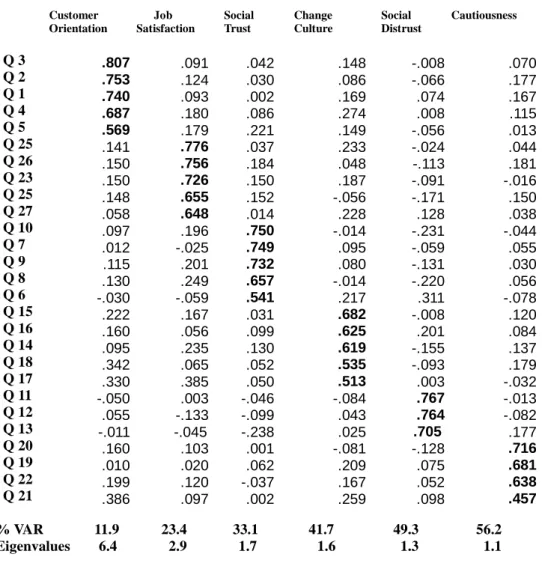
which were based on measures used by Rotter (1967). Questions on trust included a variety of items measuring trust towards various exchange partners in a variety of business contexts. The questionnaire also included multiple items intended to measure customer orientation, organizational cultural attributes relating to change, and job satisfaction. Factor analyses and reliability analyses were performed on the aggregate data in order to arrive at overall factors measuring the key variables under study. In an attempt to arrive at factors that are reliable in all countries, we did not
12
12
consider items with loadings less than .40 on each factor. Tables 2 shows the varimax rotated factor analysis and the Appendix A shows the reliability coefficients for the aggregate factors and those for each country. These factors were: Customer
Orientation (5 items), Social Trust (5 items), Social Distrust (3 items), Cautiousness (4 items), Change Culture (5 items), and Job Satisfaction (5 items).
(Insert Table 2 here)
In addition, three demographic variables were used in the study: age, education and gender. Age and education were measured in number of years. Gender was coded as 0 (female) and 1 (male).
RESULTS
Table 3 shows the descriptive statistics and Pearson correlations among the variables. As expected, societal trust had a negative correlation with societal distrust. In addition, the results in Table 3 show that education and culture for change were positively and significantly related to societal trust but did not have relationships with societal distrust could indicate that the two concepts of trust and distrust are indeed distinct. Appendix B shows the correlation among the variables per country.
.
[Insert Table 4 here]
Table 4 shows the results of one-way ANOVA comparisons of means of the
13
13
done in order to compare the scores for the core variables among the four economies included in the study. For societal distrust (and to a weaker extent for customer orientation) the differences between United States and Chinese Societies were clear. United States had significantly lower level of societal distrust, and higher levels of customer orientation, while there was no difference among the three Chinese societies for these two variables. For cautiousness the same differences are observed only between US and two countries (i.e. China and Hong Kong) but not with Taiwan.
[Insert Table 3 here]
In order to test some of the Hypotheses multiple regressions were computed for the overall sample, as well as for high and low societal distrust sub-samples. Following Lewickietal.’s(1998)pointon the distinction between trust and distrust, we felt that such a comparison of the regression models in high and low distrust sub-samples would allow up to test Hypothesis 2 more directly. We usedsocialdistrust’smedian score of 3.33 to divide the sample into high and low distrust contexts. In these regressions, customer orientation was the dependent variable and the core and demographic variables, as well as interaction between change culture and societal trust, as independent variables. This latter variable was created and included in the analysis to control for the possible interaction between a positive work climate and perceptions societal trust. The results of regression models are shown in Table 5.
14
14
positive relationship between customer orientation and trust, the regression results did not support Hypothesis 2. That is even though societal trust and customer orientation were positively correlated (support for Hypothesis1), the effect of low societal distrust on this relationship was not significant (Hypothesis 2 not supported).
[Insert Table 5 here]
Hypothesis 3 postulated an interaction effect between culture for change and societal trust in predicting customer orientation. This hypothesis does not seem to be supported. As shown in Table 5 even though the culture for change has a positive influence on customer orientation, the interaction term effects were not significant. This relationship was further examined by replacing the variable of change culture with its 25thpercentile
(representing weak change culture) and its 75thpercentile (representing strong change
culture) respectively, we could derive two regression lines between customer orientation and societal trust, as shown in Figure 1. Although customer orientation was positively related to societal trust in both weak culture and strong culture for change, the slope of the regression line in weak culture for change was much steeper than that in strong culture. As a result, it was a crossover interaction in which the two lines intersected. We have therefore concluded that the impact of social trust on customer orientation is
stronger in organizations where the culture for change is low and weaker when culture for change is high. Therefore, Hypothesis 3 was partially supported only when societal trust was at a lower level.
Hypothesis 4 and 5 were both supported. That is, both cautiousness and job
15
15
all three regression models.
[Insert Figure 1 here]
DISCUSSION
The primary purpose of this paper is to examine the role of societal trust and distrust t in relation to customer orientation. We examined the effects of societal trust, societal distrust, cautiousness, climate for change, and job satisfaction on customer orientation Using data from 812 mid level bank managers and employees in four countries we tested 5 Hypotheses in relation to the possible associations between customer orientation and the above constructs The study supported 4 of the five proposed Hypotheses.. On the one hand, our data showed the distinctness of the concepts of trust and distrust (Lewicki et al, 1998) and provided a basis for supporting our assertion that distrust and trust are concepts similar in their relationship to
Hertzberg’s(1966)hygieneand motivatorfactors. On theotherhand,ouranalysisdid not find support for our hypothesis that trust and customer orientation require a low level of distrust as a precondition. Mayer et al. (1995) posit that the general propensity to trust of organizational members will have an important effect on the organization's trust for customers, which we believe could serve as the basis for customer orientation. Clearly, this question is more complex and needs to be further researched. The literature on customer orientation (e.g. Narver and Slater, 1990; Deshpande, Farley and Webster, 1993) have already pointed out to the importance of developing the appropriate culture within the organization to support customer orientation. In this sense our study has provided additional evidence by incorporating both trust and distrust and aspects organizational culture in the design of the study.
16
16
One of the key contributions of the present study is the finding that societal trust and culture for change could become effective only when the level of societal distrust maintains at a low level. Following Herzberg (1966), we may regard a low level of societal distrustasan important“hygiene”factorforcustomerorientation.
Hypothesis 3 was about the moderating relationship between culture for change and societal trust in predicting customer orientation. As shown in Figure 1, the interaction effects did exist but they did not totally follow the directions we would
theorize. It seems that, as far as customer orientation is concerned, societal trust may be more important than the culture for change. This is consistent with the suggestion of many writers in the customer orientation literature (e.g. Deshpande et al. , 1993; Pelham and Wilson, 1996).
Supporting Hypothesis 4, our results indicate clearly that the cautiousness really matters for the banking industry. It is understandable in that the customers chosen carefully atthefirstplace tend to obtain moreattention from thebanks’employees. This finding has important implication to human resource practitioners for the banks. Similarly, the study found support for Hypothesis 5 in terms of the relationship between job satisfaction and customer orientation. This finding is equally important regarding the role of employment practices and their impact on job satisfaction from the viewpoint of customer orientation. More recent research on trust in banking industry tend to confirm these findings (e.g. Saparito, Chen and Sapienza, 2004).
With data collected from banks in China, Taiwan, Hong Kong (the three Chinese societies) and United States, we have made comparisons among these four economies. Compared to their counterparts in the three Chinese societies, U.S. banks demonstrated
17
17
significantly higher level of customer orientation and, at the same time, a significantly lower level of societal distrust, as shown in Table 3. The higher level of societal distrust in three Chinese societies is conceivable. As research in the cross-national field has shown (e.g. Redding, 1990; House et al. 1999) in Chinese society family, or in-group collectivities, is the primary locus of trust and protection against outside threat. Chinese trust their family absolutely, but make no assumptions about the goodwill of everybody else.
REFERENCES
Albrecht, K. 1992. The Only Thing That Matters: Bringing the Power of the Customer
into the Center of Your Business. New York: Harper.
Andaleeb, S.S. 1996. An Experimental Investigation of Satisfaction and Commitment in Marketing Channels: The Role of Trust and Dependence. Journal of Retailing, 72, 1, 77-93.
Ashkanazy, N. M., Wilderom, S.P.M., and Peterson, M.F. 2000. Handbook of Organizational Culture and Climate. London: Sage.
Band, W.A. 1991. Creating Value for Customers: Designing and Implementing a Total
Corporate Strategy. New York: Wiley.
Barney J.B., and Hansen, M.H. (1994) Trustworthiness as a source of competitive advantage. Strategic Management Journal, 15: 175-190.
Cameron, K. and Quinn, R. 1999. Diagnosing and Changing Organizational Culture:
Based on the Competing Values Framework. Reading, Mass.: Addison Wesley. Cooper, R. & Kaplan, R. S. 1991. The Design of Cost Management systems. Englewood Cliffs, NJ: Prentice-Hall.
Deshpande, R., Farley, J., and Webster, F. 1993. Corporate Culture, Customer
18
18
Marketing. 57, pp.23-37.
Deutsch, M. 1960. The effect of motivational orientation upon trust and suspicion.
Human Relations, 13:123-139.
Doney, P., anon, J., and M. Mullen (1998) Understanding the influence of national culture on the development of trust. Academy of Management Review, 23(3): 601-620.
Drucker, P.F. 1955. The Practice of Management. London: Heinemann.
Drucker, P. F. 1964. Managing for Results: Economic Tasks and Risk-Taking. London: Heinemann.
Drucker, P.F. 1973. Management: Tasks, Responsibilities, Practices. New York: Harper and Row.
Dyer, J.H. and Chu, W. (2003) The role of trustworthiness in reducing transaction costs and improving performance: empirical evidence from the United States, Japan and Korea. Organization Science, 14(1): 57-68.
Fukuyama, F. 1995. Trust: The Social Virtues and the Creation of Prosperity, New York: The Free Press.
Greene, W.E., Walls, G.D., and Schrest, L.J. 1994. Internal marketing: The key to external marketing success. Journal of Services Marketing, 8(4): 5-13.
Hauser, J.R., Simester, D.I., and Wernerfelt, B. 1996. Internal customers and internal suppliers. Journal of Marketing Research (August), 268-280.
Herzberg, F. 1966. Work and the Nature of Man. Cleveland: World Publishing. Herzberg, F., Mausner, B., and Synderman, B.B. 1959. The Motivation to Work. N.Y.: Wiley.
House, R., Hanges, P., Ruiz-Quintanila, S.A., Dorfman, P.W., Javidan, M., Dickson, M., and Gupta, V. 1999. Cultural Influences on Leadership and Organizations: Project GLOBE. Advances in Global Leadership, 1, pp.171-233.
Huff, L. and Kelly, L. (2003) Levels of organizational trust in individualistic versus collectivist societies: A seven-nation study. Organization Science, 14(1): 81-90.
Johansson, H.J., McHugh, P., Pendlebury, A.J., and Wheeler, W.A. 1993. Business
Process Reengineering: Breakpoint Strategies for Market Dominance. New York: John Wiley & Sons.
19
19
Trust and Strategic Integration in Japanese-U.S. Cooperative Alliances. Journal of International Business Studies, 27, 5, 981-1004.
Kotter, J. P. and Haskett, J.L. 1992. Corporate Culture and Performance. N.Y.: Free Press.
Kumar, N. 1996. "The Power of Trust in Manufacturer-Retailer Relationships," Harvard
Business Review, Nov-Dec, 94-106.
Levitt, T. 1960. Marketing Myopia. Harvard Business Review, 38(4), 45-56
Levitt, T, 1962. Innovation in Marketing: New Perspectives for Profit and Growth. London: Pan.
Lewicki, R.J., McAllister,D.J. and Bies, R.J. 1998. Trust and Distrust: New Relationships and Realities. The Academy of Management Review, 23, 3, 438-458.
Locke, E.A. 1976. The nature and causes of job satisfaction. In M. Dunnette (ed.),
Handbook of Industrial and Organizational Psychology. Chicago: Rand-McNally.
Mayer, R.C., Davis, J.H. and Schoorman F.D. 1995. An Integrative Model of Organizational Trust. Academy of Management Review, 20, 3, 709-734.
McAllister, D.J. 1995. Affect and Cognition-based Trust as Foundations for
Interpersonal Cooperation in Organizations. Academy of Management Journal, 38, 1,
24-59.
McEvily, B., Perrone, V. and A. Zaheer (2003) Special issue on: Trust in an organizational content. Organization Science, 14(1), 1-103.
McKitterick, J. B. 1957. What is the marketing management concept? in F.M. Bass (ed.)
The Frontiers of Marketing Thought and Science (Chicago, American Marketing
Association: Duke University Press
Moorman, C., Zaltman,G. and Deshpande, R. 1992. Relationships Between Providers and Users of Market Research: The Dynamics of Trust Within and Between Organizations.
Journal of Marketing Research, 29, Aug., 314-28.
Moorman, C., Deshpande, R. and Zaltman, G. 1993. Factors Affecting Trust in Market Research Relationships. Journal of Marketing, 57, Jan., 81-101.
Narver, J. and Slater, S. 1990. The Effects of Market Orientation on Profitability.
Journal of Marketing, 54, pp.20-35.
20
20
Structure, Firm Structure, Strategy, and Market Orientation Culture on Dimensions of Performance. Journal of Academy of Marketing Science. 24, pp.27-43.
Peters, T,J. & Waterman, R. H. 1982. In Search of Excellence: Lessons from America’s Best-Run Companies. New York: Harper & Row.
Petty, J. & Goodman, K. 1996. Customer profitability analysis, Management Accounting
Issues Report Number, Australian Society of CPAs Management Accounting Centre of
Excellence (Melbourne: ASCPA)
Redding, S.G. 1990. The Spirit of Chinese Capitalism. Berlin, Germany: Walter de Gruyter & Co.
Reichheld, F. F. 1996. The Loyalty Effect: The Hidden Force Behind Growth, Profits,
and Lasting Value. Boston: Harvard Business School Press
Rosenbluth, H.F. and Peters, D.M. 1992. The Customer Comes Second. New York: William Morrow.
Schein, E. 1985 Organizational Culture and Leadership. San Francisco: Jossey-Bass. Sharman, P. 1996. ABC and the bottom line on customers, CMA Magazine, 70(7), 20-24. Saparito, P.A., Chen, C., and Sapienza, H.J. 2004. The Role of Relational Trust in Bank-Small Firm Relationships. Academy of Management Journal. 47, No. 3,
pp.400-420.
Tenner, A.R. and DeToro, I.J. 1997. Process Redesign: The Implementation Guide for
Managers. Reading, Massachusetts: Addison-Wesley.
Webster, F. E. 1988. The rediscovery of the marketing concept. Business Horizons, 31(3), 29-39.
21
21
Appendix A
Measures
Customer Orientation
1. Creating customer value should be the focus of almost everything that is done in this organization.
2. Based on their decisions and actions, top management should place a high priority on customer satisfaction.
3. Our organization should continually measure customer satisfaction so that we can know how we can improve in meeting the needs of our customers.
4. This organization should place much emphasis on after-sales service to make sure that we establish a strong long-term relationship with our customers.
5. Managers in this organization believe that marketing research is a valuable use of resources
Cronbach’salpha:Aggregate = .81; United States = .81 ; Hong Kong = .82; China = .78; Taiwan = .82
Societal Trust
6. When my car needs to be repaired, I can depend on repair shops to be fair and honest with me.
7. When Iordersomething I’ve neverseen through themailortelephone,Iam confident that the product will arrive as promised.
8. I believe that people usually keep their promises. 9. Most salespeople are honest.
10. Most people can be trusted.
Cronbach’salpha:Aggregate = .74; United States = .70 ; Hong Kong = .72; China = .71; Taiwan = .79
Societal Distrust
11. Employees will not work hard or do quality work unless managers closely monitor their work.
12. The only people that can always be trusted are those from my own extended family. 13. I am usually suspicious of people until I have had plenty of time to get to know them and
know they can be trusted.
Cronbach’salpha:Aggregate = .69; United States = .69 ; Hong Kong = .61; China = .50; Taiwan = .65
Change Culture
14. Individuals in work groups in this organization work together more than strive for individual recognition.