
反販賣人口行徑在拉丁美洲: 私營和公共伙伴關系瓜地馬拉 - 政大學術集成
179
0
0
全文
(2) Anti-Human Trafficking Practices in Latin America: Private-Public Partnership in Guatemala. Student: Ruth Abigail Calderon. Advisor: Dr. Alex Chiang. 政 治 大. 立. A Thesis. ‧ 國. 學. Submited to the internationl Master’s Program in International Studies. ‧ y. sit. Nat. National Chengchi University. n. al. er. io. In partial fullfilment of the Requirement. i n U. C. v. e n gincInternational For the degree of h Master Studies hi July 2014 . . 1 .
(3) Table of Contents List of Figures ...................................................................................................................... 5 List of Tables ....................................................................................................................... 5 List of Abbreviations ........................................................................................................ 6 Acknowledgments ............................................................................................................. 8 Abstract ................................................................................................................................. 9 1. Introduction ............................................................................................................. 10 1.1 Background ..................................................................................................................... 10 1.2 Objectives of the study ................................................................................................ 13 1.3 Literature Review ......................................................................................................... 14 1.3.1 Human Trafficking in Latin America ............................................................................. 14 1.3.2 NGOs in Latin America ......................................................................................................... 17 1.3.3 NGOs and Anti-‐human trafficking in Latin America ............................................... 18 1.4 Research Methodology ................................................................................................ 21 1.5 Scope and Limitations ................................................................................................. 22 1.5.1 Scope ........................................................................................................................................... 22 1.5.2 Limitations ................................................................................................................................ 23 1.6 Thesis Structure ............................................................................................................ 23 . 立. 政 治 大. ‧ 國. 學. ‧. 2 Global Human Trafficking ..................................................................................... 26 2.1 Classical Slavery to Modern Slavery ....................................................................... 26 2.2 The Legal Definition Human Trafficking .............................................................. 29 2.3 Human Trafficking in the World .............................................................................. 31 2.4 Global Trafficking Patterns ....................................................................................... 32 2.4.1 Trafficked Victims ................................................................................................................. 32 2.4.2 Human Traffickers ................................................................................................................ 34 2.4.3 Forms of Exploitation .......................................................................................................... 35 2.5 Global Trafficking Flows ............................................................................................. 37 2.6 World Responses in combating human trafficking ........................................... 38 2.6.1 International Law and Human Trafficking ................................................................. 39 2.6.2 The United Nations Organized Crime Convention .................................................. 40 2.6.3 Trafficking Victims Protection Act (TVPA) ................................................................. 41 2.6.4 Human Trafficking and International Human Rights ............................................ 42 2.6.5 Universal Declaration of Human Rights ....................................................................... 43 2.6.6 Protocol to the Convention on Eliminating of All Forms of Discrimination against Women (CEDAW) .................................................................................................................. 45 2.6.7 The International Convention on the Rights of Child (CRC) ............................... 46 2.7 Role of Non-‐Governmental Organizations in the Global Arena ..................... 47 . n. er. io. sit. y. Nat. al. Ch. engchi. i n U. v. 3 Latin America Region ............................................................................................. 49 3.1 Political and Economic History in Latin America .............................................. 49 3.1.1 Latin America Economy: Land Ownership ................................................................. 50 3.1.2 Politics in Latin America: Authoritarian Regimes ................................................... 52 3.2 Human Trafficking in Latin America ...................................................................... 56 3.2.1 Trafficked Victims in Latin America .............................................................................. 58 3.2.2 Human Trafficking Flows in Latin America ................................................................ 59 3.2.3 Forms of Human Trafficking ............................................................................................. 62 3.3 International Human Trafficking Laws adopted in the Region ..................... 62 . 2 .
(4) 3.3.1 Protocol to Prevent, Suppress and Punish Trafficking in Persons in Latin America ...................................................................................................................................................... 63 3.3.2 The Trafficking Victims Protection Act (TVPA) in Latin America .................... 64 3.4 International Human Rights Laws adopted by Latin America ...................... 66 3.4.1 Universal Declaration of Human Rights ....................................................................... 67 3.4.2 United States Role in democracy and human rights in Latin America ........... 68 3.4.3 Organization of American States and Human Rights ............................................. 69 3.5 Private-‐Public Partnership and Human Trafficking in Latin America ....... 71 . 4 Human Trafficking in Guatemala ....................................................................... 74 4.1 Guatemala’s Country Profile ..................................................................................... 74 4.1.1 Economic: Guatemala Agrarian Law ............................................................................. 76 4.1.2 Political: Guatemala Civil War .......................................................................................... 79 4.1.3 Civil War impact on Women and Human Trafficking ............................................ 82 4.1.4 Guatemalan Migration ......................................................................................................... 83 4.2 Problem of Human Trafficking in Guatemala ..................................................... 85 4.2.1 Trafficked Victims Profile in Guatemala ...................................................................... 86 4.2.2 Forms of Trafficking in Guatemala ................................................................................. 90 4.2.3 Human Traffickers in Guatemala .................................................................................... 92 4.3 Overview of International and Regional Conventions and Treaty Laws Adopted by Guatemala ........................................................................................................... 94 4.3.1 Convention for the Elimination of all Forms of Discrimination Against Women CEDAW (Ratified in 2001) ............................................................................................... 95 4.3.2 Trafficking Victims Protection Act (TVPA) 2000, Trafficking in Persons Report (TIP) in Guatemala ................................................................................................................ 96 4.3.3 The Inter-‐American Convention to Prevent Punishment and Eradication of Violence against Women “Convention Belem Do Para”, 1992 .......................................... 99 4.4 Guatemalan National Laws against Human Trafficking ................................ 100 4.4.1 Law on Protection of Children and Adolescents (PINA) -‐ Decree 27-‐2003 100 4.4.2 Adoption Law-‐ Decree 77-‐2007 ................................................................................... 101 4.4.3 Warning System Act Alba-‐ Keneth-‐ Decree 28-‐2010 .......................................... 103 4.4.4 Law against Femicide and other Forms of Violence against Women-‐ Decree of the Congress, 2008 ....................................................................................................................... 103 4.4.5 Law against Sexual Violence, Exploitation and Human Trafficking-‐ Decree 09-‐2009 .................................................................................................................................................. 104 4.5 SVET Projects ............................................................................................................... 106 . 立. 政 治 大. ‧. ‧ 國. 學. n. er. io. sit. y. Nat. al. Ch. engchi. i n U. v. 5 Private-‐Public Partnership (PPP) .................................................................... 110 5.1 Why Public-‐Private Partnership? .......................................................................... 110 5.1.1 United States Agency for International Development Assessment 2005 (USAID) ................................................................................................................................................... 110 5.1.2 Casa Alianza (Covenant House) .................................................................................... 113 5.1.3 End Child Prostitution, Child Pornography and Trafficking of Children for Sexual Purposes (ECPAT) Guatemala ........................................................................................ 123 5.1.4 International Organization of Migration (IOM) ..................................................... 135 5.2 Public-‐Private Partnerships in Guatemala ........................................................ 141 5.2.1 Improvements ...................................................................................................................... 144 5.2.2 Obstacles ................................................................................................................................. 145 6 Conclusion ................................................................................................................ 148 APPENDIX A .................................................................................................................... 156 APPENDIX B .................................................................................................................... 159 . . 3 .
(5) APPENDIX C .................................................................................................................... 163 Bibliography ................................................................................................................... 165 . 立. . . y. sit er. al. n. . io. . Nat. . ‧. . ‧ 國. . 學. . 政 治 大. Ch. engchi . 4 . i n U. v.
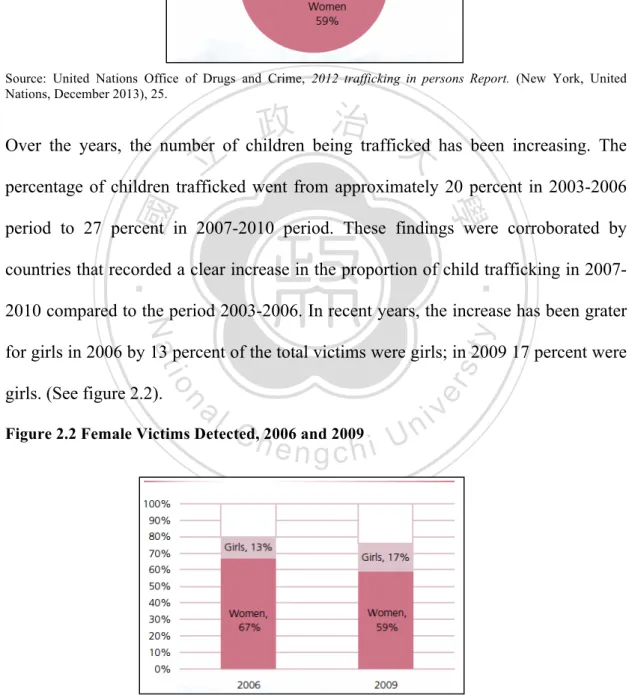
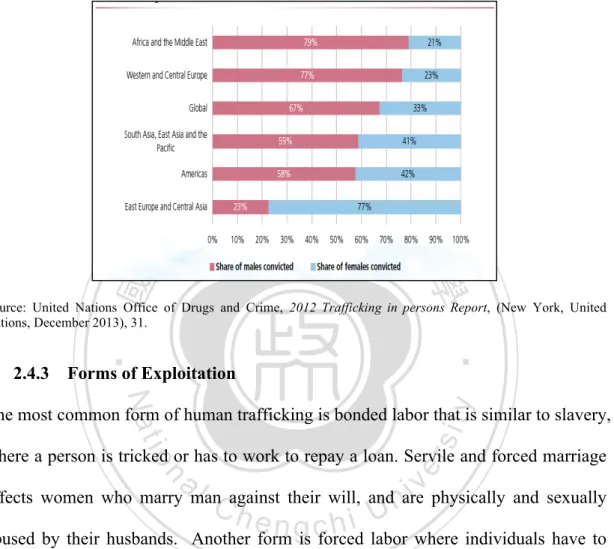
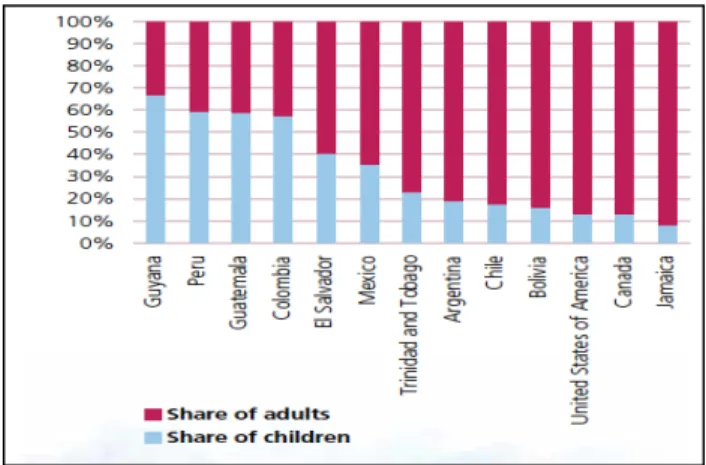
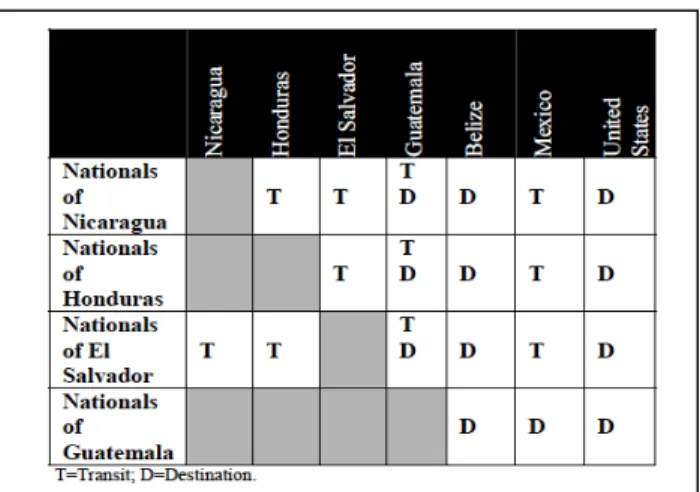
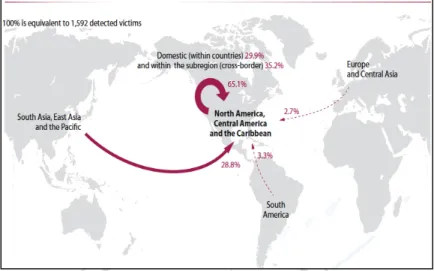
(6) List of Figures Figure 2.1 Gender and Age Profile of Victims Detected Globally, 2009 ..................................... 33 Figure 2.2 Female Victims Detected, 2006 and 2009 ....................................................................... 33 Figure 3.1 Victims of Human Trafficking by Age 2007-‐2010 ......................................................... 58 Figure 3.2 Share of Adults and Children Victims 2007-‐2010 ........................................................ 58 Figure 3.3 Origin of trafficking victims detected in the American Continent as a proportion of the total of victims detected in the sub-‐region 2007-‐2010 ............................................. 61 Figure 3.4 Origin of victims trafficked in South America as proportion of total number of victims in the sub-‐region 2007-‐2010 .......................................................................................... 61 Figure 4.1 Guatemala, Department Divisions and Border Countries ......................................... 74 Figure 4.2 Trafficking in Persons Victims, 2000-‐2012 .................................................................... 86 Figure 4.3 Girl Victims of Sexual Exploitation by Age ...................................................................... 87 Figure 4.4 Girl Victims of Sexual Exploitation by Origin 1998-‐2000 .......................................... 89 Figure 4.5 Geographical Coverage of Training and Awareness SVET, 2013 ........................... 106 Figure 4.6 Total of Students trained on the subject of Sexual Violence, Sexual Exploitation and Human Trafficking, 2013 ...................................................................................................... 107 . 立. 政 治 大 List of Tables. ‧. ‧ 國. 學. Table 3.1 General Migration Flows in Central America ................................................... 60 Table 4.1 Forms of Human Trafficking in Guatemala, 2010-2011 ................................... 90 Table 4.2 Geographical Coverage Training and Awareness National Program in Guatemala by SVET, 2013 ......................................................................................... 106. n. er. io. sit. y. Nat. al. . Ch. engchi. i n U. v. 5 .
(7) List of Abbreviations CIA . . Central Intelligence Agency . CEDAW . Convention on Elimination on all Forms of Discrimination against Women . CRC . International Convention on the Rights of Child . CICIG . International Commission against Impunity in Guatemala . DEIC-‐PNC . Unit Against Human Trafficking . DGM . Department of Migration . ECPAT . End Child Prostitution, Child Pornography and Trafficking Purposes . FAR . Rebel Armed Forces . GDP . Gross Domestic Product . IPEC . International Program on the Elimination of Child Labor . ILO . . International Labour Organization . ISI . . Import Substitution Industrialization . 學. ‧. ‧ 國. 立. 政 治 大. y. Nat. IACHR . Inter-‐American Commission of Human Rights . IMF . International Monetary Fund . IMJ . International Justice Mission . er. n. . al. sit. International Organization of Migration . io. IOM . Ch. engchi. i n U. v. INGO . International Non-‐profit Organization . IGO . International Governmental Organization . IHRLI . International Human Rights Law Institute . MP . Public Prosecutor Office . . MOFA . Ministry of Foreign Affairs . MSPAS . Ministry of Social Welfare in Guatemala . MOE . Ministry of Education . MOU . Memorandum of Understanding . NAC . National Adoption Council . 6 .
(8) NGO . Non-‐profit Organization . OAS . Organization of American States . PAMI . Assistance Program, Mobilization and Advocacy for Children and Adolescents . PINA . Protection of Children and Adolescents . PPP . Public-‐Private Partnership . PDH . Human Rights Prosecutor Office . PGN . Prosecutor General Nation's Office . SVET . Secretariat against Sexual Violence, Sexual Exploitation and Trafficking in Persons . SICA . Central American Integration System . TIP . . 學. ‧ 國. TVPA . 治 政 Trafficking Victims Protection Act 大 立 Trafficking In Persons United Fruit Company . UNHCR . United Nations High Commissioner for Refugees . USAID . United States Agency for International Development . UN . United Nations . UNICEF . United Nations . WB . World Bank . n. . . al. er. United Nations Office of Drugs and Crime . io. UNODC . Ch. sit. y. Nat. . ‧. UFC . engchi. i n U. v. . . 7 .
(9) Acknowledgments It would not have been possible to write these master thesis without the help and support of the kind people around me, to only some of whom is possible to give particular mention here. Above all, I want to thank my parents Marta Cuellar and Wilfredo Calderon and my brother Jacob Calderon for their unconditional support. My family was always supporting throughout the process even though from distance, I always could feel their belief on me.. 政 治 大. This thesis would have not been possible without the help, support and patience of my. 立. advisor, Professor Alex Chiang not to mention his advice and unsurpassed knowledge. ‧ 國. 學. in structure and making of a comprehensive thesis on the topic. Professor Chiang was. ‧. always willing to help in every detail of the thesis writing. For his time invested in me I am extremely grateful.. y. Nat. io. sit. I would like to acknowledge the INGOs, and IGOs in Guatemala who let some of. n. al. er. their work time by accepting an interview with me. I want to thank their patience and. Ch. i n U. v. honesty in providing the necessary information to complete this thesis. Without the. engchi. information provided, this thesis would not have been possible. I owe them my most appreciation for collaborating with me even though we did not met face to face due to the distance. Lastly, but my means not least thank my friend Magdalena Zieba, Anabell, Lucila in Taiwan and elsewhere for their support and encouragement throughout.. 8 .
(10) Abstract Human Trafficking is a global issue increased dramatically with globalization, the rise of illicit trade, and the end of the Cold War. After drug trafficking, human trafficking is neck-to-neck with the arms industry as the second largest criminal industry in the world. The purpose is to study Latin America’s human trafficking situation and Guatemala’s Private-Public Partnership in implementing anti-human trafficking activities.. Due to the limited investigations in the region, this study will be a. contribution to readers that do not know the situation of human trafficking in Latin. 政 治 大. America. The study will use secondary data such as reports from multilateral. 立. organizations, government institutions, and most importantly conducted interviews to. ‧ 國. 學. NGOs. The PPP work has been positive through two channels of communication in Guatemala. The interagency of government institutions and the network against. ‧. human trafficking composed of the government institutions, INGOs, IGOs and NGOs.. y. Nat. io. sit. This study describes the efforts from the government side as well as the knowledge. n. al. Keywords: Public-Private. er. and expertise on NGOs in combating human trafficking in Guatemala.. v i n Ch Partnership, Government e n gInternational chi U. Institutions,. International Non-governmental Organization.. . 9 .
(11) . 1. Introduction . 1.1 Background. One of the motivations of this research is to explore and learn more about the subject of human trafficking. It will entail, learning the perception of human trafficking by governments, the identification of traffickers and victims, as well as government’s and other organizations efforts involved in combating human trafficking. Additionally, studies around the world about human trafficking have shown more concern in certain. 治 政 regions such as in Europe and Asia. Encouraging this大 research on human trafficking 立 in the Latin America region. Finally, the motivation behind conducting the research 1. ‧ 國. 學. on Guatemala is that the country has huge migration flows. Its geographical location,. ‧. bordered with Mexico and proximity to the United States has a non-stop mobilization. y. Nat. of goods and people. Many South and Central Americans transit through Guatemala. or being trafficked for sexual exploitation.2. n. al. Ch. engchi. er. io. sit. to the United States facing dangers such as kidnapping, violence, raped, and robbery. i n U. v. Human Trafficking has become a global issue. Human trafficking has increased dramatically with globalization, the rise of illicit trade, and the end of the Cold War. Globalization has made it easier for greater mobility of goods, services, capital and people, facilitating remote parts of the world to have access to the global economy. Furthermore due to globalization, human trafficking has become a crime of both. . 1. Frank Laczko and Elizbieta M. Gozdziak ed. “Data and Research on Human Trafficking: Global Survey”,. 2 Clare Ribando Seelke, “Trafficking in Persons in Latin America and the Caribbean”, Washington D.C.: Congressional Research Service (2010), http://digitalcommons.ilr.cornell.edu/key_workplace/792/ (Accessed November 1, 2013). 10 .
(12) small-scale entrepreneurs and large criminal organizations. 3 However, increasing controls on entering the most affluent countries create barriers for those who seek to migrate. Many seek illegal ways to enter countries where there is demand for labor. This factor has facilitated human trafficking in Europe, Asia, Africa and Latin America, with increasing number of border crossings outside the control of central state authorities. Furthermore, corruption easily takes place when certain economic conditions are unfavorable to the labor force. The result has been an increase in prostitution and other slave-like conditions for women and children in search of work. Other aspects that are important to consider are the internal conflicts in countries,. 治 政 大 or flee to refugee camps, whereby many people are forced to live in bad conditions 立 making them vulnerable for human trafficking.4. ‧ 國. 學. Latin America and the Caribbean are considered a region of source, transit and. ‧. destination for victims of human trafficking. According to the International Labor. sit. y. Nat. Organization estimation of 1.8 million people in Latin America are engaged in forced. io. er. labor. The United States Central Intelligence Agency (CIA) estimates that 50,000 enslaved Latin Americans are trafficked into the United States each year.5 Adding to. al. n. v i n C h Office of Drugs U this, a report by the United Nations e n g c h i and Crime (UNODC) describes. that women and children are the most vulnerable victims for sexual exploitation and domestic servitude in Latin America.6 3. Catherine Paris, “Modern Slavery: Human Trafficking Revealed”. (New York: Claddagh Ltd. Publishing, 2007), 114. 4. Eileen Pittaway, “Making A Mainstream Of Reality: Gender And The UNHCR Policy On Refugee Protection And Solutions In Urban Areas: A Refugee Perspective”, UNHCR, Centre for Refugee Research (2010). http://www.unhcr.org/4b0bb83f9.pdf (accessed April 5, 2014) 5. Charles M. Goolsby, “Dynamics of Prostitution, and Sex Trafficking from Latin America into the United States”, LibertadLatina.org (2003). http://www.libertadlatina.org/LL_LatAm_US_Slavery_Report_01_2003.htm (accessed February 01, 2014) 6. UNODC-United Nations Office on Drugs and Crime. Global Report on Trafficking in Persons 2012. United Nations Publications, Sales No. E.13.IV.1. (Geneva: December 2012). http://www.unodc.org/documents/data-andanalysis/glotip/Trafficking_in_Persons_2012_web.pdf (accessed November 10, 2013).. . 11 .
(13) Reasons involve socioeconomic problems where families in Latin America live in poverty, have minimal education, lack of job opportunities, and suffer physical or sexual abuse by family members. Also, Latin America has a predominant issue with gender inequality and demand for prostitution is very high.7 These and other issues have contributed to the predominance of human trafficking in the region, which will be discussed in detail in the thesis. Despite the identification of forced labor in the region there are very limited studies to rely on for this research.8 Specifically in Guatemala men, women and children are victims of human trafficking for sexual exploitation and forced labor. Guatemalan women are forced into. 治 政 大States. In other cases, men, prostitution within the country, in Mexico and United 立 women and children have been exposed to forced labor within the country in. ‧ 國. 學. agriculture or near Guatemala-Mexico border and in the highlands of the region.. ‧. Child sex tourism has been found in Lake Atitlan, one of the most popular touristic. io. er. Canada, Germany, Spain and the United States.9. sit. y. Nat. places in Guatemala and the child sex tourists have been reported to come from. Women in Guatemala are highly discriminated, low status and lack of rights. Children. al. n. v i n C hin Guatemala. Children in the streets are a big problem e n g c h i U are physically or sexual abused by family members and lack of human rights leading them to find a better life. elsewhere. In a 2002 report the United Nations estimated that approximately 2,000 minors are in prostitution just in Guatemala City alone.10 In Guatemala prostitution is . 7. David E. Guinn, and Elissa Steglich, In Modern Bondage: Sex Trafficking in the Americas. 2nd ed. Chicago, IL: International Human Rights Law Institute, DePaul University College of Law, pp.40-46. 8 U.S. Department of State, Office to Monitor and Combat Trafficking in Persons, Trafficking in Persons Report 2012 (2012), 171. http://www.state.gov/documents/organization/192587.pdf (accessed November 2, 2013). 9. . U.S. Department of State, Trafficking in Persons Report 2012, 172. 10 Casa Alianza, “Investigation Finds Hundreds of Girls Trafficked in Guatemala, ” LibertadLatina.org, (March 31, 2004). http://www.libertadlatina.org/Lat_Guatemala_Casa_Alianza_Finds_688_Trafficked_Children_03-312004.htm (accessed December 2013). 12 .
(14) legal, so it is a problem to identify who is being sexually exploited voluntarily or involuntarily. One thing is certain the more the demand of prostitution the more vulnerable women will be.11 1.2 Objectives of the study The objective of this study is to learn the situation of human trafficking in Guatemala. To understand how big of a problem is, when the government recognized human trafficking as a crime and starts to fight against it. Also the objective will be to examine the activities and response of national and international Non-Governmental. 政 治 大 Furthermore, researching 立 public-private partnerships that worked and supported in. Organizations that are involved in the anti-human trafficking practices in Guatemala.. ‧ 國. 學. anti-human trafficking in Guatemala. This research intends to answer two questions: How is the problem of human trafficking in Latin America?. 2.. What have the Public and Private Partnerships (PPP) done in anti-human. ‧. 1.. sit. y. Nat. trafficking in Guatemala?. n. al. er. io. The reason why Guatemala has been chosen is because it is a country of origin, transit. i n U. v. and destination for human trafficking victims. This is due to the serious problem of. Ch. engchi. irregular immigration in Latin America. South and Central Americans may migrate legal or illegally hopeful to find better job opportunities in Mexico or the United States.12 Furthermore, Guatemala is a member state of the Central American Integration System (SICA) together with Honduras, El Salvador and Nicaragua, Costa Rica, Panama, Belize and Dominican Republic. Of the eight SICA member states, four . 11. Anti-Trafficking Technical Assistance: Guatemala Anti-Trafficking Activity Review, August 1-6, 2005. 2005. PDF file. Washington, D.C.: Chemonics International. http://pdf.usaid.gov/pdf_docs/PDACG024.pdf. (accessed December 12, 2013).. 12. ”Anti-trafficking Technical Assistance: Guatemala Anti-Trafficking Activity Review”.. . 13 .
(15) countries have signed the Central American Regional Agreement (CA-4). This body is composed of Honduras, Guatemala, El Salvador and Nicaragua. The aim of this regional agreement is to harmonize their migration procedures. Nationals of the member states are allowed to cross border by simply presenting their national identification card. This helps traffickers to smuggle human beings for forced labor and prostitution purposes to other countries without being detected.13 Another reason is that among all the Central American Countries, Guatemala has the major concentration of NGOs in the region. In a study on the growth of NGOs located in Central American countries (Costa Rica, Honduras, Nicaragua, El Salvador and. 治 政 大 Panama), Guatemala had the most concentration of NGOs. 立. 14. Finally, Guatemala has. also been affected economically and socially by several events, such as a civil war. ‧ 國. 學. that lasted for 36 years from 1960 to 1996. It has also been hit by natural disasters. ‧. such as Hurricane Mitch in 1998 and the most recent volcanic eruptions that occurred. sit. y. Nat. in 2010 and 2012.15 Consequences of these events have made an impact on human. io. of the government and NGOs in Guatemala.. n. al. Ch. 1.3. Literature Review. 1.3.1. Human Trafficking in Latin America. engchi. er. trafficking. It will be necessary to highlight the anti-trafficking efforts and activities. i n U. v. The data for the thesis will be obtained from researched publications on human trafficking. Louis Shelley writes about the forms of human trafficking globally, . 13. SICA-Sistema de la Integración Centroamericana. Tratado General de la Integración Económica Centroamericano. Managua, Nic.: December 13, 1960. http://www.sica.int/busqueda/centro%20de%20documentación.aspx?IdItem=449&IdCat=10&IdEnt=401 (accessed December 13, 2013).. 14. Roger Gonzalez Chacon, “Organizaciones No Gubernamentales”, Ciencias Administrativas y Financieras de la Seguridad Social no. 1, 41-45 (1995). http://www.binasss.sa.cr/revistas/rcafss/v3n11995/art6.pdf (accessed December 12, 2013). 15. Angela M. Berry-Koch, “5-year Evaluation of the Central Emergency Fund. Country Study: Guatemala”, United Nations Office for Coordination in Humanitarian Aid, 2011. https://ochanet.unocha.org/p/Documents/110922%20Guatemala_FINAL.pdf (Accessed December 7, 2013). 14 .
(16) revealing the operations of the trafficking business and the nature of the traffickers.16 Similarly Alexis A. Aronowitz also describes the global trade in human beings.17 Catherine Paris discusses the various laws, agencies, countries, and protocols dealing with human trafficking, with new and the up-to date information available from the United States Government.18 An investigation of human trafficking in Latin America by the International Human Rights Law Institute (IHRLI) with the support of the Inter-American Commission of Women of the Organization of American States (OAS) and the American Children’s Institute of the OAS was also published.19 The IHRLI focused in Latin America and. 治 政 大 rights work in the region the Caribbean given its longstanding involvement in human 立 and the lack of information on human trafficking. IHRLI found that the existing. ‧ 國. 學. literature in human trafficking demonstrated that most of what is known of human. ‧. trafficking is purely anecdotes, from reports in the media as well as from human. sit. y. Nat. rights organizations specially the ones assisting victims. Investigation by the IHRLI. io. er. was very “explorative” that is consultation and field investigations on site by the experts. This is a collection of increasingly accurate information about the extent of. al. n. v i n Ctoh help governments, America e n g c h i U regional. the problem in Latin. organizations and. advocates with the necessary information to create draw action plans to combat . 16. Louise Shelley. Human Trafficking: A Global Perspective. (New York: Cambridge University Press, 2010).; Maggy Lee. Human Trafficking. (London: Willan Publishing, 2007). 17. Alexis A. Aronowitz, Human Trafficking, Human Misery: The Global Trade in Human Beings, (Westport, Connecticut: Praeger 2009); Joel Quirk, The Anti-Slavery Project: From the Slave Trade to Human Trafficking, (Philadelphia: University of Pennsylvania Press, 2011). 18 Paris, Modern Slavery: Human Trafficking revealed’; Christina Fisanick, Human Trafficking, (Michigan: Greenhaven Press, 2010); Jo Doezema. Sex Slaves and Discourse Masters: The Construction of Trafficking, (London: Zed Books, 2010). ; Julietta Hua. Trafficking Women’s Human Rights, (Minneapolis, U.S.: University of Minnesota, 2011). 19 Guinn and Steglich, Modern Bondage: Sex Trafficking in the Americas. ; Kate Zdrojewski, . “The Development of Sex Trafficking in Central America.” In Topical Research Digest: Human Rights and Human Welfare, edited by Amy Bhalla, Jessie Burley, Raslan Ibrahim, Arianna Nowakowski, and Joel Pruce, 17-32. Denver: Josef Korbel School of International Studies-University of Denver, 2008The Development of Sex Trafficking in Central America, Topical Research Digest: Human Rights and Human Welfare, Denver: University of Denver. 2008.. . 15 .
(17) human trafficking. IHRLI integrated other actors at the national and regional level committed to turn the research findings into actions. Region studied in human trafficking includes Honduras, Nicaragua, Guatemala, El Salvador, Panama, Belize, Dominican Republic and Costa Rica individually and as group to get a better understanding of trafficking at national level and international level. The United States Congress has also published reports on human trafficking in Latin America. The United States Library Congress has a branch providing legal and policy analysis to committees and to both the House and the Senate. The Congressional Research Service published reports on Trafficking in Persons in Latin America and. 治 政 大 the Caribbean in 2011 and in 2013. 立 20. These reports describe the factors of trafficking in persons, child exploitation, the. ‧ 國. 學. relationship with organized crime and terrorism, the forced labor, the problem of HIV. ‧. and human trafficking in the region. The report also, describes U.S. government anti-. sit. y. Nat. trafficking practices in the region and the efforts of countries in the region. Finally the. io. er. evaluation of sanctions in Latin America of their work combating human trafficking was mentioned. The International Labor Organization through the International. al. n. v i n C h Labour (IPEC) developed Program on the Elimination of Child a project, contributing engchi U to the Prevention and Eradication of commercial sexual exploitation of Children and Adolescents in Central America, Panama and Dominican Republic. Among the first. activities supported was a study in each of the following countries: Honduras, Panama, El Salvador, Guatemala, Nicaragua, Costa Rica and Dominican Republic with the purpose of helping the creation of intervention strategies for combating human trafficking. 21 In addition, the Annual Report of Trafficking by the Department of 20. Ribando Seelke. “Trafficking in Persons in Latin America and the Caribbean”.. 21 Bente Sorensen and Maria Cecilia Claramunt, “Commercial Sexual Exploitation in Central America, Panama and Dominican Republic”: Synthesis Report (October 2003).. 16 .
(18) State of the United States classifies countries in three tiers, depending on the efforts of the country. The Annual report is published every year to evaluate if countries are making progress in combating human trafficking.22 1.3.2. NGOs in Latin America. In Latin America, both the tradition of peasant movements seeking improved rights to land, and other of political radicals working towards more open democratic societies both fed into the emergence of local NGOs. NGOs were also fed by the rise of “liberation theology” that signaled a renewed commitment to the poor among some sections of the Catholic Church. An article that describes NGOs effectiveness in Latin. 治 政 大cone. Also with the military America proves this statement at least in the southern 立 dictatorships in some countries, NGOs were supporting the massive movements that. ‧ 國. 學. were fighting against dictatorship.23. ‧. NGOs in Latin America being studied are mostly European NGOs. United States has. y. Nat. been the largest financial donor to Latin America but countries like Germany, Spain,. er. io. sit. United Kingdom and Italy have also provided financial aid to the region.24 NGOs and with support of International Government Organizations efforts in the Latin America. n. al. Ch. engchi. i n U. v. http://www.ilo.org/ipec/Informationresources/WCMS_IPEC_PUB_6630/lang--en/index.htm (accessed January 6, 2013). 22. U.S. Department Of State, Office to Monitor and Combat Trafficking in Persons. “Trafficking in persons report 2013”, 2013, 182-183. http://www.state.gov/documents/organization/210739.pdf (Accessed November 19, 2013).; Heather J. Clawson, Mary Layne, and Kevonne Small. Estimating Human Trafficking in the United States: Development of a Methodology. Caliber-ICF International. (December 2006). https://www.ncjrs.gov/pdffiles1/nij/grants/215475.pdf (accessed December 2, 2013). 23. Frits, Wils, ISS, The Hague, ‘“NGOs in Latin America: Past Strategies, Current Dilemmas, Future Challenges”, In Occasional Paper Series Number 8 (May 1995), INTRAC-International NGO Training and Research Centre. http://dspace.cigilibrary.org/jspui/bitstream/123456789/21764/1/NGOs%20in%20Latin%20America%20Past%20 Strategies%20Current%20Dilemmas%20Future%20Challenges.pdf?1 (accessed December 9, 2013).. 24. Jean Grugel, “Romancing Civil Society: European NGOs in Latin America”, Journal of Interamerican Studies and World Affairs 42, no. 2, Special Issue: The European Union and Latin America: Changing Relations (Summer 2000). http://onlinelibrary.wiley.com/doi/10.1111/j.1548-2456.2000.tb00138.x/abstract (accessed December 16, 2013).. . 17 .
(19) region have been concentrated on the areas of health, education, agriculture, and natural disasters, among others.25 1.3.3. NGOs and Anti-human trafficking in Latin America. A study by Peter Rohloff, Anne Kraemer Diaz, and Shom Dasgupta describes the appraisal of the emergence of small health care NGOs in the development of rural areas in Guatemala. It introduces the history of events in the country that led to the expansion of NGOs.26 The growth of NGOs is due to military dictatorship, civil war from 1960 to 1996, natural disasters, poverty, violation of human rights etc. The studies on NGOs anti-human trafficking practices have been focused in Asia and Europe.. 27. 治 政 To date, an important study was made by 大 The Protection Project at The 立. Hopkins University. They describe the roles of society, NGOs and businesses in 100. ‧. ‧ 國. 學 y. Nat. . 25. sit. n. al. er. io. Sonia Arellano-Lopez and James F. Petras, “Non-Governmental Organizations and Poverty Alleviation in Bolivia”, In Development and Change 25, 556-568. Oxford: Blackwell Publishers, 1994. http://www.plataformademocratica.org/Publicacoes/22524.pdf (accessed January 10, 2014); Patricia Weiss Fagen Natural Disasters in Latin America and the Caribbean: National, Regional and International Interactions, A regional case study on the role of the affected state in humanitarian action. HPG Working Paper (October 2008). London: Overseas Development Institute, 2008.http://www.odi.org.uk/sites/odi.org.uk/files/odiassets/publicationsopinion-files/3415.pdf (accessed January 13, 2014); UNICEF—United Nation’s Children’s Fund. “Latin America and the Caribbean.” In Humanitarian Action Report: Mid-Year Review: Building Resilience, 72-80 (2011). http://www.unicef.org/hac2011/files/HAC_2011_MYR.pdf (accessed January 15, 2014).. Ch. engchi. i n U. v. 26 Peter Rohloff, Anne Kraemer Diaz, and Shom Dasgupta. “‘Beyond Development’: A Critical Appraisal of the Emergence of Small Health Care Non-Governmental Organizations in Rural Guatemala”, In Human Organization 70, no. 4 (Winter 2011): 427-437. Oklahoma City, U.S.: Society for Applied Anthropology, 2011. ; William F Fisher, “DOING GOOD? The Politics and Antipolitics of NGO Practices”, In Annual Review of Anthropology 26, 439-464 (1997). http://faculty.bemidjistate.edu/mlawrence/Fisher.pdf (accessed December, 2013). 27. United Nations Office of Drugs and Crime. Compendium of Best Practices On Anti-Human Trafficking by NonGovernmental Organizations. UNODC Regional Office for South Asia, 2008, http://www.unodc.org/documents/southasia/Trainingmanuals/NGO_Compendium.pdf (Accessed December 7, 2013); Deanna Davy, “Transnational NGOs against Human Trafficking-Challenges and Opportunities of Advocacy Networks for Social Change?”, (PhD diss. University of Sydney, 2012). http://c.ymcdn.com/sites/www.istr.org/resource/resmgr/working_papers_istanbul/davy_wp10.pdf (Accessed December 1, 2013); Robert Spires, “Human Trafficking and Education: a Qualitative Case Study of Two NGOs Programs in Thailand”, Paper presented at the Fourth Annual Interdisciplinary Conference on Human Trafficking for the University of Nebraska—Lincoln, Lincoln, Nebraska, October 12, 2012. http://digitalcommons.unl.edu/humtrafconf4/8 (accessed December 6, 2013). ; Jacqueline Berman and Phil Marshal, Evaluation of the International Organization of Migration and its Efforts to Combat Human Trafficking, Oslo, Norway: NORAD-Norwegian Agency for Development Cooperation, February, 2011. https://www.iom.int/jahia/webdav/shared/shared/mainsite/activities/ct/Evaluation-IOM-CT.pdf (accessed December 7, 2013).. 18 .
(20) different projects. Most of the NGOs identified in the study were from United States, Africa, Asia and Europe.28 The Central American Women Network published in 2012 the Trafficking of Women in Central America and the Caribbean, describing the issue and the big problem women are facing.29 A handbook publication by the End Children Prostitution, Child Pornography And Trafficking Purposes (ECPAT) called ‘The Regional Strategy for Comprehensive Care and support of Victims of Human Trafficking in Central America’ by countries Honduras, Nicaragua, El Salvador, Costa Rica and Guatemala was financed by the Central American Development Bank in 2008 and executed by ECPAT in 2009.. 30. 治 政 The purpose of this project was to大 contribute in a integration of 立. processes in policies and standards in the prevention and punishment of trafficking in. ‧ 國. 學. persons in Central America. Additionally ECPAT wanted to achieve the promotion. ‧. and improvement of the care of victims in the region of Central America. The manual. sit. y. Nat. explains the steps that countries can follow, from the detection of the victim; their. io. er. protection and social integration to the society to create a standardized and improved process of victim assistance. ECPAT also published a ‘Systematization of research. al. n. v i n Cchildren efforts on sexual exploitation of and trafficking in Central h e n gandcadolescents hi U America’ with the aim of identifying the existing gaps in terms of qualitative and quantitative data from 2000 to 2010. Moreover, the research efforts on sexual. exploitation of children and adolescents and trafficking in Central America was a 28. The Protection Project. 100 Best Practices in Combating Trafficking in Persons: The Role of Civil Society: A Series of 100 Best Practices 1, The John Hopkins University Paul H. Nitze School of Advanced International Studies, 2012. http://www.protectionproject.org/wp-content/uploads/2012/07/100-Best-Practices-in-CombatingTIP_Final-Doc1.pdf (accessed December 5, 2013). 29. Luna Rodriguez and Maisie Davies, Trafficking of Women in Central America and Mexico, Edited by Marilyn Thomson, Briefing paper for CAWN-Central America Women’s Network. London: CAWN, 2012. http://www.cawn.org/Trafficking%20of%20women%20briefing%20paper.pdf (accessed November 25, 2013). 30 BID-ECPAT Guatemala, “Estrategia Regional para la Atención Integral y el acompañamientos a las Víctimas de Trata en Centroamérica”, ECPAT-Guatemala, (September 2011). http://ecpatguatemala.org/inicio/manuales.html (accessed December 21, 2013).. . 19 .
(21) process of searching, sorting, classification and generating the thematic documents prepared by international organizations, NGOs and universities of four Central America countries. Likewise reports prepared by governments in the region, various treaties and international conventions and protocols on human rights protection and reporting department of the United States are reviewed.31 ECPAT in Guatemala has also published several documents on the situation of human trafficking. The exploration in the use of pornography of Children and adolescents in Guatemala study objective by ECPAT is to understand how the population perceives pornography as consumers and the knowledge of the law against the use of children and adolescents. Furthermore,. 立. 治 政 大 understanding the perception. by officials in the. administration of justice, finding the strengths, weaknesses in framing the. ‧ 國. 學. performance of their duties and collect qualitative information about the number of. ‧. cases on the use of children and adolescents in pornography in the different legal. y. Nat. institutions. 32 It was prepared hoping the same effort can support the NGOs and. er. io. sit. governmental organizations in the sensitization and information about these crimes.33 ECPAT has contributed with the majority of investigations related with forms of. al. n. v i n C h their efforts researching human trafficking. They have placed e n g c h i U forced marriages in four. departments where it has been a practice in Guatemala. 34 In Guatemala, forced marriages in some communities are seen as a tradition not as a crime. The report helps . 31 ECPAT/Guatemala, “Sistematización de Esfuerzos Investigativos Sobre la Explotación Sexual de Niños, Niñas y Adolescentes y Trata de Personas en Centroamérica”. ECPAT-Guatemala. (2011). http://ecpatguatemala.org/inicio/investigaciones-e-informes.html(accessed February, 2013). 32. ECPAT/Guatemala, “Sondeo Exploratorio Sobre la Utilización en Pornografía de Niños, Niñas y en Guatemala”. ECPAT-Guatemala. http://ecpatguatemala.org/inicio/investigaciones-e-informes.html (accessed February, 2013). 33. ECPAT/Guatemala. “Trata de Persona y Explotación Sexual.” ECPAT-Guatemala, (2010). http://ecpatguatemala.org/inicio/manuales.html (accessed December 20, 2013).. 34. Ana Myrella Saadeh Rivera and Maria Ester Caballero Garcia, “La Trata de Personas con Fines de Matrimonios Forzados, Explotacion Sexual Comercial y Explotacion Laboral en Huehuetenango, Quetzaltenango, Totocapán y Quiché”, (Guatemala: ECPAT Guatemala, December 2013), http://ecpatguatemala.org/inicio/investigaciones-einformes.html (accessed May 25, 2014).. . 20 .
(22) to understand the perception of the citizens. Also, finding the perception of the governmental institutions on incidences of forced marriages, prosecution and ending with recommendations from ECPAT. Subsequently, the interviews to the different NGOs working in the country will be helpful to fill in the gaps of the study. Reports of NGOs are not available for the general public. In that case, interviews of their work in Guatemala will cover the last chapter of the thesis. 1.4. Research Methodology. First, thesis will use secondary data on human trafficking. It will use traditional. 政 治 大 library research. Reports by立 multilateral organizations such as the UN and its agencies. ‧ 國. 學. will be collected. UN human rights laws, conventions and treaties that have been adopted will be reviewed. The United Nations Office of Drugs and Crime will be a. ‧. source for the Protocols that have been adopted by the UN members on human. sit. y. Nat. trafficking. Government agencies like USAID, the United States Department of State. n. al. er. io. and the Organization of American States also have publications on human trafficking.. i n U. v. Second, The national laws adopted by Guatemalan government in combating human. Ch. engchi. trafficking and other important document to support their efforts are available on their Official government web site. Most importantly interviews will be conducted to international and national NGOs in Guatemala. The INGO’s interviewed Casa Alianza and End Child Prostitution and Trafficking (ECPAT) in Guatemala. Additional information from NGOs will be from reports and manuals that are available for the general public or information found on their website. Also, IOM as an IGO working in human trafficking will be interviewed. First IOM is going to be interviewed. The person interviewed is from Guatemala and works as a coordinator in the anti-human trafficking section. The first interview was . 21 .
(23) November 22, 2013. A second interview was in February and a third on June 6, 2014. The NGO ECPAT was interviewed once on February 25th 2014. The person interviewed was the director of ECPAT in Guatemala. Her nationality is Mexican but she has been in Guatemala since ECPAT started in 2000. La Alianza was interviewed twice in February 7, 2014 and June 10, 2014. The person interviewed was in charge of the Prevention Program. She is from Guatemalan as well. 1.5. Scope and Limitations. 1.5.1 Scope The time period of the investigation will be from 2003 to 2013. Reason why the. 政 治 大. scope is from is to explore Guatemala’s efforts affect ratifying the protocol to Prevent,. 立. Punish and Suppress Trafficking in Persons in 2003. An assessment report by USAID. ‧ 國. 學. collected information from different governmental and non-governmental institutions. ‧. in 2005. The USAID report will back Guatemala’s efforts until the application of the national Law against Sexual Violence, Sexual Exploitation and Trafficking in Persons. y. Nat. er. io. sit. in 2009. From 2009 it is apparent the commitment of the government to combat human trafficking. Most projects are noticeable by NGOs and government after the. n. al. law was launched.. Ch. engchi. i n U. v. The focus will be on NGO’s efforts combating human trafficking. The Guatemalan government efforts and the effectives of those specialized offices created for combating human trafficking. Also, how countries in the region have been cooperating with each other, international government agencies (IGOs) and the society. This study will identify the most active NGOs on anti-human trafficking practices. The study will find the NGOs aims and areas of expertise. In addition, areas to be discussed will include: goals, stakeholders, activities, achievements and obstacles. Most importantly the collaboration between public and private actors. 22 .
(24) combating human trafficking will also be explained in the research. Regional entities such as the United States and institutions have shown interest in combating human trafficking. Not only with the TVPA law but also providing funds to Latin American countries to combat organized crime. 1.5.2. Limitations. In this thesis, one obstacle will be that reports by international and nationals nonprofit organizations are strictly available for the sponsors or donors of projects and not for general public. Hence, information available on their website is somewhat lacking in detail. The second obstacle is that this study is conducted outside. 治 政 大 people working on in antiGuatemala. To conduct on-site face-to-face interview with 立. human trafficking will not be possible for this research. However, due to the lack of. ‧ 國. 學. financial resources and time constraints this research will rely on all open sources. ‧. materials, supplemented by interviews via Internet.. sit. y. Nat. The third obstacle is that there have been no studies on the efforts of NGOs in anti-. io. er. trafficking in Guatemala and the government. The available information has been published by the TIP US report ranking Guatemala on their efforts. Although a. al. n. v i n C htrafficking practices combination of PPP and anti-human e n g c h i U is non-existent. This study is probably the first investigation on this specific topic. 1.6 Thesis Structure Chapter 1: Introduction •. Objectives of the Study. •. Research Methodology. •. Literature Review. Chapter 2: Human Trafficking in the World • . History of Slavery 23 .
(25) •. Global Human Trafficking. •. International Laws to Combat Trafficking. •. NGOs Role in the International Arena. Chapter 3: Human Trafficking in Latin America and the Caribbean •. Political and Economic History of Latin America. •. Problem of Human Trafficking in Latin America and the Caribbean. •. International and Regional Laws Adopted in the Region. Chapter 4: Human Trafficking in Guatemala. •. International, Regional Conventions and National adopted by Guatemala in. 學. •. 政 治 大 Human Trafficking in Guatemala 立 Political and Economic History in Guatemala. ‧ 國. •. Human Trafficking. ‧. Chapter 5: Public and Private Partnerships in Anti-Human Trafficking NGOs and IGOs Profile and Practices. •. Public Private Partnerships in Guatemala. n. 24 . sit er. io. al. Chapter 6: Conclusion. y. Nat. •. Ch. engchi. i n U. v.
(26) 立. 政 治 大. ‧. ‧ 國. 學. n. er. io. sit. y. Nat. al. Ch. engchi. i n U. v.
(27) 2 Global Human Trafficking 2.1 Classical Slavery to Modern Slavery For the vast majority of recorded history, various forms of slavery can be found in political communities in Africa, the Americas, Asia and Europe. Slavery in the past was regarded as natural, venerable and fairly unremarkable part of the prevailing social order. Slavery also represented wealth and property ensuring that political and. 政 治 大 slaves. In David Brion Davis 立 book, he writes that the first and primary source of. economic elites were consistently the most prominent raiders, traders and holders of 1. 2. ‧ 國. kidnapping.. 學. slaves in many societies was the foreign prisoners of war and victims of piracy and Slaves were considered ‘barbarians’ strange, alien objects of. ‧. incompetence and dishonor, which spoke different languages from their master.. y. sit. n. al. er. io. master’s society.. Nat. Slaves were ignorant from cultural characteristics and political institutions of their. Ch. i n U. v. Slavery existed all throughout history - from ancient Greece to the Byzantine Empire. engchi. and the Arab worlds. Various markets and exchanges were formed from slavery from the medieval shipment of slaves from the Balkans, the Black Sea, and the Caucasia to Muslim and Christian Mediterranean markets, to the African slave trade in the fifteenth century from Portugal and Spain to the New World.3 Arabs and Muslims were the first people who used blacks from sub-Saharan Africa, associating 1. Quirk, p.24.. 2 David Brion Davis, Inhuman Bondage the Rise and Fall of Slavery in the New World (New York: Oxford University Press, 2006), p.38. 3. Brion Davis, 43..
(28) them with the lowliest form of bond servant-hood. Muslim conquests created a world from modern Pakistan on the east to northern Africa, Spain, and even southern France on the west. As a result of Muslim empire, the flow of slaves began - as servants, soldiers, chaperons, etc. Starting in the 600s, for nearly twelve centuries, black slaves were mobilized in large numbers from the Islamic islands of Spain to India. 4 Another group that enslaved black Africans was the European Empire. In the 1400s, Portuguese naval expeditions to West Africa were sent to find wheat and barley in an effort to outwit the Arab caravan trade. In addition, they were trying to find gold and pepper from south of Mali.5 The Portuguese and Spaniards were the first to settle their. 治 政 sugar plantations on Africa’s Islands of Madeiras and 大 Sao Tome and Principe, in that 立 period.. ‧ 國. 學. Later in 1492, the discovery of the ‘New World’ led to the creation of new colonies in. ‧. need of cheap labor. In the 16th to 17th century, the Spaniards and Portuguese used the. sit. y. Nat. land and owned many sugar plantations in the Americas. They used and forced the. io. er. “indigenous” population in the Americas to work on the land. After, diseases brought from Europe spread in the Americas affecting the indigenous population.. al. n. v i n Unfortunately, the Indians wereCnot U causing massive deaths. h immune e n g ctohthei diseases In consequence, Europeans turned to Africa for more slaves. 6 Given the high. profitability of sugar plantations, the Portuguese expanded their plantations to Brazil and the Caribbean. The European countries started setting up slave trading stations. In the beginning of the eighteenth century the British, French and Dutch had acquired all. . 4. Brion Davis, 60-61. 5. Brion Davis, 84. 6. Candice Goucher, Charles LeGuin, and Linda Walton, ‘Commerce and Change: The Creation of a Global Economy and the Expansions of Europe’, In The Balance: Themes in Global History (Boston: McGraw-Hill 1998).. . 27 .
(29) the Caribbean as colonies and established themselves as major slave traders embarking an estimation of 6,494,619 slaves.7 However, some African groups would rebel against their masters. A notable event, considered a turning point for slavery, was the Haitian Revolution in 1709 by the African slaves uprising against the French.8 Following Haiti’s rebellion, slaves in several colonies such as Jamaica, Cuba and North America revolted as well. Afterwards organized anti-slavery groups emerged in Britain, France, and the United States in the second half of the eighteenth century.9 Britain moved quickly from being the world’s leading purchaser and transporter of. 治 政 slaves to abolishing its slaved trade. The campaign to大 end slave trade can be traced 立 back to handful of Quakers in Britain (members of the Religious Society of Friends). ‧ 國. 學. in late 1600’s. Quakers saw the slave trade as a violation of fundamental belief that. ‧. everyone is equal in the sight of God. No person has the right to own another. 10 The. sit. y. Nat. Quakers were the first to give a petition to the Parliament in 1787. Other proponents. io. er. of abolishing slavery and the slave trade were Anthony Benezet and Thomas Clarkson.11 They landed a small victory in 1807 when Parliament passed an Act for. al. n. v i n Cslavery. Abolition of Slave Trade, but not the Parliament ended slavery in all h e n Ing 1834, chi U. British colonies. The French colonies abolish slavery in 1848, the United States in. 1865, Cuba in 1886 and in Brazil in 1888, among others.12 7. Quirk, 29. 8. Brion Davis, 157-174. 9. Quirk, 25.. 10. East of England Broadband Network, “Organization Action Groups”, The Abolition Project. http://abolition.e2bn.org/campaign_6.html (accessed December 1, 2013). 11. East of England Broadband Network, “Quakers (Society of Friends)”, The Abolition Project. http://abolition.e2bn.org/people_21.html (accessed November 30, 2013). 12. East of England Broadband Network, “Quakers (Society of Friends)”.. 28 .
(30) Today, slavery is illegal in every parts of the world and outlawed by several international agreements that form the foundation of making slavery illegal. It begins with the 1926 Slavery Convention with the League of Nations, which required signatory countries to work to abolish every aspect of slavery. It was followed by the International Labor Organization’s Convention on Force Labor in 1930. Finally in 1956, the Supplementary Convention on the Abolition of Slavery, Slave Trade and Institutions and Practices similar to slavery supported the prohibition of slavery.13 Today, slavery has taken a different form; the head officer of United Nations of Drugs and Crime, Mr. Antonio Mario Costa, believes that ‘modern slavery’ still exists. 治 政 大 despite the existence of international treaties. 立 14. ‘Modern slavery’ exists in the form of human trafficking – from the villages of Sudan. ‧ 國. 學. to the factories, sweatshops and brothels of India and South Asia. Some 27 million. ‧. people worldwide are kept in some form of slavery, forced prostitution or bonded. sit. y. Nat. labor.15 In 2000 the United Nations approved a protocol to Prevent, Suppress and. io. er. Punishing the Trafficking in Persons in as a part of a major convention on fight against organized crime. This is evidence that human trafficking is a significant issue. al. n. v i n C hThis begs us to ask and requires the world’s attention. e n g c h i U the question, why is human trafficking flourishing and what is the global situation? 2.2 The Legal Definition Human Trafficking The definition of human trafficking has evolved many times. This evolution has provided different insights into ideas, beliefs and assumptions that the international . 13. David Masci, “Human Trafficking and Slavery.” CQ Researcher Online 14, no. 12 (March 2004). http://www.hrusa.org/workshops/trafficking/CQResearcher.pdf (accessed February 10, 2014).. 14. British Broadcasting Corporation, ‘UN forum aims to end Trafficking’, BBC News, February 13, 2008, http://newsvote.bbc.co.uk/2/hi/europe/7242180.stm (accessed: January 25, 2014). 15. Masci, 274. . 29 .
數據


+7



Outline
Background
Human
Trafficking
in
Latin
America
Classical
Slavery
to
Modern
Slavery
Global
Trafficking
Patterns
Economic:
Guatemala
Agrarian
Law
The
Inter-‐American
Convention
to
Prevent
Punishment
and
Eradication
of
Casa
Alianza
(Covenant
House)
End
Child
Prostitution,
Child
Pornography
and
Trafficking
of
Children
for
Conclusion
相關文件
The main interest in the interpretation and discussion of passages from the sutra is to get a clear picture of how women are portrayed in the sutra and to find out
• helps teachers collect learning evidence to provide timely feedback & refine teaching strategies.. AaL • engages students in reflecting on & monitoring their progress
Robinson Crusoe is an Englishman from the 1) t_______ of York in the seventeenth century, the youngest son of a merchant of German origin. This trip is financially successful,
fostering independent application of reading strategies Strategy 7: Provide opportunities for students to track, reflect on, and share their learning progress (destination). •
Strategy 3: Offer descriptive feedback during the learning process (enabling strategy). Where the
How does drama help to develop English language skills.. In Forms 2-6, students develop their self-expression by participating in a wide range of activities
Hope theory: A member of the positive psychology family. Lopez (Eds.), Handbook of positive
The existence of cosmic-ray particles having such a great energy is of importance to astrophys- ics because such particles (believed to be atomic nuclei) have very great
