c7
Journal of Organometallic Chemistry, 389 (1990) C7-Cl1 Elsevier Sequoia S.A., Lausanne - Printed in The Netherlands
JOM 20894PC
Preliminary communication
Synthesis and crystal structure of a pentanuclear heterometallic
acetylide complex Cp, MO, Ru J CO) I& GCPh) 2
Der-Kweng Hwaug, Yun Chi l
Department of Chemistry, National Tsing Hua University, Hsinchu 30043 (Taiwan)
Shie-Ming Peng and Gene-Hsiang Lee
Department of Chemistry, National Taiwan University, Taipei 10764 (Taiwan)
(Received March 22nd, 1990)
Abstract
The pentanuclear heterometallic acetylide complex Cp,Mo,Ru ,(CO),,(CSPh), (3) was prepared by the reaction of the metal acetylide CpMo(CO),C=CPh with Ru,(CO),,. This complex was characterized by spectroscopic methods and by X-ray single-crystal structure determination. Notable structural features of the new com- plex 3 include an unusual symmetric pentametallic double butterfly skeleton and a novel p4-q2 bonding mode for the acetylide ligand. Crystal data for 3: space group P2,/c; a 24.119(10), b 20.739(4), c 15.358(3) A, /3 101.68(4)“, Z = 8; final R = 0.038, R, = 0.034 and GOF = 1.57.
Heterometallic transition metal chemistry has experienced rapid growth for many years [l]. One of the key factors is due to the belief that cooperative effects between different metal atoms may promote unique patterns of substrate activation. In seeking to develop a systematic method to synthesize mixed-metal complexes by using the concept of isolobal analogy [2], Stone and coworkers have used alkylidyne
derivatives Cp(CO),W=CR to prepare many mixed-metal clusters containing a
bridging alkylidyne fragment [3]. Recently, a few research groups have started to use transition metal acetylide complexes L,MCSR in attempts to prepare hetero- metallic clusters containing a multisite cluster-bound acetylide fragment [4].
We have performed the reaction between CpW(CO),GCPh and the triosmium
derivative Os,(CO),,(NCMe), 153. T wo heterometallic acetylide complexes,
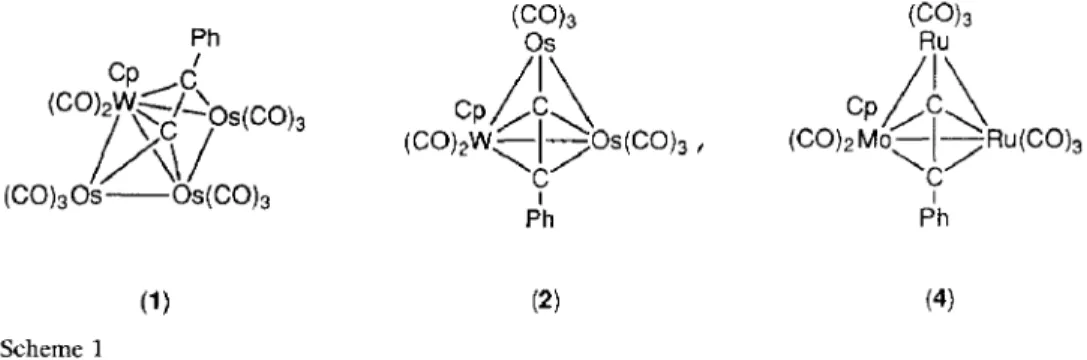
CpWOs,(CO),,(C=CPh) (1) and CpWOs,(CO),(C=CPh) (2), have been isolated
and characterized by X-ray crystal structure determination (Scheme 1). However, the analogous reaction with Ru,(CO)i2 failed to produce the analogous tetranuclear derivative, but provided only the trinuclear complex [6]. In this paper, we report the preparation and crystal structure of an analogous pentanuclear heterometallic
C8
Ph
(1) (2) (4)
Scheme 7
derivative Cp,Mo,Ru3(CO),,(C=CPh), (3), generated by condensation of CpMo
(CO),C=CPh with Ru,(CO),,. Notable structural features of the new complex 3 include an uncommon symmetrical pentametallic double butterfly skeleton [7] and a novel p4-n2 bonding mode for the acetylide ligand [5].
Treatment of a mixture of Ru,(CO),, and CpMo(CO),C=CPh in a molar ratio 2 : 3 in refluxing toluene under nitrogen for 40 min, followed by thin-layer chro- matography on silica gel (CH,Cl, : hexane = 2 : 3) gave the expected trinuclear acetylide derivative CpMoRu,(CO),(C&CPh) (4, 42%) unreacted Ru,(CO),, (7%) and small proportions of dark-brown complex 3 (5%). The complex 3 was identified primarily from its spectroscopic data: FAB MS (‘“2R~, 98Mo): m/z 1114 (MS ); IR(CC1,): v(CO), 2073 (vs), 2054 (s), 2014 ( m, br), 1986 (w), 1973 (w), 1940 (VW)
_
‘; ‘H NMR (300 MHz, CDCI,, 294 K): 6 7.56 (d, 4H, J(H-H) = 7.1 Hz), 7.42 ;:4H, J(H-H) = 7.3 Hz), 7.30 (t, 2H, J(H-H) = 7.3 Hz), 5.23 (s, 10H); 13C NMR
(75 MHz, CDCl,, 294 K): S 238.1 (MO-CO, 2C), 198.9 (Ru-CO, 2C), 196.9
(Ru-CO, 2C), 195.8 (Ru-CO, ZC), 193.3 (Ru-CO, 2C). The ‘H and “C NMR
spectra and the parent ion in the mass spectrum suggest the presence of two identical acetylide ligands and two identical CpMo units. Cluster complexes possess- ing such high molecular symmetry are rather uncommon.
Precise structural details have been provided by X-ray analysis. Crystals suitable for single-crystal X-ray diffraction study were obtained from a solution in CH,Cl,/CH,OH at room temperature. According to the X-ray structure determina- tion, the asymmetric unit contains two crystallographically distinct, but structurally similar molecules [8* 1. An ORTEP diagram of one of these molecules is shown in Fig. 1, together with selected bond distances and angles. The molecule crystallizes in the monoclinic space group P2,/c with the presence of one independent CH,Cl, molecule. There is no interaction between the cluster complexes nor between the
* Reference number with asterisk indicates a note in the list of references
Fig. 1. Molecular structure of Cp,Mo,Ru,(CO_),,(GCPh), (3) showing the atomic numbering scheme. Important dimensions include: bond lengths (A): Mo(lA)-Mo(2A) 3.063(2). Mo(lA)-RLI(IA) 2.830(2), Mo(lA)-Ru(2A) 2.729(l), Mo(2A)-Ru(2A) 2.755(2), Mo(2A)-Ru(3A) 2.822(2), Ru(lA)-Ru(2A) 2.778(2), Ru(2A)-Ru(3A) 2.770(2), Mo(lA)-C(21A), 2.22(l), Mo(2A)-C(27A) 1,99(l), Ru(2A)-C(2IA) 2.146(9), Mo(lA)-C(22A) 2.303(9), Ru(lA)-C(22A) 2.11(l), C(21A)-C(22A). 1.37(l), Mo(lA)-C(29A): 2.02(l), Mo(2A)-C(29A) 2.25(l), Ru(2A)-C(29A) 2.14(l), Mo(2A)-C(30A) 2.28(l). Ru(3A)-C(30A) 2.12(l), C(29A)-C(30A) 1.36(l), Mo(lA)-C(lA) 2.00(l), Ru(lA)-C(lA) 2.33(l), Mo(2A)-C(2A) 2.01(l), Ru(3A)-C(2A) 2.36(l); bond angles ( “): Mo(lA)-C(lA)-O(lA) 152.9(9), Ru(lA)-C(lA)-O(lA) 125.4@), Mo(2A)-C(2A)-O(2A) 152.9(9), Ru(3A)-C(2A)-O(2A) 126.6(E).
c9
Fig. 2. An ORTEP view of 3 showing the C, rotational symmetry of this molecule.
cluster and the solvent molecules. The Mo,Ru, cluster core adopts a novel doubie butterfly geometry [7], as expected for the pentametallic complexes characterized by the presence of 76 outer valence electrons IS]. Atoms Ru(2A), Mo(lA) and Mo(2A) co~stitnte the metal triangle located in the center, of which the ruthenium atom
Ru(2A) associates with two terminal CO ligands and each molybdenum atom
associates with one bridging CO ligand and one Cp ligand. There are two further ruthenium atoms, Ru(lA) and Ru(3A), each of which is located on one of the two Ru-MO edges of the central triangle and is coordinated by three terminal CO ligands. Furthermore, the arrangement of the transition metal atoms and their surrounding ligands of this molecule suggests that there is a C, rotational axis which passes the Ru(2A) atom and the middle of the Mo(lA)-Mo(2‘~) vector. A side-view of this molecule, which emphasizes the C, symmetry, is depicted in Fig. 2,
Due to the existence of C, symmetry, the acetytide figands. ~{2lA}-C(~2A) and C(29A)-C(30A), occupy opposite faces of the Mo,Ru 2 butterfly skeleton related by a 180 O rotation, and are coordinated in mu~tisite fashion with each or-carbon bound
to the three center metal atoms Mo(lA), Mo(2A) and Ru(2A), and with the
P-carbon atom bridged to the MO-Ru bond at the edge. The dihedral angles
between the planes ~~o(lA)“-Mo~2A)-Ru(2A) and Mo(~A~-R~(lA~-Rn(ZA) and
between the planes Mo(lA)-Mo(2A)-Ru(2A) and Mo(~A~-R~(~A)-Ru(~A) are
132.72(4) and 135.59(4)“, respectively. The ,u~-Q’ bonding mode of the acetylide ligand is of interest. The related p.-q2 bonding interaction has been reported in the
Cl1
spiked triangular Ni,Fe, and FeRuCo, complexes, [IO] the square pyramidal Ru, complex [ll] and the wing-tip bridged butterfly NiRu, complex [12]. However, the pentametallic derivative 3 and the tetranuclear complex 1 represent rare examples, in which the acetylide lies on the face of the tetrametallic butterfly skeleton and adopts a la + 2a bonding interaction [13] supplying a total of five electrons to the cluster orbitals. Tetranuclear Fe, and Ru, nitrile complexes which possess similar pa-q2 bonding interactions have been documented [14].
The mechanism for the formation of 3 is unknown at present, However, it is reasonable to propose that the mechanism involves the generation of a tetrametallic intermediate CpMoRu,(CO),,(C%CPh) with a structure similar to 1, followed by further condensation with CpMo(CO),C=CPh to give the isolated product. Unfor- tunately, no such species was observed during the reaction, suggesting that the proposed intermediate may be unstable under the conditions studied.
Acknowledgement. We are grateful to the National Science Council of the Republic of China for financial support (Grant NO. NSC79-2008-M007-52).
References
1 D.A. Roberts and G.L. Geoffroy, in: G. Wilkinson, F.G.A. Stone and E.W. Abel (Eds.), Comprehen- sive Organometalhc Chemistry, Pergamon Press, Oxford, 1982, Vol. 6, Chap. 40.
2 (a) R. Hoffmarm, Angew. Chem. Int. Ed. Engl., 21 (1982) 711. (b) F.G.A. Stone, Angew. Chem. Int. Ed. Et-&., 23 (1984) 89.
3 (a) F.G.A. Stone, in: M.H. Chisholm, (Ed.), Inorganic Chemistry: Toward the 21st Century, ACS Symp. Ser. No 211, American Chemical Society, Washington, DC, 1983, p 383. (b) S.J. Davies, J.A.K. Howard, R.J. Musgrove and F.G.A. Stone, Angew. Chem. Int. Ed. Engl., 28 (1989) 624 and references cited therein.
4 (a) E. Roland, W. Bernhardt and H. Vahrenkamp, Chem. Ber., 119 (1986) 256. (b) W. Bemhardt and H. Vahrenkamp, Organometahics, 5 (1986) 2388. (c) A.J. Deeming, S. Donovan-Mtunzi and K. Hardcastle, J. Chem. Sot., Dalton Trans., (1986) 543. (d) A.A. Koridze, A. Kizas, Yu.T. Struchkov, AI. Yanovakii and N.E. Kolobova, Metalloorg. Khim., 1 (1988) 831. (e) H. Vahrenkamp, Pure Appl. Chem., 61(1989) 1777. (f) P.M. Fritz, K. Polbom, M. Steimann and W. Beck, Chem. Ber., 122 (1989) 889. (g) Y. Chi, D.-K. Hwang, S.-F. Chen and L.-K. Liu, J. Chem. Sot., Chem. Commun., (1989) 1540.
5 Y. Chi, G.-H. Lee, S.-M. Peng and C.-H. Wu, Organometallics, 8 (1989) 1574. 6 Y. Chi, S.-M. Peng, G.-H. Lee and B.-J. Liu, Polyhedron, 8 (1989) 2003.
7 E. Sappa, A. Tiripicchio, A.J. Carty and G.E. Toogood, Prog. Inorg. Chem., 35 (1987) 437. 8 Selected crystal data for 3: C,,H,,MqO,oRu,.fCH,C1,, M = 1150.1, monoclinic, space group
P 2,/c, (I 24.119(10), b 20.739(4), c 15.358(3) A, j3 101.68(4)O, V 7523(4) A3, Z = 8. 0, 2.03 g/cm3. F(OO0) = 4422.9, MO-K, radiation with X 0.70930 A, 9 scan absorption correction was made and 9816 unique reflections were measured of which 6262 were considered observed with I > 2a(Z). The structure was solved by a direct method and refined by full matrix least-squares refinement. Final R = 0.038, R, = 0.034 and GOF = 1.57. Tables of bond distances and angles, a table of positional parameters and anisotropic thermal parameters, and listings of the observed and calculated structural factors are available from the authors.
9 D.M.P. Mingos, Act. Chem. Res., 17 (1984) 311.
10 (a) C. Weatherell, N.J. Taylor, A.J. Carty, E. Sappa and A. Tiripicchio, J. Organomet. Chem., 291 (1985) C9. (b) E. Roland and H. Vahrenkamp, Organometallics, 2 (1983) 1048.
11 A.J. Carty, S.A. MacLaughhn and N.J. Taylor, J. Am. Chem. Sot., 103 (1981) 2456.
12 M. Lanfranchi, A. Tiripicchio, E. Sappa, S.A. Maclaughlin and A.J. Carty, J. Chem. Sot., Chem. Commun. (1982) 538.
13 E. Sappa, A. Tiripicchio and P. Braunstein, Chem. Rev., 83 (1983) 203.
14 (a) H. Bantel, B. Hansert, A.K. Powell, M. Tasi and H. Vahrenkamp, Angew Chem. Int. Ed. EngI., 28 (1989) 1059. (b) E. Keller and D. Wolters, Chem. Ber., 117 (1984) 1572.