Tunable and high-power semiconductor laser with good beam quality
in optical-communication band
Chih-Hung Tsai
a, Yi-Shin Su
a, and Ching-Fuh Lin
a, b aInstitute of Electro-Optical Engineering, National Taiwan University, Taipei, Taiwan, R.O.C.
bDepartment of Electrical Engineering and Institute of Electronics Engineering, National Taiwan
University, Taipei, Taiwan, R.O.C.
ABSTRACT
High power and good beam quality are desired for semiconductor lasers in many applications. We propose a new type of broad area laser diodes that is capable of emitting good beam quality, high power and broadband tuning. The new type of laser diodes is fabricated with a broad-area waveguide that is oriented at an angle from the facet normal. This device does not require the DFB structure, so the fabrication is much simpler. The L-I curves, spectra, near-field patterns and far-field patterns of the angled broad-area waveguide laser diode are measured. The direction of the far field pattern along the facet normal for the device operated above the threshold current indicates that the light path is not along the waveguide direction. As the laser diode is inserted in a grating-loaded external cavity, it is tunable from 1280nm to 1315nm with output power up to 1.4 watt at 8Amp. The beam quality is good and the near field has negligible filamentation.
Keywords: high-power semiconductor lasers, beam quality, tunable, near field, far field. 1.INTRODUCTION
The compact size, reliability and efficiency of semiconductor lasers make them suitable for a wide variety of applications requiring high power levels. High power and good beam quality are desired for semiconductor lasers in many applications such as frequency doubling1, free space communication2, and material processing3. In particular, laser sources operating at the 1.3μm and 1.55μm wavelengths have important applications in cable television transmission systems, microwave photonics, interferometric sensors, and can be used as an alternative to diode-pumped solid state lasers. High-power spatially coherent semiconductor lasers have been a goal of diode laser researchers for years. Single-stripe devices are generally limited to a few hundred mW of output power. At higher power, reliability problems associated with high optical intensity at the output facet begin to limit device performance.
In order to improve the output power and beam quality, several approaches such as tapered power amplifiers4, antiguided arrays5 and angled-grating DFB lasers6 had been investigated. Although tapered amplifier system can provide watt-range output power, beam filamentation remains to be a problem and trade-off between modal gain and beam quality must be made7. Angled-grating distributed feedback (DFB) lasers can provide good beam quality, but the working wavelength is fixed after fabrication. In addition, the fabrication of grating structures is difficult. Furthermore, the mismatch between the peak gain wavelength and the DFB resonance wavelength can severely affect the device performance8. This imposes a strict requirement on the fabrication of DFB structure. Temperature variation can also make serious effect on the device operation by shifting the gain profile.
To make a diode laser emit optical power at thousands of milliwatts, the emitting facet must be large to prevent catastrophic optical damage (COD). Even with a high COD threshold (10MW/ cm2 )9, the emitting facet is required to be large to make COD threshold three times higher than the optical intensity for 1 watt operation. Thus, more than 30μm broad emitting facets are necessary for watt-range operation10. But the broad-area waveguide leads to the small difference of the threshold gain between the high-order modes and the fundamental mode. In addition, the nonlinear interaction between carriers and light will produce filamentation of optical power distribution11. All these reasons make high-order transverse modes excited in broad-area Fabry-Perot laser diodes and the spatial coherence of emissions on every part of the facets is poor. It is necessary to resolve the filamentation problem and investigate a new type of semiconductor laser that can provide high power and good beam quality.
In this paper, we propose a new type of broad-area laser diodes. The laser diodes are fabricated on the wafer with quantum wells designed for the wavelength of 1300nm. The laser diodes have a 100 μm wide waveguide oriented at 6o
from the facet normal. The device length is 1960μm. Above the threshold of 1.0 Amp, the far field emits at the direction of the facet normal and has FWHM of 4.2o. When the LD is placed in a grating-loaded external cavity, It emits over 1 watt output power with good beam quality and its output is wavelength-tunable with 35nm tuning range. The laser diode has a broad-area waveguide oriented at an angle from the facet normal. This device does not require the DFB structure, so the fabrication is much simpler.
2.Device Structure
The laser diodes are fabricated on the wafer with multiple quantum wells (MQWs) designed for the wavelength at 1300nm. The laser diodes have a 100μm wide waveguide oriented at 6o from the facet normal. The device length is 1960μm. W is the width, L is the length and θ is the tilted angle of the waveguide (Fig.1). In the fabrication, θ=6o, W=100μm and L'=1960μm. The waveguide direction is not perpendicular to cleaved facet, but tilted at an angle. The devices have a double channel ridge waveguide created by reactive ion etching (RIE). The process gases are CH4 and H2.
The channel button is 100nm~200nm above the undoped optical confinement layer. After the waveguide fabrication, silicon oxide grown by plasma enhanced chemical vapor deposition is used as the insulating dielectric. The contact metal is Ti/Pt/Au on the p-side and AuGe/Ni/Au on the n-side. After processing, the devices are cleaved apart. No coatings are applied.
Figure 1: Structure of the laser diode. W is the width, L is the length and θ is the tilt angle of the waveguide. L' is the length of the device.
3. Device Performance
The performance of the semiconductor laser is first measured without external cavity, the threshold current of the laser diode is 1.0 Amp and the output power is up to 1W as the pumping current is 8 Amp (Fig.2). The differential efficiency is 0.15W/A per facet.
The spectra below and above the threshold are measured (Fig.3). Below the threshold, the spectrum is broad with a full width at the half maximum (FWHM) of 25nm. Above the threshold current, the lasing wavelength is centered at 1300nm with a FWHM spectral width of 10nm. The measured spectrum consists of many modes with the spectral spacing of 0.122nm. It indicates that the optical-path length is 1978μm.
θ
W
L'
0 2 4 6 8 0 200 400 600 800 1000 1200 1400 W ithout Feedback
Feedback with grating at 1295nm
Pow e r ( m W) Current (A)
Figure2: L-I curve of the high power laser diode.
Figure3: Spectra of the high power laser diode.
Near-field patterns and far-field patterns are also obtained. The near field shows that the output light is mainly emitted from the waveguide region. The width of the near-field distribution is around 40μm as the current is 6 Amp. No filamentation is observed (Fig.4). The corresponding diffraction-limited angle of the far field is 2.27 o. 30μm width of near-field distribution is observed as the pumping current is 0.6Amp.
25nm
Current: 0.6A
Current: 6A
Figure4: Near field of the high power laser diode.
Far fields of the laser diode are also shown (Fig.5). When the pumping current is below the threshold, the output light beam emits at the left hand side with 22 o from the facet normal. As the pumping current is above the threshold current, the light beam emits from the facet normal. The right side figure of Figure5 shows the far field pattern of this laser diode as the injection current is 6Amp. The light beam does not go along the tilted waveguide. Instead, it goes straight out of the facet. The reason is that the light path in the waveguide is zigzag instead of along the tilted angle. The light in the waveguide is reflected twice at the waveguide boundary, so the output light can still go straight toward the cleaved facets. The FWHM of the far field is 4.2 o, which corresponds to 1.85 times of the diffraction-limited value of the near-field pattern.
Figure5: Far field of the high power laser diode.
Figure5: Far field of the high power laser diode.
0 100 200 300 400 500 600 0 1000 2000 3000 4000 5000 6000 7000 In tensity (a.u.)
Lateral position (um)
30µm
0 100 200 300 400 500 600 0 1000 2000 3000 4000 Inte nsity (a .u.)Lateral position (um)
40µm
Current: 0.6A
Current: 6A
-20 0 20 40 60 80 100 120 140 160 180 200 20 40 60 80 100 120 Inten s ity ( a .u.) Angle
28 º
0 30 60 90 120 150 180 0 300 600 900 1200 1500 1800 In te n s ity ( a .u .) AngleCurrent: 6A
4.2 º
Current: 0.6A
The above device is set up in the external cavity with a grating at one side of the facet to provide external feedback. The external cavity consists of a collimator with 3 mm focal length and a diffraction grating. The grating selects the wavelength of laser operation by dispersing the diffracted light parallel to the junction plane (Fig.6). The grating is gold-coated with 600 grooves/mm.
Figure6: Experimental setup of grating-tuned external cavity
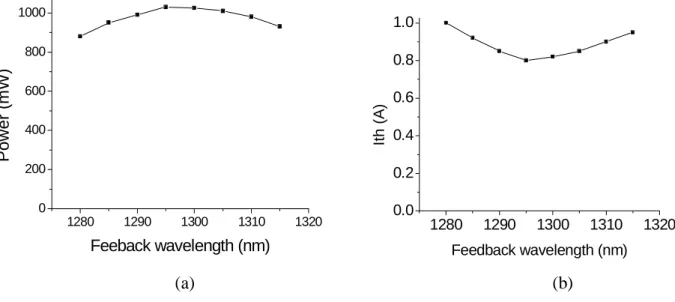
Using grating as the feedback mirror for the 100μm wide waveguide device, the lasing wavelength is controlled by the grating from 1280nm to 1315nm. The laser wavelength is tunable for a spectral range of 35nm. The tuning spectrum of the angled broad-area semiconductor laser is measured and shown in Fig.7. The output power against the tuning wavelength is also measured and shown in Fig. 8 (a).
Figure 7: Tuning spectra of the 100µm wide angled waveguide
Grating
Collimator
Device
Collimator
The threshold current of the device is 1.0 Amp without external feedback. In the external cavity, the threshold current is reduced to 0.8Amp with grating feedback at 1295nm. The threshold current against the tuning wavelength is shown (Fig.8 (b)).
1280 1290 1300 1310 1320 0 200 400 600 800 1000 Pow e r ( m W) Feeback wavelength (nm)
Figure 8: Output power at 6Amp operating current and threshold current against tuned wavelength
With the feedback from the grating, the lasing wavelength is different from the original lasing wavelength of 1300 nm. It becomes controllable by the grating orientation. Thus the lasing wavelength is tunable from 1280nm to 1315nm. With 6Amp of injection current, the maximum output power is 1030mW at 1295nm and the minimum output power is 820mW at 1310nm. When the injection current increases, the output power also increases within the same tuning wavelength. Thus higher output power is still possible with the injection current larger than 6 Amp. In the external cavity, the threshold current is reduced to 0.8Amp with grating feedback at 1295nm and 0.9Amp at 1285nm wavelength. These values are smaller than the threshold current of the laser diode without feedback. It indicates that the feedback from the grating effectively suppresses the original oscillation of the laser diode. Thus, the lasing wavelength of the laser diode is controlled by the feedback light from the grating. At 1295nm feedback wavelength, the grating reflection provides the maximum output power. The emission power can achieve 1.4 W as the pumping current is 8Amp. The output power is measured at the other facet (Fig. 9).
0 2 4 6 8 0 200 400 600 800 1000 1200 1400 1600 Without Feedback
Feedback with grating at 1295nm
Po we r ( m W ) Current (A)
Figure 9: L-I curve with grating feedbackFig
1280 1290 1300 1310 1320 0.0 0.2 0.4 0.6 0.8 1.0 Ith ( A ) Feedback wavelength (nm)
(a) (b)
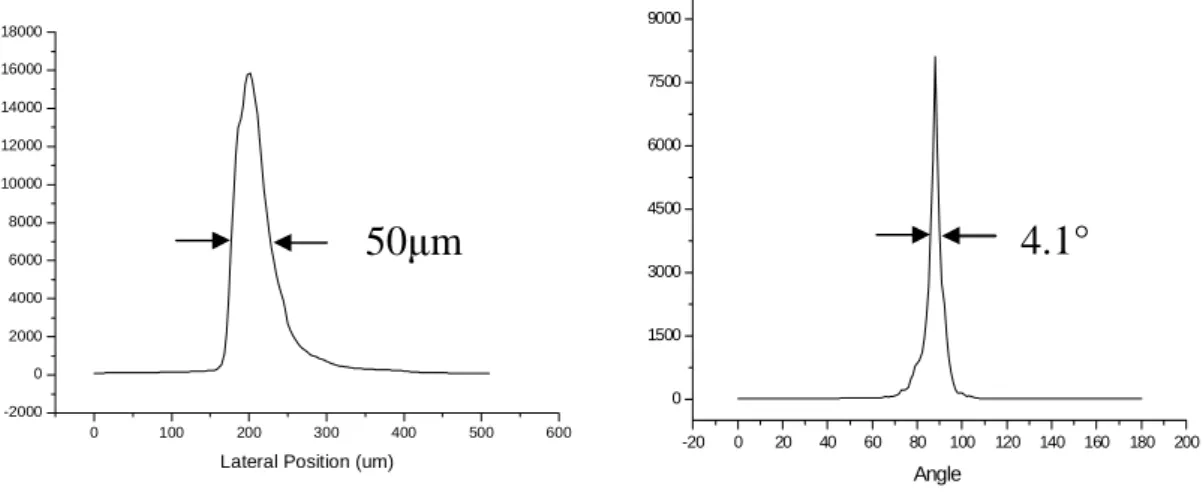
The near field and far field patterns of this device at 6Amp with grating feedback at 1295nm are measured, respectively (Fig.10). It shows that the near field is broad with a full width at the half maximum (FWHM) of 50μm.
Figure 10: Near field and far field with grating feedback at 6Amp.
The horizontal FWHM of the far field pattern is 4.1°. This angle is twice of the diffraction-limited value corresponding to the near field. The near field is mainly emitted from the waveguide region at the cleaved facet. The filamentation is not obvious in the near field pattern. In the conventional laser diodes with abroad-area waveguide, filamentation phenomenon is due to the interference between the counter-propagation waves. Angled broad-area waveguide can provide specific optical-path to average out the fluctuation. When the pumping current is below the threshold, the light is emitted at an angle from the facet normal and the far field angle is broad. When the operation current is above threshold, the far field emits along the normal direction of the cleaved facet. Compared with the near field and far field of the device without grating feedback, the FWHM of the near field in the external cavity is slightly expanded by 10μm and the far field is narrowed by 0.1 degree.
4. Discussion
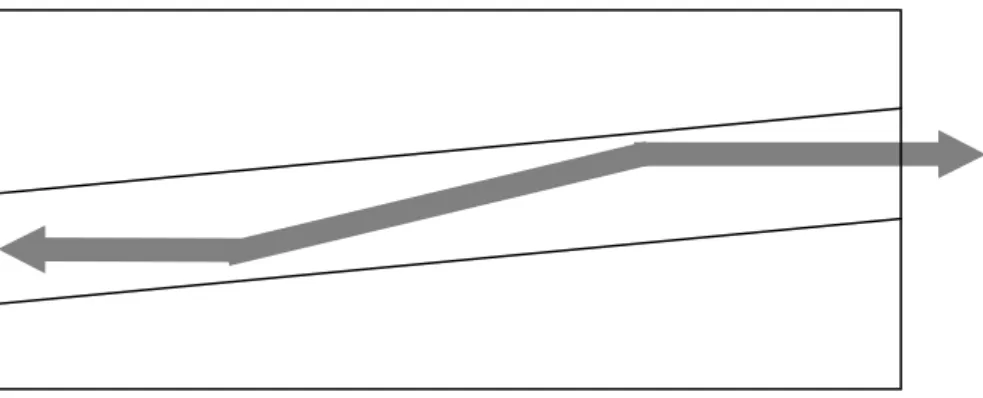
The direction of the far field pattern along the facet normal for the device operated above the threshold current indicates that the light path is not along the waveguide direction. Instead, the light path in the waveguide is zigzag, similar to that occurring in the angled-grating DFB lasers. The light in the waveguide is reflected twice at the waveguide boundary, so the output light can still go straight toward the cleaved facets (Fig. 11). This kind of light path can average out the fluctuation induced by the interaction between carriers and light. For the conventional broad-area waveguide normal to the cleaved facets, the light path is along the waveguide direction, so light trace does not vary its distance from the waveguide boundary. Then the beam distortion accumulates along the propagation distance. In our devices operated above the threshold, the light path is not along the waveguide direction. Instead, the light path is zigzag, so each light trace varies its distance from the waveguide boundary. As a result, the index fluctuation across the waveguide experienced by each light trace is averaged out, so filamentation is significantly reduced. Devices with broad-area waveguide normal to the cleaved facets have also been fabricated on the same wafer. Their near fields have severe filamentation and the far field has several spikes.
-20 0 20 40 60 80 100 120 140 160 180 200 0 1500 3000 4500 6000 7500 9000 Angle 0 100 200 300 400 500 600 -2000 0 2000 4000 6000 8000 10000 12000 14000 16000 18000
Lateral Position (um)
Figure 11: Possible optical-path in the angled waveguide.
As the device is operated above the threshold current, the measured spectrum of the 1000μm device above the threshold consists of many modes with the spectral spacing of 0.122nm. It indicates that the optical-path length is 1978
μm, which is longer than the device length. Thus the light path is zigzag instead of along the waveguide direction. For
such a mode to oscillate, the device length should be properly chosen to satisfy the zigzag path. As shown in Fig.1, L is the length, W is the width and θ is the tilt angle of the waveguide. L' is the length of the device. The optical-path length would be 2mW/sin(θ), the waveguide length would be L=2mWcos(θ) / sin(θ), and the device length would be L'=2mWcos(θ) / tan(θ), where m is any positive integer, m=1 means that light in the waveguide is reflected twice at the waveguide boundary. Too long or too short waveguide for the devices will cause some portion of the output beam to emit toward other directions.
5. Conclusion
In conclusion, a new type tunable angled broad-area waveguide laser diodes is fabricated on a substrate with MQWs designed for 1300nm. The device length is 1960μm. The waveguide is 100μm wide and tilted at 6 o from the facet normal. This device oscillates and could emit 1 W output power per facet at 8 Amp. The far field pattern has interesting changes between below and above the threshold current. When the device is oscillating, the far field emits along the facet normal. The horizontal far-field angle is only twice of the diffraction-limited value. Compared with conventional broad area waveguide lasers, the near field of angled broad area lasers shows no filamantation. When the laser diode is placed in a grating-loaded external cavity, the lasing wavelength is tunable from 1280 nm to 1315 nm although the facet is not anti-reflection coated. The threshold current is 0.8 Amp at 1295 nm and the output power is as large as 1.4 W at 8 Amp. The wavelength tunable and high power make this laser diode a good candidate of pump lasers for Raman amplifiers by providing more available bandwidth to Raman amplifiers.
References
1. B. Beier, D. Woll, K.-J. Boller, and R. Wallenstein, "Second-harmonic generation of the output of an AlGaAs diode oscillator-amplifier system in critically phase matched LiB3O5 and b-BaB2O4," Appl. Phys. Lett., vol. 71, pp.1-3, 1997. 2. S. G. Lambert, W. L. Casey, "Laser Communication in Space," Boston, MA: Artech, 1995.
3. P. Loosen, H.-G. Treusch, C. R. Haas, U. Gardenier, M. Weck, V. Sinnho, St. Kasperowsky, and R. vor dem Esche, "High-power diode lasers and their direct industrial applications," SPIE Proc.2382, pp.75-78, 1995.
4. J. N. Walpole, "Semiconductor amplifiers and lasers with tapered gain regions," Opt. Quant. Electron, vol.28, pp.623-645, 1996.
5. C. Smudzinski, D. Botez, L. J. Mawst, A. Bhattacharya, M. Nesnidal, and R.F. Nabiev, "Three-core arrow-type diode laser, novel high-power, single-mode device, and effective master oscillator for flared antiguided MOPAs," IEEE J. Select. Topics Quant. Electron, vol. 1, pp.129-137, 1995.
6. S. D. de Mars, K. M. Dzurko, R. J. Lang, D. F. Welch, D. R. Scifres, and A. Hardy, "Angled grating
pp.77-78, 1996.
7. M. Mikulla, "Improved beam quality for high-power tapered diode lasers with LMG eptitaxial layer structures," SPIE Proc.3284, pp.72-79, 1998.
8. I. Vurgaftman, W. W. Bewley, R. E. Bartolo, C. L. Felix, M. J. Jurkovic, J. R. Meyer, M. J. Yang, H. Lee and R. U. Martinelli, "Far-field characteristics of mid-infrared angled-grating distributed feedback lasers," J. Appl. Phys., vol.88, pp.6997, 2000.
9. M. Fukuda, "Reliability and degradation of semiconductor lasers and LEDs", Boston, MA: Artech, 1991. 10. M. A. Emanuel, N. W. Carlson, "High-efficiency AlGaAs-based laser at 808nm with large transverse spot size," IEEE Photon. Technol. Lett., vol. 8, pp.1291-1293, 1996.
11. Jie-Wei Lai and Ching-Fuh Lin, "Carrier diffusion effect in flared semiconductor-laser amplifier," IEEE J. Quantum Electron. 34, pp.1247-1256, 1998.