
台灣學童英語拼字錯誤探討:音韻覺識與拼寫能力之關係研究
123
0
0
全文
(2) 論文名稱:台灣學童英語拼字錯誤探討:音韻覺識與拼寫能力之關係研究 校所組別:國立交通大學英語教學研究所 畢業時間:九十八學年度第二學期 指導教授:林律君博士 研究生:陳湘菱. 中文摘要 本研究旨在探討台灣學童英語拼字錯誤,聚焦於音韻覺識與拼字能力之關 (1)檢視台灣學童的英語拼字表現是否 係,有鑑於此,本研究有以下三個目的: 因其音韻覺識程度而顯著差異; (2)探究台灣學童之音韻覺識在其拼字能力上所 扮演的角色;以及(3)分析台灣學童之英語拼字錯誤。 本研究的參與者為 33 位小學四年級學童,來自於新竹市某公立小學同一班 級,在 33 名參與此研究的學童中,有 28 名完成所有階段的資料收集程序。資料 收集的內容包含拼字能力測驗、音韻覺識測驗與讀寫能力測驗,當中,拼字能力 測驗包括真字與假字聽寫測驗以及故事改寫活動;音韻覺識測驗則包含音素辨 別、音素結合與音素操弄能力的測試;英文程度的評估則採用劍橋兒童英語認證 (Cambridge Young Learners English Test)之閱讀與寫作項目測驗成績。真字與 假字聽寫測驗以拼字之語音可接受度(phonological acceptability)為評分方式, 除變異數、相關係數和回歸分析之計算外,本研究也探討拼字錯誤之類型與結 構,以瞭解台灣學童拼字能力與其音韻覺識之相關性。 根據音韻覺識測驗的成績,研究對象被分為低、中、高三個不同音韻覺識程 度之組別,結果顯示中程度與高程度的組別在真字與假字聽寫測驗之成績未呈現 顯著差異,但兩組之得分皆顯著高於低程度組別。相關係數分析則指出所有的測 量結果彼此呈現高度相關,驗證學童之拼字能力與其音韻覺識程度兩變項間有顯 著性的正相關。層級迴歸分析結果顯示,音韻覺識測驗成績可有效預測真字與假 字聽寫測驗之分數,然而,當考慮讀寫能力此一變項時,音韻覺識程度對於拼字 能力則不具顯著預測力。 i.
(3) 最後,本研究發現台灣學童常見的拼字錯誤類型為:半似原音拼字錯誤 (semiphonetic spelling error)以及拼成他字的錯誤(another word correctly spelled),此外,從研究對象的拼字錯誤中,不難發現台灣學童在拼寫雙元音與 子音串時,多以其他字母替換目標音而拼錯字的現象。值得注意的是,音韻覺識 程度較低的學童,有較多的隨機拼字錯誤(random error pattern) 、刪去母音拼字 錯誤(vowel omission)、刪減複合子音拼字錯誤(consonant diagraph reduction)和拼 字不完整的錯誤;音韻覺識程度較佳的學童,其拼字錯誤較少被歸類為隨機拼字 錯誤之結構,儘管並不顯著,本研究並發現部分音韻覺識程度較高之學童在拼寫 字尾齒槽音時有省略不寫的現象。 研究結果不僅發現台灣學童英語拼字能力明顯的個別差異,更指出除音韻覺 識外,讀寫能力對拼字能力的發展也有重要影響,此外,本研究發現台灣學童可 能使用類推的方法(analogy strategy)拼寫不熟悉字,以及他們拼寫雙元音、子 音串與複合子音時,可能的拼字問題。結論指出音韻教學、讀寫活動在台灣學童 拼字能力發展中應是相當有助益的,並強調自創拼字(invented spelling)及語音 分析能力(phonological analysis ability)對其拼字能力習得之重要性。總結而言, 本研究希望能說明台灣學童如何運用其語言知識拼寫英語單字,並且提供台灣英 語教育者重要的教學啟示。. ii.
(4) ABSTRACT The present study focuses on the role of phonological awareness in English spelling of Taiwanese EFL children beyond early grade level.. The primary purposes. are: (1) to examine phonological awareness group differences in spelling performance; (2) to investigate the role of phonological awareness in spelling performance; and (3) to discuss the types and patterns of spelling errors. To achieve these objectives, measures of spelling performance, phonological awareness, and literacy skills were administered to an intact fourth-grade class of 33 students in an elementary school in Hsinchu city, Taiwan. completed all testing procedures of the study.. Among them, 28 students. The children’s spelling performance. was gauged using a spelling dictation task and a story rewriting task.. Three. phonological awareness tasks were employed to tap the children’s ability of phoneme identification, blending, and manipulation.. To assess their command of literacy. skills which served as proficiency baseline, the reading and writing subset of the Cambridge Young Learners English Test was presented.. Spellings collected from the. spelling dictation tasks were assessed mainly for phonological plausibility.. In. addition, spellings archived from both spelling tasks were analyzed and elucidated in terms of error types and patterns. Based on the phonological awareness scores, the children were divided into three levels of phonological awareness groups (i.e., low, middle, and high).. Significant. group differences in spelling dictation scores were revealed except for those between the middle and high phonological awareness groups.. Correlational analyses showed. that the children’s spelling performance was significantly associated with phonological awareness and literacy measures.. Regression analyses demonstrated. that phonological awareness alone predicted a significant amount of variance in spelling performance, whereas it became nonsignificant when literacy scores were iii.
(5) considered.. With respect to spelling patterns, semiphonetic and. another-word-correctly-spelled errors appeared to be the top two predominant misspelling types.. Substitutions of vowel diagraphs and consonant clusters also. occurred frequently in the children’s spellings.. The low phonological awareness. group showed a tendency to make more random error patterns, incomplete responses, vowel omissions, and consonant diagraph reductions.. In contrast, the high. phonological awareness group made fewer random errors. The most salient but minor misspelling patterns observed in this group were omissions of final lenis consonants. The results concerning group differences indicate that there was a noteworthy discrepancy in spelling achievement among Taiwanese EFL children.. Although the. correlational analyses ascertained that phonological awareness was associated with spelling performance even for EFL children, the regression findings imply that other than phonological awareness, literacy skills appear to play a more crucial role in EFL children’s spelling.. The analyses of the children’s spelling errors not only suggest. that EFL learners may draw on analogy strategies to spell unfamiliar words, but also pinpoint their difficulty in spelling vowel diagraphs (e.g., ee), consonant clusters (e.g., dr), and consonant diagraphs (e.g., ch).. Comparison of spellings across different. groups further underscores the extent phonological awareness was associated with the children’s spellings, and even highlights the value of invented spellings (i.e, phonetic spelling attempts), teaching grapheme-phoneme representative skills, and phonological analysis instruction. To conclude, this study may be of importance in providing a complete picture of what cognitive-functioning school-aged EFL children could rely on when learning to spell unfamiliar words, and in offering insights into spelling and phonological awareness instruction in EFL contexts. iv.
(6) ACKNOWLEDGEMENTS Here, I would like to express my thanks to several people who helped me to complete this thesis.. To being with, the first person that I would like to show my. deep gratitude to is my advisor, Dr. Lu-Chun Lin.. Every time when I had any. questions concerning the thesis, she was always there with me.. Not only did her. support encourage me to exert myself to conduct this study, but her mentoring offered me many insights into how to refine my thesis.. Dr. Lu-Chun Lin’s enthusiasm for. research in this field positively influenced my attitudes towards doing research. Without her specialty at literacy development and bilingualism, I would have not been able to finish this thesis.. I want to show my appreciation for the Institute of TESOL. in National Chiao Tung University as well.. In this program, I greatly extended my. knowledge and sharpened my thoughts, which no doubt prepared me for undertaking this study. Next, I am very grateful to have the National Experimental Elementary School at Hsinchu Science Park participate in this study.. My sincere gratitude also goes to my. committees, Dr. Yu-Chih Sun from the National Chiao Tung University, and Dr. Rong-Lan Yang from the National Hsinchu University of Education. constructive comments and suggestions all made this study better.. Their. Furthermore, I. want to thank writing consultants, Holli and Jennifer, from the Language Teaching and Research Center in National Chiao Tung University.. Having writing. consultations with them helped me to organize my thesis points in a clear way. Lastly, I would like to offer my heartfelt thanks to Flora, the second rater of this study.. I am also deeply appreciative of Tiffany, Alvin and Erin’s preparation for the. recordings of test items, together with Alice’s useful feedback on this research. Special thanks go to my family and friends for their love and support. v.
(7) TABLE OF CONTENTS 中文摘要 ........................................................................................................................... i ABSTRACT ................................................................................................................... iii ACKNOWLEDGEMENTS ....................................................................................... v TABLE OF CONTENTS ........................................................................................... vi LIST OF TABLES ....................................................................................................... ix LIST OF FIGURES ...................................................................................................... x CHAPTER ONE INTRODUCTION ...................................................................... 1 Purposes and Research Questions of the Study ............................................................ 4. CHAPTER TWO LITERATURE REVIEW........................................................ 6 Spelling Development .................................................................................................... 6 Spelling Development in Monolingual Children .................................................... 6 Spelling Development in Bilingual Children .......................................................... 9 The Role of Phonological Awareness in Children’s Spelling ................................... 12 Studies on Spelling Errors............................................................................................ 18 Analysis of Spelling Errors ...................................................................................... 18 Spelling Errors and Phonological Awareness ........................................................ 22 Studies on Invented Spelling .................................................................................... 28 Significance of the Study ............................................................................................. 35. CHAPTER THREE METHODOLOGY ............................................................. 37 Participants .................................................................................................................... 37 Materials ........................................................................................................................ 39 Spelling Ability Tasks ............................................................................................... 39 Phonological Awareness Tasks ............................................................................... 43 English Proficiency Test........................................................................................... 44 vi.
(8) Data Collection and Procedures................................................................................... 46 Data Analyses ............................................................................................................... 47 Spelling Performance across Different Phonological Awareness Groups ........... 48 The Role of Phonological Awareness in Spelling Performance ............................ 48 Spelling Patterns across Different Phonological Awareness Groups................... 49 Coding Reliability ..................................................................................................... 51. CHAPTER FOUR RESULTS ................................................................................. 52 Spelling Performance across Different Phonological Awareness Groups ................ 52 The Role of Phonological Awareness in Spelling Performance ................................ 55 Spelling Patterns across different Phonological Awareness Groups ......................... 58 Overall Percentage and Rank Order for Each Type of Spelling Errors ............... 59 Comparison of Spelling Error Patterns across Phonological Awareness Groups .. ……………………………………………………………………………………………………………………………………60. Summary of the Results ............................................................................................... 66. CHAPTER FIVE DISCUSSION ........................................................................... 68 Spelling Performance across Different Phonological Awareness Groups ................ 68 The Role of Phonological Awareness in Spelling Performance ................................ 73 Spelling Patterns across different Phonological Awareness Groups ......................... 77 Semiphonetic Spelling Errors and Another-Word-Correctly-Spelled Misspellings . ……………………………………………………………………………………………………………………………………77. Substitution Spelling Error Patterns ....................................................................... 81 Spelling Error Patterns across Phonological Awareness Groups ........................ 82 Summary of the Discussion ......................................................................................... 85. CHAPTER SIX CONCLUSIONS ......................................................................... 87 Overview ....................................................................................................................... 87 Implications of the Present Study ................................................................................ 89 Limitations of the Study and Suggestions for Future Work ...................................... 91 vii.
(9) REFERENCES ............................................................................................................. 93 APPENDICES ............................................................................................................ 105 Appendix A ................................................................................................................. 105 Appendix B ................................................................................................................. 107 Appendix C ................................................................................................................. 109 Appendix D ................................................................................................................. 110. viii.
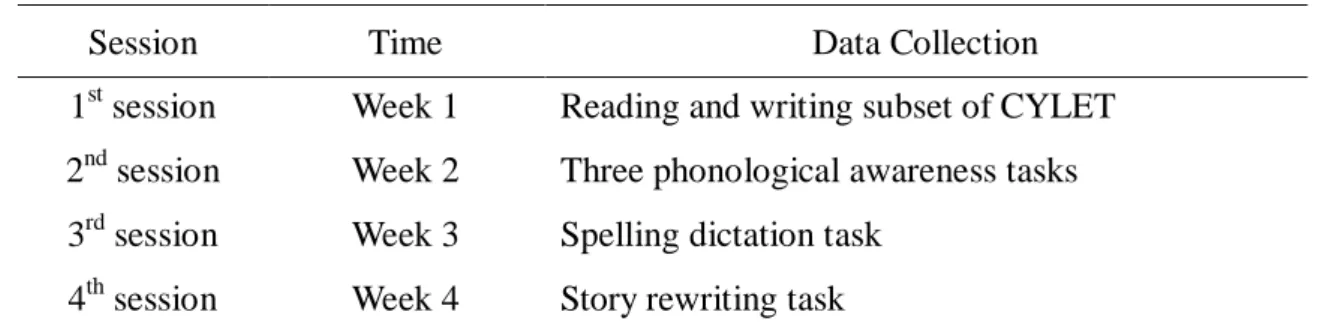
(10) LIST OF TABLES Table 3.1 Scoring Scheme for the Phonological Acceptability Scale .............................. 41 Table 3.2 Summary of Testing Materials ............................................................................... 46 Table 3.3 Testing Sessions ........................................................................................................ 47 Table 3.4 Spelling Error Pattern Coding Scheme ............................................................... 50 Table 4.1 Descriptive Statistics for the Measures ................................................................ 53 Table 4.2 Descriptive Statistics for Phonological Awareness and Spelling Dictation Scores of Different Groups of Children with Low, Middle, and High Phonological Awareness ......................................................................................... 54 Table 4.3 An ANOVA Analysis for Phonological Awareness Group Effect on Spelling Scores .......................................................................................................................... 54 Table 4.4 Tukey Post-hoc Analyses for Spelling Dictation Scores from Different Phonological Awareness Groups ........................................................................... 54 Table 4.5 Correlation Matrix for Spelling, Phonological Awareness, and Literacy Skills Tukey ................................................................................................................. 55 Table 4.6 Hierarchical Regression Analyses with Phonological Awareness and Literacy Skills ............................................................................................................ 58 Table 4.7 Proportion of Each Spelling Error Type .............................................................. 59 Table 4.8 Comparison of Misspelling Patterns across Different Phonological Awareness Groups .................................................................................................... 62. ix.
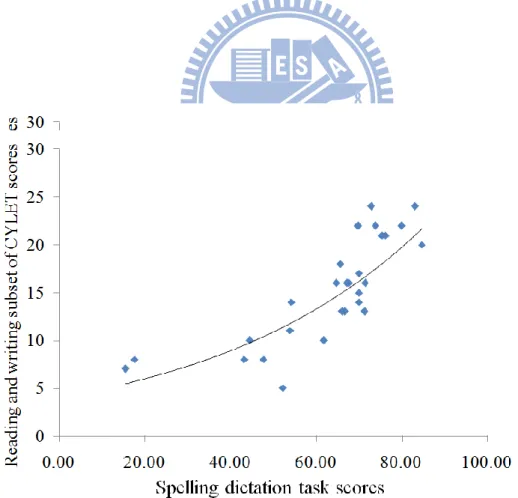
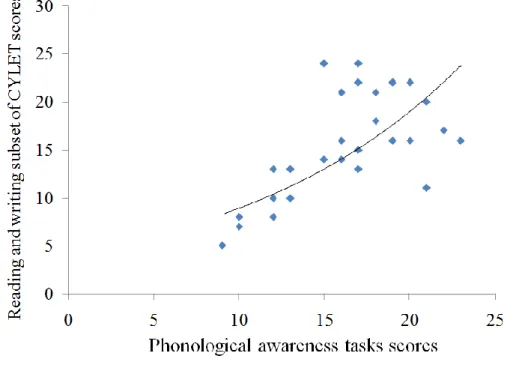
(11) LIST OF FIGURES Figure 4.1 Correlation between spelling dictation and phonological awareness scores .................................................................................................................................... 56. Figure 4.2 Correlation between spelling dictation task and CYLET scores ................... 56 Figure 4.3 Correlation between phonological awareness tasks and CYLET scores ..... 57. x.
(12) CHAPTER ONE INTRODUCTION. English is an international language in that it connects people from every corner of the globe.. In Taiwan, learning English has become a national trend in the 21st. century of globalization.. English curriculum no longer started from junior high. school; instead, it was adopted as one of the formal elementary school subjects based on the General Guidelines of Grades 1-9 Curriculum for Elementary and Junior High School (Ministry of Education, R.O.C., 2001).. Accordingly, in the school year 2001,. elementary schools in Taiwan began to initiate English instruction in the fifth and sixth grade.. By the time of 2005, English curriculum has been extensively launched. with a range from Grade 3 to Grade 6 in the elementary schools.. Some cities like. Taipei, Hsinchu, and Tainan even lower the grade of English instruction to Grade 1 or 2 to increase children’s future competiveness.. To maintain competitive edge, how to. establish children’s English skills has stood out as the major concern for the government, practitioners and parents in Taiwan. Among these English skills, literacy skills play a crucial role because they are closely tied with children’s academic achievement in English learning.. Generally. speaking, without literacy, it seems difficult for children to learn any school subjects. In addition, through reading and writing, children are able to engage in thinking and reasoning activities in which they argue for their own opinions and think of solutions for problems (Duffy & Roehler, 1993). This leads to the possibility that when children comprehend ideas from reading and express thoughts in writing, they progress in language learning.. Considering the significance of literacy, a growing. number of studies are available to provide theoretical and pedagogical implications for English reading and writing instruction. 1.
(13) In studying English literacy development, children’s emergent writing, the development of spelling in particular, has received considerable attention (e.g., Bear & Templeton, 1998; Chang, 2002; Dildine, 1994; Figueredo, 2006; Hill, 1999; Korkeamaki & Dreher, 2000; Liow & Lau, 2006; Lundblade, 1994; Ouellette & Sénéchal, 2008; Read, 1986; Stuart, 1999; Wang & Geva, 2003).. Chang (2002),. among others, pointed out that the children who are at risk for spelling problem generally hold a negative attitude toward English learning.. Read (1986) noted that. ―spelling involves segmentation, categorization and other cognitive processes applied to language‖.. This notion implies that children’s spelling ability is not about. memory; instead, it pertains to various aspects of linguistic knowledge as well as cognitive abilities.. Other researchers (e.g., Cataldo & Ellis, 1988; Clarke, 1988;. Perfetti, Beck, Ball, & Hughes, 1987; Post, Swank, Hiscock, & Fowler, 1999) have presented evidence supporting that spelling achievement benefits language competence such as phonological awareness, reading ability and writing ability. Overall, numerous research has highlighted the value of the improvement in spelling ability to English learning. Similarly, most parents and teachers in Taiwan also note the importance of spelling ability in English learning.. Perfect spelling, for some parents and teachers. in Taiwan, signifies children’s success in English learning.. On the other hand,. spelling errors are thought of as their failure in English learning.. To these parents. and teachers, only rote memorization can lead to spelling success and only ―correct‖ spellings can bring an achievement in English learning.. However, substantial studies. have implied that their conception of learning to spell may be mistaken.. First, these. parents and teachers’ focus on facilitating perfect spelling may conceal the message that children’s erroneous language output delivers.. According to Richards (1971,. 1974), errors in language learners in fact reflect their ways of exploring language in 2.
(14) the process of language acquisition.. With regards to learning to spell, several. researchers (e.g., Asselin, 2001; Bear & Templeton, 1998; Gentry, 1982; Treiman, 1993) have suggested that children’s misspelling is an important indicator of their progress in learning to spell conventionally.. Gentry (2000) further proposes that. spelling errors show not only children’s developmental stages of spelling, but also their growing knowledge of language such as phonological awareness and literacy skills.. Simply stated, the overemphasis on perfect spelling could mislead us over the. complete picture of students’ spelling development. Second, the process of learning to spell in English is much more complex (Lutz, 1986); therefore, it is apparent that rote learning is not the only way to develop successful spelling ability.. Specifically, the inconsistent grapheme-phoneme. correspondences in English may cause a great challenge in spelling.. For example,. there are about 14 ways to spell the sound sh (e.g., shoe, sugar, ambitious) (Bryson, 1990).. How do children, especially for L2 learners, master these spellings only. through memorization? Clearly, other than rote learning, explicit instruction of phonological awareness seems to be a more effective way of teaching spelling skills. In addition, to spell words, children need to draw upon differing linguistic knowledge like phonological, orthographic and morphological awareness (Apel, Masterson, & Niessen, 2004; Wasowicz, 2009).. In this regard, spelling is considered an encoding. process of the aforementioned knowledge, not a mechanical response trained by rote learning.. So, instead of rote memorization, what factors contribute to spelling. achievement? To tackle this question, it is necessary to look at the literature on the building blocks of spelling ability. A wealth of studies has convincingly demonstrated the casual relationship between phonological awareness and spelling performance (e.g., Adam, 1990; Bradley & Bryant, 1983; Caravolas, Hulme, & Snowling, 2001; Jongejan, Verhoeven, 3.
(15) & Siegel, 2007; Lundberg et al., 1980; Plaza & Cohen, 2003, 2004 & 2006; Torneus, 1984).. In addition to standard spelling, there is general agreement that spelling. errors are also highly pertinent to phonological awareness of children (e.g., He & Wang, 2009; Hu, 2003; Kamii & Manning, 1999; Kamii, Long, & Manning, 2001; Liow & Lau, 2006; Masterson & Crede, 1999; Sutcliffe, Dowker, & Campbell, 1999; McBride-Chang, 1998; Ouellette & Sénéchal, 2008).. On these grounds, we may. reasonably conclude that enhancing phonological awareness can facilitate spelling achievement in children.. In view of the major findings of the research on children’s. spelling, the present study examined the role of phonological awareness in spelling performance for Taiwanese fourth graders.. Purposes and Research Questions of the Study It should be noticed that previous studies have focused primarily on the predictive power of phonological awareness to spelling performance in monolingual children instead of English as a second language (ESL) or English as a foreign language (EFL) children.. Although there is research on L2 learners’ spelling. performance, emphasis has been on standard spelling, with scant attention given to spelling errors in relation to phonological awareness.. Given the limitations of the. previous studies, the aim of the present study is to yield evidence to the growing body of literature on how spelling errors reflect language development in EFL children. The research questions to be addressed in this study are as follows: 1. Do Taiwanese EFL fourth graders with different phonological awareness show significant different performance in spelling English unfamiliar words? 2. To what extent does Taiwanese EFL fourth graders’ phonological awareness relate to and predict their spelling performance? 4.
(16) 3. What types and patterns of spelling errors do Taiwanese EFL fourth graders make? How do the children with higher phonological awareness differ from those with lower phonological awareness in spelling error patterns?. 5.
(17) CHAPTER TWO LITERATURE REVIEW. Overview The foci of the literature reviewed in this paper are threefold.. First, the studies. of spelling development in monolingual and bilingual children are presented. Following this section is the research concerned with the role of phonological awareness in spelling performance. the topic of spelling errors.. The last part of the literature review discusses. This section includes research examining the. mechanisms under spelling errors and invented spelling, which are the main focus of this paper.. This is followed by purposes and significance of the present study.. Spelling Development Spelling Development in Monolingual Children Notions about the phases of learning to spell in early native English speaking monolingual learners have been influenced by the characteristics of the English writing system and the nature of literacy development (Bourassa & Treiman, 2007). To obtain a complete picture of these notions, it is worthy to note the three prominent models proposed by Ferreiro (Ferreiro & Teberosky,1986), Ehri (1986) and Ellis (1994). Even though Ferreiro and Teberosky made their claim based on the research findings on young native Latin Americans, it is still worth noticing the model presented by them in that Spanish is classified as an alphabetic language like English. According to Ferreiro and Teberosky, children develop the knowledge of an alphabetic writing system through three stages: (1) presyllabic; (2) syllabic; and (3) alphabetic stages.. At the presyllabic stage, children are not aware of the relationship 6.
(18) between print and speech.. They do not understand that sounds can be represented. through letters and words.. As for the syllabic stage, spelling performance of. children at this time has a special characteristic; that is, the amount of letters children write is in accord with the number of syllables. of the sound-symbolizing function of letters.. At this stage, children are also aware Lastly, after children have the capacity. for connecting letters with speech, they move on to the alphabetic stage at which they can spell with phonetically appropriate orthographic units. Ferreiro and her colleague’s ideas provide insights into the development of spelling ability in children with alphabetic languages as mother tongue; however, their model is not without limitations.. The findings of a study by Cardoso-Martins et al.. (2006) conclude that syllabic spelling addressed by Ferreiro and Teberosky happens incidentally only when children depend on letter names to spell words.. According to. Cardoso-Martins et al., children’s syllabic spellings should be categorized as instances of partial alphabetic spellings which they point out Ehri’s phase theory does address. They also imply that Ferreiro’s stage model of spelling development might be incomplete. Ehri’s phase theory (1986) classifies spelling development in four stages: (1) prealphabetic; (2) partial alphabetic; (3) alphabetic or full alphabetic; and (4) consolidated alphabetic stages.. Children gradually demonstrate their understanding. of grapheme-phoneme correspondences at the partial alphabetic stage after building up knowledge of letter names and phonology at the first stage, the prealphabetic stage. At the alphabetic stage, children become capable of spelling words with phonetically appropriate letters; for example, they may misspell book as buk.. Up to the. consolidated alphabetic stage, children’s spelling ability progresses in that they can spell words with multi-letter units such as words ended with a suffix, -ing. In addition to Ehri, the stage model of spelling proposed by Ellis (1994) is also 7.
(19) worth our attention.. Based on phases of spelling development recognized by Ellis. (1994) and Ehri (2000), Gillon (2004) provides a detailed summary of developmental stages in spelling.. In Gillon’s summary, children go through four stages to foster. spelling ability: (1) precommunicative spelling; (2) semiphonetic spelling; (3) phonetic spelling; and (4) transitional spelling stages.. At the precommunicative. spelling stage, children’s spelling attempts reveal that they do not have knowledge of grapheme-phoneme correspondences.. They may only know how to spell their. names by reduplicating visual features of letters. At the semiphonetic spelling stage, children start to apply letter-name strategy to spell and write words like r for are or u for you.. Their spellings appear to be partially phonetic; while their spellings cannot. represent complete sound structures in words.. Following the semiphonetic spelling. stage, children at the phonetic spelling stage are more capable of associating sounds with letters.. They can represent major phonological features of words through. letters (e.g., bak as back).. Last, at the transitional spelling stage, children not only. apply their phonological knowledge, but also their orthographic knowledge to spell. Marking each syllable with a vowel is one of the salient characteristics at this stage. In light of the above frameworks of developmental spelling stages, it is clear that the knowledge of letters and sounds is vital to early spelling development in English. Most importantly, identifying the stages in spelling development further helps researchers and practitioners to gain an overall idea of how children develop spelling ability at different given point in time (Gillon, 2004).. The following is a general. description of the process of acquiring spelling skills in monolingual English-speaking children. even after kindergarten.. Children do not often show their ability to spell words. By grasping the function of the written language, they. begin to match letters to sounds at the initial stage of spelling development. Through grapheme-phoneme correspondences, while children are able to represent a 8.
(20) sequence of phonemes with some failure at the beginning, their spelling ability progresses after repeatedly experiencing phonetic spelling practice and conventions of the language. Spelling performance becomes more complex at later stages with the interaction of the knowledge of phonology, orthography and morphology (Ellis, 1994; Treiman & Bourassa, 2000).. Nevertheless, we still cannot deny the paramount importance of. the concept of sounds from syllables to phonemes because it prepares children with the understanding of the nature of the alphabetic system at early stages of spelling development (Downing, 1970).. Given that written English is highly alphabetic, once. children acquire the correspondent letters to specific sounds, they have the ability to spell these sounds in English (Adam, 1990).. In other words, the knowledge of. phonology is the crucial first step toward building up the awareness of grapheme-phoneme correspondences of written language which closely links to the early spelling development (Ehri, 1992).. Spelling Development in Bilingual Children The understanding of the spelling developmental stages in monolingual children raises an interest in how ESL learners develop their spelling skills.. There has been. several literature documented whether the language discrepancies between L1 and L2 yield different progress in ESL spelling development compared with monolingual norms (e.g., Chiappe, Glaeser, & Ferko, 2007; Dildine,1994; Dressler, 2002; Figueredo, 2006; Geva & Zadeh, 2006; Wade-Woolley & Siegel, 1997; Wang & Geva, 2003).. A consensus appears in the literature that ESL children generally go. through similar stages of spelling development. Wang and Geva’s research (2003) on spelling acquisition in 72 children at the age of 6 in Toronto showed that the developing spelling ability in ESL students was 9.
(21) generally equivalent to that of L1 students.. In their 2-year longitudinal study, 35. Cantonese-English bilingual children and 37 English monolingual children received the developmental spelling test four times which measured their emergent English spelling ability.. The results indicated that the ESL Cantonese children and their. English monolingual counterparts revealed the parallel progress in spelling 16 target words.. Generally, both ESL and L1 groups scored similarly and consistently made. progress in the spelling assessments. improved considerably.. The children in these two language groups all. In the fourth session, it was found that both groups were. capable of representing every phoneme in each target word. However, through error analysis, Wang and Geva also noted that the L1 group indeed showed more precise performance on spelling pseudowords than the ESL learners.. They observed that phonemes not existing in Cantonese such as th. probably imposed a challenge for the Cantonese-English bilingual children.. This. suggests the difficulties ESL children probably encounter when spelling English. Even though the developmental trajectories of spelling in ESL and monolingual children are generally similar, it is likely that ESL children demonstrate their ability in spelling differently from native English speakers due to the dissimilarities between their native language and English (Liow & Lay Choo, 2004). Holm and Dodd’s study (1996) enhances this finding by examining the influence of different language backgrounds on English literacy acquisition.. Holm and Dodd’s. work compared university students from Mainland China, Hong Kong, Vietnam and Australia in terms of English reading as well as spelling skills.. All four language. groups showed similar results in real word spelling task, and among them, the students from Australia scored significantly better at both real and pseudoword spelling tasks than others.. The data also reported that the Hong Kong group. performed poorer in spelling pseudowords than the other three language groups. 10. A.
(22) possible explanation offered for the Hong Kong ESL learners’ lower scores on the pseudoword spelling task was that they did not develop the required phonological awareness neither at syllabic nor phonemic levels in their first language, Cantonese. In other words, because of the distinctions of the phonological as well as orthographic characteristics between Cantonese and English, it takes the Hong Kong ESL learners much more effort to spell sounds they had not heard or pronounced in their L1. To summarize, with regard to the developmental path of learning to spell, Wang and Geva (2003) noted that there was no significant differences between the ESL and the English-speaking groups.. But this finding does not indicate that there is no. disparity in learning to spell between ESL learners and English monolinguals in terms of spelling strategies and the rate of spelling development.. In addition to Wang and. Geva, Holm and Dodd further suggest the difficulties of spelling words for English learners with non-alphabetic language backgrounds.. According to Figueredo (2006),. the ESL Cantonese-speaking learners were poor at spelling pseudowords because their use of spelling strategies was different from that of monolinguals.. He points. out that the distance between ESL learners’ first language and English is related to the degree of how they and monolingual norms vary in the use of spelling strategies and the rate of spelling development.. Although the comparison between ESL learners. and native English speakers regarding the developmental rate was not made explicit in Figueredo’s paper, such assumption implies that there may be negative transfer that affects ESL learners’ use of spelling skills, rate of learning to spell, and particularly, spelling performance. Generally speaking, for ESL learners, developing spelling ability, there could be certain challenges caused by cross-linguistic differences (Bebout, 1985; Figueredo, 2006; Liow & Poon, 1998; Treiman & Zukowski, 1991).. This may result in ESL. learners to differ from the native English norms when learning to spell English. 11.
(23) The Role of Phonological Awareness in Spelling Ability ―Spelling is the encoding of the linguistic forms into written forms (Perfetti, 1997).‖ A general understanding of linguistic mechanisms for spelling gives a useful framework by which to depict the ways children’s spelling ability develops. Among the literature, there have been a substantial number of studies tackling the issue regarding the precursor skills of English spelling in children (e.g.,Adam, 1990; Bradley & Bryant, 1983; Caravolas, Hulme, & Snowling, 2001; Jongejan, Verhoeven, & Siegel, 2007; Lundberg, Olofsson, & Wall, 1980; Plaza & Cohen, 2003; Plaza & Cohen, 2004; Plaza & Cohen, 2006; Torneus, 1984).. A number of well-known. predictors of spelling ability such as phonological awareness, naming speed, syntactic awareness, working memory or reading ability have been widely discussed in literature. The results are consistent with each other, recognizing phonological awareness as the most powerful factor among the predictors influencing spelling skills in children.. This can be seen in the following discussion of the literature addressing. these areas of concern. In Plaza and Cohen’s related studies (2003; 2004) of predictors of spelling and reading abilities, French-speaking first and second graders were given a battery of tests measuring their L1 reading ability, spelling ability, phonological awareness, morphological awareness, and naming speed.. The results revealed that the children. who scored low on the phoneme deletion task, generally, performed poorly on spelling measure as well.. Apart from that, there were significant interactions. between spelling and the three independent variables (i.e. phonological awareness, morphological awareness and naming speed), and phonological awareness remained to be a powerful variable that accounted for most variance in spelling.. This is. consistent with earlier findings (e.g., Adams, 1990; Caravolas, Hulme & Snowling, 2001; Goswami & Bryant, 1990; Henderson & Beers, 1980; Read, 1986) suggesting 12.
(24) that high phonological awareness facilitates spelling ability. Caravolas, Hulme, and Snowling (2001) also presented empirical evidence supporting the crucial role of phonological awareness in spelling development in children.. Their study differed from Plaza and Cohen’s, in that the participants were. young English-speaking children and the target language was English.. In their study,. 153 monolingual British-English children were assessed in terms of verbal IQ, phonological awareness and literacy.. The regression analysis showed that the. children’s phonological awareness involving letter knowledge and phoneme segmentation skill significantly predicted both their conventional and phonological spelling abilities.. Such findings, compatible with that of Plaza and Cohen, suggest. that children tend to apply what they know about phonology to spell alphabetic languages such as French and English.. Specifically, in an alphabetic orthography,. phonological awareness might be thought of as the most rudimentary skill for spelling. This leads us to believe that instruction of phonological knowledge is necessary for developing spelling ability in children speaking alphabetic languages. So, can phonological awareness intervention enhance children’s spelling performance? Numerous studies have investigated this question and demonstrated the positive effect of explicit instruction in phonological awareness on spelling ability (e.g., Ball & Blachman, 1991; Brady et al., 1994; Castiglioni-Spalten & Ehri, 2003; Frederickson & Wilson, 1996).. In clinical or classroom practice, training in. phonological awareness has proved to hold promise for facilitating reading and spelling abilities (Ehri et al., 2001).. Frederickson and Wilson (1996) evaluated. whether literacy skills, including reading and spelling, in English-speaking children improved after 20-week phonological awareness training.. This phonological. awareness program was aimed at developing children’s ability to make analogies through generating words (e.g., all: stall, wall, tall). 13. The 48 participants with.
(25) limited literacy were divided into two groups: a control group and an experimental group.. Compared to the control group, the 24 children who received phonological. awareness training made considerable progress on reading, spelling and phonological awareness measures.. The results support the conclusion that phonological. awareness intervention appears to be effective in benefiting children’s English spelling as well as reading abilities. Some people may argue that the results would have been different if Frederickson and Wilson had used differing activities to instruct phonological awareness.. Another study (Castiglioni-Spalten & Ehri, 2003), however, indicates. that no matter how phonological awareness intervention is implemented, it enhances young English-speaking children’s literacy skills.. In this study, 45 kindergarteners. were allocated into three groups: (1) a control group, (2) a ―mouth treatment‖ group, and (3) an ―ear treatment‖ group.. The mouth treatment group was taught to. articulate sounds with pictures illustrating mouth movements which they mimicked in a mirror.. After practicing pronunciation, this group was taught to segment words by. pronouncing each phoneme in a word separately.. The ear treatment group differed. from the mouth treatment group in that no articulatory pictures or mirrors were provided for children to practice with.. The results showed that both treatment. groups scored higher on a spelling task than the control group.. In a reading task,. only the mouth treatment group performed significantly better than the others. However, the findings still suggest a benefit to early spellers of phonological awareness intervention regardless of implementation ways. The above literature adds to a growing body of evidence for the relationship between spelling and phonological awareness in children who speak alphabetic languages; however, this link has not been considered in ESL learners.. As noted. previously, ESL learners are more likely to exploit different strategies when learning 14.
(26) to spell English words (Figueredo, 2006). In addition, according to Scarborough (1998), children’s literacy development is closely associated with their home literacy environment.. In other words, ESL children who speak languages other than English. at home probably differ from English monolingual children in spelling development. Although we can presume that phonological awareness is still prerequisite for ESL spelling development based on the previous findings (Wang & Geva, 2003), considering the differing way ESL children learn to spell, empirical evidence supporting this assumption is required.. Therefore, there has been a gradual increase. in attention to constructs of English language learners’ (ELLs’) spelling ability in literature (e.g., Jongejan, Verhoeven, & Siegel, 2007; Leong, Tan, Cheng, & Hau, 2005; Liow & Lau, 2006). A longitudinal study by Jongejan, Verhoeven and Siegel (2007) compared ESL school-aged children with various L1 backgrounds (i.e. Chinese, Gujarati, Urdu, and Greek) to English-speaking children.. The researchers examined variables including. phonological awareness, lexical access, syntactic awareness and working memory that contribute to English spelling and reading abilities.. The English monolingual. children and ESL learners revealed similar performance on measures of phonological awareness, reading and spelling.. As Jongejan et al. note, phonological awareness is. the most influential factor that predicts both L1 and ESL children’s real-word and pseudoword spelling abilities.. The findings imply that not only for monolingual. English speaking children but also for ESL learners, phonological awareness remains a key element of English word spelling ability. While the study by Jongejan et al. has presented that for L2 learners, phonological awareness has a central place in English spelling and reading development, the finding of Leong and his colleagues’ paper (2005) is slightly discrepant with the results of the previous studies. 15. The participants in their research,.
(27) chosen from three public and church elementary schools in Hong Kong, were 156 Grade-four to-six Chinese children who spoke Cantonese as the first language.. In. considering the nature of the children’s L1 writing system, Leong et al. hypothesized that they may rely more on knowledge of orthography to spell and read English words, rather than on phonological awareness.. The results confirmed this assumption,. showing that three orthographic and lexical knowledge tasks accounted for most of the variance in spelling as well as reading measures than three phonological awareness tasks.. Although one of the phonological awareness tasks assessing. onset-rime awareness made significantly contribution to spelling and reading scores, its influence was not as strong as the orthographic measures. Results in the study of Leong et al. support and extend the findings of the previous literature by substantiating value of orthographic and lexical understanding in spelling and reading abilities in Chinese EFL children.. This study, however, is. limited by the assessment design for the predictor variables.. As acknowledged by. the authors themselves, the participants might use both phonology awareness and orthographical and lexical knowledge to finish the tasks which measured orthography and lexicon only.. Because evaluation targets of tasks which examined two different. independent variables overlapped, it is necessary to treat the results with caution. Simply stated, in light of this concern, we cannot deny the role of phonological awareness in spelling development; and yet, for children who acquire a logographic language as L1, it must be noted that they probably count on both orthographical and phonological resources to deal with English spelling tasks, that is, the principle of grapheme-phoneme correspondences.. Additional work focusing on these aspects. would be of great interest and value in understanding influence of the interplay of orthographic and phonological awareness on spelling in Chinese children who learn English as a foreign language. 16.
(28) Compared to research on the predictive power of phonological awareness to spelling in EFL children, there have been more studies of EFL norms compiled positive effects of differing phonological awareness intervention on spelling ability (e.g., Chang, 2002; Chang, 2008; Chen, 2006; Hsu, 2003; Lee, 2008).. These studies. are in line with the research on monolingual children that phonological awareness intervention is vital to spelling development.. Most importantly, the findings from. these studies seem to lend some support to the notion that phonological awareness contributes to spelling ability in both native English speakers and ELLs. Up to this point, there has been cogent evidence proving the predictive role of phonological awareness in relation to spelling performance in both English monolingual and bilingual norms.. On these grounds, we may conclude that without. phonological awareness, children may not be able to successfully represent sounds with letter strings or even write down their thoughts (Adams, 1990).. Most. importantly, differences in phonological awareness could be thought of as principal criteria for distinguishing good and bad English spellers.. The conclusions support. the claim, reported above, that phonological awareness training could contribute to the success of spelling development. While the existing body of literature is extensive, there have been some points which it has not addressed satisfactorily.. First, the conclusions derived from the. above research are based largely on investigation of English monolingual and ESL children.. With regards to spelling development in EFL children who do not speak. English as their L1 and lack opportunities for using English on a daily basis, much less has been done to understand the underlying knowledge EFL children employ for spelling.. In the light of the research findings on English monolingual children, to. gain a thorough understanding of how EFL children learn to spell, it is necessary to look at the impact of EFL children’s phonological awareness on their spelling 17.
(29) performance. analyses.. Second, the above research was conducted mainly through empirical. Studying the statistical interaction between spelling and phonological. awareness may not be enough to understand the degree to which English learners rely on their knowledge of phonology while spelling.. Given that the early stages of. spelling development in L2 learners are full of trial and error (Bebout, 1985), studying spelling errors is more likely to exhibit to what extent phonological awareness affects spelling performance, and provide additional implications for classroom practice.. Studies on Spelling Errors Analysis of Spelling Errors Spelling errors, by definition, are strings of letters formed without following spelling conventions.. Several papers (e.g., Deorowicz & Ciura, 2005; Greenberg,. Ehri, & Perin, 2002; Ibrahim, 1978; Wyatt, 1973) have identified causes and types of English spelling errors, which goes beyond a statistical analysis of learners’ spelling performance.. Following are illustrations of different classifications of misspelling. data. In Deorowicz and Ciura’s (2005) study on a computerized technique for spelling correction, they indicate three reasons that account for spelling errors in typed texts: (1) vocabulary incompetence, (2) uncertainty of spelling or pronunciation, and (3) mistyping.. In view of the current research purposes, only the first and the. second causes of misspellings will be discussed below. In terms of the first reason, lack of lexicon in a language is probably one of the major causes of misspelling, especially for children and L2 learners.. For example,. they may mistakenly replace accurate affixes in words with wrong ones (e.g., inperfect for imperfect) for they are not certain about usage of negative prefixes in different cases.. In addition to vocabulary incompetence, individuals could also. misspell words because they represent phonemes of words with incorrect graphemes. 18.
(30) On account of the complexity of English grapheme-phoneme correspondences, when spelling unfamiliar words, individuals are likely to substitute certain letters with wrong ones which sound identical (e.g., occurrance for occurrence, grammer for grammar, and fourty for forty). The difficulties in lexicon retrieval and grapheme-phoneme correspondences, however, are just an preliminary analysis of misspelling behaviors.. Although. Deorowicz and Ciura shed some light on causes of misspellings from a general perspective, they do not give a detailed reasons for spelling errors. Greenberg, Ehri and Perin (2002), differing markedly from Deorowicz and Ciura, observed five types of spelling errors in English monolingual children and adults and provided reasons for each error type.. Consistent with Ehri’s previous findings. (1986), from spelling samples of 144 children and adults, they conclude that misspellings fall into the categories below: (1) phonetic, (2) semiphonetic, (3) nonphonetic, (4) another word correctly spelled, and (5) another word misspelled errors.. Erroneously spelled words which represent accurately articulated ones. belong to the first two spelling error categories (i.e. phonetic and semiphonetic errors). It must further be noted that most misspellings in the participants who misused grapheme-phoneme correspondences or omitted letters in words (e.g., wen for when; bup for bump) fit into these two categories.. With regards to nonphonetic errors, they. are random spellings that are completely unrelated to phonological or morphological characteristics of conventions (e.g., chegh for squirrel).. Besides this, Greenberg et. al. also notes that some participants, especially adults, wrote another word either spelled correctly or incorrectly instead of the correct one.. For example, one. participant spelled fortunate as force, and another even substituted instint for inspection.. It seems that to complete the spelling task assigned by the examiners, the. participants would perfunctorily give obliquely related answers when spelling 19.
(31) unknown words. Greenberg and her colleagues, in brief, presented spelling error types by collecting data only on native English speakers.. Unfortunately, in their study, the question. concerning the causes of ESL learners’ misspellings was not made explicit.. To. understand whether ESL learners make similar spelling errors as their monolingual counterparts, an analysis of spelling errors by Ibrahim (1978) is provided below. In past work by Ibrahim (1978), Arab-speaking ESL college students’ spelling errors are attributed to seven causes: (1) complex grapheme-phoneme correspondence in English, (2) negative influence of the L1, (3) incorrect analogy, (4) inconsistent nature of English word derivation, (5) overgeneralization of spelling rule, (6) confusion about American and British English, and (7) other causes that do not fit into the above six categories. First, due to the inconsistent and arbitrary nature of English spelling, learners may make spelling errors such as biginner for beginner, goverment for government, and reed for read.. More specifically, ESL learners could misspell words with weak. vowels, unpronounced letters, or homophones.. Second, spelling errors in ESL. learners may be relative to negative cross-linguistic transfer.. A good illustration of. this is when English learners of Arabic make errors like blaying or bicture because Arabic sound system lacks unvoiced bilabial plosives.. As for the third cause of. spelling errors, Ibrahim points out that analogy is also responsible for spelling errors in ESL learners.. Errors like tought for taught, for example, take place when learners. make a wrong phonetic analogy with words such as bought or fought.. Other types of. analogy are orthographic (e.g., maney for many), and grammatical (e.g., heared for heard) analogy.. Next, learners may spell words inaccurately in that they. overgeneralize English word derivational rules.. For example, they may write savety. for safety using the analogy of how to change adjectives like brave or slave into nouns 20.
(32) (bravery; slavery).. In addition to the analogy and derivational errors, some. misspellings by ESL learners also show their overgeneralization of spelling rules. For example, if learners do not know certain spelling rules, they may make mistakes like occured for occurred and compareing for comparing.. With regards to the sixth. cause of spelling errors, a good example of this is that ESL learners could spell inflectional as inflextional, a combination of British inflexional and American inflectional.. Apparently, learners who make this type of errors may experience both. American and British spelling conventions and have limited understanding of how to distinguish these two spelling conventions.. Last of all, Ibrahim states that there are. errors which cannot be placed under any of the above-mentioned categories.. In his. analysis of ESL spelling errors, the last category involves random errors, slips of pens, difficulty in spelling unfamiliar words, and other errors that can overlap in classification. Ibrahim’s work not only documents causes and types of spelling errors, but also leads to a better understanding of spelling strategies that ELLs may utilize to deal with spelling tasks.. The seven possible causes of spelling errors he proposed,. however, overlap to some extent.. It raises doubts why Ibrahim differentiates. phonetic, orthographic and grammatical analogy from the category of derivational analogy.. Derivational analogy errors, which in fact are part of misspellings yielded. by grammatical analogy, should be classified under the same category with grammatical analytical errors.. In addition, as acknowledged by Irabhim himself,. some misspelling examples could be placed under more than one category.. For. example, phonetic analogy errors (e.g., tought for taught) could also be attributable to the complexity of English spelling conventions.. In conclusion, to extract more clear. information on causes of spelling errors, reorganizing the classification of ESL spelling error patterns offered by Ibrahim is inevitable. 21.
(33) Taken together, the literature on spelling error causes and types provides us important insights into mechanisms for spelling performance to some degrees despite the fact that no empirical evidence supporting effects of linguistic knowledge on misspelling was documented.. By discussing causes and types of spelling errors, it is. apparent that English users’ fail in spelling is closely related to limited linguistic knowledge.. Most importantly, the above analyses of spelling errors all imply that. knowledge of grapheme-phoneme correspondences is a major result of misspelling in both English native speakers and ESL learners.. As indicated by Treiman et al.. (1993), some rules of grapheme-phoneme correspondences in English are difficult to learn (e.g., /w/ for w, / / for a, and / / for e).. In light of this, English learners,. especially for young and L2 students, probably do not have enough understanding of how to match sounds with correspondent letters and therefore spell words inaccurately. However, the work of Deorowicz and Ciura (2005), Greenberg et al. (2002) and Ibrahim (1978) focuses on misspelling in English native speakers and ESL adult learners only, but overlooks that in ESL or EFL children.. If these researchers had. examined spelling errors of learners with more difficulties in spelling, the issue regarding causes and types of English misspellings would have been tackled thoroughly.. Spelling Errors and Phonological Awareness In studying ESL spelling development, researchers have noted the powerful influence of phonological awareness on spelling achievement.. Findings of these. studies have shown that spelling performance is not only significantly associated with phonological awareness ability, but also predicted by it.. Even though the preceding. literature (Deorowicz and Ciura,2005; Greenberg et al., 2002; Ibrahim, 1978) has suggested that the significance of studying spelling errors, little research has been 22.
(34) done on the link between spelling errors and phonological awareness (Hu, 2003). Given that the studies on identifying causes and types of spelling errors do not present direct connection between English misspelling and its predictive factors, explicit information on this link is therefore required.. To answer the question concerning. whether phonological awareness significantly accounts for misspelling, numerous studies on the causal relationship between children’s linguistic knowledge and spelling errors will be discussed (e.g., Hu, 2003; Kamii, Long, & Manning, 2001; Liow & Lau, 2006; Masterson & Crede,1999; Sutcliffe, Dowker, & Campbell, 1999). The related studies reported as follows can be classified into two categories. Among them, some studies are exploratory for the focus is to investigate the influence of linguistic knowledge on spelling errors through analyzing spelling error samples (e.g., Liow & Lau, 2006; Sutcliffe, Dowker, & Campbell, 1999).. By contrast,. some studies attempt to gather empirical evidence supporting the correlation between spelling errors and linguistic knowledge such as phonological awareness, orthographical awareness and so on (e.g., Kamii, Long, & Manning, 2001).. A study. by Kamii, Long and Manning (2001) that is concerned with an empirical analysis of misspellings will be reviewed below. Kamii et al. produced empirical research evidence to back up the view that spelling errors are tied with phonological awareness in young children.. To evaluate. the relationship between these two variables, in their study, 68 kindergarteners in America received a 4-pair-word writing task as well as two oral phoneme segmentation tasks.. The spellings in the participants were classified into six levels,. and the phoneme segmentation responses were categorized into five levels.. The. children’s spellings advanced to be more and more phonetic and conventional as the level progressed.. To be more specific, the children at Level one not having the. knowledge of letter-sound relationships drew pictures or wrote random letter strings 23.
(35) to represent a word (e.g., ostfc for hamster).. By contrast, the spelling productions at. Level six nearly or even completely followed spelling conventions (e.g., bubllgum for bubblegum).. In terms of the phoneme segmentation level, likewise, the children at. the lower level showed inability of decoding words, whereas those at the higher level could segment one of two syllables or all of phonemes in a word.. After identifying. the levels of the spelling as well as the phoneme decoding abilities in each participant, Kamii et al. further examined statistic association of the two variables (i.e. misspelling and phonemic awareness).. Results suggest the presence of an. interaction effect between levels of spelling and phoneme segmentation performance in young children.. To put it differently, young children at lower levels of spelling. ability were placed at lower levels of phoneme segmentation ability, and vice versa. Overall, the findings of the study by Kammi and Manning are in line with previous research on the relation between spelling and phonological awareness.. The. only difference is that the previous studies place much more emphasis on ―conventional‖ spelling performance, that is, scores in spelling dictation tasks, rather than erroneous spelling productions.. The research of Kamii et al., conversely, aims. at identifying and analyzing misspellings. lead to several important implications.. Apparently, the findings of their study. To begin with, in Kamii et al.’s research,. even though most spelling samples were conventionally inaccurate, they were verified to be positively correlated with phoneme segmentation ability.. Their research is. seen to provide statistical validation for the impact of phonological awareness on spelling errors.. Second, by categorizing the young children’s spelling ability, Kamii. et al. also found that those who at the second level began to represent sounds they heard with letters. This finding leads us to believe that phonological awareness is relevant to literacy learners’ beginning writing from an early time.. Specifically,. young children not well trained in literacy skills do have the ability to utilize their 24.
(36) phonological awareness as a strategy to represent speech with letter strings, whether they spell conventionally or not. In light of this point, documenting different spelling error types and levels could be beneficial for practitioners to identify children’s spelling progress and therefore lends help in a practical way (Lutz, 1986; Martins & Silva, 2006; Read, 1986).. This highlights the essentiality to study. erroneous spellings in beginning literacy learners because this may be a better way to clearly capture how knowledge of letters and sounds work in spelling development. In short, Kamii et al. provide an in-depth description of spelling errors in young children at different levels and empirical evidence supporting the association between spelling errors and phonological awareness.. However, their study only involves. English monolinguals rather than those who with different language backgrounds.. Is. there any possibility that misspelling in ESL learners differ from native English norms due to the discrepancy between their first language and English? In answering this question, it is necessary to discuss the studies of Sutcliffe, Dowker, and Campbell (1999) along with Liow and Lau (2006).. These researchers lend support to the. previous research on the predictive role of phonology in early spelling performance (e.g., Chan, Hu, & Wan, 2005; Leong, Tan, Cheng, & Hau, 2005; Jongejan, Verhoeven, & Siegel, 2007; Ouellette, & Sénéchal, 2008), and take a further step in the direction of examining factors causing L2 children’s spelling errors. In Sutcliffe et al.’s research (1999), although their major goal is to evaluate the differences between deaf children and ESL children (i.e. Indian-English, Pakistani-English and Bangladeshi-English) at school age with regard to spelling development, their findings are applicable to the array of research on spelling errors. By comparing the participants’ spelling samples derived from 60 words between groups, Sutcliffe et al. discovered that a large number of English spelling errors in the ESL group belonged to the type of phonetic errors. This finding may suggest that 25.
(37) ESL children are able to employ their phonological awareness when spelling words. In addition to this finding, Sutcliffe et al. also found that there were more vowel substitution errors identified in the ESL group, which implies the inference that ESL learners could bring phonological awareness to word spelling tasks (Wang & Geva, 2003).. In English writing system, the grapheme-phoneme correspondences in. vowels are not consistent (Sun-Alperin & Wang, 2008); therefore, it seems probable that ESL children with immature phonological awareness ability could misspell vowel sounds more often.. As a result, the ESL children in Sutcliffe et al.’s study tended to. replace correct vowels with wrong ones in words. Unfortunately, we cannot have an explicit knowledge of patterns of spelling errors in ESL children due to the purposes of this study.. If the researchers had provided more specific information on L2. learners’ misspelling responses, we would have grasped that how phonological awareness relates to spelling difficulties in ESL children. Similarly, the study by Liow and Lau (2006) also suggests that the role of phonological awareness in spelling errors in bilingual children.. Nevertheless, this. study is differentiated from Sutcliffe et al.’s by its focus of spelling errors and choice of variables.. The population for Liow and Lau’s study consists of three different. groups of children—English-Mandarin, Mandarin-English, and Malaysia-English bilinguals.. Unlike the ESL group in Sutcliffe et al.’s research, spellings Liow and. Lau collected are limited to flap spelling errors only, not spelling errors of other kinds of words.. Besides phonological awareness, they examined orthographic and. morphological knowledge in relation to spelling performance as well. The intent of Liow and Lau’s research is to explore to what extent different metalinguistic knowledge pertains to flap spelling performance.. To achieve this goal,. 80 kindergarteners in Liow and Lau’s research received an extended version of Treiman et al.’s flap spelling task (1994).. It is important to notice that there was no 26.
(38) direct assessment of each metalinguistic knowledge— phonological, orthographic, and morphological awareness in this study.. Therefore, to examine the relation. between phonological awareness and flap spelling, Liow and Lau compared /d/ versus /t/ flapped and unflapped spelling samples.. The data show that children are prone to. substitute /d/ sounds for /t/ sounds in flap words, which clearly indicates phonological awareness is conducive to beginning spelling.. Another major finding is that Liow. and Lau ascertain group differences in applying phonological and orthographic awareness to spelling tasks.. This supports the view that for ESL learners, the. distance between two languages may have an effect on their L2 spelling performance (Sun-Alperin & Wang, 2008).. Above all, in view of this conclusion, further. investigation on the interplay of phonological awareness and spelling errors of children with different home languages; for example, EFL literacy learners, may hopefully extend this body of literature. Despite the merit of offering valuable insights, Liow and Lau’s research is not without limitations.. Similar to the study done by Sutcliffe et al. (1999), given that. tests measuring predictor variables, including phonological, orthographic and morphological, are absent in Liow and Lau’s research, interpretations of the results are restricted to the exploratory nature of the study.. Future work is recommended to. administer an empirical approach in order to clarify the influence of different linguistic knowledge on English spelling performance in ESL literacy beginners. In conclusion, regardless of language backgrounds of participants, most English spelling errors that the above literature reported are seen to relate mainly to phonological awareness.. In other words, even though spellings in beginning learners. with limited literacy do not follow conventions, they do reflect these learners’ attempts to utilize developing phonological awareness to spell unfamiliar words. Rubin and Eberhardt (1996) noted, spelling errors, that are referred to as ―invented 27. As.
(39) spelling‖, in fact show children’s current knowledge of internal structure in words. To arrive at a full understanding of to what extent phonological awareness is pertinent to differing misspellings in children, the next section is the discussion of studies on invented spelling.. Studies on Invented Spelling In Richgels’s (2001) thorough review of literature on children’s emergent writing, he offers comprehensive knowledge of the roles of invented spelling and phonemic awareness in literacy development.. The term ―invented spelling‖, originated from. Charles Read’s study (1971), signifies young children’s attempts at writing in a systematic way.. Read’s initial intention was to illustrate preschoolers’ phonological. knowledge; however, he accidently found that children’s rudimentary writing involves active presentation of grapheme-phoneme principles, although they were not trained in literacy skills.. Spellings in these children, needless to say, were not. conventionally accurate, but revealed the features of systematicity as well as abstractness.. Such interesting finding has opened an era of invented spelling studies. in the realm of beginning writing in children. After Read’s work, numerous studies continued to address this issue and documented information regarding the stages of invented spelling, invented-spelling-reading relationship, invented-spelling-phonological-awareness connection, benefits of invented spelling and so on (Clarke, 1988; Gentry, 2000; He & Wang, 2009; Kamii, Long, & Manning, 2001; Kamii & Manning, 1999; Leak, 1996; Lombardino & Bedford, 1997; Lundblade, 1994; Manning, 2004; Martins & Silva, 2006; Miller, 1996; Nicholson, 1996; Ouellette & Senechal, 2008; Rubin & Eberhardt, 1996; Silva & Martins, 2003; Sipe, 2001; Tangel & Blachman, 1992).. To understand. the relation between phonological awareness and invented spelling, the patterns of 28.
(40) invented spelling will be discussed first.. In 1997, Lambardino and colleagues. studied the spelling patterns of 100 kindergarten children who were speakers of English.. Their spelling performance was assessed by the spelling subset of the. standardized Early Reading Screening Instrument (ERSI), in which the children were asked to dictate 12 three-to four-phoneme words orally presented by the researchers. Ten patterns and 21 response types of invented spellings were found in a sample of 1200 words that collected from the participants.. Additionally, Lambardino et al.. also observed that the children with higher scores in spelling used the common response types more frequently and used the atypical response types less frequently. The major finding of the study is that as children progress in knowledge of letter-sound and conventions of orthography, they tend to map phonemes to graphemes in writing with better phonetic accuracy. In short, this study lays a foundation for us to identify possible examples of invented spelling that helps language teachers detect the ―red flag‖ of child’s literacy development (Rando, 2009).. Besides this, the invented spelling patterns this study. generated can be of enormous value for future research into determining the role of phonological awareness in invented spelling. spelling in this study is not without problems.. However, the measure of the invented The spelling samples of only 12. words may not be able to fully demonstrate the patterns of invented spelling.. The. second limitation concerns the implicit interpretation of the children’s spelling errors and the occurrence of a particular pattern.. If the authors had given a detailed. elaboration on the usage of the response types they found in the children’s spelling performance, we would have understood the relation between invented spelling and its underlying predictors better. As opposed to Lambardino and colleagues, some other research lays its emphasis upon the underpinnings of the invented spelling, rather than the patterns of invented 29.
數據
相關文件
Apart from spelling out clearly the curriculum objectives, content and learning strategies of moral and national education, related curriculum resources and
To be an effective practitioner, a defined body of formal knowledge and skills is the necessary, but not sufficient, condition to meet workplace requirements. The important
There is a growing recognition that China will change the world, not only economically, but also politically, intellectually, ideologically and culturally...
To improve the convergence of difference methods, one way is selected difference-equations in such that their local truncation errors are O(h p ) for as large a value of p as
加強「漢語拼音」教學,使學生掌握
This research is conducted with the method of action research, which is not only observes the changes of students’ creativity, but also studies the role of instructor, the
• Early experiences have long term impacts on brain power.. • Creative play and quality care make all
A majority of the secondary schools adopted project learning to develop students’ language development strategies and generic skills but this was only evident in a small number of
