Color-tunable multilayer light-emitting diodes based on conjugated polymers
C. C. Huang, H. F. Meng, G. K. Ho, C. H. Chen, C. S. Hsu, J. H. Huang, S. F. Horng, B. X. Chen, and L. C. Chen
Citation: Applied Physics Letters 84, 1195 (2004); doi: 10.1063/1.1645983 View online: http://dx.doi.org/10.1063/1.1645983
View Table of Contents: http://scitation.aip.org/content/aip/journal/apl/84/7?ver=pdfcov
Published by the AIP Publishing
Articles you may be interested in
Predictive modeling of the current density and radiative recombination in blue polymer-based light-emitting diodes
J. Appl. Phys. 109, 064502 (2011); 10.1063/1.3553412
Direct measurement of the magnetic field effects on carrier mobilities and recombination in tri-(8-hydroxyquinoline)-aluminum based light-emitting diodes
Appl. Phys. Lett. 97, 073301 (2010); 10.1063/1.3478014
Recombination distribution and color tuning of multilayer organic light-emitting diode
Appl. Phys. Lett. 86, 201102 (2005); 10.1063/1.1923759
The use of electrical pulses to study the physics of bilayer organic light-emitting diodes
J. Appl. Phys. 97, 014504 (2005); 10.1063/1.1811778
Trilayer hybrid polymer-quantum dot light-emitting diodes
Appl. Phys. Lett. 84, 2925 (2004); 10.1063/1.1699476
This article is copyrighted as indicated in the article. Reuse of AIP content is subject to the terms at: http://scitation.aip.org/termsconditions. Downloaded to IP: 140.113.38.11 On: Thu, 01 May 2014 04:30:09
Color-tunable multilayer light-emitting diodes based
on conjugated polymers
C. C. Huang, H. F. Meng,a)G. K. Ho, and C. H. Chen
Institute of Physics, National Chiao Tung University, Hsinchu 300, Taiwan, Republic of China C. S. Hsu and J. H. Huang
Department of Applied Chemistry, National Chiao Tung University, Hsinchu 300, Taiwan, Republic of China
S. F. Horng and B. X. Chen
Department of Electrical Engineering, National Tsing Hua University, Hsinchu 300, Taiwan, Republic of China
L. C. Chen
Delta Optoelectronics, Inc., Hsinchu, Taiwan, Republic of China
共Received 22 August 2003; accepted 9 December 2003兲
Wide-range low-voltage continuous color tuning is achieved in multilayer light-emitting diodes based exclusively on the commonly used high-efficiency electroluminescent conjugated polymers. There are three layers for red, green, and blue emission, and one extra layer for electron blocking. The color of the emitted photon depends on the position of the electron-hole recombination. Due to the stronger field dependence of the electron mobility relative to the hole mobility, the recombination zone is pushed away from the cathode and concentrated in different emissive layers as the voltage increases. © 2004 American Institute of Physics. 关DOI: 10.1063/1.1645983兴
Conjugated polymers have been used as the emissive materials for efficient light-emitting diodes 共LED兲,1 which cover the whole visible spectral range. The emission color is fixed by the band gap of the particular polymer. Poly 共p-phenylene vinylene兲 共PPV兲 and polyfluorene 共PF兲 are the two most important families of conjugated polymers used in LED. PPV derivatives cover the red to green spectral range, while PF derivatives cover the whole visible range. It will be highly desirable if one single LED can emit light with a wide range of color, continuously tuned by the applied voltage. Such tunable LED can be applied in the full-color display, signaling, and illumination. There is currently a tremendous amount of effort on the PPV and PF display. In order to achieve a full-color pixel, ink-jet and other techniques are being developed to deposit accurately three different kinds of polymers for red, green, and blue in small areas.2,3In addi-tion to technical difficulties, such approaches sacrifice one great advantage of the conjugated polymers, namely, ease of direct spin-coating to form large-area uniform films. It will be much simpler if the polymer film is uniformly formed while the color of each pixel is controlled by the voltage. Apparently the capability of such continuous color tuning will also be highly desirable for solid-state illumination in the future. There have been reports of organic color-tunable LED involving small molecules,4a combination of polymers and small molecules,5–7 CdSe nano-particle/polymer composites,8,9 dye-doped polythiophene,10 polythiophene blends,11,12and n-type polymers.13 In this letter, we propose a mechanism which enables wide-range color-tuning for multilayer polymer LED based on PPV and PF with tuning voltage as low as 4 V.
Color-tuning can be realized in a multilayer LED if the electron-hole recombination zone is controlled by the volt-age. Due to the presence of electron traps in most conjugated polymers including PPV and PF, the electron mobilitye is
much smaller than the hole mobility h. So the holes can
easily move away from the anode while the electrons hardly move far from the cathode. The carrier mobility depends on the electric field E in the Poole–Frenkel form:
⫽0exp(␥冑E). The parameter␥determines how rapidly the
mobility increases with E. As the voltage bias increases, the electron traps are gradually filled by the injected current and
e increases strongly.
14 This corresponds effectively to a
larger ␥ for e than for h.15 For the typical case of poly 关2-methoxy-5 (2
⬘
-ethyl-hexyloxy兲-1,4-phenylene vinylene兴共MEH-PPV兲, it is shown thath⫽37e at zero field, while
h⫽2.2e at E⫽2⫻108 V/m.15 Light emission is due to
the recombination of the holes and electrons. At low bias, the electron distribution concentrates near the cathode, while the hole distribution is more extended from the anode due to the higher mobility. So most of the recombination takes place near the cathode. As the bias increases, the electron distribu-tion become more extended, and the recombinadistribu-tion moves from the cathode toward the anode.14 In single-layer LED, such motion of the recombination zone does not alter the emission color. However, the color does vary due to such zone motion in multilayer LED whose layers emit with dif-ferent colors. At low bias, recombination occurs only in the layer nearest to the cathode. As bias increases, electrons be-come able to move out of the nearest layer and recombina-tion takes place in other layers successively. An electron blocking layer is needed to enhance the electron density and recombination in the farthest layer from the cathode at high bias by confining the electrons near the interface with the a兲Electronic mail: [email protected]
APPLIED PHYSICS LETTERS VOLUME 84, NUMBER 7 16 FEBRUARY 2004
1195
0003-6951/2004/84(7)/1195/3/$22.00 © 2004 American Institute of Physics
This article is copyrighted as indicated in the article. Reuse of AIP content is subject to the terms at: http://scitation.aip.org/termsconditions. Downloaded to IP: 140.113.38.11 On: Thu, 01 May 2014 04:30:09
blocking layer. It is expected that in such multilayer LEDs the motion of the recombination zone through different lay-ers causes a continuous change in the weighting of the emis-sion from each layer. The overall color can therefore be con-trolled by the voltage.
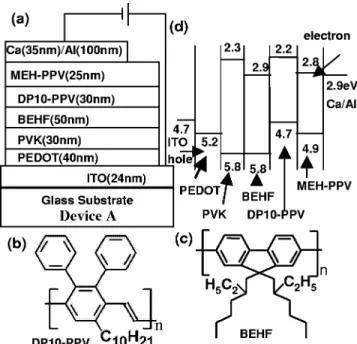
Four multilayered LEDs共devices A – D) are studied with various combinations of red 共R兲, green 共G兲, and blue 共B兲 layers. The device structure for A is shown in Fig. 1共a兲. We use MEH-PPV for R, poly共2,3-diphenylphenylene vinylene兲
共DP10-PPV兲 关Fig. 1共b兲兴 for G1, Dow Chemical
LUMATION16 Green-B polyfluorene 共DPF兲 for G2, and poly关9,9-di-共2-ethylhexyl兲-fluorenyl-2.7-diyl兴 共BEHF兲 关Fig. 1共c兲兴 for B. MEH-PPV and DP10-PPV are synthesized,17,18 DPF is from Dow Chemical Company,19 and BEHF is from Aldrich. The peaks of photoluminescence共PL兲 for the poly-mers are 592 nm 共R兲, 500 nm 共G1兲, 540 nm 共G2兲, and 424 nm 共B兲. Poly共3,4-ethylenedioxythiophene兲 doped with poly-styrene sulphonated acid 共PEDOT:PSS兲 is used as the hole transport layer. A layer of poly共N-vinyl carbazole兲 共PVK兲 is added between PEDOT:PSS and the emissive layer in order to block the electrons. The electron affinity共EA兲 and ioniza-tion potential共IP兲 are indicated in Fig. 1共d兲. All the emissive polymers are dissolved in toluene with weight percentages 0.3 wt. % for R, 0.5 wt. % for G1, 1.2 wt. % for G2, and 1.5 wt. % for B. The concentration for R and G is lower than what is normally used for LED in order to have a thinner film. The layer thicknesses for the devices are as follows. Device A 共B/G1/R兲: PEDOT/PVK 共50 nm兲/BEHF 共70 nm兲/ DP10-PPV共20 nm兲/MEH-PPV 共20 nm兲/Ca; device B 共B/G2/ R兲: PEDOT/PVK 共30 nm兲/BEHF 共50 nm兲/DPF 共30 nm兲/ MEH-PPV共30 nm兲/Ca; device C 共B/G2兲: PEDOT/PVK 共50 nm兲/BEHF 共70 nm兲/DPF 共30 nm兲/Ca; device D 共G2/B兲: PEDOT/PVK 共50 nm兲/DPF 共70 nm兲/BEHF 共30 nm兲/Ca. Each polymer layer is baked at 120 °C for 60 minutes in vacuum (10⫺3torr) after spin-coating. It is crucial that the spin coating of the subsequent layer does not dissolve the previous layer. To check this, pure toluene is spin-cast on
baked film and we found that the film thickness is reduced by no more than 5%. The Ca/Al cathode is evaporated and packaged in a glove box.
The normalized emission spectrum and picture of device
A with triple emission layers is shown in Fig. 2. At 6 V, the
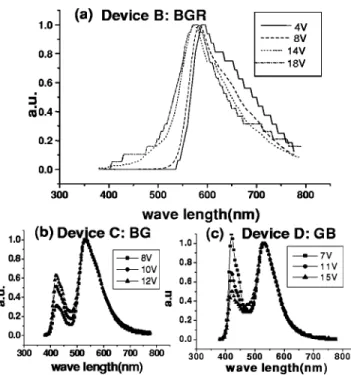
spectrum is identical to the PL of MEH-PPV because the electron-hole recombination concentrates near the cathode. As the bias voltage increases, there is a significant blueshift. It is yellow at 9 V and green at 13 V. The emission becomes greenish blue after 17 V. In the spectrum one sees clearly the emergence of the peak around 424 nm due to BEHF. The spectrum is, however, never dominated by the blue emission up to 20 V. The main reason is that the efficiency of blue polymers is much weaker than red and green polymers. Bet-ter color-tuning at higher voltage could be realized if more efficient blue polymers 共or less efficient red and green兲 are used. The highest brightness is around 400 cd/m2, reached at 14 V. Beyond 14 V, the brightness decreases and the current saturates at the same time 共Fig. 4兲. This peculiar saturation behavior is reproduced in many triple-layer devices with similar structures. One possible reason is that as the voltage increases, a large amount of electrons are accumulated at the barrier between R and G, which screen the electric field ef-fectively in the very thin R layer and cause an effective in-crease in the injection barrier from the cathode to R.20The green polymer is replaced by DPF in device B. The spectrum shown in Fig. 3共a兲 starts to shift rigidly from red to green for voltage as low as 6 V. The blue emission is weaker, presum-ably due to the larger barrier between G2 and B. The current saturation at high voltage is even more pronounced than de-vice A.
Figure 3共b兲 shows the results for double-layer device C.
FIG. 1. 共a兲 Device structure of multi-layer LED, 共b兲 chemical structures of the emissive polymers DP10-PPV, and共c兲 BEHF. 共d兲 The EA and IP are also shown.
FIG. 2.共Color兲 共a兲 Normalized spectra and 共b兲 pictures of triple-layer device A(BGR) at various voltages.
1196 Appl. Phys. Lett., Vol. 84, No. 7, 16 February 2004 Huanget al.
This article is copyrighted as indicated in the article. Reuse of AIP content is subject to the terms at: http://scitation.aip.org/termsconditions. Downloaded to IP: 140.113.38.11 On: Thu, 01 May 2014 04:30:09
As expected, there is an emergence of the blue emission as the voltage increases. Without the broad R emission, the B and G emission are well separated. Significant color-tuning occurs between 8 and 12 V. In order to test the mechanism of color-tuning further, we study device D, which has a re-versed order or G and B layers. As expected, from the stron-ger field dependence of electron mobility, the spectrum has a redshift instead of a blueshift as the voltage increases 关Fig. 3共c兲兴. At low voltage, the recombination concentrates in the B layer, which is next to the cathode. The strong G emission at 7 V is due to the PL of the G layer excited by the B emission. There is no such effect in the other devices in which layers with larger band gaps are closer to the transpar-ent ITO. The redshift of device D is a clear confirmation that the recombination zone is controlled by the mobility differ-ence. The current and luminance are plotted in Fig. 4 as functions of voltage. In general, the double-layer devices are much brighter than the triple-layer devices. Perhaps the layer junctions introduce exciton quenching centers and the effi-ciency decreases with more junctions. The color is deter-mined by the field and the luminance is deterdeter-mined by the current. They change simultaneously in our LED’s. Many applications require independent control of the color and lu-minance. One may add a base layer between PEDOT:PSS and PVK to make a device similar to a bipolar junction transistor,20in which color is controlled by the base-collector
共Ca/Al兲 bias while current is controlled by the emitter 共ITO兲
base bias.
This work is supported by the National Science Council, the Excellence Project ‘‘Semiconducting Polymers for Elec-troluminescence’’ of the Ministry of Education, and Indus-trial Technology Research Institute of Taiwan, R.O.C.
1
R. H. Friend, R. W. Gymer, A. B. Holmes, J. H. Burroughes, R. N. Marks, C. Taliani, D. D. C. Bradley, D. A. Dos Santos, J. L. Bre´das, M. Lo¨gdlund, and W. R. Salaneck, Nature共London兲 397, 121 共1999兲.
2H. Kobayashi, S. Kanbe, S. Seki, H. Kigchi, M. Kimura, I. Yudasaka, S. Miyashita, T. Shimoda, C. R. Towns, J. H. Burroughes, and R. H. Friend, Synth. Met. 111–112, 125共2000兲.
3J. Birnstock, J. Bla¨ssing, A. Hunze, M. Scheffel, M. Sto¨ßel, K. Heuser, G. Wittmann, J. Wo¨rle, and A. Winnacker, Appl. Phys. Lett. 78, 3905共2001兲. 4J. Kalinowski, P. Di Marco, M. Cocchi, N. Camaioni, and J. Duff, Appl.
Phys. Lett. 68, 2317共1996兲. 5
M. Hamaguchi, A. Fujii, Y. Ohmori, and K. Yoshino, Jpn. J. Appl. Phys., Part 2 35, L1462共1996兲.
6M. Granstrom and O. Ingana¨s, Appl. Phys. Lett. 68, 147共1996兲. 7Y. Z. Wang, R. G. Sun, F. Meghdadi, G. Leising, and A. J. Epstein, Appl.
Phys. Lett. 74, 3613共1999兲.
8B. O. Dabbousi, M. G. Bawendi, O. Onitsuka, and M. F. Rubner, Appl. Phys. Lett. 66, 1316共1995兲.
9V. L. Colvin, M. C. Schlamp, and A. P. Alivisatos, Nature共London兲 370, 354共1994兲.
10
A. Kaur, M. Cazeca, S. Sengupta, J. Kumar, and S. Tripathy, Synth. Met. 126, 283共2002兲.
11M. Berggren, O. Ingana¨s, G. Gustafsson, J. Rasmusson, M. R. Andersson, T. Hjertberg, and O. Wennerstrom, Nature共London兲 372, 444 共1994兲. 12
O. Ingana¨s, Making Polymer Light Emitting Diodes with Polythiophenes, in Organic Electroluminescent Materials and Devices, edited by S. Miyata and H. S. Nalwa共Gordon and Breach, Amsterdam, 1997兲.
13X. Zhang and S. Jeneke, Macromolecules 33, 2069共2000兲.
14P. Blom and M. de Jong, IEEE J. Sel. Top. Quantum Electron. 4, 105 共1998兲.
15L. Bozano, S. A. Carter, J. C. Scott, G. G. Malliaras, and P. J. Brock, Appl. Phys. Lett. 74, 1132共1999兲.
16Trademark of The Dow Chemical Company. 17
C. Neef and J. Ferraries, Macromolecules 33, 2311共2000兲. 18
W. C. Wan, H. Antoniadis, V. E. Choong, H. Razafitrimo, Y. Gao, W. A. Feld, and B. R. Hsieh, Macromolecules 30, 6567共1997兲.
19J. J. O’Brien, M. T. Bernius, M. Inbasekaran, and W. Wu, Adv. Mater. 共Weinheim, Ger.兲 12, 1737 共2000兲.
20
S. M. Sze, Physics of Semiconductor Devices, 2nd ed.共Wiley, New York, 1981兲.
FIG. 3. 共a兲 Normalized spectra of triple-layer device B(BGR) and of 共b兲 double-layer devices C(BG) and共c兲 D(GB). Green emission is normalized.
FIG. 4. 共a兲 Current-voltage and 共b兲 luminance-voltage relations for devices
A – D.
1197
Appl. Phys. Lett., Vol. 84, No. 7, 16 February 2004 Huanget al.
This article is copyrighted as indicated in the article. Reuse of AIP content is subject to the terms at: http://scitation.aip.org/termsconditions. Downloaded to IP: 140.113.38.11 On: Thu, 01 May 2014 04:30:09