Direct observation of structure effect on ferromagnetism in Zn
1−xCo
xO nanowires
W. B. Jian*
Department of Electrophysics, National Chiao Tung University, Hsinchu 300, Taiwan Z. Y. Wu, R. T. Huang, F. R. Chen, and J. J. Kai
Department of Engineering and System Science, National Tsing Hua University, Hsinchu 300, Taiwan C. Y. Wu
Opto-Electronics and Systems Laboratories, Industrial Technology Research Institute, Hsinchu 310, Taiwan S. J. Chiang and M. D. Lan
Department of Physics, National Chung Hsing University, Taichung 402, Taiwan J. J. Lin†
Institute of Physics and Department of Electrophysics, National Chiao Tung University, Hsinchu 300, Taiwan
共Received 20 July 2005; revised manuscript received 14 April 2006; published 21 June 2006兲
Diameter-controllable single-crystalline ZnO nanowires 共NWs兲, with the 关0001兴 growth direction in the plane, have been fabricated by using thermal evaporation method. The as-grown NWs with diameters of ⬃40 nm were implanted with various amounts of Co ions. These Zn1−xCoxO共x艋0.11兲 NWs possessed a high
density of bombardment-induced orientation variations and stacking faults, and exhibited paramagnetic behav-ior. After thermal annealing, the structural defects largely disappeared and noticeable hysteresis in the magne-tization loops were observed, indicating the presence of apparent ferromagnetic ordering in the NWs. This result provides important insight into the role played by defects in relation to the occurrence of ferromagnetism in diluted magnetic semiconductor NWs.
DOI:10.1103/PhysRevB.73.233308 PACS number共s兲: 75.75.⫹a, 75.50.Pp, 81.07.⫺b
I. INTRODUCTION
Not only a high Curie temperature TC, but also the mecha-nism of ferromagnetism in diluted magnetic semiconductors 共DMS兲 has recently drawn intense attention. Theoretically, it has been proposed that the ferromagnetism in III-V based DMS materials,共In,Mn兲As and 共Ga,Mn兲As, is mediated by the mobile holes originating from the magnetic Mn dopants.1–3The ferromagnetic p-type共Ga,Mn兲As with a high
carrier density of 1018– 1020cm−3could possess a T
Cas high as 110 K.3It has also been argued that the T
Cof the p-type Mn-doped ZnO semiconductor, with a carrier concentration of 3.5⫻1020cm−3, could be as high as the room temperature.
Recently, these theoretical proposals have stimulated exten-sive efforts to search for high-TC DMS ferromagnets.4–6In particular, ab initio and first-principles calculations,7–11and
some recent experiments12showed a ferromagnetic phase in
the n-type ZnO doped with Co. Experimentally, significant discrepancies have been reported among different groups and between the measurements and the theoretical calculations. For example, Ueda et al.4 reported room-temperature
ferro-magnetism in pulse laser deposited Zn1−xCoxO thin films. Other groups5,13 reported ferromagnetism above room
tem-perature even in nanophased structures.14,15On the contrary,
Risbud et al.16and Lawes et al.17 found no ferromagnetism
in Co substituted polycrystalline ZnO. Thus far, very few experiments have been performed on Zn1−xCoxO nanowires 共NWs兲 to see the direct correspondence between structure and ferromagnetism.
ZnO is an oxide semiconductor with a room temperature energy gap of 3.37 eV. In contrast to the other II-VI
com-pound semiconductors, ZnO can be heavily doped to form a transparent conductor.18 Since nanostructures are potentially
ideal functional components for nanoelectronic and optoelec-tronic devices, the study of ZnO NWs is of high interest. Realization of spintronic devices from the bottom up might be feasible by adopting the DMS Co-doped ZnO NWs.19,20
In addition to the amount of carrier concentration, it is theoretically accepted that crystalline quality and structural defects should play an important role in determining the oc-currence and stability of ferromagnetism.16,21,22 However,
there has been no direct experimental observation to discern this conjecture. In this work, we use as-implanted and an-nealed Zn1−xCoxO NWs共Ref. 23兲 to explore the detrimental effects of defects on ferromagnetism. Compared with the bulk and thin film samples, NW samples have the advantage that no additional mechanical treatment of the specimens 共which might introduce unwanted changes in the crystal structure兲 was needed for the transmission electron micro-copy共TEM兲 studies.
II. EXPERIMENT
ZnO powder was placed in a crucible situated at the cen-ter of a quartz tube in a furnace heated to 950 ° C. A glass substrate at a temperature of 500 ° C with gold nanoparticles 共⬃40 nm in diameter兲 as catalysts predeposited on it was located at the downstream end of the quartz tube. The cham-ber was maintained at 200 Pa with a constant flow of argon. After 8 h, ZnO NWs with an average diameter of 40 nm formed. The as-grown ZnO NWs were implanted by Co ions
PHYSICAL REVIEW B 73, 233308共2006兲
with doses of共1–6兲⫻1016cm−2. The implantation was
per-formed at room temperature with an accelerating energy of 40 keV by using a tandem accelerator共9SDH-2兲. The beam current was kept at 150 nA/ cm2 to avoid beam heating. An-nealing of the as-implanted ZnO NWs was then performed at 600 ° C for 12 h either under an argon flow of 150 sccm at 1 atm or in a vacuum of 5⫻10−5torr. This annealing
tem-perature was chosen because it would not cause aggregation and clustering of the implanted ions, as was previously established24 for ZnO and was confirmed by our
high-resolution transmission electron microscopy共HRTEM兲 stud-ies. Annealing in argon would not only prevent oxidation of the samples and substrates but also improve the lattice order. On the other hand, annealing in vacuum would produce oxy-gen deficiencies and increase n-type carriers.22,25,26Both the
as-implanted and annealed ZnO NWs were characterized by using a field-emission scanning electron microscope共JEOL JSM-6330F兲 and HRTEM 共JEOL JEM-2010F兲. Magnetic properties of the NWs were studied by using a Quantum Design superconducting quantum interference device 共SQUID兲 magnetometer. All the magnetizations as a function of applied field were taken at 2 K, unless otherwise stated. It should be noted that the magnetic responses were large such that no corrections for the sample holder and the substrate were needed. For instance, the magnetizations at 2 K and in a field of 1000 Oe were 1.4⫻10−5emu for the substrate
alone and 2.8⫻10−4 emu for the substrate with Zn 1−xCoxO NWs.
III. RESULTS AND DISCUSSION
Most of our ZnO NWs with a length of several microns lay on the substrate with关0001兴 growth direction in the plane and form a NW film of about 3.7m thick on the substrate. High-energy Co ions were bombarded on one side to pro-duce DMS NWs. Computer simulationSRIMcode27enabled
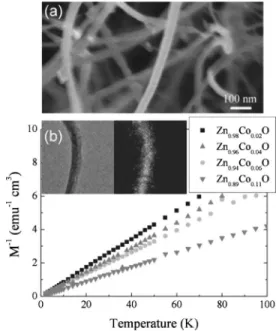
us to estimate the distribution of Co ions in the ZnO NWs. When implanting in bulk, the Co-ion density distribution as a function of penetration depth showed a range of 40 nm, close to the diameter共⬃40 nm兲 of our NWs. Figure 1共a兲 shows a scanning electron microscopy共SEM兲 image of representative as-implanted NWs. We found that the morphology and di-mension of the ZnO NWs did not change appreciably after Co implantation except for a slight bending of the NWs. To ensure that the implanted Co ions distributed uniformly, rather than aggregated, in the NWs, we performed energy dispersive x-ray spectroscopy 共EDX兲 and bright field TEM studies. The right image of the inset in Fig. 1共b兲 shows an EDX compositional map revealing Co distribution in a NW, while the left image of the inset in Fig. 1共b兲 shows a bright field TEM image for the same NW. In addition, maps of the electron energy loss spectroscopy共EELS兲 have been carried out to exclude any formation of Co clusters larger than 1.8 nm. These results strongly indicate the uniformity of Co ions in the NWs. The Co atom implantation generated a thin layer of Zn1−xCoxO NWs on the top of the as-grown ZnO NW film on the substrate. The thickness of this DMS NW layer can be evaluated as follows. We know that the bom-bardment of 1⫻1016cm−2 Co ions produced the
as-implanted Zn0.98Co0.02O NWs from EDX analysis. Assuming
a uniform layer of the Zn0.98Co0.02O material, we estimated
the thickness of this layer to be about 120 nm which was used for evaluation of the sample volume and magnetization. The main panel of Fig. 1共b兲 shows a plot of the inverse magnetizations of our Zn1−xCoxO NWs with several concen-trations x. The inverse magnetization for every NW varies linearly with temperature and diminishes at zero tempera-ture, indicating that these as-implanted NWs display
para-magnetism closely obeying the Curie law. As x increases, the
paramagnetic behavior becomes more pronounced in accor-dance with the Co concentrations determined from the EDX spectra. The effective moment for the implanted Co ions in the DMS NWs was extracted and found to be 1–2 times of the ideal value共4.8B兲 for Co2+.28This overestimation arose from the uncertainties in the evaluation of the sample vol-ume.
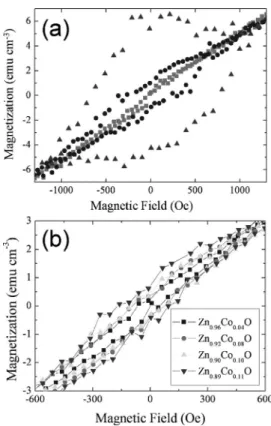
The as-implanted NWs exhibit paramagnetism, barely re-vealing any signature of ferromagnetic ordering关squares in Fig. 3共a兲兴. High densities of structural defects are produced during the high-energy Co-ion bombardment. The structure of the NWs was therefore investigated in detail. The HRTEM image shown in Fig. 2 displays one type of structural defects, i.e., stacking faults, as indicated by the many small triangles. Another type of structural defects is orientation variations, a typical diffraction pattern of which is shown for the as-implanted Zn0.89Co0.11O NWs in the inset of Fig. 2. It is seen that the lattice planes along the 关0001兴 direction are fairly ordered while there is orientation variation between the 共112¯0兲 lattice planes.
To see the detrimental effects of defects on ferromag-netism in DMS, and particularly in Co-doped ZnO NWs, we have carried out systematic thermal annealing and magneti-zation measurements on our NWs. Figure 3共a兲 shows the
FIG. 1. 共a兲 Typical SEM image of the as-implanted Zn0.94Co0.06O NWs.共b兲 The inverse magnetizations of as-implanted Zn1−xCoxO NWs taken at a field of 1000 Oe. Inset: A bright field
TEM image of a NW共left兲 together with its corresponding EDX mapping image共right兲.
BRIEF REPORTS PHYSICAL REVIEW B 73, 233308共2006兲
field-dependent magnetizations for the representative Zn0.89Co0.11O NWs. Similar magnetization behavior has also been observed in other NWs with different Co concentra-tions. Figure 3共a兲 illustrates that the argon-annealed NWs 共circles兲 displayed a noticeable hysteresis loop, indicating the occurrence of ferromagnetism.
It is important to clarify whether the enhanced hysteresis loop observed in the argon-annealed NWs might be due to any aggregation of Co ions as a result of implantation. To disprove this conjecture, we have studied the magnetizations of several Zn1−xCoxO NWs annealed under a high vacuum. The triangles in Fig. 3共a兲 reveal the magnetization of the vacuum-annealed Zn0.89Co0.11O NWs at 2 K. It is clearly
seen that the hysteresis loop becomes enormously enlarged, suggesting strong ferromagnetism. We also found that, as the temperature increases, the hysteresis loop squeezes 共not shown兲, indicating the depression of the ferromagnetic order-ing. These results argue against the possibility of aggregated Co ions induced magnetism. If the Co atoms had aggregated in our NWs, their structural configurations should have
barely changed under our annealing conditions and the
mag-netizations should be very similar for the argon- and vacuum-annealed samples.
Furthermore, we have performed second annealing in 1 atm of either oxygen or argon atmosphere on those already vacuum-annealed samples. Noticeably, we found an appre-ciable shrinkage of the hysteresis loops with attenuated mag-netizations for those that underwent second annealing in oxygen, but we found no change in the magnetic properties for those that underwent second annealing in argon. The structure of all the annealed NWs was inspected in detail by using the HRTEM and no perceptible change was spotted. In fact, it is known25 that preparing ZnO
1−␦ thin films under
high vacuum could increase the oxygen vacancies and re-duce the electrical resistivity. It has also been reported that transition-metal doped ZnO thin films grown in oxygen29
rarely showed hysteresis loops, while they might display strong ferromagnetism even at room temperatures if grown in vacuum.30 Thus, we think that the enhanced
ferromag-netism found in the vacuum-annealed NWs must be closely
connected with not only the improved structure but also likely with an increased number of carriers. The current the-oretical concept of the carrier-mediated ferromagnetism in DMS might be relevant to our case.
To further inspect any possible aggregation of Co atoms in our NWs, in addition to the bright field TEM and EDX studies关Fig. 1共b兲兴, we have performed systematic HRTEM and EELS measurements. Any possible aggregated micro-structure and aggregated Co elements can be detected by HRTEM and EDX, respectively, and the aggregated Co ions with specified oxidation state can be identified by EELS. Our HRTEM studies indicate no evidence of any Co-atom aggre-gation down to the scale limit of 0.5 nm, and our EELS analysis points to the valence state of Co ion in the argon-annealed NWs to be close to +2. The valence state of the Co ion in the vacuum-annealed NWs is slightly shifted to a high oxidation state of +2.67, which is definitely not the valence state of Co metal. These results strongly argue against the existence of Co clustering and segregation in our NWs.
Figure 3共b兲 shows the magnetizations of
argon-annealed Zn0.96Co0.04O, Zn0.92Co0.08O, Zn0.90Co0.10O, and Zn0.89Co0.11O NWs divided by factors of 4, 8, 10, and 11, respectively, for comparison. We see that the hysteresis loops become more pronounced with increasing Co concentration, implying the formation of domains as well as the enhanced exchange interactions between Co ions. Meanwhile, the magnetization increases with increasing Co implantation,
FIG. 3. 共a兲 Magnetization as a function of applied field at 2 K for as-implanted共squares兲, argon-annealed 共circles兲, and vacuum-annealed 共triangles兲 Zn0.89Co0.11O NWs. The magnetization has been scaled by dividing the number 11 for comparison with共b兲. 共b兲 Magnetization as a function of applied field at 2 K for argon-annealed Zn1−xCoxO NWs with different x as indicated. The
mag-netization for each concentration has been scaled共see text兲. FIG. 2. HRTEM image of the as-implanted Zn0.89Co0.11O NWs
with white triangles indicating stacking faults. Inset: A typical dif-fraction pattern revealing a rotation of reciprocal lattice points.
BRIEF REPORTS PHYSICAL REVIEW B 73, 233308共2006兲
confirming the occurrence of ferromagnetic, but not previ-ously reported antiferromagnetic,16ordering among Co ions.
Moreover, this result implies the absence of a second phase of CoO in our NWs, since CoO is antiferromagnetic with a Neel temperature of 291 K.
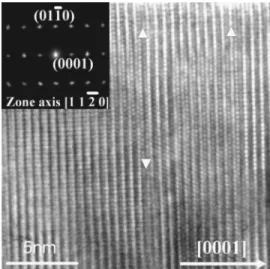
The structure of our annealed Zn1−xCoxO NWs was then inspected by HRTEM. The diffraction pattern in the inset of Fig. 4 clearly reveals disappearance of orientation variations. The lattice points along the 关011¯0兴 direction are now well ordered. In addition, the HRTEM image of the argon-annealed Zn0.89Co0.11O 共the main panel of Fig. 4兲 shows a
significant reduction in the density of stacking faults. A very similar result has also been observed in those high-vacuum annealed NWs. Therefore, it is clear that the improved lattice order must lead to the enhanced ferromagnetism found in the annealed Zn1−xCoxO NWs. In other words, the ferromag-netism was deprived due to the presence of a high density of structural defects before annealing. In short, our observations clearly indicate that structural defects are detrimental to the occurrence of ferromagnetic ordering in DMS NWs. Any theoretical model attempting to explain the mechanism of ferromagnetism in Zn1−xCoxO must take this result into account.1,2
IV. CONCLUSION
In this work, 40-nm diameter Zn1−xCoxO NWs were syn-thesized by thermal evaporation, followed by high-energy Co-ion implantation. The implanted Co ions were uniformly distributed in the NWs but the implantation produced many orientation variations and stacking faults in the NWs. After annealing, the crystalline lattice order was essentially recov-ered. The magnetizations then indicated apparent ferromag-netic behavior. This work provides strong evidence for the close connection between the structural order and the occur-rence of ferromagnetism in DMS Zn1−xCoxO NWs.
ACKNOWLEDGMENTS
This work was supported by the Taiwan National Science Council under Grants No. NSC 93-2112-M-009-038, No. NSC 93-2120-M-009-009, and No. NSC 94-2120-M-009-010, and by the MAU ATU Program.
*Electronic address: [email protected]
†Electronic address: [email protected] 1T. Dietl et al., Science 287, 1019共2000兲. 2H. Akai, Phys. Rev. Lett. 81, 3002共1998兲.
3F. Matsukura et al., Phys. Rev. B 57, R2037共1998兲. 4K. Ueda et al., Appl. Phys. Lett. 79, 988共2001兲. 5H.-J. Lee et al., Appl. Phys. Lett. 81, 4020共2002兲. 6D. P. Norton et al., Appl. Phys. Lett. 82, 239共2003兲.
7K. Sato and H. Katayama-Yoshida, Jpn. J. Appl. Phys., Part 2 40,
L334共2001兲.
8M. H. F. Sluiter et al., Phys. Rev. Lett. 94, 187204共2005兲. 9C. H. Park and D. J. Chadi, Phys. Rev. Lett. 94, 127204共2005兲. 10Q. Wang et al., Phys. Rev. B 70, 052408共2004兲.
11N. A. Spaldin, Phys. Rev. B 69, 125201共2004兲. 12K. R. Kittilstved et al., Nat. Mater. 5, 291共2006兲. 13S. Ramachandran et al., Appl. Phys. Lett. 84, 5225共2004兲. 14J.-J. Wu et al., Appl. Phys. Lett. 85, 1027共2004兲.
15K. Ip et al., J. Vac. Sci. Technol. B 21, 1476共2003兲.s 16A. S. Risbud et al., Phys. Rev. B 68, 205202共2003兲. 17G. Lawes et al., Phys. Rev. B 71, 045201共2005兲. 18K. Ip, et al., Appl. Phys. Lett. 84, 544共2004兲. 19Y. Ohno et al., Nature共London兲 402, 790 共1999兲. 20S. A. Wolf et al., Science 294, 1488共2001兲. 21Y. W. Heo et al., Appl. Phys. Lett. 84, 2292共2004兲. 22Y. M. Cho et al., Appl. Phys. Lett. 80, 3358共2002兲. 23F. Tuomisto et al., Phys. Rev. Lett. 91, 205502共2003兲. 24E. Sonder et al., J. Appl. Phys. 64, 1140共1988兲. 25A. Tiwari et al., J. Appl. Phys. 96, 3827共2004兲. 26C. Ronning et al., Appl. Phys. Lett. 84, 783共2004兲. 27J. F. Ziegler and J. P. Biersak, http://www.srim. org
28C. Kittel, Introduction to Solid State Physics共Wiley, New York,
1996兲.
29W. Prellier et al., Appl. Phys. Lett. 82, 3490共2003兲. 30K. Rode et al., J. Appl. Phys. 93, 7676共2003兲.
FIG. 4. HRTEM image for argon-annealed Zn0.89Co0.11O NWs
with white triangles indicating stacking faults. Inset: A typical dif-fraction pattern showing regular reciprocal lattice points.
BRIEF REPORTS PHYSICAL REVIEW B 73, 233308共2006兲