Cross-national and cross-industrial comparison of two strategy approaches
for global industrial evolution
Chia-Han Yang
⁎
, Joseph Z. Shyu
Institute of Management of Technology, National Chiao-Tung University, No. 1001, Ta-Hsuch Rd., Hsinchu, 300 Taiwan, ROC
a r t i c l e i n f o
a b s t r a c t
Article history:
Received 15 October 2007
Received in revised form 6 March 2008 Accepted 17 March 2008
This research focuses on analyzing the two prime science and technology (S&T) strategy approaches for industrial evolution based on the concept of S&T gap, namely, the optimist and pragmatist approaches. Particularly, the cases of global IC, pharmaceutical, and computer industries, are used to make cross-national and cross-industrial comparison of these two approaches. The optimist approach is developed based on the product life cycle theory which envisions technology transcending everyday limitations. With this perspective, market demand is the most critical factor in selecting the S&T strategy approaches. The pragmatist approach is formed based on the new trade theory which recognizes the power of science and technology but seeks tofit it into structures that already exist, and government must manage resources pouring into science and technology. Case studies of global IC, pharmaceutical, and computer industries during the 2nd half of the 20th century are used as research targets to reflect policy impacts on the technological evolution. The results of this study reveal that, strategy approaches have to be adapted and turned to the specific stage, technology level, and market segment that have been selected for intervention. This result of comparison also offers the criteria of strategy selection for developing different industry based on distinct national base. © 2008 Elsevier Inc. All rights reserved. Keywords: Industrial evolution S–T gap Strategy approach Pragmatist Optimist 1. Introduction
The debates of industrial policy have been devoted to increasing attention to the design and selection of policy approaches to aid the growth of high-technology industries. The emergence of“science and technology policy” (S&T policy) as an area of controversy had been influenced by the different visions for technological evolution at the postwar period, and increasingly evolved to two different strategy approaches— the optimist and pragmatist approach[1].
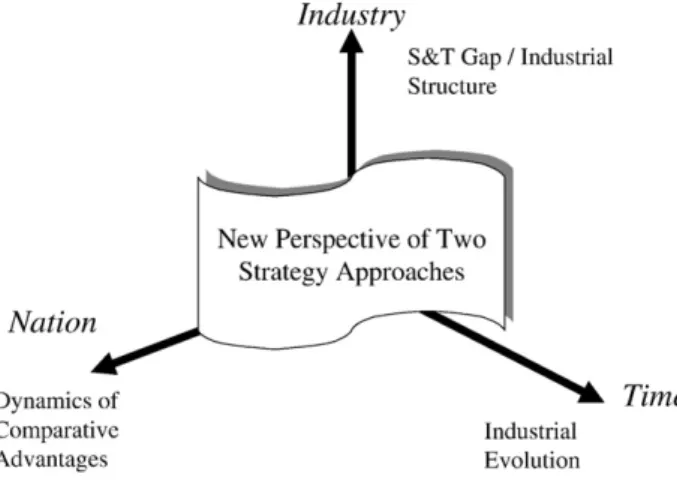
This research focuses on analyzing these two prime S&T visions and the corresponding policy approaches based on the change of S–T gap. The optimist approach is developed based on the product life cycle theory which envisions technology transcending everyday limitations. With this perspective, market demand is the most critical factor in selecting the S&T strategy approaches. The pragmatist approach is formed based on the new trade theory which recognizes the power of science and technology but seeks to fit it into structures that already exist, and government must manage resources pouring into science and technology. This research elaborates benefits and detriments of these two approaches, and the evolution patterns resulting from the variation of S&T gap also are discussed. It is vital to verify the industrial circumstantial conditions and national economic strategy prior to decision-making for S&T policy, including selection between the optimist or pragmatist approaches. As a result, this research intends to develop a coordinate framework with the dimensions of time, country, and industry, by an anatomy of the circumstantial conditions of these two approaches, and the industrial evolution patterns derived from different S&T gap.
Case studies of global IC, pharmaceutical, and computer industries during the 2nd half of the 20th century are used as research targets to reflect policy impacts on the industrial evolution. A cross-national and cross-industrial comparison would be analyzed,
Technological Forecasting & Social Change 76 (2009) 2–25
⁎ Corresponding author. Tel.: +886 3 5712121x57518; fax: +886 3 5726749. E-mail address:[email protected](C.-H. Yang).
0040-1625/$– see front matter © 2008 Elsevier Inc. All rights reserved. doi:10.1016/j.techfore.2008.03.019
Contents lists available atScienceDirect
to offer criteria of strategy approach selection. Not only does it provide policy-level strategy approaches in different industrial stages, it also makes an empirical comparison for future reference.
2. View of economic theories
2.1. The dynamics of comparative advantage
At one time in the history of industries,firms located in one country developed superior technologies or products, ways of organizing production, or market strategies that gave them significant advantages over other firms based in other countries. The traditional absolute advantage theory[2]could not explain the situation where one country is more efficient than another in developing some technologies or producing specific goods. Thus, the comparative advantage theory proposed by David Ricardo[3]
stated that both countries would gain from trade by their comparative advantages in producing a good relative to the other nation. Economists often expressed the concept of comparative advantage in static terms, under the assumption that many key variables, such as technologies, never change over time. In addition to Ricardo, the Heckscher–Ohlin theorem[4,5]also assumed that the technology factor remains essentially unchanged in all trading countries and the production function is identical anywhere in the world. However, a number of theories examined changes in the nature of a technology to describe realistic industrial situations, infirms, industries, and supporting institutions as a technology matures. These theories in turn yielded several different views of the dynamics of comparative advantage that are germane to this research[6,7].
Two broad theories considered the interaction of technological and industrial dynamics in the changing locus of comparative advantage. One group of theories is the product life cycle theory developed initially by Posner[8], Hufbauer[9], and Vernon[10]. Abernathy and Utterback[11]are also the names most frequently associated with the theory that provides a systematic pattern of change in a technology as the technology evolves from novelty to maturity. This theory argued that high-income countries generally pioneer in new technology for two reasons. One is that these countries tend to be abundant in industry R&D investment and a comparative advantage in new technology, and the other reason is that high-income domestic markets also tend to demand higher-quality products. Additionally, the Posner–Vernon life cycle theory[10]stated that outflows of technology through foreign investments and other channels erode the comparative advantages in the formerly high-income countries. As a product technology matures, comparative advantages rely more heavily on low cost, where lower-wage countries may become more competitive production sites for these specific products[6,12].
Another theory to explain technological and industrial dynamics in the changing locus of comparative advantage is the new trade theory originally expounded in a series of papers by Dixit and Norman[13], Lancaster[14], Helpman[15], Ethier
[16], and Krugman[17]. These theorists argued that countries take advantage of not only their differences; but also trade because of increasing returns, which makes specialization advantageous per se. It stated that economies of scale are reduction of manufacturing cost per unit as a result of increased production quantity during a given time period, and intra-industry trade (international trade involving the same industry) is largely driven by increasing returns resulting from specialization within the industry[7]. Thus, this new trade theory suggests that successful early entrants into an industry may develop an advantage that latecomers are unable to offset. Thesefirst-mover advantages are rooted in fixed investments to lower a learning curve.
These two theories, describe dynamic comparative advantages, were broadly used to explain the systematic shift in locus of industrial leadership, and evaluate the impacts of technological evolution on industrial development[6]. The concepts were also developed to formulate a theoretical basis of traditional S&T policy that identify the factors that led to the emergence of national leadership, and the reasons behind the shifts that occurred[1].
2.2. S–T gap and industrial evolution
The concept of S–T gap was widely investigated to explain the dynamics of comparative advantage since the discussion of the relationship between science and technology have gathered great importance in recent years. An early development[18,19]in this discussion was the claim that science and technology were path-independent and seldom interacted in progress. More recently, several studies[20–22]have noted that some links exist between science and technology, and scientific discoveries have provided the knowledge bases for technological innovations in a pattern. Betz[23]clarified that, by definition, science understands nature and technology manipulates nature for human purposes, and also offered a sounder theoretical basis for the science and technology information tracks to explain that once science has created a new phenomenal knowledge base, inventions for a new technology may be made at this time to begin investment in a technological revolution and a new industries or even fuel a new economic expansion. Anotherfinding of studies[24]also examined a relationship between science and technology through the knowledge creation process and classified it into self-motivated creativity, system understanding, advanced skill and cognitive knowledge.
The relationship between science and technology has also been addressed, by Teitelman[1], that here is a model of how a steadily narrowing gap between science and technology actually alters the dynamics of comparative advantages and industrial structure. The definition of S–T gap was depicted as the maturity of scientific knowledge in support of technology development. Thus, the ease with which a technology is commercialized varies with the maturity of its underlying science, which determines speed of technological evolution and shapes industrial structure. This research concluded that we could judge this maturity and the width of gap through the following circumstantial evidence, like“how much of a consensus exists on fundamental theory and
have the lines between science and engineering begun to blur?” or “there is a theoretical model that helps the design of commercial products”.
Another corresponding concept of S–T gap to explain the dynamics of comparative advantage is the evolution of innovation. Since the late 1970s, industrial dynamics and evolution has emerged as a major research area for economists. Within the growing interest in industrial dynamics, innovation and technology evolution has been recognized as key elements affecting the dynamics of industries[25]. It has brought empirical evidence that the relationship between innovation and industrial change has periods of great uncertainty related to radical innovations and periods of more incremental technical change, and differs greatly across industries and countries[26–29]. The concepts of S–T gap could also explain the application of two modes of technological innovation, recently proposed by Jensen et al.[30]. One mode is based on the production and use of codified scientific and technical knowledge, the Science, Technology and Innovation (STI) mode, and one is an experienced-based mode of learning based on Doing, Using and Interacting (DUI-mode). At the level of the industrial development, the tension between the STI and DUI modes corresponds to a need to national innovation systems focusing on the role of formal processes of R&D in order to produce explicit and codified knowledge with those focusing on the learning from informal interaction within and between organizations resulting in competence-building often with tacit elements. From the view of technological evolution, the shrink of S–T gap through industry evolution will change the model of innovation and knowledge interaction, between STI and DUI modes.
Moreover, a growing number of studies about life cycle are also now available to describe the linkage of technological evolution and comparative advantage, because each technology possesses its own individual dynamics in its life cycle, capital needs and time required to mature. Several studies[31,32]have revealed that the shifts in locus of industrial leadership andfirm-level strategies have been heavily determined by the path of innovation or the type of technology. Some models[33,34]have also been reported to describe or predict the technological evolution such as the concept of S-curve. The nature of technological discontinuity in S-curve has been further explained by Christensen[35]to posit the emergence of disruptive innovation instead of traditional sustaining innovation, and provided extensive discussions of the competition between existing large corporations and newly small entrants
[36–38]. A lot of research findings [39–41]have been done in this issue to seek for the difference of firm-level strategies corresponding with the distinct industrial stages and innovative types.
3. Two different visions of strategy approach
The concepts of dynamic comparative advantages respectively in the product life cycle theory and the new trade theory provide a theoretical framework of two different visions for science and technology developments at the postwar period in the United States after the glorious science achievements resulted in war-related researches sponsored by government, the federal government suspected that the development of basic research, nurtured during the war, should be fed during the peace again. It is uncertain for policymakers whether the government should play a major role in postwar science and technology development, and corporations continue to pursue wartime businesses, thus remaining dependent on government funding.
This new environment produced two different visions of how to manage highly charged technological change throughout the postwar period[1,42]. The first, the optimist view, based on the concept of product life cycle theory, envisions technology transcending everyday limitations and would reshape the postwar world. This vision suggests that the only role of the less interventionist government is to maintain a well-established free-market. The second view, the pragmatist view, developed by the new trade theory, recognizes the power of science and technology but seeks tofit it into structures that already exist. This vision depicts that technology had to be dammed and channeled, not released to wander, and does not quite believe in technological revolutions or a golden age of science. Accordingly, government should control and manage resources pouring into science and technology, and lead the direction of industrial development[43,44].
AsFig. 1shows, the optimist approach, emphasizing free-market mechanism and natural evolution of technology, is developed based on the concept of product life cycle theory. By contrast, the pragmatist approach, notices the leading role of governments to create thefirst-mover advantage or the economies of scale, has a theoretical thinking developed by the new trade theory. S&T policy could be devised by the dynamic comparative advantages and locus of industrial leadership based on these two theories to formulate two kinds of strategic views— optimist and pragmatist approaches.
4. Policy-level comparative analysis
4.1. Policy philosophy of optimist and pragmatist approaches
In the application of policy approach, the manifestation of optimist and pragmatist in S&T policyfirstly was unfolded in wartime in the United States, among policymakers struggling to forge a role for the government in this new scientific age[1,45–49]. The initiator of optimist policy approach, Vannevar Bush, a computer scientist, advocated that the government should continue funding R&D after the war, but disagree to intervene too much to influence the free-market mechanism[1,50,51]. Bush argued that market demand is the primary incentive of technological economic, and the role of the less interventionist government is to establish a free-market system. This bottom-up optimist policy approach, appreciated by Republican Party, emphasizes natural evolution of industry and formulates the ideology of small government to be generally applied in a large, stable, or well-developed country with affluent resources.
In contrast to optimist, the initiator of pragmatist policy approach, Harley Kilgore, an attorney and Senator, proposed to establish a National Science Foundation (NSF) to control resources pouring into R&D programs and suggested that patents generated through
government's direct research or its funding would fall into the public domain[1,52,53]. This top-down pragmatist policy approach, appreciated by Democratic Party, emphasizes industrial forced evolution shaped by governments and formulates the ideology of big government to be extensively applied in a small, chaotic, or developing country with insufficient resources.
The policy philosophy of optimist approach is bottom-up, diffusion-oriented, implicit, and takes the innovation process as a system view of demand sides. On contrary, the pragmatist approach emphasizes the role of government in policy planning, as the
Table 1
Comparative policy analysis of the two strategy approaches
Pragmatist Optimist
Concepts and basis Top-down Bottom-up
Forced evolution Natural evolution
Big government Small government
Typical political party of U.S. Democratic party Republican party
Applications Small country, insufficient resource, chaotic and developing economies
Large country, affluent resource, stable and well-developed economies
Contents Government should control and manage resources pouring into science and technology, and lead the direction of industrial development
Market demand is the primary incentive of technological economic, and the role of the less interventionist government is to establish a free-market system
Practical measures Sponsor large R&D programs Invest fundamental research
Pour resources into the selected target industry Establish infrastructure
Develop the application technology Develop well-established free-market Develop the social science projects Encourage entrepreneurship and venture
capital business Notice the technological demand of politics and society
Education investment
Initiator in U.S. Harley Kilgore (1893–1956) Vannevar Bush (1890–1974)
Claims and rationale Propose to establish a National Science Foundation (NSF) to control resources pouring into R&D, and President Truman signed the NSF legislation in 1950
Advocate that the government should continue funding R&D after the war, but disagree intervene too much to influence the free-market mechanism Opinions to S&T development Recognize the power of science and technology but seek
tofit it into structures that already exist, and not quite believe in technological revolutions or a golden age of science
Envision science and technology transcending everyday limitation to reshape the postwar world Fig. 1. The dynamic comparative advantage theory and visions of strategy approach.
thinking of top-down, mission-oriented, explicit, and takes the innovation process as a linear view of supply sides[54,55]. The results of comparative analysis in these two different policy approaches are summarized inTable 1, which shows the practical measures adopted by governments respectively in these two approaches.
For policymakers, it is vital to verify the cross-national and cross-industry differences before decision-making. AsTable 2
shows, these two policies both have benefits and detriments individually. For the optimist approach, firms give up time to entry for autonomous maturation of technology and market, and gain competitive advantages formulated for the most favorable position in the industry. However, the drawbacks for this approach are that, in an amorphous market, visionary and luck to generate industrial leadership is required. Also, it takes more time and resources over a long period which demands a long-term commitment by the top management.
For the pragmatist approach, it offers strategic advantages in speed,first-mover advantage, channel dominance, economies of scale and scope. The setbacks for this approach is that it only focuses on the narrow segments in a specific industry and bears tremendous risks in changing marketing conditions, regulatory policy, and standardized product offerings. Moreover, it also requires visionary leadership to select the strategic target industry, and demands that the core competencies infirms or industries are unique, non-substitutable, and expandable.
4.2. Policy strategies of two different approaches
For evaluating and selecting two different policy approaches to apply, some national or industrial criteria must be examined to verify which policy is appropriate to the present scenarios, or the mix of both is better.Fig. 2shows three basic criteria to judge the market conditions andfirm's capabilities or resources for policy selection.
As thefigure shows, national or industrial competitive advantages can be estimated by the analysis of industrial leadership involving the factors of resources, institutions, technology, and market. Second, the static evaluation, analysis of source of competitive advantage, can be used to understand the core competencies, strength and weakness offirms or industry, and judge whether it possesses the circumstantial conditions for specific approach. Finally, policymakers can analyze the industrial life cycle,
Table 2
Benefits and detriments of the two policy approaches
Pragmatist Optimist
Benefits First-mover advantage Competitive advantages formulated for the most favorable position in the industry Channel dominance Broad industrial development segments
Economies of scale/scope Autonomous maturation of technology and market Policy additionality
Detriments Tremendous risk Time-consuming
Focus on narrow segments in a specific industry Require sizeable potential market and marketing networks Require visionary leadership Take more resources
More suitable for maturity technology Demand a long-term commitment by the top management
Fig. 2. Criteria for policy selection.
the dynamic evaluation, to estimate the present situation of technology, market, and industrial pattern, thereby selecting the policy tools derived from the most appropriate policy approaches according to the national economic mission.
The circumstantial conditions of optimist and pragmatist policy approaches are summarized inTable 3. As the table shows, some specific capabilities and resources of firms must be possessed when applying the corresponding approach. Moreover, the evaluation of market conditions domestically and internationally is also necessary for policy selection.
Fig. 3adopts the model of government policy toward the nation's wealth-building strategy, proposed by Kotler et al.[56], to explain the role of two policy approaches in developing the industries. For pragmatist approach, the government's primary policies would be decided by policymakers in advance, to influence the corresponding support policies and economic process, thereby further affecting the company's primary policies. To elaborate, the nation's investment policies strengthen the input component of its economic process, particularly inward investment. The nation's industry policies enhance the nation's industrial competitiveness in the global marketplace. The nation's industrial portfolio is developed to serve both domestic and export markets.
While applying the optimist approach, the priority of government is to pursue a supportive environment with an adequate infrastructure, an appropriate institutional framework, and a stable macroeconomic groundwork by the support policies, thereby formulating a supporting industry base to nurture and stimulate the economic process and the corresponding company's primary policies. At present, the three government's primary policies would be naturally developed and work efficiently in the base of the support policies.
4.3. Models of life cycle and industry evolution
These two policy approaches should be applied in the different industrial stage by policymakers, depending on the above-mentioned circumstantial conditions of different life cycle and industry evolution. The model of industry life cycle[57]and the approach to industrial dynamics taken by evolutionary models[58], could be used in this analysis. The research regarding life cycle
Table 3
Circumstantial conditions of the two policy approaches
Pragmatist Optimist
Firm's capabilities and resources
First-mover advantage Unique, non-substitutable, and expandable core competencies
Resources limited Market and technology leadership
Intensive market competition Competitive advantages are derived from innovative enabling functions in quality, performance, and costs
Substitutable core competencies
Market applications are slowly evolving, requiring various marketing networks Control complementary assets
Technology in growth stage, while market in burgeoning stage (amorphous structure)
Market conditions Limited size and growth potential of markets Global, sizeable, and growing
Insurmountable marketing networks Require close affiliation with various market applications Maturity status of markets Extensive user–producer interactions required Sources of competitive advantage are derived from
Chandlerian economics
Booming economic turns and bull capital markets Many substituting offerings
Monopolistic competition in nature Oligopoly in nature
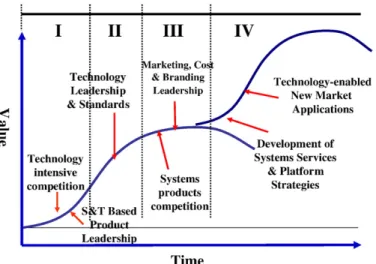
and industry evolution examines the stages of industrial development, analyzing together product and process innovations; rate and type of entrant selection;firm size and growth; and market concentration[25,59,60].Fig. 4offers a scheme that reflects our given segmentations in industrial life cycle by the difference of S–T gap, and the corresponding industrial situation and competitive environment in these stages have been illustrated inTable 4.
This researchfirstly adopts the analysis of firm-level strategies under different S–T gap and industrial stages, to further explain the competitive environment of industry dynamics and evolution, in the given segmentation of industrial life cycle described in
Fig. 4. The study is summarized inTable 4to illustrate the distinctions of applied strategy approaches between large and small corporations.
The relationship betweenfirm size and technology R&D has drawn considerable attention from studies for over several decades
[61–66]. Thefindings inTable 4refer to these literatures to make an analysis of life cycle in different technology level. Firstly, in Stage I, S–T gap is simply too wide to traverse effectively, and fundamental scientific advances fail to generate products and have little effect in corporate R&D. The industrial situation schematized inFig. 4tends to be science-based product leadership and technology intensive competition. In such a circumstance, technological innovation is slow and halting, and it requires large amounts of capital to make incremental improvements. Thus, the industry may be dominated by a number of large corporations that have thefinancial resources to operate R&D and patent protection. Market control may come from dominating innovation through patents or a stranglehold on marketing or distribution channels[1]. In this stage, most of market users are innovators and
Fig. 4. Industrial life cycle.
Table 4
Firm-level strategies based on the evolution of S–T gap
Stage S–T gap Industrial situation Firm-level strategies
Large corporation Small corporation I Wide Slow technology innovation Dominate the market and form the
hegemony
Capital disadvantages to exploit science
Require large amounts of capital to make incremental improvements
Industry structure is oligopoly in nature by large corporations
Form a stronghold on patents, market, and channels
Long-term R&D investment
Science-based product leadership and Technology intensive competition
II Become narrow Capital advantages shrink and science becomes accessible
Establish the standard of technology Develop the applications by the existing science model Productivity and entrepreneurship prevail
Industries may undergo wracking changes
Develop systems products
Speed,flexibility, and productivity advantages
III Close Commoditization and maturity Vertical/horizontal integration Affiliation Competition and capital cost occur over marketing
and distribution
Outsourcing Channel and brand
Development of disruptive innovation Cost and system product competition SCM and logistic
IV Close but technology diversify
Knowledge-based economy and knowledge intensive competition
Dynamic specialization Development of systems services Development of market intelligence
Competition-driven network effects Diversity
Platform strategy Customer-centric leadership Technology-enabled new market
application
Technology-enabled new market application
early adopters[67], and therefore large amounts of capital must be invested in the complementary assets of technological products
[68]to acquiring thefirst-mover advantage and crossing the chasm of mass market. That is also why the industrial structure in this period may be oligopoly in nature by large corporations with capital advantages. In this stage,first-mover advantage could be acquired by the science and technological innovation due to the technological uncertainty and undefined industry rule[69].
As the S–T gap begins to narrow, the industrial development gets into the Stage II after the inflection point of life cycle curve. In this stage, capital advantages shrink and erode. Science becomes accessible and builds more models allowing product engineers to extrapolate from given conditions. Thus, the time required to move from lab to market dramatically shrinks and the risk declines as a result of lower uncertainties. The small corporations with particular strengths of speed,flexibility and productivity may prevail before the dominant design or technology standard appears[70,71]. They can develop the new technological applications by the existing science models to occupy these markets that large corporations disdain due to the long-term investment in the increasing return products (with increasing slope) before the inflection point of life cycle curve[37]. With competition changing, industrial structure may undergo wracking shifts in this stage. For large corporations, in addition to investing in sustaining innovation[41], the best strategy is to develop systems products and establish the dominant design or standard to accelerate the narrow of S–T gap and the move from this stage to commoditization or cost competition. In this stage,first-mover advantage could appear in the corporations possessing the dominant design or technology standard[72,73].
With S–T gap closing even further, commoditization sets in and industrial development gets into the Stage III. Now competition and capital cost occur over control of marketing, distribution and supply chain management, and the industrial situation[1]
illustrated in Fig. 4 becomes oversupply and tends to be marketing, cost and branding leadership and systems products competition. In addition to the strategies of branding, channel, or logistic, large corporations can also form the monopoly by vertical/horizontal integration to obtain the scale or scope advantages under this price competition. Furthermore, another strategy
[74,75]is to outsource the low-profit segment in value chain to small corporations through production modularity based on the theory of value chain evolution (VCE) developed by Christensen and Raynor[41]. This stage seems not to be favorable for small corporations. The better way is to integrate themselves into the supply chain of large corporations and form the affiliation based on their core capabilities. Another opportunity for small corporations with research strength is to focus on the demands of low-end or new markets to develop the disruptive innovation[35,36], thereby yielding new value to enable the next stage or curve depicted in
Fig. 4. Thus,first-mover advantage could be seized by the corporations with cost advantage.
With knowledge dynamically evolving and globally proliferating, industries upgrade and create new values shown graphically as the second S-curve inFig. 4. This Stage IV of knowledge-based economy is defined under the assumption of several industrial driving forces such as diversity of highly segmented markets, systems and platform services, network effect derived from internet, and technology-enabled new markets[76–78]. Thus, the industrial situation under this still close S–T gap is transformed into customer-centric leadership and knowledge intensive competition due to the diversity of technology or market application and the destroy of commoditization[79]. In this stage, high-profit segments of value chain may concentrate on the interfaces of industrial supply chain, production of key components, or process integration segments[41]. It provides considerable opportunities for small corporations to develop dynamic specialization and innovation-intensive services based on the platform strategy and network externality[80–82]. The size of these corporations with the nature of speed,flexibility and efficiency may be out of proportion to their leveraged capability enabled by expandable core competences[83]; however, it can be just proper to prevail in the increasing return industry of this knowledge-based stage [84,85]. For large corporations, the strategies of experience marketing and customization can be adapted for the development of dynamic specialization by the manipulation of the above-mentioned platform operation[86]. In addition, scale and scope advantages of these corporations can be applied to develop vertical integration strategy by the existing cluster effect or diversity strategy by the control of market intelligence and technology base. Finally, technology innovation should be more emphasized in this stage for both large and small corporations to seize the opportunities of technology-enabled new market application, resulting in the acquirement of first-mover advantages due to the network characteristics of increasing return industries[87,88]. In addition, the appropriate strategies of platform and specialization based on the core competences could also turn these capabilities into first-mover advantage in this stage[89,90].
As a result, based on the abovefirm-level discussion, the strategic concepts of pragmatist and optimist mentioned can be applied to devise the policy approaches under different S–T gap and industrial stages. AsTable 5shows, in Stage I, S–T gap is simply too wide to traverse effectively, and fundamental scientific advances fail to generate products and have little effect in corporate R&D[1]. The industrial situation of this epoch tends to be science-based product leadership and technology intensive competition. Thus, the optimist policy approach can befirstly adopted by large countries with affluent resource and sizeable domestic market in the emergent stage based on their science foundation, to invest in the industrial infrastructure and market mechanism for autonomously formulating the industrial capabilities while technology and market gradually developing. On contrary, for small countries, due to the lack of resource and science base, the pragmatist policy approach must be selected to pour resources into the target industrial segment and take some protectionist measures, for nourishing the competitiveness of localfirms[91,92]. Some literatures about the theory of latecomers or catch-ups development such as small countries, also refers to the active role of governments[93–95].
With S–T gap beginning to shrink, large countries can maintain the optimist approach to strengthen the leading base and infrastructure, or try to apply the pragmatist policy approach such as government sponsored or procurement program, to foster the speed of technology development and the growth of domestic market, thereby achieving the economies of scale/scope. It is also appropriate for small countries in this stage to adopt pragmatist policy approach such as trade barrier, local industrial standards, national institution, and national champion policies, for maintaining the competitive advantage or technology base of local
industry in the domestic market[92,96,97]or formulate the selected industry clusters of science parks like Taiwan and Israel
[98,99].
Next, with S–T gap becoming close, in Stage III and IV, the industrial competition changes into marketing-based product and consumer-centric leadership[78]; cost, brand, channel, or customization advantages become essential due to the maturity of technology[79]. Thus, the optimist policy approach is suitable for both large and small countries, particularly in the industrial development of learning economy[100,101]. In this period, market demand is the primary incentive of technology development, and the role of the less interventionist government is to establish a free-market mechanism. Large countries with profound industry base could use this policy approach to strengthen the status of their established vertical integration industry giants. On the other hand, governments in small countries could also apply the policy tools of optimist approach to assist their localfirms for developing specialization and differentiation strategy[102,103]based on the legacy, resource-based and capabilities[104,105]and the support of academic institutions or innovation infrastructure [106,107]. However, pragmatist policy approach could be continuously adopted by small countries or corporations if the global competitiveness is still relatively weak in the industrial value chain[92,108]. 5. Cross-national and cross-industrial comparison of global industrial evolution
A cross-national and cross-industrial comparison of optimist and pragmatist approaches would be applied to manifest the validity of the above policy-level analysis inTable 5, by the empirical cases of global industries, that is, case studies of global IC, pharmaceutical, and computer hardware industries during the 2nd half of the 20th century are used as research targets to elaborate these two strategy approaches on policy levels.
5.1. Case study of global IC industrial development
The analysis of global IC industry should focus on the dynamics of industrial leadership and the evolution of industry structure, regarding some elements of factors behind industrial leadership, including resources, institutions, markets, and technology, proposed by Mowery and Nelson[6]. They shed new light on co-evolutionary processes over time and across countries. Malerba
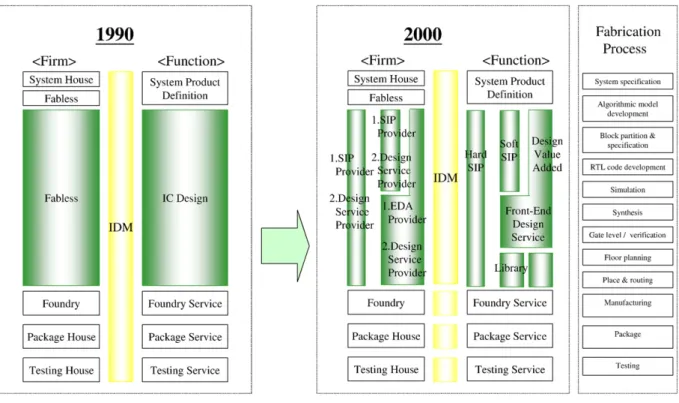
[109,110]also raised the framework of sectoral innovation system, including three building blocks of knowledge and technology, actors and networks, and institution, and a sectoral system would undergo processes of change and transformation through the co-evolution of its various blocks. Based on the above analytical blocks, the industry structure of global IC industry nowadays should tend to be commodity co-existing with specialty products; amorphous and oligopoly. The U.S.firms are basically dominant in the industries, and the Japanese, Korean, and Taiwanesefirms are dominant in different market segments due to the considerable IC function and market application, resulting in a trend of vertical disintegration and horizontal integration. This trend also contributes to the emergence of the small start-up design house, and design and IP service platforms.Fig. 5illustrates this trend of IC industry in the views of technology and value chain.
Based on the discussion of the IC industry dynamics and factors behind industrial leadership, the case studies of IC industrial development of Taiwan, Korea, Japan, and United States., are used to demonstrate the effectiveness of these two optimist and pragmatist approaches. In what follows, we chronicle in orderfive major episodes of regional competitive advantage in global IC industry[111]. The results of IC industrial development and policy selection of these four countries are respectively summarized in
Table 5
Policy-level strategies of two different approaches
Stage S–T gap Industrial situation Applied policies
Large country Small country
I Wide Slow technology innovation Optimist to formulate the competitive advantages for the most favorable position in the industry
Pragmatist to pour resources into specific industrial segment to protect local industry Require large amounts of capital to
make incremental improvements Industry structure is oligopoly in nature by large corporations Science-based product leadership and Technology intensive competition II Become
narrow
Capital advantages shrink and science becomes accessible
Pragmatist/optimist to foster the speed of technology development and the growth of domestic market
Pragmatist to maintain the competitive advantage of local industry in the domestic market Productivity and entrepreneurship
prevail
Industries may undergo wracking changes
III Close Commoditization and maturity
Optimist to strengthen the technology and market status of established vertical integration industry giants
Optimist/pragmatist to develop specialization strategy based on the legacy and capabilities under industrial mature situation Competition and capital cost occur
over marketing and distribution Cost and system product competition IV Close but
technology diversify
Knowledge-based economy and knowledge intensive competition Competition-driven network effects Customer-centric leadership
Table 6byfive industrial periods. The applied policy tools listed in the table can be used to describe the distinct strategy approaches in every country at different periods.
During thefirst and second periods with wide S&T gap, the invention of transistor and integrated circuit, American dominated the IC market by strong corporate research laboratories and rapid technology diffusion and commercialization of patent cross-licensing. The market for semiconductor began with the demand of United States military, and it was the Cold War after WWII that nurtured this industry in its infancy. Military demand for semiconductors provided several spillovers from the development of military devices to civilian applications, and indirectly enhanced the development of commercial semiconductor markets in the late 1950s. In addition to investing in education and infrastructure, the role of federal government is to provide direct support both for R&D and industrial infrastructure as well as indirect support through military systems contractors[111–113]. Thus, the ideology of S&T policy for IC industry at this period is nearly the optimist due to the wide S–T gap and amorphous market conditions. In the meanwhile, Japanesefirms just committed early to IC mass production and remained dependent on U.S. sources of supply, and were successfully export-oriented because of less military and domestic commercialized demand. Also, Japanese government subsidized virtually no basic research during this period.
During the third period, the comparison was found in the dynamics of competition between American and Japanese companies in the new generation of IC products[114,115]. This competition involved issues of productive efficiency, investment rates and timing, and design strategy. The success of Japanese companies was achieved by the nature of end-use markets in Japan, the timing of market developments, and the patterns of investment. Japanese government essentially adopted pragmatist policy approach at this period to pour resources into this industry, with the S–T gap gradually shrinking. The VLSI Program initiated by the Nippon Telephone and Telegraph (NTT) and the Ministry of International Trade and Industry (MITI) is the most famous efforts made by the government to deepen their technological competences to a level at which it could challenge American dominance[116–118].
The typical pragmatist policy approach was also applied at this period by Taiwanese and Korean government because of the lack of national resource[119–122]. They both chose the specific segments in the IC industrial value chain or market application as a national strategic industry, and developed by government funding, overseas technology transfer, and hiring of American-trained Chinese or Korean talent[123–126], thereby developing the IC cluster in specific science park[127–129].
During the fourth period, shown asTable 6, the American resurgence has been largely the result of the industry's ability to improve manufacturing and achieve a dominant position in the fastest-growing and design-intensive segment of the industry due to the narrowing of S&T gap[130,131]. Moreover, organization innovation and specialization also allowed the American industry to take advantage both of its own structural advantages and global manufacturing and technological capabilities[113,132]. On the contrary, Japanesefirms were facing threats to their manufacturing leadership from elsewhere in Taiwan and Korea during a sustained period of pragmatist policy supports. Korean entry was based upon an aggressive investment program and government funding support in minor specific consortia[92,133]. For instance, much of Samsung's output was focused on DRAMs and became the world's largest memory chip producer. In contrast to Korea, Taiwan has developed into a highly diversified producer of semiconductors, with significant and growing capabilities in design as well as in fabrication[134]. The Taiwanese industry has its
Table 6
Comparative analysis of global IC industrial development American's rise to dominance
(1955–1965) IC era (1965–1975) Japanese challenge (1975–1990) American resurgence and Far Easternproduction (1990–2000) Globalization (2000–) United
States
Industrial
development ♦Corporate research laboratory ♦IC technology reinforcedAmerican dominance ♦Focused on growth ratherthan on profit margins ♦Manufacturing improvements,imitated TQM practice of Japanese, focused on higher-margin, design-intensive chips
♦Market and technology leadership
♦Commercialize and diffuse by
cross-licensing ♦Trend of vertically
disintegration ♦Insisted on radical new designsand process technology
♦Trend of decoupling of design from production, benefits American industrial organization
♦Outsourcing strategy ♦Majority demand in military, and
minority demand in computer and
onsumer-electronics (like radio) ♦Demand: rapid growth ofAmerican computer industry ♦Government demand fell
♦Offshore strategy for cost reduction ♦Shifts in the pattern of demand (ASICs, MPU, Logic chips), benefits American companies
Applied
policy tools ♦Government procurement:military and space program ♦Government procurement:military and space program ♦Essentially laissez-faire policy ♦Trade policy (Section 301, Dumping) ♦Trade policy forglobalization ♦Military R&D support ♦Military R&D support ♦Imitate Japanese model to encourageR&D consortium
♦Education/infrastructure ♦Education/infrastructure ♦Direct subsidy to cooperative research ♦Government demand fell
♦Reduce obstacles of antitrust policy Japan Industrial
development ♦Committed to IC massproduction ♦Gain a significant foothold inthe American market in DRAMs ♦Japanese IC demand for computer fell ♦Market and technologyleadership ♦Export orientation ♦Larger companies in comparison
with American counterparts
♦Threats to manufacturing leadership
from elsewhere in Asia ♦Vertical integration ♦Manufacturing advantage and
price-cutting
♦Appreciation of Japanese yen Applied
policy tools ♦Prevention of direct foreigninvestment ♦The VLSI Program by NTT and MITI ♦Trade policy ♦Trade policy forglobalization ♦Support for the licensing of
foreign tech.
♦R&D consortium between companies
and joint laboratory ♦Future Electronic Device Project(no significant commercial effect) ♦Domestic demand by NTT
Korea Industrial
development ♦Select specific segments in theindustrial value chain to develop by government
♦Economics of capacity investment or
productivity in manufacturing ♦Diverse and massiveconglomerate ♦Modern facilities and growing share
of the market
♦Samsung become the world's largest memory chip producer
Applied
policy tools ♦Government support andtarget industry ♦Government support and targetindustry ♦Support of funding ♦Hiring of American-trained
Korean talent ♦Aggressive investment program♦Funding support in minor consortia
Taiwan Industrial
development ♦Select specific segments in theindustrial value chain to develop by government
♦Develop highly diversified producers ♦Originally design manufacturing ♦Offshore site for American
manufactures
♦Joint ventures with American fabless firms
Applied
policy tools ♦Government support andtarget industry ♦Cluster effect of Science Park ♦National industrialprograms ♦Quasi-governmental research
institution licensed tech. from foreignfirms
♦Encourage foreign direct investment,
strategic alliances with foreignfirms ♦Investment regulation ♦Hiring of American-trained
Chinese talent
♦New companies spun off from quasi-governmental research institution
12 C.-H. Y ang, J.Z. Shyu / Technological For ecasting & Social Change 76 (20 09) 2– 25
origins that encouraged foreign direct investment, strategic alliances with foreignfirms, and high mobility of engineers, especially to and from the United States, to serve for years as an offshore site for American manufactures[126,135].
After 2000, during thefifth period, the optimist policy approach was continuously applied to IC industry by American and Japanese government as a result of their international firm's capabilities about core competencies, market and technology leadership, and competitive advantages derived from innovative enabling functions in quality or performance[136,137]. The greatest difference between these two countries is the distinction of globalization strategies derived from their economic systems according to the national varieties of capitalism model[105,138]. For liberal market economies, like the United States and Britain, in which allocation and coordination of resources take place mainly through markets[138,139], the Americanfirms have always been accustomed to buying their resources in the market and were well-prepared for the world of fragmentation and outsourcing. It explains that American ICfirms outsource the manufacturing of their chips to Asian firms and benefit from them. In contrast, for coordinated market economies, like Japan's and Germany's, in which negotiation, long-term relationships, and other non-market mechanisms are used to resolve the major issues, the Japanesefirms that cannot find the home-based resources abroad, are likely to be more reluctant to move abroad. It explains that Japanese IC industry continues to make many of its own chips in-house in Japan[137,140].
In developing economies of Asia, the supports of pragmatist approach would be sustained by Taiwan and Korea governments at this period owing to the limited resources and intensive market competition. The globalization strategies of these two countries are nearly like the dynamic legacies model proposed by Suzanne Berger[105], emphasizes that globalization starts from a company and its reservoir, or legacy, of resources that have been shaped by the past. Thus, the way of Taiwanese and Korean industry is to position itself in the global IC value chain based on their individual legacies offirms which are composites, with capabilities, talents, and aspirations shaped by diverse experiences as well as national imprinting[141–143]. In addition, instead of deficiency of brand or system productfirms in Taiwan, the optimist policy approach has begun to be applied in Korean IC industry, such as R&D investment, relies on the formation of diverse or massive conglomerate by technology and market leadership offirms like Samsung
[122,144,145]. As to Taiwan, the policy thinking in IC industry tends to be the mixture of the pragmatist and optimist due to the industrial characteristic of SMEs model. The government still invests in the industry cluster and develops the national programs in the IC related industries such as telecommunications, LCD panel, internet, and automobile electronics, to promote the related industrial development, thereby driving the growth of IC industry, and transform from OEM, ODM, to OBM. In the meanwhile, a great deal of new start-ups set up in the IC segments of design house, EDA design tools, and silicon IP services, based on the established industrial bases such as IC fabrication companies, human resource, academic research, and industrial infrastructure
[146,147].
5.2. Case study of global pharmaceutical industrial development
The pharmaceutical industry could be considered as a network of innovative activities, directly or indirectly, includingfirms, universities, research centers,financial institutions, regulatory authorities and consumers[148]. In this industry, high R&D costs and complex regulatory issues forcefirms to go global, resulting in consolidation and oligopolized industry structure, except the amorphous and variety biotechfirms in the upper stream. McKelver[149]argued that the industry is a traditional stronghold of the European industry, and has undergone profound changes in technology (biotechnology and the molecular biology revolution),
demand (cost-containment policies), and institutions (patent legislation), over the last two decades. These variations have resulted in a redefinition of the fundamental sources of competitive advantages in this industry, and have led to organizational changes withinfirms as well as to extensive network changes in relationships among companies and other academic institutions. Value has migrated from a design centered on serendipitous science, to a design focused on the creation of blockbuster products, to a design that responds to the changing structure of the customer base in the 1990s by focusing on low-cost distribution and market access— the managed health care design[150,151].Fig. 6reflects the change of industry structure in the view of pharmaceutical value chain
[152].
Based on the discussion of the industry dynamics and structure, the case studies of global pharmaceutical industrial development of United States, Europe, Japan, and Taiwan are selected to demonstrate the conclusion of the above-mentioned analysis in strategy approaches. In this section, the history of the pharmaceutical industry is divided into three major epochs, referring to the definition of Henderson et al.[153], as shown in Table 7. During the first period with wide S&T gap, the pharmaceutical industry was not tightly connected to formal science in the early history. Until the outbreak of World War II, the U.S. government organized a massive research project that focused on commercial production techniques and chemical structure analysis. This system led to major gains in productivity and R&D investment and laid out an architecture for the process in which future improvements could took place[154]. In this stage, for United States and Europe, the pharmaceutical industries were roughly developed by the base of university and related industry, including chemical, dye, textile, silk, and food, using essentially laissez-faire policy, until World War II[155]. Thus, the ideology of strategy approach at this epoch is nearly the optimist due to the nature of wide S–T gap in this industry, for developing pharmaceutical giants in German, Swiss, or Netherlands based on the established chemical industry[153,156], or founding the specialized pharmaceutical producers in United States and United Kingdom.
During the second epoch after the World War II, the S–T gap in global pharmaceutical industry still remains wide, and there were many physical diseases for which no drugs existed in the early postwar years. Pharmaceuticalfirms invented an approach referred to as “random screening” that natural and chemically derived compounds are randomly screened in laboratory animals for potential therapeutic activity[153,155]. Furthermore, the industry also began to benefit directly from the explosion in public funding for health research projects that followed the war. Smallfirms, those farther from the origins of public research, have been much slower to adopt the new techniques than their rivals. Moreover, the organizational capabilities, the process of gaining regulatory approval, and marketing and distribution also appear to have acted as powerful barriers to new entry into the industry[157]. There was also significant geographical difference in adoption. Whereas the largerfirms in the United States, the United Kingdom, and Switzerland were among the pioneers of the new technology and dominated the postwar pharmaceutical industry, other European and Japanesefirms appear to have been slow in seizing to the opportunities afforded by the new science[158,159]. As a result, except few measures of public research program and procurement, optimist policy approach was still applied by United States and most European countries in this stage, such as infrastructure and education investment, support of university research, openness of domestic market, development of venture capital and entrepreneurship, and deregulation policy, like the passage of Bayh–Dole act in United States[160]. In contrary, the ideology of strategy approach in Japan was similar with the pragmatist at this epoch due the relatively weak competitiveness in science, including the policy tools like protectionist measures of domestic market and international competition, pricing policy, and drug coerced licensing[158,161].
During the third period, the biotechnology revolution represents that the emergence of biotechnology and molecular biology narrow the S–T gap in pharmaceutical industry[162,163]. In United States, the large-scale new biotechnology start-ups were primarily university spin-offs and were usually formed through collaboration between scientists and professional mangers, backed by venture capital[164,165]. Established pharmaceuticals initially played a less direct role in this application of biotechnology, and invested in biotechnology R&D through collaborative arrangements, R&D contracts, and joint ventures with the new biotechnology start-ups and university laboratories[166–169]. With the S–T gap becoming close by the bridge of biotechnology, the typical optimist policy was adopted in this epoch by U.S. government by the development of local scientific base, patent protection, access to capital, favorable environment for entrepreneurship, and high mobility in scientific labor market[161,170].
In contrary, the exploitation of genetics as a tool to produce proteins as drugs in Europe and Japan lagged considerably behind that in the United States. The most striking difference is the absence of the phenomenon of the specialized biotechnology start-ups in Europe and Japan, with the exception of the United Kingdom[153,171]. Governments in Europe and Japan have devised a variety of measures to foster industry–university collaboration and the development of venture capital to favor the birth of new biotechnology ventures[155,172]. In the absence of extensive newfirm founding, most of the innovation in biotechnology in Europe has occurred within establishedfirms. Thus, in mainland Europe, a few firms possess a large proportion patents in biotechnology on the activities of a small group of large established companies. For instance, the British and the Swiss companies moved earlier in the direction pioneered by the large U.S. firms in collaborating with American star-ups. Firms in the rest of Europe tended to focus primarily on the establishment of a network alliance with local research institutes. As a result, in this stage, two kinds of policy approaches would be both adopted in Europe based on the technology and market segment for intervention. Some countries still used the ideology of optimist to foster the industry– university collaboration and the birth of biotechnology start-ups. Other countries lagging to adopt biotechnology as a research tool, like France and Italy, may apply pragmatist approach in the development of minor products for the domestic markets based on the legacy of core capabilities[159,173].
In Japan, entry in biotechnology was pioneered by the large food and chemical companies with string capabilities in process technologies. Although having strong capabilities in process technologies, thesefirms generally lack abilities in basic research.
Comparative analysis of global pharmaceutical industrial development
Early Epoch (1850–1945) After World War II (1945–1990) Biotechnology revolution (1990–) United
States
Industrial development ♦Mass production pharmaceuticals began in the later 19th century
♦Benefit directly from the explosion in public funding for health related research, as a source of knowledge about disease
♦Large-scale new entry into the industry, being primarily university spin-offs through collaboration between scientists and professional managers, backed by VC
♦Specialized pharmaceutical producers
♦Larger firms of economies were the pioneers of the new technology, and had a number of isolating mechanisms working in their favor
♦Established pharmaceuticals initially played a less direct role in the application of biotechnology
♦Discover and commercialization of Penicillin
♦Great internal organizational processes and tacit skills of largefirms
♦Established pharmaceuticals acquire the technology through collaboration— both with small biotech firms and university laboratories ♦R&D investment and gain in productivity
in World War II
♦Approach of “random screening” for potential therapeutic activity
Applied policy tools ♦Essentially laissez-faire policy ♦Public funded research in the postwar years ♦Investment of education and local science base ♦Government support for health
related research in World War II
♦Passage of the Bayh–Dole act (1980) ♦Deregulation in high mobility of scientific labor market ♦Collaboration between firms, government,
and university in wartime
♦Entrepreneurship in university ♦Patent protection
♦Emergence of venture capital ♦Venture capital for new start-up ♦Open to international competition in
domestic market Europe Industrial development ♦Emergence of synthetic dye
industry in German and Switzerland in mid-19th century
♦Larger firms of scale economies seize the new technology (United Kingdom, Switzerland)
♦Initial absence of the specialized biotech start-up (exception of the United Kingdom)
♦Swiss and German pharmaceutical activities emerge within larger chemical producing enterprises
♦Slow in responding to the opportunities afforded by new science (other countries)
♦Many of the new firms not involved in drug research, but instead in instrument, reagents, diagnostics, and agriculture
♦Specialized pharmaceutical producers (United Kingdom)
♦Postwar Europe pharmaceutical industry was dominated by Switzerland, Germany, and United Kingdom, French and Italy have not played major international role
♦Start-up were founded through the support of both government and large pharmaceuticals rather than through VC
♦Up until World War I German dominated the industry (80% of world's output)
♦Approach of “random screening” for potential therapeutic activity
♦Most of innovation in biotech occurred within few established firms ♦British and Swiss companies moved earlier in collaborating with U.S. start-up, the rest of Europe focus primarily on the network of alliances with local research institution
(continued on next page)
15 C.-H. Y ang, J.Z. Shyu / Technological For ecasting & Social Change 76 (20 09) 2– 25
Table 7 (continued)
Early Epoch (1850–1945) After World War II (1945–1990) Biotechnology revolution (1990–) Applied policy tools ♦Essentially laissez-faire policy ♦Public funded research in the postwar years ♦Foster industry–university collaboration
♦University science base ♦Public research institution (France and Germany) ♦Development of VC for the birth of new biotech star-up ♦Base of chemical, silk, and
textile industry
♦Open international competition (Britain and Switzerland) ♦Government program for funding start-up ♦Development of minor products for domestic
market (Italy and France)
♦Licensing technology from U.S. firms Japan Industrial development ♦Slow in responding to the opportunities afforded
by new science
♦Initial absence of the specialized biotech start-up ♦The 2nd largest pharmaceutical market in the world ♦Disadvantage of entering the innovative marketrelatively late instead of U.S. ♦Dominated by local firms (for regulatory reasons) ♦Entry in biotechnology was pioneered by the large
food and chemicalfirms with strong capabilities in process technology
♦Lack capabilities in basic drug research Applied policy tools ♦Trade regulation ♦Foster industry–university collaboration
♦Protection from foreign competition ♦Licensing technology from U.S. firms ♦Drug licensing and reimbursement regime ♦Government research program ♦Clinical testing and pricing policy ♦Protectionist measures
Taiwan Industrial development ♦Academic research ♦Focus on pharmaceutical medicament, pharmaceutical ingredient and herb
♦Foreign investment and local SMEs
♦Generic drug production ♦Drug agency
♦Health Insurance plan ♦Domestic market
♦Biotech start-ups ♦Similarity of products
♦Regional disease research Applied policy tools ♦Regulatory of GMP, C-GMP, GLP, GCP after 1980 ♦Recruitment of overseas talents
♦Encourage merger ♦Response for WTO impact ♦Build international network ♦Research institution
♦Biotech industrial park ♦Biotech national program
16 C.-H. Y ang, J.Z. Shyu / Technological For ecasting & Social Change 76 (20 09) 2– 25
Meanwhile, as a result of the combination of patent laws, the policies surrounding drug licensing, and the reimbursement regime, Japanese pharmaceuticalfirms had little incentive to develop world-class product, and in general concentrated on finding novel processes for making existing foreign or domestically originated molecules[161]. Thus, pragmatist approach like protectionist measures was still applied in Japan for protecting local pharmaceuticals in domestic market[174].
In Taiwan's case, the pharmaceutical industry is the global latecomer due to the lack of technology and limited domestic market. Government did not almost apply industry policy in this segment until the regulatory legislation of the GMP, C-GMP, GLP, and GCP regulation, to build the international network. In this stage, the domestic market was dominated by foreign pharmaceuticalfirms, and the local industrial capabilities almost focused on the academic research, drug agency, and some small and medium drug enterprises. After the biotechnology revolution, the pragmatist policy approach was gradually applied to improve this industry by developing biotechnology[175]. Biotechnology became the target industry in Taiwan after 2000, and poured national resource into the establishment of science parks, research institutions, national sponsored program, and recruitment of overseas talents. In the support of established R&D base and biotech start-ups[176], the pharmaceuticalfirms in Taiwan found some niches in the markets of the pharmaceutical medicament, pharmaceutical ingredient and herbs, production of foreign generic drugs, and some regional disease research.
5.3. Case study of global computer industrial development
The computer industry is one of the most dramatic value-growth stories of the 20th century. The industry history shows the U.S. firms are dominant in this industry along with the growth of the semiconductor and software industries. During WWII, decoding demanded uses of large-scale computation, contributing to the emergence of IBM as the industrial leader, and corporate, institutional, and government users constituted the entire computing market. Next, in the 1980s, the influx of millions of individual users, both in households and businesses, rapidly and radically changed the target market of computer companies. The evolution of its needs drove the shift in successful business design from integration to specialization[150,177].
In the view of industry structure, in the United States, the punctuations were associated with the entry into the industry of new firms, and these new firms almost always were the first to venture into the new market. However, this happened to a significant lesser degree in Europe, and hardly at all in Japan[178]. In addition, the progressive vertical disintegration of the computer industry and in particular by the increase in mainframes, minis, PCs, and supercomputers [179,180], has marked the era of personal computers, resulting in the emergence of the PC manufacturer and component supplier such asfirms in Taiwan, Korea, and China. Nowadays, the industry structure of computer hardware tends to be commodity, consolidated, and closing S–T gap, and follows the smiling curve with high value-added in the extreme sides of R&D and branding activities.Fig. 7presents the evolution of business model in computer industry[181].
Based on the discussion of industry dynamics and structure, global computer hardware development of United States, Europe, Japan, and Taiwan are analyzed to make a comparison of these two optimist and pragmatist approaches. The industrial evolution is divided into three major epochs, referring to the definition of Bresnahan and Malerba[182], as shown inTable 8. During thefirst


![Fig. 6. Change of pharmaceutical value chain (source: [152] ).](https://thumb-ap.123doks.com/thumbv2/9libinfo/7534554.120238/12.816.153.663.682.1010/fig-change-of-pharmaceutical-value-chain-source.webp)
![Fig. 7. Change of computer value chain (source: [181] ).](https://thumb-ap.123doks.com/thumbv2/9libinfo/7534554.120238/16.816.168.646.656.1010/fig-change-computer-value-chain-source.webp)