行政院國家科學委員會補助專題研究計畫
5 成 果 報 告 □期中進度報告以短期記憶能力導向探討行動化學習環境下之語文學習
(2/2)
計畫類別:5 個別型計畫 □ 整合型計畫
計畫編號:NSC 95-2520-S-110-001-MY2
執行期間:95 年 08 月 01 日至 97 年 10 月 31 日
計畫主持人:陳年興 教授
共同主持人:
計畫參與人員:
魏春旺、陳彥宏、吳秉儒、楊秀珍、蔡俊毅、莊育承、蔡
昆庭、陳信宏、朱家賢、劉新茹、王茂蕊、廖祥智、陳思穎、陳偉聖、洪逸
群、劉珈綺
成果報告類型(依經費核定清單規定繳交):□精簡報告 5完整報告
本成果報告包括以下應繳交之附件:
5出席國際學術會議心得報告及發表之論文各二份
5國際合作研究計畫國外研究報告書一份
處理方式:除產學合作研究計畫、提升產業技術及人才培育研究計畫、
列管計畫及下列情形者外,得立即公開查詢
□涉及專利或其他智慧財產權,□一年□二年後可公開查詢
執行單位:國立中山大學 資訊管理學系
中 華 民 國 97 年 10 月 20 日
目 錄
摘要 ...1 ABSTRACT ...2 1. INTRODUCTION...3 2. METHODS ...6 7.1 Research questions ...6 7.2 Participants...7 7.3 Materials...8 7.4 Hypothesis ...10 7.5 Procedure ...117.6 Data collection instruments ...13
3. RESULTS ...14 4. DISCUSSION ...22 5. CONCLUSION...24 6. 已發表之研究成果...25 7.1 期刊論文 ...25 7.2 研討會論文 ...26 7.3 畢業碩士論文 ...29 7. 計畫成果自評 ...29 7.1 研究內容與原計畫相符程度...29 7.2 達成預期目標情況 ...30 7.3 研究成果之學術或應用價值...31 7.4 是否適合在學術期刊發表或申請專利...31 REFERENCES ...32 APPENDIX 1 ...36 APPENDIX 2 ...38 APPENDIX 3 ...39 APPENDIX 4 ...40
以短期記憶能力導向探討行動化學習環境下之語文學習
陳年興 國立中山大學資訊管理系 [email protected]摘要
處在一個知識爆炸的行動化社會,人們隨時隨地都在接收各式各樣類型的資訊,因此 如何迅速將這些不同呈現方式的資訊吸收並轉化成自己的知識,已成為現代人最重要的課 題。且隨著行動通訊與無線傳輸技術的進步與成熟,各界對於行動科技將為學習帶來的改 變有不少期待。事實上,只要能夠有效地運用手機簡訊此種行動科技(包含有 SMS 與 MMS),作為學習內容傳遞的技術,並提供不同呈現方式的學習內容給使用者,即可達到 行動化學習的效果。然而,利用不同的學習內容呈現方式並搭配不同的傳遞技術,是否能 真正受到學習者的青睞與接受是一個相當重要的議題。因此本研究希望根據 Alavi 和 Leidner 在 2001 對科技中介學習所提出的理論,針對學習者之短期記憶能力在整個心智學 習過程中所扮演的角色,來探討在利用手機簡訊此種行動科技進行學習的環境下的學習成 效。研究結果發現,如果把不同的內容呈現方式與傳遞方式進行適當的搭配,來符合學習 者的短期記憶能力將可以有效的提高學習成效。例如,對於語文與非語文短期記憶能力皆 低的學習者,最符合學習者的學習方式就是只呈現必要的學習教材;但是對語文短期記憶 能力高於非語文的學習者,額外提供語文的註解來輔助學習是最符合學習者的學習方式; 對於非語文短期記憶能力高於語文的學習者,最好的輔助學習學習方式就是額外提供圖像 類的非語文註解;但對於語文與非語文短期記憶能力皆佳的學習者,則提供語文或非語文 的註解來輔助學習皆可達到不錯的效果。 關鍵字:短期記憶能力,學習內容播送,學習內容呈現,行動化學習Applying STM ability for language learning in mobile learning environment
Nian-Shing Chen
Information Management Department, National Sun Yat-sen University [email protected]
Abstract
Due to the rapid advancements in mobile communication and wireless technologies, many researchers and educators have started to believe that these emerging technologies can be leveraged to support formal and informal learning opportunities in the future. Mobile language learning can be effectively implemented by using different Learning Content Delivery (LCD) methods, for example, Short Message Service (SMS) and/or Multimedia Message Service (MMS) to deliver learning content through mobile phones. Because the screen size of mobile phones is limited, how to best present learning materials using different Learning Content Representation (LCR) types is an issue that needs to be explored. This study addresses the issue of content adaptation in mobile language learning environments. Three dimensions have been taken into consideration to identify a promising solution: instructional strategies (LCR types: written annotation and pictorial annotation), information technologies (LCD methods: SMS and MMS) and learners’ cognitive models (STM ability: verbal and visual). Our findings show that providing learning content with pictorial annotation in a mobile language learning environment can help learners with lower verbal ability and higher visual ability to learn better because these learners find it easier to learn content presented in a visual form rather than in a verbal form. Providing learning content with both written and pictorial annotation can also help learners with higher verbal ability and higher visual ability. According to the Cognitive Load Theory, providing too much information might cause a higher cognitive load and lead to irritation and a lack of concentration. Our findings also suggest that providing just the basic learning materials is more helpful to learners with lower verbal ability and lower visual ability.
Keyword: Short-term Memory Ability, Learning Content Delivery, Learning Content Representation, Mobile Learning
1. Introduction
Mobile learning (m-learning) has emerged as the next generation of e-learning (Sharples, 2000). One of the main reasons for this is the high availability of mobile devices: the market penetration of mobile phones, for example, in Austria, is currently at a level of 81% and the numbers are still increasing (Kaesshaefer, 2004). Wikipedia (n.d.) reports that several countries now have more mobile phones than people, with Luxembourg at 164% at the end of 2001 and Hong Kong at 139.8% by July 2007, and that by 2006, 80% of the world’s population had mobile phone coverage. It can be emphasized that a large number of people have mobile phones or other similar mobile devices with them most of the time nowadays. Thus, m-learning has the potential to be an important instrument for lifelong learning (Holzinger, Nischelwitzer & Meisenberger, 2005).
However, some researchers still doubt the value of using mobile devices for education. They argue that the excitement and encouragement shown by learners is temporary (Gay, Stefanone, Grace-Martin & Hembrooke, 2001). Meanwhile, experiments have shown that some learners cannot effectively use mobile devices during their learning (for example, see Hsi, 2003). Researchers typically agree that mobile devices such as PDAs and mobile phones serve only as an extension for learning; they do not replace existing learning tools (Liu, Wang, Liang, Chan, Ko & Yang, 2003). What is more important to consider is that not all learning content and activities are suitable for mobile devices (Gay et al., 2001). There seems to be no consensus among researchers over the learning outcomes facilitated by mobile devices.
Some researchers have concluded that if ICT for education can incorporate related learning theories and instructional strategies, the learning outcomes can be increased significantly (Riffell & Sibley, 2005; Clark, 1994; Wiredu, 2005). Meanwhile, Alavi & Leidner (2001) reported that majority of previous studies have mainly relied on the stimulus-response theory, which probed only the relationship between information technology (stimulus) and learning outcome (response). They further emphasized that the study of technology-mediated learning (TML) cannot be bound in only ICT and instruction; future studies should also take learners’ characteristics into consideration in assessing the learning outcome of TML. They also pointed out that the Psychological Learning Process (PLP) of learners is an important mediator that cannot be neglected. Therefore, we want to re-examine how learners’ PLP would affect the learning outcome in a mobile language learning environment. This research will explore the role
of PLP in TML to answer the appeal made by Alavi and Leidner (2001): Facing the new era when m-learning is developing quickly, would learners place the same importance on mobile language learning that they do on traditional learning? This research will also explore the learning outcomes of mobile language learning based on the PLP.
According to the cognitive information processing viewpoint, human beings absorb and apply knowledge via the internal PLP, which includes sensory observation, attention, identification, transformation and memorization. The basic architecture of the cognitive information processing model is a Multi-Store Model (MSM) (Atkinson & Shiffrin, 1968). This model consists of three types of memory: Sensory Memory, Short-Term Memory (STM) and Long-Term Memory (LTM). In studies of second-language (L2) learning, Geva and Harrington (Geva & Ryan, 1993; Harrington & Sawyer, 1992) found that L2 reading skills are highly correlated with STM ability. Abu-Rabia found significant correlations between STM ability and L2 writing proficiency as measured by the test of written language (Abu-Rabia, 2003).
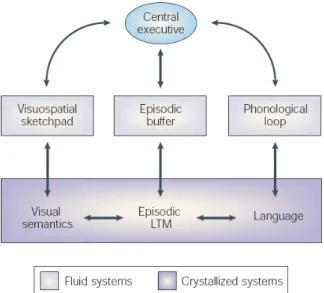
Baddeley proposed a new concept of STM, called the Working Memory Model (WMM), shown in Figure 1, which states that outer information is actually processed in three different parts when it enters into STM via sensory memory (Baddeley, 2003). Baddeley describes WMM as a system composed of one Central Executive (CE) with three subsystems, including Phonological Loop (PL), Visuo-Spatial Sketch Pad (VSSP) and Episodic Buffer (Figure 1), where outer information is not only temporarily stored but is also processed at the same time. The darker areas represent long-term or crystallized knowledge and the lighter areas represent working memory. That is, the Multi-Store Model (MSM) viewed STM only as storage, whereas the WMM not only viewed STM as storage, but also as a system with different kinds of processing powers. If learners are provided with suitable Learning Content Representation (LCR) types in favor of their STM abilities, can we then produce better learning performance? This leads to a very important implication that different learners have different STM processing abilities (Courtney, 1998; Fuster, 1994; MacGregor, 1987; Miller, 1956). Therefore, STM ability in this paper refers to the PL STM ability and VSSP STM ability. In general, we can say that PL STM ability refers to verbal ability and VSSP STM ability refers to visual ability.
Figure 1. Working Memory Model (Baddeley, 2003).
According to the above analysis of the literature, it is evident that the learner’s STM ability is an important issue for studying learning outcome from the Psychological Learning Process (PLP) viewpoint and that examining learning outcome from just the MSM viewpoint is not appropriate. We therefore want to examine learning outcome in m-learning using STM ability from the Working Memory Model (WMM) viewpoint, which includes both storage and processing abilities. To achieve this goal, another important issue that needs to be addressed is how to transfer information from STM into LTM for longer retention. A crucial perspective is the Levels of Processing Theory (Cermak & Craik, 1979; Craik, 2002), which says that a memory trace can persist in LTM if it involves a deeper level of processing. Many research efforts based on the Levels of Processing Theory have been published in the literature. Among them, the use of annotations as instructional strategies in vocabulary learning has been very popular (Cohen, 1981; Courtney, 1998; Plass, Chun, Mayer & Leutner, 1998; Pressley, Levin & Miller, 1982; Taylor & Taylor, 1990). There are two major types of annotation: pictorial and written (Al-Seghayer, 2001). For example, vocabulary learning strategies such as the use of word annotation (Cohen, 1981; Taylor & Taylor, 1990) and keyword annotations (Courtney, 1998; Pressley, Levin & Miller, 1982) require deeper processing of word meanings and have been shown to enhance retention of target words. In this study we use pictorial annotations and written annotations as the instructional strategies. We call these two types of annotation Learning Content Representation (LCR) types.
Further to the discussion, the Dual-Coding Theory says that learning is more effective when learners use more than one sensory modality, for instance, verbal and visual processing together, and when connections are clearly made between the information contained in each modality (Mayer & Sims, 1994). We therefore hypothesize that giving multi-sensory learning content by combining written and pictorial annotation will affect learning performance differently for students with different verbal and visual abilities. Moreover, from the Cognitive Load Theory perspective (Sweller, 1994), information may only be stored in LTM after first being attended to and processed by STM. STM, however, is extremely limited in both capacity and duration. These limitations will, under some conditions, impede learning (Sweller, 1994). For example, learners with both lower verbal ability and lower visual ability are quite different from learners with both higher verbal ability and higher visual ability, so we also want to know if combining both written and pictorial annotation would cause higher cognitive load and impede the learning performance of these learners.
The aim of our research is to explore how to better match different instructional strategies (LCR types) for presenting English vocabulary learning content with learners’ individual STM ability (verbal or visual) using mobile phones, and examine how the relationship affects English Vocabulary learning. The English Vocabulary Recognition and Recall (EVRR) test is often used to assess learners’ English vocabulary knowledge (Al-Seghayer, 2001; McDaniel & Mason, 1985), so the scores of the EVRR test will be used to assess the performance of how students use mobile phones to learn English words.
2. Methods
7.1 Research questions
From an instructional-strategy point of view, we hypothesize that delivering written annotation-based learning content to the learners with good verbal ability would result in better learning outcomes. Similarly, delivering picture annotation-based learning content to the learners with good visual ability would result in better learning outcomes. Accordingly, the research questions designed in this study are as follows:
For learners with higher verbal ability and higher visual ability, will learning content with either written annotation or pictorial annotation result in better learning performance than basic content without any annotation?
For learners with lower verbal ability and higher visual ability, will learning content with pictorial annotation result in better learning outcomes than basic content without any annotation?
For learners with lower verbal ability and lower visual ability, will learning content with either written annotation or pictorial annotation result in learning outcomes significantly different from basic content without any annotation?
For learners with higher verbal ability and lower visual ability, will learning content with written annotation result in better learning outcomes than basic content without any annotation?
With regard to the Dual-Coding Theory and Cognitive Load Theory, we are also keen to see the impact of content with both written and pictorial annotation on learners with different STM abilities. Consequently, this study asks following additional questions:
For learners with higher verbal ability and higher visual ability, will learning content with both written and pictorial annotation result in better learning outcomes than basic content without any annotation?
For learners with lower verbal ability and higher visual ability, will learning content with both written and pictorial annotation result in better learning outcomes than basic content without any annotation?
For learners with lower verbal ability and lower visual ability, will delivering learning content with both written and pictorial annotation result in learning outcomes significantly different from basic content without any annotation?
For learners with higher verbal ability and lower visual ability, will delivering learning content with both written and pictorial annotation result in better learning outcomes than basic content without any annotation?
7.2 Participants
The subjects who participated in our experiment were students of four classes selected from two universities (National Kaohsiung Normal University [NKNU] and Far East University [FEU]). Classes 1 and 2 were from the Industrial Technology Education Department of NKNU, where a total of 71 students participated in this experiment. Classes 3 and 4 were from the Information Management Department of FEU, where 85 students participated. The students were between 19 and 22 years of age and were all enrolled in the four classes for credit. To meet the minimum large sample size criterion (n = 30) for each group, the minimum sample size in our
experiment needed to be 120 (30 × 4 = 120). However, in order to have more statistical significance, we used 160 as our sample size. Four subjects did not provide the necessary background information, so their data were removed from the study, leaving a total of 156 students.
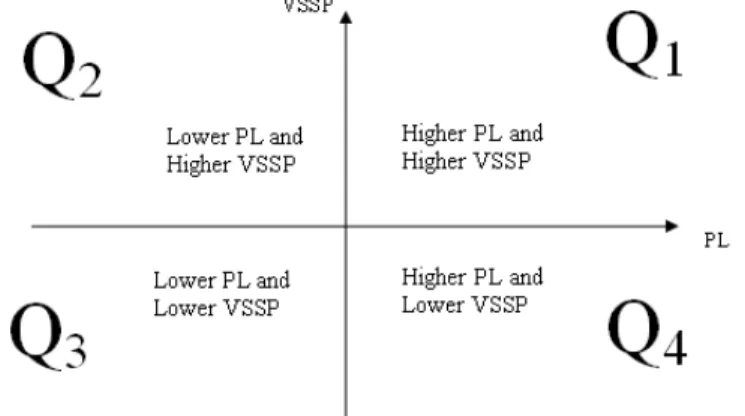
Since each learner has a different STM ability for processing the content of different LCR types delivered by SMS or MMS, different LCR types would need to fit with each learner’s individual STM ability to achieve a better learning performance. We therefore classify learners into four groups according to their different STM abilities. These four groups are shown in the four quadrants in Figure 2 and are listed below:
Quadrant 1 (Q1): learners with higher STM ability in both PL (verbal) and VSSP (visual) components;
Quadrant 2 (Q2): learners with lower STM ability in PL (verbal) and higher STM ability in VSSP (visual);
Quadrant 3 (Q3): learners with lower STM ability in both PL (verbal) and VSSP (visual); and Quadrant 4 (Q4): learners with higher STM ability in PL (verbal) and lower STM ability in VSSP (visual).
Figure 2. Four groups of learner classified by STM abilities
7.3 Materials
In order to evaluate the learning performance regarding vocabulary learning in m-learning, we used the number of common English vocabulary items a learner can remember before and after the experiment. We adopted the method proposed by Nation (2001) to assess learners’ vocabulary learning. The corpuses used in our experiment were sampled from the most common 1000 and 2000 vocabulary items selected from the most common 2284 words
suggested by Bauman (1995). For his selection of the most common English vocabulary items in the literature, Bauman (1995) referred to three papers. The first one is “A General Service List of English Words,” published by West (1953), the second one is “Word Families,” published by Bauer and Nation (1993), and the third one is “Frequency Analysis of English Usage,” published by Francis and Kucera (1982), based on the Brown Corpus.
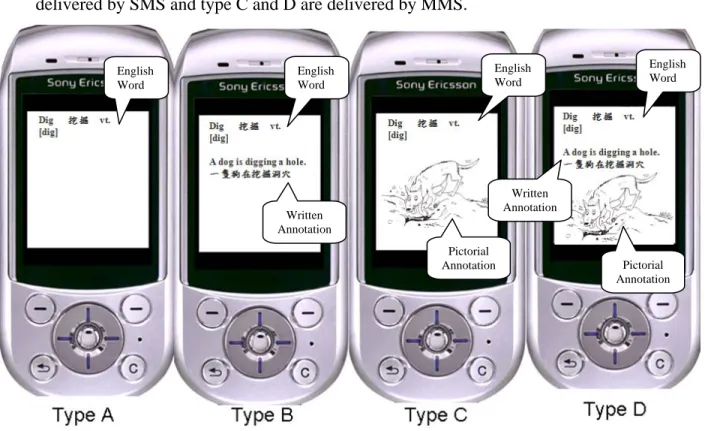
Before we conducted the lab experiment, we had to assess the students’ original English vocabulary abilities to avoid those English words that students were already familiar with. We chose 50 words for testing students’ original English vocabulary ability and 24 words for the mobile vocabulary learning experiment. We adopted Bauman’s most common 2284 English words, which are listed based on the use-frequency order. There are two attribute values associated with each English word. The first number represents its order in the list of use frequency, and the second number represents its frequency of occurrence within about one million words in the Brown Corpus. For example, the entry <40, 2203, more> represents that the word “more” is ranked as 40th on the list of use-frequency and appears 2203 times in the Brown Corpus. To obtain our 50 words for testing students’ original English vocabulary ability, we selected one word from every 40 words starting from the 40th word, “more,” and continuing until 2000th word, “scenery.” Appendix 1 contains the list of these 50 English words. While sitting for this test, students were asked to write down the Chinese meaning of each word. Their answers were counted as correct if the students gave only one answer for a word with multiple meanings. After students completed this original English vocabulary ability test, we found that most students could only get the correct answers up to the 1348th word, which implies that the students’ original English vocabulary ability is at about this level. Therefore, we selected the 24 English words for the experiment after the 1500th word, as these English words were all new to the students. Appendix 2 shows the list of these selected 24 words. Each of these 24 words was then represented in four different ways for the experiment:
¾ LCR type A — providing the English word with its spelling, phonetic symbol, and Chinese translation (no additional annotation; this is basic learning material);
¾ LCR type B — providing the English word information, similar to LCR type A, plus written annotation such as a sample sentence using the English word and its Chinese translation;
¾ LCR type C — providing the English word information, similar to LCR type A, plus pictorial annotation such as a picture to represent the meaning of the English word; and ¾ LCR type D — providing the English word information, similar to LCR type A, plus
pictorial annotation and written annotation. Examples of the four different LCR types for one English word presented on a mobile phone are shown in Figure 3. Type A and B are delivered by SMS and type C and D are delivered by MMS.
Figure 3. An example of the four types of Learning Content Representation for the English word “Dig”
7.4 Hypothesis
Based on the previous discussion, the hypotheses in our study are as follows:
Hypothesis 1 (H1): For learners with higher verbal ability and higher visual ability (Q1), type B or type C learning content will result in better learning outcomes than type A learning content.
Hypothesis 2 (H2): For learners with lower verbal ability and higher visual ability (Q2), type C learning content will result in better learning outcomes than type A learning content.
English Word English Word English Word English Word Written Annotation Pictorial Annotation Pictorial Annotation Written Annotation
Hypothesis 3 (H3): For learners with lower verbal ability and lower visual ability (Q3), neither type B or type C learning content will result in learning outcomes significantly different from type A learning content.
Hypothesis 4 (H4): For learners with higher verbal ability and lower visual ability (Q4), type B learning content will result in better learning outcomes than type A learning content.
Based on the Dual-Coding Theory and Cognitive Load Theory, we can hypothesize that hypotheses 5, 6, 7 and 8, which combine both written and pictorial annotation, would benefit learners in Quadrants 1, 2 and 4, but not learners in Q3:
Hypothesis 5 (H5): For learners with higher verbal ability and higher visual ability (Q1), type D learning content will result in better learning outcomes than type A learning content.
Hypothesis 6 (H6): For learners with lower verbal ability and higher visual ability (Q2), type D learning content will result in better learning outcomes than type A learning content.
Hypothesis 7 (H7): For learners with lower verbal ability and lower visual ability (Q3), type D learning content will not result in learning outcomes significantly different from type A learning content.
Hypothesis 8 (H8): For learners with higher verbal ability and lower visual ability (Q4), type D learning content will result in better learning outcomes than type A learning content.
7.5 Procedure
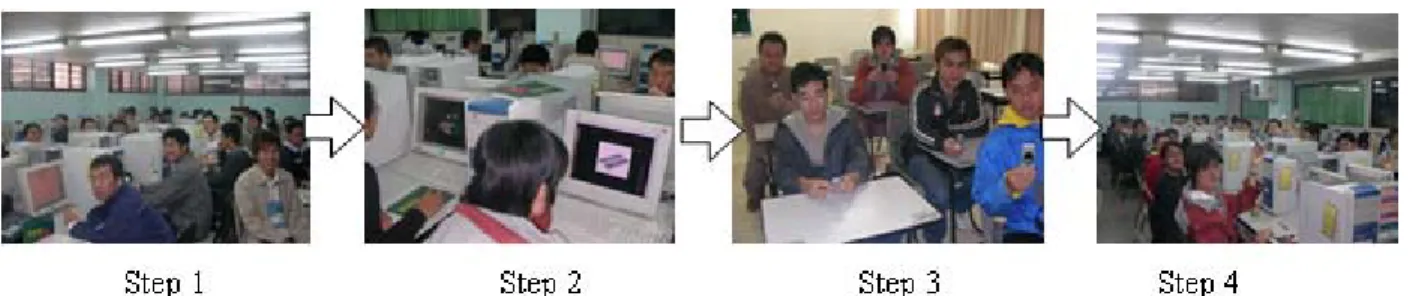
The experimental procedure consisted of four different steps, as presented in Figure 4, and the whole process took place at the same computer lab. First, participants met with the researcher in the computer lab, where each participant was asked to fill out a background questionnaire. Then students were told that the objective of this experiment was to learn English vocabulary using a mobile phone and that they would go through a procedure with four steps as shown in Figure 4. This step took about 15 minutes.
In the second step, all participants were seated in front of individual computers in the lab for the STM ability test using the STM ability test system (Hsieh, 2006). The system design is based on Wright (1988) and Chen, Lee and Chen (2005), with some modifications to fit into our study. The system architecture of STM ability test and examples of written and pictorial content can be found in Appendix 3. There were 60 questions in this STM ability test, 30 questions for written materials and 30 for pictorial materials. Each question was presented on computer screen for 7 seconds and the participants were given 5 seconds to respond. It took 12 minutes (60 questions at 12 seconds each) in total for this step. Immediately after the 156 participants finished the STM ability test, the system recorded each participant’s STM ability which was a value converted to a standard normal distribution with a mean of 0 and a standard deviation of 1. Based on these results, we then divided the students into four groups, with 61 in Quadrant 1, 36 in Quadrant 2, 30 in Quadrant 3 and 29 in Quadrant 4. For the validity of this working memory test, interested readers can refer to Chen, Lee and Chen (2005).
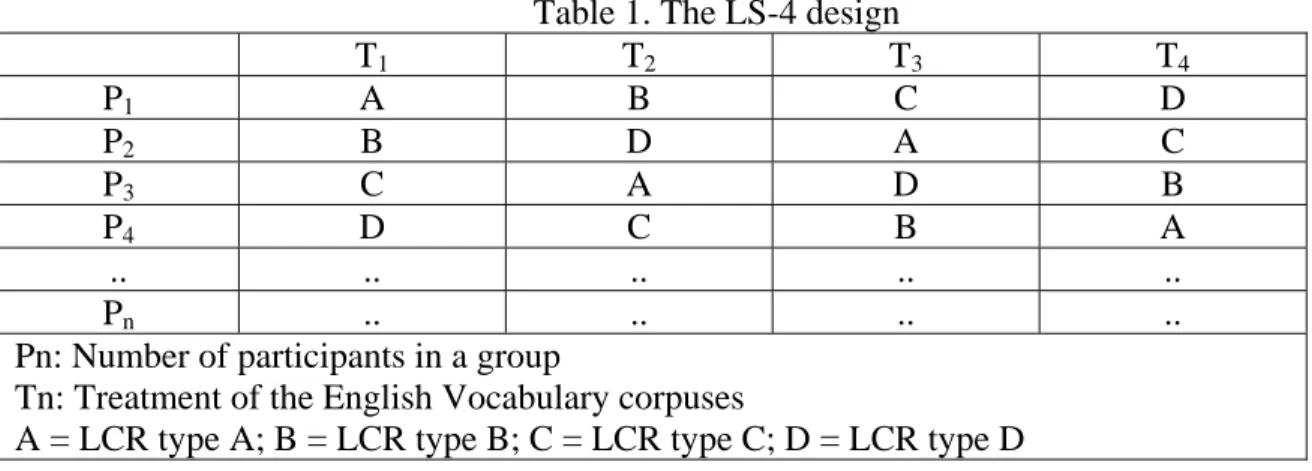
In the third step, every participant was then immediately assigned a mobile phone to learn the 24 English words delivered by SMS or MMS. All participants individually read the English words sent out by the researcher to their mobile phones. Every participant received the same 24 English words, with 6 words for every representation type. To avoid the learning effect of representation types presented in a fixed order, we adopted an LS-4 design (Table 1) to deliver these four representation types for participants in every group. For example, participant P1 in group 1 received 6 words randomly selected from 24 words represented in type A format, then 6 words randomly selected from the remaining 18 (represented in type B format), then 6 words randomly selected from the remaining 12 (represented in type C format) and lastly the remaining 6 words (represented in type D format). However, participant P2 in group 1 received 6 words randomly selected from 24 words (represented in type B format), then 6 words randomly selected from the remaining 18 (represented in type D format), and then 6 words randomly selected from the remaining 12 (represented in type A format) and lastly the remaining 6 words (represented in type C format). And so it went for all participants. The same procedure was applied for group 2, group 3 and group 4. The average time set for learning one English word in the majority of previous research of L2 experiments was about 2 minutes (Nikolova, 2002; Jones, 2004). Therefore, we set 50 minutes for the learners to learn the 24 English words in our experiment.
Table 1. The LS-4 design T1 T2 T3 T4 P1 A B C D P2 B D A C P3 C A D B P4 D C B A .. .. .. .. .. Pn .. .. .. ..
Pn: Number of participants in a group
Tn: Treatment of the English Vocabulary corpuses
A = LCR type A; B = LCR type B; C = LCR type C; D = LCR type D
7.6 Data collection instruments
In the fourth step, after viewing the content to learn 24 English words, all participants were immediately asked to sit for the English Vocabulary Recognition and Recall (EVRR) test to assess their English vocabulary learning performance. These recognition and recall tests are often used to examine learners’ English vocabulary knowledge (Al-Seghayer, 2001). However, test and measurement studies indicate that these two forms of testing are quite different and demand separate processing strategies (Cariana & Lee, 2001; Jonassen & Tessmer, 1996). For example, recognition tests usually involve multiple-choice activities in which learners select or guess the correct response from the given alternatives. Such tests may strengthen any existing memory traces (McDaniel & Mason, 1985). Recall, on the other hand, demands the production of responses from memory. It is more difficult than recognition because learners must search for the correct response within their mental representation of the newly experienced information (Cariana & Lee, 2001; Glover, 1989; McDaniel & Mason, 1985).
Figure 5 and Figure 6 show examples of a recognition test item and a recall test item, respectively, in our study. Participants spent approximately 15 minutes completing the EVRR test.
Figure 6. Example of a recall test item
The final step in our study was the focus group interview, for which 8 participants were selected. To effectively evaluate our hypotheses, the interview questions focused on our proposed hypotheses. The following is a list of questions used to assess what learners learned from participating in the English vocabulary learning experiment. During the interviews, learners were asked three modified open-ended questions that were originally proposed by Al-Seghayer (2001):
¾ Question 1: Which one of the four LCR types is best for helping you to learn and memorize the English vocabulary in the experiment?
¾ Question 2: Which one of the four LCR types can provide better meaning about English words for you in the experiment?
¾ Question 3: What are the good features in this kind of mobile learning environment that help you, as a language learner, to effectively learn English vocabulary?
The open-ended questions were used to allow more freedom of responses, to elicit more information from the participants and to check the accuracy of the quantitative results in the mobile learning experiment. The focus group transcript records were reviewed by the moderator and teaching assistants immediately after the interview. Appendix 4 is a table of transcript records from the focus group interview, which will be cited in the following analysis.
3. Results
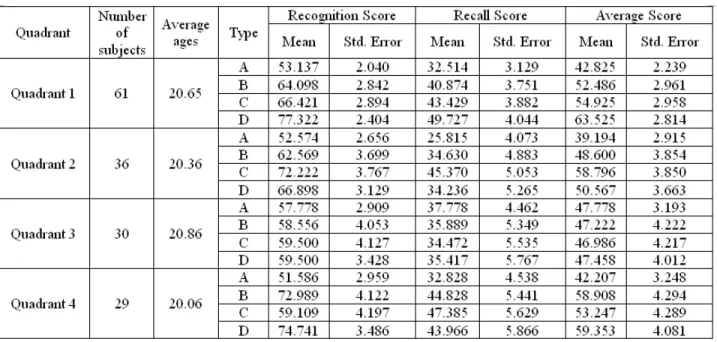
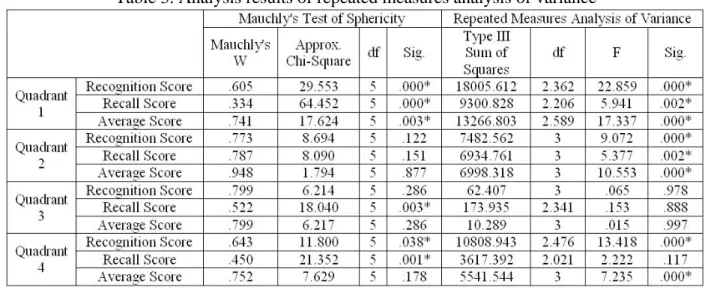
The EVRR test score was used for assessing the learning outcome in our study. Table 2 shows the descriptive statistics results. We conducted the repeated measures analysis of variance for learners with four different STM capacities (Quadrants 1 to 4), with LCR types as independent variables and scores measured from the EVRR test as dependent variables. The Mauchly’s test of sphericity for the homogeneous test was conducted before the repeated measures analysis of variance. An important result in Mauchly’s test of sphericity indicates that
the covariance of the three within-subject variables (recognition score, recall score and average score) are not homogeneous. Thus, an adjusted degree of freedom statistic provided by the Greenhouse-Geisser correctional formula was used to do the repeated measures analysis of variance (Hair, Tatham, Anderson & Black, 1998). Otherwise, if the result is not significant, based on sphericity’s assumption, no adjustment to the degree of freedom is needed (Hair et al, 1998).
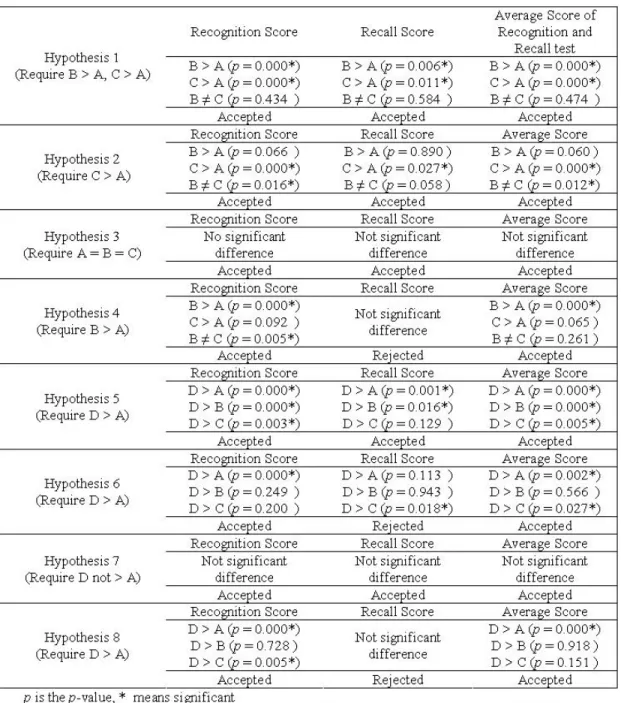
A significant result after the repeated measures analysis of variance indicates that the mean scores of the four different types (A, B, C and D) are not equal. In such a case, a post-treatment pair-wise comparison is used to compare the mean scores of the four types. Conversely, a result that is not significant indicates that the mean scores of the four different types are equal. Based on the result shown in Table 3, the pair-wise comparison was not needed. Table 4 shows the analysis results with respect to the eight hypotheses.
Table 2. Descriptive statistics of the four research hypotheses
Table 4. Analysis results of the eight research hypotheses
The analysis results for H1 in Table 4 show the following:
(1) that the EVRR scores of the learners who were presented with information as LCR type B (p = 0.000) or type C (p = 0.000) were significantly better than the scores of the learners who were presented with information as LCR type A in the recognition test;
(2) that the EVRR scores of the learners who received information as either LCR type B (p = 0.006) or type C (p = 0.011) were significantly better than the scores of the learners who received information as LCR type A in the recall test. The same result also appeared in average
scores for type B (p = 0.000) and type C (p = 0.000). Therefore, we can conclude that the H1 proposed in this research is accepted. This implies that learners with higher verbal ability and higher visual ability can benefit from learning content that contains either written annotation or pictorial annotation.
For H2, the EVRR scores of the learners who received information as LCR type C were better than the scores of the learners who received information as LCR type A (p = 0.000) in the recognition test. Moreover, the learners who received information as LCR type C exhibited better EVRR scores than the learners who received information as LCR type A (p = 0.000) in the recall test. Average scores of the learners who received information as LCR type C were also better than those of the learners who received information as LCR type A (p = 0.000). Therefore, we can conclude that the H2 is accepted. This implies that learners with higher visual ability can benefit from learning content that contains pictorial annotation.
For H3, Table 4 shows that there is no significant difference in these three scores among the learners who received information as LCR types A, B and C. Therefore, we can conclude that the H3 is also accepted. This implies that learners with lower verbal ability and lower visual ability do not benefit from learning content containing either written annotation or pictorial annotation.
For H4 shown in Table 4, it is evident that scores of the learners who received information as LCR type B are better than those of learners who received information as LCR types A (p = 0.000) and C (p = 0.005) in the recognition test. However, this is not the case in the recall test. Therefore, we can conclude that the H4 is only partially accepted. This implies that learners with higher verbal ability benefit from learning content containing written annotation with regard to recognition.
For H5, we found that recognition scores of the learners who received information as LCR type D were better than those of learners who received information as LCR type A (p = 0.000) and that recall scores of the learners who received information as LCR type D were also better than those of learners who received information as LCR type A (p = 0.001). Also, average scores of the learners who received information as LCR type D were better than those of learners who received information as LCR type A (p = 0.000). Therefore, we can conclude that the H5 proposed in this research is accepted. This implies that learners with higher verbal ability and
higher visual ability can benefit from learning content containing combined written annotation and pictorial annotation.
For H6, recognition scores of the learners who received information as LCR type D were better than those of learners who received information as LCR type A (p = 0.000). However, in the recall test, scores of the learners who received information as LCR type D were not significantly better than those of learners who received information as LCR type A. Average scores of learners who received information as LCR type D were better than those of learners who received information as LCR type A (p = 0.002). Therefore, we can conclude that the H6 is only partially accepted. This implies that learners with higher visual ability can only somewhat benefit from learning content containing combined written annotation and pictorial annotation with regard to recognition.
For H7, Table 4 shows that there is no significant difference in the scores of learners who received information as LCR types A and D in both the recognition and recall tests. Therefore, we can conclude that H7 is also accepted. This implies that learners with lower verbal ability and lower visual ability cannot benefit from learning content containing both written annotation and pictorial annotation.
Finally, for H8, recognition scores of the learners who received information as LCR type D are better than the scores of learners delivered with LCR type A (p = 0.000). However, in the recall test, scores of the learners who received information as LCR type D were not significantly better than those of learners who received information as LCR type A. Average scores of the learners who received information as LCR type D were also better than the learners who received information as LCR type A (p = 0.000). Therefore, we can conclude that the H8 is only partially accepted. This implies that learners with higher verbal ability can only somewhat benefit from learning content containing both written annotation and pictorial annotation with regard to recognition.
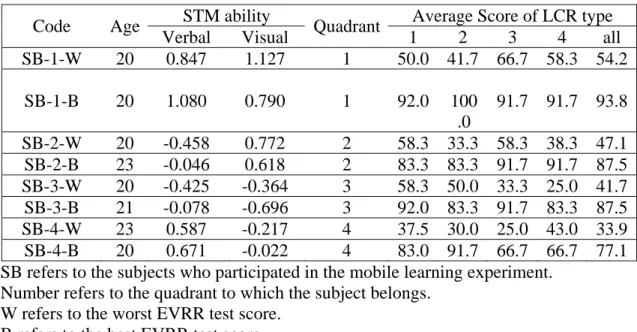
In this research, focus group interviews were also conducted to acquire qualitative evidence to support the results from the quantitative experiment. Therefore, eight participants were selected from 156 college students by using the extreme or deviant case sampling method. The background information of these participants is shown in Table 5. For the sake of privacy, Table 5 uses a coding scheme (SB-Quadrant-EDCS) to replace the real names of the students. SB
means subject, Quadrant is the number of STM ability Quadrant, and W and B of EDCS are the worst and the best results of the EVRR test.
Table 5. Participants’ background information in focus group interview STM ability Average Score of LCR type Code Age
Verbal Visual Quadrant 1 2 3 4 all
SB-1-W 20 0.847 1.127 1 50.0 41.7 66.7 58.3 54.2 SB-1-B 20 1.080 0.790 1 92.0 100 .0 91.7 91.7 93.8 SB-2-W 20 -0.458 0.772 2 58.3 33.3 58.3 38.3 47.1 SB-2-B 23 -0.046 0.618 2 83.3 83.3 91.7 91.7 87.5 SB-3-W 20 -0.425 -0.364 3 58.3 50.0 33.3 25.0 41.7 SB-3-B 21 -0.078 -0.696 3 92.0 83.3 91.7 83.3 87.5 SB-4-W 23 0.587 -0.217 4 37.5 30.0 25.0 43.0 33.9 SB-4-B 20 0.671 -0.022 4 83.0 91.7 66.7 66.7 77.1 SB refers to the subjects who participated in the mobile learning experiment.
Number refers to the quadrant to which the subject belongs. W refers to the worst EVRR test score.
B refers to the best EVRR test score.
Focus group interview results:
Transcripts of interviews with the Q1 students (SB-1-B and SB-1-W) revealed that written or pictorial annotation can provide better learning outcomes (SB-1-B-83) than no annotation (SB-1-W-62). Furthermore, written annotation or pictorial annotation can help learners learn and remember more English vocabulary items (SB-1-W-17). These are the qualitative findings to support H1.
Transcripts of interviews with the Q2 students show that pictorial annotation can provide better learning effects (SB-2-B-50), more cues (SB-2-B-52), more attractive content (SB-2-W-85) and better representation than words (SB-2-B-81). Finally, pictorial annotation is helpful in remembering more English vocabulary items (SB-2-B-9). Interview transcripts also revealed that these students disagree that written annotation helps them understand the meaning (SB-2-B-38), even though they agree that written annotation can be somewhat useful. These qualitative findings therefore support H2.
Transcripts of interviews with the Q3 students show that the feedback on the four LCR types are similar (SB-3-B-68). When student SB-3-W saw a lot written annotation or pictorial
annotation, the student felt irritated and unable to concentrate on learning (SB-3-W-78). This may be the result of the learner’s insufficient STM . For learners in Q3 (those with lower verbal ability and lower visual ability), more annotation causes a higher cognitive load in their STM, according to the Cognitive Load Theory, and prevents those learners from learning more. From these two findings, it is clear that more written annotation or pictorial annotation causes frustration and increased negativity to Q3 learners. This phenomenon is supported by the transcripts, which show that even though written annotation can help learners memorize vocabulary in a more organized way and understand how to remember vocabulary (SB-3-B-46), learning outcomes in the four LCR types do not vary on a large scale (SB-3-B-25). Another conflicting finding is that content with no annotation (LCR type A) seems to be the most difficult for memorizing the English vocabularies (SB-3-B-27). So, there are qualitative findings that support H3, but there are also some conflicting findings.
Transcripts of interviews with the Q4 students show that written annotation can provide meaningful information (SB-4-B-66). For example, student SB-4-W did not agree with the benefits of written annotation (SB-4-W-72). So, there are not only some qualitative findings that support the hypothesis that Q4 learners have better learning outcomes in the case of written annotation (LCR type B), but there are also some conflicting findings. However, according to the Levels of Processing Theory, if Q4 learners provide no positive feedback with regard to written annotation (LCR type B), they cannot learn and memorize better than students in the baseline group (LCR type A). However, from the transcripts, it is evident that they all agree that written annotation can help them remember more English vocabulary items (SB-4-B-19). This means that Q4 learners could achieve better learning outcomes in the fit cases with regard to learning and memorizing more English vocabulary items. In the next section, these conflicting findings based on feedback made by students in SB-4-W will be discussed further. In the meantime, due to the feedback of students in SB-4-W, the qualitative findings seem to only partially support H4. Transcripts of interviews with the Q1 (SB-1-B and SB-1-W) students show that the written annotation plus pictorial annotation can provide better learning outcomes (SB-1-B-56). Furthermore, written or pictorial annotation can help learners learn and remember more English words (SB-1-B-40). These qualitative findings seem to support H5.
Transcripts of interviews with the Q2 (SB-2-B and SB-2-W) students show that pictorial annotation can provide better learning outcomes and cues, and that they are more appealing.
Besides, pictorial annotations are helpful in remembering more English vocabulary items. However, there are no qualitative findings to show that combined annotations provide better learning outcomes and cues, nor that they are more appealing. The interviews also do not indicate that combined annotations help learners remember more English words. Therefore, we can conclude that H6 is not supported.
Transcripts of interviews with the Q3 (SB-3-B and SB-3-W) students show similar feedback from the four LCR types (SB-3-B-68). The transcripts also reveal that even though written annotations could help learners memorize vocabulary items in a more organized way and understand how to remember vocabulary items (SB-3-B-46), learning outcomes in the four LCR types do not vary on a large scale (SB-3-B-25), and baseline group content (LCR type A) would be the most difficult to memorize (SB-3-B-27). So, the qualitative findings do not seem to support H7.
Transcripts of interviews with the Q4 (SB-4-B and SB-4-W) students show that there are no qualitative findings to support the fact that combined annotations provide students with better learning outcomes with regard to learning and memorizing compared to the results of students in the baseline group. Therefore, we can conclude that H8 is not supported.
4. Discussion
Quantitative results suggest that learners with lower verbal ability and higher visual ability (Q2) will benefit more from learning content with pictorial annotation than they will from learning content with no annotation. Qualitative findings also support this conclusion, indicating that pictorial annotation can help learning and memorizing more than no annotation. From both the quantitative and qualitative findings, the most suitable method to help these learners study in the mobile language learning environment is to provide them with more pictorial annotation and less written annotation. This result matches the finding that providing additional pictorial annotation in learning content can help learners with lower verbal ability and higher visual ability to learn better, because they have better skills for learning content presented in a visual form than they do for learning content presented in a verbal form (Geva & Ryan, 1993; Harrington & Sawyer, 1992).
Results also suggest that providing basic learning materials can help learners with lower verbal ability and lower visual ability (Q3) to learn better. A possible reason is that, since these
students do not have higher verbal and visual abilities, providing these learners with too many written or pictorial annotation will cause a higher cognitive load in their STM and thus could make them irritable and unable to concentrate. According to the Cognitive Load Theory (Sweller, 1994), learners in such situations would probably ignore or skip that the information that caused the overload. How much information a learner would consider to be an overload is a matter for further study.
According to the research of Geva and Ryan (1993) and Harrington and Sawyer (1992), learners with higher verbal ability exhibit better skills for learning with verbal material. Therefore, providing them learning content in verbal forms would achieve better results than would providing the content in nonverbal form. Thus, theoretically speaking, for learners with higher verbal ability and lower visual ability (Q4), learning content type B should help students achieve higher EVRR scores than learning content type A in our experiment, However, H4 in Table 4 shows that this condition is only valid in the recognition test, not in the recall test. Consequently, we should be cautious about claiming that “providing this type of learner with more written annotation is a suitable teaching strategy in m-learning.”
Both quantitative and qualitative findings support the hypothesis that, in the mobile language-learning environment, learners with higher verbal ability and higher visual ability (Q1) will achieve better results from learning content with written annotation and pictorial annotation (either separately or in combined form) than they would from learning content without any annotation. However, to what extent learners benefit from these annotations and whether or not the Cognitive Load Theory will affect these learners are issues worth further study. Finally, Hypotheses 5 to 8 show that the effects of both the Dual Code Theory and the Cognitive Load Theory are also supported. The use of more than one modality by learners (learners presented with combined-annotation LCR type D content) is more effective than the use of single modality (learners presented with only single-annotation LCR type A content), such as in the case of Q1 learners. However, for the group with lower verbal ability and lower visual ability (Q3), learners presented with combined-annotation content (LCR type D) performed significantly worse than learners presented with learning content with no annotation.
Moreover, it is interesting to note the comments from SB-4-B and SB-4-W. SB-4-B’s comment (SB-4-B-66) explains the quantitative results and tells us why the English vocabulary recall test scores of LCR type B are not better than LCR type A. According to SB-4-B’s
interview statement, providing more than one illustrative sentence could help learners to have a better learning outcome, which could result in a significant difference in English vocabulary recall scores. The other interesting comment was from W (W-72). Evidently, SB-4-W did not agree with the benefits of written annotation because SB-4-SB-4-W usually spent more time recalling when no pictorial annotation was provided. Moreover, according to Table 4, the SB-4-W’s verbal ability is 0.587 and visual ability is -0.217. Therefore, these two findings prove that even if we provide written annotation to help Q4 learners (SB-4-W) who do have higher verbal ability, their lower visual ability could impede the benefits of the written annotation.
5. Conclusion
This study addresses the issue of content adaptation in mobile language learning. To identify a promising solution to identify a promising solution three dimensions have been taken into consideration: instructional strategies (LCR types: written annotations and pictorial annotations), information technologies (LCD methods: SMS and MMS) and learner’s cognitive model (STM ability: verbal and visual). The findings should contribute to the design of more effective content adaptation solutions for mobile language learning.
In summary, providing learning content with pictorial annotation in the mobile language learning environment can help learners with lower verbal ability and higher visual ability learn, because they have better skills for learning content presented in visual form as opposed to being presented in verbal form. Providing learning content with both written annotation and pictorial annotation can help learners with higher verbal ability and higher visual ability. Results also suggest that providing basic learning materials can help learners with lower verbal ability and lower visual ability. According to the Cognitive Load Theory, providing this type of learner with too many written or pictorial annotations will only cause higher cognitive load, leading to irritation and a lack of concentration.
It should be noted that, theoretically, learners with higher verbal ability should exhibit better skills for learning verbal material. Therefore, providing them with learning content in verbal forms should achieve better results than providing content in a nonverbal form. However, this condition was only valid in the recognition test but not in the recall test in our experiment. Consequently, further study is needed to analyse whether providing this type of learner with more written annotation is indeed a suitable teaching strategy in mobile language learning. Our
study also shows that the effects of both DCT and Cognitive Load Theory are also supported and the use of more than one modality by the learners is more effective than use of single modality. However, for learners with lower verbal and lower visual abilities, combined-annotation content (LCR type D) is not suitable.
As for future study, in order to provide a wider perspective, it would be more promising to include socio-cognitive or social constructivist theory in the curriculum design for mobile language learning. Further study is also recommended on using the same research framework with smart phones or PDAs instead of with traditional mobile phone devices, in order to see the differences that may arise due to the somewhat larger screen size and pen-input capabilities of those devices.
6. 已發表之研究成果
7.1 期刊論文
(1) 陳年興, 魏春旺, 黃盟升, 林俊成. (2008). 混成同步學習環境中之即時互動現象. 臺 南大學理工研究學報, 42(1), 59-72. (NSC95-2520-S-110-001-MY2)
(2) Chen, N.S., Hsieh, S.W., Kinshuk. (2008). Effects of Short-Term Memory and Content Representation Type on Mobile Language Learning. Language Learning & Technology, 12(3), 93-113. (SSCI, Impact Factor: 1.222) (NSC95-2520-S-110-001-MY2)
(3) Chen, N.S., Wang, Y (2008). Testing Principles of Language Learning in a Cyber Face-to-Face Environment. Educational Technology & Society, 11(3), 97-113. (SSCI) (NSC95-2520-S-110-001-MY2)
(4) Chen, N.-S., Kinshuk, Wei, C.W., & Yang, S. J. H. (2008). Designing a Self-contained Group Area Network for Ubiquitous Learning. Educational Technology & Society, 11(2), 16-26. (SSCI) (NSC 95 -2520 -S -110 -001 -MY2)
(5) Chen, N.S., Kinshuk, Wei, C.W. Chen, H.J. (2008). Mining e-Learning Domain Concept Map from Academic Articles. Computers & Education, 50(3), 1009-1021. (SSCI) (NSC95-2520-S-110-001-MY2)
(6) Hwang, W.Y., Chen , N.S. , Dung, J.J., Yang, Y.L. (2007). Multiple Representation Skills and Creativity Effects on Mathematical Problem Solving using a Multimedia
Whiteboard System. Educational Technology & Society, 10(2), 191-212. (SSCI) (NSC94 2520-S-110-001)
(7) Hastie, M. , Chen, N.S., Kuo, Y.H. (2007). Instructional Design for Best Practice in the Synchronous Cyber Classroom. Educational Technology & Society , 10(4), 281-294. (SSCI) (NSC95-2520-S-110-001-MY2)
(8) Yang, J.H., Chen, Y.L., Kinshuk, Chen, N.S. (2007). Enhancing the quality of e-learning in virtual e-learning communities by finding quality e-learning content and trustworthy collaborators. Educational Technology & Society , 10(2), 84-95. (SSCI) (NSC94-2524-S-008-001 & NSC95-2520-S-008-006-MY3)
7.2 研討會論文
(1) Chen, N.S., Wei, C.W., Uden, L. & Wu, K.T. (2008). Effects of Reflective Teaching Strategies on Online Learners' Reflection Levels. The 8th IEEE International Conference on Advanced Learning Technologies (ICALT-2008), July 1-5, Santander, Spain. IEEE Computer Society Press, pp. 384-386. (NSC 95 -2520 -S -110 -001 -MY2) (2) Chen, N.S., Wang, Y.P., Wu, P.J. & Levy. M. (2008). Developing a Pedagogically
Meaningful E-tutor Training Program for Cyber Face-to-Face Language Teaching. The 8th IEEE International Conference on Advanced Learning Technologies (ICALT-2008), July 1-5, Santander, Spain. IEEE Computer Society Press, pp. 361-365.(NSC 95 -2520 -S -110 -001 -MY2)
(3) Nian-Shing Chen, Yuping Wang, Ping-Ju Wu (2008, May). A Reflective Teacher Training Model for Online Synchronous Language Teaching. 第十九屆國際資訊管理 學術研討會(ICIM2008),16-17 May, 南投:國立暨南國際大學, 231. (NSC 95-2520-S-110-001-MY2)
(4) Nian-Shing Chen,Ping-Ju Wu,Chia-Chi Liu (2008, May). Evaluation Criteria for Pre-recorded Lecture on Demand. 第十九屆國際資訊管理學術研討會(ICIM2008),16-17 May, 南投:國立暨南國際大學, 76. (NSC 95-2520-S-110-001-MY2)
(5) 陳年興,魏春旺,莊育承 (2008, May). 先備知識診斷搭配數位教材輔助機制對於合 作學習成效之影響. 第四屆台灣數位學習發展研討會(TWELF 2008), 16-17 May, 臺中:國立臺中教育大學, 41. (NSC 95-2520-S-110-001-MY2)
(6) 謝盛文,陳年興,黃志成 (2008, May). 以行動研究法探討武術教學如何以網路教學 方式進行. 第四屆台灣數位學習發展研討會(TWELF 2008), 16-17 May, 臺中:國立 臺中教育大學, 85. (NSC 95-2520-S-110-001-MY2, 96-2412-H-269-001-SSS) (7) 陳年興,魏春旺,劉新茹 (2008, May). 應用TPCK分析教師在職進修網路課程─以數 學遊戲教學為例. 第四屆台灣數位學習發展研討會(TWELF 2008), 16-17 May, 臺 中:國立臺中教育大學, 96. (NSC 95-2520-S-110-001-MY2) (8) 陳年興,魏春旺,吳昆庭 (2008, May). 反思學習策略對於網路學習者反思層次之影 響. 第四屆台灣數位學習發展研討會(TWELF 2008), 16-17 May, 臺中:國立臺中教 育大學, 31. (NSC 95-2520-S-110-001-MY2) (9) 陳年興, 郭彥宏, 朱家賢 (2007, December). 資訊呈現方式對資訊再利用之影響. 2007 第十三屆資訊管理暨實務研討會(CSIM2007), 8th Dec, 高雄:樹德科技大學. (NSC 95-2520-S-110-001-MY2)
(10) Nian-Shing Chen, Kinshuk, Chun-Wang Wei, and Wei-Sheng Chen (2007, December). A GroupNet System for Supporting Mobile Learning. IEEE International Symposium on Multimedia 2007 (ISM2007). 10-12 Dec, Asia University, Taichung, Taiwan, 505-510. (NSC 95-2520-S-110-001-MY2)
(11) Hsieh, S.W., Chen, N.S., Wu, M.P., Chen, Y.H., (2007, July). A study of Using Analytic Hierarchy Process to Explore Critical Success Factors of the K12 Digital School. 7th IEEE International Conference on Advanced Learning Technologies (ICALT-2007), 18-20 July, Niigata, Japan, 133-135. (NSC95-2416-H-269-004-)
(12) Hastie Megan, Chen, N.S., Kuo, Y.H., (2007, July). Best Pratice Instructional Design in the Synchronous Cyber Classroom for Early Childhoo Students. 7th IEEE International Conference on Advanced Learning Technologies (ICALT-2007), 18-20 July, Niigata, Japan, 288-292. (NSC95-2520-S-110-001-MY2)
(13) Chen, N.S., Kinshuk, Wei, C.W., Chen, Y.R., Wang, Y.C., (2007, July). Classroom Climate and Learning Effectiveness Comparison for Physical and Cyber F2F Interaction in Holistic-Blended Learning Environment. 7th IEEE International Conference on Advanced Learning Technologies (ICALT-2007), 18-20 July, Niigata, Japan, 313-317. (NSC95-2520-S-110-001-MY2)
(14) Chen, N.S., Kinshuk, Wei, C.W., Hsu, F.H., (2007, July). Impact of Process Goal and Outcome Goal on Learning Performance for Web-based Learners. 7th IEEE International Conference on Advanced Learning Technologies (ICALT-2007), 18-20 July, Niigata, Japan, 487-488. (NSC95-2520-S-110-001-MY2)
(15) 陳年興, 謝盛文, 蔡俊毅, 范瑞珠 (2007, May) . 以引用分析為基礎找尋關鍵文獻之 專家系統. 第十八屆國際資訊管理學術研討會(ICIM2007), 26 May, 台北:銘傳大學. (NSC95-2520-S-110-001-MY2)
(16) Nian-Shing Chen, Chun-Wang Wei, Kinshuk, Siang-Jhih Liao. (2007, May). Blended Synchronous Learning Model for Integrated Physical F2F and Cyber F2F Learning Environment. (The 18th International Conference on Information Managment, ICIM2007), 26 May, Taipei, Taiwan. (NSC95-2520-S-110-001-MY2)
(17) 陳年興, 魏春旺, 吳昆庭, 許峰銜 (2006, December). 程序目標和結果目標對於網路 學習者之學習成效影響. 第十二屆資訊管理暨實務研討會, 雲林:虎尾科技大學, 211. 國科會NSC95-2520-S-110-001-MY2. (18) 陳年興, 魏春旺, 陳信宏 (2006, December). 以視覺化方式呈現研究者之共同研究 關係網路. 第十二屆資訊管理暨實務研討會, 雲林:虎尾科技大學, 182. 國科會 NSC95-2520-S-110-001-MY2. (19) 陳年興, 魏春旺, 莊育承(2006, December). 基於MISQ關鍵字分類架構採用多層級 關聯規則探勘法建構資管領域之多層級概念圖. 第十二屆資訊管理暨實務研討會, 雲林:虎尾科技大學, 46. 國科會NSC95-2520-S-110-001-MY2. (20) 陳年興, 謝盛文, 陳怡如 (2006, November ). 探討新一代混成學習模式之學習成效, TANET 2006台灣網際網路研討會, 花蓮:花蓮教育大學, 99. 國科會NSC 95-2520-S-110-001. (21) 陳年興, 謝盛文, 鄭百勝 (2006, November ). 研究利用關聯法則挖掘資訊管理領域 之知識結構圖, TANET 2006台灣網際網路研討會, 花蓮:花蓮教育大學, 82. 國科會 NSC 95-2520-S-110-001.
7.3 畢業碩士論文 (1) 96下 廖祥智 可移動式數位學習中心設計與實作 (2) 96下 陳偉聖 支援無所不在學習之GroupNet系統設計與建置 (3) 96下 劉新茹 發展線上跨國協同教學的評估準則 (4) 96下 王茂蕊 同步網路教室影響社會場感因素之探討 (5) 96下 陳思穎 在行動化合作學習環境中利用流程引導控制降低團體迷思現象 (6) 95下 莊育承 先備知識對合作學習成效之影響 (7) 95下 朱家賢 階層式與網路式之資訊呈現方式對資訊再利用之影響 (8) 95下 陳信宏 影響研究室成員透過知識管理平台進行知識分享行為之因素探討 (9) 95下 蔡俊毅 以引用分析為基礎找尋關鍵文獻之專家系統 (10) 95下 吳昆庭 高層次提問與同儕互評對網路學習者反思之影響
7. 計畫成果自評
7.1 研究內容與原計畫相符程度In this research we have explored the role of psychological learning process through TML (Technology Mediated Learning) on assessing learning outcomes in M-learning. The aim of our research focuses on assessing learning outcomes in M-learning using mobile phone with two different learning content delivery methods of learning content by SMS (Short Message Service) and MMS (Multimedia Message Service).
Our findings show that providing learning content with pictorial annotation in a mobile language learning environment can help learners with lower verbal ability and higher visual ability to learn better because these learners find it easier to learn content presented in a visual form rather than in a verbal form. Providing learning content with both written and pictorial annotation can also help learners with higher verbal ability and higher visual ability.
According to the Cognitive Load Theory, providing too much information might cause a higher cognitive load and lead to irritation and a lack of concentration. Our findings also suggest that providing just the basic learning materials is more helpful to learners with lower verbal ability and lower visual ability.
The research subject conforms to original plan completely.
7.2 達成預期目標情況
Seven objectives have been achieved which are described as follows: ¾ First year of the plan (2006):
(1) The theories of psychology learning process were studied.
(2) An IRT-based verbal short term memory test system based on the idea from Chudler of University of Washington (http://faculty.washington.edu/chudler/stm0.html) was developed.
(3) An IRT-based nonverbal short term memory test system based on the idea from Chudler of University of Washington (http://faculty.washington.edu/chudler /puzmatch.html) was developed.
(4) Four different types LCR of English vocabularies were developed which can use to compare the different learning performance of four types LCR for language learning experimental in M-learning environment.
¾ Second year of the plan (2007):
(5) The verbal short term memory test system, nonverbal short term memory test system and four different types LCR of English vocabularies were integrated to build a prototype system “adaptive language learning application system”.
(6) “Adaptive language learning application system” was used to evaluate the learning performance and other factors when the learners in M-learning environment.
(7) According to the research results, some papers have been published on international journals and conferences.
7.3 研究成果之學術或應用價值
There are three expected contributions of this research, one is contribution to practice and the other two are contributions to research:
(1) This work will contribute to research in the learning sciences by increasing the understanding of how inner psychology learning process would affect learning outcomes. It will analyze the role of psychology learning process from the theoretical perspective of cognitive information processing mode and show how concepts and issues raised with STM in the psychology learning process affect learning outcomes. (2) This work will contribute to research in adaptive learning system design by advancing
the understanding of how the introduction of STM ability orientation can be used to support designing adaptive learning systems. It will show the adaptive technology can be applied when there is a good fit between inner requirement (STM ability orientation) and outer supports (learning content delivery technology and representation methods). It will identify how different features of outer supports fit into different inner requirement in the mobile learning environment. That is how outer supports can be designed in a most appropriate way to better facilitate psychology learning process. (3) This work will contribute to practice by providing specific guidance to educators who
want to adopt adaptive learning as a pedagogical technique. It will identify a set of fitting methods that contribute to the use of STM ability orientation in adaptive learning design and explain (some of) their interactions. It will provide evidence-supported advice on what an educator needs to consider when using STM ability orientation and what outcomes to expect.
7.4 是否適合在學術期刊發表或申請專利
Eight journal papers and twenty-one conference papers, and handbook chapters have been published or accepted as shown in section six.
References
[1] Abu-Rabia, S. (2003), “The influence of working memory on reading and creative writing processes in a second language”, Educational Psychology, Vol. 23, No. 2, pp. 209-222. [2] Alavi, M. & Leidner, D. E. (2001), “Research commentary: technology-mediated learning - a
call for greater depth and breadth of research”, Information Systems Research, Vol. 12, No. 1, pp. 1-10.
[3] Al-Seghayer, K. (2001), “The effect of multimedia annotation modes on L2 vocabulary acquisition: a comparative study”, Journal of Language Learning & Technology, Vol. 5, No. 1, pp. 202-232.
[4] Atkinson, R. C. & Shiffrin, R. M. (1968), “Human memory: A proposed system and its control processes”, In Spence, K. W. & Spence, J. T. (Eds.), The Psychology of Learning and Motivation, London: Academic Press.
[5] Baddeley, A. (2003). “Working memory and language: An overview”, Journal of Communication Disorders, Vol. 36, pp. 189-206.
[6] Bauer, L. & Nation, P. (1993), “Word families”, International Journal of Lexicography. Vol. 6, No. 4, pp. 253-279.
[7] Bauman, J. (1995), “About the GSL”, http://jbauman.com/aboutgsl.html.
[8] Cariana, R. B. & Lee, D. (2001), “The effects of recognition and recall study tasks with feedback in a computer-based vocabulary lesson”, Educational Technology Research & Development, Vol. 49, No. 3, pp. 23-36.
[9] Cermak, L. & Craik, F. (1979), Levels of Processing in Human Memory, Hillsdale, New Jersey: Erlbaum.
[10] Chen, C. M., Lee, H. M. & Chen, Y. H. (2005), “Personalized e-learning system using item response theory”, Computers and Education, Vol. 44, No. 3, pp. 237-255.
[11] Craik, F.I.M. (2002). “Levels of processing: Past, present ... and future?”, Memory, Vol. 10, pp. 305-318.
[12] Clark, R. E. (1994), “Media will never influence learning”, Education Technology Research and development, Vol. 42, No. 2, pp. 21-29.
[13] Cohen, A. D. & Aphek, E. (1981), “Basifying second language learning”, Studies in Second Language Acquisition, Vol. 3, No. 2, pp. 221-236.
[14] Courtney, M. S. (1998), “An area specialized for spatial working memory in human frontal cortex”, Science, Vol. 279, No.5355, pp.1347-1351.
[15] Fuster, J. M. (1994), The Prefrontal Cortex: Anatomy, Physiology and Neuropsychology of the Frontal Lobe, Neurosci: Res.
[16] Gay, G., Stefanone, M., Grace-Martin, M. & Hembrooke, H. (2001), “The effects of wireless computing in collaborative learning environments”, International Journal of Human-Computer Interaction, Vol. 13, No. 2, pp. 257-276.
[17] Geva, E. & Ryan, E. B. (1993), “Linguistic and cognitive correlates of academic skills in first and second languages”, Language Learning, Vol. 43, pp. 5-42.
[18] Glover, J. A. (1989), “The testing phenomenon: Not gone but nearly forgotten”, Journal of Educational Psychology, Vol. 81, No. 3, pp. 392-399.
[19] Hair, J. F., Tatham, R. L., Anderson, R. E.& Black, W. C. (1998), Multivariate Data Analysis (5thed.), New Jersey: Prentice-Hall, Inc
[20] Harrington, M. & Sawyer, M. (1992), “L2 working memory capacity and L2 reading skill”, Studies in Second Language Acquisition, Vol. 14, No. 1, 25-38.
[21] Holzinger, A., Nischelwitzer, A. & Meisenberger, M. (2005), “Mobile phones as a challenge for m-learning: examples for mobile interactive learning objects (MILOs) ”. 3rd IEEE International Conference on Pervasive Computing and Communication, pp. 307-311. [22] Hsi, S. (2003), “A study of user experiences mediated by nomadic web content in a
museum”, Journal of Computer Assisted Learning, Vol. 19, pp. 308-319.
[23] Hsieh, S. W. (2006), Study on Adaptive Learning based on Short-term Memory Capacity in Mobile Learning Environment, Doctoral Dissertation, National Sun Yat-Sen University, Taiwan.
[24] Jonassen, D. & Tessmer, M. (1996), “An outcome-based taxonomy for instructional systems design, evaluation and research”, Training Research Journal, Vol. 2, pp. 11-46. [25] Jones, L. (2004), “Testing L2 vocabulary recognition and recall using pictorial and
written test items”, Journal of Language Learning & Technology, Vol. 8, No. 3, pp. 122-143. [26] Kaesshaefer, J. (2004), “Austria country commercial guide FY 2004”,
[27] Liu, T. C., Wang, H. Y., Liang, J. K., Chan, T. W., Ko, H. W. & Yang, J. C. (2003), “Wireless & mobile technologies to enhance teaching & learning”, Journal of Computer Assisted Learning, Vol. 19, pp. 371-382.
[28] MacGregor, J. N. (1987), “Short-term memory capacity: limitation or optimization?”, Psychological Review, Vol. 94, No. 1, pp. 107-108.
[29] Mayer, R. E. & Sims, K. (1994), “For whom is a picture worth a thousand words? Extensions of a dual-coding theory of multimedia learning”, Journal of Educational Psychology, Vol. 86, No. 3, pp. 389-401.
[30] McDaniel, M. A. & Mason, M. E. J. (1985), “Altering memory representations through retrieval. Journal of experimental psychology”, Learning, Memory and Cognition, Vol. 11, pp. 371-385.
[31] Miller, G. A. (1956), “The magical number seven plus or minus two: Some limits on our capacity for processing information”, Psychological Review, Vol. 63, pp. 81-97.
[32] Nation, I. S. P. (2001), Learning Vocabulary in another Language, Cambridge: Cambridge University Press.
[33] Nikolova, O. R. (2002), “Effects of students' participation in authoring of multimedia materials on student acquisition of vocabulary”, Journal of Language Learning &
Technology, Vol. 6, No. 1, pp. 100-122.
[34] Plass, J. L., Chun, D. M., Mayer, R. E. & Leutner, D. (1998), “Supporting visual and verbal learning preferences in a second language multimedia learning environment”, Journal of Educational Psychology, Vol. 90, No. 1, pp. 25-36.
[35] Pressley, M., Levin, J. R. & Miller, G. E. (1982), “The keyword method compared to alternative vocabulary learning strategies”, Contemporary Educational Psychology, Vol. 7, pp. 50-60.
[36] Riffell, S. & Sibley, D. (2005), “Using web-based instruction to improve large undergraduate biology course: an evaluation of a hybrid course format”, Computers and Education, Vol. 44, pp. 217-235.
[37] Sharples, M. (2000), “The design of personal mobile technologies for lifelong learning”, Computers & Education, Vol. 34, pp. 177-193.
[38] Sweller, J. (1994), “Cognitive load theory, learning difficulty and instructional design”, Learning and Instruction, Vol. 4, pp. 295-312.
[39] Taylor, I. & Taylor, M. (1990), Psycholinguistics: Learning and Using Language, New Jersey: Prentice Hall.
[40] West (1953), A General Service List of English Words, Longman: London. [41] Wikipedia (n.d.), “Mobile phone”, http://en.wikipedia.org/wiki/Mobile_phone.
[42] Wiredu, G. (2005) “The Reconstruction of Portable Computers: On the Flexibility of Mobile Computing in Mobile Activities” IFIP 8.2 Conference on Designing Ubiquitous Information Environments.
[43] Wright, B. D. (1988), “Rasch model from campbell concatenation”, Rasch Measurement Transactions, Vol. 2, No. 1, pp. 16.