
墨西哥商薩果堤克有限公司進入高檔市場之策略 - 政大學術集成
89
0
0
全文
(2) 墨西哥商薩果堤克有限公司進入高檔市場之策略 Salxótico, Co. Ltd. Mexican salsa export strategy into high end markets. 研究生:村上勇 指導教授:林建智. Student: Yuichi Murakami Coronado Advisor: Dr. J. J. Lin. 國立政治大學. 學. 商學院國際經營管理碩士學程 碩士論文. ‧. Nat. A Thesis. sit. y. ‧ 國. 立. 政 治 大. er. io. Submitted to International MBA Program. n. National Chengchi Universityv a. l. i. Ch in partial fulfillment of the iRequirements Un engch. for the degree of Master in Business Administration. 中華民國九十九年七月 July 2010.
(3) Abstract. ‧ 國. 學. Salxotico, Co., Ltd. is a manufacturer of salsa for the high end market. Main products are salsas in the gourmet segment. Company relies on innovation to be a distinctive brand, main goal is to position the brand as a leading company in the high end segment and achieve sales equivalent to half million dollar at the end of third year of operation, with a long-term strategy for the long run, planned investment of USD$100,00 the company expects to become an important player in the luxury segment of salsa, achieving increment in sales of above 治 16 % each year, which 政 means one point more than the average大media for that sector worldwide. Selected 立 countries to export their salsas are Taiwan, Korea, Poland and Czech Republic.. ‧. Key words: Salxotico, salsa, business plan, strategy.. y. Nat. sit. n. al. er. io. By (Yuichi Murakami Coronado). Ch. engchi. 2. i Un. v.
(4) TABLE OF CONTENTS. 1 2 3 4. Table of Contents……………………………………………………… 3 Executive Summary …………………………………………………... 6 Objective of this research ……………………………………………... 7 General Company Description …………………………………………8 4.1 Mission Statement …………………………………………………9 4.2 Company Summary ………………………………………………11 4.3 Company History…………………………………………………11 4.4 Company Ownership……………………………………………..12 4.5 Start-up Summary……………………………………………..….13 4.6 Board of Directors…………………………………………….…..13 4.7 Company Locations and Facilities………………………………..14 4.8 Branch Office ………………………………………………….…14 4.9 Milestones……………………………………………………...…14 Company Products ……………………………………..……….…..…16 5.1 Product Description………………………………………………16 5.1.1 Salsa Pico de Gallo…………………………………………..17 5.1.2 Guacamole…………………………………………..………18 5.1.3 Salsa Verde…………………………………………………..19 5.1.4 Salsa Roja……………………………………………………20 5.1.5 Salsa de Xoconostle…………………………………………20 5.1.6 Salsa de Habanero……………………………………..……21 al iv n 5.2 Future Products…………………………………………………...22 Ch engchi U 5.2.1Own Salsa Jars………………………………………………..22 5.2.2Blue Corn Tortilla Chip………………………………………22 5.2.3 White Corn Tortilla Chips…………………………...………22 5.2.4 Fruit Salsa……………………………………………………23 5.2.5 Restaurant in Taiwan ………………………………………..23 5.3 Competitive Comparison…………………………………………23 5.3.1 Salxótico versus Mexican Brands comparison………...……25 5.3.2 Salxótico versus Foreign brands comparison………….……26 5.4 Sales Literature……………………………………………………29 5.5 Sourcing…..………………………………………………………29 Worldwide Sauce Market Analysis Summary …………..………..…..31 6.1 Country Market Segmentation………………………………..….43 6.1.1First Stage Screening Selection………………………………43. 立. ‧. ‧ 國. 學. 5. 政 治 大. n. er. io. sit. y. Nat. 6. 3.
(5) 6.1.2 Second Stage Screening Selection…………………………..45 7 Strategy and implementation Summary………………………………..51 7.1 Marketing Strategy………………………………………..………52 7.1.1Promotion Strategy……………………………………………52 7.1.2 Distribution Strategy…………………………………..…….53 7.1.3 Pricing Strategy…..…………………………………….……53 8 Key Financial Indicators……………………………………………….54 8.1 Start up Costs…….………………………………………...……..54 8.2 Sales Forecast………….……………………………………….…57 8.3 Break-even analysis..………………………………………….….62 8.4 Projected balance sheet……………………………………..…….64 9 Conclusion and Recommendations …………………………………...69 10 Appendix……………………………………………………………….70 10.1 Data……………………………………………………………….70 11 References……………………………………………………….……...87. 立. 政 治 大. ‧. ‧ 國. 學. n. er. io. sit. y. Nat. al. Ch. engchi. . 4. i Un. v.
(6) . 立. . 政 治 大. ‧. ‧ 國. 學. n. sit er. io. 5. y. Nat. World Trade Center, Mexico Montecito 38 12 F, 12 Office Mexico City, 03810 Telephone: +52-55-1107-0498 a Fax: +52-55-1107-0764 l Ch www.salxotico.com engchi E-mail: [email protected] http://twitter.com/salxotico. i Un. v.
(7) 2. Executive Summary Salxotico is a start-up company that produces Mexican gourmet salsa for the high end market. The company targeted customers are those who are in an age between 25 and 65 with an income higher than the average. Salxotico aims for the perfection on each salsa that it is produced in their facilities. Salxotico has divided its marketing and sales plan into three phases; the first one includes national sales, i.e. within the Mexican territory, after three years of consistent sales the company plans to expand into international sales. Having a rigorous screening method the company has selected potential markets to initiate their export adventure. With an initial investment $100,000 USD coming from. 政 治 大 year. Sales are expected to be $176,400 USD for the first year with a net profit of $3,900 立. family members, the company expects to become very profitable at the end of the second. USD. The company expects to have earnings $34,250 USD for second year of operation. ‧ 國. 學. and growing at a rate of 50 % in sales. After the third year of operations company plans to expand internationally and become more profitable. The selection of the markets is. ‧. fully and detailed described in this document, having selected four main markets: Taiwan,. n. al. er. io. sit. y. Nat. South Korea, The Czech Republic and Poland.. Ch. engchi. 6. i Un. v.
(8) 3. Objective of this research The main objective of this research is to show the reader strategies developed by a Mexican start up company to explore the export of their products into foreign markets. In this case the product is defined as salsa, and the foreign markets to export are Poland, Czech Republic, Korea and Taiwan. The originality of this research relies on the description of the approach adopted by this company to do their business in the international arena, and the practical approach which led them to become an important player in the foreign markets.. 政 治 大. This research is the result of the documentation of all the processes made by the company, from finding an original idea, going through legal establishment of the company, until the. 立. project of doing exports to international emerging markets, and the analysis of the. ‧ 國. 學. expansion into the international high end market. The main objective for the company is to become the leader and reference as a major brand in the luxury segment for salsa.. ‧. n. er. io. sit. y. Nat. al. Ch. engchi. 7. i Un. v.
(9) 4. General Company Description According to the company’s website 1 Salxótico® is a manufacturer of salsa; their products are positioned into the high end market of salsa meaning a high standard for quality and price. The company is using traditional and ancient recipes. 2. and would like to position them. in the high end market of salsa, creating and developing on that base new ways to eat spicy food. Their target customers are those who have an inclination for hot flavors, between the ages of 25 and 65, with disposable income above the medium of the population.. 政 治 大 from a non spicy experience立 to the ultimate one which they claim to be the infinite spicy. Salxótico® main efforts will focus on salsa3 the enterprise would like to take customers. ‧ 國. 學. salsa.. According to the enterprise website, their core business is the production, manufacturing,. ‧. distribution and sales of traditional Mexican salsa.4. y. Nat. The manufacturer plan for the next five years is to position the brand Salxótico® and gain. io. sit. recognition as one of the best brands of salsa in the international market, they also would. er. like to reach at least an increase in sales by $591,161 (five hundred ninety one thousand. al. n. iv n C U Center (ITC). sauces market, according to data of the h eInternational n g c h iTrade. one hundred sixty one, US dollars), equivalent to 0.01% of the world condiments and. In Salxótico® one of their targets is to get gross margins above 50 %, the long term includes an increase of their sales at a rate of 16 % yearly5, and in order to do so, they have delineated an outline of international expansion, one of their ambitious objectives is to enter into the international sales arena6, getting a market share of 0.1% of the market in 1 2 3 4 5 6. www.salxotico.com, That have been in use for more than 5000 years Spanish noun for sauce i.e. a combination of different chilies and spices www.salxotico.com/espanol/quienes-somos The world annual growth for condiments and sauces was 14 % in 2008 www.salxotico.com/espanol/quienes-somos. 8.
(10) the US, which means USD$565,124.00 and from there expand step by step into their desired markets. In the Asia Pacific region they have plans to achieve at least rates of penetration of 5 % of the market, increasing participation on each market by 2-3% every three years, until become part of the top three in sales for each destination.. 4.1 Mission Statement Salxótico® was created to offer the highest quality and value in our salsa. It is a company full of history, their recipes have been in use for thousands of years and they are going to. 政 治 大. enrich them with the best and freshest ingredients, consumers all over the world are claiming for a real authentic Mexican salsa, more appealed, with fresh ingredients,. 立. designed for the high end market, longer shelf life, keeping a Mexican style image of. ‧ 國. 學. labels and jars, but including more ingredients, using creativity when making a unique salsa, adding different flavors, offer a variety of products from mild to hot and super hot.. ‧. According to Randall Frost7, the market in the US is more mature than its Mexican. y. Nat. counterpart this is shown by the fact that product availability is higher in America than in. sit. Mexico. According to this company trends in the US show that consumers are willing to. er. io. get more flavors, and they are ready to answer to this claim, the trend is that American. al. n. iv n C different markets in the domestic market U as Chichi’s not only they are h e ncompanies i such h c g being more creative having different salsas they are adding more ingredients, they are brands are doing great in this industry because its capacity to adapt and to evolve into. also offering different packaging, including organic ingredients or salsa clubs. Salxotico would like to apply American companies’ model into the Salsa worldwide market and get a share of it. Their primary objective is to position Salxótico® as leaders in the segment of hottest salsas.. 7. http://www.brandchannel.com/features_effect.asp?pf_id=401. 9.
(11) For the Taiwanese market Salxótico® wants to position as the leading company in foreign brand salsa, one of their goals in the Taiwanese market is to have a loyal customer base as well as be financially healthy, and growing at a rate of 15 % yearly.. Salxótico® is a brand that views itself in three ways: •. Financial: The company would like to attract investors to raise private. funds to do their operations and would offer them an expected yearly return of 25%, the expected amount to be financed is around US$100,000 (one hundred. 政 治 大. thousand dollars), the length of the project is five years, if there are no private investors interested, then Salxótico will apply for a governmental loan in Mexico. 立. to acquire machinery and to do their desired business expansion. Brand Extension: In the future, Salxótico® brand will be used as a platform. ‧ 國. 學. •. to launch other related products such as tortilla chips. This will give Salxótico®. ‧. leverage over existing brands and increase awareness of the brand on the part of the consumer while reducing advertising.. y. Nat. Consumer based: They believe that a strong brand increases the consumer’s. sit. •. al. er. io. attitude strength towards the product associated with the brand. And this for. n. Salxótico® will be built by experience with the product. The consumer’s. Ch. i Un. v. awareness and associations with the brand will lead to perceived quality, indirect. engchi. attributes and eventually brand loyalty.. Customer satisfaction is the most important for Salxótico®, in order to achieve the highest level of satisfaction we are going to produce our salsa with the freshest and best quality of products that will give a unique combination. In Taiwan their main target are those people who have experience traveling to the US, specifically California and tried Mexican food, Latin Americans living in Taiwan that like spicy food, Americans living in Taiwan who like spicy food and in general customers that like gourmet food and customers that like salsa,.. 10.
(12) Salsa industry is one that is growing at an exceptional rate; simply in the US it has surpassed ketchup in terms of consumption, Salxótico® anticipates that it can be the dominant player in the next 5 years in Taiwanese salsa market, furthermore Salxótico®, foresees that due to the demographic change in the US map, salsa would get an increase global acceptance, and we are ready to do this global expansion.. 4.2 Company Summary Salxótico® is a startup company, in its first year of operation. Their sales office is located in the WTC Mexico.. 立. 政 治 大. ‧ 國. 學 Source: www.google/maps. ‧. R&D team is creating the ultimate salsa, professional services of design were hired to get. Nat. sit. standards and Mexican standards know as Norma Oficial Mexicana (NOM)9.. io. al. er. 8. y. the best and carefully design label according to Food and Drug Administration (FDA). v. n. Company is going to invest up to USD $80,000 to get the ultimate technology to produce. Ch. i Un. salsa, and is looking forward for opportunities to achieve their goals.. engchi. 4.3 Company History. 8. For additional information on the FD regulation for labeling please check the following link:. http://www.fda.gov/Food/GuidanceComplianceRegulatoryInformation/GuidanceDocuments/FoodLabeling Nutrition/FoodLabelingGuide/ucm064894.htm. 9. For additional information on how to get the NOM please check the following address: http://www.sisi.org.mx/jspsi/documentos/2006/seguimiento/00010/0001000078106_055.pdf. 11.
(13) Salxótico® was created to fulfill a gap between the current markets and the future markets, it was created when the worst recession hit all sectors of economy, according to their founders they created the company on this situation because they were preparing the terrain and investing money when everybody was in panic, and they expect that when economy is recovering they will be already on a good way. Salxótico® was built to be an export oriented company. It was created to have 80 percent of its sales in the international markets and do not depend exclusively on the domestic sales. Within years they want to become a renowned producer of Salsa.. 政 治 大. Salxótico® was formally established on April the Eight 2009, as a Limited liability. 立. Corporation and got its legal rights from Mexican government, with the permit 0911676. ‧ 國. Mexico. The next step was to register the company website.10. 學. immediately after receiving its business license an office was established in the WTC. ‧. Company registered working capital was around $5,000 USD, the minimum required by Mexican laws, currently Salxótico® is working with a small warehouse and the salsa. y. Nat. io. sit. production is outsourced to a third party meanwhile company acquires its own machinery.. er. In order to accomplish their goals, additional capital is needed as the organization plans. al. n. iv n C U for seasonal products like of $10,000 USD,hone dehydrating en g c h i machine. to grow, the outline consists of a purchase of an industrial blender with a capacity of 50 liters with a cost. avocado, prickly pear cactus and nopal, and for purchase of larger quantities of ingredients. Rent of a factory and its renovation, includes an ambitious plan and they estimate USD$100,000 on initial investment.. 4.4 Company Ownership Salxótico® is a Limited liability company and its shareholders are as follows:. 12.
(14) Exhibit 4.1 Salxótico Shareholers. SHAREHOLDERS. SHARES. AMOUNT. YUICHI MURAKAMI CORONADO. 46. $ 46,000. ELISA CORONADO VALLEJO. 1. $ 1,000. CRISTOBAL ALBERTO MURAKAMI CORONADO. 1. $ 1,000. JORGE ERNESTO MURAKAMI CORONADO. 1. $ 1,000. SADASHI MURAKAMI CORONADO. 1. $ 1,000. 50. $50,000. 政 治 大 Source: own elaboration with data provided by Salxótico 立 TOTAL. ‧ 國. 學. 4.5 Start-up Summary. ‧. Salxotico is a start-up company. Financing will come from shareholders capital and a three- year Fondo para el Desarrollo Social (FONDESO) in Mexico City. The amount of. y. Nat. n. er. io. al. sit. the loan is US $10,000 approximately.. 4.6 Board of Directors. Ch. engchi. i Un. v. The role of each shareholder is defined as follows: Governing body of Salxótico® Exhibit 4.2 Salxótico Board of Directors. 10. Owner Directors. Alternate Directors. Yuichi Murakami Coronado. Sadashi Murakami Coronado. Elisa Coronado Vallejo. Cristóbal Alberto Murakami Coronado. www.salxotico.com.. 13.
(15) Jorge Ernesto Murakami Coronado. ---------------------------------------------. Source: own elaboration with data provided by Salxótico. 4.7 Company Locations and Facilities Salxótico® has two locations, a warehouse area, and an office. The second one located in the WTC Mexico, it is used to have meetings with potential customers, to receive income phone calls, in the future Salxotico plans to add a new location and will include a plantation field, warehouse and production facilities, to integrate vertically their business and become more competitive.. 4.8 Branch Office. 立. 政 治 大. Salxótico® is conscious of the meaning of being an international company, in order to. ‧ 國. 學. reply to the demands of its partners in Asia, Salxotico is going to open a branch office in Asia, the selected for this initial branch office needs to be decided by the board of. ‧. directors, the candidates cities are Kyoto, Japan and Taipei in Taiwan.. sit. y. Nat. The project manager should be in charge of visiting potential customers, do presentations. io. er. about the company, about their products, service to customers, in charge of local promotions to boost the demand of Salxótico products, and trying to detect business. al. n opportunities for the group.. Ch. engchi. i Un. v. He would also act as purchasing manager for salsa jars in China; look for reliable suppliers of the same product. Check shipping of goods. 4.9 Milestones According to Salxotico Management team their milestones can be measured by the accomplishment of their objectives on time and budget.. 14.
(16) Exhibit 4.3 Salxótico Milestones. Item/Date. of. 2009-Apr. 2009-. achievement. May. 2009. 2009 -2010. 2010. 2010. 2013. Apr-Aug. May-Jan. Jan. Apr. Sep. Company registration Website registration of. 立. Salxotico. sit. io. market. y. Nat. Going to the. ‧ 國. completion. ‧. Marketing plan. 學. concept. n. al. er. Design. 政 治 大. Purchasing of machinery Enter. Ch. engchi. to. i Un. v. End. of. April End. of Sep 2013. Foreign. 2011 to to. markets. the US. Source: own elaboration with data provided by Salxótico. 15. Taiwan.
(17) 5. Company Products Salxótico® sells Mexican salsa to the most demanding consumers, in general terms they focus on the high end market providing gourmet salsa made of the highest quality and the freshest availability in the market. Salxotico product offering is built into market segmentation, giving them uniqueness in appeal, and flavor, with the best quality. Their promise is that every time you open a jar of our salsa you will feel like you were in Mexico. 5.1 Product Description. 政 治 大. As a start up enterprise they are just going to focus only on one line of products, which is. 立. salsa, according to the company website they have a variety of 5 different flavors,. ‧ 國. 學. including what they claim to be the spiciest salsa in the world.. Available level of spiciness is: hot, medium and mild. Their plan is to expand their. ‧. product portfolio in the future and includes the launch of tortilla chips brand, made of blue and white corn, a fully own restaurant and different flavors for salsa.. sit. y. Nat. Based on their statements this company claims that their salsa has a unique appeal,. io. er. especially due to it’s carefully and well designed label and for the quality of its. al. n. v ni. ingredients, they combine only fresh ingredients and a long life in shelf. 11. furthermore. C U Mexican salsa industry got the their R&D team supported by yearshofeexperience n g c hini the ultimate salsa in the market which they claim to be the spiciest in the world.. Salxótico® currently offers salsa as their main item, product offering encompass: mild, hot and very hot salsas. The following chart explains the different levels of spiciness available in their line and its ingredients:. 11. (approximately 60-90 days), normal fresh salsa life is around 3 weeks. 16.
(18) Exhibit 5.1 Product Description. #. Name. 1. Pico de Gallo. Description. Level of spiciness. A non spicy salsa made of tomato, cilantro, onion Mild, medium and hot. and a minimum quantity of pepper.. Suitable for. kids and beginners. Another version includes more chilies to have it spicy. 2. Guacamole. Could be both non-spicy and spicy. Ancient Mexican Mild, Medium and Hot. recipe consists of mashed avocados, onion, lemon drops, cilantro and green chili.. 3. Salsa Verde. 政 治 大. Combination of green tomato, garlic, onion, green Mild, Medium and Hot.. 立. chilies, spices and cilantro.. ‧ 國. Salsa Roja. 學. 4. Combination of tomatoes, chile de arbol, chile Medium, hot and very hot. morita, chile pasilla, garlic and spices.. Salsa de Xoconostle. ‧. 5. Combination of prickly pear, tomato, onion, water, Very, very hot.. Nat. sit. Combination of onion, water, lemon drops, dice The hottest. n. al. er. Salsa de Habanero. io. 6. y. chile de árbol, chile morita,. habanero chile, pepper and spices.. Ch. engchi. Source: own elaboration with data provided by Salxótico. i Un. v. 5.1.1 Salsa Pico de Gallo For its characteristics could be suitable for those who are beginners in salsa or with no experience with it, it is not spicy, it can be a perfect match for nachos, or can even replace ketchup, is made of chopped tomatoes, onion, a bit of pepper to make it tasty, cilantro, water and spices. The label is designed to focus on kids, the craziest label of all. All their mild salsa will use this kind of packing.. 17.
(19) 政 治 大. Figure 1: Salsa Pico de Gallo, source: www.salxotico.com/english/products. 立. Salxotico is also offering different levels for each salsa, not only are they going to be. ‧ 國. 學. mild, they can control how spicy a salsa can be by adding dice or chopped chilies, so in this case salsa pico de gallo although originally is non spicy, customer can also find it in. sit. y. Nat. 5.1.2 Guacamole. ‧. its spicy version and very spicy version.. Guacamole, one of the most famous salsa all over the world, it is made of mashed fresh. io. er. avocados, chopped onion, lemon juice drops, salt and cilantro this level of spiciness could. n. al. i n C U nachos the label for medium salsa is h theefollowing: ngchi. v. be either mild, medium or hot, making it a perfect match for burritos, tacos, and of course. 18.
(20) 政 治 大 Figure 2: Guacamole, 立 source: www.salxotico.com/english/products. ‧ 國. 學. 5.1.3 Salsa Verde. Literally green salsa, is the next level of spiciness, is a bit hot, made of combination of. ‧. chilies, onion, cilantro, green tomato, water and spices, all of the ingredients are cooked to make them have a longer love on shelf, suitable meals, pollo verde, enchiladas suizas.. n. er. io. sit. y. Nat. al. Ch. engchi. i Un. v. Figure 3: Salsa Verde, source: www.salxotico.com/english/products. 19.
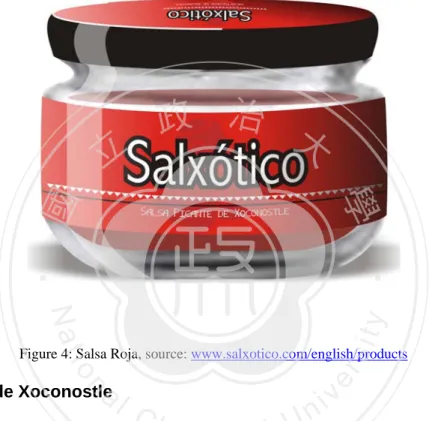
(21) 5.1.4 Salsa Roja Salsa Roja (Red salsa), is made of tomatoes, chile de pasilla, chile chipotle, tomatoes, onion, garlic, spices, and salt, basically suitable for those experienced in the culinary art, it can help to make Mexican dishes such as: Tinga, pollo en salsa roja, carne con chile.. 立. 政 治 大. ‧. ‧ 國. 學 sit. y. Nat. n. al. er. io. Figure 4: Salsa Roja, source: www.salxotico.com/english/products. 5.1.5 Salsa de Xoconostle. Ch. engchi. i Un. v. Salsa de Xoconostle (Prickly pear) is one of a hot flavor but innovative in the market because it is using an ancient component of the traditional Mexican food that has not been in use for one or another reason, its ingredients are as follows: Prickly pear, water, morita chili, chile de arbol, salt, garlic and spices, suitable to eat carnitas and barbacoa, or simply try it with tortilla chips, you would love it.. 20.
(22) 立. 政 治 大. ‧ 國. 學. Figure 5: Salsa de Xoconostle source: www.salxotico.com/english/products. ‧. Nat. sit. y. 5.1.6 Salsa de Habanero. al. er. io. Salsa de Habanero (Habanero Salsa): Habanero (the hottest chili in the universe), garlic,. v. n. onion, salt and spices, this is only for experts and those willing to try the hottest, no other. Ch. i Un. salsa can give you this flavor, suitable for tacos of cochinita pibil, burritos and tacos.. engchi. 21.
(23) Figure 6: Salsa de Xoconostle source: www.salxotico.com/english/products. 5.2 Future Products Salxótico® is always looking for new business opportunities so in the future the company would extend their portfolio with exotic salsa, they will explore tropical fruits as a main ingredient of our salsa, fruits such as mango, raspberry, kiwi, pineapple, are on target to develop a new line of products, another line of natural products should include the following in order of importance to launch into the market Tortilla chips made of white and blue corn and a Mexican restaurant in Taiwan. 5.2.1. Own salsa Jar. 立. 政 治 大. Customers always expect the best for their money, in Salxotico they are conscious of this. ‧ 國. 學. issue and because of that reason and in order to charge a premium price for their product they are going to have their own salsa jar, carefully designed by Mexican artisans to. ‧. make their appeal even more beautiful and attractive to the customers eyes.. sit. y. Nat. io. er. 5.2.2 Blue corn Tortilla Chips. al. n. iv n C Salxotico always wants to offer the best U products to its loyal customers, h evalue hthei best n gand c a new line of blue corn tortilla is being cooked to satisfy all salsa aficionados. Salxotico One of the best ways to eat salsa is with the ancient Mexican tortilla chips, since. trying to be always ahead its competitors will launch a new product for the market, something only available in the Mexican market, and considered as a gift of Gods.. 5.2.3 White corn Tortilla Chips. To gain more awareness on the brand, Salxotico is going to launch their own tortilla chips, so they can sell not only a great salsa but its natural compliment which are tortilla chips. Expectations are that Tortilla chips would become a common sales item in Salxotico’s. 22.
(24) portfolio and management team expects to be at least 10 % of their sales by third year of operation.. 5.2.4 Fruit Salsa. Because of competition Salxotico expects to be imitated in image, appeal and strategy, so they want to move forward and anticipate their competitors and launch a new series of. 政 治 大. products including Salsa made of exotic fruits.. 立. 5.2.5 Restaurant in Taiwan. ‧ 國. 學. To make sure that company´s efforts into Taiwanese market are going on the right path,. ‧. Salxotico management team has decided that upon two years of company operations in Taiwan they will launch a Mexican restaurant when people can delight the culinary. Nat. sit. y. delicacies, it will assure that company is going on the right direction, they have planned. io. n. al. er. to recover investment upon three years.. Ch. 5.3 Competitive Comparison. engchi. i Un. v. As a start up enterprise they are just going to focus only on one line of products, which is salsa, according to the company they are going to have a variety of 5 different flavors, including what they claim to be the spiciest salsa in the world. Available level of spiciness is: hot, medium and mild. Their plan is to expand their product portfolio in the future and includes the launch of tortilla chips brand, made of blue and white corn, a fully own restaurant and different flavors for salsa. Based on their statements this company claims that their salsa has a unique appeal, especially due to it’s carefully and well designed label and for the quality of its ingredients, they combine only fresh ingredients and a long life in shelf (approximately 60-80 days) furthermore their R&D team supported by years of experience in the 23.
(25) Mexican salsa market got the ultimate salsa in the market which they claim to be the spiciest in the world. The identified competitors in salsa market for Salxotico are already identified; the first line of competitors are those Mexican companies, already established in the market, companies such as la Costeña and Herdez, are the big Mexican players in the foreign markets. A second category of competitors is identified as the foreign brands who are US producers of salsa. In this case major competitors are brands; such as Old El Paso, Chichis and Casa Fiesta.. 政 治 大. The third category of salsa producer was identified as those foreign companies, major. 立. competitors are: Fuego (Germany), Poco Loco (Belgium).. ‧ 國. 學. Salxotico compared how they want to position themselves with the other brands already in the market and the perception of that comparison is shown on the following graphs.. ‧. In order to compare the company selected a sample of products that might be their. sit. y. Nat. competitors in a selected market.. al. er. io. The methodology was quite simple, the company went shopping to selected stores of. n. Taiwan, specifically Marketplace by Jason’s12 supermarket in the 101 shopping mall was. Ch. i Un. v. used for the recompilation of the information, during 2009, on randomly selected days. engchi. Salxotico purchased different jars of salsa and took them home to analyze them. Factors that were analyzed: product quality, measured by the ingredients that were used to prepare the salsa, the highest number a company got, the freshest the ingredients were. The maximum number a company could get was three. The second one is product appeal, in this stage Salxotico analyzed quality of label, design of label, jar and instructions of how to eat the salsa, greater number meant label was carefully designed.. 12. For more information please visit their website http://www.jasons.com.tw/jasons/jasons.jspx. 24.
(26) Price, it was measured by weight and total price. The higher the rate the more expensive the product. Flavor availability, on supermarket shelf salsa were displayed, Salxotico took note of them and assigned a measure for each brand, the higher the number the got, the higher availability of different flavors, the lower meant only one product of the brand in a shelf. Finally customer awareness was calculated by the mean average of the other four results. 5.3.1 Salxótico versus Mexican brands comparison In the section 6 and 6.1 there is a detailed explanation on how Salxotico arrived to the. 政 治 大. conclusion of choosing Taiwan as one of their desired markets to penetrate in the international sales.. 立. In this section the comparison between how Salxotico would like to be perceived and the. ‧ 國. 學. comparison with possible competitors is stated using an index.. companies in Taiwan market are: flavor, appeal and price.. Nat. y. ‧. The biggest difference between Salxótico® products and those available from Mexican. sit. Mexican players, sell their products in cans, with old-fashion labels, and the minimum. er. io. information on how to eat salsa.. al. n. iv n C U a differentiated strategy to the Costeña and Herdez. In Taiwan these noti have hplayers e n gdoc h The Mexican dominant players in the Taiwanese Mexican market are as follows: La. markets they are in, i.e. they do not charge a premium margin for their operations in Asia, they basically do sales, but do not do marketing. For example a jar of La costeña 453 grams plain salsa on Jason´s costs NT$95, thus it appears to the customers like a low cost and low quality product, Herdez is having pretty much the same strategy you can find a can of Herdez Salsa of 198 grams at NT$99, and 793 grams at NT$198. The following chart explains how Salxótico® wants to be perceived by its clients, the expected impact on label by appeal, price and flavor availability, thus compared to Mexican brands.. 25.
(27) Exhibit 5.2 Salxótico vs Mexican Brands. 立. 政 治 大. ‧ 國. 學 ‧. Source: own elaboration based on Salxotico information of Taiwanese supermarket.. Salxótico® wants to make a difference with those already established Mexican players by. y. Nat. sit. its different appeal, different price and flavor availability, thus it will create a better. n. al. er. io. image of Mexican enterprises and create a higher awareness of clients.. i Un. 5.3.2 Salxótico versus Foreign brands comparison. Ch. engchi. v. There are foreign competitors already in the Taiwanese market, they have a well defined strategy in the market, the result is higher prices, better variety and better appeal, and thus they can charge a higher price and therefore get a higher margin and allow the supermarket to get higher profits. Players that are already in Taiwanese market are: Fuego, German company it sells three different kinds of salsa, hot, mild and green the hot and medium come in jars of 200 ml at a price of NT$120, the green one come in a different jar at a different price they charge NT$160 for each one. Chi-chi´s is an American company selling mild and medium salsa, in glass jars of 255 grams at a price of NT$199.. 26.
(28) Garduños they sell three different salsas from medium to hot and green jars of 454 grams at NT$235. Enrico´s a jar of 454 grams at NT$199 Neal Brothers, they have an offering of 3 three different products jars of 500 ml priced at NT$249 Casa Fiesta cheese sauce 425 grams at NT$190. In the following chart an analysis of the well established competitors in the Taiwanese market, these are the results:. 立. Exhibit 5.3 Salxótico vs Foreign Brands. 政 治 大. ‧. ‧ 國. 學. n. er. io. sit. y. Nat. al. Ch. engchi. i Un. v. Source: own elaboration based on Salxótico information of Taiwanese supermarket.. Salxótico® wants to beat its competitors by offering better products in they way they are produced, a salsa made of fresher ingredients something that makes the firm unique in the Taiwanese market, although Mexican firms also do the same i.e. offer fresh products, their appeal makes them look in a different category, therefore they are not able to sell. 27.
(29) more expensive because of their segment, in the other hand Salxótico® is making a bigger salsa with a long life in shelf out of fresh products, something that the already established foreign companies can not do.. In Salxótico® they believe that they can make a space for their company and bring them to Taiwan and become the leaders in this industry by five years. They are going to charge a premium price for their products, in the future they will also include especially and carefully designed jar that will be unique in the market for being useful and beautiful.. 政 治 大 Salxótico® is an authentic Mexican company, therefore their expertise is much more 立 better than those German and Belgium companies, ingredients used in the process of The main difference between Salxótico and its rivals in Taiwanese is as follows:. ‧ 國. 學. making salsa are all fresh, compared to those international companies, an example of it is that when Salxotico reviewed avocado salsa from Fuego company they found out that. ‧. there were no avocados on it, the main ingredient was green pumpkin powder adding. io. y. sit. avocado.. Nat. green color and essence of avocado to make to product look like and taste like real. n. al. er. The biggest difference between Salxótico® products and those available in the Mexican market are: flavor, appeal and price.. Ch. engchi. i Un. v. Meanwhile dominant players in the Mexican market, sell their products in cans, with and old-fashion label, and the minimum information on how to eat salsa, their product is really good, due to the fact that they use simple and fresh ingredients.. 28.
(30) Figure7and 8 Mexican brands appeal Source: http://www.brandchannel.com/features_effect.asp?pf_id=401. Salxotico would charge a premium price for their products, in the future they plan to have a fully owned jar that will be unique in the market and it will help to have a better image. 5.4 Sales Literature Salxótico® is currently designing a catalog and brochures as well as sales materials and designing the web page that will help our customers and dealers. They want to attach. 政 治 大. photos as well as include recipes on how to eat Mexican salsa i.e. provide more information to customers to make them happy.. 立. The web page is going to have the languages of markets in which Salxotico is doing. ‧ 國. 學. business, so it will include Spanish for Mexico, English for the US, Traditional Chinese for Taiwan, Czech for the Czech Republic, Korean for Korea and Polish for Poland.. ‧. 5.5 Sourcing. Nat. sit. y. Based on the part 5 (Products) Salxotico cost of producing a jar of salsa are as follows:. al. er. io. Exhibit 5.4 Salxótico Sourcing. Description. Salsa jar. Salsa glass jar 250 Distbrand, S.A. USD$0.28. Mexico. gr. de C.V., México. EXW. Jar cap.. Distbrand, S.A. USD$0.07. Mexico. de C.V., México. EXW. Cap. Design of label. Provider. n. Item. Design. Ch. Cost per unit. engchi U. and Centro. de USD$4,000. adjustment to FDA Diseño, México and. NOM. standards. 29. v ni. One payment. Total cost. Mexico.
(31) Label. Made of paper. Mexico EXW. Bar Code. Bar. code AMECE. registration. USD$500, One. year. membership Salsa. Chilies,. onions, Outsourced. USD$0.5. spices, water, etc Own 政 治 大 Source: own elaboration with data provided by Salxótico 立 Store it. 學. ‧ 國. Storage. Exhibit 5.5 Salxótico Glass Jar Design. ‧. n. er. io. sit. y. Nat. al. Ch. engchi. 30. i Un. v.
(32) Source: provided by Salxótico. Since products are acquired with established dealers of chilies, garlic, onion and spices, they have a plan to negotiate with them to reduce costs, by establishing a contract. So they can reduce main costs dramatically.. Because Salxotico has detected that their jar is very expensive in Mexico in the near future they are going to buy it from a provider in Mainland China to reduce their unit cost from $0.28 to $0.01, one risky situation that can be presented to Salxotico is that they need to invest at least in 100,000 pieces of jar each time, with the consequent cost of. 政 治 大 Another source for lowering立 costs will be the acquisition of a dehydrating machine, for storage of the unused jars.. ‧. ‧ 國. more efficiently.. 學. those seasonal products, and a larger blender, which will allow us to produce faster and. 6. Worldwide Sauce Market Analysis Summary. y. Nat. io. sit. According to the Tariff Harmonized Code salsa is classified as follows:. Subheading 2103. al. n. Heading/. er. Exhibit 5.6 Tariff Harmonized Code (THC) of salsa, condiments and sauces.. Ch. engchi U. v Unit of i n. Rate of Duty. Article Description. Quantity. Sauces and preparations therefore; mixed. Kg. Free (MX). condiments and mixed seasonings; mustard flour and meal and prepared mustard. 2103.20. Tomato Ketchup, and other tomato sauces:. Kg. Free (MX). 2103.20.40. Other. Kg. Free (MX). 2103.90. Other. Kg. Free (MX). 31.
(33) 2103.90.90.40 Other. salad. dressing. Tomato-based. Kg. Free (MX). preparations for sauces: In containers less than 1.4 kg Source: http://www.usitc.gov/publications/docs/tata/hts/bychapter/1000C21.pdf. Based on Salxotico sales team these as the reasons for entering into the international concert: According to statistics of UN Comtrade, (United Nations Commodity Trade Statistics Database), the worldwide imports of salsa, sauces and condiments in 2008 were US$ 5,911,616 thousand dollars, the annual growth in value from 2004 to 2008 accounted for. 政 治 大 annual growth between 2007-2008 立 in value was 22%. The main importers of salsa, sauces 14%, meanwhile the annual growth in quantity between 2004-2008 was 6%, and the. ‧ 國. 學. and condiments, in 2008 were: the UK, (10.2%), the US (9.56%), France (4.75%), Germany (4.7%) Canada (4.03%).. ‧. Exhibit 5.7 Main importers of salsa, sauces and condiments (210390), 2008. n. er. io. sit. y. Nat. al. Ch. engchi. Source: United Nations Commodity Trade Statistics Database http://www.trademap.org/Country_SelProduct_Graph.aspx. 32. i Un. v.
(34) Based on the same database, the main exporters of salsa are described as follows: the United States of America, are the leaders on this segment, with (10.21%) of the market, annual growth in 2004-2008 period accounted for 12%, second player is Germany with 10.11 % share of the worldwide market and a growth in the past four years of 21 %, the following most important players are: Holland (7.19%) and 7% growth, China (5.89%) and 25 % of growth, and Italy. (5.15%) and 14% growth.. For more information check. the section appendices.. 政 治 大. Exhibit 5.8 Main exporters of salsa, sauces and condiments (210390), 2008. 立. ‧. ‧ 國. 學. n. er. io. sit. y. Nat. al. Ch. engchi. i Un. v. Source: United Nations Commodity Trade Statistics Database http://www.trademap.org/Country_SelProduct_Graph.aspx. The above bar graph shows the top ten exporters of Salsa in the world, to show it in a better way a map is depicted to show the same information, highlighting by country the amount of exports made in 2008.. 33.
(35) Exhibit 5.9 Map of main exporters of salsa, sauces and condiments (210390), 2008. 立. 政 治 大. ‧. ‧ 國. 學 sit. y. Nat. Source: ITC calculations based on COMTRADE statistics http://www.trademap.org/Country_SelProduct.aspx. io. er. Salxótico main efforts will focus on ten selected countries, for academic purposes of this research Taiwan was selected to describe the strategy of this company.. n. al. Reasons for entering U.S. market:C h. engchi. i Un. v. Based on statistics provided by the International Trade Center (ITC)13 Mexican salsa, sauces and condiments exports into the world accounted for US$144,415,000 dollars. •. Salsa Mexican-American market i.e. Mexican exports and American imports accounted for US$ 97,807,000 it means that 67.72 % of all Mexican exports os salsa, sauces and condiments have only one destiny, the U.S., in fact it is a saturated market that is underperforming the growth of Mexican exports of Salsa.. 13. For more information, please visit the following website: http://www.trademap.org/Bilateral.aspx 34.
(36) Meanwhile Mexican exports of salsa and condiments grew 4.34% in 2005, 10.6 on 2006, 8.63% on 2007 and 13.94 in 2008. American imports of Mexican Salsa grew at the following rates 1.01% in 2005, 5.98% in 2006, 9.21 in 2007 and 3.84 in 2008. Exhibit 5.10 Main importers of Salsa, sauces and condiments products exported from Mexico. 立. 政 治 大. ‧. ‧ 國. 學 er. io. al. sit. y. Nat Source: United Nations Commodity Trade Statistics Database. n. iv n C Mexico was the second thirdhlargest e n gexporter c h i ofUSalsa, sauces and condiments to. http://www.trademap.org/Country_SelProduct_Graph.aspx. •. the U.S., having a share of 25.87% in 2005, 23.56% in 2006, 22.68% in 2007 and 24.40% in 2008., in terms of dollars by 2008 it was on the amount of US $ 58,407,000. 35.
(37) Exhibit 5.11 Suppliers of Salsa, sauces and condiments, imported by the US. 立. 政 治 大. ‧ 國. 學. Source: United Nations Commodity Trade Statistics Database. Nat. y. ‧. http://www.trademap.org/Country_SelProduct_Graph.aspx. •. Currently salsa is more consumed in the US than in Mexico,. •. er. al. iv n C Popularity of Mexican food inhthe i U at exponential rates e nStates g cishgrowing n. •. sit. Starting 2004 salsa was more consumed in the States than ketchup14.. io. •. By 2002 Hispanic births in the States surpassed Anglo births. Given this scenario and according to Salxotico sales team, they want to follow the trend of the salsa consumers in the US. Their plan is to enter first into states like California and Texas and then expand into a nationwide chain of supply. Reasons for entering selected European Markets: 14. For more information, please check the following article http://www.brandchannel.com/features_effect.asp?pf_id=401 36.
(38) According to the International Trade Center (ITC), the EU imported from the world USD$ 2,391,755,000 it accounted 40.46 % of the total market, equivalent to 981,771 Metric Tons. In the last five years imports had increased in a rate of 5% in value and 30 % in volume. Exhibit 5.12 European Importers of salsa, sauces and condiments in 2008, form the world.. 政 治 大. 立. ‧. ‧ 國. 學 sit. y. Nat. io. http://www.trademap.org/Country_SelProduct_Graph.aspx. n. al. Ch. er. Source: United Nations Commodity Trade Statistics Database. i Un. v. The principal reason to enter into Asian markets for Salxotico is due to the fact that. engchi. according to statistics of ITC and COMTRADE there is a big potential of trade between Mexico and selected countries such as Japan, Korea, Honk Kong, Singapore and Taiwan as shown in the following graphs.. 37.
(39) Exhibit 5.13 Prospects for Mexican diversification of salsa, condiments and sauces (markets 1). 立. 政 治 大. Source: United Nations Commodity Trade Statistics Database. ‧ 國. 學. http://www.trademap.org/Country_SelProduct_Graph.aspx. ‧. Exhibit 5.14 Prospects for Mexican diversification of salsa, condiments and sauces (markets 2). n. er. io. sit. y. Nat. al. Ch. engchi. Source: United Nations Commodity Trade Statistics Database http://www.trademap.org/Country_SelProduct_Graph.aspx. 38. i Un. v.
(40) Exhibit 5.15 Prospects for Mexican diversification of salsa, condiments and sauces (markets 3). 立. 政 治 大. sit er. io. http://www.trademap.org/Country_SelProduct_Graph.aspx. y. ‧. ‧ 國. 學. Nat. Source: United Nations Commodity Trade Statistics Database. al. n. iv n C The information can be read as follows: h e nTheg cMexican h i Uparticipation on the world salsa market accounted for 2 % of its total.. The U.S. alone represented almost 70 % of the total exports of Mexican salsa, and grew at a rate of almost 10%, countries like Chile, grew at 40 % in imports of Mexican salsa and represent less than 1% of Mexican exports of Salsa. The world average growth on consumption of Mexican salsa was 14 %, for Salxotico they want to achieve superior rates of growth than the world average. Potential markets discovered by Salxotic sales team include those Asian markets that are growing at a rate of at least 5 % a year, because it means a potential buyer for Salxotico products, Taiwan, Honk Kong, Singapore, Korea and Japan are within these economies. 39.
(41) Reasons to enter Taiwan: Taiwan represented the 29th most important purchaser of Salsa, condiments and sauces industry in the world in 2008, purchasing an amount of USD$53,524,00.00 with an estimated of 6 % of growth between 2004-2008, last year increase in the demand accounted for a 9%, having a 0.91 % of the worlds share. market. The average tariff. imposed to foreign products by Taiwan is 14.8 %. The following chart provides the main commercial partners of Taiwan in 2008 structured by salsas, sauces and condiments.. 立. 政 治 大. Exhibit 5.16 Top 20 Main exporters of Salsa, sauces and condiments to Taiwan, 2008. ‧. ‧ 國. 學. n. er. io. sit. y. Nat. al. Ch. engchi. Source: ITC calculations based on COMTRADE statistics http://www.trademap.org/Country_SelProduct.aspx. 40. i Un. v.
(42) Exhibit 5.17 Top 21-31 Main exporters of Salsa, sauces and condiments to Taiwan, 2008. 立. 政 治 大. ‧ 國. 學. Source: ITC calculations based on COMTRADE statistics. ‧. http://www.trademap.org/Country_SelProduct.aspx. sit. y. Nat. Although Taiwanese imports from Mexico represented only a small share of the total. io. into a virgin terrain.. n. al. er. imports of sauce in 2008. Salxotico believes it is a great chance to make its appearance. Ch. i Un. v. Salxotico base its assumptions on data provided by Mexican Minister of Economy, in. engchi. 2007, Taiwan was the 9th commercial partner of Mexico, 36th as purchaser and 7th as provider. Furthermore Salxotico delineated a plan to arrive to Taiwanese market after the first two years of operations in California Salxótico®, they highlight the following facts: z. An estimated population of 500,000 Taiwanese American constantly travelling back and forth, according to the US of Commerce Statistics in 2001-2008 period there were 344,000 Taiwanese visitors on average per year to the States, in 2008 this number was 295,000.. 41.
(43) z. By 2008 the preferred destination was California with 65.3 %, and the purpose of visit was 90 % shopping and 79 % dining in restaurants.15. z. Salxótico® assumes that Mexican cuisine is going to grow on popularity in the west coast, Taiwanese visitors would try Mexican food in the States and they like to eat hot food.. Given this scenario they are going to follow another companies strategy to do their business, examples of them are: Chi-chis, an American company with a 7 % of the American market, Enrico´s and Old El Paso.. 政 治 大. Salxotico firmly sees an opportunity to become the leader into Taiwanese Salsa market as it is unattended by other Mexican companies or it doesn’t seem to be a priority. The. 立. following chart represents the top twenty attended markets by Mexican exporters of salsa.. ‧ 國. 學. Exhibit 5.18 Top ten importers of Mexican salsa, sauces and condiments, 2008. ‧. n. er. io. sit. y. Nat. al. Ch. engchi. i Un. v. Figure 12, Source: ITC calculations based on COMTRADE statistics http://www.trademap.org/Country_SelProduct.aspx. 15. For more information please check the following website: http://tinet.ita.doc.gov 42.
(44) The graph shows a common picture in the Mexican exports, i.e. more than 65 % of its exports going to the U.S., virtually ignoring new opportunities in different markets. In Salxotico they want to take advantage of this issue and export into markets yet unexplored of partially explored by Mexican companies.. Exhibit 5.19 Top 41-60 importers of Mexican salsa, sauces and condiments, 2008. 立. 政 治 大. ‧. ‧ 國. 學. n. Ch. http://www.trademap.org/Country_SelProduct.aspx. engchi. er. io. sit. y. Nat. al. Figure 12, Source: ITC calculations based on COMTRADE statistics. i Un. v. 6.1 Country Market Segmentation According to Czinkota and Ronkainen 16 , “the assessment of a foreign market environment should start with the evaluation of economic variables relating to the size and nature of the markets”. For the preliminary estimation of foreign markets Salxotico based on the following assumptions: 6.1.1 First Stage Screening Selection. 43.
(45) Salxotico collected data to identify and evaluate potential marketing opportunities. It was done in a multi-stage screening process. a) Preliminary screening criteria: Exhibit 6.1 Preliminary Criteria. Item #. Criteria. Remarks. 1. Minimum Population Size. Above ten million habitants. 2. GDP. 學. 4. ‧ 國. 3. Above USD$50,000,000,000.00 政 治 大 Minimum GDP 立 per capita Above US$10,000.00. Imports. Above USD $15,000,000,000.00. Source: Own elaboration with data provided by Salxótico. ‧. The next exhibit shows those countries that fulfilled the four criteria. 17. 18. and. Nat. sit. y. represented the prospective markets for Salxotico, and then they made another refinement. io. al. n. Exhibit 6.2 Selected countries that fulfilled four criteria # Country Population GDP 1 United States 307,212,123 $14,440,000,000,000 2 Brazil 198,739,269 $1,998,000,000,000 3 Russia 140,041,247 $291,900,000,000 4 Japan 127,078,679 $4,340,000,000,000 5 Mexico 111,211,789 $1,567,000,000,000 6 Germany 82,329,758 $2,925,000,000,000 7 Turkey 76,805,524 $903,900,000,000 8 Iran 66,429,284 $843,700,000,000 9 France 64,057,792 $2,133,000,000,000 10 United 61,113,205 $2,236,000,000,000. Ch. engchi. 16. er. to establish only three or four countries to start doing business with.. i Un. v. GDP PPP $47,500 $10,200 $16,100 $34,100 $14,300 $35,500 $11,900 $12,800 $33,300 $36,700. Imports $2,117,000,000,000 $173,100,000,000 $291,900,000,000 $708,300,000,000 $308,600,000,000 $1,232,000,000,000 $193,900,000,000 $67,250,000,000 $692,000,000,000 $639,300,000,000. Michael Czinkota and Ilka Ronkainen, International Marketing,Mason, 2007 For detailed information on the selection process, please visit the section appendix on this document to get all the tables, that were used by Salxotico in this process. 18 There are some cases to be considered by Salxotico to make criteria flexible in some countries, to mention some examples: China didn’t fit criteria number 3, but the others, Singapore didn’t fulfill number one, but outpassed 2,3,4, Honk Kong is the same, they are going to be considered as special cases for Salxotico in the future, because due to this analysis they have a huge potential. 17. 44.
(46) $1,827,000,000,000 $492,200,000,000 $1,338,000,000,000 $575,200,000,000 $1,402,000,000,000 $670,700,000,000 $1,303,000,000,000 $577,900,000,000 $356,300,000,000 $385,200,000,000 $713,700,000,000 $272,000,000,000 $802,900,000,000 $673,500,000,000 $245,100,000,000 $176,200,000,000 $343,800,000,000 $237,300,000,000 $390,200,000,000. $31,400 $10,100 $27,700 $14,200 $34,600 $17,400 $39,200 $20,500 $13,500 $15,200 $31,100 $12,200 $38,200 $40,500 $14,900 $11,500 $32,100 $22,200 $37,500. $264,800,000,000. $25,900. $546,900,000,000 $90,570,000,000 $427,400,000,000 $54,560,000,000 $415,500,000,000 $204,400,000,000 $415,200,000,000 $108,300,000,000 $48,100,000,000 $154,700,000,000 $236,700,000,000 $76,170,000,000 $194,200,000,000 $474,800,000,000 $57,610,000,000 $38,450,000,000 $93,910,000,000 $87,830,000,000 $387,700,000,000. 政 治 大. 立. 10,211,904. 學. 30. 58,126,212 49,052,489 48,508,972 40,913,584 40,525,002 38,482,919 33,487,208 28,686,633 26,814,843 25,715,819 22,974,347 22,215,421 21,262,641 16,715,999 16,601,707 15,399,437 10,737,428 10,707,924 10,414,336. $139,400,000,000. ‧. ‧ 國. 11 12 13 14 15 16 17 18 19 20 21 22 23 24 25 26 27 28 29. Kingdom Italy South Africa Korea, South Argentina Spain Poland Canada Saudi Arabia Venezuela Malaysia Taiwan Romania Australia Netherlands Chile Kazakhstan Greece Portugal Belgium Czech Republic. 6.1.2 Second Stage Screening Selection. y. Nat. sit. The second stage was conducted at country level information, and consisted of indicators. al. er. io. related to the general business environment, for this stage the selected thirty countries. v. n. were analyzed, in the following chart the chosen variables are depicted. Exhibit 6.3 Second Criteria. Item #. Criteria. 1. GDP growth. Ch. engchi. i Un. Remarks. More than 3% on average on the last four years.. 2. Rate of inflation. Less than 8% on the last your years. 3. Rank between 1st and 5th in the. Market potential index. last five years.. 45.
(47) Source: Own elaboration with data provided by Salxotico. Exhibit 6.4 GDP growth 2004-2008 GDP growth (2004-2008) average 1 Venezuela 10.43 2 Argentina 8.46 3 Kazakhstan 8.42 4 Russia 7.27 5 Romania 7.14 6 Turkey 6.61 7 Iran 5.81 8 Malaysia 5.78 9 Czech Republic 5.35 10 Poland 5.33 11 Chile 4.81 12 Brazil 4.72 13 South Africa 4.66 14 Saudi Arabia 4.30 15 Korea, South. 4.22 16 Greece 3.90 17 Taiwan 3.53 18 Mexico 3.40 19 Australia 3.36 20 Spain 3.15 Source: Own elaboration with data provided by Salxotico from the World Bank. #. Country. 立. 政 治 大. ‧. ‧ 國. 學. er. io. sit. y. Nat. al. n. iv n C then Salxotico worked with these data them again, now the discriminator was: htoerefine hi U n c g rate of inflation.. Having selected those countries that had a GDP above 3% on average on selected years,. Considering the fact that a normal rate of inflation for developed countries stands between 1% and 4%, and that last year world’s average inflation was in the order of 8.67, Salxotico decided to target those countries that in the past four years had an average inflation below 8 %. The selected countries are in the following chart Exhibit 6.5 Rate of inflation 2004-2008 # 1. Country Malaysia. GDP growth annual 20042008 average 5.78 46. Rate of inflation 5.99.
(48) 2 Czech Republic 5.35 2.10 3 Poland 5.33 3.04 4 Chile 4.81 6.56 5 Brazil 4.72 6.20 6 South Africa 4.66 7.62 7 Korea, Rep. 4.22 1.67 8 Greece 3.90 3.27 9 Taiwan 3.53 2.78 10 Mexico 3.40 6.30 11 Australia 3.36 4.19 12 Spain 3.15 3.68 Source: Own elaboration with data provided by Salxotico from the World Bank.. The third discriminating criteria was called “Market Potential Index” (MPI), Salxotico based its MPI, on data published by Michigan State University “Market Potential Index for Emerging Markets”19.. 立. 政 治 大. Since most of the economies that fit Salxotico criteria were in the category of emerging. ‧ 國. 學. markets their management decided to choose those economies that were in the top ten of this MPI to start doing operations in those countries.. ‧. n. al. Market Consumption Capacity. sit. Market Intensity. er. Market Market Size Growth Rate. io. Countries. y. Nat. Exhibit 6.6 Market Potential Index 2009. v C h 12 28 2 U n i73 e1 n g100c h i 26 1 100. Rank Index Rank Index Rank Index Rank Index Singapore. 26. 1. 15. 57. China. 1. 13. 60. Hong Kong. 24. 1. 14. 27. 1. 100. 18. 48. Korea, South. 7. 10. 23. 12. 6. 64. 1. 100. Czech Rep.. 22. 1. 21. 17. 15. 45. 2. 94. Israel. 23. 1. 24. 12. 3. 68. 9. 74. Poland. 15. 4. 13. 27. 7. 63. 5. 78. Hungary. 25. 1. 26. 1. 4. 67. 3. 90. 19. The Index study is conducted by The International Business Center (IBC) in The Eli Broad Graduate School of Management at Michigan State University. This index helps companies compare the Emerging Markets with each other on several dimensions. Eight dimensions are chosen to represent the market potential of a country, over a scale of 1 to 100. Each dimension is measured using different indicators, and weighted in determining their contribution to the Overall Market Potential Index, for more information on how the Index is calculated please check the Appendix section on this paper. 47.
(49) Russia. 3. 25. 8. 38. 21. 29. 8. 75. Malaysia. 19. 3. 17. 26. 22. 27. 10. 73. India. 2. 38. 3. 54. 23. 25. 11. 60. Turkey. 8. 7. 9. 38. 5. 66. 14. 58. Chile. 21. 2. 15. 27. 12. 49. 23. 24. Mexico. 6. 10. 22. 16. 10. 58. 22. 38. Saudi Arabia. 13. 4. 7. 39. 25. 12. 7. 75. Brazil. 4. 21. 11. 29. 17. 44. 24. 20. Egypt. 14. 4. 6. 40. 11. 54. 6. 75. Argentina. 12. 4. 4. 53. 13. 47. 20. 42. Thailand. 16. 4. 10. 31. 24. 22. 17. 52. Pakistan. 10. 6. 4. 79. Peru. 20. 2. 39. Indonesia. 5. 立11. 21. Philippines. 11. Venezuela. South Africa. 政52 5256治 188 大 6142 20. 37. 16. 55. 5. 25. 12. 9. 59. 19. 48. 17. 3. 18. 24. 19. 37. 12. 60. 9. 6. 19. 21. 16. 45. 26. 1. Colombia 18 3 20 17 Source: http://globaledge.msu.edu/resourcedesk/mpi/.. 14. 46. ‧. ‧ 國. 26. 學. 16. Nat. sit. io. er. Exhibit 6.7 Market Potential Index 2008. al. n. Economic Market iv n C h Freedom Receptivity i U Index e g c hRank Index Rankn Index. Commercial Countries Infrastructure Rank. 9. y. 25. Country Risk Rank Index. Singapore. 3. 94. 6. 77. 1. 100. 1. 100. China. 19. 34. 26. 1. 18. 4. 10. 55. Hong Kong. 1. 100. 2. 93. 2. 69. 2. 89. Korea, South. 4. 92. 5. 77. 8. 15. 6. 67. Czech Rep.. 2. 94. 3. 85. 9. 14. 3. 77. Israel. 7. 70. 7. 77. 4. 23. 4. 74. Poland. 6. 78. 8. 70. 15. 6. 8. 61. Hungary. 5. 82. 4. 81. 5. 16. 15. 43. Russia. 8. 65. 24. 7. 21. 3. 12. 48. Malaysia. 9. 64. 16. 45. 3. 24. 9. 55. India. 25. 2. 17. 44. 24. 3. 23. 24. 48.
(50) Turkey. 12. 49. 13. 51. 19. 4. 19. 35. Chile. 13. 49. 1. 100. 10. 13. 7. 63. Mexico. 15. 46. 10. 63. 6. 15. 11. 51. Saudi Arabia. 10. 59. 23. 19. 11. 12. 5. 72. Brazil. 14. 47. 12. 54. 25. 1. 14. 46. Egypt. 20. 32. 22. 19. 13. 6. 20. 34. Argentina. 11. 56. 15. 46. 20. 3. 24. 14. Thailand. 16. 46. 20. 38. 7. 15. 17. 40. Pakistan. 24. 4. 21. 28. 26. 1. 26. 1. Peru. 26. 1. 11. 61. 17. 5. 16. 40. Indonesia. 21. 30. 18. 43. 22. 3. 21. 27. Philippines. 22. 26. 22. 25. Venezuela. 18. 41. 25. 13. South Africa. 23. 19 38 治 16 6 政 25 5 12 大 7. 立13. 14. 6. 13. 47. Colombia 17 41 14 47 Source: http://globaledge.msu.edu/resourcedesk/mpi/.. 23. 3. 18. 35. 學. 65. ‧. ‧ 國. 9. Exhibit 6.8 Market Potential Index Rank Historical (Not including Taiwan). sit. y. Nat. Countries 2009 2008 2007 2005 2004 2003 2002 2001 2000 1998 1997. 1996. Rank Rank Rank Rank Rank Rank Rank Rank Rank Rank Rank Rank. io. 1. 3. 3. 1. 1. 1. 1. 1. China. 2. 2. v5 i n. 6. 5. 2. 3. H.Kong. 3. 1. 2. C1h. 3. 2. 2. 4. 2. Korea. 4. 5. 6. 4. 2. 10. 3. 9. 5. Czech. 5. 6. 7. 7. 7. 7. 7. 7. 7. 7. 7. 19. Israel. 6. 9. 5. 5. 5. 4. 4. 8. 4. 4. 5. 4. Poland. 7. 10. 10. 8. 9. 8. 8. 9. 9. 12. 6. 13. Hungary. 8. 7. 8. 6. 6. 6. 6. 10. 11. 11. 16. 15. Russia. 9. 12. 13. 11. 12. 15. 13. 19. 19. 19. 21. 23. Malaysia. 10. 14. 12. 13. 14. 13. 17. 15. 16. 8. 13. 7. India. 11. 11. 9. 9. 8. 9. 10. 11. 8. 10. 10. 10. Turkey. 12. 13. 11. 15. 15. 14. 14. 20. 17. 18. 19. 18. Chile. 13. 15. 16. 14. 10. 11. 9. 16. 13. 14. 11. 14. Mexico. 14. 8. 14. 10. 11. 10. 11. 14. 15. 22. 14. 9. n. al. 1. 2. 2. 2. 2. 3. 4. 5. 5. e n13 g c13h i U13. 49. er. Singapore.
(51) S.Arabia. 15. 20. 18. Brazil. 16. 23. 23. 18. 20. 17. 16. Egypt. 17. 21. 19. 16. 16. 19. 21. Argentina. 18. 17. 17. 21. 19. 23. Thailand. 19. 16. 15. 12. 13. Pakistan. 20. 24. 20. Peru. 21. 25. 25. 17. Indonesia. 22. 19. 21. Philippines. 23. 18. Venezuela. 24. S.Africa Colombia. 18. 21. 20. 22. 20. 15. 13. 14. 17. 3. 12. 12. 12. 12. 18. 13. 15. 8. 21. 18. 18. 19. 17. 16. 22. 21. 23. 16. 17. 21. 22. 20. 18. 20. 19. 17. 12. 15. 18. 22. 27. 26. 23. 24. 22. 23. 23. 20. 23. 20. 16. 25. 22. 24. 22. 22. 21. 20. 22. 22. 21. 23. 17. 26. 26. 27. 24. 24 24 政23 治 大. Source: http://globaledge.msu.edu/resourcedesk/mpi/.. 立. ‧ 國. 學. Exhibit 6.9 Market Potential Index Rank Historical (Including Taiwan). ‧. Countries. 2009 2008 2007 2005 2004 2003 2002 2001 2000 1998 1997. 1996. 1. 1. 1. 1. 2. 1. 3. 4. 5. 5. 3. 2. 2. 2. 2. 4. al. 4. 3. y. Singapore. 1. 3. 2. 2. 4. 2. 5. 6. 5. 2. 3. 1 v i. 1. 1. 1. 1. 2. 10. 3. 9. 5. sit. 2. 2. er. China. 1. n. 3. io. Hong Kong. Nat. Rank Rank Rank Rank Rank Rank Rank Rank Rank Rank Rank Rank. n e n3 g c h3 i U3. Korea S. 4. 5. 6. Ch. Czech. 5. 6. 7. 7. 7. 7. 7. 7. 7. 7. 7. 19. Hungary. 8. 7. 8. 6. 6. 6. 6. 10. 11. 11. 16. 15. Mexico. 14. 8. 14. 10. 11. 10. 11. 14. 15. 22. 14. 9. Israel. 6. 9. 5. 5. 5. 4. 4. 8. 4. 4. 5. 4. Poland. 7. 10. 10. 8. 9. 8. 8. 9. 9. 12. 6. 13. India. 11. 11. 9. 9. 8. 9. 10. 11. 8. 10. 10. 10. Russia. 9. 12. 13. 11. 12. 15. 13. 19. 19. 19. 21. 23. Turkey. 12. 13. 11. 15. 15. 14. 14. 20. 17. 18. 19. 18. Malaysia. 10. 14. 12. 13. 14. 13. 17. 15. 16. 8. 13. 7. Chile. 13. 15. 16. 14. 10. 11. 9. 16. 13. 14. 11. 14. Thailand. 19. 16. 15. 12. 13. 12. 12. 12. 18. 13. 15. 8. Taiwan. 4. 50.
(52) Argentina. 18. 17. 17. 21. 19. 23. 15. 13. 14. 17. 3. 12. Philippines. 23. 18. 22. 20. 18. 20. 19. 17. 12. 15. 18. 22. Indonesia. 22. 19. 21. 19. 17. 16. 22. 21. 23. 16. 17. 21. S.Arabia. 15. 20. 18. Egypt. 17. 21. 19. 16. 16. 19. 21. S. Africa. 25. 22. 24. 22. 22. 21. 20. 22. 22. 21. 23. 17. Brazil. 16. 23. 23. 18. 20. 17. 16. 18. 21. 20. 22. 20. Pakistan. 20. 24. 20. Peru. 21. 25. 25. 17. 21. 18. 18. Colombia. 26. 26. 27. 24. 23. 24. 24. Venezuela. 24. 27. 26. 23. 24. 22. 23. 23. 20. 23. 20. 16. 政 治 大. Source: http://globaledge.msu.edu/resourcedesk/mpi/.. 立. ‧ 國. 學. Those countries that consistently were positioned in the top ten of the MPI and that fulfilled all requirements from Salxotico are: Taiwan, South Korea, The Czech Republic and Poland. Therefore Salxotico’s main effort to export their products will focus on those. ‧. four countries to start with.. er. io. sit. y. Nat. 7. Strategy and implementation summary. al. n. iv n C U coined by Oviatt & McDougall h Global Salxotico can be classified as a “Born e n gfirm”, c h iterm What Strategy is Salxotico going to use, based on their export oriented sales strategy. (1994), referring to Logitech case.. A definition of “Born Global” is stated by Madsen et al. (1997) saying that it is a production firm with an export percentage (compared to the total sale) of 25 % or more, which have started exporting within three years after the firms foundation. Salxotico is not positioned as one technological company, but aims to become an exporter within the first three years of it foundation.. 51.
(53) 7.1 Marketing Strategy Salxotico is implementing a program to do their international sales, their marketing strategy consists of a full approach of understanding local cultures because of this fact they will send a team of employees to develop Taiwanese market. This company believes that going into the international market not only means do sales in domestic market and abroad, but it also means a broad understanding of the markets they are going to. Before entering to every market Salxotico would perform a competitive analysis, analysis of Salsa demand, human resources plan, and the financing for the entry into each territory.. 政 治 大. Salxotico do not want to follow in any way the Mexican business model because they do. 立. not want to make the same mistakes as Aztec companies are doing in the sense of asking. ‧ 國. 學. for a low price for their products.. What they are looking for in the long term is to be recognized as a high end salsa,. ‧. therefore exceed their customer expectations and eventually brand recognition and brand loyalty. In this sense Salxotico would generate greater revenues to their partners that. y. Nat. io. sit. decided to invest on the brand.. n. al. er. The basic idea of Salxotico is to get their products in Taiwanese high end supermarkets,. i Un. v. so it will lead to a partnership with those chains devoted to this sector.. Ch. engchi. It is a matter of time and it is Salxotico’s management team to decide which companies to partner with. For academic purposes the author is not authorized to reveal further information about this issue. 7.1.1 Promotion Strategy For Salxotico management promotion is key to stay in touch with loyal customers, and for that they have studied the possibility to launch a business account on Facebook, to communicate with their fans in selected countries. The other way they have thought for doing promotion is to follow those of the big corporations, such as Kellogg’s, to have one person in charge of demos in selected. 52.
(54) supermarkets and promote directly with possible customers, Salxotico will do it in the first six months of its arrival to Taiwan in selected high end supermarkets, the approximate budget for one campaign like this one is around NT$300,000. It is Salxotico’s management team to decide which companies to partner with. For academic purposes the author is not authorized to reveal further information about this issue, and it is job of the reader to judge and suggest which strategy should be the best for Salxotico’s management team. 7.1.2 Distribution Strategy One of the great advantages of Taiwan for distribution purposes it’s relatively small size. 政 治 大 the selected partner, but one key issue for them is that they want to have presence only in 立 the north of the island at the beginning so they won’t spend too much resources on the of the island, the channel that Salxotico will choose for its distribution basically relies on. ‧ 國. 學. building a strong channel of distribution due to the fact that they. want only presence on. high end supermarkets only available on the north of the island. ‧. 7.1.3 Pricing Strategy. y. Nat. sit. As for pricing it was mentioned that Salxotico view itself into a high end salsa producer,. n. al. er. io. so according to that prices in Taiwan will be in a range of $10 US per jar of salsa.. Ch. engchi. 53. i Un. v.
(55) 8. Key Financial Indicators As in every established company these indicators are essential to evaluate the financial performance of the company. In Salxotico they would present every year their results into a standardized way to their shareholders. The following section shows the summary of this work. 8.1 Start up Costs Exhibit 8.1 Start up costs. 立. Start-up Requirement. ‧ 國 n. al. Others. Ch. $3,000. engchi. Total Start-up Expenses (1). $57,500. Exhibit 8.2 Start-up Assets. Start-up Assets Cash required. $100,000. Long term assets. $60,000. 54. y. sit. $12,000. er. io. Factory Renovation. $40,000. Nat. Equipment. $2,500. ‧. Legal. 學. Start-up expenses. 政 治 大 In US $ Dollars. i Un. v.
數據



相關文件
Cowell, The Jātaka, or Stories of the Buddha's Former Births, Book XXII, pp.
二、其他 匯兌手續費 多國政府為增加稅收,自本(2005)年 1 月起將匯 兌手續費自 10%調升為 13%,哥斯大黎加已向世 界貿易組織表示該措施違反 WTO 相關規定,因
美國 [United States of America] 加拿大 [Canada].
(1) The MOJ invited experts and scholars from both academia and in the field relating to combating money laundering to actively organized education and training
On the other hand Chandra and Taniguchi (2001) constructed the optimal estimating function esti- mator (G estimator) for ARCH model based on Godambes optimal estimating function
Thus, for example, the sample mean may be regarded as the mean of the order statistics, and the sample pth quantile may be expressed as.. ξ ˆ
According to the United Nations Educational, Scientific and Cultural Organization (UNESCO), a language is considered endangered when “its speakers cease to use it, use it in fewer
For example, even though no payment was made on the interest expenses for the bank loan in item (vi), the interest expenses should be calculated based on the number of
