企盼精神機制下的攝影本真:論蘇菲卡勒《威尼斯攝蹤紀》
之性別化進程
計畫類別: 個別型計畫 計畫編號: NSC92-2411-H-009-005- 執行期間: 92 年 08 月 01 日至 93 年 10 月 31 日 執行單位: 國立交通大學外國語文學系暨文化研究所 計畫主持人: 林建國 報告類型: 精簡報告 處理方式: 本計畫可公開查詢中 華 民 國 94 年 1 月 31 日
Demanding the Photographic Real: Sexuation in Sophie Calle’s Suite vénitienne
Kien Ket Lim
On February 11, 1980, Sophie Calle sets out on a trip to Venice to stalk a man without his knowledge. For months, she has been tailing strangers on the streets of Paris photographing them, but this time she will be in a mazy city she has never visited,
dogging this man she barely knows. It is carnival time in Venice; trailing a stranger in a huge masquerade shall involve more love than pain. Her father sees her away at Gare de Lyon, as if to fulfill a certain Oedipal ritual by sending his daughter off to an unknown man. This man, as the ritual goes, is kept from the secret that a token of love has been handed along to him. “In my suitcase:” the daughter writes, there are “a make-up kit so I can disguise myself; a blond, bobbed wig; hats; veils; gloves; sunglasses.” In addition to all this are a Leica and a special lens attachment for her to “take photos without aiming at the subject.”1 The target of her apparatus, as well as her masquerade, is this man, who is also a photographer, called Henri B.2
“Please follow me,” says Jean Baudrillard in his afterword to Sophie Calle’s Suite
vénitienne, “to a senseless enterprise that requires more patience, servitude, boredom, and
energy than any amorous passion” (81). “[O]ne must never come into contact,” he adds, “one must follow, one must never love, one must be closer to the other than his own shadow. And one must vanish into the background before the other turns around” (85). To erase the other as a shadow, or myself as his shadow, all the same. We smell the ____________________________________
1 Calle, Suite vénitienne 4. The book will hereafter be abbreviated as SV.
2 Henri B.'s last name is never disclosed, nor is his face shown. To parallel his
semi-fictional character, Sophie Calle will be referred to by her first name hereafter, equally maintaining her status as a subject, a signifier.
urge of death drive, but whether this is love remains sternly ambiguous. Sophie reminds herself, “I must not forget that I don’t have any amorous feelings toward Henri B.” (SV 20). Still she murmurs Proust to herself in pain: “‘To think that I’ve wasted years of my life, that I wanted to die and that I had my greatest love, for a woman whom I did not care for, who was not my type ’” (SV 20). Days later, she is to be shaken by a confrontation with Henry B.’s wife in her nightmare (SV 42). The moment has arrived for her to define the sort of passion she has for Henri B., when stuck outside of an antique shop on a cold evening after tracking him there. She tells a curious passerby who offers help: “I’m in love with a man--only love seems admissible--and this man has been in Luigi’s antique shop since 6:15 in the company of a woman” (SV 38). If “only love seems admissible,” as she says it to herself, all the more so as an unrequited one, it is because it sounds so banal and therefore sensible as a pretext which she never believes, but which she hopes would allow her to trail and photograph this man without giving any further pretext. Her intention, after all, is to stay near, when it is too dark to photograph. Soon she is to whisper elatedly to herself on the vaporetto she furtively boards along with Henry B.: So
close to him, she murmurs, as if sharing an island (SV 40).
Moments of confusion sneak into Baudrillard’s otherwise brilliant essay when he cannot determine what it is precisely by Sophie’s “blind passion.” At one point he has no doubt that Sophie “follows the other with eyes closed and doesn’t want him to recognize her” (84). At another point, however, he sees her passion heading for an
“amorous intercession of the other” (82), to be consummated by her photographic venture. To sum up in his characteristic Baudrillardian parlance, Sophie’s project is an instance of seduction (76), yet devoid of any “sexual adventure” (77). There is, as he sees it, only the “sensuality” of her seductive manipulation of the other, but not quite sensuality itself (76). A philosophical distance soon keeps Baudrillard from coming down to the troubling sensual world Sophie is unknowingly seeking to unearth. To Baudrillard, shadowing a person is rather a matter of coming either too close or too far: if you come
too close, you become a shadow; too far, it is because you are a shadow. There is no other proper distance than this one that allows only the existence in the form of a shadow, as philosophy has dictated that distance. Sophie’s self-consciousness in remarking that “only love is admissible” as an excuse of her erratic engagement, will readily be taken to justify that distance. Love, if any, is nothing but a pretext, must be part of her shady masquerade. The signifiers-- her words and mask, and they alone, shall, as it were, tell us all we need to know about sexuality.
Perhaps the only justifiable use of this philosophical distance is to hold back one's hasty attempt to interpret Sophie Calle's venture as perverse, which appears to have been inflamed and engulfed by her voyeuristic pleasure. The “artificial pact,” Baudrillard steadfastly remarks, between the stalker and the stalked in Sophie's shadowing “is perfectly ritual and ceremonial, not perverse, spares us the obscenity (psychological or aesthetic) of manipulating and appropriating someone else's desire” (81-82).3 Ringing with psychoanalytic undertone, this perceptive note will soon allow us to explain why pleasure is altogether missing in Sophie's act of pursuit, diminishing the possibility of there being a perverse structure involved. What remains unsettled is rather the state of sexuality in her quest, the state that is gravely toned down, so far as the impression of perversion is also toned down. Now by philosophizing the distance of Sophie's object from herself (“the only way not to meet someone in Venice,” he says, “is to follow him from a distance and not lose sight of him” [83]), Baudrillard is led to leave the impression that what is at work in Sophie, if any, is some masculine kind of phantasy, when her ____________________________________
3 Parallel to this is: “Here the photography [of Sophie Calle] does not have the
voyeur’s or archivist’s perverse function” (Baudrillard 78). A comparison, if needed, can be made with the case of a perverse use of camera in Michael Powell's film, Peeping
Tom (1960). See also Parveen Adams' brilliant account of the film in Lacanian terms in
“amorous passion” (81)--or non-passion, as he also wants to equivocally suggest--has, in his eye, taken this distance or distancing as its precondition to become possible. If it is love, it must then be “courtly love,” generally structured within the masculine subject, whose love object, as suggested by psychoanalysis, takes on the aura of Madonna to be further sanctified as “a special type of choice of object made by men,” the choice as the aftermath of their “universal tendency to debasement in the sphere of love.”4 In this light, Baudrillard might have wanted to argue that between Sophie Calle and her stalked object, there in fact may not be love, for the implicit reason that love has been debased and must be so, so far as it is love; or that there may be love, for the precise reason that there is a distance between them in the first place, further reducing, as it were, Sophie Calle's pursuit in Venice to Luchino Visconti's Death in Venice (1971). Drawn closer to the classical structure of phantasy, notated as S/ <>a by Jacques Lacan (“Subversion”
313) and defined as this “courtly love” in terms of sexual relation,5 Sophie and her quest ____________________________________
4 This is a reference to Sigmund Freud's first two contributions to the psychology
of love, "A Special Type of Choice of Object Made by Men" (1910h) and "On the Universal Tendency to Debasement in the Sphere of Love" (1912d). All Freud's works cited in this paper are from The Standard Edition of the Complete Psychological Works of
Sigmund Freud and will be numbered according to the author-date system laid out there.
Whenever two pagination numbers are given, the first refers to the German original in his
Gesammelte Werke, while the second to the English translation in this Standard Edition.
5 Which is to say, "courtly love," being the only form of love man adopts,
amounts to nothing but the absence of love relation. "Courtly love," says Lacan, "is, for man--in relation to whom the lady is entirely, and in the most servile sense of the word, a subject--the only way to elegantly pull off the absence of the sexual relationship" (SXX 69). All subsequent citations from Lacan's seminars will be abbreviated according to their volume numbers. For instance, Book 20 of his seminar will be written as SXX.
cannot but be generalized, intentionally or not, into another paramount example of man's existential anguish in Western philosophical tradition. Is this Baudrillardian distance, we may be tempted to ask, all that we have in order to decipher her “amorous passion”? Or, is this all we can say of love, if love can be mentioned at all along with sexuality and sensuality, in Sophie's quest? The enigma of love keeps lingering over this “distancing” talk nevertheless, feeds on it, and is perpetrated by it, so far as Sophie has turned
allegedly sexless in the conventional wisdom of Western metaphysics. Which is to say that sexual difference becomes Baudrillard's philosophical leftover and now an issue left to us.
The Demand for a Quest
The ensuing discursive risk, however inevitable, seems to lie in the temptation of putting Sophie Calle's art projects, Suite vénitienne in particular, on the analyst's couch. Yet on their part, there also arises a seductive lure that unfailingly presents a tenacious consistency suggestive of an underlying structure at work, beckoning us in turn to become its shadow. It will soon be realized that we are ushered down to the sexual bedrock her photographic projects have rested upon, to see the end of her gender woven into the end of art. This is an extraordinary theoretical claim, and, to borrow Baudrillard's words, it “requires an entire ritual” (76) to back itself up, such as the one undertook by Sophie herself, tortuous as it is like the world of any troubling mind. She has, nevertheless, shed some light on it, externalized it as her Venetian pursuit in the most theatrical manner, yet also camouflaged it with her photographic ritual, leaving us in the shadow with the structural consistency we find there known as her unconscious.
Of all the writings on Sophie Calle, Deborah Irmas's “The Camouflage of Desire” Should two pagination numbers be given, the first refers to the French original, while the second to the English translation.
presents us the farthest one has ventured into Sophie's installation of camouflage. The use of this warfare metaphor is not innocent, because Sophie always lurks behind the “controlled situations” she has created (Irmas 7), while composing herself in a “detached and formalized behavior” (Irmas 9) in the face of those who step unknowingly into her mined/mind field. “The complex disguise,” Irmas notes, “that Calle fashions in order not to be recognized is an integral component of her strategy” (7), resulting in the
“photographs and words [ . . . ] as a kind of documentation of situations she masterminds involving other people” (6). “All of Calle's orchestrated situations,” Irmas further explains, “are charged by the calculated orderly activity of documentation” (7), indicating Sophie Calle's heavy-handed manipulation in writing to write before, after, and over the events she brings into existence. Her works are therefore not simply products but productions, textual as well as visual, situated between the stage, cinema, and real life. In more precise terms, each of her works or ventures, driven by her meticulous
mise-en-scène as in a film or stage play, can only happen once as a real-life or
documentary event, but unlike a stage production, can only be viewed later in print or on exhibit as the-script-after-the-fact. Even so, she is never “concerned with perfecting images and texts on their own terms” (Irmas 6). Only a still camera is used in all her film-like productions, where there is very likely no retake, no logistics, no soundtrack, but only her voice-over constantly furnished and refurnished after the fact in her “language of cool distance” (Irmas 7). Editing, when used at all, falls strictly into the textual but not filmic convention.6 A photographer in her own right, Sophie Calle is also the director of ____________________________________
6 The use of film editing technique can take place in the media other than film to
convey a narrative, such as what we see in many of the Japanese comic strips (manga) that run in book-length series. Elements such as the eyeline match, consistent screen direction, pans and tilts, to name a few, are carefully observed, willfully molded, and at times violated, making the best of Japanese mangas function more than just a good story
her imaginary movie, the camerawoman, the script girl, the crew itself, the documentarian, the auteur in the strongest sense of the word, but also the author as producer, a performer, an actor, an impersonator, a character, a narrator, the voice, the gaze, the vision in her dreams, a somnambulist, a hollow persona, a signifier who represents herself to another signifier, and therefore, perhaps also most important of all, an analysand resigning herself to her analyst's couch.7
Amidst the replicas of either “a vulnerable psycho/emotional persona” (Irmas 6) or board. Nothing of the like happens--or reaches this level--in Calle's works.
7 One may be tempted to relate Calle to Cindy Sherman, especially to Sherman's
projects of the untitled (film) stills, most notably, in "Black & White" (1975-80), "Rear-screen Projections" (1980), and "Centerfolds" (1981), so far as the filmic convention is concerned (Sherman 10-97). Yet the difference between the two photographers is equally immense in the sense that, among other things, "Sherman is manipulating stereotypes and that though these are being relayed through a generalized matrix of filmic portrayals and projections, there is no real film, no 'original,' to which any one of them is actually referring" (Krauss 36). To Calle, however, her production "notes" are equally important and are part of her "real films" or "filming" events on display. Equally conscious of the feminine subjectivity being at work in her projects, Calle avoids stereotypes not by manipulating them (at least this is not her major intent) but by erasing herself or tracing her own disappearance under the camera lens. There emanates a kind of narcissism which is vital to her being, while in Sherman, narcissism is a piece of rhetoric, a glossy surface where tensions always lie. That said, however, my note here does not seek to exhaust all possible readings of the difference between Calle and Sherman, but calls for a study which should also include an inquiry of why
contemporary feminist criticism--two recent examples being Amelia Jones (33-53) and Kaja Silverman (195-227)--has been heatedly devoted to the latter, less to the former.
“'the secret woman'” (7) she assumes, is the Sophie Calle who is nearly unable to deal with men. “Almost always,” Irmas remarks, “they involve men she has never met or barely knows. They are the impulse that drives her imagination” (6). Approaching them through some “erotic non-liaisons,” Sophie knows by heart that “her subject matter is the unspoken desires” (Irmas 6) deep within herself, burdened with a surreal “erotic realness” (Irmas 7). Her little mind game soon spirals into a ruthless war game,
recklessly simulating a host of unexplained psychological mishaps to hurt herself, now as a “manufactured feeling,” now as some “fabricated emotions” (Irmas 7). In Suite
vénitienne, for instance, what she intends to do is “to simulate the obsessive longing for a
stranger that one usually associates with unrequited love” (Irmas 7). With the usual “transgressive nature” embedded in her work, she pushes her “curious impoliteness” to the limit, infringing, among other things, upon the capitalist propriety of “privacy” and “private property” (Irmas 10). The “voyeuristic pleasure” we derive from her works (Irmas 7) is also perverse in the civil terms, when common bourgeois protocol is violated in her play-acting. Perhaps, Sophie thinks, there is, among other things, something secret beneath the bonding of men and she therefore shares the infantile phantasy that the adult world--bourgeois, Victorian, or otherwise--has certain things to hide. In order to steal the secret of this conspiracy beyond any imaginary scale, be it “society,”
“community,” “nation,” “family,” “sexual difference,” or simply “the Other,” she has to play hide and seek with it; she has to take risks.
This is the moment we bump into the Oedipal structure she has been locked into, the secret of which, vital and precious as it is to her, has somehow been kept away from her. Hence the pain she keeps resurrecting through her art projects one after another, which in whole or parts intend to recuperate her lost, primordial universe of three: Mom, Dad, and herself as a little girl who keeps asking lots of why's, like a “chatterbox.”8 As if in the ____________________________________
process of sinking into some gruesome after-effect, this universe has become to her the one of violently incestuous ménage à trois, when incest turns out to be Sophie's desperate means to overcome the pain of loss, to revive an affect of great magnitude long gone. It is precisely because she can no longer choose both mother and father as her incestuous object that her pain arises; with the Oedipal scenario in place, she is forced to choose only one, painfully losing the other, Mother, who now remains impervious, silent, and
detached. Paradoxically as it may seem, Sophie's bitterness has to be addressed to her, in a way to be ascribed to her. The daughter soon seeks her revenge on all conceivable sides, in order to steal from Mother whatever she knows, who has since kept her mouth shut. In other words, Sophie becomes the daughter who bears a grudge, grumbles, and groans for the reason that is beyond her grasp. Soon the realness of this pain shall send her to some unheard-of, faraway destination, mazy as well as desolate, such as Venice.
The Demand to the Mother
The long trip begins from her homelessness back home, from one of her gruesome household exhibition items called “The Bed.” Her harrowing sentiment towards Mother cannot be more telling in this exhibit where the parts of a partially scorched bed scatter, with a caption running as follows:
The bed. It was my bed. The one in which I slept until I was seventeen.
Then my mother put it in a room she rented out. On the 7th of October, 1979, the tenant lay down on it and set himself on fire. He died. The firemen threw the bed out of the window. It was there, in the courtyard of the building, for nine days. (La Visite guidée n. pag.)9
The tragedy is, as it were, triggered off by Mother, who has given Sophie's bed away in a come back to this.
transaction with a stranger, a trade-off of her love that should not have happened in the first place. As a result of Mother's heedlessness, the bed that is dear to Sophie as a part of herself is now burned alive, with death spread all over it. Worse still, after this precious part of hers is dead, it is thrown out of the window, treated worse than a corpse, unburied and unmourned. If, Sophie seems to think, it were not for Mother to have given me away, I would have been better loved. Now Mother is engaged in a transaction with an unknown third party (she always owns this scandalous third party!), while Sophie is relegated to a trade object; later Mother continues her transaction with death, with this man as a trade-off. There can be no other mother harder to please than this one, who is a born exploiter, taking away from Sophie all that she can imagine.
A series of inevitable questions must rise in Sophie. If she is to ask why Mother wants to take so much away from her, she is also asking Mother implicitly: Why are you, being my Mother, so insatiable? Why are you so empty (A/ ) but not full (A)? What on earth do you want? Che vuoi?10 Getting no response, the daughter decides to seek out one. The result is her project entitled “The Shadow” (1981), to which she writes this interesting introduction:
At my request my mother, Rachel S., went to the “Duluc” detective agency. She hired them to follow me, to report my daily activities, and to provide photographic evidence of my existence. (Calle, A Survey 25)
The project comprises the photographs of Sophie taken by a “Duluc” detective and accompanied by her own account of herself being aware of (!) how she has been stalked and photographed (Calle, A Survey 26-27). Her existence, as she seems to suggest, is at stake and she wants it to be taken care of. She has to, namely, be followed, overseen, ____________________________________
10 Italian for "What do you want?" (Lacan, "Subversion" 312). It is used by
Lacan to mark the trajectory of desire in Graph III of his "Graph of Desire" ("Subversion" 313). We will elaborate on this question in the context of the graph later.
looked after, desired, and she entreats Mother to fulfill such a caretaking job, though by proxy. If the daughter is well taken care of, regaining the attentiveness Mother has allegedly deprived her of, and if Mother has agreed to seek an unknown third party to divert its attention to the daughter from herself, what Sophie also intends to do is to want Mother to give up being her rival to compete for the attention from this third party. The latter, as has been known by the daughter for some time, is where Mother's attention lies and is the party to whom the daughter's bed has been willfully given away. It happens that, as it also dawns on the daughter, this third party has to be man, who alone shall give her what Mother cannot offer but also wants, including that which guarantees the
daughter's existence. Mother has been, so it seems, inadequate in offering what the daughter wants, for Mother, by not granting her attention to her daughter, has turned this attention elsewhere--to what Mother herself wants. The daughter, in turn, may ask: if Mother does not want me, what does she want? Was will das Weib?11 If the daughter can hark back far enough in her memory, she will remember a time when Mother would not trade her away, hurt her by burning her, hurl her out of the window, and have her exposed under the sun. Instead, she was Mother's sole object of happiness, which she still wants to be and which alone shall define her existence--more precisely, the mode of her existence. To be this object, that is. Which cannot therefore be an ordinary object, but an object so unique that Mother's attention, as the daughter has painfully come to realize, is always directed to, lacking it and wanting it, which the daughter is not. If the daughter cannot live up to it, is this object not also what she wants in order to exist, to stay happy, to be fulfilled--sexually as well as ontologically? The problem of her existence hinges on this piece of unknown object of happiness that has taken Mother's ____________________________________
11 German for "What does a woman want?" According to Ernest Jones, this is
the question Freud asked of Marie Bonaparte to express his theoretical bafflement he had with femininity (Jones, Sigmund Freud 2: 468)
attention away from her. Who can this person be, if not Mother, who owns the third party that possesses this object of fulfillment the daughter also craves for? Because the daughter does not have it but wants it, she has to keep any attention upon herself from the third party afloat and alive.
Now a “revenge” of sort where Mother becomes less my mother than someone in the third person's name: Rachel S., who is more a stranger than a mother, being demanded to hire people to pay the daughter attention--and this is all the more so a “revenge” when these people are men. As ritualistic as it is, the photographic session conducted by the Other works as the one to allow Mother to relinquish her men, to pass along to the daughter what she holds precious, that little something whose lack has, as it were, held the daughter hostage by endangering her existence. With the revenge in place, it does not mean, on the other hand, that her demand for love and attention has been replaced by her alleged aversion to Mother. The daughter's demand, so far as it has been the pure Demand, must survive its own loss after being effectively spoken as a series of demands, that is, after being formulated into the signifiers--into such questions as “What do I want?”, or “What do you, being my insatiable Mother (A/ ), want?” With the intervention of language--the Other that is full (A)--the daughter, as nicely phrased by Moustafa Safouan, “finds herself barred in the face of Demand. To be Barred means to have no possibility of saying which demand. The result is that she can only constitute herself as not-knowing” (132). That is, the pure Demand persists in her without herself being conscious of it, and in psychoanalytic terms, persists even after castration qua the symbolic intervention has taken place. We will come back to the theoretical weight of this pure Demand, which drives femininity to a different route from masculinity. For the moment, we need to deal with what happens presently to the daughter's existence--her
mode of existence, more precisely, of being the precious and unique object we mentioned
just now, which her Mother also wants. A convenient but inadequate answer, though not incorrect, is that the daughter has now obtained her status of subjectivity by being
barred (S/ ), or if you will, by becoming a signifier. Yet this answer has only managed to explain her non-existence qua her existence through language, with her demands having been effectively spoken there as desire (Safouan 130-31). Our formulation of the daughter's existence must include other terms as well: the destiny of her demand for love, her desire for what Mother desires, and the presence of the third party as man. All these terms revolve around one pivotal object, however--or perhaps the Object, which is the phallus.
Lacan himself has conceptualized what happens here with tour de force in the passage below quoted from “The Signification of the Phallus” (1960), a passage which is otherwise extremely obscure even with our notes inserted into the text:
I am saying that it is in order to be the phallus, that is to say, the signifier of the Other, that a woman will reject an essential part of femininity, namely, all her attributes in the masquerade [i.e., the masking of the “fact” that she owns a phallus]. It is for that which she is not [i.e., the phallus] that she wishes to be desired as well as loved. But she finds the signifier of her own desire in the body of him to whom she addresses her demand for love. Perhaps it should not be forgotten that the organ [i.e., the penis] that assumes this signifying function [i.e., as the phallus] takes on the value of a fetish [i.e., she desires the phallus, not the penis, but ends up enjoying the penis]. But the result for the woman remains that an
experience of love, which, as such (cf. above), deprives her ideally of that
which the object gives [i.e., her love for man compels her to concede that she is not the phallus; her existence is at stake], and a desire which finds its signifier in this object, converge on the same object. (289-90; emphasis added)
What the last sentence also means is: the phallus has allowed her demand for love
The inherent problem of her shaky existence is momentarily resolved in her genital love. We say “momentarily” because it will perhaps have no hope to be resolved, as we will soon see, in particular, in the case of Dora, Freud's foremost hysteric patient (1905e). We have momentarily established only why the daughter's ambivalent relation with Mother (love coupled with hate) has compelled the daughter to seek out men, in a way to compete with Mother in a revenge. That is, the daughter has now completed her
identification with Mother by desiring like her, in genital love. Yet this emulation is a revenge in the sense that the daughter intends to make Mother desire what the daughter desires--to make her feel the daughter's pain--by making her hire the “Duluc” detective, who, in the eye of the daughter, is also a “better” Other than Mother herself. At least this male detective as the third party now offers Sophie a nearly unconditional love, for which Mother also supposedly longs. Here, as we can clearly see, the “loss of love” turns out to be Sophie's, and Everywoman's, greatest anxiety of all (Freud, 1924d 178). Summing up what we have laid out above is this succinct remark by Catherine Millot:
The identity of the object of satisfaction and the object of love for the woman, as Lacan puts it, makes her more dependent on the love of that Other from whom she expects the satisfaction of her demand for the phallus. To this extent the source of anxiety for her is the loss of this love, which would count for her at the same time as a refusal of her phallic demand. (299)
We are soon brought to face the difficult issue concerning why the father-daughter relation is, on the other hand, easily prone to incest.12 We are still arguing along the ____________________________________
12 "A number of questions remain," Lacan notes in his "Guiding Remarks for a
Congress on Feminine Sexuality" (1964), "concerning the social incidences of feminine sexuality," and raises this as the first among those questions: "Why is the analytic myth found wanting on the prohibition of incest between the father and daughter?" (97) The
orthodox line of psychoanalysis by making reference to the concept of the primordial dead father, who used to own all the women in the horde as in Freud's Totem and Taboo. Yet something else is at stake, when our emphasis is rather the irresolution of Sophie's Oedipus complex. That is, the desire to compete with Mother also originates from this irresolution, owing to which the daughter must compete for the love of the third party within the Oedipal triangle. The inception of Oedipus complex in the daughter, paradoxical as it may sound, is caused by castration complex,13 in the sense that she is prohibited by Father to own Mother, particularly by becoming the phallus Mother desires. Or rather, the third party, who owns Mother and says “no” to the daughter, is this
prohibitive Father. Once the castration threat is imposed, the daughter is barred, her demands get spoken out as desire, while her pure Demand persists unconsciously, and her demand for love and attention gets transferred to what Mother desires qua what the daughter has now learned to desire, the Father. Does the Duluc detective not then in this case assume such a role of the father figure, so far as he is the third party, who supposedly “owns” Mother but is forced to “relinquish” her in her hiring act, to allow the daughter to “consummate” her own demand as an incestuous one? Again, a paradox is at work: precisely because the daughter's demand for love addressed to Mother is incestuous that it is now, in the wake of Father's prohibition, directed to him, with the result which is nothing other than incest. When the daughter has learned to desire what Mother desires, flip side of this question suggests, on the other hand, that, according to the discovery of psychoanalysis, by far "there is only one basic form of incest--that which takes the mother as its object" (Safouan 125).
13 Freud: "Whereas in boys the Oedipus Complex is destroyed by the castration
complex, in girls it is made possible and led up to by the castration complex" (1925j, 256). In addition to this, Freud suggests, the "renunciation of the penis is not tolerated by the girl without some attempt at compensation" (1924d, 178).
that is, the phallus, the Father in the Oedipal triangle cannot but become in this scenario the next penis bearer at hand to the daughter, or the first penis bearer she happens to come across. She must love him for his penis in the wake of incest prohibition.
The Demand to the Father
It is in this classical scenario as the irresolution of Oedipus complex that we see Sophie, or the Sophie persona, the daughter par excellence, being tirelessly obsessed with the penis, the father figure, and most importantly, the penis of this father figure--an obsession of hers that borders on fetishism. All these become our theoretical leverage to string together below the captions of her art pieces entitled in bold typeface, and to read out the structural consistency that relates them:
The bucket. In my fantasies, I am a man. Greg was quick to notice this.
Perhaps that's why he invited me one day to piss for him. It became a ritual: I would come up behind him, blindly undo his pants, take out his penis, and do my best to aim well. Then, after the customary shake, I would nonchalantly put it back and close his fly. Shortly after our separation, I asked Greg for a photo souvenir of this ritual. [ . . . ] (Calle,
VG n. pag.)
Letter (1).14 I was nine years old. While rummaging through my
mother[']s letters I found one, addressed to her, which begun [sic.] like this: 'Darling, I trust you are seriously thinking about a boarding school for our Sophie . . .' The letter was signed by a friend of my mother's. I assumed ____________________________________
14 The "Letter" series comprises incidents evolving the love letters written or
received on various accidental or contrived occasions. Four other such letters as art pieces are collected in Calle's La Visite guidée (n. pag.).
from this that he was my real father [emphasis added]. Whenever he came to visit us, I would sit on his knee and, with my eyes deep in his, I would wait for a confession. But his total lack of response caused me at times to have doubts. Then I would reread the stolen letter. [ . . . ] (Calle,
VG n. pag.)
The bathrobe. I was eighteen years old. I rang the bell. He opened
the door. He was wearing the same bathrobe as my father. A long white terry cloth robe. He became my first love. For an entire year, he obeyed my request, and never let me see him naked from the front [ . . . ], gently hiding inside the white bathrobe. When it was all over he left the
bathrobe behind with me. (Calle, VG n. pag.; A Survey 54, emphasis
added)
The wedding dress. I always admired him. Silently, since I was a
child. One November 8th--I was thirty years old--he allowed me to pay him a visit. [ . . . ] I had brought a wedding dress in my bag, white silk with a short train. I wore it on our first night together. (Calle, VG n. pag.; A Survey 55)
Two elements stand out among these quotes: Sophie's demand for love and her obsession with the penis. For the moment, though, what we find is some rather accessible
occurrences: Sophie's Oedipal triangulation in which Mother seems to have a vital secret to hide, foreclosing the daughter's right to approach her alleged real father, or rather her first man, after the paternal intervention as incest prohibition has taken effect. Very much to the daughter's despair, his letter, his vindication, or his token of love, can never reach the daughter but Mother, whose desire is embodied in this Father. The quest for the first penis bearer in her life to whom the daughter addresses her demand for love must
be resolved, in a way to resolve her Oedipus complex, which she nevertheless brings along until she can consummate this love by re-encountering this father figure since her childhood in her wedding dress. The institution of marriage embodied in the dress now has as its function to reserve the virginity right for this father figure to enjoy. The wedding dress is therefore the phallus, into which the taboo of virginity,15 the marriage institution, and most importantly, paternal function have embodied. Sophie presents herself as such a phallus, consummating also her will to be in the face of Demand, from which she has been sternly barred.
What does Sophie want to enjoy through the penis bearer in this simulated marriage, if not again the phallus? This is precisely what the bathrobe, on the other hand, means to function, all the more so when it is, as in Sophie's words above, “the same bathrobe as my father.” The Lacanian insight is this: all sexual relations, straight or gay, must rest upon this piece of non-sense called the father’s bathrobe. Its significance, as we have suggested, goes beyond just that, as the garment also stakes out two fundamental modes of sexual identity as to have and to be (Lacan, “Signification” 289). The real lack of the penis does make a difference in determining which mode a subject will fall into, yet under one condition: it is “some psychical consequences of the anatomical distinction between the sexes,”16 but not any kind of anatomical teleology or determinism, that psychoanalysis wants to assert. Namely, what counts is the psychical phenomena involved, among which phantasy is the most significant one. Gravely overdetermining the phantasy is the kernel called phallocentrism--the word is used by Lacan (“Possible Treatment” 198)--that also, if one digs far enough, forms the bedrock of all cultural phenomena.
____________________________________
15 "The Taboo of Virginity" is the title of Freud's third contribution to the
psychology of love (1918a[1917]).
Now the bathrobe of Sophie's father figure: apparently, she has met her Superman there, but is also unconsciously aware that her love must not be physically consummated. Sophie must try every means to maintain his status as such, and for this reason, his penis must not be exposed, so to allow her to enjoy his bathrobe as hoisted and turgid, like “the same bathrobe as my father.” The penis, then, as Lacan pointed out earlier, “takes on the value of a fetish” and has to be “veiled” by the bathrobe in order to remain tumescent and function there symbolically. Is Sophie not, in her sartorial love, also playing her
fort-da game with the bathrobe and the penis, the latter of which she does not have?
Apparently castration threat has taken a toll on her, whereas her belated rediscovery of this bathrobe, especially her present capability to sexually enjoy it, is her triumphant return to this happiness formerly forbidden and unattainable in the wake of, paradoxically, incest prohibition. Even more paradoxical is that this bathrobe, so far as it is the phallus, incest taboo, law and the logos, becomes her sexual object par excellence. She submits herself to it as any subject would, and realizes there her unconscious wish of incest by her
Aufhebung of the castration threat, that is, by realizing herself, her being, as the phallus.
“The phallus,” Lacan therefore writes, “is the signifier of this Aufhebung itself” (“Signification” 288).
In other words, there is one thing Sophie cannot quite get over with, which is her phantasies to become a man. Hence her attempt to pee into the bucket is generated. This is in fact a comic moment, also a very Apollonian17 and appeasing one, in which ____________________________________
17 Lacan has used the word "Apollonian" to define the effect of painting that
disarms the return gaze of the spectator: "The function of the picture [ . . . ] has a relation with the gaze [of the spectator. . . . The painter] gives something for the eye [of the spectator] to feed on, but he invites the person to whom this picture is presented to lay down his gaze there as one lays down one's weapons. This is the pacifying, Apollonian effect of painting" (SXI 101). In this light, the "Apollonian effect" would then refer
she can finally enjoy this piece of flesh not simply sensually but also in sublimation.
Penisneid may not at all be negative, even less so as a pejorative judgment, but as a sign
that castration threat has been properly, and gently, “sublated” (aufgehoben) in her comic
relief. What remains is only an innocuous dissatisfaction with this lack, which she
nevertheless needs to elevate to the level of comedy once in a while. Failing to sense this comical moment will also be a failure for us to see sexual relation as essentially comic. However, her contempt there for him does not, on the other hand, spare her her own phantasy in the form of Penisneid.
Perhaps the conceptual “use” of Penisneid can be better formulated as thus: there is a fundamental restlessness in Sophie's mindset, prompting her to question her own sexual identity. Constantly falling in love with each other, both man and woman share a similar stake in phallocentrism,18 but that alone does not tell her what the female sex is, all the more so when in her phantasies, as is acknowledged by herself, she has been a man. If she is not a man, what then is a woman, if she is a woman at all? The enigma of
woman, even to her, lies in the fact that there is no signifier for the female sex; the lack of penis, that is, is a negative term and cannot affirm what the female sex is. Man, on the other hand, does have the phallus to symbolize his sex, for better or worse, though he may not always live up to that symbol. Yet man does enjoy the advantage of identifying with the prohibitive father to form his sexual identity; prohibited and barred in the like manner, the daughter, however, lacks an imaginary object, which is the penis, for her to acquire such an identification, and so to resolve her Oedipus complex. Again, we are dealing more or less to the function for a subject to remove any psychological menace through artwork.
18 Miller: "Instead of the sexual relation, there is a relation to the phallus" between
man and woman ("Drive" 18). In other words, there is no sexual relation, unless it is
with, in Freud's words, the imaginary or “psychical consequences” a subject has upon his or her anatomy, which on the level of the real, is always full, having nothing to be added to and taken away from.19 Namely, sexual identity hinges upon the dialectic of the imaginary and the symbolic, which unfortunately takes “an extra detour” to occur in woman.20
This detour is all the more apparent in Dora's case (Freud, 1905e), on which Lacan has this comment:
When Dora finds herself wondering, What is a woman?, she is attempting to symbolize the female organ as such. Her [imaginary] identification with the man [i.e., ego as an object], bearer of the penis, is for her on this occasion a means of approaching this definition that escapes her. She literally uses the penis as an imaginary instrument for apprehending what ____________________________________
19 This touches upon Lacan's concept of "privation." According to Dylan Evans,
Privation is Lacan's attempt to theorise more rigorously Freud's concept of female castration and penis envy. [ . . . ] Privation, then, refers to the female's lack of a penis, which is clearly a lack in the real. However, by definition, 'the real is full'; the real is never lacking in itself [ . . . ]. In other words, when the child perceives the penis (a real organ) as absent, it is only because he has a notion that it somehow should be there, which is to introduce the symbolic into the real. Thus what is lacking is not the real organ, for, biologically speaking, the vagina is not incomplete without one; what is lacking is a symbolic object, the symbolic phallus. (151)
20 Lacan: "For a woman, the realization of her sex is not accomplished in Oedipus
Complex in a way symmetrical to that of the man's, not by identification with the mother, but on the contrary by identification with the paternal object, which assigns her an extra detour" (SIII 172).
she hasn't succeeded in symbolizing. (SIII 178)
Now the onset of her hysterical symptoms has allowed Dora to identify with her father, an act she could not have accomplished otherwise (SIII 178). By desiring what the
Other--in this case, her father--desires (Frau K.), Dora turns into a homosexual (Lacan, SXI 38).21 Without actually falling into a neurosis, Sophie finds her own solution in a much more sublimating manner: she stalks a man, simulates his acts, visits the places he loves to visit, including the morbid graveyards, as if she were to meet his gaze there (Fig. 1), uses her
____________________________________
21 This statement should not be interpreted reversely to mean that a homosexual is
Fig. 1.22
____________________________________
22 All photographs in Suite vénitienne are not titled or captioned. In most cases,
they do not form a narrative among themselves; instead, it is Calle's text that is the master code to give them a coherent story. Another element that contributes to this narrative is the maps of Venice showing the itinerary Sophie has followed to shadow Henri B. (SV 31, 36, 49). As regards the cemeteries, Sophie reports that the only thing she has learned about Henri B. is his love of visiting them (SV 30).
Fig. 2.23 ____________________________________
23 This series of pictures form a film-like sequence to show how Henri B. is
shadowed by Sophie from her own point of view. In the top row of the pictures, we see him surmising the scene and later taking photographs over the bridge. The picture on the left in the middle row, taken by Sophie from the same bridge a while later, is the canal, whose scene has just been shot by Henri B. This is the picture through which Sophie tries to see what he has seen. This picture aside, we see Henri B.'s back in all other pictures, some in extreme long shot. Sophie, in her disguise, has in fact moved very close to him; at one point, she says to herself: "I could touch him" (SV 44).
own camera in the way he does (Fig. 2), sees in the way he sees, desires what he desires, and, in other words, identifies with him as an alter-ego, but keeps her own demand for love from a penis bearer alive, even simulates it, so that, it is hoped, she can disperse the enigma of woman with the enigma of man. She, too, is wondering, What is a woman?, but to answer it she has to first resolve the enigma of man by trying to feel what it is like to share the stripper phantasy. She has to proceed carefully: she has to, that is, move in her masquerade, so that she can also try out that phantasy underneath.
The Demand to the Other
At first glance, Sophie, by stalking her alter-ego, is functioning merely within the classical structure of phantasy, notated as S/ <>a. This is the structure in which the
subject as alienated in and "barred" by language is going after her object cause of desire (object small a). The similar object is known variably at the mirror stage as the a in i(a) to designate the ego-ideal behind the mirror image (Lacan, "Subversion" 316), and known more specifically in the scopic field as the "gaze [le regard] imagined by me [i.e., the subject] in the field of the Other" (Lacan, SXI 84). So imagined because a phantasy has been formulated through the subject's relation with this object to know what the Other wants. In Sophie's case, this phantasy even finds its support in her persistent question as
Che vuoi? ("What do you want?"), with the result which is her "detour" to Venice. The
dialectic of desire in the famous Lacanian photo-session, in which the gaze as the object small a emerges, will have to form a new dialectical relation with this question.
However, the Lacanian photo-session, so long as the dialectic of desire dominates the scene, cannot but present, first of all, an impasse of desire. By
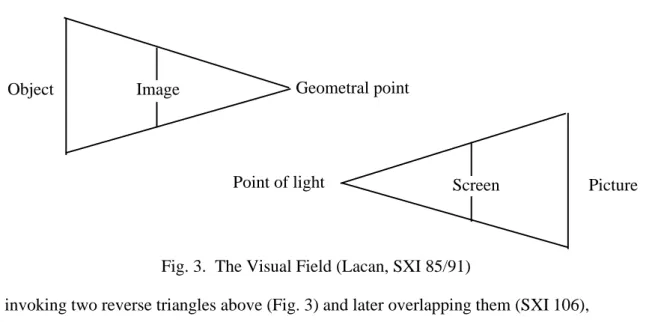
Geometral point Object
Point of light
Fig. 3. The Visual Field (Lacan, SXI 85/91) Screen Image
Picture
invoking two reverse triangles above (Fig. 3) and later overlapping them (SXI 106), Lacan proceeds to explain why, in the first triangle, perspectivism as upheld by the
Cartesian seeing paradigm is never visuality at all (SXI 94), which can only be realized by the function of the scopic drive in the second triangle (SXI 102). The point of light is where the gaze of recognition is situated, as is the gaze of the dead child's in Freud's "burning child dream," who recognizes, as it were, in the father's dream the guilt of the father by painfully pressing him with the question, "Father, don't you see I'm burning?" (1900a 509). Too painful to see the glaring scene, the father wakes up and continues to dream in his consciousness, whose function is to shield him from his child's soliciting gaze (Lacan, SXI 70; Z˘ iz˘ ek 45). One major "philosopheme" Lacan has derived for this “gaze” is the Kantian category of transcendental idea,24 which by definition lies beyond the realm of experience but nevertheless upholds that experience, including the visual one (Kant 533; Zupanc˘ ic˘ 54). Whereas this transcendental dialectic works to form our identity as in the “burning child dream,” any possible “hijacking” of the gaze25 ____________________________________
24 Lacan himself acknowledges the reference to Kant's "transcendental categories"
in the concept of the "gaze," but also disputes them on account of the fact that he (Lacan) is here dwelling on "the splitting of the being," of the subject (SXI 106).
by Fascism, for instance, will railroad us to the gas chamber, conforming to Theodor Adorno’s otherwise obscure dictum in Negative Dialectics that “Auschwitz confirmed the philosopheme of pure identity as death” (362; emphasis added).26 Should his paternal identity be realized by the gaze, the father of the burning child would also have been dead. Yet he is already as good as dead even by dodging this gaze in his consciousness, since it is there that he turns into a signifier, a stain in the picture of the second triangle, “in the form of the screen” (SXI 97). There the subject is written by the light, is photo-graphed (SXI 106): Wo Es war, so Ich werden27--where the light was, there I, as a signifier, shall Jeremy Bentham’s panoptic device in his essay ("Jeremy" 4), which is more Althusserian than Lacanian.
26 It is also in this manner that we come to understand this remark on race and
gender by Mary Ann Doane:
When Fanon claims that the black represents to the white the body, the biological, or corporeality in all its specificity, when he speaks of the hypersexualization of the black or of a kind of paranoia of the visible
attending an identity chained to appearance, it is difficult not to recognize
these categories as playing an important role within feminist analysis (particularly feminist film theory) where they have been applied to the situation of the woman and her representation/self-representation. Both
the woman and the black would be, in a sense, overvisible. ("Dark
Continents" 231; emphasis added)
27 "Where id [It] was, there ego [I] shall be" (Freud, 1933a[1932], 86/80). This
much quoted remark, though intending to explain the relation of the ego and the id, is in fact more ambiguous and abstruse in German. See Lacan's various reinterpretations through his word play on this remark (SXI 44-45). My quote here, however, does not attempt a new definition of the ego and the id.
be, for my ontological being is, under the decree of language, declared dead. Otherwise, this being will be an unbearable one to experience jouissance in the form of anamorphosis within the visual field, when the scopic drive surges, as it were, into death drive by
encountering its object a as the gaze (as that of the burning child's). So long as this gaze is not met, the subject is happy under the sway of symbolic order, accepting ultimate enjoyment (jouissance) as an impossibility. Since desire is founded on such a
prohibition, it is an impasse (Miller, "Commentary" 425-26; Fink, "Desire" 38), and is particularly so in the scopic field.
Sexual identity, so far as it does not remain just an "identity" but is also rooted in the structure of “sexuation,” must extend beyond the scope of this scopic experience of transcendental dialectic and be constructed elsewhere.28 However, given that the process of identification has been involved, gender identity is also subjected, in part, to this experience, to the gaze of recognition that is equally ferocious as shielded behind the mirror image called Henri B., the "image" in the first triangle.29 It is in this sense that ____________________________________
28 As attested by Mary Ann Doane, it is "difficult [ . . . ] to see how Lacan's gaze
can shed light on the analysis of sexual difference" ("Remembering Women" 279n14).
29 Rosalind Krauss, while referring to Joan Copjec's essay, "The Orthopsychic
Subject," admits that there is a "distinction between film theory's 'male gaze' and Lacan's 'gaze as object à [sic.]' (Krauss 109n46). Amelia Jones soon dismisses Krauss of
"devaluing feminism" in such an understanding of the "gaze" concept (Jones, "Tracing the Subject" 52n19). To resolve the matter, however schematically, we must bear these facts in mind: that in the theory of "male gaze" the borrowing from Lacan is readily apparent, despite some intellectualization involved; that so far as it is also a
transcendental--Kantian--"gaze of recognition," the function of "male gaze" follows the logic of Lacanian conceptualization; but also that it has not exhausted the critical edge of the latter by taking into account the concept of the unconscious. If, instead, this concept
Sophie's masquerade takes on, among other things, the function of mimicry to become part of the picture effected by the impending light in the second triangle. There is, in masquerade, a sexual finality in its own right (SXI 100), but it being so, the subject is also mortified by being "photo-graphed" in the Lacanian sense. The most a subject can do in this scenario is, ironically, to be "sutured”: to experience the "moment of seeing," of looking back, as "a conjunction of the imaginary and the symbolic" or
"pseudo-identification," in which the real (the gaze) is, so to speak, warded off (SXI 117-18). Again, we are brought back to the Lacanian algorithm of phantasy as S/ <>a,
the impasse of desire. If, on the other hand, mirror identification has indeed taken place in this scenario, in the imaginary order, what arises as a problem is precisely Sophie's too successful an identification with Henri B. in which masculinity, and gender in general, cannot but become an enigma. Enigma because she does not understand why, after her successful identification, she is still not a man. Apparently, we cannot limit ourselves to visuality, and thereby sutured identity or identification, to account for Sophie's
subsequent "detour" to Venice, let alone her "masquerade" there.
A way out--literally, from the imaginary order--is to look into the nature of this scopic drive more attentively. At this point an important theoretical shift in Lacan's account of the drive, taking place in Seminar XI (1964) where he also conceptualizes the gaze, deserves a closer look. According to Bruce Fink, the shift has been the one
can be used as its major theoretical reference, the theory of "male gaze" will be unlikely, in particular, to take "ego," "identification," or "consciousness" as its counter-measure to the impending gaze, with the result which can only be phantasy (S/ <>a); nor will it believe that, as we stated a while ago, sexual identity is to be constructed predominantly on this (visual) level. In other words, if there is a theoretical distinction as Krauss has described it, it must be the epistemological one between the Cartesian paradigm and the Freudian one, not between the feminist and anti-feminist.
moving from the drive correlating to the Other's demands to the drive encircling the object a. He adds,
This might be understood as a change in Lacan's theorization of the drive itself--that is, one might think that by 1964 he believes that the drive is never related to the Other's demand, neither before nor after analysis--but I think it is better understood as the transformation the drive undergoes in the course of analysis. Subjugated first by the Other's demands and then by the Other's desire, the drive is finally freed to pursue object a. ("Desire" 39)
This shift, despite Fink's defense in analytic terms, soon creates, I think, a difficulty in Lacan in that he has to define scopic drive as a special kind of drive that has nothing to do with demand (SXI 104).30 What Fink means to reconcile is the definition of the drive before 1964 as S/ <>D, where D stands for demand (Lacan, "Subversion" 314), and after. When the emphasis now is teleology, this a as jouissance, what is established is then a ____________________________________
30 A major reason for Lacan to consider the scopic level, along with the
invocatory one, as the level of desire is that the drives functioning there do not arise out of the need, such as nutritional consumption, but out of castration (-φ), bypassing the pregenital demand (“Introduction to the Names-of-the-Father Seminar” 87). The
parallel here to Hegel's Aesthetics is striking: “the sensuous aspect of art is related only to the two theoretical senses of sight and hearing, while smell, taste, and touch remain excluded from the enjoyment of art. For smell, taste, and touch have to do with matter as such and its immediately sensible qualities [ . . . ]. What is agreeable for these senses is not the beauty of art” (38-39). In turn, Lacan never fails to relate scopic drive to the perception of artwork as in Seminar XI, and he even seriously considers at one point in Seminar VII what "the end of art" would be in terms of this drive (141). We will come back to this issue at the end of this paper.
non-relation to the Other, and for this reason "the solitary status of jouissance" as phallic is also established (Miller, "Drive" 20). This understanding in turn goes perfectly well with Lacan's formulation of the scopic drive, kernel to the castration (notated as -φ) on the scopic level (SXI 89, 104-5), with the only kind of jouissance, anamorphosis, being possible there as essentially phallic (SXI 88-89). Jacques-Alain Miller, by tracing the genealogy of the drive backwards from jouissance to demand, finds that what remains kernel to the drive after Lacan's conceptual shift is still "the signifying cut," which, Miller adds, is what "one finds present in the Freudian concept of the erogenous zone as in the concept of the partial drive" ("Drive" 23). It is from here Miller deduces that "the drive is speech," "a signifying chain," and that Lacan subsequently "leaves this concept of the drive to the side, and extracts jouissance from it." It is in this manner that the Freudian concept of the drive breaks conceptually, as it were, into halves as language and
jouissance in Lacan's formulation (Miller, "Drive" 24).
Such a "total assimilation of the drive to a signifying chain," though allowing Lacan to tackle the relation of drive and jouissance in a more direct manner (that is, to "extract jouissance from it"), is not without a problem, despite Lacan's cautious treatment in this particular obscure zone (Miller, "Drive" 25-26). For example, precisely what Lacan means by the "driven signifiers" (signifiants pulsionels) or "the driven signifying chain" (la chaîne signifiante pulsionelle) is not fully developed (Miller, "Drive" 25). Yet again, as Miller points out above, this thesis of the drive as speech in fact comes closer to the Freudian conceptualization when the signifying cut as castration, responsible for the advent of "erogenous zone," is highlighted.31 There demand must have a place, even the demand of love, which alone has a relation with the Other. After the conceptual shift, the stress has slid rather to the destiny of the drive, despite the "signifying cut" being the major cause of this drive. Still, what links together the concept of the drive before and ____________________________________
after the Lacanian shift is castration. The aim of analysis, then, as inferred from Fink's words just quoted, would be to put castration back in the proper place, in where it should be, and to (only) allow the drive be directed to the object a. What is foregrounded is then the relation with the other (S/ <>a), not with the Other (S/ <>D). As a consequence of this shift, though conforming to the logic of analysis, one is forced to choose either desire or phallic jouissance, and on the scopic level, suture or anamorphosis. This forced choice alone becomes presumably a criterion to judge whether an analysis has been well carried out.
Still we find that the thesis of the drive as speech cannot be overlooked, for this is where the "communication" with the Other can again be linked up, a "communication" even in the sense of analysis. Along with this thesis, the modus operandi of the scopic drive also has to be speech, not visuality; or rather, it is visuality defined in terms of speech.32 So long as the relation to the Other is maintained and, in fact, persists,
demand can (at least in the logical sense) be transformed into the scopic drive that, on the other hand, also maintains a relation with the Other as the "treasury of signifiers," namely, with S(A/ ) (Miller, "Drive" 25).33 From here we can link the scopic drive to the context in which Safouan has conceptualized the pure Demand of the daughter. "At the
____________________________________
32 "Semiotics, not optics," thus goes Copjec's comment on the Lacanian
"photo-session" in Seminar XI, "is the science that enlightens for us the structure of the visual domain. Because it alone is capable of lending things sense, the signifier alone makes vision possible" ("Orthopsychic Subject" 34).
33 S(A/ ) is taken here by Miller, following Lacan, to be a "quilting point" where
"the total assimilation of the drive to a signifying chain" takes place in Lacan's "Graph of Desire" (Miller, "Drive" 25). Probably the most complicated Lacanian matheme of all, S(A/ ), literally "the signifier of the lack of the Other," takes on different meanings when Lacan's thinking evolves (Fink, Lacanian Subject 195n36). See also footnote 36 below.
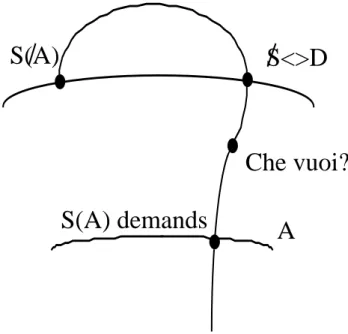
moment," he says, referring to the graph below, "when the subject articulates the first demands [in language after castration], the field of pure want has already been transformed by these objects [the most notable of which is the phallus, the master
signifier] into the field of the drives: S/ <>D" (134). That is, demand must become the drive and can only be "communicated" by it and as such, as indicated by the upper and final portion of the big question mark in Che vuoi?, which ends in S(A/ ):
S(A) demands
A
S<>D
Che vuoi?
S(A)
Fig. 4. The Graph of Desire (partial) (Safouan 132)34
By reaching this point, the scopic drive, so far as it has a relation with the Other, must have a stake in the lack of the Other (A/ ), or Mother, and that, to say the least, this drive is the logical outcome, as well as the eventual stage, of the daughter's Demand leading and responding to what the Other wants. So far as it is the drive, it may not be necessarily scopic, but we have stuck to the scopic level mainly because Sophie's quest, ____________________________________
34 This is Safouan's simplified version of Lacan's completed "Graph of Desire"
("Subversion" 315), where Lacan also comments on the "question-mark" (312). Minor corrections of Safouan's graph have been made by myself.
aided and facilitated by her still camera (we will come back to this), also takes place in the scopic field, which we have been led to consider as simply imaginary. We may therefore overlook the fact that it is her urging demand, or rather Demand, that has turned to phantasy (S/ <>a) in the scopic field for an ad hoc solution to her quest as substantiated
in her "detour" to Venice. She has, as a result, discovered nothing, not even with her good eyesight; facing this wall called the phantasy, her scopic drive is instead gravely pacified, encircling the object a without ever meeting it. This makes her demand even more an unsettling matter, subsisting nevertheless in her phantasy.
Now phantasy is not a peaceful event, on the other hand. It is equally unsettling, as in these words by Fink:
Fantasy is the attempt to bring the two elements of choice--the subject of language and jouissance--together [ . . . ]. Fantasy thus attempts to overcome the either/or, the choice responsible for the advent of the subject and for a loss of satisfaction; it stages the attempt to reverse that loss. ("Desire" 50n26)
So far as the subject is barred by language (S/ ), this loss (of jouissance) is filled up by words, words, words. Yet we must also take this scenario as arising from the
"signifying cut"--as being related to Demand. Precisely because Demand has no place in this phantasy scenario that we must throw the nature of scopic drive into question by asking whether another important aspect of the drive has been forgotten, which is its nature as speech. It is in this sense that, as we have said earlier, the drive provides us a way out of the imaginary scenario, particularly of phantasy, in the scopic field.
If we should at this point shove aside Miller's radical deduction of the drive as speech, then the notion of the drive that is left to us--the one that is not "communicative" but has object a as its sole destiny--would fall short of unfolding to us the whole story about jouissance. Referring again to the graph above, it is clearly defined that the drive in the final trajectory of the question mark succeeds, and in fact originates from, demand.
If there is pure Demand at all in Safouan's sense, it must then survive castration by becoming the drive, yet not the kind of drive as we know it that encircles the object a, with phallic jouissance as its one and only destiny. This soon lays, I think, the logical ground for feminine jouissance as the jouissance of the Other, notated as S(A/ ), to arise, which has its root in pure Demand.35 On the other hand, since "surviving" castration does not mean, in psychoanalysis, that castration is "overcome" or "abolished," but first and foremost that castration is reaffirmed as a necessity, pure Demand would not then become the drive without this castration. It is in this light that Miller approaches this obscure remark of Lacan's on the very last page of "Subversion of the Subject":
"Castration means that it is necessary that jouissance be refused so that it can attain the opposite side of the law of desire" (qtd. in Miller, "Drive" 28).36 Miller's gloss is: "It is necessary that phallic jouissance be refused, it is castration--so that the jouissance of the Other, her, can be attained" ("Drive" 28). I would add: phallic jouissance has to be refused through castration, so that the drive can "communicate" with the Other and retain there its status as pure Demand. Otherwise, without this "communicative" drive, the feminine jouissance qua the jouissance of the Other would be unimaginable.
However, there can be several "different modes of renunciation of phallic ____________________________________
35 That is to say, S(A/ ) will have to mean here the signifier of the primordial loss
in a subject. Fink: "Symbols' meanings often evolve very significantly over time in Lacan's texts, and I would suggest that S(A/ ) shifts between Seminars VI and XX from designating the signifier of the Other's lack or desire to designating the signifier of the 'first' loss" (Lacanian Subject 114).
36 The modified translation quoted here is by Kirsten Stolte, the translator of
Miller's text, while Alan Sheridan's translation runs as follows: "Castration means that
jouissance must be refused, so that it can be reached on the inverted ladder (l'échelle renversée) of the Law of desire" (Lacan, "Subversion" 190/324).