行政院國家科學委員會專題研究計畫 成果報告
中文動詞詞彙語義網的建構:互動性評價動詞的研究
研究成果報告(精簡版)
計 畫 類 別 : 個別型 計 畫 編 號 : NSC 98-2410-H-009-036- 執 行 期 間 : 98 年 08 月 01 日至 99 年 07 月 31 日 執 行 單 位 : 國立交通大學外國語文學系 計 畫 主 持 人 : 劉美君 計畫參與人員: 碩士班研究生-兼任助理人員:張若梅 碩士班研究生-兼任助理人員:簡蔓婷 碩士班研究生-兼任助理人員:招彥甫 碩士班研究生-兼任助理人員:吳佳純 碩士班研究生-兼任助理人員:江姿儀 博士班研究生-兼任助理人員:胡佳音 報 告 附 件 : 出席國際會議研究心得報告及發表論文 公 開 資 訊 : 本計畫可公開查詢中 華 民 國 99 年 10 月 31 日
行政院國家科學委員會補助專題研究計畫 成果報告
中文動詞詞彙訊息網的建構:互動性評價動詞的研究
計畫類別:
個別型計畫
計畫編號:
NSC 98-2410-H-009-036
執行期間:
98 年 08 月 01 日至 99 年 07 月 31 日
執行單位:國立交通大學外國語文學系
計畫主持人:國立交通大學外文系 劉美君 教授
計畫參與人員:胡佳音、張若梅、簡蔓婷、招彥甫、吳佳純、
江姿儀
報告類型:精簡報告
報告附件:出席國際學術會議心得報告
處理方式:本計劃可公開查詢
中 華 民 國 99 年 10 月 2 日
I
行政院國家科學委員會專題研究計畫研究報告─精簡版 中文動詞詞彙訊息網的建構:互動性評價動詞的研究 Construction of the Mandarin VerbNet: Verbs of Judgment
計畫編號:NSC 98-2410-H-009-036 執行期限:98 年 08 月 01 日至 99 年 07 月 31 日 主持人:國立交通大學外文系 劉美君 教授 計畫助理:胡佳音、張若梅、簡蔓婷、招彥甫、吳佳純、江姿儀
摘要
本研究以Fillmore和Atkins(1992)提出之「框架語意理論」(Frame semantics)及 Liu和Chiang(2008)之「中文動詞語意網之架構」為本,觀察語料中漢語內在評價 動詞,如同意、相信、懷疑、輕視、支持、反對等,並以其語意、語法表現,進 行「框架」分類並解決框架語義理論中極少提及的多元承繼的跨類現象。 關鍵字:中文動詞詞網、詞彙語意、框架語意、內在評價動詞、跨類現象Abstract
Based on Frame Semantics (Fillmore & Atkins 1992) and the Framework of Mandarin VerbNet (Liu & Chiang 2008), this study attempts to explore Mandarin Internal Judgment verbs, such as xiangxin ‘believe’, huaiyi ‘doubt’, zhongshi ‘value’,
qingshi ‘belittle’, zhichi ‘support’, fandui ‘be opposed to’, and tongyi ‘agree’.
Through this study, in addition to providing a systematic analysis for Mandarin Internal Judgment verbs, the issue about cross-domain lemmas can be solved.
Key words: Mandarin VerbNet, Lexical Semantics, Frame Semantics, Mandarin
1 1. Introduction
1.1 Goal of Research
This study attempts to categorize a set of Mandarin Internal Judgment verbs through Frame Semantic analysis based on the observation from the corpus. In addition, the Certainty frame in Cognition domain (Hu 2007) also denotes a kind of epistemic judgment and can be categorized as a basic frame under Internal Judgment primary frame. In other words, Certainty frame inherits the features from both Cognition domain and Judgment domain. Therefore, the relationship between Internal Judgment verbs and other domains is discussed in the study as well.
1.2 Literature Review
The study of lexical semantics has always been a hot issue in linguistic field. Rradical linguists of lexical semantics even believe that the meaning denoted in the lexicon determines its syntactic pattern. Many lexically-based information networks have been constructed, such as HowNet (Dong et al.), Sinica BOW (Huang et al.), and FrameNet (Baker, Fillmore and Cronin 2003). While all these networks are valuable, only FrameNet is based on Frame Semantics (Fillmore & Atkins 1992). However, the lexicon investigated on FrameNet is English only. Due to the uniqueness of each language, the same system may not necessarily fit into any languages. Moreover, the structure of FrameNet does not include analysis of interrelations of the proposed frames. To meet the gap, Liu and Chiang (2008) proposed a multi-layered hierarchical taxonomy:
Archiframe > Primary Frame > Basic Frame > Microframe
Based on the model, Mandarin Internal Judgment Verbs were classified into four Basic frames and seven micro frames.
1.3 Research Method
The FrameNet is adopted as the source of lemma extraction. Each English lemma is put into Sinica BOW (http://bow.sinica.edu.tw/wn/) and the Chinese equivalents are the basis of the analysis. By analyzing the semantic and syntactic properties of the verbs in each frame, they are further categorized into different but related frames.
2 2. Conceptual Schema of Judgment Archiframe
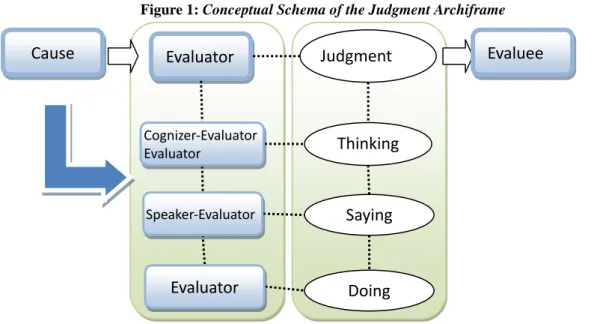
In Mandarin Judgment domain, the Evaluator can express the opinion by Thinking,
Saying, and Doing.
‧Thinking (Used in Internal Evaluation Primary Frame):我懷疑他說的話。 ‧Saying (Used in Verbal Evaluation Primary Frame):老師很稱讚他的報告 ‧Doing (Used in Internal Evaluation Primary Frame):我同意你離開。
Under Judgment Archiframe, the three examples respectively belong to Internal Evaluation primary frame and Verbal Evaluation primary frame. The following is the conceptual schema postulated to capture the cognitive essence of Judgment event.
Figure 1: Conceptual Schema of the Judgment Archiframe
In the conceptual schema, the Evaluator and the Evaluee are the most essential frame elements in Judgment domain. The Evaluator is the one who makes the judgment on the Evaluee; the Evaluee is the target about whom/which a judgment is made. In addition to the two frame elements, the judgment event may have a Cause.
3 Frame-based Analysis
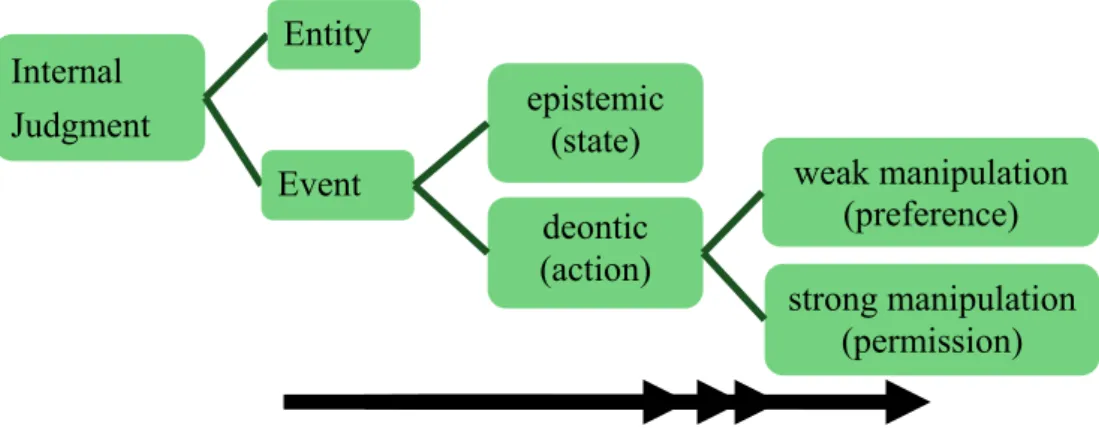
3.1 The Hierarchical Structure of the Judgment Verbs
Figure 2: Frame Relations of Judgment Verbs
Cause Evaluator Judgment Evaluee
Thinking Saying Doing Speaker‐Evaluator Cognizer‐Evaluator Evaluator Evaluator
3
3.2 Layer 1: Judgment Archiframe
Definition: An Evaluator makes a judgment on an Evaluee. The judgment may be positive or
negative and can be either Verbal or Non-Verbal (Internal) evaluation.
Representative Lemma: 同意tongyi ‘agree’、稱讚chengzan ‘praise’ Frame Element: Evaluator, Evaluee
Defining Patterns: Evaluator < * < Evaluee: 我 同意/稱讚 他。 3.3 Layer 2: Primary Frame
Judgment archiframe can be classified into two primary frames based on the way of judgment—Verbal and Non-Verbal (Internal). For Verbal Evaluation, Saying is the only way to express one’s attitude. For non-Verbal judgment, i.e. Internal Evaluation, Thinking and
Doing can be the ways for judgment expression. The verbs in Internal Evaluation frame
depict one’s inner attitude toward an event or an entity. When we have some kind of opinion in our mind, we keep that opinion in mind instead of speaking out.
Definition: Verbs in this frame describe an Evaluator who has an Internal Evaluation toward
an Evaluee. Generally, there is a potential Cause in the Internal Evaluation event.
Representative Lemmas:
看重 kanzhong ‘think highly of’、看輕 kanqing ‘look down on’、看扁 kanbian ‘look down on’、看好 kanhau ‘look on…as good’、重視 zhongshi ‘value’、珍視 zhenshi ‘highly value’、 鄙視 bishi ‘despise’、蔑視 mieshi ‘scorn’、輕視 qingshi ‘belittle’、藐視 miaoshi ‘defy’、瞧 不起 qiaobuqi ‘look down upon’、瞧得起 qiaodeqi ‘think much of’、看不起 kanbuqi ‘look down upon’、看得起 kandeqi ‘have a good opinion of’、否定 fouding ‘deny’、否決 foujue ‘reject’、信任 xinren ‘trust in’、信賴 xinlai ‘count on’、尊重 zunzhong ‘esteem’、尊敬 zunjing ‘respect’、珍惜 zhenxi ‘treasure’、愛惜 aixi ‘cherish’、認同 rentong ‘be identify with’、欣 賞 xinshang ‘appreciate’、賞識 shangshi ‘appreciate’、仰慕 yangmu ‘admire’、敬佩 jingpei ‘esteem’、欽佩 qinpei ‘admire’, 同意 tongyi ‘agree’、贊成 zancheng ‘approve’、贊同 zantong ‘endorse’、反對 fandui ‘be opposed to’、支持 zhichi ‘support’、肯定 kending ‘affirm’、相 信 xiangxin ‘believe’、深信 shenxin ‘deeply believe’、確信 quexin ‘sure’、確定 queding ‘sure’、懷疑 huaiyi ‘doubt’、質疑 zhiyi ‘suspect’
Core Frame Elements: Evaluator, Evaluee, Cause
The Defining Patterns of Internal Evaluation Primary Frame
a. Evaluator [NP]< * < Evaluee [NP][VP][CL] (Transitive) [他的母親/Evaluator]很信任[他/Evaluee]。
b. Evaluee [NP][VP][CL] < Evaluator [NP] < * (Obj. preposing) 對於[這個議題的處理/Evaluee],[黨中央/Evaluator]完全尊重。
c. Cause[NP][VP][CL] < 令/讓/使/教 < Evaluator[NP] < *< Evaluee [NP][VP][CL] [你的表現/Cause]也讓[我們/Evaluator]重新認識自己、看重[自己/Evaluee]。
3.4 Layer 3: Basic Frame
4
Internal Evaluation frame, lemmas in Certainty frame and Attitude frame express the judgment by Thinking; in Self-Permitting and Preference, by Doing.
3.4.1 Certainty Frame
Definition: Verbs in this frame describe the Evaluator’s epistemic judgment. It concerns an
Evaluator’s Degree of certainty about the correctness of an Evaluee_belief.
Lemma: 同意tongyi ‘agree’、肯定kending ‘affirm’、相信xiangxin ‘believe’、深信shenxin
‘deeply believe’、確信quexin ‘sure’、確定queding ‘sure’、懷疑huaiyi ‘doubt’、質疑zhiyi ‘suspect’
Frame Elements: Evaluator, Evaluee_belief, Cause Defining Patterns: a. Evaluator [NP] < * < Evaluee_belief [CL][NP] [我/Evaluator][相信/Certainty][學醫的也有很迷信的/Evaluee_belief], b. Evaluee_belief [CL][NP] < * < Evaluator [NP] [他說的話/Evaluee_belief][我/Evaluator]很[懷疑/Certainty]。 c. Evaluee_belief [CL][NP] < 令/讓/使/教 < Evaluator [NP] < * [你還活著/Evaluee_belief],真令[人/Evaluator]難以[相信/Certainty]!
d. Cause [NP][VP][CL] < 令/讓/使/教 < Evaluator[NP] < * < Evaluee_belief[CL] / Evaluee_belief [CL][NP]
[劉學強平日行止怪異/Cause],一度令[警方人員/Evaluator][懷疑/Certainty][他有精 神上的疾病/ Evaluee_belief]。
3.4.2 Attitude Frame
Definition: Verbs in this frame describe an Evaluator’s affective judgment directly toward an Evaluee_person or Evaluee_entity. Sometimes, there may be a Reason which leads to an evaluation.
Lemma: 看重 kanzhong ‘think highly of’、看輕 kanqing ‘look down on’、看扁 kanbian ‘look
down on’、看好 kanhau ‘look on…as good’、重視 zhongshi ‘value’、珍視 zhenshi ‘highly value’、鄙視 bishi ‘despise’、蔑視 mieshi ‘scorn’、輕視 qingshi ‘belittle’、藐視 miaoshi ‘defy’、瞧不起 qiaobuqi ‘look down upon’、瞧得起 qiaodeqi ‘think much of’、看不起 kanbuqi ‘look down upon’、看得起 kandeqi ‘have a good opinion of’、否定 fouding ‘deny’、否決
foujue ‘reject’、信任 xinren ‘trust in’、信賴 xinlai ‘count on’、尊重 zunzhong ‘esteem’、尊
敬 zunjing ‘respect’、珍惜 zhenxi ‘treasure’、愛惜 aixi ‘cherish’、認同 rentong ‘be identify with’、欣賞 xinshang ‘appreciate’、賞識 shangshi ‘appreciate’、仰慕 yangmu ‘admire’、敬 佩 jingpei ‘esteem’、欽佩 qinpei ‘admire’, 同意 tongyi ‘agree’、贊成 zancheng ‘approve’、 贊同 zantong ‘endorse’、反對 fandui ‘be opposed to’、支持 zhichi ‘support’
Frame Elements: Evaluator, Evaluee_person, Evaluee_entity, Reason, Cause Defining Patterns:
a. Evaluator [NP]< * < Evaluee_person/Evaluee_entity [NP] [他的母親/Evaluator]很[信任/Attitude][他/Evaluee_person]。
5
[我/Evaluator][同意/Attitude][你的看法/Evaluee_entity]。
b. Evaluator [NP]< * < Evaluee_person/Evaluee_entity[NP] < Reason [VP] [我/Evaluator][敬佩/Attitude][他/Evaluee_person][態度積極/Reason]。 c. Evaluee_person/Evaluee_entity [NP] < Evaluator [NP] < * d. Evaluator [NP] < 對 < Evaluee_person/Evaluee_entity [NP] < * [我/Evaluator]對[這幅畫/Evaluee_entity]十分[欣賞/Attitude], e. Evaluee_person/Evaluee_entity [NP] < 令/讓/使/教 < Evaluator [NP] < * [她的表現/Evaluee_entity]也讓[總公司/Evaluator][賞識/Attitude], f. Cause[NP][VP][CL] < 令 / 讓 / 使 / 教 < Evaluator[NP] < * < Evaluee_person/Evaluee_entity [NP] [你的表現/Cause]也讓[我們/Evaluator][看重/Attitude][自己/Evaluee_person]。 g. Evaluee_person/Evaluee_entity[NP] < 被/為/受 (< Evaluator[NP]) < (所) * [這個行業/Evaluee_entity]仍然不很被[看重/Attitude]。 3.4.3 Self-Permitting frame
Definition: Verbs in this frame describe an Evaluator’s deontic intention to an action, which
is irrealis and is supposed to be done by the Evaluator himself.
Lemma: 同意tongyi ‘agree’、贊成zancheng ‘approve’、贊同zantong ‘endorse’、反對fandui
‘be opposed to’、不屑buxie ‘distain to do something’、不恥bushi ‘be ashamed to do something’
Frame Elements: Evaluator, Evaluee_act, Cause Defining Patterns:
a. Evaluator [NP] < * < Evaluee_act [VP]
[我/Evaluator][同意/Self-Permitting][讓步/Evaluee_act]。 b. Evaluee_act[VP] < Evaluator[NP] < *
對於[參加這個會議/Evaluee_act],[他/Evaluator]並不是非常[贊成/Self-Permitting]。 c. Cause[NP][VP][CL] < 令/讓/使/教 < Evaluator[NP] < * < Evaluee_act[VP]
[這件事情的發生/Cause]讓[我/Evaluator][不恥/Self-Permitting][與你共事 /Evaluee_act]。
3.4.4 Preference frame
Definition: Verbs in this frame describe an Evaluator’s deontic preference to an
Evaluee_potential situation, which is irrealis. In this basic frame, the Evaluator may have authority to control the realization of Evaluee_potential situation.
Lemma: 同意tongyi ‘agree’、贊成zancheng ‘approve’、贊同zantong ‘endorse’、反對fandui
‘be opposed to’、支持zhichi ‘support’
Frame Elements: Evaluator, Evaluee_potential situation, Cause Defining Patterns:
a. Evaluator < * < Evaluee_potential situation
6
[媽媽/Evaluator][同意/Preference][我出門/Evaluee_potential situation]。 b. Evaluee_potential situation[VP] < Evaluator[NP] < *
[華南金控與第一金控合併/Evaluee_potential situation],即便[一銀工會/Evaluator]也不 [反對/Preference];
c. Cause[NP][VP][CL] < 令/讓/使/教 < Evaluator[NP] < * < Evaluee_potential situation [我們應以行動/Cause],讓他們[同意/Preference][我們成為會員/Evaluee_potential situation],
3.5 Layer 4: Microframe
3.5.1 Microframes under Certainty Frame
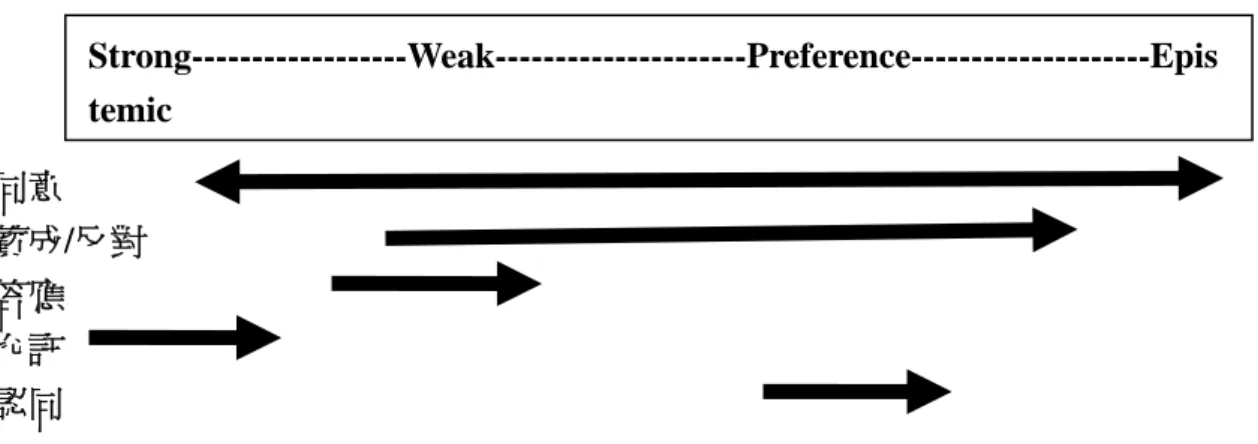
The lemmas in Certainty can be differentiated by their strength of epistemic certainty. Strong lemmas (同意tongyi ‘agree’、肯定kending ‘affirm’、確信quexin ‘sure’、確定queding ‘sure’) may be collocate with 已經yijing ‘already’、必然biran ‘must’; Weak lemmas (同意 tongyi ‘agree’、相信xiangxin ‘believe’、深信shenxin ‘deeply believe’、懷疑huaiyi ‘doubt’、 質疑zhiyi ‘suspect’) collocate with 可能maybe ‘keneng’、或許huoxu ‘perhaps’ more often. a. [我/Evaluator][確定/Certainty][中方必然清楚此一立場/Evaluee_belief]。
b. [我/Evaluator][懷疑/Certainty][他可能回家了/Evaluee_belief]。
3.5.2 Microframes under Attitude Frame
In Attitude frame, there are three microframes: Think_highly_of-Look_down_on frame, Value-Disvalue frame, and Inchoative_Attitude frame. Collocation, role internal feature, and aspectual marker can be used to differentiate those frames, as shown in Table 10.
Table 1: the Summary of the Three Microframes under Attitude Basic Frame Microframe Ba
construction
Imperative Reason The feature of Evaluee Aspectual marker Le Think_highly_of- Look_down_on ✓ ✓ ✓ most animate ✗
Value-Disvalue ✗ few More most animate ✗
Inchoative_Attitude Rare ✓ ✓ most inanimate ✓ 3.5.3 Microframes under Preference Frame
(1) Strong Preference microframe: verbs collocating with 立刻like ‘immediately’、馬上
mashang ‘right away’ with higher frequency. In addition, it may contain the construction
經(過) < Evaluator < *. In the corpus, it also can be found to function as “speech act” verb with relatively higher frequency. Therefore, it is more common for the agent in the clause preceded by 同意tongyi ‘agree’ to be second pronoun and the Evaluator to be first pronoun.
Lemma: 同意tongyi ‘agree’
a. Evaluee_potential situation < 經(過) < Evaluator < *
[學生請假/Evaluee_potential situation]要經過[學校/Evaluator]同意。 *學生請假要經過學校 贊成/贊同/反對/支持。
7
b. Collocation with 立刻like ‘immediately’、馬上mashang ‘right away’ 我同意你立刻離開。
c. It is more common for the agent in the clause preceded by 同意tongyi ‘agree’ to be
second pronoun and the Evaluator to be first pronoun.
我們同意你成為公司的一份子。
(2) Weak Preference microframe: verbs collocating with suggestive modal such as 應該
yingai ‘should’、最好zuihao ‘had better’ more often.
Lemmas: 同意tongyi ‘agree’、贊成zancheng ‘approve’、贊同zantong ‘endorse’、反
對fandui ‘be opposed to’、支持zhichi ‘support’
[他/Evaluator][同意/Preference][約翰應該要離開/Evaluee_potential situation]。
3.6 Polysemous Words v.s. Multiple Inheritances
Adopted the central idea of the framework of Mandarin VerbNet “one frame, one meaning”, 同意tongyi ‘agree’ is actually a polysemous verb since it can be settled in different frames:
‧Certainty Frame:[我/Evaluator][同意/Certainty][明天可能會下雨/Evaluee_belief] ‧Attitude Frame:[我/Evaluator][同意/Attitude][你的看法/Evaluee_entity]
‧Self-Permitting Frame:[我/Evaluator][同意/Self-Permitting][離開/Evaluee_act] ‧Preference:[我/Evaluator][同意/Preference][你離開/Evaluee_potential situation]
There are two kinds of multiple inheritances: balanced cross-categorial phenomenon and unbalanced cross-categorial phenomenon.
Balanced cross-categorial phenomenon means that a frame shares all the features in
both domains. The best example is Certainty frame, which can be categorized into either Cognition or Judgment because of different perspectives from the observer.
(1) Certainty frame in Cognition domain (Hu 2007)
[我/Cognizer]深深[相信/Certainty],[沒有諒解與寬恕的心,就沒有溫柔敦厚好禮的社會 /Content]。
(2) Certainty frame in Judgment domain
[我/Evaluator]深深[相信/Certainty],[沒有諒解與寬恕的心,就沒有溫柔敦厚好禮的社 會/Evaluee_belief]。
Unbalanced cross-categorial phenomenon means that a frame only shares a partial
feature from other domain. Attitude frame can serve as the example of unbalanced cross-categorial phenomenon because it also shares a partial feature from the Exp-Oriented primary frame in Emotion domain. We may figure that Exeriencer in Emotion domain can be tagged as Evaluator in Judgment domain, and Target can be tagged as Evaluee. However, in Judgment domain, lemmas seldom collocate with feel verbs such as 覺得juede、感覺
ganjue、感到gandao, which can be used to signal the existence of the experiencer.
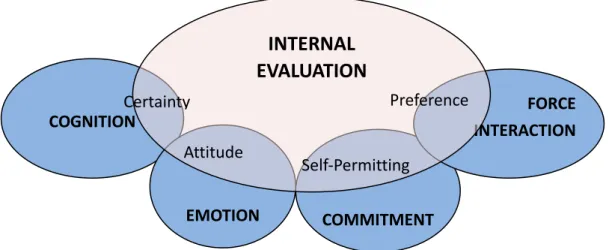
3.7 The Potential Cross-Categorial Phnemonon of Internal Evaluation
As for Self-Permitting and Prefernece frame, there may be potential issues. For example, the semantic of Self-Permitting is close to Commitment domain such as wish and want in
8
English and 打算dasuan ‘intend’ and 想要xiangyao ‘would like’ in Mandarin; Preference frame shares a partial feature from Force Interaction domain (e.g. 允許yunxu ‘allow’ and 准許zhunxu ‘permit’) which we are still in the process.
The following figure shows the intersection between Internal Evaluation and other domains.
Figure 3: The Intersection between Internal Evaluation and other Domains
In order to reflect the cross-categorial phenomenon, we did some revision for the name of frame elements:
The Tag Revision of the Four Basic Frames
a. Certainty frame (complete inheritance from Cognition)
[我/Evaluator][同意/Certainty][明天可能會下雨/Evaluee_belief]。
Î [我/Cognizer-Evaluator][同意/Certainty][明天可能會下雨/Content_belief]。 b. Attitude frame (partial inheritance from Emotion)
[我/Evaluator][同意/Attitude][你的看法/Evaluee_entity]。
Î [我/Evaluator][同意/Attitude][你的看法/Evaluee_entity]。(keep the same name) c. Self-Permitting frame (partial inheritance from Commitment)
[我/Evaluator][同意/Self-Permitting][離開/Evaluee_act]。 Î [我/Evaluator][同意/Self-Permitting][離開/Committed_act]。 d. Preference frame (partial inheritance from Force Interaction)
[我/Evaluator][同意/Preference][你離開/Evaluee_potential situation]。 Î [我/Elvauator][同意/Preference][你離開/Preferred_situation]。 COMMITMENT COGNITION EMOTION FORCE INTERACTION
INTERNAL
EVALUATION
Preference Self‐Permitting Certainty Attitude9 4. Conclusion and Discussion
Adopting the theory of Frame Semantic (Fillmore and Atkins 1992) and Mandarin VerbNet (Liu and Chiang 2008), this study classifies Internal Evaluation verbs into different basic frames and microframes based on the syntactic structures and internal semantic features. A multi-layered hierarchical structure helps us not only have a complete overview about verbs in the same domain but also prove the correlation between the semantic and syntax. Through the complete investigation of the primary frame in Judgment domain, Internal Evaluation frame, the polysemy of 同意 tongyi ‘agree’ can be distinguished. In addition, this study can function as a cross-domain case study which is seldom discussed in the field of frame semantics. Through multi-layered hierarchical structure, both polysemy and multiple inheritances of verbs can be revealed.
In fact, Judgment domain by nature is a semantically complicated category. For Internal Evaluation primary frame, each basic frame is cross-categorial. In addition to Internal Evaluation domain, verbs can inherit the feature from other domain such as Cogniion, Emotion, Commitment, and Force Interaction. The cross-categorial phenomenon is resulted from different perspectives from the observer instead of the polysemy of the verb.
For Internal Evaluation domain, potential issues needed to be investigated in the future are listed in the following:
z In this study it has been known that 同意 tongyi ‘agree’ is a polysemous word and can be settled in different basic frames under Internal Evaluation frame. However, for the four different usage of 同意 tongyi ‘agree’, which one is the original meaning? How does the original one extend to other meanings?
z In addition to 同意 tongyi ‘agree’, the polysemy can be seen from the lemmas such as 贊 成 zancheng ‘approve’、贊同 zantong ‘endorse’、反對 fandui ‘be opposed to’ which can be used in three basic frames under Internal Evaluation: Attitude frame, Self-Permitting frame, and Preference frame. Under Internal Evaluation, is there any relationship among the three basic frames?
References
Chang, Li-Li, Keh-Jiann Chen, and Chu-Ren Huang. 2000. Alternation Across Semantic Field: A Study of Mandarin Verbs of Emotion. In Yung-O Biq. (Ed.) Special Issue on Chinese Verbal Semantics. Computational Linguistics and Chinese Language Processing 5.1: 61-80.
Chiang, Ting-Yi. 2006. A Frame-based Corpus Approach to Mandarin Verbal Semantics: The Case with Mandarin Statement Verbs. M.A. Thesis. National Chiao Tung University. Cruse, Alan. 1986. Lexical Semantics. Cambridge: Cambridge University Press.
Fillmore, Charles J. 1971. Verbs of Judging: an exercise in semantic description. In Fillmore and Langendoen (eds.) Studies in Linguistic Semantics. New York: Holt, Rinehart & Winston. 272-289.
10
of RISK and its neighbors. Frames, fields, and contrasts, ed. by Lehrer, Adrienne and Eva Feder Kittay, 75-102. Hillsdale, New Jersey: Lawrence Erlbaum Associates.
Fillmore, Charles J., Josef Ruppenhofer, and Collin F. Baker. 2004. FrameNet and Representing the Link between Semantic and Syntactic Relations. Computational Linguistics and Beyond, ed. by Chu-Ren Huang and Winfried Lenders. Nankang:
Language and Linguistics.
Givón, Talmy. 1993a. English Grammar: a Function-Based Introduction. Volume 1. Amsterdam: John Benjamins.
---. 1993b. English Grammar: a Function-Based Introduction. Volume2. Amsterdam: John Benjamins.
Graeme Forbes. 2006. Attitude problems: an essay on linguistic intensionality. Oxford: Clarendon.
Grimshaw, J. 1990. Argument Structure. MIT press, Cambridge, MA.
Hong, Shih-Mei, 2009. A Frame-based Lexical Semantic Categorization of Mandarin Emotion Verbs. National Chiao Tung University. MA thesis.
Huang, Chu-Ren, Kathleen Athens, Li -Li Chang, Keh-Jiann Chen, Mei-Chun Liu, and Mei-Chih Tsai. 2000. The Module -Attribute Representation of Verbal Semantics: From Semantics to Argument Structure. International Journal of Computational Linguistics
and Chinese Language Processing . 5(1).19-46.
Huang, Shun-Jia, 2009. A Lexical Semantic Study of Mandarin "Feel" Verbs. National Chiao Tung University. MA thesis.
Hu, Jia-Yin, 2007. Conceptual Schema of the Cognition Domain: A Frame-based Study of Mandarin Cognition Verbs. National Chiao Tung University. MA thesis.
Longacre, R.E. 1996. The grammar of discourse. New York: Plenum Press.
Levin, Beth. 1993. English Verb Classes and Alternations. Chicago: Chicago University Press.
Levin, B. and M. Rappaport Hovav. 2005. Argument Realization. Research Surveys in Linguistics Series, Cambridge University Pres s, Cambridge, UK.
Liu, Mei-chun et al. 1999. Semantic Representation of Verbal Information:A case from Mandarin Verbs of Judging. Proceedings of the 12th Research on Computational Linguistics Conference, 87-100. Hsinchu: National Chiao-Tung University.
Liu, Mei-Chun. 2002. Mandarin Verbal Semantics: A Corpus-based Approach. 2nd ed. Taipei: Crane.
Liu, Mei-Chun. 2003. From Collocation to Event Information: the Case of Mandarin Verbs of Discussion. Language and Linguistics 4.3: 563-585.
Liu, Mei-chun and Ting-yi Chiang. 2008. The Construction of Mandarin VerbNet: A frame-based approach to the classification of statement verbs. Language and Linguistics 9.2: 239-270.
11
Semin, G. R. and Fiedler, K. 1988. The Cognitive Functions of Linguistic Categories in Describing Persons: Social Cognition and Language. Journal of Personality and Social
Psychology, 54, 558-568.
Tsai, Mei-Chih, Chu-Ren Huang, and Keh-Jiann Chen. 1996.From Near-synonyms to the Interaction between Syntax and Semantics. (由近義詞辨義標準看語意、句法之互動).
Proceedings of the Fifth International Symposium on Chinese Languages and Linguistics.
167-180. Taipei: National Chengchi University.
Tsai, Mei-Chih, Chu-Ren Huang, Keh-Jiann Chen, and Kathleen Ahrens. 1998. Towards a Representation of Verbal Semantics--An Approach Based on Near Synonyms.
Computational Linguistics and Chinese Language Processing. 3.1: 61-74.
Wu, Jia-Chun, 2010. The Polysemy of Tongyi ‘Agree’—The Analysis of Mandarin Internal and Actional Judgment Verbs from the perspective of Frame-based Lexical Semantics. National Chiao Tung University. MA thesis.
巫宜靜(Wu, Yi-Ching)、劉美君(Liu, Meichun) 2001. <心理動詞「想」、「認為」、「以 為」與「覺得」的語義區分及訊息表達--以語料為本的分析方法>,《第十四屆計算 語言學研討會論文集》,317-336 頁。臺南:成功大學。 湯廷池(Tang, Ting-chi) 2000. 漢語詞法論集台北:金字塔出版社。 張言軍(Zhang, Yan-Jun) 2005. <“同意”類動詞初探>,《唐山師範學院學報》,第27卷第 6期 Website Resources
Academia Sinica Bilingual Ontological WordNet (Sinica BOW): http://bow.sinica.edu.tw/
Academa Sinica Balanced Corpus of Modern Chinese (Sinica Corpus): http://www.sinica.edu.tw/SinicaCorpus/
Chinese WordNet: http://cwn.ling.sinica.edu.tw/ FrameNet: http://framenet.icsi.berkeley.edu/ Google: http://www.google.com.tw/
12
國科會補助專題研究計畫成果報告自評表
請就研究內容與原計畫相符程度、達成預期目標情況、研究成果之學術或應用價值(簡 要敘述成果所代表之意義、價值、影響或進一步發展之可能性)、是否適合在學術期刊 發表或申請專利、主要發現或其他有關價值等,作一綜合評估。1. 請就研究內容與原計畫相符程度、達成預期目標情況作一綜合評估
▓達成目標
□ 未達成目標(請說明,以 100 字為限)
□ 實驗失敗
□ 因故實驗中斷
□ 其他原因
說明:
2. 研究成果在學術期刊發表或申請專利等情形:
論文:□已發表 ▓未發表之文稿 □撰寫中 □無
專利:□已獲得 □申請中 ▓無
技轉:□已技轉 □洽談中 ▓無
其他:(以 100 字為限)
3. 請依學術成就、技術創新、社會影響等方面,評估研究成果之學術或應用價
值(簡要敘述成果所代表之意義、價值、影響或進一步發展之可能性)(以
500 字為限)
本研究採語料庫為本之統計分析完成中文評價動詞之語意區分。本研究
不但可擴展並改進現有「中文動詞語義網」、強化其訊息內容及涵蓋範圍,
且可發展框架語意理論下的認知轉換及多義性的分析及表徵原則,在中文動
詞語意研究上廣立根基、開創新局,對語言學、華語教學及自然語言剖析皆
有重大極深遠的影響。
NSC 98-2410-H-009-036 出席國際學術會議心得報告及論文(1/2)
國科會補助專題研究計畫項下出席國際學術會議心得報告
日期:99 年 10 月 08 日一、參加會議經過
學生從台灣桃園中正機場搭乘國泰航空公司之航班,經香港於舊金山轉機後,轉搭美國 AA 航空班機到波士頓羅根機場,參加由美國哈佛大學東亞系與語言學系聯合主辦之「國際中國語言 學學會第 18 屆年會暨北美洲漢語語言學第 22 次會議 (The 18th annual conference of the International Association of Chinese Linguistics (IACL-18) & The 22nd annual conference of the North America Conference on Chinese Linguistics (NACCL-22)」。國際漢語研究以 IsCLL、 NACCL 及 IACL 三大會議最盛大。學生此次出席之會議為 IACL-18 & NACCL-22 聯會,囊括語言學 功能/形式、理論/實驗等各次領域之研究討論,又因今年由美國語言學龍頭之一哈佛語言學系承 辦,實為漢語語言學界年度盛事。研討會為期三天,來自全球各地之學者、學生等與會者共兩百多位。大家齊聚一堂,百家爭 鳴,進行語言學研究的交流與分享。各場會議發表深入淺出,內容豐富多元,極具水準。此會議 共有四場主要講演,受邀之演講者均為享譽國際語言學界之專家學者,會議講演由美國賓州大學 語言學系 Anthony Kroch 教授開場,為大家帶來 “ Change and Stability in Diachronic Syntax"(歷時句法之動靜態研究)。首日末場由音韻大家林燕慧教授 (Professor Yen-Hwei Lin) 的 “Unexpected morphophological outputs"做結,第二天研討會以香港科技大學人文社會科 學學院丁邦新教授 (Professor Pang-Hsin Ting)的“漢語方言中的歷史層次"為大會提供歷 史語言學的分析面向。最後,三天會議中的最高潮莫屬美國哈佛大學李豔惠教授 (Professor Y.H. Audrey Li)帶來的精彩演說,講題為 “Deletion, phrase structures and constraints"。除 了精采絕倫的主題講演外,會議中另有青年學者獎競賽發表,總計共有超過 200 篇研究成果發表。
計畫編號
NSC 98-2410-H-009-036
計畫名稱
中文動詞詞彙訊息網的建構:互動性評價動詞的研究
出國人員姓名
研究生: 賴伊凡
服務機構及職稱
國立交通大學
會議時間
99 年 05 月 20 日
至
99 年 05 月 22 日
會議地點
美國 波士頓 哈佛大學
會議名稱
(中文) 國際中國語言學學會第 18 屆年會暨北美洲漢語語言學第
22 次會議
(英文) The 18th annual conference of the International Association of Chinese Linguistics (IACL-18) & The 22nd annual conference of the North America Conference on Chinese Linguistics (NACCL-22)
NSC 98-2410-H-009-036 出席國際學術會議心得報告及論文(1/2)
分組研討會採七個平行場次同時進行,主題豐富多元且分組細密。各場次由一位主持人 負責主持,並由四~六位發表人輪流發表論文,每位發表人有十七分鐘展演,八分鐘開放提問。 各場聽眾皆踴躍發問及討論,氣氛熱絡。學生就自身興趣及個人研究領域相關的題目至各會場聆 聽發表,其中包含漢語句法與外力 (on the cleft construction in Mandarin Chinese 等)、詞 彙語意學 (詞彙、語法和認知的表達等)、句式語意介面 (動結式中動作 V1 和結果 V2 隱現的句 法條件等)、詞彙與詞源學 (漢語句子的疑和問等)等各主題。從發表者的分享與與會者的提問討 論之中學生獲益良多。 會議結束後於費城、紐約停留數日,拜訪旅居當地留學、研究的老師們等研究前輩及友 人,後搭乘國泰航空班機直飛香港,再轉機返回台灣。
二、與會心得
此次學生的論文藉由這次發表獲益良多,發表是在會議第三天早上進行的,因內容豐富, 報告時間為二十分鐘,包含七分鐘綜合討論時間。與會者提出了一些研究內容上的細節,並 提供了許多寶貴的建議和給予肯定,主要歸納為兩點:1) 就所觀察到的力學模型,除了漢語 和英語外,是否也能應用至世界其他之語言,例如日文、閩客等方言等? 學生相信力學抗衡 具備語言普遍性,在各語言中均為重要,但可能使用不同的語言符號或句法形式標記。針對 此部份我們仍以觀察漢語為主,但需隨時注意其他語言的表現與其比較。2) 對於本次研究報 告中例句 “我幫他結婚/選上總統",與會者希望能有其他更多例句佐證中文的動詞 “幫" 囊跨 “協助"與 “為誰施做"之語意。學生認為,我們採用中研院平衡語料庫之語料研究, 可再使用 Chinese word sketch 和 google search 搜尋例子,以為說明輔助並增加說服力。 然而,與會者多方回饋和建議幫助我們釐清了研究中不足的部分,同時省視自己未注意到的 盲點。 總的來說,此次會議橫跨語言學各領域,議題豐富多元,並促進與會者之交流、令 與會者得到許多學術上之啟發。次外,哈佛豐富的學術人文環境及波士頓、費城、紐約等各 歷史人文景觀確實開拓了學生的視野和心境,燃起學生對多元文化及語言研究之熱情。三、考察參觀活動(無是項活動者略)
四、建議
學生十分感謝國家科學委員會補助出席國際學術研討會。因為貴單位的支持與協助,學生才 得以參與此次國際語言學的大型會議盛宴,稍稍減輕過重的經濟負擔。因為這個機會,學生認識 了語言學界的各方學者與同好友人,互相交換學術意見與研究交流。另外出席國際會議也協助學 生增長見聞,拓展視野,見習西方學術研討之熱烈氣氛,並進行跨文化溝通。這次出席國際會議 的經驗,確實讓學生多方受益,也在各方面成長許多。學生滿心感謝,並希望院上能夠繼續提供 並增加這類的經費補助,對於有志於做學問的研究生而言,貴會之幫助除了能鼓勵研究發展,更 能協助年輕學者一圓研究發表之夢!五、攜回資料名稱及內容
六、其他
NSC 98-2410-H-009-036 出席國際學術會議心得報告及論文(1/2)
Force Dynamics and Social Interaction Verbs in Mandarin
Meichun Liu, Tzu-I Chiang, and I-Fan Lai
[email protected]; [email protected]; [email protected]
Institute of Foreign Literatures and Linguistics, National Chiao Tung University
Abstract
This paper explores the issues of force dynamics discussed in Talmy (2000) by investigating the social interaction verbs (SIVs) in Mandarin. The ways physical entities interact with each other in terms of force relations provide the conceptual bases for various causative relations. According to Talmy, force dynamics as a semantic category exhibits a directed force relation between two force-exerting entities. In the force interaction, “one force-exerting entity is singled out for focal attention, and the second force entity, correlatively, is considered for the effect that it has on the first, effectively overcoming it or not (Talmy 2000: 413). Several major force schemas were distinguished. Social interaction verbs in Mandarin, however, display a categorical complexity distinct from that of English in terms of force trajectory projections.
This study aims to investigate the possible range of force intentional trajectories distinguished and lexicalized in Mandarin as well as the constructional variations associated with each distinct lexicalization patterns.
Under the assumption that verb meanings are anchored in semantic frames with lexically- profiled specificities (Fillmore and Atkins 1992, Goldberg 2005), Mandarin SIVs are analyzed and re-constructed with a frame-based taxonomy, following the classificational scheme established in Liu and Chiang (2008) with an extendable hierarchy of semantic scopes: Archiframe > Primary frame > Basic frame > Microframe > Near-synonyms. It is proposed that the correlations of semantic properties and syntactic behaviors characteristic of Mandarin SIVs are triggered and modeled upon a number of extensional patterns of force interactions. By offering a cognitive semantic account, the study ultimately draws implications on the cognitive-linguistic correspondences pertaining to the domain of force relations for both language-specific and cross-linguistic generalizations.
Keywords: Social Interaction Verbs, Force Dynamics, Frame Semantics
1. Introduction
Many works on force dynamics (FD) manifestation on verbs propose that the ways physical entities interact with each other in terms of force relations provide the conceptual bases for various causative relations that may be lexicalized in a language (Talmy 1988, 2000; Chiang 2003). As distinct force relations in different semantic domains are exemplified in English (Talmy 1988, 2000; Wolff et al. 2002), German (Wolff et al. 2005), French ( Achard 2001) and the like, the studies of force relations in Mandarin focus more on the physical, psychological, and intrapsychological causation (Lai and Chiang 2003; Chiang 2003; Chang 2007); whereas verbs in social interaction domain are often left unspecified.
NSC 98-2410-H-009-036 出席國際學術會議心得報告及論文(1/2)
force relation in which an Antagonist is viewed as the opposite party exerting an effect on an Agonist. He further suggested that force-dynamics patterns incorporated in lexical items can bring many of them together into systematic relationships.
In light of Talmy’s theory, this study proposes the following three research questions. First, do those schematized force-dynamic patterns proposed by Talmy (2000) exist in Mandarin as well? In what way and to what extent are they lexicalized in Mandarin? Next, while applying the FD schemas to Mandarin, why is it difficult to decide the balance of strengths in the Chinese corresponding schemas? If the balance of strengths is not lexicalized nor indirectly implied in Mandarin verbs, how does Mandarin exhibit the relative strengths between the two force exerting entities? Finally, if FD, as Talmy suggested, is a unique semantic category and is capable of being extended to interpersonal domain, are there other possible social interactive relations left for further research? The three topics are of great importance because they not only provide evidences from Mandarin causative verbs in social interaction domain but also refine the force-dynamic schemas into a more complete mechanism by investigating Mandarin social interaction verbs (SIVs) in detail.
The purpose of this study is to explore the possible force relations distinguished and lexicalized in Mandarin as well as the constructional variations associated with each distinct lexicalization pattern. Under the assumption that verb meanings are anchored in semantic frames with lexically-profiled specificities (Fillmore and Atkins 1992, Goldberg 2005), Mandarin SIVs are analyzed and re-constructed with a frame-based taxonomy, following the classificational scheme established in Liu and Chiang (2008) with an extendable hierarchy of semantic scopes: Archiframe > Primary frame > Basic frame > Microframe > Near-synonyms. By offering a cognitive semantic account, this study presents a unified, frame-based, and corpus-based1classification to the study of SIVs in Mandarin and ultimately provides evidences to define force dynamics as a natural and unique semantic category in a cross-linguistic level.
The paper is sequenced in the following way. The first section illustrates the background information. The next section is the review of the literature. The third section exhibits the Chinese corresponding schemas and proposes a comparison between English and Mandarin. The forth section exhibits the unique force patterns in Mandarin SIVs, and they’re also the findings that motivate this research. The fifth section proposes a frame-based analysis of social interaction verbs in Mandarin based on the findings. Finally, the last section concludes the paper and proposes theoretical implications for further research.
2. Theatrical Frameworks
Talmy (2000) brings force dynamics to the attention of linguistic study by proposing that force
1 The present analysis is mainly based on the corpus data from Academia Sinica Balanced Corpus of Modern Mandarin
Chinese simplified as Sinica Corpus. It hosts more than five million words of both written and spoken contemporary
Mandarin and is developed by the CKIP group in Academia Sinica, Taiwan. The second database is Chinese Word Sketch. It provides amplified data in contribution to the tendency and the distribution of syntactic behavior of each lemma. Thirdly, the daily-updated database ‘Google Search’ was used to verify collocational observations.
In the present analysis, frequency and the distributional tendencies were taken as the important evidences. Verbs with high-frequency were chosen as the representative lemmas to start with in each sub-frames. The corpus data were used primarily for examining the basic syntactic patterns as well as collocational associations.
NSC 98-2410-H-009-036 出席國際學術會議心得報告及論文(1/2)
dynamics is a fundamental category that helps language to structure conceptual materials and organize meanings. It is a unique semantic category that describes how entities interact with respect to force. To schematize every possible force patterns, Talmy (2000: 414) uses a diagramming system to represent the basic elements involved as shown in diagram (1) below:
(1) Force Entities Intrinsic force tendency
Agonist (Ago): toward action: >
Antagonist (Ant): toward rest: •
(a) (b)
Resultant of the force interaction Balance of strengths action: stronger entity: + rest: • weaker entity: -
(d) (c)
Diagram (1): the basic elements of force dynamic relations
As shown in (1a), the Agonist (Ago) is indicated by a circle and the Antagonist (Ant) by a concave figure. The intrinsic tendency of Agonist as seen in (1b) is either toward motion (represented by an arrowhead) or toward rest (represented by a black dot). It will be placed within the Agonist’s circle. (1c) indicates the balance of strengths between Ant and the Ago. During force interaction, the stronger entity gets a plus. Last, the result of the force interaction as seen in (1d) is a line underneath the Agonist. It is either an action indicated by an arrowhead or an inaction indicated by a black dot.
In Talmy’s theory, there are two basic patterns of force interactions, namely ONSET pattern and EXTENDED pattern. By expending these patterns with the examination of causative verbs in English, Talmy (2000) develops several FD schemas, which depict ‘causing’ and ‘letting’ into finer primitives as shown in diagram (2)2 below:
2 This diagram is quoted and re-numbered from diagram (10) in Talmy (2000). Please refer to Talmy (2000: 424) for the
NSC 98-2410 In d position ag Agonist’s t intrinsic te affected by Agonist in inaction) a when the s the Agonis conceptual Apar dynamics i also includ below: 3 This diagra 0-H-009-036 diagram (2) gainst the A tendency as endency is e y the diseng n (2), the An against the i stronger An st can perf l schema of rt from the is a general des concept am is quoted f 出席國際學術 Diagram (2): ), (2a,b,c) a Agonist as s in (2c). (2 either affect gaged Anta ntagonist’s intrinsic ten ntagonist is form an act f verbs of let e relations lization ove s like “lettin Di from diagram 術會議心得報 : the causing a are exampl in (2a,b) o 2d,e,f), on th ted by the o agonist as in coming int ndency. Thi disengaging tion (or ina
tting. of ‘causin er causation ng,” “hinde agram (3): FD (14) in Talmy 報告及論文(1
and letting pat
les of ONS or removes he other ha opposing for n (2f). Mor to impingem is is the co g or has be action) acco ng’ and ‘le n, which not ering,” and D patterns with y (2000: 426). /2) tterns with a s SET pattern the obstac and, are EX rce exerting reover, sinc ment forces nceptual sc een disengag ording to th tting,’ Talm t only divid “helping” s h a weaker An stronger Antag n. The Ant le and is d XTENDED p g by the An ce the Antag the Agonis chema of ca ged from bl he intrinsic my (2000) des “causing schematized ntagonist gonist tagonist eith disengaging patterns. Th ntagonist as gonist is st st to perform ausative ver locking the tendency, further cla g” into fine d as shown her comes from bloc he Agonist in (2d,e) or tronger than m an action rbs. In cont Agonist’s w and this is aims that f r primitives in diagram into cking with r not n the n (or trast, way, s the force s but (3)3
NSC 98-2410 (3a,b are lexical remaining alone” in E The (2) and 3 category th should be across lang different la Take distinct FD 4 Talmy (200 these pattern “nevertheless 5 In Talmy’s with a weake English. How presented in p.426 for orig 6 This diagra patterns he h 0-H-009-036 b,c) are repr lized force disengaged English resp generalizat in diagram hat represen cross-lingu guages but anguages. e the Englis D patterns as 00: 425) sugg ns seem to play s well present work (2000), er Antagonist wever, certain English, only ginal diagram am is drawn a has discussed. 出席國際學術 resentative patterns in d in (3c). T pectively. tion over ca m (3)) prese nts cognitiv istic and un may be lex sh “causing s shown pre Dia ested that ther y a less impor ted” in English , there are ten
as partially sh patterns amon nine FD patte ms. and re-number Please refer to 術會議心得報 schemas fo English.4 They repres ausation and ented above ve operation niversal. Al xicalized an g” relation eviously in d agram (4): the re are a set of rtant role than h. Only three
FD patterns ( hown in (3) ) p
ng them espec erns are focus
red based on T o Talmy (2000
報告及論文(1
or force inte The Antago sent the con
d the nine m e arouse sev n in terms l FD patter nd syntactic for exampl diagram (2) FD patterns o f eight patterns the set with a FD patterns a (six of them w presented and cially those w sed and exemp
Talmy’s diagra 0:424) for orig /2) eractions w onist is eng nceptual sch major corres veral intere of force int ns should b cally realize e. It is sch ) and now re of “causing” in s with weaker a stronger Anta as shown in (3 with a stronger discussed as with a weaker A plified by Talm am (10), whic ginal diagram ith a weake gaged in (3 hema of “h sponding F esting issue teractions, be natural a ed with diff hematized b earranged in n English Antagonist in agonist. More ) are lexicaliz r Antagonist a evidences of g Antagonist are my. Please refe
h brings toget ms. er Antagoni a), disenga hinder,” “he D schemas5 s. If FD is FD as a se and possible fferent close by Talmy (2 n diagram ( n terms of forc eover, most of zed in English s shown in (2) generalization e not lexicaliz fer to Talmy (2
ther all the cau
ist because aging in (3b elp” and “l 5 (6 in diag a fundame emantic con e force relat e-class form 2000) with 4)6 below: ce patterns, bu f them are . ) and four of t n over causatio ed nor well 2000) p.424, a
using and letti they b) or eave gram ental ncept tions ms in four ut them on in and ing
NSC 98-2410-H-009-036 出席國際學術會議心得報告及論文(1/2)
In diagram (4), all the Antagonists are syntactically realized as the subject marked by ‘1’ and semantically are stronger in the competition of the balance of strengths, thus, marked by a ‘+.’ Moreover, diagram (2a) and (2b) are the causing relations with a result-named VP as in sentence (1) and (2)7 below; whereas diagram (2c) and (2d) are the causing relations with a tendency-named VP as in the following sentence (3) and (4)8:
(1) The added soap got the crust to come off. (resultant_named VP: toward motion) (2) The fan kept the air moving. (resultant_named VP: toward motion) (3) The added soap stopped the crust from sticking.(tendency_named VP: toward motion) (4) The fan kept the air from standing still. (tendency_named VP: toward motion)
The causing relation in Mandarin, however, displays a seemingly blurry boundary in terms of lexicalizing the onset and the extended patterns. Take the result-named causing relation for example. Both Mandarin and English have the onset FD pattern representing strong causative relation in which the Antagonist is the stronger force in the interaction. Diagram (5) below is used as a comparison.
(5a) (5b)
Diagram (5): onset causing FD patterns
On the other hand, while English lexicalizing the force-dynamic verb keep representing the extended causation, Mandarin are seemingly lack of the lexicalization of this force relation. The extended causation in Mandarin is expressed by adding the adverb yìzhí/jìxù/búduàn 一 直 / 繼 續 / 不 斷 ‘continuously’ before the complement VP. Diagram (6) and example (5) to (6) are used as a comparison:
7 These sentences are quoted from Talmy (2000:424). 8 These sentences are quoted from Talmy (2000:424).
NSC 98-2410-H-009-036 出席國際學術會議心得報告及論文(1/2)
(6a) (6b)
Diagram (6): extended causing FD patterns
(5) 我 令/使/讓/叫 她 為 我 工作。 wŏ lìng/shĭ/ràng/jiào tā wèi wŏ gōngzuò I LING/SHI/RANG/JIAO she for me work
‘I caused her to work for me.’ / ‘I made her work for me.’ (diagram 5a) (6) 我 令/使/讓/叫 她 一直/繼續/不斷 為 我 工作。
wŏ lìng/shĭ/ràng/jiào tā yìzhí/jìxù/búduàn wèi wŏ gōngzuò I LING/SHI/RANG/JIAO she continuously for me work
‘I caused her to work for me constantly.’ / ‘I made her work for me constantly.’ (diagram 6a)
From the examples above, we found that both Mandarin and English require FD patterns to signal onset and extended strong causative relations, but they differ in lexicalization and syntactic realization they perform. This brings us a crucial question. If Mandarin and English share the FD patterns we discussed above but only differ in the way they lexicalize these patterns, is it true for other FD patterns as well? Is it possible to find FD patterns that are exclusively for Mandarin not for English?
To tackle these issues, the present study tries to apply schematized FD patterns proposed by Talmy (2000) to Mandarin causation in social interaction domain and examines the possible force relations in Mandarin SIVs.
3. A Comparison: The Corresponding FD schemas in Mandarin
In this section, we apply the force relations and the schematized FD patterns proposed by Talmy (2000) to Mandarin causation in social interaction domain with further investigation on Mandarin SIVs in this section. 3.1 illustrates the FD applications of Mandarin causation in social interaction domain and proposes a comparison between FD patterns in English and those in Mandarin. 3.2 elaborates the FD patterns of Mandarin SIVs with the example of verbs of helping.
3.1 The FD Patterns of Causation in Mandarin Social Interaction Domain
According to Talmy (2000), there are nine major FD patterns lexicalized in English causation as shown previously in diagram (2) and (3). While applying these FD patterns to Mandarin, two interesting
NSC 98-2410-H-009-036 出席國際學術會議心得報告及論文(1/2)
observations are found. Firstly, Mandarin does not have particular lexicons for the pattern of extended strong causation as shown previously in section 2. It is expressed by the onset causative verbs
lìng/shĭ/ràng/jiào with an adverb yìzhí/jìxù/búduàn 一直/繼續/不斷 ‘continuously’ adding before the
complement VP. It seems that Mandarin often lexicalizes the onset and the extended FD patterns with the same lexicon. Take verbs of letting ràng 讓 for example. Mandarin lexicalizes both the onset and the extended letting with the same lexicon ràng in the construction NP ràng NP VP.
(7) 我讓你走。 wŏ ràng nĭ zŏu I RANG you go
‘I (as a disengaging force) let you go from now.’ (onset letting) ‘I (stayed out of the impingement) and let you go.’ (extended letting)
Example (7) above as well as the strong causation mentioned in section 2 demonstrate that there seems to be a blurry boundary in terms of lexicalizing the onset and extended FD patterns in Mandarin. Secondly, unlike English in which the balance of strengths between the Antagonist and the Agonist is clearly lexicalized and unambiguously encoded in the verbs, Mandarin seems to leave it unspecified from the lexical meaning of the verbs. Take zŭzhĭ 阻止 ‘stop~from’ for example. It allows both the strong Antagonist and the weak Antagonist readings without specifying the result of the interaction. Example (8) is used as an illustration.
(8) 我 阻止 他 去 美國。
wŏ zŭzhĭ tā qù měiguó
I ZUZHI he go to America
a. ‘I (as a stronger force) stop him from going to America.’ b. ‘I (as a weaker force) try to stop him from going to America.’
In (8a), the Antagonist wŏ ‘I’ exerts a stronger force to the Agonist tā ‘him’ to stop him from going to America. Even though the Antagonist is a stronger force, whether the Agonist successfully departs or not is not clear in this sentence. The Antagonist in (8b), on the contrary, is a weaker force in terms of stopping relation. Even though the Agonist has a stronger force which makes his tendency of going to America more possible, the result of this interaction is still not encoded in the meaning of the lexical verb zŭzhĭ. Therefore, prevention verb zŭzhĭ is used to lexicalize two FD patterns in Mandarin as shown in diagram (7) below:
NSC 98-2410 In su extended p the verbs. diagram (2 pattern in E except for do not lexi the nature stronger to strong caus Diag but lexical Antagonist 0-H-009-036 Diagram ( um, Manda patterns but If ‘causing’ 2a) to (2f), English wit the strong icalize the f of force int o force the C sation with gram (8) bel lized with M t: 出席國際學術 (7): the FD pa arin not on also leaves ’ and ‘lettin the corresp th a stronge causative o force pattern teraction in Causee (Ag a weaker A low is used Mandarin c 術會議心得報 atterns of stopp nly has a bl s the balance ng’ relations ponding sc er Antagonis ones as show ns with a we terms of ca go) in perfor Ant is rare an as an overa correspondin 報告及論文(1 ping verbs zŭz lurry bound e of strengt s are schema hemas for st has a twi wn in (2a) a eaker Antag ausation. In rming an ac nd thus mar all illustratio ng verbs. ( /2) zhĭ, fángzhĭ, a dary in term ths unspecif atized in En Mandarin w n schema w and (2d). It gonist in str n unmarked ction or inac rked. on. (8a) to ( (8g) to (8j) and bìmiăn ms of lexic fied in the fo nglish with will increas with a weak is worth no rong causati situations, ction in stro (8f) are the are new F calizing the force interac 6 FD patter se to 12 be ker Antagon oticing that ion. The rea the Causer ong causatio FD schema FD patterns e onset and ction marke rns as show ecause each nist in Mand both langu ason is base (Ant) has t on. Therefo as in diagram with a we d the ed by wn in h FD darin uages ed on to be ore, a m (2) eaker
NSC 98-2410 Com patterns th extended “ NP(Ago) V Mandarin which matc (9) 我 讓 Wŏ r I R ‘I caus (10) 我 Wŏ r I R a. ‘I (activ b. ‘I (gav 9 The lexical 我 讓 Wŏ ran I RA ‘I was sc Since the p 0-H-009-036 mpared with han English “letting” (2 VP. The A counterpart ch with five 讓 他 ràng tā RANG him ed him to si 讓 你 ràng nĭ RANG you vely) let you e way and) l item RANG 他 罵 ng tā mà ANG he sc olded by him. passive meani 出席國際學術 Di h the Englis h does. Tak 2f) are lexic Antagonist i t ràng 讓, h e force-dyna 簽 合 qiān h m sign c ign the cont 你 先走。 xiānzŏu u first go u go first.” let you go f
has the passiv 罵了 àle old-PERF N .’ ing of RANG 術會議心得報 iagram (8): the sh schemas e verbs of calized in E in both for however, dis amic pattern 合同 了 hétóng LE contract P tract.’ / ‘I m first.’ ve reading illu 一頓。 y ídùn NUM-CL is not the con
報告及論文(1 e possible FD in diagram letting for English wit rce patterns splays at lea ns as in diag 了。 E ERF made him sig
ustrated as in ncern of the pr /2) schemas in M m (2), Mand example. B th one verb s are design
ast five inte grams (8a), gn the contr resent study, w Mandarin darin lexica Both the on b let in the nated to be erpretations (8c), (8i), ( (Stro ract.’
we will not dis
alizes more nset “letting e constructi e the stron s9 illustrated (8f), and (8j ong Causati (Permis (To yi (Pa scuss it for no e force-dyna g” (2c) and ion NP(Ant) nger force. d in (9) to ( j) respective ive) sive) eld) assive) w. amic d the t) let The (11), ely:
NSC 98-2410-H-009-036 出席國際學術會議心得報告及論文(1/2)
(11) 我 讓 你 予取予求。
Wŏ ràng nĭ yúqŭyúqíu
I RANG you ask for freely
a. ‘I (over-tolerated and) let you take whatever you want.’
(To indulge, To let sb. have his own way) b. ‘I (had nothing to do but) let you take whatever you want.’ (To leave sb. alone)
The stronger Antagonist in sentences (9, 10a, 11a) exerts stronger forces to the weaker Agonist as shown in diagram (8a, 8c, 8f), which encode a successful manipulation as the result of the interaction (his signing the contract in (9), your leaving first in (10a), and your freedom of taking whatever you want in (11a)); whereas the weaker Antagonist in (10b, 11b) exerts weaker forces to the stronger Agonist as seen in (8i, 8j) in which the successful manipulation is not guaranteed as a result. In other words, while verbs of letting in English lexicalize the balance of strengths and the result of the event, Mandarin counterparts only lexicalize the force interaction between Ant and Ago. The lexical item ràng 讓 is used to represent five different force-dynamic patterns in which the Antagonist can be strong or weak and the result of the interaction can be successful or unsuccessful.
In addition, Causing patterns with tendency named VP display the similar complexity as that in
ràng 讓. While English using the force-dynamic verb stop and keep in conjunction with from in a
construction indicating “onset prevention” and “extended prevention” with successful manipulation shown in diagram (2b) and (2e), Mandarin SIVs incorporate the PP (from~) into the meaning of the onset prevention verb zŭzhĭ 阻止 and the extended prevention verb zŭdăng 阻擋 without guaranteeing the result of the interaction.10 It is because both verbs allow strong Ant and weak Ant readings and the strengths competition is not lexicalized nor encoded in the meaning of the verbs as demonstrated in (12) and (13):
(12) 我 阻止 他 去 美國。 wŏ zŭzhĭ tā qù měiguó I ZUZHI he go to America
a. ‘I (as a stronger force) stop him from going to America.’ (diagram 8b) b. ‘I (as a weaker force) try to stop him from going to America.’ (diagram 8g) (13) 我 阻擋 他 去 美國。
wŏ zŭdăng tā qù měiguó I ZUDANG he go to America
a. ‘I (as a stronger force) keep him from going to America.’ (diagram 8e) b. ‘I (as a weaker force) hinder him in his going to America.’ (diagram 8h)
10 Note that the extended prevention can be lexicalized with the prevention verb zŭzhĭ 阻止 by adding the adverb
jìxù/búduàn 繼續/不斷 ‘continuously’ before the complement VP as well: 美、日 等 國 阻止 北韓 繼續/不斷 發展 核子 武器。 mĕi rì dĕng guó zhŭzhĭ bĕihán jìxù/búduàn fāzhăn hézĭ wŭqì
America Japan etc country ZHUZHI North Korea continuously develop nuclear weapon ‘Countries such as America and Japan keep North Korea from developing nuclear weapon.’
NSC 98-2410-H-009-036 出席國際學術會議心得報告及論文(1/2)
Given the finding that most Mandarin SIVs such as zŭzhĭ and zŭdăng do not guarantee a clear result of the force interaction11, we are now a in a position to figure out what complements the resulting part of the event. It is found that Mandarin depends highly upon collocations such as aspectual markers, auxiliaries, complement VPs, and even the collocational NPs. If we compare example (12) and (14) below, the balance of strengths and the result of the interaction in (14) is seemingly easier to decide:
(12) 我 阻止 他 去 美國。 wŏ zŭzhĭ tā qù měiguó I ZUZHI he go to America
a. ‘I (as a stronger force) stop him from going to America.’ (diagram 8b) b. ‘I (as a weaker force) try to stop him from going to America.’ (diagram 8g) (14) 我 要 說話。 元帥 伸了 手 阻止 我。
Wŏ yào shuōhuà yuánshuài shēn-LE shŏu zhŭzhĭ wŏ I want talk the general reach out-PERF hand ZHUZHI I
‘I wanted to talk, but the general had his hand extended and stopped me from talking.’
In (14), the Antagonist yuánshuài is a general with a stronger force, which makes the stopping event more possible. The post-verbal perfective aspectual marker le indicates the completion of the action
shēnshŏu ‘extend one’s hand or reach out one’s hand,’ which reinforces the result of the stopping
interaction to be accomplished. That is to say, with the help of the collocational NPs and the aspectual marker le, it gets easier to distinguish the result of the force interaction in (14) than that in (12).
To conclude this section, two observations are found during the FD applications: First, while English lexicalizing both the onset and the extended strong causations schematized as in diagram (2a,b), Mandarin only lexicalizes onset causation and expresses the extended causing relation by adding the adverb yìzhí/jìxù/búduàn 一直/繼續/不斷 ‘continuously’ as the indication of extended causation. Secondly, while English causation verbs lexicalize and encode the balance of strengths between the Ant and the Ago as well as the result of the interaction, Mandarin causation verbs open two possibilities to the force competition between the Ant and the Ago (either one can be stronger than the other) because in most of the case they do not lexicalize the result of the competition12. The polysemy of ràng 讓 and that
of prevention verbs such as zŭzhĭ 阻止, zŭdăng 阻擋 indicate that it is common to use one lexical item to represent more than one force-dynamic patterns without specifying the relative strengths between the Ant and the Ago nor marking the result of the force interaction. To distinguish the polysemy of the lexicon and differentiate the force-dynamic patterns, Mandarin depends highly upon collocations such as aspectual markers, auxiliaries, complement VPs, and even the collocational NPs.
11 The verb zhōngzhĭ 中止 ‘to cease in the middle’ and zhōngzhĭ 終止 ‘to terminate’ are of exceptions. A successful
manipulation is encoded in the meaning of the verbs. They will be further discussed shortly.
12 The strong causative verbs lìng 令 and shĭ 使, and the terminating verbs zhōngzhĭ 中止 ‘to cease in the middle’ and
zhōngzhĭ 終止 ‘to terminate’ are the verbs encoding a stronger Antagonist as well as a successful manipulation as the result of the event. They are rare and of exceptions.
NSC 98-2410-H-009-036 出席國際學術會議心得報告及論文(1/2)
3.2 The Elaboration on Mandarin SIVs: The FD Patterns of Verbs of Helping
With the examination of Mandarin causation verbs in social interaction domain, it is found that the Antagonist in Talmy’s FD patterns is viewed as the opposite party exerting an effect on the Agonist. Along this pattern, The FD schema of English verb help is illustrated with two examples by Talmy (2000) as in diagram (9) below:
Smoothing the earth helped the logs roll down the slope. Removing the benches helped the marchers cross the plaza.
Diagram (9): the FD schema of ‘help’ in English
The force interaction encoded here is the Antagonist impinging against the Agonist where the former is weaker. With the Antagonist as subject, the sentences above show the pattern with the Antagonist disengaging from the event. That is, the concept of 1 help 2 VP in English is incorporated into the movement which the Antagonist leaving impingement so that the Agonist can move toward the action. Semantically, the Antagonist helps the Agonist by removing a potential obstacle.
The similar concept of help can be lexicalized into different but synonymous lexical items in Mandarin, say, verbs of helping, such as bāng 幫, bāngmáng 幫忙, bāngzhù 幫助, and xiézhù 協助. Thus, the following sentence exhibits the same force interaction as mentioned above.
(15) 延緩血糖上升可以 幫/幫忙/幫助/協助 糖尿病患控制血糖。
Yánhuăn xiětáng shàngshēng kěyĭ bāng/bāngmáng/bāngzhù/xiézhù tángniàobìnghuàn kòngzhì xiětáng.
delay blood sugar rise can BĀNG/BĀNGMÁNG/BĀNGZHÙ/XIÉZHÙ diabetic control blood sugar ‘Delaying the rising degree of blood sugar helps a diabetic control his blood sugar.’
Nevertheless, the Antagonist is not necessarily to be impinging against the Agonist. As a matter of fact, in most cases, the social interaction as a force-dynamic form that Mandarin verbs of helping display is an Antagonist exerts a force on an Agonist toward a particular action. More specifically, the force direction exerted by the Antagonist is the same as the Agonist’s intrinsic force tendency, as shown in diagram (10). Its force pattern depicts an interaction that the Agonist has an intrinsic force tendency to do a certain action and the Antagonist exerts an additional force on the Agonist toward that action, hence forming the concept of help in Mandarin. Such examples are illustrated as the following.