Improvement of Ultra-Thin Gate Oxide Reliability Using Fluorine and Nitrogen
Implantation
Cheng-Chuan Huang Chien-Nan Lee
Department of Electronics Engineering
Abstract
The effects of fluorine and nitrogen incorporation on ultra-thin gate oxide integrity (GOI) were investigated by implanting fluorine and nitrogen into Poly gate or Si substrate. The transconductance (Gm) and subthreshold swing (S.S) of fluorinated devices were better than that of nitrided devices. For area dependence of charge-to-breakdown, the fluorine atoms pile up at the Poly-Si/SiO2 interface may be responsible for degradation in large gate area devices. It is observed that fluorine and nitrogen implantation into Si substrate prior to oxidation can be used to obtain multiple oxide thickness.
Keyword: fluorine and nitrogen implantation、ultra-thin gate oxide integrity、fluorinated, nitrided oxide 、area dependence of charge-to-breakdown.
I. Background and Motivation
Down scaling of CMOS technology into sub-0.1 um regime requires high quality gate dielectric. Recently, as system-on-chip (SOC) becomes the popular future trend of ULSI technologies, several studies have focused on the growth of multiple oxide thickness on a wafer, as well as on improving gate oxide integrity (GOI) by implantation technique[1,2]. The nitrided and fluorinated oxides have received particular research interests since it
can improve the oxide reliability.
It has been reported that incorporation of fluorine in the gate oxide can improve device resistance to channel hot carrier degradation or radiation damage [3,4]. The effect of fluorine on gate dielectric integrity has also been studied. These studies have shown that fluorine incorporation in the gate dielectric provides no significant improvement on time-dependent dielectric breakdown (TDDB). Gate oxide with fluorine incorporation also exhibits a slightly lower charge-to-breakdown (Qbd) value relative to unfluorinated gate oxides.
In the previously mentioned studies, fluorine was incorporated into the gate dielectric by various techniques such as low energy fluorine ion implantation (reduce implantation damage) into the poly-silicon gate and driving in or dipping in HF solution before gate oxide growth. For the tungsten polycide process, fluorine is inadvertently introduced into the gate oxide from chemical vapor deposition (CVD) W or WSi deposition using WF6 gas.
For ultra-thin gate MOSFETs have been realized at below 1.5 nm oxide thicknesses, a major obstacle to overcome is the high level of direct tunneling current through the gate. One possible solution is to incorporate the use of a high-k film in the gate dielectric. High-k films allow the use of a physically thicker film while
acting electrically as a thin dielectric. Silicon nitride is an excellent choice for substitution in the gate stack since it provides almost double the dielectric constant of oxide. The nitrogen implantation into the gate electrode is one method to obtain the nitride oxide [5].
Under optimum design, nitrogen implantation into Poly-Si gate is effective in suppressing boron penetration without degrading performance of either p- or n-channel transistors.
II. Experiment Description
The MOS capacitors and n-MOSFET were fabricated on 6-inch (100) oriented p-type Si wafers. The process steps are described as below: (1) Well Formation: standard RCA cleaning; grow pad oxide at 925¢J in furnace; P-well implant BF2. (2) LOCOS oxidation: grow pad oxide; deposit nitride by LPCVD; define LOCOS pattern by RIE etch; channel stop implant; field oxidation; remove the oxide by BOE; nitride stripped off by H3PO4. (3) Gate oxide fabrication: grow 30 nm sacrificial oxide; First Ion-implantation: (i) Threshold voltage adjustment BF2; (ii) Anti-punch through B; (iii) F and N implant in the Si substrate. Remove sacrificial oxide by HF dip; gate dry oxide growth 4nm. (4) Poly-Si gate deposition: 200nm undoped polysilicon deposit by LPCVD; Second Ion-implantation: F and N implant into Poly-Si gate; define gate pattern. (5) Poly gate and source/drain implantation. (6) Thermal activation by furnace and RTP. (7) Contact hole: TEOS layer deposit by LPCVD; contact hold define. (8) Metallization: 1um Al-Si-Cu alloy deposit by PECVD; metal pads pattern define; metal sintering.
III. Results and Discussion
z Measurement Techniques
Gate Oxide Thickness: The oxides grown on nitrogen implanted Si substrate, the oxidation rates were reduced
with increase nitrogen dosage. On the other hand, the oxide thicknesses increase with fluorine incorporation into Poly-Si gate or Si substrate. The variation of oxide thickness is large in this experiment. We use Ellipsometer and F-N current fitting methods to determine the gate oxide thickness.
C-V Measurement: In the fluorine and nitrogen incorporation into gate oxide and Si substrate. It will be caused oxide thickness variation. We use capacitance and voltage measurement to monitor these change within the gate oxide.
I-V Characteristics: The parameters of MOSFET can be extracted from the I-V curve. We define the threshold voltage at Idsat = 0.5 uA per unit width (um), and linear transconductance Gm (Gm = dId/dVg), subthreshold swing S.S (S.S = 2.3*Id*dVg/dId) for Vd=0.1 V.
TDDB (Time-Dependent Dielectric Breakdown): The dependence of charge-to-breakdown under a constant current injection ( Qbd ) is one of the TDDB reliability testing result. We use Qbd test to evaluate the fluorinated and nitrided gate dielectrics. Qbd are defined as the product of gate injection current density and the time until the voltage suddenly drops.
z Results and Discussion
We grown ultra-thin gate oxide with fluorine and nitrogen implantation into Poly-Si gate and Si substrate. We observe clearly that the nitrogen implant dose increases, the resulting oxide thickness is reduced. On the contrary, oxide thickness increases with fluorine implant dose increase. Fig. 1 and Fig. 2. show gate oxide thickness (Tox) for O2 oxides as a function of fluorine or nitrogen dose. Note that we denote samples that received substrate implant of fluorine or nitrogen with 1E14 or 1E15 cm-2 dose as FS1E14, NS1E14, FS1E15 and NS1E15. And gate implant as FG1E14, NG1E14, FG1E15 and NG1E15. From Fig. 1, only a small Tox increase is induced for FG samples. While for substrate
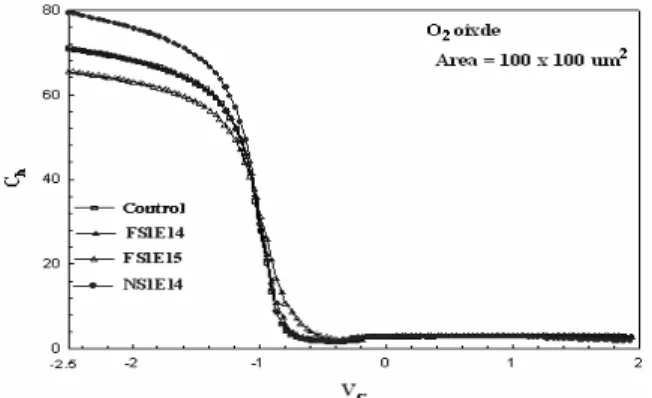
implant, Tox increase about 0.4 nm for FS1E15. From Fig. 2, for NG sample, no noticeable Tox change is observed even with a large dose (1E15 cm-2). Bur for substrate implant, nitrogen is more effective in suppressing Tox. Tox decreases by 0.4 nm for NS1E14 and 1.3 nm for NS1E15. Fig. 3. is the comparison of Tox using C-V and F-N current fitting methods; the trend of increment and decrement of Tox is identical with C-V and I-V measurements. The high frequency C-V plot is shown in Fig. 4. It is clearly that different Tox show different high frequency capacitance (Ch) values in accumulation region. Fig. 5. shows proposed mechanism for additional oxide growth for fluorine-enriched oxide. First, F diffuses and bonds to dangling bonds and weakened bonds in the silicon dioxide. After these interface regions have been saturated with F, additional incorporation occurs primarily in the bulk. The F will then break the Si-O bonds and displace oxygen at these sites. Lastly, the free oxygen diffuses to the interfaces and oxidizes additional silicon. The mechanisms of the oxidation retardation, the Si-N bonds are formed at the first few monolayers of the thin gate oxides, which might be able to explain the large oxidation retardation.
Fig. 6. and Fig. 7. depicts the Gm and S.S. for nMOSFETs with different implanted species and dose. The FG1E14 and NG1E14 show smaller Gm than pure oxide; fluorinated oxide is more effective in improving Gm than nitrided oxide. The nMOSFETs with fluorine and nitrogen implantation also have slight improvement in S.S.
In order to examine the reliability of fluorinated and nitrided oxide, we use the constant current stress measurement to evaluate it. Fig. 8. depicts the charge to breakdown distribution as a function of implanted species and dose. FG1E14 and NG1E14 show larger Qbd. While FS1E14 and NS1E14 degrade Qbd. The degradation of Qbd seen to more worse in FS1E15.
This may be attributed to the substrate implantation that received more implanted damage and too much fluorine will degrade the oxide reliability. Fig. 9. shows the proposed trapping mechanism for fluorine-enriched oxide. Fluorine displaces oxygen in Si-O-Si bond and the dangling bond on the silicon atom acts as a trap. Since the dangling bonds at the both interface would cause interfacial traps. Bonding an nitrogen or fluorine atoms to the dangling bond would move the state at least 0.5 eV outside the silicon bandgap. Because of the stronger bonding energy of the Si-F (5.73 eV) bond and Si-N bond compared to the Si-H bond (3.18 eV), fluorine bonds at the Si-SiO2 interface should be more immune to hot electrons.
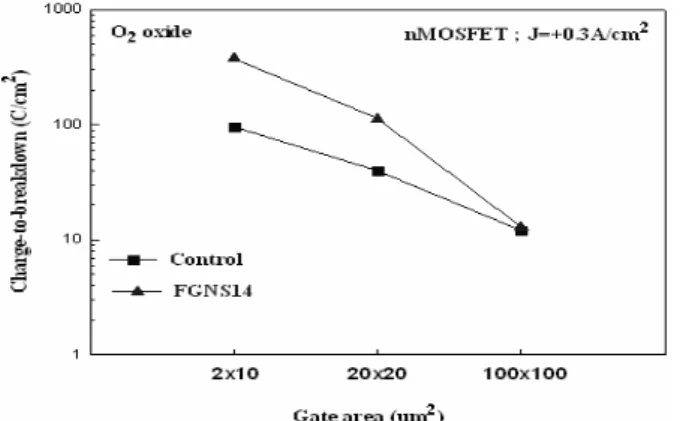
In the study, the fluorine and nitrogen implantation into gate electrode or substrate. Those will affect the interface defect. It is interesting to discuss the area dependence of Qbd in the fluorinated and nitrided oxides. Fig. 10. depicts the 50%-value of the intrinsic Qbd distribution as a function of the test gate area for NG1E15 sample, the stress current is J= +0.3A/cm2, substrate injection. It is observed that for nitrided oxide, the Qbd decreases with gate area increases and the trend is the same with control sample. From Fig. 11. the Qbd degradation of fluorinated oxide in large gate area device was worse than that in control sample. The exist of fluorine atoms in large gate area devices may be the factor of degrading Qbd value. We combine the effect of fluorine and nitrogen in large gate area, as shown in Fig. 12. The Qbd shows less degraded. This is because for FGNS1E14 sample, it could be attributed to retardation of fluorine incorporation by nitrogen already present in the oxide for NS1E14 sample. So the concentration of fluorine of FGNS1E14 is lower than that of FS1E14 sample. Previous results were stressing under the substrate injection that the damage should be occurred at the Poly-Si/SiO2 interface. While for gate
injection condition, the damage occurred at SiO2/Si interface, the area dependence of Qbd is not obvious for FGNS1E14 sample, as shown in Fig. 13. We conclude that fluorine pile up at the Poly-Si/SiO2 interface may be responsible for Qbd degradation.
IV. Conclusion
We have studied the effect of fluorine and nitrogen incorporation into poly gate and Si substrate on ultra-this gate oxide integrity. The Gm and S.S. in fluorinated and nitrided oxide were better than that of control samples. The fluorine at the Poly-Si/SiO2 interface may be responsible for Qbd degradation in large gate area devices. The clever manipulation of fluorine (to increase Tox) and nitrogen (to decrease Tox) implantation into Si substrate prior to oxidation can be used to obtain multiple oxide thickness on the wafer.
Fig. 1.Gate oxide thickness for O2 oxide as a function of fluorine dose.
Fig. 2. Gate oxide thickness for O2 oxide as a function of nitrogen dose.
Fig. 3. Gate oxide thickness for O2 oxide as a function of fluorine and nitrogen dose. The data was obtained by C-V and F-N current fitting method.
Fig. 4. The high frequency C-V curve of samples with fluorine and nitrogen incorporation into Si substrate.
Fig. 5. Proposed mechanism for additional oxide growth for fluorine-enriched oxide. (a) F bonds to dangling bonds at the interface, and weak bonds in the bulk of the oxide. (b) Displace oxygen diffuses to the interface and grows additional oxides.
Fig. 6. The transconductance (Gm) for samples with fluorine and nitrogen implantation into the gate and Si substrate.
Fig. 7. The subthreshold swing (S.S.) for samples with fluorine and nitrogen implantation into the gate and Si substrate.
Fig. 8. Charge to breakdown distribution for samples with F and N implantation into the gate electrode and Si substrate.
Fig. 9. Proposed trapping mechanism for fluorine enriched oxide. (a) F displaces an oxygen in an Si-O-Si bond. (b) The dangling bond on the silicon atom acts as a trap.
Fig. 10. Area dependence of 50% Qbd value for nitrogen implanted the gate electrode. The stress current density was J=+0.3 A/cm2.
Fig. 11. Area dependence of 50% Qbd value for fluorinated oxides. Stress current density J=+0.3 A/cm2.
Fig. 12. Area dependence of 50% Qbd value for fluorine and nitrogen co-implantation into gate oxide and substrate. The stress current density was J= +0.3 A/cm2.
Fig. 13. Area dependence of 50% Qbd value for fluorine and nitrogen co-implantation into gate oxide and substrate. The stress current density was J= -0.3 A/cm2.
Reference
1. L. K. Han, S. Crowder, M. Hargrove, E. Wu, S.H. Lo, F. Guarin, E. Crabbe, and L. Su,” Electrical Characteristics and Reliability of Sub-3 nm Gate Oxides Grown on nitrogen Implanted Silicon Substrate,” IEEE IEDM, p.643, 1997 2. C. T. Liu, E. J. Lloyd, Y. Ma, M. Du, R. L. Opila,
and S.J. Hillenius, “High Performance 0.2 um CMOS with 25 A Gate Oxide Grown on Nitrogen Implanted Si Substrate,” IEEE IEDM p.499, 1996
3. D. G. Lin, T. A. Rost, H.S. Lee, D. Y. Lin, A. T. Tsao, and B. McKee, “The Effect ofFluorine on MOSFET Channel Length,” IEEE Electron Device Letters, vol.14, NO.10,p.469, 1993
4. N. Kasai, P. J. Wright, and K. C. Saraswat, “Hot-Carrier-Degradation Characteristics for Fluorine-Incorporated nMOSFET’s,” IEEE Trans. Electron Devices, vol. 37, NO.6, June, p. 1426, 1990
5. Cheng-Chuan Huang, “A study of Fluorine and Nitrogen on Ultra-Thin Gate Oxide Reliability”, Institute of electronics, National Chiao Tung University, 2000, pp. 1~21.