
An Optimality-Theoretical Exploration of
Retroflex Diminutives in the Nanjing Dialect
Ming-Chung Cheng
Institute of Hakka Language and Communication National United University
Associate Professor
Retroflex diminutives have been widely investigated among Mandarin dialects, but those associated with the Nanjing dialect have received scant descriptive or theoretical attention. Thus, in this study, the formation of retroflex diminutives in the Nanjing dialect is reviewed, and framed in terms of Optimality Theory (OT). The formation of retroflex diminutives in the Nanjing dialect can be captured by a set of ranked constraints (MAX[r], ANCHOR-SD(L), ANCHOR-r(R), *r/, *r/N, *r/
VH/F >> CONTIGTY-Finalσ-IO, OKFinal, ONS[palatal]V[H,F] >> MAX-SD, DEP-SD, IDENT-SD[r]). Further investigation into whether prevocalic glides [i], [u], and [y] are preserved or deleted in the formation of retroflex diminutives is undertaken, focusing on the related topics of phonetic enhancement and linguistic typology.
Keywords: diminutive, erhua, Nanjing dialect, Optimality Theory (OT), retroflexion
Corresponding Author: Ming-Chung Cheng, E-mail: [email protected] Manuscript received: Oct. 18, 2013; Revised: Dec. 7, 2013; Accepted: Dec. 8, 2013 doi: 10.6210/JNTNULL.2014.59(2).06
1. Introduction
Nanjing is located in the southern bank of the downstream Yangzi River(長江) and is the capital of Jiangsu(江蘇) Province. Previously called Jinling(金陵), Jianye(建鄴) or Jiankang(健康), Nanjing started its name from the Ming Dynasty. Historically, ten dynasties established their capitals here, so Nanjing has always been one of the most significant political, cultural, and socioeconomic centers in China. Besides, when natural disasters and invading or civil wars broke out in northern China, a large amount of population kept on moving southwards in search of peaceful lives. On account of its convenient communication, excellent geographic location, and in particular, military advantage, Nanjing was not only a protective citadel for the refugees, but an aggressive target for those barbarians. The historically large-scale immigration concomitantly brought to the Nanjing dialect the “linguistic invasion” which gradually shifted its linguistic status and eventually transformed its membership from Wu to Mandarin.1
In recent decades, strong policy to enforce Standard Chinese, because of a great number of immigrants from northern Jiangsu and neighboring Anhui, the present-day Nanjing dialect has undergone a swift change. It shows more and more linguistic features from Standard Chinese, like the split of [y] from [i], the distinction of [n/l], [an/A], [ən/əŋ] and [in/iŋ] (please refer to Liu 1995, 4-11 for more discussion).2 As a result, typical linguistic characteristics of the Nanjing dialect have
faded out rapidly. Among these fading characteristics, the most remarkable one is the retroflex diminutives which have suffered from a severe decline of use.3 Nowadays, only the old preserve the
1 The Nanjing dialect belonged to the Wu family before the East Jin Dynasty, but belongs to Jianghuai Mandarin
now. The linguistic status change of the Nanjing dialect into the Mandarin family resulted mainly from the revolt of the Xong Nu barbarians(匈奴)at the end of the West Jin Dynasty, an event historically called Yongjiazhiluan(永 嘉之亂). This notorious war forced a great number of nobles and refugees in northern China to move southwards to the basin of the Yangzi River. At that time, the immigrants were even more in number than the original residents in Nanjing, so the languages of the northerners had a crucial influence upon the Nanjing dialect. Besides, there were still many other subsequent historical, usually negative, events that caused the change of linguistic status in the Nanjing dialect. For a brief and quick review, please see Liu (1995, 3-4).
2 The Nanjing dialect can be roughly divided into two varieties in terms of speakers’ generations. The
old variety, spoken by those aged more than eighty and inhibiting in the Qinhuai, Baixia, and Jianye districts, is representative of the Nanjing dialect. This variety is in restrictive use now, and is predicted to disappear in the not-so-distant future. In contrast, the new variety is linguistically similar to Standard Chinese, and is used by the majority of residents in Nanjing, especially those under the age of fifty (Fu 2004; Lu 2000).
3 Most Mandarin dialects shape their diminutives by suffixing to the stems a retroflex morpheme (i.e., –r, -)
coming historically from [ɚ]. These diminutives initially denote meanings of smallness or hypocorism. However, the notion of smallness or hypocorism has degenerated in present-day use, and the use of diminutives has become a
retroflex diminutives which are the main focus of this study, while the young delete the retroflex suffix “er” [ər] or replace it with “zi” [tsɿ].4 In spite of the expected coming vanishment, retroflex
diminutives in the Nanjing dialect show plenty of peculiar characteristics that are different from those in Beijing Mandarin, and, therefore, are worthy of further explorations.
The remainder of this study has the following organization. Section 2 reviews the formation of retroflex diminutives in the Nanjing dialect. Special attention is directed to the status of prevocalic glides in these diminutives. Section 3 provides an overview of Optimality Theory (OT) and its theoretical advantages. Section 4 applies OT to retroflex diminutives in the Nanjing dialect. Section 5 specifically discusses whether prevocalic glides are preserved or deleted in forming retroflex diminutives in the Nanjing dialect. Section 6 centers on two issues of the interaction between [t], [th], and [] and prevocalic glides [i] and [y] in the formation of retroflex diminutives among Mandarin dialects. Section 7 provides the conclusion of this study.
2. Retroflex Diminutives in the Nanjing Dialect
Retroflex diminutives extensively exist in the Mandarin dialects, and the most famous and best-studied case is Beijing Mandarin. In terms of retroflex diminutives, the Nanjing dialect is similar to Beijing Mandarin, but the former receives relatively less attention than the latter.5 As far as I know,
only Liu (1995), Huang (2003a, 2003b, 2005) and Wang (2008) have some discussion towards this issue. Though these works are largely descriptive, the data they collected, with my own fieldwork survey, are the basis of the analysis in the present study.
Discussing retroflex diminutives in the Nanjing dialect requires an introduction to the canonical syllable structure among Chinese dialects, as structurally illustrated in Table 1. The maximal syllable
stylistic feature, instead of a grammatical one.
4 Traditionally, the retroflex suffix “er” is phonetically symbolized as [ɚ], but [ər] is used in this study in order
to clearly manifest the retroflex feature [r] deriving from the simplification of [ɚ].
5 The retroflex diminutives in Beijing Mandarin have appealed to a great multitude of related literature (Chao
1968; Li 1996; Lin and Wang 1992; Lu 1995; Peng 2004; Wang 2005, among others), and have been analyzed under different phonological frameworks, such as Linear Approach (Cheng 1973), Nonlinear Approach (Duanmu 1990; Goh 1997; Lin 1989), Feature Geometry (Wang 1997; Yin 1986, 1989) and Optimality Theory (Ma 2003; Zhou 1995). Based on Li (1986), retroflex diminutives in Beijing Mandarin can be divided into two types, the additive type and the fusional type. In the former, [ɚ] is added directly to the end of the stems because the stem rimes are unsuitable for retroflexion, like [ti] → [tiɚ] “chick.” In the latter, [ɚ] is incorporated into the stems as a retroflex feature, like [pho ]→ [phor] “an old woman” and [ia] → [iar] “tooth,” for the rimes and retroflexion are articulatorily compatible.
However, unlike the Nanjing dialect, the stem rimes of the retroflex diminutives are never replaced by [ɚ] in Beijing Mandarin. This will become evident in the coming discussion of the retroflex diminutive in the Nanjing dialect.
structure in Chinese dialects is CGVX (where C=consonant, G=glide, V=nucleus vowel, X=vocalic or consonantal endings). A syllable can be f irst structurally divided into “Initial” and “Final,” the latter can be further divided into “Medial” and “Rime.” It should be noted, in advance, that syllable finals play crucial roles in the formation of retroflex diminutives in the Nanjing dialect.
Table 1 Canonical Syllable Structure of Chinese Dialects Syllable (σ) Initial or Onset (C) Final Medial (G) Rime Nucleus (V) Ending Vocalic / Consonantal (X) Source: Raung-Fu Chung, The Segmental Phonology of Southern Min in Taiwan (Taipei, Taiwan: Crane, 1996), 1.
Retroflex diminutives in the Nanjing dialect are generated by incorporating the suffix “er” [ər] into stem finals. For this reason, the finals in the Nanjing dialect should be understood first. According to Liu (1995), there are 49 finals in the Nanjing dialect, including syllabic nasals, as shown in Table 2. In addition, according to Liu (1995, 12), the glottal stop coda makes Ru-tone syllables shorter than the corresponding non-Ru-tone ones, and cannot be treated as an independent segment. For this sake, this study views it as glottalization, and symbolizes it as a glottalized feature [ʔ] on the vowels. Based on Liu (1995), [a] and [A] are in complementary distribution. The former, a front-low vowel, occurs in [an] and [ae], while the latter, a back-low vowel, appears in [Aŋ].
Table 2 The Finals in the Nanjing Dialect
ər A e o ae əi ɔo əɯ i iA ie iE iɔo iəɯ u uA uae uəi y ye ɚn A o an
in ien iA io m` n` `
un uA yn yen yA A ə o i iA ie iɔ u uA ue y ue
According to the traditional syllable structure in Chinese dialects, CGVX, finals contain at most three segments (i.e., GVX). Finals in the Nanjing dialect follow this formation rule. G in the Nanjing dialect can be one of [i], [u], and [y]. Rimes [əi], [əɯ], [ae], and [ɔo] are treated as diphthongs, with a more sonorous one (main vowel) followed by a less sonorous one. Furthermore, it can also be observed in Table 2 that diphthongs can be preceded by glides (though some phonotactic rules may involve), but diphthongs can not be followed by nasal codas. In this study, prevocalic glides (phonetically known as semivowels) and vowels (mono- and diphthongs) are all viewed as “vocalic” segments, and finals are defined as the combination of vocalic and post-vocalic segments in the syllables.
Return to the formation of retroflex diminutives in the Nanjing dialect. There are two ways to shape the retroflex diminutives in the Nanjing dialect. The suffix “er” [
ə
r] may completely substitute stem rimes or become a retroflex feature on preceding vowels.6 Both phenomena are shown in Table 3,examples are sorted in terms of different types of stem rimes for ease of exposition.
Table 3 Retroflex Diminntives in the Nanjajing Dialect Formed by Different Types of Stems (a) Stem = CV (where V = [], [i], [e], [o], [A])
[ts] → [tsər] “kernel” [ko] → [kor] “attic” [li] → [lər] “a kind of bird” [pA] → [pAr] “handle” [tʂhe] → [tʂhər] “car”
(b) Stem = CVV (where VV = [əi], [əɯ], [ae], [ɔo])
[pəi] → [pər] “back” [thəɯ] → [thər] “head” [lae] → [lər] “milk” [lɔo] → [lɔor] “corner” (c) Stem = C(G)V (where V = [i], [y], [e], [ə], [o], [A])
[ti] → [tər] “drop” [ʂə] → [ʂər] “tongue” [sy] → [sər] “dust” [mo] → [mor] “powder” [ie] → [iər] “leaf” [iA] → [iAr] “duck” (d) Stem = C(G)VN (where VN = [in], [en], [an], [ən], [A])
[min] → [mər] “tomorrow” [tən] → [tər] “stool”
[mien] → [mər] “face” [
ʂA] → [ʂər
] “fan”
[pan] → [pər] “petal”
6 The suffix “er” [ər] may occur as a syllabic diminutive word, and bear a [24] tone (e.g., [tu11-24
ti24 ər24] “navel”)
or a neutral tone (e.g., [tin31 ər0 ko44] “today”). Retroflex diminutives can be constructed by changing citation tones
to [24], without any observable retroflexion on the surface (e.g., [xiɔo11 tu11-24
] “small belly” and [ien24 s24 lɔo11-24]
“idler”). However, the two types are few in number, and exhibit no phonological alternations (except for a tone sandhi rule 11 → 24 /_ 24), so they are not the concern in this study.
Prior to detailed discussion of Table 3, general background knowledge is required in advance. First of all, Table 3 shows that [ər] or retroflexed vowels in retroflex diminutives appear at the rightmost edge all the time. This reflects that Chinese diminutives tend to be predominately suffixes. Next, articulatory compatibility between stem rimes and retroflexion is crucial in the formation of retroflex diminutives in the Nanjing dialect (Chao 1968). If segments in the rimes can articulatorily harmonize with retroflexion, [ər] will realize itself as a retroflex feature on the rimes. If rimes contain any segments that are not suitable for retroflexion, the rimes will be replaced by [ər].7 For example,
[ər] is produced by curling the tip of the tongue back. This articulation is incompatible with [i] and [y], the latter of which requires that the tongue be positioned towards the hard palate. Yet, the articulation of [ər] is compatible with [A], for the tongue position in producing [A] is low in the oral cavity and has nothing to do with the tip of the tongue. At this time, the tongue tip is free for curling back. Third, the vocalic segments in the Nanjing dialect can be separated into two groups, depending on their compatibility with retroflexion. One contains the compatible ones [o], [ɔ], [A], and [ə], while the other holds the rest, [], [i], [e], [y], [a], [u], and [ɯ] which cannot coexist with retroflexion.8
Given these prerequisites, this study proceeds to discuss the examples in Table 3. In Table 3(a), the rimes of the stems are simple (i.e., V), so whether they are compatible with retroflexion is decisive in the formation of retroflex diminutives. Specifically, [], [i], and [e] are replaced by [ər], while [o, A] are retroflexed as [or] and [Ar]. In Table 3(b), one or both segments in [əi, əɯ, ae] are not congruous with retroflexion, so [ər] takes the place of the whole rimes. On the contrary, [ər] is realized as a retroflex feature on [ɔo] because this rime can be r-colored. In Table 3(c), glottalization and retroflexion are different in their airstream continuation (i.e., [-cont] vs. [+cont]) and they are
7 The issue of articulatory (in)compatibility results partly from articulatory complexity of retroflexes.
Retroflexes are cross-linguistically marked on account of their articulatory complexity. For example, according to Ladefoged and Bhaskararao (1983, 292), only 11% of the languages in the world have a retroflex stop. Based on Maddieson’s (1984) survey, retroflexes typically occur in languages with large phonemic inventories, and imply the presence of the unmarked segments, like apical or laminal coronals (e.g., *RETROFLEX >> *CORONAL). Because of the weakness of perceptual cues, retroflexes also show perceptual markedness (Flemming 2002; Ohala 1993a; Padgett 2001, 2003; Steriade 1995, 2001). For instance, Ohala (1993a, 89) divides features into two types, robust vs. weak, and remarks that only large phonemic inventories use weak features. Therefore, retroflexion should be considered perceptually weak or marked. For more discussion on cross-linguistic retroflexes, see Hamann (2003) who investigates the retroflexes from a multitude of languages in terms of markedness, articulatory, acoustic and perceptual phonetics, and functional phonology.
8 Unlike Beijing Mandarin in which the retroflexed [ur] is possible (e.g., [ku → kur] “drum” and [u] → [ur]
“house”), Liu (1995, 15) states that no retroflex diminutives are found to be formed with stems rimed by [u] in the Nanjing dialect, so [u] is placed in the retroflexion-incompatible group. For example, [tu] “rabbit” is articulated as [tu tsɿ] instead of [tur] in my fieldwork surrey. Another rime in the Nanjing dialect that is rarely used to form retroflex
mutually excluded. Thus, [o] and [A] become [or
] and [Ar], for both [o] and [A] are permitted to coexist with retroflexion. However, [i], [y], [e], and [ə] are completely replaced by [ər] because of their articulatory incompatibility with retroflexion. By [ər] merger, the Ru-tone stems will become non-Ru-tone diminutives. In addition, incompatibility between glottalization (or glottal stop) and retroflexion is broadly observable in retroflex diminutives in the synchronic dialects with Ru tones, for example, those in Shanxi Province (Qiao 2000), such as Yangquan (Cao 2006), Youyu (Ma 2002), Datong (Jiang 1999), and Yingxian (Jiang and Li 2008). It seems to be a cross-dialectal prohibition in Chinese dialects for glottalization and retroflexion from co-occurring in forming retroflex diminutives. In Table 3(d), nasal codas in the rimes are incompatible with retroflexion. Namely, retroflexion cannot surface on nasals, so all the VN rimes in the Nanjing dialect are replaced by [ər] when retroflex diminutives are formed. This restriction can be easily observable from retroflex diminutives in the Mandarin dialects, such as Beijing Mandarin (Ma 2003), Laiyang (Luan and Gong 2006), Yangquan (Cao 2006), and Shangqiu (Xie 2004).9
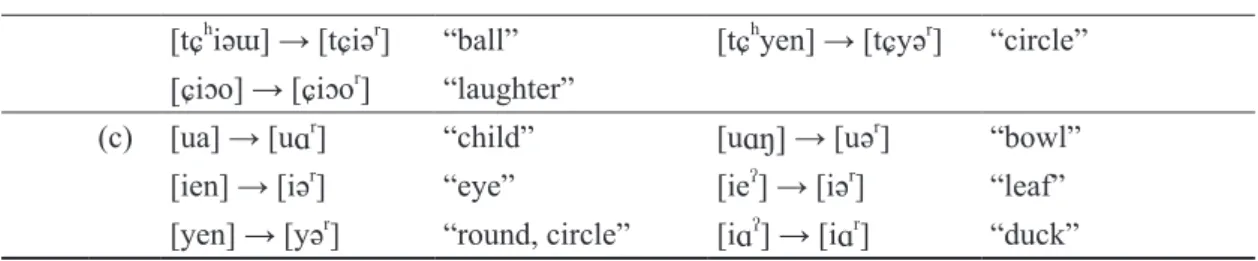
Besides [ər] replacement and r-coloring, when stems with prevocalic glides [i], [u], and [y] are used to form retroflex diminutives, different phonetic behaviors occur between [i, y] and [u], as in Table 4. In Table 4(a), when prevocalic glides follow onset consonants other than [t], [th], and [], [i, y] are deleted, but [u] is maintained. In fact, [u] remains undeleted all the time, but [i, y] always get omitted, except in two conditions. First, when [i, y] follow [t], [th], and [], they will be protected from deletion, as in Table 4(b). Second, when [i, y] show up stem-initially, they will be protected from being deleted, as in Table 4(c). This issue will be specifically discussed in section 5.10
Table 4 Retroflex Diminutives Derived from Stems with Prevocalic Glides (a) [tsuəi] → [tsuər] “mouth” [kuan] → [kuər] “pipe”
[phien] → [phər] “slice” [lien] → [lər] “face” [sye] → [sər] “dust”10
(b) [tiɔo] → [tiɔor] “foot” [tie] → [tiər] “knot”
9 The Nanjing dialect differs from Beijing Mandarin as for vowel nasalization in retroflex diminutives. In
Beijing Mandarin, when CVŋ stems are used to form diminutives, [ŋ] gets deleted, and stem vowels are nasalized, such as [təŋ → tə)r] “light.” Vowel nasalization is not observed in the diminutives derived from CVn stems, such
as [pan → par] “plate.” As for the Nanjing dialect, both [n] and [ŋ] in CVN stems get deleted in the formation of
retroflex diminutives, but whether or not vowels are nasalized is rather unsystematic. As indicated in Liu (1995, 14), it is uncertain whether the vowels ought to be nasalized in the diminutives derived from CVN stems, so this study does not concern this issue. For those who are interested in this aspect, refer to Ma (2003) for how nasalization and retroflexion are incompatible, and how vowel nasalization in the retroflex diminutives in Beijing Mandarin is put into the OT framework.
[thiəɯ] → [tiər] “ball” [thyen] → [tyər] “circle” [iɔo] → [iɔor] “laughter”
(c) [ua] → [uAr] “child” [uA] → [uər] “bowl” [ien] → [iər] “eye” [ie] → [iər] “leaf” [yen] → [yər] “round, circle” [iA] → [iAr] “duck”
So far, this study has provided a descriptive review of the formation of retroflex diminutives in the Nanjing dialect, arriving at the descriptive adequacy of linguistic research. However, as pointed out in Tsao (2006), Li (2007) and Wang (2007), most of the literature related to Chinese diminutives centers on descriptive data collection and pattern classification. Relatively, theoretical attention paid to the potential mechanism behind these patterns is rare, and explanatory adequacy of the formation of Chinese diminutives is neglected.11 There is no exception for retroflex diminutives in the Nanjing
dialect. For this reason, this study targets not only to connect the descriptions to OT, but to explore the mechanism that underlies the formation of retroflex diminutives in the Nanjing dialect, too.
3. OT
Dispensing with serial derivation and ordered rules, OT is traditionally a parallel output-oriented theoretical framework in which “Input,” “Generator,” “Evaluator,” and “Output” are crucial components (McCarthy 2002; Prince and Smolensky 2004). For a given input, “Generator” will produce all logically possible output candidates. The set of candidates are then evaluated for optimality (i.e., harmony) by “Evaluator,” which contains a universal set of violable constraints that have a language-specific ranking hierarchy. The candidate which incurs the least violation marks of the high-ranked constraints is regarded as the optimal output. Differences in constraint rankings result in different languages (or dialects).
Prior to the theoretical analysis, it is essential to introduce the OT model in this study, as depicted in Figure 1. At the heart of OT lies the force of faithfulness and identity competing against
meaning. The former appears in [mụ sər
] [← sy] “wood dust” (Liu 1995, 48), while the latter shows up in [mə.i sər] [←
sye] “coal dust” (Liu 1995, 116).
11 The diminutives in Chinese dialects have been widely surveyed in a great body of related literature, like
Cao (2002), Z.-M. Chen (1992, 1999), Dong (1985), Li (1996), Li (1978), Lin (1993, 1997, 2004), Ma (2003), Wu and Wang (2006), among others.
the force of markedness, a notion called “correspondence” in OT. For example, two types of correspondence exist in Figure 1, IO-FAITHFULNESS and SD-IDENTITY.
Input:
/
STEM/ Input: /STEM + AFFIX/IO-FAITHFULNESS
↓
↓
Output: STEMform ↔ Output: DIMINUTIVE form
SD-IDENTITY
Figure 1 Correspondence of IO-FAITHFULNESS and SD-IDENTITY
The former requires that diminutive outputs be faithful to the inputs (i.e., /STEM + AFFIX/),
while the latter requires the identity between stems (S) and diminutives (D), a model traditionally called output-to-output correspondence (OOC).12 With this model, this study will then illustrate
how faithfulness and markedness constraints come into confliction to trigger different types of [ər] mergers, and further capture the underlying mechanism that is not observed on the surface.
4. An OT Analysis of the Retroflex Diminutives in the Nanjing
Dialect
After the introduction of the basic tenets of OT, this section will show how to use OT to frame the retroflex diminutives in the Nanjing dialect. For ease of explanation, this section will proceed in a sequence of CV, CVV, CV and CVN stems. Most of the constraints that are crucial for this study are introduced in Table 5.
Table 5 Constraints for the Formation of Retroflex Diminutives in the Nanjing Dialect IDENTITY and FAITHFULNESS Constraints
MAX-SD Every element in the stem has a correspondent in the diminutive (“no deletion of
segments”).
DEP-SD Every element in the diminutive has a correspondent in the stem (“no insertion of
segments”).
12 With the advent of OT, a large body of relevant research (Benua 1995, 1997; Kenstowicz 1996;
IDENT-SD[r] Correspondent segments between the stem and the diminutive have the same
value on the [retroflex] feature (‘no change of the value of the [retroflex] feature’). MAX[r] Diminutive retroflexion must be maintained in the diminutive (‘no deletion of the
diminutive retroflexion’). MARKEDNESS Constraints
OKFinal All finals in the retroflex diminutives must be legal in the inventory in the Nanjing dialect.
*r/ Retroflexion is not compatible (i.e., cannot occur) with glottalization. *r/N Retroflexion is not compatible with nasals (i.e., cannot occur on nasals). *r/VH/F Retroflexion is not compatible with high or front vowels.
The constraints in Table 5 call for some explanations beforehand. The first three are SD-Identity constraints that are responsible for the correspondence between stems and diminutives. The ranking of these constraints will turn out to be definite later. MAX[r] is an IO-Faithfulness constraint,
proposed specifically to the occurrence of diminutive retroflexion, a segment [ər] or a feature [r].13
Retroflexion is a significant marker for retroflex diminutives, for it bears the main morphological or semantic information, so it should be protected from being omitted. For this sake, MAX[r] is
high-ranked all the time.
The last four in Table 5 are markedness constraints which are hypothesized according to previous observations in Table 3, and function as the triggers for different [ər] mergers into the stems. As for OKFinal, syllable finals in the retroflex diminutives must be legal in the inventory of the Nanjing dialect, as previously shown in Table 2. Hence, syllables like Vər in tauto-syllables will be ruled out by this constraint. OKFinal patterns with OK-σ in Yip (2003). The reason for using OKFinal lies in that syllable-initial segments are always protected from being changed in the formation of retroflex diminutives in the Nanjing dialect, so syllable finals / rimes are the foci in the process of diminutive formation. Note that OKFinal deals with segments in syllable finals only. The addition or deletion of features to the segments in syllable finals is controlled by IDENT-[F].
13 MAX[F] is adopted in Lombardi (1999, 2001) and Zhang (2000, 2001). Unlike MAX-IO which only
targets segment deletion, MAX[F] also extends its function to feature deletion. Moreover, high-ranked MAX[r] is functionally similar to REALIZEMORPH (i.e., a morpheme must have some phonological exponent in the output) (Lin 2004, 1033), originating from AFFIX MANIFESTATION PRINCIPLE (Lin 1993, 656) which states that “within the limits of universal and language-specific constraints, the effect of affixation of a phonologically expressed morpheme is always manifested.”
Glottalization and nasal codas are incompatible with retroflexion, so *r/ and *r/N are ranked high in the hierarchy. Observation of Table 3 also shows that retroflexion cannot co-occur with [], [i], [e], [y], [a], [u], and [ɯ] which are high and / or front vowels, so *r/VH/F should be high-ranked. According to Emeneau (1939), retroflexion is possible for any segments. However, there seems to be a preference scale among these segments. To be definite, retroflexion is far easier to realize on back vowels than front vowels, and consonants are the worst for retroflexion. This viewpoint also makes *r/ and *r/N phonetically-based. As far as articulation is concerned, retroflexion is articulated by curling the tip of the tongue against the alveolar ridge, obviously incompatible with the articulation of raising the tongue blade to the hard palate in the production of high vowels. Hence, *r/VH/F is also a phonetically-based constraint.
4.1 CV Stems
For CV stems, there are two strategies adopted for [ər] merger. One is the total replacement of [], [i], and [e] by [ər], and the other is the r-coloring on [o] and [A]. In OT, the two strategies must go against different identity constraints. The correspondence between stems and diminutives in Figure 2 well demonstrates what constraints are violated and how they are violated.
STEM
:
tʂh e Ø STEM:
p [A]↓
↓
↓
↓
↓
DIMINUTIVE
:
tʂh Ø ər DIMINUTIVE:
p Arò ò ò
VIOLATION
:
MAX-SD DEP-SD VIOLATION:
IDENT-SD[r](a) tʂhe → tʂhər“car” (b) pA →pAr “handle”
Figure 2 Stem-Diminutive Correspondence of [tεhe → tεhər] and [pA → pAr]
In Figure 2(a), MAX-SD and DEP-SD are violated owing to [e] deletion and [ər] insertion. In
Figure 2(b), retroflexion on [A] deviates from IDENT-SD[r]. Nonetheless, violation of these constraints
must be tolerable on account of the actual existence of [tʂhər] and [pAr], so MAX-SD, DEP-SD and IDENT-SD[r] are all ranked low in the hierarchy. The constraint ranking for the retroflex diminutives
derived from CV stems is exhibited in Table 6. Table 7 and 8 show constraint evaluation, with [li] “a kind of bird” and [ko] “attic” as illustrative examples.
Table 6 Constraint Ranking for the Retroflex Diminutives in the Nanjing Dialect MAX[r], OKFinal, *r/VH/F >> MAX-SD, DEP-SD, IDENT-SD[r]
Table 7 Constraint Evaluation of Forming the Retroflex Diminutive from [li] “a kind of birds” INPUT: /li + ər/ STEM: [li] MAX[
r
] OKFinal *r/VH/F MAX-SD DEP-SD IDENT-SD[r] (a) li *! (b) liər *! * * (c) lir *! * ☞ (d) lər * * *Table 8 Constraint Evaluation of Forming the Retroflex Diminutive from [ko] “attic” INPUT: /ko + ər/ STEM: [ko] MAX[r] OKFinal *r/VH/F MAX-SD DEP-SD IDENT-SD[r] (a) ko *! (b) koər *! * * ☞ (c) kor * (d) kər * * *
MAX[r] is fatally violated by candidate Table 7(a) because neither [ər] nor [r] surfaces in the
output. Candidates Table 7(b) and (c) turn out to be suboptimal, for the former violates OKFinal and the latter breaks *r/VH/F. Violating MAX-SD (i.e., [i] deletion) and DEP-SD (i.e., [ər] insertion). Candidate Table 7(d) does not violate MAX[r] and OKFinal because [ər] occurs and is a legal rime in
the Nanjing dialect. It is chosen as the optimal output for no violation of the high-ranked constraints. As far as Table 8 is concerned, candidates Table 8(a) and (b) incur deadly violation marks on MAX[r] and OKFinal respectively. Both Table 8(c) and (d) transgress no high-ranked constraints, so
the low-ranked constraints become significant, and the number of violation marks of the low-ranked constraints is crucial in the selection of the optimal output (i.e., the fewer, the better). Candidate Table 8(d) violates MAX-SD and DEP-SD owing to [o] deletion and [ər] insertion, but candidate
Table 8(c) only violates IDENT-SD[r] owing to the change of [o] to retroflexed [or]. Thus, Table
8(c) becomes optimal because of the fewer violation marks. Obviously, the ranking in Table 6 can successfully select the optimal diminutives derived from CV stems.
4.2 CVV Stems
As far as CVV stems are concerned, the ranking in Table 6 should also be feasible because the rimes involve only vocalic segments. For illustration, the tableau in Table 9, with a retroflexion-incompatible VG rime [ae] in [lae] “milk” as an example, illustrates the applicability of the ranking in Figure 1.
Table 9 Constraint Evaluation of Forming the Retroflex Diminutive from [lae] “milk” INPUT: /lae + ər/ STEM: [lae] MAX[r] OKFinal *r/VH/F MAX-SD DEP-SD IDENT-SD[r] (a) lae *! (b) laeər *! * * (c) laər *! * * * (d) leər *! * * * (e) laer *! * (f) lare *! * (g) larer *!* ** (h) ler *! * * (i) lar *! * * * ☞ (j) lər ** * *
Because of the lack of [ər] or [r] on the surface, candidate Table 9(a) is ruled out by MAX[r]. Candidates Table 9(b)-(d) and (i) are evaluated out by OKFinal on account of the illegal final structures [aər], [eər] and [a]. High and / or front vowels with retroflexion are prohibited, so candidates Table 9(e)-(h) get one or two violation marks on *r/VH/F. Clearly, candidate Table 9(j) is the optimal output on account of its satisfaction of all high-ranked constraints, even though it incurs two violation marks on MAX-SD (i.e., deletion of [a] and [e]) and one on DEP-SD (i.e., insertion of [ər]).
When retroflex-compatible VG rimes are taken into account, such as the stem [lo] “corner” in Table 10, an explanatory difficulty appears. Candidates Table 10(a)-(d) and (h) are evaluated out by MAX[r] and OKFinal respectively on account of the lack of [ər] or the occurrence of the illegal rimes.
For the remaining candidates, since they do not violate any high-ranked constraints, the importance of the low-ranked constraints emerges. Candidates Table 10(g)-(j) incur two or more violation marks on the low-ranked constraints, and are unable to be optimal. Nonetheless, the ranking in Table 6 fails
to select the optimal output. Candidates Table 10(e) and (f) make a tie, since both of them merely violate IDENT-SD[r] once.
Table 10 Constraint Evaluation of Forming the Retroflex Diminutive from [l
o] “corner” INPUT: /lo + ər/STEM: [lo]
MAX[r] OKFinal *r/VH/F MAX-SD DEP-SD IDENT-SD[r]
(a) lo *! (b) loər *! * * (c) lər *! * * * (d) loər *! * * * ? (e) lor * ? (f) lro * (g) lror **! (h) lr *! * * (i) lor * * (j) lər ** * *
To deal with this difficulty, there must be another dominated constraint that prefers Table 10(e) and discard Table 10(f). The retroflexed vowels always occur at the right edge of the diminutives, so
A
NCHOR-r(R)14 must play a crucial role.A
NCHOR-r(R) stresses the right edge of the retroflexdiminutives, and should be ranked high. The evaluation of [l
or] and [l
ro] is restated in Table 11, with the constraint ranking simplified.Table 11 Constraint Evaluation of Forming the Retroflex Diminutive from [lo] “corner” (Further and Simplified Version)
INPUT: /l
o + ər/STEM: [lo]
A
NCHOR-r(R) IDENT-SD[r]☞ (a) l
or *(b) l
ro *! *Table 11 illustrates that
A
NCHOR-r(R) can successfully select the optimal output Table 11(a).14 ANCHOR-r(R):The retroflex segments originating from diminutive retroflexion must anchor at the right edge
With [or] anchored at the right edge of the diminutives,
A
NCHOR-r(R) is satisfied by candidate Table 11(a). Because one segment [o] intervenes between [ɔr] and the right edge, candidate Table 11(b) deadly violatesA
NCHOR-r(R). The ranking for CVG stems is restated in Table 12. This ranking isalso applicable to CV stems.
Table 12 Constraint Ranking for the Retroflex Diminutives in the Nanjing Dialect MAX[r], ANCHOR-r(R), OKFinal, *r/VH/F >> MAX-SD, DEP-SD, IDENT-SD[r]
4.3 CV Stems
For CV stems, the markedness constraint *r/ is of great importance. It prevents glottalization and retroflexion from co-occurrence, and transform Ru-tone stems into non-Ru-tone retroflex diminutives, so *r/ should be high-ranked. For CV stems, the constraint ranking is in Table 13. Table 14 and Table 15 exhibit constraint evaluation, with [ti] “drop” and [mo] “powder” as examples.
Table 13 Constraint Ranking for the Retroflex Diminutives in the Nanjing Dialect MAX[r], ANCHOR-r(R), OKFinal, *r/ , *r/VH/F >> MAX-SD, DEP-SD, IDENT-SD[r]
Table 14 Constraint Evaluation of Forming the Retroflex Diminutive from [ti] “drop” INPUT: /ti + ər/ STEM: [ti] MAX[r] ANCHOR -r(R) OKFinal *r/ *r/VH/F MAX -SD DEP -SD IDENT -SD[r] (a) ti *! (b) tiər *! * * (c) tir *! * * (d) tir *! * ☞ (e) tər * * * (f)` tiər *!
In Table 14, candidates Table 14(a)-(d) and (f) deviate from the high-ranked constraints. Table 14(a) and (b) are punished by MAX[r] and OKFinal respectively because of the loss of [ər] and the
occurrence of an unacceptable rime [iər] on the surface. For Table 14(c), the rime [ir] breaks *r/ because of the deviation of the co-occurrence restriction of glottalization and retroflexion. Candidates Table 14(c) and (d) depart from *r/VH/F because retroflexion is realized on an incompatible front-high
vowel [i]. Moreover, violation of *r/VH/F also renders IDENT-SD[r] violated.15 Candidate Table 14(f)
violates OKFinal, for [iə] is an illegal rime in the Nanjing Dialect. Irrespective of the violation of MAX -SD and DEP-SD (i.e., [i] deletion and [ər] insertion), Table 14(e) is destined for optimality by reason
of its total .satisfaction of the high-ranked constraints.
Like Table 14, the first three candidates in Table 15 are ruled out by MAX[r], OKFinal and *r/,
and turn out to be mortal. Both Table 15(d) and (e) do not violate any high-ranked constraints, so the seriousness of violation of the low-ranked ones becomes decisive. Table 15(d) has one less violation mark than Table 15(e), so the former is chosen as the optimal output. So far, the ranking in Table 13 can pick out the optimal diminutives formed by CV, CVG and CV stems.
4.4 CVN Stems
For CVN stems, the markedness constraint *r/N is a crucial trigger. To form the retroflex diminutives, nasal codas cannot co-occur with retroflexion. This restriction can be observed with ease from retroflex diminutives in Mandarin dialects, like Beijing Mandarin (Ma 2003), Laiyang (Luan and Gong 2006), Yangquan (Cao 2006), and Shangqiu (Xie 2004). For this sake, *r/N is high-ranked in Table 16, too.16 Constraint evaluation for Vn rimes is shown in Table 17, with [pan] “petal”
as an example.
15 Note that IDENT-SD[r] focuses only on the change of the [retroflex] feature. In the case at hand, the change
of glottalization may be handled by IDENT[] which is inert and low-ranked.
16 As indicated in Hamann (2003, 20), there is a tendency that “languages which employ a retroflex nasal also
have a retroflex stop.” That is, an implicational relation exists in that the presence of the former implies the existence of the latter. With this background, the assumption of *r/N is reasonable, for no retroflex or retroflexed stops are found in the Nanjing dialect.
Table 15 Constraint Evaluation of Forming the Retroflex Diminutive from [mo] “powder” INPUT: /mo + ər/ STEM: [mo] MAX [r] ANCHOR -r(R) OKFinal *r/ *r/VH/F MAX -SD DEP -SD IDENT
-SD[r] (a) mo *! (b) moər *! * * (c) mor *! * ☞ (d) mor * (e) mər * * *Table 16 Constraint Ranking for the Retroflex Diminutives in the Nanjing Dialect17
MAX[r], ANCHOR-r(R), OKFinal, *r/, *r/N, *r/VH/F
>> MAX-SD, DEP-SD, IDENT-SD[r]17
Table 17 Constraint Evaluation of Forming the Retroflex Diminutive from [pan] “petal” INPUT: /pan + ər/ STEM: [pan] MAX [r] ANCHOR -r(R) OKFinal *r/N *r/VH/F MAX -SD DEP -SD IDENT -SD[r] (a) pan *! (b) panr *! * (c) pa rn *! * * (d) parnr *! ** (e) paər *! * * * (f) par *! * * * ☞ (g) pər ** * *
Candidate Table 17(a) fatally violates MAX[r] because [ər] does not surface. Candidates Table
17(b) and (d) are ruled out by *r/N owing to [nr]. Without anchoring [ar] at the right edge, Table 17(c) incurs a deadly violation mark on ANCHOR-r(R). Candidate Table 17(e)-(f) break OKFinal because of
the illegal rimes [aər] and [a]. Candidate Table 17(f) also violates *r/VH/F, since the front-low vowel [a] is retroflexed as [ar]. Candidate Table 17(g) violates DEP-SD once and MAX-SD twice, but it does not incur any violation marks on the high-ranked constraints, so it succeeds to be chosen as the optimal output.
As for V rimes, Table 18, with [ʂA] “fan” as an example, gives constraint evaluation of Table 15. Candidate Table 18(a) is fatal because it violates MAX[r]. The occurrence of [r] in candidates
Table 18(b) and (d) deviate from *r/N, and turn out to be suboptimal. Candidates Table 18(c) and (e) break ANCHOR-r(R) and OKFinal respectively. However, the ranking in Table 16 does not evaluate in
the real optimal output Table 18(g). Instead, it wrongly considers Table 18(f) optimal, as indicated by I.
There must be another high-ranked constraint that makes Table 18(g) much preferable over Table 18(f). Comparing /pA → pAr/ and /
ʂA → ʂər/ reveals a significant difference in [ər] merger. The suffix [ər] can only merge into the segments that immediately precede it (i.e., no skipping of
17 The constraint *r/ is temporarily ignored in constraint evaluation in Table 17 and Table 18 because of its
segments). Specifically, if this segment is inappropriate for retroflexion, such as [] in [A] and [i], [ɯ], and [e] in [əi], [əɯ], and [ae], [ər] will replace the whole rimes of the stems. It seems that the retroflex suffix [ər] is not permitted to merge into non-adjacent segments, even if retroflexion is possible on these segments (e.g., [A] in [A]). This phenomenon can be handled with by CONTIG
-Finalσ-IO.18 The function of this constraint can be observed from the simplified evaluation tableau
in Table 19. Part of the reason to propose this constraint is that onsets seem to play no role in the formation of retroflex diminutives in the Nanjing dialect and are protected from being deleted.
Table 19 Constraint Evaluation of Forming the Retroflex Diminutive from [ʂAŋ] “fan” (Further and Simplified Version)
INPUT: /ʂA1ŋ2 + ər3/
STEM: [ʂA1ŋ2]
CONTIG-Finalσ-IO MAX-SD
(a) ʂAr
13 * *
☞ (b) ʂər3 **
Candidates Table 19(b) violates MAX-SD twice, but Table 19(a) gets only one violation mark
on MAX-SD, so MAX-SD is unable to decide the optimal output between them, and the pressure is
shifted to CONTIG-Finalσ
-IO. In Table 19(a), [A] and [ər] are merged together, and the subscripts in [Ar13] clearly show the skipping of [ŋ], which is an obvious violation of CONTIG-Finalσ-IO. In Table
18 CONTIG-Finalσ-IO: The portion of syllable finals of the input standing in correspondence forms a contiguous
string, as does the correspondent portion of the output (i.e., No medial intrusion / skipping of the segments in syllable finals).
Table 18 Constraint Evaluation of Forming the Retroflex Diminutive from [ʂAŋ] “fan” INPUT: /ʂA + ər/ STEM: [ʂAŋ] MAX [r] ANCHOR -r(R) OKFinal *r/N *r/VH/F MAX -SD DEP -SD IDENT
-SD[r] (a) ʂA *! (b) ʂAr *! * (c) ʂAr *! * (d) ʂAr r *! ** (e) ʂAər *! * * * I (f) ʂAr * * (g) ʂər **! * *19(b), there exists no segment merger and no medial skipping, so no violation of CONTIG-Finalσ -IO occurs. Candidate Table 19(b) is successfully selected as the optimal output. This help account for why CONTIG-Finalσ-IO surpasses MAX-SD and is ranked above M
AX-SD for the time being. It
ranking will be changed due to the involvement of prevocalic glides [i], [u], and [y] in the formation of retroflex diminutives in the Nanjing dialect. This issue will be discussed in section 5.
In a nutshell, the constraints crucial for the formation of retroflex diminutives in the Nanjing dialect are recapitulated in Table 20. This ranking not only shows the triggers of different [ər] mergers for different stems, but accounts for the retroflex diminutives derived from different types of stems. Additionally, the operation of CONTIG-Finalσ-IO shows a diminutive-creating mechanism that cannot be observed from the surface.
Table 20 Constraint Ranking for Forming the Retroflex Diminutives in the Nanjing Dialect (Temporary Version)
MAX[r], ANCHOR-r(R), CONTIG-Finalσ-IO, OKFinal, *r/ , *r/N, *r/VH/F >> MAX-SD, DEP-SD, IDENT-SD[r]
5. Prevocalic Glides [i], [u], and [y] in Retroflex Diminutives of
the Nanjing Dialect
This section centers on the issue of prevocalic glides [i], [u], and [y] in the formation of retroflex diminutives in the Nanjing dialect. Among [i], [u], and [y], [u] is always preserved in any conditions, but [i] and [y] are preserved only when they follow [t], [th], and [] or surface stem-initially. When [i] and [y] follow onset consonants other than [t], [th], and [], they will be deleted. In OT, this issue can be handled by means of the constraints in Table 21.
Table 21 Constraints for Diminutives Formed by Stems with Prevocalic Glides
ONS[palatal]V [H,F] [t], [th], and [] must co-occur with high front vocalic segments (ie., [i]
and [y]) in the retroflex diminutives.
ANCHOR-SD(L) Any element at the left edge of the stem has a correspondent at left
The constraint ONS[palatal]V[H,F] is a positive markedness one general to Mandarin, requiring
[t], [th], and [] must co-occur with [i] and [y] in the formation of retroflex diminutives. [t], [th], and [] are palatalized sounds triggered by the high front vowels [i] and [y]. Historically, the development of [t], [th], and [] (from [k], [kh], and [x] or [ts], [tsh], and [s]) is closely interrelated to [i] and [y] in Mandarin dialects and in other Chinese dialects, such as Hakka, Yue, and Gan, so this constraint is both typologically-based and phonetically-grounded. If [i] and [y] get lost, [t], [th], and [] cannot exist anymore, so their combinations should be seen as a language processing constituent in the brain of Mandarin-speaking population (see Yip 2003, 797, for some discussion of this aspect from Mandarin secret language).
As to ANCHOR-SD(L), segment insertion and deletion at the left edge is prohibited, so it is
high-ranked.19 Ranking ANCHOR-SD(L) high follows the cross-linguistic trend that the left edge of
a word is respected in sound change (Kager 1999; Nelson 2003), illustrates that diminutive affixes in Chinese dialects are predominantly attached to the right edge of the stems (Lin 2004), and is beneficial for the immediate lexical access to the stems (Hawkins and Cutler 1988; Nelson 2003). The effect of ANCHOR-SD(L) is widely observable in plenty of Mandarin dialects. Take the three
Mandarin dialects in Table 22 for example. Beside the retroflexion on the stem rimes, [}], [l], and [R] are inserted into the stems, but all the inserted segments stand as close as possible to the left edges of the stems. In all the cases, the left edges of the stems are thoroughly respected and protected from being changed.
Table 22 Retroflex Diminutives in Three Mandarin Dialects (a) Shangqiu
[ia] → [iər] “tooth” [yo] → [yor] “moon” [iEn] → [iεr] “along” [yn] → [yər] “cloud” (b) Yanggu
[iu] → [ilur] “oil” [ie] → [iler] “leaf” [yə] → [ylər] “medicine” [yã] → [ylεr] “circle”
19 Based on reduplication and truncation, Nelson (2003) proposes Positional Anchoring and argues for
an inherent asymmetry between both edges. She states that only left-edge anchoring constraints are default and necessary, while right-edge association is attributed to other independent factors (like stress, foot, etc.), and this view can be extended to the affixation of fixed segments. Though the formation of retroflex diminutives in the Nanjing dialect does not rely on prosodic structures, like stress or foot, this study also exhibits that, following Nelson (2003), the placement of the diminutive retroflexion is compelled to surface at the right edge of the stems under the pressure of the high-ranked constraints, like ANCHOR-SD(L), ANCHOR-r(R) and markedness constraints. Hence, ANCHOR -SD(R) is not assumed in this study.
(c) Yanshan
[iA] → [iɾAr] “bud” [iɐn] → [iɾɐr] “eye” [yɐn] → [yɾɐr] “garden”
Source: Ke-Shao Dong, Yanggu fangyan yanjiu (Study of the Yanggy Dialect) (Jinan, China: Qilu, 2005), 53; Qian-Lan Li, “Hebeifangyan de ‘x-ev’ xinshi yanjiu” (Study of the Diminutives in the Hebei Dialects) (Doctoral diss., Shangdong University, 2007), 60; Shu-Min Xie, “Shangqiu fang yan de erhua yinbian” (The er Suffixation in the Shangqiu Dialect), Journal of Shangqiu Teachers College, 20.3 (2004): 159-160.
In terms of the constraint ranking, ONS[palatal]V[high, front] and ANCHOR-SD(L) are ranked higher than
MAX-SD and DEP-SD, for satisfaction of the former will sometimes violate the latter. ANCHOR-SD(L)
is further positioned higher than ONS[palatal]V[H,F] in the ranking hierarchy. The reason is that segment
deletion is always used as a repair strategy when ONS[palatal]V[H,F] gets violated, and ANCHOR-SD(L)
always protects the segments in the stem-initial positions from being deleted. Thus far, the ranking is stated in Table 23, and Tables 24-26 show constraint evaluation of Table 23 , with [tsuəi] “mouth”, [phien] “slice”, [yen] “circle” and [
iɔo] “laughter” as illustrative instances.
Table 23 Constraint Ranking for Prevocalic Glides in the Retroflex Diminutives20
ANCHOR-SD(L) >> ONS[palatal]V[H, F] >> MAX-SD, DEP-SD20
Table 24 Constraint Evaluation of Forming the Retroflex Diminutive from [tsuəi] “mouth” INPUT: /tsuəi + ər/ STEM: [tsuəi] ANCHOR-SD(L) ONS[palatal]V[H,F] MAX-SD DEP-SD ☞ (a) tsuər ** * (b) tsər *** *! (c) uər *! *** * (d) ər *! **** *
In Table 24, ONS[palatal]V[H,F] is specific to [t], [th] and [] and [i] and [y], so no candidates
violate this constraint. Candidates Table 24(c) and (d) violate ANCHOR-SD(L) because of the
20 In this study, MAX-SD and DEP-SD are viewed as “gradient” constraints.
misalignment of the stem-diminutive left edges, so both become fatal. Candidate Table 24(b) gets one more violation mark on MAX-SD than candidate Table 24(a), and turn out to be suboptimal.
Candidate Table 24(a) is optimal regardless of its violation of the low-ranked constraints, MAX-SD
and DEP-SD. However, it should be noticed that the optimal form Table 24(a) also violate a
high-ranked constraint CONTIG-Finalσ-IO (/tsu
1ə2i3 + ər4/→[tsu1ər4]), so it must be adjusted to a ranking at least as high as ONS[palatal]V[H,F]. The same situations appear in Tables 25, 26 and 28, but the current
constraint ranking is able to pick out the optimal forms in Tables 25, 26 and 28, so CONTIG-Finalσ -IO is excluded from the discussion.
Table 25 Constraint Evaluation of Forming the Retroflex Diminutive from [pHien] “slice” INPUT: /pHien + ər/ STEM: [pHien] ANCHOR-SD(L) ONS[palatal]V[H,F] MAX-SD DEP-SD (a) pHər *** * I (b) pHiər ** * (c) iər *! *** * (d) ər *! **** *
Table 26 Constraint Evaluation of Forming the Retroflex Diminutive from [pHien] “slice” (Further Version) INPUT: /pHien + ər/ STEM: [pHien] ANCHOR -SD(L) OKFinal ONS[palatal]V[H,F] MAX-SD DEP-SD ☞ (a) pHər *** * (b) pHiər *! ** * (c) iər *! * *** * (d) ər *! **** *
In Table 25, candidates Table 25(c) and (d) fatally violate ANCHOR-SD(L). Candidates Table
25(a) and (b) make a tie on ONS[palatal]V[H,F], so the lower-ranked constraints must play a role to select
the optimal form. According to the number of violation marks of the low-ranked constraints, Table 25(b) is wrongly predicted as the optimal form. How can this situation be solved? As a matter of fact, Table 25(b) is evaluated out by a previously mentioned higher-ranked constraint, OKFinal, for [iə] is an illegal final in the Nanjing dialect. The evaluation table is re-displayed in Table 26. Candidate Table 26(a) gets no violation marks on the high-ranked constraints, and is chosen as the optimal output, in spite of its four violation marks on the low-ranked MAX-SD and DEP-SD. Thus, the constraint
ranking is shown in Table 27, and is workable in Table 28.
Table 27 Constraint Ranking for Prevocalic Glides in the Retroflex Diminutives
A
NCHOR-SD(L), OKFinal >> ONS[palatal]V[H,F] >>M
AX-SD,D
EP-SDTable 28 Constraint Evaluation of Forming the Retroflex Diminutive from [yen] “circle” INPUT: /yen + ər/ STEM: [yen] ANCHOR -SD(L) OKFinal ONS[palatal]V[H,F] MAX-SD DEP-SD ☞ (a) yər * *** * (b) yər * *! ** * (c) ər * **** *!
In Table 28, Candidates Table 28(a) and (b) violate OKFinal, and Table 28(b) and (c) violate
A
NCHOR-SD(L). Candidate Table 28(b) has one more violation mark than Table 28(a) and (c), so itturns out to be fatal. Hence, the low-ranked constraints must function in choosing the optimal form. Table 28(c) has one more violation mark than Table 28(a) in
M
AX-SD, so Table 28(a) is the optimaloutput. However, the constraint ranking in Table 27 is problematic in the evaluation in Table 29 below.
Table 29 Constraint Evaluation of Forming the Retroflex Diminutive from [i
o] “laughter” INPUT: /i
o + ər/ STEM: [i
o] ANCHOR -SD(L) OKFinal ONS[palatal]V[H,F] MAX-SD DEP-SD I (a) ər * *** * (b) iər *! ** * (c) iər *! *! (d) ər *! **** *Candidates Table 29(b), (c) and (d) are ruled out by the highest-ranked constraints, so they lose the right to be the optimal form. This constraint ranking wrongly predicts Table 29(a) as the output form due to no violation marks on the highest-ranked constraints. However, the actual diminutive emerging in this dialect is Table 29(b). To help Table 29(b) surface as the optimal form, the key constraint, OKFinal, should be downgraded, at least, to the next low level to reduce its influence. The evaluation is re-displayed in Table 30.
Table 30 Constraint Evaluation of Forming the Retroflex Diminutive from [i
o] “laughter” (Further version) INPUT: /i
o + ər/ STEM: [i
o] ANCHOR -SD(L) OKFinal ONS[palatal]V[H,F] MAX-SD DEP-SD (a) ər * *** *! ☞ (b) iər * ** * (c) iər *! * (d) ər *! **** *In Table 30, Candidates Table 30(c) and (d) are ruled out because of its violation of the highest-ranked constraint, ANCHOR-SD(L). Not violating ANCHOR-SD(L), candidates Table 30(a) and (b)
violate ONS[palatal]V[H,F] and OKFinal respectively, so they make a tie at this level. The lowest-ranked
constraints, MAX-SD and DEP-SD, become crucial. Obviously, Table 30(b) has one less violation
mark than Table 30(a), and surfaces as the optimal output. Therefore, this constraint succeeds to pick out the optimal form in Table 30 and is workable in Table 26 and Table 28 as well. To summarize, the constraint ranking used to form retroflex diminutives in the Nanjing dialect is shown in Table 31.
Table 31 Constraint Ranking for Forming the Retroflex Diminutives in the Nanjing Dialect (Final Version)
MAX[r], ANCHOR-SD(L), ANCHOR-r(R), *r/, *r/N, *r/VH/F >>
CONTIGITY-Finalσ-IO, OKFinal, ONS[palatal]V[H,F] >> MAX-SD, DEP-SD, IDENT-SD[r]
6. Related Issues of Prevocalic Glides [i] and [y] in Retroflex
Diminutive Formation
Whether prevocalic glides [i] and [y] are deleted or kept in the formation of retroflex diminutives further brings about two noteworthy issues. The first issue is interrelated to phonetic
enhancement. According to Stevens, Keyser, and Kawasaki (1986) and Stevens and Keyser (1989),
certain combinations of features (or segments) are more natural than others and will maximize perceptual distinctiveness, for they can phonetically enhance each other. For illustration, front and back vowels cross-linguistically tend to be unrounded and rounded respectively. This is because
these pairings will, perceptually, make the vowels distinctive from each other (Flemming 2001, 2002, 2005; Liljencrants and Lindblom 1972).21 This concept can also be extended to the present
study. Precisely, prevocalic glides [i] and [y] and retroflexion are restricted to co-occur in the formation of retroflex diminutives in the Nanjing dialect.22 When [i] and [y] are articulated, the blade
of the tongue is raised toward the hard palate. However, this articulation is disfavored by retroflexed vowels [Ar] and [or] or [ər], all of which are produced by bending the tongue tip backwards to contact the post-alveolar area, and, as a corollary, the tongue blade will be lowered.23 This incompatibility
explains why prevocalic glides [i, y] are deleted in retroflex diminutives, like [lien → lər] ‘face’ and [sye → sər] ‘dust’. On the contrary, [t, th, ] provide a protective basis to prevocalic glides [i] and [y], for articulating [t], [th], and [] gets involved with a raise of the tongue blade toward the hard palate.24 Specifically, the tongue position of [t], [th], and [] and [i] and [y] are high, so the co-articulatory effect from the former (i.e., the onset-rime transition) contributes to the phonetic maintenance of the latter in the formation of retroflex diminutives in the Nanjing dialect.
The second issue is relevant to “linguistic typology” between the afore-mentioned phonetic enhancement (PE) and diminutive retroflexion (DR) in retroflex diminutive formation. The interaction between the two forces can be classified into three types: (1) PE dominates DR, (2) PE equals DR, and (3) DR dominates PE. Actually, this issue deserves further deep research, but this study just briefly introduces the three types. The support for the first type (i.e., PE > DR) comes from the retroflex diminutives in the Nanjing dialect, because prevocalic glides [i] and [y] phonetically enhanced by [t], [th], and [] directly proceed to the following retroflex vowels or [ər], without any
21 Acoustically, [i] and [u] have high and low F
2 values respectively, and lip rounding will further lower F2
value of [u]. The effect of lip rounding on F2 values can also be observed in the [i-y] pairing. Both [i] and [y] are
front, but [i] has a slightly higher F2 value than [y] (Ladefoged 2001).
22 Generally speaking, front vowels (and also glides [i, y] for the articulatory similarity) and retroflex segments
(or retroflexion) are restricted to co-occur. Cross-linguistically, when both classes of sounds coexist, a number of avoidance strategies will be used, like de-retroflexion (e.g., [it] → [it]), retraction, lowering or rounding of the vowels (e.g., [iʈ] → [ɨʈ] or [ɯʈ], [εʈ] → [Qʈ], and [iʈ] → [yʈ]), and so forth. For more details, please refer to Hamann (2003, 94-111).
23 According to Hamann (2003), the class of retroflexes displays large articulatory variation, and not all sounds
traditionally described as retroflexes involve the gesture of bending the tongue tip backwards. For properly defining retroflexes, he proposes four defining properties (i.e., apicality, posteriority, sublingual cavity and retraction). Please refer to Hamann (2003, 11-51) for discussion on the parameters of articulatory variation (e.g., speaker dependency, vowel context, speech rate and manner dependency) and the four defining properties of retroflexes.
24 According to Clements (1991) who argues for the similarity between consonantal and vocalic place
features, vowels and consonants could be defined by the same set of articulators. In the present case, [t], [th
], and [] and [i] and [y] can both be featurally represented as [+high]. For more discussion about the synthesis of V-Place and C-Place features, please see Kenstowicz (1994).
transitional segments inserted. For the second type (i.e., PE = DR), the examples in Table 32 coming from three Mandarin dialects give empirical support to the tie between PE and DR.
Table 32 Three Mandarin Dialects Supporting for the Type of “PE = DF” (a) Shangqiu
[tiEn] → [ti}Er] “piece” [tyEn] → [ty}Er] “roll” [thiau] → [thi}aur
] “bridge” [thyn] → [thy}ər
] “cloud” [iE] → [i}Er] “shoe” [yo] → [y}or] “boot” (b) Yanggu
[tiE] → [tilEr] “street” [tyau] → [tylEr] “roll” [thiu] → [thilur
] “ball” [thyə] → [thylər
] “lack” [iE] → [ilEr] “shoe” [yə] → [ylər] “boot” (c) Jiaonan
[tiə)] → [tiRər] “strong/powerful” [tyə] → [tyRər] “main actor” [thi] → [thiRər] “Chinese chess” [thya)] → [thyREr] “circle” [i] → [iRer] “war” [yə] → [yRər] “boot”
Source: Ke-Shao Dong, Yanggu fangyan yanjiu (Study of the Yanggy Dialect) (Jinan, China: Qilu, 2005), 53; Xing-Jie Li, “Jiaonan fangyan de erhua wentri” (The [er] Suffixation in Jiaonan), Journal of Teachers
College Qingdao University, 14.3 (1997), 28; Shu-Min Xie, “Shangqiu fang yan de erhua yinbian” (The
er Suffixation in Shangqiu Dialect), Journal of Shangqiu Teachers College, 20.3 (2004): 159-160.
In Table 32, because of the PE coming from [t], [th], and [], prevocalic glides [i] and [y] can coexist with DR. Yet, different from the first type, linking segments (i.e., [}], [l], [], and [R]) are inserted into the stems (right after the glides [i] and [y]).25 In fact, due to the incompatibility between
25 Most of the inserted segments in the construction of retroflex diminutives function to smooth the transition
between [i, y] and the following retroflexed rimes, but special attention should be paid to the Pingding dialect, where diminutives are formed by inserting a retroflex lateral [--] between the onsets and the rimes, such as [thu→th
u] “rabbit” and [kuQ )] → [kuɐ] “shop” (Xu 1981, Wang 1994). Since the [C-] onset cluster is not attested in Chinese dialects, [--] infixation in Pingding inspires a great deal of discussion. For instance, Sargart (1999) regards [--] as a relic coming from the infix [-r-] in ancient Chinese. Xu (2003) claims that, in addition to rime change (i.e., retroflexed rimes), some dialects may make use of onset change, like [--] infixation, to create diminutives. He further states that the inserted segments should phonologically behave like glides, and should be treated as a structural relic from ancient Chinese. Yet, disagreeing with the historical viewpoint, Sun (2005) argues that [--] infixation is simply a segment insertion. Yu (2004) claims that [--] originates from rhotic metathesis (Blevins and Garrett 1998). Following Ohala (1981, 1993a, 1993b, 1996, 2005), Yu (2004, 54) states that “the emergence of [] is due to the possibility of a listener’s being unable to recover the historically more accurate position of the rhotic.”
[i] and [y] and retroflexion, these inserted segments function to smooth the transition and thus solve the conflict between the two forces.26 The last type (i.e., DR > PE) is well illustrated by the examples
in Table 33 from the Shouguang dialect.
Table 33 Shouguang 27
tia → tʂr “Zhang” thiə → tʂhr “car” t hiə →tʂh
r “city” iQ) → ʂər “fan”
Source: Shu-Zheng Zhang, “Shandong shouguang beibu fangyan de erhua” (Retroflex Diminutives in the Northem Shouguang Dialect in Shandong Province), Fangyan (Dialect), 4 (1996): 301.
In Table 33, stems contain sound sequences of [t], [th], and [] plus [i] and [y]. However, in the formation of retroflex diminutives, instead of being phonetically enhanced by [t], [th], and [], prevocalic glides [i] and [y] in the stems get omitted. What’s worse, palatal onsets [t], [th], and [] are further changed to retroflex onsets [tʂ], [tʂh], and [ʂ]. This change of non-retroflex onsets into retroflex ones is also extensively observable in retroflex diminutives in Mandarin dialects, such as Jimo (Qian 2001), Anqiu and Jiaonan (Li 1997) in Table 34, where [tS], [tSh], [S], and [l] are shifted to [tʂ], [tʂh], [ʂ], and [] respectively.
Table 34 Three Mandarin Dialects Suppoarting for Changing Non-retroflex Onsets to Retroflex Ones in Retroflex Diminutives
(a) Jimo
[tS] → tʂer “niece” [tSH] → [tʂHer] “ruler” [Su] → ʂur “uncle” [liA] → [A)r] “cool” (b) Anqiu
[tSu] → tʂur “pig” [tSHə] → [tʂər] “car” [SQ)] → [ʂEr] “fan”
26 Diminutives formed with segments inserted into the stems are widely observed from the dialects in
Shandong, Henan and Shanxi Provinces. The reasonable account for this widespread distribution exists in the historical immigration in the Ming Dynasty (Pei 1988). Additionally, diminutives with infixed segments have been explored under different theoretical frameworks, such as infixation (Lin 2008; Xu 1981; Yu 2004), retroflex feature spreading (Y.-C. Chen 1992; Duammu 1990; Wang 1994, 1999), prosodic licensing (Yip 1992) and articulatory phonology (Ma 2007, 152-204).

![Table 3 Retroflex Diminntives in the Nanjajing Dialect Formed by Different Types of Stems (a) Stem = CV (where V = [], [i], [e], [o], [A])](https://thumb-ap.123doks.com/thumbv2/9libinfo/7140569.42373/5.807.95.726.525.900/table-retroflex-diminntives-nanjajing-dialect-formed-different-types.webp)
![Table 4 Retroflex Diminutives Derived from Stems with Prevocalic Glides (a) [tsuəi] → [tsuə r ] “mouth” [kuan] → [kuə r ] “pipe”](https://thumb-ap.123doks.com/thumbv2/9libinfo/7140569.42373/7.807.90.722.715.835/table-retroflex-diminutives-derived-stems-prevocalic-glides-tsuəi.webp)
![Figure 2 Stem-Diminutive Correspondence of [tε h e → tε h ə r ] and [pA → pA r ]](https://thumb-ap.123doks.com/thumbv2/9libinfo/7140569.42373/11.807.129.710.608.770/figure-stem-diminutive-correspondence-tε-tε-ə-pa.webp)
![Table 6 Constraint Ranking for the Retroflex Diminutives in the Nanjing Dialect M AX [r], OK Final , *r/V H/F >> M AX -SD, D EP -SD, I DENT -SD[ r ]](https://thumb-ap.123doks.com/thumbv2/9libinfo/7140569.42373/12.807.76.719.234.381/table-constraint-ranking-retroflex-diminutives-nanjing-dialect-final.webp)
![Table 9 Constraint Evaluation of Forming the Retroflex Diminutive from [lae] “milk” I NPUT : /lae + ə r / S TEM : [lae] M AX [r] OK Final *r/V H/F M AX -SD D EP -SD I DENT -SD[ r ] (a) lae *! (b) laeə r *! * * (c) laə r *! * * * (d) leə r *! * * * (e) lae](https://thumb-ap.123doks.com/thumbv2/9libinfo/7140569.42373/13.807.95.728.368.662/table-constraint-evaluation-forming-retroflex-diminutive-final-dent.webp)
![Table 11 Constraint Evaluation of Forming the Retroflex Diminutive from [lo] “corner” (Further and Simplified Version)](https://thumb-ap.123doks.com/thumbv2/9libinfo/7140569.42373/14.807.76.500.773.877/table-constraint-evaluation-forming-retroflex-diminutive-simplified-version.webp)
![Table 12 Constraint Ranking for the Retroflex Diminutives in the Nanjing Dialect M AX [r], A NCHOR -r(R), OK Final , *r/V H/F >> M AX -SD, D EP -SD, I DENT -SD[ r ]](https://thumb-ap.123doks.com/thumbv2/9libinfo/7140569.42373/15.807.92.742.661.860/table-constraint-ranking-retroflex-diminutives-nanjing-dialect-final.webp)
![Table 15 Constraint Evaluation of Forming the Retroflex Diminutive from [mo ] “powder” I NPUT : /mo + ə r / S TEM : [mo ] M AX [r] A NCHOR-r(R) OK Final *r/ *r/V H/F M AX-SD D EP-SD I DENT -SD[r] (a) mo *! (b) mo ə r *! * * (c) mo r *! * ☞ (d)](https://thumb-ap.123doks.com/thumbv2/9libinfo/7140569.42373/16.807.78.719.150.324/table-constraint-evaluation-forming-retroflex-diminutive-nchor-final.webp)
