NGOs in International Development:
Case Study of Taiwan in South/
Southeast Asia
Rebecca Wang
CEO, Noordhoff Craniofacial Foundation Chairperson, Taiwan Alliance in International DevelopmentNina Hsiao-ling Kao
CEO, Overseas Medical Mission Center, Changhua Christian Hospital Executive Director, Taiwan Alliance in International DevelopmentJay Hung
CEO, Zhi-Shan Foundation Executive Director, Taiwan Alliance in International DevelopmentShiuh-shen Chien
Professor, Department of Geography, National Taiwan University Advisor, Taiwan Alliance in International DevelopmentAbstract
Non-government organizations have long taken part in inter-national development. Since the 1980s, they have rapidly grown into key players, engaging in emergency rescue, democracy building, con-flict resolution, human rights, community building, environmental protection and other areas. This trend is also happening in Taiwan, where even prior to the New Southbound Policy most Taiwanese NGOs involved in overseas aid focus their services on the Asia Pacific
region. However the government has failed to provide sufficient legis-lative cooperation and financial support, partly because of no diplomatic allies in New Southbound countries. This paper argues the Taiwan government should recognize NGOs as an important means of spreading the values of Taiwanese civil society, and draw on the UN Sustainable Development Goals as a core concept of cross-sectoral “smart diplomacy.” Concrete recommendations include: (1) build trusting partnership relations to realize civil participation, (2) establish a mechanism to monitor official development assistance, (3) reform overseas aid legislation and policies to plant the roots for a long-term development plan, (4) create an Asian humanitarian aid platform, (5) invest in long-term international youth volunteering, (6) lobby for corporate social responsibility in foreign investment by overseas Taiwanese corporations, and (7) encourage the Taiwanese government, private and civil society sectors to actively engaged a south-south development cooperation.
Keywords: Non-Governmental Organizations, International
De-velopment, Sustainable Development Goals, South-South Development Cooperation, Smart Diplomacy
I. Introduction: International Development Cooperation
for the New Southbound Policy
There are many ways to create international ties. Apart from of-ficial diplomatic exchanges there is also aid, trade, investment, and migration, etc. The second groups directly impact everyday life, which have no less influence than official diplomacy, and sometimes even sway diplomatic policy. As globalization brings in a trend toward ever more complex international interactions, these methods have slowly developed into academic fields, which can generally be grouped together under the concept of “international development.” This is
to say that in a broad sense diplomatic policy should include the in-ternational development of both traditional official diplomacy and civil exchanges. Diplomatic policy makers must also be equipped with two sets of skill, otherwise poor judgement will easily creep into foreign policy decisions, which has long been a point of weakness in Taiwan’s diplomatic system.
With the arrival of the Cold War, to claim its place in the inter-national arena Taiwan launched a major interinter-national aid effort using aid and development as a means to establish diplomatic relations with a significant number of developing countries. Since then, Taiwan’s official international aid has been in the domain of diplomacy. The majority of exponents have a background in diplomacy with the result that political considerations override development expertise. In addition, Taiwan’s unusual national status means official inter-national aid development is not transparent, and has been criticized as inefficient or not suitable for assessment.
At the same time, with democratization and the growing influence of civil society, Taiwanese citizens have the capacity and motivation to engage in international development actions, and in the style of NGOs form specialist groups, which are both experienced and get results. In New Southbound countries, where Taiwan has very close economic and trade ties but no diplomatic allies, the government needs to work in partnership with NGOs to make the New Southbound policy a success.
II. Characteristics of NGO Participation in International
Cooperation and Development
NGOs already have a long history of existence, and can be divided into a variety of subsets. Yet they all have three essential
characteristics. First, apart from being independent of the state, they are not part of any government; thus, NGOs are structurally independent of the state. Second, they are independent of the market, so they are not for profit, and any operational gains are put back into the original goals of the organization. Third, their focus is on social development, with the ultimate goals of overcoming poverty, suffering and want; operating either through direct development intervention, service de-livery, or indirect advocacy and campaigns.
Since the 1980s, NGOs have rapidly grown to become important players in the architecture of international aid and development. They work at all levels, from peak bodies to grassroots groups. NGOs have also become an important channel for official aid, sometimes playing the role of white kid gloves for government aid. No matter what the issue or modus operandi, they can combine the energies of other diverse bodies and groups, to successfully fight for rights or assistance. The rapid expansion of NGOs since the 1980s can be traced back to the following four items.
First, the mainstream concept at the dawn of the Cold War of the centrality of the nation state has gradually lost momentum. Many people are actively looking for alternatives, and because the people-centered, bottom-up working model of NGOs fits that need, a number of aid organizations have attracted considerable investment.1Second, official development assistance (ODA) has limited effectiveness, and the capacity of the government to design, implement and monitor development plan policies is overrated. Meanwhile resulting bureau-cracy and corruption exacerbate the situation. This is why many
de-Norman Uphoff, “Grassroots organizations and NGOs in rural development: Opportunities with diminishing states and expanding markets,” World
velopment experts and workers are more optimistic about NGOs, and think NGOs can be a panacea for government ailments.2
Third, the unofficial role of NGOs gives them access to the most disenfranchised and impoverished groups. Furthermore, programs by NGOs are relatively low-cost, flexible, participatory and empowering, which have won NGOs favor in the international aid community and gained many development program opportunities.3 Finally, with the end of the Cold War in the 1980s and the rise of the “good governance” policy ideal, NGOs were seen as ambassadors of civil society who could support the democratic process and help accomplish liberal democratic transformation.4 In addition, an increasing number of NGOs started to actively participate in more specialist work, including emergency rescue, democratic system building, conflict resolution, human rights, social construction, and environmental protection. To sum up, NGOs have been empowered to become important players in international development work.
With the mass intervention of NGOs in international development, the roles they play are also very diverse, but can generally be divided into three categories.5The first group is disaster reduction and social welfare provision, which under the influence of emergency aid, Sangeeta Kamat, “The Privatization of Public Interest: Theorizing NGO Discourse in a Neoliberal Era,” Review of International Political Economy, Vol. 11, Issue 1, April 2004, pp. 155-176.
Jenny Pearce, “NGOs and Social Change: Agents or Facilitators?” Development
in Practice, Vol. 3, Issue 3, October 1993, pp. 222-227.
Michael Edwards & David Hulme, “Too Close for Comfort? The Impact of Official Aid on Nongovernmental Organizations,” World Development, Vol. 24, Issue 6, June 1996, pp. 961-973.
David C. Korten, “Third Generation NGO Strategies: A Key to People-centered Development,” World Development, Vol. 15, Supplement 1, Fall 1987, pp. 145-159.
focuses on the main goals of meeting supply or service shortages. This kind of NGO enters a locality within a very short timeframe, targeting individuals or households, with special attention to starving children. To quickly deliver supplies or services, this category of NGO focuses on logistical management, with the aim of rapid response in the event of a disaster.
The second category is characterized by the local, small-scale, self-funded and development-orientated organization, which when working with deeply ingrained local traditions, uses long-term strategies to create deeper partnerships with neighborhoods or villages. Aside from NGOs, partnerships will be created with other local com-munity organizations, so when outside NGOs gradually withdraw, these community organizations will have the capacity to lead sustain-able self-development of the community. This category of NGO naturally concentrates on program management, systematically plan-ning entry and exit strategies. The third type is mainly characterized by sustainable development, in the vein of advocacy, with the core goals of system and policy reform, so the period of operation is very long, with a regional or even national scope, to reach all relevant public and private bodies or groups within their field. Because re-forming the system involves multiple layers of stakeholders, this category of NGO places special emphasis on policy management, to effectively lever change.
Because NGOs are multifunctional, in recent years official aid has depended more and more on NGOs, and as government budgets increase, this has greatly impacted NGO finances. The proportion of NGO funding from donor country governments/organizations increased from 1.5% in the 1970s to 30% in the 1990s, showing that more and more NGOs depend on government funding to run development pro-grams.6 Aid organizations in large donor countries clearly state that
NGOs are important partners, and have established policy frameworks to partner NGOs. For instance, the US and UK have consistent and clearly defined rules for NGOs to apply for funding, according to different countries and policy priority issues. However, Taiwan’s specialist aid organization the International Cooperation and Develop-ment Fund (ICDF), unfortunately has yet to set clear rules and principles for a mechanism or channel to cooperate with local NGOs. Nonethless, local NGOs inspired by humanitarianism have long carried out inter-national development projects overseas. Below we will examine how Taiwanese NGOs work in New Southbound countries.
III. The Status of Taiwanese NGO Cooperation in New
Southbound Target Countries
A year into promotion of the New Southbound policy, interaction between Taiwan and New Southbound target countries is flourishing. NGOs have long worked in New Southbound nations, and are essential partners for the government in promoting international cooperation and development. Not only do these organizations participate in a wide variety of international cooperation efforts (such as humanitarian aid, public health, skills education, women’s empowerment, environ-mental protection, youth exchange), their target populations are not limited to diplomatic allies, promoting international cooperation pro-grams in a more flexible way. Therefore, as the government actively promotes the New Southbound Policy, it should be drawing on the resources and energies of NGOs by establishing firm partnerships. By delivering ODA through these organizations, development aid can be executed in the form of a “comprehensive project,” which establishes mechanisms of project management, monitoring and Overseas Development Institute, “NGOs and Official Donors,” Briefing Paper, No. 4, August 1995, p. 1.
assessment for the biggest impact.
In 2014-2015 the Taiwan Alliance in International Development (Taiwan AID) carried out the very first comprehensive survey of the capacity and current status of overseas aid work carried out by Taiwanese NGOs.7The research offered a basic picture of the activities of Taiwanese NGOs in New Southbound countries.
Taking the regional divisions used by Ministry of Foreign Affairs (MOFA) as standard, and including China in the Asia-Pacific region, we can see NGO service projects are concentrated in the Asia-Pacific region with Africa second (see Figure 1). Although the majority of Taiwan’s diplomatic allies are in the Latin American region, few NGOs have service programs in the region, which is probably related to language and cultural differences as well as physical distance. In addition the Latin America region is more economically advanced than Africa, so local NGOs choose to invest fewer resources in the Latin American region.
Research participants were local NGOs involved in overseas aid (not including ICDF), who had been carrying out overseas aid for at least one year. The research was carried out using a questionnaire and telephone interviews. A total of 59 questionnaires were sent out, with 46 replies, for a return rate of 78%. Taiwan
Asia Pacific Africa Latin America West Asia Europe North America 90% 80% 70% 60% 50% 40% 30% 20% 10% 0%
Figure 1. Comparative Percentage of Overseas Services by Region Carried out by Overseas Aid Taiwanese NGOs
Source: Taiwan AID, Current Situation and Prospect of Non-Government
Organizations Overseas Assistance, p. 33.
The focus of the New Southbound Policy, the Asia Pacific region, just happens to be where there are the most Taiwanese overseas aid NGO programs. Two-thirds of NGOs are working in Southeast Asia, with South Asia and China in second place, making up around 45%. East Asia excluding China has around one-third. On the other hand in the South Pacific, where Taiwan has a significant number of diplo-matic allies, only around 10% of NGOs have aid and service programs (see Figure 2).
AID, Current Situation and Prospect of Non-Government Organizations Overseas
Assistance ( ) (Document Number:
70% 60% 50% 40% 30% 20% 10% 0%
Southeast Asia South Asia China
(include HK)
East Asia
(exclude China)
Oceania Central Asia
Figure 2. Comparative Percentage of Overseas Services by Region Carried out by Overseas Aid Taiwanese NGOs – Asia Pacific Region
Source: Taiwan AID, Current Situation and Prospect of Non-Government
Organizations Overseas Assistance, p. 34.
Currently most Taiwanese NGOs have not established work stations in partnering New Southbound countries. Only a minority of organizations in Vietnam, Thailand, and other countries have registered and opened work stations; however they have numerous partnership projects. The current status of Taiwanese NGO services and cooperation in New Southbound countries includes providing specialist disease or emergency medical treatment, educational services for poor or disaster affected children, environmental protection and agricultural services, assisting community infrastructure construction, training medical and other technically skilled workers in recipient countries, donating funds and supplies, sending international volunteers and so on.
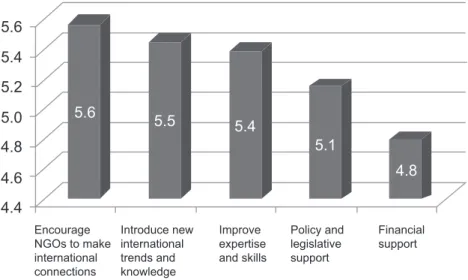
New Southbound countries. At the same time, the government provides wide-ranging support to NGO international aid and development work. On a scale out of ten, NGOs give the government a score of 5.6 for encouraging NGOs to make international connections, 5.5 for introducing new trends and knowledge, 5.4 for improving expertise and skills, 5.1 for supporting policies and legislation, and 4.8 for financial support (see Figure 3).
5.6 5.4 5.2 5.0 4.8 4.6 4.4 5.6 5.5 5.4 5.1 4.8 Encourage NGOs to make international connections Introduce new international trends and knowledge Improve expertise and skills Policy and legislative support Financial support
Figure 3. NGO Itemized Assessment of Government Performance Source: Taiwan AID, Current Situation and Prospect of Non-Government
Organizations Overseas Assistance, p. 49.
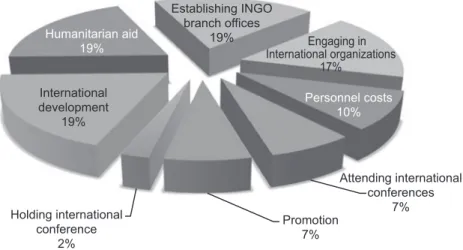
Regarding funding priorities, three groups of almost 20% each (8 NGOs) respectively gave “international development”, “humani-tarian aid” and “establishing INGO branch offices” top priority (see Figure 4).
Humanitarian aid 19% Establishing INGO branch offices 19% Engaging in International organizations 17% Personnel costs 10% International development 19% Holding international conference 2% Promotion 7% Attending international conferences 7%
Figure 4. NGO Recommendations for Top Priority Government Funding Areas
Source: Taiwan AID, Current Situation and Prospect of Non-Government
Organizations Overseas Assistance, p. 49.
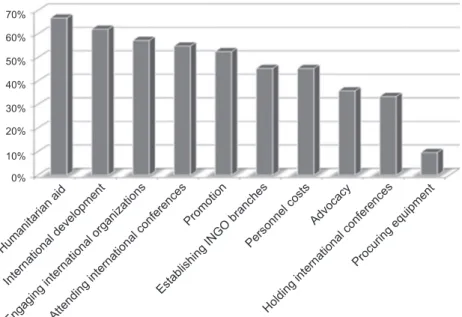
Among the priority areas where NGOs thought the government should increase financial support, over half the NGOs put “humanitarian aid”, “international development”, “attending international con-ferences”, and “promotion” in the top five priorities. In comparison, less than 10% of NGOs prioritized “procuring equipment” (see Figure 5).
Humanitarian aid International development
Engaging international organizationsAttending international conferences Promotion
Establishing INGO branches Personnel costs
Advocacy
Holding international conferences Procuring equipment 70% 60% 50% 40% 30% 20% 10% 0%
Figure 5. Analysis of NGO Recommendations for Priority Areas for Increased Government Funding
Source: Taiwan AID, Current Situation and Prospect of Non-Government
Organizations Overseas Assistance, p. 50.
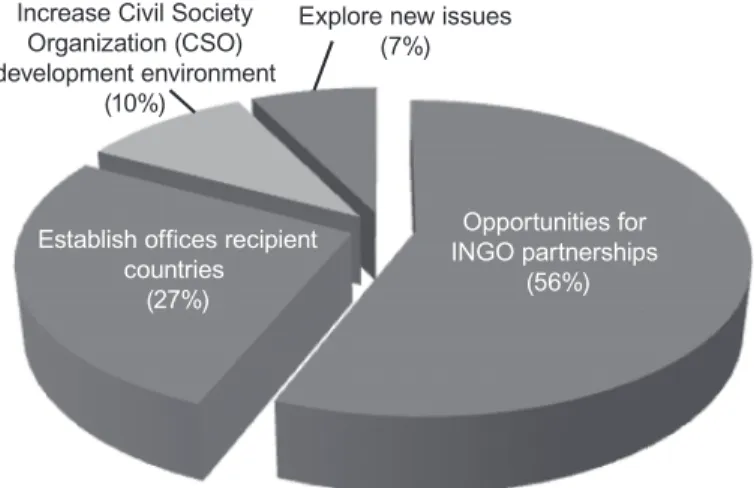
Regarding the areas where the government should increase support for NGOs in international aid and development work, 56% of NGOs recommended “increasing partnership opportunities with INGOs” as the top priority. Additionally 27% of NGOs made “es-tablishing offices in recipient countries” their top priority. In the written explanation, many NGOs recommended the government use national networks to help NGOs get local media exposure, make connections and get to know local resources. Furthermore, some NGOs suggested increasing the overseas aid budget, adopting a humanitarian needs-based approach, and cutting back on diplomatic and political bilateral donations (see Figure 6).
Explore new issues (7%) Increase Civil Society
Organization (CSO) development environment
(10%)
Establish offices recipient countries
(27%)
Opportunities for INGO partnerships
(56%)
Figure 6. Itemized Analysis of NGO Priorities for Increased Support
Source: Taiwan AID, Current Situation and Prospect of Non-Government
Organizations Overseas Assistance, p. 50.
Tackling Taiwan’s unusual international political situation commonly appears among the recommendations from all NGOs. For example, although Taiwan can go through NGOs to carry out inter-national cooperation and assistance plans in many countries without official diplomatic ties, the process is often fraught with obstacles (for example: customs, bank transfers, connections). Official foreign policy thinking and planning still gives diplomatic allies first priority, and since most international assistance funding is facilitated through ICDF, private NGOs receive less government funding, so must rely on private donations or corporate sponsorship to carry out their pro-grams. NGOs feel that in light of the modern-day boom in civil society organizations, the government should harness the power of NGOs to break the international impasse.
IV. Opportunities and Challenges for Taiwan in
Inter-national Development: An NGO Perspective
Taiwan’s government did not start investing in international aid until the end of World War II. Since then, national overseas assistance policy has been dramatically challenged and transformed by inter-national trends and changes. First, Taiwan has a diminishing number of diplomatic allies, currently down to just 22. Yet Taiwan maintains close economic ties with non-diplomatic allies, especially in Southeast Asia. Second, to stabilize formal relations, most ODA is invested in diplomatic allies, and relatively little is reserved for NGOs to implement official assistance. Third, historically Taiwan’s overseas aid focused on agriculture and fishing, but in recent years has concentrated on information technology and economic development, with relatively little attention to advocacy for democracy and human rights. Therefore we need to prioritize the questions of how to transform the effectiveness and visibility of Taiwan’s overseas assistance, utilize the efforts of civil society, strengthen expert knowledge on international development in the diplomatic system, and keep up with the latest trends in inter-national development.
Garnering past experiences and practices, from an NGO per-spective the possible challenges that Taiwan might face as it evolves from diplomacy to international development are discussed below.8 First, Taiwanese society is generally unfamiliar with New Southbound countries. The focus of official diplomacy is still the US, Japan, and Europe, in the hope that these nations will bring investment, personnel
Chien Shiuh-Shen & Wu Yi-Chen, “International Development and Aid from a Global South Perspective,” in Chien Shiuh-Shen & Wang Jenn-Hwan, eds.,
Development Studies and Contemporary Taiwanese Society (Taipei: Chuliu
and expertise to boost internal development and bolster national de-fense. Thus most academic debate on holistic worldviews unfortunately focuses on international relations instead of international development. Such an unbalance not only centers on the North while ignoring the South, but also omits parliaments, academia, NGOs, corporations and other players in a comprehensive game plan. It leads us to not include a comprehensive in-depth discussion of human rights, the environment, faith, labor, cities, education, art and other fields.
Second, Taiwanese international NGOs are by nature limited. Although Taiwan has a growing number of NGOs working on reform and advocacy, they do not yet have the capacity to campaign inter-nationally, which means almost all Taiwanese CSOs engaged in international aid are service oriented NGOs. This gives civil society international aid efforts the same characteristic as government aid, in that there is little or no mention of the environment, land, gender, labor, fair trade or other global structural changes.
Third, there is a geographical gulf between the government and NGOs. Taiwan’s diplomatic allies are concentrated in Latin America and Pacific Islands states. But civil society aid recipients are con-centrated in Southeast Asia, South Asia and China. Not only are there no diplomatic allies in the first two regions, but the last is not part of MOFA’s jurisdiction. Clearly there is a structural fault-line dividing the geographical destinations of civil society and government aid. Although strategically the government needs to use NGOs to get around its foreign affairs difficulties, when diplomatic allies are pri-oritized for overseas aid, a conflict of interests in public-private partnership is inevitable.
Fourth, MOFA lacks consistency. Officials in the MOFA De-partment of NGO International Affairs are reposted every few years.
There are no long-term positions for experienced officials. Neither is there any collective set of standards for international emergency rescue operations jointly agreed with civil society to consolidate re-sources. Taken together, this makes it difficult to establish stable partnerships between NGOs and government, let alone discuss insti-tutionalization.
Fifth, to solidify diplomatic relations, the government sends most aid through public organizations (such as MOFA or ICDF) to diplomatic allies, with relatively little allocated to suitable NGO-run programs. The Control Yuan, a main central government body with powers to investigate and impeach the administration, has criticized MOFA for over-concentrating funds on a minority of NGOs with strong state ties, while its overall budget continues to shrink.
Finally, Taiwanese NGO aid is systematically hampered, resulting in the situation that NGOs are unable to achieve their full potential. Primarily, in order to partner with ICDF, the International Cooperation
and Development Act was passed, which makes it even more difficult
to react to the explosion of interest in international participation by Taiwan’s NGOs.9
This also includes the following technical details. First, the Act excludes Taiwanese NGOs, limiting cooperation to “foreign governments, intergovern-mental organizations, international NGOs and other foreign institutions, organi-zations or professionals”, and Taiwanese NGOs have no legally defined policy advisory status; second, the government only has a contractual relationship with CSOs, and must “first commission ICDF”; third, the competent authority of many overseas aid-giving NGOs is the Ministry of Health and Welfare, the Ministry of the Interior, the Ministry of Education, etc., and many international cooperation issues concern the Ministry of Economic Affairs, the Mainland Affairs Commission, the Ministry of Agriculture, etc., but the International
V. How the New Southbound Policy Can Harness the
Power of NGOs
The New Southbound policy is essentially “people based,” which is consistent with the concept of a human rights-based approach (HRBA) central to NGO promotion of international cooperation and development. The focus of the New Southbound Policy is on economic and trade cooperation, talent exchange, resource sharing and regional links. Furthermore, Taiwan must pay attention to the needs of partner countries and adapt to local circumstances, in a break with the go-alone method of the past. By doing so, Taiwan can strengthen partner-ship relations with international organizations, use civil society and diaspora networks, and cooperate with private businesses and NGOs, thereby promoting international cooperation and development projects, and using the results of mutually beneficial relations between Taiwan and ASEAN and South Asian countries. From this we can see that promotion of the New Southbound Policy can be on track with the progress of international cooperation and development, and NGOs are important drivers of the process.
First the government should give CSOs space to move and develop the unique characteristics of Taiwanese overseas aid. The autonomy of Taiwan’s civil society is in stark contrast to China’s authoritarian regime. This intrinsically helps highlight the special qualities of Taiwan’s international cooperation and development. As well as being diverse and not limited to diplomatic allies, international
other central government bodies, making it difficult to consolidate CSO and government aid actions. Apart from the International Cooperation and
Develop-ment Act, the Ministry of Finance also uses the logic of for-profit organizational
management to manage NGOs, resulting in heavy taxation of overseas aid funds, thus lowering the incentive for CSO participation in overseas aid.
cooperation and development conducted by Taiwanese CSOs can also be delivered in a number of different ways to satisfy the local needs, political systems, environmental sustainability, accountability, and transparency mechanisms of partnership countries, to make more efficient use of cooperation funding, and train more talented individuals in relevant fields at home and abroad.10
Therefore, Taiwanese government organizations and CSOs should establish systematic partnership relations, by, for example, revising the International Cooperation and Development Act to put the energies of civil society to good use in the allocation of official assistance funds, so that funding can be administered in a “comprehensive project” model to establish project management, monitoring and assessment mechanisms. In this vein, apart from responding to the global sustainable development issues and universal values of demo-cratic participation and respect for human rights, the Taiwanese government can incorporate the influence of CSOs to fulfill its international development responsibilities to global society. At the same time Taiwan can distance itself from China’s recent tightening of controls on local and foreign NGO activity, and the reality of China putting pressure on Taiwan.
Second, the government should make the Sustainable Develop-ment Goals (SDGs) the focus of its future international developDevelop-ment cooperation. In September 2015, the UN passed the SDGs and in November of the same year ratified the Paris Agreement (COP21). Both these documents are the result of a global consensus of over Rebecca Wang, Nina HL Kao, Jay Hung, & Chien Shiuh-Shen, “Debunking the Diplomatic Allies Numbers Myth: The Need for Transformation of Traditional Aid Diplomacy,” CommonWealth Magazine, December 26, 2016, <http://opinion. cw.com.tw/blog/profile/52/article/5161>.
180 countries, which recognized traditional aid had overlooked “eco-nomic prosperity”, “social sustainability”, “the environment”, “peace and tolerance”, “effectiveness” and other overarching features of international cooperation and development. As a result, the focuses on people, planet, peace, partnership and prosperity as sustainable development strategy became the conceptual framework for sustainable international cooperation, offering the world clear and coherent long-term development strategic goals. Therefore, the government must quickly include these two key documents, which will shape the future world agenda from 2016 to 2030, into Taiwan’s international develop-ment strategic planning, to systematically make the SDGs and COP21 important reference guides to reevaluate and redefine Taiwan’s overseas aid policy.11
Finally, we recommend the government promotes a cross-departmental “smart diplomacy” model of international cooperation. Taiwan urgently needs to let go of traditional aid practices and adopt a more inclusive international cooperation and development mindset, which integrates diplomatic, academic, technological, economic, health, human-rights, labor, environmental and other resources from other sectors. In addition, Taiwan should be transformed according to the values of transparency, participation, accountability, HRBA and liberal democracy in order to elevate Taiwan to the status of a key player in the agenda of global human development and international cooperation.12
Rebecca Wang, Nina HL Kao, Jay Hung, & Chien Shiuh-Shen, “Debunking the Diplomatic Allies Numbers Myth: The Need for Transformation of Traditional Aid Diplomacy.”
Rebecca Wang, Nina HL Kao, Jay Hung, & Chien Shiuh-Shen, “Don’t Just Think of Foreign Relations with New Southbound, Let NGOs and Government ‘Cooperate Internationally,’” CommonWealth Magazine, July 22, 2017, <http:// opinion.cw.com.tw/blog/profile/52/article/5911>.
In other words, we believe Taiwan’s future global development strategy must break out of the traditional “nation-to-nation” diplomatic mold, and open up to connect with global civil society organizations, to promote “people-based” smart diplomacy. We recommend the Office of the President should intervene to require all government departments to (1) reinterpret the hard- and soft-power of Taiwan’s development experience, (2) consolidate public and private resources, (3) develop bilateral and multilateral cooperative strategies, (4) study and learn from the local needs of different partnership countries, (5) negotiate with local governments and CSOs, and (6) draft a joint “Strategic Action Plan for International Development and Cooperation between Taiwan and Partnership Countries.”
VI. In Lieu of a Conclusion: Recommendations for an
NGO New Southbound Policy
Regarding Taiwanese NGOs and cooperation with New South-bound countries, we put forward the following policy suggestions: first, build partner relationships of trust to facilitate civil engagement. Due to the lack of a mechanism and legal basis for cross-ministerial horizontal coordination and integration in international cooperation and development projects, each ministry implements its own inter-national cooperation policies, making consolidation difficult. So the government should facilitate horizontal coordination between all ministries engaged in international cooperation and establish an in-tegration mechanism. The government should also establish a regular communications mechanism with corporations and NGOs on the use of overseas assistance funds, as well as international cooperation project planning, participation, monitoring and assessment, to collectively appraise the effectiveness of international cooperation projects, which would be an important point of reference to improve foreign aid policy.
Second, improve ODA transparency. Increasing ODA is the basic requirement for Taiwan to participate in international cooperation. The UN target for ODA is 0.7% of GNI.13Currently Taiwan’s ODA is only 0.053% of GNI,14 leaving much room for improvement. In addition, ODA effectiveness should match the Busan Agreement, which requires localized, results-orientated, accountable, transparent and inclusive partnerships. So how to monitor the development effectiveness of government ODA (for example, learning from the establishment of Korea’s ODA Watch) should be a key future policy. Third, reform overseas assistance laws and policies to encourage long-term development programs. In light of Taiwan’s foreign affairs situation, diplomacy-related international cooperation and development needs an injection of new ideas. Resource distribution and allocation should be balanced between allied and non-allied nations. Especially now the government is energetically promoting a New Southbound Policy, the question of how to consolidate local resources – including NGO, business and government resources – and utilize the local knowledge of Taiwanese NGOs, is crucial to promoting foreign re-lations. Therefore, revising the International Cooperation and
De-velopment Act, establishing a transparent operational mechanism to
International Implementation Framework, “Official Development Assistance,” July 25, 2012, International Implementation Framework, <http://iif.un.org/ content/official-development-assistance>.
In the past 3 years (2013-2016), Taiwan’s GNI is around 17 trillion, according to National Statistics R.O.C.(Taiwan), “Taiwan’s Directorate-General of Budget Accounting and Statistics Data,” August 2017, National Statistics R.O.C.
(Taiwan), <http://www.stat.gov.tw/np.asp? ctNode=492&mp=4>; ODA is around
9 billion, according to Ministry of Foreign Affairs R.O.C.(Taiwan), “Taiwan’s Ministry of Foreign Affairs’ Budgets,” August 16, 2017, Accessed, Ministry of
Foreign Affairs R.O.C.(Taiwan),
select international cooperation projects, actively encouraging NGOs to join long-term international development projects, and offering resources in a dignified way, can motivate Taiwanese NGOs and cor-porations to invest in international cooperation work, to strengthen the impact and visibility of Taiwan’s genuine concern for Southeast Asia, South Asia and the SDGs.
Fourth, create an Asian humanitarian assistance platform. With global climate change and the increasing frequency of natural disasters, the government is faced with the threat of a major international disaster, yet it lacks a response mechanism and a comprehensive disaster relief SOP strategy, and has not prepared the funds and re-sources to react to an international disaster. In contrast, NGOs are more mobile, flexible and capable than the government. Although Taiwan’s government has set up a disaster relief fund, according to the law it cannot be used for major international disaster relief work, so it is functionally limited. That is why the disaster relief fund and the functions of its designated appropriation organization should be assessed. There is also a need to establish a cross-border emergency disaster relief and mutual-help mechanism and resources bank, which is flexible enough to incorporate the power of civil society into disaster relief, post-disaster rebuilding and recovery projects.
Fifth, provide a systematic mechanism for youth to volunteer on long-term international development. Youth engagement in inter-national volunteering has long been an interinter-national trend. Youth participation can offer innovative and out-of-the-box thinking and partnerships to programs. Another strength of young people is making connections through social networks, which is seen as an essential advocacy tool for key international development issues. Taiwan’s Youth Development Administration, Ministry of Education, provides subsidies to encourage young people to volunteer, but its limited
re-sources are concentrated on short-term activities, with not enough attention on long-term, in-depth volunteering projects, including volunteering destination, location, organization and project assessment, volunteer selection, training, task allocation, management, supervision, completion rewards, and other long-term planning considerations, which makes it difficult to establish deeper connections. In the future, there will be more demand for qualified long-term international youth volunteers. Working in partnership with NGOs and the private sector, and through their overseas branches, a variety of placements and in-ternship opportunities can be created to send long-term volunteers (3 months to 2 years) to assist with the implementation of international cooperation projects, and at the same get a proper understanding of international cooperation and development.
Sixth, lobby for corporate social responsibility (CSR) in foreign investments by overseas Taiwanese corporations. International co-operation and development projects in partnership with corporations, apart from effectively using corporate resources such as funding, per-sonnel, expertise, skills, and networks, can also help companies promote CSR locally. According to 2016 statistics, overseas Taiwanese business investment (including in China) is around US$12 billion.15 Apart from earning foreign currency, these businesses can promote local social enterprise and sustainable corporate development, which are important strategies. Through cooperation with local NGOs they can implement local partnership programs in education, the environ-ment, health, infrastructure, women’s empowerment and other local community developments in need of assistance. Unfortunately, for many overseas Taiwanese businesses the concept of social enterprise Executive Yuan R.O.C.(Taiwan), 〈對外貿易與投資〉, April 11, 2017, Executive
Yuan R.O.C.(Taiwan), <http://www.ey.gov.tw/state/News_Content3.aspx?
goes no further than holding events and offering scholarships, without achieving an overall plan. In the future, international cooperation projects implemented locally by Taiwanese NGOs, combined with the overseas investment resources of Taiwanese companies, can help overseas Taiwanese entrepreneurs promote social enterprise. In addition, the government can establish a reward system to reward and encourage Taiwanese companies investing overseas to promote local social enterprise and fulfill their obligations as global citizens. Finally, encourage the Taiwanese government, private and civil society sectors to actively engage in South-South development co-operation (SSDC). SSDC is a future international development trend. Through this collaborative framework, developing countries in the global south can work in partnership, and share experiences, knowledge, tools, skills and resources to assess the challenges they face and explore solutions. Furthermore, former developing countries in this area (such as China and Brazil) are now major donors of aid resources, skills and funding to help other countries develop, especially middle-income and low-middle-income countries. Taiwanese NGOs running projects in developing countries should jointly create new methodologies, via knowledge sharing, technical instruction, training, advocacy and other activities, to help SSDC countries promote economic, human rights, governance, gender equality and other developments. The government can use NGOs to actively invest in SSDC, and illustrate its concern and capacity for international work.
References
English
Journal Articles
Edwards, Michael & David Hulme, 1996/6. “Too Close for Comfort? The Impact of Official Aid on Nongovernmental Organizations,”
World Development, Vol. 24, Issue 6, pp. 961-973.
Kamat, Sangeeta, 2004/4. “The Privatization of Public Interest: Theo-rizing NGO Discourse in a Neoliberal Era,” Review of
Inter-national Political Economy, Vol. 11, Issue 1, pp. 155-176.
Korten, David C., 1987/Fall. “Third Generation NGO Strategies: A Key to People-centered Development,” World Development, Vol. 15, Supplement 1, pp. 145-159.
Overseas Development Institute, 1995/8. “NGOs and Official Donors,”
Briefing Paper, No. 4, pp. 1-4.
Pearce, Jenny, 1993/10. “NGOs and Social Change: Agents or Facilitators?” Development in Practice, Vol. 3, Issue 3, pp. 222-227.
Uphoff, Norman, 1993/4. “Grassroots organizations and NGOs in rural development: Opportunities with diminishing states and expanding markets,” World Development, Vol. 21, Issue 4, pp. 607-622.
Online Resources
International Implementation Framework, 2012/7/25. “Official De-velopment Assistance,” International Implementation Framework, <http://iif.un.org/content/official-development-assistance>.
Chinese
Book Articles
and Aid from a Global South Perspective,” in Chien Shiuh-Shen & Wang Jenn-Hwan, eds., Development Studies and
Contem-porary Taiwanese Society. Taipei: Chuliu Book Company. pp.
31-64.
Research Reports
Taiwan AID, 2015. Current Situation and Prospect of Non-Government
Organizations Overseas Assistance (
)(Document Number: 103218CD). R.O.C.: Ministry of Foreign Affairs.
Online Resources
Executive Yuan R.O.C.(Taiwan), 2017/4/11.〈對外貿易與投資〉,
Executive Yuan R.O.C.(Taiwan), <http://www.ey.gov.tw/state/
News_Content3.aspx?n=1DA8EDDD65ECB8D4&s=9BC22A8E 74771B7E>.
Ministry of Foreign Affairs R.O.C.(Taiwan), 2017/8/16(accessed). “Taiwan’s Ministry of Foreign Affairs’ Budgets,” Ministry of
Foreign Affairs R.O.C.(Taiwan),
<http://www.mofa.gov.tw/New-sNoHeadOnlyTitle.aspx?n=D78EA22C51DC706E&sms=04C0F2 D009469151>.
National Statistics R.O.C.(Taiwan), 2017/8. “Taiwan’s Directorate-General of Budget Accounting and Statistics Data,” National
Statistics R.O.C.(Taiwan), <http://www.stat.gov.tw/np.asp?
ctNode=492&mp=4>.
Wang, Rebecca, Nina HL Kao, Jay Hung, & Chien Shiuh-Shen, 2016/12/26. “Debunking the Diplomatic Allies Numbers Myth: The Need for Transformation of Traditional Aid Diplomacy,”
CommonWealth Magazine,
<http://opinion.cw.com.tw/blog/pro-file/52/article/5161>.
2017/7/22. “Don’t Just Think of Foreign Relations with New Southbound, Let NGOs and Government ‘Cooperate Internation-ally,’” CommonWealth Magazine, <http://opinion.cw.com.tw/ blog/profile/52/article/5911>.