一、中文摘要
本研究為高級氧化處理含氯聯苯之研究。首 先本研究發現玻璃表面吸附含氯聯苯造成含氯聯 苯濃度之不穩定性,以 Langmuir-first order 反應式 模擬玻璃吸附含氯聯苯,得 pH 11±0.1 時反應速 率常數較 pH 2.5±0.1 高。以吸附固體表面之自由 能解釋玻璃表面吸附含氯聯苯之行為,結果顯示 影響吸附者為疏水作用。 在高級氧化(UV/TiO2系統)處理含氯聯苯之研 究中,以 Langmuir-first order 吸附反應式模擬水中 含氯聯苯接受高級氧化(UV/TiO2系統)處理之結果 發現反應常數有一些是模擬失敗(呈現負數),發現 UV/TiO2 反應並非全部在 TiO2 表面吸附態上進 行,應假設光反應發生於二氧化鈦表面有效區域 及發生於水溶液相。 以高級氧化(photo-Fenton 系統)處理水中含氯 聯苯之研究中顯示 H2O2濃度與反應速率成一階或 零階反應,而 Fe(II)濃度則與反應速率呈飽和型反 應式(saturation-type)。與 UV/TiO2系統分解含氯聯 苯之總有機碳比較,可知 photo-Fenton 之氧化力較 UV/TiO2系統強。 關鍵字:含氯聯苯;玻璃表面吸附;UV/TiO2系統; photo-Fenton 系統Abstr act
The research of chlorobiphenyls in aqueous solution was conducted in two parts. The first part of the study explored the adsorption of chlorobiphenyls onto glass. Langmuir-first order reaction was used in the adsorption and the photocatalytic oxidation. The results showed some were false in photocatalytic oxidation reaction using
the Langmuir-first order reaction. In the second half of this study, the photocatalytic oxidation (photo-Fenton and UV/TiO2 processes) of chlorobiphenyls
was investigated. With respect to the simulated the photo-Fenton experimental data, the relationship between the reaction rate for chlorobiphenyls and H2O2 concentration was expressed as zero or
first-order reaction and that between the reaction rate and the Fe(II) concentration was a saturation-type reaction. The degradation of TOC was shown for the stronger oxidative ability of the photo-Fenton process more than UV/TiO2.
K eywor d s: chlorobiphenyls; adsorption onto glass; photo-Fenton processes; UV/TiO2 processes.
二、緣由與目的
含 氯 聯 苯 類 (chlorobiphenyl) 或 多 氯 聯 苯 (polychlorinated biphenyls,簡稱PCBs)於全世界存 在量約75萬噸,估計約30萬噸已存在於環境中, 特別是河川底泥中(Sun and Inskeep, 1995; Dexter and Pavlou, 1978)。由於PCBs具有生物累積性、致 癌性和不易被代謝分解等特性,故全世界於1978 年來致力於處理環境中之多氯聯苯已經花費超過 10 億 美 元 , 但 仍 無 法 有 效 地 去 除 (Woodyard, 1990),上述物種也因而始終在需優先管制之毒性 物質名單中(Keith, 1980)。 紫外光/二氧化鈦氧化程序之反應速率與pH 之關係常被探討(Davis and Huang, 1990; Ku and Hsieh,1992),但目前pH對光催化分解有機物之影 響並無一致之結論,故本研究試圖由TiO2吸附有 機物之行為來解釋pH對光催化作用之影響,由於 TiO2表面特性會隨水中pH變化,而有機物狀態亦 隨pH而改變,上述現象不但造成TiO2吸附量之變 化,而且影響VU/TiO2程序之分解效能,故pH之
以 UV/TiO
2與 Photo-Fenton 程序處理水中含氯聯苯之研究
Tr eatment of Aqueous Chlor obiphenyls Using UV/TiO
2and Photo-Fenton
Pr ocesses
計畫編號:NSC-88-2211-E-002-020 執行期限:87 年 8 月 1 日至 88 年 7 月 31 日
計畫主持人:駱尚廉
改變對TiO2吸附水中氯酚類及含氯聯苯之研究相 當 重 要 , 需 加 以 研 究 並 進 一 步 探 討 吸 附 量 與 VU/TiO2程序分解水溶液中含氯聯苯之關係。 另外,Fenton 反應(H2O2/Fe2+)1960 年被應用於 分解水中有機化合物 (Huang et al., 1993),於 1991 年以後文獻出現了以光照 Fenton 程序增加其處理 效能(Sedlak and Andren, 1991; Kuo, 1992; Kiwi et
al., 1993, 1994; Kuo and Lo, 1998(a); Kuo and Lo,
1998(b)),以適用於高濃度廢液或縮短反應時間。 上述光照反應為 photo-Fenton(UV/H2O2/Fe2+)程序 (Safarzadeh-Amiri et al., 1997),係一高級氧化程 序。其處理效能較 UV/TiO2強,也較其他 AOPs 強,適用於高濃度廢液或欲使反應時間縮短之實 驗。
三、 實驗設備及方法
3-1 材料與分析 為避免二氧化鈦 TiO2 (Degussa, P25)表面官能 基不一致而影響其之吸附結果,實驗前需先將TiO2 純化,純化方法係參考 Hohl 和 Stunm (1976)
純化氧化鋁之方法而加以改良之。 3-2 實驗方法
含氯聯苯濃度測定,參考 US. EPA Standard
Method 及 EPA Method 608 加 以 改 良 , 採 用
GC/ECD 偵測殘留濃度。光反應槽分為內部燈光 套及外部反應容器二部份。內部燈光套為石英夾 層(玻璃會吸收紫外光,降低光能量),其內徑約 57 mm,外徑 36 mm,光反應槽中軸向位置放置 內部燈光套,內部燈光套中放置紫外光源,紫外 光源為 Oriel 6285 Mercury,主要波長為 254 nm。 3-3 photo-Fenton (UV/H2O2/Fe2+)法和 UV/TiO2 法
之實驗步驟 (1) 精秤適量適量之水化溶液(TiO2 溶液)或硫酸 亞鐵及適量過氧化氫水溶液添加於已放置在 光反應槽中固定起始濃度之目標污染物水溶 液中。此時反應開始。 (2) 序時取出之水樣以 0.45 mm 之過濾針筒過濾 後以 GC/ECD 測目標污染物殘餘濃度及有機 碳濃度。
四、結果與討論
4-1 UV/TiO2系統處理含氯聯苯之背景測試 本研究實驗之背景測試,包括玻璃壁、TiO2 吸附及直接光解量。在酸或鹼性條件下,玻璃器 壁吸附量與 TiO2吸附約為 6~8 %,直接光解則較 少只佔 3~4 %,以直接光解量而言,含氯聯苯之 降解確實需要高級氧化作用來促進。反應終止 (120 分鐘後),測不出 TiO2表面殘留含氯聯苯, 表示光反應時間內之吸附率遠小於分解率之故, 因此含氯聯苯之降解並不是吸附所致。 4-2 UV/TiO2系統之反應速率探討 首先假設含氯聯苯於 UV/TiO2系統之反應是 發生在 UV/TiO2表面,假設從液相中移去 C 之速 率與表面覆蓋分率θ為一階(first order)反應式,成 為飽和型式反應式,稱為 Langmuir-first order 反應 式。從表 1 中可知模擬之分解速率常數及平衡常 數有些是失敗的(分解速率常數及平衡常數呈現 負值)。其因是假設光反應在二氧化鈦表面吸附態 上進行,實際上光反應作用應分為發生於二氧化 鈦表面有效區域及發生於水溶液相。Table 1. Simulation of Langmuir First-Order Reaction for Chlorobiphenyls Using the UV/TiO2 Process (20℃)
pH 3 pH 7 pH 11 4-CBP k (µg/sL) 4.8 -8.6 50 K (L/µg) 4×10⁻⁵ -10-3 10-4 4,4’-CBP k (µg/sL) -0.12 6.8 35 K (L/µg) -10-4 2×10⁻⁴ 10-4 2,4,6-CBP k (µg/sL) 3.6 -1.8 9.9 K (L/µg) 2×10⁻⁴ -2×10⁻⁴ 2×10⁻⁴ 4-3 UV/H2O2/Fe2+系統處理水中含氯聯苯之暗反 應與光反應之比較 圖 1 所示為 4-CBP 和 4,4’-CBP 在暗反應 (Fe(II)/H2O2)與光 反應 (UV/Fe(II)/H2O2) 目 標 污 染 物降解百分比與反應時間之關係。在暗反應下, 降解速率顯著低於光反應之結果。圖 2 顯示暗反 應之 TOC 不僅產生量多,分解速率亦較之緩慢甚 多。由於越來越多之文獻指出由光化學處理有機 物時,往往中間產物比原目標污染物更毒(Jardim
et al., 1997; Minero et al., 1995; Mills and
Hoffmann, 1993; Manilal et al., 1992)。由此可知有
UV 光照對之 photo-Fenton 於反應中間產物之分解 以及礦化率都有相當大之助益,明顯優於 Fenton 法。
4-4 UV/H2O2/Fe2+系統處理水中含氯聯苯之過
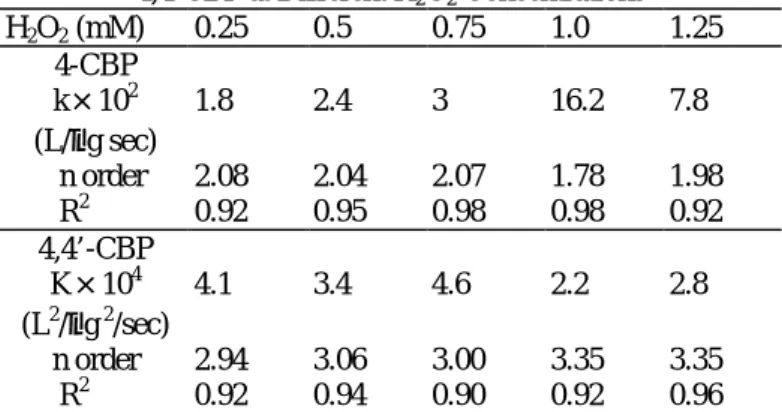
經擬 n 階速率式模擬之降解速率與 R 平方(如 圖 3 和 4),見表 2 和 3。
Table 2. kexp and R2 of Photo-Fenton-Degraded 4-CBP and
4,4-CBP at Different H2O2 Concentrations H2O2 (mM) 0.25 0.5 0.75 1.0 1.25 4-CBP k×102 (L/µg sec) 1.8 2.4 3 16.2 7.8 n order 2.08 2.04 2.07 1.78 1.98 R2 0.92 0.95 0.98 0.98 0.92 4,4’-CBP K×104 (L2/µg 2/sec) 4.1 3.4 4.6 2.2 2.8 n order 2.94 3.06 3.00 3.35 3.35 R2 0.92 0.94 0.90 0.92 0.96
Table 3. kexp and R2 of Photo-Fenton-Degraded 4-CBP and
4,4’-CBP at Different Fe(II) Concentrations
Fe(II) (mM) 0.05 0.1 0.2 0.3 0.4 4-CBP k×102 (L/µg sec) 1.3 2.2 2.7 2.8 3.3 n order 2.09 2.01 2.22 2.23 2.29 R2 0.89 0.73 0.87 0.93 0.97 4,4’-CBP k×104 (L2/µg 2/sec) 4.4 6.4 6.7 15.1 13.7 n order 2.88 2.87 2.99 3.00 3.08 R2 0.66 0.98 0.97 0.94 0.96 4-5 UV/H2O2/Fe 2+系統處理水中含氯聯苯之反應 速率探討 首先假設反應速率常數與 H2O2濃度為 m 階關 係,再假設 4-CBP 之反應速率常數與 Fe(II)濃度 為飽和型反應式(saturation-type) (階層之模擬結 果不佳),則反應常數被改寫為:
[
]
[
][
2 2]
m exp ) ( ) ( O H II Fe K II Fe k k s + = [1] 式中 k 為最大反應速率;KS 為半反應之濃度 (µg/L)。用表 2 和 3 之數據加以模擬得: (1)4-CBP[
]
[
] [
H]
R 0.98 ) ( 1 Fe(II) 13.6 2 2 2 exp = + × = O II Fe k [2] (2) 4,4’-CBP[
]
[
]
R 0.85 ) ( 9 . 7 Fe(II) 39.7 2 exp = + × = II Fe k [3] 就模擬之速率表示式而言,H2O2為 0.25~1.25 mM 時,其為一階反應。由於文獻指出高 H2O2 濃度將遮蔽紫外光照射污染物(Ku, 1992),且本研 究也發現起始 H2O2濃度若超過 2.0 mM 時,反應 速率有降低之現象,故 H2O2濃度之最大貢獻量應 存在於 0.25~2.0 mM。本研究採飽和型模式模擬 亞鐵離子與速率常數之關係(階層模式模擬之結 果不佳)。五、計畫成果自評
本計畫具體之貢獻為 1. UV/TiO2 程序處理水中含氯聯苯之實驗結果以 Langmuir-first order 反應式模擬,可知光反應完 全在二氧化鈦表面吸附態上進行的假設是須被 修正的,實際上光反應作用應分為發生於二氧 化鈦表面有效區域及發生於水溶液相。2. 比較 Fenton 程序和 UV/TiO2程序,photo-Fenton
程序之紫外光確實對原目標污染物之降解(分 解率)、中間產物之降解(礦化率)及礦化時間之 縮短助益相當大,為處理大量廢水之新方向。
六、參考文獻
Davis, A. P., and Huang, C. P., Wat. Res.,24, 543, 1990.
Dexter, R. N., and Pavlou, S. P., Mar. Chem.,7, 67, 1978.
EPA Method 608, 40 CRF, Part 136, Federal Register, 49, p. 209, 1984.
Hohl, M., and Stumn, W., J. Colloid Interface Sci., 55, 281, 1976.
Huang, C. P., Dong, C., and Tang, Z., Waste Mgmt.,13, 361,
1993.
Jardim, W. F., Moraes, S. G., and Takiyama, M. K., Wat. Res.,
31, 1728, 1997.
Kiwi, J., Pulgarin, C., Peringer, P., and Gratzel, M., Applied Catalysis B: Environmental, 3, 85, 1993.
Kiwi, J., Plgarin, C., and Peringer, P., Applied Catalysis B: Environ.3, 335, 1994.
Ku, Y., and Hiseh, C. B., Wat. Res., 26, 1451, 1992. Kuo, W. G., Wat. Res.,26, 881, 1992.
Kuo, C. Y., Lo, S. L., and Chan, M. T., J. of Environ. Sci. and Health (Part B), B33, 723, 1998(a).
Kuo, C. Y., and Lo, S. L., Chemosphere, 38, 2041, 1998(b). Manilal, V. B., Harida, A., Alexander, R., and Surender, G. D.,
Wat. Res., 26, 1035, 992.
Mills, G., and Hoffmann, M. R., Environ. Sci. Technol., 27,
1681, 1993.
Minero, C., Pelizzetti, E., Pichat, P., Sega, M., and Vincenti, M.,
Environ. Sci. Technol.,29, 2226, 1995.
Standard Methods for the Examintion of Water and Wastewater, 6020 and 6431, 18th Ed., Prepared and Published by APHA, AWWA, and WEF, 1992.
Sedlak, D. L., and Andren, A. W., Wat. Res., 28, 1207, 1994. Sedlak, D. L., and Andren, A. W., Environ. Sci. Technol.,25,
777, 1991.
Sun, S., and Inskeep, W. P., Environ. Sci. Technol., 29, 903,
1995.
Widish, D. J., Metcalfe, C. D., Akai, H. M., and Mcleese, D. W., Bull. Environ. Contam. Toxical., 24 20, 1980.
Fig.1. Comparison of Chlorobiphenyl Concentrations Remaining After Photo-Fenton and Fenton Treatment (4-CBP and 4,4’-CBP Initial Concs. = 500 µg/L, [Fe2+] = 0.1 mM, pH = 3±0.25, 20oC, [H2O2] = 0.5 mM, UV Light Intensity = 5 mW/cm2, Methanol = 1%)
Fig.2. Comparison of TOC Concentration Remaining After Photo-Fenton and Fenton Treatment 0 20 40 60 80 100 120 0 50 100 Tim e (m in) Chlorobiphenyl Residue (%) 4-CB P (light) 4-CB P (dark) 4,4'-C B P (light) 4,4'-C B P (dark) 0 20 40 60 80 100 120 140 160 0 50 100 Tim e (m in) TOC Concentration Residue ( % ) 4-C B P (light) 4-C B P (dark) 4,4'-C B P (light) 4,4'-C B P (dark)
Fig.3. Degradation of Chlorobiphenyls with Different pH Using the Photo-Fenton Process (4-CBP and 4,4’-(4-CBP Initial Concs. = 500 µg/L, [Fe2+] = 0.1 mM, 20oC, [H2O2] = 0.5 mM,
UV Light Intensity = 5 mW/cm2, Methanol = 1%)
Fig.4. Degradation of TOC with Different pH Using the Photo-Fenton Process (the Same Conditions as Fig. 3) 20 30 40 50 60 70 80 90 100 110 0 50 100 Time (min) Chlorobiphenyl Residue (%) 4-CBP (pH 2) 4-CBP (pH 3) 4-CBP (pH 4) 4,4'-CBP (pH 2) 4,4'-CBP (pH 3) 4,4'-CBP (pH 4) 50 60 70 80 90 100 110 120 130 0 2 4 6 8 10 Time (min) TOC Concentration Residue (%) 4-CBP (pH 2) 4-CBP (pH 3) 4-CBP (pH 4) 4,4'-CBP (pH 2) 4,4'-CBP (pH 3) 4,4'-CBP (pH 4)