National Research Program for Genomic Medicine
National Science Council, the Executive Yuan, ROC.
Research Project
基因體醫學國家型科技計畫
研究計畫
Application Status: ; Continuation ٱ Revised Application
Program Classification:
;
Genomic Medicine ٱ Bioinformatics
ٱ Proteomics & Structural Genomics ٱELSI
Serial Number
:91GMP012-3
(原計畫申請編號) (in Chinese) 中文 人類移形上皮癌之基因表現檔案---尋找與砷有關之致癌機轉及調 整化學治療處方 Title of Component Prject 子計畫名稱 (in English) 英文
Gene Expression Profiling of Human Transitional Cell Carcinoma---Identifying Arsenic-Related Carcinogenic Mechanism and Tailoring Chemotherapy Regimens
(in Chinese) 中文
台大醫學院泌尿科 Institution
研究(執行)單位
(in English) 英文
Department of Urology, College of Medicine, National Taiwan University
TABLE OF CONTENTS
Part B. Progress Report
B1. Face Page
B2. Progress Report
B2a. Specific AimsB2b. Studies & Results
B2c. Personnel
B2d. Projected Timeline
B2e. Publications (Optional)
B2f. Patents (Optional)
B3. Request for Modifications of the Project
(Optional)
You do not have to finish this section except your budgets or items of requests are modified.
(請求經費或項目變動者才須加填此一部份,否則直接附上去年全程計畫書當附件即
可)
B3a. Background & Statement (including literature cited) B3b. Summary Budget Requested
B3c. Postdoctoral Fellows Requested B3d. Detailed Budget for Personnel
B3e. Detailed Budget Requested for Equipments B3f. Detailed Budget Requested for Travel to Overseas B3g. Detailed Budget Requested for Attending Conferences B3h. Detailed Budget Requested for Other Categories B3i. Use of Core Facilities Requested
B3j. Biographical Sketches of New Personnel
Part B.
Progress Report
of Component Project
PROGRAM PROJECT: Component Project __3___
((請填入子計畫編號) B2. Progress ReportB2a. Specific Aims
Please state the overall goals of the project, and specific aims, as reviewed and approved by the Study Section and actually awarded. If these specific aims as actually funded did not differ in scope from those actually pursued during the grant period, and if the aims have not been modified, state this. If they have been modified, give the revised aims and the reasons for the modifications.
Specific aims (The aims have not been modified.)
1. Establishing arsenic-related carcinogenic mechanism of human urothelium
A. Compare gene expression profiles of human urothelial carcinoma (UC) specimens from Blackfoot Disease (BFD) and non-BFD endemic areas in Taiwan by using cDNA microarray.
B. Formulate possible toxicogenic and carcinogenic pathways of arseniasis by the expressed gene profiles of UCs.
2. Establishing a drug-selecting algorithm for UC
A. Identify differentially expressed genes in cell lines of varied chemosensitivity and tumor specimens from chemotherapy responders and non-responders.
B. To build up a drug-selection algorithm for UC chemotherapy and validate the algorithm in a xenograft nude mouse model.
Hypothesis
1. Arsenic-mediated carcinogenesis of human urothelium involves multiple genetic factors which can be delineated by the expressed gene profiles of transitional cell tumors. 2. Human TCC can be classified molecularly by expressed gene profiles which may confer
PROGRAM PROJECT: Component Project __3___
((請填入子計畫編號) B2b. Studies and ResultsDescribe the studies directed toward the specific aims during the current grant period and the results obtained. Indicate the extent to which the work accomplished has successfully met the specific aims. Include negative results. If technical problems were encountered in carrying out this project, describe how your approach was modified.
Establishing arsenic-related carcinogenic mechanism of human
urothelium
We have finished the following works:
1. Gene expressions profiles of NTUB1 and NTUB1/As using cDNA microarray have been determined. Gene of 3-fold or higher difference in expression between NTUB1 and NTUB1/As (arsenic trioxide-resistant clone) have been picked up and are thought to play roles in arsenic-related carcinogenesis. (Table 1)
Table 1. Differentially expressed genes: NTUB1/As vs. NTUB1
Up-regulated Fold Gene category Gene name (revised on Jan.31, 2001) Nil
Down-regulated
1614 0.12 Transcriptional factor general transcription factor IIB 1750 0.14 stathmin 1/oncoprotein 18
572 0.16 Growth factor or cytokine pleiotrophin (heparin binding growth factor 8, neurite growth-prom 1204 0.19 ESTs, Moderately similar to 810024E cytochrome oxidase III [H.s 1555 0.2 RAB5 interacting protein 2
1582 0.2 Homo sapiens, clone IMAGE:3677155, mRNA 1286 0.21 ribosomal protein L35
1273 0.24 Phosphatase protein phosphatase 1, regulatory (inhibitor) subunit 1A
2. The above data will be linked to those from Component Project 2, which used immortalized human urothelial cells (SV-HUC-1 or CRL9520) that were also made resistant to arsenic trioxide by long-term incubation. The common genes responsible for resistance in NTUB1/As and SV-HUC-1/As should be the priority for validation and further in-depth study.
3. One of the up-regulated genes in resistant cell lines, heme oxygenase-1 (HO-1), had been done by real time PCR, but the data are not definitely compatible with those in cDNA microarray. We also used PA3-019 (polyclonal rabbit anti-HO1 antibody) (Affinity BioReagentTM) to detect HO-1 protein, which is expressed in all UC tissue samples, regardless of arsenic resisitance; but not in adjacent normal or normal urothelia. We observed that tumors with higher grade and stage or related to arsenic tended to express lower level of HO-1 protein. Whether there is real difference between high-level expression tumors and low-level expression tumors is currently under study.
Non-aresenic-related Non-arsenic-related
superficial bladder cancer (Gr I) superficial bladder cancer (Gr II)
Non-aresenic-related Arsenic-related
invasive bladder cancer (Gr III) invasive bladder cancer (Gr III)
Control (renal pelvis urothelium)
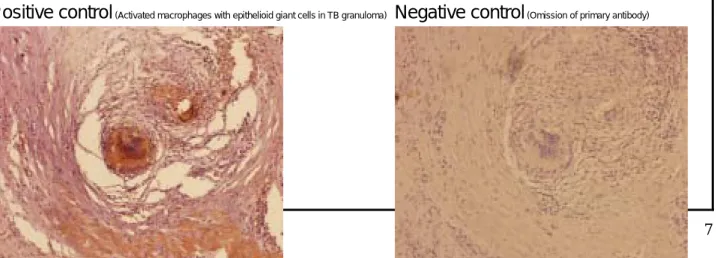
It appears that normal urothelium is negative for HO-1 staining. Almost all tumors are positive for HO-1 staining. We are still working on the staining intensity to see if there is differential staining between As-related or unrelated UCs.
of low amount and suboptimal quality, which made microarray results questionable. Linear amplification will be used to amplify the amount of RNA. We will adopt laser capture microdissection and linear amplification to get enough cDNA representing benign urothelia.
6. In the coming grant period, we will continue the cDNA microarray experiment and subsequent data analysis to isolate genes specific for carcinogenesis of
arsenic–related UC.
Establishing a drug-selecting algorithm by correlating drug sensitivity
with expressed gene profiles in UC
We have finished the following works:
1. In vitro chemosensitivity testing: Six parental sensitive UC cell lines (NTUB1, T24, HTB5, TSGH8301, BFTCC905, and BFTCC909) and 5 daughter resistant UC cell lines (NTUB1/As resistant to arsenic trioxide, NTUB1/G resistant to gemcitabine, NTUB1/P resistant to cisplatin, NTUB1/T resistant to paclitaxel, and T24/A resistant to
doxorubicin) have been tested against 8 commonly used chemotherapeutic drugs (cisplatin, doxorubicin, 5-FU, gemcitabine, methotrexate, paclitaxel, vinblastine, and arsenic trioxide). A total of 88 IC50 values (11 X 8 = 88) had been obtained. (Table2)
Table 2. IC50 of UC cell lines by using the MTT assay
IC
50Doxorubicin
(µM)Cisplatin
(µM)Paxlitaxel
(µM)NTUB1
0.0870±0.0145 1.9365±0.2770 0.0126±0.0007NTUB1/P
(14)
0.4745±0.0384 48.2044±2.1603 0.0736±0.0164NTUB1/As
(0.4)
0.1980±0.0746 1.5965±0.3487 0.0207±0.0044NTUB1/T
(0.005)
0.1087±0.0200 5.6090±0.3118 0.0398±0.0139T24
0.1292±0.0648 2.3179±0.5110 0.0285±0.0115T24/A
(0.4)
1.8573±0.5125 3.3184±0.7353 0.4254±0.0892BFTCC905
0.1341±0.0710 0.9093±0.1364 0.0303±0.0119NTUB1/As
(0.4)
0.2256±0.0725 35.8309±6.8506 0.8514±0.1828NTUB1/T
(0.005)
0.1177±0.0139 42.1262±5.8884 0.7948±0.1216T24
0.1554±0.0933 72.8369±1.6904 0.6885±0.1263T24/A
(0.4)
1.2149±0.1939 89.9002±5.5595 1.4375±0.0489BFTCC905
0.5463±0.2633 19.6165±2.3546 0.6817±0.0869BFTCC909
2.9876±0.2482 40.8998±1.6550 2.0117±0.2492 NTUB1/P, NTUB1/cisplatin-resistantNTUB1/As, NTUB1/arsenic trioxide-resistant NTUB1/T, NTUB1/paclitaxel-resistant
T24/A, T24/doxorubicin-resisitant
2. Gene expression profiles of 11 UC cell lines determined by the cDNA microarray technology have been obtained. Genes of 3-fold or higher difference in expression between the 3 most sensitive (mean expression signals) and 3 most resistant UC cell lines have been picked up to be responsible for the chemoresistance. These genes are referred to as “resistance-related genes”. A total of 79 genes have been identified. (See B2b. Studies and Results (Cont.))
3. Tumor specimens from patients treated with chemotherapy were collected. Pre-chemotherapy tumor RNAs were extracted and cDNAs were made ready for real-time PCR to examine the expression status of the above “resistance-related genes”. These tumors had variable responses (complete response [n = 2], partial response [n = 8], stable disease [n = 8], and progressive disease [n = 8]) to
chemotherapy containing paclitaxel, 5-fluorouracil, cisplatin, methotrexate, vinblastine, gemcitabine, etc. So theoretically tumor responses can be correlated with the
expression status of the “resistance-related genes”.
4. A model of predicting the chemosensitivity of a given tumor for each chemotherapeutic agent will be formulated by inputting above data (gene expressions as the independent variables and clinical response as the dependent variable) of about 20 clinical tumor samples. Another set of 20 to 30 clinical tumors will be used to validate the model. However, the difficulty of the following analysis lies in that we use combination
human urothelial cells (SV-HUC-1 or CRL9520) that were made resistant to arsenic trioxide by long-term incubation. These 2 component projects pursue the topic from different aspects and are complementary to each other.
Comment III-2. Second, this component project intends to establish a drug-selecting algorithm by correlating drug sensitivity with expressed gene profiles of TCC. Can one equate, at least approximately, the notion of drug sensitivity with the desire to reduce toxicity and improve efficacy? How will the drug sensitivity be measured and have such measures been validated? It is felt that a strong rationale should be provided to assure that the approach for in vitro chemosensitivity testing, which is rather complicated with 23 cells subjected to test against 10 agents, will tailor future chemotherapy regimens.
Answer to Comment III-2. This study approach is a novel one which needs
verification and validation. If a given tumor is resistant to certain chemotherapeutic agents
and sensitive to others, a reasonable strategy to improve treatment efficacy and reduce toxicity is to utilize sensitive drugs but avoid resistant ones. Our strategy is to correlate resistance-related gene expressions of a given tumor and clinical responses to a certain agent. Hopefully, a model of predicting chemosensitivity can be formulated and will be validated by another set of tumors of whom the clinical treatment response and gene expressions by real-time PCR can be obtained.
Comment III-3. The detailed budget request is not provided. Every page after 16 is blank. Answer to Comment III-3. As requested, the budget request of the third year is attached in the report.
Comment III-4. A major concern raised in previous review was that the proposed
approaches for part II are purely exploratory and with the number of units considered (small indeed), it is unclear if meaningful results would be obtained. This concern was not
addressed in the progress report.
Answer to Comment III-4. The proposed approaches for part II are not entirely exploratory. For examples, Zajchoski DA, et al. (Cancer Res 2001;61:5168-78) identified gene
expression profiles that predict the aggressive behavior of breast cancer cells using 9 weakly invasive and 4 highly invasive breast cancer cell lines (13 cell lines in total). As compared with the 11 parental (presumably chemo-sensitive) cell lines and 12 daughter (presumably chemo-resistant) cell lines used in our study, the power of the study could be as strong as Zajchoski’s study. However, we admit that using gene expression profiles of certain cell lines to predict clinical chemosensitivity (or chemoresistance) is exploratory.
PROGRAM PROJECT: Component Project __3___
((請填入子計畫編號) B2b. Studies and Results (Cont.)Cisplatin IC50 ranking list 1 = BFTCC905 2 = TSGH8301 3 = HTB5 4 = NTUB1/G 5 = NTUB1/As 6 = NTUB1 7 = T24 8 = T24/A 9 = BFTCC909 10 = NTUB1/T 11 = NTUB1/P
Cisplatin resistance-related genes (cells of the 3 highest IC50s vs cells of the 3 lowest IC50s)
Up-regulated Fold Gene category Gene name (revised on Jan.31, 2001) Acc. NO 1987 9.3 Translation putative translation initiation factor N91944
878 4.3 Adhesion & ECM annexin A8 H58091 1299 4.1 Kinase & signaling histidine triad nucleotide-binding protein T57556
Down-regulated
731 0.036 Proteolytic activity ubiquitin carrier protein E2-C T86744 1775 0.08 Growth factor or cytokine antigen identified by monoclonal antibody Ki-67 N52414
2011 0.14 ESTs
403 0.16 Receptor activin A receptor, type I R45384
101 0.22 Miscellaneous ESTs N93946 3 3 3 3 3 3 3 3 3 3 3 N =
Urothelial Carcinoma Cell Lines
11.00 10.00 9.00 8.00 7.00 6.00 5.00 4.00 3.00 2.00 1.00 IC 50 (microM) 60 50 40 30 20 10 0
Doxorubicin IC50 ranking list 1 = NTUB1/G 2 = TSGH8301 3 = NTUB1 4 = NTUB1/T 5 = T24 6 = BFTCC905 7 = NTUB1/As 8 = HTB5 9 = BFTCC909 10 = NTUB1/P 11 = T24/A
Doxorubicin resistance-related genes (cells of the 3 highest IC50s vs cells of the 3 lowest IC50s)
Up-regulated Fold Gene category Gene name (revised on Jan.31, 20 885 3.89 Receptor retinoic acid receptor, beta
1009 3.85 Oncogene & suppressor gene GRO2 oncogene 813 2.50 Oncogene & suppressor gene exotosis (multiple) 1
1233 2.39 Kinase & signaling mitogen-acitvated protein kinase 6
1102 2.06 Homo sapiens mRNA; cDNA DKFZp434F0723 (from clone D 1307 2.05 Human platelet-derived growth factor A chain (PDGFA) gene
Down-regulated
1809 0.107 chloride channel, calcium activated, family member 4
28 0.195 calnexin
1643 0.197 Kinase & signaling protein kinase, cAMP-dependent, regulatory, type I, alpha (ti 1982 0.215 tousled-like kinase 1
1542 0.244 Stress protein secreted protein, acidic, cysteine-rich (osteonectin)
3 3 3 3 3 3 3 3 3 3 3 N =
Urothelial Carcinoma Cell Lines
11.00 10.00 9.00 8.00 7.00 6.00 5.00 4.00 3.00 2.00 1.00 IC 50 (microM) 3.5 3.0 2.5 2.0 1.5 1.0 .5 0.0
5-Fluorouracil IC50 ranking list 1 = TSGH8301 2 = BFTCC905 3 = NTUB1/As 4 = BFTCC909 5 = NTUB1/T 6 = NTUB1 7 = NTUB1/P 8 = NTUB1/G 9 = T24 10 = T24/A 11 = HTB5
5-FU resistance-related genes
Up-regulated Fold Gene category Gene name (revised on Jan.31, 2001) 13 5.23 indolethylamine N-methyltransferase
134 3.43 Proteolytic acitivity ubiquitin protein ligase E3A (human papilloma virus E6-associated 1069 3.24 ESTs, Highly similar to unnamed protein product
494 3.12 Growth factor or cytokine parathyroid hormone-like hormone
480 3.11 Proteolytic acitivity matrix metalloproteinase 7 (matrilysin, uterine)
Down-regulated
30 0.14 Adhesion & ECM integrin, beta 4 1911 0.25 AD023 protein 3 3 3 3 3 3 3 3 3 3 3 N =
Urothelial Carcinoma Cell Lines
11.00 10.00 9.00 8.00 7.00 6.00 5.00 4.00 3.00 2.00 1.00 IC 50 (microM) 140 120 100 80 60 40 20 0
Gemcitabine IC50 ranking list 1 = NTUB1 2 = T24 3 = NTUB1/T 4 = NTUB1/As 5 = BFTCC905 6 = TSGH8301 7 = T24/A 8 = NTUB1/P 9 = BFTCC909 10 = HTB5 11 = NTUB1/G
Gemcitabine resistance-related genes
Up-regulated Fold Gene category Gene name (revised on Jan.31, 2001) 1256 18.03 Differentiation TGF beta receptor associated protein -1
2011 11.16 ESTs
1282 7.13 Kinase & signaling protein kinase C, zeta
1206 6.94 DNA replication and repair growth arrest and DNA-damage-inducible, alpha 1263 6.15 Cell-cycle control CDC-like kinase 2
1693 5.68 unknown ESTs 1473 5.3 prefoldin 5
1908 5.24 H3 histone, family 3B (H3.3B)
344 4.77
TAF9-like RNA polymerase II,
TATA box binding protein (TBP)-associated factor, 31 kD 1388 4.17 regulated in glioma
786 4.08 Transcriptional factor adaptor-related protein complex 3, beta 1 subunit
Down-regulated
111 0.21 phosphatidylinositol glycan, class F
170 0.23 Transcriptional factor human immunodeficiency virus type I enhancer-binding protein 1013 0.16 Proteolytic activity proteasome (prosome, macropain) activator subunit 3 (PA28 ga 1190 0.22 eukaryotic translation elongation factor 1 gamma
3 3 3 3 3 3 3 3 3 3 3 N =
Urothelial Carcinoma Cell Lines
11.00 10.00 9.00 8.00 7.00 6.00 5.00 4.00 3.00 2.00 1.00 IC50 (microM) 10 8 6 4 2 0
Methotrexate IC50 ranking list 1 = BFTCC905 3 = NTUB1/As 4 = T24/A 5 = NTUB1/G 6 = NTUB1/T 7 = T24 8 = NTUB1 8 = TSGH8301 9 = NTUB1/P 10 = BFTCC909
Methotrexate resistance-related genes
Up-regulated Fold Gene category Gene name (revised on Jan.31, 154 7.55 CDK2-associated protein 1
464 5.07 ubiquitin B
860 4.48 Oncogene & suppressor gene oxidase (cytochrome c) assembly 1-like
1117 5.31 Vascular disorder serine (or cysteine) proteinase inhibitor, clade E (nexin, plasm 1153 4.4 Oncogene & suppressor gene DEK oncogene (DNA binding)
1301 5.77 Miscellaneous small nuclear ribonucleoprotein polypeptides B and B1 1526 4.26 hypothetical protein MGC5363
1562 5.07 ESTs
1587 4.05 Oncogene & suppressor gene sarcoma amplified sequence
1704 4.76 arachidonate 5-lipoxygenase-activating protein 1789 4.09 House keeping GAPDH(200X)
1897 4.51 Translation putative translation initiation factor
Down-regulated 3 3 3 3 3 3 3 3 3 3 N =
Urothelial Carcinoma Cell Lines
10.00 9.00 8.00 7.00 6.00 5.00 4.00 3.00 2.00 1.00 IC 50 (microM) 40 30 20 10 0
Paclitaxel IC50 ranking list 1 = NTUB1 2 = NTUB1/As 3 = NTUB1/G 4 = T24 5 = BFTCC905 6 = BFTCC909 7 = NTUB1/T 8 = TSGH8301 9 = HTB5 10 = NTUB1/P 11 = T24/A
Paclitaxel resistance-related genes
Up-regulated Fold Gene category Gene name (revised on Jan.31, 2001)
885 4.27 Homo sapiens, clone MGC:10965 IMAGE:3633884, mRNA, com 461 4.25 Kinase & signaling huntingtin (Huntington disease)
Down-regulated
1604 0.12 bromodomain adjacent to zinc finger domain, 1A 1720 0.15 DNA replication and repair eukaryotic translation initiation factor 4A, isoform 2 1524 0.17 Transcriptional factor HMT1 (hnRNP methyltransferase, S. cerevisiae)-like 1
692 0.21 Kinase & signaling serine/threonine-protein kinase PRP4 homolog 1531 0.21 House keeping ribosomal protein S20
3 3 3 3 3 3 3 3 3 3 3 N =
Urothelial Carcinoma Cell Lines
11.00 10.00 9.00 8.00 7.00 6.00 5.00 4.00 3.00 2.00 1.00 IC 50 (microM) .7 .6 .5 .4 .3 .2 .1 0.0
Vinblastine IC50 ranking list 1 = NTUB1/As 2 = NTUB1 3 = BFTCC905 4 = NTUB1/T 5 = NTUB1/G 6 = TSGH8301 8 = T24 8 = NTUB1/P 9 = BFTCC909 10 = T24/A
Vinblastine resistance-related genes
Up-regulated Fold Gene category Gene name (revised on Jan.31, 2001) 885 10.1 Homo sapiens, clone MGC:10965 IMAGE:3633884, mRNA, complete cd
Down-regulated
1474 0.145 Kinase & signaling mitogen-activated protein kinase 13
1672 0.186 Adhesion & ECM integrin, beta 2 (antigen CD18 (p95), lymphocyte function-associated an 1524 0.187 Egr1 3 3 3 3 3 3 3 3 3 3 N =
Urothelial Carcinoma Cell Lines
10.00 9.00 8.00 7.00 6.00 5.00 4.00 3.00 2.00 1.00 IC 50 (microM) 5 4 3 2 1 0
Arsenic trioxide IC50 ranking list 1 = HTB5 2 = NTUB1/G 3 = BFTCC905 4 = T24 5 = NTUB1/T 6 = NTUB1 7 = NTUB1/As 8 = TSGH8301 9 = T24/A 10 = BFTCC909 11 = NTUB1/P
Arsenic trioxide resistance-related genes
Up-regulated Fold Gene category Gene name (revised on Jan.31, 2
Down-regulated
1775 0.082 Growth factor or cytokine antigen identified by monoclonal antibody Ki-67 444 0.099 hypothetical protein MGC8721
315 0.111 synaptosomal-associated protein, 23kD 1491 0.119 CDC28 protein kinase 2
2011 0.141 ESTs
1672 0.166 Adhesion & ECM integrin, beta 2 (antigen CD18 (p95), lymphocyte function-associa 302 0.172 Growth factor or cytokine interleukin 1, beta
1493 0.173 translocase of inner mitochondrial membrane 17 homolog A (yeas 1297 0.183 ribosomal protein L34
131 0.186 ribosomal protein L23
251 0.244 signal transducer and activator of transcription 1, 91kD
3 3 3 3 3 3 3 3 3 3 3 N =
Urothelial Carcinoma Cell Lines
11.00 10.00 9.00 8.00 7.00 6.00 5.00 4.00 3.00 2.00 1.00 IC 50 (microM) 7 6 5 4 3 2 1 0
PROGRAM PROJECT: Component Project ___3__((請填入子計畫編號) B2c. Personnel
Summarize the personnel involved in the project during the grant period. List the personnel in accordance to the following categories: (1) senior investigators, including visitors; (2) postdoctoral fellows; (3) graduate students; (4) technicians; and (5) other research assistants. Specify for each individual the period of involvement and the percentage commitment of effort.
Position Title
Name
Chinese English
%
Effort Job Description or Responsibilities
PI 蒲永孝 Yeong-Shiau
Pu
35 Organize and supervise research team, report and manuscript preparation, tissue collection and handling
Co-PI 李德章 Te-Chang Lee 15 Provide gene chips
Co-PI 侯自銓 Tzyh-Chuyan
Hour 15 Animal experiments, molecular biology experiments
PhD student 林家齊 Chia-Chi Lin 15 Tissue collection and handling, data
analysis Research
associate 官靜儀
Jing-Yi Guan 10 Cell culture, performing microarray assay
Research
associate 王榮蓮
Jung-Lien Wang
10 Cell culture, molecular biology experiments
PROGRAM PROJECT: Component Project ______
((請填入子計畫編號) B2d. Projected TimelineProvide a reasonable timetable for the execution of the work outlined in the project. Highlight appropriate milestones that you might use to target the studies. Indicate technical hurdles that might slow down the execution of the work and discuss any contingencies that you have or might have built in the research plan in anticipation of these difficulties. Do not exceed one page.
A. Arsenic-mediated carcinogenic mechanisms
First Year (2002/05 to 2003/04)
1. Collection and extraction of tumor RNA of human UC tissues Second Year (2003/05 to 2004/04)
2. cDNA microarray study (primary gene chip)
3. Analyze microarray results and select differentially expressed genes 4. Q-PCR to confirm the expression status.
5. Construct secondary gene chips that contain the above differentially expressed genes.
6. LCM and Linear amplification of tumor RNA of human UC tissues (30 cases for each of the two groups of UC specimens).
Third Year (2004/05 to 2005/04)
7. cDNA microarray (secondary gene chip) study. 8. Q-PCR to confirm the expression status.
9. Functional study of significant unknown genes found in the study.
10. Link data with those from Component Project 2, which uses human urothelium cells (CRL9520) with long-term treatment of MMA(III), DMA(III), and arsenic trioxide.
11. Preparation of project reports and manuscripts to be published.
B. To establish a drug-selecting algorithm by correlating drug
sensitivity with expressed gene profiles in TCC
First Year (2002/05 to 2003/04)
1. Establish chemosensitivity profiles of 23 UC cell lines (sensitive and resistant). Organize the cell line list by the order of chemosensitivity.
2. Extract RNA for cDNA microarray study. Second Year (2003/05 to 2004/04)
3. Q-PCR to confirm the expression status of these genes in cells. 4. Construct the drug-selecting algorithm
Third Year (2004/05 to 2005/04)
5. Validate and modify the drug-selecting algorithm
6. Clinical tumor study: LCM and linear RNA amplification of clinical tumor samples for cDNA microarray study.
PROGRAM PROJECT: Component Project ___3__
((請填入子計畫編號) B2e. Publications (Optional)List the title and complete references (author(s), journal or book, year, page number) of all publications resulting from studies supported by the project. List the publications for the project in accordance to the following categories: (1) manuscripts published and accepted for publications; (2) manuscripts submitted and under review; (3) manuscripts under preparation; and (4) conference proceedings. Provide one copy of each publication not previously reported to the National Science Council in the Appendix.
Conference Proceedings
1. Gene expression profiling of human urothelial carcinoma – identifying arsenic-related carcinogenic mechanism and tailoring chemotherapy regimens. Chia-Chi Lin, et al. Proc Annual Meeting of Taiwan Urology Association 2003 B05. (Aug 30, 2003)
B2f. Patents (Optional)
PROGRAM PROJECT: Component Project __3___
((請填入子計畫編號) B3. Summary of the Modified Budgets (Optional)B3a. Background and Statement (including literature cited)
Please describe the background leading to the present revised project and discuss the potential difficulties and limitations of the previously proposed application. List all major changes in the budget and the personnel, and provide a justification for the change. State concisely the importance of the requested revision or supplement by relating the specific aims to the broad, long-term objectives, as well as the overall goals of the project.
We had changed the master student to Jen-Mei Lee. Because the prior master student had graduated and went to military service.
PROGRAM PROJECT: Component Project ______
((請填入子計畫編號) B3b. Summary Budget Requested in NT dollar (in NT dollars: 1USD = 34 NTD)Budget Categories 1st Year (granted) ( y m∼ y m) 2nd Year (granted) ( y m∼ y m) 3rd Year (requested) ( y m∼ y m)
Remarks for Changes
1. Personnel (Form B3d) 2. Equipment (Form B3e) 3. Travel to Overseas /Mainland (Form B3f) 4. Attending International Conferences (Form B3g) 5. Others* (Form B3h) 6. Overhead**
7 .Use of Core Facilities (Form B3i)
8. Bonus for the PI*** 9. Total****
10 Postdoctoral Fellow (The Number of Person)
Total for entire project period: NT$
Other Personnel and Supplemental Request
National High Computing Center (Quota)
Precision Instrument Center (Quota)
Other Research support
PROGRAM PROJECT: Component Project ______
((請填入子計畫編號) B3c. Postdoctoral Fellows RequestedPROGRAM PROJECT: Component Project ______
((請填入子計畫編號) B3d. Detailed Budget for Personnel (3rd Year, requested)Name Salary (NT$)
Class/Grade
Chinese
English Monthly Annual
Insurances (Annual)
Role in Project
PhD Student 林家齊
Chia-Chi Lin
20,000 240,000 Tissue collection and
handling, data analysis Master Student 李貞妹 Jen-Mei Lee 8,000 96,000 Microarray assay, molecular biology experiments Bachelor/
Ninth year Jing-Yi Guan 官靜儀
36,300 490,050 40,992 Laser capture microdissection, performing microarray assay (Insurance coverage per year) Bachelor/
Ninth year Jung-Lien Wang 王榮蓮
36,300 490,050 40,992 Cell culture, RNA
extraction and Amplification, Q-PCR, molecular biology experiments
PROGRAM PROJECT: Component Project ______
((請填入子計畫編號) B3e. Detailed Budget Requested for Equipments in NT dollarsEquipment Function and Justification 1
st year (granted) 2nd year (requested) 3rd year (planned)
PROGRAM PROJECT: Component Project ______
((請填入子計畫編號) B3f. Detailed Budget Requested for Travel to Overseas in NT dollars* Schedule of the travel
* Detailed Budget
Name Item/Budget Description 1
st Year (granted) 2nd Year (requested) 3rd year (planned) 1. Transportation/ 2. Living expense/ 3. Others/ … 1. 2. 3. …
PROGRAM PROJECT: Component Project ______
((請填入子計畫編號) B3g. Detailed Budget Requested for Attending Conferences in NT dollars* Description of the period and location of the conference to be attended.
* Detailed Budget
Name Item/Budget Description 1
st Year (granted) 2nd Year (requested) 3rd year (planned) 1. Transportation/ 2. Living expense/ 3. Registration fee/ 4. Others/ … 1. 2. 3. 4. …
B3h. Detailed Budget Requested for Other Categories
(Supplies, Consumables, Maintenance, Travel, Experimental Animal, Publication Costs, and Miscellaneous)
Price Total
Year Item Description Unit Quantity NT$ NT$ Remark
2nd or 3rd Year
PROGRAM PROJECT: Component Project ______
((請填入子計畫編號) B3i. Use of Core Facilities RequestedCheck the major core facilities that you intend to use as part of the work proposed in the component project, and include the costs of supplies and other consumables anticipated from these uses. (Please see website http://www.sinica.edu.tw/~asgpp/ for provided items and prices.)
Core Facilities 1st Year
(granted) 2
nd Year
(requested) 3
rd Year
(planned) Justification
A1. ENU Mutagenesis and Phenotyping Core Facility A2. Functional and Micro-Magnetic
Resonance Imaging Center A3. PET Gene Probe Core B1. Clinical core for Genomic
Medicine Research
B2. Identifying Hereditary Cancers in Taiwan
C1. National High Throughput Facility for Physical Mapping and DNA Sequencing
C2. High-Throughput Genotyping Core Facility
C3. A Microarray and Gene Expression Analysis Core Facility
C4. High Throughput Microarray Anlaysis
C5. Microarray Core Facility for Genomic Medicine
D1. High Throughput Recombinant Protein Production Core D2. High Throughput and High
Capacity Core Facilities for Proteomic Research, Service and Technology Development D3. High-Throughput Protein X-ray
Crystallography Core Facility D4. Use of Synchrontron Radition
Facilities e.g. SRRC, Spring 8, ALS
D5. High-Field Biomacromolecular Solution NMR Core Facility E1. Bioinformatics: Computing
PROGRAM PROJECT: Component Project ______
((請填入子計畫編號) B3j. Biographical Sketches of New Personnel姓 名 (in Chinese) ID No. (身份証或護照字號) Name (in Print) (in English) Date of Birth
Signature Sex □ Male □ Female Education
(Degree, Year, Field of Study)
Institution and Location
Component Project: 3
B6a. Budget Requested for Entire Proposed Project Period (in NT$)
Budget Categories 1st Year From
5 /2002 to 4 /2003 (mm/yy) 2nd Year From 5 /2003 to 4 /2004 (mm/yy) 3rd Year From 5 /2004 to 4 /2005 (mm/yy) Personnel
1,247,760
1,247,760
1,247,760
Equipment0
0
0
Travel to Overseas or Mainland China0
0
0
Attend International Conference93,944
92,720
90,760
Others*1,380,000
1,400,000
1,300,000
Overhead (8%)217,737
219,239
211,082
Total3,239,441
3,259,719
3,149,602
Usage of Core Facilities
300,000
300,000
300,000
Postdoctoral Fellow (Person)
0 0 0
PhD Graduate Fellowship
(Person)
1 1 1
Sources of Other Support
Component Project: 3
B6b. Major Personnel
Position Title* Name Chinese English %Effort Role in Project
PI 蒲永孝 Yeong-Shiau
Pu 35 Organize and supervise research team, report and manuscript preparation, tissue collection and handling
Co-PI 李德章 Te-Chang Lee 15 Provide gene chips
Co-PI 侯自銓 Tzyh-Chuyan
Hour
15 Animal experiments, molecular biology experiments
PhD
student 林家齊 Chia-Chi Lin 15 Tissue collection and handling, Data analysis, Sequencing, Q-PCR Research
associate 官靜儀
Jing-Yi Guan 10 Laser capture microdissection,
performing microarray assay Research
associate 王榮蓮
Jung-Lien Wang
10 Cell culture, molecular biology experiments
List of Grants for the last three year of Principle Investigator, Co- Principle
Investigator, Research Associates and Postdoctoral Fellows
Name of
Personnel Title of Project
Role in Project Project period (mm/yy) Funding Agency Yeong-Shiau Pu
Expression and prognostic value of a novel tumor suppressor, C-CAM in human prostate cancer
PI 08/98~ 07/99 National Science Council Yeong-Shiau Pu
Cadmium, prostate specific antigen and
prostate cancer (I & II) PI 08/98~ 07/00 National Science
Council Yeong-Shiau
Pu
Searching Novel Treatment for Hormone-Refractory Prostate Cancer (I, II & III) PI 08/99~ 07/02 National Science Council Yeong-Shiau Pu
Exposure of Urothelial Cells to Inorganic Arsenic and Drug Resistance Mechanisms in Arsenic-Related Urothelial Cancer (I, II & III)
PI 08/99~
07/02 National Science Council Yeong-Shiau
Pu
A Molecular Epidemiological Study of Urinary Transitional Carcinoma in the Southwestern Area of Taiwan (I, II & III)
Co-PI 08/99~
07/02 National Science Council
Te-Chang Lee
Micronucleus Frequency as a Cytogenetic Marker for Arsenic Exposure in Humans and its Inhibition by Antioxidant
Co-PI 7/98∼ 6/99 Academia Sinica Te-Chang Lee
Genetic Toxicology: Study of arsenic-induced alterations of gene expression in human cells
PI 8/98∼
7/01 NSC
Te-Chang
Lee A Study on Genetic Susceptibility to
Arsenic-induced Skin Cancer Co-PI
7/99∼ 12/00
Academia Sinica Te-Chang
Lee Study of Chromosome segregation
disturbance by inorganic arsenic PI
8/99∼
7/02 NSC
Te-Chang Lee
Alterations of Gene Expression Profiles in Arsenic-Induced Urinary Transition Cell Carcinoma
PI 8/01∼
7/02 NSC
Tzyh-Chyuan
Hour Therapeutic Roles and Molecular Mechanisms of Antioxidants in Prostate Cancer
PI 12/01 ∼
11/02
NSC
Form P012 / (Page No./Total Page)
* Personnel in project can be classified into Principle Investigator (PI), Co-PI, Research Associates and
Component Project: 3
B6c. Postdoctoral Fellow*
Component Project: 3
B6d. Budget for Personnel
Class/Grade Name Amount Requested
(NT$) Role in Project Monthly Annual First year (05/02-04/03) Bachelor/ Third year Jing-Yi Guan 31,200 421,200 (+34,680)
Laser capture microdissection, performing microarray assay (Insurance coverage per year) Bachelor/ Third year Jung-Lien Wang 31,200 421,200 (+34,680)
Cell culture, RNA extraction and Amplification, Q-PCR, molecular biology experiments
Ph.D student Chia-Chi
Lin 20,000 240,000 Conduct experiments
MS student To be
hired 8,000 96,000 Conduct experiments
Subtotal 1,247,760 Second year (05/03-047/04) Bachelor/ Third year Jing-Yi Guan 31,200 421,200 (+34,680)
Laser capture microdissection, performing microarray assay Bachelor/ Third year Jung-Lien Wang 31,200 421,200 (+34,680)
Cell culture, RNA extraction and Amplification, Q-PCR, molecular biology experiments
Ph.D student Chia-Chi
Lin 20,000 240,000 Conduct experiments
MS student To be
hired 8,000 96,000 Conduct experiments
Subtotal 1,247,760 Third year (05/04-04/05) Bachelor/ Third year Jing-Yi Guan 31,200 421,200 (+34,680)
Laser capture microdissection, performing microarray assay Bachelor/
Third year Jung-Lien Wang 31,200 421,200 (+34,680) Cell culture, RNA extraction and Amplification, Q-PCR, molecular biology experiments
Ph.D student Chia-Chi
Component Project: 3
B6e. Biographical Sketch of Research Associates
Name Jing-Yi Guan Jung-Lien Wang
Birthday (mm/dd/yy) 09/29/1971 (mm/dd/yy) Sex ( ) Male (9) Female 04/05/1960 (mm/dd/yy) Sex ( ) Male (9 ) Female Full-time Research Assistant
( ) High School ( ) Junior College (9) Bachelor ( ) Master
( ) High School ( ) Junior College (9) Bachelor ( ) Master
Research
Compensate ( ) Lecturer ( ) Teaching Assistant ( ) Lecturer ( ) Teaching Assistant
Period From 8 / 01 To 7 / 02 (mm/yy) From 08 / 01 To 07 / 02 (mm/yy)
Monthly
Amount/Award 31,200 NTD 31,200 NTD Highest
Degree
Public Health Department, Taipei Medical University
Graduate From:Department of Horticulture, National Taiwan University
Full-time Research Assistant
Period From 09 / 90 To 06 / 94 (mm/yy) From 09 / 79 To 06 / 83 (mm/yy)
Doctor/Master Student
Date of Entrance: / (mm/yy) Name of School:
Date of Entrance: / (mm/yy) Name of School:
Lecturer / TA Date of Employment: / (mm/yy) Date of Employment: / (mm/yy)
Title 1. Chemopreventive effect of curcumin on
bladder cancer---in vitro model 1. Five-Year Project for Establishment of a Cancer in National Taiwan University Medical College (Part I) and Research Projects of the Center for 1994-5 (Part II)
Series No.
NSC86-2314-B-002-117 DOH 84-HR-201
Period From 08 / 96 To 07 / 97 (mm/yy) From 07 / 94 To 06 / 95 (mm/yy)
Title 2. Exploring the role of cytokine IL-6 in the
prostate carcinoma 2. PCR Quantitation of lung cancer mucin gene expression and correlation with prognosis of patients
Series No.
NSC-87-2314-B-002-324 NSC 85-2331-B-002-021
Period From 08 / 97 To 07 / 98 (mm/yy) From 08 / 95 To 07 / 96 (mm/yy)
Title 3. Expression and prognostic value of a novel
tumor suppressor, C-CAM in human prostate
3. The formation of myotendinous
junction R es ea rch Expe ri en ce o f F ull -ti m
Component Project: 3
B6f. Budget for Equipments
Minor and Major Equipment Needed for the Project and Justification. List all equipment (unit cost exceeding NT$ 35,000) required to carry out the project. Identify all items exceeding NT$ 500,000 as major equipment and provide a justification of the need for each of these items, as well as an estimate of the percentage of usage of the equipment item as part of the project. If the latter estimate is significantly less than 25%, consider sharing the use of the equipment item with other component projects.
Year Description of
Equipment
Cost Check if Major
Equipment Check if Shared Use 01 or 02 or 03
Nil
TotalComponent Project: 3
B6g. Budget for Other Categories(Miscellaneous, Maintenance, Travel, Animal Study, Publication Fee, and Consumables)
Price Total
Year Item Description Unit Quantity
NT$ NT$
Remark
01 Chemotherapeutic drugs, chemicals, buffers and reagents Cell culture
DNA probes, primers and reagents cDNA microarray (membranes) LCM analysis Plasticwares, glassware Miscellaneous
Domestic traveling for meetings
Post fee, long-distance calls Cellular cytotoxicity assay Media, antibiotics, CO2 serum, dishes, LN2 for PCR & RT-PCR, Q-PCR, Fluorescence tags, etc
RNA extraction, Gene chips, hybridization kit, etc
Microdissection, linear RNA amplification Pipette, Dropper, Tips, plates, eppendorf centrifuge tubes etc
Stationery, Xerox, blank CD, software, publication fee, computer usage, maintenance of equipment, etc. set set set set set box 10 10 8 10 20 20 10,000 20,000 35,000 20,000 15,000 10,000 100,000 200,000 280,000 200,000 300,000 200,000 60,000 20,000 20,000
Component Project: 3
B6g. Budget for Other Categories(Miscellaneous, Maintenance, Travel, Animal Study, Publication Fee, and Consumables)
Price Total
Year Item Description Unit Quantity
NT$ NT$
Remark
02 Cell culture for functional study of unknown genes DNA probes, primers and reagents cDNA microarray (membranes) LCM analysis Plasticwares, glassware
Animals and raise expense
Miscellaneous
Domestic traveling for meetings
Post fee, long-distance
Media, antibiotics, CO2
serum, dishes, LN2
for for PCR & RT-PCR, Q-PCR, Fluorescence tags, etc
RNA extraction, Gene chips, hybridization kit, etc
Microdissection, linear mRNA amplification Pipette, Dropper, Tips, plates, eppendorf centrifuge tubes etc Nude mice xenograft experiment Stationery, Xerox, blank CD, software, publication fee, computer usage, maintenance of Set set set set box One 5 10 15 20 15 50 20,000 20,000 20,000 15,000 10,000 5,000 100,000 200,000 300,000 300,000 150,000 250,000 60,000 20,000 20,000
Total 1,400,000
Form P017 / (Page No./Total Page)
Component Project: 3
B6g. Budget for Other Categories(Miscellaneous, Maintenance, Travel, Animal Study, Publication Fee, and Consumables)
Price Total
Year Item Description Unit Quantity
NT$ NT$
Remark
03 Cell culture
DNA probes, primers and reagents cDNA microarray (membranes) LCM analysis Plasticwares, glassware Miscellaneous
Domestic traveling for
Media, antibiotics, CO2
serum, dishes, LN2 for PCR & RT-PCR, Q-PCR, Fluorescence tags, etc
RNA extraction, Gene chips, hybridization kit, etc
Microdissection, linear RNA amplification Pipette, Dropper, Tips, plates, eppendorf centrifuge tubes etc Stationery, Xerox, blank CD, software, publication fee, computer usage, set set set set box 10 8 10 20 20 20,000 35,000 20,000 15,000 10,000 200,000 280,000 200,000 300,000 200,000 80,000 20,000
Total 1,300,000
Form P017 / (Page No./Total Page)
Component Project: 3
B6h. Use of Core Facilities Planned.
Check the major core facilities that you intend to use as part of the work proposed in the component project, and include the costs of supplies and other consumables anticipated from these uses.
Year Check Core(s) Needed
Core Facilities Consumables
Needed Amounts (in NT$)
Justification
01 02 031. DNA Sequencing Facilities 2. Oligo synthesis
3. Bioinformatics and data mining Subtotal
1. DNA Sequencing Facilities 2. Microarray construction 3. Oligo synthesis
4. Bioinformatics and data mining
Subtotal
1. DNA Sequencing Facilities2. Microarray construction 3. Oligo synthesis
4. Bioinformatics and data mining
Subtotal
200,000 60,000 40,000 300,000 120,000 80,000 50,000 50,000 300,000 120,000 80,000 50,000 50,000 300,000 Total 900,000Form P018 / (Page No./Total Page)
Component Project: 3
B6i. Travel to Overseas
Name Role
on
the
project
Categories
Schedule of the travel
NIL
Budget
Items Budget
Description
Traffic
Living
Others
Totals
Form P019 / (Page No./Total Page)
* Categories: including experiments, research, or investigation. * Please describe year by year.
Component Project: 3
B6j. Attending Conferences
Please describe the period and location of the attending conference, and the budget. I.
1. Conference: 94th annual meeting of American Association for Cancer Research 2. Time: April 5-9, 2003
3. Location: Toronto, Ontario, Canada Bugget:
1. Traffic: 39,000
2. Living: 37,944 (6,324/day X 6 days) 3. Other: 17,000 (registration rate) 4. Subtotal: 93,944 (first year) II.
1. Conference: 95th annual meeting of American Association for Cancer Research 2. Time: March 27-31, 2004
3. Location: Orlando, FL, USA Bugget:
1.Traffic: 39,000
2. Living: 36,720 (6,120/day X 6 days) 3. Other: 17,000 (registration rate) 4. Subtotal: 92,720 (second year) III.
1. Conference: 96th annual meeting of American Association for Cancer Research 2. Time: April 16-20, 2005
3. Location: Anaheim, CA, USA Bugget:
1.Traffic: 35,000
2. Living: 38,760 (6,460/day X 6 days) 3. Other: 17,000 (registration rate) 4. Subtotal: 90,760 (third year)
Total: 277,424
The conferences that the applicant attended during the last 3 years. Please describe the name, the time, the location of the conference, and the sources of support.