Longitudinal-optical-phonon
efFects
on
the exciton
binding
energy
in
a
semiconductor
quantum
well
Der-San Chuu
Institute ofPhysics, National Chiao Tung University, Hsinchu, Taiwan, Republic of China Win-Long Won
Department ofElectrophysics, National Chiao Tung University, Hsinchu, Taiwan, Republic of China Jui-Hsiang Pei
Department
oj
Science and Mathematics Education, National Hsin Chu Normal College, Hsinchu, Taiwan, Republic of China(Received 29October 1993)
The longitudinal-optical-phonon effect on the exciton binding energies in a quantum well con-sisting of a single slab of GaAs sandwiched between two semi-infinite slabs ofGa~ Al As are studied. Byusing the Lee-Low-Pine unitary transformation, the Hamiltonian can beseparated into two parts which contain the phonon variables and exciton variables, respectively, providing that the virtual phonon-electron and virtual phonon-hole interactions are neglected. A trial wave function,
which is able to reproduce the correct exciton binding energy in a quantum well, is obtained by using a perturbative variational technique. The trial wave function consists ofa product of the envelope function in the z direction (perpendicular tothe layers) for electron and hole and a purely two-dimensional exciton wave function. The dependence of the ground-state binding energy, which
includes the effect ofelectron-phonon interaction on the well width, is investigated. Itis found that the correction due to polaron effects on the exciton binding energy is quite significant for a well
width ofseveral hundred angstroms and the effects ofeither surface phonons or bulk phonons on the binding energy of the heavy-hole exciton is always larger than that of the light-hole exciton. Our results are compared with some previous results, and satisfactory agreements are obtained.
I.
INTRODUCTION
During the past decade it has become possible to grow systems consisting of alternate layers of two diferent
semiconductors with controllable thickness and relatively sharp interfaces using epitaxial crystal growth techniques such as molecular beam epitaxy and metal-organic chem-ical vapor deposition. This situation allows the exper-imental studies of excitonic states to become possible. One ofthe most interesting features of photoexcited sys-tems isthat the electrons and the holes interact strongly
at low temperature their kinetic energy islow enough for
them to combine and form bound states (free exciton).
This free exciton is analogous
to
a
hydrogen atom or,more exactly, to positronium, since the mass of
a
hole is typically about the same as the mass ofan electron. Insome semiconductors an exciton can exist for a relatively long period oftime
—
more than 10 psec in silicon before the electron-hole pair annihilates. The recombination in-volves a characteristic emission which can be detectedto obtain information. The exciton in the quantum well
behaves like
a
quasi-two-dimensional hydrogen atom; be-cause that the exciton binding energy is observedto
in-crease asthe quantum well width decreases. The binding energy for an exciton is typically 100—1000times smallerthan that of ahydrogen atom.
Themost extensively studied heterostructure isthe one consisting of alternate layers
of
GaAs and Gaq Al As with layer thicknesses varying &oma
few monolayersto
more than 400A.. The quantum states and band structure
of
a
GaAs-Gaq Al As quantum well has been observed by many authors.Both
ofthese two compounds have zinc blende lattices. For instance, the direct gap ofGaAs isat
K
=
0 where the conduction band hasa
nonde-generate minimum and. the valence band hasa
threefold-degenerate maximum if the spin is neglected. The in-clusion of spin and spin-orbit interactions modi6es the bands by splitting the sixfold-degenerate valence statesinto an upper fourfold (
1
=
3/2) state and alower twofold(1=
1/2) state separated by spin-orbit splittingA.
Sev-eral recent studies have shown that Gaq Al As has a
direct band gap
at
theI
point for Al concentrations lessthan about 40%
(x
=
0.
4).
The conduction and valenceband discontinuities at the interface have been shown to
be about 85'% and 15%, respectively, of the band gap
difFerence between the two semiconductors. Thus elec-trons and holes in the GaAs matrix 6nd themselves in a
potential well whose height depend on Al concentration
in the surrounding Gaq Al As layers. The transport
and optical measurements of this heterostructure have
been investigated. The optical spectra are often
domi-nated by excitonic transitions from hole subbands to
tron subbands. The intersubband optical (or
magneto-optical) transitions in GaAs-Gaq Al As quantum wells
have been observed. Theabsorption,
magnetoabsorp-tion, and luminesence excitation spectra in high quality
samples clearly display exciton features. Most
of
theat-tention has been focused onthe excitons formed between
the lower-lying electron and hole subbands, the latter be-ing split into heavy-hole and light-hole subbands.
The binding energies
of
the exciton ina
quantum well have been studied extensively by many authors. 'The binding energies of the ground heavy-hole and
light-hole excitons are still matters ofexperimental and
theo-retical controversy. 2' ' The magneto-optical
observa-tions give binding energies which are consistently larger
than those deduced &om the absorption or luminescence
excitation experiments. ' In previous works, the hole
was usually treated as a particle with either the heavy-hole mass or the light-hole mass. Most previous calcu-lations employed the variational approach. ' Some
works ' included the nonparabolicity
of
theconduc-tion band and the degeneracy
of
the valence band.It
is well known that an electron staying in
a
low-lying level of the conduction band ofa
polar crystal willin-teract strongly with the longitudinal optical mode of
lat-tice vibrations. We may picture the electron as it
moves through the crystal accompanied by a cloud of
phonons. Since the
III-V
materials used in producing typical quantum well structures are polar crystals, an electron weakly bound in this system will interact withthe phonons of the host semiconductor and so increase
the donor binding energy. On the basis of the strong coupling scheme, Ercelebi and Ozdincer calculated the
ground state binding energy of the exciton-phonon sys-tem in GaAs/GaA1As quantum well structures and found
that the corrections due
to
electron-phonon coupling arerather significant. Degani and Hipolito also found the
polaronic contribution
to
the exciton binding energies is quite significant and increases with decreasing well thick-ness. Riicker et aL calculated the electron-LO-phononscattering rate in quasi-two-dimensional systems, based
on afully microscopic description of the phonon spectra
and concluded that interface phonons are ofgreat
impor-tance.
As mentioned above, most previous theoretical studies employed the variation principle
to
construct the trialwave functions. However, the construction
of
variationaltrial wave functions relies heavily on physical intuition. And the errors involved in the construction are usually
dificult
to
estimate. Sincea
good knowledgeof
theex-citon binding energy is essential for an accurate
inter-pretation of the experimental observations, therefore, it
should be interesting
to
employa
more reliable methodto
study the binding energy of the exciton system moreaccurately. In this work we concentrate on the effect
of
electron-phonon coupling on the binding energy
of
Wan-nier excitons in quantum well structures. Wewill employ
the perturbative variation technique
to
constructa
trialwave function which is separated into z and the
x
—
ycoordinates. The interaction between the electron and
surface phonon and the electron and bulk-longitudinal phonon will be taken into account. Lee-Low-Pines
trans-formation will be applied
to
separate the electron and phonon variables. The reason that we takea
separable form wave function is partly becauseof
the numerical cal-culation involved using sucha
wave function is simpler. Another reason is because it has been shown that theseparable trial function is able
to
yield reasonably good results for thin layers.II.
THEORY
The Hamiltonian
of
an exciton associated withei-ther the heavy-hole band or the light-hole band in a
GaAs slab sandwiched between two semi-infinite slabs
of
Gaq Al As interacting with the longitudinal opticalphonon can be expressed within the &amework
of
effec-tive mass approximation asH
=
H,
+
Hh+ H,
h+
Hsp+
Hsp+Hsp
—h+
HBp+
HBp—e+
HBp —h& where h2H,
=
—
V',+V,
2m.
Hh=-
Vh+V,
„,
2mh—
e2 eof~.
-ra]'
Hsp=
)
fuu,at
aq, qH,
h —— 2z,H».
=)
r,
L
(4)+H.c.
2z)
r
em*( a——,) e—e*( a+—,)+H.c.
HBp=
)
hush„bI„
A: HBp=
)
Wy8(z,
) cosk,
z,
e' "'"'~~bic+
H.c.
, k HBp g=
)
Wgg 0(zg) cosk zg e' """~~ bit„+ H.c.
,(io)
where V, (z )and Vh, (zg) are the well potentials seen by
the electron and hole, aq is the annihilation operator for
optical surface (SO) phonons
of
wave vectorq
=
(q„,q, )and frequency ur„bg, is the annihilation operator for the
optical bulk
(BO)
phononsof
vectork
=
(k„,
k,
) andfre-quency u~, Hsp is the surface phonon energy, and
Esp,
sur-face phonon and the electron (hole) in the well. HBp is the bulk phonon energy and HBp ~-(Hnp g) is the
in-teracting hamitonian between the bulk phonon and the
electron (hole) in the well. And the interaction strengths are42 44 fzrhcu, e21
'
I'~=z
(
s'Aq
)
m,@~=e
(E~
Ep) 2h tdbj
=e,
hwhere V is the crystal volume, co and e are the static
and high &equency dielectric constants, and
~,
and ~b are the dispersionless SO andBO
phonon energies.Now applying the Grst and second Lee-Low-Pines transformation4 for the two-dimensional system
fop
—
1 s—
11
(op+1
s
+1)
(12)
Ui—
expi
r,
„.
)
—
qataz—iz, .
)
k„b&bie,
(18)
k L —L 0( ) 0)
z)
L(z(L
2orz(
U2—
—
exp zr"
ll)
qa~ a~ zzi'i)
k„bi,bz, ,(19)
1 U~ gk k~'I
(14)
Us—
—
exp ~)
(a
fs
—
aqf*)
U4
—
—
exp)
(b&tgq—
bz,g&)(20)
(21)
h
)
1/2U~
=
brut 4~zj~ I(2m~us)
wheretron andr,
holeandpositions and one obtainsrp, are the in-plane projection of theelec-K:
U4 U3 U2 U~K
Uy U2 U3 U4) (22) h2q2 h2q2H
=H, +Hg+H,
g+)
hzd,+
+
I(a + f*)(a
+f
) 2m2m')
+)
I'
e—~l.
l(a
+f)+H.
c.
+)
I'
e ~l~l(a
+f)+Hc
h2k2 h2k2 &+)
.
I hs+
"
+
"
I (bi,+»)(bA:+»)
2m,2m'
)
+)
W,i,8(z,
) cosk,
z,
(bi,+
g~)+
H.c.
+
)
Wgg 0(zg)cosk,
zz, (by+
gA,)+
H.c.
In the above derivation, we have neglected the terms involving the virtual phonon-electron and virtual phonon-hole
interaction. The trial wave function for our system is assumed as a product ofthe exciton part and phonon part:
I
~)
=
4(
) I &), (24)where
P(r)
depends on the exciton coordinates and Ig)
depends on the phonon coordinates. Since the majorcontribution to the energies ofthe polaron system comes from the Coulomb interaction between the electron and hole, the realistic energies for the polaron states can be obtained only ifthe excitonic part can be solved more accurately.
To achieve this goal we shall perform a perturbative variational approach
to
obtain more accurate eigenenergies forthe excitonic
part.
Before we perform this, let us first manage the phonon part. The Ig)
can be expressed asI
g)
=
P
(~(a+)
I0),
and I 0) is the phonon vacuumstate.
For the low-lying polaron states, Ig)
can be takenas I
0).
Then (H')
=
(o I 4'(
)H'
0( ) I o).
(
hzq2 h2qzl
=(&()
IH.
+H +H.
—.
l@())+).
Ih.
+
+
2m 2m',)
.
(
h2kz h2kz)
+)
r,
P.
,
f,
+H.c.
++I'
Pg,f,
+H.
c.
+)
I h~+
"+
"
Iqgq~ 2m, 2m',)
+
Q
Wga,
ggz+
Hc
+)
Wigai
i.
gz.+
H.c.
, (25) (26)where —L/2&z,zp,&L/2 l q(z,—
-)
—q(z,+-)
L
x
I@(r)Ix dx,
dy, dz, dxg dyI,dzg, (27)H
y —— H'(A)=
8'
)
Ae'y')
spaz'+
y2'Q2
-h2
02 2+
Vh (zh), 2mh ~zh g2(
g2 2p~(Bx
,
+
8
At. 2(39)
(4o) (41) Phq=
—L/2&z„zp,&L/2 2z L ~q( ~—g) ~—q(~+g)
LL
xl&(
)l'
x
dz,
dy, dz, de~dy~ dz~, (28)in the above equations and A is treated as
a
parameterwhich can be varied tomake the perturbation term H'(A)
as small as possible. py is the reduced mass correspond-ing
to
heavy(+)
or light (—
) hole bands in the plane perpendicularto
the z direction. The potential wells seen by the electron V,(z,
) and by the holes Vh (zh) are assumedto
be square wells with well widthL:
—L/2&z,,zg&L/2
e(z,
)cosk,
z,
~P(r)
~'xdx,
dy, dz,dzh, dye dz~, (29) O,iz,
i&L/2
Viz i&L/2
0, [zh[&L/2
Vh~(h)—
(42) (43) —L/2&zan, zp,&L/2 8(zh) cosk,
zh ~P(r)
~xdx,
dy, dz,dx~dyh, dz~.The parameters fq,
f',
gh, and gh can be obtained byminimizing the
(H
) with respect to the parameters fq,f
',
gh, and gh, respectively,Here we have chosen, without loss
of
generality, the originof the coordinate system
to
beat
the center ofthe GaAswell. The heights of the potential well V, and Vj, are
determined Rom the Al concentration in Gaq Al As, using the following expression for the total band gap discontinuity: 1'q
&"
+
1'q ~hq $2qQ fPq2 'I 2m, 2m'~~k
ek+
~ak
~ak h~k~ h~k~ b 2m 2mfq=(f;)',
gh=
(gh)*
(31)
(33)
(34)AE
=
1.
155x
+
0.
37x eV. e2 z2(Ll
(H')
—
-
R~—
~ Eppp(a
j
(44)The value ofV, and Vh are 85%and
15'
ofEEg,
respec-tively. Now let us roughly estimate the magnitude of the term
H'
by the uncertainty relation for the ground state exciton:Using these parameters, one obtains finally
(H')
=
(&(r) IH.
+
Hh+
H.
hI&(r))-)
-
I F'qI'
I&.
q+
&hqI'
a
s+
"".'+
2m,"'"
2m', 2-
~ lVeh o'eh+
lVhh chh ~ h k„+
h k„ k 2m, 2m'Now let us turn
to
the excitonic part. TheHamiltonianof
an exciton associated with either the heavy-hole band or
the light-hole band in
a
GaAs slab sandwiched betweenthe two semi-infinite slabs
of
GaAS-Waq Al As ismod-A
ified by adding
a
term"'
to
and then subtracting~2+@2
the same term f'rom the Hamiltonian and rearranging as follows:
for small well width
L
(&a
whereL
is the GaAs well width, a=
ep7i2/p~e is the transverse efFective Bohrradius, and
R
=
pye4/2sp52 is the three-dimensional ef-fective Rydberg calculated with transverse reduced masspy.
Hence as(L/a)
((
1,the termH'
inH
can be taken as a small perturbation. The introductionof
the varia-tional parameter Aensures that the termH'
can be madeas small as possible. One can note that the eigenfunc-tions
of
Ho can be solved exactly. The motions of theelectron or hole along the z direction are just those
of
the one-dimensional square well potential. The solution
to
the transverse partH
„
isjust
the two-dimensional hydrogen problem. For illustration, we shall consider theground state only; it isstraightforward
to
obtain theex-cited states. Now the ground state eigenfunction and
eigenvalue for
H, (H,
„)
andH
„can
be expressed aswhere
H
=
Hp(A)+
H'(A)=
H,
.
+
H,
„+
H.
„+
H'(A), (36)(37)
where~'=A,
cosk,
z„
/z.
) &L/2B,
exp(—K,
/z,
/), /z,
f)
L/2 (45)—
h2 02H„=,
+
V,(z.),
2m, Oz(38)
2m,
E,
h2 (46)2M,
(V,—
E,
) 62k, L
K
=
k,
tan2 (48)
and
E,
isthe ground state energy ofelectron in potentialwell
of
height V,.M,
is interpolated effective mass ofelectron in the Gaq Al As material and
m,
=
0.
067mp, m+—
—
0.
45mp,=
0.
082mp,M,
=
(0.
067+
0.
083x)mp, M+=
(0.
45+
0.
2x)mo,M
=
(0.
082+
0.
068x)mp, cp—
—
12.5,(»)
(52) (53) (54) (55) (56) (57) l. t'4&1c".
(s»4)
=
—
I—
I 2i)'(a)
Ep—
—
-4A
B.
(49) where mp isthe free electron mass, Hence the wave
func-tion ofthe unperturbed part for the lowest subband
ex-citon can be written as
It
was known that Ga~ Al As is direct forx
(
0.
45 the longitudinal effective masses in the GaAs region (de-noted by m) and in the GaAli As region (denoted byM)
are@(a,4,
z)=
f.
(z.
)fi
(za)@oo(S,4)
(58)and the first order perturbation to the ground state en-ergy is
«,
"(")
=
j
&z.))'*lz.
))f
&z.f~)z~))
H'("))O~o)S
4))
p~p&4a2 2
dz.
f.
(z,
)I' dz, lfi,(z),)'
—4A Ae~dp—
—4Ape
dpp'+
Iz.
—
zi,l' (59) ]6$2e2 OOdz.
If.
(z.
)I'
dz.
Ifs (zs)
I' P —OO —OO a 7t &4&Iz.
—
«
I )(4&
lz.
—
«
I )-+
lz.
—«I
——
Iz—
«I
4'
2'
(
a
)
g a)
(60)where
Hi (x)
and Ni(x)
are the Struve and Neumann function oforder1.
Based on the first order perturbation energy, the fast
convergence condition requires KEYED l(Ap)
=
0, whichyields the optimum value Ap for the variational
parame-ter.
Hence the binding energy of the ground state exci-ton without the polaron effect, which is defined as—
Ep,is 4Ap2B.
as
L
decreases. This result is similar to that obtained previously. Furthermore, the value ofAp for theheavy-hole exciton islarger than that for light-hole exciton. The
variation ofbinding energy with well width for x
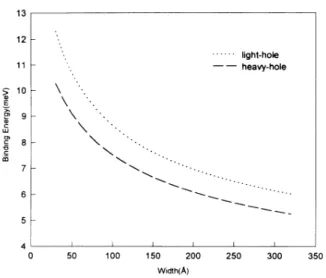
=
0.
15is displayed in
Fig.
2. One can note that the binding energy decreases as the well width increases. This is because as L is reduced, the exciton wave function is090--—
--
——
III.
RESULTS
ANDDISCUSSIONS
0.85—0.80—
—
—
heavy-holelight-hole
We have calculated the binding energy of the heavy
hole
(EIi~)
and the light hole(E~I,
) exciton of GaAs quantum wells for different Al concentrationsx
0.
15,0.
2,0.
25,0.3,
0.
4 as a function of the well widthL.
The physical parameters are adopted from the previous works. The reduced masses in the x
—
y plane for the heavy-hole(J
=
3/2) and the light-hole(J
=
1/2) exci-tons are taken as0.
04mp and0.
051mp, respectively. Thereduced mass associated with
1
=
3/2 band is smallerthan that
of
J=
1/2 band.In
Fig.
1 we display the variation ofAp as afunction ofthe well width
L
for both heavy-hole exciton andlight-hole exciton with x
=
0.15.
The range of widthscon-sidered is between 30and 300 A. One can see from
Fig.
1 that for a given value of x, the valueof
Ap increasesE GJ m CL C: O 070 Cg 0.65— 060-- 055-0 50 100 150 200 width(A) 250 300 350
FIG.
1.
Thevariation ofAoasafunction ofthe well width L for both heavy-hole and light-hole excitons with concentration x=
0.15.13 12— light-hole
——
heavy-hole 10— I E o) 9 tD C UJ O) c 8 C tD 50 100 150 200 Width(A) 250 300 350FIG.
2. The variation ofheavy-hole and light-hole exciton binding energy (meV) as afunction of the well Lfor concen-trationx=0.
15.13
compressed in the quantum well, thus leading
to
increase binding. WhenL
is larger than a certain value ofL,
thespilling
of
the wave function becomes more important and this makes the binding energy get closerto
the bulk value. One can note &om the 6gures that the binding energyof
heavy-hole exciton issmaller than thatof
light-hole exciton. This is because the conduction-band
non-parabolicity is enhanced by quantum con6nement.
Ac-cording
to
the magneto-optics observationof
Rogers et al. the heavy-hole effective mass for motion ina
layer plane iswell thickness dependent and decreases consider-ably for decreasing well widths dueto
the decouplingof
the light- and heavy-hole subbands, while the light hole exhibits electronlike dispersion relations with
a
large ef-fective mass inthe layer plane. This makes the binding energy ofheavy-hole exciton smaller than thatof
the lighthole exciton. In
Fig.
3we plot the variations ofbindingenergies with respect
to
the well widthL
for heavy- and light-hole excitons withx
=
0.
15,0.
2,0.
25,0.3.
We 6ndthat the binding energies decrease as
L
increases and thevariation with
L
isalmost independentof
the concentra-tionz.
The effects of the surface phonon and bulk phonon
on the exciton binding energy for both heavy-hole and
light-hole exciton in
a
quantum well for Al concentrationz
=
0.
15 and0.3
as a function of the well widthL
are presented in Figs. 4 and5.
One can see that the Alcon-centrations cannot signi6cantly influence exciton binding
energies. Table
I
presents our calculated exciton binding energies with and without the phonon effect for several well widths and concentrationx
=
0.15.
We also list thepercentage
of
the phonon effect in the last columnof
Ta-ble
I.
One can see &om TableI
that the polaron effect onthe exciton binding energy is in general smaller for
nar-12 g4 C v' CJ 0l a 10 I I I I I I I I I I I I I I I I I I I I I I I I I I I I I 30 90 120 150 180 0 240 270 300 WelIWidth(A)
FIG.
3. The variation ofheavy-hole and light-hole binding energies (meV) as a function ofwell width Lfor concentration13 10— 12 9 lD E 8— Cl C I) C 7 C LQ 6— 11 (D E 10— Q) e 9 O) T3 C Q3 5— Is « iI Ii I III ii I III « II iI iII i ii I iI II 4 0 50 100 150 200 250 300 350 400 450 Width(A) 12 13 50 100 L 150 200 250 Width(A) 300 350 y10 E 9 Q C 8 C C CQ x=0.3 12—
)
E ~10--e 9 CD 8-CO 4I, II 1 II I II III I iI Ii I iI I I Ii I I i I iI i I I I i I I 50 100 150 200 250 300 350 400 450 (b) Width(A)FIG.4. The variation ofheavy-hole exciton binding energy (meV) as a function ofwell width (A)for Ep (curve 1), Ep+SO
(curve 2),Ep+BO (curve 3),and Ep+SO+BO (curve 4).
5
0 250 300
I
50 100 150 200 350
WIdth(A)
FIG.5. The variation oflight-hole exciton binding energy (meV) asa function ofwellwidth (A)for Ep (curve 1), Ep+SO
(curve 2),Ep+BO (curve 3), Ep+SO+BO (curve 4).
row well width and becomes more pronounced as the well width becomes wider for either heavy-hole or light-hole
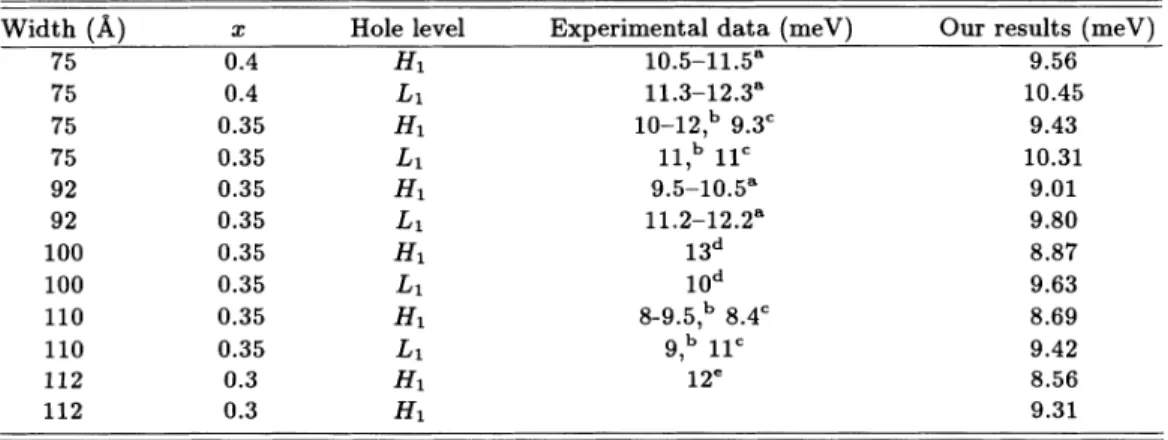
exciton. Table
II
presentsa
comparison ofour calculatedresults with recently observed
data.
In order to makea
clear comparison, our results are calculated for some
spe-cific well widths and concentrations. One may note that the phonon effect on the heavy-hole exciton is larger than that on the light-hole exciton and the total binding en-ergy oflight-hole exciton is larger than that ofheavy-hole
exciton. This may be due
to
the effective mass differenceas we mentioned above. One may also note from Table
II
that, although the observed data have some degree ofuncertainty, our results agree satisfactorily with most re-cent observations, ' except the experimental data
ofMaan e.t
al'4
Figures 6 and 7show the plot
of
the variation of per-centage of effects of surface-phonon, bulk-phonon, andthe total phonon effects on heavy-hole and light-hole
ex-citon binding energies. Some interesting results can be
noted in these two figures. The effect of the surface phonon decreases very fast for both cases of very large and very small well widths. Forvery large well width the reason for the decrease of the surface phonon effect on
the total exciton binding energy is due
to
the largepos-sibility ofthe exciton existing in the interior of the bulk semiconductor and thus reduce the interaction strength
of
the exciton and the surface phonon. On the contrary,the decrease ofthe surface phonon effect on the total
ex-citon binding energy for very small well width is caused
by the leakage
of
the exciton wave function out of the quantum well because the well potential height is finite.For the intermediate well width, the surface phonon
ef-fect on the total binding energy increases with well width for smaller well width, but after a maximum value the
surface phonon effect decreases very fast for larger well width. This might be due
to
the smaller the well width,the more pronounced SO phonon modes, which in turn increases the importance of the exciton-surface phonon coupling. However, the wave function begins
to
leak outof
the quantum well for well widths shrunk to a much smaller value so that the surface phonon effect reaches amaximum value for a well width of about 80 A.
It
maybe worthwhile
to
analyze here the competition betweenthe surface phonon and the bulk phonon modes. One
can see from the figures that the surface phonon effect grows larger than the bulk phonon effect when the width isreduced
to
a
certain value. Therefore, the influence ofthe phonon effect on the exciton binding energy is
dom-inated by the surface phonon as the well width becomes
small while the polaron effect is dominated by the bulk phonon as the well width becomes large. This is because asthe well width decreases, the exciton isclose
to
thehet-erojunction and the confinement on the exciton becomes
important which makes the interface phonon modes
be-comes more pronounced. This in turn makes the
TABLE
I.
The binding energy (meV) ofheavy hole and light hole exciton as afunction of thewell width (A) with and without the phonon effect.
E'
and Eo are the binding energies with and without the phonon effect.Width A 30 40 50 60 70 80 90 100 150 200 250 290 300 30 40 50 60 70 80 90 100 150 200 250 290 300 Exciton Eo 10.28
9.
619.
09 8.66 8.31 8.01 7.74 7.51 6.67 6.10 5.68 5.42 5.35 12.3011.
39 10.68 10.129.
659.
26 8.93 8.64 7.62 6.97 6.51 6.21 6.15Binding energy (meV)
Exciton with phonon effect
E'
Heavy-hole exciton x=
0.15 10.66 10.25 9.92 9.63 9.36 9.12 8.89 8.68 7.85 7.26 6.80 6.50 6.43 Light-hole excitonz
=
0.15 12.4211.
6311.
05 10.60 10.23 9.92 9.669.
42 8.52 7.89 7.41 7.10 7.03(&' —
&s)/&' (%%uo)3.63 6.27 8.44 10.07
11.
28 12.19 12.90 13.45 15.12 15.94 16.41 16.64 16.68 0.95 2.043.
30 4.54 5.68 6.82 7.54 8.28 10.5611.
60 12.17 12.50 12.44the interaction between exciton and bulk phonon. One
can also note that the inBuence
of
the bulk phononef-fect on the exciton binding energy increases with well
width and thus the
total
phonon effect (including the surface and bulk phonon efFects) increases with increasing well width. Our calculated percentageof
phonon efFectsreach
a
saturation value of about17.
5% for heavy-holeexciton and
13.
5% for light-hole exciton. One can seefrom Figs. 6 and 7 that the percentage
of
the efFect ofeither surface phonon or bulk phonon on the heavy-hole
exciton are always larger than that on the light-hole
exci-ton. This is because the efFective mass
of
the heavy holeTABLE
II.
Comparison ofour calculated results with some observed data.Width (A) 75 75 75 75 92 92 100 100 110 110 112 112 Reference 8. Reference 15. 'Reference 25. Reference 14. 'Reference 50. 0.4 0.4 0.35 0.35 0.35 0.35 0.35 0.35 0.35 0.35 0.3
0.
3 Hole level Hg Hg Lg Hg Lg Hg Lg Hg Lg Hg HgExperimental data (meV)
10.5—
11.
511.
3—12.3 10—12,9.3'
11, 119.
5—10.511.
2—12.2 13 10 8-9.5, 8.4' 9,b11'
12'Our results (meV)
9.
56 10.459.
43 10.319.
019.
80 8.879.
63 8.699.
42 8.569.
3118I— 16 14-O g t
.
12'-0 k 10— (g 0 CL P 0 8 G) CD 6--C (U O I h 4 CL t-2 r 0.— I-x=0 15——
curve 1 curve 2 curve 3 14 ( 12— O C) ~10-= 8I-6— Q) C C e 4— O I P 0—/
//'/
x=0. 15——
curve 1 curve 2 curve 3 I I I I I I . I I I I I I I I I I I I I I I I~~~
J 0 50 100 150 200 250 300 350 400 450 width(A) 50 100 150 200 250 300 350 ( & ) width(A) 18 p ———16;
4 o 12t P 0 10'-P 0 8 E Q o 6 CL 4 I-P P" I-0I 0 100 200 Width(A) x=0.3——
curve 1 curve 2 curve 3 300 400 14I—
12 I-~10 C-(g 8— 3. 0 Ch rO C O L Q 2-50 x=0.3—
—
curve 1 curve 2 ———curve 3 100 150 200 250 300 350 ('t,) Width(A)FIG.
6. The variation ofpercentage of phonon effect on the heavy-hole exciton asafunction ofwell width (A) for SO (curve 1),BO (curve 2),aud SO+BO (curve3).
FIG.7. The variation of percentage of phonon effect on the light-hole exciton as afunction ofwell width (A) for SO (curve 1),BO (curve 2),and SO+BO (curve
3).
along the zdirection is heavier than that ofthe light hole; therefore the heavy hole is bound more tightly than light hole and yields a smaller interaction range. Therefore,
a larger effect will be over a short distance for the sur-face phonon effect. The same reason can be applied
to
the bulk phonon case, so that the effect of
BO
phonon on the heavy-hole exciton isalso larger than that on thelight-hole exciton. Ercelebi and Ozdincer considered the electron (hole) lattice interaction and introduced a
variational trial wave function in their calculation. They
obtained an enhancement on the binding energy which increases as the well width becomes larger and larger. However, their results yield more than 30%phonon ef-fect as the well width becomes larger than 150A.. Their
results seem to overestimate the phonon effect. Degani and Hipolito studied the phonon effect on the binding energy of exciton and obtained a result of26—
20%
effectofphonons as the well width ranges from 10to 150 A..
Comparing with the recent observations as listed in
Ta-ble
II,
our calculated results seem to be more reliable.The results show that polaronic effects are important and cannot be neglected. Our results predict that the correc-tion due
to
the polaron effect on the exciton binding en-ergy ranges Rom several percent in the small well widthto 17%in the bulk case.
It
has also been found that the energy correction due to the polaron effect isdominated by the SO phonon when the well width is suKciently small while the electron and bulk phonon interaction be-comes important when the well width becomes larger.The effects of either electon-surface-phonon interaction
or electron-bulk-phonon on the binding energy are larger for the heavy-hole exciton. This may be ascribed
to
theeffective mass difference for the heavy hole and the light hole. We also found that the
total
binding energy of the light-hole exciton is larger than thatof
heavy-holeexci-ton. This is consistent with recent observations and other
theoretical calculations.
IV.
SUMMARY
ACKNOWLEDGMENT
Ia.this work we studied the longitudinal optical surface and bulk phonon effects on the exciton binding energy.
This work is partially supported by the National
L.
L.
Chang, L.Esaki, andR.
Tsu, Appl. Phys. Lett. 24,593(1974).
R.
Dingle, W. Wiegmann, and C.H. Henry, Phys. Rev.Lett.
33,
827 (1974).R.
Dingle, in Festkorperprobleme/Advances in Solid State Physics, edited by H.R.
Queisser (Vieweg, Braunschweig,1975),Vol. 15, p. 21.
J.
Batey,S.
L.Wright, and D.J.
DiMaria,J.
Appl. Phys.57,484 (1985).
H.
J.
Lee,L.Y.
Juravel,J.
C.Woolley, and A.J.
S.
Thorpe, Phys. Rev.B 21,
659 (1980).R.
C.Miller, D. A. Kleinman, W.T.
Tsang, and A. C.Gossard, Phys. Rev.
B
24, 1134(1981).
C.Weisbuch,
R.
C.Miller,R.
Dingle, A. C.Gossard, andW.Wiegmann, Solid State Commun.
37,
219(1981).
P. Dawson, K.
J.
Moore, G. Duggan, H.I.
Ralph, and C.T.
Foxon, Phys. Rev.B
34,6007(1986).K.
J.
Moore, P. Dawson, and C.T.
Foxon, Phys. Rev.B
34,
6022 (1986).G. Duggan, H.
I.
Ralph, and K.J.
Moore, Phys. Rev.B
32,8395(1985).
E.
S.Koteles andJ.
Y.Chi, Phys. Rev.B
37,
6332(1988).J.
Lee,E.
S.Koteles, and M. O.Vassell, Phys. Rev.B 33,
5512(1986).F.
Y.
Juang,Y.
Nashimoto, and P. K. Bhattacharya,J.
Appl. Phys. 58, 1986(1985).J.
C. Maan, G. Belle, A. Fasolino, M. Altrarelli, and K.Ploog, Phys. Rev.
B
30,
2253 (1984).D. C. Rogers,
J.
Singleton,R.
J.
Nicholas, C.T.
Foxon, andK.
Woodbridge, Phys. Rev.B
34,4002 (1986).J.
A. Brum and G. Bastard,J.
Phys. C18,
L789 (1985). G.Bastard,E. E.
Mendez, L.L.Chang, and L.Esaki, Phys.Rev.
B
26, 1974(1982).R.
L.Greene,K.
K.Bajaj,
and D.E.
Phelps, Phys. Rev.B 29,
1807(1984).R.
L.Greene and K. K.Bajaj,
Solid State Commun. 45,831(1983).
Y.
Shinozuka and M.Matsuura, Phys. Rev.B
29, 3717(E) (1984).C.Priester, G. Allen, and M. Lannoo, Phys. Rev.
B 80,
7302 (1984).T.
F.
Jiang, Solid State Commun. 50, 589(1984).G. D. Sanders and
Y.
C. Chang, Phys. Rev.B
31,
6892(1985).
G. D. Sanders and
Y.
C. Chang, Phys. Rev.B 32,
5517(1985).
U. Ekenberg and M. Altarelli, Phys. Rev.
B 35,
7585(1987).
R.
Dingle, A. C.Gossard, and W.Wiegmann, Phys. Rev.Lett.
34,
1327(1974).R.
C. Miller, A. C. Gossard, D. A. Kleinman, and O. Munteanu, Phys. Rev.B
29,3740 (1984).R.
C. Miller, D. A. Kleinman, and A. C.Gossard, Phys.Rev.
B
29,7085 (1984).M. H. Meynadier, C. Delalande, G. Bastard, M. Voos,
F.
Alexandre, andJ.
L.Lievin, Phys. Rev.B
31,
5539(1985).T. F.
Jiang and D.S.Chuu, PhysicaB
1B4,287(1990).X. X.
Liang, S. W. Gu, and D.L.Lin, Phys. Rev.B
84,2807(1986).
A. Ercelebi and M. Tomak, Solid State Commun. 54, 883
(1985).
A. Ercelebi and U.Ozdincer, Solid State Commun. 57,441
(1986).
M. H. Degani and O. Hipolito, Phys. Rev.
B 35,
4507(1988).
S. W.Gu and H. Sun, Phys. Rev.
B 37,
8805 (1988).C.Guillemot and
F.
Clerot, Superlatt. Microstruct. 8, 263(1990).
X.
X.
Liang andX.
Wang, Phys. Rev.B
43,5155(1991).
K.
T.
Tsen, K.R.
Wald,T.
Ruf, P.Y.
Yu, and H.Morkoc, Phys. Rev. Lett. 67, 2557(1991).
H. Rucker,
E.
Molinari, and P. Lugli, Phys. Rev.B
44,3463
(1991).
C. Y.Chen, P.W.Jin, and S.Q.Zhang,
J.
Phys. C4,4483(1992).
Y.
C.Lee, M.N. Mei, and K. C.Liu,J.
Phys. C15,
L469(1982).
J.
Sak, Phys. Rev.B
B, 3981(1972).M.Matsuura, Jpn. Phys. Soc.
41,
394 (1976).R.Zheng and S.Gu, Solid State Commun. 59, 331 (1986).
T.
D. Lee,F.
E.
Low, and D.Pines, Phys. Rev.90,
297(1953).
P.Lawaetz, Phys. Rev.
B
4,3460(1971).
Handbook of Mathematical Functions, edited by M. Abramowitz and
I.
A. Stegun (Dover, New York, 1965).K. K.
Bajaj
and C.H. Aldrich, Solid State Commun.35,
163(1980).
A. Baldereschi and N. O. Lipari, Phys. Rev.
B 3,
439(1971).
S.Tarucha, H. Okamoto,