行政院國家科學委員會專題研究計畫 成果報告
由因果關係網路看漢語高功能自閉症兒童的敘事連貫能力
研究成果報告(精簡版)
計 畫 類 別 : 個別型 計 畫 編 號 : NSC 99-2410-H-004-200- 執 行 期 間 : 99 年 08 月 01 日至 101 年 04 月 30 日 執 行 單 位 : 國立政治大學英國語文學系 計 畫 主 持 人 : 薩文蕙 共 同 主 持 人 : 童寶娟 計畫參與人員: 碩士班研究生-兼任助理人員:葉侃彧 大專生-兼任助理人員:張簡佳怡 大專生-兼任助理人員:陳奕欣 大專生-兼任助理人員:王詩涵 報 告 附 件 : 出席國際會議研究心得報告及發表論文 公 開 資 訊 : 本計畫涉及專利或其他智慧財產權,2 年後可公開查詢中 華 民 國 101 年 07 月 30 日
中 文 摘 要 : 研究文獻指出,高功能自閉症兒童與普通兒童於語音、構詞 與語法的能力表現並無顯著差異,然其敘事表達上質的缺陷 被普遍視為自閉症的核心障礙之一。Diehl 等人(2006)指 出自閉症兒童於敘事結構及連貫性(coherence)上有明顯不 足之處,並認為此與自閉症兒童無法建立故事中重要事件間 的因果脈絡(causal network)有關。鑒於以上觀察,本研 究旨在藉由對故事事件間因果脈絡的處理,探討漢語高功能 自閉症兒童的敘事連貫能力。 本研究實驗組為 18 位高功能自閉症兒童,對照組為 18 位普通兒童。我們以繪本 Frog, where are you?(Mayer, 1969)為據,收集兩組兒童的敘事語料。經轉寫編碼後,以 Trabasso 及 Sperry(1985)的因果網路分析架構進行語料分 析。 研究發現兩組兒童在整體子句數、語詞多樣性等語言能 力指標並無顯著差異。兩組受試者對主要事件(causal chain)的敏感度差異不大,但對照組在事件間因果連結數 (causal connection)的掌握明顯地優於自閉症組。此外, 自閉症組兒童傾向使用獨立事件以建構故事,而對照組兒童 建構的因果脈絡網路較為縝密。 針對上述發現,因果網路架構提供了量化分析「敘事連 貫」的可能性。基於此分析法,本研究結果顯示自閉症兒童 對敘事連貫性的處理不及對照組兒童。研究者藉由廣義的心 智理論、中央連貫理論以及兩組兒童溝通能力的可能差異進 行探討,並提出後續研究的建議。 中文關鍵詞: 自閉症、敘事連貫性、因果關聯
英 文 摘 要 : Previous language studies indicate that high-functioning children with autism have intact phonological, morphological and syntactic
development, but are qualitatively different from typically-developing children in narrative discourse. Recent research suggests that children with autism have marked difficulty with narrative organization and coherence. As reported, autistic children appear to have difficulty representing the gist of stories and thus fail to link important events coherently in their narratives.
To explore Mandarin-speaking autistic children's narrative ability, the current study examines how these children maintain narrative coherence. We
provided an analysis of narratives from 18 children with high-functioning autism and 18 typically
developing children matched on cognitive and linguistic abilities. The narrative data were elicited on the basis of a well-known wordless pictured book Frog, where are you? Narrative
coherence was assessed in terms of the causal network (Diehl et al., 2006; Trabasso & Sperry, 1985). Consistent with our predictions, there were no significant differences in the basic narrative measures such as narrative length and variety of words. This replicates prior research that revealed intact performance if autistic participants were matched rigorously with normal controls on language abilities (Tager-Flusberg & Sullivan, 1995). Children with autism produced similar amount of causal-chained events as did the control group; this intact
performance suggested that autistic children were as sensitive as typically developing children to the relative causal importance of narrative events. Their deficiency in constructing and organizing causal connections between events, however, rendered their narratives less coherent. The findings were discussed in relation to the theoretical constructs such as `theory of mind' and `weak central coherence' and to autistic children's limitations in communicative competence. Since the impairment in narrative
production is considered one of the significant characteristics of children with autism, the current study about their difficulties in narrative coherence has theoretical and therapeutic implications. The outcome of this study thus not only contributes empirical data of atypical development to narrative studies based on the frog story but also advances our understanding of the narrative ability of children with autism.
英文關鍵詞: high-functioning children with autism, narrative coherence, causal connection
1
Narrative Coherence in Children with High-functioning Autism: An Investigation of Causal Connectedness
1. Introduction
Over the past decades, autism is considered a mysterious disorder with core deficits in social cognition and language, both of which are essential to what makes us human. It is noted that one major defining characteristic of autism is a qualitative impairment in pragmatic aspects of language (American Psychiatric Association, 〔APA〕1994). Despite their intact grammatical development, children with autism are reported to have marked pragmatic language disorders in communicative intentions, presupposition, and social discourse, and the deficits may appear across communicative domains (Colle et al., 2008; Lord & Paul, 1997; Tager-Flusberg, 2001; Young et al., 2005).1 One promising way of measuring the pragmatic language abilities is through narrative analysis.
Given that narrative ability involves an integration of social-emotional, cognitive, and linguistic knowledge, narrative analysis not only serves as a significant component of various language assessment tools but also provides rich information about multiple aspects of language development. More importantly, narrative assessment is considered as a potential tool for investigating linguistic deficits of children with atypical language development (McCabe, 1995; Schneider et al., 2006; Tager-Flusberg, 1995). Previous studies of narrative abilities have tapped language development of a variety of clinical populations, including children with learning disabilities, specific language impairment, and mental retardation (Tsai & Chang, 2008; van der Lely, 1997). In recent years, a substantial amount of narrative studies have been conducted on children with autism (Losh & Capps, 2003; Tager-Flugsberg, 2001; Tager-Flusberg & Sullivan, 1995; Tsou & Cheung, 2007).
Earlier research on narrative and autism has addressed a wide variety of indices of narrative ability, ranging from measures of story length, story organization, cohesion and narrative evaluation. It is indicated that if autistic and normal subjects are matched on language abilities, few quantitative differences are found in these aspects (Losh & Capps, 2003; Tager-Flusberg & Sullivan, 1995). Several studies, however, reported qualitative differences between autistic individuals and normal controls in that the former appear to have impairment at a more global aspect while constructing narratives. Baron-Cohen et al. (1986), for instance, observed that children with autism spectrum disorders (ASD) had difficulty organizing story retelling into a meaningful chain of events. In the work by Loveland and colleagues (Loveland et al., 1990; Loveland & Tunali, 1993), children with ASD were more likely to have pragmatic violation consisting of bizarre or irrelevant utterances. Moreover, their stories sounded more like recitation rather than retellings. Related observation is also
1
These communicative domains include: nonverbal communication, conversation, and narrative skills (Tager-Flubsberg, 2001)
2
noted in Bruner and Feldman’s (1993: 283) analyses of the story retellings of four adolescents with ASD. Though they preserved some essential content and proper order of events, these retellings, according to the researchers, were not organized with regard to the importance of events, and thus sound more like “reporting” a sequence of actions rather than “composing” a story. Similarly, Landa and colleagues (1995) reported that their autistic subjects were less likely to organize essential events coherently and hence failed to represent the gist of the story. The deficiency in thematic representation is also noted in Losh and Capps’s (2003) research in that the autistic children appear to have difficulty constructing thematically integrated narratives and demonstrated impairments establishing underlying causal relationships both within and across story episodes. Overall, though individuals with ASD and normal controls perform similarly on basic narrative measures such as story length, complexity and grammar, they show little regard for organizing and integrating narrative information at a more global level.
A variety of research has tried to analyze the global representation of stories (Berman & Slobin, 1994; Mandler, 1983; Stein & Glenn, 1979). The global representation of story meaning and connectedness is referred to as coherence, which, according to Karmiloff-Smith (1985), is embodied in the temporal and causal structure of a story. In particular, causal relation is considered a basic mechanism for integrating episodic and thematic information for a coherent representation of a story. Given the significance of causal connections for narrative construction, Trabasso and Sperry (1985) developed a system of causal network to assess the causal relationships between linguistic units in a narrative. Research has shown that the causal network provides explanation for the variance in story recall, and that the causal connections, derived from the network, correlate with the importance ratings for narrative events (Trabasso & Sperry, 1985; Trabasso & van den Broek, 1985, Trabasso et al., 1989). Accordingly, the system of causal network is considered as an alternative for examining narrative structures and discourse comprehension, and as a potential methodology for quantitatively assessing narrative coherence (Diehl et al, 2006; Cevasco & van den Broek, 2008). To understand how Mandarin-speaking children with autism construct their narratives and how they maintain narrative coherence, we thus analyzed data in terms of the causal network.
Narrative is a primary means for relating the cause and consequences of psychological states and actions (Tager-Flusberg & Sullivan, 1995). Previous investigations indicated that children with ASD had difficulty building episodic and thematic connections between narrative information. In particular, autistic children were less apt than typically developing children to include causal explanations in their narratives (Capps, Losh & Thurber, 2000; Losh & Capps, 2003). This deficiency is presumably related to impairments in causal understanding beyond narrative or social functioning (Gopnik, Capps, & Melzoff, 2000). On the basis of causal network, Diehl and colleagues (2006) set off their investigation of narrative coherence in children with ASD through tasks of story recall. They noted that autistic children
3
were able to use the gist of the story to organize their recall, which is consistent with Trabasso and Sperry’s (1985) findings on typical adults. But their narratives were less coherent than those of normal controls, as measured by their causal connections. Significant as the finding may seem, it inspires us to speculate the feasibility of the causal-network system on narrative data based on different narrative tasks.
Approximately 67 million people worldwide are suffering from ASD, considered as the fastest-growing serious developmental disability in the world. Huge increases in the incidence and prevalence of ASD have been reported recently. In Taiwan, the cumulative prevalence of and annual incidence of ASD has also increased markedly.2 Despite the rapid increase in incidence as well as in prevalence, there have been few detailed investigations of narrative abilities of individuals with ASD in Taiwan. It is important for us to understand more about the narrative ability in this population, for such ability is considered closely related to their pragmatic deficits. To this end, Tsou and Cheung (2007) used a variety of testing batteries in their investigation of Mandarin-speaking children with autism. Among these batteries, the goal-plan analysis, derived from Trabasso and colleagues’ (1985, 1994) causal framework, was adapted to assess the narrative structure by autistic children. Tsou and Cheung noted that autistic children were less apt to include essential episodic components in their narratives, which renders their narratives less complete and less coherent. Though applying the goal-plan analysis, this work didn’t directly tap the likelihood of using the causal network per se to analyze narrative data. The present work thus attempts to use the causal framework to quantitatively assess Mandarin autistic children’s narrative coherence by addressing the following research questions.
1. Is there any difference between Mandarin-speaking children with autism and typically developing controls regarding the establishment of causal chain?
2. Is there any difference between the two groups of children in establishing causal connections between narrative events?
3. Is there any difference between the two groups of children in encoding events with different levels of causal connectedness?
2. Method
2.1 Subjects
18 children with autism (mean age: 8.23) and 18 normal controls (mean age: 7.03), attending various elementary schools in the Taipei City and the New Taipei City, participated in the present study. Both groups of subjects were male and were matched on receptive and
2 According to Chien et al. (2011), the cumulative prevalence of ASDs rose from 1.79 to 28.72 per 10000 from 1996 to 2005, while its annual incidence also markedly increased from 0.91 to 4.41 per 10000 per year within this period of time.
4
expressive language scores from the Revised Language Impairment Checklist for School Children (Lin et al., 2009). The normal controls comprised typically developing children, with no concerns about autism, learning disabilities or language delays.
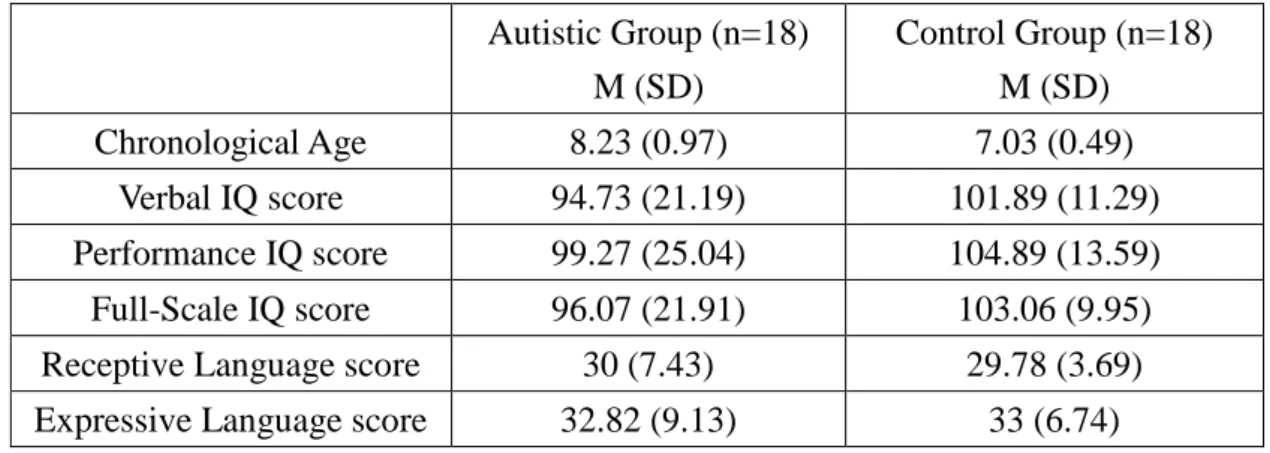
Diagnoses were established with the school records and clinical judgment by qualified clinicians. All autistic children met DSM-IV (APA, 1994) criteria for Autistic Disorder based on the Autism Diagnostic Interview--Revised (ADI-R, Lord, Rutter & LeCouteur, 1994). In addition, the autistic children were all high-functioning with the Full Scale IQs (FSIQs) above 80 (Chen, 1997), and with sufficient language abilities to create narratives (see Table I).
Table I. Group Characteristics
Autistic Group (n=18) M (SD) Control Group (n=18) M (SD) Chronological Age 8.23 (0.97) 7.03 (0.49) Verbal IQ score 94.73 (21.19) 101.89 (11.29) Performance IQ score 99.27 (25.04) 104.89 (13.59) Full-Scale IQ score 96.07 (21.91) 103.06 (9.95)
Receptive Language score 30 (7.43) 29.78 (3.69)
Expressive Language score 32.82 (9.13) 33 (6.74)
2.2 Material
The present study aims to replicate and expand upon prior research by using the wordless picture book Frog, where are you ? (Mayer, 1969), for researchers consider this book to be a very reliable tool for tapping children’s narrative abilities (Bamberg & Marchman, 1990; Berman & Slobin, 1994; Trabasso & Rodkin, 1994).
This book was chosen not only because it has become a worldwide research tool, but also because it is wordless and its structure has been extensively analyzed (Bamberg & Marchman, 1990). The frog story is a typical children’s story with a hero, a problem, a series of actions following the problem, and a happy ending.3 It is suitable to our research goals since it depicts an elaborate series of events which allow narrators to provide various links among events and to take different perspectives on events. Therefore, this book is suitable to our research goals.
3 The frog story is about a boy and his quest to find his missing pet frog. Its scenario is as follows: A boy has a pet dog and a pet frog. While the boy and his dog go to sleep one night, the frog gets out of the jar where it has been kept. When the boy wakes up the next morning, he finds the jar is empty and realizes that the frog has gone. He decides to search for his frog, and begins his quest, first inside the bedroom, then outside the house. Together with the dog, the boy visits many places, including a hole on the ground, a hole in the tree, a rock, and a log. They encounter various obstacles, and finally find the missing frog with a mate and a clutch of baby frogs.
5 2.3 Data Collection
Rapport was first established in the observation period. The interviews were carried out individually with each subject, and consisted of an initial warm-up conversation followed by a narrative task based on Frog, where are you. The subjects were first asked to look through the entire book and then to tell a story while looking at the pictures. The entire interviews were audio-taped and subsequently transcribed.
2.4 Data Analysis
In order to verify the accuracy of transcriptions, a second trained examiner checked each transcript. Then, the transcriptions were independently coded by two examiners. Coding discrepancies were discussed and agreement between examiners was obtained on all transcripts.
Clauses were used to quantify story length. A clause is defined as a verb and its argument, and corresponds roughly to a single event. Then, number of clauses was tallied to quantify story length. We examine narrators’ ability in maintaining narrative coherence in terms of the establishment of causal connections and causal chain (Diehl et al., 2006; Trabasso & Sperry, 1985). A causal connection is established between a pair of events when the criterion of necessity is satisfied. The necessity is tested by using counterfactual argument of the form: If not A then not B.4 The interconnections between events not only signal causal dependency between events but also quantify relative importance of an event to the story.
In addition to identifying causal relationships between events, we examined the causal chain set up by narrators. The causal chain refers to the sequence of events essential to the story plotline. To determine the causal chain, we first identify the opening and closing events: the former introducing setting information and initiating the ensuing episodes; the latter referring to the goal attainment/failure of the protagonists. The events with causes and consequences which can be traced from the opening through the closing of the narratives are considered belong to the causal chain. Finally, we examined the pattern of causal connectedness within each narrative.
To this end, four type of causal connectedness were differentiated based on the number of connections one event has in relation to other events in the story, namely, C0, C1, C2, and C3+.
C0 type refers to the individual, discrete event which has no connection with other events in
the story; C1 type includes the event which has connection with only one other event; events
in the C2 type have connections with two other events. And events with three or more
connections were collapsed into the category C3+ because they were used infrequently across
all participants.
4
For instance, there are two events: Event A and Event B. If Event A had not happened, Event B would not occur either. Then, Event A is necessary for Event B. The two events are therefore causally connected.
6
3. Results
Since analyses regarding the causal chain and causal connections were considered in relation to story length, the overall story length for the two groups of subjects was first established. To this end, the number of clauses was used as an indication of story length. The mean number of clauses was 41.89 for the children with autism and 42.00 for the normal controls. Autistic children were also similar to controls in the variety of words used in their narratives: the mean number of different words for autistic children and normal controls were 123.89 and 108.22, respectively. On the basis of previous research, we predicted that children with autism would not differ from controls on basic narratives measures (Diehl et al. 2006; Tsou & Cheung, 2007). As expected, a repeated measures analysis of covariance (ANCOVA) did not yield significant differences between the two groups of subjects regarding story length, F(1, 33) = 0.21, p = .65, η2partial = .01, and regarding variety of words employed, F(1, 33) = 0.82, p
= .37, η2partial = .02.
The current study aims to examine the coherence of the narratives of high-functioning children with autism. As mentioned earlier, the causal chain and causal connections are considered as indicators for inferring narrators’ abilities to integrate narrative information. It is hypothesized that the more causal chained events and more causal connections are encoded for a narrative, the more coherent that narrative is. Given their deficiencies in organization and planning, as identified in neuropsychological studies (Pennington & Ozonoff, 1996; Ozonoff et al., 2004), and difficulties in integrating narrative information as a meaningful chain of events (Baron-Cohen, Leslie, & Frith, 1986; Landa, 2000; Loveland et al., 1990), we predicted that children with autism would be less sensitive to the global plotline, as measured by the causal chain. In addition, the narratives produced by the autistic children would be less causally connected in their structure, and therefore would be less coherent.
Regarding the first and the second research questions, our data revealed that children with autism seemed less likely to encode events along the causal chain and were less apt to establish causal connections between events (Figure 1).5 ANCOVA were performed on the data. The differences in causal chains, however, failed to reach statistical significance (F(1, 32) = 0.26, p = .62, η2partial = .01), which suggested that children in both groups showed similar
tendency in using the gist to organize their stories. On the other hand, a significant group main effect was obtained for the causal connections (F(1, 32) = 12.57, p < .01, η2partial = .28),
indicating that the typically developing controls established significantly more connections between narrative events than did the autistic children.
5 Following the method of previous research (Davis et al., 1997; Diehl et al., 2006), we divide the total number of causal chained events and that of causal connections in each story by the total number of clauses in that story so as to control the overall story length and thus to measure story connectedness.
7
Fig.1 Numbers of causal chains and causal connections encoded by each group in per cent (relative to the total number of clauses by each group)
As predicted, the measures of causal connections suggested that the narratives produced by children with autism were less coherent. The third research question further examines the pattern of causal connectedness within stories. Four type of causal connectedness were differentiated based on the number of connections one event has in relation to other events in the story: C0, C1, C2, and C3+. We calculated the proportions of events from each
connectedness type within each participant’s story. Arc sine transformations were applied to the percentage data to normalize the distribution. After that, ANCOVA were performed on the data. The statistical analyses yielded significant Group x Type interaction, F(3, 96) = 7.23, p < .01, η2partial = .18. Further examination noted that two groups of children performed
differently in encoding events with different types of causal connectedness. To begin with, as displayed in Figure 2, children with autism were significantly more likely to encode discrete events (C0 events) than did the typically developing children, F(1, 32) = 13.63, p <.01, η2 partial
= .30. Reverse patterns were shown for the use of both C2, and C3+ types of events (F(1, 32) =
4.73, p = .04, η2partial = .13 and F(1, 32) = 5.43, p = .03, η2partial = .15, respectively), in that
autistic children were significantly less likely to encode events with two and more connections than did the controls. Regarding the events in connections with only one other event (the C1 events), the differences between subject groups failed to reach significance, F(1,
8
Fig.2 Proportion of events with each type of causal connectedness used by each group
4. Discussion
This work is an attempt to build on prior research by examining narrative coherence in children with autism. In order to test for the subtle difficulties in establishing narrative coherence, we went beyond the sentence level and assessed narrative production at a global level by carrying out a more detailed analysis on the basis of the causal network framework (Trabasso & Sperry, 1985). The results were in consonance with the findings in earlier research, though we relied on a different research protocol.
Consistent with our predictions, there were no significant differences in the basic narrative measures such as narrative length and variety of words. This replicates prior research that revealed intact performance if autistic participants were matched rigorously with normal controls on language abilities (Diehl et al., 2006; Tager-Flusberg & Sullivan, 1995). In the present work, children were matched on both receptive and expressive language abilities, which allows the interpretations of findings to exclude possible deficits in the autistic group being due to an overall impairment in their linguistic capacity.
Although children with autism produced similar amount of causal-chained events as did the control group, their narratives were less coherent, as measured by causal connections. In other words, autistic children were less likely to established causal connections between narrative events than did the controls. More detailed analysis for pattern of causal connectedness further revealed subtle differences between two groups of participants. It is noted that children with autism were less likely to encode narrative events with higher number of connections. To summarize, the narratives of children with autism were less causally connected and less coherent, in spite of the fact that their narratives appeared typical on basic
9 narrative measures.
The intact performance in encoding causal-chained events suggests that children with autism were as sensitive as typically developing children to the relative causal importance of narrative events. Their deficiency in constructing and organizing causal connections, however, renders their narratives less coherent. As reported in previous research, individual with autism perform differently from normal controls at a more global level of narrative production. In particular, qualitative analyses reveal autistic people’s difficulties in organizing their narratives into a meaningful, coherent whole (Bruner & Feldman, 1993; Loveland et al., 1990; Loveland & Tunali, 1993). Furthermore, in one earlier study, Landa (2000) reported that individual with ASD were impaired in organizing topics and subtopics in narratives, which is believed to reflect their pragmatic deficits. In line with previous endeavors, our data also revealed autistic children’s difficulties in maintaining narrative coherence. Such deficiency is presumably relevant to their pragmatic deficits.
Pragmatic knowledge is a key communicative competence and embodies itself in communicative decisions such as when to say, what to say, whom to say, and how much to say. Specifically, such competence enables individuals to recognize a speaker’s intended meaning, to differentiate given information from new one, and to conform to conversational rules. Previous research provided consistent evidence that individuals with ASD have significant pragmatic deficits across communicative domains (Surian et al., 1996; Tager-Flusberg, 2001). And it is widely held that the analysis of narrative practices represents a significant source for exploring the pragmatic deficits in this population.
At the pragmatic level, a competent narrator needs to supply contextual and referential information and to monitor listeners’ comprehension. Put it another way, a narrator should be able to provide sufficient pieces of information and construct a narrative in a manner that is understandable to listeners by selecting what is relevant based on the listener’s knowledge and perspective (Astington, 1991). Previous studies had demonstrated autistic individuals’ pragmatic impairments in narrative tasks. Surian and colleagues (1996), for instance, reported that individuals with autism had difficulty in detecting utterances that violating Grice’s (1989) conversational maxims. Relevant to this, the less causally connected narratives produced by our autistic participants may be due to a competence deficit in adhering to these maxims, as suggested by Diehl et al. (2006). The less than sufficient causal links provided by the autistic children may reflect their failure in conforming to the Maxim of Quantity, for they did not have the knowledge about what their listeners needed to know.
The selection of needed information for narrative elaboration is largely based on a narrator’s assumption regarding listeners’ shared knowledge about the on-going discourse. Such assumption is closely related to a narrator’s ability in theory of mind (ToM). As indicated by Tager-Flusberg and Sullivan (1995), ToM is essential to narratives, for a successful narrator relies on this ability not only to elaborate the psychological motivations
10
and internal states of story characters to account for their actions so as to render a coherent representation, but only to take account of listeners’ knowledge and perspectives. Given its significant role in narrative construction, ability in ToM is likely impact on the extent to which narrators encode narrative information and build up interconnections between events. Put it another way, ToM is seemingly decisive in inclusion and establishment of essential narrative information and thus is influential in the degree of explicitness of a narrative.
A variety of studies reveal ToM deficits in individual with ASD (Baron-Cohen, 1995; Frith, 2003). Some attempted to relate ToM deficits to narrative practices. For instance, Capps and colleagues (2000) reported that ToM was significantly correlated with the total proportion of evaluation and evaluative diversity used in narratives. The researchers reckoned that individuals with autism had limited, but not entirely absent, appreciation about the need to engage listeners in narrative discourse. Additional support is found in the study by Colle et al. (2008), in which the impairments in ToM is held as possible explanations to autistic individuals’ difficulties in referential use of pronouns and temporal marks in narratives. The current work detected significant differences in causal connections between subject groups. Regarding this, an explanation in terms of linguistic abilities can be ruled out, given that our subjects were matched on them. A ToM account seems more likely for this discrepancy. In line with the reasoning in previous research, we reckon that autistic children’s insensitivity in mindreading might lead to an inability to understand what the listeners need, which is presumably reflected in the insufficient causal connections these children encoded.6
The theory of mind hypothesis is probably the most-documented theoretical construct to account for the social-communicative deficits in individual with autism; however, it fails to explain some of the non-social features in this population (Happé, 1999). Frith (2003), therefore, formulated the central coherence hypothesis with an attempt to explain both assets and deficits in autistic individuals. Central coherence theory postulates that most people have a natural built-in preference to process incoming information globally and in context so as to construct higher-level meaning. Despite that it is a natural tendency for people to do so, individuals with autism are considered weak in this regard (referred to as weak central coherence, WCC). Based on the WCC account, some research focuses on autistic individuals’ inability to integrate information (Frith, 2003); other research, instead, considers the detail-focused preference as a specific cognitive style (Happé, 1999).
In the first description of infantile autism, Kanner already reported his patients’ “inability to experience whole” (Kanner, 1943: 38). A growing body of empirical studies has provided evidence for the WCC account in domains such as visual and auditory perception (for reviews,
6 Loveland and colleagues (1990: 20) indicated that autistic children’s social deficit, which would affect the ability in making appropriate storytelling, was not solely due to impairments in ToM; rather, autistic children appeared to lack ‘a human cultural perspective’, which involves appreciating meaningful aspects of human interaction, such as knowing the meaning of cultural conventions like story telling.
11
see Happé, 1999, 2000). In an investigation of linguistic processing, Jolliffe and Baron-Cohen (2000) showed that high-functioning adults with ASDs encountered problems in arranging sentences coherently and in making global inferences. Relevant finding comes from the study of Losh and Capps (2003), in which autistic participants had difficulties in producing thematically integrated and elaborated narratives. In a more recent study, Colle et al. (2008) noted that adults with autism preferably used discrete sentences but failed to integrate a specific event with contextual information. The preference in encoding unlinked events is also detected in the current study, as shown in the significantly larger proportion of C0 events
employed by the autistic children than did the typically developing controls. The less causally connected narratives produced by autistic children seemingly reflected that they did not strive for coherence (Noens & van Berckelaer-Onnes, 2005). Their biased style for local processing makes them value piecemeal details at the expense of the whole picture of things, which, in our study, presumably leads to the less coherent narratives.
Despite the seemingly relevance to either ToM or WCC account, the current investigation did not address ToM or central coherence deficits directly. Further research is needed to probe the plausible links between the theoretical constructs and narrative organization. Though this study did not provide decisive answers to the debate over ToM or WCC accounts on autism, our analysis suggests a possible way of measuring pragmatic language abilities through narrative production. To replicate earlier findings about narrative coherence in individuals with autism, we adopted similar analytical framework based on the causal network to analyze narrative data, but we presented a different protocol from the story recall task used in previous research (Diehl et al., 2006), by asking participants to narrate with the aid of a picture book. Despite less cognitively demanding than story recall, our task still identified organizational difficulties in children with autism. Taken together, our results show that the causal network by Trabasso and Sperry (1985) provides a sensitive methodology to quantify narrative coherence, whether the narrative data is from a story recall task or a less complicated task. This methodology is of interest because it affords an opportunity to quantitatively examine narrative coherence at a deeper causal level, which helps to complete the picture constructed by qualitative descriptions and analyses based on episodic components.
5. References
American Psychiatric Association. (1994). Diagnostic and Statistical Manual of Mental
Disorders (4th ed.). Washington, DC: Author.
Astington, J. (1991). Intention in the child’s theory of mind. In D. Frye & C. Moore, (Eds.),
Children’s theories of mind: Mental states and social understanding. Hillsdale:
Lawrence Erlbaum Associates.
Bamberg, M., & Marchman, V. (1990). What holds a narrative together? The linguistic encoding of episode boundaries. Papers in Pragmatics, 4, 58-121.
12
Baron-Cohen, S. (1995). Mindblindness: An essay on autism and theory of mind. Cambridge, MA: MIT Press.
Baron-Cohen, S., Leslie, A., & Frith, U. (1986). Mechanical, behavioral, and intentional understanding of picture stories in autistic children. British Journal of Developmental
Psychology, 4, 113-125.
Berman, R. A., & Slobin, D. 1994. Relating Events in Narrative: A Crosslinguistic
Developemental Study. Hillsdale, NJ: Lawrence Erlbaum Associates.
Bruner, J., & Feldman, C. (1993). Theories of mind and the problem of autism. In S. Baron-Cohen, H. Tager-Flusberg, & D. J. Cohen (Eds.), Understanding other minds:
Perspectives from autism (pp. 267-291). Oxford: Oxford Univ. Press.
Capps, L., Losh, M., & Thurber, C. (2000). “The frog ate the bug and made his mouth sad”: Narrative competence in children with autism. Journal of Abnormal Child Psychology,
28, 193-204.
Cevasco, J., & van den Broek, P. (2008). The importance of causal connections in the comprehension of spontaneous spoken discourse. Psicothema, 20, 4, 801-806. Chen, Rong-hua. (1997). Wei Shi Er Tong Zhi Li Liang Biao Di San Ban (Wechsler Intellegence Scale for Children, WICS-III). Taipei: Zhongguoxing Kexueshe.
Chien, I-Chia, Lin, Ching-Heng, Chou, Yiing-Jenq, & Chou, Pesus. (2011). Prevalence and incidence of autism spectrum disorders among national health insurance enrollees in Taiwan from 1996 to 2005. Journal of Child Neurology, 26 ,7, 830-834.
Colle, L., Baron-Cohen, S., Wheelwright, S., & van der Lely, H. (2008). Narrative discourse in adults with high-functioning autism or Asperger syndrome. Journal of Autism and
Developmental Disorders, 38, 28-40.
Davis, G. A., O’Neil-Pirozzi, T.M., & Coon, M. (1997). Referential cohesion and logical coherence of narration after right hemisphere stroke. Brain and Language, 56, 183-210. Diehl, J, Bennetto, L., & Young, E. (2006). Story recall and narrative coherence of
high-functioning children with autism spectrum disorders. Journal of Abnormal Child
Psychology, 34, 1, 87-102.
Frith, U (2003). Autism: Explaining the Enigma. Oxford: Blackwell.
Gopnik, A., Capps, L., & Meltzoff, A. (2000). Early theories of mind: What the theory can tell us about autism. In S. Baron-Cohen, H. Tager-Flusberg, & D. J. Cohen (eds.),
Understanding other minds: Perspectives from developmental cognitive neuroscience
(2nd ed., pp. 50-72). Oxford: Oxford University Press.
Grice, H. P. (1989). Studies in the way of words. Cambridge, MA: Harvard Univ. Press. Happé, F. (1999). Understanding assets and deficits in autism: Why success is more
interesting than failure. The Psychologist, 12, 540-546.
Happé, F. (2000). Parts and wholes, meaning and minds: Central coherence and its relation to theory of mind. In S. Baron-Cohen, H. Tager-Flusberg, & D. J. Cohen (Eds.),
13
Understanding other minds: Perspectives from developmental cognitive neuroscience
(pp. 203-221). (2nd ed.). Oxford, NY: Oxford University Press.
Jolliffe, T., & Baron-Cohen, S. (2000). Linguistic processing in high-functioning adults with autism or Asperger syndrome: Is global coherence impaired? Psychological Medicine, 1169-1187.
Kanner, L. (1943). Autistic disturbances of affective contact. Nervous Child, 2, 217-250. Karmiloff-Smith, A. (1985). Language and cognitive processes from a developmental
perspective. Language and Cognitive Processes, 1, 61-85.
Landa, R. (2000). Social languge use in Asperger syndrome and high-functioning autism. In A. Klin, F. Volkmar, & S. Sparrow (Eds.), Asperger Syndrome (pp 125-155). New York: Guilford Press.
Landa, R., Martin, M., Minshew, N., & Goldstein, G. (1995). Discourse and abstract language ability in non-retarded individuals with autism. Paper presented at the Biennial Meeting of the Society for Research in Child Development, Indianapolis, IN.
Lin, Bao-gui, Huang, Yu-zhi, Huang, Guijun, & Xuang, Chong-hui. (2009). Xiu Ding Xue Ling Er Tong Yu Yan Zhang Ai Ping Liang Biao Bian Zhi Bao Gao (Report on the Revised Language Impairment Checklist for School Children). Zhong Hua Gou Tong
Zhang Ai Jiao Yu Xue 2009 Nian Nian Hui Ji Gou Tong Zhang Ai Jiao Yu Xue Shu Yan Tao Hui Lun Wen Ji (Proceedings for the 2009 Conference of the Communicative Disorders Association of R.O.C.), 77-95. Taiwan: Taipei.
Lord, C., & Paul, R. (1997). Language and communication in autism. In D. Cohen & F. Volkmar (Eds.), Handbook of autism and pervasive developmental disorders (pp. 195-225). New York: Wiley.
Lord, C., Rutter, M., & LeCouteur, A. (1994). Autism Diagnostic Interview—Revised: A revised version of a diagnostic interview for caregivers of individuals with possible pervasive developmental disorders. Journal of Autism and Developmental Disorders, 24, 659-685.
Losh, M., & Capps, L. (2003). Narrative ability in high-functioning children with autism or Asperger’s syndrome. Journal of Autism and Developmental Disorders, 33, 239-251. Loveland, K., McEvoy, R., Tunali, B., & Kelley, M. (1990). Narrative story telling in autism
and Down’s syndrome. British Journal of Developmental Psychology, 8, 9-23. Loveland, K., & Tunali, B. (1993). Narrative language in autism and the theory of mind
hypothesis: A wider perspective. In S. Baron-Cohen, H. Tager-Flusberg, & D. J. Cohen (Eds.), Understanding other minds: Perspectives from autism (pp. 247-266). Oxford: Oxford Univ. Press.
Mandler, J. (1983). Representation. In P. Mussen (ed.), Handbook of child psychology, Vol. 3:
Cognitive development (4th ed., pp. 420-493). New York: Wiley. Mayer, M. (1969). Frog, where are you? New York: Dial Press.
14
McCabe, A. (1995). Evaluation of narrative discourse skills. In K.N. Cole, P.S. Dale, & D.J. Thal (eds.), Assessment of communication and language, 121-142. Baltimore, MD: Paul Brookes.
Noens, I. L., & van Berckelaer-Onnes, I. A. (2005). Captured by details: sense-making, language and communication in autism. Journal of Communication Disorders, 38, 2, 123-41.
Ozonoff, S, Cook I., Coon, H., Dawson, G., Joseph, R. M., Klin, A., McMahon, W. M., Minshew, N., Munson, J. A., Pennington, B. F., Rogers, S. J., Spence, M.A., Tager-Flusberg, H., Volkmar, F. R.,& Wrathall, D. (2004). Performance on Cambridge Neuropsychological Test Automated Battery subtests sensitive to frontal lobe function in people with Autistic Disorder: Evidence from the Collaborative Programs of Excellence in Autism network. Journal of Autism and Developmental Disorders, 34, 139-150.
Pennington, B. F., & Ozonoff, S. (1996). Executive functions and developmental psychopathology. Journal of Child Psychology and Psychiatry, 37, 51-87.
Schneider, P., Hayward, D., & Dubé, R. V. (2006). Storytelling from pictures using the
Edmonton Narrative Norms Instrument. Journal of Speech Pathology and Audiology, 30, 4, 224 – 238.
Stein, N. L., & Glenn, C. G. (1979). An analysis of story comprehension in elementary school children. In R. O. Freedle (Ed.), New Directions in Discourse Processing (Vol. 2, pp. 53-120). Norwood, New Jersey: ABLEX Publishing Corporation.
Surian, L., Baron-Cohen, S., & ver der Lely, H. (1996). Are children with autism deal to Gricean Maxims? Cognitive Neuropsychology, 1, 55-72.
Tager-Flusberg. (1995). ‘Once upon a ribbit’: Stories narrated by autistic children. British
Journal of Developmental Psychology, 13, 45-59.
Tager-Flusberg, H. (2001). Understanding the language and communicative impairments in autism. International Review of Research in Mental Retardation, 23, 185-205.
Tager-Flusberg, H., and Sullivan, K. (1995). Attributing mental states to story characters: A comparison of narratives produced by autistic and mentally retarded individuals. Applied
Psycholinguistics, 16, 241-256.
Trabasso, T, & Rodkin, P. (1994). Knowledge of goal/plans: A conceptual basis for narrating
Frog, where are you?. In R. Berman and D. Slobin (eds.), Relating Events in Narrative: A Crosslinguistic Developmental Study. Hillsdale, N J: Lawrence Earlbaum Associates.
Trabasso, T, & Sperry, L (1985). Causal relatedness and importance of story events. Journal
of Memory and Language, 24, 595-611.
Trabasso, T., & van den Broek, P. (1985). Causal thinking and representation of narrative events. Journal of Memory and Language, 24, 612-630.
Trabasso, T., van den Broek, P., & Suh, S. (1989). Logical necessity and transitivity of causal relations in stories. Discourse Processes, 12, 1-25.
15
Tsai, W., & Chang, Chien-ju. (2008). “But I first…and then he kept picking”: Narrative skill in Mandarin-speaking children with language impairment. Narrative Inquiry, 18, 2, 349-399.
Tsou, Chi-Zong, & Cheung, Hintat. (2007). Narrative story telling of high-functioning children with autism spectrum disorders. Bulletin of Special Education, 32, 3, 87-109. van der Lely, H. (1997). Narrative discourse in grammatical specific language impaired
children: A modular language deficit? Journal Child Language, 24, 221-256.
Young, E., Diehl, J., Morris, D., Hyman, S., & Bennetto, L. (2005). The use of two language tests to identify pragmatic language problems in children with autism spectrum disorders.
acp
2012
acerp
2012
The Second Asian Conference on Psychology & the Behavioral Sciences The Second Asian Conference on Ethics, Religion & Philosophy March 30-1 April 2012, The Ramada Osaka, Osaka, Japan
Mr Takayuki Yamada Chairman, IAFOR Japan Dr. Wen-hui Sah
National Chengchi University , Taiwan
January 20, 2012 Contact Email: [email protected] Submission Reference Number: 0419 Presentation Type: Oral Presentation
Submission Title: Developmental Progression in Narrative Coherence: Causal Connectedness and Planning Knowledge Author(s): Wen-hui Sah
Dear Dr. Sah ,
On behalf of the conference organizers, and the Chairman of the IAFOR International Advisory Board, Professor Stuart D. B. Picken, I am pleased to write that your proposal “Developmental Progression in Narrative Coherence: Causal Connectedness and Planning
Knowledge”, having met the accepted international academic standards of blind peer review, has been accepted for Oral Presentation at ACP 2012.
The Conference will be held in Osaka, Japan, at the Ramada Osaka Hotel, from the evening of Friday March 30 through Sunday April 1, 2012. The keynote speaker and plenary session will be on Saturday morning and parallel panel sessions begin Saturday afternoon and run for the duration of the conference. Panels run for 90 minutes, with generally three presenters per panel, so each presenter has 30 minutes total for presentation and Q&A. For more detailed information about the conference, and accommodation, please visit the conference website.
If you cannot attend for any reason, you are kindly requested to notify the conference administration team at [email protected], remembering to quote your submission reference number. Also, if you observe special religious holidays during the conference, please let us know on which day(s) you must not present. Not everyone can be accommodated with preferential dates and time, so presenters should limit any request of this nature to unavoidable situations.
A PDF of the full Conference Programme will be placed on the ACP 2012 website by March 20, 2012. Your name and paper title will be listed in the Programme upon payment of your registration fees. Please check the Programme at that time to make sure all information pertaining to you is included and correct.
Thank you for participating in the Second Asian Conference on Psychology & the Behavioral Sciences 2012. All of us affiliated with the organization aim to make this conference a success.
Yours Sincerely,
Takayuki Yamada
iafor
iafor japan, Aza Katahira 23-4 – 801 Ouaza Nagakute, Nagakute-cho, Aichi-gun, Aichi-ken, 480-1131 Japan www.iafor.org
行政院國家科學委員會補助國內專家學者出席國際學術會議報告
報告人姓名 薩文蕙 服務機構 及職稱 政治大學英語系副教授 會議時間 2012 年 3 月 30 日至 4 月 1 日 會議地點 日本大阪 會議 名稱 (中文) 第二屆亞洲地區心理學與行為科學研討會(英文)Second Annual Asian Conference on Psychology and the Behavioral Sciences
發表 論文 題目
(中文)由「計劃知識」與「因果關聯」看兒童敘事連貫能力之發展 (英文) Developmental progression in narrative coherence: Planning knowledge and causal connectedness
筆者此次參加的學術研討會由International Academic Forum 所籌辦,會議自 3 月 30
日至 4 月 1 日,分三天進行;會議地點設於日本大阪。該會議以心理學與行為科學為主 要範疇,與會學者來自世界各地,實為亞太地區跨領域交流的學術盛事,亦讓筆者領受 許多啟發。 本屆學術研討會的會議涵蓋:心理學與教育、語言習得、心理學與醫學、心理與語 言、哲學與文化、並探討質性與量化等研究取向與各認知議題間的關係。大會聚焦於跨 領域交流,提供不同專長、不同文化背景的研究者一對話的平台,使激盪出更宏觀更具 創意的看法以處理研究議題。例如,筆者此次發表的兒童敘事發展研究中有關因果脈絡 的探討,即受到來自澳洲的臨床心理團隊(Dr. Lynne Mason)之高度重視,相關發現及論點 與其臨床上對自閉症患者的觀察十分映和,經討論切磋,彼此均感獲益良多。 本屆大會針對心理學相關領域,提供與會學者一相互交流切磋的機會,不僅讓來自 世界各地的專家可交換研究心得,並藉此推動跨領域跨文化研究之前進。筆者認為國內
可借鏡International Academic Forum 的作法,廣邀心理語言學各相關領域的學者,進行
Developmental Progression in Narrative Coherence: Causal Connectedness and Planning Knowledge
Coherence, one essential feature of successful narratives, relates to a global representation of story meaning and connectedness. As Kintsch (1987) indicated, narrators tend to use the most global frame to organize their narratives. Studies of story recall report developmental advancement in this regard. It is noted that, with increasing age, children are more likely to integrate narrative information into a globally coherent whole (Brainerd & Reyna, 1998).
To integrate information coherently, a narrator needs to attend to the interrelatedness between individual events, which can be achieved by providing events with temporal, causal or logical links. Trabasso and colleagues, for the purpose of understanding the interrelatedness between narrative events, developed a system of causal network which provides a methodology for examining how narrators construct their narratives. The causal network can not only quantify relative importance of particular events, but also identify causal connectedness between them, and thus help quantitatively assess narrative coherence (Trabasso & Rodkin, 1994; Trabasso & Sperry, 1985; Diehl et al., 2006). Additionally, the knowledge of planning is considered a crucial conceptual basis underlying the causal representation of a narrative. The planning knowledge is believed to be embodied in planning components which are regarded as the essential content to include in a coherent representation of a story. Compared with Berman and Slobin’s (1994) rhetoric plot-component scheme, the planning-component scheme is considered more feasible in terms of revealing psychological validity since narrators tend to encode a protagonist’s actions as relevant to a goal-plan (Tsou & Cheung, 2007; Sah, to appear).
To explore children’s narrative development, the current study examines how they maintain narrative coherence with relation to causal connectedness and planning knowledge. Twenty 5-year-olds, twenty 9-year-olds and twenty adults were included as subjects. The narrative data were elicited on the basis of a well-known pictured book Frog, where are you? (Mayer, 1969). Narrative coherence was assessed in terms of causal chains and causal connections established in a causal network as well as planning components encoded throughout a narrative. It is assumed that that the more chained events, causal connections, and planning components are included, the better causal relatedness is established and, accordingly, the more coherent a narrative is. Given such assumption, we hypothesize that developmental progress pertinent to these aspects may reveal.
With regard to the causal-chained events encoded, our data were not consistent with the hypothesis for the developmental differences failed to reach significance. However, a clear age-related progress displayed in the establishment of causal connections. Specifically, the adults were more likely to encode connections between narrative events than did
children; the 9-year-olds performed better than 5-year-olds. A reversed pattern was found for irrelevant description in that the 5-year-olds’ narratives had more instances of odd storytelling and thus seemed less coherent than those by older children and adults. The present study also detected developmental advancement in children’s encoding of planning components, which reveals that older children and adults were more likely to use planning knowledge to encode information than did the younger children.
To sum up, our analyses suggest that, with increasing age, children have better ability to integrate information coherently by attending to causal connectedness between events and by applying the planning knowledge while constructing a narrative. The results are discussed in relation to capacities for working memory, theory of mind and integration. Narrators’ differences in communicative competence and cognitive preferences are also considered in our explanation. The present outcome not only contributes empirical data to studies based on the frog story but also advance our understanding of children’s ability for maintaining narrative coherence.
Keywords: narrative coherence, causal connectedness, planning knowledge
References
Berman, R., & Slobin, D. (1994). Relating Events in Narrative: A Crosslinguistic Developmental
Study. Hillsdale, N J: Lawrence Erlbaum Associates.
Brainerd, C. J., & Reyna, V. F. (1988). Fuzzy-trace theory and children’s false memories.
Journal of Experimental Child Psychology, 71, 81-129.
Diehl, J, Benneto, L, & Young, E. (2006). Story recall and narrative coherence of high-functioning children with autism spectrum disorders. Journal of Abnormal Child
Psychology, 34 (1), 87-102.
Kintsch, W. (1987). Psychological processes in discourse production. In H. Dechert & M. Raupach (eds.), Psycholinguistic Models of Production. Norwood, NJ: Albex.
Mayer, M. (1969). Frog, where are you? New York: Dial Press.
Sah, W. H. (to appear). Emotion expressions and knowledge of story structure: A study of Mandarin-speaking children’s narrative development. Taiwan Journal of Linguistics. Trabasso, T, & Rodkin, P. (1994). Knowledge of goal/plans: A conceptual basis for narrating
Frog, where are you?. In R. Berman and D. Slobin (eds.), Relating Events in Narrative: A Crosslinguistic Developmental Study. Hillsdale, N J: Lawrence Earlbaum Associates.
Trabasso, T, & Sperry, L. (1985). Causal relatedness and importance of story events. Journal of
Memory and Language, 24, 595-611.
Tsou, C. Z., & Cheung, H. (2007). Narrative story-telling of high-functioning children with autism spectrum disorders. Bulletin of Special Education, 32 (3), 87-109.
國科會補助計畫衍生研發成果推廣資料表
日期:2012/07/27國科會補助計畫
計畫名稱: 由因果關係網路看漢語高功能自閉症兒童的敘事連貫能力 計畫主持人: 薩文蕙 計畫編號: 99-2410-H-004-200- 學門領域: 心理語言學無研發成果推廣資料
99 年度專題研究計畫研究成果彙整表
計畫主持人:薩文蕙 計畫編號: 99-2410-H-004-200-計畫名稱:由因果關係網路看漢語高功能自閉症兒童的敘事連貫能力 量化 成果項目 實際已達成 數(被接受 或已發表) 預期總達成 數(含實際已 達成數) 本計畫實 際貢獻百 分比 單位 備 註 ( 質 化 說 明:如 數 個 計 畫 共 同 成 果、成 果 列 為 該 期 刊 之 封 面 故 事 ... 等) 期刊論文 0 0 100% 研究報告/技術報告 1 1 100% 研討會論文 0 0 100% 篇 論文著作 專書 0 0 100% 申請中件數 0 0 100% 專利 已獲得件數 0 0 100% 件 件數 0 0 100% 件 技術移轉 權利金 0 0 100% 千元 碩士生 1 1 100% 另 有 三 位 大 學 部 同 學 擔 任 兼 任 助 理 博士生 0 0 100% 博士後研究員 0 0 100% 國內 參與計畫人力 (本國籍) 專任助理 0 0 100% 人次 期刊論文 0 1 100% 目 前 正 著 手 將 研 究 報 告 改 寫 成 學 術論文,擬待參加 過 2012 年 8 月底 於 香 港 舉 辦 的 IACL 20 國際學術 研討會後,針對研 討 會 中 的 回 饋 加 以潤改,完成後將 投稿國外期刊 研究報告/技術報告 0 0 100% 國外 論文著作 研討會論文 2 2 100% 篇 研 究 成 果 寫 成 兩 篇 研 討 會 論 文 , 分 別 發 表 在 日 本 舉辦的 The Second Asian Conference on Psychology & the Behavioral Sciences(ACPAnnual Conference of the International Association of Chinese Linguistics (IACL-20) 國 際 學 術研討會. 專書 0 0 100% 章/本 申請中件數 0 0 100% 專利 已獲得件數 0 0 100% 件 件數 0 0 100% 件 技術移轉 權利金 0 0 100% 千元 碩士生 0 0 100% 博士生 0 0 100% 博士後研究員 0 0 100% 參與計畫人力 (外國籍) 專任助理 0 0 100% 人次 其他成果
(
無法以量化表達之成 果如辦理學術活動、獲 得獎項、重要國際合 作、研究成果國際影響 力及其他協助產業技 術發展之具體效益事 項等,請以文字敘述填 列。) 本計畫研究成果之貢獻與價值可從下列幾方面來說:1.以兒童敘事連貫能力(narrative coherence) 為主,並以 Frog, where are you?為本的漢語長篇言談之研究本屬少數,針對國內自閉症兒童為對象的相關 研究,更是鳳毛麟角。本計畫不僅為此研究領域留下實證資料,亦能凸顯長篇 敘事中連貫能力的重要性,為日後相關議題的研究提供可參考的方向。 2.Landa (2000)曾指出語用溝通的缺陷為自閉症之主要障礙,但該項障礙卻未 成為篩選患者的重要依據。國內各相關中心與醫療院所的復健中心對個案的評 估,於敘事表達能力的著墨有限。然近年國內自閉症患者的數量逐年攀升。是 以,就臨床實務介入與理論探討而言,自閉症相關語言溝通能力的研究有其必 要性。本計畫之研究可為日後國內相關臨床研究之參考。 3.本計畫因涉及自閉症兒童,為求研究設計及論述的周延,由擅長心理語言學 以及專精語言治療與兒童病理學不同背景的學者共同擔綱,且相關測驗施測與 資料分析過程中,經心理師、特教老師、醫療院所的醫師及語言治療師的支援 協助,是以,本計畫充分體現了跨領域合作交流的精神。 4.本計畫針對敘事連貫能力的表現,從語料的收集、判讀、分類到分析,展現 出有系統的研究步驟。其研究成果,讓我們對漢語自閉症兒童與發展正常兒童 的敘事連貫能力,有更深刻的認識。此外,經整理出的語料,可資作為相關研 究跨語文比較的依據。 5.本計畫對描述觀察的語言現象,形成分類架構,具描述上的適切性;針對敘 事連貫能力的表現,分析詮釋,並反思相關理論之周延性,具解釋上的適切性。 6.藉著本計畫之研究成果,希望能推動國內更多學者,從事自閉症孩童敘事能 力方面跨領域的相關研究。本研究之成果經撰寫成論文,在國際性會議(如: IACL 20, 研究者即將於 2012 年 8 月前往香港赴會)以及國際性學術刊物 ( 如 :Journal of Autism and Developmental Disorders 及 Journal of Psycholinguistics)上發表,以增進我國於此方面研究的能見度。
之語言學學理知識,亦可提高他們對語言學的學習與研究興趣,增進他們對研 究計畫進行過程的瞭解及學習,以激發他們未來更進一步從事語言學相關研究 之潛能。同時,藉此跨領域合作的經驗,使他們領略跨領域交流的精神。 成果項目 量化 名稱或內容性質簡述 測驗工具(含質性與量性) 0 課程/模組 0 電腦及網路系統或工具 0 教材 0 舉辦之活動/競賽 0 研討會/工作坊 0 電子報、網站 0 科 教 處 計 畫 加 填 項 目 計畫成果推廣之參與(閱聽)人數 0
國科會補助專題研究計畫成果報告自評表
請就研究內容與原計畫相符程度、達成預期目標情況、研究成果之學術或應用價
值(簡要敘述成果所代表之意義、價值、影響或進一步發展之可能性)
、是否適
合在學術期刊發表或申請專利、主要發現或其他有關價值等,作一綜合評估。
1. 請就研究內容與原計畫相符程度、達成預期目標情況作一綜合評估
■達成目標
□未達成目標(請說明,以 100 字為限)
□實驗失敗
□因故實驗中斷
□其他原因
說明:
2. 研究成果在學術期刊發表或申請專利等情形:
論文:□已發表 □未發表之文稿 ■撰寫中 □無
專利:□已獲得 □申請中 ■無
技轉:□已技轉 □洽談中 ■無
其他:(以 100 字為限)
目前正著手將研究報告改寫成學術論文,擬待參加過 2012 年 8 月底於香港舉辦的 The 20th Annual Conference of the International Association of Chinese Linguistics (IACL-20) 國際學術研討會後,針對研討會中的回饋加以潤飾修改,完成後將投稿國外期刊3. 請依學術成就、技術創新、社會影響等方面,評估研究成果之學術或應用價
值(簡要敘述成果所代表之意義、價值、影響或進一步發展之可能性)(以
500 字為限)
本計畫研究成果之貢獻與價值可從下列幾方面來說:
1.以兒童敘事連貫能力(narrative coherence) 為主,並以 Frog, where are you?為本的 漢語長篇言談之研究本屬少數,針對國內自閉症兒童為對象的相關研究,更是鳳毛麟角。 本計畫不僅為此研究領域留下實證資料,亦能凸顯長篇敘事中連貫能力的重要性,為日後 相關議題的研究提供可參考的方向。 2.Landa (2000)曾指出語用溝通的缺陷為自閉症之主要障礙,但該項障礙卻未成為篩選患 者的重要依據。國內各相關中心與醫療院所的復健中心對個案的評估,於敘事表達能力的 著墨有限。然近年國內自閉症患者的數量逐年攀升。是以,就臨床實務介入與理論探討而 言,自閉症相關語言溝通能力的研究有其必要性。本計畫之研究可為日後國內相關臨床研 究之參考。 3.本計畫因涉及自閉症兒童,為求研究設計及論述的周延,由擅長心理語言學以及專精語 言治療與兒童病理學不同背景的學者共同擔綱,且相關測驗施測與資料分析過程中,經心 理師、特教老師、醫療院所的醫師及語言治療師的支援協助,是以,本計畫充分體現了跨 領域合作交流的精神。
研究步驟。其研究成果,讓我們對漢語自閉症兒童與發展正常兒童的敘事連貫能力,有更 深刻的認識。此外,經整理出的語料,可資作為相關研究跨語文比較的依據。 5.本計畫對描述觀察的語言現象,形成分類架構,具描述上的適切性;針對敘事連貫能力 的表現,分析詮釋,並反思相關理論之周延性,具解釋上的適切性。 6.藉著本計畫之研究成果,希望能推動國內更多學者,從事自閉症孩童敘事能力方面跨領 域的相關研究。本研究之成果將撰寫成論文,在國際性會議(如:IACL 20, 研究者即將 於 2012 年 8 月 前 往 香 港 赴 會 ) 以 及 國 際 性 學 術 刊 物 ( 如 :Journal of Autism and Developmental Disorders 及 Journal of Psycholinguistics)中發表,以增進我國於此 方面研究的能見度。 7.就培育人才而言,本計畫聘用一名研究生以及數位大學部生擔任兼任研究助理。此份研 究工作有助培養他們觀察語言現象的敏感度,不但可印證其所學到之語言學學理知識,亦 可提高他們對語言學的學習與研究興趣,增進他們對研究計畫進行過程的瞭解及學習,以 激發他們未來更進一步從事語言學相關研究之潛能。同時,藉此跨領域合作的經驗,使他 們領略跨領域交流的精神。