
解析英語學習社群: 國際演講協會對大學生英語自學之研究 - 政大學術集成
176
0
0
全文
(2) Towards an Understanding of a Language Learning Community: A Study on a University-based Toastmasters International Club in Taiwan. A Master Thesis Presented to. 政 治 大. Department of English,. 立. ‧ 國. 學. National Chengchi University. ‧. n. er. io. sit. y. Nat. al. Ch. engchi. i n U. v. In Partial Fulfillment of the Requirements for the Degree of Master of Arts. by Yi-ning Chen April, 2011.
(3) Acknowledgement. The birth of this thesis would not be possible without many people whom I am indebted to. First of all, I owe a great deal to my advisor, Dr. Chin-chi Chao, for her inspiring guidance and encouragement throughout the whole process, from the direction of research topic to the reading as well as revision of the manuscripts. Despite her tight schedule, she always squeezed time for my problems and guided me,. 政 治 大. a novice researcher in this field, to do this qualitative study. I would also want to express my gratitude to Dr. Chen-kuan Chen and Dr. Chieh-yue Yeh, for their reading. 立. of my proposal and the constructive suggestions on carrying out this study. Many. ‧ 國. 學. thanks also go to my committee members, Dr. Chih-cheng Lin and Dr. Yi-ping Huang. Their keen eyes and thoughtful suggestions contributed to the revision and surely, the. ‧. birth of this thesis.. I am also wholeheartedly thankful for this particular TM club and the members. sit. y. Nat. here, especially the four focused participants, Olivia, Clare, Wayne, and Stella. Without their generous help and sharing, this thesis would not have been possible.. io. n. al. er. Surely, I would like to express my gratitude to Dora, Ann, Sonia, Joy, and Irene,. i n U. v. for their unselfish sharing and assistance throughout the process of studying in the. Ch. engchi. TESOL program. Very special thanks go to my dear friends, Hsiang-pin, Yu-ting, Chieh-min, and Chia-yu, for never doubting my ability. They are always there expressing concerns and giving continuous encouragement and support to me. I also want to thank the friends who have accompanied me for such a long time. You know who you are. Last, but certainly not the least, I am deeply grateful and indebted to my dearest and wonderful family. Thanks to their endless love and cares, I was able to concentrate on the thesis, overcome the frustration encountered during the process, and move forward to the end. My parents and my sister are the ones whom I dedicate this thesis to.. iii.
(4) TABLE OF CONTENTS. Acknowledgement ........................................................................................................iii Table of Contents .......................................................................................................... iv List of Tables ................................................................................................................ vi List of Figures ..............................................................................................................vii Chinese Abstract .........................................................................................................viii English Abstract ............................................................................................................. x Chapter 1. Introduction....................................................................................................... 1. 政 治 大. Background ................................................................................................. 1. 立. Statement of Problems ................................................................................ 2. ‧ 國. 學. Statement of Purpose .................................................................................. 3 Research Questions ..................................................................................... 4 Significance of the Study ............................................................................ 5. ‧. Definition of Key Terms ............................................................................. 5. sit. y. Nat. 2. Literature Review ............................................................................................. 8 Autonomy ................................................................................................... 8. io. n. al. er. Definition of Autonomy ....................................................................... 8. i n U. v. Nature of Autonomy ............................................................................. 9. Ch. engchi. Autonomy in Language Learning....................................................... 10 Learning Communities ............................................................................. 11 Theoretical Background on Learning in a Community ...................... 11 Elements of a Community .................................................................. 13 Types of Learning Communities......................................................... 15 Toastmasters Clubs as Learning Communities ......................................... 17 History................................................................................................. 17 Mission and Features .......................................................................... 18 Regular Meetings ................................................................................ 22 Toastmasters Clubs in Taiwan ............................................................ 23 University-based Toastmasters Clubs ................................................. 23 Research on Toastmasters Clubs ........................................................ 24 iv.
(5) 3. Methodology ................................................................................................... 26 The Context of the Study .......................................................................... 26 Participants ............................................................................................... 27 Instruments ................................................................................................ 30 Data Collection ......................................................................................... 32 Data Analysis ............................................................................................ 35 4. Findings .......................................................................................................... 37 The Community: The Focused University-based TM Club...................... 37 The Four Focal Participants ...................................................................... 72 Stella.................................................................................................. 72 Wayne ............................................................................................... 85. 政 治 大 Olivia............................................................................................... 112 立 Discussion ..................................................................................................... 127 Clare .................................................................................................. 98. 學. ‧ 國. 5.. Cross Case Findings .................................................................................. 127 Four Assertions for Discussion ................................................................. 135. ‧. 6. Conclusion .................................................................................................... 145 Summary of the Study .............................................................................. 145. y. Nat. sit. Pedagogical Implications .......................................................................... 146. er. io. Limitations of the Study............................................................................ 147. al. v i n Conclusion ............................................................................................... 148 Ch U i e h n gc References .................................................................................................................. 150 n. Suggestions for Further Study................................................................... 148. Appendixes ................................................................................................................ 156 A: First Interview Guidelines.......................................................................... 156 B: Follow-up Interview Guidelines................................................................. 158 C: Post-observational Interview Guidelines ................................................... 161 D: Informed Consent Statement...................................................................... 164. v.
(6) LIST OF TABLES. Table 1: Toastmasters’ Competent Communication Project ....................................... 21 Table 2: Toastmasters’ Competent Leadership Project ............................................... 21 Table 3: Schedule for Data Collection ......................................................................... 34 Table 4: Distribution of Members’ Backgrounds in the Fall Semester, 2009 ............. 39 Table 5: A Sample Regular Meeting Agenda .............................................................. 53 Table 6: Introduction of Regular Meeting Sessions and Roles .................................... 55 Table 7: A Sample Study Group Agenda .................................................................... 61 Table 8: Stella’s English Learning in the Club .......................................................... 83. 政 治 大. Table 9: Wayne’s English Learning in the Club .......................................................... 96. 立. Table 10: Clare’s English Learning in the Club ........................................................ 110. ‧. ‧ 國. 學. Table 11: Olivia’s English Learning in the Club ....................................................... 125. n. er. io. sit. y. Nat. al. Ch. engchi. vi. i n U. v.
(7) LIST OF FIGURES. Figure 1: Toastmasters International’s Educational System ........................................ 19 Figure 2: Structure of the Officer Team....................................................................... 64. 立. 政 治 大. ‧. ‧ 國. 學. n. er. io. sit. y. Nat. al. Ch. engchi. vii. i n U. v.
(8) 國立政治大學英國語文學系碩士班 碩士論文提要. 論文名稱:解析英語學習社群:國際演講協會對大學生英語自學之研究. 指導教授:招靜琪教授. 研究生:陳伊寧. 立. 論文提要內容:. 政 治 大. ‧ 國. 學. 本研究旨在了解台灣大學生如何應用校內可及資源-國際演講協會分會,來. ‧. 發展自主學習與加強英語能力。本研究以情境學習理論(Situated Learning Theory). sit. y. Nat. 為基礎,採用民族誌(或稱俗民誌、人種誌)研究方法探討國際演講協會社團、社. io. er. 團活動以及其成員們三者之間的互動關係。本研究進行於九十八學年度第二學. al. 期,並持續一學期之久,當學期的四十五名社團成員為本研究的研究對象,其中. n. v i n Ch 四名社團成員為本研究的焦點研究對象,這四名焦點研究對象各擁有一到四學期 engchi U 不等的國際演講協會社團年資。研究資料透過半結構性訪談、現場觀察和文件資 料收集而得,並根據情境學習理論做分析解釋。 研究發現此社團提供大學生課外的英語學習環境,並提供多樣化的資源和社 群活動讓其成員透過自發性參與來加強英語溝通能力。四位焦點研究對象皆意識 到社團所提供的學習機會並自發地參與社團活動以增進英語溝通能力; 然而,各 成員參與社團活動的程度受其對社團的認同感、經驗和年資而有所不同。對社團 有著較高認同與較深資歷的成員較常參與社團活動並表現出較多的自主英語學 習行為,而這四位焦點研究對象在一學期的參與活動過程中也各自遭遇到問題與 viii.
(9) 衝突。此外本研究也發現,身處學習社群情境脈絡的成員們各自相互影響其社群 參與和自主學習,而社群所舉辦的社交活動有助於提升社群凝聚力,並隨之影響 成員的活動參與和學習。最後,研究者也提出幾項在學習社群裡學習的重要議題 並進一步提供建議,以作為學習社群與英語自學之參考。. 立. 政 治 大. ‧. ‧ 國. 學. n. er. io. sit. y. Nat. al. Ch. engchi. ix. i n U. v.
(10) Abstract. This study aimed to obtain an understanding of how a group of Taiwan college students as EFL learners made use of the attainable resources on campus, that is, a Toastmasters International club, to work on autonomous learning and develop English. 政 治 大 explore the relationship among the setting (the club), the activities (club activities), 立 proficiency outside the classrooms. Ethnographical methodology was adopted to. and the persons (the learners as members). All of the club members were the. ‧ 國. 學. participants of this study, but four of them with diverse experiences in the club were. ‧. invited to be the focal participants. The data collection stage lasted for one semester. sit. y. Nat. (fall, 2009). During this period, qualitative data were elicited from interviews, on-site. io. er. observation, and document collection, and situated learning theory served as the theoretical and analytic framework.. al. n. v i n The findings of this studyC indicated that this club h e n g c h i Ufunctioned as a valuable. environment where members took advantages of its resources and social engagements to develop autonomous English learning. The four focal participants of this study were aware of the affordance of this club and valued the opportunities to engage in the club activities, but the degree of participation among them was influenced by individual commitment and the length of membership in the club. It was found that the seasoned members with higher commitment tended to participate more in the club activities, and they demonstrated more autonomous behaviors in developing language proficiency. During the process of participating in the club activities, all of the four x.
(11) participants encountered diverse problems and conflicts. In addition, members of the learning community exerted influence on one another members’ learning in terms of autonomous behaviors and degree of participation. Moreover, social contacts were of vital importance in strengthening the cohesiveness of the learning community, which influenced members’ participation and learning afterwards. It is suggested that, first, teachers and professors alike could encourage the establishment of learning community since the social and interactive support from the peers in the community is of vital importance for learners’ development of language. 政 治 大 community could encourage help-seeking behaviors in an autonomous learning 立. proficiency and learner autonomy. Second, teachers and experienced members of a. community and pay more attention to learners’ concerns of face-saving. It is hoped. ‧ 國. 學. that this study could cast light on autonomous language learning community as a. ‧. structure for future English education in Taiwan.. n. er. io. sit. y. Nat. al. Ch. engchi. xi. i n U. v.
(12) 1. CHAPTER 1 INTRODUCTION Background During the past few decades, the concept of autonomy has gained increasing attention in the field of Second Language Acquisition (SLA). The concept of autonomy originated from the field of education, and autonomy is often defined as “the ability to take charge of one‟s own learning” (Holec, 1981, p. 3) or “the capacity to take control of one‟s own learning” (Benson, 2001, p. 47). Because of such definitions, people assume that autonomy implies learners working in isolation in order to meet their. 政 治 大. individual needs and achieve goals. Since the concept of autonomy was introduced into. 立. the field of SLA under the influence of Communicative Language Teaching (Benson,. ‧ 國. 學. 2002), autonomy has been viewed as a communicative capacity rather than a cognitive capacity. The language itself is the medium and the content for learning. In other words,. ‧. autonomy in SLA does not refer to learning the language alone; instead, it refers to. y. Nat. io. sit. using the target language to interact with others in society and to learn knowledge in. n. al. er. daily life (Holec, 1981; Little, 1991, 1994, 1997; Littlewood, 1996). Following this. i n U. v. rationale, social interaction is naturally a necessity in the process of developing autonomy.. Ch. engchi. Most English teachers agree that it is important to help learners develop autonomy in the process of language learning since autonomous learning is successful learning (Little, 1991). In recent years, researchers on autonomous language learning have found that autonomy develops effectively in a supportive community (Ryan,1991), and they have made efforts to advocate developing collaborative and collective learner autonomy in the context of classroom where learners can use the target language to interact with teachers and peers towards common goals (Benson, 2001). In view of this, many English teachers in Taiwan have encouraged.
(13) 2. collaborative autonomy through authentic tasks and authentic interaction in class. A few researchers (e.g., Chou, 2003; Sun, 2008) and some high school teachers used the model of Toastmasters club meeting (TM club meeting) in classrooms. This model features practice-based learning and forms learning communities where learners are provided with authentic audience for honing public speaking skills. These practitioners further acknowledged the positive impacts of this model on language learning. For example, Chou (2003) applied it in an advanced speaking training course at a language center of a national university and found that this model. 政 治 大 Similarly, learners in Sun‟s tertiary English class (2008) also stated that they had 立. facilitated the development of communicative competence and learner autonomy.. made great improvements in terms of autonomy, linguistic competence, affective. ‧ 國. 學. competence, and social competence after using the model of TM club meeting. These. ‧. findings made it clear that learners developed autonomy and communicative. sit. n. al. er. io. Statement of Problems. y. Nat. competence at the same time in a class adopting the model of TM club meeting.. i n U. v. Standing on the shoulders of these innovative practitioners, it is possible to. Ch. engchi. move a step forward to researching how a learning community like a TM club fosters autonomous language learning in an out-of-class informal learning context. Since the participants in Chou‟s (2003) and Sun‟s studies (2008) were students who enrolled in speaking training courses, no one but students on the roster of the classes were admitted to enter the communities. The two communities were self-contained without outsiders‟ supports, and thus new insights or inspirations to the development of communities were outside of the door. However, in the natural context of a conventional TM club, guests are welcome to participate in activities and encouraged to share their views with members. Learning in the natural context of TM club is not.
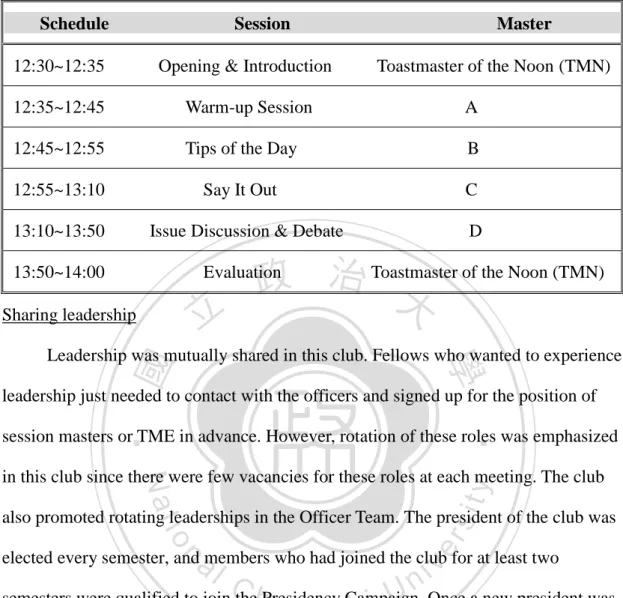
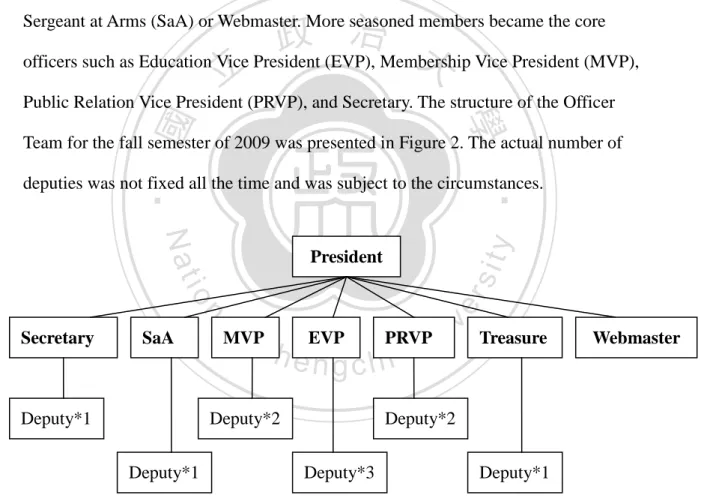
(14) 3. as fixed as it is in the context of a class using the model of TM club since new ideas and inspirations are shared by any person at any moments in any meetings of the club. In another previous study, Chen (2000) took a great step ahead to investigate a conventional TM club and showed members‟ public speaking anxiety was greatly reduced as a result of many facilitative factors in the club. However, she studied the functions of TM club only from the perspective of members‟ public speaking anxiety and employed questionnaires to collect answers to the research questions, irrespective to the developmental process of learning and psychological transformation of. 政 治 大 arena to support learners‟ autonomous language learning has also not been thoroughly 立 members. Mostly, how a learning community like a TM club functions as a social. explored. More studies need to be conducted to investigate how learners take. ‧ 國. 學. initiatives in using a conventional TM club to develop English proficiency and learner. ‧. autonomy.. y. Nat. io. sit. Statement of Purpose. n. al. er. Recognizing the missing piece in the literature on autonomous language. i n U. v. learning in a learning community like a TM club, this study aims to explore how an. Ch. engchi. out-of-class informal learning community, a university-based TM club, functions and supports members‟ autonomous English learning from the perspective of situated learning theory, which helps capture members‟ gradual movement of making process from peripheral members to full members in a community (Lave &Wenger, 1991). In other words, this study explores how members take advantages of the TM club to develop autonomy in English learning and to transform the identity from a novice to an expert in the community. In order to better capture the multiple aspects of the TM club and the transformational learning processes that the members experience, ethnographical approach was applied to help arrive at a deep understanding of the.
(15) 4. club since such a research method emphasizes the context, people, and activities. Besides, the process of how a new member becomes a full participant is examined by the lens of four focal members possessing diverse length of membership. In this way, the systems of the club, the learning opportunities provided by the club, and the developmental changes as well as the conflicts that occur to individual members could be described in detail. It is hoped that the results of this study can provide new insights into autonomous language learning and make preliminary contributions to the design of learning community as a structure for English teaching and learning in Taiwan.. 立. Research Questions. 政 治 大. ‧ 國. 學. The study was guided by the following three research questions.. ‧. (1) How does a university-based TM club serve as a learning community to support. sit. y. Nat. members‟ autonomous language learning? In particular, what resources,. io. work together to support English learning?. al. er. opportunities for social engagement, and club functions are there and how do they. n. v i n C h take advantage ofUthe TM club in developing (2) How do four individual members engchi their language proficiency? How is their participation changed during the club activities in one semester? (3) In the TM club‟s attempt to support language learning, what conflicts, challenges and problems do the four participants encounter?.
(16) 5. Significance of the Study Seeing that learning community gradually plays an important role in EFL learners‟ development of language proficiency, this study is the preliminary one that captures the picture of how a club supports its members‟ language learning with its resources and how a group of Taiwan college students participate in the club activities and develop English proficiency out of autonomy through ethnographical methodology. The results of this study also provide some insights to encourage community-based autonomous language learning in Taiwan.. Definition of Key Terms. 立. 政 治 大. Since this club is an affiliate of a historical international organization, some. ‧ 國. 學. terms concerning the working of club meeting are used among members. In this study,. ‧. the researcher also adopted the terms used by the club members to authentically. sit. y. Nat. present the picture of members‟ learning in the club. In order to provide readers with. io. Meeting Roles. al. er. general understanding, brief definitions of these terms are given in the following.. n. v i n C hof the Evening. TME TME: TME stands for Toastmaster is the chairperson and the engchi U host/hostess conducting the whole club meeting and controlling the pace of each meeting session. To ensure a well-conducted meeting, three helpers and several session masters take specific duties from the TME. The three helpers are Timer, Ah Counter and Vote Counter. Timer is the one who records how much time a speaker spends on a speech. Ah Counter is the one who counts the unnecessary vocalize pauses and the mixing usage of “he” and “she” uttered by the speakers. Vote Counter is the one collecting the ballots near the end of each meeting and dealing with the awards..
(17) 6. Session Master: A TM meeting comprises several sessions, and each session is charged by a member called session master. In other words, session masters are like the deputies of TME in TM meetings. IE: IE stands for Individual Evaluator. Members of this TM club take turns delivering speech in front of the audience. Each speaker is assigned one fellow evaluator, that is, the IE. The duty of an IE is to pay close attention to the content of the fellow member‟s speech and the stage manner performed by the member and then to provide the fellow member with constructive suggestions as well as sincere encouragement. 政 治 大 LE: LE stands for Language Evaluator. LE is like a grammarian who picks out the ill 立 during the Evaluation Session.. usage and wrong pronunciation from members‟ speeches. In this particular TM club,. ‧ 國. 學. the role of LE is always taken on by a guest native speaker of English or the very. ‧. experienced members from other TM clubs.. sit. y. Nat. GE: GE stands for General Evaluator. GE pays attention both to the general. io. er. performance of each speaker and the efficacy of the meeting. In this focused TM club, this role is always taken on by a guest member from other TM clubs.. n. al. Ch. Officer Roles. engchi. i n U. v. President: The president is the leader of the club and the bridge among the university, area headquarters, division headquarters, and TM Taiwan Headquarters. Three vice presidents work with the president, and each of them is given different officer duties. EVP: EVP stands for Education Vice President. He/she is responsible for weekly agendas and club‟s educational activities. EVP also pays attention to each member‟s progress in the club and sends an invitation e-mail to all members and guests on the list before the meeting every week..
(18) 7. PRVP: PRVP stands for Public Relation Vice President. PRVP invites guests to take on the role of LE and GE every week. Also, PRVP promotes the activities organized by TM Taiwan Headquarters to members at the meetings. Moreover, the PRVP is responsible for the Club Fair on campus at the beginning of each semester. MVP: MVP stands for Membership Vice President. MVP deals with anything related to interaction among members. To be specific, what a MVP does is to arrange Family System and Mentor-Mentee System at the beginning of each semester, to send a thank-you note to members after each meeting, and to arrange Study Groups as well. 政 治 大 SaA: SaA stands for Sergeant at Arms. SaA is responsible for all the snacks, drinks 立 as outings during the semester.. and facilities before each meeting.. ‧. ‧ 國. 學. Club Activities. sit. y. Nat. Joint Meeting: Joint meeting is a regular and formal activity among TM clubs.. io. er. Members of a TM club pay a formal visit to another TM club, and the two TM clubs holds a meeting together. In this way, the meetings roles are shared among them.. al. n. v i n Club Visiting: Club Visiting canC be understood as members‟ h e n g c h i U private visit to other TM clubs. Members of a TM club spend their free time visiting other clubs and take on some meeting roles sometimes. Study Group: Study Group in this club refers to a mini regular meeting. The purpose of Study Group is to provide members with extra opportunities to speak English outside the regular club meetings. Study Groups are arranged periodically in one semester..
(19) 8. CHAPTER 2 LITERATURE REVIEW The purpose of this study aims to understand how college students develop autonomy in language learning in the context of a learning community: Toastmasters club. In view of this purpose, this chapter firstly reviews literature on the fundamental issues of autonomy and then deals with literature on learning communities. The last part of this chapter offers backgrounds of Toastmasters International (TI) and reviews related studies on the Toastmasters clubs (TM club).. Autonomy. 立. Definition of autonomy. 政 治 大. ‧ 國. 學. The concept of autonomy originated from the field of education (Boud, 1998;. ‧. Knowles, 1975; Tough 1971; Benson, 2001) and has received growing attention in. sit. y. Nat. SLA for a few decades (Gremmon & Riley, 1995). Of the varied definitions of. io. er. autonomy, the definition given by Holec (1981) is most often quoted. He defined autonomy as “the ability to take charge of one‟s own learning” (p. 3) and stressed that. al. n. v i n C h the responsibilities learners should be having and holding for making all decisions in engchi U every stage of learning. In other words, it is learners who possess full controls and. responsibilities for determining the learning goals, the content, the pace of learning, the method and techniques, monitoring the process of learning, and evaluating the outcomes of the learning (Holec, 1981). This sense of autonomy is further called “proactive autonomy” in Littlewood‟s work (1999: 75). Holec‟s definition focused on a learner‟s cognitive dimension, but for Little (1991), autonomy was not just a matter of cognitive capacities; instead, autonomy concerned a learner‟s psychological relation to the learning content and learning process. He defined autonomy as “a capacity for detachment, critical reflection,.
(20) 9. decision-making, and independent action” (p. 4). On the basis of Holec‟s and Little‟s definitions, Littlewood (1996) once analyzed the components of autonomy and proposed that the manifestation of autonomy depends both on a learner‟s “ability” and “willingness” (p. 428). That is, an autonomous learner is able and willing to take charge of learning. The first component, ability, refers to a learner‟s “knowledge” and “skills” (Little, 1996, p. 428), and both of them are necessary for carrying out whatever choices concerning learning. The other component, willingness, refers to a leaner‟s “motivation” and “confidence” (Little, 1996, p. 428) to take responsibilities. 政 治 大 and he argued that a learner‟s control over the learning was under the impact of 立. for the choices that have been made. In 1996, Benson went beyond these definitions,. society. In his view, a learner‟s control over learning is not achieved by individual. ‧ 國. 學. preferences but heavily dependent on the collective decision-making as well as. Nature of autonomy. io. er. sit. y. Nat. Benson set out to define autonomy from sociocultural aspect.. ‧. interaction with others in society during the process of learning. It is obvious that. According to Benson (2001), measuring learner autonomy is not an easy task. He. al. n. v i n C h of autonomy forUthe following reasons. First, attributed the difficulties to the nature engchi. autonomy is a multidimensional construct so that it is difficult to identify a particular set of behaviors which manifest autonomy. In other words, autonomy can manifest itself in diverse ways, and the form of autonomy is performed differently in individual learners. Second, autonomy is a capacity or ability, but possessing the capacity does not always lead to action. Just as Littlewood (1996) proposed, autonomy is composed of ability and willingness, so the performance of autonomy also hinges on the learner‟s willingness. Third, the acquisition of autonomy is a developmental process, and autonomy is a matter of degree. However, there is still little literature, if any, about the developmental stages that learners will go through in the process of developing.
(21) 10. autonomy (Benson, 2001). Autonomy in language learning Autonomy entered the field of language learning through the work of the Council of Europe‟s Modern Languages Project, which was established in 1971. This project aimed to provide adults with learning opportunities to develop second language proficiency through the wide establishment of self-access learning centers where rich materials and resources were given (Benson, 2001). Its rise in the field of language learning was connected to the advocacy of communicative approach in SLA (Benson,. 政 治 大 approach was made by Holec (1981). He claimed that being a linguistic expert was not 立 2002). The early connection between the concept of autonomy and the communicative. the goal of those adult learners who used self-access centers to develop language. ‧ 國. 學. proficiency; instead, these learners oriented their efforts to develop communicative. ‧. competence and to synthesize both personal and situated communicative goals in the. sit. y. Nat. process of learning. Another link between autonomy and communicative approach was. io. er. developed by Little (1991, 1994, 1997). In his view, autonomy implied using the target language to communicate meanings and to fulfill communicative purposes during the. al. n. v i n Ch process of learning. In these communicative contexts, the target language serves as the engchi U. medium and the content of learning. Also, autonomy implies learning the knowledge of target language within the context of language use. Later, Littlewood (1996) suggested three elements of autonomous learners: autonomy as a “communicator,” a “learner,” and a “person” (p. 431). The learner as a communicator, one possesses the ability to use the language creatively and to use appropriate communicative strategies to invoke successful communication. As a learner, one is able to carry out independent work and to employ strategies which assist learning whenever necessary. As a person, the learner possesses the ability to express personal meaning in the target language and to create personal learning environments. These elements of autonomy proposed by Littlewood.
(22) 11. (1996) were similar to Little‟s view on autonomy (1991, 1994, 1997). In line with these perspectives above, Ryan (1991) proposed the concept of “relatedness” for fostering the development of learner autonomy. Relatedness refers to a learner‟s contact, support and community with others. In Ryan‟s view, the positive feeling of relatedness facilitates the development of autonomy. He further suggested that autonomy would develop most effectively in a supportive environment which offers concrete support like help as well as resources, personal concerns, opportunities for making choices, and the freedom of being an agent. On the basis of these. 政 治 大 an interactive environment and viewed as interdependent achievement for learners who 立 perspectives, autonomous language learning should be carried out interdependently in. are involved in the process of learning (Breen, 1986; Breen & Candlin, 1980; Kohonen,. ‧ 國. 學. 1992; Little, 1994). Since autonomous language learning implies learning how to use. ‧. the language authentically with others, providing learners with a supportive and. sit. y. Nat. interactive environment seems to foster the development of learner autonomy. In view. io. er. of this, the next part reviews literature on communities in service of learning in order to understand the development of learner autonomy in a learning community, and this is. n. al. the focus of this study.. Ch. engchi. i n U. v. Learning Communities Theoretical background on learning in a community The most salient theoretical perspectives supporting the idea of learning in communities are Vygotsky‟s sociocultural theory (1978) and situated learning theory (Lave & Wenger, 1991). The fundamental concept of sociocultural theory is the idea that human‟s development happens when individuals build interrelated relationships with the world under the mediation of tools or social artifacts (Lantolf, 2000). In Vygotsky‟s view (1978), any higher mental development, including learning, is a two-phase development. It appears first in interpersonal plane as a socially collective.
(23) 12. product generated from learner‟s active interaction with others or artifacts of the society, and then appears in intrapersonal plane as internalization generated from the previous mediated interactions. Vygotsky‟s emphasis on social interaction can be further captured by his idea of Zone of Proximal Development (ZPD), which is often understood as the difference between the level of what a learner can achieve alone and the level of what the same learner can reach with assistance from more able persons in society. Aljaarfreh and Lantolf (1994) contended that ZPD involves expert-novice interaction only, and for Lantolf (2000), society is the key to mental development. 政 治 大 collaboratively constructed opportunities for development. Such one-to-one 立. since it provides learners with more capable others to interact with and to gain. interaction with more able persons in society is further termed “apprenticeship” in. ‧ 國. 學. situated learning theory (Lave & Wenger, 1991), which is developed under the. ‧. umbrella of sociocultural perspectives. However, the experts-novices relationship. sit. y. Nat. embedded in the concept of ZPD and apprenticeship are extended to encompass any. io. 2000; Rogoff, 1995).. al. er. interpersonal interaction in any culturally organized activities nowadays (Lantolf,. n. v i n C h apprenticeship,ULave and Wenger (1991), two Based on the idea of one-to-one engchi. leading figures of situated learning theory, further contended that a community is an. ideal context for learning. They believed learning is integrated in real world activities, so participation in social activities is learning, and a community is the exact place providing various social engagements for development. When new members enter a community and actively participate in organized activities with assistances from other members, apprenticeship is taking place and making the new members gradually advance their current level of development. For the sake of capturing the gradual advancements on new members, Lave and Wenger (1991) further proposed that learning is a situated activity that features a process called “legitimate peripheral.
(24) 13. participation” (LPP). LPP describes the process of learner‟s gradual movement of making progress from being a peripheral participant to a full participant in a community. In other words, learning is a process in which learners as apprentices gradually increase participation in real world activities and then become full participants in a community rather than passively receive a body of knowledge. Compared with peripheral participants, full participants in a community have more accesses to on-going activities, latest information, resources and opportunities for learning, and they keep relationship with other members more steadily than peripheral. 政 治 大 need to devote a greater commitment of time and take upon more responsibilities as 立. participants. When peripheral participants long to move towards full participants, they. well as challenges. Their identity will be transformed gradually from a novice to an. ‧ 國. 學. expert in the process of participation in the community activities (Lave & Wenger,. ‧. 1991). Therefore, the state of a peripheral participant and a full participant is a relative. sit. y. Nat. concept, which is subject to transformation in nature. A peripheral participant will. io. er. become more experienced after engaging in the community for a period of time, and he is closer to the state of a full participant than another member who just enters the. n. al. community (Goody, 1989) Elements of a community. Ch. engchi. i n U. v. According to Barab et al. (2004), community is often viewed as a substitute for “group” because it has not been credited with a clear definition. For Barab and Duffy (2000), a community in service of learning is not simply a group of learners, and it should include fundamental elements like shared goals and beliefs, significant history and heritage, and reproductive cycles. Besides, it should be socially interdependent because community itself implies members working towards common goods. In Wenger‟s view (1998), a shared repertoire like routines, gestures, and ways of behaving will develop and shape over time after a complicated process of collective.
(25) 14. negotiation among members in a community. In fact, members in a learning community not only work towards shared intellectual goals but develop emotional bonds with one another and a sense of belonging to the community (Heath, 1995). Such a psychological attachment is what McMillan and Chavis (1986) termed: “sense of community” (p. 9). They defined sense of community as “a feeling that members have of belonging, a feeling that members matter to one another and to the group, and a shared faith that members‟ needs will be met through their commitment to be together” (p. 9). They also suggested that sense of community is composed of four. 政 治 大 emotional connection. People join a community for certain reasons, and the attraction 立 elements: integration and fulfillment of needs, membership, influence, and shared. of the community to people depends on to what extent the community can fulfill their. ‧ 國. 學. desired needs. When people perceive that their desired needs can be fulfilled in the. ‧. community, they are more likely to join the community and become a member. The. sit. y. Nat. membership serves as an important boundary of a community. A community. io. er. distinguishes itself from others by setting up boundaries, and these boundaries are marked by, for example, paying member fee or developing a set of rituals and. al. n. v i n Cofhparticipation, theU language. Also, during the course club exerts influences over its engchi members, and at the same time, members are also empowered and motivated to. influence the development of the community. In addition, members gradually form a shared emotional connection to others after contacting and interacting with other members. The experience of undergoing shared history increases the strength of emotional connection among members as well. The gained emotional connection and sense of safety make members identify more with the community that they live in. This feature (i.e., shared emotional connection) is regarded as “the definitive element for true community” by McMillan and Chavis (1986, p. 14). Therefore, for many researchers like Boyd and Hord (1994) and Graham (1972), learning communities are.
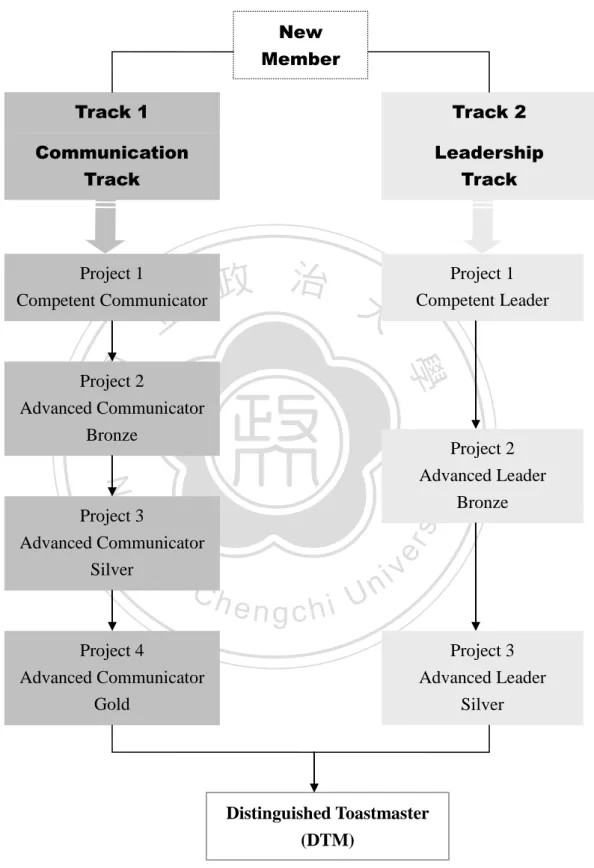
(26) 15. supportive and caring environment in nature. The criteria suggested by the National Institute of Education‟s Study Group of the Conditions of Excellence (in White, 1989) also clearly marked that a learning community is the place where common themes are shared, psychological isolation reduced, interaction between people increased, curriculum integrated, and group identity developed. All these definitions pinpoint the positively convergent elements of a learning community, suggesting cognitive growths as well as psychological needs are catered with learning as the core theme in a learning community.. 政 治 大 in learning communities, harmony and coherence are expected but not guaranteed to 立. Although community itself implies positive experience on members in general,. members as heterogeneity exists among members with various backgrounds and. ‧ 國. 學. belief systems. Disagreement, conflicts, and tensions surely occur in the process of. io. er. Types of learning communities. sit. y. Nat. negotiation of meaning and thus for learning (Wenger, 1998).. ‧. negotiation, but these conflicts are believed to become facilitative conditions for. With an attempt to understand learning in communities, Riel and Polin (2004). al. n. v i n C h but overlappingUlearning communities: pointed out that there are three distinct engchi task-based learning community (or product-based learning community),. practice-based learning community, and knowledge-based learning community. They employed a four-dimension framework which provided a common ground for understanding the similarities and differences among these three types of communities. The four dimensions are membership, task features or learning goals, participation structure, and reproduction as well as growth mechanisms. The first dimension, membership, concerns about issues like who joins the community and how they get access to the community. The second dimension, task features or learning goals, focuses on the enterprise of the group, including what people do in the community, so.
(27) 16. this aspect can be understood from community activities or product, if any. The third dimension, participation structure, focuses on the extent that the community offers members access to the community‟s activities and the extent that members take part in these activities. The fourth dimension, reproduction and growth mechanisms, aims to understand the means by which the community sustains its life and goes beyond the current development. These four dimensions are used to differentiate the three types of communities, and the features of these three types of communities are described as follows.. 政 治 大 around well-specified goals that propelled members to achieve understanding of 立. In Riel and Polin‟s view (2004), task-based learning community is organized. well-defined issues, to carry out solution to certain problems, or to complete certain. ‧ 國. 學. products within time limit. This kind of community is organized temporarily, and its. ‧. life ends with the fulfillment of the temporary group goal. The products of the. sit. y. Nat. community would be disseminated and assessed by other people after they are. io. er. produced. Practice-based learning community arises from a profession or field of endeavor and works around a shared activity. It differs from task-based community in. al. n. v i n C hin practice-basedUcommunity and that members that members voluntarily participate engchi are formally acknowledged. Learning in this type of community is increasing participation and responsibilities, and knowledge is embodied in practice and. performance. In addition, a member‟s identity is defined by the extent of participation in the community. In order to have members engage in the practice as much as possible, open assess to the activity structure is essential in this kind of community. Knowledge-based learning community endeavors to construct reusable knowledge base in continuous cycles. It seeks to advance current collective knowledge of members by conducting intellectual conversations which in turn support the growth of each individual in the community. Knowledge-based learning community shares.
(28) 17. many features of practice-based learning communities, and it can be seen as a practice-based learning community since the construction of an ongoing knowledge is the practice of a knowledge-based learning community.. Toastmasters Clubs as Learning Communities This part provides background about Toastmasters clubs (TM clubs), and the information serves as the fundamental stone for understanding the particular university-based TM club of this study. The information includes the history of this international organization, its mission and feature, its development in Taiwan, and its. 政 治 大. development in Taiwan universities.. 立. History. ‧ 國. 學. Toastmasters International (TI) is a worldwide non-profit organization which began its development from a social club in Santa Ana, California, in 1924. Ralph C.. ‧. Smedley, the founder of this club, perceived that most of the young men lacked training. sit. y. Nat. in public speaking, so he organized his training program in the form of a social club. He. al. er. io. believed that young men would be more interested in learning in a social environment. v. n. than a formal context such as a classroom. Then he entitled his social club “The. Ch. engchi. i n U. Toastmasters Club” since the word “toastmaster” referred to the person who gave a toast and introduced speakers in public. In view of this, “The Toastmasters Club” suggests a supportive and pleasant environment for members to practice public speaking skills. Smedley‟s attempt seemed to be welcomed and the model of his club was gradually extended to other neighboring communities, states, and even other countries. In 1932, Smedley‟s club was renamed “Toastmasters International” when it incorporated with a club from Canada (Toastmasters International, n/d). To date, Toastmasters International has extended to five continents with a headquarters located in California. The number of members and charted clubs are still growing, and this.
(29) 18. organization has nearly 260,000 members in more than 12,500 clubs in 113 countries so far (Toastmasters International, n/d). Mission and features According to the information on TI‟s home, TI aims to help people around the world become better public speakers and leaders. It tries to fulfill the mission by establishing worldwide TM clubs which offer a supportive and enjoyable environment for training public speaking and leadership skills. Generally speaking, each club holds a regular meeting weekly or biweekly for one to two hours, and the operation of each. 政 治 大 members practice and learn skills of communication as well as leadership by taking 立. club differs slightly. Each regular meeting is like a learning-by-doing workshop where. on meeting roles, which range from a speaker of prepared speech or an impromptu. ‧ 國. 學. speaker to a timer or even a chair. With several decades of development, an. ‧. educational system that incorporates communication and leadership training has been. sit. y. Nat. well developed by TI, and it offers members two tracks of learning: communication. io. er. track and leadership track. These two tracks are carried out in the form of projects, called “Competent Communication Project” (CC Project) and “Competent Leadership. al. n. v i n Project” (CL Project). MembersC go through these two U h e n g c h i projects by delivering speeches and serving a role at meetings, according to their own goals and paces of learning.. The following figure depicts the two tracks of TI‟s educational system, and after the figure follows some explanations..
(30) 19. Toastmasters International’s Educational System New Member Track 1. Track 2. Communication Track. Leadership Track. Project 1 Competent Communicator. Project 1 Competent Leader. 學. ‧ 國. 立. 政 治 大. ‧. Project 2 Advanced Communicator Bronze. sit. y. Nat. Project 2 Advanced Leader Bronze. Project 3. io. n. al. er. Advanced Communicator Silver. Ch. Project 4 Advanced Communicator Gold. engchi. i n U. v. Project 3 Advanced Leader Silver. Distinguished Toastmaster (DTM). Figure 1 Toastmasters International‟s Educational System (Toastmasters International, n/d).
(31) 20. New members start learning in a TM club from working on Competent Communication Project (CC Project) and Competent Leadership Project (CL Project). Taking part in the club‟s regular meetings is the way to undertake these two projects. CC Project is a series of ten speaking projects with defined objectives, which serve as guidelines for developing basic techniques for public speaking. After the tenth speech is delivered, the speaker completes CC Project and is granted Competent Communicator status. Furthermore, members who have completed CC Project would receive a Competent Communication Award, two free Advanced Communication manuals and a. 政 治 大 entitled to start the Advanced Communication project (AC Project), which includes a 立. letter of recognition from the TI Headquarters. Then the Competent Communicator is. series of fifteen topics focusing on different speaking situations. For example, the. ‧ 國. 學. topics include storytelling, public relations, facilitative discussion, communication on. ‧. TV, and so on. These Competent Communicators can select two from these topics. sit. y. Nat. based on their future needs and continue pursuing the status of an Advanced. io. er. Communicator Bronze, an Advanced Communicator Silver, or even Advanced Communicator Gold. Only after a member goes through the Communication Track and. al. n. v i n C hbe granted the status the Leadership Track would he/she of “Distinguished engchi U. Toastmaster” (DTM), which is the highest honor for all worldwide Toastmasters. Table 1 below is the well-specified objectives and time requirement for the ten speeches in the CC Project, and Table 2 shows the ten projects of CL Projects. All the wordings are taken directly from TI‟s Competent Communication manual (CC manual) and Competent Leadership manual (CL manual)..
(32) 21. Table 1 Toastmasters‟ Competent Communication Project Level of CC Project. Title. Time requirement. C1. The Ice Breaker. 4~6 minutes. C2. Organize Your Speech. 5~7 minutes. C3. Get to the Point. 5~7 minutes. C4. How to Say it. 5~7 minutes. C5. Your Body Speaks. 5~7 minutes. C6. Vocal Variety. 5~7 minutes. 政 治 大 Get Comfortable with Visual Aids 立. C7. Research Your Topic. C8. ‧ 國. C10. Persuade with Power. 5~7 minutes. Inspire Your Audience. 8~10 minutes. ‧. al. y. sit. er. Content. n. 2. io. 1. Nat. Table 2 Toastmasters‟ Competent Leadership Project Project. 5~7 minutes. 學. C9. 5~7 minutes. Listening and Leadership. v i n Ch e n g cCritical h i UThinking. 3. Giving Feedback. 4. Time Management. 5. Planning and Implementation. 6. Organizing and Delegating. 7. Developing Your Facilitation Skills. 8. Motivating People. 9. Mentoring. 10. Team Building.
(33) 22. Regular meetings Each regular meeting in all the worldwide TM clubs comprises three essential sessions: Prepared Speech Session, Table Topics Session, and Evaluation Session (NCCU Toastmasters New Member Manual, 2009). It is in the Prepared Speech Session that members could work on their CC Project. Three to four members take on the role of prepared speech speaker at each meeting. These speakers would prepare a speech based on personal progress on the CC Project, and then deliver their speech one by one in this session. On the other hand, the Table Topics Session helps train members‟. 政 治 大 session, the session master prepares several questions of the same topic and randomly 立. impromptu speech skills with the technique of impromptu Question and Answer. In this. picks some members to share their answers or opinions on the assigned question for. ‧ 國. 學. one to two minutes. Unlike most English learning environment, there is no teacher or. ‧. instructor in a TM club although feedback is necessary for members in the process of. sit. y. Nat. learning. Therefore, the Evaluation Session is designed to provide members with. io. er. feedback. This session includes Individual Evaluation, Language Evaluation, and General Evaluation. Three to four fellows take on the role of Individual Evaluator (IE). al. n. v i n C h of prepared speech. who evaluates a certain fellow speaker Their evaluation focuses on engchi U what fellow speakers have done well and provides suggestions for improvement in. encouraging manners. After that, Language Evaluator (LE) and General Evaluator (GE), who are guests invited by the club, start their evaluation from different respects. The LE is like a grammarian who pays attention to all speakers‟ English use, shares any good or poor language, and specifies any mispronounced words in public. As for the GE, he/she orients the evaluation towards the efficiency of the meeting and the club as a whole. What has been done well and what can be improved might be pointed out..
(34) 23. Toastmasters Clubs in Taiwan According to TM Taiwan Headquarters‟ home, Taiwan TM clubs are in District 67, Region Thirteen of TI. The first TM in Taiwan was established in Taipei in 1958, and 150 clubs have been founded island-widely thus far. The languages used in TM clubs are diverse, but most of the clubs in Taiwan are English clubs (120). Also, there are four Taiwanese clubs, five Japanese clubs, one Hakka club, and twenty bilingual clubs, which speak English-Mandarin Chinese, or English-Taiwanese, or Mandarin Chinese-Taiwanese. The Taiwan TM clubs are either community, university-based, or corporate clubs. Among these three types, community clubs are the majority. They are formed by a group of adults. 治 政 living in neighboring communities, and the size of these 大clubs are relatively small 立 compared to that of corporate clubs or university-based clubs. Corporate clubs are ‧ 國. 學. established by corporations and usually named after the corporation. The membership is. ‧. built from employees of these corporations. Most of these corporate clubs are English clubs, but few are not. University-based clubs are established on university campus, and students. y. Nat. n. al. er. io. Taiwan are English clubs.. sit. of the campus are the major source of membership. All the university-based clubs in. Ch. University-based Toastmasters Clubs. engchi. i n U. v. A university-based TM club is usually established by a group of pioneering students of a university or a college with the support from TM Taiwan Headquarters and the university. According to the information by TM Taiwan Headquarters, nineteen university-based TM clubs have been chartered in Taiwan. Half of these university-based clubs are located in Taipei, and the rest of them are in the western and middle parts of Taiwan, including Keelung, Taoyuan, Taichung, Nantou, Yunlin, Tainan, and Kaohsiung..
(35) 24. Research on Toastmasters Clubs Many English teachers and professors in Taiwan agree that an interactive and authentic environment is facilitative for the development of autonomy in language learning, and they have put this idea into practice with extensive use of authentic tasks and promotion of collaboration on tasks in classrooms. Learners are also encouraged to use the target language as much as possible in the classroom and to express who they are as well as what they think about on different issues instead of studying the language as a subject matter in school. Many teachers and professors in Taiwan have also experienced TM clubs,. 政 治 大 authentic tasks, and audience to interact with. Therefore, some of these teachers and 立. and TM clubs attracted them for the reason that it gave learners clear purposes of learning,. professors (e.g., Chou, 2003; Sun, 2008) were inspired to corporate the model of TM club. ‧ 國. 學. meeting into tertiary English courses, attempting to establish a learning environment for. ‧. EFL learners in Taiwan.. sit. y. Nat. The results of these studies (Chou, 2003; Sun, 2008) indicated that the model of TM. io. er. club meetings was highly welcomed by most learners as it was a powerful and supportive environment for polishing their public speaking skills. For instance, Chou (2003) applied. al. n. v i n C hSpeech Training Program modified Toastmasters International (TISTP) to an adult English engchi U speaking training course at a language center of a national university, and through. ethnographical investigation, she found most learners welcomed this program which featured constructive tension and lower oppression. Most important of all, learners also showed positive learning outcomes in becoming more communicative, more independent, and more autonomous. Sun (2008) also adopted the model of TM club meetings in her tertiary English speaking training class and called it the Toastmasters Approach. Her findings showed that learners made great improvements not only in public speaking skill but also in overall English proficiency, affective competence, and social competence in such a cooperative, autonomous, and student-centered learning environment. Also, this.
(36) 25. approach created an authentic learning environment for the students to practice what they had learned in class. From the results shown in these studies, it seems that the positive effects of such a learning community on English public speaking skills and the development of autonomy has been recognized by both these researchers and learners themselves. Its effectiveness and uniqueness in classroom context were revealed, but little research has explored how learning happens in a learning community like a conventional TM club. Some strides were made by Chen (2000) in her attempts to understand how members‟ public speaking anxiety. 政 治 大 relationship between members‟ PSA and many variables like age, genders, and occupations, 立 (PSA) was reduced in a conventional TM club. Chen oriented her efforts to study the. to explore whether members‟ participation in the club affects their PSA, to document the. ‧ 國. 學. characteristics of members with low level of PSA, and to understand how the leader of a. ‧. TM club helps members reduce their PSA. The results from questionnaires showed that. sit. y. Nat. most members‟ PSA decreased as a result of many interrelated factors. The researcher also. io. er. pointed out that the leader as well as some systems and activities in the club played indispensable roles on members‟ PSA reduction. However, learning in a community is so. al. n. v i n complicated and dynamic that itC can not be fully understood h e n g c h i U without comprehensive. investigation of learners‟ behaviors and the context where these behaviors occur. Besides, how EFL learners in Taiwan take initiatives in making use of a TM club to learn English autonomously and how their identities are transformed in the context of a TM club have not been fully explored. Therefore, this thesis aims to investigate how a university-based TM club facilitates EFL college students‟ development of autonomy in learning English by employing ethnographical approaches. The use of ethnographical approaches is expected to map out the multifacets of this TM club with in-depth descriptions of members‟ autonomous English learning in the club. The detailed methodology of this study is presented in the next chapter..
(37) 26. CHAPTER 3 METHODOLOGY A detailed description of methodology is presented in the following sections, including the context of the study, participants, instruments, data collection, and data analysis. In this study, ethnography was employed to collect data. Ethnography is the research method that roots in anthropology and sociology (Wilson, 1982). Ethnographical study puts emphasis on the natural context in which human behaviors. 政 治 大 from the context unobtrusively and longitudinally, so the participants‟ subjective 立. occur. In order to capture human behaviors in a holistic way, this method collects data. perceptions and beliefs can be obtained. Since the purpose of this study was to. ‧ 國. 學. understand why and how these college students use this club to develop English. ‧. proficiency and learner autonomy outside the class and to depict how this club supports. y. sit. io. al. n. The Context of the Study. er. employed.. Nat. their language learning, ethnographical method rather than experimental method was. The campus. Ch. engchi. i n U. v. The particular university-based TM club was located in a research-oriented university which was established in 1927 and located in the northern part of Taiwan. According to the information on the web site of this university, this university contained nine colleges and thirty-three departments, housing 9050 undergraduates, 3250 master students, 910 Ph. D. students, 1940 on-the-job master students, and 400 international students in the year of 2010. It is famous for humanities and social science disciplines, and in particular, its College of Commerce was highly regarded nationally as well as internationally. The prosperousness of the College of Commerce played an important role on the birth of this particular TM club on campus..
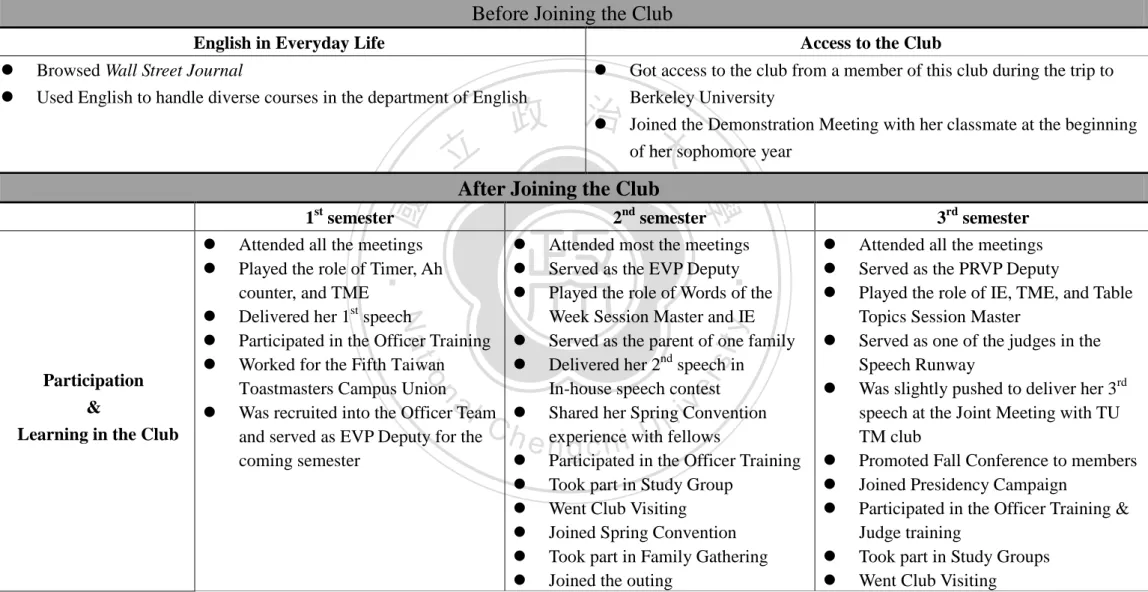
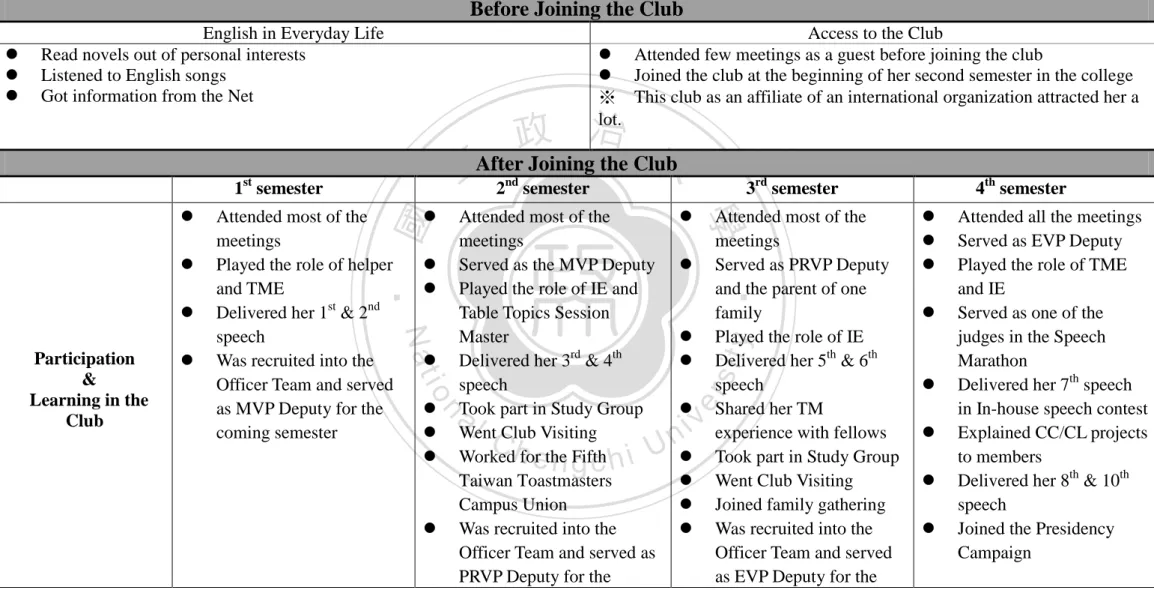
(38) 27. The TM club This focused TM club was founded in 2005 by a group of commerce majors with support from the TM Taiwan Headquarters and the university Office of Student Affairs. Since it was formed as an English learning club on campus, students from various disciplines voluntarily made use of it to cultivate English speaking proficiency by participating in the two-hour meeting every Wednesday evening. These weekly meetings were organized by a group of experienced members who regularly took turns forming the Officer Team. Each semester, 18 to 20 members would serve as the. 政 治 大 enjoyable learning environment where members developed both communication skills 立 Officers, and these officers were responsible for leading the club and creating an. and leadership skills.. ‧ 國. 學. Participants. ‧. The participants of this study included all of the club members during the fall. sit. y. Nat. semester of 2009. Forty-five members in total were on the member roster, and most of. io. er. them were undergraduate students from this university with a few from nearby universities. In this study, 8 members who have been the club for at least two semesters. al. n. v i n C were and already served as the Officers full members, and 13 members who h e considered ngchi U have been in the club for one semester were viewed relatively experienced members. As for those who just joined the club, they were viewed peripheral members. There were 24 peripheral members in total when the study was conducted. In order to clearly understand how these members take advantages of this club, the researcher identified each member‟s experience in the club and disciplines first, and then purposely selected four members with various lengths of membership and different backgrounds to become the focal participants. In this way, the picture of how full members, relatively experienced members and new members developed English proficiency and autonomy could be obtained..
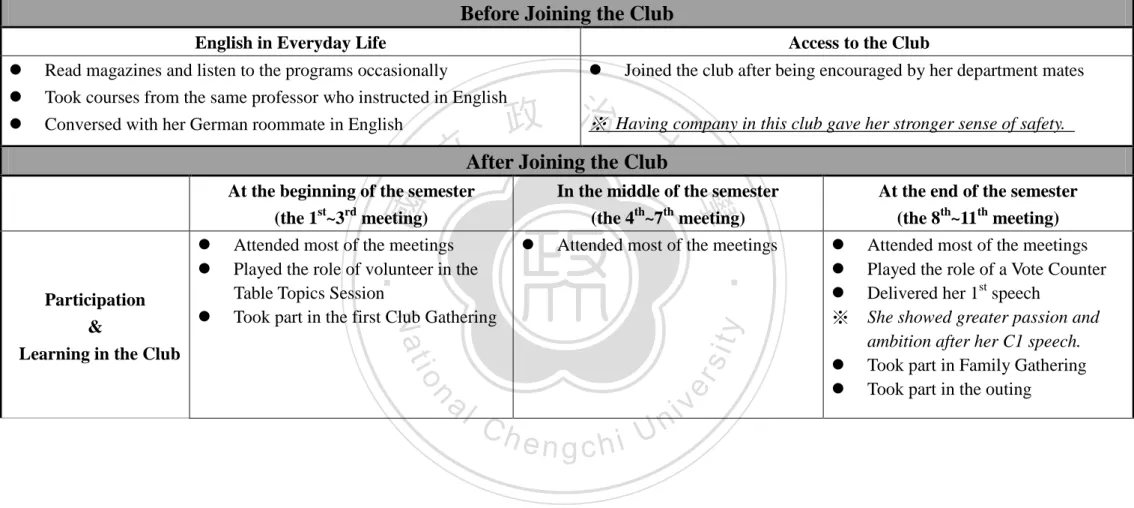
(39) 28. Introduction of the four focused participants The peripheral member: Stella Stella was a new member when the study was conducted in the fall semester of 2009, so she was considered a peripheral member in this study. She was a junior and majoring in history, but she had been a Chinese major studying in another nearby national university for one year. She transferred to the department of History of this university in September, 2008 when she was going to begin her sophomore year. Speaking of English proficiency, Stella did not have a clear sense to self-evaluate her. 政 治 大 confidence in her speaking ability than writing, reading, and listening skills. 立. proficiency level because she did not get any certificate, but she had much more. The relatively experienced member: Wayne. ‧ 國. 學. Wayne was a sophomore majoring in law. He had not been confident in his. ‧. English public speaking owing to an uncomfortable experience happened in his sixth. sit. y. Nat. grade. Wayne joined the club in the spring semester of 2009, and when the study was. io. er. conducted, he was going to start his second semester in this club. Due to his one-semester membership, he was considered a relatively experienced participant in. al. n. v i n C hHigh-IntermediateULevel as well as the requirement this study. Wayne had passed GEPT engchi of graduation from this university before the study was carried out. The full member: Clare Clare was a junior who majored in English. She joined the club in the fall semester of 2008, going to begin her third semester in this club when the study was conducted. In this study, she was considered an experienced participant. She had served as the deputy of Education Vice President (EVP deputy) of this club in her second semester of participation, and she was going to serve as the Public Relations Vice President (PRVP) as the study started..
(40) 29. The full member: Olivia Olivia was a sophomore majoring in political science. When she was a second grader, her family moved to the Netherlands. She studied at the International school in the Netherlands for two years. She joined the club in the spring semester of 2008 when she was a freshman majoring in Arabic Language and Literature. After studying the Arabic languages for two years, she decided to transfer to another department because she did not have great interest in the Arabic languages. She just transferred to the department of Political Science and studied as a sophomore when the study was. 政 治 大 Membership Vice President (MVP deputy) and the deputy of Public Relationship Vice 立 conducted. She was an experienced officer since she had served as the deputy of. President (PRVP deputy) in her second and third semester of participation. She served. ‧ 國. 學. as the deputy of Education Vice President (EVP deputy) in her fourth semester, the. ‧. period of data collection. She was the most experienced member of the four.. sit. y. Nat. The role of the researcher. io. er. Before the formal date collection, the researcher had conducted one-semester-long on-site observation in this particular club by attending the weekly. al. n. v i n two-hour meetings in the springC semester of 2009. TheUresearcher sat in the back of the hengchi classroom, video-taping each meeting for another project to which she served as a research assistant. She also noted down all the significant episodes without participating in any meeting sessions. This on-site observation enabled the researcher to practice taking logs, and the role of a regular guest gave the researcher access to the club in the coming semester when the data of this study was collected. Mostly, the on-site observation provided the researcher with a general understanding of this club, such as the club protocols, the size of this club, and the members‟ backgrounds. In the formal date collection stage (fall, 2009), the researcher paid the new member fee and became a formal member. She acted as a participant-observer.
(41) 30. participating in each of the regular meetings and extending club activities, such as Club Visiting and outing, while observing both the members and the club as a whole unobtrusively. The researcher closely observed, audio-recorded the eleven regular meetings, and took notes during each of the meetings. She did not video-record the club as she did not want to break rapport established with all the club members. Instruments Semi-structured interviews Semi-structured interviews were employed as an important instrument for. 政 治 大 were segmented into the First Interview, Follow-up Interview, and Post-observational 立 collecting data from the four focused participants. These semi-structured interviews. Interview, depending on time and focuses. Each of the four participants was. ‧ 國. 學. interviewed for three times. The First Interviews with each of them were conducted in. ‧. November, 2009 in order to gather these participants‟ background information, such as. sit. y. Nat. personal learning experience, English learning experience, motivation for joining this. io. er. club, and their perspective as well as impression of the community (see Appendix A for the First Interview questions). The Follow-up Interviews were carried out with each of. al. n. v i n C 2009. the four participants in December, purpose U of the Follow-up Interviews was h e nOne i h gc. to clarify any confusion in on-site observation and to ask follow-up questions like their experiences with recent speeches. Another purpose was to discuss more profound issues like changes that had occurred to them recently and the significances of what had happened in the meetings. The other purpose of the follow-up interviews was to keep track of four focal participants‟ autonomous English learning in the club (see Appendix B for the Follow-up Interview questions). The Post-observational Interviews with them were conducted in the middle of January before the winter vacation began. These interviews had the four members reflect on the things that they had done during the data collection period (i.e., fall, 2009) as well as the ways that they made use of this club to.
(42) 31. learn English, express their opinions on the club activities, evaluate their own performances in the club, and state changes as well as progress that had been made by them during the past semester, if any (See Appendix C for the Post-observational Interview questions). Since Chinese was the mother tongue for the four members, it was used in all interviews. Each of these interviews lasted for one to one and a half hours, and all of the interviews were audio-taped for later transcription. On-site observation In the fall semester of 2009, the researcher entered the community with the identity. 政 治 大 and participated in every meeting session with other members. She audio-recorded each 立. of a formal member and conducted on-site observation. She sat in the crowd of members. meeting and took logs for the purpose of providing a clear description of each meeting.. ‧ 國. 學. The on-site observation focused on the operations and functions of this club that. ‧. supported and discouraged members‟ learning and on the attempts made by the club to. sit. y. Nat. offer opportunities for English learning. Particularly, the performance of four focused. io. er. members was carefully documented and served as the basis for the Follow-up and Post-observational Interviews. The observational data obtained in the spring semester of. al. n. v i n C hearlier was also referred 2009 for another study as discussed to when the researcher engchi U perceived any changes made by the club in the fall semester of 2009. Document collection For the sake of establishing trustworthiness, multiple sources of data were. collected. Apart from interviews and on-site observation, all the documents circulated at the time in the club were also collected. Formal documents came from both the Toastmasters International and the particular TM club. For instance, the formal documents from Toastmasters International included the web pages, a formal member kit, and monthly magazines, while the formal documents of this club included the member‟s manual, weekly agendas, and journals. The first journal of this TM club.
數據

+5

相關文件
吳佳勳 助研究員 國立台灣大學農經博士 葉長城 助研究員 國立政治大學政治學系博士 吳玉瑩 助研究員 國立台灣大學經濟博士 陳逸潔 分析師 國立台灣大學農經系博士生 林長慶
Professional Learning Community – Music
中學中國語文科 小學中國語文科 中學英國語文科 小學英國語文科 中學數學科 小學數學科.
Rebecca Oxford (1990) 將語言學習策略分為兩大類:直接性 學習策略 (directed language learning strategies) 及間接性學 習策略 (in-directed
大學教育資助委員會資助大學及絕大部分專上院 校接納應用學習中文(非華語學生適用)的「達 標」
Master Taixu has always thought of Buddhist arts as important, the need to protect Buddhist arts, and using different forms of method to propagate the Buddha's teachings.. However,
個人、社會及人文教育 |英國語文教育| 藝術音樂教育 | STEM 教育 全球意識與文化敏感度 |體驗學習| 接觸大自然
依據教育部臺教師(二)字第 1070199256 號,辦理國小全英語教學之教師專業成長工作
