LAPPED HADAMARD TRANSFORMS AND FILTER BANKS
See-May Phoong
Dept. of EE &
Grad. Inst. of C o n "
Engr.
National Taiwan Univ.
Taipei, Taiwan, R.O.C.
[email protected]
ABSTRACT
In this paper, we generalize the Hadamard transform to the the case of lapped transform A matrix A(z) is a lapped Hadamard transform if it satisfies A ~ ( ~ - ' ) A ( ~ ) = a~ for some integer a and all the entries of its coefficient matrices are i1. Many meth- ods have been proposed to construct lapped Hadamard matrices. In this paper, we will study these matrices using the theory of pa- raunitary filter bank. This approach not only greatly simplifies the analysis of lapped Hadamard transform but also gives rise to new construction methods that can generate a much wider class of lapped Hadamard matrices.
1. INTRODUCTION
Hadamard transform has found many applications in various areas of signal processing. An M x M constant matrix H is called a Hadamard transform if
H ~ H = MI,
andallitsenVicsh,j t { + l , -I}. ln[l]theauthorshowedthatif an M x M Hadamard matrix exists. then M = 2 or M is a multi- ple of 4. It was widely conjectured that this is also a sufficient con- dition. In the past, many methods have been introduced for their constructions [2]. This paper studies lapped Hadamard transforms. A causal M x M polynomial matrix A(z) = a ( k ) z 8 is called a lapped Hadamard transform if all the entries of the M by
M matrices a(k) are &1 and A(=) satisfies AT(z-')A(z) = M N I
When A ( z ) is a constant matrix independent of z , the lapped Hadamard matrix reduces to a Hadamard matrix. Matrices satis- fying the above expression are also known as paraunitary matrices [3]. In frequency domain, A(e3-) is unitary for all frequencies w .
In other words, lapped Hadamard transforms are the special class of paraunitary matrices whose coefficient matrices are antipodal. These matrices are closely related to complementary sequences [4][5]. When a lapped Hadamard matrix A(z) and its inverse A T ( z - ' ) are used as the analysis and synthesis polyphase ma- trices of a filter bank, we have a paraunitary filter bank 131 where all the filter coefficients are 51.
This work was supponed in pans by National Science Council, Tai- wan. R. 0. C., under NSC 91-2219-E-002-047 and 91~2213-8-009-031, Ministry of Education, Taiwan, R. 0. C, under Grant # 89E-FA06-2-4, and the Lee and MTI Center for Networking Research.
Yuan-Pei Lin
Dept. Electrical and Control Engr.
National Chiao Tung Univ.
Hsinchu, Taiwan, R.O.C.
Recently it has been demonstrated in [6] [71 that lapped Hadamard transforms have many potential applications in synchronous spread spectrum communication and CDMA. In the past, many construc- tion methods for lapped Hadamard matrices have been proposed [4][51[6][8][9][10]. In [8] [9],itisshownthatwecanconstruct2x 2 lapped Hadamard transforms by cascading 2 x 2 Hadamard ma- trices and diagonal matrices with delay elements. Such a method is generalized to the A4 x M case in [6]
[IO].
In [4], the authors show that a 2 x 2 lapped Hadamard matrix can be constructed from a pair of Golay sequences [I I] and vice versa. In[SI,
the authors show how to construct larger lapped Hadamard matrices from smaller lapped Hadamard matrices. Except [6], all the construction meth- ods are derived using a time-domain approach, which often in- volves complicated expressions.In this paper, we apply the theory of paraunitary matrices to the study of lapped Hadamard matrices. All the derivations will be done using a z-domain approach. This approach not only gives a compact description of the previous results, but also enable us to generalize previous methods. Moreover we will introduce some new methods for the construction of lapped Hadamard matrices. The new methods enable us to generate a much wider class of lapped Hadamard matrices.
2. DEFINITIONS AND PRELIMINARIES In this section, we will describe a number of tools that will be use- ful for later discussions. Consider the polynomial matrix A(z) =
E,=,
a ( n ) z - " with nonzero a(0) and a(N - 1). The constant matrices a(n) are the coefficient matrices. The numbers N and (N - 1) are respectively the length and the order of A(=). All matrices studied in this paper are square matrices. The tilde of A(z) is defined asL(z)
= A T ( + - ' ) .Using the tilde notation, an A4 x M matrix A(z) is paraunitary (PU) if
A(z)A(z) = cI, for some nonzero constant c. (I) When all the entries of all the nonzero coefficient matrices a(.) are
i1,
then A(z) will be called an antipodal (AP) matrix. A PU AP matrix will be called a lapped Hadamard matrix.Let A(=) and B(z) be two M x M AP matrices with lengths N, and Nb respectively. In general, the AP property is not pre- served by additions and multiplications. However it can be verified that the following two matrices are AP:
N - l
-
A(~)B(."*), A ( ~ )
+
Moreover if A(z) and B(z) have the same length, the matrix A ( z z ) + ~ - ' B ( z 2 ) will also be AP. These AP-property preserving operations will be useful in understanding of many construction methods described later,
Kronecker product will he useful for the construction of larger lapped Hadamard matrices from smaller lapped Hadamard matt- ces. Given two square matrices A ( = ) and B ( z ) with dimensions Ma and A& respectively, their Kronecker product A(z) @ B ( z ) is defined as (we have dropped the argument I for notational sim-
plicity)
1,
AooB AoiB . . . Ao.M-IB AloB A l l B . . , Ai.hr-iB
(
A A , - ~ , o B A n i - i . ~ B!
!
. . .
".
A~r--l.hr--iB jwhereAij(2) i s t h e i j t h e l e m e n t o f A ( z ) . Notethat A(z)@B(z) is an A4=A4b x M,Mb matrix. Moreover if the lengths of A(z) and B(r) are
N,
and Nb respectively, then the length of A(z) @ B ( z ) willbe N,_fNb-L. OnecanverifythatthetildeofA(z)@B(z) is equal to A(z)@B(z). Let the dimensions of the matrices A, B, C and D be so that all the matrix multiplications in the following expression are defined. Then the product rule states that( A @ B ) ( C @ D) = (AC) @ (BD)
Using the product rule, one can immediately show that given two PU matrices A ( z ) and B(z) (not necessarily of the same dimen- sions), their Kronecker product A ( z ) @ B(z) is also PU.
3. EXISTING CONSTRUCTION METHODS In this section, we will review come existing construction meth- ods for lapped Hadamard matrices. Though many of these meth- ods were originally derived using time-domain sequences, we will adopt the z-domain expression as it gives a more compact exprer- sion. Moreover, we will use the theory of PU matrices to explain these methods.
It was shown in [4] that 2 x 2 lapped Hadamard transforms are closely related to complementary sequences, or more commonly known as Golay sequences. A pair of AP sequences A t ( = ) =
E,=,
ai(n)z-" (i = O,l)arecomplementaryiftheysatisfy[11] Ao(z)&(z)+
Al(z)Ai(+) = 2 N ."1
Using these sequences, we form
One can verify by direct multiplication that E(z)E(z) = 2 N I ; the matrix E(z) is a lapped Hadamard matrix. Though comple- mentary sequences can be generalized to the case of M sequences [SI, unfortunately there is no known method to construct M x A'I lapped Hadamard matrices from M complementary sequences.
In [SI [9] [6] [IO] , it was shown that lapped Hadamard trans- forms can he constructed from Hadamard matrices. Let M be such that Hadamard matrices exist and let Hi, be Hadamard matrices. Let Eo(=) = Ho. Consider the following M x A4 matrices:
E ~ + ~ ( Z ) = H ~ A ( & ) E ~ ( ~ ) * for I; = 0,1,.
. .
,
( 2 )where A(=) is the diagonal matrix
As both Hk and A(z) are PU (I), so are their products. Hence Ek(z) are PU for all k . Moreover it is not difficult to verify that all thecoeffiicient matrices in Ek(z) have *1 as their entries. Thus E k ( z ) are lapped Hadamard transforms. Note that the length of the lapped Hadamard matrix Eh(z) is
M k .
For moderate numbers M and k , the length of E ~ ( z ) becomes very large.In [SI, several algorithms were given for the construction of larger lapped Hadamard matrices from smaller lapped Hadamard matrices. Let A ( z ) be an M x M lapped Hadamard matrix with length N . Then consider the following two 2 M x 2M matrices
A(zZ)
+
z-'A(zZ) -A(I')+
z-lA(;') Ea(.) =Clearly both Ei(z) are AP matrices with length 2 N . Using the paraunitariness of A(=), one can verify by direct multiplication that Ei(z) are also PU. Thus Ei(z) are lapped Hadamard matri- ces. The matrices E o ( z ) and E1 ( z ) can be viewed as "interlaced and "cascade" versions of A(z) respectively. By repeatedly ap- plying the above methods, starting from a 2 x 2 lapped Hadamard transform, one can generate Z k x 2k lapped Hadamard transforms for all integer k .
It was also shown in [SI that we can construct lapped Hadamard matrices by applying the Kronecker product. Let H be an Mh x
M h Hadamard matrix and A(z) be an M a x Ma lapped Hadamard matrix with length
N,.
Form the following MhM, x M h f i L ma- trixE ( z ) = H @ A ( z ) . ( 5 ) It is clearly an AP matrix. As the Kronecker product of PU matri- ces is also PU, E(z) is a lapped Hadamard matrix of length
N,
Though it was not mentioned in [SI, one can verify that A(z) @ His also n lapped Hadamard matrix.
4. NEW RESULTS
In the following, we will first generalize the results in (3). (4) and
( 5 ) . Then two new construction methods will he given.
Let A ( = ) and B(z) be lapped Hadamard matrices with the same dimension M and the same length N,,. Then one can gener- alize the result in (3) by constructing the matrix
~ ( 2 )
+
= - l ~ ( 2 ) -A@) + = - ' B ( Z ~ )E+) = (-A(Z')
+
z-lB(zZ)+
z - l q z Z ))
.It is not difficult to verify by direct multiplication that the above Eo(+) is a lapped Hadamard matrix with length 2N,. Let C(z) be another M x M lapped Hadamard matrix with length
N,.
Then one can verify that the following matrix is a lapped Hadamard transform with length ( N ,+
N 6 ) .A ( a )
+
z - " C ( z ) -A(z) + z F N " C ( z )z-"C(z) A ( z )
+
zCNeC(z) Ei(z) =One can also generalize ( 5 ) by taking the Kronecker product of two lapped Hadamard matrices. However special care has to he taken so that the AP property of these matrices is not destroyed. Let B(z) and C ( z ) be lapped Hadamard matrices of dimensions
Ma and M , respectively. Let Nb and
N,
be their lengths respec- tively. Then one can show that the resulting matrices of the follow- ing two Kronecker products are lapped Hadamard matrices with length (Nb+
N,
- 1) and dimension h f b M G .En(=) = B(z") @ C ( z ) (6) E i ( z ) = B(z) @ C ( z N b ) (7) The above seemingly simple generalization ofthe Kronecker prod- uct method includes (3) (4) and (5) as special cases. To see this, let
,
a n d C ( z ) = A ( z ) . -1+z-' l + z - 'Then (6) and (7) reduce respectively to (3) and (4).
Construction Method Using the Agayan-Sarukhanyan Multi- plication Theorem: By taking the Kronecker product of two ma- trices with dimensions
M a
and Ma, we will get a matrix ofdimen- sion M,Mb. In [2], it was shown that we can reduce the dimension using the elegant multiplication theorem of Agayan-Sarukhanyan. It was shown that given two Hadamard matrices of dimensionsM,, and Ma, one can construct a Hadamard matrix of dimension MaA4b/2. WIt turns out that we can also apply the multiplica- tion theorem of Agayan-Sarukhanyan to the construction of lapped Hadamard matrices. Let A(z) and B(z) be lapped Hadamard ma- trices of dimensions
Ma
and Mb respectively. Suppose that their lengths are N, and Nb respectively. Consider the following parti- tions:where A,,(.) and B,,(z) are M,/2 x M a / 2 and Ma12 x A4bl2 matrices respectively. This partition is always possible as A4a and
Mb are even (see the remark at the end of this section for a proof). Form the following x matrix with length ( N , N b ) :
The malrix C ( z ) , formed in such a manner, is called the Agayan- Sarukhanyan multiplication of A ( z N b ) and B(z), denoted as
C ( z ) = A ( z N b ) @,is B ( z ) .
One can verify that all C,, ( z ) are AP matrices of the same length and hence C ( z ) is an AP matrix. Applying the PU properties of A ( z ) and B(z), one can show that c ( z ) C ( z ) = aI, where
a = ~ M ~ M ~ N , N b . Hence C ( z ) is a lapped Hadamard matrix. Clearly, one can verify that A(z) @,is B(zNa). where
N,
is the length of A ( z ) . is also a lapped Hadamard transform. Note that when one of the matrices, say A(z), has dimension A4a = 2, then the dimension of C ( z ) will be Mb. Using this method, one can generate lapped Hadamard matrix with length 2 k for any integer k . Let A4 be such that Hadamard matrices H of dimension A4 exist. LetClearly E l ( z ) is an M x M lapped Hadamard matrix of length 2'. F o r k
2
1, we carry out the following iterations:ClearlyallEi,(z) a r e M x M P U m a t r i c e s a s t h e Agayan-Sarukhanyan multiplication preserves the PU propeny. Moreover Ek(z) are AP matrices with length 2'. Hence Es(z) are A4 x
M
lapped Hadamard matrices with length 2 k . Comparing our results with (2), we see that the matrices constructed using (2) have length equal to M k whereas our matrices have length 2'.Butterfly Structure Method: Let M be a number such that Hadamard matrices exist. From [I], we know that M is either 2 or a multiple of 4. Define the following two M x iz.I matrices:
e(=)
= diag[i z-l 1 z-l.. .
1 2-l1.
Let Eo(z) = H, an M x
M
Hadamard matrix. For k2
0, we formwhere Pt are M x M permutation matrices. It is clear that EIE(Z) are PU. Moreover they are also AP matrices due to the insertion of delay elements in
e(=).
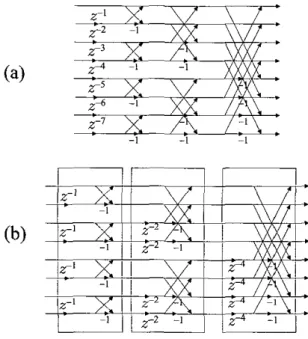
The length of Ek(z) is 2 k . For example, Fig. 1 shows the implementation of Ek(z) for k = 2 and M =4. Note that the butterfly structure has an additional advantage of low complexity. The computational cost for adding one stage is M additions. Note that when A4 is a power of two, H can also be realized using lag, M stages of the butterflies [LZ]. To implement a lapped Hadamard matrix of length 2 k , we only need ( k
+
log, A4)M additions.Connection Berwrrn the Butterjy Srrucrure Method and (2): When
the number of channels M is a power of two, we can show that the butterfly structure method includes (2) as a special case. We demonstrate this for the case A4 = 8. To do this, we need to show that HA(=) in (2) can be expressed as a product of maui- ces of the form Ba%(z)P as in (8). It is well-known [I21 that the 8 x 8 Hadamard matrix can be implemented efficiently the butter- flies. Using such an efficient structure, we can implement HA(z)
E k + i ( Z ) = BAl~(z2')PkEk(z), (8)
Figure I : A 4 x 4 lapped Hadamard matrix E ~ ( z ) constructed by the butterAy method.
as in Fig. 2(a). After moving some delay elements to the right of the butterflies, we can redraw Fig. 2(a) as Fig. 2(b). Note that each stage (indicated by the box) in Fig. 2(a) can he described by Us8(z2‘)P; by choosing the permutation matrix Pi properly.
(4
(b)
Figure 2: (a) An implementation of HA(=). (b) An equivalent system.
Remark: It was known [ l ] that Hadamard matrices H exist only for dimensions of 2 or a multiple of 4. Whether this is also a necessary condition for the existence of lapped Hadamard ma- trices is still unknown. But it is easy to see that the dimension of lapped Hadamad matrices has to be even. Too see this, let A(=) = a(n)zP’ be an M x M lapped Hadamard trans- form. The PU property of A(=) (defined in (1)) implies that
a*(N - l)a(o) =
o
As a(n) are AP matrices, the above equation implies that the di- mension M is even.
5. CONCLUSIONS
In this paper, we have studied lapped Hadamard matrices. The the-
ory of
PU
matrices was applied to analysis and synthesize thesematrices. Using such an approach, we can not only prove all pre- vious construction methods in a simple manner but also generalize their results. New methods that Can generate a much wider class of lapped Hadamard matrices are also introduced. One can generalize the definition of lapped Hadamard matrix to the complex case. An
M x M matrix A(z) = a(n)zYn is a lapped Hadamard matrix if all the entries of the coefficient matrices have unit mag- nitude and A’(l/z*)A(z) = M N I , where * and
’
denote the complex conjugate and transpose conjugate respectively. It can be verified that except the method using Agayan-Sarukhanyan multi- plication theorem, all the methods described in this paper can be modified for the construction of complex lapped Hadamard matri- Acknowledgement: We would like to thank Prof. S. C. Pei at the Department of Electrical Engineering, National Taiwan University for bringing our attention to the results on Hadamard matrices with non power-of-two dimensions.CCS.
6 . REFERENCES
[I] R. E. A. C. Paley, “On orthogonal matrices:’ J. Math. Phys..
vol. 12,pp. 311-320, 1933.
121 J. Sebeny and M. Yamada, “Hadamard Matrices, Sequences and Block Designs,” in Contemporary Design Theory: A Col-
lecrion of Survey, edited by J . H. Dinitz and D. R. Stinson, John Wiley & Sons, Inc., 1992.
[3] P. P. Vaidyanathan, Multirate systems and filter banks, Prentice-Hall, 1993.
[41 Y. Taki, H. Miyakawa, M. Hatori and S. Namba, “Even-shift onhogonal sequences,’’ IEEE Trans. Inform Theory, vol. IT-15, pp. 295-300, Mar. 1969.
151 C.-C. Tseng and C. L. Liu, “Complementary sets of se- quences,” IEEE Trans. Infornr. Theory, vol. IT-IS, pp. 6 6 6 5 2 , Sep. 1972.
[6] G. W. Womell “Emerging applications of mutirate signal pro- cessing and wavelets in digital communications:’ Pmceedings
of rhe IEEE, vol. 84, pp. 586-1 187, Aug. 1996.
[71
g.
Chen, J. Yeh, and N. Suehira, “A multicarrier CDMA archi- tecture based on orthogonal complementary codes for new gen- erations of wideband wireless communications,” IEEE Coni- municarions Mugazine, pp. 12G135, Oct. 2001.[XI
H. S . Shapiro, “Extremal problems for polynomials and power series,” Master’s thesis, MIT, Cambridge, MA, 1951.[Y]
W. Rudin, “Some theorems on Fourier coefficients,” Proc. Amer Math. Soc.. vol. 10, pp. 855-859, 1959.[IO] N. Suehiro and M. Hatori, “N-shift cross-orthogonal se- quences,” IEEE Trans. Information Theory, vol. 34, no. I , Ian. 1988.
[ I I] M. J . E. Golay, “Complementary series,” IRE Trans. Inform. [I21 N. Ahmed and K. R. Rao, Orthogonal Transforms f o r Digital
Theor),, vol. IT-7, pp. 82-87, 1961. Signal Processing, Springer-Verlag. 1975.