Full-Wavelength White Organic Light Emitting Diodes
with Blue Fluorescence and Phosphorescent Iridium Complexes
Jian-Feng Li,a,zShih-Fang Chen,bShui-Hsiang Su,cKao-Shing Hwang,aandMeiso Yokoyamac a
Department of Electrical Engineering, National Chung-Cheng University, Min-Hsiung Chia-Yi, Taiwan b
Department of Electronic Engineering, National Chiao-Tung University, Hsinchu, Taiwan c
Department of Electronic Engineering, I-Shou University, Ta-Hsu Hsiang, Kaohsiung County, Taiwan
A highly efficient white organic light emitting diode共WOLED兲 was fabricated and possible emission mechanisms of a WOLED configured with blue fluorescence and phosphorescent iridium complexes are proposed. The white light emitting layer is com-prised of a blue fluorescent emitting layer anthracene and a green and red phosphorescent emitting layer TPBI:11% Ir共ppy兲3: 0.5% Ir共piq兲2共acac兲. The device exhibits white emission with a Commission Internationale de l’Eclairage coordinate of 共x = 0.33, y = 0.33兲 and the luminance and luminous efficiency was 6389 cd/m2 and 6.4 cd/A, respectively, at 100 mA/cm2. Evidence indicates that the good energy overlap between the absorption spectrum of Ir共ppy兲3and Ir共piq兲2共acac兲 and the emission spectrum of TPBI results in an effective energy transfer from TPBI to Ir共ppy兲3and Ir共piq兲2共acac兲. The optimal thickness of the green and red emitting layer promotes the injection and emitting of carriers in that layer.
© 2006 The Electrochemical Society. 关DOI: 10.1149/1.2335968兴 All rights reserved.
Manuscript submitted March 30, 2006; revised manuscript received June 20, 2006. Available electronically September 6, 2006.
White organic light-emitting diodes共WOLEDs兲 are commercial OLEDs, because they have potential applications as backlights for liquid-crystal displays and as general solid-state light sources.1,2A WOLED is based on an additive mixture of the three primary colors or two complementary colors. Many approaches have been proposed for developing WOLEDs with high luminance and high stability.3-7 When WOLEDs are fabricated by vacuum evaporation, using red, green, and blue colors, making the pixels of the WOLED uniform is difficult because of the difficulty in the alignment of the shadow masks. Additionally, when WOLEDs are fabricated using color fil-ters, the luminance intensity of the light sources is degraded and a pure white emission with a broad wavelength is required. Therefore, systematic investigations of the fabrication and the characteristics of full-wavelength WOLEDs with high luminance and good color bal-ance must be conducted to identify potential applications of high-efficiency backlight sources in full-color displays. Unfortunately, numerous full-wavelength WOLEDs have the shortcomings that the luminescent efficiency is very poor and the chromaticity coordinate changes significantly with the operating voltage.8,9Moreover, only a few WOLEDs with high luminescent performance, using three primary-color emitters, have been reported because of the complex-ity of the device fabrication process.10For example, Huang et al. fabricated a full-wavelength WOLED using a dual-doped method, where the luminous efficiency was 4.8 cd/A at 100 mA/cm2and the
electroluminescence 共EL兲 spectra of this device only covered the range of 400–700 nm.11Although blue phosphorescent dyes were reported to exhibit an external quantum efficiency of 7.5%, their dependency on host materials with very large bandgaps represents a barrier to the design of WOLEDs.12Therefore, the high efficiency and color stability of WOLEDs depends on the use of blue fluores-cence with green and red phosphorescent dyes.
This study reports a full-spectrum and highly efficient WOLED and establishes the possible emission mechanisms of WOLED con-figured with blue fluorescence and phosphorescent iridium com-plexes.
Experimental
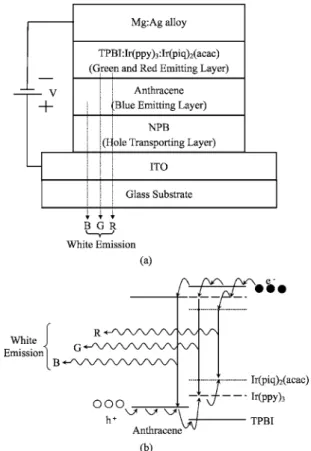
WOLEDs are fabricated by vacuum vapor deposition at a pres-sure of 5⫻ 10−6Torr. Figure 1a presents the WOLED structure
with a hole-transporting layer N, N
⬘
-diphenyl-N, N⬘
-bis 共1-naphthyl-phenyl兲-共1, 1⬘
-biphenyl兲-4, 4⬘
-diamine 共NPB兲 共400 Å兲, a blue emitting layer anthracene共300 Å兲, a green and red emitting layer TPBI: fac tris 共2-phenylpyridine兲 iridium 共Ir共ppy兲3兲:bis关1-共phenyl兲isoquinoline兴 iridium 共III兲 acetylanetonate 关Ir共piq兲2共acac兲兴,
and the cathode Mg/Ag alloy with an atomic ratio of 10:1. TPBI is an efficient host material for phosphorescent dopant and hole-blocking material, due to the wide energy gap and suitable emission spectrum.13 The white emission comes from the anthracene blue fluorescence and the TPBI host doped with Ir共ppy兲3green
phospho-rescent iridium complexes and Ir共piq兲2共acac兲 red phosphorescent
iridium complexes. The thickness of the film was measured using an oscillating quartz thickness monitor共Sycon STM-100兲 and the ac-tive area of the devices, defined by the size of the overlap between the indium tin oxide 共ITO兲 and Mg/Ag electrodes, was 0.3
z
E-mail address: [email protected]
Figure 1.共a兲 Configuration and 共b兲 energy band diagram of WOLED, com-prising blue fluorescence and phosphorescent iridium complexes.
Journal of The Electrochemical Society, 153共11兲 H195-H197 共2006兲
0013-4651/2006/153共11兲/H195/3/$20.00 © The Electrochemical Society H195
) unless CC License in place (see abstract).
ecsdl.org/site/terms_use
address. Redistribution subject to ECS terms of use (see
140.113.38.11
⫻ 0.3 cm2. All devices were encapsulated in a dry nitrogen glove
box.
EL spectra and Commission Internationale de l’Eclairage 共CIE兲 coordinates of the devices were measured using a PR650 spectroscan spectrometer and the luminance vs current density共L–J兲 characteristics were determined simultaneously from the EL spectra by using the spectrometer with a Keithley 2400 programmable voltage–current source. Photoluminescence共PL兲 spectra of the or-ganic films were obtained using the 325 nm line from an He–Cd laser. Fluorescence was collected through a window and directed into a 1/4 m spectrograph with a cooled photodiode array detector.
Results and Discussion
Because Ir共ppy兲3 and Ir共piq兲2共acac兲 were adopted as the green and red guest phosphorescent iridium complexes, respectively, the optimal concentrations of these two dopants added to the host ma-terial TPBI must be determined. Figure 2 presents the EL spectra of ITO/NPB/anthracene/TPBI/Ir共ppy兲3 共300 Å兲/Mg/Ag with various Ir共ppy兲3doping concentrations of between 0 and 13%. As shown in
Fig. 2, at doping concentrations of Ir共ppy兲3of between 7 and 11%,
the intensity of green emission at a wavelength of approximately 520 nm关contributed by Ir共ppy兲3兴 was observed to increase with the doping concentration of Ir共ppy兲3 up to 11%. However, at doping concentrations of Ir共ppy兲3of over 11%, the intensity of the green
emission dropped as the doping concentration of Ir共ppy兲3increased.
This is due to triplet-triplet共T–T兲 annihilation between the Ir共ppy兲3 and host triplets.14Therefore, the host material of TPBI doped with 11% Ir共ppy兲3 exhibits an energy transfer at the appropriate rate,
optimally emitting green light from Ir共ppy兲3.
The effect of doping TPBI with Ir共ppy兲3 and Ir共piq兲2共acac兲 on the balance between the green and red emission intensities was also studied. Figure 3 shows the EL spectra of ITO/NPB/anthracene/ TPBI:11% Ir共ppy兲3/Ir共piq兲2共acac兲 共300 Å兲/Mg/Ag with various doping concentrations of Ir共piq兲2共acac兲 of between 0.5 and 0.7%.
The analytical results in Fig. 3 indicated that the device with 0.5% Ir共piq兲2共acac兲 in the host material TPBI exhibited not only balanced
green and red emission intensities but also relatively high energy transfer from TPBI to Ir共piq兲2共acac兲.
The thickness of the blue, green, and red emissive layers as well as the doping concentration of each fluorescent and phosphorescent material strongly affects the EL spectrum of the white light emitting device. The thickness of the green and red emitting layer was varied
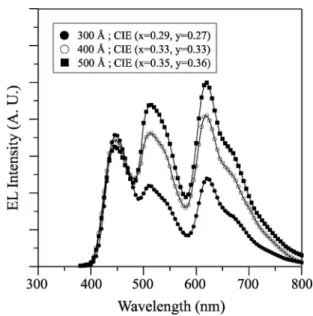
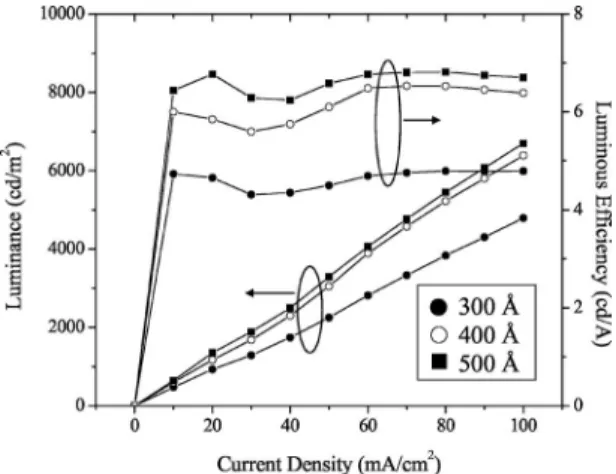
and the doping concentrations of Ir共ppy兲3and Ir共piq兲2共acac兲 main-tained at 11 and 0.5%, respectively, to obtain a bright and high-purity WOLED. Figure 4 shows the EL spectra of the WOLEDs with green and red emitting layers of various thicknesses and reveals that the luminescent performance was strongly related to the thick-ness of the green and red emitting layer. The EL spectra of the devices are full-spectrum and cover the range 400–800 nm, with three major emissions at 440 nm共from anthracene兲, 520 nm 关from Ir共ppy兲3兴, and 620 nm 关from Ir共piq兲2共acac兲兴. Figure 5 plots the luminance-current density-luminous efficiency characteristics of WOLEDs with green and red emitting layer of various thicknesses. Evidence shows that green and red emitting layer of suitable thick-ness 共400 Å兲 can be used to yield white emission with relatively high color purity and a CIE coordinate of共x = 0.33, y = 0.33兲. The luminance and luminous efficiency was 6389 cd/m2and 6.4 cd/A,
Figure 2. EL spectra of ITO/NPB/anthracene/TPBI:Ir共ppy兲3/Mg:Ag WOLED with 0, 7, 9, 11, and 13% Ir共ppy兲3in TPBI layer whose thickness is 300 Å and current density is 20 mA/cm2.
Figure 3. EL spectra of ITO/NPB/anthracene/TPBI:11%Ir共ppy兲3: Ir共piq兲2共acac兲/Mg:Ag WOLED with 0.5 and 0.7% Ir共piq兲2共acac兲 in TPBI layer whose thickness is 300 Å and current density is 20 mA/cm2.
Figure 4. EL spectra of the WOLEDs with green and red emitting layers of various thicknesses.
H196 Journal of The Electrochemical Society, 153共11兲 H195-H197 共2006兲
H196
) unless CC License in place (see abstract).
ecsdl.org/site/terms_use
address. Redistribution subject to ECS terms of use (see
140.113.38.11
respectively, at 100 mA/cm2. The optimal thickness of the green and
red emitting layers promotes the injection and emission of carriers in the green and red emitting layers.
To understand the energy transfer mechanisms between the TPBI and phosphorescent dopants, we examine the PL spectrum of TPBI and the absorption spectra of Ir共ppy兲3and Ir共piq兲2共acac兲, as shown in Fig. 6, elucidating the real emission mechanisms for Ir共ppy兲3and Ir共piq兲2共acac兲 doped into TPBI. The similarity overlap between the
absorption spectra of Ir共ppy兲3and Ir共piq兲2共acac兲 and the emission of
TPBI and that of the energy transfer process probably represents the dominant emission mechanism in our WOLED. The energy transfer pathways between host material of TPBI and guest materials of
Ir共ppy兲3and Ir共piq兲2共acac兲 in full-wavelength WOLED are shown
in Fig. 1b. In general, the white emission was generated at the in-terface between the blue emitting layer of anthracene and the green and red emitting layers of Ir共ppy兲3and Ir共piq兲2共acac兲. The energy
bandgap of TPBI is larger than Ir共ppy兲3and Ir共piq兲2共acac兲. There-fore, injected holes and electrons in TPBI are transferred easily into the Ir共ppy兲3 and Ir共piq兲2共acac兲, and excitons were formed in
Ir共ppy兲3and Ir共piq兲2共acac兲, respectively. Besides, an efficient T–T
energy transfer from Ir共ppy兲3 to Ir共piq兲2共acac兲 can occur through their adjoining positions.15,16The T–T energy transfer reduces the green light emission of Ir共ppy兲3and enhances the red light emission of Ir共piq兲2共acac兲 as shown in Fig. 3. For this reason, in order to
balance green and red emission intensities, the doping concentration of Ir共piq兲2共acac兲 should be lower than Ir共ppy兲3.
Conclusions
In conclusion, we have demonstrated a high-efficiency full-wavelength WOLED with blue fluorescence and phosphorescent iri-dium complexes. The device exhibits white emission with a CIE coordinate of共x = 0.33, y = 0.33兲 and the luminance and luminous efficiency was 6389 cd/m2 and 6.4 cd/A, respectively, at
100 mA/cm2. The possible emission mechanisms of WOLED
con-figured with blue fluorescence and phosphorescent iridium com-plexes were investigated. Evidence shows that the good energy over-lap between the absorption spectrum of Ir共ppy兲3and Ir共piq兲2共acac兲 and the emission spectrum of TPBI results in an effective energy transfer from TPBI to Ir共ppy兲3and Ir共piq兲2共acac兲. Additionally, a
green and red emitting layer of an appropriate thickness共400 Å兲 increases the luminance of WOLEDs. The optimal thickness of the green and red emitting layer suggests the injection and emission of carriers in that layer.
Acknowledgments
The authors thank the National Science Council of the Republic of China for financially supporting this research under contract no. NSC 94-2622-E-214-001 and NSC 94-2215-E-214-002.
I-Shou University assisted in meeting the publication costs of this article. References
1. D. Qin and Y. Tao, Appl. Phys. Lett., 86, 113507共2005兲.
2. Y. Zhang, G. Cheng, Y. Zhao, J. Hou, and S. Liu, Appl. Phys. Lett., 86, 011112 共2005兲.
3. Z. L. Zhang, X. Y. Jiang, W. Q. Zhu, X. Y. Zheng, Y. Z. Wu, and S. H. Xu, Synth.
Met., 137, 1141共2003兲.
4. J. Kido, H. Shionoya, and K. Nagai, Appl. Phys. Lett., 67, 2281共1995兲. 5. C. W. Ko and Y. T. Tao, Appl. Phys. Lett., 79, 4234共2001兲.
6. Y. S. Huang, J. H. Jou, W. K. Weng, and J. M. Liu, Appl. Phys. Lett., 80, 2782 共2002兲.
7. G. Li and J. Shinar, Appl. Phys. Lett., 81, 1738共2003兲.
8. U. Scherf and E. J. W. List, Adv. Mater. (Weinheim, Ger.), 14, 477共2002兲. 9. S. Setayesh, A. C. Grimsdale, T. Weil, V. Enkelmann, K. Mullen, F. Meghdadi, E.
J. W. List, and G. Leising, J. Am. Chem. Soc., 123, 946共2001兲.
10. C. C. Wu, Y. T. Lin, K. T. Wong, and Y. Y. Chien, Adv. Mater. (Weinheim, Ger.), 16, 61共2004兲.
11. Y. S. Huang, J. H. Jou, W. K. Weng, and J. M. Liu, Appl. Phys. Lett., 80, 2782 共2002兲.
12. R. J. Holmes and S. R. Forrest, Org. Electron., 2, 37共2001兲.
13. Y. T. Tao, C. W. Ko, and E. Balasubramaniam, Thin Solid Films, 417, 61共2002兲. 14. M. A. Baldo, C. Adachi, and S. R. Forrest, Phys. Rev. B, 62, 10967共2000兲. 15. D. L. Dexter, J. Chem. Phys., 21, 836共1953兲.
16. D. F. O’Brien, C. Giebeler, R. B. Fletcher, A. J. Cadby, L. C. Palilis, D. G. Lidzey, P. A. Lane, D. D. C. Bradley, and W. Blau, Synth. Met., 116, 379共2001兲. Figure 5. Luminance-current density characteristics of WOLEDs with green
and red emitting layers of various thickness.
Figure 6. PL spectrum of TPBI and absorption spectra of Ir共ppy兲3 and Ir共piq兲2共acac兲.
H197
Journal of The Electrochemical Society, 153共11兲 H195-H197 共2006兲 H197
) unless CC License in place (see abstract).
ecsdl.org/site/terms_use
address. Redistribution subject to ECS terms of use (see
140.113.38.11