
Heuristics for Multicast Routing and Wavelength Assignment with Delay Constraint in WDM Network with Heterogeneous Capability
6
0
0
全文
(2) Int. Computer Symposium, Dec. 15-17, 2004, Taipei, Taiwan.. Therefore, transmitting data with delay bound is realistic to reflect the demand about data transmission in the future. Data is required to be transmitted from a source to multiple destinations is referred as a request. A request with delay bound represents that it need to be transmitted under a given delay bound. To reroute a request in the multicast scheme is referred as the Multicast Routing and Wavelength Assignment problem (MRWA). To solve multicast routing problems, several heuristics [5, 7, 8] and ILP (Integer Linear Programming) formulations [3, 4, 6, 9, 10] have also been proposed in WDM network. In our survey, few studies seem to have been done on discussing the MRWA problems of routing a request with delay bound in WDM-He network with or without wavelength conversion, and seem to have token account of both communication cost and wavelength consumption in the object function. Therefore, the Multicast Routing and Wavelength Assignment with Delay Constraint (MRWA-DC) problem, finding an optimal light-forest with minimal multicast cost and assigning wavelengths to these light-trees for routing a request with a given delay bound in WDM-He network, was proposed in [9], where the multicast cost is the values of the multicast cost function. The multicast cost function, a linear combination of communication cost and wavelength consumption, α×(communication cost) + β×(wavelength consumption), was defined to respond the cost of rerouting a request, where α and β can be appropriately chosen according to the topology and the load of network. The MRWA-DC problem was solved by ILP formulation in [9], but the ILP formulation used to solve the problem in huge network may be very difficult and inefficient. According to previous experimental results, the execution time to reroute a request with 4 destinations in the network with 100 nodes might consume nearly 20 hours, and the ILP formulation couldn’t be used to solve the problem in the network with more than 110 nodes or with great numbers of wavelengths and nodes in affordable execution time. Therefore, to propose an efficient heuristic seems necessary and important to solve the problem. In this paper, the MRWA-DC problem will be solved by an integrated 2-Level solution model which is an iterative process consisting of two integrated procedures (Selecting Wavelength Procedure with two evaluation functions and Finding Assigned Light-tree Procedure with two heuristics). Three experiments are simulated to discuss the performance and efficiency of the solution model.. links between two nodes, respectively. For each link connecting two nodes u and v denoted as eu,v, c(eu,v) and d(eu,v) represent the communication cost and the transmission delay of eu,v, respectively. Μ represents a set of available wavelengths in each link to provide the functionality of transmitting data. θ(v) represents the light splitting capacity of node v; that is, the node v is an MC node when θ(v) > 1; otherwise, θ(v) = 1. A request with a delay bound ∆ represented as r(s, D={d1, d2, …, dm}, ∆) indicates that there is data originating from a certain source s, and the data is routed to all destinations di in D finally, where s∈V, D ⊆ V-{s} is a set of destinations, |D| = m, and the transmission delay of routing data to each di must be bounded by the delay bound ∆. In this paper, we assume that ∆ is a given value. Suppose there are τ sub-trees STi with root si connecting s to form a routing-tree T with root s for 1≤i≤τ. The wavelength consumption ω(T), communication cost c(T), and transmission delay d(T) of T are defined as follows, respectively. 1. T having a root node only ∑ ω ( STi ) max( 1≤i ≤τ θ ( s) , ϖ (T )) otherwise . ω(T) = . ,. where ϖ(T)= max ω ( STi ) . 1≤i ≤τ. c(T ) =. ∑ (ω ( STi ) ⋅ c(e s, si ) + c( STi )). 1≤ i ≤τ. d (T ) = max(d ( STi ) + d (es , si )) 1≤i ≤τ. The usage status of the wavelength λ (λ∈Μ ) in the edge e described with eλ represents whether it has been used or not. That is, eλ =0 shows that λ in e has been used to transmit some request; otherwise, eλ =1. Therefore, the wavelength λ is named as a wfeasible wavelength in e when eλ =1; in other words, e is named as a w-feasible edge in λ. When λ is a wfeasible wavelength in each e∈T, λ is a w-feasible wavelength for T. The node pair (T, λ) represents that the wavelength λ is assigned to T. Let Γ={(T1, λ1), (T2, λ2), … ,(Tω, λω)} for r(s, D, ∆) being an assigned light-forest must satisfy the following four conditions: (1) capacity constraint : outTi(u) ≤ θ(u), where outTi(u) represents the number of outgoing edges of node u in Ti (2) delay constraint : d(Ti) ≤ ∆, ∀ i∈ω (3) destination constraint : D ⊆ Uω (V (T )) i =1. i. (4) wavelength constraint : eλi=1, ∀ e∈Ti, ∀ i∈ω, λi∈Μ. To evaluate different assigned light-forests, the multicast cost function f to calculate multicast cost of Γ is defined as f (Γ)= α ⋅ ∑ c(Ti ) + β ⋅ ω .. 2. Problem formulation In [9], a WDM-He network represented with a weighted graph G(V, E), and the node set V and the edge set E represent the switches and directed optical. Ti ∈Γ. 697.
(3) Int. Computer Symposium, Dec. 15-17, 2004, Taipei, Taiwan.. According to the above definition, the MRWADC problem is equivalent to find an optimal assigned light-forest with minimal multicast cost to route a request under delay bound. When finding an optimal light-forest and assigning wavelength for each light-tree are processed independently, it is hard to choose a w-feasible wavelength for each light-tree. Furthermore, it may have a high possibility that no w-feasible wavelength can be found for some lighttree. The request is blocked because it is fail to be routed. Therefore, proposing integrated heuristics to regard the wavelength usage of each link in the process of finding a assigned light-forest is important and realistic. Suppose a wavelength-based graph of λ, G(V, Eλ), is defined as a graph by removing all edges which are not w-feasible edge in λ; that is, Eλ = {e| e∈E, eλ= 1}. A light-tree T found from G(V, Eλ) can be viewed as that λ is a w-feasible wavelength to T, and the procedure used to find a light-tree covering some destinations from the wavelength-based graph of λ is equivalent to find an assigned light-tree of λ. The observation is applied in the paper to propose an integrated 2-Level solution model which is an iterative process consisting of Selecting Wavelength Procedure (SWP) and Finding Assigned Light-tree Procedure (FALP) to solve the MRWA-DC problem in polynomial time.. 3. Solution Model The solution model basically is an iterative process, and each iteration is to select a wavelength to construct wavelength-based graph and to find a light-tree from the wavelength-based graph. For a selected wavelength λ, the found light-tree is the assigned light-tree of λ used to reroute some destinations in the iteration. The other assigned lighttrees used to route to the reminder of destinations need to be decided in the next iteration. When the process is executed again, the parts of the reminder will be rerouted by the assigned light-trees found in the iteration. To repeat the process till the reminder is empty, all destinations are rerouted by some assigned light-tree and the union of these light-trees will be an assigned light-forest which satisfies the 4 constraints defined in the Session 2. It is evident that the iterative process being a greedy approach can be used to solve the MRWA-DC problem. According to the above discussion, the iterative process including two procedures: (1) Selecting Wavelength Procedure (SWP) choosing a wavelength to construct a wavelength-based graph, and (2) Finding Assigned Light-tree Procedure (FALP) finding a light-tree from the wavelengthbased graph, is proposed. An assigned light-tree will be found in iteration, and an assigned light-forest is obtained when the iteration is terminated. In the FALP, two coupled problems, which destinations can be rerouted in the selected wavelength and how to find a light-tree under the delay bound to cover. these destinations, induce finding optimal light-tree to be an NP-Complete problem. Furthermore, the found light-tree will not be adjusted again because how to adjust the light-tree based on previous found light-trees is another NP-Complete problem. For the additional cause that the order of selecting wavelength may affect the multicast cost by using the greedy approach, we may note that it is necessary to propose some heuristics in the SWP and in the FALP. In this paper, Maximal W-Feasible Edges Assigning First (MaxE) and Minimal Requests Assigning First (MinR) for SWP and Maximal Depth Seserving First (MaxDepth) and Maximal Destinations Reserving First (MaxDest) for FALP are proposed as follows.. 3.1. Selecting Wavelength Procedure An improper order of selecting wavelength may cause the FALP to find a set of local optimal assigned light-trees; furthermore, the solution is far from the optimal light-forest. It is necessary to propose some evaluation functions to evaluate each wavelength. When all assigned light-trees can always be found from the wavelength-based graph of the wavelengths with high value in iteration, the union of these assigned light-trees may be approximated to the optimal solution in high possibility In the procedure, the Eval(λ) evaluation function will be used to give an evaluated value for each wavelength λ and the wavelength is selected according to Eval(λ). Nevertheless, the selecting is very hard to predict accurately or to compute the value in affordable execution time. Two simple greedy heuristics, Maximal W-Feasible Edges Assigning First (MaxE) and Minimal Requests Assigning First (MinR) are proposed as follows. (1) MaxE heuristic The MaxE heuristic is based on the assumption that the wavelength-based graph with more edges is advantageous to find a light-tree with less communication cost in higher possibility. The wavelength λopt ∈ M’ satisfying | Eλopt| ≥ |Eλ| for all λ ∈ M’ will be chosen first and the Eval(λ) is defined as : Eval(λ) = |Eλ| , where Eλ = {e| e∈E, eλ= 1}. (2) MinR heuristic A wavelength which has been used to route minimal number of requests represents its utility rate is the lowest than other wavelengths. The lower utility rate of wavelength selected first to route requests can balance the transmission load of wavelength to reduce the blocking rate. Therefore, the heuristic is proposed and defined as: Eval(λ) = the number of requests routed by using the wavelength λ. 698.
(4) Int. Computer Symposium, Dec. 15-17, 2004, Taipei, Taiwan. α (c( Pˆ d ( x, u )) − c( P c (v, u ))), T if outTˆ d (v) < θ (v) d ˆ CD(T , u, v) = c α (c( PTˆ d ( x, u )) − c( P (v, u )) − c( PTˆ d ( s, v))) − β , otherwise . 3.2. Finding Assigned Light-Tree procedure In this procedure, the optimal light-tree with minimal communication cost is expected to be found. Nevertheless, finding the optimal light-tree is NPcomplete discussed in [9] such that proposing an efficient heuristic to find a near optimal light-tree in polynomial time is more important than to find the optimal light-tree. In [9], the two heuristics used in Generating Phase and Refining Phase to find a lightforest with less multicast cost, and two critical lightpaths MCLP (Minimal Communication cost LightPath) Pc(u, v) and MDLP (Minimal transmission Delay Light-Path) Pd(u, v) which are two light-paths between u and v with minimal communication cost and with minimal transmission delay are utilized in the procedure. The procedure divided into three steps, generating a candidate, refining the candidate, and cutting up infeasible branches will be described as follows.. All node-pairs in the Tˆ d are sorted in the decreasing order by the value of cost-difference. When f( Tˆ n ) < f( Tˆ d ) and d( Tˆ n ) ≤ ∆ are satisfied, Tˆ n will be a better weak candidate than Tˆ d . The multicast cost and execution time could be affected by the number and the choosing order of node-pairs. In this step, each node will try to reroute to its nearest node, where the nearest node of u, δ(u), is defined as the node with CD( Tˆ d ,u, δ(u)) ≤ CD( Tˆ d ,u, v) for all v∈V-{u}. The iteration will be terminated when no node-pair can be refined again. (3) Cutting up infeasible branches Some internal nodes may be infeasible branches such that the weak candidate may not be a light-tree. It is necessary to propose some heuristics to decide which nodes will be eliminated from the weak candidate to form a light-tree. In this step, the reservation weight function, r-weight, is defined to give a reservation weight for each node. Reserving the edge connecting the node with high reservation weight may reduce the multicast cost or the blocking rate of routing the request. Therefore, for v being an infeasible branch (i.e., out Tˆ n (v) >θ(v)), out Tˆ n (v) -. (1) Generating a candidate All MDLPs between the source and all destinations need to be checked for the condition that their transmission delay must be smaller than or equal to the delay bound. A graph, constructed by merging these MDLPs which are satisfied the check condition is referred as a weak candidate. Because there is only one light-path with minimal transmission delay between two nodes, the weak candidate must be a tree. (2) Refining the weak candidate The refining process is also an iterative process which refines the light-path between two nodes to reduce multicast cost. The iteration consists of two processes, finding a node-pair (u, v) to be refined and rerouting the light-path between u and v. For the weak candidate Tˆ d and x being the nearest common predecessor node of u and v, the rerouting process consists of eliminating PTˆ d ( x, u ) from Tˆ d. θ(v) outgoing edges whose reservation weight are smaller than others need to be cut out from outTˆ n (v) outgoing edges of v. There are two different heuristics, Maximal Depth Reserving First (MaxDepth) and Maximal Destinations Reserving First (MaxDest), are defined for the r-weight. For routing the request to one destination by the lightpath with maximal depth, it needs to use more links such that the destination may be more difficult to be rerouted by other sub-tree using other wavelength or have high probability to be blocked for needing more w-feasible edges. Therefore, the MaxDepth heuristic applies the heuristic such that these edges connecting these sub-trees with maximal depth are reserved. Nevertheless, in the MaxDest heuristic, it assumes that the sub-tree covering more destinations may indicate routing the request with fewer wavelengths.. and concatenating Pc(v, u) to Tˆ d to form a new graph Tˆ n , where the notation PTˆ d ( x, u ) represents a path between x and u in Tˆ d ; that is, PTˆ d (u , v) is the path of concatenating PTˆ d ( x, u ) and PTˆ d ( x, v) . It is worth noting that the latter may cause cycles to be formed in Tˆ n and the Prim’s Minimal Spanning Tree algorithm needs to be applied to clean up the cycles. Nevertheless, which node-pair or how many node-pairs need to be rerouted is hard to recognize. Therefore, cost-difference (CD) of a node-pair (u, v), CD( Tˆ d , u, v), is proposed to predict the expectation of the multicast cost promotion on rerouting u to v. The node-pair (u, v) having higher cost-difference value indicates that the rerouting from u to v may reduce multicast cost more efficient than others. The CD( Tˆ d , u, v) is defined as. 4. Experiments The approach used in this simulation to evaluate the performance of our solution model can be referred in Waxman [11]. In the approach, there are n nodes in network, these nodes are distributed randomly over a rectangular grid, and are placed on an integer coordinates. For a network topology generated for experiencing, each directed link between two nodes u and v is added with the probability function P (u , v) = λ exp(− p(u , v) / γδ ) ,. 699.
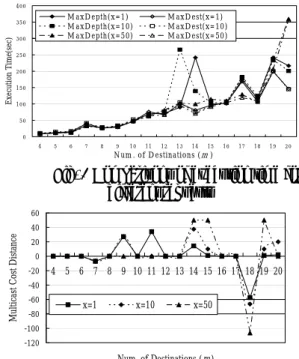
(5) Int. Computer Symposium, Dec. 15-17, 2004, Taipei, Taiwan.. where p(u, v) is the distance between u and v, δ is the maximum distance between each two nodes, and 0 < λ, γ ≤ 1. The communication cost and the transmission delay of link (u, v) are defined as the distance between u and v on the rectangular coordinated grid and a randomly generated value between 0.1 and 3, respectively. For each experimental request r(s, D, ∆), s and D with different number of destinations are generated randomly. The notation of “m=4” would be used to represent a randomly generated request routed to 4 destinations. Nevertheless, the delay bound ∆ must be reasonable; otherwise, the lightforest cannot be found to satisfy delay constraint. The ∆ is equal to 1.2 times as large as the maximum of transmission delays between the source and all destinations. In our simulations, we set λ=0.7, γ=0.7, and size of rectangular grid = 100 to simulate the networks with different numbers of nodes consisting of 15% MC nodes, where the light splitting capacities of these MC nodes are generated randomly. The special net1 is a network with 100 nodes. Three experiments are simulated on the computer with Intel PIII 850 CPU and 256M RAM to discuss the performance and efficiency of the solution model.. cost by using MaxDest; that is, the multicast cost distance using positive value means that MaxDepth can find a light-forest with less multicast cost. According to experimental results, MaxDepth may have high probability to find a light-forest with less multicast cost but consume more execution time. For different x with high value, the MaxDepth finding a light-forest will have less multicast cost in the case of requests with fewer destinations, but it may not be obviously in the case of request with more destinations.. 4.3. Comparisons between MaxE and MinR In the experiments, the two heuristics (MaxE and MinR) are applied to reroute the set of 100 different requests with 5 destinations in the networks with 4 wavelengths and with different numbers of nodes (n=100, 90, and 80). According to the experimental results shown in Table 1, the third and the fourth rows, present the total requests which can be routed successfully and total light-trees in these light-forests found successfully, where these request are named as success. The next two rows are used to describe the total communication cost and total multicast cost of success, respectively. The ETS (execution time of success requests), ETF (execution time of failure requests), and total execution time which is a sum of ETS and ETF are described in following. The final row presents the sum of edges of light-trees in success. In the phase of routing 100 requests, there are about 30% of requests rerouted successfully and the success rates are proportional to the numbers of nodes in network. We can derive that it will need more wavelengths to rerouted more requests concurrently in network with less nodes. Under the condition that partial requests are rerouted, the numbers of light-trees, the communication costs, and the multicast costs of MaxE and MinR are so ambiguous such that the performances of the two heuristics can’t be distinguished. Nevertheless, according to the comparisons between the ETS and the ETF, the MaxE needs less execution time to reroute these request successfully than the MinR. The ETSs of MaxE and MinR is proportional to the number of nodes, but the relationship between ETFs and the number of nodes is ambiguous. According to the ratio between ETS and ETF, the MaxE seems to be suitable to be applied to the routing problem with more nodes and more concurrent requests to reroute successfully; on the contrary, the MinR may be utilized.. 4.1. Comparisons with the ILP formulation The comparisons of multicast costs between experimental results of the ILP formulation [9] and the 2-Level procedure are shown in Fig. 1. For the same requests with 4 destinations routing in the networks with different nodes (n=30, 40, …, 100), the solutions found by the 2-Level procedure is near the solutions found by the ILP formulation, but the execution times of ILP formulation are not affordable. For example, the multicast costs are 176.02 and 183.21, and execution times are 71830 seconds and 8.36 seconds in the network with 100 nodes, respectively. Therefore, the 2-Level may be a good choice to find a near optimal light-tree in less execution time.. 4.2. Comparisons between MaxDepth and MaxDest The experimental results of execution times and multicast cost distances of different heuristics (MaxDepth and MaxDest) for different requests are shown in Figs. 2 and 3 for net1, where x is defined as a value of β divided by α. According to these experimental results in Fig. 2, we observe that the execution times of both are proportional to the numbers of destinations in requests. Moreover, MaxDest needs less execution time and increase of execution time is gentler than MaxDepth. For some requests, the execution time increase sharply for MaxDepth; for example, m=13 and 14. In the Fig. 3, multicast cost distance is the value of subtracting multicast cost by using MaxDepth from multicast. 5. Conclusion In this paper, the MRWA-DC problem is studied and solved by the 2-Level solution model which is an iterative process. Although the discussion of lower bound about the solution found in the solution model is not involved in this paper,. 700.
(6) Int. Computer Symposium, Dec. 15-17, 2004, Taipei, Taiwan. [8] M.T. Chen, S.S. Tseng, “Multicast Routing under Delay Constraint in WDM Network with Different Light Splitting”, International Computer Symposium 2002 (ICS 2002), Taiwan, R.O.C. [9] Ming-Tsung Chen, Shian-Shyong Tseng (2003), “Multicast Routing and Wavelength Assignment with Delay Constraint in WDM Network with Heterogeneous Capability – New ILP”, ISCOM2003. [10] D. N. Yang, W. Liao, “Design of Light-Tree Based Logical Topologies for MulticastStreams in Wavelength Routed Optical Networks”, IEEE INFOCOM 2003 [11] B. M. Waxman, “Routing of multipoint connections”, IEEE JSAC, 6 (1988), p. 333-34. experimental simulation can present that the solutions are approximated to the optimal solutions. The MaxDepth may have high probability to find a light-forest with less multicast cost but it may consume more execution time. It seems that the MaxDepth is suitable to solve the problem with high value of β divided by α in multicast cost object function. In the comparison between MaxE and MinR, the MaxE seems to be suitable to solve the routing problem with more nodes and more concurrent requests to reroute successfully; on the contrary, the MinR can be utilized. Because WDM networks with wavelength conversion may route requests more flexibly, the cost of wavelength conversion seem need to be evaluated in multicast cost for finding an efficient light-forest. Nevertheless, for WDM networks with sparse wavelength conversion, an extra constraint describing a node with/without wavelength conversion needs to be incorporated. Therefore, the problem becomes more complicated. For further studies, we may seek to refine our solution model to solve the problem, routing a request in the network with sparse wavelength conversion... 200 Multicast cost. ILP 150. 2-Level. 100 50 0 30. 40. 50. 60. 70. 80. 90. 100. Num. of nodes (N). Fig. 1. Comparisons of ILP and 2-Level models 400. Acknowledgement. M axD epth(x= 1) M axD epth(x= 10) M axD epth(x= 50). 350. Execution Time(sec). This work was partially supported by MOE Program for Promoting Academic Excellence of Universities under grant number 89-E-FA04-1-4, High Confidence Information Systems, and National Science Council of the Republic of China under Grant No. NSC93-2752-E-009-006-PAE.. 300. M axD est(x= 1) M axD est(x= 10) M axD est(x= 50). 250 200 150 100 50 0 4. 5. 6. 7. 8. 9. 10. 11. 12. 13. 14. 15. 16. 17. 18. 19. 20. N um . of D estinations ( m ). References. Fig. 2 Comparisons of execution time for different requests. [1] E. Lowe, “Current European WDM Development Trends”, IEEE Communications Magazine 36 (2) p.4650, 1998 [2] L.H. Sahasrabuddhe and B. Mukherjee, “Light-trees : Optical multicasting for imporoved performance in wavelength-routed networks”, IEEE Commun. Mag., vol 37, p. 67-73, Feb, 1999. [3] R.M. Krishnaswamy, K. N. Sivarajan, “Algorithms for Routing and Wavelength Assignment Based on Solutions of LP-Relations”, IEEE, Comm. Letters, Vol. 5, No. 10, p.435-437, Oct., 2001. [4]. Shiva Kumar, P. Sreenivasa Kumar, “Static light-path establishment in WDM networks – New ILP formulations and heuristic algorithms”, Computer Communications 25, p. 109-114, 2002. [5] Xiao-Hua Jia, Ding-Zhu Du, Xiao-Dong Hu “Integrated algorithm for delay bounded multicast routing and wavelength assignment in all optical networks”, Computer Communications 24 p.13901399, 2001 [6] S. Yan, M. Ali, J. Deogun, “Routing Optimization of Multicast Sessions in Sparse Light-splitting Optical Networks”, IEEE GLOBECOM 2001, vol 4, pp. 21342138 [7] B. Chen, J. Wang, “Efficient Routing and Wavelength Assignment for Multicast in WDM networks”, IEEE JSAC, vol 20, pp 97-q09, Jan. 2002. 60. Multicast Cost Distance. 40 20 0 -20. 4 5 6 7 8 9 10 11 12 13 14 15 16 17 18 19 20. -40 -60. x=1. -80. x=10. x=50. -100 -120. Num. of Destinations (m ). Fig. 3 Comparisons of multicast cost distance for different requests Table 1. Comparisons of MaxE and MinR No. of Nodes. 100 90 MaxE MinR MaxE MinR No. of success 31 32 30 29 Total light-trees 87 91 76 81 4106.6 Communication 4161.9 5261.2 5312.6 cost 4 Multicast cost 5348.2 5403.6 4182.6 4242.9 ETS 4305.2 3669.2 2391.6 2520.5 ETF 2702.0 4840.7 1997.1 2499.1 Total execution 7007.2 8509.9 4388.7 5019.6 time. 701. 80 MaxE MinR 16 17 46 52 2571.0 2635.6 2617.0 2687.6 1005.4 1029.4 2432.2 3554.5 3437.7 4584.0.
(7)
數據
相關文件
With the process, it is expected to provide distribution centers with a useful reference by obtaining a better combination of order batching and storage assignment, shortening
Therefore, the purpose of this study is to propose a model, named as the Interhub Heterogeneous Fleet Routing Problem (IHFRP), to deal with the route design
keywords: Ant Colony Optimization, Guided Local Search, Pickup and Delivery Problem with Time Windows, Time Window Partitioning Strategy... 第三章 PDPTW 轉換
Therefore, this research is for the purpose of understanding the service of privatization nursery, discussing parents’ satisfaction with service quality and finding the
Selcuk Candan, ”GMP: Distributed Geographic Multicast Routing in Wireless Sensor Networks,” IEEE International Conference on Distributed Computing Systems,
Furthermore, given a set of nets in a bus on routing grids with obstacles, and the length constraints for all the nets in the bus, based on this proposed longest path generation,
Compared with the combination of our IO assignment, the single-layer BGA global router[1] and our detailed routing phase, our RDL router reduces the global wirelength by 15.9%
Kim, “An optimal algorithm for allocation, placement and delay assignment of adjustable delay buffers for clock skew minimization in multi-voltage mode designs,” Asia-South
