This article was downloaded by: [National Chiao Tung University 國立交通大學] On: 28 April 2014, At: 06:43
Publisher: Taylor & Francis
Informa Ltd Registered in England and Wales Registered Number: 1072954 Registered office: Mortimer House, 37-41 Mortimer Street, London W1T 3JH, UK
Molecular Crystals and Liquid Crystals Science and
Technology. Section A. Molecular Crystals and Liquid
Crystals
Publication details, including instructions for authors and subscription information: http://www.tandfonline.com/loi/gmcl19
Room Temperature Difluoro-Tolane and
Diphenyl-Diacetylene Liquid Crystals with Negative Dielectric
Anisotropy
Shin-Tson Wu a , C. S. Hsu b & J. M. Chen b a
Hughes Research Laboratories , 3011 Malibu Canyon Road, Malibu, CA, 90265, USA b
Department of Applied Chemistry , National Chiao Tung University , Hsinchu, Taiwan, ROC Published online: 04 Oct 2006.
To cite this article: Shin-Tson Wu , C. S. Hsu & J. M. Chen (1997) Room Temperature Difluoro-Tolane and Diphenyl-Diacetylene
Liquid Crystals with Negative Dielectric Anisotropy, Molecular Crystals and Liquid Crystals Science and Technology. Section A. Molecular Crystals and Liquid Crystals, 304:1, 441-445, DOI: 10.1080/10587259708046994
To link to this article: http://dx.doi.org/10.1080/10587259708046994
PLEASE SCROLL DOWN FOR ARTICLE
Taylor & Francis makes every effort to ensure the accuracy of all the information (the “Content”) contained in the publications on our platform. However, Taylor & Francis, our agents, and our licensors make no
representations or warranties whatsoever as to the accuracy, completeness, or suitability for any purpose of the Content. Any opinions and views expressed in this publication are the opinions and views of the authors, and are not the views of or endorsed by Taylor & Francis. The accuracy of the Content should not be relied upon and should be independently verified with primary sources of information. Taylor and Francis shall not be liable for any losses, actions, claims, proceedings, demands, costs, expenses, damages, and other liabilities whatsoever or howsoever caused arising directly or indirectly in connection with, in relation to or arising out of the use of the Content.
This article may be used for research, teaching, and private study purposes. Any substantial or systematic reproduction, redistribution, reselling, loan, sub-licensing, systematic supply, or distribution in any
form to anyone is expressly forbidden. Terms & Conditions of access and use can be found at http:// www.tandfonline.com/page/terms-and-conditions
Mol. Crysf. Liq. Crysf., 1997, Vol. 304, pp. 4 4 1 4 4 5 Reprints available directly from the publisher Photocopying permitted by license only
0 1997 OPA (Overseas Publishers Association) Amsterdam B.V. Published in The Netherlands under license by Gordon and Breach Science Publishers Printed in India
ROOM TEMPERATURE DIFLUORO-TOLANE AND DIPHENYL- DIACETYLENE LIQUID CRYSTALS WITH NEGATIVE DIELECTRIC ANISOTROPY
SHIN-TSON WU
Hughes Research Laboratories
301 1 Malibu Canyon Road, Malibu,
CA
90265. USAC.
S.
HSU and J. M. CHEN Department of Applied Chemistry National Chiao Tung University Hsinchu, Taiwan,ROC
Abstract Several laterally difluorinated tolane and diphenyl-diacetylene liquid crystals were synthesized and their physical properties evaluated. These compounds exhibit low melting temperature, small heat fusion enthalpy and large negative dielectric anisotropy. Their potential applications are in the high contrast displays using a homeotropic cell and for infrared spatial light modulators.
1. INTRODUCTION
Homeotmpic liquid crystal cells' are highly desirable for the normally-black display application owing to their excellent contrast ratio. In the voltage-off state, the LC directors
are aligned to be nearly perpendicular to substrate surfaces. The incoming linearly polarized light experiences no phase retardation and is blocked by the crossed analyzer. As a result, an excellent dark state can be achieved. This dark state is insensitive to
dAn
(d=cell gap and An=bireFringence) of the LC cell which provides a large cell gap tolerance during fabrication. As the applied voltage exceeds the M e r i c k s z transition threshold, the LC directors are reoriented by the electric field and phase retardation results.
To realize the useful elecm-optic effect of a homeompic cell, the LC employed must exhibit a negative dielectric anisotmpy besides the general requirements on wide nematic range and low viscosity.
For
active matrix displays, an extra requirement on the LC material is high resistivity. High resistivity enables the LC cell to hold the applied voltage without flickering. To satisfy high resistivity and negative dielectric anisotropy at the same time, laterally fluorinated compounds are often considered.In this paper, we report on the phase transition temperatures and physical properties of some lateral difluoro-tolane and diphenyl-diacetylene liquid crystals. These LCs possess relatively low melting temperature and high clearing temperature, large and
[2319]/441
4421[2320] S.-T.
wu
et Ul.negative dielectric anisotropy, and high resistivity. Therefore, they are useful compounds for formulating eutectic mixtures for high c o n m t liquid crystal display applications.
2. (2,3) DIFLUORO TOLANES
The structures of the latexally &fluorinated tolanes we studied are shown below:
F, F
We have synthesized several homologues with n=2-7. Similar tolanes with alkoxy side chains have been reported previously.2 These alkoxy tolanes possess high melting point and large heat fusion enthalpy. Thus, their solubility in a LC mixture is limited even though their high clearing point (T,) is attractive for enhancing the T, of the mixture.
2.1 Phase Transition Temperatures
The phase transition temperatures and heat fusion enthalpy (AH) of the (2,3) difluoro- tolanes we synthesized are listed in Table I.
TABLE
I Phase transition temperatures (in OC) and heat fusion enthalpy (AH in kcal/mol) of the laterally difluoro-tolane LC homologues. Here K , N and I stand for crystalline, nematic and isotropic phase. respectively.~ n Phase transitions AH 2 K 34.6 N 75.9 I 3.52 3 K 38.5 N 94.2 I 2.28 4 K 22.5 N 105.8 I 3.05 5 K 38.3 N 104.6 I 5.22 6 K 36.8 N 68.9 I 2.60 7 K 37.2
N
86.2 I 2.85These homologues exhibit relatively low melting temperatures and high clearing point. Normally, the asymmetric side chain groups help to reduce melting tem~erature.~ However, this phenomenon is not so obvious here. The observed low melting temperature is mainly attributed to the molecular width. The lateral difluoro group widens the molecular separation and weakens the inter-molecular association resulting in low melting temperatures.
On
the other hand, the high clearing temperature originates from the cyclohexane ring. The small AH of these homologues is quite desirable for formingDIPHENYL-DIACETYLENE LC [232 1]/443
eutectic mixtures. According to the Schroder-Van Laar equation:> both low melting temperature and small heat fusion enthalpy play equally important roles in reducing
the
melting temperature of an eutectic mixture. Low melting temperature and high clearing point are critical for practical display applications. Normally, the desirable nematic range of a LC mixture is from
-40
to +85”C.2.2 Dielectric anisotropy:
The dielectric constants of the n=4 homologue were measured by the capacitance method.6 Results are: E, =I0 and E, =4 at 1 kHz and T=23”C. This large negative
dielectric anisotropy originates from the lateral fluoro groups. From mean-field theory, the dielectric constants of a LC compound are determined by the dipole moment and its relative position with respect to the principal molecular axis as:
’
E//= N h F ( < w
+
(Fp2/3kT) [l-
(1-3c0s28)S])E L = NhF(<al>
+
(Fp2/3kT) [l+
(1/2)(1-3cos28)S])A& = NhF((af
- ad
-
(Fp2/2kT)(1- 3 cos2B))S(1) (2)
(3) where N is the molecular packing density, h = 3E/(2~ + I ) is the cavity field factor, &= (&I
+2&1)/3 is the averaged dielectric constant, F is the Onsager reaction field, at and
at
arethe principal elements of the molecular polarizability tensor, 8 is the angle between the dipole moment
p
and the principal molecular axis, andS
is the order parameter of the second rank.The effective dipole moment of the two fluoro groups is perpendicular to the principal molecular axis.
Thus,
the dielectric anisotropy (E,-
E ~ ) is large but negative. The threshold voltage of the LC cell was measured to be 2.4.
,
V
From the relationship V, = x [K,JAe]”, the bend elastic constant (K3J of the n=4 homologue is calculated tobe 3 ~ 1 0 . ~ dyne.
2.3 Birefringence:
The birefringence of the n=4 homologue was determined to be 0.20 at X=633 nm by measuring the voltage-dependent phase retardation of a homeotropically-aligned ce11.6 The observed relatively high birefringence is due to linear molecular conjugation of the
tolane core. The tolane structure offers reasonably good photostability. Therefore, this series of LC compounds can be employed for high contrast display applications.
444/[2322] s.-T.
wu
el ul.3.
(2,3)
DIFLUORO DIPHENYL-DIACETYLENESThe structure of the (2,3) laterally difluorinated diphenyl-diacetylene liquid crystals we
studied is shown below:
C.H2"+,-(=J-C
EC
-
c
=c
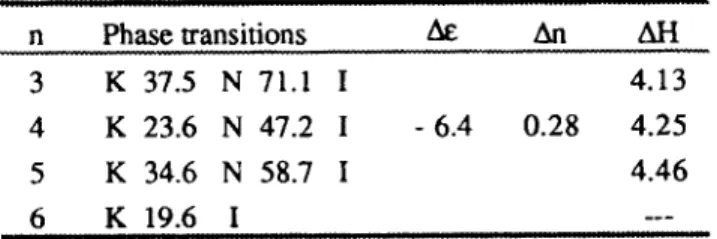
The compounds we synthesized have n=3-6. Their phase transition temperatures and heat
fusion enthalpy are listed in Table 11.
TABLE
II
Phase transition temperatures (in OC), dielecmc anisotropy (A& atT=25"C and 1 kHz), birefringence (An at 1 4 3 3 nm) and heat fusion
enthalpy (AH in kcal/mol) of the laterally difluoro diphenyl-diacetylene LC homologues. Here K, N and I stand for crystalline, nematic and isotropic phase, respectively. n Phase transitions A E A n m 3 K 37.5 N 71.1 I 4.13 4 K 23.6 N 47.2 I
-
6.4 0.28 4.25 5 K 34.6 N 58.7 I 4.46 6 K 19.6 I---
Normally, the melting temperature of such a highly conjugated liquid crystal is quite high. However, due to the lateral substitutions, their melting point is reduced to near room temperature.
'Ihe physical propemes of the n=4 homologue was characterized and results are
included in Table 11. 'Ihe high An results from long molecular conjugation and the large negative dielectric anisotropy from lateral dipole moment.
The absorption edge of the diphenyl-diacetylene LCs extends to 350 nm.6 Thus, their photostability in the blue
spectral
region is a concern and not so desirable for visible display application. However, there are other displays or light modulation in the infrared and microwave regions where photostability of these LCs is not a problem. The highbirefringence
and
negative dielecmc anisotropy of these compounds turn out to'be attractive for such applications. To improve the lifetime of a LC device, the cell should be sealed peripherally in order to keep moistures and oxygen out. Otherwise, moistures and oxygen tend to interact with LC molecules and cause alignment deterioration. As a result, the contrast ratio of the LC device is degraded gradually.DIPHENYL-DIACETYLENE LC [2323]/445
4. CONCLUSION
The laterally fluorinated tolane and diphenyl-diacetylene liquid crystals exhibit large but negative dielectric anisotropy, high birefringence and low melting temperature. Owing to
their low melting temperature and small heat fusion enthalpy, a wide nematic range eutectic mixture consisting entirely of these homologues can be formulated. These LCs would also possess a relatively high resistivity (estimated to be -lo'* &XI) for active
matrix display applications. When these mixtures are used in a horntropically aligned cell, a contrast ratio higher than 1ooO:l can be obtained under the crossed-polarizer configuration.
ACKNOWLEDGMENT
The Hughes group is supported by
Air
Force Office for Scientific Reseaxh under acontract F49620-94-C-0078. STW is indebted to W. H. Smith, Jr. of
HRL
for his technical assistance.REFERENCES
1 . M. F. Schiekel and K. Fahrenschon,
-fi,
391 (1971).2. V. Reiffenrath et al,
SPIE
m,
84 (1990). 3. S. T. Wu, et al, ,&f- 630 (1992). 4. L. Schrder, 11.449 (1 893). 5. J. J.Van
Laar,
216 (1908). 6 . I. C. Khoo and S. T.Wu,(World Scientific, Singapore, 1993).
7 . W. Maier and G. Meier, w u r f o r s h . &I '