ELSEVIER Physica C 259 (1996) 61-68
PHYSICA
Vortex response to the ac field
in anisotropic high-T c superconductors
Chien-Jang Wu, Tseung-Yuen Tseng *
Department of Electronics Engineering and Institute of Electronics, National Chiao-Tung University, Hsinchu, Taiwan Received 25 August 1995
Abstract
The ac response of anisotropic high-T e superconductors in the mixed states is theoretically analyzed. The physical picture proposed by Geshkenbein, Vinokur and Fehrenbacher together with the theory of thermally assisted flux flow is generalized to include the material anisotropy. The results show that the transition in the real part and the peak in the imaginary part of magnetic ac permeability are due to skin effect and, additionally, related to the sample dimensions. For an isotropic superconductor, the infinite slab geometry exhibits a maximum peak absorption, while a minimum dissipation peak is obtained in the case of a square rod. The peak frequency in the infinite slab is, however, the lowest as compared with other finite prisms. In the very anisotropic superconductors, the thin edges lower the dissipation peak and raise the peak frequency as well. Dependence of the irreversibility line in the mixed state on the geometric factor is therefore suggested.
1. I n t r o d u c t i o n
The discovery o f high temperature superconduc- tors (HTSCs) has triggered a flood o f research on the magnetic properties in the mixed state of these type-II materials. There are two new findings which are unique to these systems and closely related to the flux line structure and dynamics. One is the broaden- ing o f the resistive transition in a magnetic field [ 1 - 3 ] and further the resistivity follows the typical Arrhenius behavior. The other is the existence o f the irreversibility line in the H - T plane [4], This line separates the region in which the magnetization is
* Corresponding author. Fax: + 886 35 724 361.
reversible from the one in which the magnetization is irreversible. These two findings are in fact not inde- pendent, since they are inferred from the similarity between the form o f the irreversibility line and the nonlinear dependence o f AT~ on the magnetic field [5].
One can experimentally define the irreversibility line with the help o f the measurements of magnetic ac susceptibility (or permeability) [6-8]. By super- imposing a small ac field on a large dc field, the real part /Z and the imaginary part /Z' o f the permeabil- ity can be determined. One usually observes a step- like change in /x' and a peak in ~" at the irreversibil- ity temperature Tir r [8]. At T > Tir r, the flux lines are thermally depinned and exhibit reversible flux flow. At T < T~r r, the flux pinning will show a strong 0921-4534/96//$15.00 © 1996 Elsevier Science B.V. All fights reserved
62 C.-J. Wu, T.-Y. Tseng /Physica C 259 (1996)61-68
irreversible behavior. The dissipation peaks in HTSCs happen in the regime of thermally assisted flux flow (TAFF). In the case of a small driving force, Kes et al. [9] have developed the theory of TAFF to calcu- late the ac permeability. The basic assumption in the TAFF model is the validity of Ohm's law. The dissipation peak frequency is derived and closely related to the magnetic field, temperature and sample size. However, some microscopic parameters enter in their expressions (Ref. [9] Eqs. (12) and (13)) which are not appropriate to compare with experimental results and to interpret the physics of the dissipation peak directly. Nevertheless, the idea of the TAFF theory is still acceptable and useful in explaining the experimental results [10-12].
Without going into the microscopic mechanism for the vortex dynamics, Geshkenbein, Vinokur and Fehrenbacher (GVF) [13] have proposed a simple picture based on the classical electrodynamics along with the idea of the TAFF theory to relate the position of the dissipation peak to the experimentally measurable macroscopic quantities. They simply treated the superconductor in the regime of TAFF as a good conductor which follows the Ohmic law. By considering the simple slab geometry, they found that the peak could be attributed directly to the skin effect and the peak frequency is proportional to the measurable quantity, the resistivity. This prediction is qualitatively in agreement with the experimental results provided by Inui et al. [14] and Palstra et al. [3]. Incidentally, one thing being worthy to mention is that the ac frequency considered in the GVF picture is restricted in the low frequency regime where the resistivity is constant. As for the high frequency vortex response, we mention the phe- nomenological theory developed by Coffey and Clem [15] where the vortex dynamics was considered based on a self-consistent method including the flux pin- ning, flux flow, flux creep as well as nonlocal vortex interactions. The linear ac response in the HTSC in the mixed state was also treated theoretically by Brandt [16-19].
In the reported theories, the most commonly used geometry in studying ac permeability was the infinite slab or cylinder. Attention will be paid in slab geom- etry in this study. We know that the HTSC single crystals in the shape of a platelet (finite slab) are usually prepared to experimentally investigate the
magnetic properties. Two sets of questions then arise considering the geometry chosen for the investiga- tion of ac permeability. One is for the isotropic superconductors. Does the calculated permeability in the infinite slab (1-D problem) wholly describe the properties of finite slab (2-D problem)? How much of an error will it have if the answer is negative? The other is for the anisotropic superconductors. The mixed-state resistivity anisotropy, Pc/Pa, has been found to be about 105 by Busch et al. [20]. The skin depth ratio, 8a/~c, is therefore about 300 from the viewpoint of electrodynamics. This signals that the ac absorption through thin edges of the finite slab is considerable in the parallel field configuration where the applied ac magnetic field is parallel to the main fiat surfaces and the thin edge surfaces. How will the anisotropy influence the absorption of these four planes of finite slab? Does the theoretical permeabil- ity of infinite slab really describe the irreversibility line accurately?
The purpose of this paper is to answer these problems within the framework of the GVF picture together with the theory of TAFF. We extend the GVF picture to the two-dimensional anisotropic case to investigate the influence of high anisotropy in resistivity (or diffusivity) on ac absorption in the mixed state. The dependence of anisotropy and geo- metric factor on the irreversibility line is simultane- ously investigated. The correlation of peak frequency with material anisotropy is also discussed.
2. Theoretical s c h e m e
Let us consider a superconducting thin platelet crystal with length 2b, width 2 a and thickness 2 c in the mixed state. The dimensions 2a, 2b and 2 c are selected relevantly to the crystallographic axes of the HTSC crystals. The main flat planes are parallel to the a - b plane, while the thin edge planes are paral- lel to the b - c plane. The a - b plane corresponds to the x - z plane in the rectangular coordinate, while thickness 2 c corresponds to the y-axis. For the sake of neglection of demagnetization field, we assume 2b >> 2 a >> 2c. A ~-polarized ac magnetic field is applied parallel to the main flat and thin edge sur-
C.-J. Wu, T.-Y. Tseng / Physica C 259 (1996)61-68
63faces. The electrodynamics of the crystals can be described as follows. The Ohmic law gives
Ex = PxJx = PaJx, ( l a )
Ey = pyjy = PcJy, ( l b )
where the electric field E = E x ~ + Ey), current den- sity j = j x ~ + jy~, and Pa, Pc are the resistivities in the a- and c-direction measured in the mixed state, respectively. According to the theory of TAFF, one has
Dx = p J l Z o , (2a)
Dy
= ( 2 b )where D x and Dy are the diffusion coefficients of the a- and c-direction, respectively. Clearly, speak- ing of p or D is equivalent depending on the context one cites. Combining with the Maxwell equations,
V . B = O , V × E = - B ,
VXB=Ixoj,
(3)and time dependent factor e i°~t is assumed, we have
a2Bz
02Bz
pc-~x2 + P,-~yZ = irotzoBz. (4)
Eq. (4) in fact represents the linear anisotropic model which has been applied to extract the anisotropic resistivities in the mixed state [20]. Taking into account the boundary conditions at the surfaces, x = __+ a and y = _ c, one can easily solve Eq. (4). The ac field inside the sample is thus given as
B z ( x , y, t) [ ( qn ) = • ( - - 1 ) n2/z°H° cosh(ky y) n~0 q. cos a x cosh(kyc)
l
cosh(kxa ) e i'°t (5) where 1 q , = ( n + 7 ) ' r r , n = 0 , 1 , 2 . . . k ~ = ( pa/Pc)'/4(k 2 + q ~ c - 2 ( p ~ / p c ) l / 2 ) 1/2,ky = ( pc/Pa) l/4( k 2 "]-q~a-2(pJpa)l/2)
1/2,with k 2 -- i o J ~ 0 / ~ a Pc and H 0 is the amplitude of the external ac field.
The current density j = j , ~ + j y ) flowing in the
x - y plane is given by and E ( - - 1 ) ky cosh(kyc) n = 0 ~ COS X
]e
a)
(6)n2Ho ~
( ~ ) cosh(kyy)
Jy= E ( - 1 ) sin xn-O
~
cosh(kyc)
osl :y)Si ,,xx) 1
cosh(kxa )
e i~'. ( 7 ) The corresponding electric field E = E x ~ + E y ) is therefore obtained through the relation Ex = PaJxand Ey = PcJy. The magnetic ac permeability/z = / z '
- i ~ " , (Bz( X, Y)) IX
~oHo
1 1 f a L C c B z ( txoH o 2a2c o x, y) d y d x ,can be calculated directly. The result is
tx= E 2 tanh(kza )
tanh(kyc)
+ . ( 8 )
n=0 kxa
kyC
Then the ac susceptibility X = / z - 1 is consequently obtained. One can investigate the magnetic proper- ties of a crystal by using /z or X equivalently. Eq. (8) is the two-dimensional ac permeability which is derived from the extended GVF picture along with the idea of TAFF theory, and the material anisotropy has also been explicitly introduced. In the next sec- tion, we shall apply Eq. (8) to study the related properties for various sizes of a sample.
3. Results and discussion
Let us consider first the simplest case, the infinite slab with thickness 2c. By letting 2a--~ ~, the per-
64 C.-J. Wu, T.-Y. Tseng /Physica C 259 (1996)61-68
meability described in Eq. (8) reduces to that of the infinite slab,
tanh(kyc)
/z = , (9)
kyc
where kyc is also simplified to k y c = ( 1 - b j ) ~ c 1, with 6¢=(2p./~oCO) 1/2. In deriving Eq. (9) we
co
2
have utilized the identity E . = 0 2 / q . = 1. From Eq. (9), one obtains /£ and /~" [9,11,13,18]:
sinh(2c/6~) + s i n ( 2 c / 6 ~ )
I.g = (2c/8~)[cosh(2c/8~) + c o s ( 2 c / 8 ¢ ) ] "
s i n h ( 2 c / 6 ¢ ) - s i n ( 2 c / 6 c )
(2c/a ) [cosh(2c/a ) + cos(2c/a )] "
(10a)
(10b)
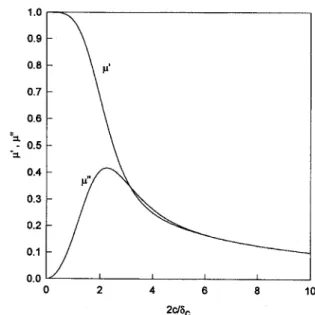
Clearly, Eq. (10) has introduced the material anisotropy, that is, the skin depth 6 c is determined by p,, the resistivity in the a-direction. Fig. 1 shows the relationships of /z' and /z" versus 2 c / 6 c. Thein-phase signal /z" attains a maximum at 2c/6~ =
2.25, with a peak height of 0.417. This point deter- mines the onset of irreversible behavior [8]. The frequency at the peak, Wp, is related to the measur- able resistivity p, and half-thickness c by
COp = 2 X 10⁶pa//C 2.
(11)
Also, the maximum in /£' occurs at 6 c = 0.9 c which means that at some temperature the skin depth is of the order of the half-thickness. This peak height is therefore argued as a result of skin size effect. On the other hand, based on the theory of TAFF, the dissipation peak will reach at some higher tempera- ture where the vortices are depinned and the inverse of the relaxation time ~- of the vortex system is equal to the external operating frequency CO. At very low temperature, the vortices are strongly pinned and slowly crept, the dissipation is consequently very small. At temperatures higher than the peak tempera- ture, the dissipation again decreases because the vortices are almost depinned completely. This inter- pretation involves some microscopic parameters such as the activation energy U, attempt frequency v 0, hopping distance and so on. We here restrict our- selves to the approach of the GVF picture to investi-
1.0 0.9 0.8 0.7 0.6 o.s ° :::L 0.4 0.3 0.2 0.1
0.0
I i i i 0 2 4 6 8 10 2C/8 cFig. 1. The imaginary part and real part of ac permeability in the
infinite slab from Eq. (10)
gate the behavior in /x". Other important information provided in Fig. 1 is the interconnection with the magnetic field dependent resistive broadening de- scribed in Refs. [6,13].
Secondly, we consider the isotropic prism where the resistivities Pa "= Pc = Pl and cross section 2 a ×
2c. In this case kxa a n d kyc Call be expressed as [ 2 2 a / 2 2( 2 a 1211/2
k x a = ( 6 s ] + q " ~ 2 c ] ] ' (12a)
[ 2 ( 2 C / 2
2(2C/2]1/2"~O
(12b)
kyc =
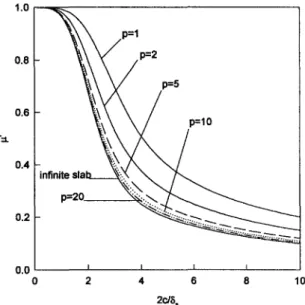
where the skin depth 6~ -- ( 2 p / ~ 0 co)1/2. In order to investigate the difference of absorption between an infinite and finite slab we keep 2 c fixed and vary 2a. The aspect ratio is defined as p = a / c for convenience. In our consideration here the value of p is usually not less than unity. For p - - o o the infinite slab is referred to and p = 1, a square prism, is considered. Figs. 2 and 3 show the imaginary and real parts of ac permeability based on Eq. (8) as a function of 2 c / ~ s with varied parameter p. It is evident in Fig. 2 that the infinite slab exhibits a sharp
C.-J. Wu, T.-Y. Tseng / Physica C 259 (1996)61-68 65 0.5 12 infinite slab o., 0.3 =2 ='~ = 5 ~ 0.2 OJ 0.0 I t I I 2 4 6 8 10 2C/8=
Fig. 2. The imaginary part of ac permeability from F_,q. (8) of isotropic prism as a function of 2 c / 6 s with variable aspect ratio p. 8" 11 lO 9 s
7
5 4 q I 5 1 0 mp is given in units of p/2~c 2 ¢. t i 15 20 25 PFig. 4. The frequency at the peak of dissipation part /~" as a function of the aspect ratio p.
peak with maximum peak height of 0.417 as shown previously. As p decreases, the peak height is low- ered and the peak curve is broadened, too. A mini- mum peak height of 0.366 is found at the extreme condition of p = 1, which corresponds to a square
1.0 0 . 8 0 . 6 "=L 0 . 4 0.2 p=l p=2
~~
p=5 p=lO nfinite sla '":.,'X p = 2 0 ~ - - ~ " ~ 0 . 0 i i i i 0 2 4 6 8 10 2C/8=Fig. 3. The real part of ae permeability from Eq. (8) of isotropic prism as a function of 2 c / 8 s with variable aspect ratio p.
rod. This occurs at 2 c / 8 s = 3.33 corresponding to
the relation
OJp = 4.38 X 10⁶ p / c 2. (13)
This peak compared with the one defined in Eq. (11) is obviously shifted to a higher value which means that the onset of irreversibility line will move as a function of frequency. This phenomenon is in agree- ment with the experimental results [1,8]. The relation of peak frequency % versus aspect ratio p is illus- trated in Fig. 4. As can be seen, the peak frequency ~op is essentially constant as the value of p is greater than 10. This strongly suggests that the sample size should be taken into account carefully in determining the magnetic properties of a crystal with aspect ratio smaller than 10. The variation of peak height would be about 13% of the maximum value of peak (the infinite slab). From the above results, we conclude that the peak height in /z" considered theoretically in the usual infinite slab is suitable for thin plate-like samples ( p > 10). It, however, will be overestimated for the thick plates ( p < 10), and should be carefully dealt with. The results suggest that the ae permeabil- ity is dependent on the thickness of the sample. This thickness-dependent magnetic property has been studied by Sanchez et al. [21] in YBCO systems.
66 C.-J. Wu, T.-Y. Tseng / Physica C 259 ( 1 9 9 6 ) 6 1 - 6 8
They found the dissipation peak to increase with increasing thickness of the sample.
The above result is essentially quite different from the result of the same configuration in the Meissner state in zero field. Previously [22], we have calcu- lated the ac permeability of an isotropic supercon- ducting platelet within the framework of a two fluid model. In the Meissner state, the calculated ac per- meability is essentially independent of sample di- mensions. It indicates that the infinite slab will al- ways suffice in the analysis of ac magnetic proper- ties even in the microwave regime. Based on the present analysis, however, the mixed-state perme- ability is closely related to the sample dimensions.
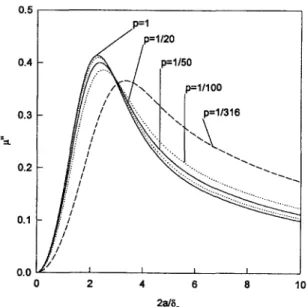
Let us finally consider the more practical case, the highly anisotropic high temperature superconductors. In the parallel field configuration, the ac absorption by main flat surfaces and thin edge surfaces may become comparable because of giant resistivity anisotropy. In HTSCs, the plate-like sample arranged for measurement is usually with very small thick- ness, i.e. 2 c << 2 a, 2 b. We are now ready to investi- gate the influence of thin edge surfaces on the magnetic ac permeability. Keeping the width 2 a fixed and change thickness 2c, the /z" and /z' are depicted in Figs. 5 and 6, respectively. These two
0.5 p=l / p=1/20 0.4 ~ / p=1/50
//%/.
!
. " . \o2
ji /
/
... J
" " -
7/ 7 / o.1 / 0.0 z i i i 0 2 4 6 8 10 2a/8,Fig. 5. The imaginary part of ac permeability from Eq. (8) of an anisotropic prism as a function of 2 a / ~ a with different aspect
ratios p. 1.0 0.8 0.6 0.4 0.2
~~~
p=11~111OO 0.0 I i i i 0 2 4 6 8 10 2a/8•Fig. 6. The real part of ac permeability from Eq. (8) of an anisotropic prism as a function of 2 a / 8 a with different aspect
ratios p.
figures have been plotted by introducing the aspect ratio p = c / a and a resistivity anisotropy Pc -- Pa =
105 has been adopted in Eq. (8) for illustration of a Bi-based system in HTSCs. It is observed that the dissipation peak is lower and broader when the thin edge surface is narrower. In this very anisotropic case we find that the absorption due to the thin edges cannot arbitrarily be neglected. The role of the thin edge surface is to lower the peak height and raise the peak frequency which in turn shifts the irreversibility line. For p -- 1, the anisotropic square rod, it is also interesting to observe that the permeability is identi- cal to that of the isotropic infinite slab. However, as the edges are narrowed down to p = 1/316, the permeability of an anisotropic thin platelet is equal to the square rod of an isotropic one. In this condi- tion p -- 1 / 3 1 6 is chosen as p = c / a = ( pa/Pc )1/2,
and the peak in /A' becomes the smallest with a value of 0.366. It is therefore tempting to call this anisotropic platelet equivalent with an anisotropic square rod, keeping in mind that such an equivalent anisotropic square rod is not an actual square rod in shape, only seen from the physical viewpoint. The actual square rod is analogous to the infinite isotropic slab from the results of imaginary and real parts of ac permeability. From the above analysis, we may
C.-J. Wu, T.-Y. Tseng /Physica C 259 (1996)61-68 67 well argue that the permeability derived on the basis
of the infinite slab is good for p =
c/a
> 1 / 5 0 in the interpretation of experimental results in the Bi- based HTSC system. In the case of a very thin platelet, however, care must be taken in that the theoretical result from infinite slab is obviously over- estimated as seen in Figs. 5 and 6.We have systematically examined the sample di- mension and anisotropy dependences of the ac per- meability in the high-T~ superconductors. Our analy- sis presented here is valid in the linear response regime, namely, the amplitude of ac field, H 0, is very small or close to 0. Accordingly, the line Tpeak(H) will converge to the irreversibility line T i r r ( n ) a s argued by Geshkenbein et al. [13]. Based on the above analysis, we conclude that the inclusion of the material anisotropy together with geometrical consideration will in effect make the resistive crite- lion Pmin [13] to be dependent on the sample dimen- sion. This consequently may cause some difference between
Tpeak(H)
and Tiff(H). In other words, the convergence of Tpeak(H) to Ti~(H) is strongly re- lated to the material anisotropy in anisotropic high-T~ superconductors in the limit of H 0 --> 0.4. Conclusion
The GVF picture together with the idea of TAFF in the ac absorption in the mixed state has been extended to include the material anisotropy. Accord- ing to our results described above, we can draw the following conclusions:
(i) The dissipation peak in the imaginary part and the step-like transition in the real part of the ac magnetic permeability in the mixed state have been ascribed to the skin effect. The frequency at the peak height is proportional to the resistivity or diffusivity. (ii) For the isotropic superconductors, the perme- ability derived theoretically in the infinite slab is quite suitable for the very thin platelet sample. As for the thick sample, in the extreme case of a square rod the peak height is lowered down by 13% of the infinite slab.
(iii) In the highly anisotropic superconductors, especially for a Bi-based system, it is suggested that the theoretical permeability of the infinite slab is, however, good for a thick sample. For the very thin
sample, the dissipation peak is overestimated by infinite slab and the peak frequency is underesti- mated, too.
(iv) As far as the HTSC is concerned, we suggest that the absorption by the edges should be carefully taken into account, especially for the strongly anisotropic Bi-based system. Because the variation of peak height is only 13%, it is expected that a deviation should be observed if the measurement is performed accurately.
Acknowledgement
This study is supported by the National Science Council of Taiwan under project no. NSC84-2112- M009-026PH.
References
[1] T.T.M. Palstra, B. Batlogg, L.F. Schneemeyer and J.V. Waszczak, Phys. Rev. Lett. 61 (1988) 1662.
[2] T.T.M. Palstra, B. Batlogg, R.B. van Dover, L.F. Schneemeyer and J.V. Waszczak, Appl. Phys. Lett. (1989) 763.
[3] T.T.M. Palstra, B. Batlogg, R.B. van Dover, L.F. Schneemeyer and J.V. Waszczak, Phys. Rev. B 41 (1990) 6621.
[4] K.A. Muller, M. Takashige and J.G. Bednorz, Phys. Rev. Lett. 58 (1987) 1143.
[5] A. Freimuth, in: Frontiers in Solid State Science, Vol. 1, Selected Topics in Super-conductivity, Eds. L.C. Gupta et al. (World Scientific, 1993).
[6] T.K. Worthington, W.J. Gallagher and T.R. Dinger, Phys. Rev. Lett. 59 (1987) 1160.
[7] T.K. Worthington, Y. Yeshurun, A.P. Malozemoff, R.M. Yandrofski, F.H. Holtzberg and T.R. Dinger, J. Phys. (Paris) C 8 (1988) 2093.
[8] A.P. Malozemoff, T.K. Worthington, Y. Yeshurun, F. Holtzberg and P.H. Kes, Phys. Rev. B 38 (1988) 7203. [9] P.H. Kes, J. Aarts. J. van den Berg, C.J. van der Beek and
J.A. Mydosh, Supercond. Sci. Technol. 1 (1989) 242. [10] J. van den Berg, C.J. van der Beek, P.H. Kes, J.A. Mydosh,
M.J.V. Menken and A.A. Menovsky, Supercond. Sci. Tech- nol. 1 (1989) 249.
[11] C.J. van der Beek and P.H. Kes, Phys. Rev. B 43 (1991) 13032.
[12] C.J. van der Beek, M. Essers, P.H. Kes, M.J.V. Menken and A.A. Menovsky, Supercond. Sci. Teclmol. 5 (1992)260. [13] V.B. Geshkenbein, V.M. Vinokur and R. Fehrenbacher, Phys.
68 C.-J. Wu, T.-Y. Tseng / Physica C 259 (1996)61-68
[14] M. Inui, P.B. Littlewood and S.N. Coppersmith, Phys. Rev. Lett. 63 (1989) 2421.
[15] M.W. Coffey and J.R. Clem, Phys. Rev. B 45 (1992) 9872. [16] E.H. Brandt, Z. Phys. B 80 (1990) 167.
[17] E.H. Brandt, Phys. Rev. Lett. 67 (1991) 2219. [18] E.H. Brandt, Phys. Rev. Lett. 68 (1992) 3769. [19] E.H. Brandt, Supercond. Sci. Technol. 5 (1992) 25.
[20] R. Busch, G. Pies, H. Werthner and G. Saemann-Ischenko, Phys. Rev. Lett. 69 (1992) 522.
[21] A. Sanchez et al., in: Proc. ICTPS '90 - Int. Conf. Transport Properties of Superconductors, Ed. Roberto Nicolsky (World Scientific, 1991).