Causal Attribution for Inter-firm Contract Violation:
A Comparative Study of Chinese and American Commercial Arbitrators1
Ray Friedman
Owen Graduate School of Management Vanderbilt University
Wu Liu
Owen Graduate School of Management Vanderbilt University
Chao C. Chen Rutgers Business School
Shu-Cheng Steve Chi National Taiwan University
1 We would like to thank Leigh Anne Liu, Ying-Yi Hong, Chi-Yue Chiu, Zhang Zhixue, Jennifer Escalas,
Tsai-Jung Daphne Huang, and Tim Vogus for their feedback and support on this project. This project was funding by the Dean’s Research Fund at the Owen Graduate School of Management, Vanderbilt University, the National Science Council of Taiwan (NSC:93-2416-H-002001) and Rutgers University School of Management. Earlier versions were presented at the International Association for Conflict Management, Seville, Spain, and the International Association for Chinese Management Research, Nanjing, China. Correspondence for this article should be addressed to Ray Friedman, Owen Graduate School of Management, Vanderbilt University, 401 21st Ave South, Nashville, TN 37203. E-mail:
Causal Attribution for Inter-firm Contract Violation:
A Comparative Study of Chinese and American Commercial Arbitrators Abstract
In this study, we examine differences between Chinese and American commercial arbitrators. We predict, and find, that Chinese arbitrators make higher awards for inter-firm contract violations than Americans. This difference is partially explained by differences in attributions. Prior theory suggests, and we find, that Chinese tend to have more internal attributions for events when observing group actions. When evidence provided to arbitrators is mixed (evidence is provided for both internal and external attributions), Chinese-American differences in awards become even stronger.
KEY WORDS:
Arbitration is an important form of third-party dispute resolution that has
appeared increasingly in business and employment contracts. Studies have indicated that arbitrators’ decisions can be affected by many factors, such as the gender of the grievant (e.g. Bingham & Mesch, 2000) or the age and experience of the arbitrator (Bemmels, 1991). Yet no one, to our knowledge, has studied how arbitrators from non-Western countries respond differently. This is an important gap since, with globalization, business practices that had been more common in the West – such as arbitration – are now
spreading to other countries. Within China, in particular, the total number of
international arbitration cases has increased from 203 to 738 during the 1990s (CIETAC report, 2000). Moreover, arbitrators from many different countries are now included on arbitration panels in places like Hong Kong and Singapore. It is important to know whether arbitrators from different cultural backgrounds solve cases in the same way.
This study examines arbitrator decision-making by comparing American and Chinese arbitrators, using a scenario research method (as used, e.g., in Bemmels, 1991). We draw on a growing body of literature showing East-West differences in attribution. Although this literature is extensive (Choi, Nisbett, & Norenzayan, 1999), it is also limited in that most studies were done with college students, not employed adults. We test whether prior findings can be extended to real-world arbitrators. We should note that the rules for commercial arbitration in the U.S. and China are roughly similar. Although there are differences in terms of court enforcement of arbitration awards (it is not as certain in China as in the U.S.; Peerenboom, 2001), the basic guidelines are similar, with rules requiring lack of bias, suggestions for how evidence is submitted, etc. (Mo, 2001).
This paper draws on a “dynamic constructivist” view of culture (Morris and Fu, 2001). In this view, culture is not a unified worldview, but rather is a “loose network of domain-specific knowledge structures, such as categories and implicit theories” (Hong, et al, 2000: 710) that are activated in different ways based on the situation. Thus, we consider not just general cultural tendencies of arbitrators, but also how those tendencies are affected by whether the observed actor is an individual or a group, and by the degree of pressure faced by those arbitrators. Adopting the dynamic constructivist view of culture, we examine patterns of differences between Chinese and American arbitrators making award decisions in contract violation cases.
Theory
Arbitrators have some leeway in determining the awards they make. One factor that should affect those awards is arbitrator perceptions of how responsible each party is for any problem that has occurred.
Determining Responsibility: Attribution in Arbitration
Attribution theory explains how people interpret and respond to what happens to themselves and others. Based on information at hand, people usually first interpret what causes outcomes and then they react to the outcome based on those causal judgments (Kelley & Michela, 1980). Many studies have confirmed that people engage in
attribution process when making decisions, such as when leaders evaluate subordinates’ performance (Knowlton & Mitchell, 1980; Dobbins, 1985), when employees respond to a coworker’s performance (e.g. Struthers et al., 2001), and when labor arbitrators make decisions (Bemmels, 1991).
While arbitrators would like us to believe that all their decisions are “objective” and based purely on law, we can expect that arbitrators are influenced by attribution processes. Bemmels (1991) argued that although attribution does not apply in discipline arbitration cases where the main question is whether an infraction did or did not occur, it does apply in (the more typical) cases where the question is what penalty to apply to the employee with the infraction. In such cases, the key question facing an arbitrator is the extent to which the employee is responsible for what occurred. If one attributes the employee’s behavior to the individual, then the employee should be punished; if one attributes the employee’s behavior to the environment, then it is not appropriate to punish the employee. Bemmels (1991) found, in line with Kelley’s theory (1967, 1973), that discipline arbitrators upheld stronger penalties for an employee if that employee was shown to have acted the same way in the same situation before (high consistency), if that employee was shown to have acted the same way in other situations (low distinctiveness), or if other employees were shown to not act the same way in this situation (low
consensus).
Bemmels’ study focused on labor arbitrators making decisions about individual employees’ actions, yes we can also expect that attribution will influence commercial arbitrators who have to make judgments about the actions of organizations. In this case, the kind of negative behavior being observed is typically a real or perceived violation of some terms of a contract between two parties. If such a violation is shown to be
attributed to the organization accused of the violation (internal attribution), arbitrators should make higher awards to the aggrieved party; if such a violation is shown to be
attributed to some factor outside of the organization’s control (external attribution), arbitrators should make lower awards to the aggrieved party.
H1: When commercial arbitrators make award decisions in response to contract violation claims, those awards will be higher when they attribute the contract violation to causes internal to the accused party.
East-West Differences in Attribution
Although early research on attribution presumed universality in attribution processes, recent work has shown that, given the same information about people’s behavior, observers from different cultures may give different explanations for those behaviors. Comparing people in Asia with those in the West, there are two streams of findings. The first relates to attributions about the behaviors of individuals. The second relates to attributions about groups.
Americans tend to make more dispositional attributions about individual behaviors, while Asians tend to make more situational or contextual attributions about individual behaviors. Shweder and Bourne (1982) found that compared with Americans, Hindu Indians tended to use more contextual-centered descriptions when they described their acquaintances, and Miller (1984) found that Indians used situational attributions more than Americans, while Americans gave dispositional attributions more than Indians. More recently, Morris and Peng (1994) found that Chinese students made more
situational attributions while American students made more dispositional attributions. These results, however, are reversed when considering attributions about groups. Menon, et al. (1999) argued that people differ in their implicit theories of agency – that is, who or what controls behavior in situations. In some cultures (those in the West), it is the
In some cultures (those in the East), it is the group that has agency. In Asian cultures individual agency is constrained by family roles and social rules so that there is less individual “innovation and improvisation” (Morris, Menon & Ames, 2001). Menon et al. (1999) showed that, when describing several well-known business scandals, American newspapers referred more to the individual involved in each scandal, while Japanese newspapers refereed more to the institution, implying a focus on the group rather than the individual as agent for Japanese. They also showed subjects from the U.S. and Hong Kong three vignettes in which either an individual or a group was described to be acting in inequitable ways. In line with their expectations, while Americans made stronger dispositional attributions than Chinese when observing individual actors, Chinese made stronger dispositional attributions than Americans when observing group actors. In sum, they report, “the relative reluctance among East Asian perceivers to make dispositional attributions for acts by individuals does not extend to acts by groups (p. 714).”
In the world of commercial arbitration, the actor is typically an organization but not an individual. Therefore, for commercial arbitrators, we would expect Chinese arbitrators to be more likely to make internal attributions than American arbitrators.
H2: Given the same causal information about a company’s contract violation, Chinese commercial arbitrators will make greater internal attribution than their American counterparts.
As a result of this difference in attributions, we expect, based on our first hypotheses, that:
H3: Chinese commercial arbitrators will make higher awards than American commercial arbitrators for company contract violations.
H4: Chinese-American difference in awards is mediated by internal attribution.
We focus here on attribution as a mediating mechanism because it has been so well established in the cross-cultural literature, and has also been identified in the research on arbitration. However, we would not expect attribution to drive all of the variance in arbitrator award decisions. There could be other psychological differences that serve as mediators, unknown to researchers because this is the first cross-cultural study of arbitrators. We therefore propose partial rather than full mediation.
Causal Ambiguity and Cultural Tendencies
One question that has been asked recently about cross-cultural research is: when are these differences likely to be more pronounced? The dynamic constructivist model of culture (Chiu et al., 2000) examines how cultural knowledge is activated. One factor that can activate cultural tendencies is need for closure (NFC). Those high in NFC have an epistemic need to reach a decision and stick with that decision. They tend to “seize” and “freeze” on the most easily accessible interpretation when making decisions, which drives them to use the most chronically accessible cultural theory available to them. NFC can also be induced by situations, such as when people are multitasking (Knowles et al., 2001) or need to make decisions under time pressure (Chiu et al., 2000). Under high time pressure Chinese were more likely to see the group as the agent in a story than Chinese under low time pressure, while the opposite occurs for Americans. Thus, under conditions of stress, people revert more strongly to their base cultural tendencies.
In arbitration, one of the key sources of stress is likely to be the presence of conflicting information. In many arbitration cases, the two sides make conflicting claims, with one side providing arguments that their transgressions were due to factors beyond
their control (external attribution) and the other side providing arguments that the transgressions were indeed under their control (internal attribution). When such
conflicting reports are provided, it creates more ambiguity for the arbitrator. Under such stress, we argue, cultural differences between Chinese and American arbitrators will become more pronounced. Therefore, we hypothesize:
H5: In causally ambiguous situations, that is, when there is both internal and
external causal information for contract violation, Chinese arbitrators will make attributions similar to Chinese arbitrators in the internal attribution condition, and American arbitrators will make attributions similar to American arbitrators in the external attribution condition.
H6: In causally ambiguous situations, that is, when there is both internal and
external causal information for contract violation, Chinese arbitrators will make award decisions similar to Chinese arbitrators in the internal attribution
condition, and American arbitrators will make award decisions similar to American arbitrators in the external attribution condition.
Given these predicted effects, Chinese and American arbitrators will react in opposite ways to an ambiguous condition; each group will revert to its more culturally preferred perceptions, enhancing the effect of culture on arbitrator awards and
attributions.
H7: The Chinese-American differences in attributions and awards will be greater
in ambiguous than non-ambiguous conditions.
Method Research Design
We conducted a field experiment to test our hypotheses, using scenarios that were constructed to provide internal, external, or ambiguous information. Chinese and
American arbitrators were provided one of these scenarios. After reading the scenario, arbitrators were asked several questions to see if the manipulations had the desired effects. In addition, they were asked questions about their attributions, and then asked to make an award decision. Thus we have a 2 (Chinese vs. American) x 3 (internal vs. external vs. ambiguous causal information) between-subjects experimental design.
Sample
Participants were all experienced arbitrators, with one set from the U.S. and another set from China. Subjects were reached with the assistance of one (in China) or two (in the U.S.) arbitration associations that emphasize commercial arbitration (as opposed to employment or labor arbitration). The sample included 68 American
arbitrators and 68 Chinese arbitrators. The two samples were equivalent in terms of sex (χ2(1)=.47, p>.40), while the Americans were somewhat older (median age for Americans was over 60 years, compared to 45-50 for Chinese, χ2(7)=65.73, p<.001) and had more experience with arbitration (median experience for Americans was 50-100 cases, while the median for Chinese was 11-50 cases, χ2(3)=28.38, p<.001). Differences in experience are likely due to the fact that arbitration as an institution is much younger than in the U.S. Differences in age may be due to the fact that arbitration in the U.S. is often done by people who are retired from full-time work. The other difference between the two
samples is education (χ2(5)=129.78, p<.001). 93% of arbitrators in the U.S. sample had a graduate law degree (a J.D.), while none of our Chinese arbitrators had a graduate law degree. Chinese arbitrators in our sample were typically college graduates (79% college;
14% master’s; 7% high school). Given these differences in age, experience, and
education, these three variables are added as controls in all models. We should also point out that both Chinese and American samples include arbitrators with little or no
international arbitration experience, so they are not likely to be highly informed about the other culture. The Chinese association’s members were only allowed (by law) to manage domestic cases. Member of the American arbitration groups were not limited in this way, but the odds are low that they would have much experience with arbitration in Asia2.
The Scenario
The scenarios were written and revised after consultation with several active arbitrators. The scenario describes a dispute between a wool supply company and a clothes company (see the Appendix for a sample scenario). A wool supply company (called State Wool Company in the English version, and Grassland Wool Company in the Chinese version) was supposed to ship a certain amount of wool to a clothes company every day but for two weeks it failed to do so. Differences between the internal, external, and ambiguous versions of this scenario are shown in Table 1. For Chinese, the scenario and survey instrument was provided in Chinese. This was done by translating the
English version into Chinese, back-translating, and then correcting any problems that the back-translations revealed (Brislin, 1970).
Insert TABLE 1 about here
Measures
Internal attribution was assessed using four items, adapted from Dobbins (1985), measured on a seven-point scale from strongly disagree to strongly agree. These
2 The main arbitration associations in Hong Kong that handles much of the international arbitration work in
East Asia -- the Hong Kong International Arbitration Centre -- includes only fifteen Americans among its 172 listed arbitrators.
included two positively coded items (e.g., “The delivery problems were caused by some characteristics of State Wool”) and two reverse-coded items (e.g., “The delivery
problems were caused by some aspect of the situation”). Scale alpha for internal attribution was .85. Award decisions were measured by asking arbitrators to identify what percentage of the requested compensation should be provided to the complaining party, from 0% (no award) to 100% (full award). They were provided with options in 10% increments (e.g., 0%, 10%, 20% and so on).
Results Preliminary Analyses
Table 2 reports the descriptive statistics and Pearson correlations for each
measure, for the Chinese and American samples separately. In order to ensure that there was proper understanding of our attribution manipulations, we examined two
manipulation check items (“State Wool is known as a reliable supplier” and “Many companies failed to deliver their projects during those weeks”). For those in the internal condition, mean responses were 3.32 (SD=1.70) and 2.82 (SD=1.70); for those in the external condition, mean response to this item were 5.15 (SD=1.59) and 5.00 (SD=1.93). These differences were significant (t (94) =5.47, p<.001, d=1.11; t (94) =5.86, p<.001, d=1.20).
Insert TABLE 2 about here
Chinese-American Differences in Attributions and Awards
We used hierarchical linear regression to test H1, H2, and H3 (see Table 3). Model 1 shows that internal attribution was associated with awards (β=.49, p<.001), and that it accounted for a significant level of variance of awards (ΔR2=.21, p<.001) after
controlling age, education, and experience. Thus, H1 was supported. Model 2 shows that Chinese arbitrators had significantly higher levels of internal attribution than American arbitrators (β=.51, p<.001, ΔR2=.08), providing support for H2. Model 3 shows that Chinese arbitrators made significantly higher levels of awards than American arbitrators (β=.57, p<.001, ΔR2=.10), providing support for H3.
Insert TABLE 3 about here
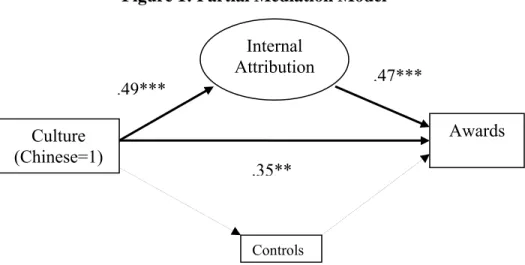
To test H4, that internal attribution would (partially) mediate the relationship between culture and award, we used structural equation modeling (SEM) as suggested by (James, Mulaik & Brett, 2006). Figure 1 depicts the model and the results (EQS 6.1, Bentler, 1995), along with the fit indices. The path from culture to internal attribution (λ=.49, t=5.07, p<.001) was significant and so was the path from internal attribution to awards (λ=.47, t=4.86, p<.001). However, the path from culture to awards (λ=.35, t=2.50, p<.01) was also significant. These results suggest that although internal attribution did not explain all of the association between culture and award decisions, it did account for a significant amount of it, providing support for H4.
Insert FIGURE 1 about here
Chinese-American Differences in Response to Ambiguity
Hypotheses 5 and 6 suggest that Chinese and American arbitrators will respond in opposite ways to ambiguity, each moving towards their own culturally “typical” ways of thinking. Before conducting the planned comparisons that would test these hypotheses, we first conducted two ANCOVAs (with controls for age, education, and case experience) to see if there was a significant interaction between culture (Chinese/American) and condition (internal/external/ambiguous) (see Table 4). One ANCOVA tested for effects
on internal attribution, while the other tested for effects on awards. Figure 2 shows the adjusted means for internal attribution, and Figure 3 shows the adjusted means for awards.
Insert TABLE 4 and FIGURES 2 and 3 About Here
The ANCOVA for the effects of culture and condition on internal attribution showed no significant interaction effect between culture and condition (F(2, 127)=.36, p>.50, η2 =.01). In contrast, the ANCOVA for the effects of culture and condition on awards showed a significant interaction effect between culture and condition
(F(2,114)=5.42, p<.01, η2=.09, see Table 4). Given these results, we rejected H5, but proceeded with a priori contrasts to test H6.
To examine patterns predicted by H6, four planned contrasts were conducted – two for Chinese arbitrators and two for American arbitrators. To evaluate these contrasts, we made family-wise Bonferroni adjustments to the required p value, reducing it
from .05 to .025. For Chinese arbitrators, awards under ambiguous conditions (M=8.48, SD=3.70, n=27) were significantly higher than those in the external condition (M=6.55, SD=3.44, n=19, F(1, 116)=4.36, p<.025, one-tailed, d=.54) and the same as those in the internal condition (M=8.34, SD=3.54, n=22, F(1, 116)<.01, n.s., d=.04), confirming that when information is ambiguous Chinese arbitrators make awards similar to the internal attribution condition. For American arbitrators, awards under ambiguous condition (M=2.09, SD=3.60, n=20) were lower than those in the internal condition (M=6.53, SD=3.50, n=14, F(1, 116)=17.05, p<.001, d=1.25) and the same as those in the external condition (M=2.53, SD=3.91, n=21, F(1,116)<.30, n.s., d=.12), confirming that when information is ambiguous American arbitrators make awards similar to the external condition. Therefore, H6 was supported.
To test H7, that Chinese-American differences are amplified under conditions of ambiguity, we regressed attribution and award on culture, ambiguous condition (internal and external condition were coded “0”; ambiguous condition was coded “1”), and culture X ambiguous condition (with controls for age, education, and experience, see Table 5). The interaction term is significant for award (β=.33, p<.05, ΔR2=.04), but not significant for attribution (β=.01, p>.90, ΔR2=0). This result suggests that while ambiguity enhances cross-cultural differences in awards, this added effect of ambiguity does not occur as a result of enhanced cross-cultural differences in internal attribution. In the discussion below, we explore possible alternative explanations for this pattern.
Insert TABLE 5 About Here
Discussion
This study extends prior research on attribution in arbitration (Bemmels, 1991) to a non-Western setting, where attribution processes are thought to operate differently (Morris and Peng, 1994; Menon et al., 1999). We found that for Chinese as well as American arbitrators, arbitration awards are affected by whether the arbitrator attributes the cause of the action to internal versus external causes. At the same time, Chinese arbitrators did differ from American arbitrators in that they were more likely to make internal attributions for the organizational behaviors that they judged, and these attributions partially explained higher levels of awards. This result contributes to a growing literature on cross-culture differences in attribution, but does so in three unique ways.
First, none of the prior cross-cultural studies of attribution assessed adults
in attribution affect real-world decision-makers, and thus can have a major impact on international business, law, and dispute resolution. The practical implication of this result is that where one chooses to have a case arbitrated, and who is chosen on the panel may well influence the nature of the awards provided. Given the same evidence, Chinese commercial arbitrators are more likely to provide severe penalties for organizations that violate terms of their contracts. Thus, if one is on the side of the complaining party, the selection of a Chinese arbitrator could be to your advantage; the converse would be true if one is the accused party. (However, this pattern may not apply for American
companies filing a case against a Chinese company, since there is some concern that Chinese arbitrators favor domestic companies; Peterbloom, 2001.) Also, this pattern, if implicitly understood by businesspeople in China, may make it more likely that
aggrieved parties initiate arbitration in China; the expected outcome is more in their favor. A second aspect of our results that is unique is our focus on group rather than
individual agency. We confirmed Menon et al.’s (1999) finding that the typical Asian tendency to make more external attributions for individual behavior is reversed when observing group actors. This result suggests that arbitration researchers– in the U.S. as well as in Asian cultures – need to be careful to note whether they are studying arbitrator responses to group or individual actions. Attribution findings based on studies of group actions (as is typical of commercial arbitration) may not apply to situations where individual actions are being judged (as is typical of labor and employment arbitration), and vice versa. Indeed, we may find that our results would be exactly the opposite if we had studied Chinese and American labor arbitrators, where the typical actor is an
tend to drive decision makers towards or away from the fundamental attribution error (Ross, 1977) [that is, the tendency to see others’ behavior as driven by dispositional tendencies, rather than external factors]. Chinese arbitrators tend to be more susceptible to this error when observing groups – since groups are where agency exists for Chinese. American arbitrators, we speculate, may be more susceptible to this error when observing individuals – since individuals are where agency exists for Americans.
The third unique aspect of our study is our examination of ambiguous information. While it is experimentally clearer to have pure external and pure internal conditions, in real arbitration cases (and indeed, in many cases where people make decisions)
arbitrators are typically faced with conflicting claims and information. That is, in fact, one of the key challenges they face. In this study we found that, when facing ambiguity, arbitrators tend to lean in the direction that is culturally more natural for them. When Chinese arbitrators are provided with evidence for both internal and external causes, award levels are at the same high level as in the purely internal condition; when
Americans are provided with evidence for both internal and external causes, award levels are at the same low level as in the pure external condition. The practical implication is that arbitrators need to be careful to weigh all information since the natural tendency will be to respond primarily to information that fits prior expectations. For arbitrators
working in international settings, they may need training to ensure that they understand potential differences between themselves and those from other countries. Also, any pre-existing biases may be exacerbated in complex cases (as we have shown here), or when under time pressure (as Chiu el al., 2000, showed). While it may be impractical to simplify the information that arbitrators hear in order to reduce biases, it may be possible
to avoid time pressures which could also enhance arbitrator biases. In this sense,
expedited arbitration may not be a wise way to set up arbitration in international contexts; this tactic, and others like designed to speed up the process, may drive parties from different cultures in opposite directions, undermining the coherence of arbitration panels.
The one puzzle that remains, however, is why Chinese vs. American differences were exacerbated under ambiguous conditions. Our expectation was that such
differences would be driven by enhanced differences in attribution. There were indeed significant Chinese-American differences in attribution in the ambiguous condition, but this difference was not especially large and did not account for the much greater Chinese-American difference in awards given. Some additional factor seemed to drive higher levels of awards by Chinese arbitrators in this situation. At this point, we can only speculate about causes, leaving the final answer for future research.
One possibility is to think about Chinese-American differences in approaches to punishment, since making award decisions could be seen as a form of punishment for bad behavior. In cultures with duty-based morality (such as Chinese), where there is a focus on meeting socially-established obligations (Shweder & Miller, 1985), there tends to be an implicit theory of agents as fixed (Chiu et al., 1997). The purpose of punishment is not to shape future behaviors of individuals, but rather to ensure moral order. Thus, punishments should always be strong and visible. In cultures with rights-based morality (such as American), where the focus is on protecting individual rights, there tends to be an implicit theory of agents as malleable – punishment may or may not be used,
Another way of looking at differences in punishment is to say that Chinese are more likely to be “lay prosecutors” than “lay scientists.” Intuitive prosecutors, according to Tetlock (2002) tend to “place greater weight on punishing norm violators (minimizing Type 2 errors of acquitting the guilty) and less weight on protecting the innocent from the wrath of the collective (minimizing Type 1 errors of convicting the innocent) (p. 462).” Those operating with a prosecutorial mind-set are less likely to be lenient due to
extenuating circumstances, and are less likely to tolerate “justifications and excuses for conduct that falls short of organizational expectations” (Tetlock, 2002, p. 463).
There also may be institutional reasons why Chinese and American arbitrators act differently. American arbitrators tend to be lawyers, while Chinese arbitrators are not lawyers, which may make Americans more aware of contextual issues. The legal principal in the U.S. of force majeur, where parties are not held responsible for “acts of god,” may not be present in the Chinese legal system. It may also be that, since
arbitration is fairly new in China, Chinese arbitrators may be trying especially hard to assert their role as enforcers of contracts, erring on the side of being more punishing. And the very fact that American arbitrators are lawyers may be another reason they lean towards the idea that guilt must be proven “beyond a reasonable doubt.”
Limitations
We should also point out several limitations of this research. First, we only studied commercial arbitrators. As we mentioned above, it is likely that labor and employment arbitrators will show a very different pattern. Second, we used one particular scenario. It may be that different scenarios generate somewhat different responses. Third, we measured attribution as a unidimensional construct, considering
external attributions as the inverse of internal attribution. Some scholars prefer to treat internal and external attributions as orthogonal constructs.
Despite these limitations, our study extends the literature by being the first to directly assess arbitrator decision making in China, which is greatly needed given the sudden rise of arbitration in China. It is also the first to look at how arbitrators respond to ambiguous information, which is needed since this type of situation is what arbitrators often face in real world decision. And it is the first to consider attributions in arbitration focused on groups rather than individuals.
REFERENCES
Bemmels, B. (1991). Attribution theory and discipline arbitration. Industrial and Labor
Relations Review, 44, 548-562.
Bentler, P.M. 1995. EQS Program Manual. Multivariate Software, Inc. book Bingham, L.B., & Mesch, D.J. (2000). Decision making in employment and labor arbitration. Industrial Relations, 39, 671-694.
Brislin, R.W. 1970. Back-translation for cross-cultural research. Journal of
Cross-Cultural Psychology, 1, 185-216.
China International Economic and Trade Arbitration Commission (CIETAC), 2000. http://www.cietac.org.cn/cd1/cd1.htm
Choi, I., Nisbett, R.E., & Norenzayan, A. (1999). Causal attribution across cultures: Variation and universality. Psychological Bulletin, 125: 47-63.
Chiu, C.Y., Dweck, C.S., Tong, J.Y., & Fu, H.Y. (1997). Implicit theories and
conceptions of morality. Journal of Personality and Social Psychology, 73, 923-940. Chiu, C.Y., Morris, M.W., Hong, Y.Y., & Menon, T. (2000). Motivated cultural
cognition: The impact of implicit cultural theories on dispositional attribution varies as a function of need for closure. Journal of Personality and Social Psychology, 78, 247-259. Dobbins, G.H. (1985). Effects of gender on leaders’ responses to poor performers: An attributional interpretation. Academy of Management Journal, 28, 587-598.
Hong, Y.Y., Morris, M.W., Chiu, C.Y. & Benet-Martínez, V. (2000). Multicultural minds: A dynamic constructivist approach to culture and cognition. American Psychologist, 55, 709-720.
James, L. Mulaik, S., & Brett, J. (2006). A tale of two methods. Organizational Research
Methods, 9, 233-244.
Kelley, H.H. (1967). Attribution theory in social psychology. In D. Levine (Ed.),
Nebraska Symposium on Motivation. Lincoln: University of Nebraska Press.
Kelley, H.H. (1973). The process of causal attribution. American Psychologist, 28, 107-128.
Kelley, H.H, & Michela, J.L. (1980). Attribution theory and research. Annual Review of
Knowles, E., Morris, M.W., Chiu, C.Y., & Hong, Y. (2001). Culture and the process of person perception: Evidence for automaticity among East Asians in correcting for
situational influences on behavior. Personality and Social Psychology Bulletin, 27, 1344-1356.
Knowlton, W.A., & Mitchell, T.R. (1980). Effects of causal attributions on a supervisor’s evaluation of subordinate performance. Journal of Applied Psychology, 65, 459-466. Menon, T, Morris, M.W., Chiu, C.Y., & Hong, Y.Y. (1999). Culture and the construal of agency: Attribution to individual versus group dispositions. Journal of Personality and
Social Psychology, 76, 701-717.
Miller, J.G. (1984). Culture and the development of everyday social explanation. Journal
of Personality and Social Psychology, 46, 961-978.
Mo, J.S. (2001). Arbitration law in China. Hong Kong: Sweet & Maxwell Asia. Morris, M.W. & Fu, H.Y (2001). How does culture influence conflict resolution? A dynamic constructivist analysis. Social Cognition, 19 (3), 324-349.
Morris, M.W., Menon, T., & Ames, D.R. (2001). Culturally conferred conceptions of agency: A key to social perception of persons, groups, and other actors. Personality and
social psychology review, 5, 169-182.
Morris, M.W., & Peng, K. (1994). Culture and cause: American and Chinese attributions for social and physical events. Journal of Personality and Social Psychology, 67, 949-971.
Peerenboom, R. (2001). Enforcement of arbitral awards in China. China Business
Review, 28, 8-12.
Ross, L. (1977). The intuitive scientist and his shortcomings. In L. Berkowitz (Ed.),
Advances in experimental social psychology (Vol. 10, pp. 174-220). New York:
Academic Press.
Shweder, R.A. & Bourne, E. J. (1982). Does the concept of the person vary across-culturally? In A.J. Marsella & G. White (Eds), Cultural conceptions of mental health and
therapy (pp97-137.) Boston: Reidel.
Shweder, R.A., & Miller, J.G. (1985). The social construction of the person: How is it possible? In K.J. Kenneth & K.E. Davis (Eds.) The social construction of the person. (pp. 41-69). New York: Springer-Verlag.
Struthers, C.W., Miller, D.L., Boudens, C.J., & Briggs, G.L. (2001). Effects of causal attributions on coworker interactions: A social motivation perspective. Basic and Applied
Tetlock, P.E. (2002). Social functionalist frameworks for judgment and choice: Intuitive politicians, theologians, and prosecutors. Psychological Review, 109, 451-471.
Table 1
Internal, External, and Ambiguous Conditions a
a. We did not include a manipulation for high distinctiveness, since trying to incorporate this third factor in Kelley’s (1967) model would require creating a story that was excessively complicated. It is not our purpose here to verify Kelley’s model in an arbitration context. That had already been done by Bemmels (1991). Rather our purpose was to examine cross-cultural differences in response to attribution-relevant information.
Low Consensus
“Most other companies managed to fulfill the contract, despite electrical problems in the city.” Internal Attribution Condition High Consistency
“The wool company was reputed to be highly unreliable.”
High Consensus
“Most other companies also failed to supply product during that period due to problems in the city electric supply.”
External Attribution Condition
Low
Consistency
“The wool company was reputed to be highly reliable.”
High and Low Consensus Ambiguous
Condition
High and Low Consistency
One witness provided the internal attribution information listed above, and another witness provided the external attribution information listed above.
Table 2
Descriptive Statistics and Correlations a b
Chinese(N=68) American(N=68) Variables c
Mean SD Mean SD Difference
Tests 1 2 3 4 5 6 1. Age 4.39 2.09 7.34 1.05 χ2(7)=65.73** -- 0.08 0.19 0.33** -0.14 0.01 2. Education 2.19 0.94 3.99 0.27 χ2(5)=129.78** 0.10 -- -0.26* -0.02 0.17 0.14 3. Case Experience 1.85 0.89 2.84 1.15 χ2(3)=28.38** 0.31** 0.01 -- 0.08 -0.04 0.06 4. Gender (Male=1) 0.81 0.39 0.86 0.35 χ2(1)=.47 0.28* -0.13 0.00 -- 0.03 0.14 5. Internal Attribution 4.46 1.44 3.06 1.08 t(135)=6.51** -0.08 0.03 -0.15 0.16 -- 0.46** 6. Award 7.63 2.85 3.80 3.74 t(122)=6.58** 0.01 -0.07 -0.06 0.19 0.43** -- 7. Culture (Chinese=1) -0.67** -0.79** -0.44** -0.06 0.48** 0.51** a. In the correlation matrix, correlations below the diagonal are for Chinese arbitrators while correlations upper the diagonal are for American arbitrators.
b. Since Age, Education, and Case experience are all ordinal variables, all correlations relevant to them are Spearman’s rhos. Other correlations are Pearson’s correlations. The p values are two-tailed, ** p<.01, * p<.05.
c. Variable descriptions: Age (8-category variable, with 1=below 30, 2=30-35, 3=36=36-40, 4=41-45, 5=46-50, 6=51-55, 7=56-60 and 8=above 60), Education (5-category variable, with 1=high school, 2=bachelor, 3=master, 4=JD and 5=PhD), Male (0=female, 1=male), Case Experience (4-category variable, with 1=1-10, 2=11-50, 3=51-100, and 4=above 100), Culture (0=American, 1=Chinese).
Table 3
Regressions Predicting Award and Internal Attribution
Model 1 Model 2 Model 3
Award Internal Attribution Award
Predictors β ΔR2 β ΔR2 β ΔR2 Step 1 .15** .14** .15** Age -0.12 -0.15 -0.12 Education -0.26* -0.17 -0.26 Case experience -0.09 -0.18* -0.09 Step 2 .21*** .08*** .10*** Culture (Chinese=1) --- .51*** .57*** Internal Attribution .49*** --- --- Overall R2 .35 .24 .25 Adjusted R2 .33 .22 .23 Overall F 16.10*** 10.23*** 9.88*** df of Overall F (4, 122) (4, 131) (4, 118) N 123 136 123 *** p<.001 ** p<.01 * p<.05
Table 4
ANCOVA Results for the Effects of Culture and Condition on Internal Attribution and Award
Predictors Internal Attribution Award
Covariates F df η2 F df η2 Age 0.17 1,127 .001 0.51 1,114 .004 Education 1.10 1,127 .009 0.19 1,114 .002 Case experience 1.03 1,127 .008 0.03 1,114 .0 Main Effects Culture(Chinese=1) 16.69*** 1,127 .12 16.76 *** 1,114 .13 Condition 14.44*** 2,127 .19 8.29 *** 2,114 .13 Interaction Effect Culture X Condition 0.36 2,127 .01 5.42** 2,114 .09 R2 .38 .38 N 136 123 *** p<.001 ** p<.01 * p<.05
Table 5
Interaction Effect of Ambiguous Condition X Culture
Internal Attribution Award
Predictors β ΔR2 β ΔR2 Step 1 .16*** .15*** Age -.15 -.12 Education -.17 .26* Case experience -.18* -.09 Step 2 .08*** .11*** Culture a .51*** .56*** Condition b .03 -.05 Step 3 .0 .04* Ambiguous X Culture .01 0.33* Overall R2 .24 .29 Adjusted R2 .20 .25 Overall F 6.77*** 7.91*** df of overall F (6, 129) (6, 116) N 136 123 a. 0=American, 1=Chinese
b. Both external and internal conditions were coded as 0, while ambiguous condition was coded as 1. *** p<.001 ** p<.01 * p<.05
Figure 1: Partial Mediation Model
Controls: age, education, case experience. The paths from culture to controls were all significant, with λs ranging from -.43 to -.77. However, none of the paths from controls to awards was significant.
N=119, χ2(22)=47.89, p=.001, CFI=.95, NNFI=.92, SRMR=.069 Internal Attribution Culture (Chinese=1) Awards Controls .49*** .47*** .35**
Figure 2
Adjusted Means of Internal Attribution in Three Conditions made by American and Chinese Arbitrators
2 3 4 5 6
External Internal Ambiguous
Condition In te rn a l A ttr ib u tio n American Chinese
Figure 3
Adjusted Means of Award in Three Conditions made by American and Chinese Arbitrators
2 3 4 5 6 7 8 9
External Internal Ambiguous
Condition
Awa
rd
American Chinese
Appendix: The Sample Scenario
CASE: Highwater-State Wool Dispute (external attribution version)
Stipulation of fact: Mr. Johnson is the CEO of Highwater Clothes Company, and Mr. White is the CEO of State Wool Company. In
May Mr. Johnson and Mr. White signed a continuous supply agreement. The agreement specified that State Wool Company would ship 3,000 kg of ISQ-99 standard wool to Highwater Clothes Company every day for one year. Highwater Clothes would pay for the wool on a monthly basis, making payment on the last day of every month. The amount to be paid monthly is $60,000. If the quality of the wool was found to be lower than “standard” quality, the price would be adjusted to reflect that lower quality. In case of unusual, extraordinary, sudden, and unexpected events each party agrees to use its best efforts under the circumstances to overcome the
difficulties. Any disputes related to this contract will be resolved through arbitration.
Four months after the start of the contract, state wool delivered only 2,000 kg of ISQ-99 wool, not 3,000kg for a two-week period. As a result, Highwater Clothes was unable to fulfill its contract with a major client, resulting in a loss of $200,000 in sales to this client. During this two-week period, the city’s electrical supply had failed repeatedly, causing most companies in the wool industries to fail to deliver their products to customers. An expert witness from the city’s economic development bureau testified that problems with the electrical system caused many companies to fail to deliver their products to customers during those weeks. He also pointed out that all portable electricity generators in stock in the city were sold out by the second day of the problem, making it difficult for most
companies to respond, and added that State Wools has a reputation for being reliable.
Mr. Johnson, the owner of Highwater Clothes, is asking for $200,000 from State Wool to compensate for lost revenues due to the lack of wool supply. Mr. White, the owner of the State Wool Company argued that the problem was not his fault and that there was really nothing that he could do about it. It would be very unfair, Mr. White argued, to penalize him for problems caused by others, and which they could do nothing about.