ELSEVIER Materials Chemistry and Physics 44 (1996) 90-94
Materials Science Communication
Preparation and magnetic properties of Al,O,-coated acicular
a-Fe particles
C.H. Lin”l*, T.S. Chin”, P.C. Kuob, S.C. Chenb, C.S. Shihb
“Department of Materials Science and Engineering, National Tsing Hua University, Hsinch, Taiwan, ROC bInstitute of Materials Science and Engineering, National Taiwan University, Taipei, Taiwart, ROC
Received 19 December 1994; accepted 29 June 1995
Abstract
Al-modified acicular cc-Fe particles were produced using the chemical precipitation method by adding Al ion on the surface of or-FeOOH. This was followed by air oxidation, dehydration, and hydrogen reduction processes. Various dehydration, reduction temperatures and times were also studied. The addition of Al ion impeded the interparticle sintering, spherization, and grain growth processes which were found to occur during dehydration and reduction. Consequently, iH, increased with the addition of Al ion, reached a maximum at 3 wt.% Al and later decreased again. The addition of Al ion always decreased the r~ value of E-Fe particles. The addition of Al ion prevented the a-Fe particles from deteriorating. At room temperature, 3 and 1.5 wt.% of Al ions would be required, respectively, for stabilizing the v and iH, values of a-Fe particles. At elevated temperature, iH, would deteriorate faster than the cr value.
Keywords: Magnetic properties, a-Fe particles; Alumina
1. Introduction
Acicular a-Fe particles are utilized extensively in high quality magnetic recording media. Acicular a-Fe parti- cles can be produced from the dehydration of acicular oI-FeOOH to a-Fe,O,, along with a subsequent re- duction of a-FeZOX. The a-Fe,O, particle surface must be modified not only to maintain the particle in its acicular shape during dehydration and reduction, but also to prevent a-Fe particles from corroding. A thin layer of SiO, [ 1,2], borates [3], or Fe,O, [4] has been previously coated on the a-FeOOH particle surface. Al ion was added in the range between 0 and 24 wt.% during our previous investigation [5]. In that work, Al ion was observed to be an effective diffusion barrier capable of maintaining a-Fe particles in their acicular shape during dehydration and reduction. However, magnetization of these heavily doped a-Fe particles deteriorated.
* Corresponding author.
0254-0584/96/%15.00 0 1996 Elsevier Science S.A. All rights reserved
More extensive research has been undertaken in this study, involving the effect of Al ion between 0 and 3 wt.% on the magnetic properties and environmental stability of a-Fe particles. The effects of preparation processes, e.g., precipitation, dehydration, and reduc- tions on the magnetic properties of a-Fe particles, were also studied.
2. Experimental
An a-FeOOH suspension, which was obtained by chemical precipitation from FeCl, solution and subse- quent air oxidation, was modified by the addition of Al ion from Al,(SO& solution [5].
In order to prepare fine Al modified cr-FeOOH parti- cles for subsequent dehydration and reduction, a- FeOOH was prepared using 0.1 M FeCI,, with neutralization by an equal volume of OS M NaOH solution, and precipitation of Al ion at pH 9.
Al modified a-FeOOH was dehydrated in open air at 300-800 “C!, so that Al(OH)s and FeOOH be-
L
I 1
0.3 pm @I
Fig. 1. a-Fe,O, dehydrated at various temperatures for 1 h: (a)
400 “‘2; (b) 600 “C.
(b)
Cd)
L I
0.3pm
Fig. 2. x-Fe particles reduced at various temperatures for 2 h: (a) 5OO”C, 1.5wt.%; (b) 52O”C, 1.5wt.%; (c) 54O”C, 1.5wt.%; (d) 520 “C, 3 wt.%. dehydrated for 1 hr -5 ; 130- E @J b q 1.5 wt.%Al ion 0 3.0 wt.% Al ion I I I I I I I 200 300 400 500 600 700 80C T (“C)
Fig. 3. c values of E-Fe particles for various dehydration temperatures.
came y-A&O3 and a-Fe,O,, respectively. a-Fe,O, was reduced in hydrogen at 500, 520 and 540 “C, respec- tively, for I-2.5 h so as to produce Al,03 modified cr-Fe particles.
The environmental stability of the Al-modified a-Fe particles was tested by placing the particles in the following different environments: (1) in open air at room temperature for a few days to several weeks; (2) at elevated temperatures ranging from 25 to 200 “C for 1 h; and (3) in a humid environment with 95% relative humidity at 45 “C for l-3 days.
The composition, shape, structure, and magnetic properties of the Al modified a-Fe particles were mea- sured for different production procedures and various environments. dehydrated for 1 hr reduced at 500°C for 1 hr q 1.5 wt.% Al ion 0 3.0 wt.% AI ion h 1 I I I I I ml 300 400 500 600 700 800 T (“C)
Fig. 4. iH, values of a-Fe particles for various dehydration tempera- tures.
92 C.H. Lin et al. 1 Materials Chemistry and Physics 44 (1996) 90-94 ? 0 ‘; 900- I I- dehydrated at 600°C for 1 hr reduced for 1 hr o 1.5 wt,% Al ion \ o 3.0 wt.% Al ion 600 I I I 460 480 500 520 540
J
Fig. 7. ;H, values of a-Fe particles for various reduction temperatures.
t (hr)
Fig. 5. c and iH, values of cc-Fe particles for various dehydration times.
3. Results and discussion
The lengths of acicular a-FeOOH particles, as ob-
served from electron micrographs, were around 0.1,
0.15, 0.2, and 0.25 ym from 0.1 M, 0.15 M, 0.2 M, and
0.25 M FeCl, solution, respectively. The aspect ratio is
around 10. An increase in the oxidation temperature
from 30 to 50 “C would lead towards an increase in the
a-FeOOH particle length from 0.25 to 0.5 pm.
No spherization and grain growth were found in the
400 “C treated sample, as shown in Fig. 1. A slight
amount of grain growth was also found in the 600 “C
treated a-Fe,O, sample. When preparing a-Fe,O, for
hydrogen reduction, complete dehydration of Fe,O,
and A&O, could be achieved by selecting the dehydra-
tion temperature to be 600 “C.
Extensive spherization and grain growth are found
(Fig. 2(a) -2(c)) to occur for a-Fe particles containing
1.5 wt.% Al, when the reduction temperature increased
from 500 to 540 “C. A comparison of Fig. 2(b) with
2(d) reveals that less spherization and grain growth
occurred when the Al ion content increased from 1.5 to
3 wt.%. Moreover, the Alz03 coating layer could effec-
tively reduce the spherization and grain growth during
reduction.
As expected, Fig. 3 shows that a higher dehydration
temperature has a higher G value, and in addition, a-Fe
containing 1.5 wt.% Al ion has a higher Q value than
E-Fe containing 3 wt.% Al ion. The iH, value of a-Fe,
as Fig. 4 shows, reaches a maximum for the sample
dehydrated at 600 “C for 1 h. In particular, a-Fe con-
taining 1.5 wt.% Al ion has a sharp maximum. Next,
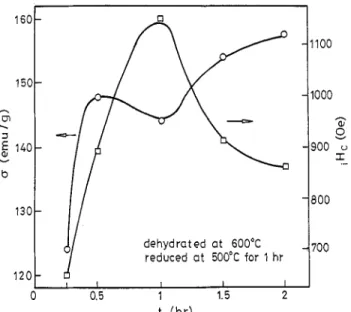
various dehydration times were applied at the dehydra-
tion temperature of 600 “C, which has the highest g
value. The higher G values occur for longer dehydration
times, as shown in Fig. 5. The iH, value reaches a
maximum at 1 h. The shape of the iH, vs. dehydra-
‘*‘[dehydrated at 600°C for 1 hr
T (“Cl
Fig. 6. g values of a-Fe particles for various reduction temperatures.
*O-
7
dehydrated at 600°C for 1 hr reduced at 500°C, Al ion 1.5 wt.%- 700
,
I I I I0 0.5 1 1.5 2 2.5
t (hr)
3 - 600 9 I” .-
dehydrated at 600°C for 1 hr
reduced at 5OO’C for 1 hr
100 1 I I I
0 0.75 1.5 2.25 3
Al ion content, wt.%
Fig. 9. u and iH, values of a-Fe particles for various Al ion contents.
0 1.5 wt,% Al ion 0 3.0 wt%Al ion
.-
dehydrated at 600°C for 1 hr 0.85 _ reduced at 5OO’C for 1 hr
25 50 75 100 125 150 175 200 2
T (“C)
tion time curve is the same as that of the iH, vs. de- hydration temperature curve.
As expected, Fig. 6 shows that a higher reduction temperature has a higher G value, and a lower Al ion content (1.5 wt.%) has a higher g value. The iH, value of a-Fe, as shown in Fig. 7, reaches a maximum for the 1.5 wt.% AI ion sample reduced at 500 “C for 1 h. For the 3 wt.% sample, the iH, value of a-Fe decreases with an increase in the reduction temperature. The iH, value sharply decreases when the reduction temperature is higher than 520 “C. As shown in Fig. 8, the G value of the 1.5 wt.% sample sharply increases with the reduc- tion time at 500 “C. Later, g gradually levels off as the reduction time extends longer than 30 min. The iH, value of the 1.5 wt.% sample sharply increases with the reduction time at 500 “C, and reaches its maximum at 1 h. The iH, value sharply decreases for reduction times longer than 1 h. Additionally, this value levels
I&--- ^ 1
time (day)
Fig. 10. G and iH, values of a-Fe particles for various exposure times.
.5
Fig. 11. G and iH, values of a-Fe particles for various exposure temperatures.
off if the reduction time extends longer than 1.5 h. The magnetic properties of E-Fe samples without Al ion are not shown in Figs. 3-7 because these uncoated samples deteriorated away before their magnetic properties could be measured.
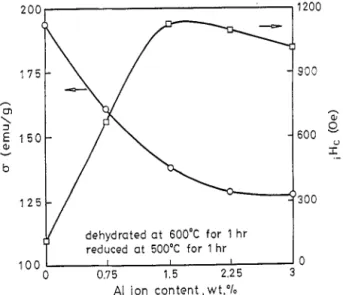
As shown in Fig. 9, the addition of Al ion always decreases the g value of a-Fe particles from the begin- ning. With the addition of Al ion the value of iH, increases, reaches a maximum, and then decreases again. The reason for iH, increasing is that the A&O3 coating layer as indicated in Fig. 2 impeded the exces- sive interparticle sintering, spherization, and grain growth. The reason for iH, decreasing is that it may react with Fe,O, when forming a new compound inca- pable of being reduced during reduction reaction. The optimum condition for preparing a-Fe particle is as follows: dehydration at 600 “C for 1 h, reduction at 500 “C for 1 h, Al ion content 1.5 wt.%. Under this condition, a-Fe particles with magnetic properties of u = 143.5 emu g-l and iH, = 1150 Oe can be obtained.
The Al-modified cc-Fe particles begin deteriorating when exposed to the open atmosphere. Fig. 10 shows that for the 0.75 wt.% and 1.5 wt.% samples, o(t) reduced to 65% of its original value after 20 days of exposure. For the 3 wt.% sample, the 0 value decreases only slightly after 20 days of exposure, and the a(t) value reduces only 7% after 96 days of exposure. Fig. 10 shows that for the 0.75 wt.% sample, the value of iH, reduces 24% after 10 days of exposure. For the 1.5 and 3 wt.% samples, the decrease in iH, is only slight after 96 days of exposure. We believe that the Alz03 coating layer can prevent the a-Fe particles from direct contact with air. There-
94 C.H. Lin et al. 1 Materials Chemistry and Physics 44 (1996) 90-94
fore, the Al ion content must be higher than 1.5 wt.% so that the coating layer is sufficiently thick to provide effective protection of a-Fe particles from oxidation.
Both o(t)/a(O) and iH,(t)/iH,(O) in Fig. 11 decrease with the heating temperature. A higher temperature deteriorated iH, more than 0’.
The addition of Al ion increases the stability of a-Fe. At room temperature 3 wt.% is required for stabilizing the Q value of a-Fe particles, while only 1.5 wt.% is required for stabilizing the iH, value of E-Fe particles. At elevated temperature, iH, deteriorates faster than Q, and a higher Al ion content always deteriorates slower than a lower Al ion content.
4. Conclusions
References Extensive spherization and grain growth were found
to occur during reduction of acicular a-Fe,O, particles to a-Fe particles at 500 “C. A higher reduction temper- ature, 540 “C, made it worse. 3 wt.% of Al was observed to be more effective than 1.5 wt.% of Al in reducing grain growth during reduction. However, even those samples were sintered.
The addition of Al ion always decreases the g value of a-particles. The addition of Al ion increases the iH, value, which reaches a maximum and then decreases again.
[l] T. Sueyoshi, H. Naono and M. Amemiya, I,%lD Twirls. Magn., MAG-20 (1984) 42.
[2] Y. Yamamoto, K. Sumiya, A. Miyake, M. Kishimoto and T. Taniguchi, IEEE Trans. Magn., MAG-26 (1990) 2098. [3] T. Miyahara and K. Kawakami, IEEE Trans. Magn., MdG-23
(1987) 2877.
[4] M. Kishimoto, S. Kitahata and M. Amemiyia, IEEE Trans.
Magn., MAG-22 (1986) 732.
[5] N. Mizutani et al. (eds.), Proc. 3rd IUMRS inf. Conj on
Advanced Materials, Tokyo, Japan, 1993, in Advanced Materials
‘93, Trans. Mater. Res. Sot. Jpn., Vol. 14A, Elsevier, Amster- dam, 1994, p. 45.