
Hydroxynaphthyridine-Derived Group III Metal Chelates: Wide
Band Gap and Deep Blue Analogues of Green Alq
3(Tris(8-hydroxyquinolate)aluminum) and Their Versatile
Applications for Organic Light-Emitting Diodes
Szu-Hung Liao,†,‡Jin-Ruei Shiu,†,§Shun-Wei Liu,†,|Shi-Jay Yeh,†Yu-Hung Chen,| Chin-Ti Chen,*,†,⊥Tahsin J. Chow,*,†and Chih-I Wu*,|
Institute of Chemistry, Academia Sinica, Taipei, Taiwan 11529, R.O.C., Department of Chemistry, National Taiwan Normal UniVersity, Taipei, Taiwan 11677, R.O.C., Department of Chemistry and Biochemistry, National Chung Cheng UniVersity, Chia-Yi, Taiwan 62102, R.O.C.,
Graduate Institute of Photonics and Optoelectronics and Department of Electrical Engineering, National Taiwan UniVersity, Taipei, Taiwan 10617, R.O.C., and Department of Applied
Chemistry, National Chiao Tung UniVersity, Hsinchu, Taiwan 30050, R.O.C. Received September 20, 2008; E-mail: [email protected]; [email protected]
Abstract: A series of group III metal chelates have been synthesized and characterized for the versatile
application of organic light-emitting diodes (OLEDs). These metal chelates are based on 4-hydroxy-1,5-naphthyridine derivates as chelating ligands, and they are the blue version analogues of well-known green fluorophore Alq3(tris(8-hydroxyquinolinato)aluminum). These chelating ligands and their metal chelates were easily prepared with an improved synthetic method, and they were facially purified by a sublimation process, which enables the materials to be readily available in bulk quantity and facilitates their usage in OLEDs. Unlike most currently known blue analogues of Alq3or other deep blue materials, metal chelates of 4-hydroxy-1,5-naphthyridine exhibit very deep blue fluorescence, wide band gap energy, high charge carrier mobility, and superior thermal stability. Using a vacuum-thermal-deposition process in the fabrication of OLEDs, we have successfully demonstrated that the application of these unusal hydroxynaphthyridine metal chelates can be very versatile and effective. First, we have solved or alleviated the problem of exciplex formation that took place between the hole-transporting layer and hydroxynaphthyridine metal chelates, of which OLED application has been prohibited to date. Second, these deep blue materials can play various roles in OLED application. They can be a highly efficient nondopant deep blue emitter: maximum external quantum efficiency ηextof 4.2%; Commision Internationale de L’Eclairage x, y coordinates, CIEx,y) 0.15,
0.07. Compared with Alq3, Bebq2(beryllium bis(benzoquinolin-10-olate)), or TPBI (2,2′,2′′
-(1,3,5-phenyle-ne)tris(1-phenyl-1H-benzimidazole), they are a good electron-transporting material: low HOMO energy level of 6.4-6.5 eV and not so high LUMO energy level of 3.0-3.3 eV. They can be ambipolar and possess a high electron mobility of 10-4cm2/V s at an electric field of 6.4× 10⁵V/cm. They are a qualified wide band
gap host material for efficient blue perylene (CIEx,y) 0.14, 0.17 and maximum ηext3.8%) or deep blue
9,10-diphenylanthracene (CIEx,y) 0.15, 0.06 and maximum ηext2.8%). For solid state lighting application,
they are desirable as a host material for yellow dopant (rubrene) in achieving high efficiency (ηext4.3% and ηP8.7 lm/W at an electroluminance of 100 cd/m2or η
ext3.9% and ηP5.1 lm/W at an electroluminance of
1000 cd/m2) white electroluminescence (CIE
x,y) 0.30, 0.35).
1. Introduction
Efficient electroluminescence (EL) was first reported by Tang and Van Slyke using green light-emitting tris(8-hydroxyquino-linato)aluminum (Alq3).1 Very few materials attract attention
as much as Alq3does in organic light-emitting diodes (OLEDs).2
Alq3 has been used as a green emitter, a common
electron-transporting material, and a host material for saturated green
and red fluorescent dopants.3Moreover, due to the rigid ball-like geometry, high glass transition temperature (Tg∼175°C),3c and polymorphic nature,4 Alq3 is readily sublimed to form
amorphous thin films, which is beneficial to the fabrication and operation lifetime of OLEDs. To tune its fluorescence color to
†Academia Sinica.
‡National Taiwan Normal University. §National Chung Cheng University. |
National Taiwan University.
⊥National Chiao Tung University.
(1) Tang, C. W.; Van Slyke, S. A. Appl. Phys. Lett. 1987, 51, 913. (2) (a) Chen, C. H.; Shi, J. Coord. Chem. ReV. 1998, 171, 161.
(3) (a) Tang, C. W.; Van Slyke, S. A.; Chen, C. H. J. Appl. Phys. 1989,
65, 3610. (b) Bulovic, V.; Baldo, M. A.; Forrest, S. R. In Organic Electronic Materials: Conjugated Polymers and Low Molecular Weight Organic Solids; Farchioni, R., Grosso, G., Eds.; Springer-Verlag: New
York, 2001; p 391. (c) Higginson, K. A.; Thomsen, D. L., III; Yang, B.; Papadimitrakopoulos, F. In Organic Light-Emitting DeVices: A
SurVey; Shinar,J., Ed.; Springer-Verlag: New York, 2004; p 71. (d)
Chen, C.-T. Chem. Mater. 2004, 16, 4389.
(4) Brinkmann, M.; Gadret, G.; Muccini, M.; Taliani, C.; Masciocchi, N.; Sironi, A. J. Am. Chem. Soc. 2000, 122, 5147.
LUMO is found on pyridine ring, the electrons of HOMO orbitals are located mostly on the phenoxide side of the ligand. An electron-withdrawing substituent on the para-position of the phenoxide ring will deplete the HOMO electron density lowering energy level of the filled states. Following the same rationale, the substitution of a electron-donating group on the
para-position of the pyridine ring will promote the LUMO
electron density raising the energy level of the vacant states. Either structural modification results in increasing energy of electrons involved in frontier orbital transition (π-π*) and an
emission that is blue-shifted relative to that of parent Alq3(λmaxf ∼ 514 nm in toluene and 524 in dichloromethane). Although there are several blue or near-blue light-emitting aluminum chelates, Alq3derivatives showing deep blue fluorescence (λmaxf < 450 nm) have not been realized yet.2,6Surveying literature, we have found that a methyl substituent on the pyridine moiety or aza (nitrogen) replacement of “CH” of the phenoxide moiety of Alq3is most attractive in blue-shifting fluorescence color,
preserving the rigid and globular structure and good valtility of parent Alq3. Examples are tris(4-methyl-8-quinolinato)aluminum
(AlmQ3) and tris(4-[1,5]naphthyridinolato)aluminum (AlND3)
showing blue-shifted fluorescence at 506 and 440 nm, respec-tively (Scheme 1). Whereas the greenish AlmQ3was reported
with EL performance,6c-fapplication of blue AlND3for OLEDs
is still literature unknown to date.2 Herein, in addition to the 4-hydroxy-1,5-naphthyridine (ND) aluminum chelate, which was efficiently prepared by our improved synthesis, we report the facile synthesis and full characterization of 4-hydroxy-8-methyl-1,5-naphthyridine (mND), 2,8-dimethyl-4-hydroxy-1,5-naph-thyridine (mmND), and 4-hydroxy-2-phenyl-1,5-naph2,8-dimethyl-4-hydroxy-1,5-naph-thyridine (mpND) metal chelates (Scheme 2). For mND, mmND, and mpND chelating ligands, a whole series of chelates with group III metals (aluminum, gallium, and indium) were also synthe-sized and characterized. We employ blue-shifting factors of both
a methyl substituent and aza (nitrogen element) as the replace-ment of “CH” in one structure. To our surprise, these metal chelates are in fact new substances and previously unknown. In addition to the thermal stability, they were characterized for deep blue fluorescence and EL in applications of OLEDs. Furthermore, due to their wide band gap and electron-deficient nature, we will demonstrate that these metal chelates are feasible as electron-transporting layer (ETL) material, the host material for highly efficient blue fluorescence dopants, or blue host material for yellow dopants to generate white EL in solid state lighting (SSL) applications.
2. Results and Discussion
2.1. Synthesis and Structural Characterization.Parent 4-hy-droxy-1,5-naphthyridine (or 1,5-naphthyridin-4-ol) is best known to be prepared by so-called “EMME synthesis” from 3-ami-nopyridine and diethyl ethoxymethylenemalonate.7 After the intramolecular cyclization, the hydrolysis of the resulting ester and thermo-decarboxylation of the acid afford 4-hydroxy-1,5-naphthyridine in unsatisfactory overall yields (18-31%).8 Alternatively, a shorter and more convenient procedure known as the Cassis method in the synthesis of a wide range of 4-1H-quinolones (tautomeric forms of hydroxyquinoline) is using (5) (a) Van Slyke, S. A.; Brynn, P. S.; Levecchio, F. V. U.S. Patent No.
5150006, 1992. (b) Burrow, P. E.; Shen, Z.; Bulvoic, V.; McCarty, D. M.; Forrest, S. R.; Cronin, J. A.; Thompson, M. E. J. Appl. Phys.
1996, 79, 7991. (c) Sugimoto, M.; Anzai, M.; Sakanoue, K.; Sakaki,
S. Appl. Phys. Lett. 2001, 79, 2348.
(6) (a) Hamada, Y.; Sano, T.; Fujita, M.; Fuji, T.; Nishio, Y.; Shibata, K.
Jpn. J. Appl. Phys. 1993, 32, L514. (b) Hopkins, T. A.; Meerholz, K.;
Shaheen, S.; Anderson, M. L.; Schmidt, A.; Kippelen, B.; Padias, A. B.; Hall, H. K., Jr.; Peyghambarian, Armstrong, N. R. Chem. Mater.
1996, 8, 344. (c) Kido, J.; Iizumi, Y. Chem. Lett. 1997, 963. (d) Kido,
J.; Iizumi, Y. Appl. Phys. Lett. 1998, 73, 2721. (e) Mattoussi, H.; Murata, H.; Merritt, C. D.; Iizumi, Y.; Kido, J. J. Appl. Phys. 1999,
86, 2642. (f) Sapochak, L. S.; Padmaperuma, A.; Washton, N.;
Endrino, F.; Schmett, G. T.; Marshall, J.; Forgarty, D.; Burrows, P. E.; Forrest, S. R. J. Am. Chem. Soc. 2001, 123, 6300. (g) Yu, J.; Chen, Z.; Sakuratani, Y.; Suzuki, H.; Tokita, M.; Miyata, S. Jpn. J. Appl.
Phys 1999, 38, 6762. (h) Pohl, R.; Anzenbacher, P., Jr. Org. Lett. 2003, 5, 2769. (i) Pohl, R.; Montes, V. A.; Shinar, J.; Anzenbacher,
P., Jr. J. Org. Chem. 2004, 69, 1723. (j) Montes, V. A.; Li, G.; Pohl, R.; Shinar, J.; Anzenbacher, P., Jr. AdV. Mater. 2004, 16, 2001. (k) Cheng, J.-A.; Chen, C. H. J. Mater. Chem. 2005, 15, 1179. (l) Montes, V. A.; Pohl, R.; Shinar, J.; Anzenbacher, P., Jr. Chem.sEur. J. 2006,
12, 4523. (m) Pe´rez-Bolivar, C.; Montes, V. A.; Anzenbacher, P., Jr. Inorg. Chem. 2006, 45, 9610.
(7) Paudler, W. W.; Kress, T. J. AdV. Heterocycl. Chem. 1970, 11, 123. (8) Eck, T. D.; Wehry, E. L., Jr.; Hercules, D. M. J. Inorg. Nucl. Chem.
1966, 28, 2439.
(9) (a) Cassis, R.; Tapia, R.; Valderrama, J. A. Synth. Commun. 1985,
15, 125. (b) Chen, B.; Hung, X.; Wang, J. Synthesis 1987, 482. (c)
Singh, B.; Laskowski, S. C.; Lesher, G. Y. Synlett 1990, 549. (d) Marcos, A.; Pedregel, C.; Avendaoˇo, C. Tetrahedron 1994, 50, 12941. (e) Bontemps, N.; Delfourne, E.; Batide, J.; Francisco, C.; Bracher, F. Tetrahedron 1997, 53, 1743. (f) Kitahara, Y.; Nakahara, S.; Yonezawa, T.; Nagatsu, M.; Shibano, Y.; Kubo, A. Tetrahedron 1997,
53, 17029. (g) Jeon, M.-K.; Kim, K. Tetrahedron Lett. 2000, 41, 1943.
(h) Salon, J.; Milata, V.; Pronayova, N.; Lesko, J. Monatch Chem.
2000, 131, 293.
Scheme 2.Chemical Structures of Group III Metal Chelates of 8-Hydroxy-1,5-naphthyridine Derivatives
2,2,6-trimethyl-4H-1,3-dioxin-4-one (Meldrum’s acid) as an effective diketone equivalent precursor.9Therefore, we adopted the effective Cassis method in the synthesis of the new naphthyrine derivatives, mND, mmND, and mpND (Scheme 3). For comparison purposes in the study herein, parent chelating ligand ND was also synthesized by the more convenient Cassis method.
In the first step of synthesis, four pyridylaminomethylene Meldrum’s acid derivatives (pre-ND, pre-mND, pre-mmND, pre-mpND) were all obtained in reasonably good yields, 87, 78, 71, and 58%, respectively. Among four species, relatively low yields (58%) of pre-mpND can be attributed to the bulky phenyl group that causes sterical hindrance in the formation of the methylene-bridge-head between the amino substituent and Meldrum’s acid. In the following step of a ring closure reaction, heating Meldrum’s acid derivatives in diphenyl ether afforded ND, mND, mmND, and mpND in 47-77% yields, respectively. Among them, ND (1,5-naphthyridin-4-ol or 8-hydroxy-1,5-naphthyridine) was obtained in lowest yields (47%), and it is due to formation of an undesired structural isomer (1,7-naphthyridin-4-ol) in the ring closure reaction. The same cause is believed to occur in the previous “EMME synthesis” of ND, which was prepared in even lower yields.8 Nevertheless, the methyl or phenyl substituents of mND, mmND, or mpND are simply from the starting materials of either 3-amino-4-picoline or triethyl orthoacetate/orthobenzoate. A different alkyl group or substituted aromatic ring can be readily incorporated onto ND with appropriate starting materials. Through the case of ND, it is conceivable that the Cassis method illustrated herein is more convenient and versatile. From the Cassis method, we obtained ND in∼40% overall synthetic yields, which is in fact better than 18-31% overall synthetic yields from the literature reported “EMME synthesis”.8Moreover, the advantage of the Cassis method is the simpler and more reliable synthetic operation, a two-step procedure instead of a four-step procedure. In “EMME synthesis”, a tedious purification process has to be performed four times after each step in the synthetic sequence. The newly synthesized 4-hydroxy-1,5-naphthyridine derivatives were successfully converted into group III metal chelates. However, due to the different reactivity of the metal starting material and the different solubility of the metal chelate product, various reaction conditions and the isolation/purification method were adopted in the final metal chelation reactions, which is somewhat variant from the conventional method preparing Alq3
(see Experimental Section for details). Basically, the synthesis and purification of hydroxynaphthyridine group III metal chelates are not much difficult than those for the easily prepared and purified Alq3. They can be readily obtained with volume
production in a conventional synthetic laboratory.
These metal chelates were fully characterized by1H and13C NMR, mass spectroscopy, and elemental analysis, and they were consistent with proposed structures. Particularly, a single crystal X-ray structure of AlND3was obtained. Its ORTEP drawing is
displayed in Figure 1.10Similar to that of Alq
3, the meridional
(mer) configuration of AlND3is clearly evident by the structure
diagram and it is consistent with its complicated 1H NMR spectrum. Interestingly, unlike AlmND3or GamND3, InmND3
exhibited a simple 1H NMR spectrum (four sharp and well-separated proton resonances), an indication of the facial (fac) configuration of InmND3. However, recent evidence has
demonstrated that the simple1H NMR spectrum of Inq
3(and
hence InmND3) is due to the rapid fluxional transitions between
mer and fac configurations on the NMR time scale.11
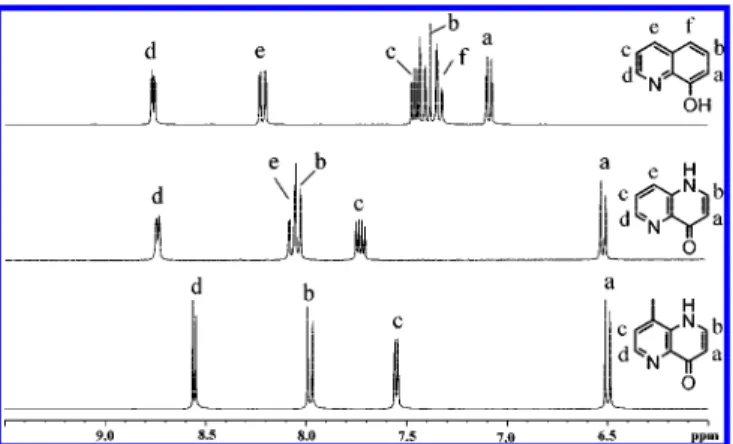
The higher level of electron deficiency of ND than 8-hy-droxyquinoline is evident by the significantly smaller pKa2.85 of ND than pKa5.13 of 8-hydroxyquinoline.12ND derivatives have been known for keto-enol tautomerism in polar organic solvents (see Scheme 3).7 We found that the extent of naph-thyridone tautomeric forms (and hence the pKavalue) can be gauged by the 1H NMR signal (chemical shift) of the proton next to the hydroxy substituent of 8-hydroxyquinoline, ND, and mND, which locates at 7.09, 6.52, and 6.50 ppm, respectively (see Figure 2). We expect that even smaller pKa values are present for mmND and mpND. The smaller pKavalues (due to the electron deficiency) render ND derivatives weakerδ-donors
on the phenoxide side of the chelating ligand. As the result of a weakerδ-donor, the average Al-O bond distance of AlND3
(1.867 ( 0.03 Å) is longer than that (1.856 ( 0.02 Å) of Alq3.4
On the pyridine side of the chelating ligand, the average Al-N bond distance of AlND3(2.025 ( 0.03 Å) is shorter than that
(2.051 ( 0.02 Å) of Alq3, and this can be attributed to the
“seesaw-like” binding mode of a bidentate chelating ligand. Otherwise, it can be attributed to the stronger N δ-donor in
AlND3than in Alq3because of the electron-donating methyl
substituent para to the Nδ-donor. We believe that the strength
of theδ-donor (or the electron deficiency) of chelating ligands
is one of the reasons why aluminum metal chelates of mND, mmND, or mpND all have a shorter fluorescence peak wavelength and are better in blue color purity than AlND3or
Alq3(see Table 1 for fluorescence data).
2.2. Photophysical Properties and Energy Levels.Whereas it is the desired deep blue color (λmaxfl 415-417 nm) of AlmND3, AlmmND3, and AlmpND3, a less satisfactory sky blue
fluorescence (λmaxfl433 nm) of the previously known AlND3is
clearly shown in their solution fluorescence images (see Figure 3). In the solid state, all four aluminum chelates display red-shifted fluorescence wavelengthλmaxfl425 nm (AlmpND3), 431
(10) Crystal data for AlND3· CH2Cl2: C25H17AlCl2N6O3: Fw ) 547.33,
Triclinic, P1j, Z ) 2, F(000) ) 560. Cell dimendions: a ) 7.9946(7) Å, b ) 12.0879(11) Å, c ) 13.1153(12) Å, R ) 70.346(2)o,β )
82.950(2)°,γ ) 84.082(2)o, V ) 1181.98(18) Å3, 2θmax) 50.0°, F cacld
) 1.538 mg/m3. Of 8777 reflections, 4157 were independent, 334
parameters, R(Fo) ) 0.0588 (for reflections with I > 2σ(I)), Rw(Fo) )
0.1663 (for reflections with I > 2σ(I)). The GoF on F2was 0.977.
(11) Sapnochak, L. S.; Ranasinghe, A.; Kohlmann, H.; Ferris, K. F.; Burrows, P. E. Chem. Mater. 2004, 16, 401.
(12) Mason, S. F. J. Chem. Soc. 1957, 5010. Scheme 3.Synthetic Routes to a Series of 8-Hydroxy-1,5-naphthyridine Metal Chelates
nm (AlmND3), and 447 nm (AlND3), exceptλmaxfl419 nm of AlmmND3 (Table 1). In dichloromethane solution, all four
aluminum chelates have reasonably good fluorescence quantum yields (Φf) around 45-47% but more or less suffer from fluorescence concentration quenching in the solid state (Table 1).
Among them, AlmpND3 has the most severe fluorescence
quenching in the solid state with aΦfof only 6%. Such solid-state fluorescence quenching is universal for mpND-based chelates (AlmpND3, GampND3, and InmpND3. This can be
rationalized by the molecular contact (probablyπ-π interaction)
through protruded phenyl substituents in the solid state. With no exception of the three chelating ligands mND, mmND, and mpND, fluorescence of these metal chelates was observed to be reduced with increasing atomic number of the metal ion from Al to Ga and then In (seeΦfdata in Table 1), known as the
heavy atom effect that increases in the rate of intersystem crossing.2,13
In the search for the origin of the wide band gap nature, AlmND3, GamND3, and InmND3were found to have a HOMO
energy level around 6.4-6.5 eV, which is significantly lower than 5.9 eV of Alq3(Figure 4). The LUMO energy level of
three mND metal chelates is around 3.0-3.3 eV, which is similar to or just a bit lower than 3.1 eV of Alq3. This is
perfectly logical because the prominent electron deficient feature (N aza substituent) locates on the HOMO of the molecule, which is the pyridin-4-olate ring of the chelating ligand, instead of the LUMO of three mND metal chelates, which is the para-methylpyridine (or 4-picoline) ring of the chelating ligand. It can be further identified that either HOMO or LUMO is stabilized by the higher atomic number of the central metals, Al, Ga, and In. Such a stabilization effect happens more prominently in the LUMO than in the HOMO. As a result, the energy band gap of three mND metal chelates decreses in the order AlmND3> GamND3> InmND3. Relative to that of Alq3,
a significantly low HOMO energy level and moderately low LUMO energy level enlarge the energy band gap of these hydroxylnaphthyridine-based metal chelates.
(13) Burrow, P. E.; Sapochak, L. S.; McCarty, D. M.; Forrest, S. R.; Thompson, M. E. Appl. Phys. Lett. 1994, 64, 2718.
Figure 1. Molecular structure of AlND3determined by X-ray diffraction
analysis.
Figure 2. 1H NMR spectra of 8-hydroxyquinoline, ND, and mND in
CD3OD from top to bottom, respectively.
Table 1. Optical and Thermal Properties of Metal Chelates of 4-Hydroxy-1,5-naphthyridine Derivatives
solutiona solid
metal chelates λmaxab, λon setab (nm) λmaxfl (nm) Φf (%) λmaxfl (nm) Φf (%) Tg (°C) Tc (°C) Tm (°C) LUMO/HOMO (eV)b Alq3 388, 443 524 20 516 40 174 367 412 3.1/5.9 AlND3 341, 381 433 47 447 45 122 262 412 -AlmND3 338, 370 415 45 431 43 196 277 387 420 3.0/6.4 AlmmND3 335, 372 416 45 419 39 233 c 436 -AlmpND3 326, 376 417 45 425 6 204 278 370 -GamND3 341, 374 431 45 439 41 c c 414 3.2/6.5 GammND3 339, 376 432 42 434 52 212 c 430 -GampND3 327, 383 432 25 439 11 185 275 381 -InmND3 344, 382 436 37 445 12 183 c 361 3.3/6.5 InmmND3 332, 381 437 36 436 22 221 c 372 -InmpND3 329, 386 437 23 446 8 186 224 370 -aIn dichloromethane.bHOMO energy was determined as the edge of
HOMO energy level or the ionization potential of the material; LUMO energy was determined as the lowest photoexcitation state energy from the on-set absorption energy in absorption spectra.cNot observed.
Figure 3. Solution (in dichloromethane) and solid state fluorescence image of AlND3, AlmND3, AlmmND3, and AlmpND3 from left to right,
respectively.
Figure 4. Energy alignment of AlmND3, GamND3, InmND3, Alq3, NPB,
and CBP in OLED devices based on ITO anode and LiF/Al cathode.
2.3. Charge-Transporting Properties and Charge Carrier Mobilities. In terms of HOMO and LUMO energy levels, hydroxynaphthyridine-based metal chelates are better hole-blocking or electron-transporting materials than Alq3or other
deep blue fluorophores. Most known deep blue fluorophores are based on triarylamines, such as NPB, or nonheteroatom-containing polycyclic aromatic hydrocarbons (PAHs), such as anthracene, perylene, pyrene, or spirobifluorene compounds. Compared with those of hydroxynaphthyridine metal chelates, such nonmetal chelate deep blue fluorophores have significantly higher HOMO and LUMO energy levels of 5.1-5.8 eV and 2.0-2.7 eV (assuming band gap energy is ca. 3.1 eV) below vacuum level, respectively.14
The HOMO-LUMO energy level of the material shown above is one of the determining factors for electron-transporting or hole-transporting properties of OLED materials. The charge carrier (electron or hole) mobility is the other decisive charac-teristic that influences the charge-transporting nature and hence the efficiency performance of OLEDs. The relative magnitude of the electron and hole mobility of the material indicates the extent of charge balancing, the efficiency of charge recombina-tion, and hence the EL efficiency of OLEDs. We measured the intrinsic charge carrier (hole or electron) mobility in a bulk film (0.6-1µm) of AlmND3and AlmmND3using the optical
time-of-flight (TOF) technique that has been described before. In addition, we also took a measurement on Alq3and Bebq2with the same measuring system for comparison and accuracy checking. Figure 5 shows the field dependence of the hole and electron drift mobility of AlmND3, AlmmND3(Figure 5a), Alq3,
and Bebq2(Figure 5b). First, the electron mobility of Alq3was
determined to be∼10-5cm2/V s at an electric field of 6.4× 10⁵ V/cm, which agrees with those obtained previously.15 Second, the electron mobility of Bebq2was determined to be ∼10-4cm2/V s at the same electric field, which is 1 order of magnitude higher than that of Alq3and consistent with the report
that Bebq2is a better electron-transporting material than Alq3.16
Devices with an electron-transporting layer (ETL) of Bebq2have been demonstrated with lower driving voltage and longer operation lifetime, when compared with ones with Alq3as an
ETL.16Third, we found that the charge carrier (either hole or electron) mobility of AlmND3is higher than that of AlmmND3
by nearly 1 order of magnitude (Figure 5a). In fact, checking
the extrapolated data in the range of electric field of (3.6-6.4) × 105V/cm, the charge carrier (either hole or electron) mobility of AlmND3 is the highest among all (Figure 5a and 5b).
Therefore, AlmND3is probably a better electron-transporting
material than AlmmND3because of its high electron mobility.
In addition, AlmND3 seems to be the only material that is
ambipolar because of its very similar hole and electron mobility determined by TOF technique. On the other hand, AlmmND3
may be a better nondopant deep blue emitter because of its low hole mobility, which limits the amount of hole carrier on AlmmND3and enhances the charge balance in normally
hole-dominated devices, one crucial factor for high efficiency OLEDs. As shown in the following sections (2.7 and 2.8), our OLED results are consistent with the forgoing derivation from the TOF data of AlmND3and AlmmND3.
2.4. Thermal Properties. Figure 6 shows the differential scanning calorimetry (DSC) thermograms of Alq3, AlND3,
AlmND3, GamND3, AlmmND3, and GammND3. In DSC
measurements, these metal chelates were first taken from the sample that was purified by a sublimation process. With such prethermal-annealed samples (sublimed-scarped samples), we found that DSC thermograms often show nothing but weak endothermic step transitions, indicative of the glass phase transition temperature (Tg). To reveal DSC signals of other phase transition temperatures, such as crystallization temperature (Tc), melting temperature (Tm), or polymorphic phase transition temperature (Tp), the sublimed-scarped samples of metal chelates were redissolved in dichloromethane and then evaporated until dryness under reduced pressure at room temperature. In Figure 6, each metal chelate is displayed with two types of DSC traces. First the heating scan, positioned as the top scan, has a heating temperature beyond the large endothermic signal, Tm. The other scans marked with the sequence number of heating scans or cooling scans in Figure 6 are DSC traces with a measuring temperature less than Tm, except for AlmpND3, GampND3, and
InmpND3(see Figure S1 for their DSC traces). Two types of
heating thermograms were displayed because these metal chelates often exhibit thermal decomposition right after their melting transition, which was evident from observations from a polarized optical microscope (POM). With samples prepared under such conditions, Alq3shows Tg(on-set Tg) at 174°C, a broad and small endortherm peaking at∼355°C (assigned as
Tp) immediately followed by an exotherm peaked at 367 °C (Tc), and finally a large endothermic signal at 412 °C (Tm). Whereas a Tgof 174°C and Tmof 412°C are rather consistent with literature data for Alq3,3c,4,6f,17the coupled endortherm and
(14) Adachi, C.; Oyamada, T. Data Book on HOMO LeVels of Organic
Thin Films in Organic Semiconductor DeVices; CMC Publishing:
Tokyo, 2005.
(15) Tse, S. C.; Kwok, K. C.; So, S. K. Appl. Phys. Lett. 2006, 89, 262102. (16) (a) Lee, J.-H.; Wu, C.-I.; Liu, S.-W.; Huang, C.-A.; Chang, Y. Appl.
Phys. Lett. 2005, 86, 103506. (b) Lee, J.-H.; Ho, Y.-H.; Lin, T.-C.;
Wu, C.-F. J. Electrochem. Soc. 2007, 154, J226. (17) Higginson, K. A.; Zhang, X.-M.; Papadimitrakopoulos, F. Chem.Mater. 1998, 10, 1017. Figure 5. Hole and electron mobility vs the square root of the applied electric field of AlmND3and AlmmND3(a) and Alq3and Bebq2(b).
exotherm have been shown before, although they were reported at higher temperatures of 393 and 396°C, respectively.4,6f,18It is interesting to know that Alq3will be vaporized (sublimed)
when heated around melting temperatures at atmospheric pressure.6fWe have a similar observation (under POM) for Alq3
and most metal chelates reported herein as well. Such an observation is indirect evidence that these new metal chelates preserve their superior volatility as well as Alq3. Unlike those
structurally modified Alq3 blue derivatives, volatile
hydrox-ynaphthyridine metal chelates reported herein have no problem in the fabrication of OLED by thermal-vacuum-deposition processes.
Alq3has been well-known for its polymorphic and racemic
nature and its multiple phase transitions that have been studied
in great detail recently.4,6f,18 It has been suggested that the exotherm observed for Alq3in DSC traces is due to
crystal-lization, indicative of the instability of the glassy phase of Alq3.
Some new hydroxynaphthyridine metal chelates, such as Alm-mND3, GamND3, GammND3, InmND3, and InmmND3, show
no discernible exotherm in DSC traces, a good sign of the morphological stability of their glassy phase. Except for AlND3
(Tg∼122°C) and GamND3(no detectable Tgin DSC traces), all metal chetates reported herein show Tg values around 183-233°C, which is higher than 174°C for Alq3(Table 1).
Higher Tg’s of metal chetates often imply a higher morphor-logical stability or a glass phase stability, which is beneficial to the operation lifetime of the multiple-thin-film OLEDs. Fur-thermore, for all aluminum chelates but AlmpND3, higher
melting temperatures than Alq3were observed by DSC
(Tab-le 1). This is a plus because the melting transition of these aluminum chelates was rapidly followed by the thermal decomposition. A higher melting temperature means a higher thermal stability in the case of the aluminum chelates studied herein.
Metal chelates based on mpND are different from the rest. Among all metal chelates, AlmpND3, GampND3,and InmpND3
(18) (a) Sano, K.; Kawata, Y.; Urano, T. I.; Mori, Y. J. Mater.Chem. 1992,
2, 767. (b) Braun, M.; Gmeiner, J.; Tzolov, M.; Co¨lle, M.; Meyer,
F. D.; Milius, W.; Hillebrecht, H.; Wendland, O.; von Schu¨tz, J. U.; Bru¨tting, W. J. Chem. Phys. 2001, 114, 9625. (c) Co¨lle, M.; Gmeiner, J.; Milius, W.; Hillebrecht, Br¨; utting, W. AdV. Funct. Mater 2003,
13, 108. (d) Muccini, M.; Loi, M. A.; Kenevey, K.; Zamboni, R.;
Masciocchi, N.; Sironi, A. AdV. Mater. 2004, 16, 861. (e) Levichkova, M. M.; Assa, J. J.; Frob, H.; Leo, K. Appl. Phys. Lett. 2006, 88, 201912.
Figure 6. DSC thermograms of Alq3, AlND3, AlmND3, GamND3, AlmmND3, and GammND3.
were found with relatively low Tg’s of 185-204°C, and they are easily recognizable in repeated heating scans in DSC measurements (Figure S1). Their Tg’s were always observed prior to a cold crystallization peak without discernible poly-morphic phase transition signals (as Tp marked for AlND3,
AlmND3, and AlmmND3in Figure 6). AlmpND3, GampND3,
and InmpND3 are also a few exceptions that they do not
decompose following the melting transition. Such a difference in thermal properties of mpND-based metal chelates can be all attributed to the protruded phenyl substituent on a symmetric and nearly globular structure of naphthyridinolate metal chelates.
2.5. Elimination of Adverse Exciplex Formation in Non-Doped Blue OLEDs. Deep blue fluorescence of AlmND3or
AlmmND3is very attractive for highly demanding blue OLEDs.
A simple nondoped bilayer EL device ITO/NPB(30 nm)/ AlmND3(30 nm)/LiF(5 nm)/Al (150 nm) was first fabricated
by sequential thermal-vacuum-deposition of NPB, AlmND3,
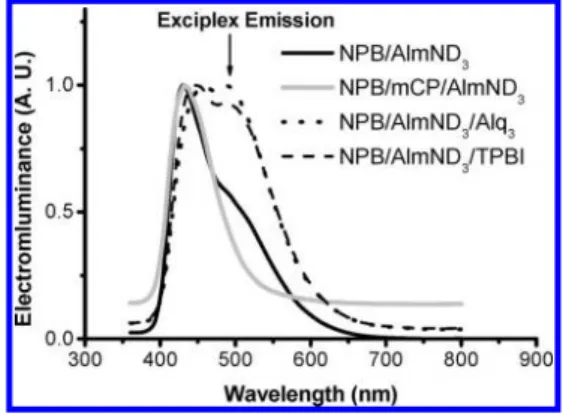
LiF, and Al onto ITO (indium tin oxide)-coated glass substrate. Unfortunately, in addition to the emission band peaking around 430-450 nm of AlmND3, a pronounced emission band around
480-540 nm appears in the EL spectrum of the device (Fig-ure 7).
Such a long wavelength EL devastates the EL efficiency and also impairs the blue color purity of OLEDs. A similar observation was also found for AlmmND3OLEDs. To clarify
the origin of the long wavelength EL, three more control devices were then fabricated: ITO/NPB (30 nm)/mCP(30 nm)/ AlmND3(30 nm)/LiF(5 nm)/Al(150 nm), ITO/NPB(30 nm)/
AlmND3(30 nm)/Alq3(30 nm)/LiF(5 nm)/Al(150 nm), and ITO/
NPB(30 nm)/AlmND3(30 nm)/TPBI (30 nm)/LiF (5 nm)/Al
(150 nm). From their EL spectra (Figure 7), we can firmly conclude that the EL around 480-540 nm is due to the exciplex emission occurring at the interface of NPB and AlmND3. It is
rather common that electron-deficient materials (such as Alq3
and 1,3,4-oxadiazole compounds) have a propensity to form exciplex with electron-rich hole-transporting materials (such as NPB triarylamine species).19By lowering the HOMO energy level of the hole-transporting material (i.e., reducing the HOMO energy level difference between the hole-transporting material and AlmND3),19dthe problem of the exciplex associated with
AlmND3can be largely alleviated. As shown in Figure 7, having
a low HOMO energy level around 6.1 eV,20arylamine mCP (1,3-di(9H-carbazol-9-yl)benzene) is effective in preventing the exciplex emission as evident in device ITO/NPB(30 nm)/ mCP(30 nm)/AlmND3(30 nm)/LiF(5 nm)/Al (150 nm), although
such a device is very poor in EL efficiency and brightness. Also having a low HOMO energy level around 6.3 eV,21another hole-transporting material CBP (4,4′ -di(9H-carbazol-9-yl)bi-phenyl) was thus inserted between NPB and AlmND3. By the
variation of CBP layer thickness, we have successfully elimi-nated the exciplex emission and optimize the performance of the blue devices ITO/NPB(40 nm)/CBP(x nm)/AlmND3(30 nm)/
Alq3(20 nm)/LiF (5 nm)/Al (150 nm) optimized with x ) 10
(Table 2). From such CBP-inserted nondoped AlmND3OLEDs,
we have successfully achieved deep blue ELs (CIEx,y) 0.15,
0.10) with a reasonably good external quantum efficiency (ηext) reaching 1.79% (or 1.63% at 20 mA/cm2) and a maximum brightness of 5070 cd/m2(or 277 cd m-2at 20 mA/cm2) (Figure 8). To the best of our knowledge, we believe that a similar exciplex problem of AlmND3has been found for AlND3before
and the problem has not been solved until this study.22
2.6. As Electron-Transporting Material in Non-Doped AlmND3 OLEDs. Similar to green emitter Alq3, deep blue
emitter AlmND3 potentially can be used as an
electron-transporting material in OLEDs. To gauge such viability, four nondoped AlmND3 OLEDs containing four different ETL
materials were fabricated: ITO/NPB(40 nm)/CBP10 nm)/ AlmND3(30 nm)/ETL(20 nm)/LiF(5 nm)/Al(150 nm), where the
ETL material is TPBI (2,2′,2′′ -(1,3,5-phenylene)tris(1-phenyl-1H-benzimidazole), Bebq2 (beryllium bis(benzoquinolin-10-olate), Alq3, or AlmND3. As data have shown in Table 3 and
Figure 9, in terms ofηext, nondoped AlmND3OLEDs are most
efficient when AlmND3is employed as the ETL material in
OLEDs, although it is not as bright as others. However, in terms of power efficiency (ηP), nondoped AlmND3OLEDs having
TPBI or Bebq2 are more efficient than ones using Alq3 or
AlmND3 as the ETL materials (Table 3). We notice that
AlmND3provide OLEDs a relatively low current density and
a relatively high turn-on voltage (Figure 9), which are compa-rable with those of Alq3but inferor to those of TPBI or Bebq2. Nevertheless, such results validate the usage of AlmND3as an
ETL material in OLEDs.
2.7. AlND3, AlmND3, AlmmND3, and AlmpND3 for High
Efficiency Non-Doped Deep Blue OLEDs. Having solved the problem of exciplex EL and demonstrated the electron-(19) (a) Itano, K.; Ogawa, H.; Shirota, Y. Appl. Phys. Lett. 1998, 72, 636.
(b) Chan, L.-H.; Lee, R.-H.; Hsieh, C.-F.; Yeh, H.-C.; Chen, C.-T.
J. Am. Chem. Soc. 2002, 124, 6469. (c) Guan, M.; Bian, Z. Q.; Zhou,
Y. F.; Li, F. Y.; Li, Z. J.; Huang, C. H. Chem. Commun. 2003, 2708. (d) Matsumoto, N.; Nishiyama, M.; Adachi, C. J. Phys. Chem. C 2008,
112, 7735.
(20) Wu, M.-F.; Yeh, S.-J.; Chen, C.-T.; Murayama, H.; Tsuboi, T.; Li, W.-S.; Chao, I.; Liu, S.-W.; Wang, J.-K. AdV. Funct. Mater 2007, 17, 1887.
(21) Hill, I. G.; Rajagopai, A.; Kahn, A. J. Appl. Phys. 1998, 84, 3236. (22) Chen, Chin Hsin, Department of Photonics and Display Institute,
National Chiao Tung University, private communication. Figure 7. EL spectra of four NPB/AlmND3-containing OLEDs: ITO/
multiple organic layers/LiF/Al.
Table 2. Electroluminescence Characteristics of Nondoped
AlmND3OLEDs Containing CBP with Different Layer Thicknessa CBP thickness [nm] max. luminance, voltage [cd/m2, V] luminance, efficiency, voltage [cd/m2, %, V]b max. efficiency [%, cd/A, lm/W] λmaxel [nm] CIE 1931 chromaticity [x, y] 3 5555, 15 119, 0.39, 5.68 0.53, 0.79, 0.33 456 0.18, 0.20 5 4971, 15 162, 0.86, 5.63 1.08, 1.01, 0.45 450 0.15, 0.11 10 5070, 15 277, 1.63, 8.37 1.79, 1.51, 0.53 448 0.15, 0.10 15 5606, 15 315, 1.63, 9.55 1.74, 1.68, 0.53 452 0.16, 0.12
aDevices have the configuration of ITO/NPB(40 nm)/CBP(x nm)/
AlmND3(30 nm)/Alq3(20 nm)/LiF(0.5 nm)/Al(150 nm), x ) 3, 5, 10,
and 15, respectively.bAt current density of 20 mA/cm2.
transporting property of AlmND3, we are ready to examine and
find the best aluminum chelates of ND, mND, mmND, and mpND for nondoped deep blue OLEDs. Having AlmND3as
the electron-transporting layer, four nondoped OLEDs were based on AlND3, AlmND3, AlmmND3, and AlmpND3: ITO/
NPB(40 nm)/CBP(10 nm)/Blue Al chelates(30 nm)/AlmND3(20
nm)/LiF(0.5 nm)/Al(150 nm) were fabricated and characterized (Table 4 and Figure 10).
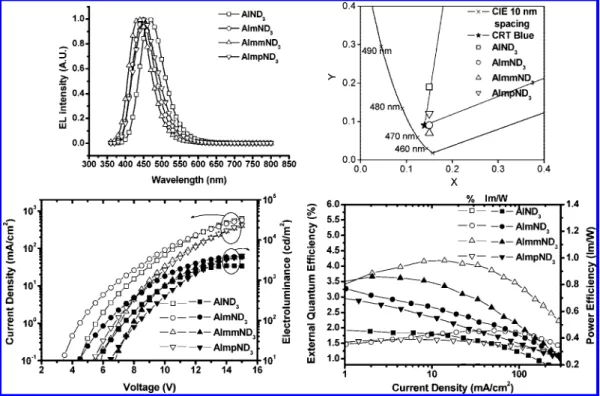
As it can be anticipated from their solution or solid-state fluorescence wavelength, the AlmND3OLED showed a much
deeper blue EL with 1931 Commision Internationale de L’Eclairage x, y coordinates (CIEx,y) 0.15, 0.09) than that of
AlND3 OLED (CIEx,y ) 0.15, 0.19). However, we do not
anticipate that AlmND3OLED performs better than does AlND3
OLED considering its fluorescence quantum yield. Since fluorescence quantum yields of AlND3are higher than those of
AlmND3either in solution or in the solid state, we attribute
such a result to the charge balancing in the OLED, which has a great influence on the efficiency of the charge-recombination in the OLED. More surprisingly, the AlmmND3OLED shows
the shortest EL wavelength (λmaxEL∼436 nm), the highest ηext of 4.18% (or 4.11% at 20 mA/cm2), and the brightest EL of 445 cd/m2at 20 mA/cm2. Considering the structural difference among AlND3, AlmND3, and AlmmND3, it is hard to conceive
that an insignificant methyl substituent or the number of methyl substituents can exert that much on ηext and EL brightness. Plausibly, among four aluminum chelates, we may recognize AlmmND3 as an exceptional one based on the red-shifted
fluorescence from solution to the solid state. The red-shifting fluorescence is 443f447 nm, 415f431 nm, 416f419 nm, and 417f425 nm for AlND3, AlmND3, AlmmND3, and AlmpND3,
respectively. Energywise, this corresponds to a red-shifting energy of 723, 895, 172, and 451 cm-1, respectively for four aluminum chelates. AlmmND3 has the smallest red-shifted
fluorescence among all. Accordingly, we surmise that, in the solid state, AlmmND3aggregates in a quite different fashion
from the other aluminum chelates. Compared with other aluminum chelates, such aggregation enables high efficiency of charge recombination (or charge balance) and thus theηext (or ηP) of AlmmND3OLEDs. For AlmmND3, the low hole
mobility (lower than its electron mobility) helps in balancing the charge of AlmmND3OLEDs.
We have also examined the performance of blue OLEDs with GamND3, GammND3, InmND3, or InmmND3as the nondoped
light-emitting layer (Table S1). As it can be anticipated from the fact that a heavy atom will quench the fluorescence, indium chelates performed the worst in terms of EL efficiency or brightness. However, this is not exactly the case for gallium chelates. Comparing data in Table 4 and Table S1, the GammND3OLED is worse than the AlmmND3OLED but the
GamND3OLED is better than the AlmND3OLED.
Neverthe-less, once again, we verified the same trend of OLED perfor-mance; namely, mmND is better than mND for gallium or indium metal chelates as nondoped deep blue light-emitting materials for OLEDs.
2.8. Nondoped AlmmND3 OLEDs with Various Metal
Chelates as Electron-Transporting Layer.Knowing all group III metal chelates are potential ETL material in OLEDs, we fabricated a series of AlmmND3-based nondoped blue OLEDs
Figure 8. EL characteristics of ITO/NPB(40 nm)/CBP(x nm)/AlmND3(30 nm)/Alq3(20 nm)/LiF(0.5 nm)/Al(150 nm), x ) 3, 5, 10, and 15, respectively.
Table 3. Electroluminescence Characteristics of Nondoped
AlmND3OLEDs with Various ETL Materialsa
ETL max. luminance and voltage [cd/m2, V] luminance, efficiency, voltage [cd/m2, %, V]b max. efficiency [%, cd/A, lm/W] λmaxel [nm] CIE 1931 chromaticity [x, y] TPBI 6000, 15 240, 1.15, 6.2 1.86, 1.79, 0.86 454 0.16, 0.13 Bebq2 7140, 15 340, 1.67, 5.6 1.81, 1.84, 0.98 458 0.15, 0.13 Alq3 5070, 15 277, 1.63, 8.4 1.79, 1.51, 0.53 448 0.15, 0.10 AlmND3 5240, 15 310, 1.85, 6.8 1.96, 1.65, 0.84 452 0.15, 0.10 aITO/NPB(40 nm)/CBP(10 nm)/AlmND 3(30 nm)/ETL(20 nm)/LiF(5 nm)/Al(150 nm).bAt 20 mA/cm2.
with a variation of ETL material, AlND3, AlmND3, AlmmND3,
AlmpND3, GamND3, or InmND3(Table 5 and Figure S2).
Here, for a fair comparison, the AlmmND3 OLED having
AlmND3as ETL material is a refabricated one, not the same
one in Table 4 and Figure 10. As the data show in Table 5, all devices exhibit virtually the same λmaxel 432 nm and a very similar deep blue color chromaticity CIEx,y ) 0.15-0.16,
0.07-0.08, consistent with all OLEDs having the same deep blue nondoped emitter AlmmND3. Regardless of ETL materials,
all deep blue OLEDs have a relatively high EL efficiency with
ηext being more than 3.0%. In terms of EL efficiency, the AlmmND3OLED having AlmND3as the ETL material is the
most outstanding. This OLED hasηextreaching 3.77% andηP over 0.80 lm/W at a current density of 20 mA/cm2. From OLED results in section 2.7 and 2.8, it is very clear that AlmmND3is
the most efficient nondoped deep blue emitter but AlmND3is
the best ETL material for it.
2.9. AlmND3 as the Host Material for Blue Perylene and
Deep Blue 9,10-Diphenylanthracene Dopants.To demonstrate the wide band gap nature of hydroxynaphthyridine metal chelates, we have fabricated a series of AlmND3 OLEDs
containing perylene or 9,10-diphenylanthracene (DPA) as highly efficient blue or deep blue dopant materials. Perylene is a highly
fluorescent blue emitter with λmaxfl467 nm (in clyclohexane) and Φf 94%.23 However, in the solid state blue perylene becomes a poor fluorophore, a yellow one, due to the severe molecular aggregation that brings about concentration quench-ing, and a diminished and red-shifting fluorescence takes place. The fluorescence of DPA is even bluer and stronger showing
λmaxfl438 nm (in cyclohexane) andΦf100%.23Similar to blue
perylene, deep blue DPA has the inherent problem of crystal-lizing when deposited as a thin film that prohibits its nondopant usage in a device.24Whereas some reports are available for the dopant usage of perylene,25there is no known literature case of the dopant usage of DPA in OLEDs to date. This can be simply attributed to the lack of appropriate host material, a wide band gap one, required for such a deep blue DPA dopant. We took 0.5, 2, and 4 wt % dopant concentration of both perylene and DPA in the fabrication of dopant-based AlmND3
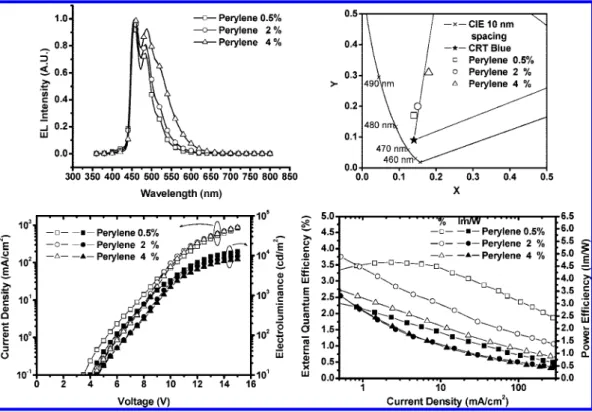
OLEDs. The EL characteristics of both series of devices are displayed in Figures 11 and 12, and their data are summarized in Table 6.
(23) Berlman, I. B. Handbook of Fluorescence Spectra of Aromatic
Molecules, 2nd ed.; Academic Press: New York, 1971; pp 264 and
399.
(24) Adachi, C.; Tsutsui, T.; Sato, S. Appl. Phys. Lett. 1990, 56, 799. (25) (a) Kojima, H.; Ozawa, A.; Takahshi, T.; Nagaoka, M.; Homma, T.;
Nagatomo, T.; Omoto, O. J. Electrochem. Soc. 1997, 144, 3628. (b) Mi, B. X.; Gao, Z. Q.; Lee, C. S.; Lee, C. T.; Kwong, H. L.; Wong, N. B. App. Phys. Lett. 1999, 75, 4055. (c) Lu, P.; Hong, H.; Cai, G.; Djurovich, P.; Weber, W. P.; Thompson, M. E. J. Am. Chem. Soc.
2000, 122, 7480. (d) Jiang, X.-Y.; Zhang, Z.-L.; Zheng, Z.-Y.; Wu,
Y.-Z.; Xu, S.-H. Thin Solid Films 2001, 401, 251. (e) Wu, C.-C.; Lin, Y.-T.; Chiang, H.-H.; Cho, T.-Y.; Chen, C.-W.; Wong, K.-T.; Liao, Y.-L.; Lee, G.-H.; Peng, S.-M. Appl. Phys. Lett. 2002, 81, 577. (f) Ni, S. Y.; Wang, X. R.; Wu, Y. Z.; Chen, H. Y.; Zhu, W. Q.; Jiang, X. Y.; Zhang, Z. L.; Sun, R. G. Appl. Phys. Lett. 2004, 85, 878. (g) Jarikov, V. V. J. Appl. Phys. 2006, 100, 014901. (h) Tse, S.-C.; Tsung, K.-K.; So, S.-K. Appl. Phys. Lett. 2007, 90, 213502. (i) Lee, R.-H.; Hung, Y.-W.; Wang, Y.-Y.; Chang, H.-Y. Thin Solid Films 2008, 516, 5062.
Figure 9. EL characteristics of ITO/NPB(40 nm)/CBP(10 nm)/AlmND3(30 nm)/ETL(20 nm)/LiF(0.5 nm)/Al(150 nm), where ETL is TPBI, Bebq2, Alq3,
and AlmND3, respectively.
Table 4. Electroluminescence Characteristics of Nondoped OLEDs of AlND3, AlmND3, AlmmND3, and AlmpND3blue Al chelatesa
Al chelates max. luminance and voltage [cd/m2, V] luminance, efficiency, voltage [cd/m2, %, V]b max. efficiency [%, cd/A, lm/W] λmaxel [nm] CIE 1931 chromaticity [x, y] AlND3 2286, 15 216, 0.75, 8.31 0.76, 1.09, 0.45 466 0.15, 0.19 AlmND3 3824, 15 279, 1.86, 7.57 1.91, 1.43, 0.77 448 0.15, 0.09 AlmmND3 3792, 15 445, 4.11, 9.36 4.18, 2.27, 0.86 436 0.15, 0.07 AlmpND3 4078, 15 306, 1.58, 9.63 1.62, 1.58, 0.71 452 0.15, 0.12
aDevices have the configuration of ITO/NPB(40 nm)/CBP(10 nm)/
Blue Al chelates(30 nm)/AlmND3(20 nm)/LiF(0.5 nm)/Al(150 nm).bAt
current density of 20 mA/cm2.
Dopant concentration 0.5 wt% was found to be optimum for either perylene or DPA. The vibronic emission observed at the low energy side of the major EL band is the distinct feature of a not so blue preylene EL, indicating a sufficient Fo¨rster energy transfer between the AlmND3 host and
perylene dopant. Compared to the undoped device (second entry of Table 4), the maximum EL efficiency of the perylene-doped device was enhanced more than four times to∼3.06 lm/W, or more than three times to ∼4.67 cd/A. At a current density of 20 mA/cm2,η
extwas 3.13%, which was enhanced 1.7 times compared to an undoped device. The maximum electroluminance also increased to 12 420 cd/m2, a greater than 3-fold enhancement than that of the undoped device, although this is at a price of deep blue color purity. The perylene-doped device had a chromaticity of CIEx,y )
0.14, 0.17, less deep blue than CIEx,y ) 0.15, 0.09 of the
undoped device (second entry of Table 4). Nonetheless, the performance of the 0.5 wt% perylene-doped AlmND3OLED
reported herein is one of the best perylene dopant devices known in literature.25 Similar enhancement of the OLED performance was also observed for DPA-doped devices, although the enhancement was to a smaller extent when compared with that of perylene-doped OLEDs. However, the
deep blue color purity was elevated to a higher level, CIEx,y
) 0.15, 0.06. After the comparison with emission spectra of solution DPA, solid state AlmND3, and solid state DPA
(fluorescence spectra shown in Figure 12), the EL spectra of the DPA-doped AlmND3 OLED can be recognized as a
coemission from both DPA and AlmND3. Since the main
emission wavelength of DPA is shorter than that for AlmND3,
the coemission EL observed for the DPA-doped AlmND3
OLED gave rise to the deepest blue color (see inserted 1931 CIE chromaticity diagram in Figure 12). Considering the inadequate overlapping of the absorption spectrum of DAP and the emission spectrum of AlmND3(not shown in Figure
12), we can conceive that Fo¨rster energy transfer between (26) (a) Xie, Z. Y.; Huang, J. S.; Li, C. N.; Liu, S. Y.; Wang, Y.; Li, Y. Q.; Shen, J. C. Appl. Phys. Lett. 1999, 74, 641. (b) Steuber, F.; Staudigel, J.; Stro¨ssel, M.; Simmerer, J.; Winnacker, A.; Spreitzer, H.; Weisso¨rtel, F.; Salbeck, J. AdV. Mater. 2000, 12, 130. (c) Xie, Z. Y.; Feng, J.; Huang, J. S.; Liu, S. Y.; Wang, Y.; Shen, J. C. Synth. Met. 2000, 108, 81. (d) Zhang, Z.; Jiang, X.; Xu, S. Thin Solid Films 2000, 363, 61. (e) Liu, S.; Hunag, J.; Xie, Z.; Wang, Y.; Chen, B. Thin Solid Films
2000, 363, 294. (f) Chuen, C. H.; Tao, Y. T. Appl. Phys. Lett. 2002, 81, 4499. (g) Li, G.; Shinar, J. Appl. Phys. Lett. 2003, 83, 5359. (h)
Cheng, G.; Zhao, Y.; Zhang, Y.; Liu, S.; He, F.; Zhang, H.; Ma, Y.
Appl. Phys. Lett. 2004, 84, 4457. (i) Liu, T.-H.; Wu, Y.-S.; Lee,
M.-T.; Chen, H.-H.; Liao, C.-H.; Chen, C. H. Appl. Phys. Lett. 2004, 85, 4304. (j) Cheng, G.; Xie, Z.; Zhao, Y.; Zhang, Y.; Xia, H.; Ma, Y.; Liu, S. Thin Solid Films 2005, 484, 54. (k) Xie, W.; Meng, M.; Li, C.; Zhao, Y.; Liu, S. Opt. Quant. Electron. 2005, 37, 943. (l) Li, M.; Li, W.; Niu, J.; Chu, B.; Li, B.; Sun, X.; Zhang, Z.; Hu, Z.
Solid-State Electron. 2005, 49, 1956. (m) Tao, S.; Peng, Z.; Zhang, X.; Wu,
S. J. Lumin. 2006, 121, 568. (n) Zhang, G. H.; Hua, Y. L.; Petty, M. C.; Wu, K. W.; Zhu, F. J.; Niu, X.; Hui, J. L.; Liu, S.; Wu, X. M.; Yin, S. G.; Deng, J. C. Displays 2006, 27, 187. (o) Choukri, H.; Fischer, A.; Forget, S.; Che´nais, S.; Castex, M.-C.; Ade´s, D.; Slove, A.; Geffroy, B. Appl. Phys. Lett. 2006, 89, 183513. (p) Hsiao, C.-H.; Lin, C.-F.; Lee, J.-H. J. Appl. Phys. 2007, 102, 094508. (q) Huang, H.-H.; Chu, S.-Y.; Kao, P.-C.; Chen, Y.-C. Thin Solid Films 2008,
516, 5669. (r) Tang, S.; Liu, M.; Lu, P.; Cheng, G.; Zeng, M.; Xie,
Z.; Xu, H.; Wang, H.; Yang, B.; Ma, Y.; Yan, D. Org. Electron. 2008,
9, 241. (s) Duan, Y.; Mazzeo, M.; Maiorano, V.; Mariano, F.; Qin,
D.; Cingolani, R.; Gigli, G. Appl. Phys. Lett. 2008, 92, 113304. Figure 10. EL characteristics of ITO/NPB(40 nm)/CBP(10 nm)/Blue Al chelate(30 nm)/ETL(20 nm)/LiF(0.5 nm)/Al(150 nm), where Blue Al chelate is
AlND3, AlmND3, AlmmND3, and AlmpND3, respectively.
Table 5. Electroluminescence Characteristics of Nondoped OLEDs of AlmmND3with Various Metal Chelates as ETL Materialsa
ETL max. luminance and voltage [cd/m2, V] luminance, efficiency, voltage [cd/m2, %, V]b max. efficiency [%, cd/A, lm/W] λmaxel [nm] CIE 1931 chromaticity [x, y] AlND3 3313, 15 369, 3.40, 8.92 3.67, 2.00, 1.04 432 0.15, 0.07 AlmND3 4444, 15 401, 3.77, 7.75 3.79, 2.00, 0.94 432 0.15, 0.07 AlmmND3 4879, 15 329, 3.01, 8.60 3.27, 1.78, 0.84 432 0.16, 0.07 AlmpND3 5487, 15 376, 3.23, 8.24 3.41, 1.99, 1.13 432 0.16, 0.08 GamND3 4694, 15 416, 3.67, 8.18 3.68, 2.09, 0.93 432 0.15, 0.07 InmND3 3848, 15 376, 3.62, 8.62 3.67, 1.91, 0.91 432 0.15, 0.07
aDevices have the configuration of ITO/NPB(40 nm)/CBP(10 nm)/
AlmmND3(30 nm)/ETL(20 nm)/LiF(0.5 nm)/Al(150 nm). bAt current
density of 20 mA/cm2.
the AlmND3host and DPA dopant is somewhat incomplete,
even though the HOMO energy level of the AlmND3host is
low enough for the DPA dopant (but the LUMO energy level of AlmND3is not high enough for the DPA dopant). Despite
such a coemission, to the best of our knowledge, this is the first observation of a deep blue EL from DPA.
2.10. AlmND3 as the Host Material for High Efficiency
White OLEDs with Rubrene Yellow Dopant. Yellow fluoro-phore rubrene is probably the most commonly used dopant accompanying blue fluorescent host material in the fabrication of white OLEDs.26,27 Fluorescence spectrum of AlmND3 is
partially overlapping with the absorption spectrum of rubrene Figure 11. EL characteristics of ITO/NPB(40 nm)/CBP(10 nm)/AlmND3:perylene(x %, 30 nm)/AlmND3(20 nm)/LiF(0.5 nm)/Al(150 nm), where x is 0.5,
2, or 4, the weight percent of perylene dopant.
Figure 12. EL characteristics of ITO/NPB(40 nm)/CBP(10 nm)/AlmND3:DPA(x %, 30 nm)/AlmND3(20 nm)/LiF(0.5 nm)/Al(150 nm), where x is 0.5, 2,
or 4, the weight percent of DPA dopant
(Figure S3 left), and white fluorescence is feasible with an appropriate ratio of mixed AlmND3 and rubrene (Figure S3
right).
We have demonstrated that the deep blue AlmND3is a good
host material for rubrene in generating high EL efficiency white OLEDs. A series of OLEDs ITO/NPB(40 nm)/CBP(10 nm)/ AlmND3:rubrene(x %, 30 nm)/AlmND3(20 nm)/LiF(0.5 nm)/
Al(150 nm) with a variation of rubrene dopant concentration 0.5-4 wt% and EL characteristics of such AlmND3:rubrene
OLEDs are shown in Figure 13 and their data are summarized in Table 7.
Similar to most rubrene-based white OLEDs, an authentic white color purity (CIEx, y) 0.32, 0.38) was achieved at a very
low dopant concentration, 0.5 wt % of AlmND3(first entry of
Table 7). Any higher dopant concentration simply impairs the white color purity of OLEDs. For such white OLEDs at a brightness of 100 cd/m2,η
extis 4.25%, which is equivalent to anηPof 8.67 lm/W, one of the highest among literature-known rubrene-based white OLEDs.26,27 The color rendering index (CRI) of such white (two-color-component) OLEDs was determined to be in the range 45-50, and it is in general inferior to CRI ∼80 of three-color-component white OLEDs.28 At practical lighting conditions, i.e., 1000 cd/m2, such an AlmND
3:
rubrene white OLED has anηextof∼3.9% or ηPof 5.1 lm/W (Figure 13). With few exceptions,27this EL efficiency at 1000 cd/m2also outperforms most literature-known rubrene-based two-element white OLEDs. Also, a doped device with a 4% rubrene concentration is virtually a yellow OLED, CIEx, y )
0.45, 0.51 (Figure 13 and the fourth entry of Table 7). Its high efficiency, 4.56%, 15.83 cd/A, or 11.94 lm/W, at 100 cd/m2 and high brightness (1930 cd/m2at 20 mA/cm2) outperforms most currently known yellow OLEDs.29The high EL efficiency of such rubrene-based white or yellow OLEDs can be attributed to the high electron mobility of AlmND3. High electron mobility
is rarely observed for the host material in the white or yellow
blue analogues of Alq3, these deep blue group III metal chelates
are volatile and thermally stable enough for OLED fabrication by a vacuum-thermal-deposition process. For OLEDs, we have overcome the problem of exciplex formation, which has hampered AlND3from practical usage in OLEDs before. High
efficiency (maximumηext> 4.0%) and deep blue (CIEx,y) 0.15,
0.07) nondoped OLEDs were achieved for AlmmND3. The wide
band gap of these deep blue metal chelates, 6.4 and 3.0 eV for AlmND3HOMO and LUMO energy levels, respectively, enable
their usage as the host material for perylene blue dopant or deep blue 9,10-diphenylanthracene. These group III metal chelates, particularly AlmND3and AlmmND3, have been characterized
for the charge carrier mobility by a time-of-flight technique. Both AlmND3and AlmmND3exhibit high electron mobility,
comparable with or even higher than that of BeBq2or Alq3.
Moreover, AlmND3is ambipolar with a similar mobility of 10-4
cm2/Vs for both hole and electron. The success of highly efficient white OLEDs (or yellow OLEDs) based on a rubrene dopant is attributed to the high electron (and hole) mobility of the host material, AlmND3. We have demonstrated the versatile
and effective application of hydroxynaphthyridine-based group III metal chelates for OLEDs. More high performance OLEDs can be anticipated now due to the availability of long-thought, wide band gap, deep blue group III metal chelates.
4. Experimental Section
General Information. Both solution and solid-state fluorescence
quantum yields (Φf’s) of the blue metal chelates were determined by the integrating-sphere method.30Photoluminescence (PL) spectra
were recorded on a Hitachi fluorescence spectrophotometer F-4500, and the same spectrophotometer was used to record the EL spectra of OLEDs. Melting points (Tms), glass transition temperatures (Tg’s),
and crystallization temperatures (Tc’s) of respective compounds
were measured via differential scanning calorimetry (DSC) using a Perkin-Elmer DSC-6 differential scanning calorimeter. The HOMO energy levels of the thin-film samples of metal chelates were studied by ultraviolet photoemission spectroscopy (UPS). The experimental detail of UPS measurement has been described before.31LUMO energy levels were estimated by subtracting the
energy gap (∆E) from HOMO energy levels. ∆E was determined by the on-set absorption energy from the absorption spectra of the materials. UV-visible electronic absorption spectra were recorded on a Hewlett-Packard 8453 Diode Array spectrophotometer. The method of time-of-flight (TOF) in measuring charge carrier mobility has been reported before.32Data collection of the X-ray
crystal-lography analysis was carried out on a Brucker X8APEX CCD (27) (a) Huang, J.; Li, G.; Wu, E.; Xu, Q.; Yang, Y. AdV. Mater. 2006, 18,
114. (b) Huang, J.; Hou, W.-J.; Li, J.-H.; Li, G.; Yang, Y. Appl. Phys.
Lett. 2006, 89, 133509. (c) Tsai, Y.-C.; Jou, J.-H. Appl. Phys. Lett. 2006, 89, 243521.
(28) (a) D’Andrade, B. W.; Forrest, S. R. AdV. Mater. 2004, 16, 1585. (b) Misra, A.; Kumar, P.; Kamalasanan, Chandra, S. Semicomd. Sci.
Technol. 2006, 21, R35. (c) Yeh, S.-J.; Chen, H.-Y.; Wu, M.-F.; Chan,
L.-H.; Chiang, C.-L.; Yeh, H.-C.; Chen, Lee, J.-H. Org. Electron.
2006, 7, 137.
(29) See: Chiang, C.-L.; Tseng, S.-M.; Chen, C.-T.; Hsu, C.-P.; Shu, C.-F.
AdV. Funct. Mater 2008, 18, 248, and references therein.
(30) (a) de Mello, J. C.; Wittmann, H. F.; Friend, R. H. AdV. Mater. 1997,
9, 230. (b) Chiang, C.-L.; Wu, M.-F.; Dai, D.-C.; Wen, Y.-S.; Wang,
J.-K.; Chen, C.-T. AdV. Funct. Mater 2005, 15, 231.
(31) Wu, C.-I.; Lee, G.-R.; Lin, C.-T.; Chen, Y.-H.; Hong, Y.-H.; Liu, W.-G.; Wu, C.-C.; Wong, K.-T.; Chao, T.-C. Appl. Phys. Lett. 2005, 87, 242107.
(32) (a) Wu, M.-F.; Yeh, S.-J.; Chen, C.-T.; Murayama, H.; Tsuboi, T.; Li, W.-S.; Chao, I.; Liu, S.-W.; Wang, J.-K. AdV. Funct. Mater. 2007,
17, 1887. (b) Liu, S.-W.; Lee, J.-H.; Lee, C.-C.; Chen, C.-T.; Wang,
J.-K. Appl. Phys. Lett. 2007, 91, 142106.
9,10-Diphenylanthracene (DPA) as Dopant
0.5 5120, 15 278, 2.78, 5.8 2.80, 1.39, 0.89 448 0.15, 0.06 2 4595, 15 259, 2.31, 5.4 2.47, 1.38, 0.87 446 0.15, 0.07 4 3295, 15 203, 1.75, 5.6 1.90, 1.91, 0.69 446 0.18, 0.07
aITO/NPB(40 nm)/CBP(10 nm)/AlmND
3:Dopant (x %, 30 nm)/
AlmND3(20 nm)/LiF(5 nm)/Al(150 nm), where x ) 0.5, 2, and 4
(weight percent) for perylene or 9,10-diphenylanthracene (DPA) dopant.
bAt 20 mA/cm2.
diffractometer at 100 K for AlND3· CH2Cl2 single crystals. The
experimental detail of X-ray diffraction and their data process in solving the crystal structure can be found elsewhere.30b
The fabrication of OLEDs and their EL characterization also have been described before.19b,33The device was placed close to the
photodiode such that all the forward light entered the photodiode. The effective size of the emitting diodes was 3.14 mm2, which is
significantly smaller than the active area of the photodiode dectector, a condition known as “under-fillling”, satisfying the measurement protocol.34This is one of the most conventional ways in measuring
the EL efficiency of OLEDs, although sometimes experimental errors may arise due to the non-Lambertian emission of OLEDs.35
The color rendering index (CRI) of white OLEDs was measured by a spectroradiometer (Specbos 1201, JETI Technishe Instrumente GmbH).
1H and13C NMR specra were recorded on a Bruker AMX-400
MHz or AVA-400 MHz Fourier-transform spectrometer at room temperature. Elemental analyses (on a Perkin-Elmer 2400 CHN Elemental Analyzer) and electron impact (EI), fast atom bombard-ment (FAB), or matrix-assisted laser desorption/ionization time-of-flight (MALDI-TOF) mass spectra (on a VA Analytical 11-250J or 4800 MALDI TOF/TOF Analyzer) were recorded by the Elemental Analyses and Mass Spectroscopic Laboratory in-house service of the Institute of Chemistry, Academic Sinica.
Materials. For the materials used in device fabrication, Bebq2,
DPA (9,10-diphenylanthracene), perylene, and rubrene are com-mercially available materials and they were used without further purification. NPB (1,4-bis(1-naphthylphenylamino)biphenyl), CBP (4,4′-bis(9-carbazolyl)-2,2′-biphenyl), mCP (1,3-bis(9-carbazolyl)-benzene), TPBI (2,2′,2′′ -(1,3,5-phenylene)tris[1-phenyl-1H-benz-imidazole]), and Alq3were prepared via published methods and were subjected to gradient sublimation prior to use.
Synthesis of Tris(4-hydroxy-1,5-naphthyridinato)aluminum (AlND3). To a toluene solution (4.5 mL) was added ND (0.15 g, 1.0 mmol) and aluminum triisopropoxide (0.07 g, 0.34 mmol). The (33) Yeh, S.-J.; Wu, M.-F.; Chen, C.-T.; Song, Y.-H.; Chi, Y.; Ho, M.-H.;
Hsu, S.-F.; Chen, C. H. AdV. Mater. 2005, 17, 285.
(34) Forrest, S. R.; Bradley, D. D. C.; Thompson, M. E. AdV. Mater. 2003,
15, 1043.
(35) Tanaka, I.; Tokito, S. Jpn. J. Appl. Phys 2004, 43, 7733.
Figure 13. EL characteristics of ITO/NPB(40 nm)/CBP(10 nm)/AlmND3:rubrene (x %, 30 nm)/AlmND3(20 nm)/LiF(0.5 nm)/Al(150 nm), where x is 0.5,
1, 2, or 4, the weight percent of rubrene dopant. EL efficiency (ηextorηP) at 100 or 1000 cd/m2electroluminance is arrow-marked for the device with 0.5
wt% rubrene dopant.
Table 7. Electroluminescence Characteristics of White OLEDs with AlmND3Host and Various Dopant (Rubrene) Concentrationa rubrene concn [wt %] max. luminanceand voltage [cd/m2, V] luminance, efficiency, voltage [cd/m2, %, V]b efficiency at 100 and 1000 cd/m2 [%, cd/A, lm/W] λmaxel [nm] CIE 1931 chromaticity [x, y] 0.5 26 710, 15 1830, 3.67, 6.58 4.25, 11.55, 8.67 444, 550 0.30, 0.35 3.91, 9.65, 5.13 1 24 810, 15 1670, 3.73, 6.75 4.97, 11.17, 8.20 444, 554 0.36, 0.42 3.97, 8.93, 4.58 2 36 290, 15 2260, 3.47, 7.02 5.35, 17.46, 13.03 444, 558 0.41, 0.48 3.98, 12.97, 6.78 4 30 970, 15 1930, 2.79, 7.05 4.56, 15.83, 11.94 444, 560 0.45, 0.51 3.24, 11.25, 5.77
aDevices have the configuration of ITO/NPB(40 nm)/CBP(10 nm)/AlmND
3:rubrene x %(30 nm)/AlmND(20 nm)/LiF(0.5 nm)/Al(150 nm), x ) 0.5,
1, 2, 4, respectively.bAt current density of 20 mA/cm.
6.81 (d, 1H, J ) 5.32 Hz).13C NMR (100 MHz, CDCl
3):δ 165.17,
164.98, 164.65, 156.28, 155.73, 155.70, 144.80, 144.43, 144.17, 144.07, 142.39, 141.87, 141.45, 141.37, 138.84, 138.18, 138.01, 125.13, 124.55, 109.80, 109.62, 109.08. FAB-MS: calcd 462.10,
m/z ) 463.1 (M+H+). Anal. Found (Calcd) for C24H15AlN6O3: C,
62.31 (62.34); H, 2.93 (3.27); N, 17.88 (18.17).
Synthesis of Tris(4-hydroxy-8-methyl-1,5-naphthyridina-to)aluminum (AlmND3). This compound was synthesized in the same manner as AlND3, except that mND (1.00 g, 6.2 mmol) was used instead of ND. The pure product was isolated as a white solid. Yield: 86% (0.90 g).1H NMR (400 MHz, CDCl 3):δ 8.73-8.70 (m, 3H), 8.57 (d, 1H, J ) 4.90 Hz), 8.52 (d, 1H, J ) 4.91 Hz), 7.51 (d, 1H, J ) 4.81 Hz), 7.42 (d, 1H, J ) 4.90 Hz), 7.27 (d, 1H, J ) 4.76 Hz), 7.11 (d, 1H, J ) 4.94), 6.94 (d, 1H, J ) 5.34 Hz), 6.91 (d, 2H, J ) 5.34 Hz), 2.84 (s, 3H), 2.79 (s, 3H), 2.77 (s, 3H). 13C NMR (100 MHz, CDCl 3):δ 165.58, 165.44, 165.12, 154.74, 154.22, 154.20, 153.22, 152.70, 152.56, 143.95, 143.76, 143.70, 143.65, 143.62, 141.75, 137.99, 137.31, 137.18, 125.25, 125.23, 124.69, 109.68, 109.40, 108.91, 17.76, 17.67. FAB-MS: calcd 504.15, m/z ) 505.1 (M+H+). Anal. Found (Calcd) for C27H21AlN6O3: C, 64.20 (64.28); H, 4.33 (4.20); N, 16.36 (16.66). Synthesis of Tris(4-hydroxy-2,8-dimethyl-1,5-naphthyridina-to)aluminum (AlmmND3). This compound was synthesized in the same manner as AlND3, except that mmND (0.50 g, 2.9 mmol) was used instead of ND. The pure product was isolated as a white solid. Yield: 86% (0.45 g).1H NMR (400 MHz, CDCl 3):δ 8.46 (d, 1H, J ) 4.88 Hz), 8.43 (d, 1H, J ) 4.88 Hz), 7.42 (d, 1H, J ) 4.88 Hz), 7.34 (d, 1H, J ) 4.88 Hz), 7.18 (d, 1H, J ) 4.92 Hz), 7.00 (d, 1H, J ) 4.96 Hz), 6.81 (s, 2H), 6.80 (s, 1H), 2.80 (s, 3H), 2.76 (s, 3H), 2.74 (s, 3H), 2.61 (s, 3H), 2.60 (s, 6H).13C NMR (100 MHz, CDCl3): δ 165.03, 164.76, 164.24, 163.59, 152.01, 151.57, 151.40, 143.09, 143.05, 142.99, 142.74, 142.48, 140.61, 136.89, 136.23, 136.09, 125.08, 124.60, 109.67, 109.26, 108.89, 26.36, 26.29, 17.60, 17.53. FAB-MS: calcd 546.20, m/z ) 547.2 (M+H+). Anal. Found (Calcd) for C30H27AlN6O3: C, 65.54 (65.93);
H, 4.94 (4.98); N, 15.37 (15.38).
Synthesis of Tris(4-hydroxy-8-dimethyl-2-phenyl-1,5-naph-thyridinato)aluminum (AlmpND3). This compound was synthe-sized in the same manner as AlND3, except that mpND (0.20 g, 0.9 mmol) was used instead of ND. The pure product was isolated as a white solid. Yield: 77% (0.16 g). 1H NMR (400 MHz, d
6 -DMSO):δ 8.59 (d, 1H, J ) 4.90 Hz), 8.49 (d, 1H, J ) 4.92 Hz), 8.23-8.20 (m, 6H), 7.78 (d, 1H, J ) 5.00 Hz), 7.69 (d, 1H, J ) 4.91 Hz), 7.58-7.42 (m, 14H), 2.85 (s, 3H), 2.83 (s, 3H), 2.80 (s, 3H). 13C NMR (100 MHz, CDCl 3): δ 165.79, 165.75, 165.51, 161.48, 161.04, 153.20, 152.82, 152.69, 143.43, 143.32, 143.12, 141.23, 140.46, 140.25, 139.94, 137.32, 136.68, 136.52, 129.65, 129.46, 129.29, 128.71, 128.67, 128.60, 127.72, 127.65, 127.62, 125.39, 124.88, 17.55, 17.47. FAB-MS: calcd 732.24, m/z ) 733.3 (M+H+). Anal. Found (Calcd) for C45H33AlN6O3: C, 73.84 (73.76);
H, 4.37 (4.54); N, 11.37 (11.47).
Synthesis of Tris(4-hydroxy-8-methyl-1,5-naphthyridinato)-gallium (GamND3). To a water solution (7.2 mL) were added mND (0.14 g, 0.87 mmol) and gallium chloride (0.06 g, 0.34 mmol). The reaction mixture was heated and stirred at∼40°C. An excess amount of potassium acetate was added to the solution to change the solution acidity from pH 3-4 to pH 7-8. During the reaction (ca. 1 h), the formation of a milky white solid emitting blue
143.81, 143.41, 143.15, 141.22, 136.08, 135.45, 135.34, 125.23, 125.14, 124.71, 109.61, 109.51, 108.97, 17.95, 17.85. FAB-MS: calcd 546.09, m/z ) 547.0 (M+H+). Anal. Found (Calcd) for C27H21GaN6O3: C, 59.03 (59.26); H, 4.00 (3.87); N, 15.09 (15.36). Synthesis of Tris(4-hydroxy-2,8-dimethyl-1,5-naphthyridi-nato)gallium (GammND3). This compound was synthesized in the same manner as GamND3, except that mmND (0.60 g, 3.4 mmol) was used instead of mND. The pure product was isolated as a white solid. Yield: 83% (0.56 g).1H NMR (400 MHz, CDCl 3):δ 8.51 (d, 1H, J ) 4.83 Hz), 8.48 (d, 1H, J ) 4.86 Hz), 7.45 (d, 1H, J ) 4.78 Hz), 7.38 (d, 1H, J ) 4.90 Hz), 7.23 (d, 1H, J ) 4.89 Hz), 7.15 (d, 1H, J ) 4.90 Hz), 6.83-6.82 (m, 3H), 2.80 (s, 3H), 2.77 (s, 3H), 2.75 (s, 3H), 2.61 (s, 3H), 2.59 (s, 6H).13C NMR (100 MHz, CDCl3):δ 164.63, 164.56, 164.36, 163.94, 163.40, 163.33, 152.32, 151.88, 143.31, 143.25, 142.20, 142.00, 140.07, 135.02, 134.38, 134.26, 125.10, 124.96, 124.62, 109.57, 109.32, 108.88, 26.31, 17.80, 17.71. FAB-MS: calcd 588.14, m/z ) 589.0 (M+H+). Anal. Found (Calcd) for C30H27GaN6O3: C, 61.50 (61.14); H, 4.63
(4.62); N, 14.17 (14.26).
Synthesis of Tris(4-hydroxy-8-dimethyl-2-phenyl-1,5-naph-thyridinato)gallium (GampND3). This compound was synthesized in the same manner as GamND3, except that mpND (0.20 g, 8.5 mmol) was used instead of mND. The pure product was isolated as a white solid. Yield: 69% (0.15 g).1H NMR (400 MHz, CDCl
3): δ 8.62 (d, 1H, J ) 4.88 Hz), 8.59 (d, 1H, J ) 4.88 Hz), 8.15-8.12 (m, 6H), 7.53-7.40 (m, 14H), 7.33 (d, 1H, J ) 5.04 Hz), 7.30 (d, 1H, J ) 4.96 Hz), 2.93 (s, 3H), 2.92 (s, 3H), 2.86 (s, 3H).13C NMR (100 MHz, CDCl3):δ 165.42, 165.31, 165.13, 161.13, 160.78, 160.70, 153.50, 153.15, 153.11, 143.63, 143.59, 142.77, 142.62, 140.66, 140.39, 140.19, 139.91, 135.45, 134.82, 134.70, 129.64, 129.46, 129.32, 128.69, 128.67, 128.60, 127.69, 128.61, 125.38, 125.24, 124.87, 106.99, 106.61, 106.24, 17.73, 17.65. FAB-MS: calcd 774.19, m/z ) 775.2 (M+H+). Anal. Found (Calcd) for C45H33GaN6O3: C, 69.80 (69.69); H, 4.27 (4.29); N, 10.72 (10.84). Synthesis of Tris(4-hydroxy-8-methyl-1,5-naphthyridinato)-indium (InmND3). To a water solution (7.2 mL) were added mND (0.15 g, 0.94 mmol) and indium chloride (0.07 g, 0.32 mmol). The reaction mixture was stirred and heated at reflux temperature. An excess amount of potassium acetate was added to the solution to change the solution acidity from pH 3-4 to pH 7-8. During the reaction (ca. 1 h), the formation of a milky white solid was observed. However, the blue fluorescence from such a precipitate was barely discernible. After the removal of water by vacuum distillation, the resulting solid was subjected to Soxhlet extration by dichlo-romethane for 24 h. The extracted dichlodichlo-romethane solution was evaporated until dryness, and the solid residue was further purified by zone-temperature sublimation. The pure product was isolated as an off-white solid. Yield: 76% (0.14 g).1H NMR (400 MHz,
CDCl3):δ 8.67 (d, 3H, J ) 5.40 Hz), 8.33 (d, 3H, J ) 4.80 Hz),
7.51 (dd, 3H, J ) 4.79 Hz, J ) 0.71 Hz), 6.95 (d, 3H, J ) 5.41 Hz), 2.83 (s, 9H).13C NMR (100 MHz, CDCl
3):δ 165.73, 153.71,
153.68, 144.30, 144.22, 136.46, 125.04, 110.75, 18.23. FAB-MS: calcd 592.07, m/z ) 593.0 (M+H+). Anal. Found (Calcd) for C27H21InN6O3: C, 54.79 (54.75); H, 3.46 (3.57); N, 14.07 (14.19). Synthesis of Tris(4-hydroxy-2,8-dimethyl-1,5-naphthyridina-to)indium (InmmND3). This compound was synthesized in the same manner as InmND3, except that mmND (0.17 g, 0.98 mmol) was used instead of mND. The pure product was isolated as an 776 J. AM. CHEM. SOC.





![Table 7. Electroluminescence Characteristics of White OLEDs with AlmND 3 Host and Various Dopant (Rubrene) Concentration a rubrene concn [wt %] max](https://thumb-ap.123doks.com/thumbv2/9libinfo/7641101.137845/13.883.63.822.576.743/table-electroluminescence-characteristics-various-dopant-rubrene-concentration-rubrene.webp)
