開讀者培訓項目的先河:小型學術圖書館
內的領導與合作
Spearheading Change in a Library Instruction
Program: Collaboration and Leadership in a
Small Academic Library
Debra Lucas
৸ࡗ͐Ђᘲ EŅZpvwjmmf ጯੰ Npoubouf ဦ३ᐡણ҂Ꮩྙૈ̈́ᐡᅫ̢ࣄొЇ!
Head of Reference, Instruction, and Interlibrary Loan, Montante Family Library of D’Youville College, Buffalo, New York
E-mail: [email protected]
Keywords(關鍵詞):Collaboration; Leadership;Library Instruction; Change Agent; Data Analysis
【Abstract】
When librarians who manage and coordinate Library Instruction programs understand the need for change, they likewise engage in effectively negotiating change. If new and seasoned librarians can efficaciously implement a new initiative, then they will spearhead change. Using the principles of collaboration, library instruction managers can articulate and market their vision to the expansive body of campus constituents and decision makers. Librarians do not always need the formal title to lead collaborative projects and improve services. However, they do need to understand the principles of collaboration and leadership.
Leading change within an academic library includes spearheading change within the college’s academic departments. This process is difficult at best because academic policy change moves at a snail’s pace. Librarians who want to be collaborative leaders need to be dedicated, educated in understanding
organizational culture, and ready to become change agents.
This article discusses the author’s experience with using principles of collaboration and leadership to improve the existing library instruction program.
INTRODUCTION
“Librarians charged with designing and implementing Information Literacy initiatives must develop strong leadership and interpersonal communication abilities, to build effective collaborative relationships across campus to work within the strictures of present campus bureaucracies and campus perceptions of roles and responsibilities” (Shane, 2004 p. 85).
BACKGROUND
In December of 2002, I became the Head of Reference at D’Youville College. This small
private college in Western New York College enrolled approximately 2,500 students. When I began managing the library instruction program, instruction was traditionally scheduled only upon the request of a professor. There was no overarching managerial coordination between the library and the academic departments. The instruction room was located in the library and it was reserved for library instruction only. It contained 12 computers with seating for 18.
In 2003-2004, after only one semester of experience managing an instruction program, I witnessed an unexpected surge in the program’s popularity. We rose from 62 to 120 sessions a year, representing a 93.5% increase in demand! As this growth continued, I learned to manage chaos. See Figure 1.
Year Number of Classes Number of Students 2002-2003 62 973 2003-2004 120 1,494 2004-2005 125 1,712 2005-2006 142 2198
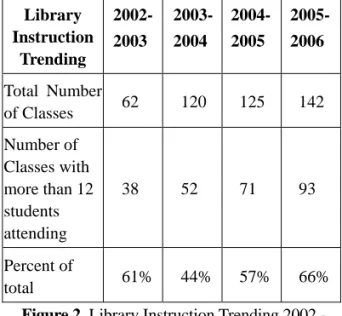
Figure1. Increase in Library Instruction per Year Through data gathering, it was further noted that a growing majority of the library sessions held contained more than 12 students (see Figure 2). An increasing percentage of the library sessions were for graduate classes (see Figure 3). Frequently, the students reported in library instruction evaluations that they felt they should have had instruction EARLIER in their academic programs (see Figure 4).
More and more, the students also reported dissatisfaction in attending multiple instruction sessions, especially if they occurred within the same semester. All education students in the Teacher Certification or Master’s Degree program were placed in scheduled cohorts, so that groups of students shared an identical class schedule for the entire semester. In some cases, we would see the same group of students attend library instruction with one professor on Monday morning, only to see them again with a different professor the following Tuesday afternoon. There was no over-all management or coordination of schedules.
Library Instruction Trending 2002-2003 2003- 2004 2004- 2005 2005-2006 Total Number of Classes 62 120 125 142 Number of Classes with more than 12 students attending 38 52 71 93 Percent of total 61% 44% 57% 66%
Figure 2. Library Instruction Trending 2002 - 2006
Figure 3. Library Instruction sessions held for Graduate Classes
Survey Question
5. The session was delivered at an appropriate time in my college career. (If you disagree, when should it be delivered? __earlier_____________
10 9 8 7 6 5 4 3 2 1 Strongly Agree Neutral Strongly Disagree
Additional Comments:
This class should be required in the first semester. I should not have to attend this session more than once in the same semester.
It will be of great benefit to me in my college career.
Figure 4. Sample Survey Questions and Data Year Total Library Sessions held
for Graduate Classes
02-03 48 %
03-04 47.5 %
04-05 64 %
THE METHODOLOGY OF CHANGE PART ONE: APPROACHES IN LIBRARY INSTRUCTION
INITIATIVES
The Library Instruction Program was a popular service, but to remain viable, and to increase satisfaction among the faculty and students, I wanted to overhaul the program. In fact, as the instruction program coordinator, I needed to lead the service enhancement. Author Barbara Dewey (2004) wrote, “In order to be productive and effective throughout the campus, librarians must strategically and energetically seek and accept leadership roles” (p.10). Although I knew I needed to lead, I wanted to do it collaboratively. Understanding collaboration and using effective leadership approaches is important to successfully creating organizational change, both within our libraries and in our relationships with academic departments. A leader who takes an autocratic approach manages employees or ser-vices independently, trumping others with their rank or title. Conversely, a leader who takes a democratic approach manages employees and situations by tapping into the personal talents of their staff and colleagues. These leaders are open, flexible and sensitive to the needs and feelings of all those within their authority. Democratic leaders seek opinions of the key constituents, thereby gathering the support of those affected by organizational, structural or service initiative changes. They invest time in the planning stages, seek buy-in, gain support, and lead the key constituents through change.
THE METHODOLOGY OF CHANGE PART TWO: UNDERSTANDING THE POWER OF COLLABORATION
Collaboration is an active means of gathering like-minded persons who share common goals and abilities to create together something that increases the common good. The group contributes collective knowledge and experience. As collaboration can define opportunities for
improvement, it can also define solutions in which the key constituents believe. From their belief comes the cooperation and effort that the initiative requires for successful implementation.
The position of department head does not always confer clear leadership status. In small academic libraries, for example, many librarians carry cards with the title “Head of . . .” without directly supervising a single staff or professional line. These same librarians are often charged with directing their colleagues as to when to teach, and in many cases, the appropriate content to include. When they are tasked to lead a service improvement initiative (with or without the title or rank), they must then function as a leader. A collaborative solution is called for.
LEADING COLLABORATIVE SOLUTIONS BY ENDORSEMENT: HOW TO FIND YOUR ALLIES
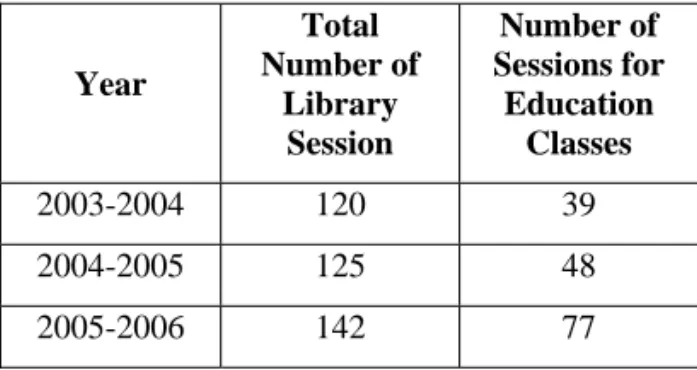
At D’Youville College, the majority of the instruction sessions were held for graduate programs, and the interest within the Graduate Education Department was continually rising. See Table 1.
Table 1. Number of Library Instruction Classes for Education Department Year Total Number of Library Session Number of Sessions for Education Classes 2003-2004 120 39 2004-2005 125 48 2005-2006 142 77
I needed to find allies and ask for their endorsement. In November of 2004, I met with the Library Director and the Chair of the Education Department to discuss the challenges facing the library instruction program and its relationship and obligation to the Education Department. Our conversations led us to a mutual
understanding of the problem. The Chair of the Education Department invited the Library Director and me to meet with the Education Faculty at their departmental meeting.
SING DATA RESOURCES TO GATHER SUPPORT
In preparing to meet with the faculty of the largest and most influential academic department on campus, I pulled together my data resources, knowing that the faculty would be best convinced by documentation, not supposition. Brothers and Richards (2006) state, “it might be tempting to rely only upon oral accolades made by your audience, but written evaluations can often shed light on areas for improvement. Evaluations can also help demonstrate the effectiveness of library instruction to administrators " (p.15). One of our most useful survey questions asked students if the library session was delivered at an appropriate time in their college career.
I gathered pertinent data for my presentation: the number of instruction sessions each year and the percentage of increase, the number of instruction sessions held for the Education Department, and the number of instruction sessions held with more than 12 students attending. I also clarified the existing policies that all faculty must attend the library instruction session, and that classes with more than 18 students must be divided into two library instruction sessions. To enhance these numbers, I presented samples of comments that their students wrote on the library evaluation forms. These comments helped demonstrate that students were attending multiple library sessions and that instruction would be of greater value if offered during their first semester on campus. After presenting the information, the department chair suggested we establish an ad hoc committee to discuss and determine options for library instruction for the students in the Education Program. The faculty readily agreed.
AD HOC SOLUTIONS
“ A major driver in the success of the departmental collaboration is whether the library has a proactive or passive approach,” (Dewey, 2006, p. 12). Because we reached out to the department and could intelligently discuss the problem in light of the facts, the faculty could willingly come on-board. The Ad-Hoc Committee convened in November of 2004, just before the fall semester ended. We determined that two graduate-level Education courses would include a library instruction seminar. No other Education courses would include the seminar. One of the Education courses selected was a required course for all Education majors. The second was a course given during an Education student’s first semester on campus. Authors Brothers and Richardson (2006) state: “One effective initiative that will boost instruction programs is in integrating instruction into an existing required course. These classes will ensure that you reach the largest number of students and that you will reach them early in their college experience” (p. 14). They go on to say that “offering instruction through elective courses represents a less effective outcome, but you should begin where the opportunity exists” (Brothers and Richardson, 2006, p.14).
The Ad-Hoc Committee further decided that: z The Education Department would
for-ward the course schedule to the library so the library staff could create an instruction schedule.
z Classes with over 18 students would be divided into two sessions. The library staff would lead one group on the computers, while the other half would complete a library assignment given by the professor (or would be excused from session attendance requirements if the professor allowed). The groups would then rotate. The professor teaching the course would be required to attend both sessions held in the computer instruction room.
instruction schedule before the beginning of the semester so they might include it in the syllabus or course schedule.
z All library research seminars would occur in the second or third week of the semester.
z The ad-hoc library committee would re-convene to discuss how the program might be improved or altered.
BACKYARD RESISTANCE
One of the biggest challenges I faced was finding allies in my own back yard. Shane (2004) wrote that “the Instruction Librarian, in particular, must be aware of ALL of the factors, and discern how exactly to exploit each area to achieve the ultimate goal, and use influence in one area to introduce greater progress into another. Politically, Instruction Librarians need to identify the key players, and enlist the support of those on campus who have influence in each of the various realms” (p. 87).
While I had gained the support of the Education Faculty, I still did not have the support of my fellow instruction librarians. Our library is small, and as in many small academic libraries, every librarian is required to participate in instruction, reference desk service, and collection development. In their interaction with the instruction program, they did not understand how room capacity affected the overall program. It was necessary to present the data that I had prepared for the Education Faculty to my fellow instruction librarians, and to educate them about the problem and the impact it has on our daily workflow.
In December, 2005, a full year after I had collaborated with the Education Department to determine the most beneficial changes, the librarians agreed that putting more computers in the instruction room would allow us to teach a class of 30 students in one session, as opposed to two sessions, reducing the overall number of classes taught each semester. I then called upon
the expertise of our new Systems Librarian. He was not entrenched in library politics, and was receptive to the proposal. He was also highly skilled in computer hardware. He repaired the library computers previously relegated to the junkyard and redeployed eight computers to the instruction room. With some additional rearrangement of existing tables, and the acquisition of an instructor’s podium to hold a slim line laptop and projector, we increased seating capacity from 18 to 30.
CONCLUSION
It has been over two years since we began this collaborative approach. In that time, I have seen many unsettled moments. I can proudly share the collaborative experience with my colleagues, but must acknowledge the plan’s short-comings. I have seen Department Chairs come and go, and each time I have had to reiterate our successes and the potential threats to our collaborative program. I have learned to take advantage of my networking opportunities. Whenever I feel problems approaching, I regroup my forces to keep this initiative strong. I hang in there, knowing that if I maintain a proactive approach, library instruction can be wedded to more required courses at D’Youville College. The methodology that I have developed will serve as my roadmap for leadership and collaboration with other academic departments across this campus. If I commit to continually monitoring, assessing, and adjusting the program in a collaborative way, success will follow.
REFERENCES
Brothers, M. and Richards, D. (2006). Bibliographic Instruction: A Cooperative Approach. The Southeastern
Librarian, 54(1), 12-15.
Dewey, B. (2006). The Embedded Librarian: Strategic Campus Collaborations. Resource Sharing and
Information Networks, 17(1/2), 5-17.
Shane, J. (2004) .Formal and Informal Structures for Collaboration on a Campus-Wide Information Literacy Program. Resource Sharing and Information