Dichromatic InGaN-based white light emitting diodes by using laser lift-off and
wafer-bonding schemes
Y. J. Lee, P. C. Lin, T. C. Lu, H. C. Kuo, and S. C. Wang
Citation: Applied Physics Letters 90, 161115 (2007); doi: 10.1063/1.2722672
View online: http://dx.doi.org/10.1063/1.2722672
View Table of Contents: http://scitation.aip.org/content/aip/journal/apl/90/16?ver=pdfcov Published by the AIP Publishing
Articles you may be interested in
Investigation of efficiency droop for InGaN-based UV light-emitting diodes with InAlGaN barrier Appl. Phys. Lett. 98, 211107 (2011); 10.1063/1.3591967
Optical evidence of an electrothermal degradation of InGaN-based light-emitting diodes during electrical stress Appl. Phys. Lett. 84, 3403 (2004); 10.1063/1.1734682
Mechanism of enhanced light output efficiency in InGaN-based microlight emitting diodes J. Appl. Phys. 93, 5978 (2003); 10.1063/1.1567803
In x Ga 1x N light emitting diodes on Si substrates fabricated by Pd–In metal bonding and laser lift-off Appl. Phys. Lett. 77, 2822 (2000); 10.1063/1.1319505
Fabrication of thin-film InGaN light-emitting diode membranes by laser lift-off Appl. Phys. Lett. 75, 1360 (1999); 10.1063/1.124693
This article is copyrighted as indicated in the article. Reuse of AIP content is subject to the terms at: http://scitation.aip.org/termsconditions. Downloaded to IP: 140.113.38.11 On: Thu, 01 May 2014 00:32:01
Dichromatic InGaN-based white light emitting diodes by using laser lift-off
and wafer-bonding schemes
Y. J. Lee,a兲 P. C. Lin, T. C. Lu,b兲,c兲H. C. Kuo,b兲,d兲 and S. C. Wang
Department of Photonics, National Chiao Tung University, 1001 Ta Hsueh Road, Hsinchu 300, Taiwan
共Received 13 February 2007; accepted 14 March 2007; published online 18 April 2007兲
An InGaN-based dual-wavelength blue/green 共470 nm/550 nm兲 light emitting diode 共LED兲 with three terminal operations has been designed and fabricated by using sapphire laser lift-off and wafer-bonding schemes. The device is equivalent to a parallel connection of blue and green LEDs; thus the effective electrical resistance of the device could be reduced. The luminous efficiency is 40 lm/ W at 20 mA, accompanied by a broad electroluminescence emission with a combination of blue and green colors. This monolithically integrated dichromatic lighting structure has great potential in the application of the solid-state lighting. © 2007 American Institute of Physics. 关DOI:10.1063/1.2722672兴
As compared to conventional illumination technologies, high brightness indium gallium nitride 共InGaN兲-based light emitting diodes共LEDs兲 have a huge impact on the solid-state lighting共SSL兲 market.1There are many approaches to fabri-cate white LEDs.2–5Commercially available SSL sources are usually composed of InGaN LEDs in the blue or UV wave-lengths and a combination of phosphors to produce a desired white-light spectrum.6However, the degradation of phosphor during the long period of optical pumping would deteriorate the output efficiency of this phosphor-converted white-light LED. Mixing two LED sources emitting complementary col-ors is another promising approach to obtain white light. Li et
al. revealed the great potential of dichromatic light sources
in terms of a very high luminous efficiency.7 Their calcula-tion shows that very high values of the luminous efficiency of 219 lm/ W can potentially be reached, based on dichro-matic white-light sources. A dual-wavelength indium gallium nitride quantum well light emitting diode with three termi-nals has been reported by Ozden et al., where they inserted a
p++/ n++InGaN / GaN tunnel junction between separated blue
and green active regions.8Although the presence of the tun-nel junction in the bottom device allowed for electrically isolated devices, an additional increase of about 1 V to the forward voltage characteristics of the bottom device was ob-served. Nicol et al. also employed the tunnel junction in LEDs to monolithically combine two emitters with distinct wavelengths and used them to excite two or more phosphors to produce white light.9According to their study, it is a fun-damental trade-off between the Mg concentration of a p+ GaN layer and its crystalline quality. To eliminate the prob-lems occurring in using tunnel junctions, in this letter, we use wafer bonding and sapphire laser lift-off共LLO兲 techniques to fabricate InGaN-based dichromatic LEDs emitting at 470 and 550 nm, respectively. The monolithically integrated dichromatic LED connecting blue and green LEDs in paral-lel can simultaneously emit a broad electroluminescence with efficiency of 40 lm/ W at 20 mA, which could facilitate the early coming of SSL.
The cross section of the dichromatic white LED is sche-matically shown in Fig. 1共a兲. Both blue and green epitaxial wafers used in this study were grown using a low-pressure metal-organic chemical vapor deposition 共Aixtron 2600G兲 system onto C-face 共0001兲 sapphire substrates. The layer structure of blue LEDs comprised a 30-nm-thick GaN nucle-ation layer, a 2-m-thick undoped GaN layer, a 2-m-thick Si-doped n-type共n=5⫻1017cm−3兲 GaN cladding layer, an
unintentionally doped active region of 470 nm emitting wavelength with five periods of 2 / 8-nm-thick InGaN / GaN multiple quantum wells共MQWs兲, and a 0.2-m-thick Mg-doped p-type 共p=3⫻1017cm−3兲 GaN cladding layer. The green wafer has almost the same epitaxial structure except for the indium composition of MQWs, which also comprise five periods of InGaN / GaN MQWs but emits a longer wave-length of 550 nm. Both p-side surfaces of blue and green wafers were deposited 300-nm-thick indium-tin-oxide共ITO兲 for serving as the transparent current-spreading layer. The blue wafer was flipped and then brought into contact with the green wafer by benzocyclobutene 共BCB兲 at the operating temperature of 220 ° C. Here, we have reduced the thickness of the BCB to as thin as 0.2m during the bonding process to minimize the impact of the relatively low thermal conduc-tivity of BCB 共⬃0.32 W/mK兲 on the overall device heat dissipation. The bonded structure was then subjected to the LLO process.10 A KrF excimer laser at a wavelength of 248 nm with a pulse width of 25 ns was used to remove the sapphire substrate. The laser was incident from the backside of the sapphire substrate onto the sapphire/GaN interface to decompose GaN into Ga and N2. After LLO, the subsequent
processes involved sophisticated control of inductively coupled plasma 共ICP兲. The fabrication of the dichromatic
a兲Electronic mail: [email protected]
b兲Authors to whom correspondence should be addressed. c兲Electronic mail: [email protected]
d兲Electronic mail: [email protected] FIG. 1.white LED by using laser lift-off and wafer-bonding schemes.共Color online兲 Schematic structure of InGaN-based dichromatic APPLIED PHYSICS LETTERS 90, 161115共2007兲
0003-6951/2007/90共16兲/161115/3/$23.00 90, 161115-1 © 2007 American Institute of Physics
This article is copyrighted as indicated in the article. Reuse of AIP content is subject to the terms at: http://scitation.aip.org/termsconditions. Downloaded to IP: 140.113.38.11 On: Thu, 01 May 2014 00:32:01
white LEDs with three terminals involved standard lithogra-phy and several etching steps to define mesa regions. The LED mesa has a 100-m-diameter hollow circle in the cen-ter for exposing the p-type contact region. Two dry-etching steps were required to reach the blue LED’s ITO current-spreading layer and the n-type GaN layer of the green LED. Part of the insulated BCB bonding layer sandwiched be-tween ITO layers was removed by using O2plasma to facili-tate the current injection from the p pad to the ITO layer on green LED. Metal for all three terminals was formed by Cr/ Au and alloyed at 200 ° C in N2atmosphere for 5 min. In
order to further improve current spreading of n-type GaN layers, both n-type metals of blue and green LEDs were de-signed with finger patterns. The wafer was then cut into 480⫻480m2 chips and packaged into TO-18 without the
epoxy resin for subsequent measurements.
Figure2共a兲shows the top view photograph of a dichro-matic LED. The blue and green LEDs share the same
p-contact metal, thus the emission wavelength of the device
can be chosen for either blue or green color by locating the cathode probe on either the n1 pad or the n2 pad. For the
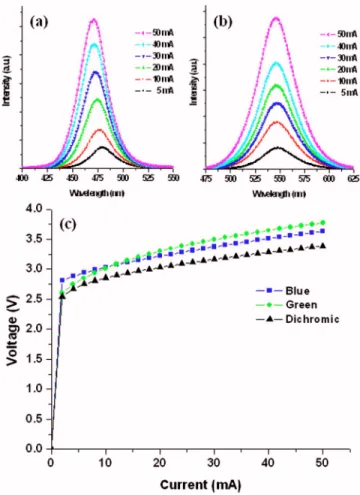
simplest case of electric circuits, the device could be re-garded as a parallel connection of blue and green LEDs. Figures 2共b兲 and 2共c兲 show photographs while turning on blue and green LEDs with the injection current of 20 mA, respectively. Dark shadows on chip surfaces in both figures are due to the blocking of electrical probes. According to this figure, by selectively probing the cathode terminal metals, the device can alternatively emit blue or green colors, reveal-ing another potential application of the dichromatic LED for optical modulators.8 The electroluminescence 共EL兲 spectra, while locating the cathode probe at the n1 pad 共blue emis-sion兲 and the n2 pad 共green emission兲, were shown in
Figs. 3共a兲 and 3共b兲, respectively. In Fig. 3共a兲 a pure blue emission with an emitting wavelength around 470 nm was observed. With increasing injection current up to 50 mA, the peak position shifts toward a short wavelength 共blueshift兲 with a shifting rate of 0.18 nm/ mA. This could be due to the well-known quantum-confined Stark effect. However, the shifting rate reduced to about 0.09 nm/ mA, while locating the cathode probe at the n2pad, as shown in Fig.3共b兲. Typi-cally, the separation of electron and hole wave functions in the quantum well was more severe for long-wavelength InGaN-based LEDs since more indium was incorporated into the epitaxial structure, inducing stronger piezoelectric fields in the quantum well region. Thus, a faster wavelength shift-ing rate shall be observed for the green LED. However, an opposite behavior was observed in Figs.3共a兲and 3共b兲. We believe this could be attributed to the current-crowding effect on the green LED. As shown in Fig. 2共c兲, current was crowded near the p-pad region for the green LED, which could raise the junction temperature and lead to a redshift of
emission wavelength. Therefore, as compared to Fig.3共a兲, a slighter shifting rate was observed in Fig.3共b兲. The current-voltage 共I-V curves兲 characteristics of blue, green, and dichromatic white LEDs were shown in Fig.3共c兲. The series resistances are about 14 and 17⍀ for blue and green LEDs, respectively. The higher series resistance of the green LED was mainly attributed to the current-crowding effect, as men-tioned above. The possible reason for the current-crowding effect on the green LED could be due to the damage of the ITO current-spreading layer. Before using ICP to dry-etch the green LED’s mesa region, we used chemical wet etching to remove the ITO current-spreading layer. The etching so-lution could leak and penetrate into chip sidewalls, thus dam-aging part of the ITO current-spreading layer on the top of the green LED. This electrical characteristic issue could be overcome by further modifying process procedures. When we simultaneously located cathode probes at n1and n2pads,
the series resistance was reduced to about 12⍀. Because the device could be regarded as a parallel connection of blue and green LEDs, series resistance of the device shall be reduced. Figure4共a兲shows EL spectra of dichromatic white LEDs packaged on TO-18 with an increase of injection currents. According to Fig.4共a兲, below an injection current of 20 mA, a broadband illumination of a combination of blue and green colors could be observed. Then, the blue peak becomes higher and dominates EL spectra when the injection current is larger than 40 mA. Gaussian profiles are fitted to the two peaks of the EL spectra in Fig.4共a兲 to determine the inte-grated emission intensity of the two emission bands. The FIG. 2.共Color online兲 共a兲 Top view photograph of dichromatic white LED.
共b兲 and 共c兲 show photographs while turning on blue and green LEDs with an injection current of 20 mA, respectively.
FIG. 3.共Color online兲 Electroluminescence 共EL兲 spectra while locating the cathode probe at the共a兲 n1pad共blue emission兲 and 共b兲 n2pad共green
emis-sion兲. 共c兲 The current-voltage 共I-V curves兲 characteristic of blue, green, and dichromatic white LEDs.
161115-2 Lee et al. Appl. Phys. Lett. 90, 161115共2007兲
This article is copyrighted as indicated in the article. Reuse of AIP content is subject to the terms at: http://scitation.aip.org/termsconditions. Downloaded to IP: 140.113.38.11 On: Thu, 01 May 2014 00:32:01
integrated emission intensity versus injection currents, ob-tained from the EL measurements, is shown in Fig.4共b兲. As compared to the green emission, the larger increment in in-tegrated EL spectra of the blue emission with injection cur-rent was mainly attributed to the better internal quantum
ef-ficiency of blue LEDs and the relatively uniform current-spreading characteristic of the ITO layer on its p-type surface. Figure 4共c兲 shows the luminous efficiency 共lm/W兲 and output power共mW兲 of dichromatic white LEDs with the increasing injection current. The output power increases lin-early with the injection current under all our measurement conditions, indicating good optical characteristics of the de-vice. The luminous efficiency is 116 lm/ W at 1 mA and rap-idly drops to 40 lm/ W at 20 mA. In Fig. 4共c兲, the rapid decline of luminous efficiency with the increasing injection current could be due to the follow-up domination of blue emission since human eyes are less sensitive to blue color. Thus, the total integrated flux of the device is decreased with the injection current, further reducing luminous efficiency. However, by carefully choosing the color combination of LEDs, this dichromatic lighting structure could have great potential in the realization of SSL.
In summary, InGaN-based dichromatic-color blue/green 共470 nm/550 nm兲 LEDs were well designed and fabricated by using sapphire laser lift-off and wafer-bonding schemes. The blue and green LEDs connecting in parallel can be ad-dressed individually and can also simultaneously emit broad EL spectra with a combination of blue and green colors, with the luminous efficiency ranging from 116 to 40 lm/ W 共⬍20 mA兲. The decline of the luminous efficiency could be due to the follow-up domination of the blue emission with the increasing injection current. By carefully choosing the color combination of LEDs, this integrated dichromatic lighting structure has a great potential to facilitate the early coming of SSL.
The authors would like to thank T. C. Hsu and M. H. Hsieh of Epistar and Shawn-Yu Lin of the Rensselaer Poly-technic Institute for useful discussion and Poly-technical support. This work was supported by the MOE ATU program and in part by the National Science Council NSC 95-2120-M-009-008, NSC 95-2752-E-009-007-PAE, and NSC 95-2221-E-009-282, Republic of China.
1E. F. Schubert, Light-emitting diodes 共Cambridge University Press,
Cambridge, U.K., 2003兲, p. 245.
2S. C. Shei, J. K. Sheu, C. M. Tsai, W. C. Lai, M. L. Lee, and C. H. Kuo,
Jpn. J. Appl. Phys., Part 1 45, 2463共2006兲.
3H.-S. Chen, D.-M. Yeh, C.-F. Lu, C.-F. Huang, W.-Y. Shiao, J.-J. Huang,
C. C. Yang, I.-S. Liu, and W.-F. Su, IEEE Photonics Technol. Lett. 18, 1430共2006兲.
4S. J. Chang, L. W. Wu, Y. K. Su, C. H. Kuo, W. C. Lai, Y. P. Hsu, J. K.
Sheu, J. F. Chen, and J. M. Tsai, IEEE Trans. Electron Devices 50, 519 共2003兲.
5Y. D. Qi, H. Liang, and K. M. Lau, J. Cryst. Growth 272, 333共2004兲. 6R. Mueller-Mach, G. Mueller, M. Krames, and T. Trottier, IEEE J. Sel.
Top. Quantum Electron. 8, 339共2002兲.
7Y.-L. Li, Th. Gessmann, E. F. Schubert, and J. K. Sheu, J. Appl. Phys. 94,
2167共2003兲.
8I. Ozden, E. Makaron, A. V. Nurmikko, T. Takeuchi, and M. Krames,
Appl. Phys. Lett. 79, 2532共2001兲.
9David B. Nicol, Ali Asghar, Shalini Gupta, Hun Kang, Ming Pan, Martin
Strassburg, Chris Summers, and Ian T. Ferguson, Phys. Status Solidi C 3, 2223共2006兲.
10J. T. Chu, T. C. Lu, H. H. Yao, C. C. Kao, W. D. Liang, J. Y. Tsai, H. C.
Kuo, and S. C. Wang, J. Appl. Phys. 45, 2556共2006兲. FIG. 4.共Color online兲 共a兲 EL spectra of dichromatic white LEDs packaged
on TO-18 with injection currents from 5 to 50 mA.共b兲 The plot of inte-grated intensity vs injection currents at room temperature.共c兲 The luminous efficiency and total output power of dichromatic white LEDs with injection currents from 5 to 50 mA.
161115-3 Lee et al. Appl. Phys. Lett. 90, 161115共2007兲
This article is copyrighted as indicated in the article. Reuse of AIP content is subject to the terms at: http://scitation.aip.org/termsconditions. Downloaded to IP: 140.113.38.11 On: Thu, 01 May 2014 00:32:01