WORLD TREND OF PERITONEAL DIALYSIS PUBLICATIONS
Tzen-Wen Chen,
1,2Li-Fang Chou,
3and Tzeng-Ji Chen
2,4Division of Nephrology,
1Department of Medicine, Taipei Medical University & Hospital; School of
Medicine,
2National Yang-Ming University; Department of Public Finance,
3National Chengchi
University; Department of Family Medicine,
4Taipei Veterans General Hospital, Taipei, Taiwan
Correspondence to: T.-J. Chen, Department of Family Medi-cine, Taipei Veterans General Hospital, 201 Shih-Pai Road Sec. 2, Taipei 11217, Taiwan.
Received 12 June 2006; accepted 20 October 2006.
♦♦ ♦♦
♦ Objectives: To analyze the trend of global peritoneal di-alysis (PD) publications, especially of publications in Peri-toneal Dialysis International (PDI), from 1991 to 2005 according to the Institute for Scientific Information data-bases of the Thomson Corporation.
♦♦ ♦♦
♦ Methods: Data were downloaded from the Web of Science, which includes the databases of Science Citation Index Ex-panded and Social Sciences Citation Index. The searching strategies were key-in of “peritoneal dialysis” in general search and of “SO=Peritoneal Dialysis International” in ad-vanced search. Only articles and reviews were included in the analysis. The analysis was stratified by publication year, jour-nal, author, country of each author’s affiliation, and cita-tion count of each paper.
♦♦ ♦♦
♦ Results: There were 7618 PD papers (6991 articles and 627 reviews) in 887 journals; 15.8% of them (n = 1204) were published in PDI. The annual outputs of global PD publica-tions has been more than 500 papers since 1996, with a peak of 665 articles in 2003. In total, 18531 authors from 102 countries and areas contributed to PD publications. Authors from the USA were present in 30.6% of all papers although their global share decreased with time. A PD paper received an average of 12.7 citations. A review received more citations than an article (17.0 vs 12.3 on average), yet statistical sig-nificance was not reached (p = 0.216, Mann–Whitney U test).
♦♦ ♦♦
♦ Conclusions: The number of PD research societies in the world has been growing during the past 15 years. More and more research is from countries other than the USA and the United Kingdom. Papers on PD have thus been published in many journals other than PDI, the leading journal in PD. How-ever, the growth rate of PD publications in the world is di-minishing. We present here the most likely reasons for the decrease in PD publications and propose suggestions for PDI to keep its leading role in the development of PD.
Perit Dial Int 2007; 27:173–178 www.PDIConnect.com
KEY WORDS: Bibliometrics; publishing.
P
eritoneal dialysis (PD) is a major subfield of nephrol-ogy. It has evolved rapidly along with technological progress in recent decades. Although there have been several reports on the quantitative aspect of nephrol-ogy publications (1–3), an analysis specific to PD publi-cations would provide valuable information for related researchers. Here we performed a bibliometric analysis on PD publications using the Institute for Scientific In-formation (ISI) databases of the Thomson Corporation, one of the most authoritative bibliographic databases in science. We also paid extra attention to records of the journal Peritoneal Dialysis International (PDI ), the offi-cial publication of the International Society for Perito-neal Dialysis (ISPD) and the most important forum for PD researchers in the world.MATERIALS AND METHODS
We downloaded records from the Web of Science over the Internet: http://portal.isiknowledge.com/ portal.cgi?DestApp=WOS&Func=Frame (accessed 5 April 2006). This site includes databases of the Science Cita-tion Index Expanded and the Social Sciences CitaCita-tion Index. The searching strategies were key-in of “perito-neal dialysis” in the general search and “SO=Perito“perito-neal Dialysis International” in the advanced search.
After downloading, we extracted papers published between 1991 and 2005. The analysis was then limited to those in the type of either “article” or “review,” that is, excluding letter, editorial material, note, meeting abstract, etc. A Short Report, if not printed in the sec-tion of Letters to the Editor, is categorized as an “Ar-ticle.” Commentaries usually categorized as Editorial Materials are thus excluded. Papers in all languages were included. To study the bibliometrics of PDI in the most recent 10 years, we also looked up related data in annual
by guest on September 12, 2012
http://www.pdiconnect.com/
articles in 2003 (Figure 1). However, the annual growth rate was close to zero after the year of 2000. The PD pub-lications in PDI reached a peak of 182 papers in 1999 though, and then decreased. Correspondingly, the glo-bal share of PD articles in PDI attained the highest point of 24.3% in 1999 and then decreased to 11.9% in 2004 and 15.5% in 2005.
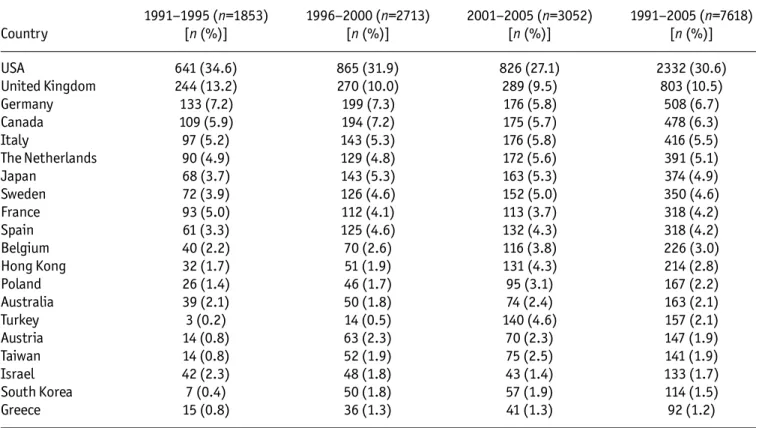
Authors from 102 countries and areas contributed to PD publications. Contributors from the USA authored 30.6% of all papers, but their global share decreased over time (Table 1). A decreasing tendency of contribution was also noted for the United Kingdom and Germany.
A PD paper received an average of 12.7 citations (me-dian 5, interquartile range 13). Only 100 papers (1.3%) received 100 or more citations; 19 of them were reviews in document type. Table 2 shows the 10 most frequently cited PD papers. In short, 285 papers (3.7%) received 50 – 99 citations, 2219 papers (29.1%) had 10 – 49 cita-tions, and 1347 papers (17.7%) had no citations at all. That is, 17.6% (n = 1230) of articles and 18.7% (n = 117) of reviews did not receive any citation. A tendency was present for a review to receive more citations than an article (mean 17.0, standard deviation 35.1, mode 5, interquartile range 16 vs mean 12.3, standard deviation 24.2, mode 5, interquartile range 13), but statistical sig-nificance was not reached (p = 0.216 by Mann–Whitney U test).
When ranked by total citations of their PD papers, only 7 journals received more than 2000 citations: Kidney In-ternational (15396 citations), American Journal of Kid-ney Diseases (14951), PDI (10519), Journal of the American Society of Nephrology (8956), Nephrology Dialy-sis Transplantation (8537), Nephron (2783), and Clinical Nephrology (2152).
printed and electronic versions of Journal Citation Re-ports from 1995 to 2004.
The analysis of PD publications was stratified by publication year, journal, author, country of the author’s affiliation, and citation count of each paper. We identi-fied authors’ affiliations and countries from addresses in their affiliations and correspondences. To maintain consistency within the study period, records of Hong Kong were separated from those of the People’s Repub-lic of China. Data from England, Scotland, Wales, and Nor thern Ireland were integrated under United Kingdom.
For PDI specifically, we studied fluctuations of its an-nual impact factor along with its determinants, which were paper count, total citation count, recent citation count, percentage of recent citations (citations to pa-pers published in the preceding 2 years) in total cita-tions, and cited half-life.
Extraction and computation of data were processed with programs written in Perl language (version 5.8.8, freely available at http://www.perl.com/). The descrip-tive statistics, for example, the frequency in count and percentage, are presented. We further compared the ci-tation numbers received by articles and by reviews. Be-cause numbers of citations varied widely among papers, we chose the Mann–Whitney U test for this analysis. We also probed the correlation between each of PDI’s yearly impact factors, paper counts, total citation counts, re-cent citation counts, share of rere-cent citations, and cited half-lives. The correlation coefficient Spearman’s rho was calculated. A p value less than 0.05 was regarded as statistically significant (two tailed). The statistical analyses were performed with SPSS release 13.0 (2004; SPSS Inc., Chicago, Illinois, USA) for Windows operat-ing system (Microsoft Corp., Redmond, Washoperat-ington, USA).
RESULTS
We retrieved 13276 PD literature records dating back to 1965 from ISI’s Web of Science. There were 7618 pa-pers (6991 articles and 627 reviews) published by 887 journals between 1991 and 2005. Only 12 journals published more than 100 PD papers in the past 15 years. With 1204 (15.8%) papers, PDI outnumbered the fol-lowing: American Journal of Kidney Diseases (627 papers; 8.2%), Nephrology Dialysis Transplantation (595 papers; 7.8%), and Kidney International (579 papers; 7.6%). The top 12 journals accounted for 57.7% of all publications on PD.
The annual output of global PD publications has been more than 500 papers since 1996, reaching a peak of 665
Figure 1 — Trend of peritoneal dialysis publications indexed in the Institute for Scientific Information databases (Thomson Corporation).
by guest on September 12, 2012
http://www.pdiconnect.com/
Disregarding the possibility of authors having the same name, a PD paper had an average of 4.7 authors (maximum 61, median 4, and interquartile range 3); 18 531 authors contributed to PD publications. Most au-thors (n = 13305) were present only in 1 paper, and 398 authors were present in 10 or more papers. The 10 most prolific authors are listed in Table 3 and the 10 top au-thors with most citations are listed in Table 4.
We obtained 2637 records of PDI, dating back to 1988, from the ISI’s Web of Science. Among those records, 1421 papers (1390 articles and 31 reviews) were published between 1991 and 2005 and 15.3% (n = 217) of them could not be retrieved with the key word “peritoneal di-alysis” in the ISI databases.
Table 5 shows some important bibliometric data for PDI from the past 10 years. The full bloom of PDI in terms of annual impact factor was around 1998. The impact factor of PDI was associated only with the percentage of recent 2-year citations in the annual total citations (cor-relation coefficient Spearman rho = 0.66, p = 0.039). However, the impact factor is derived from the number of 2-year citations, thus a statistical significance about the correlation between these two variables might not be stated. We also found the total citation count corre-lated with yearly publication count (correlation coeffi-cient Spearman rho = 0.63, p = 0.039).
DISCUSSION
Peritoneal dialysis is only a small subfield of nephrol-ogy and urolnephrol-ogy in scientific research. There were 627 PD papers listed in 2005 in the ISI databases, while the subject category of “urology & nephrology” contained 8377 papers in 51 journals. That is, only 7.5% of papers were PD papers (http://portal.isiknowledge.com/ portal.cgi?DestApp=JCR&Func=Frame; accessed 10 Oc-tober 2006). Although the annual number of PD papers grew during the study period, from 353 papers in 1991 to 627 in 2005, a similar trend could also be observed in global hemodialysis publications but with higher growth: from 1019 papers in 1991 to 2135 in 2005 (according to our separate calculations).
Papers on PD were scattered in varied biomedical jour-nals because PD research societies have burgeoned in the past 15 years. More and more PD research and papers were from countries other than the most medically ad-vanced countries, such as the USA and the UK. Proof could be found in decreasing PD paper contributions from the USA (from 34.6% to 27.1%), the UK (from 13.2% to 9.5%), and Germany (from 7.2% to 5.8%) between the years 1991 and 2005, as shown in Table 1.
Peritoneal dialysis publication numbers after 2000 were in a plateau, as shown in Figure 1. Not only PDI, but TABLE 1
Share of Articles on Peritoneal Dialysis for the Twenty Top-Ranking Countries
1991–1995 (n=1853) 1996–2000 (n=2713) 2001–2005 (n=3052) 1991–2005 (n=7618) Country [n (%)] [n (%)] [n (%)] [n (%)] USA 641 (34.6) 865 (31.9) 826 (27.1) 2332 (30.6) United Kingdom 244 (13.2) 270 (10.0) 289 (9.5) 803 (10.5) Germany 133 (7.2) 199 (7.3) 176 (5.8) 508 (6.7) Canada 109 (5.9) 194 (7.2) 175 (5.7) 478 (6.3) Italy 97 (5.2) 143 (5.3) 176 (5.8) 416 (5.5) The Netherlands 90 (4.9) 129 (4.8) 172 (5.6) 391 (5.1) Japan 68 (3.7) 143 (5.3) 163 (5.3) 374 (4.9) Sweden 72 (3.9) 126 (4.6) 152 (5.0) 350 (4.6) France 93 (5.0) 112 (4.1) 113 (3.7) 318 (4.2) Spain 61 (3.3) 125 (4.6) 132 (4.3) 318 (4.2) Belgium 40 (2.2) 70 (2.6) 116 (3.8) 226 (3.0) Hong Kong 32 (1.7) 51 (1.9) 131 (4.3) 214 (2.8) Poland 26 (1.4) 46 (1.7) 95 (3.1) 167 (2.2) Australia 39 (2.1) 50 (1.8) 74 (2.4) 163 (2.1) Turkey 3 (0.2) 14 (0.5) 140 (4.6) 157 (2.1) Austria 14 (0.8) 63 (2.3) 70 (2.3) 147 (1.9) Taiwan 14 (0.8) 52 (1.9) 75 (2.5) 141 (1.9) Israel 42 (2.3) 48 (1.8) 43 (1.4) 133 (1.7) South Korea 7 (0.4) 50 (1.8) 57 (1.9) 114 (1.5) Greece 15 (0.8) 36 (1.3) 41 (1.3) 92 (1.2) by guest on September 12, 2012 http://www.pdiconnect.com/ Downloaded from
Kidney International, American Journal of Kidney Dis-eases, and Nephrology Dialysis Transplantation all pub-lished fewer PD papers. The most likely reasons for this decrease in PD publications are that journals other than PDI had limited interest and capacity for PD articles;
nephrologists had lost their interest in PD research; pro-fessionals had not yet found new dimensions for PD stud-ies; less molecular biology-related research, the mainstream in current scientific study, had been devel-TABLE 2
The Top Ten Peritoneal Dialysis Articles by Highest Number of Citations Indexed in the Institute for Scientific Information Databases (Thomson Corporation), 1991–2005 (Status: 5 April 2006)
Article Citations (n)
Churchill DN, Taylor DW, Keshaviah PR, Thorpe KE, Beecroft ML, Jindal KK, et al. Adequacy of dialysis and 573 nutrition in continuous peritoneal dialysis: association with clinical outcomes. Canada–USA (CANUSA)
Peritoneal Dialysis Study Group. J Am Soc Nephrol 1996; 7:198–207.
Sherrard DJ, Hercz G, Pei Y, Maloney NA, Greenwood C, Manuel A, et al. The spectrum of bone disease in 382 end-stage renal failure—an evolving disorder. Kidney Int 1993; 43:436–42.
Foley RN, Parfrey PS, Sarnak MJ. Clinical epidemiology of cardiovascular disease in chronic renal disease. 373 Am J Kidney Dis 1998; 32(5 Suppl 3):S112–19.
Foley RN, Parfrey PS, Harnett JD, Kent GM, Murray DC, Barre PE. The impact of anemia on cardiomyopathy, 309 morbidity, and mortality in end-stage renal disease. Am J Kidney Dis 1996; 28:53–61.
Handwerger S, Raucher B, Altarac D, Monka J, Marchione S, Singh KV, et al. Nosocomial outbreak due 297 to Enterococcus faecium highly resistant to vancomycin, penicillin, and gentamicin.
Clin Infect Dis 1993; 16:750–5.
Young GA, Kopple JD, Lindholm B, Vonesh EF, De Vecchi A, Scalamogna A, et al. Nutritional assessment of 267 continuous ambulatory peritoneal dialysis patients: an international study. Am J Kidney Dis 1991;
17:462–71.
Fenton SS, Schaubel DE, Desmeules M, Morrison HI, Mao Y, Copleston P, et al. Hemodialysis versus 233 peritoneal dialysis: a comparison of adjusted mortality rates. Am J Kidney Dis 1997; 30:334–42.
Pereira BJ, Shapiro L, King AJ, Falagas ME, Strom JA, Dinarello CA. Plasma levels of IL-1 beta, TNF alpha 216 and their specific inhibitors in undialyzed chronic renal failure, CAPD and hemodialysis patients.
Kidney Int 1994; 45:890–6.
Foley RN, Parfrey PS, Harnett JD, Kent GM, Murray DC, Barre PE. Impact of hypertension on cardiomyopathy, 216 morbidity and mortality in end-stage renal disease. Kidney Int 1996; 49:1379–85.
Churchill DN, Thorpe KE, Nolph KD, Keshaviah PR, Oreopoulos DG, Page D. Increased peritoneal membrane 210 transport is associated with decreased patient and technique survival for continuous peritoneal dialysis
patients. The Canada–USA (CANUSA) Peritoneal Dialysis Study Group. J Am Soc Nephrol 1998; 9:1285–92.
TABLE 4
Authors with the Most Citations in Peritoneal Dialysis Publications Indexed in the Institute for Scientific
Information Databases (Thomson Corporation): 1991–2005 (Status: 5 April 2006) Author Citations (n) Lindholm B 2827 Krediet RT 2539 Oreopoulos DG 2340 Bergström J 2136 Nolph KD 1977 Heimbürger O 1910 Gokal R 1820 Struijk DG 1586 Foley RN 1436 Parfrey PS 1391 TABLE 3
The Most Prolific Authors in Peritoneal Dialysis Publications Indexed in the Institute for Scientific Information
Databases (Thomson Corporation): 1991–2005
Author Papers (n) Krediet RT 128 Lindholm B 121 Oreopoulos DG 94 Heimbürger O 86 Li PKT 82 Gokal R 75 Struijk DG 75 Selgas R 74 Piraino B 67 Bergström J 64 by guest on September 12, 2012 http://www.pdiconnect.com/ Downloaded from
oped; experimental studies dealing with the peritoneal membrane, transport, or defense issues did not mention PD in their titles or abstracts; and PD papers were pub-lished in journals not indexed in the ISI databases, which could be verified by tracing the fate of manuscripts re-jected by PDI (4).
Peritoneal Dialysis International has played a piv-otal role in the development of PD since the initia-tion of its society (the ISPD). The annual PD paper count in PDI correlates with global PD publications. The reduction in PD articles in PDI in recent years has not been countervailed by an increase in PD articles in other journals since the annual PD paper count in non-PDI journals also shows similar fluctuation. For example, the dip in 2004 (Figure 1) was observed in PDI and other journals as well (63 papers and 468 papers respectively).
Our citation counts were not stratified by publication year when making comparisons between document types among journals or among authors. Due to the absence of a full authors’ names index, we could not discern the authors who shared the same surname and forename initials (5).
The citation count per paper in PDI was obviously lower than that of other top-ranking journals. The impact fac-tor of a journal is arbitrarily defined as the citation num-ber that all its publication items in the preceding 2 years received in the reference year, divided by the journal’s total number of articles and reviews (“source items”) in the preceding 2 years. Accordingly, the impact factor of PDI was lower. This algorithm for impact factor is
con-troversial (6,7) and especially unfavorable to PDI, which has a longer cited half-life.
The cited half-life of PDI is much longer than other journals. Apparently, there have been few classical and breakthrough papers for citation in recent years. Loss of interest in PD among nephrologists was again mani-fested. However, we believe that lack of free access to an electronic version of PDI was another influential fac-tor of PDI ’s longer cited half-life. During the past de-cade, scientific publications have increasingly become available on the Internet, where they can be used by far more readers than print journals have ever reached (8). Without having free access to an electronic version of PDI, authors of newly submitted manuscripts would prob-ably use secondary citations or forsake citing PDI. That would result in fewer recent citations and further in-crease the length of “cited half-life” and dein-crease the impact factor at the same time. Since promotion of PD instead of commercial purpose is the main goal of the ISPD, a free electronic version of PDI would be very appropriate.
An impact factor can be boosted by either decreasing its denominator or increasing its numerator. To increase the rejection rate of a journal for higher quality papers, that is, to decrease the denominator, would raise its im-pact factor. A higher rejection rate would rule out self-cited papers, which could increase the denominator and the numerator of the impact factor at the same time. However, it is commonly believed that such papers are usually not so valuable and their contributions to an impact factor would be minimal or even negative. TABLE 5
Trend of Bibliometric Data for Peritoneal Dialysis International
Citations to papers
Paper count Total citation in preceding 2 years Cited half-life Year Impact factora (source itemsb) counta (% of total citations)c (years)
1995 1.520 61 1116 126 (11.3) 3.9 1996 1.673 88 1340 184 (13.7) 5.1 1997 2.129 114 1351 317 (23.5) 4.8 1998 2.856 83 1818 577 (31.7) 4.8 1999 2.406 182 2030 474 (23.3) 4.6 2000 1.842 145 2571 488 (19.0) 4.8 2001 1.657 161 2277 542 (23.8) 5.3 2002 1.915 99 2410 586 (24.3) 5.2 2003 1.950 135 2528 507 (20.1) 5.1 2004 1.056 73 1726 247 (14.3) 5.9
aData sources: the annual Journal Citation Reports, Science Edition.
bSource items were derived from the downloaded datasets of the Institute for Scientific Information databases (Thomson Corpo-ration). The data in 1995 and 2001 differed from those printed in the Journal Citation Reports.
cRecent citation count and share of recent citations.
by guest on September 12, 2012
http://www.pdiconnect.com/
Therefore, increasing the rejection rate would definitely increase the impact factor in the short term.
Nevertheless, a high rejection rate might conversely hamper young nephrologists’ interest in PD research. The total number of PD papers after 2000 has been growing slowly (Figure 1). That is, the manuscripts re-jected by PDI were not accepted by other SCI journals. As above in Results, the total citation count signifi-cantly correlated with yearly paper count (correlation coefficient Spearman rho = 0.63, p = 0.039). With a higher rejection rate, PDI might get even fewer PD pub-lications, especially at such time of output shrinkage. We are afraid that, before long, citations would decrease as well. For instance, as shown in Table 5, PDI ’s impact factor plunged in 2004, to 1.056 [247/(99 + 135)], be-cause “citations to papers in the preceding 2 years” dropped precipitously, from 507 (2003) to 247 (2004). The most likely reason for this drop was that the reduc-tion of source items in 2002 and 2003 left fewer papers for citation. Therefore, raising the rejection rate alone would not likely sustain a higher impact factor in the long run.
In conclusion, developing new directions for PD re-search would be the fundamental solution for a higher PDI impact factor. Before that, retaining the original rejection rate along with providing free access or at least open access (9) to an electronic version of PDI would help increase the impact factor of PDI and encourage
nephrol-ogists to consistently put their ef for ts into PD publications.
REFERENCES
1. Weisinger JR, Bellorin-Font E. Latin American nephrol-ogy: scientific production and impact of the publications. Kidney Int 1999; 56:1584–90.
2. Al-Khader AA, Al-Jondeby MS, Shaheen FA. Impact of nephrology publications from Saudi Arabia in the last de-cade. Saudi Med J 2002; 23:1177–80.
3. Rahman M, Sakamoto J, Fukui T. Japan’s share of research output in urology and nephrology. Int J Urol 2003; 10: 353–5.
4. Opthof T, Furstner F, van Geer M, Coronel R. Regrets or no regrets? No regrets! The fate of rejected manuscripts. Cardiovasc Res 2000; 45:255–8.
5. Scoville CL, Johnson ED, McConnell AL. When A. Rose is not A. Rose: the vagaries of author searching. Med Ref Serv Q 2003; 22(4):1–11.
6. Jacsó P. A deficiency in the algorithm for calculating the impact factor of scholarly journals: the journal impact factor. Cortex 2001; 37:590–4.
7. Kurmis AP. Understanding the limitations of the journal impact factor. J Bone Joint Surg Am 2003; 85:2449–54. 8. Frank M. Access to the scientific literature — a difficult
balance. N Engl J Med 2006; 354:1552–5.
9. Willinsky J. The Access Principle: The Case for Open Ac-cess to Research and Scholarship. Cambridge, MA: MIT
Press; 2006. by guest on September 12, 2012
http://www.pdiconnect.com/