行政院國家科學委員會專題研究計畫 成果報告
鐵錳鋁合金鋼塊狀相變化之研究(II)
計畫類別: 個別型計畫
計畫編號: NSC92-2216-E-011-027-
執行期間: 92 年 08 月 01 日至 93 年 07 月 31 日 執行單位: 國立臺灣科技大學機械工程系
計畫主持人: 鄭偉鈞
報告類型: 精簡報告
處理方式: 本計畫可公開查詢
中 華 民 國 93 年 11 月 3 日
An ordered FCC phase formed during air cooling from high temperature in a Fe-Mn-Al alloy
Wei-Chun Cheng(鄭偉鈞)*, Chi-Wen Wang(王祺文), Huang-Ren Chen(陳皇仁)
Department of Mechanical Engineering
National Taiwan University of Science and Technology 43 Keelung Road, Section 4, Taipei, 106, TAIWAN
We observed a new phase precipitated in the BCC grains of a Fe-Mn-Al alloy heated at 1573 K and air-cooled to room temperature. The composition of the alloy was Fe-24.1 wt.% Mn-7.6 wt.% Al-0.03 wt.% C. The precipitates with a morphology of Widmanstätten side-plate distributed uniformly in BCC grains and some precipitates resided along the BCC grain boundaries as grain boundary allotriomorphs. In TEM and X-ray analyses, we identified the crystal structure of the new phase with a simple cubic Bravais lattice and related it as an ordered FCC phase. The new phase is probably related to the L12 crystal structure and is found in Fe-Mn-Al alloys for the first time.
Keywords: Fe-Mn-Al-C alloy, ordered FCC phase, Widmanstätten structure, TEM, simple cubic.
1. Introduction
Fe-Mn-Al alloys gained much attention as less expensive substitutes for some conventional Ni-Cr stainless steels. Several studies showed that at some suitable composition range Fe-Mn-Al alloys provide good oxidation resistance [1,2]. For the development of corrosion resistance and high temperature oxidation resistance of the alloys, the phase equilibria, especially at high-temperature portions, used to chart the Fe-Mn-Al ternary systems have practical importance. The phase equilibria of the ternary alloys have been studied several times since the 1930s, and the results were summarized by Rivlin [3].
In 1996, Liu and coworkers [4] established several isothermal phase diagrams for Fe-Mn-Al ternary alloys.
One example ranged between 10 to 30 wt.% Mn and 4 to 10 wt.% Al when brought to a temperature of 1373 K.
Fe-Mn-Al alloys are composed of ferrite and austenite phases. Some of them are single phase (either ferrite or austenite), while others are dual phase. It is well known that Mn and Al are austenite and ferrite formers, respectively. Higher Mn content causes a higher proportion of the austenite phase to emerge at low temperatures, in contrast to the full ferrite phase in plain carbon steels. If the Fe-Mn-Al alloy contains a low concentration of Al and a high concentration of Mn, the full austenite phase can be observed even at room temperature. In this unusual situation, the BCC (δ-Fe) to FCC (γ-Fe) phase transformation at a high temperature shifts to a lower temperature. This is vital for understanding the origin of the massive transformation found in the Fe-Mn-Al alloy [5].
Transformations, changing from ferrite to austenite phase during high-temperature quenching, yield massive austenite [5,6], austenite martensite [7] and the needle-like 18R martensite [8-13] within the ferrite
grains of the Fe-Mn-Al alloys. If the cooling is lower, austenite Widmanstätten side-plates appeared in the ferrite grains in the air-cooling condition [13]. The austenite precipitates appear within the ferrite grains in the quenched and aged condition [14]. From observing the 18R martensite forming within the ferrite grains, researchers always thought that the needle-like 18R martensite should appear in the dual-phase region of Fe-Mn-Al alloys [6-13]. The dual phase requirement for the formation of 18R martensite in the ferrite grains has been modified as that in the upper phase region ferrite is the major phase, maybe the only phase, and in the lower phase region austenite is the major phase [15]. By judging from the martensite-free zones in the BCC grains near the FCC grains, Yang and co-workers [9] suggested that 18R martensite is essentially induced by the carbon element, with the critical low carbon content for the formation of the 18R martensite at 0.06 wt.%. However, the lowest limit of carbon content for finding the 18R martensite in the Fe-Mn-Al alloys has been shifted to 0.03 wt.% in the study of Cheng and coworkers [15]. In the present study another kind of new phase never mentioned in the literature has been observed for the alloy heated at 1573 K and air-cooled to room temperature.
2.Experimental procedures
Slabs with a composition of Fe-24.1 wt.% Mn-7.6 wt.% Al-0.03 wt.% C were initially prepared by air induction melting. 1008 plain carbon steel, electrolytic manganese and high-purity aluminum were melted and cast into approximately 10-kg ingots. They were homogenized at 1473 K for 6 hours, hot-forged and cold-rolled to a thickness of 2 mm. These were heated at high temperatures in a tube furnace with argon protection and then cooled either in water or air to room temperature.
Samples were sectioned, mechanically polished and
etched in a 10% nital solution for optical microscopic (OM) observation. Some of the samples were also examined in a RIGAKU DMAX-B X-ray diffractometer with a maximum power of 12 kW for qualitative analysis.
The chemical composition analyses of the samples were carried out by a JEOL JXA-8600SX Electron Probe x-ray Microanalyzer (EPMA). Due to the difficulty of determining the chemical composition of light elements via EPMA, the carbon content was measured, using a glow discharge method, by a LECO SA-2000 Surface Analyzer. Samples for the TEM study were also made into thin foils by using a twin jet polisher in a 10%
HClO4 and 90% ethanol solution at 30 volts/0.1 A/cm2 and then examined in a JEOL JEM 2010 TEM operating at 200 kV.
3. Results and discussion
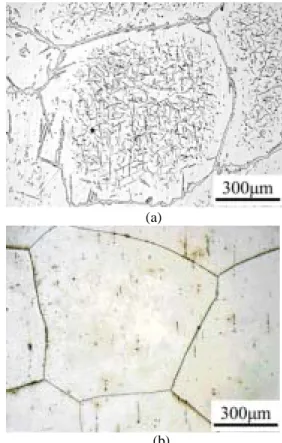
Figure 1(a) is an optical micrograph (OM) of the Fe-Mn-Al alloy heated at 1573 K in an argon atmosphere for 30 minutes and then air-cooled to room temperature.
There are a lot of needle-like precipitates distributed uniformly in BCC grains. Fig. 1(b) is the OM of the alloy with the same heat treatment as that in Fig. 1(a) but cooled using water-quenching. We observed only BCC grains without any precipitates in Fig. 1(b). The sizes of the BCC grains in Figs. 1(a) and (b) are similar. There are only BCC grains as shown in Fig. 1(b). Therefore, the high temperature phase of the Fe-Mn-Al alloy at 1573 K is BCC phase. The Al content of the present alloy is 0.4 wt.% less than the alloys in Fig. 1(b). However, in the specimens with air-cooling treatment shown in Fig. 1(a), there are lots of small needle-like Widmanstätten plates distributed within the BCC grain and intruding into the matrix from some of the grain boundaries with precipitate free zones.
For phase transformations in the Fe-Mn-Al alloys from high temperature cooling, earlier studies showed several types of FCC phases forming in the BCC matrix when Fe-Mn-Al alloys were cooled from 1573 K. These are 18R martensite and austenite Widmanstätten side-plates [13]. The morphology of the new phase is somewhat between 18R martensite and austenite Widmanstätten side-plate. However, the needle-like precipitates shown in Fig. 1(a) are probably neither 18R martensite nor austenite Widmanstätten side-plates. As the 18R martensite formed in the Fe-Mn-Al alloys during water-quenching from high temperatures, the needle-like precipitates should not be 18R martensite due to the cooling rate. No 18R martensite appeared in the as-quenched condition of the present Fe-Mn-Al alloy after the alloy was heated at 1573 K as shown in Fig. 1(b).
There is a slight resemblance between the morphologies of both phases, though. Some researchers found austenite Widmanstätten side-plates in Fe-Mn-Al alloys after heating the Fe-Mn-Al alloys to 1573 K and cooling them in air to room temperature [13]. These austenite Widmanstätten side-plates with large side-plate width could even be distinguished in the OM study. In the present study, the needle-like phase has a much smaller
plate-width in comparison to the austenite Widmanstätten side-plate. Therefore, the precipitate found in present study was probably not an austenite phase. As the morphology of the needle-like precipitates could slightly be distinguished from those of 18R martensite and austenite Widmanstätten side-plates, further studies to understand the crystal structure of the precipitate could be worthwhile.
(a)
(b)
Fig. 1. The OM of the Fe-Mn-Al alloy heated at 1573 K with argon protection for 30 minutes, and (a) air-cooled, or (b) water-quenched to room temperature
Fig. 2(a) shows the TEM bright-field micrograph of the Fe-Mn-Al alloy heated at 1573 K and cooled to room temperature. The needle-like precipitates appeared as side-plates in the TEM study; however, the width of the side-plates was much smaller than those of austenite Widmanstätten side-plates [13]. So far, the width of these two plate-precipitates found in Fig. 2(a) was almost the largest one in the TEM observation. To compare it with 18R martensite, the plate of needle-like precipitate was less straight than that of 18R martensite in the TEM studies [13]. The selected area diffraction patterns (SAD) taken at the area covered with the precipitate were shown in Figs. 2(b) and (c). Fig. 2(b) shows the SAD for the zone axis of the precipitate is along the [011]-direction which is quite similar to that of the FCC crystal structure along [011] zone axis, except small additional diffraction spots formed half way of the FCC 200 spots. These are 100 diffraction spots. From the SAD patterns, we knew the austenite phase was the parent phase of the new precipitate. Fig. 2(c) shows the SAD for the zone axis of the precipitate was along the [001]-direction which is
quite similar to that of the FCC crystal structure along the [001] zone axis, except small additional 100 diffraction spots. Due to the major diffraction spots similar to those of austenite phase in the Fe-Mn-Al alloys, we could draw a conclusion that the precipitate is a derivative phase of the FCC phase with a simple cubic Bravais lattice (SC).
(a)
(b)
(c)
Fig. 2. The TEM micrographs of the alloy with the same heat treatment as that in Fig. 1(a). (a) a TEM bright-field image, (b) a selected area diffraction (SAD) pattern taken on the area covering the precipitate along a [011]
zone-axis, and (c) the SAD pattern taken on the precipitate along the [001] zone-axis
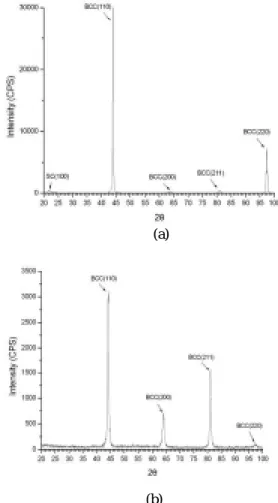
From the X-ray analyses, peaks from BCC or FCC crystal structure were observed for the specimens heated at 1573 K and air-cooling processes as shown in Fig. 3(a), while the SC (100) peak was observed but with a weak signal as indicated in Fig. 3(a). For the specimens with heat treatment at 1573 K and water-quenching processes,
only peaks from BCC crystal structure were observed in Fig. 3(b). The results were consistent with the observation in TEM and OM studies.
(a)
(b)
Fig. 3. The X-ray analyses of the Fe-Mn-Al alloy heated at 1573 K with argon protection for 30 minutes, and (a) air-cooled, or (b) water-quenched to room temperature.
We found that the sequence of the phase transformation of the Fe-Mn-Al alloy during cooling from high temperature is BCC Æ BCC + FCC. However, the FCC grains of the alloy have to nucleate and grow within the BCC grains during cooling from high temperature. When the alloy was heated at 1573 K and cooled to room-temperature, the high cooling rate of water-quenching could suppress the formation of the FCC phase and the BCC phase remained as-saturated at room temperature. The lower cooling rate of air-cooling could possibly also suppress the formation of the FCC phase;
however, somewhere between the BCC transforming into FCC a possible intermediate phase, an ordered FCC phase, might exist. Therefore, the ordered FCC appeared during an air-cooling process.In the studies of phase equilibria in Fe-Mn-Al ternary alloys no precipitate with the above crystal structure was observed [4]. However, one similar phase namedκ-phase with a simple cubic structure, L12, has been observed in the quaternary Fe-Mn-Al-C alloys. The minimum carbon content for precipitation of the κ -phase is 0.7 wt.% for the
formation of the κ-phase [16]. However, the κ-phase is carbide precipitating inside the FCC grains and with the shape of modulated particles. The new precipitates were not the κ-phase judging from the extremely low carbon content of present alloy and the morphology of the precipitate. The shape of the new phase is different from that of κ-phase. Therefore, from the TEM and X-ray studies, the needle-like precipitate belongs to a simple cubic Bravais lattice and probably L12 crystal structure.
4. Conclusions
We observed a new phase with a simple cubic crystal structure precipitated in the BCC grains of a Fe-Mn-Al alloy. The composition of the alloy is Fe-24.1 wt.%
Mn-7.6 wt.% Al-0.03 wt.% C. The heat treatment of the Fe-Mn-Al alloy was heating in a tube furnace at 1573 K with argon protection for 30 minutes and air-cooling to room temperature.
The precipitates with morphology of idmanstätten side-plate distributed uniformly in BCC grains and some precipitates along the BCC grain boundaries as grain boundary allotriomorphs. In TEM and X-ray analyses, we identified the crystal structure of the new phase as a simple cubic crystal structure and related it as an ordered FCC phase. This new phase is probably related to the L12 crystal structure and is found for the first time in Fe-Mn-Al alloys.
The phase at 1573 K is a single BCC phase and that at 1323 K is a dual phase with major BCC phase plus a small amount of FCC phase. The phase transformation during air-cooling from 1573 K could be the transformation of some of the BCC phase to FCC phase.
However, there is an intermediate phase and the BCC to FCC transformation shifted to being a BCC to ordered FCC transformation. Therefore, Widmantatten side-plates with SC crystal structure formed in the BCC grains during air-cooling from 1573 K.
Acknowledgements
The authors are pleased to acknowledge the financial support of this research by the National Science Council, Republic of China under Grant NSC92-2216-E-011-027.
Reference
[1] P.R.S. Jackson and G.R. Wallwork, Oxidation Metals, 21, 135 (1984).
[2] J.G. Duh and C.J. Wang, J. Mat. Sci., 25, 2063 (1990).
[3] V.G. Rivlin, Int. Met. Rev., 17, 309 (1983).
[4] X.J. Liu, S.M. Hao, L.Y. Xu, Y.F. Guo, and H. Chen, Metall. Trans. A, 27A, 2429 (1996).
[5] W.C. Cheng, H.Y. Lin, and C.F. Liu, Mat. Sci. and Eng. A, 335, 82 (2002).
[6] K.H. Hwang, C.M. Wan, and J.G. Byrne, Scripta Metall., 24, 979 (1990).
[7] S.K. Chen, K.H. Hwang, C.M. Wan, and J.G. Byrne,
Scripta Metall., 24, 151 (1990).
[8] K.H. Hwang, W.S. Yang, T.B. Wu, C.M. Wan, and J.G.
Byrne, Acta Metall. 39(5), 825 (1991).
[9] W.S. Yang, K.H. Hwang, T.B. Wu, J.G. Byrne, and C.M. Wan, Scripta Metall., 24, 1221 (1990)
[10] C.H. Chao and N.J. Ho, Scripta Metall., 26, 1863 (1992).
[11] W.B. Lee, F.R. Chen, S.K. Chen, G.B. Olson, and C.M. Wan, Acta Metall., 43, 21 (1995).
[12] H.Y. Chu, F.R. Chen and T.B. Wu, Scripta Metall., 33(8), 1269 (1995).
[13] K.H. Hwang, C.M. Wan, and J.G. Byrne, Mat. Sci.
and Eng. A, 132, 161 (1991).
[14] W.C. Cheng and H.Y. Lin, Mat. Sci. and Eng. A, 323, 462 (2002).
[15] W.C. Cheng, C.F. Liu and Y.F. Lai, Scripta Metall., 48, 295 (2003).
[16] M.C. Li, H. Chang, P.W. Kao, D. Gan, Mat. Chem.
Phys., 59, 96 (1999).