國立臺灣大學電機資訊學院資訊工程學系 碩士論文
Graduate Institute of Computer Science and Information Engineering College of Electrical Engineering and Computer Science
National Taiwan University Master Thesis
基於同儕式網路之異質社群網路整合研究 P2P-iSN: A Peer-to-Peer Network for Integration of
Heterogeneous Social Networks
鍾百俊 Pai-Chun Chung
指導教授:林風 博士 Advisor: Phone Lin, Ph.D.
中華民國一百零一年七月
July, 2012
Acknowledgement
兩年的碩士生涯轉眼間就過去了,又到了畢業的時候。首先我要感謝我的指導老 師,林風教授。在兩年的碩士生涯中,林風老師扮演著亦師亦友的角色,讓我學 到做研究的熱情以及態度,並且順利完成了這篇論文。接著要特別感謝顧磊博 士,在數學分析上提供我許多寶貴的意見以及相關的參考資料,讓我能夠順利完 成。同時,我 也非常感謝林一平教授、方玉光教授、周勝鄰博士以及黃天立博士 擔任學生的口試委員,並且對本篇論文提供許多良好的建議,使得這篇論文更加 完整。
接著我要感謝與我在這兩年一起奮鬥的實驗室同仁們。懷磊學長、啟維學 長、家朋學長、有倫學長、亭佑學姊、厚鈞學長、思適學長、家綸學長、 宗哲學 長、坤豐、冠銘、振翔、明峰、彥婷、恩豪,與你們相處的點滴永難忘懷,在你 們的陪伴下,讓我十分快樂的度過這段研究的時光。
最後我要感謝我的家人,我的父母與姊姊,在這兩年中給我全力的支持與鼓 勵,讓我可以全心全意的認真讀書,順利地拿到碩士學位。
i
ii
Chinese Abstract
社群網路快速的發展吸引了學者研究和分析大量的社群網路資料,而異質社群網 路也啟發學者發展出新的應用程式來整合不同社群網路資源,以提供更多社群網 路服務。 本篇研究著重於社群關係整合上,我們使用同儕式網路架構來整合不同 的社群網路關係,稱作(P2P-iSN)。在P2P-iSN上透過Global Relationship Model計算 出使用者彼此在社群網路上的關係強度,並且根據關係強度我們提出(i-Search)機 制尋找出一條有意義的社群關係路徑來連結任兩個使用者。 這些特點可用來開發 出許多應用程式如信任模組以及社群資源分享,使我們更加了解使用者彼此在異 質網路上的社群網路關係,並且能夠設計出更多以人為本的應用程式。
關 關
關鍵鍵鍵字字字(Keywords): 全域社群關係(Global social relationship)、異質社群網路(Heterogeneous social network)、同儕式網路(Peer-to-peer network)、關係強度(Relationship strength)
iii
iv
English Abstract
The unprecedented growth and influence of Social Network Sites (SNSs) have opened the possibility for researchers to explore an abundance of social and behavioral data. A landscape of heterogeneous SNSs further sparks research innovations to develop methods and applications that integrate resources and offer more seamless services across SNSs.
Specifically aiming at the integration of social relations data, a much less studied subject, we propose a set of tools to aggregate social relations across multiple SNSs (P2P-iSN), calculate relationship strength between users (Global Relationship Model), and offer a so- cial path that indicates how any two users are meaningfully connected in heterogeneous SNSs (i-Search mechanism). These key features allow for many future application de- velopments, such as improved trust/prestige metrics and integrated content-sharing. With these tools that enhance our understanding of social relations in this heterogeneous SNS landscape, SNS developers can also design more user-centric applications and future SNS components.
Keywords: Global social relationship; Heterogeneous social network; Peer-to-peer net- work; Relationship strength;
v
vi
Contents
Acknowledgement i
Chinese Abstract iii
English Abstract v
1 Introduction 1
2 Implementation of P2P-iSN 5
2.1 The Peer Node . . . 5
2.2 The Index Peer Node . . . 9
2.3 Turning on A Peer Node . . . 11
3 The Three Functions in the PeerAgent Class 13
3.1 The Update Tvalue() function and Update FriendList() function . . . 13
3.2 i-Search Mechanism . . . 15
vii
viii CONTENTS
4 Analytical Model 19
5 Performance Evaluation 25
6 Conclusions 29
Bibliography 33
List of Figures
1.1 System Architecture of P2P-iSN . . . 2
2.1 An Example of Friend List . . . 6
2.2 The Software Architecture of P2P-iSN . . . 8
2.3 An Example of GlobalID List . . . 10
2.4 The Message Flow for The Login Procedure . . . 11
5.1 Effects of α (n = 1000; m = 6) . . . 26
5.2 Effects of m (n = 1000; α = 0.4) . . . 26
6.1 (a) Facebook Graph API (b) Twitter REST API (c) Functionality of P2P-iSN 31 6.2 (a) Direct message communication with friends (b) Search for the rela- tionship between two users (c) The search result for the request from a friend (d) The request passed to user’s friend . . . 32
ix
x LIST OF FIGURES
List of Tables
xi
xii LIST OF TABLES
Chapter 1
Introduction
Hundreds of Social Network Sites (SNSs) have gathered users together and changed how users interact with one another. Although SNSs offer different services, one key feature shared among SNSs is how they are built around users and users pre-existing social net- works [3, 11]. Furthermore, this is a landscape of heterogeneous SNSs, where a user carries multiple SNS accounts, interacts with contacts from different social networks, publishes and accesses different web content, and shares the content within each SNS community. With growing influence and complexity of SNSs, researchers are proposing methods to connect users and aggregate data across SNSs so that each SNS no longer stands alone. For example, the study [10] summarized how social network connect ser- vices allow users to leverage their information in multiple SNSs, from using single id to access multiple SNS accounts to publishing content simultaneously on multiple SNSs.
However, the aggregation of social relations data has been much less studied, and this is the main purpose of our paper. We propose a model to define a large-scale and aggregated
1
2 CHAPTER 1. INTRODUCTION
Google User Twitter User Facebook User Index Peer
A Peer node
User a
User b
na nb
Figure 1.1: System Architecture of P2P-iSN
set of users social relations across heterogeneous SNSs.
First of all, within an SNS, if user b is in user a’s friend list, we define that there is a directional social link denoted by “a → b” between user a and user b. Building along these directional links, users in SNS form a social graph [1]. When there exists a social path between two users in an SNS, we define that there is a “relationship” between the two users. Secondly, we define “global relationship” as the social path between two users across different SNSs. These are basic notations that are applied and elaborated in our model. By identifying “global relationship” among users over heterogeneous SNSs, this paper aims to open the possibility for users from different SNSs to interlink their vari- ous networks and communicate with a larger audience more openly. A better evaluation of this heterogeneous SNS landscape can also help SNS developers design user-centric applications and design future SNS components [11].
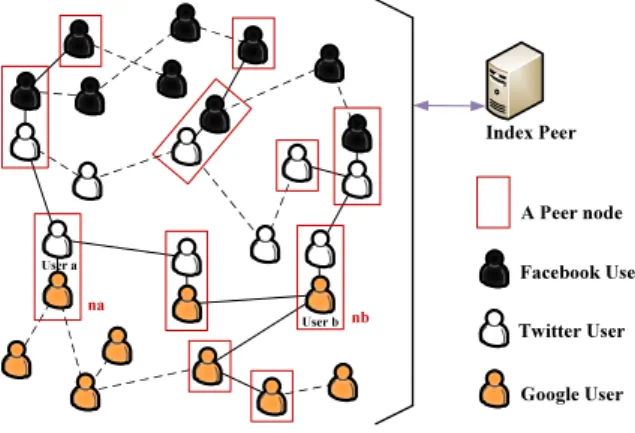
In this paper, we first propose a peer-to-peer (P2P) network, namely P2P-iSN, to in- tegrate heterogeneous SNSs as shown in Figure 1.1. P2P-iSN consists of two kinds of nodes: Peer node and Index Peer node. A Peer node is installed on an end-device (e.g.,
3 PDA or desktop) for the user to access SNSs, and its main functionality is to integrate heterogeneous SNSs. The user of a Peer node may register to one or more SNSs on his end-device, and login to one or more SNSs at the same time. To associate these different accounts of the same user from heterogeneous SNSs, a unique user ID is required. The concept is known as the OpenID1concept in [6]. A unique user ID can be some kind of ID information like user’s cell phone number or email address. When the Peer node is turned on, it reports the online status, which includes the ID and IP address of the Peer node, to the Index Peer node. Upon receiving the online status, the Index Peer node up- dates the online status for the Peer node. If a user a of the Peer node na and a user b of the Peer node nb are on each other’s friend list in a SNS, and na and nb are turned on, these two online Peer nodes can communicate with each other by using the corresponding IP addresses queried from the Index Peer node. The Peer nodes establish social paths among users from different SNSs and build our so-defined “global relationship”.
With the peer-to-peer network architecture, P2P-iSN allows users from heterogeneous SNSs to communicate without involving the SNS, and the integration is independent from a specific SNS. In other words, the integration does not incur overhead to the SNSs. Then applying P2P-iSN, we propose a Global Relationship Model to identify global relation- ship strength between two users from heterogeneous SNSs. Based on the Global Rela- tionship Model, we propose a searching mechanism, namely i-Search, to find the social
1OpenID is a protocol that authenticates a user’s digital identity. A user could register on any one of the
Identity Providers, which are websites that handle user authentication, including FacebookT M, GoogleT M and MySpaceT M. Once the register describes the identity of the user, the user, carrying the same ID, can browse all websites that support OpenID.
4 CHAPTER 1. INTRODUCTION path between two users from heterogeneous SNSs. An analytical model is proposed to approximate the performance of the i-Search mechanism in terms of the “path found”
probability with details to be elaborated later. We also conduct simulation experiments to validate the analysis results.
The rest of the paper is organized as follows: Chapter 2 describes the implementa- tion of P2P-iSN. In Chapter 3, we detail the three functions in the PeerAgent class. In Chapter 4, we describe the analytical model. Chapter 5 is the performance evaluation. We conclude our work in Chapter 6. Some snapshots of P2P-iSN can be found in Appendix A.
Chapter 2
Implementation of P2P-iSN
P2P-iSN consists of two kinds of nodes: the Peer node and the Index Peer node. The main functionality of the Peer node is to integrate the heterogeneous SNSs through the Friend List maintenance (to be elaborated later). The Peer nodes communicate with each other directly and form a peer-to-peer network. The Index Peer node maintains the status and the IP address of the Peer node. The design and implementation for the two kinds of nodes are elaborated in the following subsections.
2.1 The Peer Node
The Peer node is installed on an end device (e.g., PDA or desktop) used by the user to access the SNS. A user may register to one or more SNSs on his end device, and login to one or more SNSs at the same time. Because a user may use different IDs in different SNSs, to associate these different accounts of a user, a unique user ID is required. The
5
6 CHAPTER 2. IMPLEMENTATION OF P2P-ISN
John_f SN Type T Value Timestamp Online
0910456 0.9 11'1211 On_12'0215_1430
John
(a) Jenny's Phone Book (b) Jenny's Friend List
John_t 0910456 Twitter 0.85 12'0214 Off_12'0214_1430
Bob_f 0910123 Facebook 0.6 12'0110 On_12'0209_1000
Bob
0910456 0910123
140.112.5.5IP 140.112.6.6
12345 11100 Null Null Social Network Information
Personal Information Address Information
Email [email protected] [email protected] [email protected] Phone No.
Phone No. ID
ID Port
Figure 2.1: An Example of Friend List
concept is known as the OpenID concept in [6]. The unique user ID can be a user’s cell phone number or email address. In this paper, we use the cell phone number as an example for the unique ID.
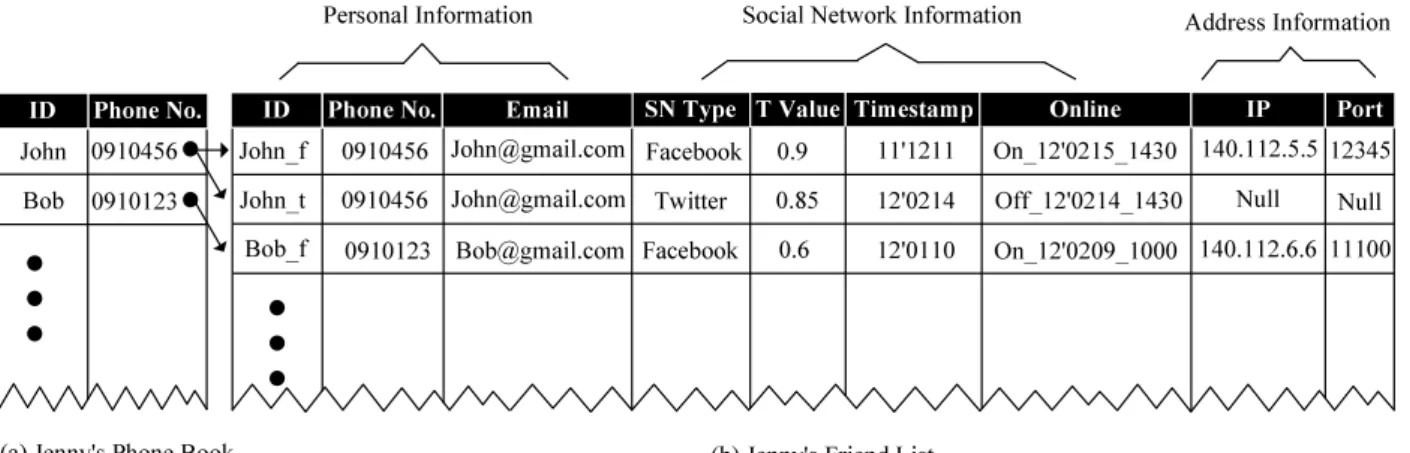
The phone book in a Peer Node (e.g., Jenny’s end device) are used as the base to integrate the heterogeneous SNSs. Take (1) in Figure 2.1 (a) for example. Jenny has a friend John with phone number “0910456”.
We maintain a database, Friend List, to store the information about the user’s friends.
Figure 2.1 (b) shows the format of a Friend List. The Friend List consists of three kinds of information: Personal Information, Social Network Information, and Address Infor- mation.
Personal Information stores the IDs of the user’s friends, including the ID in SNS, phone number, and email address. In different SNSs, users may use different IDs.
For example, Jenny’s friend, John, uses the ID, “John f”, on FacebookT M (see (1) in Figure 2.1 (b)) and use the ID, “John t”, on TwitterT M (see (2) in Figure 2.1
2.1. THE PEER NODE 7 (b)). The phone number associates the entry in the phone book with the entry in the Friend List. An entry in the phone book may be mapped to multiple entries in the Friend List.
The Social Network Information consists of four fields, including SN Type, T Value, Timestamp, and Online. The SN Type indicates which SNS the friend has reg- istered. For example, in (1) in Figure 2.1 (b), Jenny’s friend, John, registered to FacebookT M using ID “John f”. The T Value stores the “trust value” which repre- sents how much Jenny “trusts” John. It can be manually set by Jenny or calculated based on the interaction between Jenny and John on the SNS. We detail it an the next chapter. For example, in (1) in Figure 2.1 (b), the T Value for Jenny← John on FacebookT M is 0.9. The Timestamp field stores the time when the T Value was calculated. The Online indicates that whether the friend is on the SNS now or not and when John logins to the FacebookT M last time. If the value of Online is “On”
(“Off”), the time is when John logins (logouts) FacebookT M. For example, in (1) in Figure 2.1 (b), “On 12’0215 1430” implies that John f logins FacebookT M at 14:00 on Feb. 15, 2012, and is now on FacebookT M.
The Address Information stores the IP address and the port number of the friend’s end- device. This information is valid when the Peer node of the friend is turned on.
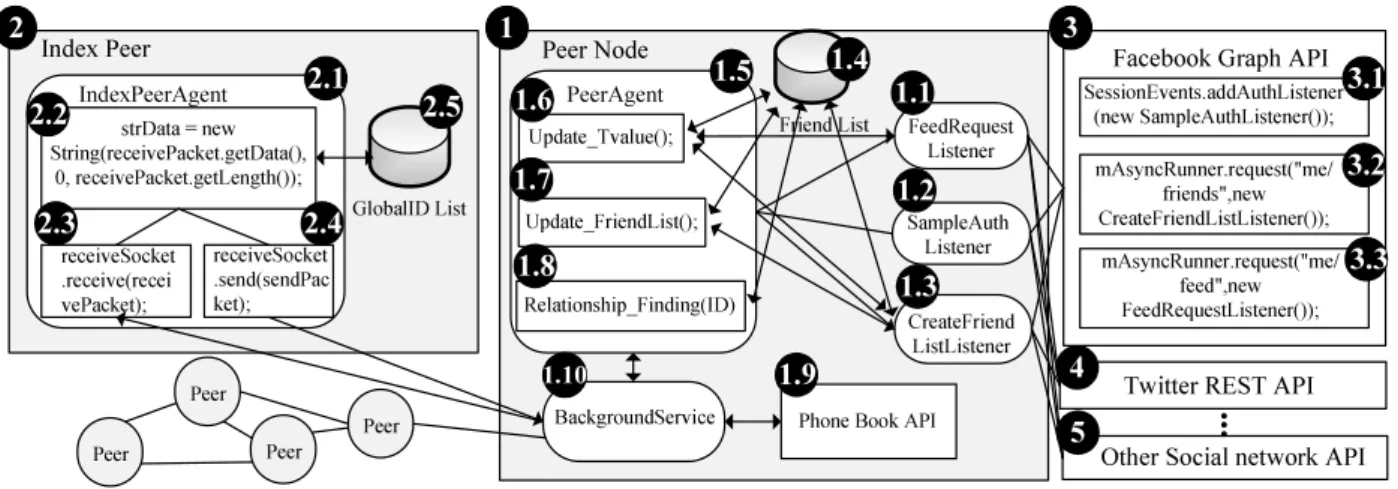
Figure 2.2 (1) shows the software architecture of the Peer node. The Peer node con- sists of five classes and a function, PeerAgent (see Figure 2.2 (1.5)), FeedRequestLis- tener(see Figure 2.2 (1.1)), SampleAuthListener (see Figure 2.2 (1.2)), CreateFriendListLis- tener (see Figure 2.2 (1.3)), BackgroundService (see Figure 2.2 (1.10)), and a Phone
8 CHAPTER 2. IMPLEMENTATION OF P2P-ISN
Peer Node Index Peer
BackgroundService GlobalID List
FeedRequest Listener
CreateFriend ListListener SampleAuth Listener
...
Facebook Graph API
mAsyncRunner.request("me/
feed",new FeedRequestListener());
mAsyncRunner.request("me/
friends",new CreateFriendListListener());
SessionEvents.addAuthListener (new SampleAuthListener());
Other Social network API Twitter REST API Phone Book API
1 3
1.1
1.2
1.3 2
1.9
5 4 strData = new
String(receivePacket.getData(), 0, receivePacket.getLength());
2.2
receiveSocket .receive(recei vePacket);
2.3
PeerAgent
Relationship_Finding(ID) Update_FriendList();
Update_Tvalue();
1.6 1.5
1.7
IndexPeerAgent
Peer
Peer Peer Peer
Friend List 2.1 1.4
2.5
1.8
1
1.10 receiveSocket
.send(sendPac ket);
2.4
3.1
3.3 3.2
Figure 2.2: The Software Architecture of P2P-iSN
Book API (see Figure 2.2 (1.9)). The details of the implementation for the five classes are given below:
• The FeedRequestListener class (see Figure 2.2 (1.1)) is responsible to get the
status of the user’s social activities on SNS by invoking the API, mAsyncRun- ner.request(“me/feed”, new FeedRequestListener()) (see Figure 2.2 (3.3)), provided by the SNS (e.g., Facebook Graph API [7]).
• The SampleAuthListener class (see Figure 2.2 (1.2)) is responsible to authenticate
a user when he turns on the Peer node and login an SNS. The SampleAuthLis- tener class is implemented by using the API SessionEvents.addAuthListener(new SampleAuthListener()) (see Figure 2.2 (3.1)) provided by the SNS.
• The CreateFriendListener class (see Figure 2.2 (1.3)) is responsible to get the IDs
of the user’s friends in an SNS by invoking the API, mAsyncRunner.request(“me/friends”, new CreateFriendListListener()) (see Figure 2.2 (3.2)), and maintain the user’s Friend List.
2.2. THE INDEX PEER NODE 9
• The BackgroundService class (see Figure 2.2 (1.10)) is responsible for the mes-
sage exchange between two Peer nodes and between the Peer node and the Index Peer node. The class provides the communication channel among Peer nodes for the i-Search mechanism. To be more specific, a Peer node uses this class to request another Peer node to execute the iSearch algorithm. The Peer node uses this class to inform his online status to the Index peer.
• The PeerAgent is the main class (see Figure 2.2 (1.5)). There are three func-
tions defined in PeerAgent including the Update Tvalue() function (see Figure 2.2 (1.6)), the Update FriendList() function (see Figure 2.2 (1.7)), and the Relation- ship Finding() function (see Figure 2.2 (1.8)). The Update Tvalue() function and the Update FriendList() function are used to respectively update the T Value and Online field in the Friend List. The Relationship Finding() function implements the iSearch algorithm. We detail the three function in the next chapter.
• The Phone Book API is used to fetch the user’s phone book friends and is provided
by Android API [5]. It is executed in the Login procedure and will be elaborated later. By using the phone number, we can identify two or more accounts of the same user to integrate the different SNSs.
2.2 The Index Peer Node
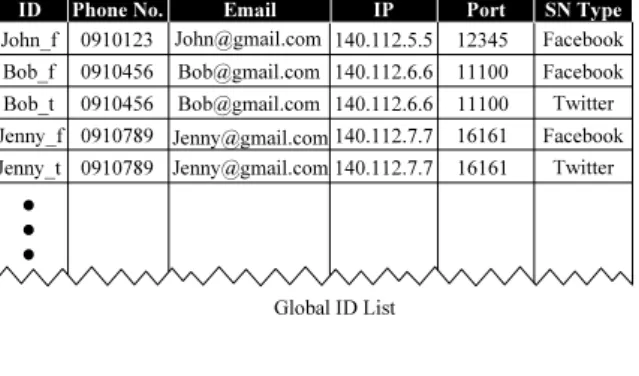
The Index Peer node is a database that maintains the GlobalID List with the format as shown in Figure 2.1 (b). For each online Peer node, an entry is created in the GlobalID
10 CHAPTER 2. IMPLEMENTATION OF P2P-ISN
0910123
John_fID Phone No. IP Port
140.112.5.5 12345
Global ID List 0910456
Bob_f 140.112.6.6 11100
Bob_t 0910456 140.112.6.6 11100
Jenny_f 0910789 140.112.7.7 16161
SN Type Facebook Facebook Facebook Twitter Twitter 140.112.7.7
Jenny_t 0910789 16161
Email [email protected] [email protected] [email protected] [email protected] [email protected]
Figure 2.3: An Example of GlobalID List
List for the Peer node. Similar to the Friend List, the GlobalID List consists of three kinds of information: Personal Information, Social Network Information, and Address Information for an online user.
The Personal Information stores the IDs of a user, including the ID in SNS that used by the user to login an SNS, phone number, and email address. Note that a user may turn on a Peer node by logining into one or more SNSs at the same time, there may be one or more SNS IDs for the same user (i.e., multiple entries for the same user exist in the GlobalID List). These multiple entries are linked used the phone number (or email address) of the user.
The Social Network Information stores the SN Type indicating which SNS the user lo- gins currently (i.e., online).
The Address Information stores the IP address and the port number of the Peer node turned on by the user. This information is valid when the Peer node is turned on.
Figure 2.2 (2) shows the software architecture of the Index Peer node. There are one main class IndexPeerAgent(see Figure 2.2 (2.1)) and a database GlobalID List (see
2.3. TURNING ON A PEER NODE 11
Peer node Social
network Site
Index Peer node 1. Authentication_Request
(UserID, Password)
Authentication_Response2. 3. User_Online_Message (ID, SN type, PhoneNumber) 4. FriendList_Request (ID)
5. FriendList_Response
6. Friends_
OnlieStatus_Request (ID) 7. Friends_OnlineStatus_
Response 8. T Value
_Parameter_Request(ID) 9. T Value _Parameter_Request
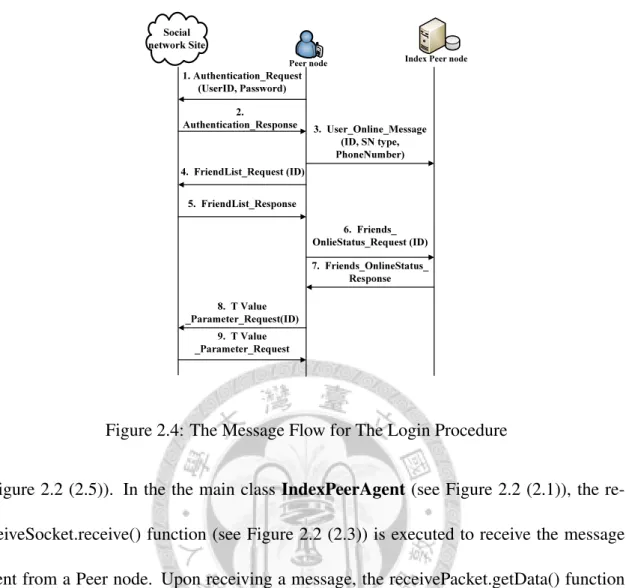
Figure 2.4: The Message Flow for The Login Procedure
Figure 2.2 (2.5)). In the the main class IndexPeerAgent (see Figure 2.2 (2.1)), the re- ceiveSocket.receive() function (see Figure 2.2 (2.3)) is executed to receive the message sent from a Peer node. Upon receiving a message, the receivePacket.getData() function (see Figure 2.2 (2.2)) is invoked to get the information carried in this message. The receiveSocket.send() function (see Figure 2.2 (2.4)) is responsible to send the response message to a Peer node.
2.3 Turning on A Peer Node
This section describes the execution of a Peer node. When a user turns on the Peer node on his end device, the Login procedure. Figure 6.1 illustrates the message flow for the Login procedure with the following steps:
12 CHAPTER 2. IMPLEMENTATION OF P2P-ISN Step 1. When a user turns on the Peer node, a SampleAuthListener class is created, and the SessionEvents.addAuthListener(new SampleAuthListener()) function is exer- cised to authenticate the user in an SNS.
Step 2. If the authentication is successful, the SNS responses the user SNS ID in the return of the SessionEvents.addAuthListener() function.
Step 3. The Peer node creates a BackgroundService class to send a message (i.e., the User Online Message message) carrying the user’s ID, Phone No., Email, IP ad- dress, port number, and SN Type, to the Index Peer. The Index Peer creates an entry for the user in the global ID list.
Steps 4 and 5. The Peer node creates a CreateFriendListener class (i.e., the FriendList Request and FriendList Response message pair) to get the IDs of the user’s friends from the
SNSs, and creates an entry for each friend in the Friend List.
Steps 6 and 7. The Peer node uses the BackgroundService class to send a message (i.e., the Friends OnlineStatus Request and Friends OnlineStatus Response mes- sage pair) to the Index Peer node to query the online friends of the user.
Steps 8 and 9. The Peer node creates a FeedRequestListener class to collect the social activity information to calculate the T value from the SNS by exchanging the T Value Parameter Request the T Value Parameter Response message pair.
Chapter 3
The Three Functions in the PeerAgent Class
Here we detail the three functions implemented in the PeerAgent class and explain the i-Search Mechanism used in the Relationship Finding() function.
3.1 The Update Tvalue() function and Update FriendList() function
The execution of the Update Tvalue() function is initiated by a user i and first it calls the mAsyncRunner.request in the Facebook Graph API to retrieve the JSON object [8], which contains the user i’s Facebook information. We define three parameters Nm,u, Nr,u, and Nl,uwhere Nm,udenotes “the total number of message that a friend u posts on i’s wall”, Nr,u denotes “the total number of message that a friend u replies to i”, and Nl,u denotes
13
14 CHAPTER 3. THE THREE FUNCTIONS IN THE PEERAGENT CLASS
“the total number of “Likes” a friend u gives to i”. The FeedRequestListener class parses the JSON object to obtain the three parameters Nm,u, Nr,u, and Nl,u.
Let Ti,u denote the T value that a user i gives to his friend u. We define the T value calculation function as
Ti,u = Wm∗ min{Nm,u, θm} θm
+Wr∗ min{Nr,u, θr} θr
+Wl∗ min{Nl,u, θl} θl
(3.1)
where Wm, Wr, and Wl are the weight of Nm,u, Nr,u, and Nl,u, respectively. θm, θr, and θl are the threshold for Nm,u, Nr,u, and Nl,u, respectively. If Nm,u > θm, the user is considered as a closed friend. The same applies to θrand θl. In our study, we set Wm, Wr to 0.4 and Wlto 0.2. We set the threshold θm, θr to 25 and θlto 50.
The concept of the T value calculation function is from the study [15]. The T value calculation function in the study is used in e-commerce communities and they computes the trust value of a peer u (i.e., a user) by a weighted average of the degree of satisfaction u receives for each transaction. We apply this concept to our P2P-iSN work and design
a similar equation (3.1). We take the parameters (i.e., Nm, Ne, and Nl) of a user’s SNS information which contains the interaction information with friends, and weight these parameters to derive an average interaction score that represent the trust value of the friend.
The Update FriendList() function is invoked by a user and it sends a list of friend’s ID to the Index Peer through the BackgroundService class. The Index Peer returns the IDs which are found in the GlobalID List. These IDs indicate which friends are online.
After receiving these IDs, the “Online” field of the corresponding IDs in the Friend List are set to “On”, while the others are set to “Off”. We use the “Polling” concept to update
3.2. I-SEARCH MECHANISM 15 the Friend List, which is mean that, we do not update the Friend List when user is online or offline because this will enhance Index Peer node overhead.
3.2 i-Search Mechanism
In this chapter, we propose an i-Search mechanism to find a social path between two Peer nodes in P2P-iSN. Though searching in a social graph has been studied in the previous works [16], most of these studies considered a centralized searching, that is, a social graph is well maintained in a central node. Fewer studies have addressed searching in a P2P social network, which is the main focus of this paper.
The concept of the i-Search mechanism is similar to the flooding search that has been widely adopted in the large network studies (e.g., [2]). To convey this social path, we define that a global relationship exists between user 1 and user L + 1. We propose a function Z(P) to measure the strength of the global relationship between user 1 and user L + 1, which is defined by
Z(P) =
1, if L = 0;
∏L i=1
Ti,i+1, otherwise (i.e., L≥ 1).
(3.2)
The i-Search mechanism establishes the social path link by link. When a link is added into a path, global relationship strength is calculated for the new path using the Z(·) function in (3.2). If the global relationship strength for the new path is below a threshold
16 CHAPTER 3. THE THREE FUNCTIONS IN THE PEERAGENT CLASS
∆, the establishment of the social path stops.
Note that ∆ is used to guarantee that the global relationship strength for the con- structed path is strong enough so that users are motivated to use the global social rela- tionship for further SNS applications. We set up ∆ based on the research results in the sociology study [13]. As mentioned in [13], on average, the Ti,jis0.5. If we consider a path P with length|P| = 4, then using the Z(·) function in (3.2), the global relationship strength for the path is Z(P) = 0.54 = 0.0625, which is considered a very weak relation- ship. Therefore, in the performance study later, we set ∆ = 0.53 = 0.125. In other words, it is likely that the social path (searched by the i-Search mechanism) has path length no larger than 3. As mentioned in [9], with path length no larger than 3, the flooding search is considered with low complexity. This is the main reason why we use the flooding search.
Details of the i-Search mechanism are given below: The Index Peer node maintains the online status (including the ID and IP address of the Peer node) for the online Peer nodes. A friend list is maintained in the Peer node, which stores the online information for all friends of the Peer node. To simplify our description, we use “the friend b of a Peer node a” to imply that the social link a→ b exits.
When a Peer node is turned on, it reports its online status to the Index Peer node, and receives the latest online status for his friends from the Index Peer node. With the latest online information, the Peer node can determine whether his friend is online (i.e., a Peer node is turned on). A online Peer node can communicate with his online friends directly. We run a recursive algorithm, the iSearch algorithm, in the Peer node as shown in Algorithm 1. In this algorithm, the set G is the friend list of a Peer node. The input
3.2. I-SEARCH MECHANISM 17 parameter s stores the ID of the Peer node who calls the iSearch algorithm, and r is the ID of the Peer node to be searched. Initially, we set P← ∅.
Algorithm 1: iSearch Input: s, r, P, Z(P) Output: Pnew, Z(Pnew)
1 foreach v : v∈ G- {P} do
2 if v = r then
3 Pnew ← P ∪ {s → v};
4 Z(Pnew)← Z(P)F (s, v);
5 return;
6 else if v is online, and Z(P)F (s, v) > ∆ then
7 v.iSearch(v, r, P∪ {s → v}, Z(P)F (s, v));
8 else if v is off-line, or Z(P)F (s, v)≤ ∆ then
9 quit;
10 end
11 end
Consider the scenario where the Peer node a searches the Peer node d. A user a can
“request” his friend b to execute the iSearch algorithm (i.e., b.iSearch() in Algorithm 1) through the direct communication if b is online. That is, the directional social path P is established along the online Peer nodes.
Note that the i-Search mechanism may find multiple global social relationships be- tween two Peer nodes. For the Peer node who triggers the i-Search mechanism, he can
18 CHAPTER 3. THE THREE FUNCTIONS IN THE PEERAGENT CLASS use the one with the largest global social relationship strength. Furthermore, we can speed up the execution of the i-Search mechanism by caching the searching results on the Peer nodes. To simply our discussion, we do not include the study for the effects of the cache in this paper.
Chapter 4
Analytical Model
All Peer nodes and the corresponding social links in P2P-iSN form a social graph. A Peer node may be turned on or turned off during the execution of i-Search, and the iSearch re- quest can reach the friends only when the friends are online. In other words, a social link a→ b does not exist if Peer node a or b is turned off (i.e., off-line). Therefore, the phys-
ical network topology of P2P-iSN changes dynamically when the i-Search mechanism is being executed.
Let Pf be the “path found” probability that a directional social path exists when a Peer node a executes the i-Search mechanism to find a Peer node d. The online status of a Peer node affects the Pf probability significantly. In this chapter, we propose an analytical model to obtain an approximation value for Pf.
To simplify our discussion, we assume that the behaviors of the Peer nodes in P2P- iSN are i.i.d. As discussed in Chapter 3, in this paper, we set ∆ = 0.53 = 0.125 in the i-Search mechanism. In this analytical model, we use the constraint |P| ≤ 3 instead of
19
20 CHAPTER 4. ANALYTICAL MODEL
∆ ≤ 0.125, i.e., the i-Search mechanism quits when the path length reaches 3, and no global social path is found.
Assume that a Peer node is turned on (i.e., online) for a time period x (with the density function fx(·) and mean 1/µx), and then it is turned off (i.e., off-line) for a time period y (with the density function fy(·) and mean 1/µy). The Peer node alters between x and y. Suppose that iSearch request arrivals to a Peer node form a Poisson process. Then ac-
cording to the alternating renewal process [12], the probability ponthat an iSearch request arrives when a Peer node is online can be obtained by
pon = E[x]
E[x] + E[y] = µy
µx+ µy (4.1)
Before the derivation, we generate the social graph for P2P-iSN using the W.S. model [14]
with the three parameters α (i.e., the rewire probability), n (i.e., the total number of Peer nodes in P2P-iSN), and m (i.e., the average number of friends of a Peer node). With the setup:
0 < α < 1 and n≫ m ≫ ln n ≫ 1 (4.2)
the W.S. model has the small-world property, including short average length and high clustering. The small-world property can also apply to SNS [11]. The details of the W.S.
model can be found at [14].
Let Ntdenote the expected number of the Peer nodes that receive the iSearch request message during the execution of the i-Search mechanism. Consider the scenario that the Peer node a executes the i-Search mechanism to search a directional social path to d. If d belongs to one of the Ntpeer nodes, then the directional social path from a to d is found.
21 Therefore, we have
Pf = Nt
n . (4.3)
We derive Nt as follows. There are two types of nodes including “far-nodes” and
“near-nodes” defined in the W.S. model. The far-nodes represents the Peer nodes that have social links after rewiring with probability α. The near-nodes represents the Peer nodes that have social links initially.
In the social graph of the P2P-iSN, let Nf and Nnrespectively be the expected num- bers of far-nodes and near-nodes that receive an iSearch request when the i-Search mech- anism is executed. Then we have
Nt = Nf + Nn.
The Nf and Nn are obtained as follows. One round means that the iSearch request is delivered using a directional social link a→ b when both Peer nodes a and b are online.
In the i-Search mechanism, there are at most three rounds to construct a directional social path. In each round, a Peer node that triggers the round can be either a far-node or near- node:
Case 1: The Peer node that triggers the round is a far-node. In this case, there are on average mαpon far-nodes and m(1− α)ponnear-nodes that can receive the iSearch request.
Case 2: The Peer node that triggers the round is a near-node. Because there is high probability that the near-node sends the iSearch request to another near-node that
22 CHAPTER 4. ANALYTICAL MODEL has received this iSearch request previously, we consider that only far-nodes can receive the iSearch request for the approximation. In this case, there are on average mαponfar-nodes that can receive the iSearch request.
We use the following interative procedure to calculate the Nf and Nn.
Procedure 1.
Input parameters: α, m, µx, µy.
Output measures: Nf, Nn, Nt.
Step 1. Select initial values, Nf ← 1, Nn← 0, and round ← 0;
Step 2. Nf ← mα (
µy
µx+ µy )
(Nf+Nn); Nn← m(1−α) (
µy
µx+ µy )
Nf; round++.
Step 3. If (round≤ 3) then go to Step 2. Otherwise, go to the next step.
Step 4. Nt ← Nf + Nn; return.
The analytical model is validated by simulation experiments of a discrete event-driven simulation model, which has been widely adopted to simulate the mobile communications network in several studies (e.g., [4]). The simulation model simulates the online/off-line behavior of a Peer node and the behavior of the i-Search mechanism.
In the simulation model, we adopt the discrete event-driven approach in our simulation model, which has been widely applied in many networking studies (e.g., [4]). In our simulation model, we define five types of events listed below:
23
• The QUERY ARRIVAL event represents that an online Peer node starts the i- Search mechanism to find another Peer node.
• The QUERY FORWARD event represents that an online Peer node sends a iSearch request to his online friend.
• The QUERY RESPONSE event represents that an online Peer node returns the
results (i.e., a path is found) for the execution of the iSearch algorithm to the Peer node who sends the iSearch request.
• The ONLINE event represents that a Peer node is turned on.
• The OFFLINE event represents that a Peer node is turned off.
We maintain a timestamp tsto indicate the time when an event occurs. The events are in- serted into an event list and deleted/processed from the list in a non-decreasing timestamp order. During execution of the simulation, a simulation clock tc is maintained, which indicates the progress of simulation. The following variables are used in the simulation model:
• Nrindicates the number of rounds that have been executed for an iSearch request.
• a is the ID of the Peer node who triggers the iSearch mechanism.
• d is the ID of the Peer node to be found.
• l indicates whither a social link exists between two Peer nodes.
We use the following counters in our simulation model to calculate the output measure:
24 CHAPTER 4. ANALYTICAL MODEL
• The Cf counter counts the total number of finding a path successfully.
• The Cqcounter counts the total number of the QUERY ARRIVAL events that have been processed.
We repeat the simulation runs until Cq exceeds 100, 000 to ensure the stability of the simulation results. Then we obtain the output measure:
Pf = Cf Cq
Figures 5.1 and 5.2 show the comparison between the analytical and simulation re- sults, whose details of the parameter setups are described in chapter 5. The figures indi- cates that the analysis results approximate the simulation results well.
Chapter 5
Performance Evaluation
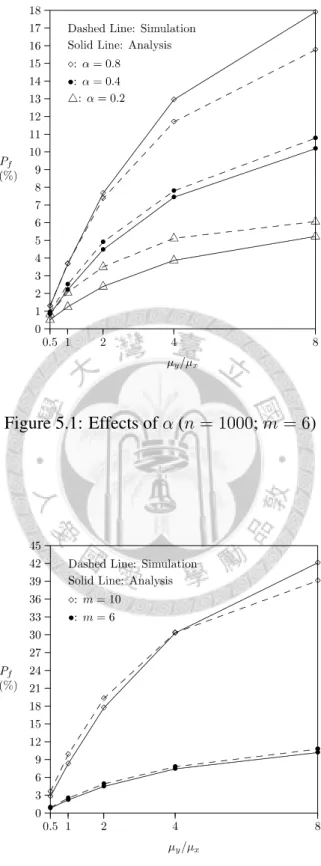
In this chapter, we study the effects of the input parameters on the Pf performance for the i-Search mechanism. In our study, we set the input parameters following the constraints in (4.2), and we set the total number of Peer nodes n = 1000. The effects of the input parameters are described as follows. In Figures 5.1 and 5.2, we change µy/µxfrom 0.5 to 8. A larger µy/µximplies that the Peer node spends more time online. For example, when µy/µx = 0.5 and µy/µx = 8, from (4.1), we have pon= 1/3 and pon= 8/9, respectively.
Both figures show that the path found probability Pf increases as µy/µx increases. It is worth noticing that we have Pf larger than 15% when µy/µx = 8 and α = 0.8 as shown in Figure 5.1 (with m = 6), and Pf is around 40% when µy/µx = 8 and m = 10 as shown in Figure 5.2.
Observing Figure 5.1 where we set m = 6, we study the effects of α. A larger α implies that the social graph of P2P-iSN is sparser (i.e., more far-nodes). Figure 5.1 indicates that Pf increases as α increases, which means that in a sparser social graph, the
25
26 CHAPTER 5. PERFORMANCE EVALUATION
Figure 5.1: Effects of α (n = 1000; m = 6)
Figure 5.2: Effects of m (n = 1000; α = 0.4)
27 i-Search mechanism attains better found probability. In Figure 5.2, we study the effects of m where we set α = 0.4. A larger m implies more friends of a Peer node. Figure 5.2 shows that with more friends, the i-Search mechanism achieves better Pf performance.
To conclude, when in a sparser social graph and a peer node has more friends, there is 40% probability that the i-Search mechanism could find a global social relationship for the user, i.e. a social path with strong relationship strength.
28 CHAPTER 5. PERFORMANCE EVALUATION
Chapter 6
Conclusions
This paper studies the aggregation of social relations across heterogeneous SNSs with an end-goal to find a social path with strong strength between any two SNS users. P2P- iSN, a peer-to-peer network architecture, is proposed to integrate multiple SNSs without incurring overhead to the SNSs. We then develop an effective Global Relationship Model to calculate the global relationship strength between two users from heterogeneous SNSs with more precision. With P2P-iSN and the Global Relationship Model as foundation, we propose the i-Search mechanism that realizes social path finding in a P2P social network.
Analytical and simulation models are conducted to investigate the performance of the i-Search in terms of the path found probability Pf.
Our study indicates that when the social graph is sparser (e.g., α = 0.8) and a Peer node has more friends (e.g., m = 10), the path found probability Pf is around 40%.
The proposed i-Search mechanism can effectively find global social relationship for users from heterogeneous SNSs. The research results encourage us to implement the i-Search
29
30 CHAPTER 6. CONCLUSIONS mechanism in real SNSs. Compared to identity data and content data aggregation across different SNSs, social path data aggregation has been much less studied and constitutes a major research challenge moving forward. This paper thus also offers important insights for further studies that aim to utilize the abundant social network and user behavior data.
Appendix A
Snapshots of P2P-iSN
This section we show some snapshots of P2P-iSN.
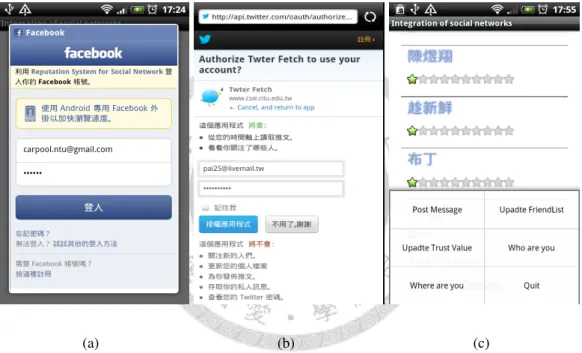
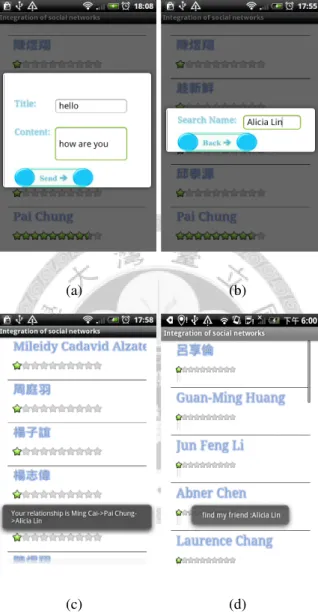
Figure 6.1 shows the snapshots that user can login to P2P-iSN by using different type social networks accounts. The login interface which is implemented by Facebook Graph API (see figure 6.1(a)) and Twitter REST API (see figure 6.1(b)).Figure 6.1(c) shows the functionality of P2P-iSN which include direct message communication, message post on the SNS, find the relationship between two users, query from Index Peer node that friend is on what type of SNS. Figure 6.2(a) shows the direct message communication between two users, the message does not pass through the SNS, it enhances the user privacy. Searching for the relationship between two users is showed in figure 6.2(b). User can use this functionality to find other user and know their relationship. Figure 6.2(c) shows the searching result for the request from 6.2(b), “Min Cai→ Pai Chung → Alicia Lin” means that Alicia Lin is the friend of Pai Chung and Pai Chung is the friend of Min Cai. Figure 6.2(d) shows the request that passed to “Pai Chung”.
31
(a) (b) (c)
Figure 6.1: (a) Facebook Graph API (b) Twitter REST API (c) Functionality of P2P-iSN
32 CHAPTER 6. CONCLUSIONS
(a) (b)
(c) (d)
Figure 6.2: (a) Direct message communication with friends (b) Search for the relationship between two users (c) The search result for the request from a friend (d) The request passed to user’s friend
Bibliograghy
[1] Bae, J. A Global Social Graph as a Hybrid Hypergraph. Proceedings of Fifth Inter- national Joint Conference on INC, IMS and IDC, pages 1025–1031, August 2009.
[2] Chang, N.B. and Liu, M. Controlled Flooding Search in a Large Network.
IEEE/ACM Transactions on Networking, 15(2):436–449, April 2007.
[3] Ellison, N. and Boyd, D. Social Network Sites: definition, history, and scholarship.
Journal of Computer-Mediated Communication, 13(1):210–230, October 2007.
[4] Fu, H.-L., Chen, H.-C., Lin, P., and Fang, Y. Energy-Efficient Reporting Mech- anisms for Multi-Type Real-time Monitoring in Machine-to-Machine Communica- tions Networks. Proceedings of IEEE INFOCOM 2012 Conference, pages 136–144, March 2012.
[5] http://developer.android.com/reference/packages.html.
[6] http://openid.net.
[7] https://developers.facebook.com/docs/reference/api/.
[8] http://www.json.org.
33
34 BIBLIOGRAGHY [9] Jiang, S., Guo, L., Zhang, X., and Wang, H. LightFlood: Minimizing Redundant Messages and Maximizing Scope of Peer-to-Peer Search. IEEE Transactions on Parallel and Distributed Systems, 19:601–614, May 2008.
[10] Ko, M. N., Cheek, G. P., Shehab, M., and Sandu, R. Social-Networks Connect Services. Computer, 43(8):37–43, August 2010.
[11] Mislove, A., Marcon, M., Gummadi, K. P., Druschel, P., and Bhattacharjee, B. Mea- surement and Analysis of Online Social Networks. Proceedings of the 7th ACM SIGCOMM Conference on Internet Measurement, pages 29–42, 2007.
[12] Nelson, R. Probability, Stochastic Processes, and Queueung Theory. Springer Ver- lag, 1995.
[13] Ronald, S. B. STRUCTURE: A General Purpose Network Analysis Program Provid- ing Sociometric Indices, Cliques, Structural and Role Equivalence, Density Tables,
Contagion, Autonomy, Power and Qquilibria in Multiple Network Systems (Version
4.2). New York: Columbia University Press, 1991.
[14] Watts, D. J. and Strogatz, S. H. Collective Dynamics of “Small-World” Networks.
Nature, 393(6684):440–442, 1998.
[15] Xiong, L. and Liu, L. PeerTrust: supporting reputation-based trust for peer-to-peer electronic communities. IEEE Transactions on Knowledge and Data Engineering, 16(7):843 – 857, 2004.
BIBLIOGRAGHY 35 [16] Yu, B. and Singh, M. P. Searching Social Networks. Proceedings of the Second International Joint Conference on Autonomous Agents and Multiagent Systems (AA-
MAS ’03), pages 65–72, 2003.