Combinatorial representations of Coxeter groups over a field of two elements ∗
Hau-wen Huang
†Chih-wen Weng
‡April 14, 2008
Abstract
Let W denote a simply-laced Coxeter group with n generators. We construct an n-dimensional representation φ of W over the finite field F2 of two elements. The action of φ(W ) on F2n by left multiplication is corresponding to a combinatorial structure extracted and general- ized from Vogan diagrams. In each case W of types A, D and E, we determine the orbits of F2n under the action of φ(W ), and find that the kernel of φ is the center Z(W ) of W.
1 Introduction
A simply-laced Coxeter group is a group WS(m) with a finite set of generators S ⊆ WS(m) subject only to relations
(ss0)m(s,s0) = 1,
where m(s, s) = 1 and m(s, s0) = m(s0, s) ∈ {2, 3} for s 6= s0 in S. When m is specified, we write WS for WS(m), and if both S and m are specified, we write W for WS(m). A Coxeter graph S represents a simply-laced Coxeter group WS(m), and vice versa. The vertex set of this graph is S, and there is an edge joining two vertices s and s0 whenever m(s, s0) = 3. There are
∗Research partially supported by the NSC grant 96-2628-M-009-015 of Taiwan R.O.C..
† ‡Department of Applied Mathematics National Chiao Tung University 1001 Ta Hsueh Road Hsinchu, Taiwan 300, R.O.C..
Coxter groups which are not simple-laced. In this article we always assume simple-laced property in a Coxter group to make the corresponding Coxeter graph S a simple graph.
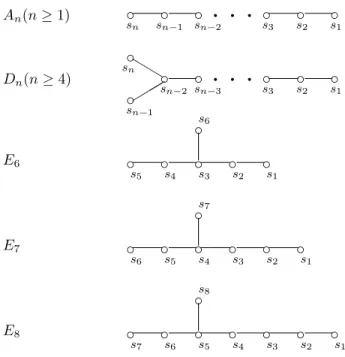
We shall investigate a kind of flipping puzzle, which is also studied in [10, 11], associated with a given Coxeter graph S. The configuration of the flipping puzzle is S, together with an assignment of a unique state, white or black, on each vertex of S. A move in the puzzle is to select a vertex s which has black state, and then flip the state of each neighbor of s. When S is one of the Dynkin diagrams described in Figure 1, the configuration above is essentially a Vogan diagram with identity involution, which was first defined in [9], in a more general way, as a combinatorial object representing the real form of the corresponding complex simple Lie algebra and a system of choices. See also [1, 2, 5].
An(n ≥ 1) c c c q q q c c c
sn sn−1 sn−2 s3 s2 s1
Dn(n ≥ 4)
c c
c c q q q c c c
"""
bb
sn−1
sn
sn−2 sn−3 s3 s2 s1
E6 c c c c c
c
s5 s4 s3 s2 s1
s6
E7 c c c c c
c
c
s6 s5 s4 s3 s2
s7
s1
E8 c c c c c
c
c c
s7 s6 s5 s4 s3
s8
s2 s1
Figure 1: Simply-laced Dynkin diagrams.
We fix a simply-laced Coxeter group W and its Coxeter graph S, where
|S| = n. Let F2denote the finite field of two elements 0 and 1. In Section 2, we use the column vector set F2S = F2nto describe the set of configurations in the flipping puzzle associated with S by setting that `s = 1 iff the configuration
` ∈ F2n has black state in the vertex s. For each vertex s ∈ S, we find a way to associate the move with selecting vertex s as an n × n invertible matrix s over F2. This s acts on a configuration ` ∈ F2n by left multiplication to become a new configuration s` which has the desired property as stated in the definition of the flipping puzzle when `s = 1. Unlike in the definition, our move s does not select configuration `, but if a configuration has white state in s, it makes no effect; i.e. if `s = 0 then s` = `.
Let GLn(F2) denote the set of n × n invertible matrices over F2 and let W denote the subgroup of GLn(F2) generated by the moves s for s ∈ S. We refer W to a flipping group of S. In Section 3, we find that the canonical map φ : W → GLn(F2), lifted from φ(s) = s for s ∈ S, is a homomorphism with φ(W ) = W. Due to its origination, we refer such a map to the Vogan representation of W. Then we find that the flipping group W has trivial center in Section 4. In Sections 5, 6 and 7, we assume W to be An, Dn and En respectively. By using the finiteness of W , we can determine the size of the corresponding flipping group W. We find that the kernel of the Vogan representation of W is the center Z(W ) of W when W is finite.
In the flipping puzzle on a Coxeter graph S, two configurations are said to be equivalent if one can be obtained from the other by a sequence of moves.
Let P denote the partition of configurations (i.e. F2n) according to the above equivalent relation. As a byproduct of our work, we solve the flipping puzzle associated with S when S is each of An, Dn and En by determining P. Note that when S is a tree, a generalization of Dynkin diagrams, some partial results on P are obtained in [11] and [10].
2 Flipping groups
Throughout this article, W will be a simply-laced Coxeter group with corre- sponding Coxter graph S of n elements and edge set R = {ss0 | m(s, s0) = 3}.
We shall construct a matrix group associated with the flipping puzzle on the Coxeter graph S. Let Matn(F2) denote the set of n × n matrices over F2
with rows and columns indexed by S. Let F2ndenote the set of n-dimensional column vectors over F2 indexed by S. For s ∈ S, let es denote the character- istic vector of s in F2n; that is es = (0, 0, . . . , 0, 1, 0, . . . , 0)t, where 1 is in the position corresponding to s.
Definition 2.1. For s ∈ S, we associate a matrix s ∈ Matn(F2), denoted by the bold type of s, as
suv =
½ 1, if u = v, or v = s and uv ∈ R;
0, else, where u, v ∈ S.
The following is a reformulating of Definition 2.1.
Lemma 2.2. For s, v ∈ S,
sev =
( ev, if v 6= s;
e v + P
uv∈R
e
u if v = s.
¤ The flipping puzzle associated with S, which is described in the introduc- tion, is now restated as follows. A configuration is simply a vector ` ∈ F2n, where `s = 1 (resp. `s = 0) means that the vertex s ∈ S has black state (resp. white state). In this setting, if `s = 1 then s` is the new configuration after the move to select the vertex s. Note that if `s = 0, we have s` = ` from Lemma 2.2, so we can view the action of s on ` as a feigning move on ` which is not originally defined as a move in the flipping puzzle. The following lemma is immediate from this combinatorial realization.
Lemma 2.3. For s ∈ S, s is an involution; that is s2 = I, the identity
matrix. ¤
From Lemma 2.3, s is invertible, so we can give the following definition.
Definition 2.4. Let W denote the subgroup of GLn(F2) generated by the set {s | s ∈ S}. W is referring to the flipping group of S.
3 Coxeter groups and their combinatorial rep- resentations
Let W denote a simply-laced Coxeter group. Recall that an n-dimensional representation of W over F2 is a homomorphism of W into GLn(F2). It is notorious difficult in the study of groups only defined by generators and rela- tions. Hence the representation theory of Coxeter groups plays an important role in the study. In [7, Section 5.3], Humphreys gives ”geometric represen- tations” of Coxeter groups and use these representations to show that the finite Coxeter groups are essentially those associated with Dynkin diagrams.
In this section we shall show that the flipping groups defined in the last section give ”combinatorial representations” of simply-laced Coxeter groups.
First we need a lemma.
Lemma 3.1. Let W denote a simply-laced Coxeter group with Coxeter graph S. For s ∈ S, set Es ∈ Matn(F2) by
Esev =
( 0,P if v 6= s;
uv∈R
e
u, if v = s for v ∈ S. (3.1) Then with referring to the notation in Definition 2.1, the following (i)-(iii) hold.
(i) s = I + Es for s ∈ S (ii) Es0Es= 0, if s0s /∈ R.
(iii) If sisi−1∈ R for i = 1, 2, . . . , t, then EstEst−1· · · Es0 =
½ Es0, if st = s0; EstEs0, if sts0 ∈ R.
Proof. (i) is immediate from Lemma 2.2. Note that Es0Esev = 0 by (3.1) for any v, s, s0 ∈ S with s0s 6∈ R, and hence we have (ii). (iii) follows from the same reason as in (ii) by applying the product of matrices in either side of the equation to ev and obtaining the desired equality in each case.
Theorem 3.2. Let W denote a simply-laced Coxeter group with Coxeter graph S. Let W denote the flipping group of S. Then there exists a surjective homomorphism φ : W → W such that φ(s) = s for s ∈ S. In particular, φ is a representation of W over F2.
Proof. We have seen s2 = I for s ∈ S. It remains to show (ss0)2 = I if s 6= s0 and ss0 6∈ R, and to show (ss0)3 = I if ss0 ∈ R. For s, s0 ∈ S,
ss0 = (I + Es)(I + Es0)
= I + Es+ Es0 + EsEs0 by Lemma 3.1(i). In the case s 6= s0 and ss0 6∈ R,
(ss0)2 = (I + Es+ Es0)(I + Es+ Es0)
= I + 2Es+ 2Es0
= I
by Lemma 3.1(ii). In the case ss0 ∈ R,
(ss0)2 = (I + Es+ Es0 + EsEs0)(I + Es+ Es0+ EsEs0)
= I + 3Es+ 3Es0 + 4EsEs0 + Es0Es
= I + Es+ Es0+ Es0Es and
(ss0)3 = (ss0)2(ss0)
= (I + Es+ Es0 + Es0Es)(I + Es+ Es0+ EsEs0)
= I + 2Es+ 4Es0 + 2EsEs0 + 2Es0Es
= I by Lemma 3.1(iii).
Definition 3.3. The representation φ defined in Theorem 3.2 is called the Vogan representation of W .
Suppose J ⊆ S. Let WJ denote the subgroup of W generated by the set {s | s ∈ J} and WJ denote simply-laced Coxeter group with the set J of generators with the function m ¹ J × J, the restriction of m to J × J. Note that WJ is isomorphic to the subgroup of W generated by the set {s | s ∈ J}
[7, Section 5.5]. Hence we use the same symbol WJ to express these two isomorphic groups. It makes no confused if the place that WJ appears is also considered. For example, the first WJ in (iii) of the following lemma is in the first meaning and the remaining two WJ are in the second meaning.
Note that WJ, which is different to WJ, is the flipping group on J. Let G[J]
denote the submatrix of G ∈ Matn(F2) with rows and columns indexed by J, and WJ[J] := {G[J] | G ∈ WJ}.
Lemma 3.4. Suppose J ⊆ S. The following (i)-(iii) hold.
(i) WJ[J] = WJ.
(ii) The map ψ : WJ → WJ, defined by ψ(G) = G[J] for G ∈ WJ, is a surjective homomorphism.
(iii) Let φ and φ0 denote the Vogan representations of WS and WJ respec- tively. Then φ0 = ψ ◦ φ ¹ WJ. In particular, Ker φ ¹ WJ ⊆ Ker φ0. Proof. By Definition 2.1, suv = 0 for s, u ∈ J and v ∈ S − J. By this, each matrix G ∈ WJ has the form
G =
µ A 0 B C
¶
if indices in J are placed in the beginning of rows and columns, where A is a
|J| × |J| matrix, B is an (n − |J|) × |J| matrix, C is an (n − |J|) × (n − |J|) matrix, and 0 is a |J| × (n − |J|) zero matrix. Then (i) and (ii) follow from the following matrix product rule in block form:
µ A 0 B C
¶ µ A0 0 B0 C0
¶
=
µ AA0 0
BA0+ CB0 CC0
¶ .
Since ψ ◦ φ(s) = s[J] = φ0(s) by (i) for all s ∈ J, we see φ0 = ψ ◦ φ ¹ WJ, and this implies Ker φ ¹ WJ ⊆ Ker φ0.
4 The center of a flipping group
As we shall see in Proposition 6.10 that the Coxeter group of type Dn has nontrivial center when n is even. In this section, we show that the center Z(W) of any flipping group W of a Coxeter graph S is trivial. Therefore, the center Z(W ) of any Coxeter group W is contained in the kernel of the Vogan representation of W. Recall that a Coxeter graph S is disconnected if there is a partition of S = S0∪ S00 with S0, S00 6= ∅ and there is no edge uv ∈ R with u ∈ S0 and v ∈ S00. In this case the Coxeter group W is isomorphic to the direct product W0× W00 of the Coxeter groups W0 = WS0 and W00= WS00. S is connected if S is not disconnected.
Proposition 4.1. Let W denote a simple-laced Coxeter group with Coxeter graph S. Then the center Z(W) of the flipping group W of S is trivial.
Proof. It suffices to assume that S is connected with at least two vertices.
Let Z be an element in the center of W and let u, v be two distinct elements in S. We show that Zvu = 0 to conclude Z = I. Suppose Zvu = 1. On the one hand vZeu 6= Zeu since Zeu has 1 in the vth position. On the other hand, vZeu = Zveu = Zeu since veu = eu. Hence we have a contradiction.
From the above Proposition 4.1 we immediately have the following corol- lary.
Corollary 4.2. Let W denote a simply-laced Coxeter group. Then the center Z(W ) is contained in the kernel of the Vogan representation of W. ¤
5 Coxeter groups of type A
nRecall that the Vogan representation φ of W is faithful whenever φ is injective.
Also φ is irreducible if there is no subspace V ⊆ F2n, V 6= 0, F2n, such that φ(W )V ⊆ V. For a ∈ F2n, the subset of F2nconsisting of all elements Ga with G ∈ φ(W ) is called the orbit of F2n containing a under the action of φ(W ).
In this section we assume that W is of type An with the Coxeter graph S as shown in Fig. 1, and determine the orbits of F2n under the action of φ(W ). We also show that the kernel of the Vogan representation φ of W is the center Z(W ) of W and determine the reducibility of φ. The trivial case is given in the following.
Proposition 5.1. Let W be a Coxeter group of type A1 with the Vogan representation φ. Then the orbits of F2 are {0}, {1} under the action of φ(W ), Ker φ = {1, s1} = W = Z(W ), and φ is irreducible.
Proof. This follows from that W = {1, s1} and φ(W ) is a trivial group.
In the remaining of this section, we always assume n ≥ 2. Set
1 = es1, i + 1 = sisi−1· · · s11 for 1 ≤ i ≤ n. (5.1) Note that
i = esi−1+ esi for 2 ≤ i ≤ n, (5.2) and
n + 1 = esn= 1 + 2 + · · · + n. (5.3)
Set ∆ = ∆(An) := {1, 2, . . . , n}. Note that ∆ is a basis of F2n. We refer ∆ to a simple basis of F2n. For a ∈ F2n, let ∆(a) denote the subset of ∆ consisting of all the elements appeared in the expression of a as a linear combination of elements in ∆. The weight of an element a ∈ F2n is wt(a) := |∆(a)|. For example, ∆(n + 1) = ∆ and wt(n + 1) = n.
Lemma 5.2. sii = i + 1, sii + 1 = i and si fixes other vectors in {1, 2, . . . , n + 1} − {i, i + 1} for 1 ≤ i ≤ n.
Proof. This is immediate by applying Lemma 2.2, (5.1) and (5.2).
Let Sn+1denote the group of permutations on {1, 2, . . . , n + 1}. By Lemma 5.2, we can give the following definition.
Definition 5.3. Let α : W → Sn+1 be the homomorphism defined by α(G)j = Gj
for each 1 ≤ j ≤ n + 1 and G ∈ W.
Note that α(si) is the transposition (i, i + 1) in Sn+1 for each 1 ≤ i ≤ n.
Lemma 5.4. α is an isomorphism from W onto Sn+1.
Proof. α is surjective since the transpositions α(s1), α(s2),. . ., α(sn) generate Sn+1. Since ∆ ∪ {n + 1} spans F2n, α is injective.
The next proposition determines the orbits of F2n under the action of W.
Proposition 5.5. For 0 ≤ i ≤ bn+12 c,
Oi = {a ∈ F2n | wt(a) = i or n + 1 − i}
is an orbit of F2n under the action of W, where btc is the largest integer less than or equal to t.
Proof. Suppose a ∈ F2n with wt(a) = i. Observe that from Lemma 5.4 and (5.3),
∆(Ga) =
½ α(G)∆(a), if n + 1 6∈ α(G)∆(a) ;
∆ − α(G)∆(a), if n + 1 ∈ α(G)∆(a)
for G ∈ W. The proposition follows from this observation because the sub- group of α(W) = Sn+1 generated by the transpositions α(s1), α(s2),. . ., α(sn−1) acts transitively on the fixed size subsets of ∆, and snn = 1 + 2 +
· · · + n by Lemma 5.2 and (5.3).
In the following propositions, we study the reducibility of φ and Ker φ.
Proposition 5.6. The Vogan representation φ of W is irreducible if and only if n is even.
Proof. Let V denote a nontrivial proper subspace of F2nsuch that φ(W )V ⊆ V . Referring to Proposition 5.5, note that
V =[
i∈J
Oi (5.4)
for some proper subset J ⊆ {0, 1, . . . , bn+12 c} with J 6= {0}. Note that the set in the right side of (5.4) to be closed under addition is when it is the set of even weight vectors, and this occurs if and only if n is odd.
Proposition 5.7. The Vogan representation φ of W is faithful. In particu- lar, Ker φ = Z(W ) is the trivial group.
Proof. The first statement follows from that Proposition 5.4 and W is isomor- phic to Sn+1[7, p41]. The second follows from the first and Corollary 4.2.
6 Coxeter groups of type D
nFix an integer n ≥ 4. Let W denote the Coxeter group of type Dn with the Coxeter graph in Fig. 1. Let φ denote the Vogan representation of W , and W = φ(W ) be the flipping group of S. Set
1 = es1, i + 1 = sisi−1· · · s11 for 1 ≤ i ≤ n − 1, and n + 1 = esn. (6.1) Note that
i = esi−1+ esi for 2 ≤ i ≤ n − 2,
n − 1 = esn−2+ esn−1+ esn, (6.2) and
n = esn−1+ esn = 1 + 2 + · · · + n − 1. (6.3) Set ∆ = ∆(Dn) := {1, 2, . . . , n − 1, n + 1} to be the simple basis of F2n in the case of type Dn. Set ∆(a) and wt(a) as before for a ∈ F2n. For example,
∆(n) = ∆ − {n + 1} by (6.3), and wt(n) = n − 1.
Lemma 6.1. The following (i),(ii) hold.
(i) For each 1 ≤ i ≤ n − 1, sii = i + 1, sii + 1 = i, and
sij = j for j ∈ {1, 2, . . . , n + 1} − {i, i + 1}.
(ii) snn − 1 = n, snn = n − 1, snn + 1 = n − 1 + n + n + 1, and snj = j for j ∈ {1, 2, . . . , n − 2}.
In particular, n + 1 ∈ ∆(Gn + 1) and G({1, 2, . . . , n}) ⊆ {1, 2, . . . , n} for all G ∈ W.
Proof. This follows immediately from Lemma 2.2, (6.1) and (6.2).
Let Sndenote the group of permutations on {1, 2, . . . , n}. By Lemma 6.1, we can give the following definition.
Definition 6.2. Let β : W → Sn denote the homomorphism defined by β(G)(j) = Gj
for 1 ≤ j ≤ n and G ∈ W.
In fact, β is surjective since the n − 1 transpositions β(s1), β(s2), . . . , β(sn−1) generate Sn. Let Z denote the additive group of (n − 1)-dimensional subspace of F2n spanned by the set {1, 2, . . . , n − 1}. Note that a ∈ Z iff n + 1 6∈ ∆(a) for a ∈ F2n. By Lemma 6.1 and (6.3), Z is closed under the left multiplication of matrices in W.
Proposition 6.3. The Vogan representation φ of W is not irreducible. In
particular φ(W )Z ⊆ Z. ¤
Hence Z is a disjoint union of orbits of F2n under the action of W. Note that F2n− Z is also a disjoint union of orbits of F2n under the action of W.
The following proposition determines all the orbits of F2nunder the action of W.
Proposition 6.4. The following are orbits of F2n under the action of W.
Oi = {a ∈ Z | wt(a) = i or n − i},
Ωo = {a ∈ F2n− Z | wt(a) ≡ 1 or n − 1 (mod 2)}, Ωe = {a ∈ F2n− Z | wt(a) ≡ 0 or n (mod 2)},
where 0 ≤ i ≤ bn2c. In particular Ωo = Ωe = F2n− Z is an orbit when n is odd.
Proof. The proof is similar to the proof of Proposition 5.5. The reason that Oi is an orbit follows from two facts: (i) β(s1), β(s2), . . . , β(sn−2) generate the subgroup Sn−1of Sn consisting of permutations on ∆ − {n + 1} and Sn−1
acts transitively on fixed size subsets of ∆ − {n + 1}, and (ii) sn−1n − 1 = snn − 1 = n = 1 + 2 + · · · + n − 1
by Lemma 6.1(i),(ii) and (6.3). The reason that Ωo and Ωe are orbits follows from an additional fact that
wt(snn + 1) = wt(n − 1+n+n + 1) = wt(1+2+· · ·+n − 2+n + 1) = n−1.
We study the structure of W.
Definition 6.5. Let γ : W → Aut(Z) denote the homomorphism from W into the group Aut(Z) of automorphisms of Z such that
γ(G)(u) = Gu for G ∈ W and u ∈ Z.
Lemma 6.6. There exists a homomorphism θ : Sn → Aut(Z) such that γ = θ ◦ β.
Proof. Since β is surjective, it suffices to show that the kernel of β is contained in the kernel of γ. Suppose G ∈ Ker β. Then Gi = i for 1 ≤ i ≤ n;
in particular G fixes each element in the basis ∆ − {n + 1} of Z. Thus G ∈ Ker γ.
Let Z oθSn denote the group of external semidirect product of Z and Sn with respect to θ[8, p.155]; i.e. Z oθSn is the set Z × Sn with the following product rule:
(u, σ)(v, τ ) = (u + θ(σ)(v), στ ),
where u, v ∈ Z and σ, τ ∈ Sn. Note that n + 1 + Gn + 1 ∈ Z for any G ∈ W by Lemma 6.1.
Definition 6.7. Let δ : W → Z oθSn denote the map defined by δ(G) = (n + 1 + Gn + 1, β(G))
for any G ∈ W.
Lemma 6.8. δ is an injective homomorphism of W into Z oθSn. Proof. For G, H ∈ W,
δ(G)δ(H) = (n + 1 + Gn + 1, β(G))(n + 1 + Hn + 1, β(H))
= (n + 1 + Gn + 1 + θ(β(G))(n + 1 + Hn + 1), β(G)β(H))
= (n + 1 + Gn + 1 + G(n + 1 + Hn + 1), β(G)β(H))
= (n + 1 + GHn + 1, β(GH))
= δ(GH).
This shows that δ is a homomorphism. δ is injective since if n + 1+Gn + 1 = 0 and G ∈ Ker β , then G fixes all vectors in ∆, so G is the identity matrix.
Note that Z = n + 1 + Ωo if n is odd, and Z = (n + 1 + Ωo) ∪ (n + 1 + Ωe) if n is even.
Lemma 6.9. δ(W) = (n + 1 + Ωo) oθSn. In particular δ(W) = Z oθSn if n is odd; δ(W) has index 2 in Z oθSn if n is even.
Proof. Note that δ(s1), δ(s2), . . . , δ(sn−2), δ(sn−1) generate 0 oθSn. Since Ωo
is an orbit containing n + 1, we have δ(W) = (n + 1 + Ωo) oθSn. The second part follows from Proposition 6.4.
Proposition 6.10. The Vogan representation φ of W is faithful when n is odd; Ker φ has order 2 when n is even. Moreover, Ker φ is the center Z(W ) of W.
Proof. Note that W is isomorphic to the semidirect product Z o Sn of Z and Sn [7, p.42]. By Lemma 6.9, φ is faithful when n is odd, and Ker φ has order 2 when n is even. From Corollary 4.2, Z(W ) ⊆ Ker φ, and from the fact that a normal subgroup of order 2 is contained in the center, we have Ker φ ⊆ Z(W ).
7 Coxeter groups of type E
nFix an integer n ≥ 6. Let W denote the Coxeter group of type En with the Coxeter graph S in Fig. 2. In this section we shall determine the orbits of F2n under the action of the flipping group W of S. Restricting the attention
to the case n = 6, 7 or 8 in which W is finite, we show that the kernel of the Vogan representation φ of W is the center Z(W ) of W .
En(n ≥ 6) c c c c c
c
q q q c c c
sn−1 sn−2 sn−3 sn−4 sn−5
sn
s3 s2 s1
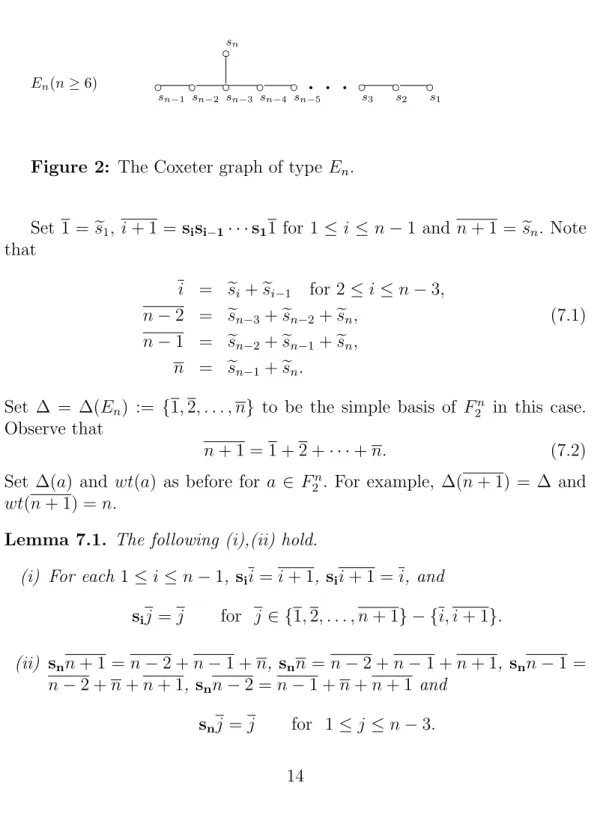
Figure 2: The Coxeter graph of type En.
Set 1 = es1, i + 1 = sisi−1· · · s11 for 1 ≤ i ≤ n − 1 and n + 1 = esn. Note that
i = esi+ esi−1 for 2 ≤ i ≤ n − 3,
n − 2 = esn−3+ esn−2+ esn, (7.1) n − 1 = esn−2+ esn−1+ esn,
n = esn−1+ esn.
Set ∆ = ∆(En) := {1, 2, . . . , n} to be the simple basis of F2n in this case.
Observe that
n + 1 = 1 + 2 + · · · + n. (7.2) Set ∆(a) and wt(a) as before for a ∈ F2n. For example, ∆(n + 1) = ∆ and wt(n + 1) = n.
Lemma 7.1. The following (i),(ii) hold.
(i) For each 1 ≤ i ≤ n − 1, sii = i + 1, sii + 1 = i, and
sij = j for j ∈ {1, 2, . . . , n + 1} − {i, i + 1}.
(ii) snn + 1 = n − 2 + n − 1 + n, snn = n − 2 + n − 1 + n + 1, snn − 1 = n − 2 + n + n + 1, snn − 2 = n − 1 + n + n + 1 and
snj = j for 1 ≤ j ≤ n − 3.
Proof. This is immediate by applying Lemma 2.2 and (7.1).
Let Sn denote the group of permutations on ∆ = {1, 2, . . . , n}. Set T := {s1, s2, . . . , sn−1}. Recall that WT is the subgroup of W generated by {s | s ∈ T }. By Lemma 7.1, we find that the set ∆ is closed under the left multiplication of elements in WT.
Definition 7.2. Let ² : WT → Sn denote the homomorphism satisfying
²(G)(j) = Gj for 1 ≤ j ≤ n and G ∈ WT.
In fact, ² is an isomorphism since ∆ is a spanning set and the n − 1 transpositions ²(s1), ²(s2), . . . , ²(sn−1) generate Sn.
Proposition 7.3. The following are orbits of F2n under the action of W.
O0 = {0},
O1 = {a ∈ F2n | a 6= 0, wt(a) ≡ 1 or n − 2 (mod 4)}, (7.3) O2 = {a ∈ F2n | a 6= 0, wt(a) ≡ 2 or n − 3 (mod 4)},
O3 = {a ∈ F2n | a 6= 0, wt(a) ≡ 3 or n (mod 4)}, O4 = {a ∈ F2n | a 6= 0, wt(a) ≡ 0 or n − 1 (mod 4)}.
In particular O1 = O3 when n ≡ 1 (mod 4), O1 = O4 and O2 = O3 when n ≡ 2 (mod 4), O2 = O4 when n ≡ 3 (mod 4), and O1 = O2 and O3 = O4 when n ≡ 0 (mod 4).
Proof. It is clear that O0 is an orbit. There are four cases to put nonzero vectors a, b in an orbit. (a)wt(a) = wt(b) : This is because ²(WT) = Sn acts transitively on the fixed size subsets of ∆; (b) wt(b) = n + 3 − wt(a), or n − 1 − wt(a) : This is from (a) and the observation that
wt(sna) =
n + 3 − wt(a), if |∆(a) ∩ {n, n − 1, n − 2}| = 3;
n − 1 − wt(a), if |∆(a) ∩ {n, n − 1, n − 2}| = 1;
w(a), else
(7.4)
by Lemma 7.1(ii) and (7.2); (c) wt(a) = wt(b) − 4 : This is by applying the first case of (7.4) and then applying the second case of (7.4); and (d) wt(a) = wt(b) + 4 : This is by applying the second case of (7.4) and then the first case of (7.4). The proposition follows from the above cases (a)-(d).
Similar to case of An, we determine the reducibility of φ from Proposition 7.3 immediately.
Proposition 7.4. The Vogan representation φ is irreducible if and only if n
is even. ¤
Recall that for a ∈ F2n, the isotropy group of a in W is {G ∈ W | Ga = a}, and the cardinality of the orbit of a is equal to the index of the isotropy group of a.
Corollary 7.5. For J := {s2, s3, . . . , sn}. the number |WJ||O1| divides |W|, where
|O1| =
2n−1− (−1)n42n−22 , if n ≡ 0 (mod 4),
2n−1, if n ≡ 1 (mod 4),
2n−1+ (−1)n−24 2n−22 − 1, if n ≡ 2 (mod 4), 2n−2+ (−1)n−34 2n−32 , if n ≡ 3 (mod 4).
(7.5)
Proof. Since WJ is a subgroup of the isotropy group of 1, the number
|WJ||O1| divides |W|. Note that by (7.3)
|O1| =
P
k≡1,2( mod 4) 1≤k≤n
¡n
k
¢, if n ≡ 0 (mod 4), P
k≡1( mod 2) 1≤k≤n
¡n
k
¢, if n ≡ 1 (mod 4), P
k≡0,1( mod 4) 1≤k≤n
¡n
k
¢, if n ≡ 2 (mod 4), P
k≡1( mod 4) 1≤k≤n
¡n
k
¢, if n ≡ 3 (mod 4),
where ¡n
k
¢ is the binomial coefficient. From this, we routinely prove (7.5) by induction on n.
We need to quote a lemma.
Lemma 7.6. ([4, Lemma 10.2.11]) If W is of type E7 or E8 then Z(W ) = {1, w0}, where w0 is the longest element of W . ¤ Recall that T = {s1, s2, . . . , sn−1} and J = {s2, s3, . . . , sn} when we indi- cate that the Coxeter group W is of type En.
Proposition 7.7. The Vogan representation φ of W is faithful if W is of type E6, and |Ker φ| = 2 if W is of type E7. Moreover, Ker φ = Z(W ) if W is of type E6 or E7.
Proof. Suppose W is of type E6. With referring to Corollary 7.5, we have
|O1| = 27. By Lemma 3.4(iii) and Proposition 6.10 (the case D5), we know
|WJ| = 245!, where J is of type D5. Since |WJ||O1| divides |W|, we have
|W| ≥ 245! · 27 = 27345. Since |W | = 27345 [7, p.44], W is isomorphic to W and Ker φ is trivial. By this and Corollary 4.2, Z(W ) is trivial.
Suppose W is of type E7. From Corollary 4.2 and Lemma 7.6, |Ker φ| ≥ 2.
Since |W | = 210345 · 7 [7, p.44], we see that |W| ≤ 29345 · 7. On the other hand, according to a similar counting argument as above, we have |O1| = 28,
|WJ| = 27345, where J is of type E6, and hence |W| ≥ 29345 · 7. Thus,
|W| = 29345 · 7 and |Z(W )| = |Ker φ| = 2.
We now go to the last case W of type E8. Note that J = {s2, s3, . . . , s8} is of type E7 and T ∩ J = {s2, s3, . . . , s7} is of type A6. We need more information of the nontrivial element w0in the center Z(WJ) of WJ. It is quite complicate to describe w0 directly as a product of elements in J. We borrow two notations to describe w0. Let φ denote the Vogan representation of W . Note that φ ¹ WT ∩J is an isomorphism of WT ∩J onto WT ∩J by Lemma 3.4(ii) and Proposition 5.7. Also ² ¹ WT ∩J : WT ∩J → S7 is an isomorphism , where
² is as in Definition 7.2 and S7 is the group of permutations on {2, 3, . . . , 8}.
The expression of w0 is as follows.
w0 = φ−1(²−1((2, 8, 3, 7, 4, 6, 5)))s8φ−1(²−1((5, 8)(4, 7)(3, 6)))s8 φ−1(²−1((4, 8)(3, 7)(2, 6)))s8φ−1(²−1((5, 8)(4, 7)))s8 φ−1(²−1((3, 7)(2, 6)))s8.
(7.6)
It is routine to check that the above w0 maps to −I by the faithful represen- tation defined in [3, Proposition 8] with c = 0 or in [6, p. 291] to conclude w0 is in the center of WJ and indeed is the longest element of WJ by [3, Proposition 21]. Thus, we have the following lemma.
Lemma 7.8. Let W be of type E8 with the Vogan representation φ and w0 ∈ Z(WJ) be not identity. Then φ(w0) is
²−1((2, 8, 3, 7, 4, 6, 5))s8²−1((5, 8)(4, 7)(3, 6))s8²−1((4, 8)(3, 7)(2, 6))s8
× ²−1((5, 8)(4, 7))s8²−1((3, 7)(2, 6))s8.
¤
Note that WJ is not isomorphic to its flipping group WJ by Proposi- tion 7.7. The following lemma claims that WJ is isomorphic to the subgroup WJ of W.
Lemma 7.9. Let W be of type E8 with the Vogan representation φ. Then the restriction φ ¹ WJ of φ to J is injective.
Proof. Let φ0 : WJ → WJ denote the Vogan representation of WJ. From Lemma 3.4(iii) and Proposition 7.7, we see that Ker φ ¹ WJ ⊆ Ker φ0 = {1, w0}, where w0 is given in (7.6). To prove that Ker φ ¹ WJ is trivial, it suffices to show that φ(w0) 6= I. This follows from the computation
φ(w0)8 = 1 + 8
by applying the expression φ(w0) in Lemma 7.8 to 8 and using Lemma 7.1 and (7.2) for n = 8 to simplify.
There is a similar result about W of type E8.
Proposition 7.10. If W is of type E8 then Ker φ has order 2. Moreover, Ker φ = Z(W ).
Proof. We have |O1| = 23 · 3 · 5 from (7.5), |WJ| = |WJ| = 210345 · 7 from Lemma 7.9 and |W | = 21435527[7, p.44]. Therefore, as the proof of Proposi- tion 7.7, Ker φ has order 2 and Ker φ = Z(W ).
8 Concluding remarks
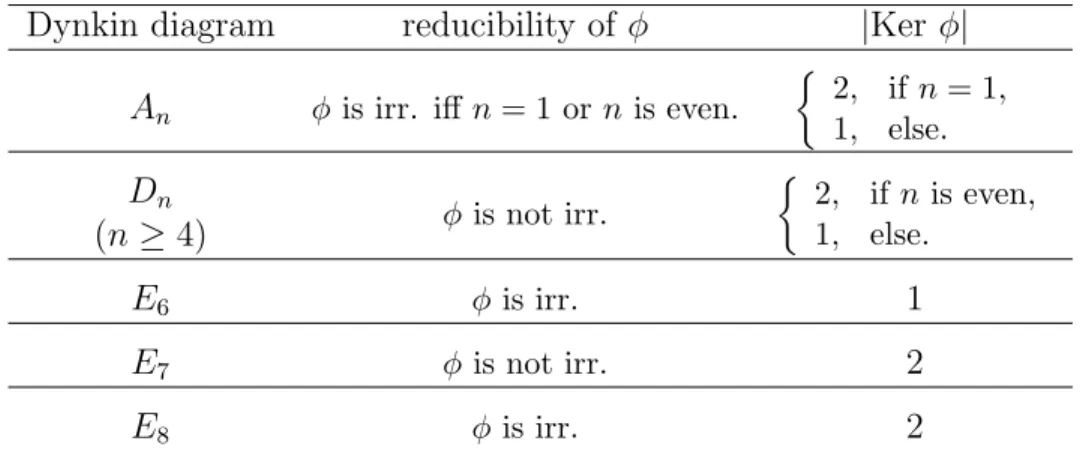
We list the main results of this article as follows.
Dynkin diagram reducibility of φ |Ker φ|
An φ is irr. iff n = 1 or n is even.
½ 2, if n = 1, 1, else.
Dn
(n ≥ 4) φ is not irr.
½ 2, if n is even, 1, else.
E6 φ is irr. 1
E7 φ is not irr. 2
E8 φ is irr. 2
Table 1: The reducibility and the kernel of a Vogan representation φ.
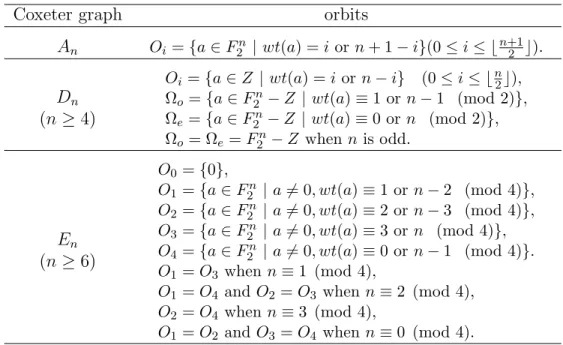
Coxeter graph orbits
An Oi= {a ∈ F2n | wt(a) = i or n + 1 − i}(0 ≤ i ≤ bn+12 c).
Dn (n ≥ 4)
Oi= {a ∈ Z | wt(a) = i or n − i} (0 ≤ i ≤ bn2c), Ωo= {a ∈ F2n− Z | wt(a) ≡ 1 or n − 1 (mod 2)}, Ωe= {a ∈ F2n− Z | wt(a) ≡ 0 or n (mod 2)}, Ωo= Ωe = F2n− Z when n is odd.
En (n ≥ 6)
O0 = {0},
O1 = {a ∈ F2n | a 6= 0, wt(a) ≡ 1 or n − 2 (mod 4)}, O2 = {a ∈ F2n | a 6= 0, wt(a) ≡ 2 or n − 3 (mod 4)}, O3 = {a ∈ F2n | a 6= 0, wt(a) ≡ 3 or n (mod 4)}, O4 = {a ∈ F2n | a 6= 0, wt(a) ≡ 0 or n − 1 (mod 4)}.
O1 = O3 when n ≡ 1 (mod 4),
O1 = O4 and O2= O3 when n ≡ 2 (mod 4), O2 = O4 when n ≡ 3 (mod 4),
O1 = O2 and O3= O4 when n ≡ 0 (mod 4).
Table 2: The orbits of F2n under the action of the flipping group of a Coxeter graph S.
References
[1] P. Batra, Invariants of real forms of affine Kac-Moody Lie algebras, Journal of Algebra 223 (2000) 208–236.
[2] P. Batra, Vogan diagrams of real forms of affine Kac-Moody Lie algebras, Journal of Algebra 251 (2002) 80–97.
[3] A. Bj¨orner and F. Brenti, Combinatorics of Coxeter Groups, Graduate texts in mathematics, vol. 231, Springer, 2005.
[4] A.E. Brouwer, A.M. Cohen, and A. Neumaier, Distance-Regular Graphs, Springer-Verlag, Berlin, 1989.
[5] Meng-Kiat Chuah and Chu-Chin Hu, Equivalence classes of Vogan di- agrams, Journal of Algebra 279 (2004) 22–37.
[6] H. Eriksson, Computational and combinatorial aspects of Coxeter groups, Ph.D. Thesis, KTH, Stockholm, Sweden, 1994.
[7] J. E. Humphreys, Reflection Groups and Coxeter Groups, Cambridge University Press, Cambridge, 1990.
[8] D. Joyner, Adventures in Group Theory: Rubik’s Cube, Merlin’s Ma- chine, and Other Mathematical Toys, The Johns Hopkins University Press, Baltimore and London, 2002.
[9] A. W. Knapp, Lie Groups beyond an Introduction, in Progr. Math., vol 140, Birkh¨auser, 1996.
[10] Xinmao Wang and Yaokun Wu, Minimum light number of lit-only σ- game on a tree, Theoretical Computer Science 381 (2007) 292–300.
[11] Hsin-Jung Wu and Gerard J. Chang, A study on equivalence classes of painted graphs, Master Thesis, NTU, Taiwan, 2006.
Hau-wen Huang
Department of Applied Mathematics National Chiao Tung University 1001 Ta Hsueh Road
Hsinchu, Taiwan 30050, R.O.C.
Email: [email protected] Fax: +886-3-5724679