目錄
目錄... i 表目錄... iv 圖目錄... vi 1、摘要... 1 2、前言... 2 2.1 緣起與研究目的... 2 2.1.1 緣起... 2 2.1.2 研究目的... 4 3、理論... 5 3.1 原理... 5 3.2 理論部分... 53.2.1 基質濃度效應(Substrate effect) — Andrews model... 5
3.2.2 溫度效應(Temperature effect) — Arrhenius equation ... 5
3.2.3 酸鹼度效應(pH effect) — Michaelis pH Function ... 5
3.3 纖維素酵素水解原理... 6 4、材料與方法... 8 4.1 實驗方法... 8 4.1.1 菌培養實驗步驟... 8 4.1.2 動力實驗步驟... 8 4.1.3 濃度動力實驗步驟... 8 4.1.4 溫度動力實驗步驟... 8 4.1.5 pH 動力實驗步驟... 8 4.2 材料... 9 4.2.1 實驗菌種... 9 4.2.2 實驗藥品... 9 4.2.3 玻璃器材... 9 4.2.4.實驗儀器... 10 5. 文獻收集與研讀整理...11
5.1 白腐菌(white rot fungus)相關資料...11
5.2 黑麴菌相關資料...11
圖目錄
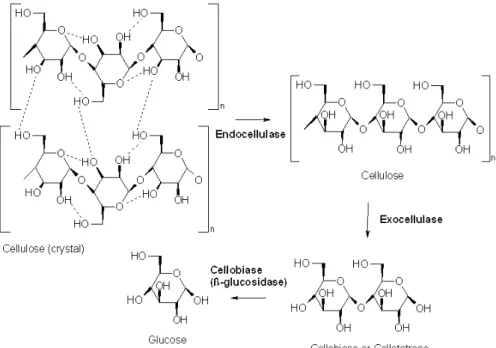
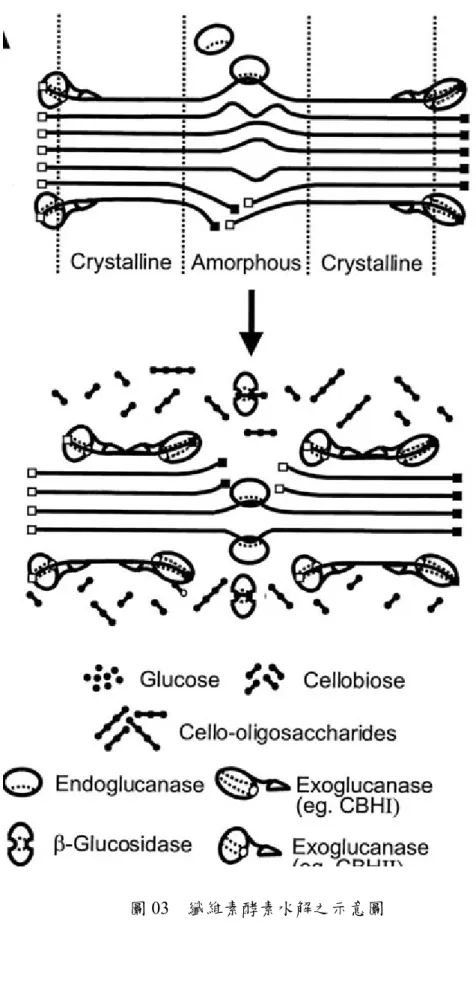
圖01 纖維素酵素水解之詳細反應機構... 6 圖02 纖維二醣酵素水解反應機構... 6 圖03 纖維素酵素水解之示意圖... 6 圖 A01 微生物在 20°C,10g/L 基質濃度(pH = 5.0)下,光學密度變化圖 ... 18 圖 A02 微生物在 20°C,20g/L 基質濃度(pH = 5.0)下,光學密度變化圖 ... 19 圖 A03 微生物在 20°C,30g/L 基質濃度(pH = 5.0)下,光學密度變化圖 ... 20 圖 A04 微生物在 20°C,40g/L 基質濃度(pH = 5.0)下,光學密度變化圖 ... 21 圖 A05 微生物在 20°C,50g/L 基質濃度(pH = 5.0)下,光學密度變化圖 ... 22 圖 A06 微生物在 20°C,60g/L 基質濃度(pH = 5.0)下,光學密度變化圖 ... 23 圖 A07 微生物在 20°C,70g/L 基質濃度(pH = 5.0)下,光學密度變化圖 ... 24 圖 A08 微生物在 20°C,80g/L 基質濃度(pH = 5.0)下,光學密度變化圖 ... 28 圖 A09 微生物在 20°C,90g/L 基質濃度(pH = 5.0)下,光學密度變化圖 ... 26 圖 A10 微生物在 20°C,100g/L 基質濃度(pH =5.0)下,光學密度變化圖 .... 27圖 A11 黑麴菌比生長動力模式(Andrews model)圖 ... 28
圖 B23 微生物在 30°C,100g/L 基質濃度(pH = 5.0)下,光學密度變化圖 ... 51 圖 B24 黑麴菌比生長動力模式(Monod model)圖 ... 52 圖 B25 微生物在 35°C,10g/L 基質濃度(pH = 5.0)下,光學密度變化圖 ... 53 圖 B26 微生物在 35°C,20g/L 基質濃度(pH = 5.0)下,光學密度變化圖 ... 54 圖 B27 微生物在 35°C,40g/L 基質濃度(pH = 5.0)下,光學密度變化圖 ... 55 圖 B28 微生物在 35°C,70g/L 基質濃度(pH = 5.0)下,光學密度變化圖 ... 56 圖 B29 微生物在 35°C,100g/L 基質濃度(pH = 5.0)下,光學密度變化圖 ... 57 圖 B30 黑麴菌比生長動力模式(Andrews model)圖 ... 58 圖 B31 微生物在 40°C,10g/L 基質濃度(pH = 5.0)下,光學密度變化圖 ... 59 圖 B32 微生物在 40°C,20g/L 基質濃度(pH = 5.0)下,光學密度變化圖 ... 60 圖 B33 微生物在 40°C,40g/L 基質濃度(pH = 5.0)下,光學密度變化圖 ... 61 圖 B34 微生物在 40°C,70g/L 基質濃度(pH = 5.0)下,光學密度變化圖 ... 62 圖 B35 微生物在 40°C,100g/L 基質濃度(pH = 5.0)下,光學密度變化圖 ... 63 圖 B36 黑麴菌比生長動力模式(Andrews model)圖 ... 64 圖 B37 在 pH= 5.1 下,基質濃度 10 ~ 100 g/L 時,黑麴菌比生長速率與溫度 之關係 (ln μ vs. 1/T) ... 65 圖B38 在 pH= 5.1 下,基質濃度 10 ~ 100 g/L 時,黑麴菌比生長速率與溫度之 關係 (μ vs. T)... 66 圖C01 在溫度 30°C, 40g/L 葡萄糖時,黑麴菌比生長速率之 pH 效應曲線 .. 68 圖D01 纖維素水解酵素之濃度校正圖... 79 圖D02 纖維二醣水解酵素之濃度校正圖... 80 圖D03 黑麴菌濃度校正曲線圖... 81
1.摘要
2.前言 根據統計,目前全球原油存量僅有約四十年的使用期限,因此世界各國 皆緊迫地集中研究能量,尋求替代能源/可再生原料,例如:利用太陽能、風力、 或是水力發電;抑或利用微生物發酵,自富含纖維素或澱粉的農業廢棄物生產氫 氣、甲烷、甲醇、乙醇、丙酮、乳酸或醋酸等生質燃料或原料,甚至配合薄膜分 離,進行揮發性產物溶解蒸發,加速與簡化分離程序,以提供車輛等運輸工具的 燃料。 利用適當的菌株,可以將農業廢棄物(纖維素或澱粉)水解為醣類,再配合適 當的酵母菌發酵,將水解醣類轉化為生質酒精或是其他生質燃料;纖維素是農業 廢棄物中含量最多的碳源,擁有極大潛力開發生產生質能源。此種程序的成敗關 鍵在於適當菌株的篩選,以取得適當的纖維素水解酵素,有效地將纖維素水解為 單醣(醣化),可以提供下一步菌株發酵,將水解單醣轉化為所需之生質能源,以 避免產生複雜的生化產品,徒增分離的成本。 2.1 緣起與研究目的 2.1.1 緣起 根據研究資料 1,2,3,4顯示:纖維素水解為單醣的生化程序,包括先利用內 切型纖維素水解酵素(endo-cellulase),將纖維素結晶水解為纖維素分子,其次, 利用外切型纖維素水解酵素(exo-cellulase),將纖維素分子水解為纖維二醣、纖 維三醣、纖維四醣、纖維五醣等纖維寡醣,最後,利用纖維二醣水解酵素 (β-glucosidase/cellobiase),將上述纖維寡醣轉化為葡萄糖。因此,所需選取的 纖維素水解菌株,必須具有內切型纖維素水解酵素、外切型纖維素水解酵素、 與纖維二醣水解酵素等三種必要酵素,才能滿足要求。
根據文獻3指出:白色腐爛真菌(簡稱白腐菌, white rot fungi) 如黃孢亮毛
3.理論 3.1 菌株生長原理: 在眾多黑麴菌等菌株的研究中,所採用的方法、條件及使用的模型(model)有差異, 則所得到的結果,可能會有顯著的不同,尤其是人體實驗部分,因個人體質及生活的差異, 很難找到相同的實驗模型,要尋求一致性的結果也很困難。而且同一種名稱的黑麴菌,可 能是從不同來源分離出來的,或不同的種株,從基因分析的結果,雖然屬於同一種類,但 在活性、溫度及酸鹼耐受性可能會有很大的差異,效果也會有差別。 而文獻中揭示酵素之製造速率與此菌種之比成長速率有重要關係,因此,先進行微生 物比成長速率與環境因素,如基質濃度、溫度、pH 等之關係,作為其生長之預測依據。由 血清瓶微生物光學密度與反應時間之關係,加上適當之模式,可決定各模式參數。 應用經過驗證之準確動力模式,可以模擬分析該程序,搜尋最佳菌株生長的操作條件, 以提高纖維素水解酵素的效率。 3.2 菌株生長理論部份 本研究利用血清瓶批次反應,來研究微生物比生長速率受到各種環境因素之影響,以 估算各模式參數值,作為後續程序謀模擬之依據。 微生物比生長速率受到各種環境因素之影響,可表為 = f 1(S)‧f2(T)‧f3(pH)‧… 以下分別敘述基質濃度、溫度、pH 等之相關模式: 3.2.1 基質濃度效應(Substrate effect)—Andrews model
C I m K S S K S μ μ μ − + + = 2 (3.1) 式中μm是最大成長常數(h-1),K 是飽和常數(ppm),S 是基質濃度(ppm),μ是微生物比 生長速率(h-1),KI是抑制常數。式中,μm與K 是待決定之模式參數。
3.2.2 溫度效應(Temperature effect)—Arrhenius equation.
3.3 纖維素酵素水解原理
和纖維素水解有關的酵素包括:內切型纖維素水解酵素(Endo-1,4-β-D-glucanase, 又分為 EG I, EG II, EG III, 與 EG V 等四種)、外切型纖維素水解酵素(1,4-β-cellobiohydrolase, 又分為 CBH I 與 CBH II 等兩種)、與纖維二醣水解酵素(β-glucosidase/cellobiase),以上三種酵素可以 將纖維素的葡聚糖(glucan)水解成六碳醣的葡萄單糖(glucose),其反應機制如下圖所示;此外, 由於木質纖維素(lignocellulose)含有五碳醣的木糖(xylose)形成的木聚糖(xylan),因此需要木糖 異構酶(xylanase)的水解。
圖01 纖維素酵素水解之詳細反應機構.
4.2 材料 4.2.1 實驗菌種 食品所之黑麴菌(Aspergillus niger) (BCRC 31494)。 食品所之半知菌木霉(Trichoderma reesei) (BCRC 31863)。 食品所之黃孢亮光伏革菌(Phanerochaete chrysosporium) (BCRC 36201)。 食品所之酵母菌(Saccharomyces cerevisiae) (BCRC 20822)。 4.2.2 實驗藥品 KH2PO4
Potassium Phosphate, Monobasic ( EP 級 )
KANTO CHEMICALS CO , INC.(塑膠瓶 500 g 裝) MgSO4.7H2O
4.2.4.實驗儀器
高效液相層析儀
HPLC (High Performance Liquid Chromatography) 多溶媒輸送系統 (Waters-600E 型) 樣品自動注射器(Waters-717 plus 型) 紫外光/可見光偵測器(Waters-2487) 折射率偵測器(Waters-2414) 美商沃特斯國際股份有限公司台灣分公司 TEL:(02)25431898 紫外光/可見光分光光度計
UV/VIS Spectrophotometer (JASCO V-530) 尚偉股份有限公司
新竹市八德路19 巷 32 號 1 樓 Tel:(03)562-3422
5. 文獻收集與研讀整理 由 3.3 節所述的纖維素水解有關的酵素,被用來作為有效篩選與培養菌株、分離濃縮與 純化水解酵素、並固定化水解酵素生產單醣、以及探討利用該單醣生產生質能源的可能性之 重要依據。因此,本研究的第一步驟是菌株的篩選與培養,由文獻收集得到的資訊整理如下 (表一至表四),表一中包含台大森林系張上鎮教授提供、可以使木材腐朽的白腐菌(white rot fungi)菌種,表二中包含黑麴菌相關資料,表三中包含可以生產各種纖維素水解酵素的菌株資 料庫,由表一至表三資料的研讀整理,可以篩選出分泌纖維素水解酵素種類最多的菌株;將 選出的纖維素水解菌株所能提供的纖維水解酵素種類示於表四。
因此,先進行黑麴菌(A. niger)(BCRC 31494)、半知菌木霉(T. reesei)(BCRC 31863)、黃孢 亮光伏革菌(P. chrysosporium)(BCRC 36201)、與酵母菌(S. cerevisiae)(BCRC 20822)等菌株的生 長動力實驗,尋求其最佳生長條件,作為下一階段的研究依據。
5.1 白腐菌(white rot fungus)相關資料
表01 台大森林系張上鎮教授提供之白腐菌菌種名稱與資料
Organism BCRC
Number Aerobic
Chinese Name Growth
Conditions Others Schizophyllum commune 35328 Aerobic 裂褶菌 30℃ 木材腐朽菌 Trametes versicolor 35253 Aerobic 雲芝;彩絨栓菌 26℃ 木材腐朽菌 Lenzites betulina 35296 Aerobic 樺褶孔菌 25℃ 木材腐朽菌 來源資料:食品所 生物資源資料庫(BCRC) 5.2 黑麴菌相關資料 表02 黑麴菌相關資料: Organism BCRC
Number Aerobic Characterization
Growth Conditions
Aspergillus
niger 31130 Aerobic
Production of tannin-gallic acid--M31; gluconic acid glucose oxidase--M2013; pseudonigeron (1-3)-alpha-D-glucan -M357;kynureninase--M128;
β-glucosidase--M766 Biotransformation of acetanilid--M767; ionone--M2438; pergolide--M601; sesquiterpene lactone costunolide--M18
24℃
Aspergillus
niger 31494 Aerobic
Production of acetylesterase--M2317; cellulolytic enzyme--M2440; β-glucosidase II--M2477, M2481; glucosyltransferase--M2479, M2483;
saccharifying enzymes--M212;
glucoamylase--M213; maltase;
alpha-amylase--M214; ethanol from potato starch when cocultured with Sacchromyces cervisiae ATCC 26603--M768; monoamine
oxidase--M2026; acetyl-xylan esterase--M769
24℃
表03 含纖維素水解酵素的菌株資料庫
酵素名稱 內切型纖維素水解酵素(Endo-cellulase)Endoglucanase 外切型纖維素水解酵素(Exo-cellulase) (Exo-cellobiohydrolase)
酵素編號 EC 3.2.1.4 EC 3.2.1.91 酵素別名 Avicelase β-1,4-glucanase β-1,4-endoglucan hydrolase Carboxymethyl cellulase Celludextrinase Endo-1,4-β-D-glucanase Endo-1,4-β-D-glucanohydrolase Endo-1,4-β-glucanase Endoglucanase Cellulose 1,4-beta-cellobiosidase 1,4-beta-cellobiosidase 1,4-β-cellobiohydrolase 1,4-β-D-glucan cellobiohydrolase Avicelase Exo-1,4-β-D-glucanase Exocellobiohydrolase Exoglucanase 酵素功能
There are capable of hydrolyzing the β(1-4) bonds randomly along the cellulose chain.
Endo-cellulase breaks internal bonds to disrupt the crystalline structure of cellulose and expose individual cellulose polysaccharide chains6.
Endohydrolysis of 1,4-β-D-glucosidic linkages in cellulose, lichenin and cereal β -D-glucans. Will also hydrolyze
1,4-linkages in β-D-glucans also containing 1,3-linkages.
It hydrolyzes β(1-4) bonds in cellulose to release cellobiose from the non-reducing end of the chains.
These enzymes cleave off glucose molecule from one end of the cellulose strand.
Exo-cellulase cleaves 2-4 units from the ends of the exposed chains produced by endocellulase, resulting in the
tetrasaccharides or disaccharide such as cellobiose. There are two main types of exo-cellulases (or cellobiohydrolases, abbreviate CBH) - one type working processively from the reducing end, and one type working processively from the non-reducing end of cellulose.
Hydrolysis of 1,4- β -D-glucosidic linkages in cellulose and cellotetraose, releasing cellobiose from the
non-reducing ends of the chains。 Hydrolysis of 1,4-beta-D-glucosidic linkages in cellulose and cellotetraose, releasing cellobiose from the
non-reducing ends of the chains Acetivibrio cellulolyticus Acremonium cellulolyticus Y-94 Acidothermus cellulolyticus Agaricus bisporus D649
Arachniotus sp. Anaeromyces sp. W-98
Aspergillus aculeatus Aspergillus ficum
Aspergillus niger 黑麴菌 Aspergillus nidulans FGSC A4
Bacillus sp. Aspergillus ustus
Cellulomonas fimi Cellulomonas fimi
Chalara (Thielaviopsis) paradoxa Chaetomium thermophilum CT2
Fusarium oxysporum Humicola insolens
Humicola insolens Hypocrea jecorina QM9414
Microbispora bispora Hypocrea koningii
Micromonospora cellulolyticum Lentinula edodes L54
Mucor circinelloides Mucor circinelloides
Mycobacterium tuberculosis H37Rv Neocallimastix patriciarum
Saccharomyces cerevisiae 酵母菌 Orpinomyces sp. PC-2
Stigmatella aurantiaca Penicillium pinophilum 含有酵素菌株
al., 1985)。
Streptomyces halstedii JM8 Piromyces rhizinflatus 2301
Streptomyces lividens Streptomyces sp. M23
Streptomyces reticuli Talaromyces emersonii
Streptomyces sp. Thermobifida fusca
Streptomyces sp. KSM-9 Thermobifida fusca YX
Thermobifida fusca Trichoderma harzianum
Thermobifida fusca YX Trichoderma koningii康寧木腐黴
Trichoderma koningii 康寧木腐黴 Trichoderma parceramosum
Trichoderma longibrachiatum Trichoderma reesei 半知菌木霉
Trichoderma reesei 半知菌木霉 Volvariella volvacea V14
Trichoderma viride綠木黴 Volvariella volvacea 表03 含纖維素水解酵素的菌株資料庫 (續) 酵素名稱 (β-glucosidase/cellobiase) 纖維二醣水解酵素 木糖異構酶 (xylanase) 酵素編號 E.C.3.2.1.21 E.C.3.2.1.8 酵素別名 β-glucosidase Amygdalase β -D-glucoside glucohydrolase Cellobiase Gentobiase Endo-1,4-β-xylanase 1,4-β-D-xylan xylanohydrolase
endo-(1 4)-β-xylanase(1 4)-β-xylan 4-xylanohydrolase; endo-1,4-xylanase; xylanase; β-1,4-xylanase; endo-1,4-xylanase; endo-β-1,4-xylanase; endo-1,4-β-D-xylanase; 1,4-β-xylan xylanohydrolase; β-xylanase; β-1,4-xylan xylanohydrolase; endo-1,4-β-xylanase; β-D-xylanase 酵素功能
It hydrolyzes β(1-4) bonds in cellobiose, giving two molecules of glucose2. Hydrolysis of terminal, non-reducing beta-D-glucose residues with release of beta-D-glucose1.
Cellobiase or beta-glucosidase hydrolyses the endo-cellulase product into individual monosaccharides6.
Xylanase hydrolyzes xylans, indigestible components of plant fibers. Since humans lack the endogenous enzymes required to digest plant fibers, the supplementation of xylans provides humans with an
additional source of nutrition and reduces the bulking effect of fibrous foods. Scientific evidence suggests that carbohydrolytic enzymes, such as hemicellulase, can be useful supplements for digestive support and general
nutritional support4.
The xylanase will attack on the xylan or pentose polysaccharide (NSP type) from plant fiber to liberate .xylose which is readily absorbed in the intestine2.
Endohydrolysis of 1,4-beta-D-xylosidic linkages in xylans1.
Arabidopsis embryos Aspergillus awamori
Aspergillus aculeatus Aspergillus niger A3 黑麴菌
Aspergillus japonicus Bacillus pumilus WL-11
Aspergillus kawasachi Bacillus sp. BP-23
Aspergillus nidulans Bacillus subtilis
Aspergillus niger 黑麴菌 Clostridium thermocellum
Aspergillus phoenicis QM 329 Neocallimastix frontalis
含有酵素菌株
Bacillus Thermoamyloliquefaciens
KP1071 Nonomuraea flexuosa
Clostridum acetobutylicum Paenibacillus barcinonensis
Clostridium thermocellum Staphylococcus sp. SG-13
Curuularia sp. Scierotium rolfsii UV-8
Fusarium oxysporum Streptomyces sp.
Lycopersicon esculentum Thermomyces lanuginosus
Mucor circinelloides Trichoderma harzianum Rifai
Penicillium purpurogenum Trichoderma sp.
Saccharomyces cerevisiae 酵母菌 Trichoderma reesei 半知菌木霉
Sclerotium rolfsii UV-8 Trichoderma reesei SAF3 半知菌木霉
Sulfolobus solfataricus Trichoderma viride綠木黴
Termitimyces clypeatus Trichoderma aureoviride 7-121 Trichoderma reesei QM9414 半知菌木霉 Trichoderma viride綠木黴 Volvariella volvacea 參考文獻: 1. http://www.cazy.org/fam/GH6.html 2. http://www.enzymeindia.com/enzymes/cellulase.asp . 3. http://www.unavarra.es/genmic/Congresos/gcbb-vi/eizmendi.htm 4. http://www.greatvistachemicals.com/biochemicals/xylanase.html
5. The future of Biofuels. http://carnegiedpb.stanford.edu/research/research_csomerville.php 6. http://en.wikipedia.org/wiki/Cellulase
7. http://www.enzymeindia.com/enzymes/beta-glucanase.asp
8.
表04 纖維水解菌株分泌酵素表
菌名 BCRC 編號 ATCC 編號
內切型纖維素水解酵素 (β-1,4-endoglucanase)
(EG I, EG II, EG III, and EG V) 外切型纖維素水解酵素 (β-1,4-cellobiohydrolases /Exo-cellulase) (Exo-cellobiohydrolase) (CBH I & CBH II) 纖維二醣水解酵素 (cellobiase/β-glucosidase) 木糖異構酶(xylanases) (XYN I & XYN II) 黑麴菌 Aspergillus niger 31494 10864 9 9 Novozyme 188 9 黃孢亮光伏革菌 Phanerochaete chrysosporium 36201 32629 9 半知菌木霉 Trichoderma reesei 31863 26921 9 9 9 9 32054 20538 33129 28020 綠木黴 Trichoderma viride 33458 52440 9 9 康寧木腐黴 Trichoderma koningii 33558; 33560; 33561; 33562; 33563; 33564; 33565; 33566 9 9 風乾菌 Scierotium rolfsii UV-8 9 9 卷枝毛黴 Mucor circinelloides 9 9 9 酵母菌 Saccharomyces cerevisiae 20822 9763 9 9 臺灣本土根瘤菌 Cupriavidus taiwanensis 17206
1. We presume that the following enzymes are important in hydrolyzing biomass: ß-1,4-endoglucanases (EG I, EG II, EG III, and EG V); ß-1,4-cellobiohydrolases (CBH I & CBH II); xylanases (XYN I & XYN II); β-glucosidase; α-L-arabinofuranosidase; acetyl xylan esterase; β-mannanase; and α-glucuronidase. ( http://www1.eere.energy.gov/biomass/printable_versions/cellulase_enzyme.html
6. 結果 6.1 黑麴菌比生長動力實驗
6.1.1 pH = 5.0, 20°C 下,基質濃度效應 6.1.1.1 10g/L 葡萄糖批次實驗數據
表 A01 在 20°C 下,基質濃度為 10g/L,黑麴菌成長之動力數據
Time (h) Abs Ln Abs μ (h-1)
6.1.1.2 20g/L 葡萄糖批次實驗數據
表 A02 在 20°C 下,基質濃度為 20g/L,黑麴菌成長之動力數據
Time (h) Abs Ln Abs μ (h-1)
6.1.1.3 30g/L 葡萄糖批次實驗數據
表 A03 在 20°C 下,基質濃度為 30g/L,黑麴菌成長之動力數據
Time (h) Abs Ln Abs μ (h−1)
6.1.1.4 40g/L 葡萄糖批次實驗數據
表 A04 在 20°C 下,基質濃度為 40g/L,黑麴菌成長之動力數據
Time (h) Abs Ln Abs μ (h-1)
6.1.1.5 50g/L 葡萄糖批次實驗數據
表 A05 在 20°C 下,基質濃度為 50g/L,黑麴菌成長之動力數據
Time (h) Abs Ln Abs μ (h−1)
6.1.1.6 60g/L 葡萄糖批次實驗數據
表 A06 在 20°C 下,基質濃度為 60g/L,黑麴菌成長之動力數據
Time (h) Abs Ln Abs μ (h−1)
6.1.1.7 70g/L 葡萄糖批次實驗數據
表 A07 在 20°C 下,基質濃度為 70g/L,黑麴菌成長之動力數據
Time (h) Abs Ln Abs μ (h-1)
6.1.1.8 80g/L 葡萄糖批次實驗數據
表 A08 在 20°C 下,基質濃度為 80g/L,黑麴菌成長之動力數據
Time (h) Abs Ln Abs μ (h-1)
6.1.1.9 90g/L 葡萄糖批次實驗數據
表 A09 在 20°C 下,基質濃度為 90g/L,黑麴菌成長之動力數據
Time (h) Abs Ln Abs μ (h-1)
6.1.1.10 100g/L 葡萄糖批次實驗數據
表 A10 在 20°C 下,基質濃度為 100g/L,黑麴菌成長之動力數據
Time (h) Abs Ln Abs μ (h-1)
6.1.2 20°C 之動力學模式
表 A11 各濃度下實驗之μ值及 SAS 預測之μ值統整表
Glucose conc. (g/L) μexp. (h-1) μpred.(h-1)
10 0.0339 0.032546 20 0.0346 0.033729 30 0.0347 0.034142 40 0.0358 0.034353 50 0.0353 0.03448 60 0.0349 0.034566 70 0.0328 0.034627 80 0.0322 0.034673 90 0.0319 0.034709 100 0.0317 0.034738 0 0.005 0.01 0.015 0.02 0.025 0.03 0.035 0.04 0 10 20 30 40 50 60 70 80 90 100 濃度(g/L) μ(h -1 ) 實驗值 預測值
6.2.1 pH = 5.1 溫度效應 22.5℃
6.2.1.1 22.5°C, 10g/L 葡萄糖批次實驗數據
表B01 在 22.5°C 下,基質濃度 10g/L,黑麴菌成長之動力數據
Time (h) Abs Ln Abs μ (h-1)
6.2.1.2 22.5°C, 30g/L 葡萄糖批次實驗數據
表B02 在 22.5°C 下,基質濃度 20g/L,黑麴菌成長之動力數據
Time (h) Abs Ln Abs μ (h-1)
6.2.1.3 22.5°C, 40g/L 葡萄糖批次實驗數據
表B03 在 22.5°C 下,基質濃度 40g/L,黑麴菌成長之動力數據
Time (h) Abs Ln Abs μ (h-1)
6.2.1.4 22.5°C, 70g/L 葡萄糖批次實驗數據
表B04 在 22.5°C 下,基質濃度 70g/L,黑麴菌成長之動力數據
Time (h) Abs Ln Abs μ (h-1)
6.2.1.5 22.5°C, 100g/L 葡萄糖批次實驗數據
表B05 在 22.5°C 下,基質濃度 100g/L,黑麴菌成長之動力數據
Time(hr) Abs Ln Abs μ(h-1)
6.3.1 pH = 5.1, 25°C 下黑麴菌溫度效應 6.3.1.1 25°C, 10g/L 葡萄糖批次實驗數據
表B07 在 25°C 下,基質濃度 10g/L,黑麴菌成長之動力數據
Time (h) Abs Ln Abs μ (h-1)
6.3.1.2 25°C, 20g/L 葡萄糖批次實驗數據
表B08 在 25°C 下,基質濃度 20g/L,黑麴菌成長之動力數據
Time (h) Abs Ln Abs μ (h-1)
6.3.1.3 25°C, 40g/L 葡萄糖批次實驗數據
表B09 在 25°C 下,基質濃度 40g/L,黑麴菌成長之動力數據
Time (h) Abs Ln Abs μ (h-1)
6.3.1.3 25°C, 70g/L 葡萄糖批次實驗數據
表B10 在 25°C 下,基質濃度 70g/L,黑麴菌成長之動力數據
Time (h) Abs Ln Abs μ (h-1)
6.3.1.3 25°C, 100g/L 葡萄糖批次實驗數據
表B11 在 25°C 下,基質濃度 100g/L,黑麴菌成長之動力數據
Time (h) Abs Ln Abs μ (h-1)
6.4.1 pH = 5.1, 27.5°C 下黑麴菌溫度效應 6.4.1.1 27.5°C, 10g/L 葡萄糖批次實驗數據
表B13 在 27.5°C 下,基質濃度 10g/L,黑麴菌成長之動力數據
Time (h) Abs Ln Abs μ (h-1)
6.4.1.2 27.5°C, 20g/L 葡萄糖批次實驗數據
表B14 在 27.5°C 下,基質濃度 20g/L,黑麴菌成長之動力數據
Time (h) Abs Ln Abs μ (h-1)
6.4.1.3 27.5°C, 400g/L 葡萄糖批次實驗數據
表B15 在 27.5°C 下,基質濃度 40g/L,黑麴菌成長之動力數據
Time (h) Abs Ln Abs μ (h-1)
6.4.1.4 27.5°C, 70g/L 葡萄糖批次實驗數據
表B16 在 27.5°C 下,基質濃度 70g/L,黑麴菌成長之動力數據
Time (h) Abs Ln Abs μ (h-1)
6.4.1.5 2.57°C, 100g/L 葡萄糖批次實驗數據
表B17 在 27.5°C 下,基質濃度 100g/L,黑麴菌成長之動力數據
Time (h) Abs Ln Abs μ (h-1)
6.5.1 pH = 5.1, 30°C 下黑麴菌溫度效應 6.5.1.1 30°C, 10g/L 葡萄糖批次實驗數據
表B19 在 30°C 下,基質濃度 10g/L,黑麴菌成長之動力數據
Time (h) Abs Ln Abs μ (h-1)
6.5.1.2 30°C, 20g/L 葡萄糖批次實驗數據
表B20 在 30℃下,基質濃度 20g/L,黑麴菌成長之動力數據
Time (h) Abs Ln Abs μ (h-1)
6.5.1.3 30°C, 60g/L 葡萄糖批次實驗數據
表B21 在 30°C 下,基質濃度 40g/L,黑麴菌成長之動力數據
Time (h) Abs Ln Abs μ (h-1)
6.5.1.4 30°C, 70g/L 葡萄糖批次實驗數據
表B22 在 30°C 下,基質濃度 70g/L,黑麴菌成長之動力數據
Time (h) Abs Ln Abs μ (h-1)
6.5.1.5 30°C, 100g/L 葡萄糖批次實驗數據
表B23 在 30°C 下、基質濃度 100g/L,黑麴菌成長之動力數據
Time(hr) Abs Ln Abs μ(h-1)
6.5.2 30°C 之動力學模式
表B24 30°C 下,實驗之μ值及 SAS 之預測μ值統整表
Glucose conc. (g/L) μexp.(h-1) μpred.(h-1)
6.6.1 pH = 5.1, 35°C 下黑麴菌溫度效應 6.6.1.1 35°C, 10g/L 葡萄糖批次實驗數據
表B25 在 35°C 下,基質濃度 10g/L,黑麴菌成長之動力數據
Time (h) Abs Ln Abs μ (h-1)
6.6.1.2 35°C, 20g/L 葡萄糖批次實驗數據
表B26 在 35°C 下、基質濃度 20g/L,黑麴菌成長之動力數據
Time (h) Abs Ln Abs μ (h-1)
6.6.1.3 35°C, 40g/L 葡萄糖批次實驗數據
表B27 在 35°C 下,基質濃度 40g/L,黑麴菌成長之動力數據
Time (h) Abs Ln Abs μ (h-1)
6.6.1.4 35°C, 70g/L 葡萄糖批次實驗數據
表B28 在 35°C 下,基質濃度 70g/L,黑麴菌成長之動力數據
Time (h) Abs Ln Abs μ (h-1)
6.6.1.5 35°C, 100g/L 葡萄糖批次實驗數據
表B29 在 35°C 下、基質濃度 100g/L,黑麴菌成長之動力數據
Time (h) Abs Ln Abs μ (h-1)
6.7.1 pH = 5.1, 40°C 下黑麴菌溫度效應 6.7.1.1 40°C, 10g/L 葡萄糖批次實驗數據
表B31 在 40°C 下、基質濃度 10g/L,黑麴菌成長之動力數據
Time (h) Abs Ln Abs μ (h-1)
6.7.1.2 40°C, 20g/L 葡萄糖批次實驗數據
表B32 在 40°C 下、基質濃度 20g/L,黑麴菌成長之動力數據
Time (h) Abs Ln Abs μ (h-1)
6.7.1.3 40°C, 40g/L 葡萄糖批次實驗數據
表B33 在 40°C 下、基質濃度 40g/L,黑麴菌成長之動力數據
Time (h) Abs Ln Abs μ (h-1)
6.7.1.4 40°C, 70g/L 葡萄糖批次實驗數據
表B34 在 40°C 下,基質濃度 70g/L,黑麴菌成長之動力數據
Time(hr) Abs Ln Abs μ (h-1)
6.7.1.5 40°C, 100g/L 葡萄糖批次實驗數據
表B35 在 40°C 下、基質濃度 100g/L,黑麴菌成長之動力數據
Time (h) Abs Ln Abs μ (h-1)
7. 實驗結果 本次實驗包括分析方法建立、文獻中纖維水解菌株篩選與培養、生長動力實驗、纖維素水解菌 株比生長最佳操作條件等,分析方法包括醣類分析與測定、酵素分析與測定、菌株濃度測定等項, 結果分述如下: 7.1 醣類分析與測定 7.1.1 分析方法:
採用高效液相層析(High Performance Liquid Chromatography),Ca 基離子交換層析管柱, 折射率(RI)偵測器等設備偵測醣類。
7.1.2 實驗儀器:
高效液相層析儀 (High Performance Liquid Chromatography, HPLC) Waters-600E 型多溶媒輸送系統
Waters-717 plus 型樣品自動注射器 Waters-2487 紫外光/可見光偵測器
7.1.3 分析條件管柱:正相層析管柱(SUPELCO 59305-U SUPELCOGELTM Ca HPLC Column, 9μm particle size, length × I.D:30cm × 7.8mm)
(1).木聚糖(Xylan)
(3).纖維五糖(Cellopentaose)
(5).纖維三糖(Cellotriose)
(7).蔗糖(Sucrose)
(9).乳糖(Lactose)
(11).半乳糖(Galactose)
(13).甘露糖(Mannose)
(15).阿拉伯糖(Arabinose)
7.2 酵素分析結果 7.2.1 纖維素水解酵素 y = 0.0058x R2 = 0.9963 0 0.05 0.1 0.15 0.2 0.25 0.3 0.35 0.4 0.45 0.5 0 10 20 30 40 50 60 70 80 90 100 濃度(%) A
Cellulase from Trichoderma reesei ATCC 26921
7.2.2 纖維二醣水解酵素
Cellobiase from Aspergillus niger
8. 討論
8.1 黑麴菌(BCRC 31494)之比生長動力模式 8.1.1 基質濃度效應 在 25°C 及 pH 7 下,黑麴菌成長之批次動力實驗顯示;在基質為葡萄糖濃度範圍 10~100g/L 之間,黑麴菌比成長速率之基質濃度效應可以Andrews 模式描述(圖 E01)為 2 m IS
S
K
S
K
μ
μ
=
+ +
-0.01 -0.005 0 0.005 0.01 0.015 0.02 0.025 0.03 0.035 0.04 0 20 40 60 80 100 120 140 160 Glucose (g/L) μ (h -1 ) μ μ predicted圖E01 黑麴菌比成長速率之基質濃度效應(Andrews model)
由上式中基質的參數,藉由統計軟體SAS 的非線性迴歸可以獲得
表E01 黑麴菌利用基質 Glucose 之比生長動力模式參數
^μ KS KI μ c
(h-1) (gL-1) (gL-1) (h-1)
8.1.2 溫度效應 黑麴菌成長之批次動力實驗顯示;在pH = 5.1 下,基質濃度 10 ~ 100 g/L,溫度 20~27.5 ºC 時,黑麴菌比生長速率之溫度效應可以Arrhenius plot 描述(如圖 B37 所示)。由圖上斜率可以求 得:黑麴菌之生長活化能為5.377 kcal/gmol,此值遠大於傳統化學反應的活化能(10 ~ 20kcal/gmol), 顯然黑麴菌之生長速率極受溫度之影響。此外,由圖B38 可知:黑麴菌之最佳生長溫度為 27.5 ºC。 8.1.3 pH 效應 黑麴菌成長之批次動力實驗顯示;在溫度30°C, 40g/L 葡萄糖之 pH 效應,可以 Michaelis pH function 描述如下(如圖 B39 所示): ( ) ( )
(
1 pH pH 2)
δ
1 10
k10
kμ
=
− −+
+
上式中的參數,藉由統計軟體SAS 的非線性迴歸可以獲得 表E02 黑麴菌利用基質 Glucose 之比生長的 pH 效應模式參數 δ (h-1) k1 k2 6.512 4.2665 5.8555 黑麴菌之最佳生長pH 為(k1 + k2)/2 = 5.06。 8.2 黑麴菌最佳生長條件 由圖C01 可得知:黑麴菌比成長速率之基質濃度效應可以 Andrews 模式描述,基質(葡萄糖) 之濃度在80g/L 時,即可達到最大比生長速率。 至於溫度效應方面,圖 B37 顯示黑麴菌比生長速率遵循阿忍尼亞定律(Arrhenius Law);此 外,由圖B38 可得知黑麴菌最佳生長溫度在 27.5°C。 至於pH 效應方面,可由圖 C01 得知:黑麴菌之比生長速率遵循 Michaelis pH 函數關係, 在使用SAS 得知最佳理論預測值為 5.1,與實際值相差不遠;因此,最佳比生長速率在 pH 5.1。 因此在得知最佳濃度效應後,在40 g/L 葡萄糖與 pH 5.1 下,繼續做溫度效應,證實溫度 20°C 以下及40°C 以上皆不利於此黑麴菌生長。 而我們在最佳濃度及溫度下進行pH 效應實驗,由圖 B39 得知最佳生長曲線在 pH 5.1,而在 pH 3 以下及 pH 7 以上的溶液中,皆不利於此黑麴菌生長。 8.3 黑麴菌生長活化能 由圖B37 顯示黑麴菌比生長速率在 20 ~ 30°C 的溫度範圍內,皆遵循阿忍尼亞定律,在此溫 度 範 圍 以 外 , 皆 不 遵 循 阿 忍 尼 亞 定 律 。 黑 麴 菌 之 比 生 長 活 化 能 為 5377cal/gmole 或 5.38 kcal/gmole。此活化能遠低於傳統化學反應活化能的 10-20 kcal/gmole,意謂黑麴菌比生長速率受溫 度影響程度不大。 8.4 纖維素水解菌株比生長最佳操作條件 由本次研究的黑麴菌、黃孢亮光伏革菌、半知菌木霉、與酵母菌等四種纖維素水解菌株比生長動力所得實驗結果,經整理列於表 E03 與表 E04。表 E03 顯示:纖維素水解菌株比生長的最
產時反應器操作之研究的重要參考依據。 表 E04 列出黑麴菌、半知菌木霉、黃孢亮光伏革菌、與 酵母菌之比生長的Michaelis pH 函數模式參數,由此可以求出最適於菌株生長的 pH 值(= (k1 + k2) / 2)。 表E03 纖維素水解菌株比生長最佳操作條件 菌名 BCRC 編號 ATCC 編號 溫度 (ºC) pH DO 最佳比生長速率 (h-1) 濃度效應 比生長活化能 (kcal/gmol) 黑麴菌
Aspergillus niger 31494 10864 27.5 5.06 Aerobic 5.0435 Andrews model 5.377 半知菌木霉 Trichoderma reesei 31863 26921 30 3.9 Aerobic 0.00578 ⎯ ⎯ 黃孢亮光伏革菌 Phanerochaete chrysosporium 36201 32629 30 5.0 Aerobic 0.0596 ⎯ ⎯ 酵母菌 Saccharomyces cerevisiae 20822 9763 28 4.3 AnaerobicAerobic/ 0.627 ⎯ ⎯ 表E04 黑麴菌之比生長的 Michaelis pH 函數模式參數 菌株 δ (h-1) k1 k2 最佳pH 黑麴菌 6.512 4.2665 5.8555 5.06 半知菌木霉 0.0069 2.9322 4.9648 3.95 黃孢亮光伏革菌 0.0618 3.2639 6.7258 5.00 酵母菌 1.1133 3.9158 4.7398 4.33 8.5 纖維素水解菌株的酵素生產種類 在 3.3 節 纖 維 素 酵 素 水 解 原 理 中 提 到 , 纖 維 素 水 解 酵 素 包 括 內 切 型 纖 維 素 水 解 酵 素 (β-1,4-endoglucanase)、外切型纖維素水解酵素(β-1,4-cellobiohydrolases /Exo-cellulase)、纖維二醣水 解酵素(cellobiase/β-glucosidase)、與木糖異構酶(xylanases)等酵素,其中內切型與外切型纖維素水 解酵素用來將葡萄糖依(β1-4)結合而成的纖維素分子分別由中間和兩惻切割,形成較小分子的寡 醣,如纖維七醣、纖維六醣、纖維五醣、纖維四醣、纖維三醣、纖維二醣等,其次,再由纖維二醣 水解酵素進一步分解成葡萄單糖,作為酵母菌醱酵生產酒精所需的碳源與能源,如圖 與圖 所示。
內切型纖維素水解酵素又可分為EG I, EG II, EG III, EG IV, 和 EG V 等五種;外切型纖維素水解酵
素又可分為CBH I & CBH II 等兩種,而木糖異構酶又可分為 XYN I & XYN II 等兩種。
由表2 黑麴菌相關資料中,可以看出黑麴菌(BCRC 31494)可以比黑麴菌(BCRC 31130)分泌更 多的纖維素水解酵素,因此,黑麴菌(BCRC 31494)被選為研究用菌株。
由表4 可分泌多種纖維水解酵素的菌株與其分泌酵素種類中,可以看出:可以分泌內切型與外
切型纖維素水解酵素、纖維二醣水解酵素、與木糖異構酶等四種酵素的菌株,只有半知菌木霉 (Trichoderma reesei),能夠分泌三種酵素的菌株,包括黑麴菌(Aspergillus niger)、卷枝毛黴(Mucor circinelloides) 等 , 能 夠 分 泌 兩 種 酵 素 的 菌 株 , 包 括 綠 木 黴 (Trichoderma viride) 、 康 寧 木 腐 黴 (Trichoderma koningii)、風乾菌(Scierotium rolfsii UV-8)、酵母菌(Saccharomyces cerevisiae)等,而黃 孢亮光伏革菌(Phanerochaete chrysosporium)只能分泌一種酵素--外切型纖維素水解酵素;但是由於 黃孢亮光伏革菌是一種白腐菌,也能分泌木質素水解酵素,因此,可以分解木材,所以對於木質纖 維素的水解,仍有賴黃孢亮光伏革菌。 因此,菌株的研究優先順序如下:半知菌木霉 > 黑麴菌, 卷枝毛黴 > 酵母菌, 綠木黴, 康寧 木腐黴, 風乾菌 > 黃孢亮光伏革菌。 8.6 未來纖維素水解酵素生產的研究方向 列於表5 中所選出的纖維水解菌株中,除了本次研究的黑麴菌、黃孢亮光伏革菌、半知菌木霉、 與酵母菌等四種纖維素水解菌株外,尚待進一步探討的菌株,包括綠木黴(Trichoderma viride)、康
9.結論
綜合以上的實驗觀察結果,可以歸納以下結論 1. 黑麴菌(BCRC 31494)之比生長動力模式,在基質為葡萄糖濃度範圍 10~100g/L 之間,基質濃 度效應可以Andrews 模式描述, Andrews 模式參數為 = 97 h-1, KS = 90000 g/L, KI = 0.07 g/L, = 0.01 h-1,最大黑麴菌比成長速率之基質濃度為79.37 g/L。 ^μ c μ 2. 黑麴菌比生長速率之溫度效應,在 pH = 5.1,基質濃度 10 ~ 100 g/L 及溫度 20~27.5 ºC 時,黑麴菌比生長速率之溫度效應可以Arrhenius plot 描述,黑麴菌之生長活化能為 5.377 kcal/gmol;黑
麴菌之最佳生長溫度為27.5 ºC。 3. 黑麴菌比生長速率之 pH 效應,在溫度 30°C, 40g/L 葡萄糖下,可以 Michaelis pH 函數描述, Michaelis pH 函數之參數如下:δ= 6.512 h-1, k1 = 4.2665, k2 = 5.8555, 黑麴菌之最佳生長 pH 為 5.06。 4. 纖維水解菌株之比生長速率的 pH 效應,可以得知最適於菌株生長的 pH 值如下:黑麴菌 5.06, 半知菌木霉3.95,黃孢亮光伏革菌 5.00,酵母菌 4.33。 5. 纖維水解菌株之比生長速率的 pH 效應,可以得知 Michaelis pH 函數模式參數( ,k1, k2)值分別 如下:黑麴菌(6.512, 4.2665, 5.8555),半知菌木霉(0.0069, 2.9322, 4.9648),黃孢亮光伏革菌(0.0618, 3.2639, 6.7258),酵母菌(1.1133, 3.9158, 4.7398)。 δ 6. 黑麴菌、半知菌木霉、黃孢亮光伏革菌、酵母菌等菌株的比生長速率皆符合 Arrhenius Law 模 式所描述之結果。最佳比生長速率之溫度值分別為:黑麴菌(27.5 ºC)、半知菌木霉(30 ºC)、黃 孢亮光伏革菌(30 ºC)、臺灣本土根瘤菌(35 ºC)、與酵母菌(28 ºC)等結果。 7. 纖維素水解產物⎯纖維寡醣之 HPLC 分析結果,各成分之滯留時間(min.)順序中,除了纖維四 糖(8.308)與纖維五糖(8.237)、纖維二糖(10.249)與蔗糖(10.450)與麥芽糖(10.606)、半乳糖(13.947) 與木糖(13.955)外,其餘皆無分析上的解析問題,甚至於兩種酵素:纖維素水解酵素(4.041)、纖 維二醣水解酵素(3.337),也可精確地分析。標定用纖維二醣水解酵素為黑麴菌(Aspergillus niger) 產製,商品名Nomozyme 188, 纖維素水解酵素為半知菌木霉(Trichoderma reesei, ATCC 26921) 所產製。
10.文獻回顧
1. 洪正峰,黑黴菌屬游離態及固定化的β-葡萄糖苷酶進行纖維寡醣及烷基醣苷類化合物生成之研 究,大同大學生化工程研究所碩士論文 (2001/7) 2. 閻 伯 旭 , 絲 狀 真 菌 纖 維 素 酶 的 结 構 與 功 能 , 山 東 大 學 博 士 論 文 (1997/2) http://www.cdgdc.edu.cn/yxbslw/pxjg/2001/yanboxu.htm 3. 趙紹惠和大衛摩亞,解讀真菌的形態發育,第三課:真菌之生物化學,香港中文大學生物系 http://ihome.cuhk.edu.hk/~b456741/chapters/chapter3.htm 4. cellulase http://www.enzymeindia.com/enzymes/cellulase.asp 5. 江善宗、殷儷容,纖維素水解酵素於綠藻工業之應用研究,農業生技產業季刊第七期,p.26-36 (2006) 6. 江 晃 榮 , 改 造 微 生 物 生 產 化 學 品 ( 下 ), 科 學 月 刊1985 年 05 月 185 期 , http://210.240.178.2/science30/disc1/content/1985/00050185/index.htm7. Feng Xu, Hanshu Ding, “A new kinetic model for heterogeneous (or spatially confined) enzymatic catalysis_ Contributions from the fractal and jamming (overcrowding) effects,” Applied Catalysis A: General 317, 70–81 (2007)
8. M. Tenkanen, J. Buchert and L. Viikari, “Binding of hemicellulases on isolated polysaccharide substrates,” Enzyme and Microbial Technology, 17, 499-505 (1995)
9. M. Ike, Y. Ko, K. Yokoyama, Jun-Ichi Sumitani, T. Kawaguchi, W. Ogasawara, H. Okada, and Y. Morikawa, “Cellobiohydrolase I (Cel7A) from Trichoderma reesei has chitosanase activity,” Journal of Molecular Catalysis B: Enzymatic 47, 159–163 (2007)
10. A.S. Bommarius, A. Katona, S.E. Cheben, A.S. Patel, A.J. Ragauskas, K. Knudson, and Y. Pu, “Cellulase kinetics as a function of cellulose pretreatment,” Metab. Eng., (2008)
11. T. Kajisa, M. Yoshida, K. Igarashi, A. Katayama, T. Nishino, and M. Samejima, “Characterization and Molecular Cloning of Cellobiose Dehydrogenase from the Brown-Rot Fungus Coniophora puteana,” journal of Biosci. and Bioeng., 98(1), 57–63 (2004)
12. T. Nagy, R.B. Tunnicliffe, L.D. Higgins, C. Walters, H.J. Gilbert, and M.P. Williamson, “Characterization of a Double Dockerin from the Cellulosome of the Anaerobic Fungus Piromyces equi,” J. Mol. Biol., 373, 612–622 (2007)
13. S. D. Mansfield, J. N. Saddler, and G. M. Gübitz, “Characterization of endoglucanases from the brown rot fungi Gloeophyllum sepiarium and Gloeophyllum trabeum,” Enzyme and Microbial Technology, 23, 133-140, (1998)
14. J. Caspi, D. Irwin, R. Lamed, Y. Li, Henri-Pierre Fierobe, D.B. Wilson, E.A. Bayer, “Conversion of Thermobifida fusca free exoglucanases into cellulosomal components: Comparative impact on cellulose-degrading activity,” Journal of Biotech., 135, 351–357 (2008)
15. J.B¨orjesson, M. Engqvist, B´alint Sipos, F. Tjerneld, “Effect of poly(ethylene glycol) on enzymatic hydrolysis and adsorption of cellulase enzymes to pretreated lignocellulose,” Enzyme and Microbial Technology, 41, 186-195, (2007)
16. V. Sild, Jerry StAhlberg, G&-an Pettersson, G. Johansson, “Effect of potential binding site overlap to binding of cellulase to cellulose: a two-dimensional simulation,” FEBS Letters 378, 51-56 (1996) 17. Y. Qin, X. Wei, X. Song, Y. Qu, “Engineering endoglucanase II from Trichoderma reesei to
improve the catalytic efficiency at a higher pH optimum,” Journal of Biotech., 135, 190–195 (2008) 18. M. Schiilein, “Enzymatic properties of cellulkes from Humicola insolens,” Journal of Biotech., 57,
71–81 (1997)
molecular mass endoglucanases Cel12A (EG III) and Cel45A (EG V) of Trichoderma reesei,” Journal of Biotech., 99, 63–78 (2002)
20. V.V. Zverlov, W. H.oll, W.H. Schwarz, “Enzymes for digestion of cellulose and other polysaccharides in the gut of longhorn beetle larvae, Rhagium inquisitor L. (Col., Cerambycidae),” International Biodeterioration & Biodegradation, 51, 175 – 179 (2003)
21. Z. Benko, M. Siika-aho, L. Viikari, Kati Réczey, “Evaluation of the role of xyloglucanase in the enzymatic hydrolysis of lignocellulosic substrates,” Enzyme and Microbial Technology, 43, 109-114, (2008)
22. R. Marcarron, B. Henrissat, and M. Claeyssens, “Family a cellulases_ two essential tryptophan residues in endoglucanase III from Trichoderma reesei,” Biochimica et Biophysica Acta, 1245, 187-190 (1995)
23. R.D. Haan, J.E. Mcbride, Daniël C. La Grange, L.R. Lynd, and W.H. Van Zyl, “Functional expression of cellobiohydrolases in Saccharomyces cerevisiae towards one-step conversion of cellulose to ethanol,” Enzyme and Microbial Technology, 40, 1291-1299, (2007)
24. N. Szijarto, M. Siika-aho, M. Tenkanen, M. Alapuranen, J. Vehmaanpera, K. Reczey, L. Viikari, “Hydrolysis of amorphous and crystalline cellulose by heterologously produced cellulases of Melanocarpus albomyces,” Journal of Biotech., 136, 140–147 (2008)
25. N. Andersen, K.S. Johansen, M. Michelsen, E.H. Stenby, Kristian B.R.M. Krogh, L. Olsson, “Hydrolysis of cellulose using mono-component enzymes shows synergy during hydrolysis of phosphoric acid swollen cellulose (PASC), but competition on Avicel,” Enzyme and Microbial Technology, 42, 362-370, (2008)
26. J. Zhou, Y.-H. Wang, J. Chu, Y.-P. Zhuang, S.-L. Zhang, P. Yin, “Identification and purification of the main components of cellulases from a mutant strain of Trichoderma viride T 100-14,” Bioresource Technology, 99, 6826–6833 (2008)
27. P. Tomme and M. Claeyssens, “Identification of a functionally important carboxyl group in cellobiohydrolase I from Trichoderma reesei: A chemical modification study,” FEBS Letters, 243(2), 239-243 (1989)
28. S. Bhat, E. Owen, and M.K. Bhat, “Isolation and Characterisation of a Major Cellobiohydrolase (S8) and a Major Endoglucanase (S11) Subunit from the Cellulosome of Clostridium thermocellum,” Anaerobe, 7, 171-179 (2001)
29. M.G. Tuohy, D.J. Walsh, P.G. Murray, M. Claeyssens, M.M. Cuffe, A.V. Savage, M.P. Coughlan, “Kinetic parameters and mode of action of the cellobiohydrolases produced by Talaromyces emersonii,” Biochimica et Biophysica Acta, 1596, 366-380 (2002)
30. H.V. Tilbeurgh, P. Tomme, M. Michelsen, R. Bhikhabhai, and G. Pettersson, “Limited proteolysis of the cellobiohydrolase I from Trichoderma reesei,” FEBS Letters, 204(2), 223-227 (1986)
31. G.J. Davies, V. Ducros, R.J. Lewis, T.V. Borchert, and M. Schülein, “Oligosaccharide specificity of a family 7 endoglucanase: insertion of potential sugar-binding subsites,” Journal of Biotech., 57, 91–100 (1997)
35. K. Piyachomkwan, K.P. Gable, and M.H. Penner, “p-Aminophenyl 1-thio-b-cellobioside: Synthesis and application in affinity chromatography of exo-type cellulases,” Carbohydrate Research, 303, 255-259 (1997)
36. K. Sangseethong and M.H. Penner, “p-Aminophenyl b-cellobioside as an affinity ligand for exo-type cellulases,” Carbohydrate Research, 314, 245–250 (1998)
37. F. Xu, H. Ding, D. Osborn, A. Tejirian, K. Brown, W. Albano, N. Sheehy, and J. Langston, “Partition of enzymes between the solvent and insoluble substrate during the hydrolysis of lignocellulose by cellulases,” Journal of Molecular Catalysis B: Enzymatic 51, 42–48 (2008)
38. Badal C. Saha, “Production, purification and properties of endoglucanase from a newly isolated strain of Mucor circinelloides,” Process Biochemistry, 39, 1871–1876 (2004)
39. Martin Schülein, “Review - Protein engineering of cellulases,” Biochimica et Biophysica Acta,
1543, 239-252 (2000)
40. K. Murashima, T. Nishimura, Y. Nakamura, J. Koga, T. Moriya, N. Sumida, T.Yaguchi, and T. Kono, “Purification and characterization of new endo-1,4-β-D-glucanases from Rhizopus oryzae,” Enzyme and Microbial Technology, 30, 319–326 (2002)
41. Y. Qin, X. Wei, X. Liu, T. Wang, and Y. Qu, “Purification and characterization of recombinant endoglucanase of Trichoderma reesei expressed in Saccharomyces cerevisiae with higher glycosylation and stability,” Protein Expression and Purification 58, 162–167 (2008)
42. Cheorl-Ho Kim* and Dong-Soo Kim, “Purification and specificity of a specific endo- β-1,4-D-glucanase (Avicelase II) resembling exo-cellobiohydrolase from Bacillus circulans,” Enzyme and Microbial Technology, 17, 248-254, (1995)
43. A.V. Gusakov, A.P. Sinitsyna, T.N. Salanovich, F.E. Bukhtojarov, “Purification, cloning and characterisation of two forms of thermostable and highly active cellobiohydrolase I (Cel7A) produced by the industrial strain of Chrysosporium lucknowense,” Enzyme and Microbial Technology, 36, 57-69, (2005)
44. L.H.H. Silvertand , J. Sastre Tora˜no,W.P. van Bennekom, and G.J. de Jong, “Review - Recent developments in capillary isoelectric focusing,” Journal of Chromatography A, 1204, 157–170 (2008)
45. H. van Tilbeurgh, R. Bhikhabhai, L. G. Pettersson and M. Claeyssens, “Separation of endo- and exo-type cellulases using a new affinity chromatography method,” FEBS LETTERS, 169(2), 215-248 (1984)
46. A.V. Gusakov, A.P. Sinitsyn, and A.V. Markov, O.A. Sinitsyna, N.V. Ankudimova, and A.G. Berlin, “Study of protein adsorption on indigo particles confirms the existence of enzyme–indigo interaction sites in cellulase molecules,” Journal of Biotechnology 87, 83–90 (2001)
47. E. Hoshino, M. Shiroishi, Y. Amano, M. Nomura and T. Kanda, “Synergistic Actions of Exo-Type Cellulases in the Hydrolysis of Cellulose with Different Crystallinities,” journal of Ferm. and Bioeng., 84(4), 300-306 (1997)
48. Lars G. Fagerstam and L.G. Pettersson, “The 1.4-β-Glucan Cellobiohydrolases of Trichoderma reesei QM 9414 - A new type of cellulolytic synergism,” FEBS LETTERS, 119(1), 97-100 (1980) 49. H. Chanzy, B. Henrissat, R. Vuong and M. Schiilein, “The action of 1,4-β-D-glucan
-ellobiohydrolase on Valunia cellulose microcrystals - An electron microscopic study,” FEBS LETTERS, 153(1), 113-118 (1983)
甲、N. Hayashi, J. Sugiyama, T. Okano, and M. Ishihara, “The enzymatic susceptibility of cellulose microfibrils of the algal – bacterial type and the cotton – ramie type,” Carbohydrate Research,
305, 261–269 (1998)
processivity, substrate inhibition and a secondary substrate binding site of an insect exo-β-1,3-glucanase,” Biochimica et Biophysica Acta 1774, 1079–1091 (2007)
51. F. Limam, S.E. Chaabouni, R. Ghrir and N. Marzouki, “Two cellobiohydrolases of Penicillium occitanis mutant Pol 6: Purification and properties,” Enzyme and Microbial Technology, 17, 340-346 (1995)