Towards a Cultural Political Economy
For Constance and Stanley Jessop
Towards a Cultural Political Economy
Putting Culture in its Place in Political Economy
Ngai-Ling Sum
Senior Lecturer, Department of Politics, Philosophy and Religion, Lancaster University, UK
Bob Jessop
Distinguished Professor of Sociology, Lancaster University, UK
Edward Elgar
Cheltenham, UK • Northampton, MA, USA
© Ngai-Ling Sum and Bob Jessop 2013
All rights reserved. No part of this publication may be reproduced, stored in a retrieval system or transmitted in any form or by any means, electronic, mechanical or photocopying, recording, or otherwise without the prior permission of the publisher.
Published by
Edward Elgar Publishing Limited The Lypiatts
15 Lansdown Road Cheltenham Glos GL50 2JA UK
Edward Elgar Publishing, Inc.
William Pratt House 9 Dewey Court Northampton Massachusetts 01060 USA
A catalogue record for this book is available from the British Library
Library of Congress Control Number: 2013944943 This book is available electronically in the ElgarOnline.com Economics Subject Collection, E-ISBN 978 0 85793 071 2
ISBN 978 1 84542 036 9 (cased)
Typeset by Servis Filmsetting Ltd, Stockport, Cheshire
Printed and bound in Great Britain by T.J. International Ltd, Padstow
Contents
Boxes and figures vii Preface viii Abbreviations xiv Acknowledgements xvii
Introduction 1 PART I THE LOGOS, LOGICS AND LIMITS OF
INSTITUTIONAL AND CULTURAL TURNS:
CHALLENGES AND RESPONSES
1 Institutional turns and beyond in political economy 33 2 Cultural turns and beyond in political economy 72 3 Semiotics for cultural political economy 96 PART II TOWARDS A POST- DISCIPLINARY CULTURAL
POLITICAL ECONOMY
4 Between Scylla and Charybdis: locating cultural political
economy 147 5 Elaborating the cultural political economy research agenda:
selectivities, dispositives and the production of (counter- )
hegemonies 196 PART III REIMAGINING AND INSTITUTIONALIZING
COMPETITIVE GOVERNANCE: NARRATIVES, STRATEGIES AND STRUGGLES
6 A cultural political economy of variegated capitalism 233 7 A cultural political economy of competitiveness and the
knowledge- based economy 261
vi Towards a cultural political economy 8 The production of a hegemonic knowledge brand:
competitiveness discourses and neoliberal developmentalism 296 9 Competitiveness clusters, Wal- Martization and the
(re)making of corporate social responsibilities 324 10 Competitiveness knowledge brands and service governance:
the making of Hong Kong’s competitiveness–integration
(dis)order 352 PART IV FINANCIALIZATION, FINANCIAL CRISIS AND
REIMAGINATIONS
11 Crisis construals and crisis recovery in the North Atlantic
financial crisis 395
12 The North Atlantic financial crisis and crisis recovery:
(trans- )national imaginaries of ‘BRIC’ and subaltern groups
in China 440
PART V CONSOLIDATING CULTURAL POLITICAL ECONOMY: FROM PRE- THEORETICAL INTUITION TO POST- DISCIPLINARY PRACTICE
13 Implications for future research in and on cultural political
economy 467 References 484 Name index 549 Subject index 553
Boxes and figures
BOXES
0.1 Cultural political economy as a social science 2 0.2 Six distinctive features of the present CPE approach 23 5.1 The seven discursive–material moments in the production
of hegemonies 220
6.1 Some commonalities of capitalism 237
6.2 The ‘law of value’ in capitalism 242
6.3 Spatio- temporal fixes 248
7.1 Six social–epistemic functions of trans- discursive terms 278
FIGURES
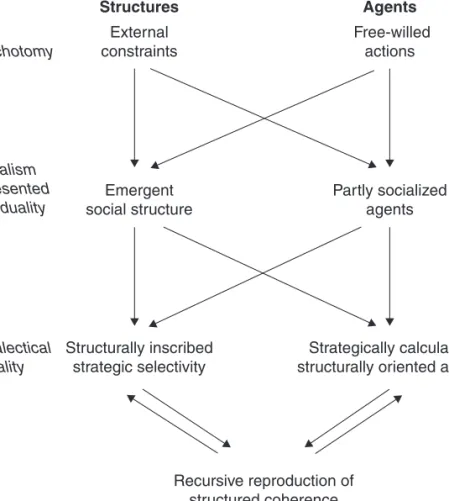
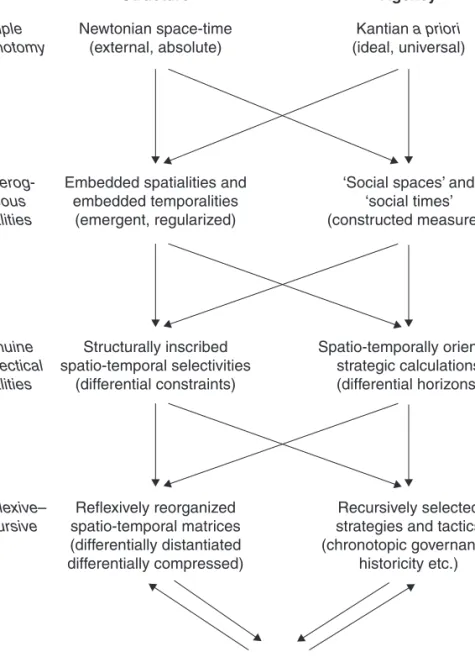
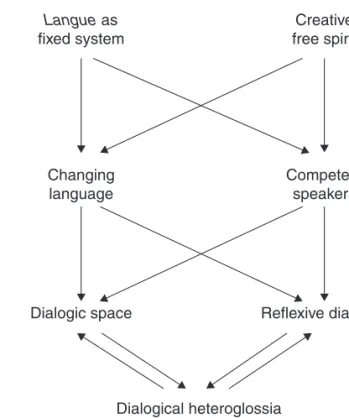
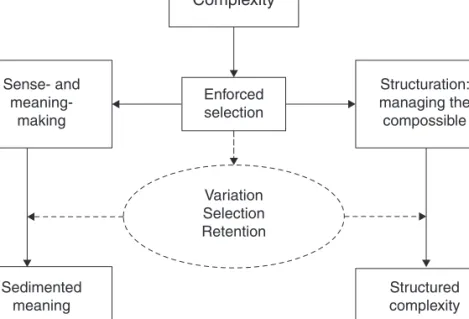
1.1 Structure–agency beyond structuration theory 50 1.2 A strategic- relational approach to spatio- temporality 63 3.1 A strategic- relational approach to dialogical heteroglossia 106 4.1 Complexity reduction through enforced selection 151 4.2 Dialectical relations among the basic concepts 160 4.3 The improbability of complexity reduction via enforced
selection 192 5.1 An encounter between Gramsci, Marx and Foucault 206 5.2 A preliminary mapping of the seven material–discursive
moments in the selectivity space 225
8.1 Porter’s diamond model of national advantage 300 9.1 Mapping and making visible clusters in the Pearl River
Delta 327 9.2 The glocal partnership of Wal- Mart in China 332 9.3 Articulation of ‘new constitutionalism’ and ‘new ethicalism’ 348 10.1 The emergence of a service bloc in Hong Kong between
1997 and 2004 366
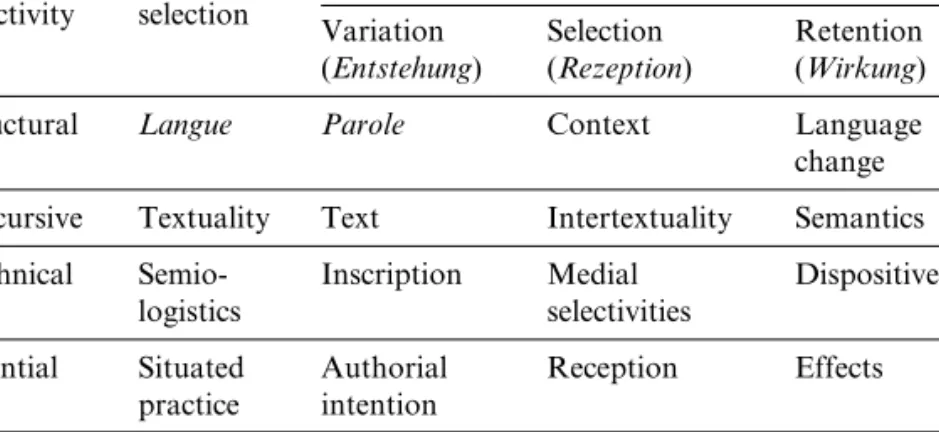
11.1 Schematic representation of variation, selection and
retention 403
Preface
This volume is a companion to our co- authored Beyond the Regulation Approach: Putting Capitalist Economies in their Place (2006) and an earlier book by Bob Jessop, State Theory: Putting the Capitalist State in its Place (1990). It adopts the same critical-realist, strategic- relational approach as these two works but elaborates our response to various institutional and cultural turns in political economy. This response was implicit in State Theory and more fully developed in Beyond the Regulation Approach.
Through a critical interrogation and recontextualization of different regu- lation schools, our previous joint text placed the profit- oriented, market- mediated logic of the capitalist economy and some of its instantiations in their wider political and socio- cultural context.
This work focuses on the semiotic dimensions of political economy con- sidered both as a field of inquiry and as an ensemble of social relations.
Introducing semiosis is not intended to replace, but to deepen, critical political economy. The principal referent of ‘semiosis’, which we develop, refine and re- specify throughout the book, is sense- and meaning- making.
Integrating semiosis provides crucial concepts and analytical tools to interpret and explain even more powerfully the logic of capital accumu- lation and its relation to the social formations in which it is embedded.
This focus explains the sub- title of our book: putting culture in its place in political economy. Consistent with our definition of semiosis, culture can be defined in preliminary terms as ‘the ensemble of social processes by which meanings are produced, circulated and exchanged’ (Thwaites et al.
1994: 1). This definition indicates the overlap between culture and semiosis and, importantly, does not reduce culture to language or discourse. We develop and move beyond this initial definition in Part II of the book and apply these elaborations in Parts III and IV. Overall, we present a research programme that responds to the cultural turn without losing sight of the specificity of the economic categories and economic dynamics typical of capitalist formations. Although cultural political economy (hereafter CPE) is applied mainly, as its name implies, in political economy, the general propositions about semiosis and its grounded heuristics can be applied elsewhere by combining the same semiotic analysis with concepts appropriate to other social forms and institutional dynamics.
Preface ix The background to this work is easily summarized. For some 18 years
now the authors have been working individually and together on an approach to political economy that does not fit into standard disciplinary ways of thinking. We describe our approach as pre- disciplinary in inspira- tion, trans- disciplinary in practice, and post- disciplinary in its aspiration.
We are not alone in refusing disciplinary boundaries and decrying some of their effects. Indeed, there are many signs of increasing commitment among scholars in the arts, humanities and social sciences (and, indeed, natural sciences) to transcend such boundaries in order to better under- stand the complex interconnections within and across the natural and social worlds. We argue that CPE can productively transform understand- ings of recent developments in political economy both as a discipline and as a changing field of social relations.
The present book retraces the development of CPE in our individual and collective writings and, more importantly, offers a joint view of its current status and prospects. When we refer to CPE, therefore, it is sometimes a metonym for our work; but, more often, it refers to a broader current with which we identify. The chapters reflect our intellectual trajectories. Ngai- Ling Sum worked on the approach in the early 1990s and initially applied it to East Asia. She began to integrate sense- and meaning- making, at first implicitly, then explicitly, into her work on the discursive and substantive dimensions of the 1997 transfer of Hong Kong to Mainland China (Sum 1995) and East Asian economic strategies (Sum 1996, 2000), drawing particularly on Foucault. Bob Jessop became interested in the regulation approach and its limits in the 1980s and explored the potential of a return to Marx and Gramsci to reinvigorate and move beyond it. This informed his response to various institutional and cultural turns in the late 1990s.
Over the last few years, we have worked intermittently on various aspects of the emerging approach (for an early statement, see Jessop and Sum 2001).
While it would be tempting to narrate how CPE evolved mainly in response to the cultural turn, this would be far too simple. This still devel- oping approach is grounded in a general interest in the philosophy of science, efforts to reconstruct historical materialism, and developments in state theory. We also addressed the explosive interest in institutions, espe- cially political science, which is reflected in various institutional turns and institutionalisms (see Chapter 1). The next chapter assesses the heuristic potential and limits of cultural turns in political economy, focusing, for the sake of presentation, on the work of Gramsci, neo- Gramscian inter- national political economy, and the regulation approach. Our responses in both cases rest on two important paradigms: one is a ‘critical realist’
view of the social world (including the nature of science); the other is the
x Towards a cultural political economy
strategic- relational approach to structure- agency (see the Introduction).
Both paradigms put sense- and meaning- making at the heart of their social science research programmes. Sense- making refers to the role of semiosis in the apprehension of the natural and social world and highlights the referential value of semiosis, even if this is to as- yet-unrealized pos- sibilities, the ‘irreal’ (or ‘irrealis’), immaterial or virtual entities (see the Introduction). Meaning- making refers to processes of signification and meaningful communication and is more closely related, but not restricted, to the production of linguistic meaning. The fact that sense- and meaning- making are already part of critical realism and the strategic- relational approach nullifies the need for a belated cultural turn. Indeed, these paradigms provide important resources to respond to one- sided cultural turns and, as a favourite phrase goes, ‘to put them in their place’. One of our main goals below is to show how this can be done and to develop a more rounded account of the relation between semiosis and structuration in political economy. We describe the basic structure of the book in the Introduction.
Just as there are many kinds of cultural turn, there are many currents in political economy. Our approach draws mainly on Marxism, supplemented by the German Historical School, modern heterodox economics, and Foucauldian analyses of discourses, technologies and power/ knowledge relations. However, in contrast to orthodox Marxism, which, like ortho- dox economics, tends to reify and essentialize the different moments of capital accumulation, treating them as objective forces, a historical mate- rialist CPE stresses their contingent and always tendential nature.
Bob Jessop’s starting point for this long- term project was the problem of understanding the British state and his dissatisfaction with prevailing theoretical approaches in the 1970s. This was also the time of crisis in Atlantic Fordism and of the mobilization not only of old but also of new social movements – raising in part the question for many public employ- ees of how to work in and against the state. He developed an approach to the state that has subsequently been labelled the ‘strategic- relational approach’, through his reading of German legal and state theory (espe- cially work in the historical materialist tradition but also other schools), the work of Nicos Poulantzas, the Prison Notebooks of Antonio Gramsci, and a critical reading of the work of Louis Althusser and his collaborators and disciples. He then turned to the regulation approach as a comple- ment to the strategic- relational approach to the state and, more recently, has developed an interest in critical historical semiotic analyses. These interests are combined in the present book.
Ngai- Ling Sum’s starting points were Hong Kong as a colonial social formation and the critique of western- centric theoretical approaches in
Preface xi political economy. The results were presented in Beyond the Regulation
Approach (Jessop and Sum 2006). The ‘war of words’ around the transfer of Hong Kong to the People’s Republic of China in 1997 stimulated her interest in critical discourse analysis. Together with a growing concern with competitiveness, Wal- Martization and issues of corporate social responsibility, this led to engagement not only with Marx and Gramsci but also with Foucault’s work on disciplinarity and governmental powers.
This explains her interest in governmentalizing Gramsci and Marxianizing Foucault (see Chapter 5). Together with her work on exportism and the world market (Jessop and Sum 2006) and the ‘new ethicalism’ (see Chapter 9), these are important entry- points into CPE.
All chapters have been freshly written but most draw on earlier work.
A monograph with the breadth of the present text is even more prone to uneven development and non- contemporaneity than most, and the contin- gency of our key reference points and citations reflects our shifting inter- ests. If one comes to new ideas, concepts and insights through a particular author or school, this will be more influential than when one encounters similar ideas elsewhere and later. This may explain why some celebrated scholars receive less attention than their place in one or more canons might lead dedicated followers or informed readers to expect, and why others are given more prominence than is normal. It also explains why we have not given equal weight to debates in all the disciplines and trans- disciplines that bear on our main arguments.
Ngai- Ling Sum is identified as the senior author of this volume because the majority of the primarily sole- authored chapters are revisions of her pioneering studies in CPE and because this recognizes her decisive contributions to the new research agenda in CPE over two decades.
Our analysis is inspired by our cooperation and discussions with many scholars from around the world and, in particular, with col- leagues at Lancaster University. Among other forums, this occurred in the ‘Language, Ideology, and Power’ research group at Lancaster, run first by Norman Fairclough and more recently by Ruth Wodak, in the ‘Complexity Network’ mediated by John Urry, and the ‘Cultural Political Economy’ workshop organized by Ngai- Ling Sum and funded by Lancaster University’s Institute for Advanced Studies (2004–2006). We have also tested the CPE approach in a European Union Framework 6 Project, directed by Frank Moulaert, on socio- economic models of devel- opment (acronym: DEMOLOGOS); and, more recently, in the EU- COST programme on World Financial Crisis: Systemic Risks, Financial Crises and Credit (COST Action IS0902), in which we have been involved in the working group on cultures of finance. We have also benefited from general discussions with Norman Fairclough and Andrew Sayer over many years.
xii Towards a cultural political economy
Our approach to CPE has been influenced at different times by discus- sions with Andrew Baker, Florian Becker, Mats Benner, Robert Boyer, Neil Brenner, Michael Brie, Ulrich Brand, Ian Bruff, Mario Candeias, Carolyn Cartier, Roger Dale, Charlie Dannreuther, Judith Dellheim, Alex Demirović, Frank Deppe, Heather Ellis, Michael Farrelly, Frank Fischer, Benoît Godin, Eva Hartmann, Jerzy Hausner, Colin Hay, Mathis Heinrich, Antony Hesketh, Ray Hudson, Joo- Hyoung Ji, Martin Jones, Oliver Kessler, Michael Krätke, Amelie Kutter, Thomas Lemke, Reijo Miettinen, Pun Ngai, Henk Overbeek, Jamie Peck, Kees van der Pijl, Katharina Puehl, Hugo Radice, Susan Robertson, Thomas Sablowski, Andrew Sayer, Christoph Scherrer, George Steinmetz, Rob Stones, Peter Utting, Bastiaan van Apeldoorn, Brigitte Young, Beat Weber and Alexander Ziem. Participants in the CPE Seminar at Lancaster have included Sara Gonzales, Ramón Ribera- Fumáz, Santiago Leyva Botero, Stijn Oosterlynck, Ralph Guth, Raphaël Ramuz and Nana Rodaki. Our colleagues in the DEMOLOGOS project included Abid Mehmood, Frank Moulaert, Andreas Novy, Stijn Oosterlynck, Jamie Peck, Pun Ngai, Alvin So, Erik Swyngedouw, Nik Theodore and Pasquale Tridico. The usual disclaimers apply.
Bob Jessop received financial support from Lancaster University Research Committee for a pilot study on the CPE of economic crisis and, later, from the Economic and Social Research Council (UK) for a three- year Professorial Fellowship (RES–051- 27- 0303) on the cultural political economy of crises of crisis management. Ngai- Ling Sum received a British Academy Research Development Award for a project on ‘Changing Cultures of Competitiveness: A Cultural Political Economy Approach’
(BARDA- 48854). This research compared the Pearl River Delta and India, 2008–2010. She also secured funding from the quondam Institute for Advanced Studies at Lancaster University (now closed) for a three- year post- disciplinary research seminar series on CPE. Both authors also benefited from a major EU grant for participation in the European Union Framework 6 Project on models of socio- economic development (DEMOLOGOS); from funding under the European Union’s EU- COST World Financial Crisis: Systemic Risks, Financial Crises and Credit (COST Action IS0902); and from short- term senior fellowships from the Rosa Luxemburg Foundation to visit the Institut für Gesellschaftsforschung, directed in this period by Professor Michael Brie. Indeed, the manuscript was finished during our stay at the Rosa Luxemburg Foundation – a cause for particular pleasure. We are grateful to all these bodies for facilitating our research on this new theoretical project. We express our gratitude to Elizabeth Teague for her careful, scrupulous and judicious reading and copy- editing of the final text. We want to thank Audrey Nolan for
Preface xiii providing the space to read and write in Berlin. And, in our trips to Hong
Kong, Lo Mo Kwan, Slamet Sowiyah, Anita Pak, Virginia Pak, Pauline Yip, Anna Lam, Jane Che, Paula Chung, Siu Shuk Ngor, Chau Lai Ha, Diana Yim and Maria Yu provided help, assistance and friendship.
Ngai- Ling Sum Bob Jessop Lancaster and Berlin 1 May 2013
Abbreviations
ACI Asia Competitiveness Institute ADB Asian Development Bank
ADBI Asian Development Bank Institute ALBA Bolivarian Alliance for the Americas ASEAN Association of South East Asian Nations BCI Business Competitiveness Index
BRIC Brazil, Russia, India, China
BRICS Brazil, Russia, India, China, South Africa
BSPU Business and Services Promotion Unit (Hong Kong) CE chief executive
CDA critical discourse analysis CEO chief executive officer
CEPA Closer Economic Partnership Arrangement CEPAL La Comisión Económica para América Latina CPE cultural political economy
CSR corporate social responsibility DHA discourse historical approach FDI foreign direct investment FS financial secretary
GATS General Agreement on Trade in Services GATT General Agreement on Tariffs and Trade GFC global financial crisis
GCI Global Competitiveness Index GDP gross domestic product GES Growth Environmental Scores
GSCP Global Social Compliance Programme GVC global value chain
HBS Harvard Business School
HKCER Hong Kong Centre for Economic Research HKCSI Hong Kong Coalition of Service Industry HKSAR Hong Kong Special Administration Region IDeA Improvement and Development Agency (UK) IMD Institute for Management Development IFI independent financial institution
Abbreviations xv IMF International Monetary Fund
IADB Inter- American Development Bank IPE international political economy IPR intellectual property right IVS Individual Visit Scheme (China)
JICA Japan International Cooperation Agency KBE knowledge- based economy
MIT Massachusetts Institute of Technology MNC multi- national corporation
MSME micro, small and medium enterprise NAFC North Atlantic financial crisis
NAFTA North Atlantic Free Trade Agreement NGO non- governmental organization NIEs newly industrializing economies
OECD Organisation for Economic Co- operation and Development
OBM original brand manufacturing ODM own- design manufacturing OEM original equipment manufacturing POS point- of- sale
PRD Pearl River Delta RA regulation approach R&D research and development RMB renminbi (Chinese currency)
SACOM Students and Scholars Against Corporate Misbehaviour SAR Special Administration Region
SARS Severe Acute Respiratory Syndrome SCMP South China Morning Post
SDR special drawing right
SME small and medium enterprise SRA strategic- relational approach STF spatio- temporal fix
TDC Trade Development Council
TRIMS Agreement on Trade Related Investment Measures TRIPS Agreement on Trade Related Intellectual Property Rights UNCTAD United Nations Commission on Trade and Development UNECE United Nations Economic Commission for Europe UNESCO United Nations Educational, Scientific and Cultural
Organization
UNIDO United Nations Industrial Development Organization USA United States of America
USAID US Agency for International Development
xvi Towards a cultural political economy USD United States dollar
WB World Bank
WEF World Economic Forum WTO World Trade Organization
Acknowledgements
The publishers wish to thank the following who have kindly given permission for the use of copyright material.
Edward Elgar for material in Chapter 11 drawn from Jessop (2013d).
John Benjamins Publishing Company in Chapter 10 from Sum (2010a).
Palgrave- Macmillan for material in Chapter 8 drawn from Sum (2010b).
Pion for material in Chapter 1 drawn from Jessop (2001a).
SAGE Publications for material in Chapters 4 and 8 drawn from Jessop (2009) and Sum (2009) respectively.
SENSE Publishers for material in Chapter 7 from Jessop (2008a).
Taylor and Francis for material in Chapters 8 and 12 from Sum (2009, 2013a).
ORIGINAL SOURCES OF THE CHAPTERS
All the chapters have been freshly written but some draw in part on previously published work. We list these below.
Chapter 1 derives in part from Bob Jessop (2001a), ‘Institutional (re)turns and the strategic- relational approach’, Environment and Planning A, 33 (7), 1213–37.
Chapter 6 derives in part from Bob Jessop (2013e), ‘Revisiting the regula- tion approach: critical reflections on the contradictions, dilemmas, fixes, and crisis dynamics of growth regimes’, Capital & Class, 37 (1), 5–24.
Chapter 7 derives in part from Bob Jessop (2008a), ‘A cultural political economy of competitiveness and its implications for higher education’, in Bob Jessop, Norman Fairclough and Ruth Wodak (eds), Education and the Knowledge- Based Economy in Europe, Rotterdam: Sense Publishers, 11–39.
xviii Towards a cultural political economy
Chapter 8 derives in part from Ngai- Ling Sum (2009), ‘The production of hegemonic policy discourses: “competitiveness” as a knowledge brand and its (re- )contextualizations’, Critical Policy Studies, 3 (2), 184–203.
Chapter 9 derives in part from Ngai- Ling Sum (2010b), ‘Wal- Martization and CSR- ization in developing countries’, in Peter Utting and José Carlos Marques (eds), Corporate Social Responsibility and Regulatory Governance, London: Palgrave and Geneva: UNRISD, 50–76.
Chapter 10 derives in part from Ngai- Ling Sum (2010a), ‘A cultural politi- cal economy of transnational knowledge brands: Porterian “competitive- ness” discourse and its recontextualization in Hong Kong/Pearl River Delta’, Journal of Language and Politics, 9 (4), 546–73.
Chapter 11 derives in part from Bob Jessop (2013d), ‘Recovered imagi- naries, imagined recoveries’, in Mats Benner (ed.), Before and Beyond the Global Economic Crisis, Cheltenham UK and Northampton, MA, USA:
Edward Elgar, 234–54.
Chapter 12 derives in part from Ngai- Ling Sum (2013a), ‘A cultural politi- cal economy of crisis recovery: (trans)national imaginaries of “BRIC”
and the case of Subaltern Groups in China’, Economy & Society, 42 (4), in press.
Introduction
Cultural political economy is an emerging and still developing trans- disciplinary approach oriented to post- disciplinary horizons. It is con- cerned with the semiotic and structural aspects of social life and, even more importantly, their articulation. It combines concepts from critical, historically sensitive, semiotic analyses and from critical evolutionary and institutional political economy. In this context, cultural political economy refers both to an increasingly ‘grand theory’ and to an expand- ing field of empirical study. Theoretically, it has six features (see 23–25) that, together, distinguish it from other approaches with similar theoreti- cal ambitions. In brief, it combines the analysis of sense- and meaning- making with the analysis of instituted economic and political relations and their social embedding. More expansively, it aims to produce a consistent ‘integral’ analysis of political economy from the perspective of the interaction of its specific semiotic and structural features at the same time as it embeds this analysis into a more general account of semiosis and structuration in wider social formations. Thus, as a grand- theoretical project, its insights can be applied far beyond its home domain in political economy.
Cultural political economy (CPE) builds on our earlier work on state theory and political economy and our critical engagement with Marx’s prefigurative contributions to language and discourse analysis (see Höppe 1982; Fairclough and Graham 2002). It also confirms the importance of Gramsci’s elaborate philological and materialist studies of hegemony and Foucault’s work on discursive formations and disposi- tives (see Chapters 3 and 4). On this basis, CPE posits that the economic field (or, better, political economy) is always- already meaningful as well as structured. Thus, whether or not meaning- making provides the initial entry- point, it must be included sooner or later to ensure the descriptive and explanatory adequacy of the analysis. The same holds for the need sooner or later to bring structural factors in. We now set out the rationale for this and other claims about CPE, beginning with some philosophical preliminaries that ground our subsequent remarks on critical realism.
2 Towards a cultural political economy
SOME PHILOSOPHICAL PRELIMINARIES
It is conventional to distinguish four modes of philosophical inquiry:
ontology, epistemology, methodology and ethics. Ontology concerns the nature and properties of being or existence and the categorial structure of reality. A derivative meaning, more important for our purposes, is ‘the set of things whose existence is acknowledged by a particular theory or system of thought’ (Lowe 1995: 634). Epistemology concerns knowledge (or belief), its very possibility, its defining features and scope, its substantive conditions and sources, its limits and its justification. Methodology deals with general rules for gaining and testing (scientific) knowledge, includ- ing analytical strategies, assuming such knowledge is possible. It is more practical and technical than epistemology, being concerned with the logic of discovery and methods of scientific inquiry. Finally, ethics concerns the good or right, that which should be. It has two main branches: deontologi- cal (concerned with the duties and obligations of individuals, focusing on their will and intention without much regard, if any, to the consequences of good conduct); and consequential (which defines proper conduct in terms of consequences rather than intentions). Cultural political economy can be considered from all four perspectives (see Box 0.1).
BOX 0.1 CULTURAL POLITICAL ECONOMY AS A SOCIAL SCIENCE
Four modes of philosophical inquiry
● ontology: nature of being, existence, meaning
● epistemology: nature of knowledge
● methodology: rules for gaining, testing knowledge
● ethics: nature of the good, that which should be Placing CPE as social science
● complexity and its reduction through semiosis and structuration
● intransitive and transitive dimensions interact in scientific inquiry
● pluralistic logic of research, logical–historical presentation
● commitment to critique of ideology and domination
Introduction 3 Ontology
Our approach posits that the world is too complex to be grasped in all its complexity in real time (or ever) and for all permutations of social rela- tions to be realizable in the same time- space. This is self- evidently and triv- ially true, of course, yet it has important implications for social science and everyday life. In particular, CPE does not aim to theorize or model com- plexity as such but to explore how complexity is reduced (but not thereby mastered) through sense- and meaning- making (semiosis)1 and through limiting compossible social relations (structuration). In this sense, semi- osis and structuration are both equally real, even though their character, generative mechanisms and effects differ. We deal with each in turn.
Regarding semiosis, this enforced selection occurs as individuals and other social agents adopt, wittingly or not, specific entry- points and standpoints to reduce complexity and make it calculable (if only to ease muddling through) so that they can participate within it and/or describe and interpret it as disinterested observers. This produces the paradox that the current complexity of the real world is also in part a path- dependent product of past and present efforts to reduce complexity. This holds both for the social world and the effects of social action in and on the natural world (e.g. the built environment, ‘second nature’, etc.). In this sense, attempts at complexity reduction may increase overall complexity; and the efforts of some forces (or systems) to reduce complexity may increase it for other forces (or systems). While the real world pre- exists current efforts at complexity reduction, actors/observers have no direct access to it. The
‘aspects’ that they regard as significant are not pre- given but depend on the meaning systems that frame its significance for them. Sense- making, to repeat the definition given in the Preface, refers to the role of semiosis in the apprehension of the natural and social world and highlights the refer- ential value of semiosis, even if this is to as- yet-unrealized possibilities, to the ‘irreal’ (or ‘irrealis’), to immaterial or virtual entities or to inexistent but culturally recognized entities (cf. Eco 1976; Graham 2001). Meaning- making refers in turn to processes of signification and meaningful commu- nication and is closely related to the production of linguistic meaning but also includes non- linguistic modes of signification and communication.
Thus sense- and meaning- making not only reduce complexity for actors (and observers), but also give meaning to the world.2 They are founda- tional to all social relations in both senses of ontology as presented above.3 In other words, CPE posits that the social world is always- already mean- ingful by nature and that its analysis must acknowledge the importance of sense- and meaning- making. This further implies that social explanation must be adequate at the level of meaning as well as of ‘material’ causation
4 Towards a cultural political economy
(see Chapter 4). In fact, as we argue below, semiosis is causally effective and not a mere supplement to causal analysis.
For the sake of clarity, in this context, meaning does not denote ‘lin- guistic meaning’ as analysed by specialists in ‘core linguistics’4 who study how meaning emerges from the composition of linguistic units (e.g. Frege 1984; Grice 1989). Instead it denotes the ‘sense meaning’ involved in the apprehension (e.g. cognitive, normative or appreciative significance) of the world and which, when translated into intersubjective meaning- making, has important intertextual, contextual and pragmatic aspects.
In this respect our approach to CPE is closer to the pragmatic tradition of Charles Sanders Peirce (1992) and Charles W. Morris (1946) without being located within it (see Chapter 3). Viewed thus, to make sense of the world is also to make sense of ourselves (Møller 2006: 65–8). In addition, construals may shape the natural and social world in so far as they guide a critical mass of self- confirming actions based on more or less correct diag- noses of unrealized potentials. In this sense construals become a ‘material force’, that is, have durable transformative effects in the natural and social world. It is the role of some, if not all, construals in constructing the world that justifies, indeed requires, an ontological cultural turn. Conversely, because not all construals lead to durable changes in the natural and social world, semiosis must also be linked to the extra- semiotic.5 Recognizing that only some construals have constructive effects ensures, in the words of Andrew Sayer (2009: 423), that discourse analysis is not merely ‘scepti- cal’ (because all ideas or discourse are deemed equally ideational), but critical (because some discourses undermine the conditions for human flourishing). Indeed, underpinning CPE’s contribution to Ideologiekritik is recognition that the effects of semiosis are not just internal to semiosis but also affect the natural and social world.
Structuration (or structure- building) is also included in ‘the set of things whose existence is acknowledged by a particular theory or system of thought’. It is a form of enforced selection that sets limits to compos- sible combinations of relations among relations within specific time- space envelopes. The core concept here is compossibility. For not everything that is possible is compossible. Compossibility is, as indicated, relative to specific time- space structures and horizons of action. To illustrate, several
‘varieties of capitalism’ coexisted in the European Union before the Economic and Monetary Union was established and, indeed, its heteroge- neity had increased with each round of expansion. This prompted a turn from integration measures based on coordination and indicative planning towards greater reliance on market forces to facilitate mutual adjustment.
In addition to increased trade, investment, and a more extensive division of labour, another result was intensified centre–periphery relations. The
Introduction 5 formation of the eurozone removed key sources of flexibility. What was previously compossible (a relatively benign co- evolution of varieties of capitalism) became hard to maintain, leading to increasing crises and, more importantly, crises of crisis management. This situation can be con- trasted with the pathological co- dependency of the USA and China (some- times known as ‘Chimerica’),6 where growing interdependence has not yet produced a ruptural incompossibility (see Jessop 2007c; and Chapters 6 and 11).
Structuration (or structure- building) is subject to processes of variation, selection and retention in the same way as semiosis. In other words, even where agents try to limit the covariation of relations among relations, these attempts rarely fully succeed. Indeed, there are many efforts at many scales to structure social relations and, if structural coherence and a stra- tegic line do emerge, even in a provisional, partial and unstable way, this result cannot be attributed to a single master subject. It is a contingently necessary outcome of the asymmetrical interaction of competing struc- turation attempts and, most importantly, of blind co- evolution (Jessop 2007b; cf. Foucault 2008a, 2008b; Poulantzas 1978).
The ontological distinction between semiosis and structuration is crucial to our approach. Since our arguments are first developed in Parts I and II, we refer here to the renowned cultural anthropologist, Clifford Geertz, who defines culture as ‘an historically transmitted pattern of meanings embodied in symbols’ (1975: 89). Given this definition, he might be expected to privilege semiosis over structuration. But he argues that the study of society must explore the articulation between cultural and social structures, without superimposing one on the other (via the metaphor of a mirror) or implying that one mechanically generates the other (1975:
142–69). Geertz adds that, if one studies only cultural symbols, the social dissolves into the meanings attributed to it by social agents via their theo- retical or practical knowledge of it. But social structure has hidden depths due to the hierarchical layering of different kinds of social relations. Thus, as Luhmann might say, social agents ‘cannot see what they cannot see’.
This clearly raises epistemological questions.
Epistemology
Inspired by the Marxian critique of political economy and Foucault’s analyses of truth regimes (among other sources), CPE assumes that knowledge is always partial, provisional and incomplete. ‘Knowledging’
activities can never exhaust the complexity of the world. On this basis, against a universal, trans- historical account of the ‘economy’, we empha- size the inevitable contextuality and historicity of knowledge claims about
6 Towards a cultural political economy
historically specific economic orders. The same holds for other positiv- ist social science analyses that take for granted their respective research objects. The basis for our understanding of (scientific) knowledge produc- tion is critical realism (see next section) with its distinction between the intransitive and transitive moments of scientific investigation. The intran- sitive moment refers to the external world as the object of observation and, in many cases, intervention; the transitive moment refers to the practices of science and scientific communities as a set (or sets) of observers and, perhaps, interveners.
Critical realists analyse knowledge as the fallible result of interaction of the intransitive and transitive moments and view its production as a con- tinuing but discontinuous process. Of course, one can also study science as a set of social practices. In this case, scientists remain ‘located’ in the intransitive world (which varies across the natural and social sciences) and those who observe them act as if they operate outside it, at least for obser- vational purposes. In good recursive fashion, one could also study the science of science studies (and so on) as well as the history of science and scientific disciplines – including their relationship to other kinds of social practice. Interesting topics here include how disciplines are distinguished from each other and from other forms of knowledge production. There is much work on the scientific practices, scientific communities and scientific knowledge that considers how knowledge production is mediated through scientific imaginaries, the structure of communities of scientific practice, scientific methods and techniques, and, of course, the ability of certain scientists or teams to produce ‘scientific revolutions’.
Because not all knowledge is produced through scientific practices (even science is embedded in other practices and its practitioners may have mixed motives), other modes of knowledge production and knowledge claims also affect social practices and how they get struc- tured. A useful entry- point into knowledge production and its effects is Foucault’s concept of ‘truth regimes’. Later chapters explore situated knowledge production, its reception by social agents, and its long- term social effects within and beyond its sites of production (for example, Chapter 5 considers intellectuals, Chapter 4 treats reception and societal effects, Chapter 7 considers the genealogy and impact of alternative post- Fordist imaginaries, and Chapter 12 explores the genealogy and impact of changing views about the BRIC economies). Of interest is how ‘knowledge’ enters strategic calculation, policy formulation and implementation, and, in some cases, becomes the basis for ‘knowledge brands’ that are marketed as patent remedies to solve socially diagnosed problems and to realize socially constructed objectives (on knowledge brands, see Chapter 8).
Introduction 7 Methodology
CPE works with a critical-realist and strategic- relational approach that relies on a pluralistic logic of discovery and a logical–historical method of presentation. Pluralism can be justified deontically and/or pragmatically in many ways, but it is grounded ontologically in the complexity of the world, which entails that it cannot be fully understood and explained from any one entry- point. Nonetheless, this does not exclude well- grounded cri- tiques of individual entry- points as an important part of scientific practice.
It is not a recipe for an ‘anything- goes’ relativism.
The logical–historical method entails the movement from abstract–
simple analytical categories to increasingly complex–concrete ones.
Whereas this movement initially relies more on elaborating and articulat- ing analytical categories and identifying basic mechanisms, tendencies and counter- tendencies, later steps consider their historical and conjunctural actualization, with due attention paid to the interaction of different causes and conditions. Nonetheless, as our comments on complexity imply, this process of discovery and method of presentation cannot culminate in the exhaustive reproduction of the real world (or, as Marx put it, the ‘real- concrete’) in all its complexity (for Marx, as a ‘concrete- in- thought’).
Positing such an outcome contradicts the foundational ontological pos- tulate of the complexity of the real world. Thus the same method of pres- entation can be used for a wide range of research programmes that start from different entry- points, mark out some aspects of the world as objects of investigation, and pursue multiple lines of inquiry. The aim is to provide adequate explanations for these research problems as they are posed with different degrees of concreteness–complexity. We discussed these epistemological issues in Beyond the Regulation Approach (2006) and will shortly consider their implications for pre- disciplinary, disciplinary, multi- disciplinary, trans- disciplinary and post- disciplinary research. Chapter 4 presents the analytical tools for CPE in more detail, after we introduce concepts for structural (especially institutional) analysis in Chapter 1 and some crucial concepts for the study of semiosis in Chapter 3.
Ethics
CPE can be extended to include ethics in both senses (deontological and consequential) as part of its subject matter. Within the broad church of CPE this is the set of pews reserved for the study of moral economy (Thompson 1971; Sayer 1995, 2002, 2005, 2009; Scott 1977). This is con- cerned with revealing and evaluating the often implicit ethical and moral values, sentiments, commitments, feelings, temporal horizons, attitudes
8 Towards a cultural political economy
to the environment and judgements that shape everyday life, organiza- tional practices, institutional orders and societal self- understandings. It examines capitalist as well as pre- capitalist social formations. Within a CPE framework, moral economy involves the critique of ideology and the ways in which morality and ethics are enrolled in reproducing domination.
In this sense, by virtue of its commitment to the critique of ideology and domination, CPE also rests on certain ethical convictions on the part of its adherents (for an incisive account of moral economy consistent with the broader CPE project, see Sayer 2002). This does not commit cultural political economists to (1) a utopian belief in a social world with no traces of ideology or domination or (2) a relativist position that all sets of social relations are equally bad, neutral or good. Within these limits, convictions are contestable and must be justified.
Missing from these observations is the substantive character of CPE.
This concerns how these general philosophical principles are reflected and refracted in a particular theoretical programme. This question can be answered by identifying the positive heuristic of the CPE research agenda, that is, the concepts, assumptions, guidelines and theoretical models with which it operates. The present volume, like its predecessor, is an exercise in elaborating a substantive CPE research programme that is consistent with the ontological, epistemological and methodological principles that we have set out. We present the six basic features of this research programme below (see 23-35) and develop them in the rest of the book.
This approach can also be applied to itself. It can assess the place of CPE in the social sciences and compare its practices and achievements, if any, with others. It can compare its philosophical presuppositions, that is, its ontological, epistemological, methodological and ethical horizons, with other approaches. It can inquire into its own conditions of possibility, the distinctiveness of its knowledge, its particular modes of inquiry, and the normative commitments of CPE scholars. These are interesting meta- analytical questions but will not be explored at length here.
ON CRITICAL REALISM
We now briefly introduce critical realism as the philosophy of science that has informed our development of CPE. Critical realism has an important
‘underlabouring’ role in the natural and social sciences. In other words, it examines, critiques, refines and reflects on the ontological, epistemologi- cal, methodological and substantive presuppositions of different theoreti- cal traditions, disciplines, schools and so forth. This ‘underlabouring’ role also implies that critical realism in general cannot provide the substantive
Introduction 9 concepts and methods necessary to develop particular critical- realist theoretical approaches. These have to be produced through other means – but can then be subject to further critical- realist reflection as one among several ways to elaborate their substantive implications.
In general terms, adherents of critical realism posit the existence of real but often latent causal mechanisms that may be contingently actualized in specific conjunctures but may also, thanks to diverse factors or actors, remain latent. On this basis, critical realists distinguish among real mecha- nisms, actual events and empirical observations. Specifically, the real com- prises the defining emergent features, causal properties, affordances (i.e.
the possibilities of action afforded, or offered by, a given material object or social network)7 and vulnerabilities of a given set of relations – which may or may not be actualized. The empirical concerns evidence about the actual, that is, those inherent potentials that are actualized. Together the empirical and the actual provoke questions about the nature of the real (for introductions to critical realism, see Bhaskar 1972; Archer et al. 1998;
and Sayer 2000; and on its relevance to the regulation approach, Jessop and Sum 2006: 259–78).
This approach invalidates the naïve positivist method of inferring cau- sation from empirical regularities, as if these could reveal cause–effect relations without prior or later theoretical work. The existence of the real world is a crucial ‘regulative idea’ in critical realism but its adher- ents do not claim to have direct access to this reality. Instead they rely on a method known as retroduction. This asks ‘what must the world be like for “x” to happen?’ This is an open process that switches among concept- building, retroductive moments, empirical inquiries, conceptual refinement, further retroduction and so on. Theory- building and testing are never final and complete: they are always ‘under construction’ based on a movement between more theoretical and more empirical phases.
For critical realists, then, science involves a continuing, spiral movement from knowledge of manifest (empirical) phenomena to knowledge of the underlying structures and causal mechanisms that generate them.
Knowledge of and/or about the real world is never theoretically inno- cent. This implies, as cultural political economists, among others, would insist, that the starting point for inquiry is discursively constituted. The movement is one from a research problem that is defined in more or less simple and, perhaps, one- sided, superficial or, worse, chaotic, terms to an account that is more complex and has greater ontological depth. This kind of problematization synthesizes multiple determinations, identifies the underlying real mechanisms, and connects them to actual and empirical aspects of the explanandum. As the spiral of scientific inquiry continues, the explanandum is defined with increasing complexity and concreteness.
10 Towards a cultural political economy
Thus, as Michel Aglietta, a pioneer regulation theorist, noted, ‘concepts are never introduced once and for all at a single level of abstraction but are continually redefined in the movement from abstract to concrete – acquiring new forms and transcending the limits of their previous for- mulations’ (1979: 15–16). He added, ‘the objective is the development of concepts and not the “verification” of a finished theory’ (ibid.: 66).
Critical realists also posit that the real world is stratified into differ- ent layers and regions that require different concepts, assumptions and explanatory principles corresponding to their different emergent proper- ties. Obviously, while philosophical argument can justify a ‘critical- realist ontology and epistemology in general’, it cannot validate a ‘critical- realist ontology and epistemology in particular’. The latter depends, as indicated above, on specific analyses of a specific object rather than on a simplistic and generic application of the critical-realist approach. We illustrated this for the regulation approach (RA) in our earlier book and do so for semiosis in Chapter 4.
PRE- DISCIPLINARITY, EMERGING DISCIPLINES AND RESEARCH CHALLENGES
Concerns with big questions and grand theory emerged well before dis- ciplinary boundaries were established and have continued without much regard for them. Examples in the modern epoch include classical political economy, Hegelian philosophy, the German Historical School, other ‘old institutionalisms’ and some versions of CPE. Relevant here is Marxism, considered as a family of approaches rather than a single unified system. It originated in a creative synthesis of German philosophy, classical English economics and French politics (and more besides), and has remained open (in its non- ossified, undogmatic variants) to other influences – witness the impact at different times of psychoanalysis, linguistics, structuralism, post- structuralism,8 ‘cultural turns’, feminism, nationalism and post- colonialism. Among important developments in the last 25 years or so are the RA and trans- national historical materialism (Jessop and Sum 2006;
see also Chapter 2). Marxism offers a totalizing perspective on social rela- tions as a whole in terms of the historically specific conditions of existence, dynamic and repercussions of the social organization of production. This does not commit this approach (although it is often assumed that it does) to the claim that the world comprises a closed totality that is unified and governed by a single principle of societal organization (e.g. accumulation).
CPE explicitly rejects this. It insists on a plurality of competing principles grounded in different sets of social relations associated with different
Introduction 11 grammars (codes, programmes, orders of discourse) and different social
logics (systemic, institutional, organizational) and competing efforts and struggles to make one or other of these principles of societalization hege- monic and/or dominant. The very existence of competing principles and their uneven instantiation at different sites and scales of social organiza- tion invalidates attempts to understand societies or social formations as closed totalities (see Chapter 6).
Another important pre- disciplinary intellectual tradition is the so- called Staats- or Polizeiwissenschaften (state or ‘police’ sciences) approach that developed in the eighteenth- century German- speaking world and else- where in Europe. This was a hybrid theoretical and policy science that explored the nature and obligations of the state with a view to promoting economic development and good governance. This has been revived in the concern (whether Foucauldian or non- Foucauldian in inspiration) with governance and governmentality. It is particularly relevant to the articulation of the economic and political in institutional, organizational and practical terms – especially to the political economy of state policy.
It is also reflected in recent work on global governance in international political economy and in the practices of international agencies such as the World Bank.
More orthodox forms of political economy began the retreat from these wide- ranging concerns in the early nineteenth century; and pure econom- ics as a distinct discipline degenerated further as it became increasingly rig- orous (mathematical and formal) at the expense of real- world relevance.
More generally, only in the mid- nineteenth century did more specialized disciplines emerge, corresponding to the growing functional differentia- tion of modern societies in this period and to struggles to establish a hier- archized division of mental labour within and across expanding academic and technocratic communities. Political economy was separated into dis- ciplines: economics; politics, jurisprudence and public administration; and sociology and/or anthropology (see Wallerstein 1996). These coexisted with history (typically subdivided in terms of distinctive historical periods, areas and places, and borrowing many concepts from other branches of the humanities and social sciences) and geography (which has an ambiva- lent identity, employs eclectic methods due to its position at the interface of nature and society, and is prone to spatial fetishism). At the turn of the nineteenth century two other major disciplines emerged: linguistics and semiotics – one focusing on language, the other on signs more generally (linked to Ferdinand de Saussure and Charles S. Peirce respectively).
These more specialized disciplines tend to reject philosophical anthro- pology (a concern with the essential, trans- historical character of the human species or its alleged subtypes) as pre- modern, unscientific, or
12 Towards a cultural political economy
overtly normative – although neoclassical economics retains a touching faith in homo economicus. In other cases they tend to work with attenuated assumptions about functionally specific rationalities (modes of calcula- tion) or logics of appropriateness that provide no real basis for a more general critique of contemporary societies. These disciplinary bounda- ries are now breaking down in a period when space and time are seen as socially constructed, socially constitutive relations rather than mere external parameters of disciplinary inquiry. To clarify these points we now distinguish forms of disciplinarity, indicating how they affect the study of economic rules and institutions, and noting their implications for a political and ethical critique of economic activities.
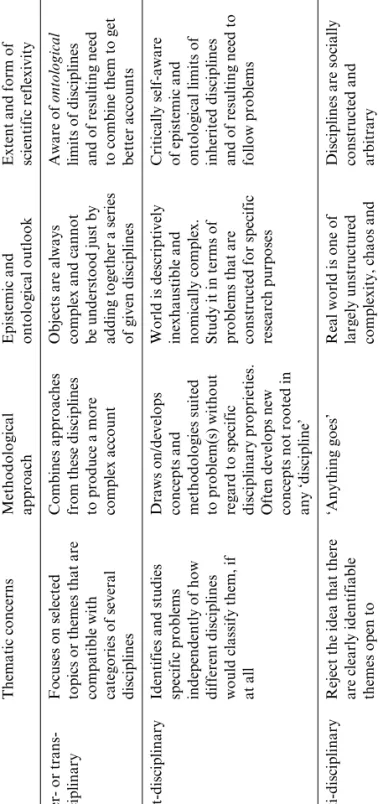
It is impossible to return to the pre- disciplinary age9 that existed before specialized disciplines were institutionalized in the mid- to late nineteenth century in Europe and North America. But this does not require us to think and act in terms set by mainstream disciplines and correspond to often outdated epistemic concerns, ideological biases and ontological real- ities. Indeed the dominance of disciplinary thinking has prompted many scholars to attempt to escape or transcend the limited horizons of disci- plines. To understand what is at stake here we now consider the nature of disciplines and different approaches to escaping from disciplinary straitjackets (for some different positions on disciplinarity, see Table 0.1).
A narrow disciplinary approach to a given topic explores themes identi- fied in terms of a single discipline. For example, in mainstream economic analysis, this would entail focusing on themes that are identified in terms of vulgar political economy and its subsequent development as a special- ized, mathematized discipline concerned with economizing behaviour.
It would also correspond to the naïve, positivist belief that the market economy exists and can be studied in isolation from other spheres of social relations. This naturalization of the economy is linked to top–down peda- gogic practices that reproduce an unreflecting and fetishistic approach to the laws of the market and the basic tendencies of the market economy.
It also neglects the ethico- political dimensions of the economic field.
Instead it would be better to develop and combine pluri- , trans- and post- disciplinary analyses of economic activities that not only draw on different disciplines and research traditions but also elaborate new concepts and methodologies to transcend disciplinary boundaries.
A pluri- or multi- disciplinary approach proceeds from a problem located at the interface of different disciplines and mechanically combines the inherently valid understandings and knowledge of different disciplines about their respective objects of inquiry to produce the ‘complete picture’
through ‘joined- up thinking’. Whilst this is better than a one- sided dis- ciplinary analysis of complex problems, inter- and/or trans- disciplinary
Table 0.1 From pre- disciplinarity to post- disciplinarities Thematic concernsMethodological approachEpistemic and ontological outlookExtent and form of scientific reflexivity Pre- disciplinary periodFocuses on holistic, multi- faceted themes Analyses pre- date the rise of distinct academic disciplines Polymathic, holistic and integrative methodologies, often with humanistic as well as positivistic aspects Tied to a world with low functional differentiation. So society–nature–cosmos often seen as integrated under God or by natural laws
Tends to naturalize a holistic world and hence tends to assert need to study it from all available perspectives DisciplinaryFocuses exclusively on themes that are identified in terms of categories of a given discipline; ignores all other aspects of an entity and other possible themes
Approach to any theme is based on categories of a given discipline. Can prompt efforts to colonize other disciplines via disciplinary imperialism Distinct disciplines correspond to the structure of the real world – each set of ontological entities has its own discipline
Tends to naturalize respective disciplinary objects of analysis as real- world entities and so does not reflect on the constructed nature of disciplines Multi- or pluri- disciplinaryFocuses on themes located at intersection of the categories of two or more conventional disciplines
Combines approaches from these disciplines to produce a simple additive account of the chosen topic Conventional disciplines correspond to simple and/or emergent entities in the real world. Joining them helps to understand a complex world Aware of epistemic limits of disciplines and of resulting need to combine them to get a ‘complete’ account
Table 0.1 (continued) Thematic concernsMethodological approachEpistemic and ontological outlookExtent and form of scientific reflexivity Inter- or trans- disciplinaryFocuses on selected topics or themes that are compatible with categories of several disciplines Combines approaches from these disciplines to produce a more complex account Objects are always complex and cannot be understood just by adding together a series of given disciplines
Aware of ontological limits of disciplines and of resulting need to combine them to get better accounts Post- disciplinaryIdentifies and studies specific problems independently of how different disciplines would classify them, if at all
Draws on/develops concepts and methodologies suited to problem(s) without regard to specific disciplinary proprieties. Often develops new concepts not rooted in any ‘discipline’
World is descriptively inexhaustible and nomically complex. Study it in terms of problems that are constructed for specific research purposes
Critically self- aware of epistemic and ontological limits of inherited disciplines and of resulting need to follow problems Anti- disciplinaryReject the idea that there are clearly identifiable themes open to discipline- based research
‘Anything goes’Real world is one of largely unstructured complexity, chaos and even catastrophe Disciplines are socially constructed and arbitrary
Introduction 15 approaches are preferable. These focus on complex problems that can
be approached in terms of the categories of two or more disciplines and combines these categories to produce a more complex, non- additive account. They recognize the ontological as well as the epistemic limits of different disciplines, that is, that they do not correspond to distinct objects in the real world; and therefore accept the need to combine disciplines to produce a more rounded account of specific themes.
Rejecting the legitimacy of disciplinary boundaries is not a licence to engage in an anti- disciplinary conceptual free- for- all in which, as Paul Feyerabend (1978) suggests, ‘anything goes’ and the most likely outcome of which is eclecticism and/or incoherence. It is a commitment to a problem- oriented rather than discipline- bounded approach and, indeed, a move towards the most advanced form of such problem- orientation, that is, post- disciplinarity.
Post- disciplinarity requires further steps. These are to recognize the conventional nature and inherent limitations of individual disciplines and disciplinarity as a whole and to remain open to new ideas that may be inconsistent or incommensurable with any or all established disciplines.
This approach refuses historically contingent disciplinary boundaries.
Instead, post- disciplinary analyses begin by identifying specific problems independent of how they would be classified, if at all, by different disci- plines; and they then mobilize, develop and integrate the necessary con- cepts, methodologies and knowledge to address such problems without regard to disciplinary boundaries. In sum, this research orientation is critically self- aware of both the epistemic and ontological limits of inher- ited disciplines and is explicitly problem- oriented rather than tied to dis- ciplinary blinkers. As such, this is a research programme that should be discursively and structurally resistant to disciplinary institutionalization, that is, to becoming another discipline alongside others.
This creates the space for looser- textured, more concrete and more complex analyses that may also be more relevant to political and ethical issues. It also leads to more critical pedagogic practices and presents us with a constantly moving target as disciplines and their relations are reor- ganized. In an age when established disciplines still dominate higher edu- cation and the intellectual division of labour, trans- disciplinarity is often sufficient for many purposes and is also easier to deliver.
RESPONSES TO DISCIPLINARITY STRAITJACKETS
While the origins of classical political economy were pre- disciplinary, contemporary political economy is becoming trans- disciplinary and, in
16 Towards a cultural political economy
some cases, has post- disciplinary aspirations. Classical political economy was a pre- disciplinary field of inquiry for two reasons. First, it developed in the early modern period of Western thought, when the market economy was not yet fully disembedded from other societal spheres and when, in particular, the commodity form had not been fully extended to labour power (cf. Tribe 1978). Second, it was formed before academic disciplines crystallized and began to fragment knowledge in the mid- to late nine- teenth century. Thus it was pioneered by polymaths who regarded politi- cal economy as the integrated study of economic organization and wealth creation, good government and good governance, and moral economy (including language, culture and ethical issues). They examined how wealth was produced and distributed, and explored the close connection between these processes and the eventual formation of civil society and the modern state. Exemplars include John Locke, Adam Smith, Adam Ferguson, John Millar, Montesquieu and Hegel. A potential downside to this approach was its penchant for philosophical anthropologies (i.e. sets of assumptions about human nature and its development) that were often linked to ethico- political considerations.
New intellectual currents have emerged that are pertinent to political economy. Here we mention just five. First, political ecology transcends the nature–society dichotomy and associated disciplinary boundaries to better understand, explain and critique the complex interconnections in and across the natural and social worlds (Altvater 1993; Gorz 1980; Harribey 1998; Lipietz 1995; Peet et al. 2010). Second, semiotics, critical linguistics and discourse analysis have partly shifted from specific disciplines focused on particular objects of inquiry (signification, language, discourse respec- tively) to become, for some scholars, analytical strategies for developing
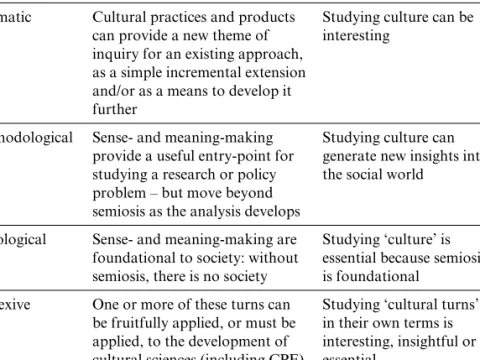
‘grand theories’ about social order (see Chapter 4). They have moved beyond text analysis to study pragmatics, that is, the use of language (and other forms of signification) as an important moment of social practices in different social contexts. This current is reflected in diverse ‘cultural turns’:
narrative, rhetorical, argumentative, linguistic, metaphorical, translational and so on (see Chapter 3). Concern with semantic conceptual history, the analysis of discursive formations, and, more recently, historical genre analysis also have major implications for the discursive constitution and regularization of the capitalist economy and the national state as imagined entities and their cultural as well as social embeddedness (see Chapter 4).
A third, related, trend is the massive expansion of cultural and/or media studies. This is a wide- ranging field defined by its thematic focus (or foci) rather than by agreed ontological, epistemological and methodological assumptions. Indeed, as one authority notes, cultural studies are marked by significant ontological and methodological differences, ranging from