行政院國家科學委員會專題研究計畫 期中進度報告
應用於太陽能轉換之新穎氮化銦/二氧化鈦奈米結構薄膜之
製備及其電子移轉研究(1/3)
計畫類別: 個別型計畫 計畫編號: NSC94-2120-M-009-014- 執行期間: 94 年 08 月 01 日至 95 年 07 月 31 日 執行單位: 國立交通大學應用化學系(所) 計畫主持人: 李遠鵬 共同主持人: 林恭如,李積琛,刁維光 計畫參與人員: 李遠鵬,刁維光,李積琛,林恭如,鍾昭宇,駱立揚,鄭棋文 報告類型: 精簡報告 報告附件: 出席國際會議研究心得報告及發表論文 處理方式: 本計畫可公開查詢中 華 民 國 95 年 6 月 6 日
奈米國家型科技計畫
學術研究重要成果表
填表日期:95 年 5 月 16 日
1. 計畫背景:
(請以中、英文並呈)
計畫主持人及共同主持人(PI and Co-PIs):
PI: 李遠鵬 (Yuan-Pern Lee)
Co-PIs: 刁維光 (Eric Wei-Guang Diau)、李積琛 (Chi-Shen Lee)、
林恭如 (Gong-Ru Lin)
研究題目(Project Title):
應用於太陽能轉換之新穎氮化銦/二氧化鈦奈米結構薄膜之製備及其電
子移轉研究
Preparation and Interfacial Electron Transfer of Novel InN/TiO2 Nanocrystalline Thin Films for Solar Energy Conversion Applications
主持人執行機構(Organization、Institution):
國立交通大學應用化學系(Department of Applied Chemistry, NCTU)
國立交通大學光電工程學系(Institute of Electro-Optical Engineering, NCTU)
全程計畫執行期限(Project Period):
2. Goals of the project (Don’t exceed 300 words)
We propose to investigate collaboratively the preparation and characterization of novel InN/TiO2 nanoparticle-film and relevant systems for solar energy conversion.
An important goal of this project is to set up an advanced ultrafast laser laboratory to use various cutting-edge spectral techniques to investigate electron/energy transfer dynamics of various nanomaterials; it will be beneficial to many researchers in nanoscience in Taiwan. We will focus on the fabrication and characterization of InN/TiO2 nanocrystalline films with different materials embedded at the interface of
the InN and TiO2 films to modify the system’s optical band gap and to promote
electron transfer rates from InN to TiO2 and back-transfer to the sensitizer for
enhancement of solar energy conversion efficiencies. The materials to be embedded and protected by the InN film include nanoparticles and/or thin films of semiconductors and conductors. In addition, mixed nanoparticle films of TiO2 and
other metal oxides with lower band gaps such as WO3 and SnO2 will also be
employed in lieu of pure TiO2 for band gap modification and potential improvement
in solar energy conversion efficiencies. Characterization of all fabricated films will be carried out by surface and film morphology analyses, interfacial electron transfer dynamics, and direct photo-current measurements of these solar cell devices. The key interfacial electron transfer dynamics between InN and TiO2 will be extensively
investigated with various time-resolved spectroscopy techniques in both UV/VIS and IR regions, including femtosecond fluorescence up-conversion, transient UV/VIS absorption/reflectance, ultrafast IR spectroscopy, and step-scan time-resolved FTIR. The intermediate excited states and the electrons in the semiconductor will be directly probed with these techniques to provide information on the mechanism and the temporal evolution of interfacial electron transfer.
4. Please list all the participants of the project, including names and
affiliations.
Name Affiliation
PI Yuan-Pern Lee Dept. Applied Chemistry, NCTU
Co-PI Eric Wei-Guang Diau Dept. Applied Chemistry, NCTU
Co-PI Chi-Shen Lee Dept. Applied Chemistry, NCTU
Co-PI Gong-Ru Lin Inst. Electro-Optical Engineering,
NCTU
Co-PI Niann-Shia Wang Dept. Applied Chemistry, NCTU
As-PI Ming-Chang Lin Dept. Applied Chemistry, NCTU
Postdoctor Chia-Yan Wu Dept. Applied Chemistry,NCTU
Research Assistant Su-Ching Chuang Dept. Applied Chemistry, NCTU Research Assistant Kuo-Hua Huang Dept. Applied Chemistry, NCTU
Ph.D. student Yu-Chung Wu Department of Chemistry, NTHU
Ph.D. student Chao-Yu Chung Department of Chemistry, NTHU
Ph.D. student Liyang Luo Dept. Applied Chemistry, NCTU
Master's student Chi-Wen Cheng Dept. Applied Chemistry, NCTU Undergraduate Cheng-Yao Tsai Dept. Applied Chemistry, NCTU
5. Please list at most six most important publications after your project
has started for six months.
1. "Femtosecond Fluorescence Dynamics of Porphyrin in Solution and Solid Films: The Effects of Aggregation and Interfacial Electron Transfer between Porphyrin and TiO2", L.-Y. Luo, C.-F. Lo, C.-Y. Lin,* I-J. Chang, and E. W.-G. Diau*, J.
Phys. Chem. B 110, 410 (2006).
2. "Evidence for the Assembly of Carboxyphenylethynyl Zinc Porphyrins on Nanocrystalline TiO2 Surfaces", C.-F. Lo, L.-Y Luo, E. W.-G. Diau,* I-J. Chang,
and C.-Y. Lin*, ChemComm 1430 (2006).
3. "Formation of Nanostructures of Hexaphenylsilole with Enhanced Color-Tunable Emissions", C. J. Bhongale, C.-W. Chang, E. W.-G. Diau*, C.-S. Hsu, Y. Dong, and B.-Z. Tang, Chem. Phys. Lett. 419, 444 (2006).
4. "Relaxation Dynamics and Structural Characterization on Formation of Organic Nanoparticles with Enhanced Emission", C. J. Bhongale, C.-W. Chang, C.-S. Lee, E. W.-G. Diau*, and C.-S. Hsu, J. Phys. Chem. B 109, 13472 (2005).
5. "Relaxation Dynamics of 2,7- and 3,6-Distyrylcarbazoles in Solutions and in Solid Films: Mechanism for Efficient Non-radiative Deactivation in the 3,6-linked Carbazole", T.-T. Wang, S.-M. Chung, F.-I. Wu, C.-F. Shu,and E. W.-G. Diau*, J. Phys. Chem. B 109, 23827 (2005).
6. "Time-resolved photoluminescence analysis of multidose Si-ion-implanted SiO2",
C.-J. Lin, C.-K. Lee, and G.-R. Lin,* J. Electrochem. Soc. 153, E25 (2006).
6. Please describe outstanding results achieved in your project with
relevant figures, tables and comparison with other similar works in the
world. (Don’t exceed 1,000 words)
At the initial statge, three parts (preparation, dynamics, and characterization) are developed in parallel. They will be integrated at the end of this project.
A. Preparation of nano materials (1) Metal oxide nanocrystals
(a) MoO3 nanomaterials (Figure 1): A novel method for growing quasi aligned
MoO3 nanorod film on glass substrate using water soluble precursor via the
vapor-pyrolysis-deposition process is developed (Scheme 1). SEM, TEM selected-area electron diffraction and powder X-ray analyses indicate that the MoO3 rods are growing along [010].
(b) WO3 nanocube and VOx nanowires (Figures 2, 3): The deposition process for
MoO3 nanorod film has been extended to other metal oxide systems to
produce WO3 nanocube and VOx nanowire. The former might be a potential
material to replace anatase TiO2 in solar cell and the study for the energy
conversion efficient is in progress. This synthetic route to deposit VOx rods or
wires on glass substrate is new.
(c) ZnO nanomaterials (Figures 4−6): A novel two dimensional coordination polymer Zn(tda)H2O (tda = O(CH2COO)22-) was synthesized under
hydrothermal condition. The structure features two dimensional,
noncentrosymmetric networks with a pseudo hexagonal network of Zn(II) coordinated by tda and water molecules. Thermodecomposition behavior of Zn(tda)H2O using synchrotron powder diffraction (Figure 4) indicates that the
structure in Zn(tda)H2O remains intact when H2O is removed. The Zn(tda)H2O
decomposed at T > 550 C to form ZnO/ZnS sponge with a surface area ~ 30 m2/g. The SEM images show extensive connection of thick flakes with an average thickness of 100 nm and a fine structure of a single flake showing countless thin crystalline sheets with average thickness of 10 nm. The method requires only one solid precursor and may be used to prepare ZnO thin film for photovoltaic studies.
(2) Sonochemical method for metal chalcogenide nanoparticles
The goal of this study was to prepare stable visible-light absorbing semiconductor nanoparticles for use as an inorganic sensitizer on photovoltaic solar cell. Figure 7 shows preliminary results of In2Se3, In2Te3, Sb2Te3 and Bi2Te3.
The products of metal chalcogenides exhibit irregular particle and rod forms depending on the compound.
(3) Deposition of InN on TiO2
The growth of nanocrystalline InN on TiO2 is achieved by a homemade
plasma enhanced chemical vapor deposition (PE-CVD) system (Fig. 8). The trimethyl indium (TMIn) and NH3 are precursors. Figure 9 shows the photocurrent
of InN/TiO2 as a function of wavelength. The photocurrent depends on the size of
TiO2, deposition temperature, and annealing; the maximal photocurrent is about
Scheme 1
Figure 1. (a) XRD pattern of MoO3 bulk (red) and
nanorod film (pink). (b) SEM image for top view of the
quasi-aligned MoO3 nanorods film. (c) SEM image of
MoO3 rods observed from the edge of glass substrate.
(d) SEM image of an enlarged MoO3 nanorod. Inset:
SAED patterns showing <001> and <010> zone axes.
Figure 2. The SEM image of WO3 nanocube
deposited on a glass substrate. Figure 3. The SEM image of VOx nanowires.
Figure 4. a) The three dimensional structure
Zn(tda)H2O projected along [010]. b) 2D structure of Zn(tda)H2O.
Figure 5. Temperature-dependent synchrotron
powder diffraction patterns for Zn(tda)H2O
recorded at 25, 245, 250, 255, 260, 265, 270, 300, 500 °C, and complete dehydrate reaction occurs to porous ZnO (from buttom to top)..
Figure 6. SEM images porous ZnO + ZnS (left) and porous ZnO (right). Insets are magnified pictures showing fine structure of flakes.
a) In2Se3 b) In2Te3
c) Sb2Te3 d) Bi2Te3
Figure 7. SEM images of a)In2Se3, b) In2Te3, c) Sb2Te3, d) Bi2Te3
Figure 8. Schematic diagram of the homemade plasma enhanced chemical vapor deposition (PE-CVD) system. To gauge NH3 / He inlet microwave discharge Heating tape TiO2 TMIninlet thermocouple
Wavelength / nm 350 400 450 500 550 600 P hot ocur rent / nA 0 1000 2000 3000 4000 5000 6000 7000 InN / TiO2 TiO2
B. Dynamics studies using ultrafast lasers
(1) Femtosecond fluorescence up-conversion measurements
The interfacial electron transfer process (IET) of the porphyrin/TiO2 system is
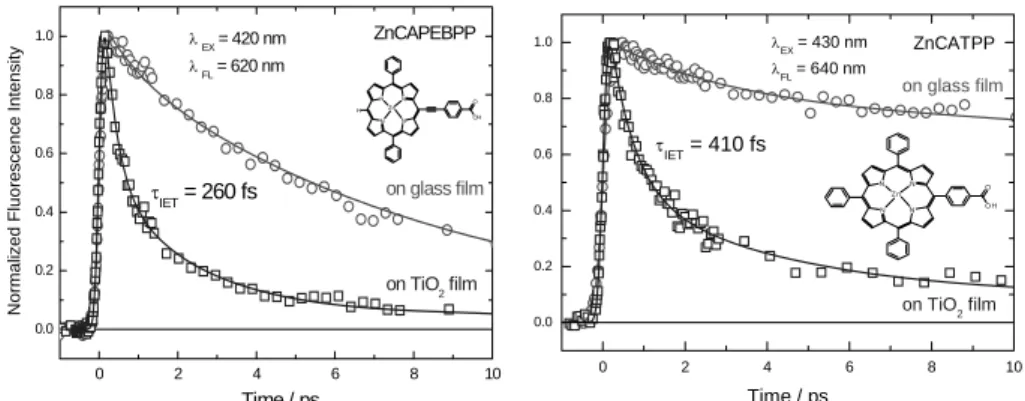
investigated using fluorescence up-conversion technique for the first time. The fluorescence decay opens a narrow window in the early stage and thus provides crucial information on the nature of the excited state of the sensitizer before the electron injection occurs. Results for observed ultrafast IET process between the porphyrins (ZnCAPEBPP and ZnCATPP) and the TiO2 nanocrystalline film are given
in Figure 10.
The IET process occurs on TiO2 film but was absent on glass film. Photocurrents
of these systems are shown in Figure 11. The IET transfer rate of ZnCAPEBPP/TiO2
film is faster than that of ZnCATPP/TiO2 film, consistent with an improved incident
photon to current efficiency (IPCE) for the former. A much better π-conjugation for ZnCAPEBPP than for ZnCATPP is responsible for the higher IET efficiency observed for the former.
0 2 4 6 8 10 0.0 0.2 0.4 0.6 0.8 1.0 τ IET = 260 fs on TiO2 film ZnCAPEBPP N N N N H Zn O OH λ EX = 420 nm λ FL = 620 nm N o rmalized Fluo resc e n c e Intensit y Time / ps on glass film 0 2 4 6 8 10 0.0 0.2 0.4 0.6 0.8 1.0 τIET = 410 fs on TiO 2 film on glass film N N N N Z n O O H λEX = 430 nm λ FL = 640 nm ZnCATPP Time / ps
Figure 10. Femtosecond fluorescence decays of two different porphyrins on
glass and TiO2 nanocrystalline thin films.
Figure 11. Absorption and incident photon-to-current efficiency (IPCE) spectra of
two porphyrins on TiO2 films. The N3 dye/TiO2 thin-film sample was also shown.
450 500 550 600 650 700 0.0 0.2 0.4 0.6 0.8 1.0 1.2 N3 Dye ZnCA(PE)1BPP ZnCATPP Abs o rb anc e Wavelength /nm 450 500 550 600 650 700 0 10 20 30 40 50 60 N3 Dye ZnCA(PE)1BPP ZnCATPP IPCE / % Wavelength / nm
Figure 9. Photocurrent-irradiation wavelength
(2) Femtosecond transient absorption measurements
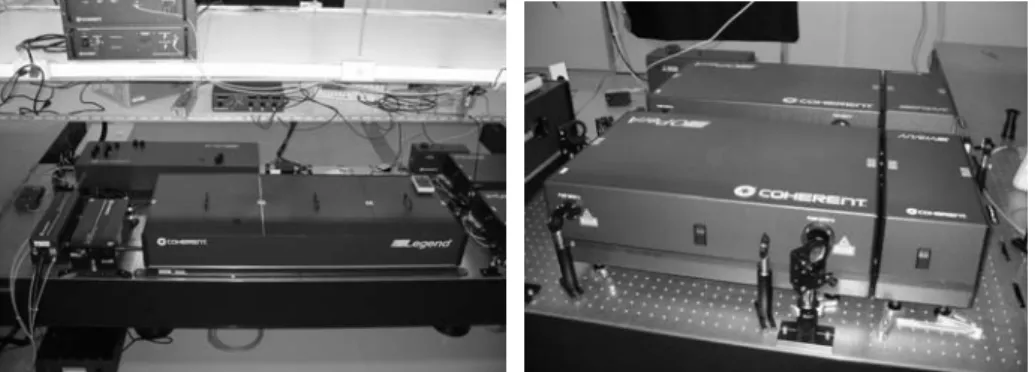
A femtosecond transient absorption spectroscopy system has been set up. The source includes a regenerating amplifier system; wavelength of the laser pulse is selected with two optical parametric amplifiers (OPAs), as shown in Figure 12. The pump-probe spectrometer uses the output of the OPA as a pump pulse to excite the molecule into its excited state and subsequent relaxation dynamics were probed by a white light pulse generated by a delayed laser pulse, as shown in Figure 13.
We have carried out transient absorption measurements for the ZnCAPEBPP/TiO2 thin-film sample with S2 excitation (λex = 435 nm). Observed
decays (Figure 14) show two additional features as compared with previous results (τ1
and τ2) obtained from fluorescence method; the prominent offset component reflects
the detection of the cation species, and the “slow” decay component (τ3) is probably
associated with the electron-hole recombination process.
Figure 12. Experimental setup of our femtosecond laser system which includes a regenerating amplifier (left) and two OPAs (right).
AC1 AC2 AC3 AC4 S B1 R L3 M2 M4 M5 Delay line Bs2 Bs1 wedge C F M3 A2 A1 L4 I1 I2 P1 WP chopper M1 imaging spectrometer imaging spectrometer PROBE PUMP PDpump PDsync F1 F2 45o P2 PD head 1 PD head 2
Figure 13. Equipmental setup of femtosecond transient absorption spectrometer (left) and its optical layout (right).
Figure 14. Femtosecond transient absorption spectra (left) and three corresponding relaxation
dynamics (right) of the ZnCAPEBPP/TiO2 films with excitation at 435 nm.
550 600 650 700 750 800 850 -0.001 0.000 0.001 0.002 0.003 0.004 Δ OD Wavelength / nm −500 fs 0 fs 300 fs 1 ps 10 ps 50 ps 0.000 0.001 0.002 0.000 0.001 0.002 0.003 0 10 20 30 40 50 0.000 0.001 0.002 ex τ1 = 650 fs τ 2 = 3.9 ps τ3 ~ 70 ps Probe = 550 nm τ1 = 330 fs τ 2 = 2.8 ps τ 3 = 34 ps Probe = 650 nm D e l a y T i m e / p s Δ OD τ 1 = 170 fs τ 2 = 2.9 ps τ3 = 48 ps Probe = 750 nm
C. Fabrication and characterization of solar cell
A Green laser based testing system has been assembled for characterizing the photocurrent-voltage response of solar cell devices. Electrical and optoelectronic diagnostics of the solar cell can be performed using this probe station. Feature functions of the probe station are:
1. Photocurrent-voltage response using monochromatic light, 2. Modulation photocurrent response,
3. Conversion efficiency analysis.
This system includes a micro-probe station with lightwave coupling fiber bundle and a 150 mW diode-pumped YAG laser at wavelength of 532 nm. Coupling with an I-V-R source meter, the photovoltaic effect of the InN/TiO2 solar cell is characterized,
as shown in Fig. 15. With this station, the photocurrent and optical responsivity of the synthesized materials for fabricating solar cell devices can be evaluated.
Figure. 15. Setup of diagnostic center for characterizing InN/TiO2 solar cell
6. Please list at most five international conferences you were invited to
give oral and plenary talks. Please also list international prizes you won
in last three years.
1. Gong-Ru Lin, “White-light and near-infrared electroluminescence of furnace or CO2 laser annealed Si-rich SiO2 with structural defects and Si nanocrystals”, 2006 SPIE Symposium on Photonics Europe (PE 2006), paper 6195-32, Strasbourg,
France, April 3-6, 2006.
2. Gong-Ru Lin, “Retrospect on the Research of Silicon Nanocrystal Embedded Silicon Oxide Materials and Light-Emitting Devices in NCTU/IEO”, 3rd
Symposium on Nanophotonics Science and Technology, Hwalian, Taiwan,