行政院國家科學委員會專題研究計畫 成果報告
台灣熱泉嗜硫菌之硫素生地化研究(I)
研究成果報告(精簡版)
計 畫 類 別 : 個別型 計 畫 編 號 : NSC 95-2611-M-002-010- 執 行 期 間 : 95 年 08 月 01 日至 96 年 10 月 31 日 執 行 單 位 : 國立臺灣大學海洋研究所 計 畫 主 持 人 : 王珮玲 計畫參與人員: 學士級-專任助理:吳俐蓁 碩士班研究生-兼任助理:陳鑑禕、許哲維、顏妏晏 報 告 附 件 : 國外研究心得報告 處 理 方 式 : 本計畫可公開查詢中 華 民 國 96 年 12 月 17 日
行政院國家科學委員會補助專題研究計畫
■ 成 果 報 告
□期中進度報告
台灣熱泉嗜硫菌之硫素生地化研究(I)
計畫類別:■ 個別型計畫 □ 整合型計畫
計畫編號:NSC 95 - 2611 - M - 002 - 010 -
執行期間: 95 年 8 月 1 日 至 96 年 10 月 31 日
計畫主持人:王珮玲
計畫參與人員: 吳俐蓁、陳鑑禕、許哲維、顏妏晏
成果報告類型(依經費核定清單規定繳交):■精簡報告 □完整報告
本成果報告包括以下應繳交之附件:
■赴國外出差或研習心得報告一份
□赴大陸地區出差或研習心得報告一份
□出席國際學術會議心得報告及發表之論文各一份
□國際合作研究計畫國外研究報告書一份
處理方式:除產學合作研究計畫、提升產業技術及人才培育研究計畫、列
管計畫及下列情形者外,得立即公開查詢
□涉及專利或其他智慧財產權,□一年□二年後可公開查詢
執行單位:國立台灣大學海洋研究所
中 華 民 國 96 年 12 月 15 日
1 摘要 本計畫欲解析生存於熱泉中的硫酸還原菌對於溫度和能量獲得變動的反應,以關仔嶺熱 泉沈積物為題材,進行一系列不同溫度的培養實驗。由於沈積物來源自海洋環境卻在陸地上 噴出,此一演化過程可能使其具有多樣的代謝能力。本研究採用接近現地水樣合成地下水的 與沈積物混合,觀察硫酸還原作用和微生物族群結構受溫度的影響。 實驗結果發現,硫酸根濃度隨培養時間增加而下降,不同溫度培養的最大硫酸根消耗速 率不同,變化在 2.5 和 12.6 M/hr 之間,此一消耗速率與一般淺海熱液沈積物中發生的硫 酸根代謝作用無異,顯示陸上熱泉中雖然硫酸根和有機物的濃度下降,但並未限制硫酸還原 菌的活動。在微生物族群分析的結果方面,在經歷不同溫度培養的樣品中,微生物總量隨培 養溫度升高而減少,微生物族群中古菌少於細菌,而族群的多樣性隨也溫度升高而減小,主 要進行硫酸還原代謝的菌種種類,在不同溫度的培養後亦有所改變,另外甲烷只出現在中高 溫度的培養中。 本研究指出硫酸還原作用是關仔嶺熱泉沈積物中所進行的主要微生物代謝作用,而培養 溫度升高時所出現較高的硫酸根消耗速率,似乎與微生物族群大小沒有關係。幾個尚未明白 機制仍有待探討,包括溫度變化如何對微生物族群結構產生影響,呼吸作用所產生的能量如 何分配是否決定微生物族群大小的改變。 Abstract
To mimic how microbial communities responsible for mineralization of complex organic matters associated sediments respond to short-term temperature fluctuation and limited sulfate supply potentially imposed by geological processes, we carried out a series of microcosm experiments incubated at temperatures ranging from 40oC to 80oC. Sediments originating from marine environments but now discharged in a terrestrial hot spring were used to provide a microbial assemblage possessing a wide range of metabolic capability for inoculation. Artificial groundwater was amended with sediment slurry in order to investigate the dominant microbial processes.
Sulfate concentrations of amended fluid shown a sigmoid depletion over a period of one month. Maximum sulfate consumption rate varied from 2.5 to 12.6 M/hr. Such a range of sulfate reduction rate is consistent with or greater than those reported for similar experiments conducted on shallow hydrothermal marine sediments, suggesting that sulfate reducing activity in terrestrial environments was not affected by the relatively limited supply of sulfate and dissolved organic carbon. PCR amplification of 16S rRNA genes indicated a substantial reduction of microbial biomass as the temperature increased from 40oC to 80oC. Archaeal populations were much smaller than bacterial populations. Cloning and sequencing analyses yielded a significant decrease of bacterial diversity as the temperature was raised. Microbial diversity for unmanipulated sediment was much greater than that for sediment incubated at any temperature. Dominated sulfate reducers changed after incubation at different temperatures. Methanogenesis presented only at a moderately thermophilic temperature range.
Our study indicated that sulfate reduction was the dominant terminal electron accepting metabolism for organic mineralization in Kuan-Shih-Ling hot spring. The enhancement of sulfate reducing activity at higher temperatures seemed to be decoupled from microbial growth. While
temperature variation results in a substantial change of community structure, partition of respiratory energy into biosynthesis and maintenance warrants further investigation.
Introduction
A significant proportion (>75%) of the Earth’s surface is covered by sedimentary rocks. When placing the upper temperature limit to life at 120oC, a temperature roughly equivalent to the depth of 4 km (based on the averaged geothermal gradient of 30oC km-1 for crustal environments), sedimentary terrain may have harbored microorganisms as much as 75% of the total microorganisms on Earth. Such an ample volume of biomass in sedimentary rocks would play an important role on regulating the elemental cycling among geosphere, hydrosphere and atmosphere. Microbial respiration in sedimentary environments is primarily driven by organic matter initially generated during photosynthetic conversion from carbon dioxide, followed with transport and deposition on the seafloor before final burial through continuously stacking of fresh detritus materials. The strategy adopted for survival in the limited volume of pore space is through the collaborative interaction between microorganisms possessing various functionalities. Fermentative microorganisms acquire metabolic energy through hydrolysis and decomposition of complex, refractory organic carbon. Previous studies on marine sediments incubated in the laboratory suggest that the fermentative production of labile organic acids and H2 would not be exhausted
within a temperature range from 20 to 115 oC for more than a year. These products are subsequently turned over to the downstream terminal electron accepting processes (e.g. sulfate reduction and methanogenesis). The expression and activity of fermentation and terminal electron accepting processes are, therefore, mutually influenced through the regulation of fermentative products. To completely mineralize organic carbon to carbon dioxide, a complex assemblage of microorganisms would be required and has not been fully characterized yet.
Sulfate reduction appears to be the most important terminal electron accepting process for anaerobic mineralization of organic carbon in typical marine environments. As the dissolved oxygen is swiftly depleted by aerobic microorganisms at the surface of seafloor, and nitrate and ferric iron are scarce, abundant seawater sulfate (28 mM) continuously percolates through sedimentary rocks for sulfate reducers residing within the pore space. The physical and chemical characteristics of pore fluid are, however, subject to the post-depositional changes induced by geological processes, such as diagenesis and tectonic displacement. Correlating shift of microbial assemblages with these changes would be essential to delineate how sulfate reducing community originally in typical marine environments responds to the environmental perturbation and, therefore, to predict the microbial role for organic mineralization during geological time scale.
Of numerous factors potentially exerted by geological processes, temperature is perhaps the most prominent one that would directly regulate the composition of microbial community and its functional expression. Detritus particulates initially deposited on the seafloor would be gradually heated up through burial diagenesis. The first order change of in situ temperature generally follows the local geotherm as a combinative result of the decay of radioactive elements within crust and the heat dissipation from mantle. Despite local geothermal effect, the temperature regime is
3
also subject to later geological processes, such as invasion of igneous body and hydrothermal circulation or tectonic displacement from marine to terrestrial environments. The temperature fluctuation experienced by any given sedimentary particulate would possibly span from the temperature range optimized for psychrophile (<10oC) to that for hyperthermophile (>80oC). How microbial community responds to such a temperature change remains not clear.
Geological processes such as diagenesis and tectonic movement could cause the changes of substrate availability and supply. As the sedimentary column thickens, the compaction driven by the accumulation of sedimentary particulates would decrease the pore volume as well as release carbonate- or silica-rich fluids for lithification, thereby reducing the connectivity of pore network. Since diffusion is the major mechanism of substrate transport, the reduction of pore connectivity and pore volume would decrease the substrate available for microorganisms. Substrate availability and supply are also governed by tectonic displacement over geological time scale. Sedimentary terrain originating from marine environments could be exhumed above the sea level by a series of thrusting events that often last for millions of years under the compressional tectonic regime. The exhumation of sedimentary rocks above sea level would result in the switch of the recharge source for pore fluid from seawater to meteoric water, thereby gradually diluting the solute contents originally equivalent with that of seawater. While sulfate is one of the key ingredients of seawater, sulfate reducing community associated with marine sediments in terrestrial environments has to reply on the limited, residual seawater sulfate trapped within the pore space. How the structure of microbial community (especially sulfate reducers) shifts under the relatively limited supply of sulfate warrants further investigation.
Methods
To address how sulfate reducing communities respond to the temperature fluctuation and the reduced sulfate supply potentially imposed by geological processes, we incubated sediment slurries statically at temperatures ranging from 40 to 80oC during a period of 30 days with characterization of both community structure and aqueous chemistry. Sulfate reduction was particularly chosen for investigation because (1) methane emitted from the muddy sediments possessed carbon isotopic values (~-10‰) indicative of thermogenic origin; (2) sulfate reduction would outcompete methanogenesis and acetogenesis for limited electron donor commonly available in sedimentary formations. These sediments were collected from a hot spring in southwestern Taiwan by taking the advantages that (1) the sedimentary strata hosting the muddy sediments of this hot spring belong to continental shelf facies prior to being uplifted by the convergence between Philippine Sea Plate and Eurasian Plate during Pliocene; (2) the residue marine sulfate trapped within the pore space is not completely washed off by meteoric water so the sulfate reducing population could still remain their metabolic activity; (3) the temperature of the hot spring fluctuated between 45 to 90oC due to variable degrees of mixing with meteoric water, precluding the need to inoculate hyperthermophiles from external sources for incubation experiments; (4) abundant organic carbon associated with the muddy sediments would favor lower redox potential for sulfate reducing community and directly fuel organotrophic community for a prolonged period of time without the need of supply of electron
donor during experiment; (5) the inoculums are fluidic, thereby facilitating the experimental manipulation. Our results revealed that microbial community originally inherited with very complex assemblages under the in situ condition gradually lost its diversity with the increase of temperature in the batch experiment. Successive changes of assemblages of fermentative bacteria and sulfate reducer seem to reflect the combinative effect of both temperature and sulfate supply.
Result and Discussion
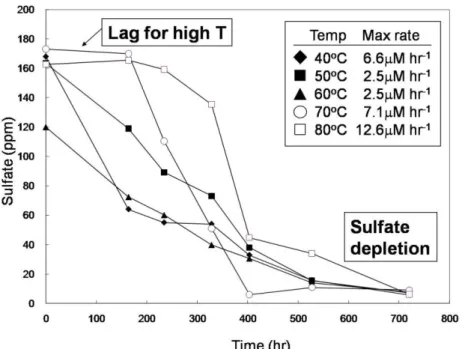
Analysis of amended fluid yielded a sigmoid depletion of sulfate over a period of one month. Sulfate reduction appears to be the dominant terminal electron accepting processes (figure 1). Maximum sulfate consumption rate varied from 6.6 M/hr at 40oC, to ~2.5 M/hr at 50o
C and 60oC, and to 7.1 M/hr at 70oC and 12.6 M/hr at 80oC. Such a range of sulfate reduction rate is consistent with or greater than those reported for similar experiments conducted on shallow hydrothermal marine sediments, suggesting that sulfate reducing activity in terrestrial environments was not affected by the relatively limited supply of sulfate and dissolved organic carbon.
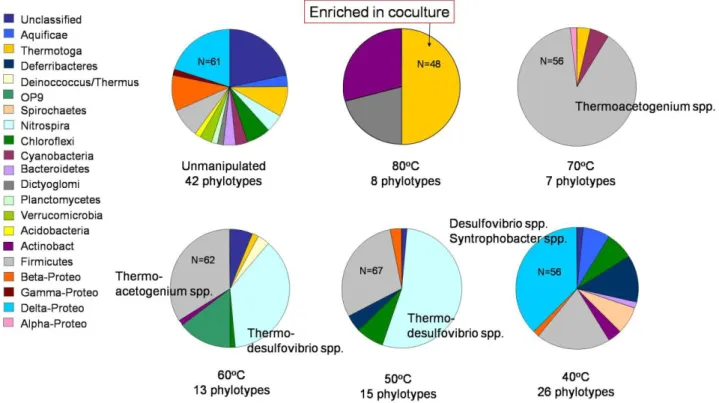
PCR amplification of 16S rRNA genes indicated a substantial reduction of microbial biomass as the temperature increased from 40oC to 80oC. Archaeal populations were much smaller than bacterial populations. Cloning and sequencing analyses yielded a significant decrease of bacterial diversity as the temperature was raised (figure2, 3). Microbial diversity for unmanipulated sediment was much greater than that for sediment incubated at any temperature. The majority of sulfate reducers belongs to Archaeoglobus spp. and Thermoacetogenium spp. at high temperatures, successively replaced by Thermodesulfovibrio spp., and then by Desulfovibrio spp. and
Syntrophobacter spp. at low temperatures. The shift of dominant phylotypes also suggested that
microbial sulfate reduction was catalyzed by various groups of microorganisms at different temperature ranges. Methanogenesis appears to be present only at a moderately thermophilic temperature range.
Overall, sulfate reduction was the dominant terminal electron accepting metabolism for organic mineralization in Kuan-Shih-Ling hot spring. The enhancement of sulfate reducing activity at higher temperatures seemed to be decoupled from microbial growth. While temperature variation results in a substantial change of community structure, partition of respiratory energy into biosynthesis and maintenance warrants further investigation.
5
Figure 1. Sulfate consumption with time for incubations under different temperatures.
赴國外研究心得報告
計畫編號 NSC 95-2611-M-002-010 計畫名稱 台灣熱泉嗜硫菌之硫素生地化研究(I) 出國人員姓名 服務機關及職稱Irene Umacob-Yambot, Dept. of Geosciences, National Taiwan University, PhD student
出國時間地點 2007/5/3 to 2007/5/17, Philippines 國外研究機構 野外採樣
工作記要:
Purpose: To collect water and sediment samples from Mt. Pinatubo and Taal volcano crater lakes
and some sites in Iloilo, Philippines.
Date Activities
May 03, 2007 am
pm
- Arrived Manila, Philippines
- Went to Philippine volcanology station near Mt. Pinatubo to meet with the people who accompanied us to the crater lake. .
May 04-05, 2007 - Hiked to the crater lake of Mt. Pinatubo and went to the thermal area of the lake. Mt. Pinatubo has a 1.5 km in diameter crater lake. The thermal area was located in southeastern part of the lake. The site has a neutral pH with temperature of 500C. Water samples were collected and are now stored in Geomicrobiology laboratory for analysis.
May 06, 2007 - Visited another volcanically active crater lake in Batangas City, the Taal volcano. The 1.2 km in diameter main crater lake is acidic with pH 2-3. Sampling sites were identified at the thermal area near the shore of the lake: the spring source and has a pH of 2.84 and temperature of 850C while the other sample site has a pH of 3 and temperature of 58.60C. Water and sediment samples were collected and stored in Geomicrobiology laboratory for analysis.
May 10-14, 2007 - Had a survey and ocular inspection of potential sampling sites in Iloilo, central part of the Philippines. Three sites were visited: Igcamagtong spring in Sibalom, Antique; Sira-an hot spring in Anini-y, Antique; and artesian well in Sta. Barbara, Iloilo.
- Water samples were taken from all sites and were stored in Geomicrobiology laboratory for analysis.