This content has been downloaded from IOPscience. Please scroll down to see the full text.
Download details:
IP Address: 140.113.38.11
This content was downloaded on 21/07/2015 at 09:43
Please note that terms and conditions apply.
Observation of self-mode-locking assisted by high-order transverse modes in optically
pumped semiconductor lasers
View the table of contents for this issue, or go to the journal homepage for more 2014 Laser Phys. Lett. 11 105803
(http://iopscience.iop.org/1612-202X/11/10/105803)
1. Introduction
The occurrence of self-mode-locking (SML) is an intrigu-ing phenomenon in a laser system without any saturable absorbers. Since Spence et al first demonstrated SML in the Ti-sapphire laser [1], the phenomena of Kerr-lens mode lock-ing (KLM) have been widely explored both experimentally and theoretically [2–6]. Recently, numerous SML lasers have been demonstrated for the Nd-doped [7–9] and Yb-doped [10–14] gain media in linear short cavities without satura-ble absorbers. So far, the origin of the self-mode-locking is conjectured to result from the combined effects of the Kerr lensing and thermal lensing [8, 9, 12, 14]. In addition to solid-state crystal lasers, the SML operation has also been demonstrated in the optically pumped semiconductor lasers (OPSLs [15–17]). However, the requirement for achiev-ing SML in OPSLs has not actually been discovered yet. Furthermore, since carrier dynamics in semiconductor gain media can affect the phase locking between lasing modes, clarifying the difference between the criteria for achieving
SML in solid-state lasers and semiconductor lasers is scien-tifically important in laser physics.
The formation of transverse modes always plays a signifi-cant role in the temporal dynamics of lasers. In end-pumped lasers, the pump-to-mode size ratio predominantly not only determines the pump threshold for TEM00 but also affects the pump threshold for other high-order transverse modes. In this work, we design various pump-to-mode size ratios in an OPSL with a plano-concave cavity to explore the performance of SML. We systematically measure the critical pump power for achieving the SML varying with the pump-to-mode size ratio. We experimentally find that as the pump-to-mode size ratio is less than 1.5, the critical pump power significantly increases to be far above the lasing threshold. We further employ the theoretical formula and experimental parameters to confirm that the critical pump power for obtaining the SML opera-tion agrees very well with the pump threshold for exciting TEM1,0 mode. The good agreement implies that the existence of high-order transverse modes can assist the phase locking between lasing longitudinal modes. More importantly, the Laser Physics Letters
Observation of self-mode-locking assisted
by high-order transverse modes in optically
pumped semiconductor lasers
H C Liang1, C H Tsou2, Y C Lee2, K F Huang2 and Y F Chen2,3
1 Institute of Optoelectronic Science, National Taiwan Ocean University, Keelung 20224, Taiwan 2 Department of Electrophysics, National Chiao Tung University, 1001 Ta-Hsueh Rd. Hsinchu 30010, Taiwan
3 Department of Electronics Engineering, National Chiao Tung University, 1001 Ta-Hsueh Rd. Hsinchu 30010, Taiwan
E-mail: [email protected]
Received 7 March 2014, revised 8 August 2014 Accepted for publication 14 August 2014 Published 15 September 2014
Abstract
The criterion for achieving the self-mode-locking (SML) in an optically pumped
semiconductor laser (OPSL) with a linear cavity is systematically explored. Experimental results reveal that the occurrence of SML can be assisted by the existence of high-order transverse modes. Numerical analysis is performed to confirm that the critical pump power for obtaining the SML operation agrees very well with the pump threshold for exciting TEM1,0 mode. The present finding offers an important insight into laser physics and a useful indication for obtaining the SML operation in OPSLs.
Keywords: self-mode-locking, optically pumped semiconductor lasers, transverse modes (Some figures may appear in colour only in the online journal)
H C Liang et al Printed in the UK 105803 LPL © 2014 Astro Ltd 2014 11
Laser Phys. Lett.
LPL
1612-2011
10.1088/1612-2011/11/10/105803
Letters
10
Laser Physics Letters
Astro Ltd
HH
doi:10.1088/1612-2011/11/10/105803
H C Liang et al
2 present finding can provide an important route for fulfilling SML in OPSLs.
2. Experimental set-up
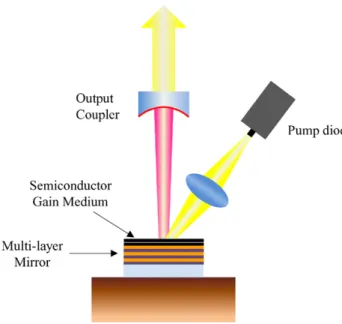
Figure 1 depicts the experimental scheme for exploring the SML performance in an OPSL. The laser cavity consists of a con-cave mirror, a semiconductor gain chip and a pump laser diode. The gain chip was obtained from a commercial OPSL module (Coherent Inc.). The gain chip included a structure of distributed Bragg reflectors (DBRs) to form a front mirror and a structure of multiple quantum wells to form a resonant periodic gain. The photoluminescence emission wavelength of the gain chip was approximately 1060 nm at room temperature. The gain chip was soldered with indium to a chemical vapour deposition diamond heat spreader with DBR side down for effectively removing the heat from the gain structure. For convenience, the cavity length Lcav was set to be 83 mm in experiment. The radius of the pump beam ωp was approximately 320 μm. Several concave output couplers with the radius of curvature Roc ranging from 100 mm–1000 mm were used to explore the variation of the las-ing threshold and the influence of pump-to-mode size ratios on the pump critical power for achieving the SML operation. The output transmission for all output couplers was 2%. With ABCD matrix, the cavity mode size on the gain chip is given by
ωl= πλ Lcav(Roc−Lcav) . (1)
With equation (1), it can be found that changing Roc from 100 mm–1000 mm leads the cavity mode size to vary from 117 μm–303 μm for Lcav = 83 mm and λ = 1064 nm. As a result, the pump-to-mode size ratio ωp/ωl can be adjusted in the range of 1.06–2.74 for ωp = 320 μm. The temporal dynamics was detected by a high-speed InGaAs photodetector (Electro-Optics Technology Inc. ET-3500 with rise time 35 ps), whose output signal was connected to a digital oscilloscope (Agilent
DSO80000) with 10 GHz electrical bandwidth and a sam-pling interval of 25 ps. A Fourier optical spectrum analyzer (Advantest Q8347), which was constructed with a Michelson interferometer, was employed to monitor the spectral informa-tion with the resoluinforma-tion of 0.002 nm.
3. Experimental results
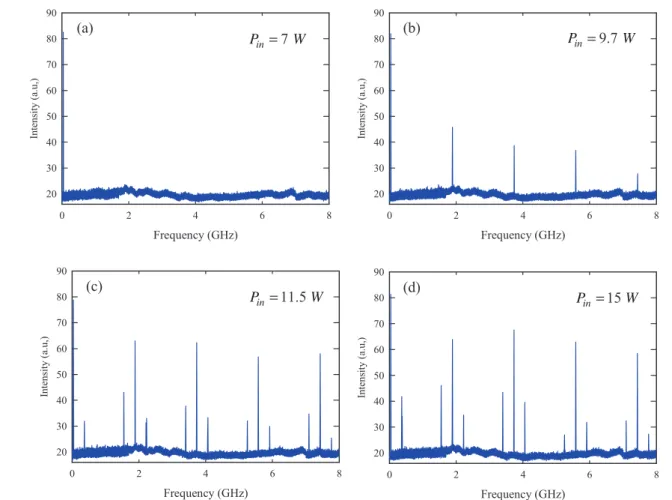
First of all, we used Roc = 300 mm to investigate the temporal dynamics varying with the pump power. Under this condi-tion, the pump-to-mode size ratio ωp/ωl was 1.51 and the las-ing threshold was experimentally found to be approximately 5.0 W. Figure 2 shows experimental results for RF power spectra measured at four different pump powers. For the pump power ranging from lasing threshold to 9.5 W, the lasing state was in the continue-wave (CW) operation and there were no obvious peaks which appeared in the RF spectrum, as shown in figure 2(a) for the result measured at a pump power of 7 W. Figure 3 shows overall performances for the laser operated in the CW state. The transverse pattern was rather circularly symmetric, as seen in figure 3(a). The temporal traces mea-sured with a 10 GHz bandwidth real-time oscilloscope did not reveal any obvious oscillations, as seen in figure 3(b). The full width at half maximum (FWHM) in the optical spectrum was found to be as narrow as 0.1 nm, as shown in figure 3(c).
For the pump power in the rather small range of 9.5– 10.0 W, the temporal trace in the oscilloscope revealed the laser to be in an intermittent mode-locked state and there were several peaks which appeared in the RF spectrum. The peak frequencies corresponded to the harmonics of the longitudinal mode spacing fL = 1.8 GHz, as shown in figure 2(b). Since the mode-locked pulse train was discontinuous, the peak values in the RF spectrum were generally less than 20 dBm, consider-ably smaller than the standard value of well-behaved mode-locked lasers. For the pump power greater than 10.0 W, the temporal trace in the oscilloscope displayed the laser to be in a continuous mode-locked state and the structure of the pulse train was spatially dependent. Meanwhile, there were two beat peaks which accompanied the harmonics of the longitudinal mode spacing in the RF spectrum, as shown in figure 2(c) for the result measured at a pump power of 11.5 W. The beat frequency was measured to be 375 MHz which exactly cor-responded to the transverse mode spacing fT. When the pump power was up to 15 W, the overall temporal behaviour was found to be unchanged, as shown in figure 2(d). The spatial dependence of the mode-locked pulse train and the appear-ance of the beat peaks at the frequencies of f = mfL ± fT with m =1, 2, 3 in the RF spectrum clearly indicated that the first high-order transverse mode had been generated. Experimental results imply that the presence of the high-order transverse modes is intimately associated with the emergence of a long-lasting SML operation. It is worthwhile to mention that this association is absent from the SML solid-state lasers [7–9].
Figure 4 shows overall performances for the laser operated in the mode-locked state. The transverse pattern became ellip-tical and the temporal trace in the centre of the transverse pat-tern displayed full modulation without any CW background, as
Figure 1. Experimental setup for exploring the SML performance in an OPSL.
Figure 2. Experimental results for RF power spectra measured at different pump powers: (a) Pin =8 W, (b) Pin = 9.7 W, (c) Pin = 11.5 W, (d) Pin = 15 W. in P = W Pin= W in P = W Pin= W
Figure 3. Experimental measurements for overall performances of the laser operated in the CW state: (a) transverse pattern, (b) temporal trace, (c) optical spectrum.
H C Liang et al
4 shown in figures 4(a) and (b), respectively. Note that the tem-poral traces in the position out of the beam center were gener-ally found to be modulated with the transverse beat frequency. This spatiotemporal dynamics is attributed to the simultane-ous longitudinal and transverse mode locking [18]. The full width at half maximum (FWHM) in the optical spectrum was found to be as wide as 1.8 nm, as shown in figure 4(c). The pulse width for the mode-locked pulse train was measured with an autocorrelator (APE pulse check, Angewandte Physik & Elektronik GmbH). Assuming the Gaussian-shaped tempo-ral profile, the FWHM of the pulse was approximately 935 fs, as shown in the inset of figure 4(c). As a result, the time-band-width product was approximately 0.446, which was close to the Fourier-limited value.
We further exploited the variation of the peak amplitude at
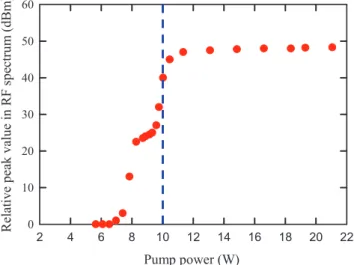
f = fL in the RF spectrum with the pump power to identify the critical pump PSML for achieving the SML operation. Figure 5 depicts experimental results for the peak amplitude at f = fL versus the pump power. It is clear that there is a rapid increase at a pump power near 10.0 W. For quantitative analysis, the critical pump power PSML is defined to be the pump power at which the peak amplitude at f = fL starts to exceed 40 dBm.
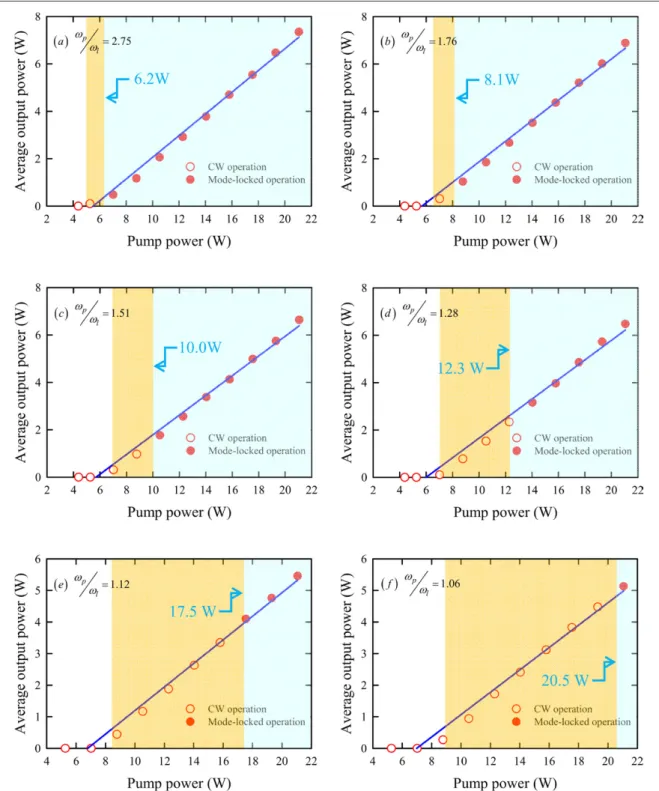
Following the same experimental procedure, we explored the variation of the critical pump power PSML with the pump-to-mode size ratios ωp/ωl by using different concave output couplers. Figure 6 shows experimental results for the average output power versus the pump power obtained with different pump-to-mode size ratios, where the CW and SML regions are specified by the critical pump power PSML. It can be seen
that decreasing the pump-to-mode size ratio leads to a signifi-cant increase in the critical pump power for achieving SML. Furthermore, experimental results revealed in the same way that when the pump power began to be higher than the criti-cal pump power PSML, there were transverse beat components to accompany every harmonic peak of the longitudinal mode spacing in the RF spectrum. All experimental observations indicated that the existence of high-order transverse modes can assist the phase locking between longitudinal modes to achieve the SML operation. As a result, the critical pump power PSML
Figure 4. Experimental measurements for overall performances of the laser operated in the mode-locked state: (a) transverse pattern, (b) temporal trace, (c) optical spectrum and the inset for auto-correlation trace.
Figure 5. Experimental results for the pump-power dependence of the peak amplitude at f = fL in the power spectrum.
for attaining SML can be forecasted from the pump threshold for high-order transverse modes. In the following, we perform a numerical calculation to confirm this feasibility.
4. Numerical analysis
Kuznetsov et al [19] have successfully developed a theoreti-cal model to analyze the pump threshold for the fundamental transverse mode. Here, we apply the effective mode area to
this theoretical model to calculate the pump thresholds for various TEMn,0 modes. The effective mode area for TEMn,0 mode can be obtained with the overlap integral [20]:
∫∫
=
(
)
−An,0 sn,0( , ) ( , ) d dx y r x y x yp , 1
(2) where sn,0( , )x y is the normalized cavity mode distribution and r x yp( , ) is the normalized pump distribution. For TEMn,0 mode, sn,0( , )x y is given by
Figure 6. Experimental results for the average output power versus the pump power obtained with different Roc for different pump-to-mode ratios: (a) ωp / ωl = 2.75, (b) ωp / ωl = 1.76, (c) ωp / ωl = 1.51, (d) ωp / ωl = 1.28, (e) ωp / ωl = 1.12, (f) ωp / ωl = 1.06. The critical pump power
H C Liang et al 6 πω ω ω = ⎛⎝⎜ ⎞ − + ⎠ ⎟ ⎡ ⎣ ⎢ ⎤ ⎦ ⎥ s x y n H x x y ( , ) 2 2 ! 2 exp 2 ( ) , n l n n l l ,0 2 2 2 2 2 (3)
where Hn() is the Hermite polynomial of order n. The
normal-ized pump distribution r x yp( , ) is approximated as a Gaussian
distribution: πω ω = ⎡− + ⎣ ⎢ ⎤ ⎦ ⎥ r x yp( , ) 2 exp 2 (x y ) . p p 2 2 2 2 (4)
Substituting equations (3) and (4) into equation (2), after some algebra, the effective mode area can be analytically inte-grated as
∑
∑
πω ξ ξ ξ ξ = + − − −+ = − + = − − − ⎪ ⎪ ⎪ ⎪ ⎛ ⎝⎜ ⎞ ⎠⎟ ⎧ ⎨ ⎩ ⎛ ⎝⎜ ⎞ ⎠⎟ ⎫ ⎬ ⎭ A n k H j n k j 2 1 ! 2 ! 1 (0) ! ( 2 ) ! 1 1 , n p k n n k k j n k n k j j ,0 2 0 2( ) 1 0 [( )/2] 2 2 (5)where ξ=
(
ωp/wl)
2. In terms of the effective mode area, thepump threshold for the single TEMn,0 mode oscillation can be given by [19] ν η τ =
(
)
P n h N L n A TEM ( ) , n w w n th ,0 th abs th ,0 (6)where hν is the photon energy, ηabs is the pump absorption effi-ciency, Nw is the number of quantum wells, Lw is the quantum well thickness. The carrier life time τ n( ) and the threshold carrier density nth are given by
τ n = +A Bn+Cn 1 ( ) 2 (7) and = Γ − ⎛ ⎝⎜ ⎞ ⎠⎟ ( ) n n R R T 1 g N L , th 0 1 2 loss 2 0 w w 1 (8) respectively. Here n0 is the transparency carrier density, R1 and
R2 are the reflectivity of cavity mirrors, g0 is the material-gain
parameter, Γ is the longitudinal confinement factor, Tloss is the
transmission factor due to the round-trip loss, A, B and C are the monomolecular, bimolecular, and Auger recombination coefficients.
With equations (5)–(8), we calculated the pump thresholds for TEM0,0 and TEM1,0 modes. According to the experimental condition, the parameters used in the calculation were as fol-lows: η = 0.85,abs Lw=8 nm,Nw=10,N0=1.7 10 cm ,× 18 −3
= −
g0 2000 cm ,1 Γ = 2.0,T =0.98,
loss R1=0.999, R2=0.98,
= × −
A 1.0 10 sec ,7 1 B=1.0 10× −10 cm sec ,3 −1 and
= × − −
C 6.0 10 30 cm sec .6 1 Figure 7 shows the calculated
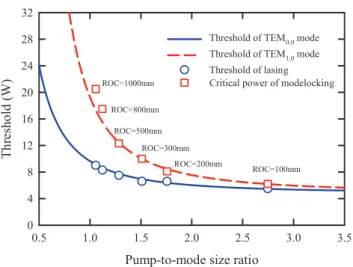
results for the pump thresholds versus the pump-to-mode size ratio for TEM0,0 and TEM1,0 modes. For comparison, experi-mental data for the lasing threshold Pth and the critical power
PSML for achieving SML are also shown in figure 7. It can be seen that experimental data for the lasing threshold agree very well with the numerical results for the pump threshold
of TEM0,0 mode. More importantly, experimental data for the critical power PSML are also in good agreement with numeri-cal numeri-calculations for the pump threshold of TEM1,0 mode. The good agreement confirms that the generation of TEM1,0 mode plays a critical role for the occurrence of the SML.
5. Conclusions
In summary, we have explored the criterion for achieving SML in an OPSL with a plano-concave cavity by using various pump-to-mode size ratios at a fixed pump radius. It has been clearly observed that the occurrence of SML is nearly synchronous with the lasing of high-order transverse modes. Since the pump threshold for high-order transverse modes significantly increases for the pump-to-mode size ratio smaller than 1.5, the criti-cal pump power PSML for achieving SML is confirmed to rise considerably. Furthermore, experimental results revealed that the continuous SML operation could not occur in the absence of high-order transverse modes. We also derived a theoretical formula with experimental parameters to calculate the pump threshold for various TEMn,0 modes. Calculated results showed that the critical pump power for obtaining the SML operation agrees very well with the pump threshold for exciting TEM1,0 mode. We believe that the present finding can provide an impor-tant guideline to explore further the SML operation in OPSLs.
Acknowledgement
The authors acknowledge the National Science Council of Taiwan for their financial support of this research under con-tract NSC 100-2628-M-009-001-MY3.
References
[1] Spence D E, Kean P N and Sibbett W 1991 60 fsec pulse generation from a self-mode-locked Ti:sapphire laser Opt. Lett. 1642–4
Figure 7. Calculated results for the pump thresholds versus the pump-to-mode size ratio for TEM0,0 and TEM1,0 modes and experimental data for the lasing threshold Pth and the critical power PSML for achieving SML.
[2] Chilla J L A and Martinez O E 1993 Spatial-temporal analysis of the self-mode-locked Ti: sapphire laser J. Opt. Soc. Am. B 10638–43
[3] Cerullo G, De Silvestri S, Magni V and Pallaro L 1994 Resonators for Kerr-lens mode-locked femtosecond Ti:sapphire lasers Opt. Lett. 19807–9
[4] Cote D and van Driel H M 1998 Period doubling of a femtosecond Ti:sapphire laser by total mode locking Opt. Lett. 23715–7
[5] Bolton S R, Jenks R A, Elkinton C N and Sucha G 1999 Pulse-resolved measurements of subharmonic oscillators in a Kerr-lens mode-locked Ti:sapphire laser J. Opt. Soc. Am. B 16 339–43
[6] Lin J-H, Wei M-D, Hsieh W-F and Wu H-H 2001 Cavity configurations for soft-aperture Kerr-lens mode locking and multiple-period bifurcations in Ti:sapphire lasers J. Opt. Soc. Am. B 181069–75
[7] Liang H C, Chen R C C, Huang Y J, Su K W and Chen Y F 2008 Compact efficient multi-GHz Kerr-lens mode-locked diode-pumped Nd:YVO4 laser Opt. Express 1621149–54 [8] Liang H C, Huang Y J, Huang W C, Su K W and Chen Y F
2010 High-power, diode-end-pumped, multigigahertz self-mode-locked Nd:YVO4 laser at 1342 nm Opt. Lett. 35 4–6
[9] Huang Y J, Tzeng Y S, Tang C Y, Huang Y P and Chen Y F 2012 Tunable GHz pulse repetition rate operation in high-power TEM00-mode Nd:YLF lasers at 1047 nm and 1053 nm with self mode locking Opt. Express 20 18230–7 [10] Liu H, Nees J and Mourou G 2001 Diode-pumped Kerr-lens
mode-locked Yb:KY(WO4)2 laser Opt. Lett. 261723–5 [11] Lagatsky A A et al 2005 Yb3+-doped YVO4 crystal for
efficient Kerr-lens mode locking in solid-state lasers Opt. Lett. 303234–6
[12] Xie G Q, Tang D Y, Zhao L M, Qian L J and Ueda K 2007 High-power self-mode-locked Yb:Y2O3 ceramic laser Opt. Lett. 322741–3
[13] Uemura S and Torizuka K 2008 Kerr-lens mode-locked diode-pumped Yb:YAG laser with the transverse mode passively stabilized Appl. Phys. Express 1012007
[14] Zhuang W Z, Chang M T, Liang H C and Chen Y F 2013 High-power high-repetition-rate subpicosecond monolithic Yb:KGW laser with self-mode locking Opt. Lett. 38 2596–9 [15] Chen Y F, Lee Y C, Liang H C, Lin K Y, Su K W and Huang K F
2011 Femtosecond high-power spontaneous mode-locked operation in vertical-external cavity surface-emitting laser with gigahertz oscillation Opt. Lett. 36 4581–3
[16] Kornaszewski L, Maker G, Malcolm G P A, Butkus M, Rafailov E U and Hamilton C J 2012 SESAM-free mode-locked semiconductor disk laser Laser Photon. Rev. 6 L20–3
[17] Albrecht A R, Seletskiy D V, Cederberg J G and Sheik-Bahae M 2013 Self-mode-locked vertical external cavity surface-emitting laser (VECSEL) CLEO: Sci. Innov. 2013 CW1G.5 [18] Liang H C, Lee Y C, Tung J C, Su K W, Huang K F and
Chen Y F 2012 Exploring the spatio-temporal dynamics of an optically pumped semiconductor laser with intracavity second harmonic generation Opt. Lett. 371–3
[19] Kuznetsov M, Hakimi F, Sprague R and Moodadian A 1999 Design and characteristics of high-power (>0.5-W CW) diode-pumped vertical-external cavity surface emitting semiconductor lasers with circular TEM00 beams IEEE J. Sel. Top. Quantum Electron. 5561
[20] Chen Y F, Huang T M, Kao C F, Wang C L and Wang S C 1997 Generation of Hermite-Gaussian modes in fiber-coupled laser-diode end-pumped lasers IEEE J. Quantum Electron. 331025–31