科技部補助專題研究計畫成果報告
期末報告
(子計畫五)故宮博物院雲端服務導入策略之研究:IT 藍
圖,整備度與評價模式(第 2 年)
計 畫 類 別 : 整合型計畫 計 畫 編 號 : MOST 102-2420-H-004-004-MY2 執 行 期 間 : 103 年 01 月 01 日至 104 年 04 月 30 日 執 行 單 位 : 國立政治大學資訊管理學系 計 畫 主 持 人 : 張欣綠 共 同 主 持 人 : 王凱 計畫參與人員: 碩士班研究生-兼任助理人員:彭雅瑄 碩士班研究生-兼任助理人員:黃聖凱 碩士班研究生-兼任助理人員:詹士潔 報 告 附 件 : 出席國際會議研究心得報告及發表論文 處 理 方 式 : 1.公開資訊:本計畫涉及專利或其他智慧財產權,2 年後可公開查詢 2.「本研究」是否已有嚴重損及公共利益之發現:否 3.「本報告」是否建議提供政府單位施政參考:是,故宮博物院中 華 民 國 104 年 08 月 11 日
中 文 摘 要 : 本研究主軸是為探討組織欲發展成功的雲端服務時,所需要 的資源與能力,並以國立故宮博物院為探討對象。透過雲端 服務,組織得以在一全球性的大規模網路環境基礎上,發展 如隨選存取、依使用付費、快速滿足需求、以及集中資源等 能力。然而,這些能力與組織的互動關係,卻仍有待探討。 特別是哪些重要的元件或資源,有助於協助組織發展這些能 力?哪些雲端服務可藉此架構為基礎被發展出來並提供使 用?如何發展並實現這些雲端技術服務?為探討這些問題, 有必要透過一完整的方法論架構,系統性地考量組織現有的 雲端技術發展能力,以及建立一技術發展藍圖,檢視組織在 不同技術發展階段中所需的能力與資源,以達到技術預期的 績效。 中文關鍵詞: 故宮博物院,雲端服務,技術接受度,組織能力,技術藍圖 英 文 摘 要 : The National Palace Museum (NPM) has recognized the
potential benefits of cloud services for museum education and visitor connection. Cloud services can offer the NPM a different way of organizing and presenting information in multiple levels,
perspectives, and dimensions, transforming the museum from a “collection-driven" museum to an “audience-driven" one. However, it is not yet clear how cloud services in the NPM can be successfully implemented. The goal of this research is thus to develop a cloud adoption framework that identifies cloud readiness factors for better adoption of cloud services and evaluates the effects on performance, so that the NPM will be able to choose adoption priorities, design diffusion paths, and predict value outcomes.
英文關鍵詞: National Palace Museum, cloud service, technology adoption, organizational capability, technology roadmap
1
DEVELOPING THE ADOPTION STRATEGY OF CLOUD
SERVICES FOR NATIONAL PALANCE MUSEUM
Final Report 1. INTRODUCTION
Cloud computing has become a new platform for enterprises. Its core concept lies at on-demand access and pay-per-use, which compete directly with traditional desktop or handheld computers. The unique characteristics of cloud computing provide incentives for companies to adopt this new technology. Essentially, cloud is an enabling force for business evolution that goes beyond technology, allowing companies to more efficiently and effectively reengineer the company’s corporate strategy. From one hand, cloud cuts information technology (IT) costs and offers mobility and collaboration, eliminating the needs to maintain the computational infrastructure of operating systems and low-level utilities. From the other hand, cloud makes companies easier to deploy solutions or to combine enabling technologies in response to changing market needs, and to some extent reduce or eliminate information latency.
Thus, the target of cloud service technologies includes improved asset utilization, aggregated demand and accelerated system consolidation, improved productivity in application development, more responsive to urgent client needs, better linked to emerging technologies, and so on. However, some companies are likely to find that even when they move applications to the cloud, the outcome of their cloud service development differs. There should be a set of resources and capabilities that enable the effective use of cloud service technologies, and thus impact organizations’ abilities to develop successful cloud service strategies. The problem is that, most companies lack a clear picture of what these capabilities are and how they should be built. Nor do the organizations know whether they are ready to deploy such cloud service technologies or not. Therefore, besides identifying the critical cloud service technologies, there are many implementation and managerial issues that need to be addressed; for example, assessing the capabilities and readiness of organizations in applying these technologies, exploring both enablers and barriers of cloud service technology adoption and diffusion, and so on.
National Palace Museum (NPM) has noticed the potential impact of cloud services on museum education and visitors’ connections. Cloud services can provide NPM different method of organizing and presenting information in multiple levels, perspectives, and dimensions, transferring the museum from a “collection-driven museum” to an “audience-driven museum.” However, to implement cloud services in NPM, several concerns need to be addressed. First, NPM has a relatively more conservative attitude toward information technology, how to align its functional and operating model with the cloud-based model of utilization of information technology resources and services will be a problem. Second, when the museum objects go to the cloud, how to manage security and reduce the potential control loss and data loss becomes important. At last, NPM needs to address legal issues such as liability, data disclosure and legislations. In order to better understand these strategic issues, we will study the adoption of cloud service technologies in NPM. Our goal is to develop a roadmap for better cloud service management, so that NPM will be able to
2
decide their adoption priorities, design their own diffusion paths, and predict the value outcome.
2. POTENTIAL CLOUD SERVICE APPLICATIONS IN NPM
In 2001, NPM began a five-year digital archives project. This project aims to establish a complete format of digitization for most of the objects in the museum collection. Thus, through Internet, user around the world can search knowledge and information on museum objects. To further apply these digital archives, NPM launched cultural and creative environment project in 2010. This project is in line with the government’s “i-Taiwan project – Cultural and Creative Society.” The goal is to provide entertaining appreciation of inter-disciplinary cultural creativity that combines cultural and technological elements, develop digital contents such as cultural and creative films, and global website tourism marketing and enhancing aesthetics literacy of the people. In 2013, NPM started mobile service project, which is the sub-project of the grand e-government project. The goal of this project is to provide mobile tour guide service. Visitors can use their mobile device to get real-time exhibition information and design their personalized itinerary. The Web 2.0 concept will be applied to design social platform service, sharing experience regarding with museum objects, exhibition, education and research.
The development of cloud services can be complement with these NPM digital projects. We identified three categories of cloud services that NPM can consider to develop: internal management, open data and value adding, and experience service. For example, infrastructure as service (IaaS) can provide on-demand storage space and computing capacity for digital archive. NPM can also develop platform as service (PaaS) for video channels and integrated database. Besides, alternative software as service (SaaS) can be applied in mobile and social platforms (Figure 2). NPM Digital Projects Potential Cloud Applications Digital Archives Project (2001-2007) • Virtualized and digitized relics • Digital assets management • Cloud environment • Preservation environment monitoring
Cultural and Creative Environment Project (2010-2013) • Integrated cloud database • Cloud video channel • Cloud authorization for digital assets NPM Mobile Service Project (2013-2016) • Location-based service • Mobile application • Interactive exhibition • Virtual reality • Augmented reality • Social media application
Digital Material Cultural and Creative Content
Internal Management
Open Data and Value Adding
Experience Service
3
Figure 1. NPM digital projects and potential cloud applications
We review relevant cloud service developments in leading museums worldwide. Their experiences can be a reference for NPM to develop its cloud service portfolios.
Cloud-based internal management. The Jewish Women’s Archive (JWA) is founded in November 1995. Its mission is to document American Jewish women from all walks of life and to reach out to the general public, as well as scholars. Since the organization has no dedicated IT staff and no in-house expertise, they determined to adopt Amazon IaaS (called Amazon Web Services) for preservation and backup. The saving in IT money can be used directly on gathering oral histories and processing them.
Open Data and Value Adding. Vernet (www.vernet.org) is a searchable online portal that links to four vertebrate distributed database networks, which currently include 171 collections from 12 countries and 52 additional collections (20 countries) committed to participation. Collectively, these networks have successfully demonstrated community data sharing and cooperative data management. In VerNet, the computing resources are consolidated on the cloud utilizing the Google App Engine PaaS. Under the new model, contributors would use a Web-based administrative interface to create accounts, describe their data sets, define usage restrictions and citation information, add contact information, and later access information about usage statistics. The data store in the cloud will contain the primary data published from all contributors as persistently available records, uniquely identifiable by their data store key. Compared with the old Web portal model, the cloud-based model provide not only a platform on which to store the results of collaboration (georeferences, use-provided annotation) associated directly with the primary data they are meant to improve, but also a platform on which to build innovative applications (e.g., analysis, visualizations, workflows).
Besides Vernet, ArtBabble is another example that hosts their Web sites and applications in the cloud. During late 2008, the Indianapolis museum of art created an on-line video website, called ArtBabble (www.artbabble.org), dedicated to art-related content. ArtBabble runs entirely in the cloud and allows streaming of high definition video content in a scalable and cost-effective manner. Using PaaS provided by Amazon’s Web Services, costs are minimized by only paying for bandwidth and storage used monthly.
User Experience Service. The museum of London introduced a mobile phone application called Streetmuseum in 2010 as part of the opening of the Galleries of Modern London. Streetmuseum uses augmented reality to give the users a unique perspective of old and new London. The app guides users to sites across London where over 200 images of the capital from the Museum of London’s art and photographic collection, can be viewed in-site, essentially offering the users a window through time. Each image comes with a little information about the scene to give the users some historical content. Londinum is another smart phone application launched by the Museum of London which is a more advanced version of Streetmuseum. The app directs users to Roman sites on a map and features video and audio to showcase a 2000 year-old Roman London that users can immerse themselves in. Users are guided around the capital where they can use a virtual dig tool to unearth artifacts when they were found, listen to the sounds of the Roman city, and watch augmented reality which presents scenes of Roman London against today’s modern backdrop.
4
3. THE RESEARCH FRAMEWORK
As NPM started planning the adoption of cloud services, the authors were charged by the NPM within the task of providing a framework to propose potential cloud services for NPM, identifying the corresponding readiness factors, and evaluate the impact of these potential cloud services.
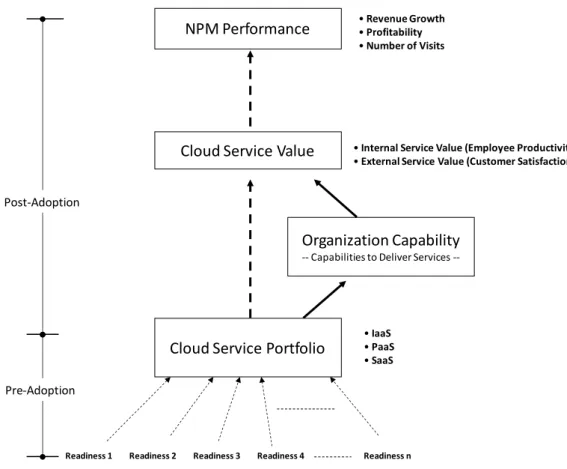
The research framework is shown in Figure 2. Based on the discussion in Section 2, we propose the following cloud service applications for NPM:
Infrastructure-as-a-Service (IaaS): The IT infrastructures, including storage, servers, network and other fundamental computing resources, are provided as a service. The potential IaaS for NPM include data analytics, data backup/storage/sync, disaster recovery, cloud storage, cloud server, server load balance, etc.
Platform-as-a-Service (PaaS): The computing platform and solutions are provided as a service, and they include the facilities and tools for application programmers to design, develop and test. PaaS provides a complete development lifecycle environment for users. The potential PaaS for NPM include cloud database, website hosting, and online development platform.
Software-as-a-Service (SaaS): All types of applications are provided as a service. These applications may be simple functional software such as web-based mail or may be complex functional software. The potential SaaS for NPM include internal applications such as collaboration software, email, office productivity, Web conferencing, project management, and so on. The NPM also can consider SaaS for external customers such as those using social networking or Web 2.0 and mobile platform.
5
Figure 2. Research Framework
We sought to understand the readiness of cloud services for NPM in each of these service categories. In the following sections, we outline the readiness factors that affect the adoption of cloud services in NPM, uncover the set of relevant cloud service value metrics, and then evaluate how they would be impacted by discussing organizational capabilities.
4. THE READINESS OF CLOUD SERVICES
We started the study by conducting interviews with Taiwanese cloud service providers to find out how they evaluate the readiness of companies to adopt cloud services. This gave us an exhaustive list of factors. Next, we conducted an interview with NPM to judge which readiness factors are relevant in the museum sector. We summarize five major readiness concerns, which are summarized as follows.
Safety Readiness
Maintaining the safety of collections in the exhibition spaces is one of the important missions for the museum manager (Gilmore and Rentschler 2002). The priceless collections could be stolen by art theft (James 2000) or be destroyed by incidents such as fire (Spafford-Ricci and Graham 2000). Similarly, the museum digital collection and its online information may also be broken or be copied. There are two important safety concerns. One is regulatory compliance. Museum managers are supposed to consider the copyright laws especially before they digitalize the collections to display on the cloud (Hirtle et al. 2009). Some artistic works, literary works, musical compositions, or films belong to their authors only in a limited time, while some may belong to the public but
Cloud Service Portfolio
Readiness 1 Readiness 2 Readiness 3 Readiness 4 Readiness n
Organization Capability
Capabilities to Deliver Services
--Cloud Service Value • Internal Service Value (Employee Productivity) • External Service Value (Customer Satisfaction)
Pre-Adoption Post-Adoption
• IaaS • PaaS • SaaS
NPM Performance • Revenue Growth• Profitability • Number of Visits
6
need “curatorial control,” which means the museums may have the abilities to control the dissemination of their treasures through licensing agreement or digital right management, such as watermarking (Torsen and Anderson 2010), in order to preserve the cherished items over time (Smith 2005). At the time the museum puts the collections online, it should respect the authorship and carefully follow the law of intellectual property even if the items are “orphan works,” the collections whose right owner cannot be identified and located after reasonable search (Brito and Dooling 2005), or are “publicly accessible,” the collections can be easily reach by the public. The other concern is data security. The unscrupulous intent online is generally growing; therefore, the data security issue on the cloud services has to be concerned strictly. Correct defensive implementations should be in place. It might need to be clarified who is legally responsible for any security attack on a cloud system. How are the attacks dealt with to reduce and limit the damage?
Service Readiness
There are two major concerns. One is service design and management. As an educational organization, a museum delivers three core elements of services – education, accessibility, and communication to its speculators (Gilmore and Rentschler 2002). With cloud services, people can have new ways to interact with the collections instead of only watching the exhibitions. The cloud services can also help service differentiation in terms of content innovations, business process speed and agility, and variations in exhibition style and spaces (Loebbecke et al. 2012). In addition, cloud services encourage two-way communications between the museum and visitors and those between exhibitions and visitors. In view of these advantages brought by cloud services, how to design and manage services on the cloud becomes important for museums nowadays.
The other issue faced by museums is related with service contract management. Many museums determine to outsource their cloud services to outside service providers. As such, museums share the essential risk profile of all outsourcing contracts concerning opportunistic behavior, shirking, poaching, and opportunistic renegotiation (Clemons and Chen 2011). While there are multiple cloud providers offering a variety of service options in terms of pricing, performance, and feature sets (Li et al. 2011), adopting museums should be mindful of some contract issues, such as performance, security (including data citizenship and data residence) and legal resource (Clemons and Chen 2011).
Environmental Readiness
Museums should consider the cloud market competitive landscape and maturity,
including both fully commercial and government-provided cloud services (Kundra 2011). If the cloud markets are not dominated by a small number of players, museums can reduce the risk of vendor lock-in by moving services from one provider to another. In addition, the number of adopters within the museum industry may also affect the intention to adopt cloud services. Museums may feel pressure and become increasingly aware of and follow other museums’ adoption of new technologies (Low and Chen 2011). Technical Readiness
There are three major concerns. The first is the quality of Internet connection. Generally speaking, cloud services are built and connected via the Internet, which suggests that cloud services should always come with connectivity. In addition, cloud computing is a recent trend in IT that moves computing and data away from desktop and portable PCs to
7
large data centers. Cloud computing refers to applications delivered as services over the Internet as well as to the actual cloud infrastructure — namely, the hardware and systems software in data centers that provide these services (Dikaiakos et al. 2009). The second is virtualization. Because cloud computing will be a multitenant environment for running virtual systems, it will provide access to virtual CPUs, memory, storage networks, IP addresses, firewalls and catalog capabilities. To implement virtualization, companies encounter with various changes that result from virtualizing current equipment and facilitating inner processes (Preimesberger 2011). There are several typical aspects of virtualized data centers. These aspects include setting up new tenants, backing up the databases, managing the customizations and configurations of tenants, and obtaining patches and newer versions of the software, with which we may understand that several issues of virtualization are influential and require preparation when introducing private clouds (Rochwerger et al. 2009). At last, the cloud infrastructure is often operated solely within a single organization and managed by the organization or a third party regardless of whether it is located on- or off-premises (Dillon et al. 2010). Therefore, self-owned IT will be necessary and require some “headroom” to manage normal peaks in demand. Infrastructure systems that are able to operate efficiently at reduced loads reduce the cost of designing in this headroom (Emerson Network Power 2010).
Organizational Readiness
Museums should consider whether they are ready to migrate their service to the cloud. The issues include the availability of capable and reliable managers, the ability to negotiate appropriate service level agreements (SLAs), the related technical experience, supportive managerial cultures, and financial stability. Finding ways to meet the dynamic changing needs and expectations is a difficult mission to the museum professionals (Marty 2008). Museums who adopt cloud services need to provide these professionals appropriate training to implement and use the technology (Subashini and Kavitha 2011). In addition, museums, like corporations, may be conservative or attractive on the new knowledge. Building the cloud service without progression-pursuing culture in the museum will face thousands of obstacles during the whole adoption process.
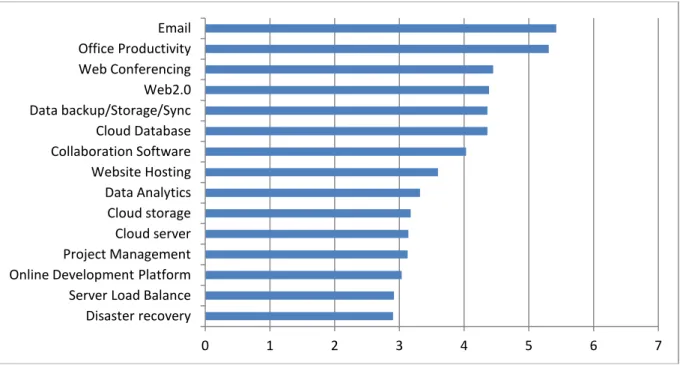
We conducted a survey of 155 companies’ IT executives to judge the readiness of cloud services. We asked the respondents to rate the five-category of readiness factors of each cloud service on a 7-point scale (7 refers to extremely ready, 1 refers to not ready at all). Figure 3 shows the cloud services ranked by their average readiness score. We find that services deemed as ready are focused on SaaS and Web-related services such as E-Mail, Web conferencing, and Web 2.0.
8
Figure 3. Readiness of Cloud Services
5. MEASURING CLOUD SERVICE VALUE
Because the benefits of cloud services can make the enterprise’s operation more efficient and improve business value (Géczy, et al., 2012, Aljabre, 2012), we can regard the cloud service value as benefits that the cloud brings to the enterprise. After reviewing the research and some informal articles about cloud services, we summarize the performance improvements from cloud services into two main areas: internal service value and external service value. Internal service value components focus on the improvement of employee productivity, and external service value components aim at the improvement of customer relationships.
5.1 Internal service value
Internal service value components can be summarized as follows.
Efficiency. Cloud computing can reduce the enterprise’s redundant investment in hardware, software, and the cost of maintenance and management; the enterprise can use these resources in another investment to increase profit (Aljabre, 2012; Boss et al., 2007). Cloud computing also provides a utility-style payment. Enterprises pay only for the resources or services that they actually use (Géczy et al., 2012).
Flexibility. Flexibility means that enterprises can use the resources or services more elastically. Cloud computing services can scale capacity up or down depending on the consumers’ needs (Gartner Report 2009). These services allow the enterprise to scale up the services whenever they need to and then to release them once the firm accomplishes its goal and needs to scale down. Moreover, enterprises have the ability to handle the peak demands (Dillon et al., 2010).
Mobility. Mobility means that enterprises can access resources or services more conveniently. Cloud computing services are delivered through the internet, so employees can use the
0 1 2 3 4 5 6 7
Disaster recovery Server Load Balance Online Development Platform Project Management Cloud server Cloud storage Data Analytics Website Hosting Collaboration Software Cloud Database Data backup/Storage/Sync Web2.0 Web Conferencing Office Productivity Email
9
information, resources and services easily regardless of location. As a result of this mobility, cloud computing also provides a collaborative environment for enterprises because multiple users can connect to the cloud services at the same time and can run cloud services on different types of OS (Aljabre, 2012).
5.2 External Service Value
Cloud services are expected to bring two benefits:
Innovation. The cloud services allow enterprises to focus on innovation and the business problem at hand without the distractions and costs of ramping up and maintaining an IT environment (Patil and Klein 2011). For example, through SaaS solutions, customers can access enterprise information from anywhere. These advancements would have been very costly and time-consuming to achieve with traditional IT system upgrades (Kundra 2011). In effect, enterprises can shift their focus from asset ownership to service management. Through collaboration with the cloud vendors, enterprises can take advantage of vendors’ innovation engine, comparing their current services to contemporary marketplace offerings, or looking at their customer satisfaction scores, overall usage trends, and functionality to identify the need for potential improvements through service innovation.
Collaboration. Cloud service allows enterprises to easily bring together the key players in business. For example, Amazon’s cloud computing services can help teams, customers, and suppliers meet, share ideas and basically do business more effectively and without delay (Aljabre 2012). Given that business partners can be given access to the cloud, market information is available and collaboration is enhanced. Both business profits and relationships can grow.
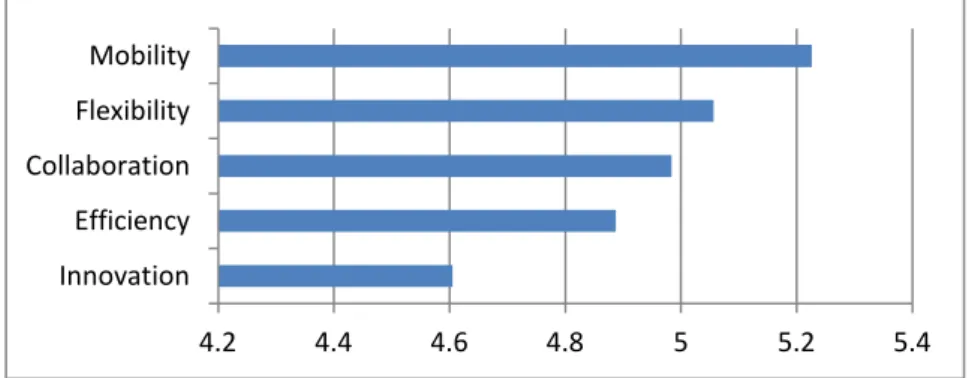
In the second part of the survey, we asked the respondents to rate the importance of each value components in terms of the benefits that are expected or have gained from implementing cloud services. The importance is measured on a 7-point scale (7 refers to extremely important, 1 refers to not important at all). Figure 4 shows the cloud service value metrics (aggregated over the 155 responding companies) regarded as the most important. We find that the metrics deemed as important are focused on internal service value components such as mobility and flexibility. We discuss the underlying causes in the following section.
Figure 4. Importance Ratings for Value Metrics
4.2 4.4 4.6 4.8 5 5.2 5.4 Innovation Efficiency Collaboration Flexibility Mobility
10
6. ORGNIZATIONAL CAPABILITIES FROM CLOUD ADOPTION
While Figure 4 shows the expected impact of cloud services, we propose that the impact would be manifested at the level of adopting alternative cloud service applications and ultimately at the enterprise level. The cloud service applications are expected to impact three fundamental organizational capabilities, which in turn would bring internal and external service value:
Resource Utilization Capability. Total control of IT resources comes at a price. Software must be installed, configured, and updated. The computational infrastructure of operating systems and low-level utilities must be maintained. Every update to the operating system requires a cascade of subsequent revisions to other programs. Adopting cloud services is expected to reduce the efforts to manage IT resources and enable rapid fulfillment of demand for IT resources and continuing ability to fulfill that demand as required. Since the IT resources are charged based on the quantity used, and the IT resources are shared across number of end users, it is expected that IT resources can be better utilized. The resource pooling can also provide economies of scale at the computing and services layers.
Integration Capability. Integration misalignment occurs when enterprises cannot efficiently coordinate their internal and external resources. Enterprises often encounter two integration problems: internal and external integration. Internal integration requires the alignment between the existing IT model and business model. External integration requires the alignment between the internal IT model and IT models of external parties. While cloud services offer end users advantages in terms of mobility and collaboration, it is expected to make it easy for an enterprise to integrate their existing IT model with the cloud-based model of resources and services (Kim et al. 2009, Géczy et al., 2012). In addition, software offered as an Internet-based service can be developed, tested, and run on a computing platform of the vendor’s choosing. The connectivity among business partners is improved.
Service Reconfiguration Capability. Service reconfiguration capability represents the ability to sense the needs of the internal or external environment, to immediately reconfigure the firm’s services for meeting changing demands of users and organizations. Since cloud environments often have thousands of applications built to quickly meet specific needs, and companies can usually try before they buy, letting them be more experimental in their approach to solving complex problems. In addition, cloud service vendors normally provide management tools to allow users to easily control and modify their subscriptions. The impact of the cloud on the enterprise becomes more measurable, providing enterprises opportunities to be more proactive to the service reconfiguration in response to the changing environment.
It is expected that advancement in these capabilities will, in turn, lead to an increase in the performance of adopting cloud services, which will ultimately be manifested in the more financial metrics of firm performance.
7. ASSESSMENT OF CLOUD MATURATY
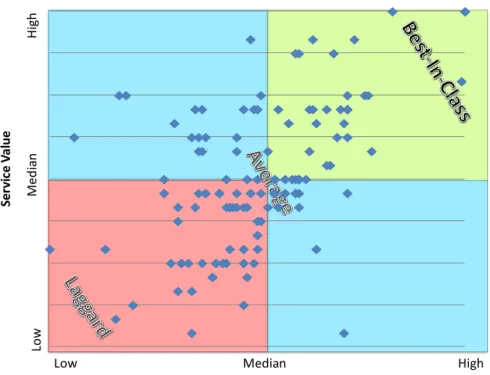
Based on the survey results, we distinguish Best-in-Class companies from Industry Average and Laggards. We use service value and organizational capability as two performance criteria to classify company’s maturity class. Best-in-Class organizations show
11
higher capability and perceive higher value from cloud adoption than their Industry Average and Laggard peers. They are the top 24% of aggregate performance scorers. On the other hand, Industry Average companies are the middle 40% of aggregate performance scorers, and Laggard are the bottom 36% of aggregate performance scorers.
Figure 5. Cloud Maturity Assessment
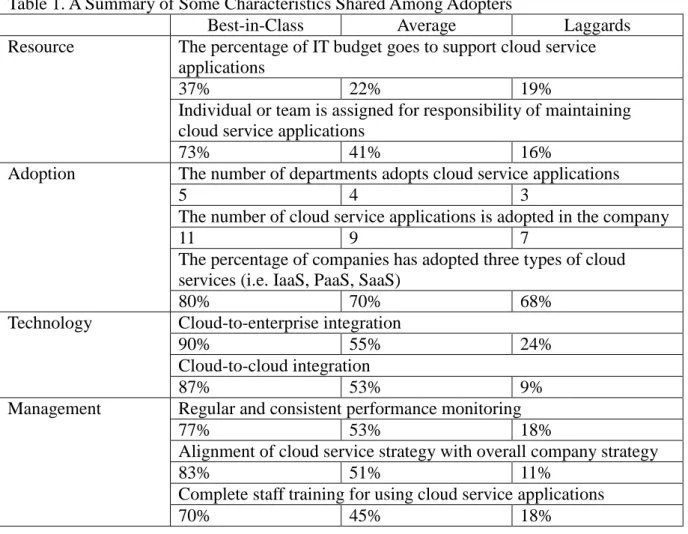
The survey results show that Best-in-Class organizations share many common characteristics that underpin their successful cloud adoption. The implementation of these characteristics may be the key to the performance of Best-in-Class organizations. We summarize these characteristics in Table 1. These characteristics may serve as a guideline for best practices, and correlate directly with Best-in-Class performance. For instance, seventy-three percent of the Best-in-Class actively create teams and assign them responsibility for maintaining cloud service applications. To ensure sufficient IT resources to support cloud services, the Best-in-Class invest over one-third IT budget on cloud (currently invested at 37%).
While multiple cloud service applications are used in adopting companies, the most pronounced differentiator between the Best-in-Class and all other companies is their ability to address the integration challenges of cloud computing. With effective strategies for integrating both within the cloud and between the cloud and enterprise, companies are able to transfer and translate data seamlessly and quickly in real-time, which is crucial to business success. Another common characteristic among the Best-in-Class is organizational efforts to ensure that cloud service strategies align with overall corporate goals (currently implemented at 83%). Besides, seventy-seven of the Best-in-Class conduct regular and consistent performance monitoring. As companies begin to move enterprise applications to the cloud, monitoring and management the performance and availability of applications becomes essential in allowing administrators to identify poor user experience quickly and correct the problems before impacting the users. At last, cloud training is necessary because many
Organizational Capability Se rv ic e V al u e High Median Low Lo w H ig h M ed ia n
12
employees do not feel confident managing the new IT environment. As seen in Table 1, 70% of the Best-in-Class are more likely to provide employees education and training on cloud technology.
Table 1. A Summary of Some Characteristics Shared Among Adopters
Best-in-Class Average Laggards Resource The percentage of IT budget goes to support cloud service
applications
37% 22% 19%
Individual or team is assigned for responsibility of maintaining cloud service applications
73% 41% 16%
Adoption The number of departments adopts cloud service applications
5 4 3
The number of cloud service applications is adopted in the company
11 9 7
The percentage of companies has adopted three types of cloud services (i.e. IaaS, PaaS, SaaS)
80% 70% 68%
Technology Cloud-to-enterprise integration
90% 55% 24%
Cloud-to-cloud integration
87% 53% 9%
Management Regular and consistent performance monitoring
77% 53% 18%
Alignment of cloud service strategy with overall company strategy
83% 51% 11%
Complete staff training for using cloud service applications
70% 45% 18%
8. THE ROADMAP FOR IMPLEMENTING CLOUD-BASED SERVICES
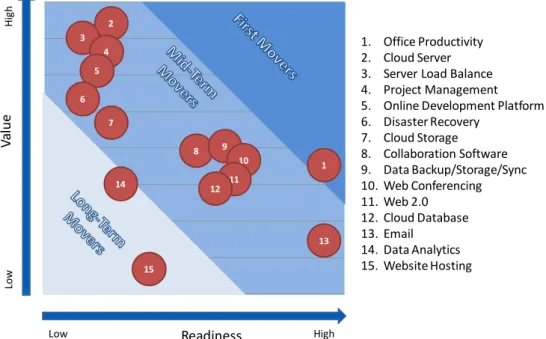
The survey results suggest that different services require different effort and some of the services are more ready to move cloud than others. Based on such an analysis it would appear that the implementation of some cloud service applications may need to be prioritized over others. Figure 6 shows the services that can be considered as First Movers, Medium-term Movers, and Long-term Movers. We define First Movers as high-value and ready cloud services which could move to the cloud first. In this instance, it seems the office productivity service is promising for development.
13
Figure 6. Potential Roadmap for Implementing Cloud Service Applications
9. CLOSING REMARK
Insights from this study are applicable to NPM that has focused on developing their cloud services. We identify an implicit set of cloud service applications for NPM to serve internal users and external visitors/customers. The evaluation (Figure 3) suggests the readiness among these applications is different as the features and functions of these applications may impact readiness differentially. A variety of value metrics are proposed to offer NPM insights for evaluating and positioning cloud services that are likely to yield the most benefits (Figure 4).
Another critical insight from our evaluation is that the performance of adopting cloud service applications depends on a combination of specific organizational capabilities. NPM can evaluate its cloud performance compared to the Best-in-Class (Figure 5). Whether NPM is trying to move its cloud service performance from Laggard to Industry Average, or Industry Average to Best-in-Class, Table 1 gives several actions that may help spur the necessary performance improvements.
Although the data collected in this study does not target at museum sectors, it offers both a framework for cloud readiness and maturity assessment, and specific findings that could be instructive for cloud strategy development in museums such as NPM. We suggest that, before NPM develop cloud services, evaluating the readiness and impacts of cloud service applications is important. Greater effort could then be directed towards the dissemination and deployment of high-impact and ready services (Figure 6).
REFERENCE
1. Aljabre, A. (2012) Cloud Computing for Increased Business Value, International Journal of Business and Social Science, vol. 3, no. 1, pp. 234-238.
2. Britol, J. and Dooling, B. (2005) An Orphan Works Affirmative Defense to Copyright Infringement Actions. Michigan Telecommunications and Technology Law Review, vol. 12, no.1, pp. 75-113. 1 2 3 4 5 6 7 8 9 10 11 12 13 14 15 Readiness High Low Va lu e Lo w H ig h 1. Office Productivity 2. Cloud Server 3. Server Load Balance 4. Project Management 5. Online Development Platform 6. Disaster Recovery 7. Cloud Storage 8. Collaboration Software 9. Data Backup/Storage/Sync 10. Web Conferencing 11. Web 2.0 12. Cloud Database 13. Email 14. Data Analytics 15. Website Hosting
14
3. Clemons, E. K., and Chen, Y. (2011) Making the Decision to Contract for Cloud Services: Managing the Risk of an Extreme Form of IT Outsourcing. Proceedings of 44th Hawaii International Conference on System Sciences, Kauai, Hawaii, January, 2011, pp. 1-10. 4. Dikaiakos, M. Katsaros, D., Mehra, P. Pallis, G., and Vakali, A. (2009) Cloud Computing:
Distributed Internet Computing for IT and Scientific Research, Internet Computing, IEEE, vol. 13, no. 5, pp. 10-13.
5. Dillon, T., Chen Wu, and Chang, E. (2010) Cloud Computing: Issues and Challenges, Proceedings of 24th IEEE International Conference on Adv advanced Information Networking and Applications, Perth, Washington, April, 2010, pp. 27-33.
6. Emerson Network Power (2010). Taking the Enterprise Data Center into the Cloud [White paper]. Available from
http://www.emersonnetworkpower.com/en-US/Brands/Liebert/Documents/White%20Papers/scalable-data-c enter_24567-R11-10.pdf
7. Gartner Report (2009). Gartner Highlights Five Attributes of Cloud Computing. Gartner press release. Available from http://www.gartner.com/newsroom/id/1035013
8. Gilmore, A. and Rentschler, R. (2002) Changes in Museum Management: A Custodial or Marketing Emphasis, Journal of management development, vol. 21, no. 10, pp. 745-760. 9. Géczy, P., Izumi, N., and Hasida, K. (2012) Cloudsourcing: Managing Cloud
Adoption, Global Journal of Business Research, vol. 6, no. 2, p0p. 57-70.
10. James, M. (2000) Art Crime. Australian Institute of Criminology. Available from
http://www.aic.gov.au/documents/9/2/9/%7B9296EF8C-47F0-4B90-95BF-2A4466B5E86
3%7Dti170.pdf
11. Kim, W. (2009) Cloud Computing: Today and Tomorrow. Journal of object technology, vol. 8, no. 1, pp. 65-72.
12. Kundra, V. (2011) Federal Cloud Computing Strategy, The White House Washington, Available from
https://www.dhs.gov/sites/default/files/publications/digital-strategy/federal-cloud-computi ng-strategy.pdf
13. Hirtle, P.B., Hudson, E., and Kenyon, A.T. (2009) Copyright and Cultural Institutions: Guidelines for US Libraries, Archives, and Museums. Ithaca, NY: Cornell University Library. Available from
https://ecommons.library.cornell.edu/bitstream/1813/14142/2/Hirtle-Copyright_final_RG B_lowres-cover1.pdf
14. Li, Z. J., Chen, C., and Wang, K. (2011) Cloud computing for agent-based urban transportation systems. Intelligent Systems, IEEE, vol. 26, no. 1, pp. 73-79. 15. Loebbecke, C., Thomas, B., & Ullrich, T. (2012) Assessing Cloud Readiness at
Continental AG. MIS Quarterly Executive, Vol. 11 No. 1., pp. 11.
16. Low, C. and Chen, Y. (2011) Understanding the determinants of cloud computing adoption, Industrial Management & Data Systems, Vol. 111 No. 7, pp. 1006-1023.
17. Marty, P.F. (2008) Museum websites and museum visitors: Digital museum resources and their use. Museum Management and Curatorship, vol. 23, no. 1, pp. 81-99.
18. Patil, G. and Klein, R. (2011) The business value of a cloud-based contact center, Aberdeen Group Report, June 2011.
19. Preimesberger, C. (2011) Private vs. Public Clouds: The Fight has just Begun. eWeek, vol. 28, no. 10, pp. 24-25.
20. Rochwerger, B., Breitgand, D., Levy, E., Galis, A., Nagin, K., Llorente, I., Montero, R., Wolfshal, Y., Elmroth, E., Caceres, J. Ben-Yehuda, M., Emmerich, W., Galan, F. (2009) The reservoir model and architecture for open federated cloud computing, IBM Journal of Research and Development, vol. 53, no. 4, pp. 1-11.
15
21. Smith, M.K. (2005) Exploring variety in digital collections and the implications for digital preservation. Library Trends, vol. 54, no.1, pp. 6-15.
22. Spafford-Ricci, S. and Graham, F. (2000) The Fire at the Royal Saskatchewan Museum, Part 1: Salvage, Initial Response, and the Implications for Disaster Planning. Journal of the American Institute for Conservation, Vol. 39, No. 1, pp. 15-36.
23. Subashini, S. and Kavitha, V. (2011) A survey on security issues in service delivery models of cloud computing, Journal of Network and Computer Applications, vol. 34, no. 1, pp. 1-11.
24. Torsen, M. and Anderson, J. (2010) Intellectual Property and the Safeguarding of Traditional Cultures: Legal Issues and Practical Options for Museums. Libraries and Archives, Geneva, Switzerland: WIPO. Available from
出席國際學術會議心得報告
本人出席 WDSI 國際學術會議,並發表論文。其心得報告分述如下:WDSI—The 44
thWestern Decision Sciences Institute Annual Meeting
計畫編號 NSC 102-2420-H-004 -004 -MY2 計畫名稱 故宮博物院的資通訊化服務創新與其影響--(子計畫五)故宮博物院雲端 服務導入策略之研究:IT 藍圖,整備度與評價模式 出國人員姓名 服務機關及職稱 張欣綠,國立政治大學資訊管理學系 會議時間地點 Maui, Hawaii, U.S.A.
會議名稱 中文:第四十四屆西方決策科學年度會議
英文:The Fourty-fourth Western Decision Sciences Institute Annual Meeting 發表論文題目 TOWARD A MATURITY MODEL FOR CLOUD SERVICE CAPABILITY
ASSESSMENT
一、
參加會議經過
The Western Decision Sciences Institute (WDSI) is a regional division of the Decision Science Institute (DSI). This year, the conference is hosted in Maui, and sponsored by State University of Denver, SUNY, University of Tennessee, University of the pAcific, and Utath Valley University. There are ten tracks in this conference: Operations and supply chain management, Finance, Hospitality management, Innovative education, military applications, engineering systems
management, marketing, Internet and e-business, management information systems, management and organizational behavior. My paper is presented on Session 15 IEB-W3 on Wednesday
afternoon, April 1.
二、
與會心得
Besides my paper, four interesting papers were presented in the sessions that I participated. I summarize the discussion results as follows.
[Apps Continuance Use Intention]
The authors adopt the perspective of experiential value theory to uncover how users develop positive attitude toward the APP and thus lead to the willingness of continuance use. The results showed that the perceived experiential value does have a positive impact on the APPs user’s attitude toward the APP. The experiential value dimensions of aesthetics, user return of investment, and service
excellence are three significant positive antecedents for the user’s attitude toward the APP.
[Service-Oriented DRM System]
The authors remodel the DRM system using Service-Oriented-Architecture (SOA) methodology to promote interoperability between service models in the DRM system. In this study, processes of all security needs in the service-oriented DRM system are policy-based and are built upon eXtensible Access Control Markup Language (XACML) standard to enable standard, generic, distributed and flexible security architecture.
[ Knowledge Sharing Platform]
This study innovatively introduced a blog-based teaching assistant (TA) knowledge sharing system for a university, and then constructed a theoretical model composed of IS success factors, system satisfaction, system use, TA self-efficacy, and internal locus of control to assess the outcome of such a TA knowledge sharing system.
[Software Piracy Intention]
The presence of software piracy can lower business investment in new product design, reduce delivery of innovative services, and suppress improvement of customer services. It evokes the attention of academia. This paper delved into this issue, and tried to find out the influencing factors and appropriate solutions.
參、 建議
Comments to the paper are summarized below.
1. The authors develop a maturity model to help companies understand their current usage level for public cloud services. This research is important to help companies to transfer effectively their information system.
2. The authors need define the three dimensions: volume, diversity, and breadth. Give some related research to identify these keywords.
3. In Figure1, the "usage level of CC" should be "usage level of Public Cloud Services". 4. In this paper, the usage level has three levels. Why you only have three levels? The CMMI
have five levels, why you don’t adopt this model?
5. In research finding section, the authors can use a cross table to specify the research finding.
肆、 攜回資料名稱及內容
A. Conference paper abstracts B. Conference program outline
伍、發表論文
TOWARD A MATURITY MODEL FOR CLOUD SERVICE CAPABILITY
ASSESSMENT
Hsin-Lu Chang, Department of Management Information Systems, National Chengchi University, No. 64, Sec. 2, Zhinan Rd., Wenshan District, Taipei City 11605, Taiwan (R.O.C.),
+886-2-29393091 Ext.81266, [email protected]
James Chen, Department of Management Information Systems, National Chengchi University, No. 64, Sec. 2, Zhinan Rd., Wenshan District, Taipei City 11605, Taiwan (R.O.C.),
+886-2-29393091 Ext.89055, [email protected]
Kai Wang, Department of Information Management, National University of Kaohsiung, No.700, Kaohsiung University Rd., Kaohsiung City 811, Taiwan (R.O.C.), +886-7-5919781,
ABSTRACT
Whereas cloud computing has gained increasing popularity in the past few years, not every firm can enjoy the acclaimed advantages and benefits. This research develops a maturity model of public cloud services. With this model, firms would determine their current usage level of public cloud services and the types of capabilities required to manage and benefit from the adoption of public cloud services. The four main capabilities are: (1) IT assets, (2) Integration, (3) Reconfiguration and transfer, (4) Human resources. The analysis of data collected from Web questionnaires shows that (1) the three important capabilities that influence the support of using public cloud services are IT assets, integration and reconfiguration and transfer; (2) the importance of the three significant capabilities could be ranked; (3) higher usage level for public cloud services leads to higher benefits; (4) human-based resources does not have significant impact on supporting greater usage level of public cloud services. The findings help companies to transfer effectively from their existing IT system to a cloud-based system.
INTRODUCTION
Cloud computing ranked number 17 in the list of key technologies in 2009, and moved up to number 5 in 2010 [12]. A survey by VMware also showed that 88 percent of the respondents regarded cloud computing as high priority in their organizations over the next 18 months, and two thirds of the respondents were planning or had already adopted cloud computing technologies [16].
However, the fact that cloud computing brings positive benefits to companies does not mean that these companies will actually obtain the benefits simply by adopting cloud computing. Some companies enjoy the benefits of adopting public cloud services, while others obtain limited benefits. Because the IT maturity varies from one company to another, different companies are at
different usage levels of public cloud services. The usage level depends on particular IT capabilities that the companies own when they adopt cloud computing. Research has shown some of the concerns that companies face when they adopt cloud computing include cloud outages, security problems, and compliance [11]. Although prior research have noted issues that companies should consider before adopting cloud computing, insufficient attention has been paid to the types of capabilities companies should build regarding cloud computing adoption. Moreover, different companies have different situations for their IT systems and therefore also have different levels of maturity when adopting cloud-computing services.
The purpose of this research is to develop a maturity model of public cloud services. Using this model, companies can understand their current usage level and the benefits pertaining to each level. In addition, it also shows the capabilities that the companies should acquire to move up to the next level. The two research questions this study intends to answer are: “What important capabilities must companies build to adopt public cloud services well and increase their usage level?” and “Does a higher usage level for public cloud services lead to higher firm performance?”
LITERATURE REVIEW
This study focuses on public cloud services, whose cloud infrastructures and services are hosted by third-party vendors and are available to the general public. Public cloud services are available through a pay-per-use model.
Levels of Cloud Computing Usage
The extent of firms’ usage of cloud computing can be complicated but is critical. Massetti and Zmud [13] have evaluated EDI usage using four facets, namely volume, diversity, breadth, and depth. We used a similar method to describe the usage level of public cloud services, and there are three dimensions that we use to assess the extent of usage. These dimensions are volume, diversity, and breadth. The volume of public cloud services refers to the number of distinct public cloud services that a firm has adopted. The more public cloud services that a firm has adopted, the more likely it is that the firm is at a higher usage level. The diversity of public cloud services represents the extent to which a firm has adopted different types of cloud services (IaaS, PaaS, and SaaS). It indicates the complexity of the firm’s cloud environment. The breadth of public cloud services indicates how many departments within the firm have adopted public cloud services. This index measures how widespread the public cloud services are in a firm.
Resource-Based Theory
According to resource-based theory, a firm’s competitive advantages are a result of the specific resources and capabilities possessed by the firm [2][9]. These resources and capabilities should be valuable, rare, and difficult to imitate and substitute [2]. Although Barney [2] regards capabilities as one of the specific resources of the firm, Grant [9] separates capabilities from resources by indicating that resources are the source of capabilities and capabilities represent the performance of tasks or activities. Resource-based theory provides the firm with a good reason to develop a suitable strategy to reduce the resource gaps and increase profit [9].
Grant [9] and Barney [2] indicated six categories of resources: financial, physical, human, technological, reputational, and organizational resources. Other researchers have extended the traditional view of resource-based theory because they believed that a firm should have additional dynamic resources and capabilities that would enable itself to confront the complicated and rapidly changing environment. Using the dynamic resource-based view, capabilities can be divided into three parts: capabilities regarding organizational and managerial processes, capabilities regarding the firm’s asset positions, and capabilities regarding paths [15]. Bharadwaj et al. [3] further proposed a resource-based view of IT: tangible IT infrastructure, human IT resources, and intangible IT-enabled resources.
Adoption Issues for Public cloud Services
There are five types of adoption issues for cloud computing, which include availability, security, support, vendor lock-in and interoperability, and compliance [10]. The availability issue concerns the outage of cloud services. Precautions such as service level agreements (SLAs) from providers are needed to avoid such problems. Placing valuable data and services with an outside provider poses a fundamental security risk. However, Won has argued that the off-premises cloud is no less secure than on-premises computing. Cloud service providers must hire and train sufficient support staff to provide better support than users receive with on-premises computing. Moreover, firms should avoid vendor lock-in to be able to migrate and integrate data, application, and services among different providers’ clouds (interoperability). Because firms need to maintain business legal documents and assure integrity to comply with law regulations, cloud service providers must ensure that users’ data satisfy their compliance requirements. Emerson [6] and Shimba [14] both offered similar viewpoint on this issue. The former indicated that data security, availability, and performance are top concerns for cloud service adoption, and the latter indicated that security is the most important concern, followed by integration, availability, and compliance. Géczy et al. [8] also pointed out the three aspects of cloud-related concerns. Alignment with the existing operating model in the organization, including integration, customization, availability, performance, and transfer assures operational efficiency. Customization is the ability to provide customized cloud-based services at several levels to accommodate diverse needs and does not represent the capability of the cloud adopter. Management and control of data and services consists of security, management, relocation, control loss, and data loss. Many cloud services providers regard these abilities as added value, and claim that they can provide better security tools than those currently used by firms. The legal concerns consist of liability, disclosure, and legislation. These concerns are restrictions that come into play during cloud service adoption.
Public Cloud Service Performance
Prior research suggests that the performance improvement due to cloud computing include increasing profit/decreasing cost, flexibility, and mobility. For increasing profit/decreasing cost, cloud computing offers direct benefits to the firm and reduces redundant investment in hardware, software, and the cost of maintenance and management [1][4]. Cloud computing also provides a utility-style payment, allowing firms to pay only for the resources or services that they actually use [8]. With the flexibility of cloud computing services, firms can easily scale the capacity upward or downward, depending on the users’ needs [7]. Moreover, flexibility allows firms to
efficiently handle peak demands [5]. Lastly, as a result of the mobility of cloud computing services, employees can use the information, resources and services easily regardless of location. Cloud computing also provides a collaborative environment for firms because multiple users can connect to the services at the same time but on different types of OS [1].
RESEARCH MODEL AND HYPOTHESES
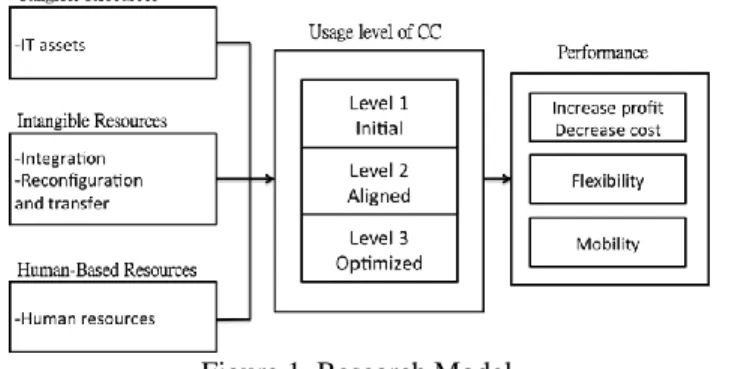
Figure 1 shows the research framework of this study. This study focuses on firms’ capabilities regarding public cloud services. According to the RBV theory and findings of prior studies, we developed a research framework that includes four resources to form public cloud capabilities, which affects three usage levels and three performance areas.
Figure 1. Research Model
As discussed earlier, the usage of public cloud services is divided into three levels and measured using three dimensions: volume, diversity and breadth. At the initial level, firms adopt only one type of public cloud service in only one department. At the aligned level, firms adopt two or three different public cloud services in two or three departments but under the same type of cloud service (IaaS, PaaS or SaaS). At the highest level, the optimized level, firms tend to heavily adopt many cloud services, especially across different types of cloud services, in most departments. Table 1 below shows the usage levels for public cloud services.
We propose four resources that form the public cloud capabilities: (1) IT assets, (2) Integration, (3) Reconfiguration and transfer, (4) Human resources. The first resource can be regarded as a tangible resource, the following two intangible resources, and the last one human-based resource.
Table 1. Usage Levels of Public Cloud Services Levels Dimensions Level 1 Initial services Level 2 Aligned Level 3 Optimized Volume 1 2~3 >3 Diversity 1 1~2 >1 Breadth 1 2~3 >3
The research hypotheses to be examined are:
H1: Firms with more IT assets are able to support greater usage levels of public cloud.
H2: Firms with greater cloud integration are able to support greater usage levels of public cloud. H3: Firms with greater capabilities in reconfiguration and transfer are able to support greater usage levels of public cloud.
H4: Firms with more human-based resources are able to support greater usage levels of public cloud.
H5: Firms with greater public cloud usage are more likely to achieve better firm performance.
RESEARCH METHODOLOGY
Before we proceed with data collection, we interviewed two major public cloud service providers in Taiwan, Hicloud of Chunghwa Telecom and ASUS Cloud. Hicloud generally agreed with the viewpoint on cloud capabilities presented in our research, especially in terms of integration ability. Dr. Wu, Managing Director of Chunghwa Telecom, also believed that adopting cloud services is more than simply applying a new IT tool. ASUS Cloud indicated that our research model has considered most of the adoption issues and that it may work in practice. Dr. Wu, CEO of ASUS Cloud Corporation, noted that public cloud services could reduce pressure on the firm to provide particular IT technologies such as virtualization and security because service providers would provide these services to users, and users would only need to know how to use them.
Data collection proceeded through online survey. We directed our sample at companies that have adopted public cloud services and at respondents who are staff who doesn’t necessarily work in the IT department. We mailed the link for the online questionnaire to the respondents. We also posted the link on popular technology web forums to collect as larger number of responses as possible. Data collection lasted for one and a half month, and we finally received 158 responses, among which 117 were complete and valid.
RESEARCH FINDINGS
Data analysis showed that all the proposed hypnoses, except H4, were supported. We summarize the major findings as follows. First, the three important capabilities that influence the support of using public cloud services are IT assets, integration, and reconfiguration and transfer. IT assets, including physical IT assets and financial assets, are essential resources to provide basic support for firms to adopt public cloud services. Integration is the ability to coordinate internal and external resources and activities. Reconfiguration and transfer can be regarded as the ability to dynamically optimize resources, which help firms to adopt public cloud services in a more efficient way. Second, the most influential factor between Initial level and Aligned level is reconfiguration and transfer. The most influential factor between Aligned level and Optimized level is integration. These two factors have the nearly the same score and much higher than that of IT assets. Between Initial level and Aligned level, the Wald values of IT assets, integration and reconfiguration, and transfer, were 3.962, 7.439, and 8.034. Between Aligned level and Optimized level, the Wald values for these three factors were 8.057, 18.748, and 15.930. These three factors were all significant at the p < 0.05 level. The last two factors had nearly the same high Wald values, indicating these two capabilities as having high influence on adopting public cloud services. Third, firms with greater public cloud usage are more likely to achieve better firm performance. We found that the score of performance at Optimized level was significantly higher than those at both Initial and Aligned levels. However, the score of performance at Aligned level
was not significantly higher than the score of performance at Initial level (p < 0.399). It might be due to the small sample size we obtained to discriminate the two groups, especially when these two group’s average scores were close. On the other hand, if firms can raise their usage level up to Optimized level, they can realize the obvious improvements in IT performance. Fourth, human-based resources do not show significant impact on supporting greater usage level of public cloud services. One reason may be due to the small sample size as discussed earlier. One other possible reason relates to the fact that most firms in Taiwan do not provide complete training on the new concept of cloud computing to their staff, except those in the IT department. Because the survey does not focus only on the respondents in the IT department, the score of human-based resources was thus low.
LIMITATIONS AND FUTURE RESEARCH
The first limitation regards the online survey. Second, the survey was conducted in Taiwan. A larger scale survey could help the generalizability of this study. Third, the selection of respondents might also influence the results of the analysis. Lastly, the measurement of performance was to ask the respondents to compare the situation before and after adopting public cloud services. Because the standard of comparison may differ from one firm to another, it may lead to inconsistent results across firms.
REFERENCES
[1] Aljabre, A. (2012). Cloud computing for increased business value. International Journal of Business and Social Science, 3(1), 234-238.
[2] Barney, J. (1991). Firm resources and sustained competitive advantage. Journal of Management, 17(1), 99-120.
[3] Bharadwaj, A. S. (2000). A resource-based perspective on information technology capability and firm performance: An empirical investigation. MIS Quarterly, 169-196.
[4] Boss, G., Malladi, P., Quan, D., Legregni, L., & Hall, H. (2007). Cloud computing. IBM white paper, 1369. Retrieved from
http://files.spogel.com/projectsqa/qa-00135--how%20a%20business%20can%20use%20clo ud%20computing%20to%20reduce%20cost.docx
[5] Dillon, T., Wu, C., & Chang, E. (2010). Cloud computing: Issues and challenges. Proceedings of the 24th IEEE International Conference on Advanced Information Networking and Applications (AINA), 27-33.
[6] Emerson. (2010). Taking the enterprise data center into the cloud: Achieving a flexible, high-availability cloud computing infrastructure. Retrieved from
http://www.emersonnetworkpower.com/en-US/Brands/Liebert/Documents/White%20Papers /scalable-data-center_24567-R11-10.pdf
[7] Gartner. (2009). Gartner highlights five attributes of cloud computing. Retrieved from http://www.gartner.com/newsroom/id/1035013
[8] Géczy, P., Izumi, N., & Hasida, K. (2012). Cloudsourcing: Managing cloud adoption. Global Journal of Business Research, 6(2), 57-70.
[9] Grant, R. M. (1991). A resource based theory of competitive advantage: Implications for strategy formulation. California Management Review, 33(3), 114-135.
[10] Kim, W. (2009). Cloud computing: Today and tomorrow. Journal of Object Technology, 8(1), 65-72.
[11] Kim, W., Kim, S. D., Lee, E., & Lee, S. (2009). Adoption issues for cloud computing. Proceedings of the 11th International Conference on Information Integration and Web-based Applications & Services, 3-6.
[12] Luftman, J., & Ben-Zvi, T. (2010). Key issues for it executives 2010: Judicious it investments continue post-recession. MIS Quarterly Executive, 9(4), 263-273. [13] Massetti, B., & Zmud, R. W. (1996). Measuring the extent of EDI usage in complex
organizations: Strategies and illustrative examples. MIS Quarterly, 331-345.
[14] Shimba, F. (2010). Cloud Computing: Strategies for Cloud Computing Adoption. Dublin Institute of Technology.
[15] Teece, D.J., Pisano, G., & Shuen, A. (1997). Dynamic capabilities and strategic management. Strategic Management Journal, 18(7), 509-533.
[16] VMware. (2011). Global cloud computing adoption: Transformation is in the air. Retrieved from
http://www.vmwaregrid.com/vcloud_service_provider/servedbythenet/assets/Cloud_IDG.pd f
科技部補助計畫衍生研發成果推廣資料表
日期:2015/06/02科技部補助計畫
計畫名稱: (子計畫五)故宮博物院雲端服務導入策略之研究:IT藍圖,整備度與評價 模式 計畫主持人: 張欣綠 計畫編號: 102-2420-H-004-004-MY2 學門領域: 全球架構下的臺灣發展無研發成果推廣資料
102 年度專題研究計畫研究成果彙整表
計畫主持人:張欣綠 計畫編號:102-2420-H-004-004-MY2 計畫名稱:(子計畫五)故宮博物院雲端服務導入策略之研究:IT 藍圖,整備度與評價模式 量化 成果項目 實際已達成 數(被接受 或已發表) 預期總達成 數(含實際已 達成數) 本計畫實 際貢獻百 分比 單位 備 註 ( 質 化 說 明:如 數 個 計 畫 共 同 成 果、成 果 列 為 該 期 刊 之 封 面 故 事 ... 等) 期刊論文 0 0 100% 研究報告/技術報告 0 0 100% 研討會論文 1 1 100% 篇 論文著作 專書 0 1 100% 申請中件數 0 0 100% 專利 已獲得件數 0 0 100% 件 件數 0 0 100% 件 技術移轉 權利金 0 0 100% 千元 碩士生 3 3 100% 博士生 0 0 100% 博士後研究員 0 0 100% 國內 參與計畫人力 (本國籍) 專任助理 0 0 100% 人次 期刊論文 0 0 100% 研究報告/技術報告 0 0 100% 研討會論文 2 2 100% 篇 論文著作 專書 1 1 100% 章/本 申請中件數 0 0 100% 專利 已獲得件數 0 0 100% 件 件數 0 0 100% 件 技術移轉 權利金 0 0 100% 千元 碩士生 0 0 100% 博士生 0 0 100% 博士後研究員 0 0 100% 國外 參與計畫人力 (外國籍) 專任助理 0 0 100% 人次其他成果