國
立
交
通
大
學
管理科學系
博
士
論
文
No.034
中國地區經銷商進入模式之選擇:
以制度及交易成本的觀點
Entry Mode Choice in China’s Regional Distribution Markets:
Institution vs. Transaction Cost Perspectives
研究生:陳永瑞
指導教授:楊千 教授 王耀德 副教授
國
立
交
通
大
學
管理科學系
博
士
論
文
No.034
中國地區經銷商進入模式之選擇:
以制度及交易成本的觀點
Entry Mode Choice in China’s Regional Distribution Markets:
Institution vs. Transaction Cost Perspectives
研究生:陳永瑞
研究指導委員會:張家齊 助理教授
指導教授:楊千 教授 王耀德 副教授
中國地區經銷商進入模式之選擇:
以制度及交易成本的觀點
Entry Mode Choice in China’s Regional Distribution Markets:
Institution vs. Transaction Cost Perspectives
研 究 生:陳永瑞 Student:Yung-Jui Chen
指導教授:楊千 王耀德 Advisor:Chyan Yang Yau-De Wang
國 立 交 通 大 學
管理科學系
博 士 論 文
A Dissertation
Submitted to Department of Management Science College of Management
National Chiao Tung University in Partial Fulfillment of the Requirements
for the Degree of Doctor of Philosophy
in
Management May 2008
Hsin-Chu, Taiwan, Republic of China 中華民國九十七年五月
i
中國地區經銷商進入模式之選擇:
以制度及交易成本的觀點
研究生:陳永瑞
指導教授:楊千 王耀德
國立交通大學管理科學系博士班
摘
要
本研究調查台灣的食品領導廠商在中國設立 312 銷售據點。研究顯示,在進入模式的選擇 方面,制度因素比交易成本更為重要;同時考慮正式制度與非正式制度。正式制度是指政府所 規定的制度而非正式制度是指產業及社會所制定的規則。兩種制度都顯示會影響進入模式,但 有一個重要的制度變數-職業規範,在中國並不存在。職業規範是指同業的壓力,這種壓力迫 使產業成員的行為符合某種共同的形式。由於缺乏職業規範,網絡的連結及模仿的行為便取代 了職業規範而顯得重要。以一個外國廠商要經營中國國內市場而言,台灣廠商在選擇組織的形 式方面會模仿先進入者以取得合法的地位。 關鍵詞:進入模式、中國、制度、交易成本、網絡關係、模仿行為。
ii
Entry Mode Choice in China’s Regional Distribution Markets:
Institution vs. Transaction Cost Perspectives
Student:Yung-Jui Chen
Advisor:Chyan Yang Yau-De Wang
Department of Management Science
National Chiao Tung University
ABSTRACT
In this paper, we investigate the entry mode choice of a leading Taiwanese food company in setting up regional distributors in China’s 312 sales districts. Our study shows that, in entry mode decisions, the institutional factors are more important than transaction cost considerations. Both formal and informal institutions are considered. Formal institutions refer to government prescribed institutions (laws and regulations), while informal institutions refer to rules prescribed by the industry and the society. Both institutions are shown to affect the entry mode choices but one important type of institution, professional norms, is conspicuously missing in China. Professional norms exert peer pressures on the practitioners in the same profession, forcing their behaviors to conform to a common pattern. In the absence of professional norms, the roles of network ties and mimetic behaviors are heightened and they become a proxy for professional norms. As a foreign enterprise operating in China’s local markets, the Taiwanese food company attained legitimacy by forming alliances with local wholesalers and by following its predecessors in selecting organization forms.
Keywords: entry mode choice; China; institutions; transaction cost approach;
network relations; mimetic behaviors
iii
誌 謝
在工作多年後,承蒙交大管科系老師們的提攜而有幸能進入博士班就讀,此
段求學期間,非常感謝指導教授楊千老師的栽培及指導,使我能如期完成學業。
特別要感謝家兄陳添枝教授及台大陳厚銘教授在論文撰寫期間的指導,並得
以順利發表於國外知名期刊。也要謝謝佳誼熱心的幫忙以及同班同學在求學的
過程中的鼓勵與協助。
另外在口試期間,感謝口試委員楊千老師、王耀德老師、黃仁宏老師、陳厚
銘老師以及林鳳儀老師的指導,使得論文內容可以更加完整。
最後,要謝謝內人淑靜的支持讓我能無後顧之憂,能夠在漫長歲月中能夠工
作與學業兼顧,願將此喜悅與家人及所有關愛我的人分享。
iv
Contents
中文摘要
……….
i
英文摘要
……….
ii
誌謝
……….
iii
Contents ……….
iv
Table List
……….
vi
Figure List
……….
vii
Chapter 1
Introduction……….
1
1.1 Background………..
1
1.2 Research
Objectives……….
2
1.3 Contributions………
3
1.4
Organization of Dissertation………
3
Chapter 2
Literature Review………
6
2.1 Theoretical
Background………..
6
2.2
Institution Theory and Transaction Costs………
6
Chapter 3
Research Design………..
11
3.1 Theoretical
Framework………
11
3.2 Hypotheses………..
13
3.2.1 Transaction
Costs………
13
3.2.2 Formal
Institutions………..
14
3.2.3 Informal
Institutions
15
3.3
Measures of Variables……….
22
3.3.1 Dependent
Variable……….
22
3.3.2 Independent
Variables………...
23
3.3.3 Control
Variables……….
27
3.4 Research
Setting………..
27
3.4.1 Questionnaire
Design and Pretest………
27
3.4.2 Subjects………
28
3.4.3 Methodology………
29
Chapter 4
Results……….
32
4.1
Reliability and Validity…….……..………
32
4.2
Data Analysis………. .………
33
4.3 Results
Summary………
36
Chapter 5
Discussions .………
37
5.1 Theoretical
Implications………..
37
5.2 Managerial
Implications………..
39
5.3 Conclusions………
43
5.4 Research
Constraints
………..
45
v
References ……….
47
Appendix A
Scales of Independent Variables and Control Variables……….
55
Appendix B
Results of Scale Purification………
56
Appendix C
Results of Using “Area” as Control Variables………
57
Appendix D
Questionnaire………..
58
vi
Table List
Table 1:Comparison of Transaction Costs Theory and Institutional Theory..10
Table 2:Correlation Matrix of Independent Variables……… 26
Table 3:Ordered Probit Analysis on Entry Mode………34
vii
Figure List
Figure 1:Research Process………5
Figure 2:Conceptual Framework……… 12
1
Entry Mode Choice in China’s Regional Distribution Markets:
Institution vs. Transaction Cost Perspectives
Chapter 1 Introduction
1.1 Background
Entry mode choice, which determines the ownership percentage and governance mechanism in business activities when multinational corporations (MNCs) operate in a foreign market, is vital to the survival and performance of the MNCs (Wind & Perlmutter 1977; Anderson & Gatignon 1986; Woodcock et al. 1994; Shaver 1998). In the past, entry mode studies were investigated mainly on the basis of transaction cost theory (Anderson & Gatignon 1986; Gatignon & Anderson 1988; Erramilli & Rao 1993; Palenzuela & Bobillo 1999), with some being investigated using resource-based theory (Isobe et al. 2000; Ekeledo & Sivakumar 2004; Sharma & Erramilli 2004) or eclectic views (Hill et al. 1990). Recently some scholars have adopted cultural and institutional perspectives to explore entry mode decisions (Kogut & Singh 1988; Meyer 2001; Brouthers 2002; Yiu & Makino 2002).
China launched its economic reforms as recently as 1978 after the demise of Mao Tse-tung and his style of command economy which emphasized collectivism. The business operations existing in China today are still deeply embedded in the institutions inherited from
2
the command economy (Park & Luo 2001). In a transitional economy, institutions are volatile and immature, exerting a large environmental uncertainty on foreign investors, particularly when considering the institutional environments established under communist rules that were drastically different from those in Western countries (Clague 1997; Meyer 2001). Even in developed countries, many scholars have found that the entry mode choice model would be more complete if the institutional environment were considered along with the transaction cost variables (Delios & Beamish 1999; Brouthers 2002; Yiu & Makino 2002).
1.2 Research Objectives
In this paper, we propose studying the entry mode choice in a transitional economy, China, from an institutional perspective, and compare it to the transaction cost theory. Our aim is to find out which approach is more relevant to a transitional economy.
In the case of China, we postulate that the institutional theory can offer more explanatory power than the transaction cost model with regard to entry mode selection. This is because when entering a transitional economy like China, reducing institutional risks is a more important concern than enhancing efficiency on which the transaction cost approach has focused. By institutional risks, we refer to the risks caused by uncertainty or non-transparency of local institutions. We will not only examine the influences of formal institutions such as laws and government regulations, but also those of informal institutions. Informal institutions refer to rules and norms established by the industry or the society. Informal institutions are not
3
bestowed with coercive power, but just like formal institutions, they restrain the behaviors of the relevant actors. We use the sales district as the unit of analysis, and our sample is composed of the entry mode choices of the regional distributors of Taiwan’s largest food company, President Food Co., in its 312 sales districts in China locating in 267 of China’s major cities. By studying the entry mode of the distributor in each sales district, we highlight the impacts of institutions, which vary across regions, on entry mode choice.
1.3 Contributions
Today, China is widely known as the “world’s factory” with a cheap labor force and an immense manufacturing power. Most studies on foreign investment in China have focused on the manufacturing aspects, but little research has been conducted on the marketing channels. By setting their eyes on the enormous market opportunities, many multinational firms have begun to explore the fast-growing domestic markets of China. This paper sets out to study the determinants of the entry mode choice of distributors in different sales districts in China. The paper offers two distinctive features: First, it studies the differences in regional institutions in determining entry mode choices in a single country for a single company; second, it highlights the importance of institutions even when the differences in national cultures seem to be small between the source and the host country.
1.4 Organization of Dissertation
4
theoretical backgrounds (literature review) of entry mode selections . In Section 3, several hypotheses are formulated based on the transaction cost and institutional perspectives. In Section 4, we describe the methodology and data of the research. The empirical results are reported in Section 5, and the theoretical, managerial implications as well as conclusions of the study are drawn in Section 6. Figure1 shows the process of our research.
5
Describe background & motives
Define question and objective
Literature review
Build framework & hypotheses
Interviews with experts
Questionnaire design & pretest Select research method
Questionnaire survey
Conclusion/suggestion Analyze and verify data
6
Chapter 2 Literature review
2.1 Theoretical Background
Most previous studies on entry mode choice were based on transaction cost theory (e.g., Anderson 1985; Anderson & Coughlan 1987; Makino & Neupert 2000). Transaction cost (TC) theory emphasizes economic efficiency in deciding the governance mechanism of a business engagement, but has been criticized for its oversight of the contextual grounding of human actions and therefore, leading to an under-socialized view of human behaviors (Granovetter 1985). It was also criticized for its ad hoc behavioral assumptions which lack empirical evidence (Simon 1991), for its failure to recognize the fundamental differences between an organization and a market (Ghoshal & Moran 1996), and more commonly, for its lack of completeness in explaining the entry mode decisions (e.g., Zhao et al. 2004). Recently, some scholars have introduced institutional theory (IT) to explore entry mode decisions. For example, Brouthers (2002), who studied European multinationals, found that entry mode choices that can be explained by an extended transaction cost model including institutional and cultural variables lead to better performance after entry compared to those that cannot be explained by the model.
2.2 Institutional Theory and Transaction Costs
7
of economic agents are restrained (North 1990). The rules of the game include regulations, customs, norms, and beliefs, which together shape the patterns of market exchanges (Fligstein 1996; Davis et al. 2000; Mols 2000). Institutional theorists examine the constraining forces exerted by economic, social, and political institutions, with which the organizations have to cope in making decisions (Scott 1995).
Whereas TC considers the finding, negotiating, and monitoring costs caused by information asymmetry and emphasizes the efficiency of exchanges (Oliver 1991; Yiu & Makino 2002), IT emphasizes the organizational legitimacy. Both theories are concerned with environmental uncertainty, but TC regards environmental uncertainty as an exogenous variable and a moderator in policy choice (Williamson 1981; Anderson & Gatignon 1986; Yiu & Makino 2002), while IT regards uncertainty as something to be controlled internally by strategic actions. When entering an overseas market, TC focuses on the risks associated with transferring assets to a foreign location and the opportunistic behavior of the local partners, while IT considers the entry barriers originating from political and social constraints, and regards such constraints as the basis for inter-firm cooperation (Hitt et al. 2004). TC emphasizes the diversity among transacting parties, while IT stresses uniformity in behavioral patterns and isomorphic pressures towards social norms (DiMaggio & Powell 1983; 1991).
We argue that in a transitional economy IT offers more explanatory power than TC. In Western countries where institutions are stable, cost minimization and organizational
8
efficiency are important considerations; therefore, TC may provide strong explanatory power (Zhao et al. 2004). However, in a transitional economy where institutions are unstable, the priority of foreign enterprises may be survival rather than efficiency, and legitimacy becomes a critical issue (Yiu & Makino 2002). To attain legitimacy in order to increase the opportunity for survival, an organization must adjust its structures and processes to cope with isomorphic pressures (Meyer & Rowan 1977; DiMaggio & Powell 1983). In a transitional economy, institutional forces are generally stronger and more complex than in a free-market economy (Peng & Heath 1996), and foreign enterprises are particularly constrained by cognitive and socio-political pressures, and hence cannot freely choose strategies simply for the purpose of efficiency (Roberts & Greenwood 1997). Control and coordination mechanisms, as emphasized by TC, may damage the ceremonial conformity of the organization and therefore undermine its social support.
The institutional framework comprises formal and informal constraints between the individuals and organizations (North 1990). The formal constraints are ruled by specific laws and regulations, which provide a legitimate basis for the external constituents, while the informal constraints are based on practical considerations, including professional norms, network ties, and general beliefs of the people. Nee (1998) suggested that it is necessary to simultaneously consider both formal and informal constraints in order to fully understand economic behavior in a transitional economy. For foreign enterprises, formal constraints are
9
obviously important and easily attended to, but informal constraints are tacit and unobservable and can be neglected. Foreign enterprises that lose sight of informal constraints may quickly end up in failure (Kostova & Zaheer 1999).
Nee (1992) used a “neolocalist” notion to describe the economic governance in China, which was administratively planned and regionally based. Because of geographical heterogeneity and social poly-idiosyncrasies, there exist distinct social cultures in different areas of China, giving rise to distinct informal constraints in different regions (Yang 2002). In terms of formal constraints, the central government endowed local governments with full discretionary power to administer local economies during the process of transition. Therefore, both formal and informal institutions vary from region to region. This is why using the region as the unit of analysis will give rise to interesting insights. Wei et al.’s (2005) study on a large sample of foreign investment projects also find that location affects the entry mode preference of foreign investors. For example, contractual joint venture, a special entry mode whereby a foreign investor brings in working capital to join the local company on a contract basis, is favorable in the coastal areas of China, but not in other regions.
10 Table 1
Comparison of Transaction Costs Theory and Institutional Theory
Transaction costs Institutional theory
Definition Cost of running the systems Rules of the game
Explanatory variables Transaction characteristics Formal & informal constraints Market environments Secure institution Unstable institution
Criterion Efficiency Legitimacy
Orientation Cost minimization Survive
Behavioral assumptions Bounded rationality/ opprtunism Entry barriers/opportunities
Interest Diversity uniformity(isomorphism)
External uncertainty effects Moderator Direct effects Reason (principles) Property safeguard Isomorphic pressure Consideration Investment cost(hazard) Investment risk
11
Chapter 3 Research design
3.1 Theoretical Framework
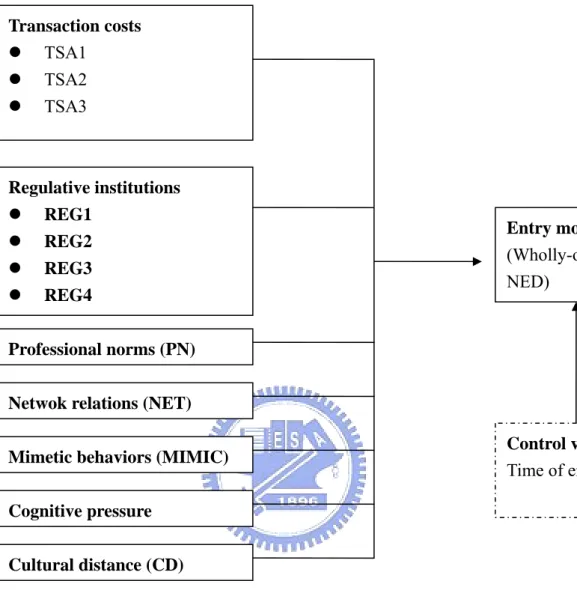
We hypothesize that institutional environments are more important than transaction cost factors in determining the entry mode choice. To test the hypothesis, we will incorporate both institution and transaction-cost related variables in the entry mode decision model and show that transaction cost variables are dispensable. Figure 2 presents the theoretical framework of this study.
12
Figure 2 Conceptual Framework Transaction costs z TSA1 z TSA2 z TSA3 Regulative institutions z REG1 z REG2 z REG3 z REG4 Entry mode (Wholly-owned, ED, NED) Control variable
Time of entry (AGE)
Professional norms (PN)
Netwok relations (NET)
Cognitive pressure
Cultural distance (CD) Mimetic behaviors (MIMIC)
13
3.2 Hypotheses
3.2.1 Transaction Costs
According to the transaction cost theory, foreign enterprises should choose the entry mode that minimizes the transaction costs. Several factors affect the transaction costs, including opportunism, the costs of monitoring and enforcing the contract, the existence of transaction-specific assets (Williamson 1975). The transactions costs are higher when (1) the opportunistic behaviors of the partner can cause more damages (Williamson 1993), (2) when it is more difficult to enforce the contracts, and (3) when the degree of asset specificity is higher. If the transaction costs associated with finding, negotiating and monitoring potential partner firms are low, foreign enterprises tend to rely on the market arrangement to deliver products and services. But if these transaction costs are high, foreign enterprises tend to switch to hierarchical modes (Makino & Neupert 2000; Gatignon & Anderson 1988; Erramilli & Rao 1993). On the other hand, asset-specificity increases the costs of switching from one transaction partner to another, leading to contract hazards (Hill 1990). Asset-specificity therefore encourages hierarchical control. We will construct variables to capture these three dimensions of the transaction costs (see Research Setting section below), and pose the following hypothesis:
H1: The higher the transaction costs, the higher the control level that will be chosen by foreign enterprises in their entry mode.
14
3.2.2 Formal Institutions
Formal institutions refer to rules and laws that provide stability and order to a society (North 1990), including government regulations and enforcement mechanisms (Child & Tsai 2005). Government agencies may use authoritative orders or legal forces to directly restrict the behavior of enterprises, or provide incentives and guidance to influence their behavior (Grewal & Dharwadkar 2002).
For example, in order to protect domestic industries from foreign competition, the host country may install restrictive measures on foreign enterprises in order to increase the survival rates of domestic enterprises. These restrictions will influence the entry mode choice of foreign enterprises. The government may even directly intervene in the entry mode decision of foreign investors by imposing ownership restrictions or financial constraints so as to increase or decrease the expected returns of a specific entry mode (Henisz 2000; Brouthers 2002). Empirical studies have shown that regulations do influence the entry mode selection of foreign enterprises. For example, legal restrictions on foreign-owned operations by the host country tend to discourage high-control entry modes (Gatignon & Anderson 1988).
In China, local governments are empowered with a great degree of discretion and autonomy because codified laws are underdeveloped and subject to alternative interpretations and varying degrees of enforcement (Lubman 1999). If the local government’s policy toward the distribution business is inconsistent, tax policies are non-transparent, or financial
15
transactions are subject to policy interventions, foreign enterprises are facing high institutional risks. As Dwyer and Welsh (1985) argued, an organization characterized by agility and flexibility is most effective in coping with environmental uncertainty. This kind of organization tends to be heterogeneous in its affiliations, decentralized in decision making, and informal in terms of organizational structure. All these suggest a low-control entry mode when operating in a uncertain institutional environment. We hence have the following hypothesis:
H2: The higher the regulative risk, the lower the control level that will be chosen by foreign enterprises in their entry mode.
3.2.3 Informal Institutions
There are various types of informal institutions. In this paper, we will discuss the following: professional norms, network relations, mimetic behavior, cognitive pressure, and cultural distance, which have been identified to be important in the literature (e.g. DiMaggio & Powell 1983; Scott 1995; Grewal & Dharwadkar 2002).
Professional Norms
Norms are multi-dimensional. They may be location based, industry based, or exchange based. Heide and John (1992), for example, studied the relational exchange norms that govern buyer-supplier relationships. These norms are based on the expectation of mutuality of interest designed to enhance the collective interests of the relationship as a whole. Relational exchange norms reduce transaction costs by limiting deviant behaviors of the partners, and enhancing
16 their willingness to commit to the partnership.
In this paper, we are concerned with group-based norms. There are many organized bodies existing in society for the purpose of promoting the interests of their members. Although they lack coercive power, these organizations can influence the conduct and behavior of their members by means of peer pressures (Grewal & Dharwadkar 2002). Nee (1998:87) pointed out that a closely-knit group will obey the rules set by its members, and will cooperate willingly through these norms, to solve their problems, to promote their common interests and preferences, and to increase the opportunity of success. Such norms may not originate from efficiency considerations, but they can increase the organization’s procedural legitimacy and make transactions more efficient because of common expectations (Grewal & Dharwadkar 2002).
Because norms are institutionalized through internalization, there is no motive for external actors to conform to them (Zucker 1977), and therefore new entrants will select a lower-control mode of entry if the local organizations have already established a comprehensive set of norms. Through their local partners, foreign enterprises may resort to the help of professional associations to safeguard their interests and preferences (Meyer & Rowan 1977). Professional norms refer to expectations about the behaviors that are shared by practitioners in the same professions (DiMaggio & Powell 1983). We hence hypothesize:
17
control in the entry mode that will be chosen by foreign investors.
Network Relations
Network relations, known as “guanxi” in China, refer to personal and business connections which have been proven to be critical to business operations in China (Xin & Pearce 1996). Network relations result from a firm’s efforts to establish long-term relationships with other firms in order to sustain its competitive advantage (Thorelli 1986; Oliver 1990; Peng & Heath 1996). Common backgrounds, such as similar ethnic, geographic, ideological, professional, or historical origins, are the most common grounds for establishing network relations (Marsden 1981; Powell 1990; Styles & Ambler 2003). Bonds connecting members of the network will be routinized and stabilized if long-term transactions have been developed among them (Marsden 1981).
Many empirical studies have shown that Chinese people were good at establishing and operating through personal networks, known as “guanxi”, when they were still in planned economic times (Peng & Heath 1996). During the transition from a planned economy to a market economy, formal institutions have not been firmly established, quanxi becomes a substitute for formal institutions. Guanxi serves two major functions in China: protection against environmental hazards and access to resources (Xin & Pearce 1996). Both functions are very important for foreign enterprises which are new to the China market. In China, even when laws are there to protect foreign investors, still guanxi is essential to get these laws
18
enforced (Ahlstrom et al. 2003). Networking also provided flexibility of resource allocation in an environment in which factor mobility was restrained and laws were subject to political manipulations (Davies et al. 1995). In China, laws are often confusing or conflicting and information flows may be impeded, and thus information obtained from the guanxi network is more reliable and more valuable. In a matured society, this kind of “particularistic” information is less valuable because people need only to assume that others are following the known rules (Coleman 1993; Zucker 1986).
Through network linkages, firms may also achieve the goal of growth by mobilizing external resources without direct ownership, saving them substantial administrative costs of owning and managing resources. Therefore, the tighter the local distributors’ structured network, the more likely it is that foreign investors will abandon hierarchical control and opt for a collaborative arrangements to take advantage of the network resources for protection against threats and for obtaining resources needed for growth. We hence have the following hypothesis:
H4: The stronger the network ties in local marketing channels, the lower the control mode that will be chosen by foreign investors when entering the market.
Mimetic Behavior
Mimetic behaviors refer to a tendency to follow the market leaders, the successful peers, or the predecessors originated from the same country (Haunschild & Miner 1997). When
19
entering a new institutional environment, foreign enterprises may seek guidance from their predecessors to cope with uncertainty. Foreign enterprises tend to adopt structures and processes similar to those of the organizations that have been successful, particularly if the successful organizations also share similar origins. Mimetic behaviors are mainly based on legitimacy as opposed to efficiency considerations (Grewal & Dharwadkar 2002). Foreign investors may choose the same entry mode as its predecessors from the same industry or the same country (Yiu & Makino 2002)
In an empirical study of Japanese investors in 12 developed countries, Lu (2002) found that new entrants tended to mimic the entry mode adopted by their successful predecessors. A successful organizational structure will be duplicated and institutionalized after being repeatedly adopted by its followers (Roberts & Greenwood 1997).
In a transitional economy like China, where commercial norms have not been established, the tendency to “follow the leader” is very strong as market participants are groping for a winning formula. For example, in the case of the electronic appliances industry, the leading distributor, Guomei, invented a business model whereby entry fees rather than “mark-ups” become the major source of revenue for distributors. The model that made Guomei rich was followed by late-comers (Wu 2005). Through imitation, the market leaders produce a network-learning effect, resulting in the erection of barriers to new entrants. The network so established will also have an external benefit on the followers if they adopt the same business
20 practices. We hence have the following hypothesis:
H5: In a transitional economy, newly-entered foreign firms will follow the entry mode choice of their successful predecessors.
Cognitive Pressure
The cognitive domain of the institutions refers to the widely shared cognitive structures by which actors of a given organizational field make sense of their world (Scott 1995). Simply put, it is the common belief system that is taken for granted and used for judgments. The similarity of cognitive institutions makes it easier for organizations to transact with each other, and to be acknowledged as legitimate and reputable (DiMaggio & Powell 1983). Cognitive pressure refers to the isomorphic pressure on foreign enterprises to conform to organizational practices that are believed to be the right way of doing things. It may also be extended to the expectation that organizations fulfill certain social responsibilities (Campbell 2006). If cognitive institutions of the host country significantly differ from those of the source country, it will be difficult for MNCs to transfer routines or practices to the subsidiary because the subsidiary employees will interpret and judge them in different ways (Kostova 1999; Ferner et al. 2005).
Entry mode is relevant here because it offers a compromise between external legitimacy and internal consistency (Yiu & Makino 2002). While conforming to local cognitive institutions is important for obtaining external legitimacy, its adverse impact on internal
21
consistency can be minimized by a proper choice of entry mode. For example, if some prevailing local practices are conflicting with the internal accounting procedures of the MNC, then a joint venture or non-equity arrangement with local partners may be preferable to wholly-owned subsidiary.
H6: The more easily the ways of doing business on the part of a foreign firm can be accepted by the local society, the higher the control level that will be adopted in the entry mode choice of the foreign firm.
Cultural Distance
Cultural distance affects entry mode choice through a few channels. First, cultural distance generates additional costs related to information collection and communications, making internalization difficult (Randoy & Dibrell 2002). Second, cultural distance induces foreign enterprises to seek local support with the aim of facilitating product adaptation, risk sharing and mistake avoidance (Palenzuela & Bobillo 1999). Third, cultural distance hinders the transfer of firm-specific routines, making collaboration more attractive than hierarchy (Madhok 1997). In sum, all these arguments lead to the conclusion that cultural distance deters resource commitments and encourages a lower-control entry mode. Empirical studies along this line of arguments have shown that joint venture is preferable to wholly-owned subsidiary when cultural distance is large (Anderson & Coughlan 1987; Kim & Hwang 1992; Brouthers & Brouthers 2000). However, cultural distance also increases the costs of
22
management integration, which implies the difficulty of acquisition and joint venture as well if the management tasks are not properly designed (Kogut & Singh 1988). A recent study by Quer et al. (2007) substantiates the argument that greater cultural distance leads to lower-commitment entry strategies.
When confronted with disparate sales philosophies, languages, customs and lifestyles, foreign investors will tend to choose a lower control entry mode to avoid conflicts with local actors and to increase the flexibility of business arrangements, particularly if they consider the contingency of withdrawal from the area when the business fails (Kim & Hwang 1992). That is, when a large cultural distance exists between the host and the home country, a wholly-owned subsidiary will give way to a contractual mode of market entry in order to mitigate the cultural disparities. We hence have the following hypothesis:
H7: The larger the cultural distance between the home and local markets, the lower the control level that will be chosen by foreign investors in relation to entry mode selection.
3.3 Measures of Variables
3.3.1 Dependent Valuable
The entry mode in each sales district was taken as the dependent variable, which was categorized in accordance with the degree of control into 3 types: wholly-owned subsidiary (WOS), exclusive dealership (ED), and non-exclusive dealership (NED). The dependent
23
variable was an ordinal variable and in the ordered probit regression model used for empirical study, WOS was taken to be 2, ED to be 1, and NED zero. The larger the number, the higher the control level. Since the entry mode might change over time, the respondents were asked to indicate their entry mode when the distributor was first established in the sales district and recall the conditions existing at the time when entry occurred.
3.3.2 Independent Valuables
The independent variables were divided into three categories: transaction cost related variables, institutional variables, and control variables. Institutional variables, the focus of this study, were further divided into six groups: regulative (formal) institutions, professional norms, network relations, mimetic behaviors, cognitive pressure, and cultural distance.
Unless specifically stated, all institutional and transaction-cost variables used in this study were measured using a 7-point Likert scale, ranging from 1 (e.g., strongly agree) to 7 (e.g., strongly disagree). Transaction cost variable (TSA) was derived from a set of three constructs which measure the costs of opportunism (TSA1), the difficulty of contract enforcement (TSA2), and the importance of transaction-specific assets (TSA3). Regulative institution variable (REG) was a composite variable derived from four constructs covering entry mode restrictions (REG1), market liberalization (REG2), tax treatment (REG3), and financial institutions (REG4). Each construct is measured by a 7-point Likert scale which takes a higher value when the dimension carries a lower institutional risk. For example,
24
REG1 takes the value of 7 when the government imposes absolutely no restrictions on organizational forms of foreign enterprises.
Mimetic behaviors (MIMIC) were measured using a dichotomous choice which was given a value of 1 for dealership and 2 for WOS. The remaining independent variables were assessed using a single Likert-type question such as professional norms (PN), network relations (NET), cognitive pressure (COG), and cultural distance (CD). Understandably, there are multiple dimensions to each of these institutional factors and it would be ideal if multiple constructs can be designed for each variable. However, in the pretest interviews, we found that Chinese respondents often confused with sophisticated questions, resulting in inconsistent answers. To obtain more reliable answers from the survey through our representatives, we have simplified the measurement of these variables to single-construct ones. To avoid confusions, strait-forward questions were posed. The measurement of these variables is explained in Appendix A. It should be noted that our measurement of cultural distance is an indication rather than a cause of the cultural distance. We measured the “difficulty of communication” as a result of cultural distance. This can be easily understood by the respondents. Hofstede’s (1980) seminal work suggests four major constructs of the cultural distance: power distance, risk avoidance, individualism and masculinity, and Kogut and Singh (1988) have devised a measure to incorporate these constructs. However, this elegant measure is mainly designed for distance in national cultures. Our simple
25
measurement captures the most important consequence of cultural distance in the distribution business. Correlations between independent variables are listed in Table 2. Although there are some indications of correlation between variables, the degrees of correlation are not large enough to cause a concern.
26
Table 2
Correlation Matrix of Independent Variables
TSA REG PN WET COG CD AGE
1.Transaction cost (TSA) 1.000
2.Regulative institution (REG) 0.140* 1.000
3.professional norms (PN) 0.191** 0.366** 1.00
4.Network relations (NET) 0.138* 0.008 0.087 1.000
5.Cognitive pressure (COG) 0.154** 0.098 0.062 0.069 1.000
6.Cultural distance(CD) -0.011 0.225** 0.157** -0.135* 0.108 1.000
7.Age (AGE) -0.062 0.047 0.063 0.010 -0.059 0.039 1.000
27
3.3.3 Control Valuable
One control variable, time of entry, was included in the model. Time of entry was measured by the number of years that a distributor had been in operation since the date of entry at the time of the survey. Foreign firms might have hesitated to establish WOS in the early stages of China’s reforms due to uncertainty regarding the local environment. Nevertheless, after they gained experience over time through interactions with various locations, they could more precisely evaluate the risks and potential returns on investment and were thus more willing to bear risks and hence increase the control level in entry mode choice (Gomes-Casseres 1989; Delios & Beamish 1999; Chang & Rosenzweig 2001). We postulate that, the later the time of entry, the greater the control level in terms of the entry mode that will be sought by foreign investors.
3.4 Research Setting
3.4.1 Questionnaire Design and Pretest
All measures on institutions and transaction costs were constructed based on the existing
literature, and interviews with executives of PFC in China were conducted prior to the survey. A pretest was performed with 5 questionnaires drawn from each region to check whether there is any misunderstanding of the survey’s literal meanings. The result of the pretest showed that the respondents tended to confuse with the meanings of questions related to institution
28
variables. Their answers were often conflicting when multi-dimensional questions are posed for a single institutional variable. We therefore simplified the questionnaire by posing a single question for each institutional variable, except for regulative institution, which seems more comprehensible.
3.4.2 Subjects
President Food Corporation (PFC) is Taiwan’s largest food manufacturer with intensive sales networks and diversified product lines. Ranked as the third largest Taiwanese investor in China, PFC’s total investment had accumulated to US$350 million by the end of 2005. Since its entry to China in 1990, PFC has established several factories around China and has focused its business lines on instant noodles and beverages. PFC recorded sales revenue of US$3 billion in China in 2005, rivaling its Taiwan operations. Instant noodles constitute one of the most important business lines for food companies in China, with total market volume amounting to RMB$30 billion (US$3.4 billion) in 2005. PFC’s products accounted for an 18% share of the instant noodles market in China and were rated as the No. 2 brand there, just behind the market leader, Master Kong, which is also a Taiwan-invested company. Like other large food companies in China, PFC divided the entire China market into about 1,200 sales districts which fall under the supervision of six regional headquarters. We will use the sales district as the unit of analysis when studying PFC’s entry mode choices.
29
Taiwan’s largest investors in China with a long history of operations. Its distribution networks cover most major cities in China. Moreover, the entry mode differs from one sales district to another. Geographical heterogeneity in formal and informal institutions is apparent (Yang 2002). Informal institutions related to normative, cognitive, and cultural domains vary across districts. For example, some districts are dominated by state-owned firms, some by collectively-owned firms, and some by private firms. Regional diversity in ethnics, languages, and tastes is also apparent. Exposures to international cultures differ as a result of different degrees of openness to foreign trade and investment. Even formal institutions are differentiated due to an uneven pace of reforms and discretionary policy environments adopted by the local government. This diversity ensures that foreign investors view different regions in China as distinctive market territories (Wei et al. 2005). Our case study provides a perfect sample to investigate the influence of institutions rooted at the regional level.
3.4.3 Methodology
The data used in this study were collected from a questionnaire survey on PFC’s distributors in China. Questions related to institutional theory as well as to transaction cost theory were directed toward PFC distributors, who were asked to answer the questions based on the data pertinent to their district. Questionnaire was designed by the authors and all questions were posed in simple Chinese language to avoid misunderstanding. The reason for making the sales district the unit of analysis was that the entry mode varies according to the
30
sales district as opposed to the product. As a huge country, China’s institutional environment also differs greatly across districts. The observed entry modes for distributors include wholly-owned subsidiaries and contractual arrangements with local firms. Joint venture is not observed in any district, indicating that it is inferior to either wholly-owned or contractual mode. Contractual arrangements can be further divided into exclusive dealings and non-exclusive dealings. Exclusive dealings refer to the cases where the contracted local agents are prohibited from handling the products of PFC’s rivals, such as Master Kong, while agents under non-exclusive dealings are allowed to do so. Because joint venture is ruled out, the entry mode choice between wholly-owned and contractual modes is a matter of control rather than ownership percentage. Although it is the PFC managers, and not the distributors, that made the decisions regarding the entry mode, we asked the owners of local agents, as well as the top managers of wholly-owned subsidiaries, who had a good understanding of the local institutional environment, to fill out the questionnaires. The distributors should have the best knowledge about local institutions. However, they were not the ones who made the entry decisions and their views on transaction costs might not be the same as the decision makers. We acknowledge that there are possible biases in the measurement of transaction costs.
PFC’s sales network consists of 6 regional headquarters — Northern China, Central China, Southern China, Eastern China, Northeastern China, and Southwestern China—which cover about 1200 sales districts throughout the country. 500 sales districts were randomly
31
selected from six regions with the sample distribution roughly falling in line with the sales revenue ratio for each region. The selected samples covered 23 provinces, 4 national metropolises, namely, Shanghai, Beijing, Tianjin and Chongqing. The samples cover 267 of China’s first-tiered and second-tiered cities. There are 302 first- and second-tiered cities in China all together, so the coverage ratio is 89%.
To increase the response rate, the survey was implemented with the help of PFC executives at regional headquarters and most questionnaires were filled out during face-to-face interviews except for remote areas where mail surveys were conducted. Before the survey is conducted, one of the authors met with the six interviewers to explain the questionnaire in details to them. All interviewers are senior employees of PFC with more than 10 years of work experience. After collecting the survey, the questionnaires with omitted or questionable entries were sent back to the interviewers for double-checking. Finally, a total of 432 questionnaires were returned, so the response rate was 86.4%. Among them, 312 were retained for study, the rest were discarded because of unresolved omissions or questions. From the pretest until the collection of the last questionnaire, the entire survey took 3 months between July and September of 2005.
Of the 312 valid samples, 109 were wholly-owned subsidiaries, accounting for 34.9% of the entire sample, 151 were exclusive-dealing contracts, accounting for 48.4%, and the remaining 52 were non-exclusive-dealing contracts, accounting for the remaining 16.7%.
32
Chapter 4 Results
4.1 Reliability and Validity
Three constructs of TSA were compressed into a single measurement of transaction cost variable, using principal components analysis method. Likewise, four constructs of REG were compressed into a single measurement of regulative institution variable. Cronbach’s α for three constructs of TSA is 0.518, and that for four constructs of REG is 0.603, indicating that the compressed measures are reliable, albeit marginally (Nunnally 1967, 1978). The results of scale purification of TSA and TSA are provided in Appendix B.
All measures of our research were based on the literature of distinguished journals, and interviews with and experts; therefore, theses appropriate contents suggest that our items relating to transactions costs and institutions for EMS test have strong content validity. However, there is no scientific cut-off point for the construct reliability. Nunnally
recommended that the minimally acceptable reliability statistic such as Cronbach alpha to be in the range of 0.5 to 0.6 in his 1967 edition of Psychometric Theory (p.226). But he raised the recommended level to 0.7 in the 1978 edition, which is widely cited in the literature. A survey of the articles published in the marketing-related journals by Churchill and Peter (1984) found the mean value of reliability statistics to be 0.751 with a standard deviation of 0.156.
33
Peterson’s (1994) updated survey of marketing-and psychology- related studies found that about three-quarters of the reported Cronbach alpha’s are equal or greater than 0.7, but the rest is smaller than 0.7.Education levels of respondents, among other things, are found to affect the measurement reliability.
4.2 Data Analysis
Given that the dependent variable representing the control level of the entry mode is a discrete variable and ordinal in nature, an ordered probit model was employed for regression analysis. Three regression models were investigated to compare the explanatory power of transaction costs and the institutional environment with regard to the choices of entry mode, with the results being presented in Table 3. In Model 1, only the control variable and transaction cost variables were considered. In Model 2, institutional variables were combined together with the control variable. In Model 3, which was the fullest model, transaction cost and institutional variables were joined together with the control variable.
34
Table 3
Using Transaction Cost and Institutional Environment as Variables for Ordered Probit Analysis on Entry Mode
Model 1 Model 2 Model 3 Model
Variables Coefficient Std. Error Coefficient Std. Error Coefficient Std. Error Transaction
cost variables TSA 0.1221 0.063893 0.1046 0.0693 REG 0.1571* 0.0723 0.1504* 0.0726 PN -0.069 0.0576 -0.0831 0.0585 NET -0.1235** 0.0443 -0.1336** 0.0449 MIMIC 1.1872** 0.1810 1.1631** 0.1820 COGNITIVE 0.1488** 0.0555 0.1387* 0.0560 CD -0.079 0.0533 -0.0754 0.0534 Institutional variables AGE -0.0522** 0.0182 -0.058** 0.0189 -0.0564** 0.0190 Log likelihood -311.1174 -278.0027 -276.8615 Degree of freedom 2 7 8 P value 0.0019 0.0000 0.0000 Likelihood ratio test
Comparison model (Model 1) (Model 2) Log likelihood ratio 68.5118** 2.2823
Probability 0.0000 0.1309
Notes:
1. Dependent variables are wholly-owned subsidiary (WOS), exclusive dealership (ED), and non-exclusive dealership (NED), with WOS=2, ED=1, and NED=0.
2. TSA is the transaction variable constructed from TSA1~TSA3, and REG is the regulative institution variable constructed from REG1~REG4 (See Appendix A).
35
In all models, time of entry (AGE) exhibits a significant and negative effect on the choice of entry mode. This suggests that the later the time of investment, the higher the control mode that will be chosen. In Model 1, the three indicators representing transaction costs, when combined into a construct, exert a significantly positive effect on the entry mode choice. This indicates that when the transaction costs are higher, a higher control level in the entry mode will be preferred. The regression results support our hypothesis H1.
Model 2 indicates that the institutional environment does have some significant explanatory power on the entry mode choice. The regression results support our hypotheses H2, H4, H5, and H6; however, H3 and H7 are not supported by our data as professional norms and cultural distance have been shown to be inconsequential to the choice.
Model 3, which is the most comprehensive model, includes both transaction costs and institutional variables at the same time. When compared with Model 1, Model 3 shows that institutional variables exert a significant incremental explanatory power (with a log-likelihood ratio of 68.5118). When compared to Model 2, Model 3 shows that the incremental explanatory power of the transaction cost variables is not significant (with a log-likelihood ratio of 2.2823). The above empirical findings support our assertion that the institutional theory has more explanatory power than the transaction cost theory on entry mode choice in the China market.
36
4.3 Results summary
In what follows, we sum up the effects of the individual institutional variables. In terms of regulative institutions, higher institutional risks lead to lower levels of control in entry mode choice. This suggests that when the local government is more liberal, when the tax regime is more transparent and when the financial institutions are better developed, PFC is more likely to enter the region by establishing a wholly-owned subsidiary. The tighter the network ties, the lower the level of control that will be sought in terms of the entry mode. Moreover, foreign enterprises are inclined to follow the market leaders in their choice of entry mode, which corresponds to the mimetic isomorphism of the institutional theory. In our case, PFC tended to adopt an entry mode similar to that of the market leader, which was Master Kong in most sales districts, as the leader had already accumulated experience and established reputation in the regional markets. Nevertheless, professional norms do not appear to have had a significant effect on the entry mode choice. This suggests that industrial associations in the Chinese markets have not yet established professional credibility to protect the interests of their members. This is probably because state-owned enterprises do not need the help of industrial associations as they have political recourses, and privately-owned enterprises only play a minor role in the “market economy” of China. Finally, in terms of cognitive pressure, the regression results indicate that the more easily that a newly-established distributor is received by the local markets, the higher the level of control in terms of entry mode that will
37
be adopted. However, cultural distance is shown to be an insignificant factor in entry mode decision. A possible explanation is that Taiwanese cultural backgrounds are so close to those of China that this is no issue. The other possibility is the measurement problem. Tihanyi et al. (2005) has shown that whether cultural distance affects entry mode choice is sensitive to the way cultural distance is measured.
Chapter 5 Discussions
5.1 Theoretical Implications
In this study, we investigated the choice of entry mode by a leading Taiwanese food company in setting up regional distribution channels in China, and found that the institutional environment is the major determinant of entry mode choice. Although many scholars have shown that transaction cost considerations are important in determining the entry mode choice (Anderson & Coughlan 1987; Gatignon & Anderson 1988; Klein et al. 1990), these considerations have only had marginal effects in the case of China.
The reasons why our findings differ from those of previous studies probably include the following: (1) Most previous studies were concerned with advanced countries where market institutions are firmly in place, whereas our study is about a transitional economy, namely, China, where foreign investors are often confronted with environmental risks posed by volatile institutions. When facing institutional uncertainty, foreign investors must choose an entry mode that conforms to the socio-political legitimacy recognized by the host-country
38
society to reduce their risks (Brouthers, 2002; Lu, 2002). (2) Network trust in our study plays an extremely important role because non market-conforming transactions can only be sustained by informal institutions such as network ties. Trust also forecloses opportunist behavior when formal institutions are too weak to provide sanctions (Granovetter, 1985). When government regulations are constantly changing, and the boundary line between legality and non-legality is subject to official interpretations, trust between the parties to the transaction is even more important (Granovetter, 1985; Powell, 1990).
Both formal and informal institutions are found to be important. In particular, this study found that network relations have played a vital role in marketing channels in China. Our research suggests that the wholesaler-retailer ties have become a substitute for professional norms, as the latter have largely been absent in China. In the process of economic transition where contract enforcement is often difficult, the transactions need to be supported by interpersonal bonds to mitigate the risks brought about by institutional uncertainty. The exchange of information between transaction parties also relies on well-established interpersonal relationships for filtering and confirmation. The network-based cooperation has been an important mechanism in China’s distribution channels since the planned economy times (Meyer 2001).
Our study also found that newcomers are likely to follow the market leaders in their choice of entry mode. If the leader has chosen a local wholesaler as its distribution agent in
39
the district, it is likely that the follower will also attempt to form an alliance with the same local wholesaler or someone else who has the access to the local distribution network. Supposedly, the market leader has trained the local wholesalers with marketing skills and product-specific knowledge, which have been transferred to downstream retailers. The followers can take advantage of the network assets that have already accumulated in the channel by forming an alliance with the same partners or other members of the network. Otherwise, the follower would have difficulty breaking into the existing network if it were to establish a wholly-owned subsidiary (WOS) to compete with the local counterpart as the established network constitutes a natural barrier to entry. On the other hand, if the market leader has established a WOS distributor to form a sales network of its own, this network is likely to be exclusive and it forecloses the opportunity for the follower to gain access. In this case, the follower would have no choice but to tread the same path as its predecessor by establishing its own subsidiary to organize a separate distribution network.
5.2 Managerial Implications
Our study suggests a first-mover advantage for foreign enterprises that invest early in a transitional economy like China. Because of the lack of information and the immaturity of market institutions, the risks faced by first movers are very high, but they may be able to shape the institutions and set the industry standards for the followers. As the first ones to bring new institutions to China, they have the opportunity to persuade, coach and train local
40
partners to adopt the rules of the game in which they have excelled. These institutions may not be suited to the local environment entirely, and therefore adaptation is necessary. Early investors who successfully adapted the transplanted institutions to suit the local environment accumulated institution-specific knowledge to sustain their competitive advantages. They became the role models to be imitated by latecomers and the resulting mimetic behavior gradually led to a formation of industry norms. The networks that were established by early entrants became more powerful when more followers joined the system. The leaders of the system increased their centrality and brought more resources under their control as the network expanded. Such a process engenders a positive network externality to benefit the original architect of the network. This is exactly the case of Master Kong, which was the first foreign investor to introduce instant noodles to China. Master Kong became synonymous with instant noodles in China. The way Master Kong distributed instant noodles became the norm of the industry practices, and the distribution network it established became one of the most resourceful platforms for food distribution. Master Kong was able to exploit the valuable network assets for its new product lines outside instant noodles, such as drinks and dairy products that were never produced by modern technologies before Master Kong came to China.
As a latecomer, it would have been very difficult for PFC to break the business models instituted by Master Kong, which were already “imprinted” in the local business community.
41
Local wholesalers and retailers would have been suspicious of new ways of doing business, and even if they were willing to experiment with the new models, extra costs would have arisen from maintaining a dual system to accommodate two distinctive business models. On the other hand, there were good reasons for PFC to join the networks that were already functional. It saved PFC the costs associated with training downstream retailers, who also liked to see alternative suppliers increase their product variety, hence realizing economies of scope. By adopting the same type of organizations and processes as Master Kong, PFC reduced the risks of failure because Master Kong was its chief competitor anyway. However, the joining of PFC, which is Taiwan’s largest food producer, gave the distribution network established by Master Kong even more legitimacy, which in turn, allowed Master Kong to extend its network to other regions or to deepen its reach to smaller retailers. When its network power was sufficiently strong, Master Kong could even replace a regional agent with a wholly-owned subsidiary, hence allowing it to discriminate against the PFC products.
Of course, this “first-mover advantage” will be realized only if the early entrants survive the hostile environments, and it is not always the first ones that succeed in becoming the market leaders.
The research on institutional environments and organizational behaviors has identified three types of mimetic behaviors, namely frequency-based, trait-based, and outcome-based imitations (Haunschild & Miner 1997). The case of PFC imitating its predecessor, Master
42
Kong, can be classified as trait-based imitation whereby PFC adopted the practices that were considered “legitimate” because its practitioner was prestigious, large, and successful. The legitimized practices are not necessarily the most efficient ones, however. Our study of the PFC case reveals that firms that adopt the same practices create a network effect that encourages the followers to join the bandwagon. Mimetic behaviors occur not because of legitimacy consideration which is important in an uncertain environment (DiMaggio & Powell 1983; Abrahamson & Rosenkopf 1993), but also because imitation breaks the entry barrier to the established network.
One kind of institution that has been conspicuously missing in terms of influencing the entry mode decisions of foreign investors in China, at least in the area of food distribution, is professional norms. Because of the short history of marketization in China, few professional associations have been established, and there is no distinct set of obligations and responsibilities that is commonly-recognized by practitioners within the distribution industries. Private enterprises have yet to play an important role in China’s economy and “professionalism” is still superseded by political ideologies even today. Although the Chinese government has transplanted several Western professional accreditation systems into China, they have yet to become a “filter” for practitioners like those in Western countries (DiMaggio & Powell 1983). Industry associations, which are dominated by state-owned and cadre-managed large enterprises, mainly serve as a conduit for political campaigns or for the
43
dissemination of official policies rather than as an autonomous sanctioning mechanism like those in Western countries. They play an insignificant role in terms of establishing codes of conduct for their members, or in expressing professional opinions on issues of social concern. Under communist rule, all professions had to serve political purposes. Professionals were sometimes intimidated or deliberately ridiculed by the authorities to make them submit to policies.
When professional norms are missing, regulative institutions and relation-based institutions serve as the major forces in constraining economic behaviors. Relation-based institutions usually operate at the personal level, and regulative institutions are tied to political powers. Therefore political and personal connections are particularly important when doing business in China. When professional norms are missing, business network ties seem to be the closest substitute, and those who are able to establish the largest business networks will have the power to construct a proxy for industry norms. MNCs have attempted to impose Western professional norms on China, but they have succeeded only partially because of a lack of network ties to support their campaigns (Cooper et al. 2002).
5.3 Conclusions
In this paper we have studied the entry mode choice of regional distributors in the China market by a leading Taiwanese food company, President Food Co. Our findings indicate that the institutional environment is more important than transaction cost considerations in the
44
entry mode choice. In fact, transaction cost-related variables provide insignificant explanatory power to the entry mode choice when institutional variables are present. We can almost say that it is only institutions that matter. We attribute this result to the fact that China is a transitional economy with incomplete or immature market institutions exerting a high risk to foreign investors, which would have to concentrate their efforts on risk control rather than cost minimization. The key message of the institutional theory is that organizations have to adopt certain forms and processes in order to attain legitimacy in the community in which the organization operates. Legitimacy is critical to the reduction of risks in a volatile environment, especially for a foreign enterprise that offers food products for people’s daily consumption.
Our study found that both formal and informal institutions are important constraining forces in the entry mode decision. Among informal institutions, network relations stand out as a very influential factor. However, one important informal institution, which is understood to be vital in mature market economies but is conspicuously missing in China, is professional norms. This is probably due to the fact that China’s privately-owned businesses constitute only a small proportion of the economic activities, and professionalism has yet to be recognized in the Chinese society as it had been deliberately suppressed in the past, particularly during the time of the Cultural Revolution. In the absence of professional norms, the power of network ties is inflated and serves as a proxy for professional norms. In the food distribution industry that we studied, political institutions and network ties are important
45
powers in the event of dispute settlements and for protecting property rights. Foreign investors are subject to “institutional liabilities” in the sense that they are often under more stringent regulatory controls and stronger social pressures than the indigenous firms. The more the institutional liabilities they face, the lower the control mode they will choose in entering the host country. Therefore, wholly-owned subsidiary may be avoided even if the government does not forbid it.
The other interesting finding of this study is that late-coming foreign investors tend to follow their successful predecessors in entry mode selection. This mimetic behavior not only serves the purpose of risk reduction, but also enables the followers to take advantage of the network assets that the predecessors have already accumulated. In a sense, the predecessors have paid the sunk costs for network learning and have helped construct a web of working relationships, which the followers can exploit. This mimetic behavior may eventually contribute to the formation of an industry norm, to which the market leaders will benefit most, however. We interpret this as a positive cumulative process of building institutions. In this process, the legitimacy of the practices is attained by business success, reflecting an old Chinese proverb: “the successful one is the king; the failing ones are all outlaws.”
5.4 Research Constraints
A few caveats must be noted, however. First, the data is from a single company, PFC. Although the company is large enough to provide observations on entry mode in all major