1
行政院國家科學委員會補助專題研究計畫成果報告
釤離子媒介反應、不對稱催化及醫藥化學之研究(2/3)
Samarium Ion Mediated Reactions, Asymmetric Catalysis
and Medicinal Chemistry (2/3)
計畫類別:■ 個別型計畫 □ 整合型計畫
計畫編號:
NSC 90-2113-M-002-043-
執行期間:
90 年 8 月 1 日至 91 年 7 月 31 日
計畫主持人:
方俊民教授
執行單位:
臺灣大學化學系
中 華 民 國 91 年 12 月 12 日
2
行政院國家科學委員會研究計畫成果報告
91年12月12日
釤離子媒介反應、不對稱催化及醫藥化學之研究(2/3)
Samarium Ion Mediated Reactions, Asymmetric Catalysis and Medicinal
Chemistry (2/3)
計畫編號:NSC
90-2113-M-002-043
執行期限:90年8月1日至91年7月31日
主持人:方俊民教授 臺灣大學化學系
一、 摘要 本年度的研究已完成五篇關於應用二碘化釤的論文:(一)分子內苯基-羰基偶合反 應,(二)二茂鐵羰基化合物與鹵化合物之偶合反應,(三)二茂鐵烯酮之繼聯反 應,(四)合成對稱及不對稱1,1'-二烯基二茂鐵,(五)二碘化釤與硫醇共同催化5-酮 基烷醛轉換成內酯。 關鍵詞:二碘化釤,偶合反應,二茂鐵,繼聯反應。 Abstract:Five papers from this study have been published: (i) synthesis of xanthenes, indanes and tetrahydronaphthalenes via intramolecular phenyl−carbonyl coupling reactions; (ii) syntheis of ferrocenyl alkenes, dienes and enynes via samarium diiodide promoted tandem addition and dehydration of ferrocenyl carbonyl with halides, (iii) samarium diiodide-promoted sequential coupling-aldol-reduction reactions of ferrocene-substituted enones, and (iv) synthesis of symmetric and unsymmetric 1,1'-dialkenylferrocenes via samarium diiodide promoted reactions of 1,1'-diacetylferrocene with halides, (v) stereoselective synthesis of δ-lactones from 5-oxoalkanals via one-pot sequential acetalization, Tishchenko reaction and lactonization by coorperative catalysis of samarium ion and mercaptan.
Keywords: samarium diiodide; coupling reactions; ferrocene; tandem reactions.
二、 緣由與目的
Lanthanide ions exhibit several characteristic properties, such as low basicity and strong affinity to oxygen groups, which are useful properties in organic synthesis. Synthetic control is a major theme in recent chemical research. The asymmetric reactions can be achieved by substrate control of reactants having chiral auxiliaries or by chiral reagent. The method using reagent control can be further elaborated to asymmetric catalytic reactions. To achieve asymmetric catalysis in tandem reaction is an especially challenging problem.
三、 報告內容
(1) Synthesis of xanthenes, indanes and tetrahydronaphthalenes via intramolecular phenyl−carbonyl coupling reactions (Fig. 1)1
Benzaldehydes and acetophenones bearing tethered carbonyl chains underwent the intramolecular phenylcarbonyl coupling reactions, by mediation of samarium diiodide and
3
hexamethylphosphoramide, to afford the xanthenes and fused benzocarbocyclic compounds containing carbonyl and hydroxyl substituents.
O H O H OH 1 SmI2 THF, HMPA O H O O H 81% O Y Y = R = H Y = Me, R = H Y = R = Me Y = H, R = Me O Y R OH O R SmI2 THF, HMPA (58%) (71%) (47%) (62%)
Figure 1. The intramolecular phenyl−carbonyl coupling reactions gave the
xanthenecarbaldehyde, indane and naphthalene derivatives.
(2) Syntheis of ferrocenyl alkenes, dienes and enynes via samarium diiodide promoted tandem addition and dehydration of ferrocenyl carbonyl with halides (Fig. 2)2
A practical method for preparation of ferrocenyl alkenes, dienes and enynes from ferrocenyl carbonyls was explored. A one-pot operation using samarium diiodide to promote the condensation reactions of ferrocenecarboxaldehyde, acetylferrocene, benzoylferrocene and butanoylferrocene with benzyl bromides, allyl bromide, propargyl bromide and 1-bromo-3-chlorobutane gave the olefinic products in very high yields. The condensation reactions were also achieved by using catalytic amounts of SmI2 with magnesium to regenerate the
divalent samarium reducing agent.
Br Fc R Fe R O SmI2 BrCH2Ar SmI2 Fc R Ar Fc R Br SmI2 R = H, CH3, Ph and n-Pr Ar = Ph, p-NCC6H4, m-MeOC6H4, 2-naphthyl, p-F3CC6H4
Figure 2. SmI2 promoted one-pot formation of ferrocenyl alkenes, dienes and enynes.
(3) Samarium diiodide-promoted sequential coupling-aldol-reduction reactions of ferrocene-substituted enones (Fig. 3) 3
On treatment with SmI2 in THF, 1-ferrocenyl-3-phenyl-2-propen-1-one and its related
ferrocene-substituted enones underwent cyclodimerizations aldols with 3,4-trans configuration. Further reduction by using increased amounts of SmI2 produced the
4
corresponding diols. The stereoselectivity in this study was comparable with that in the SmI2
-promoted cyclodimerization of chalcones, but contrast to that in the SmI2-promoted
cyclization-aldol reaction of 1,1'-dicinnamoylferrocenes. The thienyl- and furyl-substituted enones could be visualized as an extended system of conjugated ketone, so that the SmI2
-mediated coupling reactions occurred preferably by linkages of β-carbons with thiophene or furan rings. O HR R Fc Fc HO O R HO HR R Fc Fc HO H SmI2 Fe 2 1 4
major aldol major diol
3 1'
1 3
R = Me, Ph
Figure 3. The ferrocene-substituted enones underwent cyclodimerizations at 0 oC to afford
aldols on treatment with 1.1 molar proportions of SmI2 in THF, and further reduction
occurred to give diols by using increased amounts of SmI2 (2.2 molar proportions).
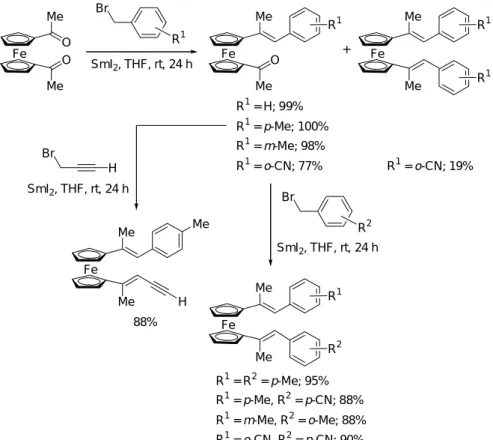
(4) Synthesis of symmetric and unsymmetric 1,1'-dialkenylferrocenes via samarium diiodide promoted reactions of 1,1'-diacetylferrocene with halides (Fig. 4) 4
Monoalkenylferrocenes were prepared from 1,1'-diacetoferrocene and appropriate benzyl bromides by the promotion of samarium diiodide. A practical method for preparation of both symmetric and unsymmetric dialkenylferrocenes was also explored. The reactions were stereoselective to give only (E) double bonds. The unsymmetric dialkenylferrocene bearing electron-donating substituent (e.g. methoxy group) and electron-withdrawing substituent (e.g. cyano group) on different phenyl rings likely exhibits a large nonlinear optical property.
Fe Me O SmI2, THF, rt, 24 h Me O Fe Me Me O R1 Br R1 Fe Me Me + R1 R1 R1 = H; 99% R1 = p-Me; 100% R1 = m-Me; 98% R1 = o-CN; 77% R1 = o-CN; 19% Fe Me Me R1 R1 = R2 = p-Me; 95% R1 = p-Me, R2 = p-CN; 88% R1 = m-Me, R2 = o-Me; 88% SmI2, THF, rt, 24 h R2 Br SmI2, THF, rt, 24 h Br Fe Me Me 88% H H R2 R1 = o-CN, R2 = p-CN; 90% Me
5
derivatives allowed us to synthesize a series of unsymmetric dialkenylferrocenes with exclusive (E) configuration.
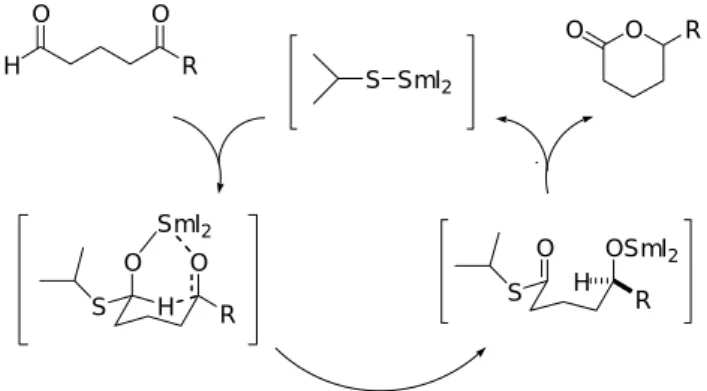
(5) Stereoselective synthesis of δ-lactones from 5-oxoalkanals via one-pot sequential acetalization, Tishchenko reaction and lactonization by coorperative catalysis of samarium ion and mercaptan (Fig. 5) 5
By the synergistic catalysis of samarium ion and mercaptan, a series of 5-oxoalkanals were converted to (substituted) δ-lactones in efficient and stereoselective manners. This one-pot procedure comprises a sequence of acetalization, Tishchenko reaction and lactonization. The deliberative use of mercaptan, by comparison with alcohol, is advantageous to facilitate the catalytic cycle. The reaction mechanism and stereochemistry are proposed, and supported by some experimental evidence. Such samarium ion/mercaptan co-catalyzed reactions show the feature of remote control, which is applicable to the asymmetric synthesis of optically active δ-lactones. This study also demonstrates the synthesis of two insect pheromones, (2S,5R)-2-methylhexanolide and (R)-hexadecanolide, as examples of a new protocol for asymmetric reduction of long-chain aliphatic ketones.
H O O S SmI2 H R O O SmI2 S R O O R O S OSmI2 H R
Figure 5. Conversion of 5-alkyl- and 5-phenyl-5-oxopentanals to δ-lactones by using the
pre-mixing and re-injection procedure. The deliberative use of mercaptan is proved to facilitate the catalytic cycle, due to its strong nucleophilicity toward aldehyde and the high aptitude of the thioester intermediate toward lactonization.
四、 參考文獻
1. Kuo, C.-W.; Fang, J.-M. Synth. Commun. 2001, 31, 877-892. 2. Jong, S.-J.; Fang, J.-M. J. Org. Chem. 2001, 66, 3533-3537.
3. Jong, S.-J.; Chen, C.-T.; Fang, J.-M.; Liu, Y.-H.; Lee, G.-H.; Fang, J.-M. Compt. Rend.
Acad. Sci. 2001, 4, 487-496.
4. Jong, S.-J.; Fang, J.-M.; Liu, Y.-H.; Wang, Y. J. Chin. Chem. Soc. 2001, 48, 1041-1046. 5. Hsu, J.-L.; Fang, J.-M. J. Org. Chem. 2001, 66, 8573-8584.