
發掘情境導向之知識地圖以管理專案知識
112
0
0
全文
(2) 國 立 交 通 大 學 資訊管理研究所 博 士 論 文. 發掘情境導向之知識地圖以管理專案知識 Discovering Context-Oriented Knowledge Map for Managing Project Knowledge. 研 究 生:許籌尹 研究指導委員會:許秉瑜 呂瑞麟 楊 千 陳安斌. 博士 博士 博士 博士. 指導教授:劉敦仁. 博士. 中 華 民 國 九 十 五 年 一 月. i.
(3) 發掘情境導向之知識地圖以管理專案知識 Discovering Context-Oriented Knowledge Map for Managing Project Knowledge. 研 究 生:許籌尹. Student:Chouyin Hsu. 指導教授:劉敦仁. Advisor:Dr. Duen-Ren Liu. 國 立 交 通 大 學 資 訊 管 理 研 究 所 博 士 論 文. A Dissertation Submitted to Institute of Information Management College of Management National Chiao Tung University in Partial Fulfillment of the Requirements for the Degree of Doctor of Philosophy in Information Management January 2006 Taipei, Taiwan, Republic of China. 中華民國九十五年一月. ii.
(4) Discovering Context-Oriented Knowledge Map for Managing Project Knowledge Student: Chouyin Hsu. Advisor: Dr. Duen-Ren Liu. Institute of Information Management National Chiao Tung University. Abstract Forming projects to achieve different objectives and works is an essential work-type in most organizations. Moreover, many enterprises implement various business projects on the Internet for extending collaboration across different departments and organizations. Accomplishing projects essentially involves extensive resources and practical solutions which are valuable enterprise assets for supporting further project development. Therefore, systematically constructing project knowledge from historical projects is helpful for efficient knowledge support. Basically, a project worker is mostly engaged in various projects and seeks different references from project knowledge. Accordingly, interacting with users and responding the relevant part of project knowledge according to user information needs is an inevitable effort as integrating project knowledge. Therefore, we propose the framework of project-based knowledge map for developing project knowledge and deliberately introduce project context for improving the communication and understanding in the framework. Based on Topic Maps, ISO/IEC 13250, the framework of project-based knowledge map is helpful for regulating project resources, interacting with users, extracting internal knowledge patterns, and constructing the project-based knowledge map for users. Particularly, project context improves the description of previous project experiences and the user interaction with current project developers for increasing the connections in the proposed framework. Multiple-phase data mining methods are therefore employed for knowledge discovery. Moreover, project context which provides the important operational information of project development is helpful for constraint-based data mining operation in the framework of project-based knowledge base. Consequently, the construction of project knowledge and the user-depend knowledge support are. iii.
(5) fulfilled in the framework of project-based knowledge map. A primitive system is developed for illustrating the significance of the framework of project-based knowledge map. Furthermore, RDF/XML technology is used for implementing the evolution of the project-based knowledge map in the system. The advantage facilitates the dissemination of project-based knowledge map across various applications over the Internet. Accordingly, the development and exploitation of project knowledge are accomplished in the framework of project-based knowledge map. Keywords:Knowledge map, Data mining, Topic Maps, RDF/XML, Knowledge management. iv.
(6) Acknowledgement 終於完成我的博士論文,心中激動萬分,難以言語。非常感謝 劉敦仁教授最初的收留及持續的指導。劉老師嚴謹治學的態度,深 深影響我對研究的堅持。從第一篇膽怯生疏的錯誤嘗試,一直到最 後具有規模的論文撰寫,過程中的摸索,迷失,苦思,嘗試等階段, 還好有劉老師適時的指引,才得以圓滿收斂完成。劉敦仁老師伉儷 提攜的恩惠,永遠銘記在心。 在此,特別感謝口試委員許秉瑜教授,呂瑞麟教授,楊千教授 及陳安斌教授熱心的指導,精采的討論過程加上延伸性的思考,頓 時領悟更深一層。畢業前的這場灌頂大會,無疑是對博士身分最佳 的洗禮,助益良多。我會更珍惜得來不易的學位,繼續加油。 為人師,為人妻,為人母,還有機會可以踏入交大校園,實現 夢想,順利完成博士學位,是身邊許多人的功勞。一路走來,感激 所有曾經幫助過我的貴人,所給予正面的能量;也謝謝眾多橫生的 阻力,轉成逆向加持。感恩的心,祝福一路上緣份或深或淺的朋友, 點點滴滴的交會,累積成就今日的我,有能力完成每個階段的任務。 面對未來,期待與我的朋友與家人一起繼續努力前進! 當然,家中的小可愛璵安及璵帆是最貼心的小天使,總是玩累 才肯去睡覺,留下我一個人面對電腦,看著你們酣睡的樣子,繼續 工作。還好有老公永裕的支持勉勵,認真工作加上高度自我要求的 建築師,是相互扶持二十年的夥伴。最後,特別將博士的榮耀獻給 我的父母親,沒有你們,就沒有今日的我。感謝你們的祝福與體諒, 我會更努力,扮演好自己的角色。. 籌尹 (Kelly) 交大浩然圖書館 2006/1/16. v.
(7) Contents Abstract. iii. Acknolwedgement. v. List of Figures. viii. List of Tables. x. Chapter 1. 1.1. 1.2. 1.3. 1.4.. Introduction ...................................................................................... 11 Motivation .......................................................................................... 11 Goals .................................................................................................. 15 Contributions...................................................................................... 15 Organization of this dissertation ........................................................ 17. Chapter 2. Related Work and Technology Background ................................. 18 2.1. Related work ...................................................................................... 18 2.1.1.. Knowledge maps for knowledge management ................................18. 2.1.2.. Context information.........................................................................20. 2.2. Technology background ..................................................................... 21 2.2.1.. ISO/IEC 13250 Topic Map ..............................................................21. 2.2.2.. XML/RDF specifications.................................................................21. 2.2.3.. Data mining methods .......................................................................23. Chapter 3. Context-oriented Knowledge Maps ................................................ 27 3.1. The project-based knowledge map in Topic Maps............................. 28 3.2. Context information in the project-based knowledge map ................ 29. Chapter 4. 4.1. 4.2. 4.3. 4.4. 4.5. 4.6.. 3.2.1.. The definition of project context......................................................31. 3.2.2.. Project context in the user interaction..............................................36. The Framework of Project-Based Knowledge Map ..................... 39 The structure of project-based knowledge map ................................. 40 Project attribute builder...................................................................... 42 Knowledge discovery module............................................................ 43 Context information service............................................................... 44 Project knowledge base...................................................................... 45 Knowledge map generator ................................................................. 46. Chapter 5. Discovering the Project-Based Knowledge Map ........................... 47 5.1. Generating consistent project attributes with project context ............ 48 5.2. Predefining the important agreements ............................................... 51. vi.
(8) 5.2.1.. The definition of category names ....................................................51. 5.2.2.. The definition of association names ................................................52. 5.3. Discoverying knowledge with data mining approach........................ 53 5.3.1.. Vector model ....................................................................................53. 5.3.2.. Clustering process............................................................................54. 5.3.3.. Context information service.............................................................57. 5.3.4.. Association rule mining ...................................................................58. 5.3.5.. Context-independent association mining.........................................59. 5.3.6.. Context-relevant association mining................................................61. 5.3.7.. Context-specific association mining ................................................64. 5.4. Transforming binary associations into rule statements ...................... 68 5.5. Displaying the project-based knowledge map ................................... 70 Chapter 6. The Evolution of the Project-based Knowledge Map ................... 73 6.1. The project context in RDF/XML...................................................... 73 6.1.1.. Topic names in 3-deck format..........................................................74. 6.1.2.. Flexible project context ...................................................................75. 6.2. The association rule statements in RDF/XML................................... 76 6.2.1.. Various forms of binary associations ...............................................80. 6.3. The project description in RDF/XML................................................ 85 6.3.1.. The implementation for a project and project objects......................85. 6.3.2.. The implementation for project attributes of a project object..........87. Chapter 7. Conclusions and Future Works ...................................................... 89 7.1. Summary ............................................................................................ 89 7.2. Future works ...................................................................................... 91 Reference .................................................................................................................. 93 Appendix A. The system of the project-based knowledge map ........................... 97 Appendix B. Evaluation on Data Mining Methods ............................................. 101 Appendix C. The Development and Evaluation on RDF ................................... 106. vii.
(9) List of Figures Figure 1.. A simple RDF statement with RDF graph.......................................... 22. Figure 2.. Context information in the development of project knowledge ....... 27. Figure 3.. Context information in human communication................................. 29. Figure 4.. Context-oriented development for the knowledge map .................... 30. Figure 5.. The framework of project-based knowledge map ............................. 39. Figure 6.. The structure of the project-based knowledge map .......................... 40. Figure 7.. The experimental system flow ............................................................. 47. Figure 8.. Agglomerative clustering forms clusters in various thresholds ....... 55. Figure 9.. Context in constraint-based association mining ................................ 58. Figure 10.. Apriori association rule mining ......................................................... 60. Figure 11.. The procedure of context-relevant association mining ................... 61. Figure 12.. The conceptual outcome of context-relevant associations............... 62. Figure 13.. The procedure of context-specific association mining..................... 64. Figure 14.. The conceptual outcome of context-specific associations (a) .......... 65. Figure 15.. The conceptual outcome of context-specific associations (b) .......... 67. Figure 16.. The proposed definition for binary associations.............................. 69. Figure 17.. Displaying the project-based knowledge map.................................. 70. Figure 18.. Displaying context-relevant topic names and occurrences ............. 71. Figure 19.. Displaying context-specific association rules with context.............. 72. Figure 20.. Displaying context-relevant association rules with context ............ 72. Figure 21.. RDF graph illustrates the project attribute with context ............... 75. Figure 22.. Project context in RDF syntax........................................................... 76. Figure 23.. RDF triple syntax and the corresponding graph ............................. 77. Figure 24.. RDF syntax for associations............................................................... 79. Figure 25.. The mapping between associations and rule statements................. 79. Figure 26.. The conceptual union of two rules in RDF graph............................ 80. viii.
(10) Figure 27.. The RDF syntax for one-to-many binary associations .................... 83. Figure 28.. The corresponding RDF graph for one-to-many associations........ 83. Figure 29.. The RDF syntax for many-to-one binary association...................... 84. Figure 30.. The corresponding RDF graph for many-to-one associations........ 84. Figure 31.. The RDF syntax for project and project objects ............................. 85. Figure 32.. The corresponding RDF graph.......................................................... 86. Figure 33.. The RDF syntax for project attributes ............................................. 87. Figure 34.. The corresponding RDF graph.......................................................... 88. Figure 35.. Displaying the project-based knowledge map.................................. 97. Figure 36.. The selected topic name and the referable project occurrences..... 97. Figure 37.. An example of referable project occurrences................................... 98. Figure 38.. Displaying the context-relevant result for the first seletion............ 98. Figure 39.. Displaying the context-relevant result for the second selection...... 99. Figure 40. The three-tier system architecture .................................................... 99 Figure 41.. The referential integrity of the system tables................................. 100. Figure 42.. W3C online RDF Validation Parser with RDF graph .................. 106. Figure 43.. The validation results of W3C Validation Parser.......................... 107. Figure 44.. The RDF graph generated by W3C RDF Validation Parser........ 108. Figure 45.. The parameters in the preferences in IsViz RDF editor ............... 110. Figure 46.. The definitions for namespaces ....................................................... 110. Figure 47.. The screenshot of project context in IsViz RDF editor ................. 111. Figure 48.. The screenshot of RDF/XML file for the model............................. 111. ix.
(11) List of Tables Table 1. The various definitions of knowledge management ............................... 18 Table 2. An example of project context.................................................................. 33 Table 3. Context conditions in the user selection .................................................. 37 Table 4. The summary of clustering operations in the first phase ...................... 43 Table 5. The collection of project objects attributes with project context.......... 50 Table 6. The formal declaration of topic names.................................................... 52 Table 7. The pre-defined association names .......................................................... 53 Table 8. An excerpt of the vector model for representing project attributes..... 54 Table 9. A dissimilarity matrix using the measure of Euclidean distance.......... 55 Table 10. The result of the clustering mining operation....................................... 56 Table 11. The context conditions in the user selection.......................................... 57 Table 12. The set of extracted context-independent associations ........................ 60 Table 13. The result of the context-relevant association mining procedure....... 63 Table 14. The process result of context-specific associations (a) ......................... 66 Table 15. The process result of context-specific associations (b) ......................... 68 Table 16. An excerpt of XML/DTD to declare a topic name ............................... 74 Table 17. Various XML tree syntax for the statement ......................................... 78 Table 18. The acceptable binary types ................................................................... 82 Table 19. Evaluation measures of association rules............................................ 102 Table 20. The distance measures for binary vector space model ...................... 104. x.
(12) Chapter 1. Introduction 1.1. Motivation Knowledge management is crucial to the adaptation and survival of organizations in the face of continuous environmental changes [34]. The activities of knowledge acquisition, storage and distribution in a KM system enable the dynamic creation and maintenance of the enterprise intelligence [19][64]. According to KPMG research reports, about 80% companies look to KM to play an “extremely significant” or a “significant” role in improving competitive advantage, and consider knowledge as a strategic asset in business [27]. IBM took four years to reengineer their customer relationships by acquiring and disseminating knowledge to both customers and human experts [36]. Bolloju et al. proposed an integrative model for building enterprise decision support environments using model marts and model warehouses as knowledge repositories [7]. Schwartz et al. considers that memory-concept associations and e-mail systems should be used to manage organizational knowledge and deliver appropriate knowledge items in a timely and helpful manner [43]. In the last decade, knowledge management has covered a variety of disciplines and extends into many domains and applications.[53] Surely, knowledge management also contributes many efforts to the field of project management for managing project knowledge. Rubenstein-Montano surveyed knowledge-based information systems for urban planning and suggested the importance of moving towards knowledge management [45]. Tah et al. applied knowledge management technology to identify project risk and further improve. project. management. [52].. Barthès. and. Tacla. developed. an. agent-supported portal to organize knowledge in complex R&D projects [4]. Deng et al. developed an integrated information system based on project-specific subjects [14]. Czuchry and Yasin offered a practical integrated informational approach to balance the strategic and operational concerns [12]. Most applications merely focus on the accumulation of projects, index or keyword search functions; however, they overlook the valuable knowledge patterns and working experiences hidden in historical projects. Therefore, extracting the internal knowledge patterns from the collection of previous projects is an 11.
(13) important contribution in this research. Forming projects to achieve different objectives and works is an essential work-type in most organizations [40]. Internet technology has facilitated project processing across different departments, organizations and even countries. Many enterprises implement various business projects on the Internet. Network convenience significantly encourages processing projects with widespread project resources, such as project teams and systems. However, a project is a ‘temporary’ endeavor undertaken to create a particular product or service, and the project team is usually disbanded and reorganized for another new project [40]. Therefore, knowledge support is highly important in this kind of volatile relationship as developing projects in the distributed environment. Many researches highlight the importance of projects in organizations [53]. Project accomplishment involves multiple project resources, including people, systems, methods and tools which contain valuable working solutions and experiences. The numerous historical projects are the important knowledge source. The advance of data mining techniques has inspired applications in different problem-solving domains [6][21][18] . Therefore, applying data mining methods to discover project knowledge from the collection of historical projects is essential in this research. The advantage is helpful to avoid committing the same errors and to reuse the practical experiences for efficiently facilitating further project development. Project is an endeavor in which human, material and financial resources are organized in a novel way, to undertake a unique scope of work of given specification, within constraints of cost and time, so as to achieve unitary, beneficial change, through delivery of quantified and qualitative objectives [53]. Therefore, integrating project resources, processes and performances from the collection of historical projects are required to be organized in a flexible and consistent structure for developing project knowledge in this research [32]. For conceptual deployment of project knowledge and efficient knowledge support, knowledge maps which can visualize and explore complex abstractions is therefore applied for integrating historical projects, knowledge patterns and displaying project knowledge. Many works have proposed flexible structures of. 12.
(14) tree or graph for developing knowledge map systems [11][26][29][31] . However, for considering the extension and dissemination of project knowledge on the Internet, Topic Maps, ISO/IEC 13250, is applied as the main structure of the knowledge map in this research. Topic Maps has been referred as the GPS (Global Positioning System) of the information universe. Therefore, Topic Maps which is a standard for representing interchangeable information is herein employed for governing the exchangeability and consistence of knowledge maps. Effective collaborations of project management over the Internet can thus be facilitated. The advantage not only facilitates the consistence and maintenance of the developed project knowledge, but also improves the meaningful representation and navigation of project knowledge. Furthermore, as developing project knowledge, not only the attributes of project resources are important, but also the operational information is valuable context for conveying project experiences. Project attributes are useful for indicating what are involved in projects, such as tools and systems. Notably, project context is used for explaining the operational information of how project attributes are applied in projects, such as the location or duration of the system. Meanwhile, the project context is helpful for increasing the communication as developing the project knowledge. As interacting with users, the project context can provides the basic context conditions for user selection to determine the user information needs. Conversely, undiscriminating responses to all users in many keyword search systems easily impose many disadvantages on users. Users have to spend great amount of time to manually separate the relevant knowledge from others. Users probably miss the important knowledge or make mistakes by manually separation. The internal relationships among the result are not easily discovered by users if without further assistance. A project is a temporary endeavor undertaken to create a unique product or service [40]. Temporary means that every project has a definite beginning and a definite ending. Inevitably, a project worker is engaged in different situation among different projects. Therefore, interacting with users is important for 13.
(15) increasing the understanding between the system and users. Since project context provides the operational information and circumstance of project development, such as the location of systems or the role of workers, users can select the similar context to locate knowledge, instead of entering keywords. Different from applying prior knowledge or experiences to enter keywords, the selection of context conditions is useful communication with users. From context perspective to manage project knowledge is practical and valuable challenge. Therefore, we propose the framework of project-based knowledge map in Topic Maps for consistently describing context-rich project attributes, integrating project resources, discovering internal knowledge patterns and displaying meaningful guideline for user selection to locate the relevant part of knowledge map. Particularly, data mining methods are employed for extracting hidden knowledge patterns. The proposed project context emphasizes the import development annotation from previous project developers and also the useful interaction for further knowledge seekers. The implicit communication facilitates the intelligent service of the framework for responding the relevant project knowledge to support further project development. Basically, three major stages are herein provided in this research for illustrating the development and evolution of the project-based knowledge map. The first stage explains the development and the advantage of the framework of the project-based knowledge map. The second stage implements a web-based system for demonstrating the performance, and the third stage applies RDF/XML technology for efficiently disseminating the project-based knowledge amp across various applications over the Internet. Therefore, the knowledge navigation and knowledge exploitation over the network are efficiently fulfilled in the framework of the project-based knowledge map with context information.. 14.
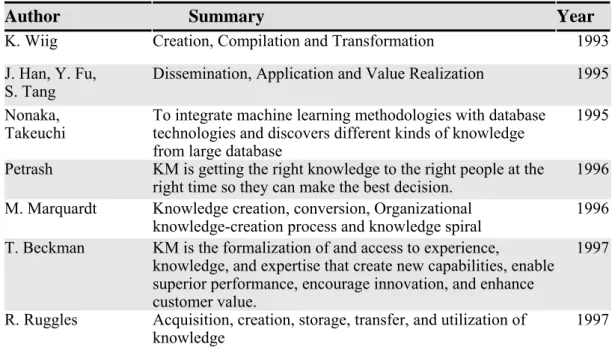
(16) 1.2. Goals Major goals of this dissertation are listed below. −. Developing the framework of project-based knowledge map in Topic Maps for persistently constructing project knowledge in the project-based knowledge map.. −. Appling various data mining methods for extracting internal association patterns from historical projects to enrich the content of project-based knowledge map.. −. Formally providing project context for annotating the essential operational information of project development to improve the performance of the project-based knowledge map.. −. Providing context-oriented selection menu for interacting with users to facilitate user-dependent knowledge support in the proposed framework.. −. Successively semantic evolution of the project-based knowledge map for disseminating the developed project knowledge across various applications on the Internet.. 1.3. Contributions Knowledge management involves a thorough, systematic approach to information repository of an organization by a sequence of collaborative processes. Many knowledge management applications for developing project knowledge mostly focus on the accumulation of projects, index or keyword search functions; however, the valuable knowledge patterns and working experiences hidden in historical projects are overlooked. Therefore, extracting the internal knowledge patterns from the collection of historical projects is an important contribution of the framework of the project-based knowledge map. Moreover, employing Topic Maps as the foundation of knowledge maps for constructing project knowledge is a leading contribution of this research. Topic Maps, ISO/IEC 13250, a standard for representing interchangeable information, is herein employed for governing the exchangeability and consistence in the 15.
(17) proposed framework. Beyond the accessibility and extensibility of trees or graphs used in many traditional knowledge map applications, Topic Maps which has been referred as the Global Positioning System of the information universe is the basic model for constructing and representing the project-based knowledge map in a meaningful hierarchy. Various data mining methods work collaboratively for extracting association patterns to promote the fulfillment of Topic Maps in this work. The advantage improves the knowledge representation and user navigation on the project-based knowledge map for efficient knowledge support. Particularly, coupling Topic Maps and data mining methods in the proposed framework is a leading research and an important contribution. Project context which is deliberatively provided for improving the communication and understanding as developing the project-based knowledge map is a novel contribution. Project knowledge is valuable intelligent asset in organizations. In order to support further project development efficiently, not only the outcome of projects is important for developing project knowledge, but also the operational information and circumstances of project development is an essential part of project knowledge. Therefore, project context is especially proposed in the framework for annotating operational experiences, such as the circumferential information of who, whom, how, when, and where is of project development. The information is helpful for providing a guideline for user interaction. As a result, project context offers various perspectives for constraint-based data mining to facilitate user-dependent knowledge support, instead of overwhelming users with indiscriminative outcome as using keyword search tools which are used in many traditional knowledge management applications. Therefore, with the benefit of project context, the previous project experiences are conveyed to current project workers in the proposed framework for improving the connections as developing the project-based knowledge map. Consequently, project context proposed is an important contribution in the framework of project-based knowledge map for determining the right part of project knowledge to right person for the right purpose. Notably, the evolution of the project-based knowledge map developed in RDF/XML technology is a further contribution in this research. Although many. 16.
(18) database systems and programming languages can provide the corresponding referential integrity and syntax to implement the project-based knowledge map, the flexibility of XML and the semantics of RDF indeed facilitate the exploitation and dissemination of the project-based knowledge map across different applications on the Internet. As the web service becomes the major highlight on the Internet in the future, the project-based knowledge map is even competent to extensively construct and disseminate project knowledge.. 1.4. Organization of this dissertation The rest of this dissertation is organized as follows. Section 2 reviews related work on technology background and related work. Chapter 3 then explains the advantage of context-oriented knowledge maps and emphasizes the definition and benefit of the project context. Chapter 4 presents the framework of project-based knowledge map and the meaningful structure of the project-based knowledge map. Plus, the important modules and essential operations are further specified. Next, Chapter 5 gives an illustrative system for developing the project-based knowledge map and explaining the performance. The evolution and progression of the project-based knowledge in RDF/XML are discussed in Chapter 6. Then, conclusions and future works are finally made in Chapter 7.. 17.
(19) Chapter 2. Related Work and Technology Background 2.1. Related work 2.1.1.Knowledge maps for knowledge management Knowledge management covers a variety of disciplines and extends into many general domains, such as general management, information systems, decision support systems, artificial intelligence, expert systems and more. On the technical viewpoint, knowledge management tools are the major considerations for implementing the effective knowledge management system. Beyond the traditional groupware and information systems, knowledge tools primarily can manipulate information, automate information search, retrieval agents, decision support, document management, and enable knowledge generation, codification transfer. Widely used keyword search engines and menu-driven interface tools have been employed for practical systems for years. In the last decade, knowledge management has become the important issue for academic research and industrial practice. As shown in Table 1, the various definitions of knowledge management provide different viewpoints of managing knowledge. Table 1. The various definitions of knowledge management Author. Summary. Year. K. Wiig. Creation, Compilation and Transformation. 1993. J. Han, Y. Fu, S. Tang Nonaka, Takeuchi. Dissemination, Application and Value Realization. 1995. To integrate machine learning methodologies with database technologies and discovers different kinds of knowledge from large database KM is getting the right knowledge to the right people at the right time so they can make the best decision. Knowledge creation, conversion, Organizational knowledge-creation process and knowledge spiral KM is the formalization of and access to experience, knowledge, and expertise that create new capabilities, enable superior performance, encourage innovation, and enhance customer value. Acquisition, creation, storage, transfer, and utilization of knowledge. 1995. Petrash M. Marquardt T. Beckman. R. Ruggles. 18. 1996 1996 1997. 1997.
(20) EC. Nevis, AJ. DiBella, JM. Gould TH. Daevenport D. W. De Long, M. C. Beers E. Zack D. Sinclair, N. Hardie A. Rabarijaona, R. Dieng, O. Corby, R. Quaddari Fischer, Ostwald The Diffuse Org. Ernst & Young. Building, Maintaining, and Sustaining the Learning Organization. 1998. Knowledge management is the process of capturing, distributing, and effectively using knowledge.. 1998. Embedding knowledge in processes, representing knowledge, facilitating knowledge, transferring , measuring the value of knowledge assets Identify, Create knowledge maps, Find the knowledge gaps. 1999. Facilitate , Creation, Optimize knowledge use. 2000. Apply the XML meta language for corporate knowledge management for ontology query. 2001. KM is collaboratively designed and constructed in the promise of social creativity, living organizational memory, and Attention economy to deliver the relevant knowledge for workers. knowledge generation, knowledge representation, knowledge codification, knowledge application. 2001. 2000. 2001. M. Cannataro, A. Guzzo, A. Pugliese. The business standard of knowledge Capture, Classification, Dissemination. 2002. M. Cannataro, D. Talia,. The reuse of semi-structured information and its integration in heterogeneous systems, and the creation of knowledge maps for the organization and sharing of information. Designing, building, and implementing an architecture for distributed knowledge discovery as Grid application. 2003. E. Woods. 2003. However, upwards to the conceptual deployment for efficient knowledge support, most tools do not the meet the challenges [59]. Therefore, knowledge maps which can visualize and explore complex abstractions become the increasingly important and popular knowledge management tool. The definition proposed by Vail illustrates the advantage of visual display for efficient communication with users [54]. “A knowledge map is a visual display of captured information and relationships, which enables the efficient communication and learning of knowledge by observers with differing backgrounds at multiple levels of detail.”. 19.
(21) Successive applications take advantage of the nature of visualization and navigation of knowledge map for locating and publishing knowledge [13][26]. Vail highlighted the visual display of captured information [54]; Browne et al. combined knowledge maps with reasoning-based methodology to elicit probability assessment for decision making [8]; Leathrum et al. employed knowledge maps to design an intelligent questioning system for learning [29]; Chung et al. proposed a knowledge map framework for discovering business intelligence to alleviate information overload on the Web [11]; Lin and Hsueh applied information retrieval algorithms to generate and maintain a knowledge map system for virtual communities of practice [31]; Kim et al. proposed a road map to develop knowledge maps in the industrial community [26]. The performance of knowledge maps has been receiving considerable attention in the many applications of knowledge management practice, excluding project management. Notably, we first apply knowledge maps for developing project knowledge extensively for support project development [32].. 2.1.2.Context information Context can be a list of situational factors or any information that characterizes the situation of an object, where an object is a person, place, or object considered relevant to the interaction between a user and an application, including the user and application themselves [17]. Therefore, with the help of context, numerous applications become user-friendly, flexible, and adaptable. For example, context information in web search is considered for improving the personalized knowledge search [28]. In mobile spontaneous network, context is useful for managing knowledge exchange [49]. Context information is applied to integrate independent tools into a pervasive computing system with that monitors user interactions with the computer and data sources [55]. Document standardization is proposed by merging the documents and work context to improve the effectiveness in document management [47]. In this work, we deliberatively employ context information for improving the communication and understanding in the proposed framework. Accordingly, context information promotes knowledge discovery and representation of the. 20.
(22) project-based knowledge map for efficient knowledge support.. 2.2. Technology background 2.2.1.ISO/IEC 13250 Topic Map Topic Maps, the ISO standard ISO/IEC 13250, defines a model for the semantic structuring of link networks in 2000 [20]. With growing information repository on Internet, Topic Maps, the need for enhanced access mechanisms for linking, navigating and exploring information from site to site is getting more and more evident. Basically, topics, associations, occurrences are major components in Topic Maps. z A topic is concrete description to represent a real world subject, such as a person, a theme, or a concept. z An occurrence is one of the real information objects link to related topics, such as a file, a video, or a report. A topic is an abstract label, and occurrences are substantial references. z Associations are used to describe the relationships between topics, and an association name is a meaningful concept for defining a relationship.. 2.2.2. XML/RDF specifications Extensible Markup Language (XML), derived from SGML, is a core technology that defines a universal standard for structuring data. XML version 1.0 was defined in 1998 by the World Wide Web Consortium [64] and the Second Edition was published in 2000. XML is a global standard for storing structured data in an editable file that is useful for data storage, data exchange and document publishing on the Internet. XML exclusively focuses on manipulating data, and Extensible Stylesheet Language (XSL) is useful for interchangeably displaying data in different templates for HTML, PDF, WAP view types and many Internet-based applications. A custom DTD is used to constrain the syntactical rules that govern the. 21.
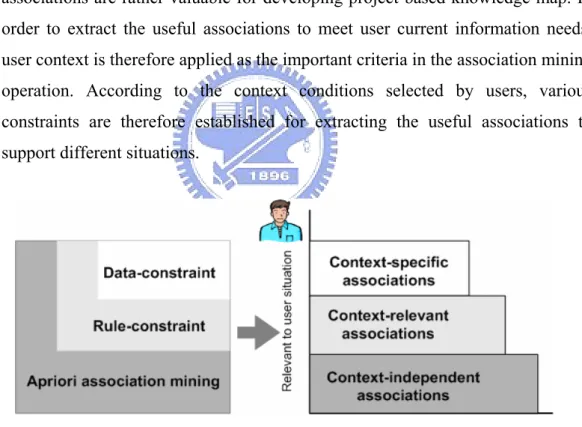
(23) proposed knowledge maps, and describe their major elements, including topic names, occurrences and association relationships, in XML documents. This work emphasizes simple definitions of XML/DTD specifications to increase the practicability of the project-based knowledge map. RDF (Resource Description Framework) provides the foundation for metadata interoperability across different applications via a syntax specification and schema specification. Moreover, concrete RDF syntax uses the XML by which RDF can specify semantics for data in a standardized and interoperable manner [10]. RDF is based on the idea of identifying things using web identifiers (called Uniform Resource Identifiers, or URIs), and describing resources in terms of simple properties and property values. RDF model intrinsically supports binary relations (a statement specifies a relation between two resources). Higher arity relations have to be represented using binary relations [42]. Basically, RDF model consists of three major components, and the explanation is given below. z Resources: All things being described by RDF expressions are called resources. A resource may be an entire Web page, a part of a Web page, an entire web site, or an object that is not directly accessible via the web page (e.g., a printed book). z Properties: A property is a specific aspect, characteristic, attribute, or relation used to describe a resource. Each property has a specific meaning, defines its permitted values, the types of resources it can describe, and its relationship with other properties.. Figure 1.. A simple RDF statement with RDF graph. z Statements: A specific resource together with a named property plus the value of that property for that resource is an RDF statement. The three. 22.
(24) individual parts of a statement are called the subject, predicate and object, of the statement respectively. For example, a statement example and RDF graph are given below, as well as the corresponding RDF graph.. Also, RDF requires the XML namespace facility to uniquely and precisely identifying the governing authority of the vocabulary. XML namespaces provide a method for unambiguously identifying the semantics and conventions governing the particular use of property-types.. 2.2.3. Data mining methods Data mining is powerful for extracting patterns of business interests, including associations, changes, anomalies and significant structures from information repositories, in efficient and productive ways. Data mining involves several tasks for different mining purposes, including association rule mining, clustering, classification, prediction, and time-series analysis [18][6][21]. We mainly employs clustering mining, generalization mining, and constraint-based association rule mining to extract different patterns based on context perspectives. Clustering mining aims at identifying groups of similar objects without known or specified classes and therefore helps to discover distribution of patterns and interesting correlations in large data set. Clustering has different names in other research fields, such as unsupervised learning (in pattern recognition), numerical taxonomy (in biology, ecology), typology (in social sciences) and partition (in graph theory). Clustering can be considered the most important unsupervised learning problem. A loose definition of clustering could be “the process of organizing objects into groups whose member s are similar in some way”. A cluster is therefore a collection of objects which are “similar” between them and are “dissimilar” to the objects belonging to other clusters [24][3]. Many clustering methods, including hierarchical clustering, partitional clustering, density-based clustering, grid-based clustering and model-based clustering, are applied in various applications [46][44][21]. Basically, Agglomerative Hierarchical Clustering (AHC) that is more commonly used for. 23.
(25) document clustering carries the following advantages [56][61] z. One can either prescribe the number of clusters or let the number of clusters determining by demanding a certain minimum similarity within a cluster.. z. The number of clusters can be rapidly adjusted by given minimum similarity, instead of rerunning clustering algorithm again.. Bottom-up hierarchical clustering continues until some stopping condition is reached. Typical stopping conditions include a threshold for the number of remaining clusters (e.g., stop if 4 clusters remain), or a threshold for the required similarity between clusters (e.g., stop if the two most similar clusters are not very similar). The procedure is given as follows [3][24]. 1.. Agglomerative clustering starts with the set of objects as individual clusters.. 2.. At each step merges the most two similar clusters. The process is repeated until a minimal number of clusters have been reached, or, if a complete hierarchy is required then the process continues until only one cluster is left.. An important component of a clustering algorithm is the similarity measure between pairs of clusters. Many distance measures are herein employed for different applications, including Euclidean, Dice, Jaccard, Cosine, Manhattan [3]. If the components of the data instance vectors are all in the same physical units then it is possible that the simple Euclidean distance metric is sufficient to successfully. group. similar. data. instances.. Note. that. it. weights. all. features/dimensions “equally”. Pair-wise vectors between ith and kth vectors, denoted by d(i, k) as follows, where t is the number of attributes.. d (i, k ) =. ⎡ ⎢ ⎣. t. ∑. j = 1. ( w. ij. − w. kj. ). 2. ⎤ ⎥ ⎦. 1 / 2. (2.1). Agglomerative clustering algorithms are mainly classified as single-link, complete-link and average-link depending on the method they define inter-cluster similarity. Single-link and average-link methods typically take O(n²) time, while. 24.
(26) complete-link methods typically take O(n³) time. Moreover, many research works hold various experiments to explain that average-link performs better than others in document/text clustering experiments [56][61]. The details of three methods are explained as follows. Single Linkage Method: The similarity between two clusters S and T is calculated based on the minimal distance between the elements belonging to the corresponding clusters. This method is also called “nearest neighbor” clustering. T. − S. =. min. x −. y. (2.2). x∈ T , y∈ S. Complete Linkage Method: The similarity between two clusters S and T is calculated based on the maximal distance between the elements belonging to the corresponding clusters. This method is also called “furthest neighbor” clustering. T − S. =. max. x − y. x∈ T , y∈ S. (2.3). Average Linkage Method: The similarity between two clusters S and T is calculated based on the average distance between the elements belonging to the corresponding clusters. This method takes into account all possible pairs of distances between the objects in the clusters, and is considered more reliable and robust to outliers. This method is also known as UPGMA (Unweighted Pair-Group Method using Arithmetic averages).. T. −. S. =. ∑. x ∈ T. −. x. y. , y ∈ S. S. ⋅ T. (2.4). Association rule mining finds interesting associations or correlations among large sets of data, and creates practical rules that describe how frequently events or objects have occurred together. It has been applied in numerous applications and successfully applied in market basket analysis, recommender systems, user behavior analysis, and other areas [3]. Apriori algorithm, one of useful association rule mining methods, counts the support of individual topic name and an itemset is considered frequent if the support of that itemset exceeds a user-specified mimum support [1]. Confidence and support, two major parameters in the formal statement of association rule, are shown below. 25.
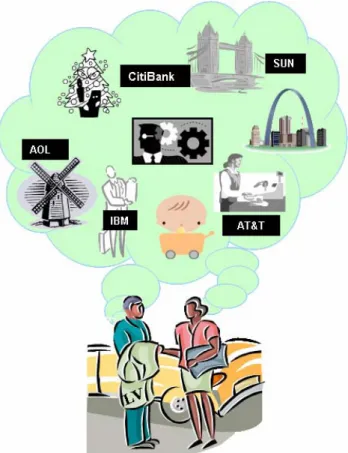
(27) (1). I is a set of items. D is the transaction database. An association rule is an implication of the form X ⇒ Y, here X ⊂ I, Y⊂ I and X ∩ Y = ∅.. (2). Rule X ⇒Y has a confidence c in D if c% of transactions in D that contains X also contains Y. Also, rule X ⇒ Y has a support s in D if s% of transactions in D contains X ∪ Y.. Generalization mining is a process that abstracts a large set of task-relevant data from a relatively low conceptual level to higher conceptual levels. Generalization mining, one of descriptive data mining methods, is helpful to describe the data set in a concise manner and present in interesting properties or attributes. Attribute removal and attribute generalization are two efficient methods for generalization [21]. z. Attribute removal is used to eliminate a constraint and thus generalize rules in a large set of distinct values for an attribute.. z. Attribute generalization is to apply a generalization operator on the attribute, in which there is a large set of distinct values.. Constraint-based association mining is performed under the guidance of various kinds of constraints, including knowledge type, data, dimension, interestingness and rules [21]. The advantage is helpful for filter out the uninteresting data and result. z. Data constraints specify the set of data to be mined. Data constraints and knowledge type constraints are applied before mining. The advantage is helpful for reducing the complexity of data mining operation and simply focusing on the interesting data.. z. Rule constraints specify the form or property of rules to be mined, including rule form constraint and rule content constraint [37].. Rule. constraints, dimension constraints, interestingness constraints are applied after mining operation. The advantage is helpful for focusing on the interesting result for further interpretation and manipulation.. 26.
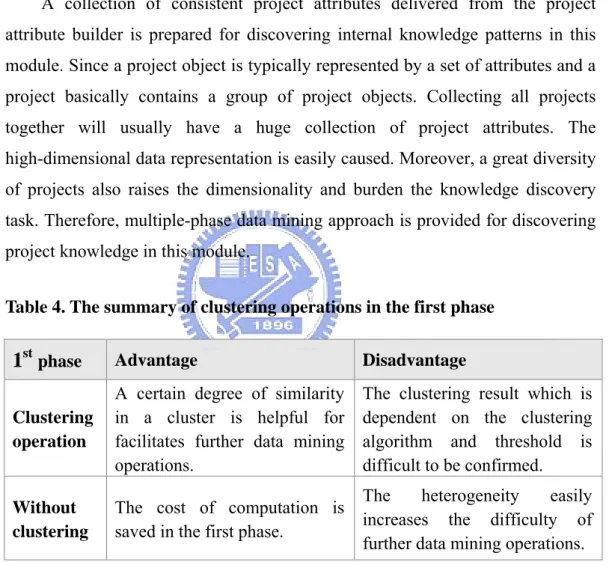
(28) Chapter 3. Context-oriented Knowledge Maps A project is performed by a project team, which performs a group of processes within a particular period, including project initiation, planning, executing, controlling and closing processes [40]. Project resources are therefore generated during these processes. As shown in Figure 2, various project resources, including people, systems, methods and tools which contain valuable working solutions and experiences, are valuable references for developing project knowledge to support further projects.. Consultant. DBA. P.M.P. Proposal. Program. System. Standard London. Algorithm. Data. Protocol. Manual Hospital. Taipei Bank. Figure 2.. Manufacture. Specification. Report. Device. Context information in the development of project knowledge. Moreover, a project involves team members from various departments, organizations or even virtual organizations to collaborate on the Internet. A global network diminishes the concern of geographic boundaries, but increases the diversity of project development environment. A project worker who is usually engaged in different situations among different projects since a project is a temporary endeavor undertaken to create a unique product or service [40]. Therefore, as managing project knowledge from diverse project resources, annotating the circumstances and background of project operations is valuable guideline for interacting with users. Not only improving the representation of 27.
(29) project knowledge, but also the useful guideline of the user interaction in the framework of project-based knowledge map.. 3.1. The project-based knowledge map in Topic Maps With the inherent advantage of knowledge map, the proposed framework of project-based knowledge map integrates and displays project knowledge systemically and meaningfully. Upon the popularity of Internet, the modern idea behind a knowledge map is required to construct a global architecture to show the content of knowledge. Therefore, we apply Topic Maps, ISO/IEC 13250, as the major model in the proposed framework for systemizing project knowledge, including project resources, important concepts and up way to association patterns. Consequently, many advantages improve the performance of project-based knowledge map as follows. z. The instinctive hierarchy of Topic Maps is the main structure of project-based knowledge map. Therefore, the expressive structure is helpful for conducting the consistent project knowledge.. z. The strong linking capability in Topic Maps supports the internal connection of project-based knowledge map, including physical and abstract links. Physical links are useful for connecting to distributed project resources, and abstract links are helpful for indicating associations.. z. The notation in Topic Maps is applied for declaring the important definitions and reducing the conflicts and ambiguity in the proposed framework.. z. The classification system in Topic Maps for managing topics and associations is helpful for improving the expression of the rule statements in the project-based knowledge map.. 28.
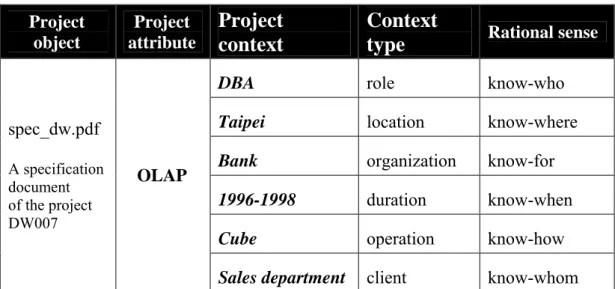
(30) 3.2. Context information in the project-based knowledge map As shown in Figure 3, when we humans interact with other person, the previous contact experience and current situation information, such as location or job title, are helpful context that intuitively affects human reactions [16]. Conversely, computers can not spontaneously exploit such context information when interacting with users. Thus, employing context in the project-based knowledge map is practical for improving intelligent communication as discovering project knowledge.. Figure 3.. Context information in human communication. Therefore, we employ context information in the framework of project-based knowledge map for improving the representation of project knowledge and the communication with users. With the helpful of context, both of the expression of project-based knowledge map and the guideline of user interaction become meaningful and practical to users in this work. Notably, the novel synergy of context and knowledge maps increasingly improves the knowledge exploitation and user navigation for efficient knowledge support in the framework of 29.
(31) project-based knowledge map. A project team is usually disbanded and reorganized before another new project, meaning that such cooperation is temporary. Plus, the convenient network increases the diversity of cooperation across geographical boundaries. This kind of volatile and complicated relationship increases the difficulty of communication as developing project knowledge. Therefore, providing sufficient project description from project workers to indicate the essential operational information and circumstance of project development is helpful for improving the communication and understanding as managing project knowledge.. Figure 4.. Context-oriented development for the knowledge map. As shown in Figure 4, along with the system itself, project participants contribute supplementary operational information of project development to build project context. On the other hand, various situations in project context provide fundamental guideline for user selection menu. The advantage is helpful for perceiving certain criteria from the result of user selection. Accordingly, project context which annotates the circumstance of project operations and the background of project workers is useful criteria as determining the proper part of project-based knowledge which is relevant to user information needs. Basically, the term of ‘project context’ is not formally defined in the domain of project management or knowledge management. A non-official definition provided by Wideman is that project context is the background or environment in 30.
(32) which the project is conducted, also the background that justifies the project in the first place [62]. For example, the project context of the Cadastre Reengineering Project provided the general project context as follow [9]. The program was launched with the passage of the Law for Quebec Cadastre Reform in 1985. In 1989, the program bases were changed and the involvement of DMR increased with the allocation of a second contract to the company, which would cover organizational aspects of the project. In January 1993, the Ministry of Natural Resources (MNR) restarted the cadastre reengineering program now reevaluated at C$ 500 million and spanning a period of 13 years, from 1993 to 2006. Different form above definition of project context for illustrating the inceptive background and environment of a project abstractly, we propose a novel and modern definition for project context from the consideration of inevitable network and complicated project types. In the framework of project-based knowledge map, work, project context is used for annotating project attributes, instead of a whole project. Since the convenient network facilitates projects processing in a distributed and heterogeneous environment, various situations and circumstances are essential annotation along with project attributes for increasing understanding and communication across geographic boundaries. Moreover, the description about project developers is also an essential part in project context. The situation, background, and viewpoint of project developers are useful for comprehending how the project attributes were applied and activated in previous projects. Therefore, the previous project experiences are naturally conveyed in project context for supporting current project workers in this work.. 3.2.1. The definition of project context Project context is persistently defined as follows for effectively discovering context-oriented knowledge maps. Project context annotates the operational information and the viewpoint of project developers for each project attribute as describing the important features of project objects.. 31.
(33) Definition 1(project context and project attribute): Given a project object PO, and project attribute PA is one of its project attributes which describe the important features of project object PO. Then, project context PC is a set of annotations which explain the details of how the project attribute PA is dedicated in the project object PO. In order to completely supplement the operational annotations, the existential dependency ⟨PA, PC⟩ is a one-to-many relation, as well as the dependency ⟨PO, PA⟩.. Definition 2 (context type): Given a set of project context PC for annotating a project attribute PA which describes a project object. Then context type is a basic set of classification for grouping PC into the sense of know-who, know-where, know-for, know-when, know-how and know-for to indicate the rational relationship between PA and PC.. Then, an example is given below along with different situations for explaining the advantage and importance of the project context for elucidating project attributes. Example 1: For the tool of OLAP which is one of the project attributes used for describing the specification file spec_dw.pdf., project context is a set of annotations which provide more operational information to elucidating how the attribute OLAP is dedicated in spec_dw.df. As shown in Table 2, a set of project context (DBA, Taipei, Bank, 1996-1998, Cube, Sales department) clearly provides users the operational information of project attribute OLAP in the specification file spec_dw.pdf, including the information of role, location, duration, operation, client, and organization type. The advantage enriches the sense of know-who, know-where, know-for, know-when, know-how, and know-whom about the project attribute OLAP used in the specification file. As a result, not only the project attribute provides the important feature of the project object, but also the project context annotates the essential operational information of the project attribute.. 32.
(34) Table 2. An example of project context Project object. Project attribute. spec_dw.pdf A specification document of the project DW007. OLAP. Project context. Context type. Rational sense. DBA. role. know-who. Taipei. location. know-where. Bank. organization. know-for. 1996-1998. duration. know-when. Cube. operation. know-how. Sales department. client. know-whom. Basically, there are four types of project workers who seek the support of project knowledge, including novice, junior, senior and expert workers. Four various user experiences are described below, and the corresponding situations are explained right after. z. A novice worker usually has little or none practical working experience. Therefore, a novice worker has to learn everything about project development from beginning level. As involving a project, a novice worker who know less and easily makes a mistake will need complete knowledge support to make progress.. z. A junior worker has some or partial project experiences. Thus, a junior workers need to review some previous experiences and learn new knowledge. As involving a project, a junior worker who probably causes some delay will need sufficient knowledge support to improve the efficiency.. z. A senior worker has much project experiences. Then, a senior user can apply the previous knowledge and understand new knowledge quickly. However, a senior worker who is usually burdened with heavy loading will need relevant project knowledge to promote the performance.. z. An expert worker has abundant project experiences in development and. 33.
(35) management. Therefore, an expert worker who usually is a project manager or a project leader will need pertinent knowledge support to facilitate project development entirely, such as key internal and external stakeholders and important contracts. Situation 1-1: From the Table 2, a novice worker can easily learn the practical operational information about OLAP from the set of project context. Before referring the project object, the user can learn some operational experiences about the project attribute OLAP, including that a DBA may utilize OLAP in some bank-type projects, and the operation of cube is useful for analyzing the data for sales department. Also, the time period is helpful for reminding users the trend and popularity of OLAP. Accordingly, a novice worker can locate these important parts as referring the specification file. Situation 1-2: From the Table 2, a junior worker can reinforce or supplement operational instruction about OLAP from the set of project context. For example, the worker applied some operations of OLAP, rather than cube operation. Then, the worker can right focus on the description on cube operation to shorten the total learning cost as referring the specification file. Situation 1-3: From the Table 2, a senior worker can decide to refer the specification file or not since the project context reveals important information. For example, the worker can overlook the specification file if the worker is familiar with the cube operation in OLAP and bank-type projects. Then, the worker can look for other support without delay. Situation 1-4: From the Table 2, an expert worker can learn some managerial information from the project context, such as a DBA may apply OLAP in some bank-type projects and the cube operation is useful in sales data. For example, the expert worker who is a project manager will select a person who knows OLAP to be a DBA. Also, the reasonable project schedule is possibly arranged according to the useful duration in project context.. 34.
(36) The sensible project context provides meaningful information for different types of project workers. Conversely, another opposite example is given below. In contrast with above situations, four types of project workers may encounter more difficulties and problems whereas the case in example 2 is given.. Example 2: OLAP is a project attribute for describing the important feature of the specification file spec_dw.pdf. None of annotation or comment is offered for the project attribute OLAP. Situation 2-1: A novice worker has no choice but referring the file. Lack of further annotation to indicate how OLAP is applied in the specification file, a novice worker has to go through the file or ask for help to figure out the application of OLAP. Many inconveniences are possible resulted from missing or misunderstanding the important parts. As a result, making progress is not easy under this situation. Situation 2-2: A junior worker still has to manually open the file to learn the relevant parts for supporting current projects. However, the learning effect is totally depends on the worker. If the user missed or misunderstood something important, no one could help. Lack of further annotation, a junior worker may slowly look for the application of OLAP. The disadvantage imposes the worker laborious learning cost to understand the operational information of OLAP in the specification file. As a result, the working efficiency is not easy improved under this situation. Situation 2-3: An expert user may use OLAP before, but he or she still has to refer the file again to see if something is useful. Simply providing the project attribute of OLAP to an expert user is insufficient to make the right decision. As a result, project development is not easy promoted under this situation. Situation 2-4: An expert user or a project manager who may use OLAP before still has to manually open the file to find the operational information about OLAP to confirm or refresh his or her experiences, such as the user role or the period as applying OLAP. As a result, the project assignment or reasonable schedule is not easily controlled under this situation.. 35.
(37) 3.2.2.Project context in the user interaction Interacting with users is important in modern knowledge management system. The advantage facilitates user-dependent knowledge support to meet with user situations. In this research, project context can provide a useful guideline for user interaction. As involving in a project, a project worker is basically assigned a particular position and working places for carrying out certain assignments in a period of time. Therefore, the situations of previous project developers which are mainly described in project context are useful guideline for current users to find previous project experiences. Itemizing some important context types used for expressing the situations of project developers in project context for users to select the interesting context conditions is the useful user interaction in this research. As a user selecting the context conditions from the user selection, user interests are explicitly expressed to the system. According the selection result, the proposed framework can determine the relevant parts of project-based knowledge map for users, rather than passively displaying the overall project-based knowledge map. Instead of entering a series of keywords or laboriously tracing user behaviors, the user selection is convenient and adaptable to change user criteria for supporting different projects. Accordingly, the efficient user-dependent knowledge support is fulfilled in the framework of the project-based knowledge map. A usually case is given in the following example. A project worker involved in different projects looks for relevant project knowledge to support different projects. Various situations in different knowledge management systems are discussed for explaining the advantage of the project context in the user interaction.. Example 3: Mary is a project worker, and she is assigned in A1 and A10 projects as DBA and consultant, separately. Mary needs different parts of project knowledge to carry out A1 and A10 projects properly Situation 3-1 (keyword search in KM system): As Mary uses a keyword search KM system for locating relevant project knowledge, she has to learn some. 36.
(38) prior knowledge to know what keywords are meaningful for project A1 and A10. However, a project may need different set of keywords to find out useful outcome, since different keywords will result in different searching outcome. Therefore, entering numerous keywords for different projects will easily cause heavy burden on users. As a result, Mary may enter more than 10 keywords for one project to search the relevant knowledge, and then manually separate the useful information from the overwhelming outcome. At the worst, if Mary is not familiar with the project, she could not get any relevant outcome without entering proper keywords. Situation 3-2 (user profile in KM system): As Mary uses a knowledge management system which offers user profiles for locating relevant project knowledge, she gets the support dependent on the operations of previous system users instead of the original previous project workers. User profiles usually collect user browsing paths in long-term monitoring archives for further analysis. However, dynamic situations in the distributed project environment easily result in unstable and capricious user profiles. The outcome of the further analysis is not always promising to locate the relevant parts of knowledge for users. At the worst, Mary will get none or irrelevant parts because the insufficient archives or unsuitable analysis.. Table 3. Context conditions in the user selection Project. A1. A10. Name. Mary. Mary. Context type. User condition. Rational Sense. role. DBA. show-who. location. Taipei. show-where. organization. Government. show-for. role. Consultant. show-who. location. NY. show-where. organization. Bank. show-for. 37.
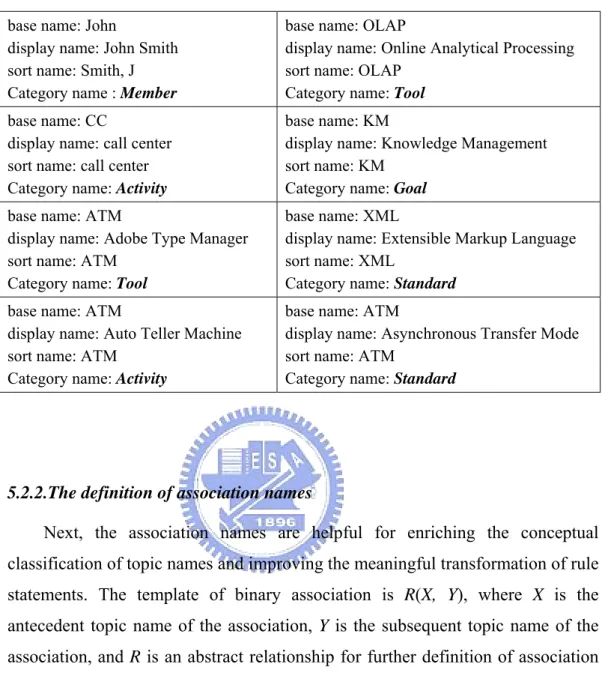
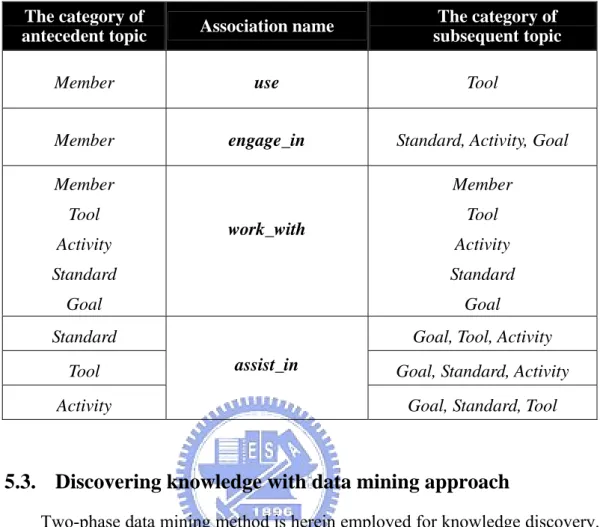
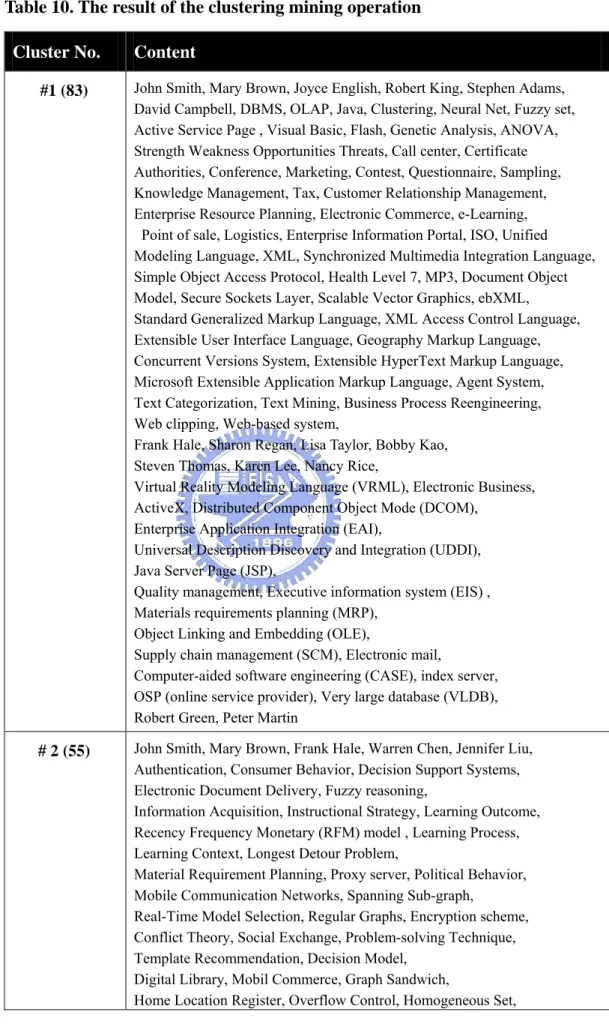
(39) Situation 3-3 (context in the project-based knowledge map): As Mary uses the project-based knowledge map system with context information, she can select the interesting context conditions from the user selection to locate the relevant parts of project knowledge. For example, the system provides context types of role, location and organization in user selection. As shown in Table 3, Mary expresses her conditions in project A1 and project A10 separately, including Mary works as a DBA for the government-type project A1 in Taipei, and she works as a consultant for the bank-type project A10 in NY (New York). The sense of show-who, show-where and show-for is used to compare with the sense of know-who, know-where and know-for in project context for further knowledge discovery operation to determine the relevant parts of project-based knowledge for Mary. Accordingly, Mary can receive the relevant knowledge support to improve the performance in project A1 and A10.. 38.
(40) Chapter 4. The Framework of Project-Based Knowledge Map We propose the framework of project-based knowledge map for developing project knowledge from historical projects. The proposed framework provides project attribute builder, context information services, knowledge discovery module, map generator module and for linking project resources, interacting with users, extracting association patterns, and displaying the proper part of knowledge map for users. Particularly, the project knowledge base collects and maintains the consistent definitions and important association patterns in the framework.. Figure 5.. The framework of project-based knowledge map. Notably, Topic Maps is the major standard for controlling the consistence and agreement for the construction and representation of knowledge in this framework. As shown in Figure 5, project knowledge base, knowledge discovery and map generator in the dot-line area persistently conform to the notation and regulation in Topic Maps for archiving, extracting and representing project knowledge. Besides, project attribute builder aims to generate applicable knowledge resources for the system, and context information service offers user selection to interact with users according to the perspectives of project context. 39.
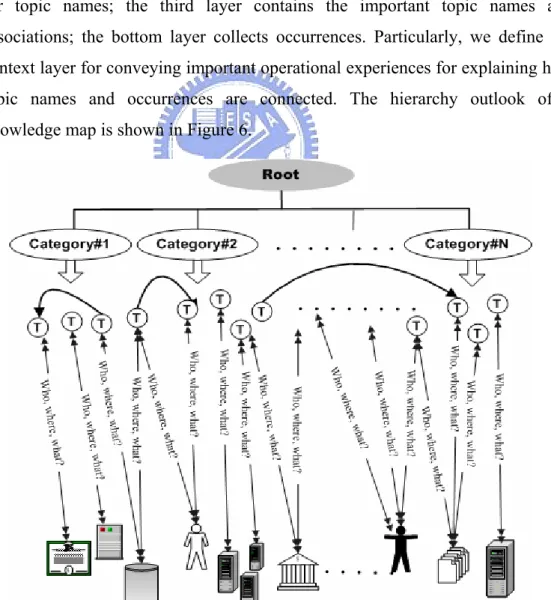
(41) As a result, the relevant part of project-based knowledge is determined for the user from the contextual view in the proposed framework. The structure of the project-based knowledge map is illustrated in the following subsection. Afterward, the essential components of the framework are also explained in separate subsections.. 4.1. The structure of project-based knowledge map The structure of project-based knowledge map is required to be flexible, expressive and navigable for representing the integrated project knowledge. Therefore, based on Topic Maps, context is specially proposed for enriching the structure of the project-based knowledge map. The first layer is the root entrance; the second layer contains the category names which are meaningful classification for topic names; the third layer contains the important topic names and associations; the bottom layer collects occurrences. Particularly, we define the context layer for conveying important operational experiences for explaining how topic names and occurrences are connected. The hierarchy outlook of a knowledge map is shown in Figure 6.. Figure 6.. The structure of the project-based knowledge map 40.
(42) Category names are helpful to consistently classify topic names and to meaningfully transform association rules. Hence, a set of agreeing category names is rather important for users to introduce a project-based knowledge map. Generally, top-down and button-up are two basic processes to set the category names. Top-down process is suitable for well-grown domain, which has widely-accepted domain ontology, such as the species of animals. It is very useful to refer the ontology to conclude the category names. Button-up process is to generate the category names from the mergence or generation operation of topic names. Data mining can provide many algorithms to set the criterion to form the domain ontology gradually. The human expert, international standard, domain experience and ontology mostly are valuable to make the conclusion. However, a group of category names is such important to classify various topic names in a domain. Correctness, completeness, comprehensibility and consistence are important principles to define the category names. Topic names are a set of important concepts in the knowledge map. Project attributes are described as formal topic names. The standard notation of Topic Maps for topic names is helpful to unify the concepts, including base name, display name and sort name. The base name is a name by which a topic name may be mostly used; the display name specifies the name to be formally explained to users, and the sort name specifies a name that is used in sorting procedures. For example, Taiwan Academic Network/TANet/TANET, is the base name, display name and sort name, respectively. This three-deck formation is helpful for reducing conflicts and misunderstanding in different operations. Occurrences practically correspond to referable project objects. A group of multiple project objects may contain reports, files, videos, or program codes in which various important methods, models or theories are described with well-defined topic names for further user references. Context offers the annotation of operational circumstances for topic names and related occurrences. A topic name is an important project attribute, and context is the useful information for identifying how the topic is applied in the occurrence. Particularly, with the help of context, the connection between topic names and occurrences becomes meaningful and expressive. Users are capable of. 41.
數據
+7

相關文件
As each school has its unique school context, including its organisation of the JS and SS curriculum, experience in conducting PL, self-directed learning atmosphere,
Senior Secondary Enriching Knowledge for the Geography Curriculum: (5) Dynamic Earth Series – Geology of Hong Kong and Slope Safety System..
• 教師為全班選定一個原因,並為各組選 定其中一個解決方法,著各組就該解決
妳笑我就會開心 妳喊幫妳遞紙巾 妳忙陪妳捱眼瞓 妳攰膊頭任妳枕 妳嬲同妳一齊炆 妳遲到時我實等
Based on the observations and data collection of the case project in the past three years, the critical management issues for the implementation of
時值知識經濟時代的來臨,台灣已加入了 WTO ( World Trade Organization,WTO ),企業面臨劇變之環境及廣闊的物料採購市 場,若能善用「知識管理」( Knowledge
This research project is to analyze and research a specific laser configuration to obtain complete knowledge、technologies and experiences to transfer to the project initiator for
在專案規劃階段,專案團隊就必須做出決定,同 時紀錄於專案成本管理計畫書 (project cost manage ment plan) 與專案時程管理計畫書 (project schedul e management
