Solid State Communications 143 (2007) 369–372
www.elsevier.com/locate/ssc
Polaron resonance in quantum dots and quantum-dot molecules
K.-M. Hung
∗, C.-S. Chen
Department of Electronics Engineering, National Kaohsiung University of Applied Sciences, Kaohsiung 807, Taiwan, ROC Received 24 March 2007; accepted 22 June 2007 by F. Peters
Available online 3 July 2007
Abstract
The theory of exciton coupling to photons and LO-phonons in quantum dots (QDs) and quantum-dot molecules (QDMs) is presented. Resonant-round trips of the exciton between the ground and excited states mediated by the LO-phonon alter the decay time and yield the Rabi oscillation. The initial distributions of the population in the ground and in the excited states dominate the oscillating amplitude and frequency. Our results presented herein explain well the anomaly in the recently reported experiment on T -dependent decay in self-assembled InGaAs/GaAs QDMs.
c
2007 Elsevier Ltd. All rights reserved. PACS:78.67.Hc; 71.35.-y; 71.38.-k
Keywords:A. Exciton; A. Polaron; A. Quantum dots; D. Equation of motion
Charge carriers that move in semiconductor QDs and QDMs provide a larger transition-dipole moment than atomic and molecular systems owing to their interaction with solid-state matter and a spatial variation of the band edge in QDs and QDMs, making applications in quantum information processing [1] and logical operations [2,3] feasible. In such applications, coherent manipulation of the excitonic wavefunction in QDs and QDMs at finite temperature is essential. A longer dephasing time (∼1 ns in self-assembled InGaAs/GaAs QDs [4–6] and QDMs [6,7]) than the manipulation time (∼1 ps [8]) is very important, because the coherence of the excitonic transition, or quantum computation, cannot be maintained because the dephasing time is comparable to or smaller than the manipulation time.
In QD and QDM systems, the carrier dephasing can be categorized into two parts: (1) the dephasing of spatial wavefunction of the exciton and (2) the dephasing of the internal degrees of freedom of the exciton, such as degenerate spin states. The former dephasing is mainly attributed to, for example, photon and real phonon scatterings. It is also called the excitonic decay because the exciton cannot incoherently reside in a spatial-confined state. The second dephasing relaxes
∗Corresponding author.
E-mail address:[email protected](K.-M. Hung).
the internal degrees of freedom of the exciton from one of its internal quantum states to the others, while preserving the spatial coherence, i.e., it conserves the number of excitons. Recently, both experimental and theoretical reports [9,10] reveal that the virtual-phonon processes for both acoustic and optical phonons are the main mechanisms of the second dephasing.
In principle, the identity of electron and hole distributions in a strong confining QD reduces the interactions of the excitons with LO-phonon by charge cancellation [11–13], and the large level spacing decreases the strength of the exciton scattering from real acoustic phonons. Accordingly, a long decay time is expected. However, the presence of piezoelectric fields [14], QD’s shape and/or size fluctuations [15], the Jahn–Teller effect [16], and charged point defects [17] lead to polarization of the charge distributions, and thus enhance the LO-phonon–exciton coupling. As for the electronic polaron [18], the coherent interactions of the electron–hole pair with a polarizable field do not contribute to phase decoherence, because the dressed state is an eigenvector of the interacting exciton–phonon system. The decay may result from the photon emission (PE), the coupling of the phonon thermostat that is originated by the anharmonicity of the crystal through the LO-phonon component [18], and the thermal emission (TE) of carriers out of the dots at high temperature T [6]. While
0038-1098/$ - see front matter c 2007 Elsevier Ltd. All rights reserved.
372 K.-M. Hung, C.-S. Chen / Solid State Communications 143 (2007) 369–372
Fig. 2. The OF (black) and OA (gray) of the RO with the parameters Γg =
0.7289 µeV, Γe = 0, γ0 = 7.8 meV for ∆ = 0.1 meV (solid), 0.4 meV
(dash), 0.7 meV (dot), 1.0 meV (dash–dot), and 1.3 meV (dash–dot–dot) with the initial conditions Ng(0) = 1 and Ne(0) = 0. The black-short-dash
line denotes the OF(÷5) and the gray-short-dash line denotes the OA for Γe=0.3Γg, Ng(0) = 0, and Ne(0) = 1.
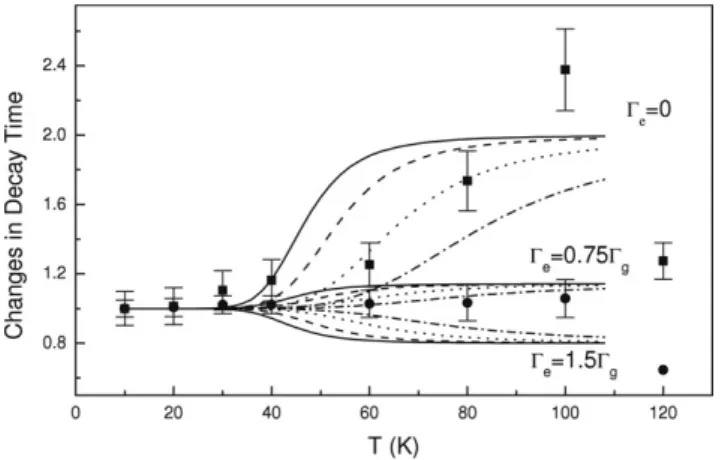
Fig. 3. The changes in decay time relative to that of T = 0 as a function of T and Γeforβ = 10 (dash–dot), β = 20 (dot), β = 42 (dash), and β = 75 (solid),
with the initial conditions Ng(0) = 1 and Ne(0) = 0. The solid square (circle)
denotes the experimental results of InGaAs QDMs [6] (InGaAs QDs [6]).
In order to discuss the decay time of these systems, a simple-exponential fitting is used to extract the decay time from the curves calculated by Eqs.(16)and(17)on removing the RO. In the limitβ = 0 and/or T = 0, zero-phonon decouples these states, thus, the decay rates for the states |gi and |ei are solely determined by their spontaneous-emission (SE) rates 2Γg and
2Γe, respectively. In another limitβ → ∞ and/or T → ∞,
the exciton has equal probability to stay in both the states |gi and |ei with an equal decay rate Γg+Γe. In this situation, the
brightness Γe of the state |ei alters the decay rate. For a
fully-dark state Γe = 0, the decay rate is one-half of the SE rate
(or double its corresponding decay time). All these features are revealed in Fig. 3. Because the brightness of the excited state of a QDM system with a symmetric structure vanishes, the maximal increase of its decay time at high T approaches two— it is comparable to the experimental result that is shown to be
slightly more than two (solid square inFig. 3). However, the brightness of the excited state in a QD system is commensurate with that of the ground state. The change in the decay time (solid circle) with respect to T is therefore not conspicuous. The experimental data also shows a rapid decease in decay time as T > 100 K for both QD and QDM due to the thermal emission of the carriers out of the QD/QDM, which is not taken into account in this work.
In conclusion, the theory of exciton coupling to photons and LO-phonons in QDs/QDMs was derived. Resonant-round trips of excitons between the ground and excited states mediated by LO-phonons alter the decay time and exhibit a RO. The decay time is strongly dependent on the brightness of the excited state—a dark state results in enhancing the decay time (in the case of QDMs), and a bright state in reducing the decay time (in the case of QDs). The distribution-dependent OA and OF provide a signature to the quantum information stored in QD or QDM systems for a wide range of temperatures. This is useful in the application of quantum information processing.
Acknowledgment
This work was supported by the National Science Council of the Republic of China, Taiwan, under Contract No. NSC95-2623-7-151-003-D.
References
[1] E. Knill, et al., Nature 409 (2001) 46. [2] G. Chen, et al., Science 289 (2000) 1906. [3] M. Bayer, et al., Science 291 (2001) 451.
[4] W. Langbein, et al., Phys. Rev. B 70 (2004) 033301-1. [5] P. Borri, et al., Phys. Rev. Lett. 87 (2001) 157401. [6] C. Bardot, et al., Phys. Rev. B 72 (2005) 035314-1. [7] G. Ortner, et al., Phys. Rev. B 71 (2005) 125335-1. [8] A. Zrenner, et al., Nature 418 (2002) 612;
H. Htoon, et al., Phys. Rev. Lett. 88 (2002) 087401-1. [9] E.A. Muljarov, et al., Phys. Rev. Lett. 95 (2005) 177405-1;
A. Vagov, et al., Phys. Rev. B 67 (2003) 115338; A.V. Uskov, et al., Phys. Rev. Lett. 85 (2000) 1516. [10] P. Borri, et al., Phys. Rev. B 71 (2005) 115328;
M. Bayer, A. Forchel, Phys. Rev. B 65 (2002) 041308. [11] S. Schmitt-Rink, et al., Phys. Rev. B 35 (1987) 8113. [12] S.P. Mahanti, C.M. Varma, Phys. Rev. Lett. 25 (1970) 1115. [13] A. Lemaitre, et al., Phys. Rev. B 63 (2001) 161309-1. [14] R. Heitz, et al., Phys. Rev. Lett. 83 (1999) 4654. [15] M. Bissiri, et al., Phys. Rev. B 62 (2000) 4642. [16] V.M. Fomin, et al., Phys. Rev. B 57 (1998) 2415. [17] S. Nomura, T. Kobayashi, Phys. Rev. B 45 (1992) 1305. [18] O. Verzelen, et al., Phys. Rev. B 62 (2000) R4809;
O. Verzelen, et al., Phys. Rev. B 64 (2001) 075315-1. [19] J. Feldmann, et al., Phys. Rev. Lett. 59 (1987) 2337. [20] T. Inoshita, H. Sakaki, Phys. Rev. B 56 (1997) R4355. [21] E. Burstein, et al., Phys. Rev. Lett. 22 (1969) 348. [22] L.C. Andreani, et al., Phys. Rev. B 60 (1999) 13276.
[23] J.R. Schrieffer, Theory of Superconductivity, W.A. Benjamin, Massachusetts, 1964.