Bulletin of Educational Psychology, 2009, 41 (2), 475-496 National Taiwan Normal University, Taipei, Taiwan, R.O.C.
The Components of the Solution-Focused Supervision
Wei-su Hsu
Department of Educational Psychology and Counseling
National Taiwan Normal University
The purpose of this study was to explore the components of Solution-focused supervision (SFS). Six supervisees, 1 male and 5 females, between the ages of 25 and 35, voluntarily participated in this study. Each supervisee received 4 sessions of SFS. A total of 24 counseling sessions were transcribed and analyzed based on the qualitative method. This study found 7 components re-occurring in the supervisory process of SFS: (a) Positive opening and problem description; (b) identifying the positive supervisory goals; (c) exploring the exceptions of supervisees and clients; (d) developing other possibilities; (e) giving feedback and clinical education; (f) forming the first little step; and (g) exploring the differences and the changes. Dynamic circulation appeared among these SFS components. The characteristics of these SFS components included: (a) Assurance and execution in positively desired and action-oriented supervisory goals went throughout the supervisory process; (b) exploring exceptions of supervisees was of great importance; (c) developing other possibilities and giving positive feedbacks and clinical education greatly enriched the supervisees’ case conceptualizations; (d) the whole supervisory process operated the SFS philosophy and skills; SFS components’ exerting empowering behaviors and supervisor’s role functions. Finally, limitations of this study and suggestions for future research were also provided.
KEY WORDS: Solution-focused supervision, supervision, the components of supervision
Researchers have long recognized supervision as both a key means for counseling training and an important professional development process for counselors (Holloway, 1995). Contemporary short-term and post-modern supervision models, paralleling dramatic developments in diverse short-term counseling approaches and in post-modern approaches, establish their importance and, indeed, their necessity (Corcoran, 2001; Peake, Nussbaum, & Tindell, 2002).
Solution-focused supervision (SFS) is isomorphic to solution-focused brief therapy (SFBT), a short-term and post-modern model. By adopting this new philosophical trend, SFS rests on assumptions and qualities opposite those of traditional models and has made a major philosophical shift or paradigm shift in psychotherapy (Kim, 2006). Four SFS characteristics include: (a) SFS promotes supervisor-supervisee
cooperation by identifying supervisees’ unique cooperative response patterns; (b) SFS focuses on supervisees’ strengths, not deficits, in order to facilitate supervisees’ changes and progresses; (c) SFS posits that supervisees should overcome their therapeutic impasses with clients by communicating to clients that they are the experts regarding their own experiences; and (d) SFS believes that changes are both inevitable and not necessarily relevant to exploring problems, so that differences and changes are worthy of being detailed and identified (Rudes, Shilts, & Berg, 1997; Thomas, 1996).
In other words, rather than regarding the supervisor as the fount of all knowledge, SFS treats supervisees and their clients as experts in their own work and lives, and prioritizes partnership collaboration that addresses supervisees’ interests, intentions, and goals for work (Waskett, 2006). SFS also supports supervisees’ and clients’ autonomy and subjective experiences, emphasizes their positive resources and inner power, creates their future visions and hopes, reinforces their solution-focused thinking and responsible actions, and enhances their sense of control in their work and lives (Greene, Lee, Mentzer, Pinnell, & Niles, 1998; Juhnke, 1996; Thomas, 1996). Therefore, SFS supervisors take a “not-knowing” position, adapt with supervisees’ pacing respectively, encourage supervisees to develop their own preferred future or desired outcome, elicit supervisees’ strengths and resources, offer supervisees appropriate compliments, and notice supervisees’ small and positive movements (Waskett, 2006). The supervisors assume this position using SFBT therapeutic skills, such as miracle questions, suppose questions, exceptional questions, scaling questions, relationship questions, coping questions, compliment, normalize and reframe (Greene et al., 1998; Juhnke, 1996; Thomas, 1996). In this vein, Briggs and Miller (2005) regarded SFS as “Success Enhancing Supervision.”
Recent researches on SFS effectiveness have been growing dramatically (Corcoran, 2001; Hsu, 2007; Hsu & Tsai, 2008; Kok & Leskela, 1996; Triantafillou, 1997; Pearson, 2006). Research outcomes of Koob (1999), and Presbury, Echterling, and McKee (1999), Barrera (2003), Briggs and Miller (2005), and Hsu (2007) all empathized that supervisee self-effectiveness has become the most highlighted aspect in this body of literature about SFS. Briggs and Miller (2005) and Hsu (2007) stated that SFS successfully helps supervisees identify and achieve supervisory goals. Also, Hsu (2007) confirmed that SFS is effective in promoting counselor professional development. In this context, SFS springing from a psychotherapy background has received considerable acceptance as a highly practical and effective model whose assumptions and therapeutic techniques have important implications for current individual and family therapy supervisions (Seleman & Todd, 1995; Waskett, 2006).
In addition to investing SFS effectiveness, some SFS practitioners and researchers have tried to identify SFS components or outlines from literature or from summarizing their own experiences. Wetchler (1990) first proposed SFS components by dividing SFS model into two parts: solution focus and clinical education. Marek, Sandifer, Beach, Coward, and Protinsky (1994) argued that goal setting, exceptions, and scaling questions were the most important SFS components. Seleman and Todd (1995) proposed 4 SFS assumptions to complete the components: (a) Supervisees will inevitably cooperate with supervisors; (b) supervisees’ exceptions should be identified and amplified; (c) if it did not work, “do something different”; and (d) supervisees should take the lead in defining supervision goals. They also believed that scaling questions, pre-suppositional questions, “pretend the miracle happened”, and “do something different” were main SFS supervisory interventions. Juhnke (1996) outlined an SFS analysis based on his practice. The outline comprised nine SFS components: (a) pre-session and initial supervision meeting; (b) establishing
supervisory goals; (c) techniques for identifying goals; (d) initial supervisees’ exceptions; (e) identifying successful interventions; (f) post-session exceptions; (g) scaling questions; (h) improvement after last supervision; and (i) identifying progress. Triantafillou (1997) formed a set of SFS guidelines after conducting a pilot study: (a) establishing an atmosphere of competence; (b) searching for client-based solutions; (c) giving feedback to supervisees; and (d) following supervision. Hsu (2007) summarized 7 SFS components from literature: (a) positive opening; (b) setting supervisory goals; (c) exploring and expending exceptional experiences; (d) identifying difference, change and process actively; (e) emphasizing a client-based solution; (f) giving clinical education;(g) keeping future-oriented thinking and searching for progress. Marek, Sandifer, Beach, Coward, and Protinsky (1994) argued that goal setting, exceptions, and scaling questions were the most important SFS components.
Considering SFS applications and developments, identifying and fleshing out SFS components through formal studies is worthwhile. Recent literature has relied more on theoretical and experiential viewpoints when examining SFS components; however, formal studies have neglected to confirm SFS components directly in the supervisory process. This study therefore explored the supervisory-process components of SFS. The research questions of this study included: (a) What were the components in the SFS supervisory process? (b) Were there specific elements for each component? (c) What was the relationship among SFS components?
METHOD
Participants
Supervisees. Six counselors in a graduate counseling program, 1 male and 5 females, between the ages
of 25 and 35, voluntarily participated in this study as supervisees. They were marked from A to F. The counseling experiences of these supervisees varied from 1 to 8 years. Three supervisees (A, B, and C) with 1 to 2 years work experience had no specific counseling approach and were open to a solution-focused approach. The supervisees D often used a problem-focused approach and the supervisees E accepted more play therapy training; both hope to learn more about SFBT. The supervisees F previously identified herself as solution-focused approach. Their clients, consisting of children, adolescents and adults, either volunteered or were recruited from their workplaces through counseling centers in campuses or in communities.
Supervisor. The supervisor was the researcher of this study, who did not get involved in the beginning
stage of data analysis. The supervisor previously received professional SFBT training, wrote relevant articles and books on SFBT, and often conducted SFBT training workshops, counseling works, and SFS sessions in Taiwan.
Co-researchers. One co-researcher with a doctoral degree had rich experiences in counseling practice,
training, and supervision. The other 2 co-researchers with master degrees were familiar with qualitative methods. They helped analyze and organize the research data as the research team, and influenced the researcher’s thinking on a variety of related subjects.
The Instruments
SFS Sessions and Their Verbatim Transcripts. Every supervisee received 4 SFS sessions in a
one-and-a-half-month period. The supervision interval lasted between 1 and 2 weeks. This study taped and transcribed verbatim the 24 supervisory sessions. Though the supervisees’ counseling approaches were not restricted to SFBT, the supervisor conducted all supervisions based on SFS philosophy and skills.
Supervisory records. The supervisor recorded the supervisory process immediately following each
session, as well as the recorded information including the supervisees’ goals, resources, exceptions, progresses, and the supervisor’s subjective experiences. The supervisor’s records served as a reference for data analysis.
The follow-up questionnaire. Each supervisee completed the following questionnaire within 3 months
of the final session. This study designed the following questionnaire with several open-ended questions, to understand SFS lasting effectiveness.
Data analysis
Analysis of the supervisor’s interventions in these 24 supervision verbatim transcripts kept the rules of open coding. The steps included:
First, dissecting the data into paragraphs (see Table 1) on the basis of themes as the primary level according to the supervisor’s changing interventions. In other words, the research team regarded the supervisor’s changing interventions as one paragraph. Despite that the supervisor’s interventions and the supervisees’ reactions were both summarily recoded in each paragraph in the first analytical step, the research team did not analyze supervisees’ reactions but used them to understand the context of why the supervisor changed her interventions in the supervisory process.
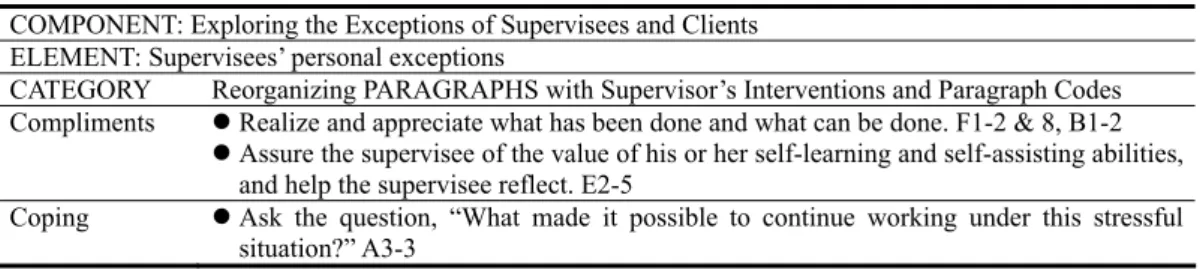
Second, the research data analysis consisted of 4 levels: Paragraph, category, element, and component (see Table 2).The research team sorted and clustered these paragraphs with the supervisor’s interventions into different categories, according to their similarity. Then, the research team sorted and clustered these categories into different elements. Finally, the team then sorted and clustered the elements with their categories into different components across SFS 24 sessions, according to SFS similarity and philosophy. The analysis confirmed the recurring items in the verbatim transcripts as key SFS components. Seven recurring components and 14 elements surfaced in conjunction with the 24 supervisory processes. The researcher reorganized element content of each component and tried to describe them.
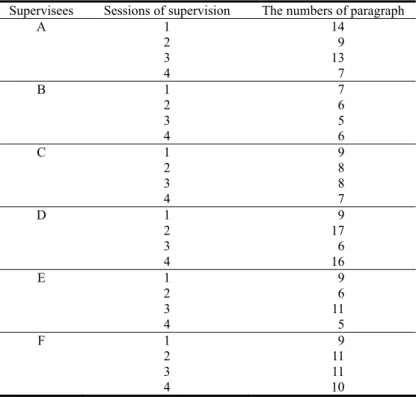
Third, the number of paragraphs in each supervisory session ranged from 5 to 15 within these 24 transcripts (see Table 3). This research labeled 3 types of data codes as “supervisee code/ supervisory-session number—paragraph number.” This coding meant that F1-7 represented information found in the SFS session for the supervisee with the supervisee F, in the first supervision, and in the seventh paragraph of this supervisory process.
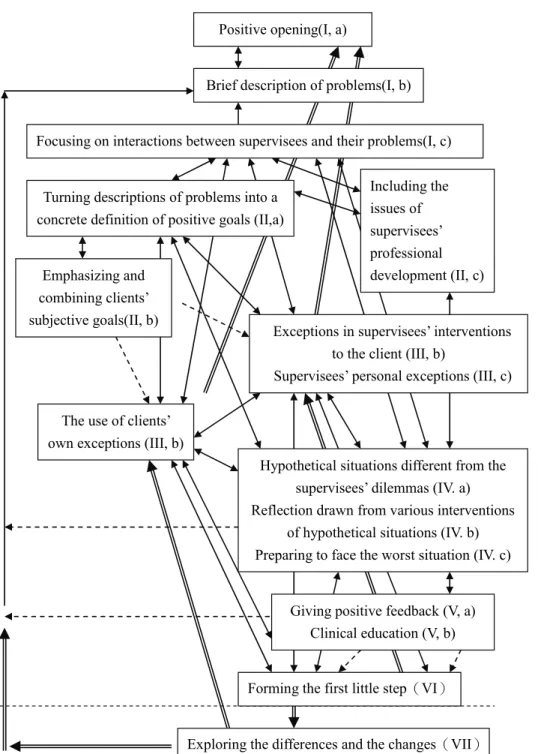
Fourth, the current work also surveyed the guiding pathways and orders of each component. The research team first recoded the pathways and order among the paragraphs (see Table 1). After that, when the supervisor’s interventions moved from one category or element to another, the research team recoded this pathway and order using one-sided arrows. When the supervisor’s interventions moved back and forth between 2 categories or elements, the team used the double-sided arrows to recode them. According to the
pathways and orders among these categories, the team tried to figure out the pathways, orders and inter-relations of these elements presented in Figure 1, and developed the relationship diagram concerning SFS components presented as Figure 2.
Fifth, the supervisees confirmed verbatim transcript correctness in their own supervisory sessions within 3 months of the final session. The researcher also invited supervisees to complete the following questionnaire to increase research validity. All supervisees felt satisfied with these SFS sessions. Six supervisees evaluated the average scores of SFS sessions as 8 in a 10-point scale. Three supervisees A, B, and C thought the SFS sessions reduced their anxiety and helped them learn more interventions to use immediately in counseling sessions. The others agreed that the SFS helped them integrate their own beliefs and counseling strategies, and become more patient with their own professional development. Meanwhile, to increase the reliability of analysis process, the research team continued discussing and giving feedback to each other during the analysis process and when encountering difficulties and differences.
Finally, Hsu (2007) used the same supervision verbatim transcripts as the research data, but just analyzed supervisees’ reactions which reflected SFS effectiveness. The supervisor’s interventions in the 24 supervision verbatim transcripts formed the main research data of this study and not used in previous study. These two studies differed in purpose and parts of research data analyzed.
Table 1 Examples of the Data-analysis Process of the Supervision-transcript Paragraph
Paragraph Code (dissected according to the direction of the supervisor’s interventions)
The Supervisor’s Interventions (the main area of research data)
The Supervisee’s Responses (not the research data, only for understanding
the context of supervisory process) F1-1
Understanding the Goal
z Which topic is more helpful to discuss? F1-1
The supervisee felt stuck, not knowing what could be done next, though the client ran away from home less frequently since the counseling. z Keep asking the supervisee why the
client ran away from home less frequently. What did the supervisee do to promote this trend? F1-2
The supervisee was not sure.
The client’s behavior made the client’s mother very mad.
F1-2 Exploring Exceptions
z Ask about the client’s descriptions of their counseling. What would the client say about the supervisee’s helping her? F1-2
Without being critical, the supervisee could listen to the client.
Pathway and Order: Understanding the Goal(F1-1) Exploring Exceptions (F1-2)
Table 2 Examples of the Data-analysis Process of Forming one Element of A Component
COMPONENT: Exploring the Exceptions of Supervisees and Clients ELEMENT: Supervisees’ personal exceptions
CATEGORY Reorganizing PARAGRAPHS with Supervisor’s Interventions and Paragraph Codes Compliments z Realize and appreciate what has been done and what can be done. F1-2 & 8, B1-2
z Assure the supervisee of the value of his or her self-learning and self-assisting abilities, and help the supervisee reflect. E2-5
Coping z Ask the question, “What made it possible to continue working under this stressful situation?” A3-3
Note: Four levels of research data analysis:
Table 3 Numbers of Paragraphs for Each Supervision
Supervisees Sessions of supervision The numbers of paragraph
A 1 14 2 9 3 13 4 7 B 1 7 2 6 3 5 4 6 C 1 9 2 8 3 8 4 7 D 1 9 2 17 3 6 4 16 E 1 9 2 6 3 11 4 5 F 1 9 2 11 3 11 4 10
RESULTS
This study found 7 components and 14 elements of SFS, described as follows.
Component I: Positive Opening and Problems Description
Positive opening. The supervisor would ask supervisees which topics would be helpful to discuss, or
what kind of help the supervisees needed. The supervisor’s intention was to open the supervisory dialogue by conveying that this supervision was goal-oriented and the supervisees’ current needs set the direction Usually, the supervisor would ask the supervisees:
“How can I be helpful to you? (D1-1)” or “when this session is over, what will you like to take with you that will make you feel that this supervision is helpful ? (A1-1) ”
Positive opening(I, a)
Brief description of problems(I, b)
Focusing on interactions between supervisees and their problems(I, c)
Turning descriptions of problems into a concrete definition of positive goals (II,a)
Including the issues of supervisees’ professional development (II, c) Emphasizing and combining clients’ subjective goals(II, b)
Exceptions in supervisees’ interventions to the client (III, b)
Supervisees’ personal exceptions (III, c) The use of clients’
own exceptions (III, b)
Hypothetical situations different from the supervisees’ dilemmas (IV. a) Reflection drawn from various interventions
of hypothetical situations (IV. b) Preparing to face the worst situation (IV. c)
Giving positive feedback (V, a) Clinical education (V, b)
Forming the first little step(VI)
Exploring the differences and the changes(VII)
Note: a. I-VII represents the SFS components found in this study; a-c represents the elements of each component. b. The one-sided and double-sides arrows represent the direction of the supervisor’s intervention; the
double-lined arrows mean next supervision
Brief description of problems. After supervisees described their own dilemmas or needs, if
understanding the context was necessary, the supervisor would collect some background information, briefly discuss the identified problems, and clarify key words that supervisees use in their descriptions. For example, the supervisor would ask: “Can you explain more about why you feel this client is not being honest about her feelings ? (B1-3)”
Focusing on interactions between supervisees and their problems. Figure 1 shows that this focus was
the major element of the first component, because it had more connections with other elements. Focusing on the interactions between supervisees and their problems made it possible to figure out precisely what the supervisees’ needs really were. For example:
”Almost everyone is anxious when he or she meets the client for the first time. Could you tell me more about how your anxiety influences you in this session? (B 4-1)”
To understand the supervisees’ problems and their definitions of failure and success, the supervisor most often asked, “How is that a problem to you now?” in a sympathetic and curious manner. After the supervisor confirmed the meaning of supervisees’ answers, the supervisees usually modified their focus to a more specific issue.
In this component, the supervisor also responded to supervisees by complimenting, normalizing, and reframing, always validating supervisees’ concerns, exhibiting an awareness of supervisees’ difficulties, and supporting supervisees’ willingness to face challenges:
“Worrying I am a good counselor is a common challenge for a novice counselor. However, it shows you are willing to face it and hope to become a good counselor (A1-1).”
These approaches helped the supervisees put aside their anxiety and clarified what they really cared about and hoped to overcome.
This component often occurred in the early phase of the supervisory process, and its 3 elements circulated. This component might take turns occurring with components II III and IV, especially component II.
Component П: Identifying the Positive Supervisory Goals
Turning descriptions of problems into a concrete definition of positive goals. The supervisor was
unlikely to capture supervisees’ real supervision-based goals via the supervisees’ descriptions of problems. Inspiring their senses of hope, the supervisor tried to help the supervisees clarify, in a positive way, their own desired goals using hypothetical questions or miracle questions. Meanwhile, the supervisor used scaling questions and relationship questions regarding different dimensions, especially actions, to make the supervisory goals more focused, concrete, and doable. For example, the supervisor would ask:
“You expressed fear in meeting clients. So, what do you expect yourself to be instead? (C2-2)” “What is the score when evaluating the client’s situation on a 1-10 scale and 10 means the miracle really happened? ... What would be different when she gets a point higher?... How will you help her move up to this step? (A1-3)”
The supervisor’s skills at complimenting, normalizing, and reframing often applied to this component. For example, the supervisor’s praise of the supervisees’ concerns could constitute a motive for further endeavors even though the supervisees had not yet fulfilled the goals. Applying these skills inspired the supervisees to face challenges bravely and continuously.
This element would often circulate with component I to develop supervisory goals precisely.
Emphasizing and combining clients’ subjective goals. The supervisees’ goals regarding SFS
supervision are as important as the clients’ goals in SFBT, which treats clients’ goals as the axis of counseling. Therefore, along with exploring supervisees’ supervisory goals, the supervisor in this study helped supervisees review both the clients’ reasons for attending the session and the clients’ hopes for the future. The supervisor often used relationship questions to help the supervisees reexamine their clients’ goals or their opinions about the dilemmas. If supervisees insisted on certain changes that clients needed to make, the supervisor would focus on how the supervisees set counseling goals for the clients in order to help supervisees both respect clients’ subjectivity and reexamine the suitability of previously set counseling goals. If the supervisees believed that clients were not willing to cooperate or change, the supervisor would ask the supervisees to think of clients’ good reasons for not changing. Helping supervisees consider the consequences and challenges that might arise if clients insist on no change was an alternative approach that the supervisor used with such supervisees.
The supervisor undertook these interventions to help supervisees expand their understanding of clients, identified ways to cooperate with clients, and then calculated the following supervisory directions. For example, the supervisor would ask:
“Why do you think the client might be better if she makes more friends? Can you explain more about that? (C3-2)”
“If you think talking to her mother is good for the girl (client), why does the girl not want to? What is her difficulty?...If we ask the girl what kind of relationship she wants to have with her mother, what might she say? (F1-4)”
Sometimes the supervisor directly applied component Ш to first explore existing exceptions, and came back again to confirm supervisees’ perspectives of their next supervisory topics.
Including the issues of supervisees’ professional development. In this element, the supervisees would
mention their issues of professional development and the counselor’s role. Because some supervisees worries that they were not good counselors or that they were doing something wrong, the supervisor would clarify both the definition of their ideal counselor and their evaluation of their own present performance. To facilitate this clarification, the supervisor also used relationship questions and scaling questions based on clients’ views; for example, the supervisor asked:
“If I ask her (the client), what kind of counselor she thinks is ideal…Will you agree with that? Why? …, what will you do to enhance the possibility that the client feels she is really getting help from you? (E2-3 & 4)”
In order to help supervisees spontaneously produce creative ways of dealing with their dilemmas, the supervisor used hypothetical questions, asking for example:
If supervisees could embody their conception of the perfect counselor, what facets of their counseling would they perform differently (D4-5)?
After that, the supervisor used supervisees’ answers to identify small steps that supervisees could take to realize better work performance. The supervisor could also explore how supervisees might reduce their dilemma-based anxiety and transform their anxiety into motivation for their professional development through scaling questions. After addressing these issues, the supervisor might discuss supervisees’ goals deriving from their professional growth during this period.
Component III: Exploring Exceptions of Supervisees and Clients
Exceptions in supervisees’ interventions to the client. While listening to supervisees’ description of
their difficulties and goals, the supervisor simultaneously explored and discussed supervisees’ successful interventions in a given client’s case regarding any aspect of change or progress since the previous session. For example:
“Can you tell me how you can get her (the client) to honestly tell you that she was lying to you and her husband about her depression? (F2-10)”
Regarding clients not becoming worse, the supervisor examined possible reasons. Along with using exceptional questions actively, the supervisor used scaling questions and relationship questions to invite supervisees to evaluate their satisfaction with their present performance and effective counseling--- from their own views first, and then from their clients’ perspectives: “What is your score on evaluating your work on a 1-10 scale? …How about the client evaluating this counseling? …What is the difference? (C4-3) These leading questions helped supervisees discover and confirm their strengths, useful strategies, and contributions to their counseling work, even when supervisees felt stuck in their work. After recognizing these concrete exceptions to previously negative self-assessments, supervisees might strengthen their interventions and yield more exceptions to their difficulties.
The use of clients’ own exceptions. The supervisor often asked supervisees to note when clients are
free from problems, when problems were less severe than usual, or how the situation had not worsened improved. The supervisor would also openly reflect on clients’ advantages and exceptions and directly posed related questions to supervisees: “How might the client help himself keep on track? What do these exceptions mean to you and to the client? (A1-5)”
The supervisor posed hypothetical questions and scaling questions to the supervisees so that supervisees might better help clients make use their small success. Hypothetical questions included the following: “How can being aware of this exception in his life be helpful? How will you help him to know his exceptions and empower him if you could? (D2-10)” These questions inspired the supervisees to generate alternative strategies with which to overcome difficulties in helping clients.
Supervisees’ personal exceptions. If supervisees’ goals concerned their personal professional growth,
or if supervisees had no exceptions of former interventions in the target client, the supervisor probed supervisees’ personal exceptions.
Using exception questions and coping questions, the supervisor explored supervisees’ former successful strategies for helping clients. If necessary, the supervisor might discuss self-help factors in supervisees’ professional growth, personal resources and experiences in their own growth processes, coping abilities of good performance and caring for clients even under high anxiety situations, and successful experiences about how to handle similar difficulties with clients or overcome difficulties in their work place or counseling. Exploring the previously described personal exceptions helped supervisees appreciate their exceptions, and further utilized these exceptions to achieve their current supervisory goals; for example,
“You have counseled some children using play therapy. How can you help them change? …What are the important factors for change? …What factors can you still create in oral therapy? (E3-11)”
“You have said it is a long road to master all counseling interventions. So, how do you help yourself stay and grow in this profession? (D4-4)”
supervisees temporarily failing to recognize their own exceptions. The supervisor usually reframed supervisees’ anxiety by characterizing it as a normal part of the learning process and as facilitating self-reflection, self-expectation, and self-monitoring, to help supervisees prepare for designing subsequent interventions:” Your anxiety seems to be an important power to help you monitor your counseling and reflect on your work after sessions (A3-5).” Supervisees usually calmed themselves, better appreciated their own strengths, and more easily used their exceptions to achieve their current supervisory goals after the above discussion.
Component IV: Developing Other Possibilities
According to supervisees’ goals, clients’ needs, and the supervisor’s own frame of reference, this component rested mainly on the supervisor’s use of hypothetical sentence patterns. These patterns encouraged supervisees to hypothetically reflect on related issues, reexamine their valued beliefs and actions whether they were solution focused approach or not, and broaden both the supervisees’ original thinking and various positive supervisory goals.
Hypothetical situations different from supervisees’ dilemmas. The supervisor would initially ask
supervisees to hypothetically consider the reverse of the supervisee-mentioned dilemmas. The supervisor also used the sentence pattern “If the current situation were…, how would you think and behave differently?” The following were some examples of if-then subordinate clauses: “If you could deal with the perceived problems…,” “If the problems you are worrying about disappear…,” “If you could agree with clients’ goals or focus more on the issues that are important to the clients…,” and “If you could accept clients’ own sense of their anxiety and needs…” These leading sentences facilitated supervisees to increase case concretization ability.
Reflection drawn from various interventions of hypothetical situations. The supervisor led the
supervisees to imagine a situation in which they had used different interventions, and then what help and outcome would emerge. Meanwhile, in order to increase the reflection ability of supervisees, when the supervisees temporarily decided on a direction for their actions no matter it was solution-focused approach or not, the supervisor would help supervisees reexamine their beliefs for change, their intentions to intervene, their perception of barriers, the possibility of success, and possible challenges. Additionally, the supervisor helped supervisees reevaluate future requisite steps or requisite conditions. With novice counselors, the supervisor would directly share and discuss the definition of counseling, identifies a counselor’s role, and might re-identify the significance of current dilemmas if necessary. For example:
“If you tell the client you feel confused about her behaviors, how may she react?...If she reacts as you expect, what is your next intervention?...If she has no response or denies your behaviors, what will you do next ? (E4-2)”
Preparing to face the worst situation. According to supervisees’ worries and concerns, the supervisor
would pose the following hypothetical situations to supervisees:
“If the worst situations you worry about truly happened, what meaning would you draw from the event? (E3-7)”
“How would you handle the situation if the client didn’t come again? What kind of resources could help you? (C4-5)”
or was disappointed in the supervisee, or if the counseling process did not proceed according to the supervisee’s expectations, what interpretation would the supervisee give to the event? The supervisor also helped the supervisees accept possible regret to unexpected outcome, but strived to reduce the possibility at the same time. In this period, the supervisor would organize, summarize and praise supervisee reflection. Sometimes these supervisees would bring up new needs for supervision after the above process, and then the previous components circulated so that the supervisees recognized and achieved their new positive supervisory goals.
Component : Giving Feedback and Clinical Education
Ⅴ
Giving positive feedback. First of all, the supervisor would always give abundant positive feedback
and assurance to supervisees during the supervisory process. Particularly before the end of each session, the supervisor helped supervisees organize findings from this supervisory session, and specifically praised the whole performance of supervisees in an organized way ; for example: “I am really impressed with your willingness to learn, and your care for clients (E2-6)…”
Clinical education. As to the second element, after circulating previous components, the supervisor
would estimate whether or not supervisees had clear strategies for reaching their goals, according to their own strengths, and whether or not supervisees were familiar with certain facets of professional knowledge. If not, the supervisor would directly share, illustrate, demonstrate, or role-play with the supervisees according to the supervisory goals and needs of the supervisees. In this way, the contents and procedures of clinical education accorded with supervisees’ needs and goals. Various dimensions of clinical education, based on professional knowledge counseling, often included: developmental psychology for a specific life stage, basic counseling principles on specific issues and populations, processes and contents of forming counseling plans and case conceptualization, intention behind and application of specific counseling techniques, functions and limitations of a counselor’s roles, and professional development or the counseling learning process. The supervisor especially introduced the philosophy and skills of SFBT in the above topics and supervisees often received suggestions regarding possible courses of action.
After supervisees received feedback and clinical education, the supervisor would discuss their understanding and their agreement. Sometimes the process of the previous components described above needed to circulate because of supervisees’ decision to follow a course of action.
Component : Forming the First Little Step
Ⅵ
After fully proceeding with components III, IV, and V, on the basis of supervisees’ goals, resources, strengths, findings from the above discussion and current restrictions, the supervisor helped supervisees form a reasonable and attainable “first little step” which the supervisees could conduct right after this supervisory session. For example, the supervisor would ask:
“Now that you know you need to practice talking with male clients, what is the first action you may take before the next supervision? (C3-8)”
“Now that you know that maintaining a 4 points on the scale is already a challenge to her (the client), and we have discussed the lost process, what is your next small step to help her maintain 4 points while going through this lost process?(B4-6)”
supervision stage. These tasks addressed specific counseling skills and specific methods for self-trust, self-training, and self-supervision:
“Before ending this session, I would like to give you a task. I suggest you pay attention to what kind of intervention or direction this client would respond quickly to (A3-13)”.
Component : Exploring the Differences and the Changes
Ⅶ
The supervisor began the following supervisory sessions by asking how the supervisees and their clients had changed after the previous supervision: “What is better since the last supervision?” The supervisor highlighted the differences and actively explored the changes that the supervisees or their clients had been experiencing. The supervisor also exhibited high interest in supervisees’ efforts, and facilitated supervisees’ awareness and accumulated self-assistance in their execution. The supervisor usually asked the supervisees: “How can you make the scaling different?” “How can you do that?” “What have you done that induces client willingness?” In these following supervisory sessions, as in the first one, the supervisor would connect the supervision process to component Ш in order to explore exceptions. Then the supervisor would facilitate the supervisees to produce further positive differences or changes. After that, the supervisor would re-circulate the whole supervisory component and process. In the last session, the supervisor probed and organized overall supervisee experiences in the 4 SFS sessions. The supervisor also encouraged supervisees to move toward their preferred goals with self-appreciation and self-assistance.
Dynamic Circulation Relationship Among the SFS Components
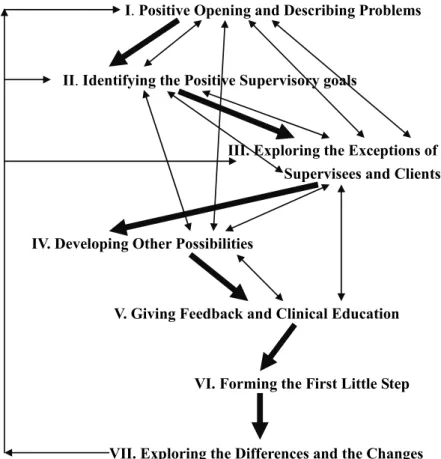
Dynamic circulation surfaced among the SFS components, as Figure 2 shows. Although components I through VII contributed to the overall shift in SFS, the components and their elements continued to function in a calculable way.
Meanwhile, according to the inter-relations and pathways among components and their elements, the most significant connections in the irregular mutual circulating process were among components I through V, and, then finally, through components VI and VII. Exploring the exceptions of supervisees and clients was the component most related to other components, and became the factor most beneficial in helping supervisees expand their own perspectives and produce useful actions.
I. Positive Opening and Describing Problems
II. Identifying the Positive Supervisory goals
III. Exploring the Exceptions of
Supervisees and Clients
IV. Developing Other Possibilities
V. Giving Feedback and Clinical Education
VI. Forming the First Little Step
VII. Exploring the Differences and the Changes
Note: The one-sided arrows, “
,” represent the main pathways; and the double-sides
arrows, “
,” represent the existing pathway diagram among components.
Figure 2. The Pathway Diagram of SFS Components Found In This Study
DISCUSSION
Comparison with Others’ Opinions
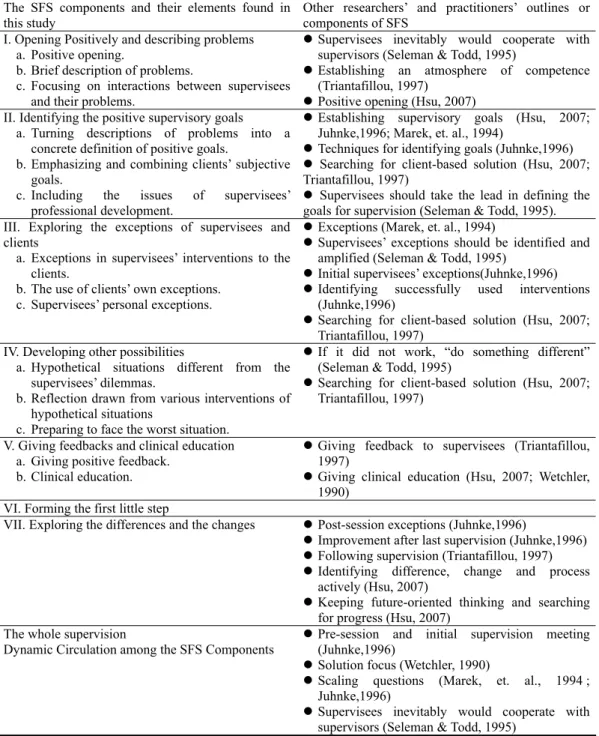
Table 4 and following illustrate comparing SFS components found in this study with others researchers’ and practitioners’ outlines or SFS components.
Table 4 Comparing SFS components found in this study with others’ opinions
The SFS components and their elements found in
this study Other researchers’ and practitioners’ outlines or components of SFS I. Opening Positively and describing problems
a. Positive opening.
b. Brief description of problems.
c. Focusing on interactions between supervisees and their problems.
z Supervisees inevitably would cooperate with supervisors (Seleman & Todd, 1995)
z Establishing an atmosphere of competence (Triantafillou, 1997)
z Positive opening (Hsu, 2007) II. Identifying the positive supervisory goals
a. Turning descriptions of problems into a concrete definition of positive goals.
b. Emphasizing and combining clients’ subjective goals.
c. Including the issues of supervisees’ professional development.
z Establishing supervisory goals (Hsu, 2007; Juhnke,1996; Marek, et. al., 1994)
z Techniques for identifying goals (Juhnke,1996) z Searching for client-based solution (Hsu, 2007; Triantafillou, 1997)
z Supervisees should take the lead in defining the goals for supervision (Seleman & Todd, 1995). III. Exploring the exceptions of supervisees and
clients
a. Exceptions in supervisees’ interventions to the clients.
b. The use of clients’ own exceptions. c. Supervisees’ personal exceptions.
z Exceptions (Marek, et. al., 1994)
z Supervisees’ exceptions should be identified and amplified (Seleman & Todd, 1995)
z Initial supervisees’ exceptions(Juhnke,1996) z Identifying successfully used interventions
(Juhnke,1996)
z Searching for client-based solution (Hsu, 2007; Triantafillou, 1997)
IV. Developing other possibilities
a. Hypothetical situations different from the supervisees’ dilemmas.
b. Reflection drawn from various interventions of hypothetical situations
c. Preparing to face the worst situation.
z If it did not work, “do something different” (Seleman & Todd, 1995)
z Searching for client-based solution (Hsu, 2007; Triantafillou, 1997)
V. Giving feedbacks and clinical education a. Giving positive feedback.
b. Clinical education.
z Giving feedback to supervisees (Triantafillou, 1997)
z Giving clinical education (Hsu, 2007; Wetchler, 1990)
VI. Forming the first little step
VII. Exploring the differences and the changes z Post-session exceptions (Juhnke,1996)
z Improvement after last supervision (Juhnke,1996) z Following supervision (Triantafillou, 1997) z Identifying difference, change and process
actively (Hsu, 2007)
z Keeping future-oriented thinking and searching for progress (Hsu, 2007)
The whole supervision
Dynamic Circulation among the SFS Components
z Pre-session and initial supervision meeting (Juhnke,1996)
z Solution focus (Wetchler, 1990)
z Scaling questions (Marek, et. al., 1994 ; Juhnke,1996)
z Supervisees inevitably would cooperate with supervisors (Seleman & Todd, 1995)
Assurance and execution in positively desired and action-oriented supervisory goals went throughout the supervisory process. The importance for identifying positive supervisory goals is the same
as with others’ opinions. In the beginning stage of SFS in this study, a positive opening fosters change-oriented and action-focused intention. After the brief description of the background of the problems, the supervisor of SFS does not assume that the problems stemmed from supervisees’ personal issues or
from supervisees’ past history, nor did the supervisor try to investigate the causes of problems. Rather than confront supervisees by naming their dilemmas “counter-transference” or “irrational beliefs” as some psychotherapy-based supervisors would do, the supervisor expresses understanding regarding interactions between supervisees and their dilemmas by capturing supervisees’ frames of reference. The strategy here does not prioritize gargantuan efforts to describe or to discuss dilemmas. Thus, through exploring exceptions and other possibilities, the supervisees redefine and transform the dilemmas into definitions of positive, workable, and desired goals, in turn, enabling supervisees to take small steps in pursuit of either new and concrete directions or long-desired breakthroughs. Exploring improvement in the following sessions reinforces changes that supervisees and client achieved in SFS.
Two additional meaningful findings includes: First, the element of supervisees’ personal-professional development surfaced rather starkly in the process of goal formation --- a theme that previous literature seldom discussed. Second, this study separated the element of emphasizing and combining clients’ subjective goals from the component of searching for client-based solutions (Hsu, 2007; Triantafillou, 1997) and became an independent goal-setting element in this study. Therefore, the dimensions of the component for identifying positive supervisory goals in this study are broader and more complete than others’ theories.
In fact, in this SFS process, supervisees take the lead in defining supervision goals as Seleman and Todd (1995) emphasized, and this supervisory process subordinates itself (the process) to goal orientation and to the belief that “small changes will bring forth big ones. Thus, the component of forming the first little step in this study is a unique component not specifically highlighted in others’ outlines.
Another important finding here is the element about clients’ own exceptions, separated from the component of searching for client-based solutions (Hsu, 2007; Triantafillou, 1997). Exceptions in the SFS of this study fell into 3 categories: supervisees’ personal exceptions, clients’ exceptions, and exceptions about supervisees’ interventions to clients, which gives greater substance to the component of exploring exceptions—a point that previous literature seldom clearly distinguished in a similar point.
Developing other possibilities and giving positive feedbacks and clinical education greatly enriched supervisees’ case conceptualizations. The component of developing other possibilities exerts the principle:” If it did not work, do something different” (Seleman & Todd, 1995) and combines some searching for client-based solutions (Hsu, 2007; Triantafillou, 1997). The component consisted of 3 elements in this study: hypothetical situations different from supervisees’ dilemmas, reflection drawn from various interventions of hypothetical situations, and preparing to face the worst situation. Hence, this component greatly increases the diversity and flexibility of supervisees’ interventions. It helps supervisees reexamine their own hypotheses about difficulties, goals, clients’ problems, and counseling professions, and integrates the supervisor’s points of view into thereby expanded dimensions open to reflection and intervention in this study. Hence, this study stresses the unique importance of developing other possibilities, which constituted another point seldom mentioned in previous literature.
Meanwhile, as Wetchler (1990), Triantafillou (1997) and Hsu (2007) believed, giving positive feedbacks and clinical education to supervisees is one important component of SFS, different from the SFBT counseling process. Most important, the supervisor of SFS provides clinical education in various ways according to supervisees’ need and goals, and presents them in a manner as “just one among many kinds of possibilities,” which the overarching goal is to stimulate supervisees’ producing new goal-realization strategies. This process also channels the supervisor’s openness and respect to supervisees,
manifesting the spirit of “regarding supervisees as experts” in SFS.
The whole supervisory process operated SFS philosophy and skills. The SFS components shown in
this study fit the basic spirit and principles of SFS and the emphasis of others. The SFS components shown in this study exert the uniqueness and comprehensiveness of the overall SFS model and overlap with Juhnke’s (1996), Triantafillou’s (1997) and Hsu’s (2007) SFS models. However, the components and their elements found in this study are more comprehensive than others. In particular, this study verifies these SFS components, not only just reflection of experiences.
Another important finding is the dynamic circular developmental process of this SFS model, which is quite different from the related identification of “linear progression” in imagination, as described in previous literature. However the component of pre-session and initial supervision meeting mentioned by Juhnke (1996) is not included in this study, because this study combined it with the explanation meeting of research purposes before the formal supervision.
The entire SFS supervisory process is a solution focus process according to Wetchler (1990). In order to change the supervisory process from “problem talk” to “solution talk”, unlike Marek et al. (1994) and Juhnke (1996) who pointed out that the scaling question was particularly important, all representative skills of SFBT operates at the same time in each component of SFS, including miracle questions, hypothetical questions, scaling questions, exceptional questions, coping questions, relationship questions, compliment, reframing, and normalizing.
SFS Components’ Exerting Empowering Behaviors and Supervisor’s Role Functions
SFS is a model of empowerment. Empowering behaviors really arise according to the characteristics
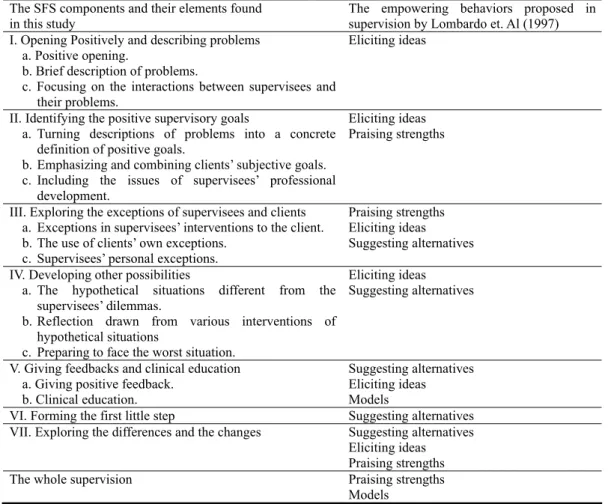
of SFS components in this study. Lombardo, Greer, Estadt, and Cheston (1997) proposed 4 kinds of empowering behaviors in supervision that could endow supervisees with a sense of empowerment including: (a) Suggesting Alternatives: Suggesting alterative skills or approaches; (b) Eliciting Ideas: Eliciting other ideas or opinions; (c) Praising Strengths: Praising specific strengths; and (d) Presenting Models: Modeling or demonstrating a skill or intervention. The SFS components in this study find consistency with the empowering behaviors proposed by Lombardo et al. (1997).
For example, the empowerment-strengthening potential of “Suggesting Alternatives” exists in the components of exploring the exceptions of supervisees and clients, developing other possibilities, giving feedback and clinical education, forming the first little step, and exploring the differences and the changes. “Eliciting Ideas” and “Praising Strengths” arise in all SFS processes, especially in the components of exploring the exceptions of supervisees and clients. “Presenting Models” shows most conspicuously in the component of giving feedback and clinical education, and the entire stretch of supervision is indeed a kind of modeling (shown as Table 5). Hence, echoing Triantafillou’s (1997) perspectives, the SFS is really an empowerment model that helps promote beneficial relationships to help supervisees reap the benefits of empowerment.
Table 5 Empowering Behaviors in Components of SFS
The SFS components and their elements found
in this study The empowering behaviors proposed in supervision by Lombardo et. Al (1997) I. Opening Positively and describing problems
a. Positive opening.
b. Brief description of problems.
c. Focusing on the interactions between supervisees and their problems.
Eliciting ideas
II. Identifying the positive supervisory goals
a. Turning descriptions of problems into a concrete definition of positive goals.
b. Emphasizing and combining clients’ subjective goals. c. Including the issues of supervisees’ professional
development.
Eliciting ideas Praising strengths
III. Exploring the exceptions of supervisees and clients a. Exceptions in supervisees’ interventions to the client. b. The use of clients’ own exceptions.
c. Supervisees’ personal exceptions.
Praising strengths Eliciting ideas Suggesting alternatives IV. Developing other possibilities
a. The hypothetical situations different from the supervisees’ dilemmas.
b. Reflection drawn from various interventions of hypothetical situations
c. Preparing to face the worst situation.
Eliciting ideas Suggesting alternatives
V. Giving feedbacks and clinical education a. Giving positive feedback.
b. Clinical education.
Suggesting alternatives Eliciting ideas Models
VI. Forming the first little step Suggesting alternatives VII. Exploring the differences and the changes Suggesting alternatives
Eliciting ideas Praising strengths
The whole supervision Praising strengths
Models
The fit between SFS components and the standards of a “good supervisor.” Person (2006) claimed
that teachers, counselors, and consultants were the 3 main traditional roles that supervisors played, and Ungar (2006) defined the post-modern supervisor as a supporter, supervisor, case consultant, trainer/teacher, colleague, and advocator. The 7 SFS components found in this study have greater effects on 3 supervisor roles: (a) The supporter: The supervisor explores the supervisees’ exceptions, complimented supervisees’ advantages and progress, normalized and reframed their difficulty; (b) the teacher/trainer: The supervisor confirms supervisees’ useful interventions, demonstrated interventions that supervisees hope to learn, and gives feedback and clinical education; and (c) the (case) consultant: The supervisor clarifies supervisees’ goals and encouraged them to change by developing other possibilities or providing their own ideas about clients’ goals and exceptions, thereby increasing their case conceptualization ability.
However, the SFS supervisor has smaller effects on the role of counselors regarding directly exploring supervisees’ negative emotions and other personal issues, even though confirming supervisees’ strengths and process in the counselor’s role (Person, 2006) is an outstanding function of SFS’s supervisor. Besides, the roles of colleague, supervisor, and advocator of postmodern approaches proposed by Ungar (2006) remain unclear in this study.
Meanwhile, this SFS process not only helps supervisees gain new perspectives on problems and new information about their barriers, but also gives supervisees a sense of effectiveness and reasonable control, encouraging them to train their self-supervision skills and self-assistance skills. Therefore, the SFS components found in this study fit the important standards of “good supervision” that some researchers have laid out with the following two standards: (a) It is important to foster relationships with mutual respect, support, encouragement, trust, compliments, understanding, and non-criticism, all of which facilitate supervisees’ openness, cooperation, risk-taking, exploration, and development of meta-cognition (Heath & Tharp, 1991; Hess, 1997; Worthington, Mobley, Franks, & Tan, 2000); and (b) it is important to help supervisees deal with clients’ issues or with counseling situations rather than with other topics, and help supervisees reflect on feedback from the supervisor and apply it to their own counseling situations (Harkness, 1997; Landany, Lehrman-Waterman, Molingaro, & Wolgast, 1999; Wampold, 2001). Thus, the components found in this study obviously support SFS and indeed fit these two standards of “good supervision.”
LIMITATIONS AND SUGGESTIONS FOR FUTURE RESEARCH
Regarding the limitations of the study, the numbers of supervisors, supervisees, and counseling sessions were insufficient and the main research data are adopted only from the supervisory process of each session. The background of supervisees, such as the stage of professional development, the counseling approach or cultural values of supervisees, were are neither included in the design of this study. Particularly, the supervisees in this study opened their mind to SFBT, however, whether the supervisees are restricted to SFBT nor not, should be an important variable to examine the effectiveness of SFS components. According to its findings and limitations, this study proposes several suggestions on increasing the investigations of SFS components for future research.
First, in order to expand the exploration of SFS components, the supervisory effects, and the relationship between them, future research can increase the numbers of supervisors, supervisees, and counseling sessions. Future researchers can use relevant questionnaire measurements or interviewing designs from supervisees’ perception to broaden the structure and components of SFS. In addition, they can also put some important variables of supervisees’ background into future research design and further examine the relationship between these variables and the operation of each SFS component.
Second, several issues derived from discussion remain worthy to explore further in the future: (a) the component of pre-session and the initial supervision meeting mentioned by Juhnke (1996) is not included in this study. Future research can examine its effectiveness; and (b) Marek, et al. (1994) and Juhnke (1996) believed that the scaling question is very important in SFS, but this study finds all representative skills of SFS operating in each component. Future research can further investigate the most important or high-used SFS skill in each component or in the whole process of SFS.
Third, according to the supervisors’ roles proposed by Person (2006) and Ungar (2006), the supporter, the teacher/trainer, and the (case) consultant are the main roles SFS supervisors play. Future research can further explore the specific dimensions of SFS supervisors’ roles, including confirming whether the colleague, supervisor, and advocator proposed by Ungar (2006) exist in SFS or not as well as investigating how effective the counselor role proposed by Person (2006) in SFS is.
Finally, each psychotherapy-based approach of supervision stemming directly from the major theoretical school of counseling has its own strengths and shortcomings (Pearson, 2006). So, further increasing comparison studies of components with different supervisory models to know more clearly about the advantages and shortcomings of SFS in the future should be interesting and necessary.
REFERENCES
Barrera, I. (2003). The impact of solution-focused supervision and social workers. Unpublished master’s thesis, California State University, Long Beach.
Bernard, J. M. (1992). The challenge of psychotherapy-based supervision: Making the pieces fit. Counselor Education & Supervision, 31, 232-238.
Briggs, J. R., & Miller, G. (2005). Success enhancing supervision. Journal of Family Psychotherapy, 16, 1/2, 199-222.
Corcoran, K. B. (2001). An ethnographic study of therapist development and reflectivity within the context of postmodern supervision and training. Unpublished doctoral dissertation, the University of Akron. Greene, G. J., Lee, M., Mentzer, R. A., Pinnell, S. R., & Niles, D. (1998). Miracles, dreams, and
empowerment: A brief therapy practice note. Families in Society, 79, 395-399.
Harkness, D. (1997). Testing interactional social work theory: A panel analysis of supervised practice and outcomes. The Clinical Supervisor, 15, 33-50.
Heath, A., & Tharp, L. (1991). What therapists say about supervision. Paper presented at the American Association for Marriage and Family Therapy Annual Conference, Dallas, TX.
Hess, A. K. (1997). The interpersonal approach to the supervision of psychotherapy. In C. E. Watkins, Jr. (ed.). Handbook of psychotherapy supervision (pp. 63-83). New York: Wiley.
Holloway, E. L. (1995). Clinical supervision: A systems approach. California: Sage.
Hsu, W. (2007). [Effects of Solution-Focused Supervision]. Bulletin of Educational Psychology, 33(2), 57-78.
Hsu, W., & Tsai, S. (2008). [The effect of Solution-focused group supervision on junior school counselors]. Bulletin of Educational Psychology, 39 (4), 603-622.
Juhnke, G. A. (1996). Solution-focused supervision: promoting supervisee skills and confidence through successful solutions. Counselor Education and Supervision, 36, 48-57.
Kim, H. (2006). Client growth and alliance development in Solution-focused brief family therapy. Unpublished doctoral dissertation, State University, New York.
Kok, C. J., & Leskela, J. (1996). Solution-focused therapy in a psychiatric hospital. Journal of Marital and Family Therapy, 22(3), 397-406.
Koob, J. J. (1999). The effects of solution-focused supervision on the perceived self-efficacy of developing therapists. Unpublished doctoral dissertation, Marquette University.
Landany, N., Lehrman-Waterman, D., Molingaro, M., & Wolgast, B. (1999). Psychotherapy supervisor ethical practices: Adherence to guidelines, the supervisor working alliance, and supervisee satisfaction. The Counseling Psychologist, 27, 443-475.
An empirical study of parallel processes. The Clinical Supervisor, 16(2), 33-47.
Marek, L. I., Sandifer, D. M., Beach, A., Coward, R. L., & Protinsky, H. O. (1994). Supervision without the problem: A model of solution-focused supervision. Journal of family psychotherapy,5(2),57-64. Peake, T. H., Nussbaum, B. D., & Tindell, S. D. (2002). Clinical and counseling supervision references:
Trends and needs. Psychotherapy: Therapy, Research, Practice, Training, 39(1), 114-125.
Pearson, Q. M. (2006). Psychotherapy-based supervision: Integrating counseling theories into role-based supervision. Journal of Mental Health Counseling, 28, 241-252.
Presbury, J., Echterling, L. G., & McKee, J. E. (1999). Supervision for inner vision: Solution-focused strategies. Counselor Education and Supervision, 39, 146-152.
Rudes, J., Shilts, L., & Berg, I. K. (1997). Focused supervision seen through a recursive frame analysis. Journal of Marital & Family Therapy, 23(2), 203-215.
Seleman, M. D., & Todd, T. C. (1995). Co-creating a context for change in the supervisory system: The solution-focused supervision model. Journal of Systemic Therapies, 14(3), 21-23.
Thomas, F. N. (1996). Solution-focused supervision: the coaxing of expertise. In S. D. Miller, M. A. Hubble, B. L. Duncan (Eds.), Handbook of solution-focused brief therapy (pp. 128-151). San Francisco: Jossey-Bass Publishers.
Triantafillou, N. (1997). A Solution-focused approach to mental health supervision. Journal of Systemic Therapies, 1, 21-24.
Ungar, M. (2006). Practicing as a postmodern supervisor. Journal of Marital and Family Therapy, 32(1), 59-72.
Wampold, B. E. (2001). The great psychotherapy debate: Models, methods, and findings. Mahwah, NJ: Erlbaum.
Waskett, C. (2006). The pluses of solution-focused supervision. Healthcare Counseling and Psychotherapy Journal, 6(1), 9-11.
Wetchler, J. (1990). Solution-focused supervision. Family therapy, 17, 129-138.
Worthington, R. L., Mobley, M., Franks, R. P., & Tan, J. A. (2000). A phenomenological investigation of ‘good’ supervision events. Journal of Counseling Psychology, 43(1), 25-34.
收 稿 日 期:2008 年 11 月 10 日 一稿修訂日期:2009 年 02 月 34 日 二稿修訂日期:2009 年 04 月 20 日 接受刊登日期:2009 年 04 月 22 日
國 立 臺 灣 師 範 大 學 教 育 心 理 與 輔 導 學 系 教育心理學報,民 98,41 卷,2 期,475-496 頁