http://jiv.sagepub.com/
Violence
Journal of Interpersonal
http://jiv.sagepub.com/content/early/2010/05/26/0886260510369130 The online version of this article can be found at:
DOI: 10.1177/0886260510369130
published online 3 June 2010 J Interpers Violence
April Chiung-Tao Shen
of Dating Violence
Cultural Barriers to Help-Seeking Among Taiwanese Female Victims
Published by:
http://www.sagepublications.com
On behalf of:
American Professional Society on the Abuse of Children
can be found at: Journal of Interpersonal Violence
Additional services and information for
http://jiv.sagepub.com/cgi/alerts Email Alerts: http://jiv.sagepub.com/subscriptions Subscriptions: http://www.sagepub.com/journalsReprints.nav Reprints: http://www.sagepub.com/journalsPermissions.nav Permissions:
Article
Journal of Interpersonal Violence XX(X) 1-23 © The Author(s) 2010 Reprints and permission: http://www. sagepub.com/journalsPermissions.nav DOI: 10.1177/0886260510369130 http://jiv.sagepub.com
Cultural Barriers to
Help-Seeking Among
Taiwanese Female
Victims of Dating
Violence
April Chiung-Tao Shen
1Abstract
This article presents a qualitative analysis regarding the help-seeking behaviors of female dating-violence victims from a cultural perspective. A semistructured, in-depth interview was used to collect data from 10 female victims (aged 20-28). Findings indicate that Taiwanese dating-violence victims tend to seek informal help rather than formal help. Culturally structured help-seeking experiences center around six primary themes: (a) self-reliant culture, (b) personal and family shame, (c) secretive and sexual dating relationships, (d) fear of negative reactions from others, (e) unfamiliarity with available resources, and (f) revictimization in seeking help. Understanding cultural meanings and barriers encountered in help-seeking behaviors is an important step in effectively assisting victims of dating violence.
Keyword
battered women, dating violence, domestic violence, help-seeking, Chinese culture
1National Taiwan University, Taipei, Republic of China
Corresponding Author:
April Chiung-Tao Shen, Department of Social Work, National Taiwan University, 1, Roosevelt Rd., Sec. 4, Taipei, Taiwan, 106 Republic of China
Introduction
Dating violence is a widespread and serious problem (Straus, 2004). The prevalence, severity, and detrimental consequences of dating violence are well documented in Western research, ever since the first pioneering study by Makepeace in 1981 (e.g., Kaura & Lohman, 2007; Lewis & Fremouw, 2001). The prevalence rate of dating violence ranged from 9% to 65%, depending on the definition of “dating violence” (e.g., whether verbal vio-lence is included), and the average prevavio-lence rate appears to have recently been about 30% among college and high school populations in the United States (Lewis & Fremouw, 2001). Recent national studies conducted in Taiwan have shown that approximately 58% to 66% of college students had experienced some form of dating violence, including physical, psychologi-cal, and sexual violence (Hsiu & Sun, 2003; Shen, 2008). Dating-violence victimization is damaging to victims’ physical health, mental health, and social functioning. Research has documented that dating-violence victims report serious physical injuries, emotional trauma, depression, anxiety, somatization, and lower self-esteem stemming from the dating violence (Kaura & Lohman, 2007; Lewis & Fremouw, 2001).
Given the high prevalence and harmful impact of dating violence on young adults and adolescents, a growing body of recent research examines the victims’ help-seeking preferences and behaviors in violent relationships (e.g., Liang, Goodman, Tummala-Narra, & Weintraub, 2005; Ocampo, Shelley, & Jaycox, 2007). Research has suggested that victims do not always ask for help and that victims’ decisions to seek help vary according to a number of factors, including individual, interpersonal (e.g., victim–offender relationship), and sociocultural (e.g., gender, race, patriarchy) factors (Liang et al., 2005). However, much of the traditional literature on help-seeking behaviors or dat-ing violence overlooks larger sociocultural factors and has surveyed primar-ily White-dominated higher education student bodies or high school student bodies. Therefore, the experience of other ethnic populations has been under-studied (Lewis & Fremouw, 2001). The behavior of asking for help, formal or informal, carries different meanings in different cultures (Kung, 2003). Cultural values and norms influence not only people’s perception of intimate partner violence (IPV) but also the way in which victims seek and experience assistance (Fernández, 2006; Yick, Shibusawa, & Agbayani-Siewert, 2003). For example, when facing IPV, South Asian immigrants in the United States tended to report abuse incidents and seek help only when the violence reached a severe or crisis level (Abraham, 2000). There is evidence suggesting that IPV in Asian communities in the United States has been seriously underreported,
and yet, Asians have been overrepresented in U.S.-based IPV fatalities (Jin, Eagle, & Yoshioka, 2007; Lee & Hadeed, 2009). Patriarchal ideology and other traditional cultural beliefs rooted in rigid gender norms, such as obedi-ence, collective interest, and self-control, may also deter women of Asian cultural backgrounds from seeking help (Midlarsky, Venkataramani-Kothari, & Plante, 2006). Therefore, it is important to understand the help-seeking behavior of dating violence victims from a cultural perspective.
Many studies have examined the help-seeking behavior of battered mar-ried women. However, the research findings on marital violence should not be automatically applied to dating violence because the nature and character-istics of dating and marital relationships are different. For example, battered married women need to consider factors such as legal bonds, familial obliga-tions, and financial impact when making the decision to stay or leave, whereas battered dating individuals do not. The chief aim of the current study is thus to fill this knowledge gap by exploring the help-seeking behaviors of female dating-violence victims from the cultural perspective of Taiwan. The examination of this topic will help to increase professionals’ awareness of and sensitivity to cultural issues related to dating violence among Taiwanese young female adults. Understanding cultural meanings and barriers affecting help-seeking behaviors is an important step in effectively assisting victims of dating violence. This study defines dating violence as any physical, psycho-logical, or sexual act of aggression perpetrated against an individual in a dating context (Bernard & Bernard, 1983).
Literature Review
Chinese Culture and IPV
Chinese culture is strongly patriarchal and collectivistic, as it is rooted in centuries-old Confucianism (Lee, 2000; Yu, 2005). Patriarchy and collectivism not only are related to higher rates of violence against females in a given society (Archer, 2006; Ho, 1990), but also have often hindered women’s help-seeking decisions and efforts (Yoshihama, Parekh, & Boyington, 1998).
In patriarchal Chinese culture, perceptions of violence against women are socially, historically, and politically situated. Patriarchal ideology places women in positions of subordination to men. The inequitable gender relation-ships serve to maintain the acceptability of male violence (Russo & Pirlott, 2006). Tang, Wong, and Cheung (2002) conducted 23 focus groups in mainland China (including Hong Kong) and Taiwan (with college students, blue-collar workers, professionals, and homemakers) and concluded that Chinese
cultural tolerance of male violence against women not only leads to victims’ self-blame but also to pervasive victim-blaming attitudes and behaviors among Chinese people in general (Tang et al., 2002).
In the collectivism of Chinese culture, the individual represents the family. Each family member is expected to honor his or her parents and ancestors, and not to bring problems into or disgrace on the family. Therefore, saving face is extremely important because it can protect the individual as well as the entire family from shame (Midlarsky et al., 2006; Yick & Agbayani-Siewert, 2000; Yu, 2005). As honor and glory for the family are highly prized, shameful issues are hidden (Nguyen, 2005). IPV among Asians and Asian Americans remains a hidden social problem due, in part, to cultural factors. Studies conducted in North America revealed that Asian American women (including Chinese Americans and immigrants) remain silent and forego seeking help when IPV occurs and that this behavior is due to fear of losing face and shaming oneself and the entire family (Ho, 1990; Lee, 2000; Nguyen, 2005; Yick, 2007; Yu, 2005).
Chinese culture also values self-reliance. Both quantitative studies and qualitative studies conducted in Hong Kong have shown that self-reliance is still treasured in Chinese culture even when the problem faced is beyond the limits of one’s capacity to cope (Chiu, 2002; Chiu, 2004; Shek, 1998). Help-seeking is subjectively interpreted as a violation of self-reliance (Chiu, 2004). Lam (2007) interviewed 19 Canadian Chinese adolescents and found that they considered the principle “Be a self-reliant person to honor the family” to be indicative of a successful outcome of adolescent development (p. 86). Lam (2007) further observed that “the ultimate goal of self-reliance is not for the ‘self’ but for the parents; reliance brings honor to the family.” “Be a self-reliant person” turns out to be a family-related expectation as well (p. 87).
Chinese Cultural Influence on Help-Seeking Behaviors
Chinese people are reluctant to seek help (Ho, 1990). For example, Kung (2003) analyzed a community sample of 1,747 Chinese Americans in California and found that 75% of respondents did not seek any help for emotional distress, but among those who did, informal help was the likeliest to be solicited, followed by alternative help (e.g., herbalists, acupuncturists). Chiu (2004) conducted two focus-group interviews with 20 women (aged 27-48) in Hong Kong who had experienced a family difficulty beyond their coping capacity and found that women’s problem definitions were closely connected to the real or imagined cultural stigma of inadequate womanhood or motherhood; they also declined to seek help from either formal or informal sources, perceiving family troubles
(such as marital discord or a misbehaving child) as personal failure and family shame. They experienced difficulty in seeking informal help and considered seeking professional help to be the last resort or totally out of the question. Liao, Rounds, and Klein (2005) found that for Asian and Asian American college students (n = 202), self-concealment (the conscious concealment of personal information that is simultaneously personal and negative) was more negatively related to attitude toward counseling than it was for the White college students (n = 336). They suggested that the significance of the self-concealment relationship for the Asian and Asian American students may involve the issue of shame and loss of face and that self-concealment could be viewed as a way of avoiding such loss of face.
When facing IPV, Chinese battered women in North America rarely use services offered by mainstream women’s shelters and other social service agencies because of cultural or language barriers (Lee, 2000). When sexual victimization is involved, Chinese women’s help-seeking behaviors may appear to be passive, secretive, and not open to outside professional help, as influenced by cultural and contextual factors, such as feelings of shame and language barriers (Lee & Law, 2001). Lee and Law (2001) surveyed 186 Asian American women (including 52 Chinese American women) regarding their preferred help-seeking methods in reaction to sexual violence. They were asked, “If you were sexually assaulted, where would you seek help?” Findings show that more than half of the Chinese American respondents (51.9%) would first turn to family members for help in a situation of sexual assault. One in five respondents preferred to first seek help from friends (19.2%) and another one in five respondents preferred to first seek help from police (19.2%). Only a minority of respondents preferred to seek help from professionals (3.8%) and rape crisis hotlines (5.8%). Respondents were also asked, “If you were not seeking outside help (other than from family, friends), what might be the reasons that prevent you from doing so?” Chinese American respondents reported that anticipating negative reactions from others (30.2%), feeling shameful (27.9%), feeling scared (27.9%), and lacking information (14%) were major barriers to seeking outside help.
Studies in Taiwan have shown an informal-to-formal help-seeking pattern similar to patterns identified by Western studies concerning Chinese American or Asian American victims of IPV. Wang and Chen (2004) conducted a national telephone interview with 3,579 adults in Taiwan (aged 18-65) regarding the help-seeking behaviors of IPV victims (including sexual violence). Their research findings show that participants who had experienced violence (17.4%, n = 622) tended to seek help from an informal system, especially from friends (41%, n = 256) and family (35%, n = 217). Fewer participants
had sought help from a formal system, such as hospitals (6.6%), law enforce-ment (5.5%), counseling centers (5.3%), and social welfare agencies (3.2%). The researchers also found significant differences between age and willing-ness to seek friends’ help. Of the participants between the ages of 18 and 30, 54.6% had sought help from their friends regarding IPV, a figure that was significantly higher than the average percentage for the whole sample (41.5%). In other words, younger participants were more likely to seek help from friends than were older participants.
Shen (2008) conducted a national survey on dating violence with 1,018 college students in Taiwan and found that the college students were most likely to rely on either themselves or friends when facing dating violence and were least likely to seek formal help. In addition, there was a significant relation-ship between Chinese traditional beliefs and the use of certain coping strate-gies among the college students. Participants who used coping stratestrate-gies such as obeying partners’ requests to avoid further violence, keeping it a secret, minimizing the seriousness of the situation, enduring, or using alcohol or drugs reported a higher degree of identification with traditional Chinese beliefs than participants who did not.
The literature review here suggests that few studies have examined dating-violence issues in Taiwan. To date, no research on dating-dating-violence victims in Taiwan has explored—from these women’s own perspectives—how cultural factors shape, influence, or determine the victims’ help-seeking decisions and behaviors and how cultural factors influence others’ reactions to victims’ help-seeking behaviors. Therefore, to bridge the knowledge gap, this study examines the help-seeking experience of dating-violence victims from the cultural perspective of Taiwan.
Method
The current study’s research design was qualitative and involved a purposive sampling method and semistructured, in-depth interviews that were themati-cally analyzed. The use of a qualitative approach could capture the cultural significance of dating violence and of seeking help, and could suit the sensi-tive and exploratory nature of the research.
Participants
For the purposive sampling, this study recruited participants via two sources: electronic advertisements posted on the largest bulletin board system (BBS) in Taiwan (called PTT) and electronic advertisements posted on university student counseling centers in late 2006 and early 2007. The recruitment
advertisement stated two criteria for potential research participants: partici-pants must be between 18 and 35 years old and must have experienced IPV. During 4 months of advertisements, 30 persons made inquiries about the study. After explaining the study in detail, 17 of them agreed to complete the screening questionnaire. Of the 17, 10 females met the eligibility criteria and were interviewed. Six of the interviewed females had seen the advertisement on the BBS and another 4 of them had learned about the information from the student counseling centers’ email posting. The 7 excluded persons either had little victimization experience (n = 5) or had perpetrated violence on their dating partners (n = 2).
Eligibility criteria required participants to be at least 18 years old and to have experienced dating violence (including physical, psychological, or sexual violence in the simplified version of the Conflict Tactics Scale; Straus, 1979) at a frequency of at least 3 (very often; the response choices consisted of 0 = never, 1 = once or twice, 2 = seldom, 3 = very often, 4 = most of the time, 5 = always).
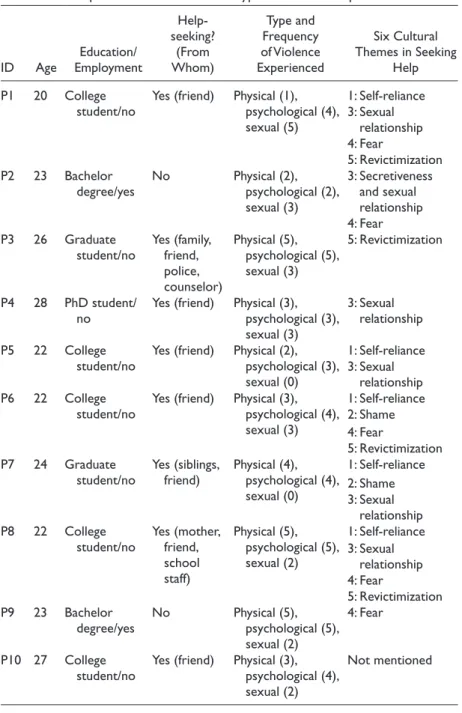
Table 1 shows the participants’ characteristics and the types of violence that the participants experienced with their partners. Participants’ ages ranged from 20 to 28 (M = 23.7). The majority of participants (80%) were college (includ-ing graduate) students; only 2 out of 10 were work(includ-ing. Two out of 10 partici-pants cohabited with their partners during the relationship. Most of them (8 out of 10) had experienced all three types of violence from their partner: physical, psychological, and sexual. The other two participants had experienced both physical and psychological violence but not sexual violence (P5 and P7). The lengths of the relationships ranged from more than 6 months to 4 years. All participants had ended the abusive relationships by the time of their participa-tion in the interviews. Seven of them had sought some help during the abusive relationship either from an informal system (e.g., family and friends) or from a formal support system (e.g., counselor and police), and 2 of them had sought no help at all (P2 and P9). One woman had told her friends about the violence only 3 years after the breakup of the dating relationship (P1).
Data-Collection Instrument and Procedure
Approval for conducting this study was obtained through the National Science Council in Taiwan. This study used semistructured, in-depth interviews with an interview guide to collect qualitative data. The interview guide explored questions related to the dating relationship, the dating-violence experiences (frequency, type, severity), the feelings and coping strategies of facing dating violence, the impact of dating violence (biological, psychological, social, etc.), and help-seeking behavior (yes or no, reasons). This article analyzes mainly
Table 1. Participants’ Characteristics and Types of Violence Experienced
ID Age EmploymentEducation/
Help-seeking? (From Whom) Type and Frequency of Violence Experienced Six Cultural Themes in Seeking Help P1 20 College
student/no Yes (friend) Physical (1), psychological (4), sexual (5) 1: Self-reliance 3: Sexual relationship 4: Fear 5: Revictimization P2 23 Bachelor
degree/yes No Physical (2), psychological (2), sexual (3) 3: Secretiveness and sexual relationship 4: Fear P3 26 Graduate
student/no Yes (family, friend, police, counselor) Physical (5), psychological (5), sexual (3) 5: Revictimization P4 28 PhD student/
no Yes (friend) Physical (3), psychological (3), sexual (3)
3: Sexual relationship P5 22 College
student/no Yes (friend) Physical (2), psychological (3), sexual (0)
1: Self-reliance 3: Sexual
relationship P6 22 College
student/no Yes (friend) Physical (3), psychological (4), sexual (3) 1: Self-reliance 2: Shame 4: Fear 5: Revictimization P7 24 Graduate
student/no Yes (siblings, friend) Physical (4), psychological (4), sexual (0) 1: Self-reliance 2: Shame 3: Sexual relationship P8 22 College
student/no Yes (mother, friend, school staff) Physical (5), psychological (5), sexual (2) 1: Self-reliance 3: Sexual relationship 4: Fear 5: Revictimization P9 23 Bachelor
degree/yes No Physical (5), psychological (5), sexual (2)
4: Fear P10 27 College
student/no Yes (friend) Physical (3), psychological (4), sexual (2)
Not mentioned
Note: (5) = always; (4) = most of the time; (3) = very often; (2) = seldom; (1) = once or twice; (0) =
data collected from participants’ responses to the “help-seeking behavior” question.
Prior to a given interview, the interviewer (the author) explained the research purpose and procedures to participants, emphasizing the voluntary and anonymous nature of the study. The interviewer also informed partici-pants of their rights to refuse or to discontinue the interview at any time. Following the reading and signing of the consent form, all interviews were conducted in Chinese, audiotaped, and transcribed for analysis. Each partici-pant was interviewed once and the 10 interviews lasted from 45 min to 2 hr. The interviewer compensated the participants with US$15 approximately per hour for the interviews.
Data Analysis
This study employed a thematic analysis to analyze qualitative data, specifi-cally using the Max.qda2 software. This method identifies recurring themes that would emerge from the interviews and, thereby, serves to illuminate participants’ experiences. Two research assistants separately and indepen-dently coded each interview transcript. Codes were generated from the data themselves in the course of the study. As the research assistants coded each interview transcript, they added to the list of codes and developed new ones to accommodate new data and new insights into those data. Those two sets of codes were then compared and discussed with the researcher (i.e., the author) so that one consensus code could be selected and so that major themes could be formed. The process of consensus seeking in coding increased the rigor of the analysis process by allowing both the assistants and the researcher to use multiple perspectives in their analysis. The researcher inferred cultural barriers from the views that females were expressing about their concerns and consid-erations in help seeking, captured by the codes and themes. The author translated quotations in the results section, and to best present the experi-ences of dating-violence victims, the author used direct quotations.
Results
This study found that culturally structured help-seeking decisions and behav-iors of victims of dating violence center on six primary themes: (a) self-reliant culture, (b) personal and family shame, (c) secretive and sexual dating rela-tionships, (d) fear of negative reactions from others, (e) unfamiliarity with available resources, and (f) revictimization in seeking help.
Self-Reliant Culture
Six participants in the present study decided to rely on themselves and did not reveal their dating-violence experiences to any member of their biological family because they did not want to burden their family. One woman identi-fied the reason for her silence relative to her family: “I won’t say any sad or painful things to my family . . . I told myself that I could get through this [dating violence] on my own and I decided to rely on myself.” Another woman explained, “I’ve never mentioned it [the dating violence] to my family because I am afraid that it might bring pressure on my family or make my parents feel sad or upset.” One woman had grown up in a single family and had seen her mother often crying because the participant’s father had left her mother with considerable debt. So this interviewed woman felt that she could face the abusive dating relationship only by herself because her mother was very sad already.
One woman thought that telling anyone about her victimization would not be helpful, so she decided not to seek help:
I really thought that it wouldn’t be helpful even if I told my friends. There wouldn’t be any real help. Maybe I’d feel better after I told someone if they were on my side. But the situation would remain the same. I’d still have to get along with him [her boyfriend].
This woman also felt that she had to rely on herself because she blamed herself partially for what had happened: “The reason I had to rely on myself was because I was responsible too. I wasn’t cautious enough. I let somebody have the chance to take advantage of me.”
Not only was telling family and friends not an option for some battered women but also formal resources or professional help were out of the ques-tion: “I never thought of this [counseling] as a resource to ask for help.”
One woman had not recognized the seriousness of dating violence in the first place and, thus, had sought no help. Her nonrecognition of the serious-ness rested, in part, on the absence of a long-term legal bond between two people who are dating each other:
I think very few people will seek any help at that moment [when dating violence occurs] . . . unless you’re married; then it becomes marital violence. That’s another thing. It [marriage] is a life-long thing where you’d need some kind of counseling. But this is dating. If it doesn’t work out, then you break up. No big deal. The relationship wasn’t going to last very long, so I didn’t feel like seeking any help.
Some battered women (n = 3) did tell a family member about the dating violence, but even in these cases, the informed family member might assume that the battered woman should be self-reliant. For example, one battered woman’s sister told her, “You have to solve this [the dating violence] on your own.”
Personal and Family Shame
The feeling of “shame” was clear in statements that emerged repeatedly during several interviews (the exact phrase used by the participants was losing face in Chinese). Feelings of personal or family shame often deter a battered woman from seeking help. For example, one woman stated, “I did not want to tell my mom because she might ask me about it all the time . . . I’d feel so ashamed.” She went on, “They [her parents] might think that their daughter is so shameful: cohabitating with someone and then getting battered by her boyfriend.”
The researcher observed that it was extremely difficult for battered women to reveal dating violence to others, especially their beloved families. During the interviews, most participants were calm most of the time. But when partici-pants talked about how their parents might feel if they knew that their daughters were being battered by boyfriends, several participants got tears in their eyes.
One participant’s boyfriend threatened her into doing whatever he wanted and into staying with him because he had taken naked photos of her while she was taking a nap in his house. One day, she had contact with a policeman and, thus, had a chance to seek help. She refused to take advantage of the opportunity, however, because she worried that the consequences of seeking help might eventually bring shame on her.
One day I felt depressed and sat by the road crying after I left his [her boyfriend’s] house. A policeman saw me and asked me what had hap-pened. I didn’t say anything. The policeman said, “If you need any help, you can come to the police station to ask for help.” But I didn’t go . . . I never thought about going to the police because I thought that telling the police would be useless. And maybe a media reporter would come . . . I might even show up on TV, which would be very shameful.
Secretive and Sexual Dating Relationships
Four participants kept their dating or cohabitating relationships a secret for several reasons. One couple, who were classmates, did not want other class-mates to tease them. Some other women were dating at a very young age and
were afraid of parents’ condemnation of the dating relationship. In these kinds of situations, it was too difficult for the corresponding participant to reveal any dating violence to her family or friends as both family and friends had no idea that the participant was dating in the first place. The secrecy of the dating relationship became a barrier to seeking help: “I didn’t want others to discover it [dating violence] because I thought it [dating violence] was too scary. Especially when things start to get worse, you just get more afraid of letting others know, and then it becomes even scarier.”
Another reason for keeping the dating relationship a secret concerned the presence of sexual activity in the relationship. Sex is a taboo issue in most Taiwanese families, and family members rarely discuss sexual issues with each other: “Some things are really difficult to speak about to them [family] such as problems in a sexual relationship. I think it’s really difficult to talk about something like that with family.”
Participants also blamed themselves for sexual-violence victimization because they had “failed” to heed their parents’ or teachers’ advice “to pro-tect their body.” “I was afraid to tell her [the mother],” one participant revealed, “because a long time ago she had told me to maintain boundaries with my boyfriend. She’d said, ‘You can date, but you have to protect your body; do not have premarital sex.’” This participant is one of those who had sought no help (P2) mainly because of the secretive dating relationship and the sexual-victimization experience. She and her boyfriend were classmates, and her boyfriend had asked her to keep their dating relationship a secret to prevent other classmates’ teasing. So she could not tell her friends (i.e., her classmates) because none of her friends knew that she was dating in the first place. Her boyfriend had forced her to perform oral sex on him several times. She felt disgusting and decided to break up with him. On the day of the breakup, the boyfriend raped her. She said, “After the rape, I took a shower. I washed and washed again. I felt so dirty . . . I did not have the face to tell anyone.” She thought about going to church to seek peace and help but decided not to because of self-blame. She said,
I was afraid to go to church because [paused for 12 seconds] I felt I’d offended it. I felt it [church] is a divine and pure environment. I was told at school not to engage in premarital sex, but I didn’t listen. What a fool I was!
Fear of Negative Reactions From Others
Five participants were afraid of the potential consequences of telling others. These participants had concerns over their family’s safety and friends’ reactions.
Three of these five participants were afraid that the abusive partner might hurt a family member as well as her if her parents learned of their daughter’s ordeal: “I was afraid if I told my parents, they’d be very angry. And they would go find him [the boyfriend], and he might hurt a family member because he had psychological problems. So, I decided not to tell.” Another participant said, “I was afraid that my mom would kill my boyfriend if she knew what he’d done to me.”
Two of these female participants also feared losing any friend to whom they might reveal the dating violence:
I was afraid of being hurt a second time if I told anyone and they didn’t respond kindly . . . I didn’t have too many friends. I was so afraid that I’d lose my friends if I told them and they couldn’t understand me. Another woman (P9) was not seeking help from anyone because she was afraid that her parents would feel very sad and angry if they knew what had happened. In addition, she and her boyfriend were a fairly well-known couple in their class. She was concerned that, if she told her classmates about the abusive relationship, their subsequent negative reactions toward her boyfriend would undermine his peer relationships. As she thought that she could not tell anyone, her coping strategy was to endure, to cry a lot, to fight back verbally at her boyfriend, and to try to forget the whole thing. Indeed, her coping mechanisms did not differ significantly from those exhibited by the other participants, who feared multiple types of negative scenarios stemming from telling a third party. Severally or individually, they coped with dating violence by enduring, crying, obeying partners’ demands to avoid further violence, fighting back verbally, writing diary entries, talking to a pet, or breaking up with the abusive partner in question.
A majority of the participants eventually told at least one third party about the violence after they came to a point at which further endurance of the abu-sive relationship felt impossible and the formidable influence of cultural bar-riers could no longer maintain the participants’ silence. When victims sought help, they often turned to informal support systems such as family and friends (n = 8). But family and friends’ help was sometimes inappropriate, indifferent, or limited to emotional or material support. The following quotes are partici-pants’ remarks regarding this matter: “I called my high school classmates to tell them about it [dating violence] and I was crying all the time, while they just listened to me.” “My friends didn’t help me. But they listened to me, which helped me to release my emotions.” “I told my friends that he hit me. . . . They comforted me and told me just to break up with that bad guy.” “There
was a classmate who lived right next to us. He [the classmate] was afraid of getting involved. He thinks that it [dating violence] is a private matter.”
Some friends offered concrete help. One participant got pregnant because of her boyfriend’s sexual abuse. Owing to her feelings of shame, she felt that she could not tell her mother about the situation. This particular participant relied on her best friend as a confidante, who addressed the pregnancy by referring the participant to a gynecologist (for information about abortions). This friend also asked her own mother to prepare some nutriments for the participant after she had gone ahead with an abortion. When the participant’s mother saw the nutriments by accident, she recognized them as serving mater-nity purposes. So the participant had to admit the pregnancy to her mother. To her surprise, the participant’s mother did not blame her as she had feared.
The friend of another participant learned about the latter’s experience of dating violence and, after learning also that the ex-boyfriend was stalking them, suggested that the participant reveal the dating violence to the school staff. In fact, after the breakup, the ex-boyfriend had sent letters to the partici-pant and had vowed that her whole family would meet with death. The par-ticipant felt threatened and was worried about her safety, so she told the school staff that if some untoward event were to befall her, her ex-boyfriend should be the prime suspect.
Unfamiliarity With Available Resources
Three participants did not seek help simply because they did not know who could help them:
I was helpless. I didn’t know whom I could ask for help. I didn’t know whom I could talk with. When it first happened [the battery], my first thought was fear; the second thought was shame. How could such things happen? It should only happen on TV shows.
Participants were unfamiliar with the available formal services helping dating-violence victims: “I’d been thinking that I should go to a Family Violence Prevention and Treatment Center for things like this [dating violence], but since I wasn’t married, it would’ve been kind of strange to tell the center about it.”
Revictimization in Seeking Help
There was one participant (P3) who was actively seeking help from multiple sources. However, it turned out that she got revictimized while trying to get help. None of her support systems worked for her. She suffered severe physical
and psychological abuse from multiple consecutive boyfriends for a total of 4 years, which was the longest victimization period among all of the partici-pants. She first sought help from her friends because she had suffered severe beatings at the hands of her boyfriend and because she felt as though the situ-ation was no longer tolerable. This woman stated,
It was obvious that my friends were all assholes. I had more male friends [because of her major]. Male friends told me that women deserve to be battered. . . . I had a female friend who was also an ass-hole. She [the female friend] said, “I think it’s your fault. . . . Your boyfriend looks OK and normal. Normal persons don’t hit people. So, he couldn’t be a batterer. If he batters you, it must be your fault.”’ As the participant could not get support from her friends, she went to her mom: “I told my mom, with whom I don’t have a close relationship. My mom said, ‘He hits you because it’s your fault.’” She also confided in her brother and sister, whose response was that she should solve the problem by herself. Then the participant sought help from formal support systems, including a counselor, her advisor at school, and the police.
The school counselor could not help me. After I told my story to the counselor, she really felt sorry for me. She even cried. She said, “Only God can help you.” So she brought me to church. But I was very much against religion back then. So I felt I hadn’t gotten help in the way I wanted.
On one occasion, this participant went to a police station after her boyfriend had forcibly detained her in his house for several days, causing her to miss several school exams. After she escaped from her boyfriend’s house with a friend’s help, she raced to the aforementioned police station to report her case. However, she did not get the formal help there that she needed: “At first, the policeman didn’t want to take my case at all. He said there are too many cases like this. He said it’s very normal for boyfriends to hit their girlfriends.”
Discussion
The present study’s author interviewed 10 female victims of dating violence and found that women in this study were first victimized and were then pres-sured to conceal their victimization because of internalized or imagined barriers rooted in Chinese patriarchal, collectivistic, and self-reliant culture. These
barriers, once the victims had internalized them, took the form of self-reliance, shame, fear, helplessness, and secretive and sexual dating relationships.
In a culture that emphasizes self-reliance, two women in the present study did not seek help at all, even when they were mistreated and severely battered by their boyfriends. Neither informal nor formal resources were options for them. Not only did these women experience pressure not to burden their families but also Chinese culture stigmatizes people who seek professional help for relationship problems. As a result, seeking professional help to deal with IPV issues (before they grow worse or out of control) is rarely an option for the majority of Asians (Nguyen, 2005). The current study’s findings that some participants herein exhibited an internalized culture of self-reliance and sometimes sought no help at all (a) are consistent with previous studies’ find-ings and (b) shed light on Chinese peoples’ reluctance to seek help and these peoples’ inclination to practice self-concealment (Chiu, 2004; Kung, 2003; Liao et al., 2005).
The present study’s findings also reveal that feelings of personal shame, fear of family shame, fear of losing friendships, and fear of endangering a family’s safety can prevent battered women from seeking help. These findings match previous research findings that shaming oneself and one’s family are simply unthinkable in Chinese culture and that, regarding situations where acts of victimization are revealed, victims tend to anticipate negative reactions from others; these factors keep many battered women from seeking help (Ho, 1990; Lee, 2000; Lee & Law, 2001; Nguyen, 2005; Yick, 2007; Yu, 2005).
Some battered women in the present study did not seek help because they were unaware of available services and therefore felt helpless. This finding is consistent with previous studies’ findings indicating that many battered women are not familiar with formal resources available for dealing with IPV (Lee, 2000). This finding suggests that, in Taiwan, there should be more publicity concern-ing the available resources for dealconcern-ing with datconcern-ing violence. Effective dissemi-nation of information about dating violence and about services available to battered women is a necessary step in reaching out to this population.
Battered women commonly face tremendous barriers in seeking help, such as shame/stigmatization, fear of retaliation from the abuser, concern for their children, and isolation from a viable support system; married abused Asian women confront additional obstacles such as cultural expectations of keeping family affairs private, of enduring abuse, and of women’s responsi-bility for maintaining family harmony (Lee & Hadeed, 2009). In comparison with married battered women, this study uncovers the unique, culturally structured challenge faced by dating-violence victims: the secretive and sexual dating relationship. In traditional Chinese and other Asian cultures, sex is a taboo issue unfit for discussion, especially among family members, and most
parents expect their daughters to avoid premarital sex (Yoshihama et al., 1998). As the mother of one participant said to the daughter, “You can date, but you have to protect your body; do not have premarital sex.” Although dating itself is not a taboo activity, premarital sex is forbidden by most Chinese parents. Hence, if there is sexual violence involved in premarital sex, it is extremely difficult for the adult children who are victims of this violence to talk about it with their parents. Moreover, when violence occurs in a secret dating relationship (regardless of whether premarital sex is taking place), bat-tered women feel pressure to keep the dating relationship and, therefore, the violence secret from their parents, heightening the women’s sense of fear and isolation. Battered women not only fear violence but also their parents’ reac-tions (Yoshihama et al., 1998).
The research findings in the current study show that the participants who sought help were more likely to seek help from informal sources, including family and friends, than from formal sources (e.g., social work professionals and the judicial system). The finding of this informal-to-formal help-seeking pattern is consistent with findings from previous studies conducted in Taiwan (Shen, 2008; Wang & Chen, 2004) and other countries such as the United States (e.g., Black, Tolman, Callahan, Saunders, & Weisz, 2008) and Australia (e.g., Chung, 2007). The type of help provided by informal systems would be limited primarily to material support, emotional support such as a sympa-thetic ear, or advice that the victim should leave the abuser. Some family and friends’ reactions even reflected misconceptions, steeped in Chinese culture, concerning dating violence, including the assumptions that “dating violence is a private matter,” “it’s OK or very normal for a boyfriend to hit his girl-friend,” and “women provoke men’s violence.” The finding of these miscon-ceptions is consistent with a previous study conducted in Taiwan and mainland China (including Hong Kong; Tang et al., 2002). These misconcep-tions might result from the cultural belief that adult women have a high level of control over what happens to them and, hence, should accept responsibility for the violence they experience. As a result, blame and shame are assigned to the woman who has been assaulted rather than to the perpetrator. In other words, some participants were further victimized when they tried to seek help from either informal or formal support systems, owing to conventional perceptions held by the Chinese community; in this regard, it should not be surprising that a police officer declared to one participant, “It is very normal for boyfriends to hit their girlfriends.” These results corroborate previous research findings that adult female victims of IPV continue to face difficul-ties or further victimization in seeking help (Lee & Hadeed, 2009).
In addition, although Taiwan has established laws that grant protection to victims of family violence (i.e., the Family Violence Prevention and
Treatment Act), the corresponding responses from Taiwanese law enforce-ment may not reflect the introduced changes. As a result, battered women would sometimes lack much-needed protection from the legal system. Such an inconsistency between laws and their execution by law enforcement may reflect the discrepancy between the changes proposed and the cultural beliefs held by the society (Fernández, 2006).
It is important to examine the help-seeking behaviors of female dating-violence victims from cultural perspectives, but this importance does not imply that the female victims’ help-seeking behaviors and experiences are entirely and necessarily culture specific. Furthermore, the six themes identi-fied by this study may not be unique to Taiwanese women. Those themes might have the same influence on female victims of other ethnic groups (such as other patriarchal or collectivistic societies).
Practice and Policy Implications
The ultimate purpose of the empirical study on dating violence is prevention (Lewis & Fremouw, 2001). A multilevel prevention strategy is needed to prevent dating violence in the Taiwanese context, at both the macro and micro levels. On the macro level, the first and most important step is to begin educating the Taiwanese community concerning the concept and damaging consequences of dating violence. Advocacy is also needed to change the stereotypes or misconceptions of dating violence in Chinese cul-ture. Cultures are not fixed and are changed constantly. The culture of the current generation is different from the cultures of preceding generations (Rimonte, 1991). For example, a previous study (Tang et al., 2002) found that younger and more educated Chinese (including young adults in Taiwan) were more likely to reject various cultural myths, oppose victim-blaming explanations, and disrupt proviolence social scripts against women than were older and less educated Chinese. Young and educated individuals might have the potential to help change Chinese conceptions of women as legitimate victims of violence.
Another effective way to change the culture is to craft laws that prohibit dating violence explicitly and to protect and empower all unmarried victims by providing them with legal rights and choices. The criminalization of dating violence is nothing short of a message, sent by the overall community, declaring that society will practice zero tolerance of dating violence by holding offenders responsible instead of blaming victims. For example, the United States has passed criminal statutes to protect all battered women, regardless of their marital status (e.g., Violence Against Women and Department of Justice
Reauthorization Act of 2005; Office on Violence Against Women, 2010). In contrast with the United States, the existing law in Taiwan (called the Family Violence Prevention and Treatment Act) defines only violence against family members (such as spouses) or against cohabiting partners as a crime, not violence against dating partners. In other words, the existing justice system in Taiwan does not afford protection to dating-violence victims unless they are married to or cohabiting with abusive partners. Taiwan must eliminate this critical loophole in the state’s violence-prevention law to combat dating violence effectively.
The present findings suggest that dating-violence victims in Taiwan are unlikely to seek help directly from school counselors or helping professionals in the wider community. However, the victims appear likely to talk to their friends about their violent dating experiences. Thus, more publicly disseminated educa-tion about violence across different kinds of relaeduca-tionships is needed so that when dating-violence victims open up to friends about violence, these friends will be more likely to listen sympathetically and to respond appropriately.
On the micro and practice level, knowing about these cultural barriers helps practitioners to understand the ambivalence and the shame that many Taiwanese women feel in response to dating violence. Seeking assistance from an outsider is often a new experience for most Chinese. When working with Chinese victims of dating violence, the first step to building rapport is to acknowledge victims’ feelings of guilt, shame, loss of face, doubt, and ambivalence about seeking help (Yick et al., 2003), and then both to help women overcome these feelings and to acknowledge the women’s courage in seeking help. It is also important to understand the ways in which certain cultural beliefs reinforce behavior. However, the victim must decide for her-self what aspects of her culture to retain or discard (Rimonte, 1991).
Researchers (Lee, 2000; Liang et al., 2005) point out that the help-seeking decisions and behaviors of battered women are often multifaceted and multi-layered, influenced by cultural, contextual, and individual factors. Therefore, it is important to have a contextual analysis of battered women’s experiences that includes the woman’s unique individual and sociocultural context. However, it is also a disservice to battered women if practitioners take on a single vision of their experiences based solely on an understanding of cultural factors.
Study Limitations
A limitation of qualitative research is the degree of generalizability of the findings across settings. The current study’s sample size is small and partici-pants were relatively young and were recruited mainly from Internet (BBS)
users; therefore, the sample is representative of neither populations of older women nor populations of women lacking access to the Internet. Another limitation might be due to participants’ higher level of education, which might reflect a middle-class bias in the sample and may not be representa-tive of the population of women who have received less formal education. Also, the current study collected data only from Taiwanese women, a fact that limits the degree to which the findings can be generalized to women in other Confucianism-dominated Chinese societies (e.g., mainland China or to one of its somewhat culturally distinct regions such as Hong Kong). In addition, the retrospective design of the current study perhaps elicited responses different from those that would characterize a study examining the experiences of women at various stages of an intimate relationship, such as before and after the relationship’s breakup. Nevertheless, this study rep-resents an initial attempt at understanding the cultural barriers that female victims of dating violence face in seeking help. Given the extremely sensi-tive nature of this research topic and the scant empirical evidence regarding cultural perspectives of the topic, the present findings from a small number of young women can be meaningful in practice and helpful in directing fur-ther research.
Conclusion
Dating-violence victims as a subpopulation of battered women present a unique challenge. Their help-seeking decisions and behaviors regarding per-sonal experiences of dating violence were additionally burdened by traditional Chinese cultural beliefs and values privileging such structures as patriarchy, collectivism, and self-reliance. Findings of this study highlight the need for culturally sensitive interventions on behalf of dating-violence victims. Although the study findings are exploratory, the hope is that the young females who suffer dating violence will no longer be completely invisible and voiceless.
Declaration of Conflicting Interests
The author(s) declared that they had no conflicts of interests with respect to their authorship or the publication of this article.
Funding
The author(s) disclosed that they received the following support for their research and/ or authorship of this article: The contributor received research grant (NSC 95-2412-H-002-005) from the National Science Council in Taiwan to conduct this study.
References
Abraham, M. (2000). Speaking the unspeakable: Marital violence among South Asian immigrants in the United States. New Brunswick, NJ: Rutgers University Press. Archer, J. (2006). Cross-cultural differences in physical aggression between partners:
A social-role analysis. Personality and Social Psychology Review, 10, 133-153. Bernard, M. L., & Bernard, J. L. (1983). Violent intimacy: The family as a model for
love relationships. Family Relations, 32, 283-286.
Black, B., Tolman, R., Callahan, M., Saunders, D., & Weisz, A. (2008). When will adolescents tell someone about dating violence victimization? Violence Against Women, 14, 741-758.
Chiu, M. Y. L. (2002). Help-seeking of Chinese families in a Hong Kong new town. Journal of Social Policy and Social Work, 6, 221-240.
Chiu, M. Y. L. (2004). Why Chinese women do not seek help: A cultural perspective on the psychology of women. Counseling Psychology Quarterly, 17, 155-166. Chung, D. (2007). Making meaning of relationships: Young women’s experiences and
understandings of dating violence. Violence Against Women, 13,1274-1295. Fernández, M. (2006). Cultural beliefs and domestic violence. Annals of the New York
Academy of Sciences, 1087, 250-260.
Ho, C. (1990). An analysis of domestic violence in Asian American communities: A multicultural approach to counseling. Women & Therapy, 9, 129-150.
Hsiu, H. L., & Sun, S. H. (2003). The measurement and investigation of dating vio-lence among college students. Journal of Education & Psychology, 26, 471-499 (in Chinese).
Jin, X., Eagle, M., & Yoshioka, M. (2007). Early exposure to violence in the family of origin and positive attitudes towards marital violence: Chinese immigrant male batterers vs. controls. Journal of Family Violence, 22, 211-222.
Kaura, S. A., & Lohman, B. J. (2007). Dating violence victimization, relationship satisfaction, mental health problems, and acceptability of violence: A comparison of men and women. Journal of Family Violence, 22, 367-381.
Kung, W. W. (2003). Chinese Americans’ help seeking for emotional distress. Social Service Review, 77, 110-134.
Lam, C. M. (2007). Not grown up forever: A Chinese conception of adolescent devel-opment. Hauppauge, NY: Nova Science Publishers.
Lee, M. Y. (2000). Understanding Chinese battered women in North America: A review of the literature and practice implications. Journal of Multicultural Social Work, 8, 215-241.
Lee, M. Y., & Law, P. F. M. (2001). Perception of sexual violence against women in Asian American communities. Journal of Ethnic & Cultural Diversity in Social Work, 10(2), 3-25.
Lee, Y. S., & Hadeed, L. (2009). Intimate partner violence among Asian immigrant communities: Health/mental health consequences, help-seeking behaviors, and service utilization. Trauma, Violence, & Abuse, 10, 143-170.
Lewis, S. F., & Fremouw, W. (2001). Dating violence: A critical review of the literature. Clinical Psychology Review, 21, 105-127.
Liang, B., Goodman, L., Tummala-Narra, P., & Weintraub, S. (2005). A theoretical framework for understanding help-seeking processes among survivors of intimate partner violence. American Journal of Community Psychology, 36, 71-84. Liao, H. Y., Rounds, J., & Klein, A. G. (2005). A test of Cramer’s (1999)
help-seeking model and acculturation effects with Asian and Asian American college students. Journal of Counseling Psychology, 52, 400-411.
Makepeace, J. M. (1981). Courtship violence among college students. Family Relations, 30, 97-102.
Midlarsky, E., Venkataramani-Kothari, A., & Plante, M. (2006). Domestic violence in the Chinese and South Asian immigrant communities. Annals of the New York Academy of Sciences, 1087, 279-300.
Nguyen, T. D. (2005). Overview: Asian American communities and domestic vio-lence. In T. D. Nguyen (Ed.), Domestic violence in Asian American communities: A cultural overview (pp. 1-11). New York: Lexington Books.
Ocampo, B. W., Shelley, G. A., & Jaycox, L. H. (2007). Latino teens talk about help seeking and help giving in relation to dating violence. Violence Against Women, 13, 172-189.
Office on Violence Against Women. (2010). About dating violence. Retrieved January 20, 2010, from http://www.ovw.usdoj.gov/teen_dating_violence.htm
Rimonte, N. (1991). A question of culture: Cultural approval of violence against women in the Pacific-Asian community and the cultural defense. Stanford Law Review, 43, 1311-1326.
Russo, N. F., & Pirlott, A. (2006). Gender-based violence concepts, methods, and findings. Annals of the New York Academy of Sciences, 1087, 178-205.
Shek, D. T. L. (1998). Help-seeking patterns of Chinese parents in Hong Kong. Asia Pacific Journal of Social Work, 8, 106-119.
Shen, A. C. T. (2008, March). Coping strategies of dating violence: A national study of Taiwanese college students. Paper presented at Family Aggression: Causes & Consequences, the First Biennial Conference of the International Family Aggres-sion Society, Preston, UK.
Straus, M. A. (1979). Measuring intrafamily conflict and violence: The conflict tactics (CT) scales. Journal of Marriage and Family, 41, 75-88.
Straus, M. A. (2004). Prevalence of violence against dating partners by male and female university students worldwide. Violence Against Women, 10, 790-811.
Tang, C. S. K., Wong, D., & Cheung, F. M. C. (2002). Social construction of women as legitimate victims of violence in Chinese societies. Violence Against Women, 8, 968-996.
Wang, L. R., & Chen, F. L. (2004). Intimate violence and help-seeking behavior analyses. Paper presented at the Social Welfare Development in Taiwan: Global-ization vs. LocalGlobal-ization Conference, Taipei, Taiwan.
Yick, A. G. (2007). Role of culture and context: Ethical issues in research with Asian Americans and immigrants in intimate violence. Journal of Family Violence, 22, 277-285.
Yick, A. G., & Agbayani-Siewert, P. (2000). Dating violence among Chinese American and White students: A sociocultural context. Journal of Multicultural Social Work, 8, 101-129.
Yick, A. G., Shibusawa, T., & Agbayani-Siewert, P. (2003). Partner violence, depres-sion, and practice implications with families of Chinese descent. Journal of Cul-tural Diversity, 10, 96-104.
Yoshihama, M., Parekh, A. L., & Boyington, D. (1998). Dating violence in Asian/ Pacific communities. In B. Levy (Ed.), Dating violence: Young women in danger (pp. 184-195). Seattle, WA: Seal Press.
Yu, M. M. (2005). Domestic violence in the Chinese American community. In T. D. Nguyen (Ed.), Domestic violence in Asian American communities: A cul-tural overview (pp. 27-38). Lanham, MD: Lexington Books.
Bio
April Chiung-Tao Shen, PhD, is an associate professor at the department of social work, National Taiwan University. Her research interests include child maltreatment, intimate partner violence, and family relationships.