Spin relaxation dynamics of quasiclassical electrons in ballistic quantum dots
with strong spin-orbit coupling
Cheng-Hung Chang,1,4A. G. Mal’shukov,2and K. A. Chao3
1National Center for Theoretical Sciences, Physics Division, 101, Section 2 Kuang Fu Rd., Hsinchu 300, Taiwan 2Institute of Spectroscopy, Russian Academy of Science, 142190 Troitsk, Moscow oblast, Russia
3Solid State Theory, Department of Physics, Lund University, S-223 62 Lund, Sweden 4National Chiao Tung University, Institute of Physics, 300 Hsinchu, Taiwan
(Received 4 May 2004; revised manuscript received 27 August 2004; published 13 December 2004)
We performed path integral simulations of spin evolution controlled by the Rashba spin-orbit interaction in the semiclassical regime for chaotic and regular quantum dots. The spin polarization dynamics have been found to be strikingly different from the D’yakonov-Perel’ (DP) spin relaxation in bulk systems. Also an
important distinction has been found between long time spin evolutions in classically chaotic and regular systems. In the former case the spin polarization relaxes to zero within relaxation time much larger than the DP relaxation, while in the latter case it evolves to a time independent residual value. The quantum mechanical analysis of the spin evolution based on the exact solution of the Schrödinger equation with Rashba SOI has confirmed the results of the classical simulations for the circular dot, which is expected to be valid in general regular systems. In contrast, the spin relaxation down to zero in chaotic dots contradicts what has to be expected from quantum mechanics. This signals on the importance of quantum effects missed in the semiclas-sical simulations for long time spin dynamics.
DOI: 10.1103/PhysRevB.70.245309 PACS number(s): 72.25.Rb, 72.25.Dc, 73.63.Kv, 03.65.Sq
I. INTRODUCTION
Spin relaxation in semiconductors is an important physi-cal phenomenon being actively studied recently in connec-tion with various spintronics applicaconnec-tions.1 In doped bulk samples and quantum wells(QW) of III-V semiconductors at low temperatures spin relaxation is mostly due to the D’yakonov-Perel’(DP) mechanism.2 This mechanism does not involve any inelastic processes, so that the exponential decay of the spin polarization is determined entirely by the spin-orbit interaction(SOI) and elastic scattering of electrons on the impurities. However, in case of confined systems such as quantum dots(QD) with atomiclike eigenstates, the SOI has been incorporated into the structure of the wave func-tions of the discrete energy levels. Without inelastic interac-tions, an initial wave packet with a given spin polarization will evolve in time as a coherent superposition of these dis-crete eigenstates. Therefore, the corresponding expectation value of the spin polarization will oscillate in time without any decay. To obtain a polarization decay in the QD’s, extra effects have to be introduced into the system, e.g., the inelas-tic interactions between electrons and phonons mediated by the spin-orbit3,4 and nuclear hyperfine effects.3,5,6 Accord-ingly, a spin relaxation in QD’s induced by these effects is a real dephasing process.
Unlike such an inelastic relaxation in QD’s, the DP spin relaxation in unbounded systems seems to be quite a differ-ent phenomenon, because the scattering on impurities is elas-tic and there is no dephasing of the electron wave functions in the systems. However, the spin polarization does decay in time exponentially, as if it would be a true dephasing pro-cess. To explain this phenomenon, let us consider an electron moving diffusively through an unbounded system with ran-dom elastic scatters. This electron is described by a wave
packet represented by a superposition of continuum eigen-states. During a DP relaxation process, the spin expectation value expressed as a bilinear combination of these wave am-plitudes will decay exponentially in time. This process can be easily understood from the semiclassical Boltzmann or Fokker-Planck approach.2 Indeed, keeping in mind that the SOI has the form · h共k兲, where is the vector, whose components are the three Pauli matrices, and h共k兲 is the effective magnetic field, whose magnitude and direction de-pend on the electron momentum k, one can envision spin relaxation as the spin random walk on the surface of the unit sphere, similar to that in Fig. 1(c). Starting at the north pole, the spin precesses around h共k1兲 until the momentum direc-tion is changed by a scattering on an impurity. Thereafter, the magnetic field changes its direction to h共k2兲 and the spin continues its precession around this direction. If the spin ro-tation angle between successive scattering events is small, the sequence of such rotations results in a diffusive spreading of the initial polarization.
Returning to QD’s, a natural question emerges: What sort of spin evolution can be generated by the DP mechanism in a ballistic QD whose size is much larger than the electron wavelength at the Fermi surface and where the mean spacing between energy levels is much less thanប/T, where T is the mean time between electron collisions with the boundary? Similar to the example in Fig. 1, the spin evolution in this semiclassical regime can be studied by tracking the spin walk on the sphere, when particles move along the classical trajectories inside the QD’s. Intuitively, one would expect the spin evolution in this case to be similar to the spin random walk governed by the impurity scattering in unbounded samples. However, this expected analogy with the open sys-tem is wrong. Indeed, in an unbounded syssys-tem, the steps of the random walk are uncorrelated. This results in a diffusive
decay of the spin polarization down to zero for any nonzero SOI. But in case of QD’s, the steps of the random walk on the sphere are correlated due to the confinement of electron trajectories within the dots. As we will show below, such correlations not only lead to a spin relaxation much longer than the DP relaxation in unbounded systems, but also to a nonzero final polarization value at long time for certain quantum dot geometries. Here, we do not take into account the inelastic mechanisms3–6which always drive the spin po-larization to zero in long time. These mechanisms are as-sumed to be absent, because they become inefficient at suf-ficiently low temperatures. By this reason we will also neglect spin relaxation associated with electron-electron col-lisions in doped QW.7
It should be noted that a tendency for slowdown of the DP relaxation in confined geometries has been also found out for disordered quantum wires,8,9diffusive two-dimensional(2D) strips,10near the edge of 2D gas,11and in the recent study on quantum dots.12 Therefore, the strong distinction of the DP relaxation in QD from that in bulk systems confirms this tendency.
In this paper, we carry out a semiclassical analysis of the DP relaxation in two-dimensional QD’s of various geom-etries, including a circular dot, a triangular dot, a generalized Sinai billiard, and a circular dot with diffusive scattering on the boundary. Note that although such 2D systems are called QD’s, the confinement in the 2D plane does not lead to strong quantization and the electronic motion can be studied semiclassically. We focus on the case of the strong SOI, such
that the characteristic spin orbit length Lso⬅vF/បh共kF兲 is not much larger than the dot size L. Such a regime can be real-ized in the InAs based heterostructures for L⬃0.5−1m.13 We found that in the short time scale⬃T the spin relaxation dynamics in all geometries shares a common feature: After a fast initial drop during the time interval⬃T, the spin polar-ization continues to oscillate weakly around some value. For weak SOI with LsoⰇL, all residual values for different dot geometries are quite close to one up to the cutoff time of our numerical simulations 共⬃103T兲. For stronger SOI with L
so
艌L, the initial drop of the spin polarization is considerably
larger compared to the weak SOI regime. The spin evolution after that drop depends on the dot geometry. In the case of circular and triangular dots, which are examples of systems with regular classical dynamics, the corresponding spin po-larizations approach nonzero residual values. However, in the case of chaotic and random systems (e.g., Sinai billiard and circular dot with rough boundaries, respectively), the spin polarizations slowly decrease to zero after that initial drop. But this decreasing is much longer than the DP relax-ation in an unbounded system, in which the mean impurity scattering time is⬃T. For very strong SOI with Lso⬍L, the spin polarization after the initial drop reaches zero and later on oscillates with a large amplitude.
These results clearly demonstrate that the spin evolution in QD’s is qualitatively distinct from the DP spin relaxation in unbounded systems. In order to elucidate the physical ori-gin of this phenomenon, two investigations have been per-formed. First, the spin evolution along a single electron tra-jectory was studied in detail, which provided a clue for understanding the above-mentioned polarization behavior. Second, the residual polarization obtained from the classical simulations for a circular quantum dot was compared with that derived from the exact solution of the Schrödinger equa-tion. A good agreement between the results from these two approaches has been found. However, for QD’s with chaotic and random electron dynamics, the general quantum me-chanical analysis revealed a contradiction to the long time spin evolution observed in our semiclassical simulations.
The paper is organized in the following way. In Sec. II, the general expression of the polarization will be derived for the spin evolution via classical path integrals. In Sec. III, the results of the numerical simulations in different quantum dots will be demonstrated. The quantum mechanical theory for the spin polarization in the circular quantum dot will be presented in Sec. IV, with the calculation in detail shown in the Appendix. Discussion and conclusion will be given in Sec. V.
II. PATH INTEGRALS FOR THE SPIN EVOLUTION
The Hamiltonian of the system
H = H0+· h共kˆ兲, 共1兲 consists of the spin independent part H0, which is the elec-tron kinetic energy plus the 2D confining potential V共r兲, and the spin-orbit interaction. In III-V semiconductor hetero-structures the effective “magnetic” field h共kˆ兲 is given by the FIG. 1.(Color online) (a) Electron motion inside a quantum dot.
The trajectory consists of three straight segments␥1,␥2, and␥3.(b) The corresponding spin evolution on the sxsy plane, which is
pro-jected from(c). (c) The spin evolution induced by the Rashba
sum of the Bychkov and Rashba14 and the Dresselhaus15 terms. If the z axis is chosen perpendicular to the heterostruc-ture interface, the magnetic field hR contributing to the
Rashba term has two components 关hRx共kˆ兲,hRy共kˆ兲兴=共␣Rkˆy,
−␣Rkˆx兲, where បkˆ=共បkˆx,បkˆy兲 is the momentum operator. In
the 2D confinement, the magnetic field hDcontributing to the
Dresselhaus term contains both linear and cubic parts with respect to kˆ.16In a[001] oriented QW the linear term has the components 关hDx共kˆ兲,hDy共kˆ兲兴=共␣Dkˆx, −␣Dkˆy兲. For
heterostruc-tures with a typical⬃10 nm confinement in the z direction, the linear part of hD is usually larger than the cubic part,
except the case of high doping concentration.17The Rashba term is not zero only in heterostructures with asymmetry in their growth direction. This term can be much larger than the Dresselhaus term in the narrow gap InAs based systems.12In this paper we will study the spin evolution induced by the Rashba term. But, since the SOI Hamiltonians corresponding to the Rashba and the linear Dresselhaus terms can be trans-formed from one to the other by the unitary matrix 共x
+y兲/
冑
2, our results are also valid for systems in which thelinear Dresselhaus term dominates the SOI.
Let us suppose En to be the nth quantized energy level with the eigenfunctionn, which is a two component spinor.
At zero magnetic field this quantum state is at least doubly degenerate. Let
共r兲 = eik·r⌽共r − R兲 共2兲
be the wave packet created at time t = 0, centered at the point
R, and propagating with the 2D wave-vector k. The function
⌽共r兲 is assumed to be slowly varying within the scale of the
electron wavelength 2/ k and normalized, so that the inte-gral兰兩⌽共r兲兩2d2r over the QD volume is equal to 1. The ini-tial spin polarization P共0兲=兺␣␣*␣is the sum over the two components␣ of the spinor, where␣苸兵1,2其. For t
⬎0, the wave packet evolves in time as
共r,t兲 =
兺
n cnn共r兲e−i Ent/ប, 共3兲 where cn=冕
n †共r兲共r兲d2r. 共4兲 In terms of 共r,t兲 the time dependent spin polarization is expressed asP共t兲 =
兺
␣
冕
␣*共r,t兲
␣共r,t兲d2r, 共5兲
with three components P共t兲=关Px共t兲, Py共t兲, Pz共t兲兴.
For further analysis it is convenient to introduce the re-tarded and advanced Green’s functions
G␣r 共t − t
⬘
,r,r⬘
兲 = G␣a*共t⬘
− t,r⬘
,r兲 =− i兺
n n␣共r兲n * 共r⬘
兲e−iEn共t−t⬘兲⌰共t − t⬘
兲, 共6兲which are 2⫻2 matrices acting on the SU共2兲 spin space, where ⌰共t−t
⬘
兲 is the Heaviside function. Using these Green’s functions, the spin-spin correlation function can be defined asKij共r,r
⬘
;t − t⬘
兲=冕
Tr关iGr共t − t⬘
,r⬙
,r兲jGa共t⬘
− t,r⬘
,r⬙
兲兴d2r⬙
, 共7兲 where i , j苸兵x,y,z其. This definition together with Eqs.(3)–(5) lead to the expression for the polarization evolution
in time
Pi共t兲 =1 2
冕
Kij共r,r
⬘
;t兲⌽共r − R兲⌽*共r⬘
− R兲⫻ eik共r−r⬘兲Pj共0兲d2rd2r
⬘
. 共8兲 For classical simulations below, the semiclassical approxi-mation of Eq.(8) is required. It can be derived from a stan-dard path integral formalism,18 by representing the retarded Green’s function in Eq.(7) as the sum of productsG␣r 共t − t
⬘
,r,r⬘
兲=冕
dr1¯ drn兺
␣1,␣2,¯具r,␣兩e−iH共t−t1兲兩r 1,␣1典
⫻具r1,␣1兩e−iH共t1−t2兲兩r2,␣2典¯ 具rn,␣n兩e−iH共tn−t⬘兲
⫻兩r
⬘
,典 共9兲of the evolution operators e−iH共ti−tj兲 within the infinitesimally
short time intervals共ti− tj兲. Thereafter, the Green’s function
can be expressed as the path integral of T exp
关
បiS共t − t⬘
, r , r⬘
兲兴
, where the actionS共t − t
⬘
,r,r⬘
兲=冕
t⬘ t冋
m* 2 v 2共兲 − V共r共兲兲 − h R冉
m*v共兲 ប冊
册
d, 共10兲is a time integral of the particle Lagrangian evaluated along a trajectory starting from r
⬘
at time t⬘
and ending with r at time t, where v共兲=dr/d. In this Lagrangian, the constant term m*␣R2/ 2 is ignored, because it only gives a phase factor. Since the SOI Lagrangians on different parts of the trajectory do not commute, one has to keep different exp关
បiS共t − t⬘
, r , r⬘
兲兴
in the order of the sequence in Eq.(9), which is preserved by the time ordering operator T.By using the saddle point approximation, the path integral in Eq.(9) can be reduced to a sum over all classical trajec-tories␥,18
Gr共t − t
⬘
,r,r⬘
兲= 12
兺
␥冑
J共r,r⬘
兲ei
បS0共t−t⬘,r,r⬘兲U共t − t
⬘
,r,r⬘
兲,共11兲
with the spin independent monodromy matrix J共r,r
⬘
兲 = det共2S0/rir⬘
j兲 and the spin independent classical actionS0共t−t
⬘
, r , r⬘
兲 along the classical trajectories. The spin de-pendence part of the Green’s function is represented by the unitary matrixU共t − t
⬘
,r,r⬘
兲 = Te−i/ប兰t⬘ thR共m*v共兲/ប兲 d. 共12兲
Such a decoupling of the spatial and spin degrees of freedom can be done under the assumption that the classical paths are only weakly perturbed by SOI, which is reasonable, when the SOI parameter ␣R is much less than the electron Fermi
velocity. Under this assumption, all quantities J, S, and U are evaluated on the unperturbed trajectories.
Inserting Eqs. (11) and (12) into Eqs. (7) and (8), we obtain a semiclassical expression for the spin polarization. This expression can be substantially simplified after integrat-ing over coordinates r and r
⬘
in Eq.(8). Indeed, let us con-sider the integral in Eq.(8)冕
冑
J共r⬙
,r兲ei/ប S0共t,r⬙,r兲⌽共r − R兲eikrU共t,r⬙
,r兲d2r. 共13兲In the semiclassical limit, the exponential function exp
关
បi S0共t,r⬙
, r兲兴
rapidly oscillates as a function of r with a period given by the Fermi wavelength. However, J, U, and⌽ are slowly varying functions of r. The length scale of J’s variation is given by the dot size. The spatial changes of U are controlled by the spin orbit length Lso=ប/共m*␣R兲, whichis assumed to be much larger than the Fermi wavelength. Therefore, the influence of the SOI on the saddle-point posi-tion can be ignored. The variaposi-tion of⌽ also can be ignored, because this function was assumed to change weakly within the length scale equal to the electron wavelength. Under these approximations, we obtain the saddle-point equation in the form
S0共t,r
⬙
,r兲r +បk = 0. 共14兲
This equation is the classical equation of motion. It deter-mines the trajectory r = r0关r
⬙
共t兲,p共0兲兴 which passes through the given point r⬙
共t兲 at the instant t, on condition that at t = 0 the initial momentum was p共0兲=បk. Therefore, the saddle-point r is a particle coordinate at t = 0 belonging to this trajectory. Since the integral over r⬘
in Eq.(8) is taken around this extremum, the value r⬘
= r = r0 are inserted into all slowly varying functions J, U, and⌽.Further, to calculate the integral over r in Eq. (13), the action S0共t,r
⬙
, r兲 is expanded around r=r0 up to the second order S0共t,r⬙
,r兲 + បk = S0共t,r⬙
,r0兲 +1 2 S0共t,r⬙
,r0兲 r0ir0j 共r − r0 i兲共r − r 0 j兲. 共15兲The integration over r and r
⬘
in Eq. (8) gives共2兲2/ det共S
0共t,r
⬙
, r0兲/r0i
r0j兲. Combining this Jacobian with J共r
⬙
, r0兲 we obtain det冉
S0共t,r⬙
,r0兲 r⬙
ir0j冊
冋
det冉
S0共t,r⬙
,r0兲 r0i r0j冊
册
−1 =det冉
r0 i r⬙
j冊
. 共16兲By using the identity det
冉
r0i
r
⬙
j冊
d2r
⬙
= d2r0, 共17兲
Eq.(7) can be integrated over r0, instead of r
⬙
, which leads to the expression of the semiclassical spin polarizationPc i共t兲 = P j共0兲 2
冕
R ij共r,r⬘
,t兲兩⌽共r⬘
− R兲兩2d2r⬘
, 共18兲 with Rij共r,r⬘
,t兲 = Tr关iU共t,r,r⬘
兲jU†共t,r,r⬘
兲兴. 共19兲 Equation(18) describes the spin evolution of a particle ini-tially distributed around the point R with the probability den-sity兩⌽共r⬘
− R兲兩2. This particle starts its classical motion from the point r⬘
with the momentumបk at time zero and arrives in the position r at time t. In the following, we are interested in the spin evolution averaged over an ensemble of electrons with uniformly distributed coordinates R and random direc-tions of the initial momenta on the Fermi surface. After av-eraging Eq.(18) over R and the angular coordinatekof themomentum k, we obtain the simple expression Pci共t兲 = P
j共0兲
4
冕
Rij共r,r
⬘
,t兲d2r⬘
dk. 共20兲
It should be noted that after the integration over R this ex-pression does not depend on the initial wave packet envelope
⌽共r−R兲. Therefore, the same Eq. (20) holds for ⌽=const, so
that the initial state can be simply a plane wave.
III. NUMERICAL RESULTS
Equation (20) is the basic equation for our numerical simulations of the spin polarization. Below we will restrict ourselves to the case when the initial polarization P共0兲 is directed along the z axis, so that Pz共0兲=1, and the
polariza-tion to be calculated at time t is also in z direcpolariza-tion. A. Spin evolution in ballistic quantum dots
Consider a free electron confined inside a quantum dot and moving along the trajectory ␥, which consists of the successive straight segments ␥j of the lengths lj with j
= 1 , 2 , . . . , n. The spin state along this trajectory can be de-scribed by the evolution operator U␥= U共t,r,r
⬘
兲 in Eq. (12)with t
⬘
= 0. This operator can be represented as a product U␥= U␥n¯ U␥j¯ U␥2U␥1, 共21兲
of the individual operators U␥
j= exp关− ijJj兴, 共22兲
with j= lj/ Lso, Jj= Nj·. Thereby, Nj= nj⫻ez is the unit vector parallel to the effective magnetic field h共k兲=␣R共k ⫻ez兲, where nj= k /兩k兩 is the unit vector along the trajectory
segment j and ezis the unit vector in z direction. Since Jjis
a vector in the space of the Pauli matrices, the individual operator in Eq.(22) has a simple form
U␥
j= cos共j兲1 − i sin共j兲Jj, 共23兲
with the identity matrix 1.
Let us assume the jth segment ␥j to have the angle wj
with respect to the x axis. Accordingly, the vector Njhas the
angle wj−/ 2, so that we get the explicit expression Jj = sin共wj兲x− cos共wj兲y. In SU共2兲 representation, the operator
U␥
j can be expressed as the matrix
U␥
j=
冉
cos共j兲 sin共j兲e−iwj
− sin共j兲eiwj cos共j兲
冊
, 共24兲
which acts on the spin state =
冉
12
冊
=
冉
cos共/2兲ei1
sin共/2兲ei2
冊
. 共25兲In SO共3兲 representation, the operator U␥
j corresponds to a
spin rotation around the axis Nj through the angle 2j. The three components of the spin expectation value are related to the spinor by s =
冢
sx sy sz冣
=冢
2 Re共1*2兲 2 Im共1 * 2兲 兩1兩2−兩2兩2冣
. 共26兲For convenience, we will call the vector projections si 苸关−1,1兴 as spin components, although they are twice as
large as the corresponding values for the spin 1/2.
As an example of spin evolution induced by the Rashba interaction, let us consider an electron confined inside a quantum dot in Fig. 1(a), moving along the trajectory ␥ which consists of three straight segments␥1,␥2, and␥3with the respective lengths l1, l2, l3, and the angles w1=/ 2, w2 =, w3= 3/ 2. The initial spin state of this electron is po-larized in the z direction, which is represented by an arrow in Fig. 1(c). This arrow is projected down to the origin共0,0兲 on the sxsyplane in Fig. 1(b). When the electron starts its motion
from the initial point p along the segment␥1 [Fig. 1(a)], its spin rotates around the axis N1=共1,0,0兲 and circumscribes an arc on the three-dimensional sphere in Fig. 1(c). This curve is projected down onto a straight line on the sxsyplane. This line is parallel to␥1, but runs in a direction opposite to ␥1, as shown in Fig. 1(b). After the first collision with the boundary the electron further moves along the segment␥2, while its spin rotates around N2=共0,1,0兲 and circumscribes the second arc on the sphere in Fig. 1(c). The spin projection
in Fig. 1(b) now runs parallel to␥2in the direction opposite to electron motion along␥2. It is easy to see that the spin evolution on other segments follows the same rule: When an electron passes through the jth segment in a certain direction, the spin on the 3D unit sphere circumscribes an arc around the axis Nj. This arc, in its turn, is projected onto the sxsy
plane as a straight line parallel to the electron trajectory, but oppositely directed to it.
Further, let us proceed from the spin evolution on indi-vidual trajectories to the spin evolution averaged over an ensemble of trajectories. We consider an ensemble of elec-trons distributed uniformly within a bounded area of a two-dimensional heterostructure. At t = 0 these electrons have ran-dom outgoing angles but the same spins polarized in the z direction. Let sz共i兲共t兲 be the z component of the electron spin at time t for the ith trajectory. Then, in our numerical simu-lations the integral in Eq.(20) can be replaced by the sum
Pcz共t兲 =1 n
兺
i=1n
sz共i兲共t兲, 共27兲 where the sum runs over n individual trajectories. The so averaged spin polarization will be calculated in the following five systems:
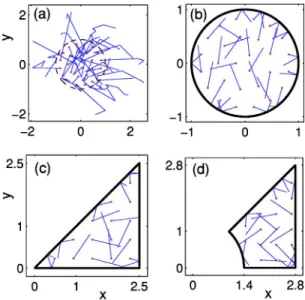
(1) In two-dimensional bulk [Fig. 2(a)] with the elastic
collision length l distributed according to the Poisson law Prob 共l兲=e−l/lm/ l
m, where lm is the mean free path. It is a
stochastic open system. This is just the system where the conventional D’yakonov-Perel’ spin relaxation has to be ob-served.
(2) In a ballistic circular quantum dot of radius 1 with the
smooth boundary in Fig. 2(b). Since the boundary is smooth, the incident and reflection angles on the boundary are the same. Since the system is ballistic, no scattering occurs in-side the dot. It is an integrable system with a high spatial symmetry.
(3) In a ballistic triangular quantum dot with the smooth
FIG. 2. (Color online) Electrons trajectories (solid lines) for short time intervals:(a) in bulk, (b) circular quantum dot, (c) trian-gular quantum dot, and(d) Sinai quantum dot.
boundary in Fig. 2(c). It is an integrable system of lower symmetry compared to the circular dot.
(4) In a generalized Sinai billiard with the smooth
bound-ary in Fig. 2(d). It is a deterministic but strongly chaotic system. The boundary geometry generates an ergodic dy-namics in the phase space.
(5) In a ballistic circular quantum dot like Fig. 2(b), but
with random reflections from the boundary. The reflection angle takes random values between −/ 2 and / 2 with re-spect to the boundary normal. It is a stochastic closed system and corresponds to a quantum dot whose boundary is not perfect in the scale of the electron Fermi wavelength.
The mean free path lmin bulk in Fig. 2(a) is set to 1. The
sizes of the triangular and Sinai dots, as shown in Figs. 2(c) and 2(d), are chosen to be
冑
2⬇2.5066 and冑
32/共16−兲⬇2.7961, such that these dots have the same areaas that of the circular dot in Fig. 2(b). We will use the dimensionless time unit, such that during the time interval 1 a particle moving with the Fermi velocity travels a distance of the length 1.B. Results of the numerical simulations
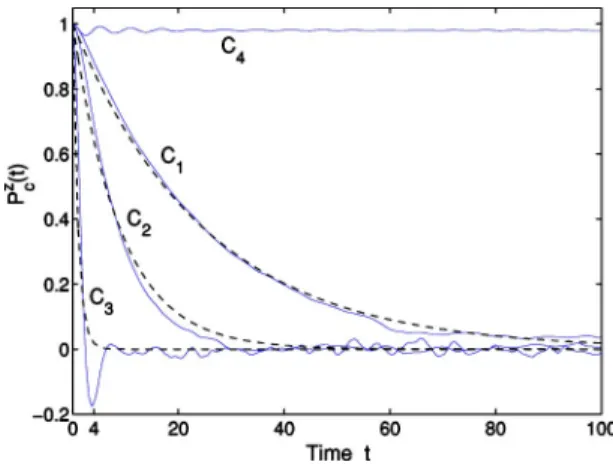
In Fig. 3 the time dependences of Pcz共t兲 for 2124 electrons in the open system [Fig. 2(a)] with Lso= 10, 6, and 2 are plotted by solid curves C1, C2, and C3. One can see that the relaxation time increases with Lso. These curves can be fitted by the well-known expression for the longitudinal DP relaxation19
PDP共t兲 = exp
冉
− 4tlmLso2
冊
, 共28兲 which is shown by the dashed curves in Fig. 3. This expres-sion was derived under the assumption of sufficiently large LsoⰇlm. For not so large Lsothe fitting is not good, as it can be seen for the curve C3 around its first drop at t = 4. In thisregime the spin rotates rather fast, so that most of the spins sz共i兲共t兲 evolve to negative values before the electrons encoun-ter their first collisions with impurities. Therefore, Pcz共t兲 can evolve to a deep negative value within a short time interval. But later on Pcz共t兲 approaches to the asymptotic value Pcz= 0
(curve C3 in Fig. 3). These results from Monte Carlo simu-lations confirm the well-known DP relaxation in unbounded systems.
If electrons are confined inside the smooth circular dot
[Fig. 2(b)], the relaxation of Pc
z共t兲 is considerably
sup-pressed, so that at large Lso the spin polarization remains close to 1 at large times, as the curve C4 in Fig. 3 demon-strates for the case of Lso= 10. At this regime, the suppression of relaxation takes place in all other quantum dots, like the circular dot with the rough boundary(curve C6), the triangu-lar dot(curve C7), and the Sinai billiard (curve C8) in Fig. 4. In all of these curves the Pcz共t兲 values fall into the range between 0.97 and 0.98 at large times up to t = 103.
On the other hand, the spin polarization evolves very fast down to 0 if Lsois smaller than the dot size. The correspond-ing time dependence of Pcz共t兲 is similar to that shown in Fig.
FIG. 5. (Color online) Time dependence of Pcz共t兲 for Lso= 2 in the smooth circular dot(curve C5), the circular dot with the rough boundary(curve C6), the triangular dot (curve C7), and the Sinai billiard(curve C8).
FIG. 3. Solid curves C1, C2, and C3represent the time depen-dent polarization Pcz共t兲 for 2124 particles in an unbounded QW with
Lso= 10, 6, 2, and the mean free path lm= 1. The particles were
initially placed inside a circular area of the radius R = 1 and polar-ized in the z direction. The dashed curves depict the DP relaxation calculated from Eq.(28). For comparison, curve C4shows Pcz共t兲 for 2124 particles confined inside a circular dot of the radius R = 1 and
Lso= 10.
FIG. 4.(Color online) Time dependence of Pc z共t兲 for L
so= 10 in the smooth circular dot(curve C5), the circular dot with the rough boundary(curve C6), the triangular dot (curve C7), and the Sinai billiard(curve C8).
3(curve C3), with a sharp drop at the beginning followed by oscillations around zero.
For an intermediate Lsothe spin relaxes according to dif-ferent scenarios, depending on the quantum dot geometry. As an example, Fig. 5 shows the function Pcz共t兲 for various dot geometries at Lso= 2. After a fast initial drop, the polarization further relaxes to 0 in the Sinai billiard(curve C8) and in the circular dot with the rough boundary(curve C6). However, in the smooth circular(curve C5) and triangular (curve C7) dots this function oscillates around a constant value at large times. It should be noted that in the former two examples the spin polarization relaxes to zero at much longer times than the DP relaxation time in the unbounded system(Fig. 3), although the mean elastic scattering length there is comparable to the dot size. The relaxation times for C6 and C8 in Fig. 5 in-crease rapidly with higher Lso. Thus, at Lso= 10 we could not detect any systematic decrease of the spin polarization in the Sinai billiard and rough circular dot, up to t = 103, which is by an order of magnitude larger than the range plotted in Fig. 4.
An interesting feature of Pcz共t兲 in the regular systems, like the triangular and smooth circular dots, is the apparent oscil-lation of the polarization. It can be seen in Figs. 4 and 5, although the oscillations in the latter figure are more pro-found for the case of the circular dot, compared to almost vanishing ripples in the triangle. These oscillations do not disappear at large times and their amplitudes increase with the strength of SOI. We cannot say much about their nature. Probably, they are associated with the role of periodic trajec-tories in regular systems. A special study is required to un-derstand the origin and characteristics of these oscillations.
At long time the spin polarizations in both regular quan-tum dots(triangle and smooth circle) in Figs. 4 and 5 oscil-late around certain nonzero residual values. These residual polarizations Pczare Lsodependent, as plotted in Fig. 6 for the circular dot.
C. Spin evolution along individual trajectories The existence of the nonzero residual polarization in regu-lar quantum dots and long spin relaxation time in chaotic
systems are fundamentally distinct from the DP spin relax-ation in the boundless QW. Such a distinction is surprising, because at first sight the spin walks on the sphere in Fig. 1(c) should be randomized by scattering of particles from dot boundaries, similar to randomization by impurity scattering in unbounded systems. However, this simple point of view is wrong, because there is an important difference between the impurity scattering and the boundary scattering. For conve-nience, let us define the scattering with a direction change smaller than / 2 as a “forward” scattering and that larger than/ 2 as a “backward” scattering. If the particles are iso-tropically scattered by an impurity, half of them continue to move “forward.” However, if the particles are scattered by a smooth boundary, the particles with incident angles between −/ 4 to / 4 with respect to the boundary normal will be reflected “backward.” Since statistically more particles hit the boundary within this range of angles, the “backward” scattering prevails in DQ’s. This property of particle scatter-ing can also be extended to QD’s with rough boundaries. Further, according to Fig. 1, a “backward” particle motion is mapped onto a “backward” spin walk. Hence, if the spin moves away from the north pole in Fig. 1, after a boundary scattering the spin is more likely bounced back toward the north pole. Such a non-Markovian statistic of the spin walks gives a clue for understanding the numerical results in Sec. III B.
In order to make this argument more clear it is instructive to study in detail the spin evolution along a single trajectory. As described in Fig. 1, the spin motion on the unit sphere can be projected onto the sxsyplane. After a long time the spin
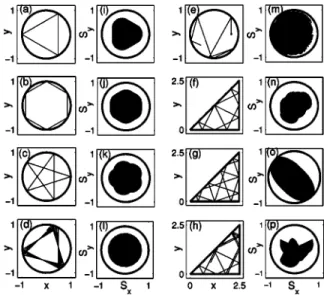
path on the sphere will cover a region and produce a certain pattern on the sxsyplane. In the circular dot this pattern looks rather ordered. If the electron moves along a triangular peri-odic trajectory[Fig. 7(a)], the pattern is a rounded triangle FIG. 7. Electron trajectories on the xy plane[(a)–(h)] and re-spective spin evolution patterns on the sxsy plane[(i)–(p)] for Lso = 5. (a), (b), and (c) periodic triangular, hexahedral, and starlike trajectories in the smooth circular dot.(d) A nonperiodic trajectory in the smooth circular dot.(e) A stochastic trajectory in the rough circular dot.(f) and (g) Two periodic trajectories in the triangular dot.(h) A nonperiodic trajectory in the triangular dot.
FIG. 6. The residual polarization Pczvs the spin rotation length
[Fig. 7(i)]. If the trajectories are hexahedral and starlike [Figs. 7(b) and 7(c)], the corresponding patterns are a
rounded hexagon and a rounded star[Figs. 7(j) and 7(k)]. If the trajectories are nonperiodic, e.g., Fig. 7(d), the pattern is a disc[Fig. 7(l)]. A common feature of these patterns is that they have the same size, which is less than 1 in the case of Lso= 5. These patterns are highly stable up to the observation time t = 104. It implies that the spin on the unit sphere cannot move far away from the north pole, so that sz共i兲共t兲 cannot take negative values. Our analysis of various trajectories with various initial conditions has confirmed this general feature of the spin evolution in the circular dot. Hence, a nonzero Pcz in Fig. 6 at infinitely long time is obviously expected.
In the triangular dot, two periodic and one nonperiodic trajectories are shown in Figs. 7(f)–7(h). The corresponding spin patterns[Figs. 7(n)–7(p)] are less symmetric and have less predictable sizes than those in the circular dot. For the trajectory in Fig. 7(g) the pattern in Fig. 7(o) touches the circular border. Nevertheless, our investigation shows that the patterns of most other trajectories are quite stable up to the observation time 104and do not touch the border. On this reason the spin polarization being averaged over trajectories is expected to relax to a positive residual value, although this value is smaller than that in the smooth circular dot.
In the circular dot with a rough boundary, the reflection angles are stochastic, as shown in Fig. 7(e). Within the ob-servation time t = 103 the corresponding spin pattern on the sxsyplane has spread out to a much larger area [Fig. 7(m)]
than those in the smooth circular dot [Figs. 7(i)–7(l)]. Fur-thermore, the pattern in Fig. 7(m) is still expanding. The corresponding spin state on the 3D sphere can penetrate into the lower hemisphere after t = 103. However, it can return back to the north sphere again. Therefore, the z component of this spin state oscillates between negative and positive values. When averaged over many trajectories, such oscilla-tions sum up to a relaxation curve, similar to C6 in Fig. 5.
In the Sinai billiard, the sxsypattern resembles that in the
rough circular dot. Consequently, the spin relaxation dynam-ics in both cases have similar characteristdynam-ics(curves C6and C8in Fig. 5).
A general trend seen from Fig. 7 is that the confinement of the particle motion in QD’s makes the spin to be also con-fined within the upper hemisphere, if Lso is larger than the size of the QD’s. For a smooth circular dot, this trend can be easily understood from the “backward” scattering effect de-scribed at the beginning of this subsection. Since all trajec-tories in this case have a simple geometry, one can easily see that particles are more frequently scattered from the bound-ary in a “backward” direction. But although this argument holds for general bounded systems, it is less evident for other QD’s besides the smooth circular dot. In a general case, the trend toward the spin confinement can be argued in a differ-ent way: As seen from Fig. 1, the projected spin path on the sxsyplane in Fig. 1(b) is more or less a rescaled curve of its
particle trajectory in Fig. 1(a). But in reality the mapping from a trajectory to the corresponding spin path is not simply a rescaling, because the spin rotations on the sphere are non-commutative. For example, a closed particle trajectory is in general mapped onto an open spin path. However, if Lso is large, the spin path is restricted to a small part of the sphere.
According to Eqs.(21) and (22), a closed particle trajectory produces an open spin path of the linear size⬃1/Lso, while the distance between the initial and the end points of the path is only ⬃1/Lso2. The mapping between the trajectories and the spin paths is then similar to a mapping between two Euclidean spaces. Therefore, with the accuracy 1 / Lso2, the spin paths are the rescaled particle trajectories and those paths are confined because the particle trajectories are con-fined. It should be noted that such a tendency for the spin confinement turns out to be strong even for not so large Lso, as one can see from the spin dynamics shown in Fig. 5 for Lso= 2.
The above argument about the spin confinement does not take into account a long time evolution. Even at large Lso, small corrections due to noncommutativity of spin walks will accumulate in time. As a result, the spin can slowly drift toward the lower hemisphere. The expanding pattern in Fig. 7(m) of the rough circular dot is an example of such a long time behavior. However, in contrast to that unstable pattern, the patterns from regular systems [Figs. 7(i)–7(p) besides 7(m)] remain stable in time. This difference between the single trajectories of random and regular systems is consis-tent with the spin relaxation curves shown in Fig. 5.
Such a distinction between regular and chaotic systems follows from fundamental properties of regular and chaotic systems. It can be understood from consideration of periodic orbits. After a particle runs along a periodic orbit␥and com-pletes a period, its initial spin statewill evolve to U␥with U␥= exp关−i⍀R兴, which represents a rotation around the axis R through the angle 2⍀. Both R and ⍀ are determined entirely by the geometry of␥ and by the value of Lso. After the particle repeats w periods, all spin positions共U␥兲w, cor-responding to the end points of all periods w = 1 , 2 , . . ., are located on a closed circle. This circle can be obtained by rotating the north pole around R, if the initialis related to the spin polarized in the north pole direction. The other points on the periodic orbit are mapped onto spin states around this circle. Taking many periodic orbits into account, one obtains a set of different axes R and consequently a set of circles passing through the north pole. Hence, when aver-aged over all periodic orbits, spin spends more time in the upper hemisphere. This means that at least the family of the periodic orbits contributes to a nonzero residual polarization. How significant is this contribution to the whole residual value depends on the amount of the periodic orbits in a sys-tem, which is quite different in regular and chaotic systems. In a regular system the family of periodic orbits has a finitely positive measure and a bundle of adjacent nearly periodic orbits. These adjacent trajectories behave like periodic orbits if the time is not too large, because their linear deviation in time from the periodic orbits is small. On the contrary, the periodic orbits in chaotic systems are of zero measure.20 Fur-thermore, their adjacent trajectories deviate from them expo-nentially fast. Therefore, with increasing time, the weight of the periodic orbits and their adjacent trajectories becomes exponentially small in chaotic systems, while it is a nonzero value in regular systems. Hence, as long as we consider only periodic orbits, the residual spin polarization has to be a positive number for regular systems and zero for chaotic sys-tems.
The individual trajectory study in a larger time scale car-ried out in this section helps us to understand some of the results in Sec. III B. However, although the indication of the nonzero residual polarization Pcz from Figs. 3–6 is strong, one might still suspect that Pcz will decay to zero within a much larger time scale, since the numerical simulations in all these figures are truncated at a finite time. This suspicion can be tested by calculating the exact spin polarization quantum mechanically, if the analytical solutions of the Schrödinger equation are available in the systems. Indeed, this exact re-sidual polarization value is nonzero in the smooth circular dot, as shown in the next section.
IV. QUANTUM MECHANICAL POLARIZATION IN THE CIRCULAR QUANTUM DOT
Due to the time reversal symmetry, the quantized energy levels En of the Hamiltonian H in Eq.(1) are, at least,
two-fold degenerate with the corresponding spinor eigenfunctions na, where a苸兵±其 is the degeneracy index. In the basis of
these states a normalized wave function 共r,t兲 can be ex-panded as
共r,t兲 =
兺
nacnana共r兲e−iEnt/ប, 共29兲
with the coefficient
cna=
冕
na†共r兲共r兲d2r. 共30兲 The expression of 共r,t兲 in Eq. (29) differs from Eq. (3) only by the degeneracy index a, which is explicitly written here for convenience of our further analysis. Taking the no-tation
na共r,t兲 = cnana共r兲e−iEnt/ប, 共31兲
andna共r兲=na共r,0兲, the z component of the quantum
me-chanical polarization in Eq.(5) can be expressed as
Pz共t兲 = 具共r,t兲兩z兩共r,t兲典=
兺
nab冕
na †共r兲 z nb共r兲d2r +兺
n⫽m,ab冕
na †共r兲zmb共r兲ei共En−Em兲t/បd2r. 共32兲
The first sum in this equation is time independent, while the second sum oscillates in time, so that its average over a sufficiently long time interval turns to zero. It is interesting to find out whether the former term coincides with the re-sidual polarization in Fig. 6. Such a coincidence is not evi-dent because the time depenevi-dent sum can give rise to large variations of Pz共t兲 after long time t. Moreover, the semiclas-sical theory employed in the previous section cannot be valid for times larger than the mean distance between energy lev-els near the Fermi energy. We can check such a coincidence at least for the simple case of a circular dot with the smooth boundary, by calculating the residual polarization
Pz=
兺
naa⬘
冕
na
† 共r兲z
na⬘共r兲d2r, 共33兲
because the analytic solution of the Schrödinger equation with the arbitrarily strong Rashba interaction is available.21 In this section only the key steps of the calculation are pre-sented, while the calculation in detail is shown in the Appen-dix.
Let us consider a circular quantum dot of radius R with the confining potential
V共兲 =
再
0 for 0艋艋 R⬁ for R⬎ , 共34兲
written as a function of the polar coordinates r = r共,兲. The eigenfunctions of the nth eigenvalue En are21
n+共r兲 =
冉
eif共兲 ei共+1兲g+1共兲冊
共35兲 and n−共r兲 =冉
e−i共+1兲g+1* 共兲 − e−if*共兲冊
, 共36兲 where the function冉
f共兲 g共兲冊
= d冉
− aJ共k+兲 + J共k−兲 a−1J共k+兲 + J共k−兲
冊
, 共37兲
contains theth order Bessel functions of the first kind J共兲, the normalization constant d, the parameters
a=J共k−兲 J共k+兲= − J+1共k−兲 J+1共k+兲, 共38兲 the wave-numbers k±=
冑
b 2+ 4 ⫿ b 2 , 共39兲and the index
= − 3/2 with = 1,2,¯ , . 共40兲
Therein, the dimensionless parameters =/ R, = 2m*ER2/ប2, and b = 2␣Rm*R /ប2 have been used. The
wave-numbers k±are quantized because the energy levels are determined by the zeros of the function
Z共兲: = J共k−兲J+1共k+兲 + J共k+兲J+1共k−兲. 共41兲 We chose the plane-wave
共r兲 =
冉
10
冊
eikr 共42兲
as the initial state. After insertingn+共r兲 from Eq. (35) and
n−共r兲 from Eq. (36) together with Eq. (31) into Eq. (33) and
averaging over directions of the vector k we obtain Pz= 2
兺
n
共兩cn+兩2−兩cn−兩2兲共Fn− Gn兲, 共43兲
Fn= d2关a 2 I共1兲− 2aI共2兲+ I共3兲兴 Gn= d2关a 2 I+1共1兲 + 2aI+1共2兲 + I+1共3兲兴, 共44兲 where the coefficients I共1兲, I共2兲, and I共3兲are presented in Eq.
(A18). The coefficients兩cn±兩2in Eq.(43) can be written as 兩cn+兩2= 42d2共− aI共4兲+ I共5兲兲2
兩cn−兩2= 42d2共aI+1共4兲 + I+1共5兲兲2, 共45兲
with the coefficients I共4兲and I共5兲given by Eq.(A21). Using the dimensionless units, one has the radius R = 1, the cou-pling constant b = 2 / Lso, and the wave-number k = 2R /, where is the electron wavelength. Hence the semiclassical range of parameters corresponds to kⰇ1.
The residual polarization calculated from Eq. (43) is shown in Fig. 8. The Pzcurves for k = 20, 30, and 40 are very close to each other and merge into the dashed curve. This curve coincides with the residual polarization obtained from the semiclassical simulations in the previous section(Fig. 6). For k = 5, 1, and 0.1, the curves are plotted in the dotted, solid, and dash-dotted curves, respectively. All the curves, as expected, have the common asymptotic value 1 in the case of the weak spin-orbit coupling Lso→⬁. In the opposite limit, Lso→0, the behavior of Pz is nonanalytic and not much
re-vealing. The strong oscillations in this limit increase with smaller wave numbers and signal about the appearance of large quantum beats in Pz共t兲. This regime of L
sois not inter-esting from the practical point of view because it implies unphysically large values of␣R for the typical dot radius R = 500 nm. In the practically important regime of Lso艌1 we note an apparent dependence of Pz on k at k艋5. This is a quantum effect which is not observed in our semiclassical simulations. In semiclassics the particle velocity determines the speed with which Pz共t兲 approaches to the residual value
Pz, but not this value itself.
V. DISCUSSION
Summarizing the above results of the semiclassical Monte Carlo simulations and quantum mechanical calculations we can draw the following picture of the spin evolution in semi-classical quantum dots. In the dots with regular semi-classical dy-namics the spin polarization does not decay to zero at long time and its residual value coincides with the quantum me-chanical spin polarization averaged over an infinitely long time interval. At least, we were able to check such a coinci-dence for the circular dot. On the other hand, in dots with chaotic or random dynamics the spin polarization relaxes to zero with the relaxation time much larger than the DP relax-ation time in unbounded quantum wells. Such a decay down to zero cannot be understood from the general quantum me-chanical expression in Eq.(32) , because it implies that the average of Pz共t兲 over an asymptotically long time interval is
zero. However, Eq.(32) predicts that this average is given by the first term in Eq.(32), which is nonzero in general. Obvi-ously, this contradiction is associated with quantum mechani-cal effects, which indicates that the semiclassimechani-cal approxima-tion is insufficient for analysis of the long time polarizaapproxima-tion evolution. Indeed, studies of electron transport in chaotic and disordered QD’s have shown that the quasiclassical method is valid only at sufficiently short times.22–25 An important crossover time is the Ehrenfest time TE. This time is
con-trolled by the Lyapunov exponent describing the divergence of close trajectories in chaotic systems. Within TE two tra-jectories initially located at a distance of the order of the de Broglie wavelength will diverge up to a distance comparable to the size of the QD. The importance of quantum effects at times larger than TE has been demonstrated for Andreev bil-liards in Refs. 22–24. Another characteristic time is given by T⌬=ប/⌬, where ⌬ is the mean distance between energy lev-els in the QD. In disordered mesoscopic systems the statis-tics of their energy spectrum together with the weak local-ization effects give rise to the so-called quantum dynamical echo at t⬎T⌬. This phenomenon was investigated for the time evolution of the electron density in a noninteracting electron system.25It was found that due to the quantum ef-fects the density profile at large time is inhomogeneous throughout the QD and preserves the memory about the ini-tial density distribution up to the dephasing time. One can expect a similar memory effect for the spin polarization. At least for an unbounded 2D gas the weak localization correc-tion to the DP relaxacorrec-tion was shown to produce a nonexpo-nential 1 / t tail in the spin polarization evolution at large times.26 This problem is outside the method of the present work and needs further study.
The predicted spin evolution can be measured experimen-tally. For an InAs dot doped up to 1011cm−2, the time unit in Figs. 3–5 is about 1 ps if the dot size is L = 0.5m. Hence, the spin polarization saturates to its residual value during first 20 ps and for Lso= 1m the difference in the long time evolution between chaotic and regular dots can be observed in the nanosecond range. In order to suppress all inelastic spin relaxation mechanisms,3–6 the measurement must be done at sufficiently low temperatures. The Rashba spin-orbit interaction can be strong in InAs based heterostructures, with Lsodown to several hundreds nm. Moreover, it can be tuned FIG. 8. (Color online) The residual spin polarization Pzvs Lso
with k = 20, 30, 40, (dashed), k=5 (dotted), k=1 (solid), and k = 0.1(dash-dotted). The dashed curve coincides with the curve from
in a wide interval by varying the gate voltage.12
In conclusion, we performed path integral semiclassical simulations of spin evolution controlled by the Rashba spin-orbit interaction in quantum dots of various shapes. Our cal-culations revealed that the spin polarization dynamics in QD’s is quite different from the D’yakonov-Perel’ spin relax-ation in bulk 2D systems. Such a distinction is not expected from the simple picture of the spin random walk, in particu-lar when the rate of electron elastic scattering on impurities in bulk is equal to the mean frequency of electron scattering from the dot boundaries. We have also found an important distinction between long time spin evolutions in classically chaotic and regular systems. In the former case the spin po-larization relaxes to zero within relaxation time much larger than the DP relaxation, while in the latter case it evolves to a time independent residual value. This value decreases with the stronger spin orbit interaction. We also analyzed the gen-eral quantum mechanical expression for the time dependent spin polarization. Using the exact solutions of the Schrödinger equation with Rashba SOI for a circular dot, we calculated the average of the spin polarization over an infi-nitely long time interval and compared the result with the residual polarization from the Monte Carlo simulations. We found that the residual values from these two approaches coincide, which confirms the results from the semiclassical simulations. On this basis, we conjecture that the nonzero residual value is a general property of regular systems. On the other hand, the spin relaxation down to zero in the Sinai billiard and circular dot with the rough boundary contradicts what has to be expected from quantum mechanics. The long time memory due to the mesoscopic spin echo is assumed to be responsible for this contradiction.
ACKNOWLEDGMENTS
This work was supported by RFBR No. 03-02-17452 and the Swedish Royal Academy of Science; A.G.M. edges the hospitality of NCTS in Taiwan. C.-H.C. acknowl-edges the hospitality of Lund University in Sweden and the Science Institute in the University of Iceland.
APPENDIX
This Appendix demonstrates a quantum mechanical cal-culation of the residual polarization Pz, as it is defined in Eq.
(33). The calculation of the exact eigenfunctions of the
Hamiltonian in Eq.(1) for the circular quantum dot can be found in Ref. 21, which is summarized in the following Eqs.
(A1)–(A5).
In order to calculate the residual polarization (33), the wave-functionna共r兲 is expanded in the basis of the
eigen-functions given by Eqs. (35) and (36). We note that for a symmetric presentation, the functions fand g have differ-ent definitions from those in Ref. 21. Inserting Eqs.(35) and
(36) into the corresponding Schrödinger equation we obtain
the equation for f and g in terms of the dimensionless parameters,, and b defined in the previous section
关䉭+兴f共兲 − b ⵜ−共+1兲g+1共兲 = 0,
关䉭+1+兴g+1共兲 − b ⵜ+ f共兲 = 0, 共A1兲 with the Laplacian
䉭= 1 d d
冉
d d冊
− 2 2 共A2兲and the nabla operator
ⵜ±= ±
冉
d d冊
−
. 共A3兲
The solutions关f共兲,g共兲兴 of these equations are
冉
f共兲 g共兲冊
= d冉
− aJ共k+兲 + J共k−兲 a−1J共k+兲 + J共k−兲
冊
, 共A4兲
with the normalization constant d, the factors agiven by Eq.
(38), and the wave-vectors k± from Eq. (39). These wave vectors obey the relations
k+k−=, k+− k−= − b,
and k++ k−=
冑
b2+ 4. 共A5兲 The quantized dimensionless energies are determined by the zeros of the function in Eq.(41) . This function stems from the determinant of the equation system in Eq.(A1) with the boundary conditions f共兲=g共兲=0 at= 1. Given a cou-pling constant b, the nth quantized value n with n= n共,兲 is determined by theth zero of Z共兲, whereand
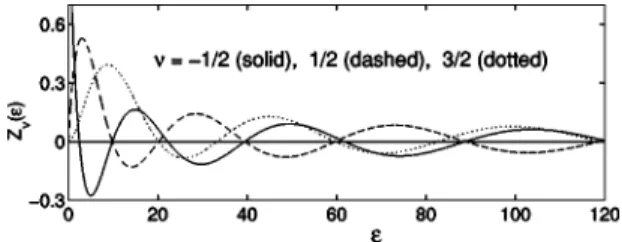
are related by Eq. (40). The allowed wave-numbers k±are given by Eq. (39) with =n. They correspond to the two degenerate eigenstates of the nth energy level. The first root of the function Z共兲 is zero for = 1 / 2 , 3 / 2 , . . ., and is a positive value for= −1 / 2 (see Fig. 9). The larger the value of b, the larger the second root of Z共兲.
Substituting the wave functions in Eqs.(35) and (36) into Eq.(33) we obtain the residual polarization in the form
Pz=
兺
n冕
0 1冕
0 2 关共兩cn+兩2−兩cn−兩2兲关f 2共 兲 − g+12 共 兲兴 + 2cn+* cn−f共兲g+1共兲e−i共2+1兲 + 2cn−* cn+f共兲g+1共兲ei共2+1兲兴 d d. 共A6兲 For the initial wave function given by Eq.(42) , the con-stants cn+can be expressed asFIG. 9. The function Z共兲 for =−1/2, 1/2, and 3/2. This function is singular at=0 for=−1/2.
cn+=
冕
冉
n+共1兲共r兲 n+共2兲共r兲冊
†冉
1 0冊
e ikrd2r =冕
n+ 共1兲*共r兲eikrd2r =冕
0 2冕
0 1 ei关k cos共−兲−兴f共兲dd, 共A7兲 where and stand for the angles of the vectors r and k with respect to the positive x axis and k =兩k兩. After the shift of the angular variable from − to the above integral transforms to cn+= e−i冕
0 2冕
0 1 ei关k cos共兲−兴f共兲dd. 共A8兲 Substituting t =+/ 2 and m = into the integral represen-tation of the Bessel function,27Jm共z兲 = 1 2
冕
− ei关z sin共t兲−mt兴dt, 共A9兲 we obtain 2ei/2J共z兲 =冕
0 2 ei关z cos共兲−兴d. 共A10兲 By using this identity, Eq.(A8) can be written ascn+= 2ei共/2−兲
冕
0 1
J共k兲f共兲d. 共A11兲 By analogy, one has
cn−= 2ei共+1兲共/2−兲
冕
0 1
J+1共k兲g+1共兲d. 共A12兲 After integrating Eq.(A6) overand the directionof k
[integration overis similar to that overkin Eq.(20) ], the
second and third terms in Eq.(A6) vanish and only the first term remains. Introducing the parameters
Fn=
冕
0 1 f2共兲d and Gn=冕
0 1 g+12 共兲d, 共A13兲the final expression for the residual polarization can be writ-ten as Pz=
兺
n 共兩cn+兩2−兩cn−兩2兲共Fn− Gn兲兺
n 共兩cn+兩 2+兩c n−兩2兲共Fn+ Gn兲 . 共A14兲For numerical calculations we explicitly wrote the norm of the normalized wave function共r,t兲 in the denominator. In this form the expression in Eq.(A14) is also valid for non-normalized wave functions, because the normalization con-stants d in the numerator and denominator are canceled with each other.
The polarization Pzin Eq.(A14) is determined by the four integrals cn±, Fn, and Gn. They can be calculated by using the
formula28
冕
0 l J共兲J共 兲d =l关J共 l兲J+1共l兲 − J共l兲J+1共 l兲兴 2−2 . 共A15兲Consequently, the integrals in Eq.(A13) can be written in the closed form Fn= d2关 a 2 I共1兲− 2aI共2兲+ I共3兲兴, 共A16兲 Gn= d2关a 2 I+1共1兲 + 2aI+1共2兲 + I+1共3兲兴, 共A17兲 with I共1兲=J共k+兲 2+ J +1共k+兲 2 2 − J共k+兲J+1共k+兲 k+ , I共2兲=k−J共k+兲J+1共k−兲 − k+J共k−兲J+1共k+兲 k−2− k+2 , I共3兲=J共k−兲 2+ J +1共k−兲2 2 − J共k−兲J+1共k−兲 k− . 共A18兲
By analogy, calculating the integrals in Eqs. (A11) and
(A12) we obtain 兩cn+兩2= 42d2共− aI共4兲+ I共5兲兲2, 共A19兲 兩cn−兩2= 42d2共a I+1共4兲 + I+1共5兲兲2, 共A20兲 with I共4兲=k+J共k兲J+1共k+兲 − kJ共k+兲J+1共k兲 k+ 2 − k2 , I共5兲=k−J共k兲J+1共k−兲 − kJ共k−兲J+1共k兲 k−2− k2 . 共A21兲
For small b the spin polarization approaches to Pz= 1, as it
must be in the absence of the spin-orbit interaction. It fol-lows from the relation k−− k+= b⬇0 in Eq. (A5), which re-sults in f共兲⬇0, according to the definition in Eq. (A4). Hence, the two quantities兩cn+兩 and Fn, which contain f共兲,
vanish in Pz. Therefore, the sums in the numerator and
de-nominator of Pz become the same, which gives rise to Pz
= 1.
For large b, we have Pz→0, which is due to the large difference between k+and k−, namely, k−− k+= bⰇ1. Accord-ing to the asymptotic behavior28
J共x兲 =
冑
2 xcos冋
x − 2冉
+ 1 2冊
册
+ O冉
1 x冊
共A22兲of the Bessel function at large x, the magnitude of the oscil-lating function J共k+兲 is much larger than J共k−兲 by the order of